

The DOI matches its Crossref record; 99 of the 99 references it cites were found in a registry or an index; 26 of the 39 sources its claims cite were checked for support.
HPV self-sampling for cervical cancer screening: a systematic review of values and preferences
Open accessAbstract
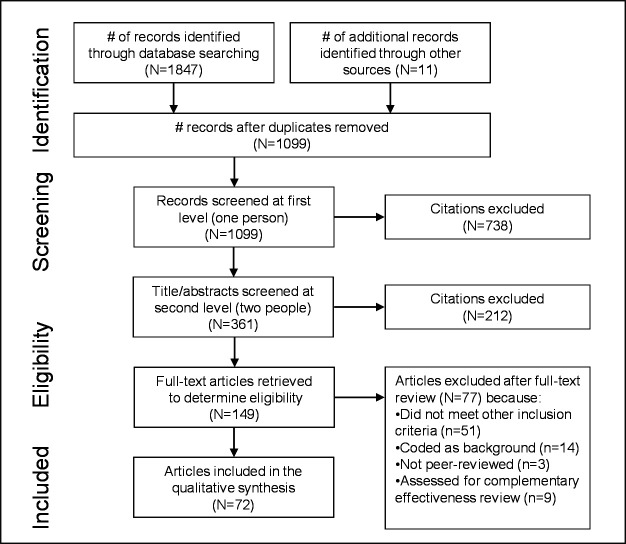
Introduction: The WHO recommends human papillomavirus (HPV) cervical self-sampling as an additional screening method and HPV DNA testing as an effective approach for the early detection of cervical cancer for women aged ≥30 years. This systematic review assesses end user’s values and preferences related to HPV self-sampling. Methods: We searched four electronic databases (PubMed, Cumulative Index to Nursing and Allied Health Literature, Latin American and Caribbean Health Sciences Literature and Embase) using search terms for HPV and self-sampling to identify articles meeting inclusion criteria. A standardised data extraction form was used to capture study setting, population, sample size and results related to values and preferences. Results: Of 1858 records retrieved, 72 studies among 52 114 participants published between 2002 and 2018 were included in this review. Almost all studies were cross-sectional surveys. Study populations included end users who were mainly adolescent girls and adult women. Ages ranged from 14 to 80 years. Most studies (57%) were conducted in high-income countries. Women generally found HPV self-sampling highly acceptable regardless of age, income or country of residence. Lack of self-confidence with collecting a reliable sample was the most commonly cited reason for preferring clinician-collected samples. Most women preferred home-based self-sampling to self-sampling at a clinic. The cervical swab was the most common and most accepted HPV DNA sampling device. Conclusions: HPV self-sampling is generally a highly accepted method of cervical cancer screening for end users globally. End user preferences for self-sampling device, method and setting can inform the development of new and expanded interventions to increase HPV screening.
Overview
AI snapshot
Written from the paper’s full text.
TL;DR
This systematic review synthesizes 72 studies among 52,114 participants on end users’ values and preferences for HPV self-sampling for cervical cancer screening. It finds HPV self-sampling is generally highly acceptable globally, with most women preferring self-sampling over clinician sampling, though confidence in sample accuracy and access to a provider remain concerns.
Key findings
- Across 72 studies among 52,114 participants published between 2002 and 2018, with ages ranging from 14 to 80 years, HPV self-sampling was generally highly acceptable regardless of age, income or country of residence; 57% of participants were from high-income countries.
- Most end users preferred self-sampling over clinician sampling, citing less pain or physical discomfort, ease of use, convenience, privacy, and less embarrassment or anxiety; lack of self-confidence in collecting a reliable sample was the most commonly cited reason for preferring clinician-collected samples.
- Most women preferred home-based self-sampling to self-sampling at a clinic; the cervical swab was the most common and most accepted HPV DNA sampling device.
- Device preference varied: in rural Gambian women, acceptability was over 70% for all methods but preference was cervical swab 97.1%, tampon 84.4%, and clinician cervical brush 72.4%; among HIV-positive South African women, 51% preferred the cervical brush, 31% the tampon, and 18% the lavage sampler. For urine self-sampling, 95% of Micronesian women were comfortable with the urine test versus 82% for Pap smear, but more preferred clinician Pap smear (44.2%) over self-sampling (38.8%).
Methods
- Systematic review conducted according to PRISMA; searched PubMed, Cumulative Index to Nursing and Allied Health Literature, Latin American and Caribbean Health Sciences Literature, and Embase through 19 October 2018, plus hand-searching and secondary searching; included qualitative and quantitative studies of cervicovaginal or urine HPV self-sampling that measured acceptability or setting preference.
- Included 72 unique studies with 52,114 participants; two reviewers independently extracted data using a standardised form, resolved differences through consensus, and stratified findings by age, location, self-sampling device, setting, and subpopulation; quality was assessed with a matrix modified from the Evidence Project risk of bias tool and CASP checklist.
Limitations
- Stated: conference abstracts and grey literature were excluded, so findings may not fully represent the literature; diversity of measures used to assess values and preferences made comparisons across studies difficult.
- Stated in quality assessment: common issues were sampling/selection bias (27 articles), lack of validation of survey measures, and lack of transferability (32 articles); only 3 of 72 studies were conducted in low-income countries.
- Evident from the text: almost all studies were cross-sectional surveys, and 57% of participants were from high-income countries, limiting generalisability to low-resource settings and causal inference.
Model-written summary. Check it against the paper before relying on it.
Integrity signals
Registry
Cites
Statistics
Figures
Verification
Claims the paper makes
32 Not checked yet · 24 Own result · 16 Supported · 16 No basis given · 8 Partly supported · 4 Sources not found · 4 Own method · 4 Own interpretation · 3 No full text of the sources · 2 Not supported · accuracy not yet measured
At least one cited source doesn’t support this claim or points to a different paper, and none confirmed it — see the verdicts below.
In the paper
“However, most participants expressed a preference for clinician sampling.”
§ HPV self-sampling for cervical cancer screening: a systematic review of values and preferences > Results > Values and preferences by end user characteristics
What the sources say
- Disputedcites [63] sourceExperimental — accuracy not yet measured
The Methods (Study Design; page unavailable) describe a nationwide online panel of lesbian and bisexual women aged 21–26, not attendees of a teen health centre. The Results (HPV Self-Testing; page unavailable) report that 44% would rather go to a doctor for screening, not most participants; 51% were willing to self-test at home. The paper did not directly measure a preference between clinician and self-sampling. (LLM, conf=0.88)
Checked by a reasoning model — may be wrong.
plain- Asserted: passes — The authors put it forward as true.
- Checkable: passes — It can be checked against evidence.
- Load-bearing: unclear — It is unclear whether the paper’s conclusions depend on it.
- Based: passes — The paper gives a reason why it holds.
- Disputed
The cited sources support only part of this claim — read each source’s verdict below.
In the paper
“and has been associated with improved participation in cervical cancer screening studies in low-income and middle-income countries.14”
§ HPV self-sampling for cervical cancer screening: a systematic review of values and preferences > Introduction
What the sources say
- Partly supportedcites [14] sourceExperimental — accuracy not yet measured
The Abstract (page not specified) reports improved screening participation with self-collected HPV testing. But it says the ten studies reviewed were in Europe and North America, so its findings do not establish improved participation in studies in low- and middle-income countries. (LLM, conf=0.91)
plaincorrelational- Asserted: passes — The authors put it forward as true.
- Checkable: passes — It can be checked against evidence.
- Load-bearing: unclear — It is unclear whether the paper’s conclusions depend on it.
- Based: passes — The paper gives a reason why it holds.
- Partly supported
The cited sources support only part of this claim — read each source’s verdict below.
In the paper
“In a study of Swedish women with CIN, 85% of participants rated self-sampling procedures (urine and cervical swab) as easy”
§ HPV self-sampling for cervical cancer screening: a systematic review of values and preferences > Results > Values and preferences related to logistical aspects of self-sampling
What the sources say
- Partly supportedcites [66] Andersson, 2018, Is self-sampling to test for high-risk papillomavirus an acceptable option among women who have been treated for high-grade cervical intraepithelial neoplasia?, PLoS One sourceExperimental — accuracy not yet measured
The Results section reports that over 85% of participants considered self-collection easy to carry out. The Methods section says participants self-collected urine and vaginal-fluid samples; cervical scrape samples were collected by clinicians, not by self-sampling. Thus the percentage is supported, but the claim's description of a self-collected cervical swab is not. (LLM, conf=0.87)
plain- Asserted: passes — The authors put it forward as true.
- Checkable: passes — It can be checked against evidence.
- Load-bearing: unclear — It is unclear whether the paper’s conclusions depend on it.
- Based: passes — The paper gives a reason why it holds.
- Partly supported
The cited sources support only part of this claim — read each source’s verdict below.
In the paper
“Despite higher ratings for urine self-sampling, more women preferred a clinician to perform a Pap smear (44.2%) over self-sampling (38.8%) because they valued the knowledge and expertise of the clinician.”
§ HPV self-sampling for cervical cancer screening: a systematic review of values and preferences > Results > Values and preferences related to logistical aspects of self-sampling
What the sources say
- Partly supportedcites [30] Sy, 2017, Acceptability and feasibility of a community based participatory research project comparing cytology and urine HPV DNA testing for cervical cancer screening in YAP, Federated states of Micronesia, Cancer Epidemiol sourceExperimental — accuracy not yet measured
The women research participant survey (Results §3.1; page not provided) reports that 44.2% preferred a doctor or nurse to perform the Pap smear, compared with 38.3% who preferred providing their own urine sample—not 38.8%. The focus group findings (Results §3.3; page not provided) link the preference for clinician collection to participants’ confidence in skilled, knowledgeable screeners. (LLM, conf=0.93)
plain- Asserted: passes — The authors put it forward as true.
- Checkable: passes — It can be checked against evidence.
- Load-bearing: unclear — It is unclear whether the paper’s conclusions depend on it.
- Based: passes — The paper gives a reason why it holds.
- Partly supported
Every source the paper cites for this claim was checked and supports it.
In the paper
“In a sample of Micronesian women, 95% of participants said they were comfortable with the urine test compared with only 82% for the Pap smear.”
§ HPV self-sampling for cervical cancer screening: a systematic review of values and preferences > Results > Values and preferences related to logistical aspects of self-sampling
What the sources say
- Supportedcites [30] Sy, 2017, Acceptability and feasibility of a community based participatory research project comparing cytology and urine HPV DNA testing for cervical cancer screening in YAP, Federated states of Micronesia, Cancer Epidemiol source
Section 3.1 (Women research participant survey) reports that all 217 participants completed surveys and that 95% felt comfortable with urine collection, compared with 82.0% for Pap smear collection. The study recruited women in Yap, Federated States of Micronesia (section 2.2). (LLM, conf=0.95)
plain- Asserted: passes — The authors put it forward as true.
- Checkable: passes — It can be checked against evidence.
- Load-bearing: unclear — It is unclear whether the paper’s conclusions depend on it.
- Based: passes — The paper gives a reason why it holds.
- Supported
Every source the paper cites for this claim was checked and supports it.
In the paper
“Among South African students aged 16–22 years, 56% preferred self-sampling (56%) over clinician sampling.”
§ HPV self-sampling for cervical cancer screening: a systematic review of values and preferences > Results > Values and preferences by end user characteristics
What the sources say
- Supportedcites [54] Mbatha, 2017, Self-Sampling for human papillomavirus testing among rural young women of KwaZulu-Natal, South Africa, BMC Res Notes source
The Abstract > Results reports that 51 of 91 respondents (56%) preferred self-sampling over sampling by a doctor. The Results identifies participants as rural high-school students aged 16–22. The main Results text gives a different count—58 of 91—for the same preference, so the paper is internally inconsistent on the percentage. (LLM, conf=0.82)
plain- Asserted: passes — The authors put it forward as true.
- Checkable: passes — It can be checked against evidence.
- Load-bearing: unclear — It is unclear whether the paper’s conclusions depend on it.
- Based: passes — The paper gives a reason why it holds.
- Supported
Every source the paper cites for this claim was checked and supports it.
In the paper
“One study surveyed a sample of HIV-positive and HIV-negative women from northern Brazil, reporting that 87% of women found cervicovaginal sampling for HPV DNA acceptable.”
§ HPV self-sampling for cervical cancer screening: a systematic review of values and preferences > Results > Values and preferences by end user characteristics
What the sources say
- Supportedcites [60] Rodrigues, 2018, Cervico-Vaginal self-collection in HIV-infected and uninfected women from Tapajós region, Amazon, Brazil: high acceptability, hrHPV diversity and risk factors, Gynecol Oncol source
The Discussion reports that 87% of women agreed to perform cervico-vaginal self-collection, which the paper calls its acceptability rate. The Methods identify the participants as HIV-infected and HIV-uninfected women in Brazil’s Tapajós region. (LLM, conf=0.93)
plain- Asserted: passes — The authors put it forward as true.
- Checkable: passes — It can be checked against evidence.
- Load-bearing: unclear — It is unclear whether the paper’s conclusions depend on it.
- Based: passes — The paper gives a reason why it holds.
- Supported
The cited sources support only part of this claim — read each source’s verdict below.
In the paper
“Other studies found that older women were more likely to prefer self-sampling over clinician sampling.”
§ HPV self-sampling for cervical cancer screening: a systematic review of values and preferences > Results > Values and preferences by end user characteristics
What the sources say
- Partly supportedcites [24] Fargnoli, 2015, To what extent will women accept HPV self-sampling for cervical cancer screening? A qualitative study conducted in Switzerland, Int J Womens Health sourceExperimental — accuracy not yet measured
The Results report a generational difference: some older women were more in favor of self-sampling than younger women, particularly after a bad experience with pelvic examinations. But the qualitative finding does not establish that older women generally preferred self-sampling over clinician sampling; the Conclusion says most participants preferred a gynecological visit. Page numbers are unavailable in our copy. (LLM, conf=0.84)
- Not checked — no full text of the sourcecites [40] Wong, 2018, Can human papillomavirus DNA self-sampling be an acceptable and reliable option for cervical cancer screening in female sex workers?, Cancer Nurs source
- Not checked — no full text of the sourcecites [42] Ilangovan, 2016, Acceptability and feasibility of human papilloma virus self-sampling for cervical cancer screening, J Womens Health source
plaincorrelational- Asserted: passes — The authors put it forward as true.
- Checkable: passes — It can be checked against evidence.
- Load-bearing: unclear — It is unclear whether the paper’s conclusions depend on it.
- Based: passes — The paper gives a reason why it holds.
- Partly supported
The cited sources support only part of this claim — read each source’s verdict below.
In the paper
“Women across all study sites preferred to conduct self-sampling in a clinic setting rather than at home so that a provider could clarify questions or do the test if needed.”
§ HPV self-sampling for cervical cancer screening: a systematic review of values and preferences > Results > Values and preferences by end user characteristics
What the sources say
- Partly supportedcites [70] sourceExperimental — accuracy not yet measured
The Results section (‘Preference of self sampling at a clinic’; page unavailable) reports that some respondents preferred the clinic because a provider could collect the sample if needed, among other reasons. The Abstract reports that most women preferred clinic-based screening, but does not establish that preference separately for every site. The Discussion attributes the specific reason that a provider could clarify questions to women in a separate Mexican study, not to participants across this paper’s study sites. (LLM, conf=0.88)
plain- Asserted: passes — The authors put it forward as true.
- Checkable: passes — It can be checked against evidence.
- Load-bearing: unclear — It is unclear whether the paper’s conclusions depend on it.
- Based: passes — The paper gives a reason why it holds.
- Partly supported
Every source the paper cites for this claim was checked and supports it.
In the paper
“In an online survey of lesbian and bisexual AGYW in the USA, 51% participants reported willingness to self-sample at home.”
§ HPV self-sampling for cervical cancer screening: a systematic review of values and preferences > Results > Values and preferences by end user characteristics
What the sources say
- Supportedcites [63] source
The Methods (Study Design) describe an online US survey of lesbian and bisexual women aged 21–26. The Results (HPV Self-Testing) report that 51% (212/418) were willing to use an HPV self-test at home. (LLM, conf=0.94)
plain- Asserted: passes — The authors put it forward as true.
- Checkable: passes — It can be checked against evidence.
- Load-bearing: unclear — It is unclear whether the paper’s conclusions depend on it.
- Based: passes — The paper gives a reason why it holds.
- Supported
- It may state two separate claims as one. 32
- Probably not a substantial claim. 28
At least one cited source doesn’t support this claim or points to a different paper, and none confirmed it — see the verdicts below.
In the paper
“Among AGYW attending a teen health centre in the USA, acceptability for both self-sampling and clinician sampling was high.”
§ HPV self-sampling for cervical cancer screening: a systematic review of values and preferences > Results > Values and preferences by end user characteristics
What the sources say
- Disputedcites [63] sourceExperimental — accuracy not yet measured
Methods (Study Design; page unavailable) says participants were lesbian and bisexual women aged 21–26 recruited through an online LGBT panel, not attendees of a teen health centre. Results (HPV Self-Testing; page unavailable) reports 51% willing to use an HPV self-test at home, rather than high acceptability for both self- and clinician sampling; clinician-sampling acceptability was not measured. (LLM, conf=0.88)
Checked by a reasoning model — may be wrong.
plain- Asserted: passes — The authors put it forward as true.
- Checkable: passes — It can be checked against evidence.
- Load-bearing: unclear — It is unclear whether the paper’s conclusions depend on it.
- Based: passes — The paper gives a reason why it holds.
It may state two separate claims as one.
- Disputed
The cited sources support only part of this claim — read each source’s verdict below.
In the paper
“HPV DNA testing is recommended by WHO, the US Preventive Services Task Force and Australian, US and European national screening programme guidelines as an effective approach for the early detection of cervical cancer for women ≥30 years.7–9”
§ HPV self-sampling for cervical cancer screening: a systematic review of values and preferences > Introduction
What the sources say
- Not matchedcites [7] World Health Organization . Guidelines for screening and treatment of precancerous lesions for cervical cancer prevention, 2013. Available: https://www.who.int/reproductivehealth/publications/cancers/screening_and_treatment_of_precancerous_lesions/en/
Couldn’t be matched to a paper in Crossref, so it can’t be checked.
- Partly supportedcites [8] sourceExperimental — accuracy not yet measured
Split into 2 atoms — 0 confirmed, 2 partially supported, 0 disputed, 0 misattributed, 0 unverifiable. Expand the claim to see per-atom verdicts.
- Not checked — no full text of the sourcecites [9] Moyer, 2012, Screening for cervical cancer: U.S. preventive services Task force recommendation statement, Ann Intern Med source
plaindirect- Asserted: passes — The authors put it forward as true.
- Checkable: passes — It can be checked against evidence.
- Load-bearing: fails — The paper’s conclusions may not depend on it.
- Based: passes — The paper gives a reason why it holds.
Probably not a substantial claim. The paper’s conclusions may not depend on it.
- Not matched
Every source the paper cites for this claim was checked and supports it.
In the paper
“We conducted this systematic review in accordance with the Preferred Reporting Items for Systematic Reviews and Meta-Analyses guidelines.21”
§ HPV self-sampling for cervical cancer screening: a systematic review of values and preferences > Methods
What the sources say
- Supportedcites [21] source
The Introduction identifies this paper as presenting the PRISMA guidelines for systematic reviews and meta-analyses. The citation identifies the guidelines the citing authors say they used; it is not evidence about their own conduct. (LLM, conf=0.92)
plain- Asserted: passes — The authors put it forward as true.
- Checkable: passes — It can be checked against evidence.
- Load-bearing: fails — The paper’s conclusions may not depend on it.
- Based: passes — The paper gives a reason why it holds.
Probably not a substantial claim. The paper’s conclusions may not depend on it.
- Supported
Every source the paper cites for this claim was checked and supports it.
In the paper
“A coding matrix was modified from the Evidence Project risk of bias tool23 and the Critical Appraisal Skills Program checklist for qualitative studies to facilitate data extraction related to quality assessment.”
§ HPV self-sampling for cervical cancer screening: a systematic review of values and preferences > Methods > Data extraction and analysis
What the sources say
- Supportedcites [23] source
The citation identifies the Evidence Project risk of bias tool as one source used to adapt the citing authors’ coding matrix; it does not attribute the matrix or the qualitative checklist to this paper. The Methods section describes the tool’s development, and the Discussion says its items are used in data extraction and can be adapted for individual reviews. Page numbers are not available in the supplied copy. (LLM, conf=0.93)
plain- Asserted: passes — The authors put it forward as true.
- Checkable: passes — It can be checked against evidence.
- Load-bearing: fails — The paper’s conclusions may not depend on it.
- Based: passes — The paper gives a reason why it holds.
Probably not a substantial claim. The paper’s conclusions may not depend on it.
- Supported
Every source the paper cites for this claim was checked and supports it.
In the paper
“A qualitative study of women in Switzerland found that younger women were used to visiting a gynaecologist and did not see the necessity of changing this practice”
§ HPV self-sampling for cervical cancer screening: a systematic review of values and preferences > Results > Values and preferences by end user characteristics
What the sources say
- Supportedcites [24] Fargnoli, 2015, To what extent will women accept HPV self-sampling for cervical cancer screening? A qualitative study conducted in Switzerland, Int J Womens Health source
The Results section directly reports a generational difference: younger women were accustomed to visiting a gynecologist and did not see a need to change that practice. (LLM, conf=0.95)
plain- Asserted: passes — The authors put it forward as true.
- Checkable: passes — It can be checked against evidence.
- Load-bearing: unclear — It is unclear whether the paper’s conclusions depend on it.
- Based: passes — The paper gives a reason why it holds.
It may state two separate claims as one.
- Supported
The cited sources support only part of this claim — read each source’s verdict below.
In the paper
“The study found that women in rural Uttar Pradesh (93.1%), Hyderabad (95.5%), Uganda (64.5%) and Nicaragua (50.0%) preferred self-sampling over clinician sampling.”
§ HPV self-sampling for cervical cancer screening: a systematic review of values and preferences > Results > Values and preferences by end user characteristics
What the sources say
- Partly supportedcites [70] sourceExperimental — accuracy not yet measured
Table 2 in Results > Ease and preference of self-sampling reports the four self-sampling percentages exactly as quoted. But in Nicaragua, 50.0% preferred self-collection and 50.0% preferred provider collection, so women there did not prefer self-sampling over clinician sampling. (LLM, conf=0.91)
plain- Asserted: passes — The authors put it forward as true.
- Checkable: passes — It can be checked against evidence.
- Load-bearing: unclear — It is unclear whether the paper’s conclusions depend on it.
- Based: passes — The paper gives a reason why it holds.
It may state two separate claims as one.
- Partly supported
Every source the paper cites for this claim was checked and supports it.
In the paper
“while some older women, less used to regular gynaecological appointments, were more in favour of self-sampling, especially if they previously had had a negative experience with pelvic examinations.”
§ HPV self-sampling for cervical cancer screening: a systematic review of values and preferences > Results > Values and preferences by end user characteristics
What the sources say
- Supportedcites [24] Fargnoli, 2015, To what extent will women accept HPV self-sampling for cervical cancer screening? A qualitative study conducted in Switzerland, Int J Womens Health source
The Results section states this comparison directly: some older women who were less used to regular gynecological appointments favored self-HPV, especially after a bad experience with pelvic examinations. The claim is a faithful paraphrase. (LLM, conf=0.95)
plaincorrelational- Asserted: passes — The authors put it forward as true.
- Checkable: passes — It can be checked against evidence.
- Load-bearing: unclear — It is unclear whether the paper’s conclusions depend on it.
- Based: passes — The paper gives a reason why it holds.
It may state two separate claims as one.
- Supported
Every source the paper cites for this claim was checked and supports it.
In the paper
“More than half of surveyed respondents in each site reported self-sampling as ‘easy’ with the lowest percentage in Hyderabad (53.6%) and the highest percentage in Uganda (89.7%).”
§ HPV self-sampling for cervical cancer screening: a systematic review of values and preferences > Results > Values and preferences by end user characteristics
What the sources say
- Supportedcites [70] source
Table 2 in Results > Ease and preference of self-sampling reports that more than half of respondents at each site rated taking a self-collected vaginal sample as easy. Hyderabad was lowest at 53.6% and Uganda highest at 89.7%. These percentages are among surveyed women who provided a self-collected sample. (LLM, conf=0.95)
plain- Asserted: passes — The authors put it forward as true.
- Checkable: passes — It can be checked against evidence.
- Load-bearing: unclear — It is unclear whether the paper’s conclusions depend on it.
- Based: passes — The paper gives a reason why it holds.
It may state two separate claims as one.
- Supported
Every source the paper cites for this claim was checked and supports it.
In the paper
“Willingness increased with age and concern about getting an HPV-related disease.”
§ HPV self-sampling for cervical cancer screening: a systematic review of values and preferences > Results > Values and preferences by end user characteristics
What the sources say
- Supportedcites [63] source
The Results (HPV Self-Testing) report that, among lesbian and bisexual women aged 21–26, willingness to use an HPV self-test at home was higher with age and with greater worry about getting an HPV-related disease. The study measured willingness, not actual self-testing. (LLM, conf=0.94)
plaindirect- Asserted: passes — The authors put it forward as true.
- Checkable: passes — It can be checked against evidence.
- Load-bearing: unclear — It is unclear whether the paper’s conclusions depend on it.
- Based: passes — The paper gives a reason why it holds.
It may state two separate claims as one.
- Supported
Every source the paper cites for this claim was checked and supports it.
In the paper
“HIV-positive rural women preferred the cervical brush over other sampling devices, whereas urban women preferred the tampon over other devices.”
§ HPV self-sampling for cervical cancer screening: a systematic review of values and preferences > Results > Values and preferences by end user characteristics
What the sources say
- Supportedcites [51] Mahomed, 2014, Human papillomavirus (HPV) testing on self-collected specimens: perceptions among HIV positive women attending rural and urban clinics in South Africa, Pan Afr Med J source
The Results (Table 2) show that the cervical brush was the most-preferred device among rural participants (77%), while the tampon-like plastic wand was the most-preferred among urban participants (45%). The Discussion explicitly summarizes the same rural–urban difference. (LLM, conf=0.94)
plaincorrelational- Asserted: passes — The authors put it forward as true.
- Checkable: passes — It can be checked against evidence.
- Load-bearing: unclear — It is unclear whether the paper’s conclusions depend on it.
- Based: passes — The paper gives a reason why it holds.
It may state two separate claims as one.
- Supported
Every source the paper cites for this claim was checked and supports it.
In the paper
“HPV DNA self-sampling is a promising screening method that, when offered to women in low-resource settings, can address barriers that create inequalities in access to cervical cancer screening.”
§ HPV self-sampling for cervical cancer screening: a systematic review of values and preferences > Discussion
What the sources say
- Supportedcites [97] Defo VF , JFJAjoe D . Why consider self-sampling for cervical cancer screening in Low-and middle-income countries? 2020;22:116–25. source
The Introduction describes HPV self-sampling as a screening technique with the potential to overcome barriers to accessing cytology in low- and middle-income countries. It says self-sampling might reduce inequalities in access to cervical screening, matching the claim's qualified wording. (LLM, conf=0.94)
plainconditional- Asserted: passes — The authors put it forward as true.
- Checkable: passes — It can be checked against evidence.
- Load-bearing: unclear — It is unclear whether the paper’s conclusions depend on it.
- Based: passes — The paper gives a reason why it holds.
It may state two separate claims as one.
- Supported
Every source the paper cites for this claim was checked and supports it.
In the paper
“Screening with high uptake will expedite reductions and will be necessary to eliminate cervical cancer in countries with the highest burden.”
§ HPV self-sampling for cervical cancer screening: a systematic review of values and preferences > Conclusion
What the sources say
- Supportedcites [98] Brisson, 2020, Impact of HPV vaccination and cervical screening on cervical cancer elimination: a comparative modelling analysis in 78 low-income and lower-middle-income countries, The Lancet source
The Abstract’s Interpretation states the claim directly. The Discussion also says that high screening uptake, alongside HPV vaccination, is necessary to achieve elimination across all LMICs, particularly those with the highest burden. (LLM, conf=0.95)
plaindirect- Asserted: passes — The authors put it forward as true.
- Checkable: passes — It can be checked against evidence.
- Load-bearing: passes — The paper’s conclusions depend on it.
- Based: passes — The paper gives a reason why it holds.
It may state two separate claims as one.
- Supported
A result the paper reports from its own data — it cites no other source for it, so there is none to check. The quote shows it is in the paper.
In the paper
“The 72 studies included a total of 52 114 participants”
§ HPV self-sampling for cervical cancer screening: a systematic review of values and preferences > Results > Characteristics of included studies
plainn = 52,114- Asserted: passes — The authors put it forward as true.
- Checkable: passes — It can be checked against evidence.
- Load-bearing: fails — The paper’s conclusions may not depend on it.
- Based: passes — The paper gives a reason why it holds.
Probably not a substantial claim. The paper’s conclusions may not depend on it.
A result the paper reports from its own data — it cites no other source for it, so there is none to check. The quote shows it is in the paper.
In the paper
“Of the included participants, 57% were from high-income countries.”
§ HPV self-sampling for cervical cancer screening: a systematic review of values and preferences > Results > Characteristics of included studies
plainn = 114- Asserted: passes — The authors put it forward as true.
- Checkable: passes — It can be checked against evidence.
- Load-bearing: fails — The paper’s conclusions may not depend on it.
- Based: passes — The paper gives a reason why it holds.
Probably not a substantial claim. The paper’s conclusions may not depend on it.
A result the paper reports from its own data — it cites no other source for it, so there is none to check. The quote shows it is in the paper.
In the paper
“Studies were conducted in a variety of countries, including all WHO regions and all World Bank country income classification categories (high, middle and low income).”
§ HPV self-sampling for cervical cancer screening: a systematic review of values and preferences > Results > Characteristics of included studies
plain- Asserted: passes — The authors put it forward as true.
- Checkable: passes — It can be checked against evidence.
- Load-bearing: fails — The paper’s conclusions may not depend on it.
- Based: passes — The paper gives a reason why it holds.
Probably not a substantial claim. The paper’s conclusions may not depend on it. It may state two separate claims as one.
The paper states this without a source or data behind it here, so there is nothing to check it against. The quote shows it is in the paper.
In the paper
“Participants ranged in age from 14 to 80 years.”
§ HPV self-sampling for cervical cancer screening: a systematic review of values and preferences > Results > Characteristics of included studies
plain- Asserted: passes — The authors put it forward as true.
- Checkable: passes — It can be checked against evidence.
- Load-bearing: fails — The paper’s conclusions may not depend on it.
- Based: passes — The paper gives a reason why it holds.
Probably not a substantial claim. The paper’s conclusions may not depend on it.
A result the paper reports from its own data — it cites no other source for it, so there is none to check. The quote shows it is in the paper.
In the paper
“Common issues with study quality were sampling/selection bias, lack of validation of survey measures and lack of transferability of values and preferences results.”
§ HPV self-sampling for cervical cancer screening: a systematic review of values and preferences > Results > Characteristics of included studies
plain- Asserted: passes — The authors put it forward as true.
- Checkable: passes — It can be checked against evidence.
- Load-bearing: unclear — It is unclear whether the paper’s conclusions depend on it.
- Based: passes — The paper gives a reason why it holds.
It may state two separate claims as one.
A result the paper reports from its own data — it cites no other source for it, so there is none to check. The quote shows it is in the paper.
In the paper
“Other study quality concerns identified in this review included: no consideration of study limitations, preference bias due to patient–physician interaction, recall bias, social desirability bias, low response rate and high loss to follow-up.”
§ HPV self-sampling for cervical cancer screening: a systematic review of values and preferences > Results > Characteristics of included studies
plain- Asserted: passes — The authors put it forward as true.
- Checkable: passes — It can be checked against evidence.
- Load-bearing: unclear — It is unclear whether the paper’s conclusions depend on it.
- Based: passes — The paper gives a reason why it holds.
It may state two separate claims as one.
A result the paper reports from its own data — it cites no other source for it, so there is none to check. The quote shows it is in the paper.
In the paper
“Study populations typically included adult end users.”
§ HPV self-sampling for cervical cancer screening: a systematic review of values and preferences > Results > Characteristics of included studies
plain- Asserted: passes — The authors put it forward as true.
- Checkable: passes — It can be checked against evidence.
- Load-bearing: fails — The paper’s conclusions may not depend on it.
- Based: passes — The paper gives a reason why it holds.
Probably not a substantial claim. The paper’s conclusions may not depend on it.
None of the sources cited for this claim have been checked yet.
In the paper
“Five studies employed a multimethod or mixed methods design.47 67–70”
§ HPV self-sampling for cervical cancer screening: a systematic review of values and preferences > Results > Characteristics of included studies
plain- Asserted: passes — The authors put it forward as true.
- Checkable: passes — It can be checked against evidence.
- Load-bearing: fails — The paper’s conclusions may not depend on it.
- Based: passes — The paper gives a reason why it holds.
Probably not a substantial claim. The paper’s conclusions may not depend on it.
A result the paper reports from its own data — it cites no other source for it, so there is none to check. The quote shows it is in the paper.
In the paper
“Six qualitative studies asked about hypothetical acceptability of HPV self-sampling.”
§ HPV self-sampling for cervical cancer screening: a systematic review of values and preferences > Results > Characteristics of included studies
plain- Asserted: passes — The authors put it forward as true.
- Checkable: passes — It can be checked against evidence.
- Load-bearing: fails — The paper’s conclusions may not depend on it.
- Based: passes — The paper gives a reason why it holds.
Probably not a substantial claim. The paper’s conclusions may not depend on it.
A result the paper reports from its own data — it cites no other source for it, so there is none to check. The quote shows it is in the paper.
In the paper
“Articles were published between 2002 and 2018, with 50% published since 2015.”
§ HPV self-sampling for cervical cancer screening: a systematic review of values and preferences > Results > Characteristics of included studies
plain- Asserted: passes — The authors put it forward as true.
- Checkable: passes — It can be checked against evidence.
- Load-bearing: fails — The paper’s conclusions may not depend on it.
- Based: passes — The paper gives a reason why it holds.
Probably not a substantial claim. The paper’s conclusions may not depend on it. It may state two separate claims as one.
A result the paper reports from its own data — it cites no other source for it, so there is none to check. The quote shows it is in the paper.
In the paper
“sample sizes for individual studies ranged from 17 to 9484”
§ HPV self-sampling for cervical cancer screening: a systematic review of values and preferences > Results > Characteristics of included studies
plain- Asserted: passes — The authors put it forward as true.
- Checkable: passes — It can be checked against evidence.
- Load-bearing: fails — The paper’s conclusions may not depend on it.
- Based: passes — The paper gives a reason why it holds.
Probably not a substantial claim. The paper’s conclusions may not depend on it.
A result the paper reports from its own data — it cites no other source for it, so there is none to check. The quote shows it is in the paper.
In the paper
“One study assessed test–retest reliability and content validity of acceptability measures,64 but psychometric properties of acceptability were not conducted consistently across studies.”
§ HPV self-sampling for cervical cancer screening: a systematic review of values and preferences > Results > Characteristics of included studies
plain- Asserted: passes — The authors put it forward as true.
- Checkable: passes — It can be checked against evidence.
- Load-bearing: unclear — It is unclear whether the paper’s conclusions depend on it.
- Based: passes — The paper gives a reason why it holds.
It may state two separate claims as one.
None of the sources cited for this claim have been checked yet.
In the paper
“End users generally found HPV self-sampling acceptable and/or expressed willingness to undergo future HPV testing using self-sampling.24 26 27 30 32 34 36–39 41 42 44 46 47 50 53 54 56 58 60–63 66–69 71 73 74 79–85 87–93 95”
§ HPV self-sampling for cervical cancer screening: a systematic review of values and preferences > Results > Values and preferences related to logistical aspects of self-sampling
plain- Asserted: passes — The authors put it forward as true.
- Checkable: passes — It can be checked against evidence.
- Load-bearing: passes — The paper’s conclusions depend on it.
- Based: passes — The paper gives a reason why it holds.
It may state two separate claims as one.
A result the paper reports from its own data — it cites no other source for it, so there is none to check. The quote shows it is in the paper.
In the paper
“A total of 58 studies employed a quantitative approach: 47 cross-sectional studies,41–46 48 50–63 65 66 71–94 two pre–post surveys,64 95 eight RCTs33–40 and one prospective cohort.49”
§ HPV self-sampling for cervical cancer screening: a systematic review of values and preferences > Results > Characteristics of included studies
plain- Asserted: passes — The authors put it forward as true.
- Checkable: passes — It can be checked against evidence.
- Load-bearing: unclear — It is unclear whether the paper’s conclusions depend on it.
- Based: passes — The paper gives a reason why it holds.
It may state two separate claims as one.
A result the paper reports from its own data — it cites no other source for it, so there is none to check. The quote shows it is in the paper.
In the paper
“Almost all studies were cross-sectional surveys, though some study designs included in-depth interviews and/or focus group discussions.24–32”
§ HPV self-sampling for cervical cancer screening: a systematic review of values and preferences > Results > Characteristics of included studies
plain- Asserted: passes — The authors put it forward as true.
- Checkable: passes — It can be checked against evidence.
- Load-bearing: fails — The paper’s conclusions may not depend on it.
- Based: passes — The paper gives a reason why it holds.
Probably not a substantial claim. The paper’s conclusions may not depend on it. It may state two separate claims as one.
A result the paper reports from its own data — it cites no other source for it, so there is none to check. The quote shows it is in the paper.
In the paper
“Most (n=67) quantitative studies focused on end users in high-income countries, while only 15 quantitative studies were conducted in low-income or lower middle-income countries.”
§ HPV self-sampling for cervical cancer screening: a systematic review of values and preferences > Results > Characteristics of included studies
plainn = 67- Asserted: passes — The authors put it forward as true.
- Checkable: passes — It can be checked against evidence.
- Load-bearing: unclear — It is unclear whether the paper’s conclusions depend on it.
- Based: passes — The paper gives a reason why it holds.
It may state two separate claims as one.
None of the sources cited for this claim have been checked yet.
In the paper
“Two qualitative studies examined cervicovaginal self-sampling device preferences,26 28 two examined urine self-sampling30 66 and one examined self-sampling with a labial padette.29”
§ HPV self-sampling for cervical cancer screening: a systematic review of values and preferences > Results > Characteristics of included studies
plain- Asserted: passes — The authors put it forward as true.
- Checkable: passes — It can be checked against evidence.
- Load-bearing: fails — The paper’s conclusions may not depend on it.
- Based: passes — The paper gives a reason why it holds.
Probably not a substantial claim. The paper’s conclusions may not depend on it. It may state two separate claims as one.
A result the paper reports from its own data — it cites no other source for it, so there is none to check. The quote shows it is in the paper.
In the paper
“Of the nine qualitative studies, seven were conducted in high-income countries in Europe and North America24–29 31”
§ HPV self-sampling for cervical cancer screening: a systematic review of values and preferences > Results > Characteristics of included studies
plain- Asserted: passes — The authors put it forward as true.
- Checkable: passes — It can be checked against evidence.
- Load-bearing: fails — The paper’s conclusions may not depend on it.
- Based: passes — The paper gives a reason why it holds.
Probably not a substantial claim. The paper’s conclusions may not depend on it.
None of the sources cited for this claim have been checked yet.
In the paper
“Reasons for preferring clinic-based testing were lack of confidence in ability to self-sample57 and ability to receive treatment if needed.70”
§ HPV self-sampling for cervical cancer screening: a systematic review of values and preferences > Results > Values and preferences related to logistical aspects of self-sampling
plaindirect- Asserted: passes — The authors put it forward as true.
- Checkable: passes — It can be checked against evidence.
- Load-bearing: unclear — It is unclear whether the paper’s conclusions depend on it.
- Based: passes — The paper gives a reason why it holds.
It may state two separate claims as one.
The paper states this without a source or data behind it here, so there is nothing to check it against. The quote shows it is in the paper.
In the paper
“Preferences related to self-sampling including sampling device (eg, swab, brush and tampon), method (eg, cervicovaginal and urine), setting (eg, home, clinic and community-based site) varied by region, subpopulation and age, though most end users found the process of self-sampling acceptable overall.”
§ HPV self-sampling for cervical cancer screening: a systematic review of values and preferences > What are the new findings?
plaincorrelational- Asserted: passes — The authors put it forward as true.
- Checkable: passes — It can be checked against evidence.
- Load-bearing: passes — The paper’s conclusions depend on it.
- Based: passes — The paper gives a reason why it holds.
It may state two separate claims as one.
None of the sources cited for this claim have been checked yet.
In the paper
“In addition, clear, step-by-step instructions with illustrations in the appropriate language were suggested as methods to facilitate self-sampling and improve end users’ confidence.62 68 79 81”
§ HPV self-sampling for cervical cancer screening: a systematic review of values and preferences > Results > Values and preferences related to logistical aspects of self-sampling
hedgeddirect- Asserted: passes — The authors put it forward as true.
- Checkable: passes — It can be checked against evidence.
- Load-bearing: fails — The paper’s conclusions may not depend on it.
- Based: passes — The paper gives a reason why it holds.
Probably not a substantial claim. The paper’s conclusions may not depend on it.
The paper states this without a source or data behind it here, so there is nothing to check it against. The quote shows it is in the paper.
In the paper
“Self-sampled specimens are seen as acceptable in terms of ease of use, convenience, privacy, and physical and emotional comfort (including decreased embarrassment, anxiety, and pain).”
§ HPV self-sampling for cervical cancer screening: a systematic review of values and preferences > What are the new findings?
plain- Asserted: passes — The authors put it forward as true.
- Checkable: passes — It can be checked against evidence.
- Load-bearing: passes — The paper’s conclusions depend on it.
- Based: passes — The paper gives a reason why it holds.
It may state two separate claims as one.
The paper states this without a source or data behind it here, so there is nothing to check it against. The quote shows it is in the paper.
In the paper
“In high-income countries, samples collected at home were usually sent for processing using the postal service, whereas in some low-income and middle-income countries, self-sampled specimens were collected by community health workers conducting home visits for processing from the homes of participants rather than mail.”
§ HPV self-sampling for cervical cancer screening: a systematic review of values and preferences > Results > Values and preferences related to logistical aspects of self-sampling
plaincorrelational- Asserted: passes — The authors put it forward as true.
- Checkable: passes — It can be checked against evidence.
- Load-bearing: unclear — It is unclear whether the paper’s conclusions depend on it.
- Based: passes — The paper gives a reason why it holds.
It may state two separate claims as one.
The paper states this without a source or data behind it here, so there is nothing to check it against. The quote shows it is in the paper.
In the paper
“The cervical swab was by far the most common and well accepted.”
§ HPV self-sampling for cervical cancer screening: a systematic review of values and preferences > Results > Values and preferences related to logistical aspects of self-sampling
boosted- Asserted: passes — The authors put it forward as true.
- Checkable: passes — It can be checked against evidence.
- Load-bearing: unclear — It is unclear whether the paper’s conclusions depend on it.
- Based: passes — The paper gives a reason why it holds.
It may state two separate claims as one.
None of the sources cited for this claim have been checked yet.
In the paper
“Most women found the labial padette to be an acceptable form of self-sampling and was preferred over clinician sampling using a cervical brush though some women were concerned about reliability of the self-sampled specimens.29”
§ HPV self-sampling for cervical cancer screening: a systematic review of values and preferences > Results > Values and preferences related to logistical aspects of self-sampling
plain- Asserted: passes — The authors put it forward as true.
- Checkable: passes — It can be checked against evidence.
- Load-bearing: unclear — It is unclear whether the paper’s conclusions depend on it.
- Based: passes — The paper gives a reason why it holds.
It may state two separate claims as one.
None of the sources cited for this claim have been checked yet.
In the paper
“Several studies assessed women’s preferences for different self-sampling devices and acceptability was generally high for all devices.26 28 32–34 49–51 54 67 80 89”
§ HPV self-sampling for cervical cancer screening: a systematic review of values and preferences > Results > Values and preferences related to logistical aspects of self-sampling
plain- Asserted: passes — The authors put it forward as true.
- Checkable: passes — It can be checked against evidence.
- Load-bearing: unclear — It is unclear whether the paper’s conclusions depend on it.
- Based: passes — The paper gives a reason why it holds.
It may state two separate claims as one.
None of the sources cited for this claim have been checked yet.
In the paper
“a sample of HIV-positive South African women rated the highest preference for the cervical brush (51%), while fewer women preferred the tampon (31%) or lavage sampler (18%).51”
§ HPV self-sampling for cervical cancer screening: a systematic review of values and preferences > Results > Values and preferences related to logistical aspects of self-sampling
plain- Asserted: passes — The authors put it forward as true.
- Checkable: passes — It can be checked against evidence.
- Load-bearing: unclear — It is unclear whether the paper’s conclusions depend on it.
- Based: passes — The paper gives a reason why it holds.
It may state two separate claims as one.
None of the sources cited for this claim have been checked yet.
In the paper
“Other devices tested included the lavage,74 81 85 cervical brush,42–44 48 52 53 55 60 69 70 72 79 82 84 86–88 92 94 95 tampon32 34 49–51 and labial padette.29”
§ HPV self-sampling for cervical cancer screening: a systematic review of values and preferences > Results > Values and preferences related to logistical aspects of self-sampling
plain- Asserted: passes — The authors put it forward as true.
- Checkable: passes — It can be checked against evidence.
- Load-bearing: fails — The paper’s conclusions may not depend on it.
- Based: passes — The paper gives a reason why it holds.
Probably not a substantial claim. The paper’s conclusions may not depend on it.
A result the paper reports from its own data — it cites no other source for it, so there is none to check. The quote shows it is in the paper.
In the paper
“Only 3 of the 72 studies included in this review were conducted in low-income countries, leaving a critical gap in understanding of end users’ preferences in these settings.”
§ HPV self-sampling for cervical cancer screening: a systematic review of values and preferences > Discussion
plain- Asserted: passes — The authors put it forward as true.
- Checkable: passes — It can be checked against evidence.
- Load-bearing: passes — The paper’s conclusions depend on it.
- Based: passes — The paper gives a reason why it holds.
It may state two separate claims as one.
The paper states this without a source or data behind it here, so there is nothing to check it against. The quote shows it is in the paper.
In the paper
“In some low-income and middle-income countries, community health workers collected specimens self-sampled by participants for processing during home-visits.”
§ HPV self-sampling for cervical cancer screening: a systematic review of values and preferences > Discussion
plain- Asserted: passes — The authors put it forward as true.
- Checkable: passes — It can be checked against evidence.
- Load-bearing: fails — The paper’s conclusions may not depend on it.
- Based: passes — The paper gives a reason why it holds.
Probably not a substantial claim. The paper’s conclusions may not depend on it.
The paper states this without a source or data behind it here, so there is nothing to check it against. The quote shows it is in the paper.
In the paper
“HPV self-sampling is generally a highly accepted method of cervical cancer screening for women across the world.”
§ HPV self-sampling for cervical cancer screening: a systematic review of values and preferences > Conclusion
plain- Asserted: passes — The authors put it forward as true.
- Checkable: passes — It can be checked against evidence.
- Load-bearing: passes — The paper’s conclusions depend on it.
- Based: fails — The paper may give no reason why it holds.
Probably not a substantial claim. The paper may give no reason why it holds.
In the paper
“Typically, per current recommendations, cervicovaginal samples for HPV DNA testing are collected by a clinician during a pelvic examination.8 9”
§ HPV self-sampling for cervical cancer screening: a systematic review of values and preferences > Introduction
What the sources say
- Not matchedcites 8 9
Couldn’t be matched to a paper in Crossref, so it can’t be checked.
plain- Asserted: passes — The authors put it forward as true.
- Checkable: passes — It can be checked against evidence.
- Load-bearing: passes — The paper’s conclusions depend on it.
- Based: passes — The paper gives a reason why it holds.
Probably not a substantial claim.
- Not matched
In the paper
“In addition, in areas with high endemic HIV, WHO recommends that sexually active girls and women, regardless of age, should be screened as soon as they have tested positive for HIV.7”
§ HPV self-sampling for cervical cancer screening: a systematic review of values and preferences > Introduction
What the sources say
- Not matchedcites [7] World Health Organization . Guidelines for screening and treatment of precancerous lesions for cervical cancer prevention, 2013. Available: https://www.who.int/reproductivehealth/publications/cancers/screening_and_treatment_of_precancerous_lesions/en/
Couldn’t be matched to a paper in Crossref, so it can’t be checked.
plain- Asserted: passes — The authors put it forward as true.
- Checkable: passes — It can be checked against evidence.
- Load-bearing: fails — The paper’s conclusions may not depend on it.
- Based: passes — The paper gives a reason why it holds.
Probably not a substantial claim. The paper’s conclusions may not depend on it.
- Not matched
In the paper
“Although previous reviews have found generally high acceptability of HPV DNA self-sampling, end users’ values and preferences regarding self-sampling method, device and setting have not been explored.13 15–17”
§ HPV self-sampling for cervical cancer screening: a systematic review of values and preferences > Introduction
What the sources say
- Not matchedcites 13 15–17
Couldn’t be matched to a paper in Crossref, so it can’t be checked.
plain- Asserted: passes — The authors put it forward as true.
- Checkable: passes — It can be checked against evidence.
- Load-bearing: fails — The paper’s conclusions may not depend on it.
- Based: passes — The paper gives a reason why it holds.
Probably not a substantial claim. The paper’s conclusions may not depend on it.
- Not matched
What the paper did — it cites no source for this, so there is none to check. The quote shows it is in the paper.
In the paper
“Two reviewers independently assessed all full-text articles for study inclusion eligibility and resolved differences through consensus.”
§ HPV self-sampling for cervical cancer screening: a systematic review of values and preferences > Methods > Search strategy and screening process
plain- Asserted: passes — The authors put it forward as true.
- Checkable: passes — It can be checked against evidence.
- Load-bearing: fails — The paper’s conclusions may not depend on it.
- Based: passes — The paper gives a reason why it holds.
Probably not a substantial claim. The paper’s conclusions may not depend on it. It may state two separate claims as one.
A conclusion the paper draws from its own results — it cites no other source for it, so there is none to check. The quote shows it is in the paper.
In the paper
“End user preferences for self-sampling device, method and setting can inform the development of new and expanded interventions to increase HPV screening.”
§ HPV self-sampling for cervical cancer screening: a systematic review of values and preferences > Abstract > Conclusions
plainconditional- Asserted: passes — The authors put it forward as true.
- Checkable: passes — It can be checked against evidence.
- Load-bearing: passes — The paper’s conclusions depend on it.
- Based: passes — The paper gives a reason why it holds.
Probably not a substantial claim.
- Rests on an assumption: HPV testing must be acceptable to end users, in particular those who are underscreened and most vulnerable to cervical cancer, for screening programmes to succeed.
A conclusion the paper draws from its own results — it cites no other source for it, so there is none to check. The quote shows it is in the paper.
In the paper
“Understanding end users’ preferences for self-sampling is critical for reaching the WHO global target of 70% HPV screening coverage by 2030.”
§ HPV self-sampling for cervical cancer screening: a systematic review of values and preferences > What do the new findings imply?
plaindirect- Asserted: passes — The authors put it forward as true.
- Checkable: fails — It may be too vague to check against evidence.
- Load-bearing: passes — The paper’s conclusions depend on it.
- Based: fails — The paper may give no reason why it holds.
Probably not a substantial claim. It may be too vague to check against evidence. The paper may give no reason why it holds.
- Rests on an assumption: HPV testing must be acceptable to end users, in particular those who are underscreened and most vulnerable to cervical cancer, for screening programmes to succeed.
What the paper did — it cites no source for this, so there is none to check. The quote shows it is in the paper.
In the paper
“Two reviewers independently used a standardised data abstraction form to capture information on location of study, study population, sample size and results related to values and preferences from each study. Differences in data abstraction were resolved through consensus, with a third reviewer as needed.”
§ HPV self-sampling for cervical cancer screening: a systematic review of values and preferences > Methods > Data extraction and analysis
plain- Asserted: passes — The authors put it forward as true.
- Checkable: passes — It can be checked against evidence.
- Load-bearing: passes — The paper’s conclusions depend on it.
- Based: passes — The paper gives a reason why it holds.
Probably not a substantial claim. It may state two separate claims as one.
A conclusion the paper draws from its own results — it cites no other source for it, so there is none to check. The quote shows it is in the paper.
In the paper
“but this preference could be due to greater familiarity with cervical swab.”
§ HPV self-sampling for cervical cancer screening: a systematic review of values and preferences > Discussion
hedgedconditional- Asserted: passes — The authors put it forward as true.
- Checkable: passes — It can be checked against evidence.
- Load-bearing: fails — The paper’s conclusions may not depend on it.
- Based: passes — The paper gives a reason why it holds.
Probably not a substantial claim. The paper’s conclusions may not depend on it.
What the paper did — it cites no source for this, so there is none to check. The quote shows it is in the paper.
In the paper
“We did not include conference abstracts or grey literature in this review, so our findings may not fully represent of the full body of literature on values and preferences for HPV self-sampling.”
§ HPV self-sampling for cervical cancer screening: a systematic review of values and preferences > Discussion > Strengths and limitations
hedgedconditional- Asserted: passes — The authors put it forward as true.
- Checkable: passes — It can be checked against evidence.
- Load-bearing: unclear — It is unclear whether the paper’s conclusions depend on it.
- Based: passes — The paper gives a reason why it holds.
It may state two separate claims as one.
What the paper did — it cites no source for this, so there is none to check. The quote shows it is in the paper.
In the paper
“Given the diversity of measures used to assess values and preferences, it is difficult to make comparisons across studies and therefore difficult to determine the specific aspects of self-sampling that clients find acceptable and whether these hold true for clients in different age groups, geographic regions and socioeconomic status.”
§ HPV self-sampling for cervical cancer screening: a systematic review of values and preferences > Discussion > Strengths and limitations
plaindirect- Asserted: passes — The authors put it forward as true.
- Checkable: passes — It can be checked against evidence.
- Load-bearing: passes — The paper’s conclusions depend on it.
- Based: passes — The paper gives a reason why it holds.
Probably not a substantial claim. It may state two separate claims as one.
The paper relies on this without support.
WHO recommends HPV cervical self-sampling as an additional screening method.
“The WHO recommends human papillomavirus (HPV) cervical self-sampling as an additional screening method”
The paper relies on this without support.
HPV testing must be acceptable to end users, in particular those who are underscreened and most vulnerable to cervical cancer, for screening programmes to succeed.
“Understanding end users’ values and preferences related to self-sampling is critical because HPV testing must be acceptable to end users, in particular those who are underscreened and most vulnerable to cervical cancer.”
The paper relies on this without support.
Understanding women’s preferences for HPV self-sampling is a critical factor for expanding choice, coverage and uptake of cervical cancer screening.
“Understanding women’s preferences for HPV self-sampling is a critical factor for expanding choice, coverage and uptake of cervical cancer screening.”
Self-check
Percentages, sums and reported differences re-computed from the paper’s own numbers.
Each contradiction between two passages listed here was confirmed by an independent check.
Rated minor: it would not touch a result — a value no result rests on, a p-value that stays on the same side of the significance level, or a conflict that is clerical, resolved elsewhere in the paper, or outside its own findings.
In the paper
§ HPV self-sampling for cervical cancer screening: a systematic review of values and preferences > Results > Characteristics of included studies
“sample sizes for individual studies ranged from 17 to 9484”
§ HPV self-sampling for cervical cancer screening: a systematic review of values and preferences > Results > Characteristics of included studies
“| Katz,26 2017 | Brush; lavage; swab | Hypothetical | Home | USA: Appalachian Ohio | Rural women aged 30–65 years who had not received a Pap test in the past 3 years. | 15 | Qualitative |”
Rated minor: it would not touch a result — a value no result rests on, a p-value that stays on the same side of the significance level, or a conflict that is clerical, resolved elsewhere in the paper, or outside its own findings.
In the paper
§ HPV self-sampling for cervical cancer screening: a systematic review of values and preferences > Methods > Inclusion criteria
“Studies were eligible for inclusion if they met the following criteria: (1) included participants who performed cervicovaginal or urine self-sampling for HPV DNA”
§ HPV self-sampling for cervical cancer screening: a systematic review of values and preferences > Results > Characteristics of included studies
“| Reiter,63 2015 | Unspecified | Hypothetical | n/a | USA | Lesbian and bisexual women aged 21–26 years. | 418 | Quantitative |”
Rated minor: it would not touch a result — a value no result rests on, a p-value that stays on the same side of the significance level, or a conflict that is clerical, resolved elsewhere in the paper, or outside its own findings.
In the paper
§ HPV self-sampling for cervical cancer screening: a systematic review of values and preferences > Results > Characteristics of included studies
“Most (n=67) quantitative studies focused on end users in high-income countries”
§ HPV self-sampling for cervical cancer screening: a systematic review of values and preferences > Results > Characteristics of included studies
“A total of 58 studies employed a quantitative approach”
Rated minor: it would not touch a result — a value no result rests on, a p-value that stays on the same side of the significance level, or a conflict that is clerical, resolved elsewhere in the paper, or outside its own findings.
In the paper
§ HPV self-sampling for cervical cancer screening: a systematic review of values and preferences > Results > Values and preferences related to logistical aspects of self-sampling
“In 21 studies, end users self-sampled from their homes.26 33 35–38 43 45 46 49 58 59 69 72 74 81 82 84 85 92 93”
§ HPV self-sampling for cervical cancer screening: a systematic review of values and preferences > Results > Characteristics of included studies
“| Harper,49 2002b | Swab; tampon | Actual | Clinic | USA: New Hampshire | Women aged 18–68 years who attended an affiliated Dartmouth-Hitchcock teaching clinic with abnormal Pap smear findings or abnormal cervical cancer findings. | 103 | Quantitative |”
Rated minor: it would not touch a result — a value no result rests on, a p-value that stays on the same side of the significance level, or a conflict that is clerical, resolved elsewhere in the paper, or outside its own findings.
In the paper
§ HPV self-sampling for cervical cancer screening: a systematic review of values and preferences > Results > Characteristics of included studies
“two examined urine self-sampling30 66”
§ HPV self-sampling for cervical cancer screening: a systematic review of values and preferences > Results > Characteristics of included studies
“| Andersson,66 2018 | Swab; urine | Actual | Clinic | Sweden: Stockholm | Women who had undergone treatment of high-grade CIN2+. | 479 | Quantitative |”
Citations
Cites
Preferred Reporting Items for Systematic Reviews and Meta-Analyses: the PRISMA statement
Moher, D., Liberati, A., Tetzlaff, J., Altman, D. G., & for the PRISMA Group (2009) · BMJ · doi:10.1136/bmj.b2535 · Cited by 83,823
Preferred Reporting Items for Systematic Reviews and Meta-Analyses: The PRISMA Statement
Moher, D., Liberati, A., Tetzlaff, J., Altman, D. G., & The PRISMA Group (2009) · PLoS Medicine · doi:10.1371/journal.pmed.1000097 · Cited by 64,042 · cited 1×
“21”
Jemal, A., Bray, F., Ferlay, J., Ward, E., & Forman, D. (2011) · CA A Cancer Journal for Clinicians · doi:10.3322/caac.20107 · Cited by 55,077
Preferred reporting items for systematic reviews and meta-analyses: the PRISMA Statement.
(2009) · PubMed Central · Cited by 44,859
Wang, G., Ma, R., Qiao, G., Wada, K., Aizawa, Y., & Satoh, T. (2015) · Integrative Medicine International · doi:10.1159/000368408 · Cited by 18,762
Bundesgesundheitsblatt - Gesundheitsforschung - Gesundheitsschutz
(2013) · Bundesgesundheitsblatt - Gesundheitsforschung - Gesundheitsschutz · doi:10.1007/103.1437-1588 · Cited by 11,769
Estimates of incidence and mortality of cervical cancer in 2018: a worldwide analysis
Arbyn, M., Weiderpass, E., Bruni, L., de Sanjosé, S., Saraiya, M., Ferlay, J., & Bray, F. (2019) · The Lancet Global Health · doi:10.1016/s2214-109x(19)30482-6 · Cited by 4,465
Users' guides to the medical literature : a manual for evidence-based clinical practice
Guyatt, G. H., Rennie, D., Meade, M. O., & Cook, D. J. (2002) · Cited by 1,196
Screening for cervical cancer: U.S. preventive services Task force recommendation statement
Moyer, V. A., & on behalf of the U.S. Preventive Services Task Force* (2012) · Annals of Internal Medicine · doi:10.7326/0003-4819-156-12-201206190-00424 · Cited by 1,049
Brisson, M., Kim, J. J., Canfell, K., Drolet, M., Gingras, G., Burger, E. A., Martin, D., Simms, K. T., Bénard, É., Boily, M.-C., et al. (2020) · The Lancet · doi:10.1016/s0140-6736(20)30068-4 · Cited by 943
Research works printed but not linked: 1
- Giorgi Rossi, 2013, Hpv self-sampling, Int J Gynecol Cancer, 23, 43
Cited by
Sorted by citations
Items 201–222 of 222
Moradi, S. (2026) · Evidence-Based Nursing · doi:10.1136/ebnurs-2026-104659
Cervical Cancer Screening in Kazakhstan: Progress, Gaps, and the Promise of HPV Self-Sampling
Rakhat, A. (2026) · Archives of Maternal and Child Health · doi:10.63946/amch/18464 · Cited by 1
“It has been demonstrated in studies that women are very content with the self-sampling methods, and they feel it gives them control and they accept it as an option, the rates of acceptance going sometimes over 80-90% in different places and with different groups of people (35, 37).”
Özdaş, T., Dönmez, E., & Ortabağ, T. (2026) · Frontiers in Public Health · doi:10.3389/fpubh.2026.1883702
Srajer, A., Hutchinson, J. M., Metcalfe, A., Brenner, D. R., Black, K. A., Mattatall, F. M., Nicolau, I., & Ronksley, P. E. (2026) · International Journal of Gynecological Cancer · doi:10.1016/j.ijgc.2026.104850
White, P., Al-Kalbani, S. R., Fitzgibbon, S., Comer, R., O’Connor, M., Fitzpatrick, P., Russell, N. E., Mooney, T., Mohan, C. M., Woods, S., et al. (2026) · Journal of Medical Screening · doi:10.1177/09691413261466046
Bērza, N., Žodžika, J., Ķīvīte‐Urtāne, A., Curkste, A., Pole, I., Nygård, M., Pärna, K., & Uusküla, A. (2026) · PLoS ONE · doi:10.1371/journal.pone.0353180
“Therefore, lack of confidence in performing the procedure and the perceived importance of clinical interaction appear to be key factors influencing preference for clinician-collected cervical sampling [24,25,39].”
Pourette, D., Cripps, A., Hassine, A., Opigez, E., Bardou, M., & Dumont, A. (2026) · BMC Public Health · doi:10.1186/s12889-026-28369-y
“Another concern voiced by women [8] related to how they had been selected and how their personal information (name and address) had been accessed, given that the kit had been sent directly from mainland France rather than through the Réunion social security system.”
InfluentialSelf-collected versus clinician-collected human papillomavirus samples
Bülbül, R., Horasanlı, J. E., Erdoğan, A. C., & Akkuş, F. (2026) · Revista da Associação Médica Brasileira · doi:10.1590/1806-9282.20260122
Hsiao, K., Lin, H.-L., & Chen, C. (2026) · Journal of obstetrics and gynaecology research · doi:10.1111/jog.70434
“As a satisfactory method of cervical cancer screening for female patients, HPV self-sampling has gradually gained acceptance [26].”
Çevik, H. S., Emiral, G. Ö., & Özsarı, S. (2026) · Türkiye Halk Sağlığı Dergisi · doi:10.20518/tjph.1837346
Cervical Cancer Screening Preferences in Transgender, Nonbinary, and Gender-diverse Patients
Steinberg, B., Paul, R., Copeland, M., Herrick, C., & Reeves, J. (2026) · O&G Open · doi:10.1097/og9.0000000000000196
“8 15 – 18 For example, one study of unhoused individuals demonstrated high uptake of self-collection but low rates of follow-up.”
Miao, S., Guan, W., Jiang, W., et al. (2026) · Microbiology Spectrum · doi:10.1128/spectrum.04026-25
“It also carries risks of mucosal injury (14– 16).”
Jassim, G., AlAli, Z., AlTaweel, K., Aldhubaib, D., Najem, W., AlHashemi, F., AlMuhanadi, R., Alawainati, M., Al-Saweer, A., & Alansari, B. K. (2026) · Research Square · doi:10.21203/rs.3.rs-10568174/v1
Ciuhodaru, M., Călin, A.-M., Nitu, B.-F., Cambrea, C. S., Popa, I. D., Bucsineanu, C., Bouassa, R. M., Ntsigouaye, J. A., Vernet, V., Sebaoun, D., et al. (2026) · Diagnostics · doi:10.3390/diagnostics16172765
Shamsunder, S., & Arora, N. (2026) · Open Journal of Obstetrics and Gynecology · doi:10.4236/ojog.2026.169113
Incidencia y mortalidad por cáncer en el Área Metropolitana de Bucaramanga, Colombia, 2013-2017
Rojas, H. C., Hormiga, C. M., Pérez, C. J. U., & Meza-Durán, E. E. (2026) · Colombia medica · doi:10.25100/cm.v57i1.6979
Peñafiel, R. D. F., & Suárez, L. (2026) · Acta Microbiologica Hellenica · doi:10.3390/amh71040037
Wang, M., Brand, A. H., Plymoth, M., Chen, J., & McGee, T. M. (2026) · BMJ Open Quality · doi:10.1136/bmjoq-2026-004525
Marak, T. R., Gadi, G., Gurung, S. D., et al. (2026) · International Journal of Innovations in Science Engineering and Management. · doi:10.69968/ijisem.2026v5i3737-753
Kyllönen, S., Saloranta, S., Kares, S., Mustila, A., & Louvanto, K. (2026) · Acta Obstetricia Et Gynecologica Scandinavica · doi:10.1111/aogs.70373
Serrano, B., Roura, E., Alemany, L., de Sanjosé, S., Cowan, M., Poljak, M., Murillo, R., Herrero, R., Arbyn, M., Almonte, M., et al. (2026) · The Lancet Global Health · doi:10.1016/j.langlo.2026.104044 · Cited by 1
Vahabi, M., Mishra, G., Pimple, S., Wong, J. P.-H., Khan, M., Prakash, V., Anand, K., Narushima, M., & Lofters, A. K. (2023) · BMC Public Health · doi:10.1186/s12889-023-15602-1 · Cited by 29
Metadata
- Authors
- Nishimura, H., Yeh, P. T., Oguntade, H., Kennedy, C. E., & Narasimhan, M.
- Affiliations
- Johns Hopkins University (US)
- World Health Organization (CH)
- Corresponding author
- Nishimura, Holly
- Venue
- BMJ Global Health
- Publisher
- BMJ
- Published
- 2021-05
- Volume
- 6
- Issue
- 5
- Pages
- e003743
- ISSN
- 2059-7908 (ISSN-L)
- PMC
- PMC8137189
- OpenAlex
- W3163098986
- Semantic Scholar
- 230d785d63fd20da248338eef71b6ca8ac7b419f
- Cited by
- 222
- References
- 98
- Citations by year
- 2026: 53 · 2025: 57 · 2024: 46 · 2023: 39 · 2022: 17 · 2021: 10
- FWCI
- 5.90
- Type
- journal article
- Language
- en
- Open access
- gold
- doi.org
- Locations
- BMJ Global Health (publishedVersion, cc-by)
- PubMed (publishedVersion)
- PubMed Central (submittedVersion, cc-by)
- DOAJ (DOAJ: Directory of Open Access Journals) (submittedVersion, cc-by-sa)
- Funders
- World Health Organization
- The Children's Investment Fund Foundation
- Topics
- Health Sciences › Medicine › Epidemiology › Cervical Cancer and HPV Research
- Health Sciences › Medicine › Public Health, Environmental and Occupational Health › Women's cancer prevention and management
- Life Sciences › Immunology and Microbiology › Microbiology › Reproductive tract infections research
- Keywords
- HPV self-sampling, cervical cancer screening, HPV testing, end-user preferences, acceptability, cervical swabs, clinician-collected samples, home-based screening, women's health
- MeSH terms
- Adolescent, Adult, Aged, Aged, 80 and over, Uterine Cervical Neoplasms, Cross-Sectional Studies, Female, Humans, Middle Aged, Self Care, Papillomaviridae, Papillomavirus Infections, Alphapapillomavirus, Early Detection of Cancer, Young Adult
About these checks
Registry, retraction, Cites and statistics results are computed, not judged, with one exception: a printed reference that no index lists is read once by a model before it counts as a citation error. Claims are extracted by a model and kept only when their quote appears verbatim in the text; each cited source is then checked, with a model’s help, for whether it says what the claim relies on. Those verdicts can be wrong — read the claim’s quote and the cited source before relying on one.
A language model drew the claims from the paper on 2026-10-16, under version 3 of the claim definition (model deepseek-v4.1-flash, prompt extract-v3).
A second model labelled each claim on 2026-10-16 (model jev-1.13-20260917, definition revision gold-guideline-v0.2).
Cited sources are checked with a language model’s help (gpt-6-sol).
Statistics and arithmetic are recomputed, not judged.
Confidence bands are shown only for fields calibrated on our annotated test set. None is calibrated yet, so no band is shown.
What counts as a claim ›How we measure confidence ›How we check this ›
Are you an author, or do you see a problem with this page? Request a review
