

Mindfulness online: an evaluation of the feasibility of a web-based mindfulness course for stress, anxiety and depression
Open accessThe DOI matches its Crossref record; 62 of the 62 references it cites were found in a registry or an index.
Abstract
Objectives: Face-to-face mindfulness interventions have been shown to significantly decrease perceived stress, anxiety and depression and research is beginning to show similar benefits for such courses delivered via the internet. We investigated the feasibility and effectiveness of an online mindfulness course for perceived stress, anxiety and depression. Design: A follow-up investigation of an online mindfulness course. Previous research examining the change in perceived stress showed promising results. Measures of anxiety and depression were added to the online mindfulness course and these were investigated as well as perceived stress using a new, larger sample. Participants: Participants (N=273) were self-referrals to the online course who completed the outcome measure immediately before the course, upon course completion and at 1 month follow-up. Intervention: The programme consists of 10 sessions, guided meditation videos and automated emails, with elements of Mindfulness-Based Stress Reduction and Mindfulness-Based Cognitive Therapy, completed at a pace to suit the individual (minimum length 4 weeks). Primary and secondary outcome measures: The Perceived Stress Scale, the Generalised Anxiety Disorder Assessment-7 and the Patient Health Questionnaire-9 (for depression). Mindfulness practice was self-reported at automated time points upon login, once the exercises and sessions for each week were completed. Results: Perceived stress, anxiety and depression significantly decreased at course completion and further decreased at 1 month follow-up, with effect sizes comparable to those found with face-to-face and other online mindfulness courses and to other types of intervention, such as cognitive behavioural therapy for stress. The amount of meditation practice reported did affect outcome when controlling for baseline severity. Conclusions: The online mindfulness course appears to be an acceptable, accessible intervention which reduces stress, anxiety and depression. However, there is no control comparison and future research is required to assess the effects of the course for different samples.
Overview
The claims and statistics of this paper haven’t been checked yet.
Free: it reads the open-access text and checks the first 5 claims that cite a source we can check. Create a free account to check every claim.
Integrity signals
Registry
Cites
Statistics
Figures
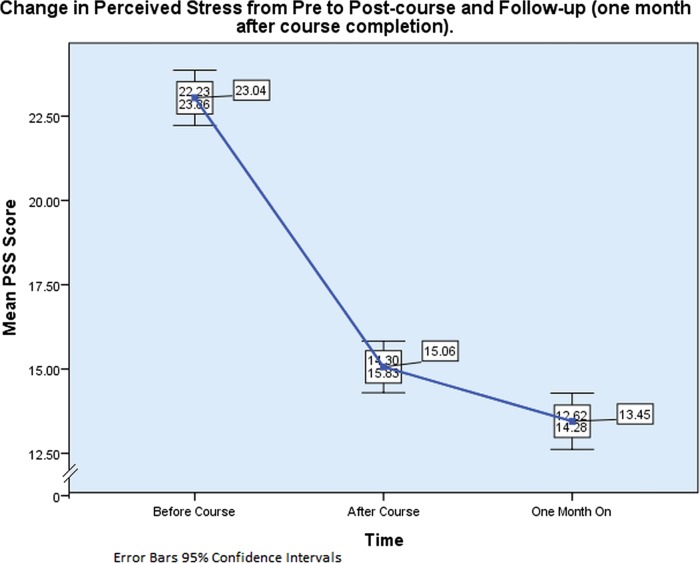
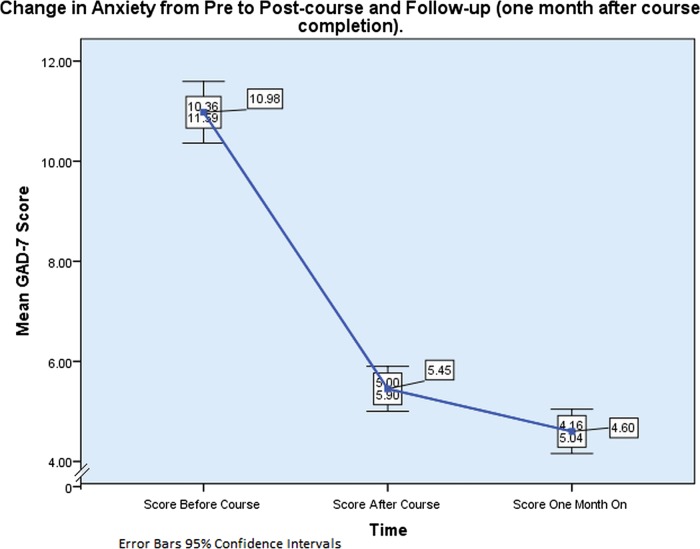
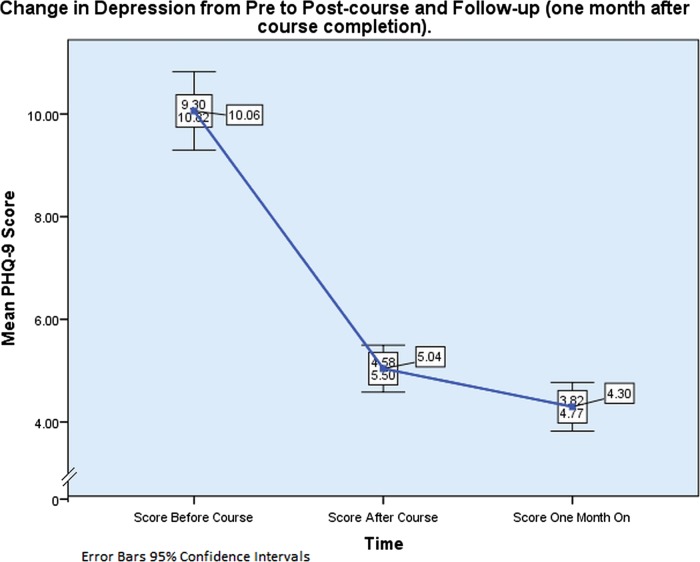
Verification
Claims the paper makes
The claims and statistics of this paper haven’t been checked yet.
Free: it reads the open-access text and checks the first 5 claims that cite a source we can check. Create a free account to check every claim.
Claims other papers make about this one
Each is checked against this paper’s own text: does it say what the citing paper says it does?
The source backs part of the claim, not all of it — or backs it for a different population, condition or comparison.
In the citing paper
“Significant effects of these apps on mindfulness, well-being and perceived stress were found in the general population26,27, in healthy employees28 and categories prone to burnout, i.e., physicians29, or with high levels of stress, i.e., college students30, in particular, medical students31 and pharmacy students32.”
From Mindfulness-based online intervention increases well-being and decreases stress after Covid-19 lockdown (2022) · cites this paper as [27]
Experimental — accuracy not yet measuredThe source backs part of the claim, not all of it — or backs it for a different population, condition or comparison.
In the citing paper
“In fact, the National Health Service (NHS) in the United Kingdom already endorses certain online support tools such as the MBT programme evaluated by Krusche et al. (2013).”
From Self-guided mindfulness and cognitive behavioural practices reduce anxiety in autistic adults: A pilot 8-month waitlist-controlled trial of widely available online tools. (2020) · cites this paper as Krusche et al., 2013
Experimental — accuracy not yet measuredThe source backs part of the claim, not all of it — or backs it for a different population, condition or comparison.
In the citing paper
“Krusche et al. (2013) showed that an online self-guided mindfulness-based programme (www.bemindfulonline.co.uk) that follows the structure of typical face-to-face programmes, yields significant reductions in anxiety, depression and stress that are maintained over at least 1 month.”
From Self-guided mindfulness and cognitive behavioural practices reduce anxiety in autistic adults: A pilot 8-month waitlist-controlled trial of widely available online tools. (2020) · cites this paper as Krusche et al., 2013
Experimental — accuracy not yet measuredThe cited source says what the claim attributes to it.
In the citing paper
“early evaluations of digital MBIs report beneficial effects that are comparable with those found in traditional in-person programs [8,9]”
From Experiences of Using Digital Mindfulness-Based Interventions: Rapid Scoping Review and Thematic Synthesis (2023) · cites this paper as [8]
The cited source says what the claim attributes to it.
In the citing paper
“Given recent evidence that online mental health support tools can help reduce anxiety in the general population (e.g. Krusche et al., 2013; Powell et al., 2013; Saddichha et al., 2014)”
From Self-guided mindfulness and cognitive behavioural practices reduce anxiety in autistic adults: A pilot 8-month waitlist-controlled trial of widely available online tools. (2020) · cites this paper as Krusche et al., 2013
1 more claim about this paper
Create a free account to see every claim other papers make about this one.
Self-check
Percentages, sums and reported differences re-computed from the paper’s own numbers.
The self-check needs the paper’s full text.
Citations
Cites
The PHQ-9: Validity of a brief depression severity measure
Kroenke, K., Spitzer, R. L., & Williams, J. B. W. (2001) · Journal of General Internal Medicine · doi:10.1046/j.1525-1497.2001.016009606.x · Cited by 44,910
Self-citationA Global Measure of Perceived Stress
Cohen, S., Kamarck, T., & Mermelstein, R. (1983) · Journal of Health and Social Behavior · doi:10.2307/2136404 · Cited by 32,807 · cited 7×
“The amount of total average practice was signi fi cantly correlated with PSS, GAD-7 and PHQ-9 levels at follow-up (r=0.16, p 0.001, r=0.14, p 0.05 and r=0.13, p 0.05) but not with the amount of change in negative mood.”
BackgroundMethodInfluentialA Brief Measure for Assessing Generalized Anxiety Disorder: The GAD-7
Spitzer, R. L., Kroenke, K., Williams, J. B. W., & Löwe, B. (2006) · Archives of Internal Medicine · doi:10.1001/archinte.166.10.1092 · Cited by 31,765
Self-citation(2008) · Medical Entomology and Zoology · Cited by 7,477
Anxiety disorders in primary care: prevalence, impairment, comorbidity, and detection
Kroenke, K., Spitzer, R. L., Williams, J. B. W., Monahan, P. O., & Löwe, B. (2007) · Annals of Internal Medicine · doi:10.7326/0003-4819-146-5-200703060-00004 · Cited by 4,741 · cited 1×
“48 53 The GAD-7 has been used in previous mindfulness intervention research showing a reduction after a face-to-face course 15 ; however, it has not been used to evaluate an online course.”
MethodSelf-citationLöwe, B., Decker, O., Müller, S., Brähler, E., Schellberg, D., Herzog, W., & Herzberg, P. Y. (2008) · Medical Care · doi:10.1097/mlr.0b013e318160d093 · Cited by 4,527 · cited 2×
“Anxiety The General Anxiety Disorder 7-item Scale (GAD-7)(48) is widely used to assess anxiety during the preceding 2 weeks and has been shown to have good reliability and validity.(51) 52 The GAD-7 consists of seven items answered using a four-point scale, ranging from 0 to 3 with total scores ranging from 0 to 21.”
BackgroundMethodKabat-Zinn, J. (1982) · General Hospital Psychiatry · doi:10.1016/0163-8343(82)90026-3 · Cited by 4,255
(1988) · Cited by 4,111
Kroenke, K., Spitzer, R. L., Williams, J. B. W., & Löwe, B. (2010) · General Hospital Psychiatry · doi:10.1016/j.genhosppsych.2010.03.006 · Cited by 4,057
Self-citationShapiro, S. L., Carlson, L. E., Astin, J. A., & Freedman, B. (2006) · Journal of Clinical Psychology · doi:10.1002/jclp.20237 · Cited by 4,002
Research works printed but not linked: 1
- Kuyken W, ed. Mindfulness Training in the UK. 41st Annual European Association for Behavioural and Cognitive Therapies (EABCT) Conference. Reykjavik, Iceland, 2011
Cited by
Items 101–194 of 194
Servant, D., Rougegrez, L., Barasino, O., Demarty, A.-L., Duhamel, A., & Vaiva, G. (2016) · L'Encéphale · doi:10.1016/j.encep.2016.03.010 · Cited by 9
Mrazek, A. J., Mrazek, M. D., Brown, C. S., Karimi, S. S., Ji, R. R., Ortega, J. R., Maul, A., Carr, P. C., Delegard, A. M., Kirk, A. C., et al. (2022) · Technology Mind and Behavior · doi:10.1037/tmb0000092 · Cited by 15
Promising practices for health and wellbeing at work: A review of the evidence landscape
Whitmore, M., Stewart, K., Pollard, J., van Belle, J., Yang, M., & Stolk, C. V. (2018) · RAND Corporation eBooks · doi:10.7249/rr2409 · Cited by 12
Landry, C. A., McCall, H. C., Beahm, J. D., Titov, N., Dear, B., Carleton, R. N., & Hadjistavropoulos, H. D. (2024) · JMIR Formative Research · doi:10.2196/54132 · Cited by 6
Mindfulness-Based Stress Reduction and Transcendental Meditation: Current State of Research
Holt, A. (2015) · Journal of Patient-Centered Research and Reviews · doi:10.17294/2330-0698.1199 · Cited by 7
Boedt, T., Willaert, N., Fong, S. L., Dancet, E. A. F., Spiessens, C., Raes, F., Matthys, C., & der Gucht, K. V. (2022) · BMJ Open · doi:10.1136/bmjopen-2021-050088 · Cited by 10
Designing technologies to support everyday mindfulness beyond meditation for mental well-being
Li, J. (2022) · Designing Interactive Systems Conference · doi:10.1145/3532107.3532883 · Cited by 10
Priore, L. B. D., Perez, V. O., Briani, R. V., Farinelli, L. A. L. B., da Silva, J. D. C. P., Martins, O. M. G., Lopes, F. A., Amorim, A. B., Pappas, E., & de Azevedo, F. M. (2023) · BMC Musculoskeletal Disorders · doi:10.1186/s12891-023-06491-x · Cited by 7
Pal, A., Mukhopadhyay, P., Datta, S., & Pal, N. D. (2022) · Indian Journal of Psychiatry · doi:10.4103/indianjpsychiatry.indianjpsychiatry_4_21 · Cited by 6
“We calculated our sample size from the previous studies [11] to detect a minimum expected difference of means ( μ 1 − μ 2 ) of 3.13 at least with a standard deviation (SD) of 4.6 with a power of >80% and Type I Error (alpha) of 5% using Welch’s t test to compare the difference of means between two…”
InfluentialInterest in online interprofessional elective mind-body skills (MBS) training
Gupta, S. J., Kemper, K. J., & Lynn, J. (2017) · Complementary Therapies in Medicine · doi:10.1016/j.ctim.2017.12.009 · Cited by 8
Infantes, A. T., Hurtado, F. A., Vera, F. S., & Guirao, J. E. M. (2022) · Sustainability · doi:10.3390/su14052547 · Cited by 9
Landry, C. A., McCall, H. C., Beahm, J. D., Titov, N., Dear, B., Carleton, R. N., & Hadjistavropoulos, H. D. (2023) · doi:10.2196/preprints.54132 · Cited by 6
Blard, F., Erraud, J., Bonnet, M., Auzou, N., & Tison, F. (2024) · Revue Neurologique · doi:10.1016/j.neurol.2024.03.013 · Cited by 5
A Brief Online Mindfulness Intervention for Women’s Sexual Desire: The BROWSE Study
Xue, A., Makarenko, B., & Brotto, L. A. (2024) · Journal of Sex & Marital Therapy · doi:10.1080/0092623x.2024.2343286 · Cited by 5
Kou, H., Luo, W., Wang, Y., Wu, J., Li, X., Wu, Y., Xiao, Q., & Bi, T. (2025) · Frontiers in Psychiatry · doi:10.3389/fpsyt.2025.1622626 · Cited by 6
Zhu, T., Zhang, L., Weng, W., Gan, R., Sun, L., Wei, Y., Zhu, Y., Yu, H., Xue, J., & Chen, S. (2025) · Journal of Medical Internet Research · doi:10.2196/55583 · Cited by 5
Vainre, M., Galante, J., Watson, P., Dalgleish, T., & Hitchcock, C. (2022) · BMJ Open · doi:10.1136/bmjopen-2021-050951 · Cited by 7
Neate, S. L., Reece, J. C., Hassed, C. S., Chambers, R., Connaughton, S., & Nag, N. (2022) · Frontiers in Public Health · doi:10.3389/fpubh.2022.947898 · Cited by 7
Rosansky, J. A., Okst, K., Tepper, M. C., Schreck, A. B., Fulwiler, C., Wang, P. S., & Schuman‐Olivier, Z. (2023) · JMIR Mental Health · doi:10.2196/48112 · Cited by 4
Apolinário-Hagen, J., & Salewski, C. (2018) · Springer eBooks · doi:10.1007/978-981-10-6577-4_22 · Cited by 5
Álvarez, E., Sutton, A., Barton, B., & Vaidya, S. (2020) · BMJ Open · doi:10.1136/bmjopen-2019-035862 · Cited by 8
A pilot study of an online self-compassion intervention for adults who stutter
Croft, R. L., & Byrd, C. T. (2023) · International Journal of Speech-Language Pathology · doi:10.1080/17549507.2023.2236813 · Cited by 8
Rice, V. J. B., Schroeder, P. J., & Allison, S. C. (2024) · Work · doi:10.3233/wor-230645 · Cited by 6
Sard-Peck, T. E., Martín-Asuero, A., Oller, M. T., Calvo, A., & Santesteban‐Echarri, O. (2019) · Psiquiatría Biológica · doi:10.1016/j.psiq.2019.03.001 · Cited by 11
The Mindful AFL Player: Engagement, Mobile Apps, and Well-Being
Mitchell, J., & Hassed, C. S. (2016) · Cambridge University Press eBooks · doi:10.1017/cbo9781139871310.013 · Cited by 7
The Scale of Online Course Anxiety: Assessing College Students’ Anxiety in Online Courses
Li, X., Lan, W. Y., & Williams, A. (2021) · Online Learning · doi:10.24059/olj.v25i4.2505 · Cited by 8
Programas de ordenador basados en mindfulness . Una revisión de la literatura médica
López-Montoyo, A., Modrego‐Alarcón, M., Morillo, H., García‐Campayo, J., & Quero, S. (2016) · Mindfulness & Compassion · doi:10.1016/j.mincom.2016.09.003 · Cited by 5
Sierra, M. A., & Ruiz, F. J. (2022) · Journal of Contextual Behavioral Science · doi:10.1016/j.jcbs.2022.08.003 · Cited by 7
Puah, S., Pua, C. Y., Shi, J. C., & Lim, S. M. (2024) · Journal of Medical Internet Research · doi:10.2196/49505 · Cited by 6
Digital Attention Training: Improving the Mental Health and Well-Being of Adolescent Youth
Richelle, J., Dow, B. R., Pasch, A. M., Schooler, J. W., Mrazek, M. D., & Mrazek, A. J. (2024) · Creative Education · doi:10.4236/ce.2024.1510132 · Cited by 5
Palma, R., Lam, H. C., Shrivastava, A., Karlinsey, E., Nguyen, K., Deol, P., Sharmin, M., & Ahmed, S. (2023) · Lecture notes in computer science · doi:10.1007/978-3-031-28032-0_24 · Cited by 5
Stress Management: Concept, Approaches, and Analysis
Ganapathi, P. B., Aithal, P. S., & Kanchana, D. (2023) · International Journal of Management Technology and Social Sciences · doi:10.47992/ijmts.2581.6012.0319 · Cited by 5
Impact of online language learning on psychological well-being
Ketebayeva, E. K., Kassymova, G. K., Ponniah, K., & Nursultankyzy, A. M. (2024) · International Scientific-Practical Internet Conference "Challenges of Science" · doi:10.31643/2024.02 · Cited by 5
Distance Delivery of Mindfulness-Based Cognitive Therapy
Thompson, N. J., McGee, R. E., & Walker, E. R. (2016) · Springer eBooks · doi:10.1007/978-3-319-29866-5_2 · Cited by 4
Mindfulness for the Treatment of Stress Disorders
Pallesen, K. J., Dahlgaard, J., & Fjorback, L. O. (2015) · Springer eBooks · doi:10.1007/978-3-319-22255-4_8 · Cited by 3
Self-Help Mindfulness-Based Cognitive Therapy
Jones, F., Strauss, C., & Cavanagh, K. (2016) · Springer eBooks · doi:10.1007/978-3-319-29866-5_10 · Cited by 3
Positive Technology for Helping People Cope with Stress
Villani, D., Cipresso, P., Gaggioli, A., & Riva, G. (2020) · IGI Global eBooks · doi:10.4018/978-1-7998-3432-8.ch038 · Cited by 3
Herfet, M., Dominicis, S. D., Seidl, F., & Jansen, P. (2023) · Scandinavian Journal of Sport and Exercise Psychology · doi:10.7146/sjsep.v5i.133568 · Cited by 2
Goodmann, D. R., Brown, L. M., Bunge, E. L., & Leykin, Y. (2023) · Journal of Technology in Behavioral Science · doi:10.1007/s41347-023-00342-1 · Cited by 3
Manning, J. B., BLANDFORD, A. E., & Edbrooke-Childs, J. H. (2024) · Journal of Medical Internet Research · doi:10.2196/50457 · Cited by 5
Bavani, M., von Lieres, J. S., Sowndaram, C. S., & Prasad, R. (2024) · IEEE Global Humanitarian Technology Conference (GHTC) · doi:10.1109/ghtc62424.2024.10771539 · Cited by 3
Paese, S., & Schiavio, A. (2025) · Frontiers in Psychology · doi:10.3389/fpsyg.2025.1567988 · Cited by 6
Detert, N. (2015) · Practical Neurology · doi:10.1136/practneurol-2015-001100 · Cited by 4
Resilient Family : A Pilot Study of a Stress Management Program for Military-Connected Families
Sylvia, L. G., Chudnofsky, R., Winklosky, T., Mulzoff, A., Francona, J., Sampson, B., Lynch, E. A., Xu, B., McCarthy, M. D., Gupta, C., et al. (2022) · Psychiatric Annals · doi:10.3928/00485713-20220506-02 · Cited by 2
Kadir, N. B. A., Mohd, R. H., Ismail, W. N. K., Jalil, S. J. A., Abdullah, N.-A., Kasim, A. C., Hoesni, S. M., & Manaf, M. R. A. (2022) · Sustainability · doi:10.3390/su14031925 · Cited by 2
Ditchburn, T. A., & Bedwell, S. A. (2019) · PsyPag Quarterly · doi:10.53841/bpspag.2019.1.110.19 · Cited by 2
Aizik-Reebs, A., Yuval, K., Hadash, Y., Gebremariam, S. G., & Bernstein, A. (2020) · MindRxiv (OSF Preprints) · doi:10.31231/osf.io/jyhwa · Cited by 3
Sierra, M. A., & Ortiz, E. (2023) · Interdisciplinaria Revista de Psicología y Ciencias Afines · doi:10.16888/interd.2023.40.2.5 · Cited by 1
Sigmon, C. A. N., Bam, D., Moldow, E., Beary, S., Wakefield, K., & Boeldt, D. L. (2021) · Journal of Technology in Behavioral Science · doi:10.1007/s41347-021-00232-4 · Cited by 3
The Impact of the Internet in Twenty-First Century Addictions: An Overview
Bisen, S. S., & Deshpande, Y. (2019) · IGI Global eBooks · doi:10.4018/978-1-5225-8900-6.ch025 · Cited by 1
Amorim, A. B., Rebbeck, T. J., Dam, N. T. V., Johnstone, C. S. H., Ashton-James, C. E., Costa, N., Barnet-Hepples, T., Jennings, M., Refshauge, K. M., & Pappas, E. (2025) · Pilot and Feasibility Studies · doi:10.1186/s40814-025-01612-w · Cited by 1
Murray, C. A., Hayden, N., Gordon‐Brown, A., Flynn, S., Bonetree, C., Harper, A., Kassa, C., Mahon, D., McGee, C. M., & Hastings, R. P. (2025) · Journal of Intellectual Disability Research · doi:10.1111/jir.70057 · Cited by 1
Teaching Mindfulness-Based Programs online: perceived costs and benefits
Burton, A. M., Crane, R. S., & Griffith, G. M. (2025) · BMC Psychology · doi:10.1186/s40359-025-02983-8 · Cited by 1
Paoli, T. D., Arena, M., Joyce, S., & Grenfell, T. (2026) · Journal of Police and Criminal Psychology · doi:10.1007/s11896-026-09802-9 · Cited by 1
Intervención online basada en mindfulness para la gestión del estrés en alumnado universitario
Camacho, C. R., & Delgado, M. G. (2024) · International Journal of Developmental and Educational Psychology Revista INFAD de psicología · doi:10.17060/ijodaep.2024.n1.v1.2649 · Cited by 5
Mindfulness meditation training for spiritual struggles: A randomized controlled trial
Feuille, M. (2015) · ScholarWorks@BGSU (Bowling Green State University) · Cited by 1
Comperat, J. M., & Genders, N. (2019) · Learning Disability Practice · doi:10.7748/ldp.2019.e1992 · Cited by 1
Veetil, A. K. V., & Pradhan, S. (2022) · Springer proceedings in business and economics · doi:10.1007/978-981-19-4892-3_14 · Cited by 1
Mind, Behaviour and Health: A Randomised ExperimentPreprint
Alem, Y., Behrendt, H., Belot, M. V. K., & Bíró, A. (2016) · SSRN Electronic Journal · doi:10.2139/ssrn.2803851 · Cited by 4
E-mindful health: Evaluation of mobile apps for mindfulness
Mani, M. (2017) · Queensland University of Technology · doi:10.5204/thesis.eprints.102651 · Cited by 6
Beshai, S. (2020) · PsyArXiv (OSF Preprints) · doi:10.31234/osf.io/967hq · Cited by 1
Managing generalised anxiety disorder
Greener, M. (2014) · British Journal of Mental Health Nursing · doi:10.12968/bjmh.2014.3.3.100
Coping and stress management training with special focus on women with breast cancer
Kvillemo, P. (2016) · Figshare · Cited by 1
Traverso-Yépez, M. A., & Safer, A. (2017) · Journal of Psychology and Cognition · doi:10.35841/psychology-cognition.2.3.177-185
Intervenciones enfermeras para la reducción de estrés con Mindfulness: Una revisión bibliográfica
Ramal-López, J. M. (2015) · Acceda (Universidad de Las Palmas de Gran Canaria)
Mindfulness and Stress - a Randomised Experiment
Alem, Y., Behrendt, H., Belot, M. V. K., & Bíró, A. (2018) · Repository of the Academy's Library (Library of the Hungarian Academy of Sciences) · Cited by 2
Meditation for Major Depressive Disorder: A Systematic Review
Sorbero, M. E. S., Ahluwalia, S. C., Reynolds, K. A., Lovejoy, S. L., Farris, C. A., Sloan, J., Miles, J. N. V., Vaughan, C., Kandrack, R., Apaydin, E. A., et al. (2015) · RAND Corporation eBooks · doi:10.7249/rr1138 · Cited by 1
Mobile Mindfulness: Effectiveness of Brief Practices on Depression, Anxiety, and Stress
Haschke, K. J., Whitaker, W. K., null, J., & null, N. (2020) · Academic Leadership Journal in Student Research · doi:10.58809/aiuf4851
A Mindfulness-Based Physical Activity Intervention: A Pilot Randomized Controlled Trial
Sala, M. (2020) · SMU Scholar (Southern Methodist University)
Better than Before: Individual Strategies for Body Image Improvement
Dunaev, J., & Markey, C. H. (2018) · Cambridge University Press eBooks · doi:10.1017/9781108297653.009 · Cited by 3
Online mindfulness-based stress reduction for lesbian women: A feasibility studyPreprint
Jabson, J. M., & Patterson, J. G. (2017) · doi:10.2196/preprints.9334
Effectiveness of Online Mindfulness Training for People Experiencing Mental Illness
Griffiths, C., Hina, F., Pollard, L., & Reid, I. (2022) · Open Journal of Depression · doi:10.4236/ojd.2022.112002 · Cited by 1
Mrazek, A. J., Mrazek, M. D., Brown, C. S., Karimi, S. S., Ji, R. R., Ortega, J. R., Maul, A., Carr, P. C., Delegard, A. M., & Kirk, A. C. (2022) · Technology Mind and Behavior · doi:10.1037/tmb0000092.supp
เชื้อบ้านเกาะ, น. (2016) · Chula Digiverse · doi:10.58837/chula.the.2016.658
Callahan, C. E., Kimber, J. M., Hu, E., Tanner, L., & Kunkle, S. (2023) · doi:10.2196/preprints.52968
Effect of Mindfulness Therapy to Reduce Stress among Janitor Workers
PRADEEPA (2023) · International Journal For Multidisciplinary Research · doi:10.36948/ijfmr.2023.v05i06.8663
Malandrone, F., Urru, S., Berchialla, P., Rossini, P. G., Oliva, F., Bianchi, S., Ottaviano, M., González-Martínez, S., Carli, V., Valenza, G., et al. (2024) · doi:10.2196/preprints.57415
Stress Management: Concept, Approaches, and AnalysisPreprint
Ganapathi, P. B., Aithal, P. S., & Kanchana, D. (2024) · SSRN Electronic Journal · doi:10.2139/ssrn.4744526
Eads, R., Guerrero, X. A., Turner, P. R., Cramer, J. L., Matteson, T., & Frazee, K. (2024) · Social Work in Mental Health · doi:10.1080/15332985.2024.2391980
Nathanson, E. W., Rispoli, K. M., & Ramazon, N. H. (2025) · Journal of Child and Family Studies · doi:10.1007/s10826-025-03210-z
Blignault, I., Saab, H., Woodland, L., Mannan, H. R., & Kaur, A. (2021) · Figshare · doi:10.6084/m9.figshare.14411753
Blignault, I., Saab, H., Woodland, L., Mannan, H. R., & Kaur, A. (2021) · Figshare · doi:10.6084/m9.figshare.14411759
Priore, L. B. D., Perez, V. O., Briani, R. V., Farinelli, L. A. L. B., da Silva, J. D. C. P., Martins, O. M. G., Lopes, F. A., Amorim, A. B., Pappas, E., & de Azevedo, F. M. (2023) · Figshare · doi:10.6084/m9.figshare.22807520
Priore, L. B. D., Perez, V. O., Briani, R. V., Farinelli, L. A. L. B., da Silva, J. D. C. P., Martins, O. M. G., Lopes, F. A., Amorim, A. B., Pappas, E., & de Azevedo, F. M. (2023) · Figshare · doi:10.6084/m9.figshare.22807532
Priore, L. B. D., Perez, V. O., Briani, R. V., Farinelli, L. A. L. B., da Silva, J. D. C. P., Martins, O. M. G., Lopes, F. A., Amorim, A. B., Pappas, E., & de Azevedo, F. M. (2023) · Figshare · doi:10.6084/m9.figshare.22807529
Blignault, I., Saab, H., Woodland, L., Mannan, H. R., & Kaur, A. (2021) · Figshare · doi:10.6084/m9.figshare.14411756
Priore, L. B. D., Perez, V. O., Briani, R. V., Farinelli, L. A. L. B., da Silva, J. D. C. P., Martins, O. M. G., Lopes, F. A., Amorim, A. B., Pappas, E., & de Azevedo, F. M. (2023) · Figshare · doi:10.6084/m9.figshare.22807526
Priore, L. B. D., Perez, V. O., Briani, R. V., Farinelli, L. A. L. B., da Silva, J. D. C. P., Martins, O. M. G., Lopes, F. A., Amorim, A. B., Pappas, E., & de Azevedo, F. M. (2023) · Figshare · doi:10.6084/m9.figshare.22807523
da Silva, B. I., Atanes, A. C., Bedendo, A., Santos, J. S., Faria, M. N., Saletti, L. C., & Noto, A. R. (2026) · Journal of Rational-Emotive & Cognitive-Behavior Therapy · doi:10.1007/s10942-026-00643-3
Evertz, L., Klingenberg, I., & Schwinges-Hess, L. (2026) · Mindfulness · doi:10.1007/s12671-026-02813-x
Findley, A. M., Culang, H., Davis, E., Gurung, M., de Rutte, J. L., & Dennis‐Tiwary, T. A. (2026) · Journal of Technology in Behavioral Science · doi:10.1007/s41347-026-00641-3
Effects of mindfulness training on autobiographical memory in depression-prone college students
Yang, Y., Ren, G., Ding, X., Lu, X., & Li, Y. (2026) · Current Psychology · doi:10.1007/s12144-026-09674-6
Duan, Y., NORDIN, N. A., Panatik, S. A., Zhang, C., 高, 学., & Li, Y. (2026) · Frontiers in Psychiatry · doi:10.3389/fpsyt.2026.1904313
Metadata
- Authors
- Krusche, A., Cyhlarova, E., & Williams, J. M. G.
- Affiliations
- University of Oxford (GB)
- Mental Health Foundation (GB)
- Corresponding author
- Krusche, Adele
- Venue
- BMJ Open
- Publisher
- BMJ
- Published
- 2013-11
- Volume
- 3
- Issue
- 11
- Pages
- e003498
- ISSN
- 2044-6055 (ISSN-L)
- PMC
- PMC3845392
- OpenAlex
- W2109641158
- Cited by
- 192
- References
- 62
- Citations by year
- 2026: 6 · 2025: 6 · 2024: 19 · 2023: 24 · 2022: 24 · 2021: 15 · 2020: 22 · 2019: 11 · 2018: 12 · 2017: 13 · 2016: 23 · 2015: 13 · 2014: 4
- FWCI
- 14.82
- Type
- journal article
- Language
- en
- Open access
- gold
- doi.org
- Licence
- cc-by-nc
- Locations
- BMJ Open (publishedVersion, cc-by-nc)
- Europe PMC (PubMed Central) (publishedVersion, other-oa)
- PubMed Central (publishedVersion, cc-by-nc)
- PubMed (publishedVersion)
- Topics
- Social Sciences › Psychology › Clinical Psychology › Mindfulness and Compassion Interventions
- Social Sciences › Psychology › Applied Psychology › Digital Mental Health Interventions
- Health Sciences › Medicine › Oncology › Cancer survivorship and care
- Keywords
- online intervention, perceived stress, anxiety, depression, mindfulness-based stress reduction, mindfulness-based cognitive therapy, guided meditation, feasibility, meditation practice, self-referral
About these checks
Registry, retraction, Cites and statistics results are computed, not judged, with one exception: a printed reference that no index lists is read once by a model before it counts as a citation error. Claims are extracted by a model and kept only when their quote appears verbatim in the text; each cited source is then checked, with a model’s help, for whether it says what the claim relies on. Those verdicts can be wrong — read the claim’s quote and the cited source before relying on one.
Statistics and arithmetic are recomputed, not judged.
Confidence bands are shown only for fields calibrated on our annotated test set. None is calibrated yet, so no band is shown.
What counts as a claim ›How we measure confidence ›How we check this ›
Are you an author, or do you see a problem with this page? Request a review
Data sources
Bibliographic data: Semantic Scholar, OpenAlex, Crossref.
Contains information from the Semantic Scholar Academic Graph Datasets, made available under the ODC Attribution License (ODC-BY 1.0).
Semantic Scholar’s data is described in: Kinney, R., et al. (2023). The Semantic Scholar Open Data Platform. arXiv:2301.10140.
