

Mindfulness online: an evaluation of the feasibility of a web-based mindfulness course for stress, anxiety and depression
Open accessThe DOI matches its Crossref record; 62 of the 62 references it cites were found in a registry or an index.
Abstract
Objectives: Face-to-face mindfulness interventions have been shown to significantly decrease perceived stress, anxiety and depression and research is beginning to show similar benefits for such courses delivered via the internet. We investigated the feasibility and effectiveness of an online mindfulness course for perceived stress, anxiety and depression. Design: A follow-up investigation of an online mindfulness course. Previous research examining the change in perceived stress showed promising results. Measures of anxiety and depression were added to the online mindfulness course and these were investigated as well as perceived stress using a new, larger sample. Participants: Participants (N=273) were self-referrals to the online course who completed the outcome measure immediately before the course, upon course completion and at 1 month follow-up. Intervention: The programme consists of 10 sessions, guided meditation videos and automated emails, with elements of Mindfulness-Based Stress Reduction and Mindfulness-Based Cognitive Therapy, completed at a pace to suit the individual (minimum length 4 weeks). Primary and secondary outcome measures: The Perceived Stress Scale, the Generalised Anxiety Disorder Assessment-7 and the Patient Health Questionnaire-9 (for depression). Mindfulness practice was self-reported at automated time points upon login, once the exercises and sessions for each week were completed. Results: Perceived stress, anxiety and depression significantly decreased at course completion and further decreased at 1 month follow-up, with effect sizes comparable to those found with face-to-face and other online mindfulness courses and to other types of intervention, such as cognitive behavioural therapy for stress. The amount of meditation practice reported did affect outcome when controlling for baseline severity. Conclusions: The online mindfulness course appears to be an acceptable, accessible intervention which reduces stress, anxiety and depression. However, there is no control comparison and future research is required to assess the effects of the course for different samples.
Overview
The claims and statistics of this paper haven’t been checked yet.
Free: it reads the open-access text and checks the first 5 claims that cite a source we can check. Create a free account to check every claim.
Integrity signals
Registry
Cites
Statistics
Figures
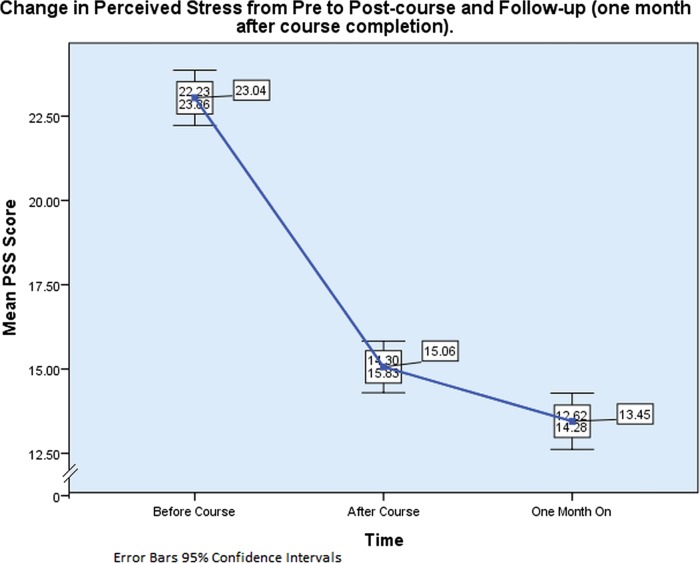
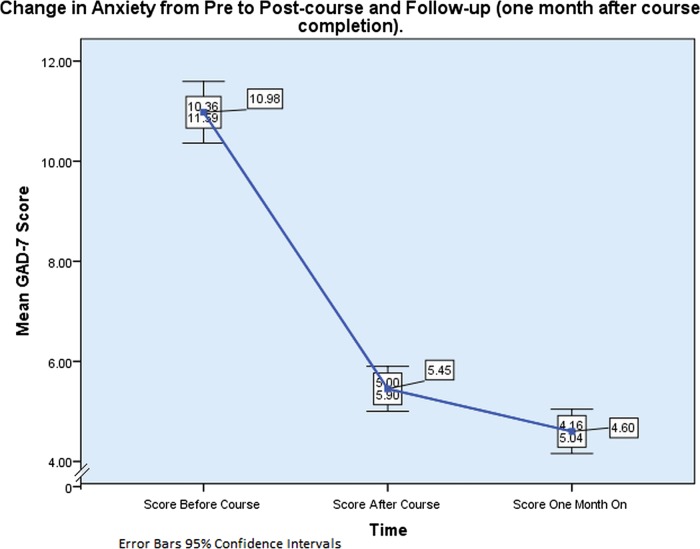
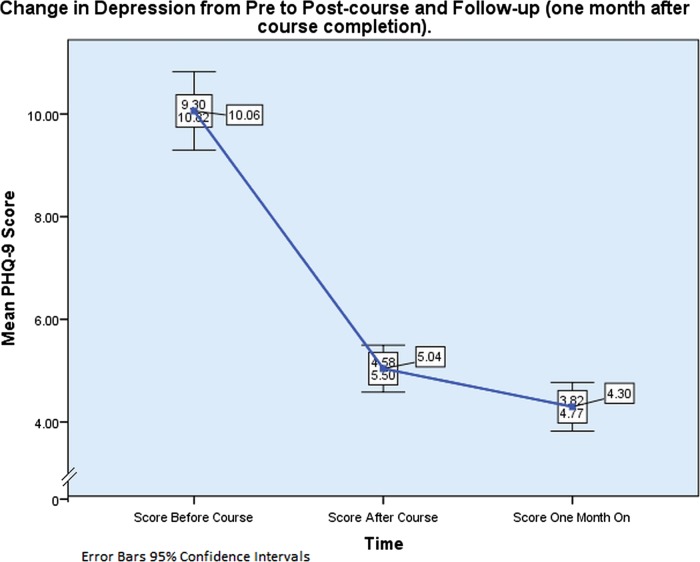
Verification
Claims the paper makes
The claims and statistics of this paper haven’t been checked yet.
Free: it reads the open-access text and checks the first 5 claims that cite a source we can check. Create a free account to check every claim.
Claims other papers make about this one
Each is checked against this paper’s own text: does it say what the citing paper says it does?
The source backs part of the claim, not all of it — or backs it for a different population, condition or comparison.
In the citing paper
“Significant effects of these apps on mindfulness, well-being and perceived stress were found in the general population26,27, in healthy employees28 and categories prone to burnout, i.e., physicians29, or with high levels of stress, i.e., college students30, in particular, medical students31 and pharmacy students32.”
From Mindfulness-based online intervention increases well-being and decreases stress after Covid-19 lockdown (2022) · cites this paper as [27]
Experimental — accuracy not yet measuredThe source backs part of the claim, not all of it — or backs it for a different population, condition or comparison.
In the citing paper
“In fact, the National Health Service (NHS) in the United Kingdom already endorses certain online support tools such as the MBT programme evaluated by Krusche et al. (2013).”
From Self-guided mindfulness and cognitive behavioural practices reduce anxiety in autistic adults: A pilot 8-month waitlist-controlled trial of widely available online tools. (2020) · cites this paper as Krusche et al., 2013
Experimental — accuracy not yet measuredThe source backs part of the claim, not all of it — or backs it for a different population, condition or comparison.
In the citing paper
“Krusche et al. (2013) showed that an online self-guided mindfulness-based programme (www.bemindfulonline.co.uk) that follows the structure of typical face-to-face programmes, yields significant reductions in anxiety, depression and stress that are maintained over at least 1 month.”
From Self-guided mindfulness and cognitive behavioural practices reduce anxiety in autistic adults: A pilot 8-month waitlist-controlled trial of widely available online tools. (2020) · cites this paper as Krusche et al., 2013
Experimental — accuracy not yet measuredThe cited source says what the claim attributes to it.
In the citing paper
“early evaluations of digital MBIs report beneficial effects that are comparable with those found in traditional in-person programs [8,9]”
From Experiences of Using Digital Mindfulness-Based Interventions: Rapid Scoping Review and Thematic Synthesis (2023) · cites this paper as [8]
The cited source says what the claim attributes to it.
In the citing paper
“Given recent evidence that online mental health support tools can help reduce anxiety in the general population (e.g. Krusche et al., 2013; Powell et al., 2013; Saddichha et al., 2014)”
From Self-guided mindfulness and cognitive behavioural practices reduce anxiety in autistic adults: A pilot 8-month waitlist-controlled trial of widely available online tools. (2020) · cites this paper as Krusche et al., 2013
1 more claim about this paper
Create a free account to see every claim other papers make about this one.
Self-check
Percentages, sums and reported differences re-computed from the paper’s own numbers.
The self-check needs the paper’s full text.
Citations
Cites
The PHQ-9: Validity of a brief depression severity measure
Kroenke, K., Spitzer, R. L., & Williams, J. B. W. (2001) · Journal of General Internal Medicine · doi:10.1046/j.1525-1497.2001.016009606.x · Cited by 44,910
Self-citationA Global Measure of Perceived Stress
Cohen, S., Kamarck, T., & Mermelstein, R. (1983) · Journal of Health and Social Behavior · doi:10.2307/2136404 · Cited by 32,807 · cited 7×
“The amount of total average practice was signi fi cantly correlated with PSS, GAD-7 and PHQ-9 levels at follow-up (r=0.16, p 0.001, r=0.14, p 0.05 and r=0.13, p 0.05) but not with the amount of change in negative mood.”
BackgroundMethodInfluentialA Brief Measure for Assessing Generalized Anxiety Disorder: The GAD-7
Spitzer, R. L., Kroenke, K., Williams, J. B. W., & Löwe, B. (2006) · Archives of Internal Medicine · doi:10.1001/archinte.166.10.1092 · Cited by 31,765
Self-citation(2008) · Medical Entomology and Zoology · Cited by 7,477
Anxiety disorders in primary care: prevalence, impairment, comorbidity, and detection
Kroenke, K., Spitzer, R. L., Williams, J. B. W., Monahan, P. O., & Löwe, B. (2007) · Annals of Internal Medicine · doi:10.7326/0003-4819-146-5-200703060-00004 · Cited by 4,741 · cited 1×
“48 53 The GAD-7 has been used in previous mindfulness intervention research showing a reduction after a face-to-face course 15 ; however, it has not been used to evaluate an online course.”
MethodSelf-citationLöwe, B., Decker, O., Müller, S., Brähler, E., Schellberg, D., Herzog, W., & Herzberg, P. Y. (2008) · Medical Care · doi:10.1097/mlr.0b013e318160d093 · Cited by 4,527 · cited 2×
“Anxiety The General Anxiety Disorder 7-item Scale (GAD-7)(48) is widely used to assess anxiety during the preceding 2 weeks and has been shown to have good reliability and validity.(51) 52 The GAD-7 consists of seven items answered using a four-point scale, ranging from 0 to 3 with total scores ranging from 0 to 21.”
BackgroundMethodKabat-Zinn, J. (1982) · General Hospital Psychiatry · doi:10.1016/0163-8343(82)90026-3 · Cited by 4,255
(1988) · Cited by 4,111
Kroenke, K., Spitzer, R. L., Williams, J. B. W., & Löwe, B. (2010) · General Hospital Psychiatry · doi:10.1016/j.genhosppsych.2010.03.006 · Cited by 4,057
Self-citationShapiro, S. L., Carlson, L. E., Astin, J. A., & Freedman, B. (2006) · Journal of Clinical Psychology · doi:10.1002/jclp.20237 · Cited by 4,002
Research works printed but not linked: 1
- Kuyken W, ed. Mindfulness Training in the UK. 41st Annual European Association for Behavioural and Cognitive Therapies (EABCT) Conference. Reykjavik, Iceland, 2011
Cited by
Mindfulness-based stress reduction for healthy individuals: A meta-analysis
Khoury, B., Sharma, M., Rush, S. E., & Fournier, C. (2015) · Journal of Psychosomatic Research · doi:10.1016/j.jpsychores.2015.03.009 · Cited by 1,617
“[61] Participants in online mindfulness course (273) 47.”
BackgroundSharma, M., & Rush, S. E. (2014) · Journal of Evidence-Based Complementary & Alternative Medicine · doi:10.1177/2156587214543143 · Cited by 342
The benefits of meditation and mindfulness practices during times of crisis such as COVID-19
Behan, C. (2020) · Irish Journal of Psychological Medicine · doi:10.1017/ipm.2020.38 · Cited by 276
The future of mindfulness training is digital, and the future is now
Mrazek, A. J., Mrazek, M. D., Cherolini, C. M., Cloughesy, J. N., Cynman, D. J., Gougis, L. J., Landry, A. P., Reese, J. V., & Schooler, J. W. (2019) · Current Opinion in Psychology · doi:10.1016/j.copsyc.2018.11.012 · Cited by 201
Jayawardene, W. P., Lohrmann, D. K., Erbe, R. G., & Torabi, M. R. (2017) · Preventive Medicine Reports · doi:10.1016/j.pmedr.2016.11.013 · Cited by 185
Magtibay, D. L., Chesak, S. S., Coughlin, K., & Sood, A. (2017) · JONA The Journal of Nursing Administration · doi:10.1097/nna.0000000000000501 · Cited by 172
“Reports of online programs to improve stress, mindfulness, empathy, and resilience have also shown similar results.(13,15,17) The current programs have modest effects, however, and require considerable time for learning and practice.”
BackgroundAllexandre, D., Bernstein, A. M., Walker, E., Hunter, J., Roizen, M. F., & Morledge, T. J. (2016) · Journal of Occupational & Environmental Medicine · doi:10.1097/jom.0000000000000680 · Cited by 157
“Overall, the magnitude of improvement with the web-based program was comparable to traditional face-to-face mindfulness programs as well as other web-based or self-help mindfulness interventions.(14,19,40,43,74) Even though online activity and weekly practice decreased once the program ended, improvements persisted, o…”
MethodGardiner, P. M., McCue, K. D., Negash, L. M., Cheng, T., White, L. F., Yinusa-Nyahkoon, L., Jack, B. W., & Bickmore, T. W. (2017) · Patient Education and Counseling · doi:10.1016/j.pec.2017.04.015 · Cited by 139
Phang, C. K., Mukhtar, F., Ibrahim, N., Keng, S., & Sidik, S. M. (2015) · Advances in Health Sciences Education · doi:10.1007/s10459-015-9591-3 · Cited by 168
Fish, J., Brimson, J., & Lynch, S. (2016) · Mindfulness · doi:10.1007/s12671-016-0548-2 · Cited by 126
Brotto, L. A., Chivers, M. L., Millman, R. D., & Albert, A. (2016) · Archives of Sexual Behavior · doi:10.1007/s10508-015-0689-8 · Cited by 99
Cavanagh, K., Churchard, A., O’Hanlon, P., Mundy, T., Votolato, P., Jones, F., Gu, J., & Strauss, C. (2018) · Mindfulness · doi:10.1007/s12671-017-0856-1 · Cited by 120
Lengacher, C. A., Reich, R. R., Ramesar, S., Alinat, C. B., Moscoso, M., Cousin, L., Marino, V. R., Elias, M. N., Paterson, C. L., Pleasant, M. L., et al. (2018) · Psycho-Oncology · doi:10.1002/pon.4491 · Cited by 101
“A nonrandomized study of an online mindfulness program also containing components of MBSR and mindfulness‐based cognitive therapy among 273 adults found significant reductions in stress, anxiety, and depression at the course completion and at 1‐month follow‐up.(18) For cancer survivors, a study by Zernicke et al(19) w…”
MethodMikolasek, M., Berg, J., Witt, C. M., & Barth, J. (2018) · International Journal of Behavioral Medicine · doi:10.1007/s12529-017-9679-7 · Cited by 105
THE INTERNATIONAL JOURNAL OF HUMANITIES & SOCIAL STUDIES
Astuti, K. S., & Prabawa, S. P. A. K. U. K. U. H. (2021) · Journal of Humanities and Social Studies · Cited by 104
Apolinário-Hagen, J., Drüge, M., & Fritsche, L. (2020) · Advances in Experimental Medicine and Biology · doi:10.1007/978-981-32-9705-0_17 · Cited by 100
Joyce, S., Shand, F., Lal, T. J., Mott, B., Bryant, R. A., & Harvey, S. B. (2019) · Journal of Medical Internet Research · doi:10.2196/12894 · Cited by 101
Effectiveness of ICT-based intimate partner violence interventions: a systematic review
El Morr, C., & Layal, M. (2020) · BMC Public Health · doi:10.1186/s12889-020-09408-8 · Cited by 90
Quinones, C., & Griffiths, M. D. (2019) · Journal of Behavioral Addictions · doi:10.1556/2006.8.2019.45 · Cited by 82
Matis, J., Svetlak, M., Slezackova, A., Svoboda, M., & Šumec, R. (2020) · doi:10.2196/preprints.20709 · Cited by 81
Working on self-compassion online: a proof of concept and feasibility study
Krieger, T., Martig, D. S., van den Brink, E., & Berger, T. (2016) · Internet Interventions · doi:10.1016/j.invent.2016.10.001 · Cited by 81
Gaigg, S. B., Flaxman, P. E., McLaven, G., Shah, R., Bowler, D. M., Meyer, B., Roestorf, A., Haenschel, C., Rodgers, J., & South, M. (2020) · Autism · doi:10.1177/1362361320909184 · Cited by 80
“…to the MBT group were enrolled on the online Be Mindful course (https://www. bemindfulonline.com/), which has been reported to yield similar reductions in perceived stress, anxiety and depression as traditional face-to-face mindfulness interventions in the general population (Krusche et al., 2013).”
BackgroundMethodInfluentialBanerjee, M., Cavanagh, K., & Strauss, C. (2017) · Mindfulness · doi:10.1007/s12671-017-0740-z · Cited by 80
“A feasibility study reported that perceived stress, anxiety and depression reduced significantly at course completion and decreased further at 1-month follow-up, with effect sizes similar to face-to-face MBIs (Krusche et al. 2013).”
BackgroundKladnitski, N., Smith, J., Uppal, S., James, M. A., Allen, A. R., Andrews, G., & Newby, J. M. (2020) · Internet Interventions · doi:10.1016/j.invent.2020.100310 · Cited by 77
A Moment of Mindfulness: Computer-Mediated Mindfulness Practice Increases State Mindfulness
Mahmood, L., Hopthrow, T., & Randsley de Moura, G. (2016) · PLOS ONE · doi:10.1371/journal.pone.0153923 · Cited by 75
Bossi, F., Zaninotto, F., D’Arcangelo, S., Lattanzi, N., Malizia, A. P., & Ricciardi, E. (2022) · Scientific Reports · doi:10.1038/s41598-022-10361-2 · Cited by 74
Henriksson, J., Wasara, E., & Rönnlund, M. (2016) · Psychological Reports · doi:10.1177/0033294116675086 · Cited by 73
Murray, G., Leitan, N. D., Berk, M., Thomas, N., Michalak, E., Berk, L., Johnson, S. L., Jones, S., Perich, T., Allen, N. B., et al. (2015) · Journal of Affective Disorders · doi:10.1016/j.jad.2015.02.024 · Cited by 70
Evaluation of a mobile mindfulness app distributed through on-line stores: A 4-week study
Chittaro, L., & Vianello, A. (2015) · International Journal of Human-Computer Studies · doi:10.1016/j.ijhcs.2015.09.004 · Cited by 84
Boggs, J. M., Beck, A., Felder, J. N., Dimidjian, S., Metcalf, C. A., & Segal, Z. V. (2014) · Journal of Medical Internet Research · doi:10.2196/jmir.3129 · Cited by 62
Kvillemo, P., Brandberg, Y., & Bränström, R. (2016) · JMIR Mental Health · doi:10.2196/mental.5457 · Cited by 56
“The effects of specific mindfulness-based programs delivered through the Internet have been promising regarding the improvement of mental states such as stress, anxiety, and depression [19-23], and results apply to persons with psychological symptoms of stress or distress [19], as well as to persons without previously…”
Therapeutic psychological and biological responses to mindfulness‐based art therapy
Beerse, M. E., Van Lith, T., & Stanwood, G. (2020) · Stress and Health · doi:10.1002/smi.2937 · Cited by 57
Eustis, E. H., Hayes-Skelton, S. A., Orsillo, S. M., & Roemer, L. (2018) · Behavior Therapy · doi:10.1016/j.beth.2018.05.009 · Cited by 57
Aizik-Reebs, A., Yuval, K., Hadash, Y., Gebremariam, S. G., & Bernstein, A. (2021) · Clinical Psychological Science · doi:10.1177/2167702621998641 · Cited by 68
Investigating Adherence to an Online Introductory Mindfulness Program
Forbes, L., Gutierrez, D., & Johnson, S. K. (2018) · Mindfulness · doi:10.1007/s12671-017-0772-4 · Cited by 54
Wang, L.-Q., Chien, W. T., Yip, L. K., & Karatzias, T. (2016) · Neuropsychiatric Disease and Treatment · doi:10.2147/ndt.s123239 · Cited by 54
“Nevertheless, most mindfulness interventions have been developed and tested in Western populations; it is uncertain whether this approach to psychosocial intervention can be applicable to Asian/Chinese populations who have an external locus of control and less self-affirmation and openness to experience attitudes.(17,…”
What Is the Impact of Online Training in Mind–Body Skills?
Kemper, K. J., Lynn, J., & Mahan, J. D. (2015) · Journal of Evidence-Based Complementary & Alternative Medicine · doi:10.1177/2156587215580882 · Cited by 50
Integrating internet CBT into clinical practice: a practical guide for clinicians
Newby, J., Mason, E., Kladnistki, N., Murphy, M., Millard, M., Haskelberg, H., Allen, A., & Mahoney, A. (2021) · Clinical Psychologist · doi:10.1080/13284207.2020.1843968 · Cited by 45
Internet-based Mindfulness Meditation for Cognition and Mood in Older Adults: A Pilot Study.
Wahbeh, H., Goodrich, E., & Oken, B. (2016) · PubMed · Cited by 59
Wahbeh, H., & Oken, B. S. (2016) · JMIR Mental Health · doi:10.2196/mental.5900 · Cited by 40
Flynn, S., Hastings, R. P., Burke, C., Howes, S., Lunsky, Y., Weiss, J. A., & Bailey, T. (2020) · Mindfulness · doi:10.1007/s12671-020-01436-0 · Cited by 40
Brotto, L. A., Stephenson, K. R., & Zippan, N. (2022) · Mindfulness · doi:10.1007/s12671-021-01820-4 · Cited by 47
Osborne, E. L., Ainsworth, B., Hooper, N., & Atkinson, M. J. (2023) · Journal of Medical Internet Research · doi:10.2196/44220 · Cited by 37
“The translation of MBIs into digital formats has the potential to overcome these constraints, and it is encouraging that early evaluations of digital MBIs report beneficial effects that are comparable with those found in traditional in-person programs [8,9].”
Osborne, E. L., Ainsworth, B., Hooper, N., & Atkinson, M. J. (2022) · doi:10.2196/preprints.44220 · Cited by 37
Fletcher, K., Foley, F., Thomas, N., Michalak, E., Berk, L., Berk, M., Bowe, S., Cotton, S., Engel, L., Johnson, S. L., et al. (2018) · BMC Psychiatry · doi:10.1186/s12888-018-1805-9 · Cited by 36
Zippan, N., Stephenson, K. R., & Brotto, L. A. (2020) · The Journal of Sexual Medicine · doi:10.1016/j.jsxm.2020.07.086 · Cited by 38
Beshai, S., Bueno, C., Yu, M., Feeney, J. R., & Pitariu, A. (2020) · Behaviour Research and Therapy · doi:10.1016/j.brat.2020.103724 · Cited by 43
Christo, E. M., & Layal, M. (2019) · Studies in health technology and informatics · doi:10.3233/978-1-61499-951-5-103 · Cited by 38
Women's Substance Use and Mental Health During the COVID-19 Pandemic
Devoto, A., Himelein-Wachowiak, M., Liu, T., & Curtis, B. L. (2022) · Women s Health Issues · doi:10.1016/j.whi.2022.01.004 · Cited by 36
Group Online Mindfulness Training: Proof of Concept
Kemper, K. J., & Yun, J. (2015) · Journal of Evidence-Based Complementary & Alternative Medicine · doi:10.1177/2156587214553306 · Cited by 34
Rice, V. J. B., Liu, B., & Schroeder, P. J. (2018) · Military Medicine · doi:10.1093/milmed/usx227 · Cited by 33
Blignault, I., Saab, H., Woodland, L., Mannan, H. R., & Kaur, A. (2021) · International Journal of Mental Health Systems · doi:10.1186/s13033-021-00456-0 · Cited by 36
A Mindfulness-Based Physical Activity Intervention: A Randomized Pilot Study
Sala, M., Geary, B. A., & Baldwin, A. S. (2020) · Psychosomatic Medicine · doi:10.1097/psy.0000000000000885 · Cited by 33
Baker, C., Huxley, P., Dennis, M., Islam, S., & Russell, I. (2015) · BMC Psychiatry · doi:10.1186/s12888-015-0703-7 · Cited by 26
Laird, B., Puzia, M., Larkey, L., Ehlers, D. K., & Huberty, J. (2022) · JMIR Formative Research · doi:10.2196/30294 · Cited by 31
Světlák, M., Linhartová, P., Knejzlíková, T., Knejzlík, J., Kóša, B., Horníčková, V., Jarolínová, K., Lučanská, K., Slezáčková, A., & Šumec, R. (2021) · Frontiers in Psychology · doi:10.3389/fpsyg.2020.581086 · Cited by 31
Rodriguez, M. A., Eisenlohr-Moul, T. A., Weisman, J., & Rosenthal, M. Z. (2021) · JMIR Formative Research · doi:10.2196/25772 · Cited by 27
Beyond Meditation: Everyday Mindfulness and Technology Use
Li, J., & Leshed, G. (2022) · CHI Conference Extended Abstracts on Human Factors in Computing Systems (CHI EA) · doi:10.1145/3491101.3519820 · Cited by 32
Pauls, N., Schlett, C., Souček, R., Ziegler, M., & Frank, N. (2016) · Gruppe Interaktion Organisation Zeitschrift für Angewandte Organisationspsychologie (GIO) · doi:10.1007/s11612-016-0315-9 · Cited by 29
Balanced Time Perspective and Life Satisfaction: The Mediating Role of “Temporal Negative Affect”
Chen, T., Liu, L., Cui, J., Qin, X., Shi, H., Irish, M., & Wang, Y. (2020) · Journal of Happiness Studies · doi:10.1007/s10902-020-00330-9 · Cited by 25
Tingaz, E. O., Solmaz, S., Ekiz, M. A., & Atasoy, M. (2023) · Sport Sciences for Health · doi:10.1007/s11332-022-00935-y · Cited by 21
“There are many pieces of evidence indicating that mindfulness-based interventions reduce depression, stress, and anxiety [10, 11, 12].”
BackgroundMrazek, A. J., Mrazek, M. D., Reese, J. V., Kirk, A. C., Gougis, L. J., Delegard, A. M., Cynman, D. J., Cherolini, C. M., Carr, P. C., & Schooler, J. W. (2019) · Education Sciences · doi:10.3390/educsci9030230 · Cited by 25
Potsch, L., & Rief, W. (2023) · Behaviour Research and Therapy · doi:10.1016/j.brat.2023.104455 · Cited by 26
Effects of web-based mindfulness training on psychological outcomes, attention, and neuroplasticity
Álvarez, M. G. M., Hölzel, B. K., Bremer, B., Wilhelm, M., Hell, E., Tavacioglu, E. E., Koch, K., & Torske, A. (2023) · Scientific Reports · doi:10.1038/s41598-023-48706-0 · Cited by 33
Co-designing Magic Machines for Everyday Mindfulness with Practitioners
Li, J., Kwon, N., Pham, H., Shim, R., & Leshed, G. (2023) · Designing Interactive Systems Conference · doi:10.1145/3563657.3595976 · Cited by 25
Brain network topology predicts participant adherence to mental training programs
Saghayi, M., Greenberg, J., O’Grady, C., Varno, F., Hashmi, M. A., Bracken, B. K., Matwin, S., Lazar, S. W., & Hashmi, J. A. (2020) · Network Neuroscience · doi:10.1162/netn_a_00136 · Cited by 21
Jabson, J. M., & Patterson, J. G. (2019) · JMIR Mental Health · doi:10.2196/15048 · Cited by 21
Riley, T. D., Roy, S., Parascando, J. A., Wile, K., LaGamma, C., Dong, H., & Zgierska, A. E. (2022) · Journal of Integrative and Complementary Medicine · doi:10.1089/jicm.2021.0415 · Cited by 18
Li, J., Guo, J., & Leshed, G. (2024) · Proceedings of the ACM on Human-Computer Interaction · doi:10.1145/3637417 · Cited by 23
Mindfulness, Health, and Longevity
Dahlgaard, J., Jørgensen, M. M., van der Velden, A. M., Sumbundu, A. D., Gregersen, N., Olsen, R. K. J., & Mehlsen, M. Y. (2018) · Elsevier eBooks · doi:10.1016/b978-0-12-814253-0.00022-x · Cited by 26
Protocol: a multi-level intervention program to reduce stress in 9-1-1 telecommunicators
Meischke, H. W., Lilly, M. M., Beaton, R. D., Calhoun, R. E., Tu, A., Stangenes, S. R., Painter, I. S., Revere, D., & Baseman, J. G. (2018) · BMC Public Health · doi:10.1186/s12889-018-5471-0 · Cited by 31
Happiness vs. mindfulness exercises for individuals vulnerable to depression
Mongrain, M., Komeylian, Z., & Barnhart, R. (2015) · The Journal of Positive Psychology · doi:10.1080/17439760.2015.1092569 · Cited by 18
The case for mindfulness interventions for traumatic stress in high violence, low resource settings
Pillay, K., & Eagle, G. T. (2019) · Current Psychology · doi:10.1007/s12144-019-00177-1 · Cited by 22
Promises and risks of web-based interventions in the treatment of depression
Hegerl, U., & Oehler, C. (2020) · Dialogues in Clinical Neuroscience · doi:10.31887/dcns.2020.22.2/uhegerl · Cited by 17
The Science of Mindfulness-Based Interventions and Learning: A Review for EducatorsPreprint
Laukkonen, R., Leggett, J. M. I., Gallagher, R., Biddell, H., Mrazek, A. J., Slagter, H. A., & Mrazek, M. D. (2020) · MindRxiv (OSF Preprints) · doi:10.31231/osf.io/6g9uq · Cited by 29
Vesa, N., & Liedberg, L. (2016) · International Journal of Neurorehabilitation · doi:10.4172/2376-0281.1000209 · Cited by 15
Yıldız, M. K., & Orak, O. S. (2023) · Psychogeriatrics · doi:10.1111/psyg.12929 · Cited by 15
A Systematic Review and Meta-Analysis of Third-Wave Online Interventions for Depression
Sierra, M. A., Ruiz, F. J., & Flórez, C. L. (2018) · Revista Latinoamericana de Psicología · doi:10.14349/rlp.2018.v50.n2.6 · Cited by 15
Psychosocial Characteristics, Training Attitudes and Well-being of Students: A Longitudinal Study
Nor, N. I. Z., & Smith, A. P. (2019) · Journal of Education Society and Behavioural Science · doi:10.9734/jesbs/2019/v29i130100 · Cited by 40
Ahmed, W., Önkal, D., Das, R., Krishnan, S., Olan, F., Hardey, M., & Fenton, A. (2023) · IEEE Transactions on Engineering Management · doi:10.1109/tem.2023.3273191 · Cited by 23
Gutiérrez, D., Forbes, L., & Johnson, S. K. (2020) · Counseling and Values · doi:10.1002/cvj.12138 · Cited by 16
Streaming mindfulness: Well-being and mindfulness among subscribers to a video streaming service
Taylor, G., Alpert, J. M., Waddell, T. F., & Bylund, C. L. (2021) · Internet Interventions · doi:10.1016/j.invent.2021.100419 · Cited by 20
Mindfulness-Based Stress Reduction for Military Women With Chronic Pelvic Pain: A Feasibility Study
Crisp, C. D., Hastings‐Tolsma, M., & Jonscher, K. R. (2016) · Military Medicine · doi:10.7205/milmed-d-15-00354 · Cited by 21
Li, J., Cochrane, K. A., & Leshed, G. (2024) · Proceedings of the ACM on Human-Computer Interaction · doi:10.1145/3687023 · Cited by 31
Mind training, stress and behaviour—A randomised experiment
Alem, Y., Behrendt, H., Belot, M. V. K., & Bíró, A. (2021) · PLoS ONE · doi:10.1371/journal.pone.0258172 · Cited by 14
Parkinson, B., Lawrence, M., McElhinney, E., & Booth, J. (2022) · Journal of Holistic Nursing · doi:10.1177/08980101221135723 · Cited by 14
Significant events in an Internet‐delivered (Space from Depression) intervention for depression
Richards, D., Dowling, M., O'Brien, E., Viganò, N., & Timulak, L. (2018) · Counselling and Psychotherapy Research · doi:10.1002/capr.12142 · Cited by 13
Online Mindfulness Interventions: A Systematic Review
Ahmad, F., Wang, J. J., & El Morr, C. (2018) · Advances in Healthcare Information Systems and Administration · doi:10.4018/978-1-5225-2958-3.ch001 · Cited by 12
Pickett, S. M., Kozak, A. T., Lanni, D. J., Warnke, A. S., Gaillard, P., & Jarrett, N. L. (2022) · Journal of American College Health · doi:10.1080/07448481.2022.2066979 · Cited by 16
Making Mindfulness Meditation a Healthy Habit
Miles, E., Matcham, F., Strauss, C., & Cavanagh, K. (2023) · Mindfulness · doi:10.1007/s12671-023-02258-6 · Cited by 21
Omylinska‐Thurston, J., Aithal, S., Liverpool, S., Clark, R. D., Moula, Z., Wood, J., Viliardos, L., Rodríguez-Dorans, E., Farish-Edwards, F., Parsons, A. S., et al. (2024) · JMIR Mental Health · doi:10.2196/55500 · Cited by 18
Does Using a Mindfulness App Reduce Anxiety and Worry? A Randomized-Controlled Trial
Abbott, D., Lack, C. W., & Anderson, P. L. (2023) · Journal of Cognitive Psychotherapy · doi:10.1891/jcpsy-d-20-00058 · Cited by 16
Positive Technology for Helping People Cope with Stress
Villani, D., Cipresso, P., Gaggioli, A., & Riva, G. (2016) · Advances in psychology, mental health, and behavioral studies (APMHBS) book series · doi:10.4018/978-1-4666-9986-1.ch014 · Cited by 14
Mindfulness training modifies attentional bias to facial emotion and emotional symptoms
Kou, H., Luo, W., Liu, X., Ke, M., Xie, Q., Li, X., & Bi, T. (2023) · Journal of Psychiatric Research · doi:10.1016/j.jpsychires.2023.10.020 · Cited by 11
Boyd, N., & Alexander, D. (2022) · South African Journal of Psychiatry · doi:10.4102/sajpsychiatry.v28i0.1840 · Cited by 21
Türkoğlu, N., & Kavuran, E. (2024) · Mindfulness · doi:10.1007/s12671-024-02336-3 · Cited by 14
Yanez, B. R., Oswald, L. B., Denburg, A. N. V., Baik, S. H., Czech, K. A., Buitrago, D., Maletich, C., Wortman, K., Penedo, F. J., & Victorson, D. E. (2022) · Contemporary Clinical Trials Communications · doi:10.1016/j.conctc.2022.100898 · Cited by 11
The uptake and outcomes of an online self-help mindfulness programme during COVID-19
Li, I., Chen, A. Z., Newby, J. M., Kladnitski, N., Haskelberg, H., Millard, M., & Mahoney, A. (2022) · Clinical Psychologist · doi:10.1080/13284207.2022.2045866 · Cited by 12
Malandrone, F., Urru, S., Berchialla, P., Rossini, P. G., Oliva, F., Bianchi, S., Ottaviano, M., Gonzalez-Martinez, S., Carli, V., Valenza, G., et al. (2024) · JMIR Mental Health · doi:10.2196/57415 · Cited by 9
The Impact of the Internet in Twenty-First Century Addictions: An Overview
Bisen, S. S., & Deshpande, Y. (2017) · Advances in human and social aspects of technology book series · doi:10.4018/978-1-5225-3477-8.ch001 · Cited by 11
Metadata
- Authors
- Krusche, A., Cyhlarova, E., & Williams, J. M. G.
- Affiliations
- University of Oxford (GB)
- Mental Health Foundation (GB)
- Corresponding author
- Krusche, Adele
- Venue
- BMJ Open
- Publisher
- BMJ
- Published
- 2013-11
- Volume
- 3
- Issue
- 11
- Pages
- e003498
- ISSN
- 2044-6055 (ISSN-L)
- PMC
- PMC3845392
- OpenAlex
- W2109641158
- Cited by
- 192
- References
- 62
- Citations by year
- 2026: 6 · 2025: 6 · 2024: 19 · 2023: 24 · 2022: 24 · 2021: 15 · 2020: 22 · 2019: 11 · 2018: 12 · 2017: 13 · 2016: 23 · 2015: 13 · 2014: 4
- FWCI
- 14.82
- Type
- journal article
- Language
- en
- Open access
- gold
- doi.org
- Licence
- cc-by-nc
- Locations
- BMJ Open (publishedVersion, cc-by-nc)
- Europe PMC (PubMed Central) (publishedVersion, other-oa)
- PubMed Central (publishedVersion, cc-by-nc)
- PubMed (publishedVersion)
- Topics
- Social Sciences › Psychology › Clinical Psychology › Mindfulness and Compassion Interventions
- Social Sciences › Psychology › Applied Psychology › Digital Mental Health Interventions
- Health Sciences › Medicine › Oncology › Cancer survivorship and care
- Keywords
- online intervention, perceived stress, anxiety, depression, mindfulness-based stress reduction, mindfulness-based cognitive therapy, guided meditation, feasibility, meditation practice, self-referral
About these checks
Registry, retraction, Cites and statistics results are computed, not judged, with one exception: a printed reference that no index lists is read once by a model before it counts as a citation error. Claims are extracted by a model and kept only when their quote appears verbatim in the text; each cited source is then checked, with a model’s help, for whether it says what the claim relies on. Those verdicts can be wrong — read the claim’s quote and the cited source before relying on one.
Statistics and arithmetic are recomputed, not judged.
Confidence bands are shown only for fields calibrated on our annotated test set. None is calibrated yet, so no band is shown.
What counts as a claim ›How we measure confidence ›How we check this ›
Are you an author, or do you see a problem with this page? Request a review
Data sources
Bibliographic data: Semantic Scholar, OpenAlex, Crossref.
Contains information from the Semantic Scholar Academic Graph Datasets, made available under the ODC Attribution License (ODC-BY 1.0).
Semantic Scholar’s data is described in: Kinney, R., et al. (2023). The Semantic Scholar Open Data Platform. arXiv:2301.10140.
