

Ultra-processed foods and added sugars in the US diet: evidence from a nationally representative cross-sectional study
Open accessThe DOI matches its Crossref record; 29 of the 29 references it cites were found in a registry or an index.
Abstract
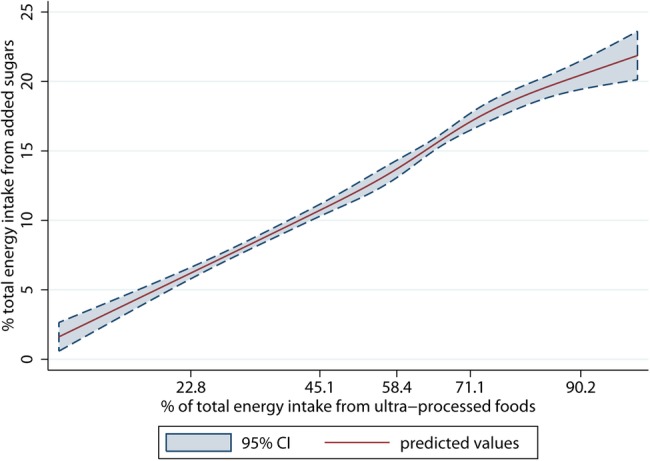
Objectives: To investigate the contribution of ultra-processed foods to the intake of added sugars in the USA. Ultra-processed foods were defined as industrial formulations which, besides salt, sugar, oils and fats, include substances not used in culinary preparations, in particular additives used to imitate sensorial qualities of minimally processed foods and their culinary preparations. Design: Cross-sectional study. Setting: National Health and Nutrition Examination Survey 2009–2010. Participants: We evaluated 9317 participants aged 1+ years with at least one 24 h dietary recall. Main outcome measures: Average dietary content of added sugars and proportion of individuals consuming more than 10% of total energy from added sugars. Data analysis: Gaussian and Poisson regressions estimated the association between consumption of ultra-processed foods and intake of added sugars. All models incorporated survey sample weights and adjusted for age, sex, race/ethnicity, family income and educational attainment. Results: Ultra-processed foods comprised 57.9% of energy intake, and contributed 89.7% of the energy intake from added sugars. The content of added sugars in ultra-processed foods (21.1% of calories) was eightfold higher than in processed foods (2.4%) and fivefold higher than in unprocessed or minimally processed foods and processed culinary ingredients grouped together (3.7%). Both in unadjusted and adjusted models, each increase of 5 percentage points in proportional energy intake from ultra-processed foods increased the proportional energy intake from added sugars by 1 percentage point. Consumption of added sugars increased linearly across quintiles of ultra-processed food consumption: from 7.5% of total energy in the lowest quintile to 19.5% in the highest. A total of 82.1% of Americans in the highest quintile exceeded the recommended limit of 10% energy from added sugars, compared with 26.4% in the lowest. Conclusions: Decreasing the consumption of ultra-processed foods could be an effective way of reducing the excessive intake of added sugars in the USA.
Overview
The claims and statistics of this paper haven’t been checked yet.
Free: it reads the open-access text and checks the first 5 claims that cite a source we can check. Create a free account to check every claim.
Integrity signals
Registry
Cites
Statistics
Figures
Verification
Claims the paper makes
The claims and statistics of this paper haven’t been checked yet.
Free: it reads the open-access text and checks the first 5 claims that cite a source we can check. Create a free account to check every claim.
Claims other papers make about this one
Each is checked against this paper’s own text: does it say what the citing paper says it does?
The cited source says what the claim attributes to it.
In the citing paper
“Ultraprocessed foods13 now contribute the majority of calories consumed in America14 and their overconsumption has been implicated as a causative factor in weight gain15.”
From Maintenance of Lost Weight and Long-Term Management of Obesity (2018) · cites this paper as [14]
The cited source says what the claim attributes to it.
In the citing paper
“Overall, compared to the unprocessed diet, the measurements obtained after the ultra-processed diet were largely unchanged from baseline suggesting that these subjects likely consumed a habitual diet high in ultra-processed foods which might be expected given the high prevalence of ultra-processed food consumption in America (Martinez Steele et al., 2016).”
From Ultra-Processed Diets Cause Excess Calorie Intake and Weight Gain: An Inpatient Randomized Controlled Trial of Ad Libitum Food Intake (2019) · cites this paper as Martinez Steele et al., 2016
In the citing paper
“The typical diet that has become widely adopted in many countries over the past 40 years is relatively low in fruits, vegetables and other fiber- and prebiotic-rich foods66,123–125 and high in refined grains124, alcohol126 and ultra-processed foods125, particularly those containing emulsifiers127.”
From Chronic inflammation in the etiology of disease across the life span (2019) · cites this paper as [125]
Self-check
Percentages, sums and reported differences re-computed from the paper’s own numbers.
The self-check needs the paper’s full text.
Citations
Cites
Sontrop, J. M., Dixon, S. N., Garg, A. X., Buendia-Jimenez, I., Dohein, O., Huang, S.-H. S., & Clark, W. F. (2013) · American Journal of Nephrology · doi:10.1159/000350377 · Cited by 5,871
The United States Department of Agriculture
True, A. C. (1912) · The ANNALS of the American Academy of Political and Social Science · doi:10.1177/000271621204000113 · Cited by 5,113
Moshfegh, A. J., Rhodes, D. G., Baer, D. J., Murayi, T., Clemens, J. C., Rumpler, W. V., Paul, D. R., Sebastian, R. S., Kuczynski, K. J., Ingwersen, L. A., et al. (2008) · The American Journal of Clinical Nutrition · doi:10.1093/ajcn/88.2.324 · Cited by 1,982
Ultra‐processed products are becoming dominant in the global food system
Monteiro, C. A., Moubarac, J. ‐., Cannon, G., Ng, S. W., & Popkin, B. (2013) · Obesity Reviews · doi:10.1111/obr.12107 · Cited by 1,827
Self-citationMoodie, R., Stuckler, D., Monteiro, C., Sheron, N., Neal, B., Thamarangsi, T., Lincoln, P., & Casswell, S. (2013) · The Lancet · doi:10.1016/s0140-6736(12)62089-3 · Cited by 1,663
Self-citationNational health and nutrition examination survey: analytic guidelines, 1999-2010.
Cl, J., Paulose‐Ram, R., Ogden, C. L., Carroll, Kruszon‐Moran, D., Dohrmann, S. M., & Curtin, L. R. (2013) · PubMed · Cited by 1,522
Johnson, R. K., Appel, L. J., Brands, M., Howard, B. V., Lefevre, M., Lustig, R. H., Sacks, F., Steffen, L. M., & Wylie-Rosett, J. (2009) · Circulation · doi:10.1161/circulationaha.109.192627 · Cited by 1,207
Monteiro, C. A., Levy, R. B., Claro, R. M., de Castro, I. R. R., & Cannon, G. (2010) · Public Health Nutrition · doi:10.1017/s1368980010003241 · Cited by 1,060 · cited 1×
“38 Being based on household purchasing data, these two prior studies and others based on the NOVA classi fi cation system 23 39 – 42 could not evaluate the fraction of wasted food nor purchases at restaurants, which represent a substantial proportion of US calories.”
MethodSelf-citationMcGuire, S. (2011) · Advances in Nutrition · doi:10.3945/an.111.000430 · Cited by 1,028
A new classification of foods based on the extent and purpose of their processing
Monteiro, C. A., Levy, R. B., Claro, R. M., Castro, I. R. R. D., & Cannon, G. (2010) · Cadernos de Saúde Pública · doi:10.1590/s0102-311x2010001100005 · Cited by 991 · cited 1×
“38 Being based on household purchasing data, these two prior studies and others based on the NOVA classi fi cation system 23 39 – 42 could not evaluate the fraction of wasted food nor purchases at restaurants, which represent a substantial proportion of US calories.”
MethodSelf-citation
Research works printed but not linked: 4
- Guideline: sugars intake for adults and children. Geneva: World Health Organization, 2015. 25905159
- Bowman SA Diets of individuals based on energy intakes from added sugars. Fam Econ Nutr Rev 1999; 12: 31– 8.
- Monteiro CA, Cannon G, Levy RB Ultra-processing and a new classification of foods. In: Neff R, ed.. Introduction to US food system. Public health, environment, and equity. San Francisco: Jossey Bass A Wiley Brand, 2015: 338– 9.
- Monteiro CA, Cannon G, Levy RB The Food System. Processing. The big issue for disease, good health, well-being. World Nutr 2012; 3: 527– 69. http://www.wphna.org (accessed Aug 2015).
Cited by
Items 601–700 of 1,000
Gholami, F., Lesani, A., Soveid, N., Rasaei, N., Samadi, M., Bahrampour, N., Javdan, G., & Mirzaei, K. (2024) · Aspects of Molecular Medicine · doi:10.1016/j.amolm.2024.100044 · Cited by 5
Nguyen, H., Jones, A., Barrett, E. M., Shahid, M., Gaines, A., Hu, M., Pettigrew, S., Wu, J. H. Y., & Coyle, D. H. (2024) · Nutrition & Dietetics · doi:10.1111/1747-0080.12880 · Cited by 5
Lewis, E. C., Xie, Y., Sundermeir, S. M., Poirier, L., Williamson, S., Lee, S., Pei, X., Stephenson, J., Trujillo, A. J., Igusa, T., et al. (2024) · Nutrients · doi:10.3390/nu16142196 · Cited by 5
Suarez, C., Cheang, S. E., Larke, J. A., Jiang, J., Weng, C.-Y., Stacy, A., Couture, G., Chen, Y., Bacalzo, N. P., Smilowitz, J. T., et al. (2025) · Food Chemistry · doi:10.1016/j.foodchem.2025.142977 · Cited by 5
Healthy eating: a matter of prioritisation by households or policymakers?
Mackenbach, J. D. (2021) · Public Health Nutrition · doi:10.1017/s1368980021000677 · Cited by 5
Factors Associated with Home Food Environment in Low-Income Overweight or Obese Pregnant Women
Chang, M., Lin, C. J., Lee, R. E., & Wegener, D. T. (2022) · Nutrients · doi:10.3390/nu14040869 · Cited by 5
Home availability of ultraprocessed foods in families who prepare meals at home
PRADO, T. R., Mazzonetto, A. C., Botelho, A. M., & Fiates, G. M. R. (2022) · Revista de Nutrição · doi:10.1590/1678-9865202235e210249 · Cited by 5
La actividad física para la salud y la prevención de enfermedades crónicas no transmisibles
Riveros, L. C., Calleja-Núñez, J. J., Millán, E. M. A., Mejía, R. C., Corona, J. A. A., Gómez-Miranda, L. M., Espinoza-Gutiérrez, R., Gutiérrez, C. G., Ortiz-Ortiz, M., Sánchez-Revilla, J., et al. (2022) · Ediciones Comunicación Científica eBooks · doi:10.52501/cc.085 · Cited by 5
Young, B. P. (2019) · Urban Science · doi:10.3390/urbansci3020053 · Cited by 5
(2023) · Nature Climate Change · doi:10.1038/s41558-023-01643-2 · Cited by 5
Capra, B. T., Hudson, S., Phillips, K. M., Marinik, E. L., Laskaridou, E., Johnson, A. L., Wilson, E. A., Dong, M., David, L. A., Ives, N., et al. (2026) · Journal of Nutrition · doi:10.1016/j.tjnut.2026.101370 · Cited by 4
Highly Processed Foods in Binge‐Eating Episodes: The Importance of Improving Food Reporting
Worth, I. A., Fazzino, T. L., Sonneville, K. R., Klump, K. L., & Gearhardt, A. N. (2026) · International Journal of Eating Disorders · doi:10.1002/eat.70069 · Cited by 4
What do parents of children know about food additives in selected foods?
Polak, P., & Osmala-Kurpiewska, W. (2024) · Polish Annals of Medicine · doi:10.29089/paom/181533 · Cited by 4
Rivero‐Mendoza, D., & Dahl, W. J. (2020) · EDIS · doi:10.32473/edis-fs402-2020 · Cited by 4
Santos, D. F. C., Souza, M. A., de Almeida, A. Q., & de Carvalho, I. M. M. (2020) · International Journal of Gastronomy and Food Science · doi:10.1016/j.ijgfs.2020.100292 · Cited by 4
Garay, J. V. L., Dextre, M. L., & Lozada-Urbano, M. F. (2022) · Revista de Investigación de la Universidad Norbert Wiener · doi:10.37768/unw.rinw.11.01.a0002 · Cited by 4
Walker, M. S., de Andrades, C. D. S., Richrot, T. S., Closs, V. E., Gustavo, A. D. S., Oliveira, M. D. S., Donadio, M. V. F., & Feóli, A. M. P. (2022) · Saúde e Pesquisa · doi:10.17765/2176-9206.2022v15n1.e9700 · Cited by 4
Oruçoğlu, B., Durmuş, E., & Kemaloğlu, M. (2024) · Gümüşhane Üniversitesi Sağlık Bilimleri Dergisi · doi:10.37989/gumussagbil.1271480 · Cited by 4
Impacts of Food Delivery Culture on Dietary Health Among Young Adults in Shanghai
Yang, T. (2025) · Asia Pacific Economic and Management Review · doi:10.62177/apemr.v2i4.450 · Cited by 4
Lucinian, Y. A., Gagnon, C., Latour, É., Hamel, V., Iglesies‐Grau, J., Nigam, A., Harel, F., Nozza, A., Juneau, M., Moubarac, J., et al. (2025) · Scientific Reports · doi:10.1038/s41598-025-11734-z · Cited by 4
Self-citationSex modifies the renal consequences of high fructose consumption introduced after weaning
Monteiro, L. M., Barbosa, C. F., Kimura, D. C., Argeri, R., & Gomes, G. N. (2023) · Frontiers in Physiology · doi:10.3389/fphys.2023.1090090 · Cited by 4
Food pyramid intake and nutrient profiles of Brazilian girls
Leme, A. C. B., & Philippi, S. T. (2017) · Nutrition & Food Science · doi:10.1108/nfs-02-2017-0024 · Cited by 4
The Pediatric Obesity Encounter: Literature and Resources to Help with 4 Common Issues
Zachary, M., & Sisley, S. R. (2020) · Current Nutrition Reports · doi:10.1007/s13668-020-00308-2 · Cited by 4
Influences on Parents’ Food Shopping for Children’s Consumption in South Carolina
Monalisa, N. N. (2020) · Scholar Commons (University of South Carolina) · Cited by 4
The NOVA system and ultra-processed foods in relation to consumer decision-making in foods choice
Angelovičová, M., Zeleňáková, L., Zajác, P., & Čapla, J. (2020) · Potravinarstvo Slovak Journal of Food Sciences · doi:10.5219/1358 · Cited by 4
Hidden Sugar and its Bitter Obstacles for the Wellbeing of Consumers
Ngo, A. N. (2020) · Markets Globalization & Development Review · doi:10.23860/mgdr-2020-05-02-02 · Cited by 4
Altavilla, C., Joulianos, A., Comeche, J. M., & Caballero, P. (2021) · Archivos de medicina del deporte: revista de la Federación Española de Medicina del Deporte y de la Confederación Iberoamericana de Medicina del Deporte · doi:10.18176/archmeddeporte.00034 · Cited by 4
Subramaniam, A., Park, B.-J., Raphael, D., Landstrom, M., & Hayes, K. C. (2022) · Nutrients · doi:10.3390/nu14153064 · Cited by 4
Sex-specific transgenerational effects of diet on offspring life history and physiology
Camilleri-Carter, T.-L., Piper, M. D. W., Robker, R. L., & Dowling, D. K. (2024) · Proceedings of the Royal Society B Biological Sciences · doi:10.1098/rspb.2024.0062 · Cited by 5
Heredia, C. R. (2022) · Publicar en antropología y ciencias sociales · Cited by 4
Scott, C. (2017) · LSHTM Research Online (London School of Hygiene and Tropical Medicine) · doi:10.17037/pubs.03894606 · Cited by 4
Machado, P. P. (2019) · Digital Library of Theses and Dissertations (Universidade de São Paulo) · doi:10.11606/t.6.2019.tde-13092019-123522 · Cited by 4
Leffa, P. D. S. (2021) · Elsevier eBooks · doi:10.1016/b978-0-12-821848-8.00009-3 · Cited by 4
Huybrechts, I., Rauber, F., Nicolas, G., Casagrande, C., Kliemann, N., Wedekind, R., Biessy, C., Scalbert, A., Touvier, M., Aleksandrova, K., et al. (2023) · Frontiers in Nutrition · doi:10.3389/fnut.2023.1207555 · Cited by 4
Self-citationThe Role of Processing-Related Labels in Consumer Identification and Choice of Ultra-Processed Foods
Gomez, P. (2025) · Journal of Consumer Policy · doi:10.1007/s10603-025-09595-0 · Cited by 3
Witek, K., Wydra, K., Suder, A., & Filip, M. (2025) · Pharmacological Reports · doi:10.1007/s43440-025-00785-8 · Cited by 3
Quality Assessment of Methodological Aspects in Microplastics Studies on Processed Food
Mahmod, A., & Praveena, S. M. (2025) · Journal of Analytical Chemistry · doi:10.1134/s1061934825700819 · Cited by 3
Identifying dietary pattern associated with adiposity among Malaysian young adults
Kaur, S., Ng, C. M., Yap, W. L., Teoh, A. N., & Chew, W. L. (2021) · Mediterranean Journal of Nutrition and Metabolism · doi:10.3233/mnm-211541 · Cited by 3
Costa-Bartuli, E., Rodrigues, A. T., Bastos, S. A. R., Kistenmacker, N., Crepaldi, L., Takiya, C. M., Zancan, P., Gomes, F. M., & Sola‐Penna, M. (2023) · Journal of Interferon & Cytokine Research · doi:10.1089/jir.2023.0047 · Cited by 3
Belarmino, E. H., Carfagno, M., Kam, L., Ifeagwu, K.-C. C., Nelson, M. E., & Seguin‐Fowler, R. A. (2024) · Public Health Nutrition · doi:10.1017/s1368980024000636 · Cited by 3
Wierzejska, R. E., Wiosetek-Reske, A., & Wojda, B. K. (2024) · Beverages · doi:10.3390/beverages10030085 · Cited by 3
Parental Obesity: The Pandemic of Intergenerational Physical and Mental Health Carnage
Myers-Morrison, C. (2023) · International Journal of Integrative Pediatrics and Environmental Medicine · doi:10.36013/ijipem.v8i.104 · Cited by 3
Coronary Heart Disease: Nutritional Interventions for Prevention and Therapy
Ferrari, M., Woodside, J. V., Brennan, S., & Temple, N. J. (2023) · Nutrition and health · doi:10.1007/978-3-031-24663-0_8 · Cited by 3
Ye, Y., & Shu, X. (2025) · Social Science & Medicine · doi:10.1016/j.socscimed.2025.117732 · Cited by 3
Venu, S., Rajesh, G., Pillai, B. V., Biswas, L., Poojara, R. H., & Raj, M. (2025) · BMJ Paediatrics Open · doi:10.1136/bmjpo-2024-003138 · Cited by 3
Food, energy, and nutrient supply in Mexican households from 1984 to 2018
Ortiz-Hernández, L., Romo-Avilés, M., & Chavez, J. R. (2021) · Nutrición Hospitalaria · doi:10.20960/nh.03686 · Cited by 3
Restoring gut biome balance for weight loss: clinical applications
Bhat, N., Bhat, J., Bhat, K., Junaid, I., Bhat, A., & Bhat, J. (2022) · Elsevier eBooks · doi:10.1016/b978-0-12-822238-6.00022-4 · Cited by 3
Kamanga, P., Zhang, B., & Kaphera, S. (2022) · International Journal of Child Health and Nutrition · doi:10.6000/1929-4247.2022.11.03.2 · Cited by 3
Finnell, J. E., & Ferrario, C. R. (2023) · Appetite · doi:10.1016/j.appet.2023.106556 · Cited by 3
Elfassy, T., Juul, F., Mesa, R. A., Palaniappan, L. P., Srinivasan, M., & Yi, S. S. (2023) · Research on Aging · doi:10.1177/01640275231222928 · Cited by 3
Alimentos ultraprocesados: repercusiones sobre la salud
Posada, S. (2018) · LA Referencia (Red Federada de Repositorios Institucionales de Publicaciones Científicas) · Cited by 3
市町村国保の特定健診受診者における家庭内・家庭外別食塩摂取源 -神奈川県真鶴町の事例-
小岩井馨, 武見, ゆ., 林, 芙., 緒方, 裕., 坂口, 景., 嶋田, 雅., 川畑, 輝., 野藤, 悠., & 中村, 正. (2019) · 日本健康教育学会誌 · doi:10.11260/kenkokyoiku.27.13 · Cited by 3
Modeling the Automation Level of Cyber-Physical Systems Designed for Food Preparation
Mujtaba, D. F., & Mahapatra, N. R. (2019) · International Symposium on Embedded Computing and System Design (ISED) · doi:10.1109/ised48680.2019.9096241 · Cited by 3
Consumo de alimentos ultraprocessados e qualidade nutricional da dieta na população americana
Baraldi, L. G. (2017) · Digital Library of Theses and Dissertations (Universidade de São Paulo) · doi:10.11606/t.6.2017.tde-06042017-093026 · Cited by 3
Self-citationFerraz, M. D. A. (2020) · Digital Library of Theses and Dissertations (Universidade de São Paulo) · doi:10.11606/t.2.2020.tde-22032021-230904 · Cited by 3
Serafim, P. A. (2021) · Digital Library of Theses and Dissertations (Universidade de São Paulo) · doi:10.11606/d.6.2021.tde-11062021-171554 · Cited by 3
Folwarczny, M., Otterbring, T., Sigurðsson, V., Tan, L. K. L., & Li, N. P. (2021) · PsyArXiv (OSF Preprints) · doi:10.31234/osf.io/zdrpq · Cited by 3
Informatics for Food ProcessingPreprint
Ispirova, G., Sebek, M., & Menichetti, G. (2025) · PubMed Central · doi:10.48550/arxiv.2505.17087 · Cited by 3
Cooper, K., Ankrum, A., Clarke, M. A., Boron, J. B., Ponce, J., & Bass, A. E. (2024) · IEEE International Conference on Healthcare Informatics (ICHI) · doi:10.1109/ichi61247.2024.00033 · Cited by 2
Parra-Soto, S. L., Díaz, M. C., Ríos-Castillo, I., Morales, G. I., Araneda‐Flores, J., Landaeta‐Díaz, L., Gómez, G., Murillo, A. G., Carpio-Arias, T. V., Cavagnari, B. M., et al. (2025) · Archivos Latinoamericanos de Nutrición · doi:10.37527/2025.75.2.005 · Cited by 2
Obesity: a disease of the ponderostat and the regulation of energy balance
Buscemi, S., Buscemi, C., Colombrita, P., Randazzo, C., Barile, A. M., & Arnaldi, G. (2025) · Eating and Weight Disorders - Studies on Anorexia Bulimia and Obesity · doi:10.1007/s40519-025-01790-9 · Cited by 2
The potential hazards of ultra-processed foods on gastrointestinal health
Chen, X., Liao, X., Liu, L., Yan, H., Ding, T., Wei, W., & Feng, J. (2025) · Future Foods · doi:10.1016/j.fufo.2025.100826 · Cited by 2
Shanbehzadeh, N., Samadi, M., Dastsouz, F., Lesani, A., & Gholami, F. (2026) · Scientific Reports · doi:10.1038/s41598-025-30049-7 · Cited by 2
Musich, M. L., Shenker, J. I., & Beversdorf, D. Q. (2026) · Journal of dementia and Alzheimer's disease · doi:10.3390/jdad3010004 · Cited by 2
Khan, M. T., Mohanty, S., Devi, S., Sharma, S., & Tripathi, P. (2026) · Molecular Nutrition & Food Research · doi:10.1002/mnfr.70368 · Cited by 2
Consumption of ultra-processed foods and increased risks of cardiovascular disease in US adults
Willett, Y., Yang, C., Dunn, J., Benson, K., Sajan, K., Ferris, A. H., Dye, T., & Hennekens, C. H. (2026) · The American Journal of Medicine · doi:10.1016/j.amjmed.2026.01.012 · Cited by 2
Lemmon, B., Grummon, A. H., Marquez, A., Miller, L. M. S., Au, L. E., Brown, S. D., Wang, A., Powell, L. M., & Falbe, J. (2026) · The Lancet Public Health · doi:10.1016/s2468-2667(26)00027-7 · Cited by 2
Louie, J. C. Y. (2026) · Journal of Nutrition · doi:10.1016/j.tjnut.2026.101575 · Cited by 2
Corsetti, G., & Pasini, E. (2026) · Nutrients · doi:10.3390/nu18111703 · Cited by 2
Bernardino, M. E., Sison, N. K., Alcantara, M. T. C., Tiribelli, C., & Rosso, N. (2026) · Exploration of Foods and Foodomics · doi:10.37349/eff.2026.1010171 · Cited by 2
Understanding human diet, disease, and insulin resistance: scientific and evolutionary perspectives
Noakes, T. D., Crofts, C. A. P., & Ben‐Dor, M. (2023) · Elsevier eBooks · doi:10.1016/b978-0-12-821617-0.00011-5 · Cited by 2
Maternal Mediterranean Diet During Lactation and Infant Growth
Grabowski, A., Baylín, A., Ellsworth, L. A., Richardson, J., Kaciroti, N., Sturza, J. S., Miller, A. L., Gearhardt, A. N., Lumeng, J. C., & Gregg, B. E. (2024) · Breastfeeding Medicine · doi:10.1089/bfm.2024.0133 · Cited by 2
Food Justice: At the Intersection of Policy and Culture
Watson, K. E. (2024) · Oxford University Press eBooks · doi:10.1093/oso/9780197642535.003.0015 · Cited by 2
Leonberg, K. E., Maski, M. R., Scott, T. M., Chen, Y., Zhou, B., & Naumova, E. N. (2025) · Discover Public Health · doi:10.1186/s12982-025-00549-y · Cited by 2
Reflections Regarding the Social Ecological Model to Address Obesity in Southern California Youth
Lemus, B. A., Mercado, F., Bryars, T., Mouttapa, M., Conkey, T., & Robertson, T. (2016) · Californian Journal of Health Promotion · doi:10.32398/cjhp.v14i3.2069 · Cited by 2
Sugar-Sweetened Beverage Taxes: Origins, Mechanisms, and Current Worldwide Status
Ferretti, F. F. (2020) · Springer eBooks · doi:10.1007/978-3-030-53370-0_63 · Cited by 2
Insulinemic potential of diet and the risk of type 2 diabetes: a meta-analysis and systematic review
Farhadnejad, H., Abbasi, M., Ahmadirad, H., Omrani, M., Jahromi, M. K., Norouzzadeh, M., Saber, N., Teymoori, F., & Mirmiran, P. (2024) · Diabetology & Metabolic Syndrome · doi:10.1186/s13098-024-01474-x · Cited by 2
Beneath the Bun: Food additives in fast-food burgers and the path to healthier choices
Besedin, D. A., Carter, S., Shah, R., Van, T. T. H., & Eri, R. D. (2025) · Food and Humanity · doi:10.1016/j.foohum.2025.100646 · Cited by 2
Social Determinants of the Transition in Food Consumption in Paraíba, Brazil, Between 2008 and 2018
de Oliveira, S. F., Vianna, R. P. D. T., Palmeira, P. D. A., Ferreira, F. E. L. D. L., Moreira, P. V. L., Neta, A. D. C. P. D. A., Gomes, N. I. G., Neto, E. D. A. L., & de Lima, R. L. F. C. (2025) · Nutrients · doi:10.3390/nu17152550 · Cited by 2
Panda, C., Kruse, R. A., Williams, K., Nance, B., Gudavalli, M. R., Pourafshar, S., Metzger, B. T., & Komarnytsky, S. (2025) · Frontiers in Nutrition · doi:10.3389/fnut.2025.1621709 · Cited by 2
The Impact of Ultra-Processed Foods on the Risk of Developing Chronic Diseases
Степаненко, Д. С. (2025) · Universal library of medical and health sciences. · doi:10.70315/uloap.ulmhs.2025.0302012 · Cited by 2
Heredia, C. R. (2023) · Etnografías contemporáneas · Cited by 2
Varela‐Moreiras, G., Samaniego-Vaesken, M. D. L., & Partearroyo, T. (2019) · Nutrición Hospitalaria · doi:10.20960/nh.02799 · Cited by 2
GIFT, transnational corporations and the sixth mass extinction
Shrimpton, R. (2019) · World Nutrition · doi:10.26596/wn.2019104143-146 · Cited by 2
Refined food addiction and its relation to obesity
Kahan, L. G., & Mehrzad, R. (2020) · Elsevier eBooks · doi:10.1016/b978-0-12-818839-2.00013-2 · Cited by 2
Medical Nutrition Therapy for Lipid and Lipoprotein Disorders
Sapp, P. A., Johnston, E. A., Petersen, K. H., Fleming, J. A., & Kris‐Etherton, P. M. (2020) · Contemporary cardiology · doi:10.1007/978-3-030-56514-5_9 · Cited by 2
Lima, B. N. D. B. M., Gapanowicz, D. P., Santos, M. R., & Moreira, A. S. B. (2021) · Brazilian Journal of Health Review · doi:10.34119/bjhrv4n3-169 · Cited by 2
Obesity as a Major Health Hazard
Tappia, P. S., & Dhalla, N. S. (2021) · Advances in biochemistry in health and disease · doi:10.1007/978-3-030-84763-0_1 · Cited by 2
Analysis of Recipes Shared as ‘Healthy’ in a Popular Brazilian Website: A Cross-Sectional Study
de Camargo, A. M., Botelho, A. M., Irmão, G. B., & Fiates, G. M. R. (2022) · International Journal of Environmental Research and Public Health · doi:10.3390/ijerph192113914 · Cited by 2
Updates in the Medical and Nutritional Management of Short Gut Syndrome
Mathews, S. N., & Ravella, S. (2023) · Current Treatment Options in Gastroenterology · doi:10.1007/s11938-023-00419-z · Cited by 3
Barh, D., Aburjaile, F. F., Tavares, T. S., da Silva, M. E., Bretz, G. P. M., Rocha, I. F. M., Dey, A., de Souza, R. P., Goés‐Neto, A., Ribeiro, S. P., et al. (2023) · International Journal of Microbiology Research · doi:10.4103/ijmr.ijmr_1701_22 · Cited by 2
ROTULAGEM DE ÁCIDOS GRAXOS TRANS: REVISÃO SOBRE BRASIL E ESTADOS UNIDOS
Moreno, L. P. Z., & von Atzingen, M. C. B. C. (2022) · Vita sanitas/Vita et sanitas · Cited by 2
Fatores associados ao consumo de grupos alimentares em adolescentes da cidade de São Paulo
de Mendonça, M. F. M. (2017) · Digital Library of Theses and Dissertations (Universidade de São Paulo) · doi:10.11606/t.6.2017.tde-05012017-111401 · Cited by 2
de França, N. A. G. (2019) · Digital Library of Theses and Dissertations (Universidade de São Paulo) · doi:10.11606/t.6.2019.tde-27062019-150226 · Cited by 2
Prebiotic Carbohydrate Profiles of Lentil, Chickpea, and Common Bean
Siva, N. (2019) · TigerPrints (Clemson University) · Cited by 2
Ng, S. W., Hoerger, T. J., & Nugent, R. A. (2021) · doi:10.3768/rtipress.2021.pb.0025.2105 · Cited by 2
Introduction to cardiology and lifestyle medicine
Rozanski, A. (2023) · Progress in Cardiovascular Diseases · doi:10.1016/j.pcad.2023.04.005 · Cited by 2
Shannon, L., & Avery, A. (2025) · Research Square · doi:10.21203/rs.3.rs-6448214/v1 · Cited by 2
Salamanca‐Fernández, E. (2020) · Institutional Repository of the University of Granada (University of Granada) · Cited by 2
Cooper, J. (2024) · Otago University Research Archive (University of Otago) · Cited by 2
Metadata
- Authors
- Martínez Steele, E., Baraldi, L. G., Louzada, M. L. D. C., Moubarac, J.-C., Mozaffarian, D., & Monteiro, C. A.
- Affiliations
- Department of Nutrition, School of Public Health, University of São Paulo, São Paulo, Brazil
- Universidade de São Paulo (BR)
- Tufts University (US)
- Corresponding author
- Monteiro, Carlos Augusto
- ORCID
- Venue
- BMJ Open
- Publisher
- BMJ
- Published
- 2016-01
- Volume
- 6
- Issue
- 3
- Pages
- e009892
- ISSN
- 2044-6055 (ISSN-L)
- PMC
- PMC4785287
- OpenAlex
- W2293621304
- Cited by
- 838
- References
- 29
- Citations by year
- 2026: 48 · 2025: 68 · 2024: 84 · 2023: 112 · 2022: 122 · 2021: 104 · 2020: 92 · 2019: 94 · 2018: 37 · 2017: 58 · 2016: 18
- FWCI
- 68.41
- Type
- journal article
- Language
- en
- Open access
- gold
- doi.org
- Licence
- cc-by-nc
- Locations
- BMJ Open (publishedVersion, cc-by-nc)
- PubMed Central (publishedVersion, cc-by-nc)
- PubMed (publishedVersion)
- HighWire Press Open Archive (submittedVersion)
- Funders
- Amarin Corporation
- South Dakota Governor's Office of Economic Development
- Ministério da Ciência, Tecnologia e Inovação (14/2014)
- Conselho Nacional de Desenvolvimento Científico e Tecnológico (14‐2014, MCTI/CNPq/Universal 14/, Universal 14/2014)
- Topics
- Health Sciences › Medicine › Public Health, Environmental and Occupational Health › Consumer Attitudes and Food Labeling
- Health Sciences › Medicine › Endocrinology, Diabetes and Metabolism › Diet, Metabolism, and Disease
- Health Sciences › Medicine › Public Health, Environmental and Occupational Health › Global Public Health Policies and Epidemiology
- Keywords
- ultra-processed foods, added sugars, dietary intake, energy intake, sugar-sweetened beverages, processed foods, minimally processed foods, food additives
- MeSH terms
- Adolescent, Adult, Aged, Aged, 80 and over, Energy Intake, Child, Child, Preschool, Cross-Sectional Studies, Diet, Female, Humans, Infant, Male, Middle Aged, Nutrition Surveys, Regression Analysis, Socioeconomic Factors, United States, Dietary Sucrose, Young Adult, Fast Foods
About these checks
Registry, retraction, Cites and statistics results are computed, not judged, with one exception: a printed reference that no index lists is read once by a model before it counts as a citation error. Claims are extracted by a model and kept only when their quote appears verbatim in the text; each cited source is then checked, with a model’s help, for whether it says what the claim relies on. Those verdicts can be wrong — read the claim’s quote and the cited source before relying on one.
Statistics and arithmetic are recomputed, not judged.
Confidence bands are shown only for fields calibrated on our annotated test set. None is calibrated yet, so no band is shown.
What counts as a claim ›How we measure confidence ›How we check this ›
Are you an author, or do you see a problem with this page? Request a review
Data sources
Bibliographic data: Semantic Scholar, OpenAlex, Crossref.
Contains information from the Semantic Scholar Academic Graph Datasets, made available under the ODC Attribution License (ODC-BY 1.0).
Semantic Scholar’s data is described in: Kinney, R., et al. (2023). The Semantic Scholar Open Data Platform. arXiv:2301.10140.
