

Ultra-processed foods and added sugars in the US diet: evidence from a nationally representative cross-sectional study
Open accessThe DOI matches its Crossref record; 29 of the 29 references it cites were found in a registry or an index.
Abstract
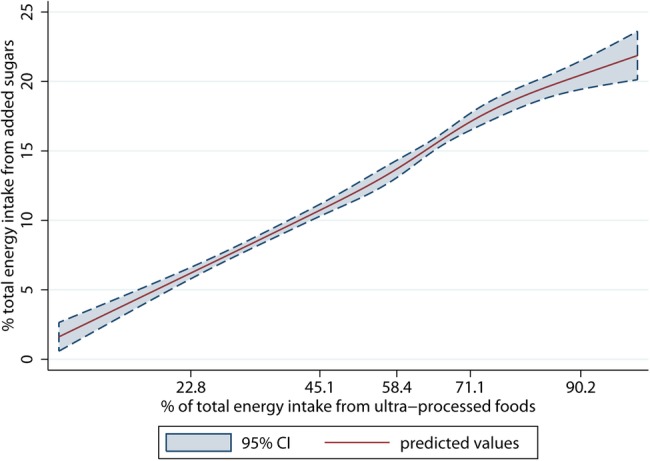
Objectives: To investigate the contribution of ultra-processed foods to the intake of added sugars in the USA. Ultra-processed foods were defined as industrial formulations which, besides salt, sugar, oils and fats, include substances not used in culinary preparations, in particular additives used to imitate sensorial qualities of minimally processed foods and their culinary preparations. Design: Cross-sectional study. Setting: National Health and Nutrition Examination Survey 2009–2010. Participants: We evaluated 9317 participants aged 1+ years with at least one 24 h dietary recall. Main outcome measures: Average dietary content of added sugars and proportion of individuals consuming more than 10% of total energy from added sugars. Data analysis: Gaussian and Poisson regressions estimated the association between consumption of ultra-processed foods and intake of added sugars. All models incorporated survey sample weights and adjusted for age, sex, race/ethnicity, family income and educational attainment. Results: Ultra-processed foods comprised 57.9% of energy intake, and contributed 89.7% of the energy intake from added sugars. The content of added sugars in ultra-processed foods (21.1% of calories) was eightfold higher than in processed foods (2.4%) and fivefold higher than in unprocessed or minimally processed foods and processed culinary ingredients grouped together (3.7%). Both in unadjusted and adjusted models, each increase of 5 percentage points in proportional energy intake from ultra-processed foods increased the proportional energy intake from added sugars by 1 percentage point. Consumption of added sugars increased linearly across quintiles of ultra-processed food consumption: from 7.5% of total energy in the lowest quintile to 19.5% in the highest. A total of 82.1% of Americans in the highest quintile exceeded the recommended limit of 10% energy from added sugars, compared with 26.4% in the lowest. Conclusions: Decreasing the consumption of ultra-processed foods could be an effective way of reducing the excessive intake of added sugars in the USA.
Overview
The claims and statistics of this paper haven’t been checked yet.
Free: it reads the open-access text and checks the first 5 claims that cite a source we can check. Create a free account to check every claim.
Integrity signals
Registry
Cites
Statistics
Figures
Verification
Claims the paper makes
The claims and statistics of this paper haven’t been checked yet.
Free: it reads the open-access text and checks the first 5 claims that cite a source we can check. Create a free account to check every claim.
Claims other papers make about this one
Each is checked against this paper’s own text: does it say what the citing paper says it does?
The cited source says what the claim attributes to it.
In the citing paper
“Ultraprocessed foods13 now contribute the majority of calories consumed in America14 and their overconsumption has been implicated as a causative factor in weight gain15.”
From Maintenance of Lost Weight and Long-Term Management of Obesity (2018) · cites this paper as [14]
The cited source says what the claim attributes to it.
In the citing paper
“Overall, compared to the unprocessed diet, the measurements obtained after the ultra-processed diet were largely unchanged from baseline suggesting that these subjects likely consumed a habitual diet high in ultra-processed foods which might be expected given the high prevalence of ultra-processed food consumption in America (Martinez Steele et al., 2016).”
From Ultra-Processed Diets Cause Excess Calorie Intake and Weight Gain: An Inpatient Randomized Controlled Trial of Ad Libitum Food Intake (2019) · cites this paper as Martinez Steele et al., 2016
In the citing paper
“The typical diet that has become widely adopted in many countries over the past 40 years is relatively low in fruits, vegetables and other fiber- and prebiotic-rich foods66,123–125 and high in refined grains124, alcohol126 and ultra-processed foods125, particularly those containing emulsifiers127.”
From Chronic inflammation in the etiology of disease across the life span (2019) · cites this paper as [125]
Self-check
Percentages, sums and reported differences re-computed from the paper’s own numbers.
The self-check needs the paper’s full text.
Citations
Cites
Sontrop, J. M., Dixon, S. N., Garg, A. X., Buendia-Jimenez, I., Dohein, O., Huang, S.-H. S., & Clark, W. F. (2013) · American Journal of Nephrology · doi:10.1159/000350377 · Cited by 5,871
The United States Department of Agriculture
True, A. C. (1912) · The ANNALS of the American Academy of Political and Social Science · doi:10.1177/000271621204000113 · Cited by 5,113
Moshfegh, A. J., Rhodes, D. G., Baer, D. J., Murayi, T., Clemens, J. C., Rumpler, W. V., Paul, D. R., Sebastian, R. S., Kuczynski, K. J., Ingwersen, L. A., et al. (2008) · The American Journal of Clinical Nutrition · doi:10.1093/ajcn/88.2.324 · Cited by 1,982
Ultra‐processed products are becoming dominant in the global food system
Monteiro, C. A., Moubarac, J. ‐., Cannon, G., Ng, S. W., & Popkin, B. (2013) · Obesity Reviews · doi:10.1111/obr.12107 · Cited by 1,827
Self-citationMoodie, R., Stuckler, D., Monteiro, C., Sheron, N., Neal, B., Thamarangsi, T., Lincoln, P., & Casswell, S. (2013) · The Lancet · doi:10.1016/s0140-6736(12)62089-3 · Cited by 1,663
Self-citationNational health and nutrition examination survey: analytic guidelines, 1999-2010.
Cl, J., Paulose‐Ram, R., Ogden, C. L., Carroll, Kruszon‐Moran, D., Dohrmann, S. M., & Curtin, L. R. (2013) · PubMed · Cited by 1,522
Johnson, R. K., Appel, L. J., Brands, M., Howard, B. V., Lefevre, M., Lustig, R. H., Sacks, F., Steffen, L. M., & Wylie-Rosett, J. (2009) · Circulation · doi:10.1161/circulationaha.109.192627 · Cited by 1,207
Monteiro, C. A., Levy, R. B., Claro, R. M., de Castro, I. R. R., & Cannon, G. (2010) · Public Health Nutrition · doi:10.1017/s1368980010003241 · Cited by 1,060 · cited 1×
“38 Being based on household purchasing data, these two prior studies and others based on the NOVA classi fi cation system 23 39 – 42 could not evaluate the fraction of wasted food nor purchases at restaurants, which represent a substantial proportion of US calories.”
MethodSelf-citationMcGuire, S. (2011) · Advances in Nutrition · doi:10.3945/an.111.000430 · Cited by 1,028
A new classification of foods based on the extent and purpose of their processing
Monteiro, C. A., Levy, R. B., Claro, R. M., Castro, I. R. R. D., & Cannon, G. (2010) · Cadernos de Saúde Pública · doi:10.1590/s0102-311x2010001100005 · Cited by 991 · cited 1×
“38 Being based on household purchasing data, these two prior studies and others based on the NOVA classi fi cation system 23 39 – 42 could not evaluate the fraction of wasted food nor purchases at restaurants, which represent a substantial proportion of US calories.”
MethodSelf-citation
Research works printed but not linked: 4
- Guideline: sugars intake for adults and children. Geneva: World Health Organization, 2015. 25905159
- Bowman SA Diets of individuals based on energy intakes from added sugars. Fam Econ Nutr Rev 1999; 12: 31– 8.
- Monteiro CA, Cannon G, Levy RB Ultra-processing and a new classification of foods. In: Neff R, ed.. Introduction to US food system. Public health, environment, and equity. San Francisco: Jossey Bass A Wiley Brand, 2015: 338– 9.
- Monteiro CA, Cannon G, Levy RB The Food System. Processing. The big issue for disease, good health, well-being. World Nutr 2012; 3: 527– 69. http://www.wphna.org (accessed Aug 2015).
Cited by
Items 101–200 of 1,000
Moradi, S., Hojjati Kermani, M. A., Bagheri, R., Mohammadi, H., Jayedi, A., Lane, M. M., Asbaghi, O., Mehrabani, S., & Suzuki, K. (2021) · Nutrients · doi:10.3390/nu13124410 · Cited by 116
Ultra-processed foods and type-2 diabetes risk in the SUN project: A prospective cohort study
Llavero-Valero, M., Escalada-San Martín, J., Martínez-González, M. A., Basterra-Gortari, F. J., de la Fuente-Arrillaga, C., & Bes-Rastrollo, M. (2021) · Clinical Nutrition · doi:10.1016/j.clnu.2021.03.039 · Cited by 115
Martínez Steele, E., Khandpur, N., da Costa Louzada, M. L., & Monteiro, C. A. (2020) · PLOS ONE · doi:10.1371/journal.pone.0236738 · Cited by 113
Self-citationFood consumption by degree of processing and cardiometabolic risk: a systematic review
Silva Meneguelli, T., Viana Hinkelmann, J., Hermsdorff, H. H. M., Zulet, M. Á., Martínez, J. A., & Bressan, J. (2020) · International Journal of Food Sciences and Nutrition · doi:10.1080/09637486.2020.1725961 · Cited by 112
Capozzi, F., Magkos, F., Fava, F., Milani, G. P., Agostoni, C. V., Astrup, A. V., & Saguy, I. S. (2021) · Nutrients · doi:10.3390/nu13113948 · Cited by 113
Davidou, S., Christodoulou, A., Fardet, A., & Frank, K. (2020) · Food & Function · doi:10.1039/c9fo02271f · Cited by 113
Djupegot, I. L., Nenseth, C. B., Bere, E., Bjørnarå, H. B. T., Helland, S. H., Øverby, N. C., Torstveit, M. K., & Stea, T. H. (2017) · BMC Public Health · doi:10.1186/s12889-017-4408-3 · Cited by 109
Phillips, N., Mareschal, J., Schwab, N., Manoogian, E., Borloz, S., Ostinelli, G., Gauthier-Jaques, A., Umwali, S., Gonzalez Rodriguez, E., Aeberli, D., et al. (2021) · Nutrients · doi:10.3390/nu13031042 · Cited by 109
Zhu, W., Iskandar, M. M., Baeghbali, V., & Kubow, S. J. (2023) · Foods · doi:10.3390/foods12173287 · Cited by 110
Ultra-Processed Food Intake and Increased Risk of Obesity: A Narrative Review
Monda, A., de Stefano, M. I., Villano, I., Allocca, S., Casillo, M., Messina, A., Monda, V., Moscatelli, F., Dipace, A., Limone, P., et al. (2024) · Foods · doi:10.3390/foods13162627 · Cited by 113
Association of Ultraprocessed Food Consumption With Risk of Dementia: A Prospective Cohort Study
Li, H., Li, S., Yang, H., Zhang, Y., Zhang, S., Ma, Y., Hou, Y., Zhang, X., Niu, K., Borné, Y., et al. (2022) · Neurology · doi:10.1212/wnl.0000000000200871 · Cited by 107
“It is worth noting that the mean contribution of UPF in total energy intake can reach up to 50% in some high-income and, increasingly, middle-income countries.(6,7) These trends have coincided with a transition toward diets linked to the increasing prevalence of chronic diseases in many countries.”
BackgroundSugars and Gastrointestinal Health
Arnone, D., Chabot, C., Heba, A.-C., Kökten, T., Caron, B., Hansmannel, F., Dreumont, N., Ananthakrishnan, A. N., Quilliot, D., & Peyrin‐Biroulet, L. (2021) · Clinical Gastroenterology and Hepatology · doi:10.1016/j.cgh.2021.12.011 · Cited by 106
Impacts of Consumption of Ultra-Processed Foods on the Maternal-Child Health: A Systematic Review
de Oliveira, P. G., de Sousa, J. M., Assunção, D. G. F., de Araújo, E. K. S., Bezerra, D. S., Dametto, J. F. D. S., & Ribeiro, K. D. D. S. (2022) · Frontiers in Nutrition · doi:10.3389/fnut.2022.821657 · Cited by 105
Ultra-processed family foods in Australia: nutrition claims, health claims and marketing techniques
Pulker, C. E., Scott, J. A., & Pollard, C. M. (2018) · Public Health Nutrition · doi:10.1017/s1368980017001148 · Cited by 104
Machado, P. P., Steele, E. M., Louzada, M. L. D. C., Levy, R. B., Rangan, A., Woods, J., Gill, T., Scrinis, G., & Monteiro, C. A. (2020) · European Journal of Nutrition · doi:10.1007/s00394-019-02125-y · Cited by 104
Self-citationHess, J. M., Comeau, M. E., Casperson, S., Slavin, J. L., Johnson, G. H., Messina, M., Raatz, S., Scheett, A. J., Bodensteiner, A., & Palmer, D. G. (2023) · The Journal of Nutrition · doi:10.1016/j.tjnut.2023.06.028 · Cited by 103
The concept of “food addiction” helps inform the understanding of overeating and obesity: YES
Gearhardt, A. N., & Hebebrand, J. (2020) · American Journal of Clinical Nutrition · doi:10.1093/ajcn/nqaa343 · Cited by 102
Nasreddine, L., Tamim, H., Itani, L., Nasrallah, M. P., Isma’eel, H., Nakhoul, N. F., Abou-Rizk, J., & Naja, F. (2018) · Public Health Nutrition · doi:10.1017/s1368980017002130 · Cited by 101
Shim, J., Shim, S. Y., Cha, H.-J., Kim, J., & Kim, H. C. (2021) · Journal of the Academy of Nutrition and Dietetics · doi:10.1016/j.jand.2021.07.012 · Cited by 100
Lopes, A. E. D. S. C., Araújo, L. F., Levy, R. B., Barreto, S. M., & Giatti, L. (2019) · Sao Paulo Medical Journal · doi:10.1590/1516-3180.2018.0363070219 · Cited by 97
Atzeni, A., Martínez, M. Á., Babió, N., Konstanti, P., Tinahones, F. J., Vioqué, J., Corella, D., Fitó, M., Vidal, J., Moreno‐Indias, I., et al. (2022) · Frontiers in Nutrition · doi:10.3389/fnut.2022.976547 · Cited by 97
Batal, M., Johnson-Down, L., Moubarac, J.-C., Ing, A., Fediuk, K., Sadik, T., Tikhonov, C., Chan, L., & Willows, N. (2018) · Public Health Nutrition · doi:10.1017/s1368980017001677 · Cited by 94
Self-citationCharacterization of the Degree of Food Processing in Relation With Its Health Potential and Effects
Fardet, A. (2018) · Advances in Food and Nutrition Research · doi:10.1016/bs.afnr.2018.02.002 · Cited by 93
Robustness of Food Processing Classification Systems
Bleiweiss-Sande, R., Chui, K., Evans, E. W., Goldberg, J., Amin, S., & Sacheck, J. (2019) · Nutrients · doi:10.3390/nu11061344 · Cited by 92
Martinez-Perez, C., San-Cristóbal, R., Guallar‐Castillón, P., Martínez‐González, M. Á., Salas‐Salvadó, J., Corella, D., Castañer, O., Martínez, J. A., Alonso‐Gómez, Á. M., Wärnberǵ, J., et al. (2021) · Nutrients · doi:10.3390/nu13072471 · Cited by 93
Food processing: criteria for dietary guidance and public health?
Jones, J. M. (2019) · Proceedings of the Nutrition Society · doi:10.1017/s0029665118002513 · Cited by 91
Visioli, F., Marangoni, F., Fogliano, V., Rio, D. D., Martínez, J. A., Kuhnle, G., Buttriss, J. L., Ribeiro, H. D. C., Bier, D. M., & Poli, A. (2022) · Nutrition Research Reviews · doi:10.1017/s0954422422000117 · Cited by 90
The concept of “food addiction” helps inform the understanding of overeating and obesity: NO
Hebebrand, J., & Gearhardt, A. N. (2020) · American Journal of Clinical Nutrition · doi:10.1093/ajcn/nqaa344 · Cited by 91
Han, T., Chen, W. K., Qiu, X., & Wang, W. (2024) · Therapeutic Advances in Endocrinology and Metabolism · doi:10.1177/20420188241227295 · Cited by 86
Morais, A. H. D. A., Passos, T. S., Maciel, B. L. L., & da Silva-Maia, J. K. (2020) · Nutrients · doi:10.3390/nu12061737 · Cited by 85
Brichacek, A. L., Florkowski, M. R., Abiona, E., & Frank, K. M. (2024) · Nutrients · doi:10.3390/nu16111738 · Cited by 85
Frison, E., & Clément, C. (2020) · Food Policy · doi:10.1016/j.foodpol.2020.101851 · Cited by 84
Aguayo-Patrón, S., & Calderón de la Barca, A. (2017) · Foods · doi:10.3390/foods6110100 · Cited by 84
Cancer Prevention with Nutrition and Lifestyle
Kerschbaum, E., & Nüssler, V. (2019) · Visceral Medicine · doi:10.1159/000501776 · Cited by 84
Ultra-processed food consumption and obesity in adolescents
Enes, C. C., de Camargo, C. M., & Justino, M. I. C. (2019) · Revista de Nutrição · doi:10.1590/1678-9865201932e180170 · Cited by 84
Dissecting ultra-processed foods and drinks: Do they have a potential to impact the brain?
Contreras‐Rodríguez, O., Solanas, M., & Escorihuela, R. M. (2022) · Reviews in Endocrine and Metabolic Disorders · doi:10.1007/s11154-022-09711-2 · Cited by 83
Added sugars and ultra-processed foods in Spanish households (1990–2010)
Latasa, P., Louzada, M. L. D. C., Martinez Steele, E., & Monteiro, C. A. (2018) · European Journal of Clinical Nutrition · doi:10.1038/s41430-017-0039-0 · Cited by 82
Self-citationConsumption of Ultraprocessed Foods and Diet Quality Among U.S. Children and Adults
Liu, J., Steele, E. M., Li, Y., Karageorgou, D., Micha, R., Monteiro, C. A., & Mozaffarian, D. (2022) · American Journal of Preventive Medicine · doi:10.1016/j.amepre.2021.08.014 · Cited by 82
Self-citationWang, M., Du, X., Huang, W., & Xu, Y. (2022) · American Journal of Hypertension · doi:10.1093/ajh/hpac069 · Cited by 80
Parra, D. C., Da Costa-Louzada, M. L., Moubarac, J.-C., Bertazzi-Levy, R., Khandpur, N., Cediel, G., & Monteiro, C. A. (2019) · Salud Pública de México · doi:10.21149/9038 · Cited by 80
Self-citationIvancovsky‐Wajcman, D., Fliss‐Isakov, N., Webb, M., Bentov, I., Shibolet, O., Kariv, R., & Zelber‐Sagi, S. (2021) · Liver International · doi:10.1111/liv.14996 · Cited by 80
Ultra-processed foods and the development of obesity in adults
Harb, A. A., Shechter, A., Koch, P. A., & St‐Onge, M. (2022) · European Journal of Clinical Nutrition · doi:10.1038/s41430-022-01225-z · Cited by 82
Harshman, S. G., Wons, O. B., Stull, M. R., Izquierdo, A. M., Holmes, T. M., Pulumo, R., Asanza, E., Eddy, K. T., Misra, M., Micali, N., et al. (2019) · Nutrients · doi:10.3390/nu11092013 · Cited by 80
Moran, A. J., Khandpur, N., Polacsek, M., & Rimm, E. B. (2019) · Appetite · doi:10.1016/j.appet.2018.12.009 · Cited by 79
Zhang, Z., Jackson, S. L., Martinez, E., Gillespie, C., & Yang, Q. (2021) · The American Journal of Clinical Nutrition · doi:10.1093/ajcn/nqaa276 · Cited by 78
Simões, B. D. S., Barreto, S. M., Molina, M. D. C. B., Luft, V. C., Duncan, B. B., Schmidt, M. I., Benseñor, I. J. M., Cardoso, L. D. O., Levy, R. B., & Giatti, L. (2018) · Cadernos de Saúde Pública · doi:10.1590/0102-311x00019717 · Cited by 77
Dinu, M., Asensi, M. T., Pagliai, G., Lotti, S., Martini, D., Colombini, B., & Sofi, F. (2022) · Nutrients · doi:10.3390/nu14102073 · Cited by 77
Neri, D. A., Steele, E. M., Khandpur, N., & Levy, R. (2022) · Journal of the Academy of Nutrition and Dietetics · doi:10.1016/j.jand.2022.01.005 · Cited by 76
Cross-sectional examination of ultra-processed food consumption and adverse mental health symptoms
Hecht, E. M., Rabil, A. M., Steele, E. M., Abrams, G. A., Ware, D. P., Landy, D. C., & Hennekens, C. H. (2022) · Public Health Nutrition · doi:10.1017/s1368980022001586 · Cited by 75
Barriers to and facilitators of ultra-processed food consumption: perceptions of Brazilian adults
Almeida, L. B., Scagliusi, F. B., Duran, A. C., & Jaime, P. C. (2017) · Public Health Nutrition · doi:10.1017/s1368980017001665 · Cited by 76
Exploring the understanding of the term “ultra-processed foods” by young consumers
Aguirre, A., Borneo, M. T., Khori, S. E., & Borneo, R. (2018) · Food Research International · doi:10.1016/j.foodres.2018.09.059 · Cited by 76
Chavez‐Ugalde, Y., de Vocht, F., Jago, R., Adams, J., Ong, K. K., Forouhi, N. G., Colombet, Z., Ricardo, L. I. C., van Sluijs, E. M. F., & Toumpakari, Z. (2024) · European Journal of Nutrition · doi:10.1007/s00394-024-03458-z · Cited by 75
Nutrient density: addressing the challenge of obesity
Drewnowski, A. (2018) · British Journal of Nutrition · doi:10.1017/s0007114517002240 · Cited by 73
Gut Microbiota: An Important Link between Western Diet and Chronic Diseases
Shi, Z. (2019) · Nutrients · doi:10.3390/nu11102287 · Cited by 73
Ultra-Processed Food Is Positively Associated With Depressive Symptoms Among United States Adults
Zheng, L., Sun, J., Yu, X., & Zhang, D. (2020) · Frontiers in Nutrition · doi:10.3389/fnut.2020.600449 · Cited by 74
Karlsen, M. C., Rogers, G. T., Miki, A. J., Lichtenstein, A. H., Folta, S. C., Economos, C. D., Jacques, P. F., Livingston, K. A., & McKeown, N. M. (2019) · Nutrients · doi:10.3390/nu11030625 · Cited by 71
Nutrient profiling for product reformulation: public health impact and benefits for the consumer
Lehmann, U., Charles, V. R., Vlassopoulos, A., Masset, G., & Spieldenner, J. (2017) · Proceedings of The Nutrition Society · doi:10.1017/s0029665117000301 · Cited by 72
How poverty affects diet to shape the microbiota and chronic disease
Harrison, C. A., & TAREN, D. L. (2017) · Nature reviews. Immunology · doi:10.1038/nri.2017.121 · Cited by 71
Koiwai, K., Takemi, Y., Hayashi, F., Ogata, H., Matsumoto, S., Ozawa, K., Machado, P. P., & Monteiro, C. A. (2019) · Public Health Nutrition · doi:10.1017/s1368980019001514 · Cited by 73
Self-citationBarbosa, S. S., Sousa, L. C. M., Silva, D. F. O., Pimentel, J. B., Sena‐Evangelista, K. C. M., Lyra, C. D. O., Lopes, M. M. G. D., & Lima, S. C. V. C. (2022) · Nutrients · doi:10.3390/nu14061215 · Cited by 71
Dietary Influences on Gut Microbiota with a Focus on Metabolic Syndrome
Thomas, M. S., Blesso, C. N., Calle, M. C., Chun, O. K., Puglisi, M. J., & Fernández, M. L. (2022) · Metabolic Syndrome and Related Disorders · doi:10.1089/met.2021.0131 · Cited by 70
Sellem, L., Srour, B., Javaux, G., Chazelas, E., Chassaing, B., Viennois, E., Debras, C., Salamé, C., Druesne-Pecollo, N., Esseddik, Y., et al. (2023) · BMJ · doi:10.1136/bmj-2023-076058 · Cited by 69
Alimentação e saúde: a fundamentação científica do guia alimentar para a população brasileira
Louzada, M. L. D. C., Canella, D. S., Jaime, P. C., & Monteiro, C. A. (2021) · Universidade de São Paulo. Faculdade de Saúde Pública eBooks · doi:10.11606/9788588848344 · Cited by 71
Self-citationMartínez Steele, E., & Monteiro, C. (2017) · Nutrients · doi:10.3390/nu9030209 · Cited by 68
Self-citationMaldonado‐Pereira, L., Barnaba, C., Campos, G. D. L., & Medina‐Meza, I. G. (2022) · Journal of Food Science · doi:10.1111/1750-3841.16235 · Cited by 68
Coyle, D. H., Huang, L., Shahid, M., Gaines, A., Tanna, G. L. D., Louie, J. C. Y., Pan, X., Marklund, M., Neal, B. C., & Wu, J. H. Y. (2022) · International Journal of Behavioral Nutrition and Physical Activity · doi:10.1186/s12966-022-01389-8 · Cited by 68
Food inequity and insecurity and MASLD: burden, challenges, and interventions
Zelber‐Sagi, S., Carrieri, P., Pericàs, J. M., Wajcman, D. I., Younossi, Z. M., & Lazarus, J. V. (2024) · Nature Reviews Gastroenterology & Hepatology · doi:10.1038/s41575-024-00959-4 · Cited by 70
Machín, L., Cabrera, M., Curutchet, M. R., Martínez, J., Giménez, A., & Ares, G. (2017) · Journal of Nutrition Education and Behavior · doi:10.1016/j.jneb.2016.12.003 · Cited by 68
Rey-García, J., Donat-Vargas, C., Sandoval-Insausti, H., Bayan-Bravo, A., Moreno-Franco, B., Banegas, J. R., Rodríguez-Artalejo, F., & Guallar-Castillón, P. (2021) · Nutrients · doi:10.3390/nu13020428 · Cited by 67
Moreira, P. V., Hyseni, L., Moubarac, J., Martins, A. P. B., Baraldi, L. G., Capewell, S., O’Flaherty, M., & Guzman-Castillo, M. (2017) · Public Health Nutrition · doi:10.1017/s1368980017002063 · Cited by 69
Self-citationPhosphate intake, hyperphosphatemia, and kidney function
Rubio-Aliaga, I., & Krapf, R. (2022) · Pflügers Archiv - European Journal of Physiology · doi:10.1007/s00424-022-02691-x · Cited by 65
da Rocha, B. R. S., Rico-Campà, A., Romanos-Nanclares, A., Ciriza, E., Barbosa, K. B. F., Martínez-González, M. Á., & Martín-Calvo, N. (2021) · Public Health Nutrition · doi:10.1017/s1368980020001524 · Cited by 65
Food classification. Public health NOVA. The star shines bright
Monteiro, C. A., Cannon, G., Jaime, P. C., Canella, D. S., Louzada, M. L. D. C., de Souza, G. C. R. M., Machado, P. P., Martins, C. A., Martinez, E., Baraldi, L. G., et al. (2016) · Cited by 65
Self-citationRussell, C., Grimes, C. A., Baker, P., Sievert, K., & Lawrence, M. A. (2020) · Nutrition Research Reviews · doi:10.1017/s0954422420000268 · Cited by 65
Drapkina, O. M., Karamnova, N. S., Васильевна, К. А., Gornyi, B., Дадаева, В. А., Drozdova, L. Y., Yeganyan, R. A., Олеговна, Е. С., Izmailova, O. V., Lavrenova, Е. A., et al. (2021) · CARDIOVASCULAR THERAPY AND PREVENTION · doi:10.15829/1728-8800-2021-2952 · Cited by 64
Ultra-processed Foods and Cardiometabolic Health Outcomes: from Evidence to Practice
Juul, F., Deierlein, A. L., Vaidean, G. D., Quatromoni, P. A., & Parekh, N. (2022) · Current Atherosclerosis Reports · doi:10.1007/s11883-022-01061-3 · Cited by 64
Dunford, E., Miles, D. R., & Popkin, B. M. (2023) · Journal of the Academy of Nutrition and Dietetics · doi:10.1016/j.jand.2022.11.007 · Cited by 64
David, I. A., Krutman, L., Fernández‐Santaella, M. C., Andrade, J. R. D., Andrade, E. B., Oliveira, L., Pereira, M. G., Gomes, F. D. S., Gleiser, S., de Oliveira, J. M., et al. (2017) · Public Health Nutrition · doi:10.1017/s1368980017003263 · Cited by 64
Monteiro, C. A., & Cannon, G. J. (2019) · World Nutrition · doi:10.26596/wn.201910189-99 · Cited by 63
Self-citationThe Role of AGE-RAGE Signalling as a Modulator of Gut Permeability in Diabetes
Snelson, M., Lucut, E., & Coughlan, M. T. (2022) · International Journal of Molecular Sciences · doi:10.3390/ijms23031766 · Cited by 64
Shin, Y. H., Jung, S. E., Im, J., & Severt, K. (2020) · Journal of Foodservice Business Research · doi:10.1080/15378020.2020.1770043 · Cited by 65
Vandevijvere, S., Pedroni, C., De Ridder, K., & Castetbon, K. (2020) · Nutrients · doi:10.3390/nu12092787 · Cited by 62
Cunha, C. M. D. L., Canuto, R., Rosa, P. B. Z., Longarai, L. S., & Schuch, I. (2022) · Ciência & Saúde Coletiva · doi:10.1590/1413-81232022272.37322020 · Cited by 63
Barbaresko, J., Bröder, J., Conrad, J., Szczerba, E., Lang, A., & Schlesinger, S. (2025) · Critical Reviews in Food Science and Nutrition · doi:10.1080/10408398.2024.2317877 · Cited by 60
García‐Blanco, L., Víctor de la, O., Santiago, S., Pouso, A., Martínez‐González, M. Á., & Martín‐Calvo, N. (2023) · European Journal of Pediatrics · doi:10.1007/s00431-023-05026-9 · Cited by 63
Ultra-processed food intake and all-cause mortality: DRECE cohort study
Romero Ferreiro, C., Martín-Arriscado Arroba, C., Cancelas Navia, P., Lora Pablos, D., & Gómez de la Cámara, A. (2022) · Public Health Nutrition · doi:10.1017/s1368980021003256 · Cited by 59
Recent origin and evolution of obesity-income correlation across the United States
Bentley, R. A., Ormerod, P., & Ruck, D. J. (2018) · Humanities and Social Sciences Communications · doi:10.1057/s41599-018-0201-x · Cited by 60
Ayton, A. K., & Ibrahim, A. (2019) · Nutrition Reviews · doi:10.1093/nutrit/nuz089 · Cited by 59
An Overlap Between “Ultraprocessed” Foods and the Preexisting Nutrient Rich Foods Index?
Drewnowski, A., Gupta, S., & Darmon, N. (2020) · Nutrition Today · doi:10.1097/nt.0000000000000400 · Cited by 58
Hyperglycaemia is associated with impaired muscle signalling and aerobic adaptation to exercise
MacDonald, T. L., Pattamaprapanont, P., Pathak, P., Fernandez, N., de Freitas, E. C., Hafida, S., Mitri, J., Britton, S. L., Koch, L. G., & Lessard, S. J. (2020) · Nature Metabolism · doi:10.1038/s42255-020-0240-7 · Cited by 58
Oral Processing, Satiation and Obesity: Overview and Hypotheses
Slyper, A. H. (2021) · Diabetes Metabolic Syndrome and Obesity · doi:10.2147/dmso.s314379 · Cited by 58
Prescott, S. L., & Logan, A. C. (2017) · Economics & Human Biology · doi:10.1016/j.ehb.2017.09.004 · Cited by 57
Salomé, M., Arrazat, L., Wang, J., Dufour, A., Dubuisson, C., Volatier, J., Huneau, J., & Mariotti, F. (2021) · European Journal of Nutrition · doi:10.1007/s00394-021-02576-2 · Cited by 58
R Cardoso, B., Machado, P., & Steele, E. M. (2022) · European Journal of Nutrition · doi:10.1007/s00394-022-02911-1 · Cited by 56
Huybrechts, I., Rauber, F., Nicolas, G., Casagrande, C., Kliemann, N., Wedekind, R., Biessy, C., Scalbert, A., Touvier, M., Aleksandrova, K., et al. (2022) · Frontiers in Nutrition · doi:10.3389/fnut.2022.1035580 · Cited by 56
Self-citationReliability and validity of assigning ultraprocessed food categories to 24-h dietary recall data
Sneed, N. M., Ukwuani, S., Sommer, E. C., Samuels, L. R., Truesdale, K. P., Matheson, D., Noerper, T. E., Barkin, S. L., & Heerman, W. J. (2023) · The American Journal of Clinical Nutrition · doi:10.1016/j.ajcnut.2022.10.016 · Cited by 56
Metabolomic Markers of Ultra-Processed Food and Incident CKD
Su, D., Chen, J., Du, S., Kim, H., Yu, B., Wong, K. E., Boerwinkle, E., & Rebholz, C. M. (2023) · Clinical Journal of the American Society of Nephrology · doi:10.2215/cjn.0000000000000062 · Cited by 57
The Effect of a Vegan Diet on the Cardiovascular System
Koutentakis, M., Surma, S., Rogula, S., Filipiak, K. J., & Gąsecka, A. (2023) · Journal of Cardiovascular Development and Disease · doi:10.3390/jcdd10030094 · Cited by 62
Shearer, J., & Swithers, S. E. (2016) · Reviews in Endocrine and Metabolic Disorders · doi:10.1007/s11154-016-9372-1 · Cited by 58
Ultra-Processed Foods and Mental Health: Where Do Eating Disorders Fit into the Puzzle?
Wiss, D. A., & LaFata, E. M. (2024) · Nutrients · doi:10.3390/nu16121955 · Cited by 55
Metadata
- Authors
- Martínez Steele, E., Baraldi, L. G., Louzada, M. L. D. C., Moubarac, J.-C., Mozaffarian, D., & Monteiro, C. A.
- Affiliations
- Department of Nutrition, School of Public Health, University of São Paulo, São Paulo, Brazil
- Universidade de São Paulo (BR)
- Tufts University (US)
- Corresponding author
- Monteiro, Carlos Augusto
- ORCID
- Venue
- BMJ Open
- Publisher
- BMJ
- Published
- 2016-01
- Volume
- 6
- Issue
- 3
- Pages
- e009892
- ISSN
- 2044-6055 (ISSN-L)
- PMC
- PMC4785287
- OpenAlex
- W2293621304
- Cited by
- 838
- References
- 29
- Citations by year
- 2026: 48 · 2025: 68 · 2024: 84 · 2023: 112 · 2022: 122 · 2021: 104 · 2020: 92 · 2019: 94 · 2018: 37 · 2017: 58 · 2016: 18
- FWCI
- 68.41
- Type
- journal article
- Language
- en
- Open access
- gold
- doi.org
- Licence
- cc-by-nc
- Locations
- BMJ Open (publishedVersion, cc-by-nc)
- PubMed Central (publishedVersion, cc-by-nc)
- PubMed (publishedVersion)
- HighWire Press Open Archive (submittedVersion)
- Funders
- Amarin Corporation
- South Dakota Governor's Office of Economic Development
- Ministério da Ciência, Tecnologia e Inovação (14/2014)
- Conselho Nacional de Desenvolvimento Científico e Tecnológico (14‐2014, MCTI/CNPq/Universal 14/, Universal 14/2014)
- Topics
- Health Sciences › Medicine › Public Health, Environmental and Occupational Health › Consumer Attitudes and Food Labeling
- Health Sciences › Medicine › Endocrinology, Diabetes and Metabolism › Diet, Metabolism, and Disease
- Health Sciences › Medicine › Public Health, Environmental and Occupational Health › Global Public Health Policies and Epidemiology
- Keywords
- ultra-processed foods, added sugars, dietary intake, energy intake, sugar-sweetened beverages, processed foods, minimally processed foods, food additives
- MeSH terms
- Adolescent, Adult, Aged, Aged, 80 and over, Energy Intake, Child, Child, Preschool, Cross-Sectional Studies, Diet, Female, Humans, Infant, Male, Middle Aged, Nutrition Surveys, Regression Analysis, Socioeconomic Factors, United States, Dietary Sucrose, Young Adult, Fast Foods
About these checks
Registry, retraction, Cites and statistics results are computed, not judged, with one exception: a printed reference that no index lists is read once by a model before it counts as a citation error. Claims are extracted by a model and kept only when their quote appears verbatim in the text; each cited source is then checked, with a model’s help, for whether it says what the claim relies on. Those verdicts can be wrong — read the claim’s quote and the cited source before relying on one.
Statistics and arithmetic are recomputed, not judged.
Confidence bands are shown only for fields calibrated on our annotated test set. None is calibrated yet, so no band is shown.
What counts as a claim ›How we measure confidence ›How we check this ›
Are you an author, or do you see a problem with this page? Request a review
Data sources
Bibliographic data: Semantic Scholar, OpenAlex, Crossref.
Contains information from the Semantic Scholar Academic Graph Datasets, made available under the ODC Attribution License (ODC-BY 1.0).
Semantic Scholar’s data is described in: Kinney, R., et al. (2023). The Semantic Scholar Open Data Platform. arXiv:2301.10140.
