

Ultra-processed foods and added sugars in the US diet: evidence from a nationally representative cross-sectional study
Open accessThe DOI matches its Crossref record; 29 of the 29 references it cites were found in a registry or an index.
Abstract
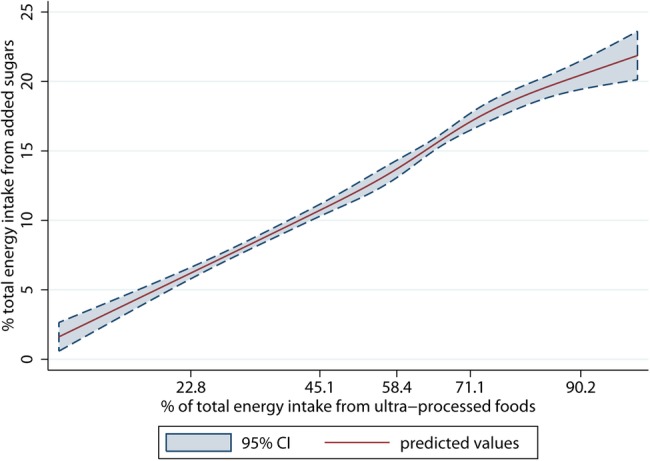
Objectives: To investigate the contribution of ultra-processed foods to the intake of added sugars in the USA. Ultra-processed foods were defined as industrial formulations which, besides salt, sugar, oils and fats, include substances not used in culinary preparations, in particular additives used to imitate sensorial qualities of minimally processed foods and their culinary preparations. Design: Cross-sectional study. Setting: National Health and Nutrition Examination Survey 2009–2010. Participants: We evaluated 9317 participants aged 1+ years with at least one 24 h dietary recall. Main outcome measures: Average dietary content of added sugars and proportion of individuals consuming more than 10% of total energy from added sugars. Data analysis: Gaussian and Poisson regressions estimated the association between consumption of ultra-processed foods and intake of added sugars. All models incorporated survey sample weights and adjusted for age, sex, race/ethnicity, family income and educational attainment. Results: Ultra-processed foods comprised 57.9% of energy intake, and contributed 89.7% of the energy intake from added sugars. The content of added sugars in ultra-processed foods (21.1% of calories) was eightfold higher than in processed foods (2.4%) and fivefold higher than in unprocessed or minimally processed foods and processed culinary ingredients grouped together (3.7%). Both in unadjusted and adjusted models, each increase of 5 percentage points in proportional energy intake from ultra-processed foods increased the proportional energy intake from added sugars by 1 percentage point. Consumption of added sugars increased linearly across quintiles of ultra-processed food consumption: from 7.5% of total energy in the lowest quintile to 19.5% in the highest. A total of 82.1% of Americans in the highest quintile exceeded the recommended limit of 10% energy from added sugars, compared with 26.4% in the lowest. Conclusions: Decreasing the consumption of ultra-processed foods could be an effective way of reducing the excessive intake of added sugars in the USA.
Overview
The claims and statistics of this paper haven’t been checked yet.
Free: it reads the open-access text and checks the first 5 claims that cite a source we can check. Create a free account to check every claim.
Integrity signals
Registry
Cites
Statistics
Figures
Verification
Claims the paper makes
The claims and statistics of this paper haven’t been checked yet.
Free: it reads the open-access text and checks the first 5 claims that cite a source we can check. Create a free account to check every claim.
Claims other papers make about this one
Each is checked against this paper’s own text: does it say what the citing paper says it does?
The cited source says what the claim attributes to it.
In the citing paper
“Ultraprocessed foods13 now contribute the majority of calories consumed in America14 and their overconsumption has been implicated as a causative factor in weight gain15.”
From Maintenance of Lost Weight and Long-Term Management of Obesity (2018) · cites this paper as [14]
The cited source says what the claim attributes to it.
In the citing paper
“Overall, compared to the unprocessed diet, the measurements obtained after the ultra-processed diet were largely unchanged from baseline suggesting that these subjects likely consumed a habitual diet high in ultra-processed foods which might be expected given the high prevalence of ultra-processed food consumption in America (Martinez Steele et al., 2016).”
From Ultra-Processed Diets Cause Excess Calorie Intake and Weight Gain: An Inpatient Randomized Controlled Trial of Ad Libitum Food Intake (2019) · cites this paper as Martinez Steele et al., 2016
In the citing paper
“The typical diet that has become widely adopted in many countries over the past 40 years is relatively low in fruits, vegetables and other fiber- and prebiotic-rich foods66,123–125 and high in refined grains124, alcohol126 and ultra-processed foods125, particularly those containing emulsifiers127.”
From Chronic inflammation in the etiology of disease across the life span (2019) · cites this paper as [125]
Self-check
Percentages, sums and reported differences re-computed from the paper’s own numbers.
The self-check needs the paper’s full text.
Citations
Cites
Sontrop, J. M., Dixon, S. N., Garg, A. X., Buendia-Jimenez, I., Dohein, O., Huang, S.-H. S., & Clark, W. F. (2013) · American Journal of Nephrology · doi:10.1159/000350377 · Cited by 5,871
The United States Department of Agriculture
True, A. C. (1912) · The ANNALS of the American Academy of Political and Social Science · doi:10.1177/000271621204000113 · Cited by 5,113
Moshfegh, A. J., Rhodes, D. G., Baer, D. J., Murayi, T., Clemens, J. C., Rumpler, W. V., Paul, D. R., Sebastian, R. S., Kuczynski, K. J., Ingwersen, L. A., et al. (2008) · The American Journal of Clinical Nutrition · doi:10.1093/ajcn/88.2.324 · Cited by 1,982
Ultra‐processed products are becoming dominant in the global food system
Monteiro, C. A., Moubarac, J. ‐., Cannon, G., Ng, S. W., & Popkin, B. (2013) · Obesity Reviews · doi:10.1111/obr.12107 · Cited by 1,827
Self-citationMoodie, R., Stuckler, D., Monteiro, C., Sheron, N., Neal, B., Thamarangsi, T., Lincoln, P., & Casswell, S. (2013) · The Lancet · doi:10.1016/s0140-6736(12)62089-3 · Cited by 1,663
Self-citationNational health and nutrition examination survey: analytic guidelines, 1999-2010.
Cl, J., Paulose‐Ram, R., Ogden, C. L., Carroll, Kruszon‐Moran, D., Dohrmann, S. M., & Curtin, L. R. (2013) · PubMed · Cited by 1,522
Johnson, R. K., Appel, L. J., Brands, M., Howard, B. V., Lefevre, M., Lustig, R. H., Sacks, F., Steffen, L. M., & Wylie-Rosett, J. (2009) · Circulation · doi:10.1161/circulationaha.109.192627 · Cited by 1,207
Monteiro, C. A., Levy, R. B., Claro, R. M., de Castro, I. R. R., & Cannon, G. (2010) · Public Health Nutrition · doi:10.1017/s1368980010003241 · Cited by 1,060 · cited 1×
“38 Being based on household purchasing data, these two prior studies and others based on the NOVA classi fi cation system 23 39 – 42 could not evaluate the fraction of wasted food nor purchases at restaurants, which represent a substantial proportion of US calories.”
MethodSelf-citationMcGuire, S. (2011) · Advances in Nutrition · doi:10.3945/an.111.000430 · Cited by 1,028
A new classification of foods based on the extent and purpose of their processing
Monteiro, C. A., Levy, R. B., Claro, R. M., Castro, I. R. R. D., & Cannon, G. (2010) · Cadernos de Saúde Pública · doi:10.1590/s0102-311x2010001100005 · Cited by 991 · cited 1×
“38 Being based on household purchasing data, these two prior studies and others based on the NOVA classi fi cation system 23 39 – 42 could not evaluate the fraction of wasted food nor purchases at restaurants, which represent a substantial proportion of US calories.”
MethodSelf-citation
Research works printed but not linked: 4
- Guideline: sugars intake for adults and children. Geneva: World Health Organization, 2015. 25905159
- Bowman SA Diets of individuals based on energy intakes from added sugars. Fam Econ Nutr Rev 1999; 12: 31– 8.
- Monteiro CA, Cannon G, Levy RB Ultra-processing and a new classification of foods. In: Neff R, ed.. Introduction to US food system. Public health, environment, and equity. San Francisco: Jossey Bass A Wiley Brand, 2015: 338– 9.
- Monteiro CA, Cannon G, Levy RB The Food System. Processing. The big issue for disease, good health, well-being. World Nutr 2012; 3: 527– 69. http://www.wphna.org (accessed Aug 2015).
Cited by
Items 201–300 of 1,000
Maniero, C., Lopuszko, A., Papalois, K.-B., Gupta, A. K., Kapil, V., & Khanji, M. Y. (2022) · European Journal of Preventive Cardiology · doi:10.1093/eurjpc/zwac163 · Cited by 54
Kliemann, N., Kraemer, M. V. D. S., Scapin, T., Rodrigues, V. M., Fernandes, A. C., Bernardo, G. L., Uggioni, P. L., & Proença, R. P. D. C. (2018) · Nutrients · doi:10.3390/nu10070891 · Cited by 54
Newman, T. M., Vitolins, M. Z., & Cook, K. L. (2019) · Nutrients · doi:10.3390/nu11112565 · Cited by 54
Mason, T. B., Dunton, G. F., Gearhardt, A. N., & Leventhal, A. M. (2019) · Eating Behaviors · doi:10.1016/j.eatbeh.2019.101343 · Cited by 55
Donat‐Vargas, C., Sandoval‐Insausti, H., Rey-García, J., Banegas, J. R., Rodríguez‐Artalejo, F., & Guallar‐Castillón, P. (2020) · American Journal of Clinical Nutrition · doi:10.1093/ajcn/nqaa389 · Cited by 54
Yuan, L., Hu, H., Li, T., Zhang, J., Feng, Y., Yang, X., Li, Y., Wu, Y., Li, X., Huang, H., et al. (2023) · Food & Function · doi:10.1039/d2fo02628g · Cited by 53
Foundational Nutrition: Implications for Human Health
Townsend, J. R., Kirby, T. O., Marshall, T. M., Church, D. D., Jajtner, A. R., & Esposito, R. (2023) · Nutrients · doi:10.3390/nu15132837 · Cited by 53
Brain Imaging of Taste Perception in Obesity: a Review
Liu, C. K., Joseph, P. V., Feldman, D. E., Kroll, D. S., Burns, J. A., Manza, P., Volkow, N. D., & Wang, G. (2019) · Current Nutrition Reports · doi:10.1007/s13668-019-0269-y · Cited by 55
Aceves‐Martins, M., Bates, R. L., Craig, L. C. A., Chalmers, N., Horgan, G. W., Boskamp, B., & de Roos, B. (2022) · International Journal of Environmental Research and Public Health · doi:10.3390/ijerph19063191 · Cited by 52
Gomes, C. D. B., Malta, M. B., Louzada, M. L. D. C., Benício, M. H. D., Barros, A. J. D., & Carvalhães, M. A. D. B. L. (2019) · Maternal and Child Health Journal · doi:10.1007/s10995-018-2690-z · Cited by 51
Self-citationEffect of Dietary Magnesium Content on Intestinal Microbiota of Rats
García-Legorreta, A., Soriano-Pérez, L. A., Flores-Buendía, A. M., Medina‐Campos, O. N., Noriega, L. G., Granados‐Portillo, O., Nambo‐Venegas, R., Tovar, A. R., Mendoza-Vargas, A., Barrera‐Oviedo, D., et al. (2020) · Nutrients · doi:10.3390/nu12092889 · Cited by 52
Watso, J. C., Fancher, I. S., Gomez, D. H., Hutchison, Z. J., Gutiérrez, O. M., & Robinson, A. T. (2023) · Obesity Reviews · doi:10.1111/obr.13589 · Cited by 52
Du, S., Sullivan, V. K., Fang, M., Appel, L. J., Selvin, E., & Rebholz, C. M. (2024) · Diabetologia · doi:10.1007/s00125-024-06221-5 · Cited by 52
The impact of caloric availability on eating behavior and ultra-processed food reward
Kelly, A. L., Baugh, M. E., Oster, M. E., & DiFeliceantonio, A. G. (2022) · Appetite · doi:10.1016/j.appet.2022.106274 · Cited by 50
Hang, D., Wang, L., Fang, Z., Du, M., Wang, K., He, X., Khandpur, N., Rossato, S. L., Wu, K., Hu, Z., et al. (2023) · JNCI: Journal of the National Cancer Institute · doi:10.1093/jnci/djac221 · Cited by 49
Martin, C., & Issanchou, S. (2018) · Food Quality and Preference · doi:10.1016/j.foodqual.2018.07.003 · Cited by 49
Pereira, G. S., Honorio, A. R., Gasparetto, B. D. R., Lopes, C. M. A., de Lima, D. C. N., & Tribst, A. A. L. (2019) · Journal of Sensory Studies · doi:10.1111/joss.12497 · Cited by 49
Scapin, T., Fernandes, A. C., Curioni, C. C., Pettigrew, S., Neal, B. C., Coyle, D. H., Rodrigues, V. M., Bernardo, G. L., Uggioni, P. L., & Proença, R. P. D. C. (2020) · Nutrition Reviews · doi:10.1093/nutrit/nuaa108 · Cited by 49
Cummings, J. R., Lipsky, L. M., Schwedhelm, C., Liu, A., & Nansel, T. R. (2022) · International Journal of Behavioral Nutrition and Physical Activity · doi:10.1186/s12966-022-01298-w · Cited by 49
Zhao, L., Clay‐Gilmour, A., Zhang, J., Zhang, X., & Steck, S. E. (2023) · American Journal of Clinical Nutrition · doi:10.1016/j.ajcnut.2023.10.014 · Cited by 48
Wolfson, J. A., Tucker, A. C., Leung, C. W., Rebholz, C. M., García-Larsen, V., & Steele, E. M. (2024) · Journal of Nutrition · doi:10.1016/j.tjnut.2024.10.048 · Cited by 48
Prevalence of processed foods in major US grocery stores
Ravandi, B., Ispirova, G., Sebek, M., Mehler, P., Barabási, A.-Ĺ., & Menichetti, G. (2025) · Nature Food · doi:10.1038/s43016-024-01095-7 · Cited by 48
Ahrné, L., Chen, H., Henry, C. J., Kim, H., Schneeman, B. O., & Windhab, E. J. (2025) · npj Science of Food · doi:10.1038/s41538-025-00395-x · Cited by 48
Itani, L., Radwan, H. M., Hashim, M. S., Hasan, H. A., Obaid, R. S., Ghazal, H. A., Hilali, M. A., Rayess, R., Mohamed, H. J. J., Hamadeh, R., et al. (2020) · Nutrition Journal · doi:10.1186/s12937-020-00553-9 · Cited by 48
Ultra-processed Food Intake and Risk of Type 2 Diabetes in Korean Adults
Cho, Y., Ryu, S., Kim, R., Shin, M., & Oh, H. (2023) · Journal of Nutrition · doi:10.1016/j.tjnut.2023.11.021 · Cited by 47
Davidou, S., Christodoulou, A., Frank, K., & Fardet, A. (2021) · Journal of Food Composition and Analysis · doi:10.1016/j.jfca.2021.103848 · Cited by 47
Perszyk, E. E., Hutelin, Z., Trinh, J., Kanyamibwa, A., Fromm, S. P., Davis, X. S., Wall, K. M., Flack, K. D., DiFeliceantonio, A. G., & Small, D. M. (2021) · Nutrients · doi:10.3390/nu13041203 · Cited by 47
Livingston, A., Cudhea, F., Wang, L., Steele, E. M., Du, M., Wang, Y. C., Pomeranz, J. L., Mozaffarian, D., & Zhang, F. F. (2021) · BMJ Nutrition Prevention & Health · doi:10.1136/bmjnph-2021-000303 · Cited by 46
Self-citationZhang, Q., Yu, G., Jiang, Y., Shi, H. N., Yang, X., Gao, Z., Wang, Q., Sun, J., Wang, C., Li, Q., et al. (2025) · Nature Communications · doi:10.1038/s41467-025-60235-0 · Cited by 47
Arsenault, B. J., Lamarche, B., & Després, J. (2017) · Nutrients · doi:10.3390/nu9060600 · Cited by 47
Junk Food Intake Among Adults in the United States
Dunford, E., Popkin, B. M., & Ng, S. W. (2021) · Journal of Nutrition · doi:10.1093/jn/nxab205 · Cited by 47
Madruga, M. F., Steele, E. M., Reynolds, C. J., Levy, R. B., & Rauber, F. (2022) · British Journal Of Nutrition · doi:10.1017/s0007114522003361 · Cited by 46
Detopoulou, P., Dedes, V., Syka, D., Tzirogiannis, K. N., & Panoutsopoulos, G. I. (2023) · International Journal of Environmental Research and Public Health · doi:10.3390/ijerph20042806 · Cited by 45
The depressogenic potential of added dietary sugars
Reis, D. J., Ilardi, S. S., Namekata, M. S., Wing, E. K., & Fowler, C. H. (2019) · Medical Hypotheses · doi:10.1016/j.mehy.2019.109421 · Cited by 46
Gupta, S., Rose, C. M., Buszkiewicz, J., Ko, L. K., Mou, J., Cook, A. J., Aggarwal, A., & Drewnowski, A. (2020) · British Journal Of Nutrition · doi:10.1017/s0007114520004705 · Cited by 45
Soares, M. M., Juvanhol, L. L., Ribeiro, S. A. V., Franceschini, S. D. C. C., & Araújo, R. M. A. (2021) · International Journal of Food Sciences and Nutrition · doi:10.1080/09637486.2021.1885016 · Cited by 45
Ultra-processing. An odd ‘appraisal’
Monteiro, C. A., Cannon, G., Moubarac, J.-C., Levy, R. B., Louzada, M. L. C., & Jaime, P. C. (2018) · Public Health Nutrition · doi:10.1017/s1368980017003287 · Cited by 44
Self-citationWolfson, J. A., Steele, E. M., Tucker, A. C., & Leung, C. W. (2024) · Journal of the Academy of Nutrition and Dietetics · doi:10.1016/j.jand.2024.03.005 · Cited by 44
Wang, K., & Xu, Z. (2021) · Food Chemistry · doi:10.1016/j.foodchem.2021.131430 · Cited by 44
Ultra-processed foods and risk of all-cause mortality in renal transplant recipients
Osté, M. C. J., Duan, M.-J., Neto, A. W. G., Vinke, P. C., Carrero, J. J., Avesani, C. M., Cai, Q., Dekker, L. H., Navis, G. J., Bakker, S. J. L., et al. (2022) · American Journal of Clinical Nutrition · doi:10.1093/ajcn/nqac053 · Cited by 44
Sullivan, V. K., Appel, L. J., Anderson, C. A. M., Kim, H., Unruh, M. L., Lash, J. P., Trego, M., Sondheimer, J., Dobre, M., Pradhan, N., et al. (2023) · American Journal of Kidney Diseases · doi:10.1053/j.ajkd.2023.01.452 · Cited by 42
U.S. Policies Addressing Ultraprocessed Foods, 1980–2022
Pomeranz, J. L., Mande, J. R., & Mozaffarian, D. (2023) · American Journal of Preventive Medicine · doi:10.1016/j.amepre.2023.07.006 · Cited by 42
Self-citationHenney, A. E., Gillespie, C. S., Alam, U., Hydes, T., Boyland, E. J., & Cuthbertson, D. J. (2024) · Obesity Reviews · doi:10.1111/obr.13682 · Cited by 47
Shmul, T. T., Beresh, O., Zaretsky, J., Griess-Fishheimer, S., Rozner, R., Kalev‐Altman, R., Penn, S., Shahar, R., & Ornan, E. M. (2021) · Foods · doi:10.3390/foods10123107 · Cited by 43
Trude, A. C. B., Surkan, P. J., Steeves, E. A., Porter, K. M. P., & Gittelsohn, J. (2018) · Public Health Nutrition · doi:10.1017/s1368980018003038 · Cited by 41
Matos, J. D. P., de Lima, M. M., & Horta, P. M. (2019) · Journal of the Academy of Nutrition and Dietetics · doi:10.1016/j.jand.2019.04.014 · Cited by 41
Berti, T. L., da Rocha, T. F., Curioni, C. C., Verly, E., Bezerra, F. F., Canella, D. S., & Faerstein, E. (2019) · Revista Brasileira de Epidemiologia · doi:10.1590/1980-549720190046 · Cited by 43
Elmeń, L., Zlamal, J. E., Scott, D. A., Lee, R. B., Chen, D. J., Colas, A. R., Rodionov, D. A., & Peterson, S. N. (2020) · Frontiers in Microbiology · doi:10.3389/fmicb.2020.00892 · Cited by 42
Araya, C., Corvalán, C., Cediel, G., Taillie, L. S., & Reyes, M. (2021) · Frontiers in Nutrition · doi:10.3389/fnut.2021.601526 · Cited by 43
Jianfeng, H. A. O., Zhou, P., & Qiu, H. (2022) · The journal of nutrition health & aging · doi:10.1007/s12603-022-1824-6 · Cited by 41
Retail Environments as a Venue for Obesity Prevention
Odoms‐Young, A. M., Singleton, C. R., Springfield, S., McNabb, L., & Thompson, T. L. (2016) · Current Obesity Reports · doi:10.1007/s13679-016-0219-6 · Cited by 41
Turner, J. B. M., Kumar, A., & Koch, C. A. (2016) · Reviews in Endocrine and Metabolic Disorders · doi:10.1007/s11154-016-9358-z · Cited by 41
Sharma, N., Ferguson, E., Upadhyay, A., Zehner, E. R., Filteau, S., & Pries, A. M. (2019) · Maternal and Child Nutrition · doi:10.1111/mcn.12711 · Cited by 41
Dana, L. M., Chapman, K. L., Talati, Z., Kelly, B., Dixon, H., Miller, C. L., & Pettigrew, S. (2019) · Nutrients · doi:10.3390/nu11051158 · Cited by 40
Huang, C., Liang, Z., Ma, J., Hu, D., Yao, F., & Qin, P. (2023) · Nutrition · doi:10.1016/j.nut.2023.112032 · Cited by 40
Recent Trends in Junk Food Intake in U.S. Children and Adolescents, 2003–2016
Dunford, E., Popkin, B. M., & Ng, S. W. (2020) · American Journal of Preventive Medicine · doi:10.1016/j.amepre.2020.01.023 · Cited by 40
The Risk of Breast Cancer between Western and Mediterranean Dietary Patterns
Tsai, H.-H., Yu, J., Hsu, H.-M., Chu, C.-H., Chang, T.-M., Hong, Z., Feng, A., Fu, C., Hsu, K., Dai, M., et al. (2023) · Nutrients · doi:10.3390/nu15092057 · Cited by 40
Ribas, S. A., Sichieri, R., Moreira, A. S. B., Souza, D. O., Cabral, C. T. F., Gianinni, D. T., & Cunha, D. B. (2017) · Nutrition Metabolism and Cardiovascular Diseases · doi:10.1016/j.numecd.2017.09.010 · Cited by 40
Bhawra, J., Kirkpatrick, S. I., Hall, M. G., Vanderlee, L., White, C. M., & Hammond, D. (2023) · Nutrition Journal · doi:10.1186/s12937-023-00844-x · Cited by 39
Willows, N. D., Johnson‐Down, L., Moubarac, J., Lucas, M., Robinson, E., & Batal, M. (2018) · International Journal of Circumpolar Health · doi:10.1080/22423982.2018.1536251 · Cited by 39
Self-citationZhang, Z., Jackson, S. L., Steele, E. M., Gillespie, C., & Yang, Q. (2021) · Journal of Adolescent Health · doi:10.1016/j.jadohealth.2021.09.031 · Cited by 39
Nazmi, A., Tseng, M., Robinson, D., Neill, D. B., & Walker, J. (2019) · Nutrients · doi:10.3390/nu11122965 · Cited by 38
Kim, H., Rebholz, C. M., Wong, E., & Buckley, J. P. (2019) · Environmental Research · doi:10.1016/j.envres.2019.109070 · Cited by 38
Honicky, M., Cardoso, S. M., de Lima, L. R. A., Ozcariz, S. G. I., Vieira, F. G. K., Back, I. D. C., & Moreno, Y. M. F. (2020) · Pediatric Obesity · doi:10.1111/ijpo.12623 · Cited by 38
Pachipala, K., Shankar, V., Rezler, Z., Vittal, R., Ali, S. H., Srinivasan, M., Palaniappan, L. P., Yang, E., Juul, F., & Elfassy, T. (2022) · Journal of Nutrition · doi:10.1093/jn/nxac082 · Cited by 38
Nansel, T. R., Cummings, J. R., Burger, K. S., Siega‐Riz, A. M., & Lipsky, L. M. (2022) · Nutrients · doi:10.3390/nu14193933 · Cited by 38
Gu, Y., Li, H., Ma, H., Zhang, S., Meng, G., Zhang, Q., Liu, L., Wu, H., Zhang, T., Wang, X., et al. (2022) · American Journal of Clinical Nutrition · doi:10.1016/j.ajcnut.2022.11.005 · Cited by 38
Lee, H., Yim, Y., Cho, Y., Oh, J., Kim, S., Son, Y., Jo, H., Hong, S., Rahmati, M., Cho, H., et al. (2025) · Scientific Reports · doi:10.1038/s41598-025-88489-0 · Cited by 37
Bleiweiss-Sande, R., Sacheck, J. M., Chui, K. K. H., Goldberg, J. P., Bailey, C. P., & Evans, E. W. (2020) · Appetite · doi:10.1016/j.appet.2020.104696 · Cited by 37
Steele, E. M., Khandpur, N., Sun, Q., & Monteiro, C. A. (2020) · Preventive Medicine · doi:10.1016/j.ypmed.2020.106261 · Cited by 37
Self-citationJohnston, B. C., SMET, S. D., Leroy, F., Mente, A., & Stanton, A. V. (2023) · Animal Frontiers · doi:10.1093/af/vfac095 · Cited by 37
Martínez Steele, E., Buckley, J. P., & Monteiro, C. A. (2023) · Preventive Medicine · doi:10.1016/j.ypmed.2023.107598 · Cited by 36
Self-citationLeone, A., Martínez-González, M. Á., Craig, W., Fresán, U., Gómez-Donoso, C., & Bes-Rastrollo, M. (2021) · Nutrients · doi:10.3390/nu13072202 · Cited by 36
Gomes, C. D. B., Malta, M. B., Benício, M. H. D., & Carvalhaes, M. A. D. B. L. (2021) · Public Health Nutrition · doi:10.1017/s1368980020001883 · Cited by 36
Consumo de açúcares de adição por adolescentes em estudo de base populacional
Braz, M., de Assumpção, D., Barros, M. B. D. A., & Filho, A. D. A. B. (2019) · Ciência & Saúde Coletiva · doi:10.1590/1413-81232018249.24692017 · Cited by 36
Machín, L., Arrúa, A., Giménez, A., Curutchet, M. R., Martínez, J., & Ares, G. (2017) · Public Health Nutrition · doi:10.1017/s1368980017001185 · Cited by 36
Relationship between food consumption, nutritional status and school performance
Schmidt, A. L., Strack, M. H., & Conde, S. R. (2018) · Journal of Human Growth and Development · doi:10.7322/jhgd.152159 · Cited by 36
Falcão, R. C. T. M. D. A., Lyra, C. D. O., de Morais, C. M. M., Pinheiro, L. G. B., Pedrosa, L. F. C., Lima, S. C. V. C., & Sena‐Evangelista, K. C. M. (2019) · PLoS ONE · doi:10.1371/journal.pone.0224984 · Cited by 36
Characterization of Breakfast Cereals Available in the Mexican Market: Sodium and Sugar Content
Nieto, C., Patiño, S. R., Tolentino‐Mayo, L., Carriedo, Á., & Barquera, S. (2017) · Nutrients · doi:10.3390/nu9080884 · Cited by 36
Menegassi, B., Sato, P. D. M., Scagliusi, F. B., & Moubarac, J. (2019) · Appetite · doi:10.1016/j.appet.2019.03.010 · Cited by 36
Self-citationAllura Red AC is a xenobiotic. Is it also a carcinogen?
Hofseth, L. J., Hébert, J. R., Murphy, E. A., Trauner, E., Vikas, A., Harris, Q., & Chumanevich, A. A. (2024) · Carcinogenesis · doi:10.1093/carcin/bgae057 · Cited by 35
Ultra-Processed Food Consumption and Systemic Inflammatory Biomarkers: A Scoping Review
Ciaffi, J., Mancarella, L., Ripamonti, C., Brusi, V., Pignatti, F., Lisi, L., & Ursini, F. (2025) · Nutrients · doi:10.3390/nu17183012 · Cited by 35
Churuangsuk, C., Lean, M. E. J., & Combet, E. (2020) · Proceedings of The Nutrition Society · doi:10.1017/s0029665120000105 · Cited by 37
Ultra-Processed Food Intake and Risk of Colorectal Cancer: A Matched Case-Control Study
Jafari, F., Yarmand, S., Nouri, M., Nejad, E. T., Ramezani, A., Sohrabi, Z., & Rashidkhani, B. (2022) · Nutrition and Cancer · doi:10.1080/01635581.2022.2125990 · Cited by 36
Cardiology and lifestyle medicine
Rozanski, A., Blumenthal, J. A., Hinderliter, A. L., Cole, S. W., & Lavie, C. J. (2023) · Progress in Cardiovascular Diseases · doi:10.1016/j.pcad.2023.04.004 · Cited by 35
Shu, L., Huang, Y., Si, C., Zhu, Q., Zheng, P.-F., & Zhang, X. (2023) · Frontiers in Nutrition · doi:10.3389/fnut.2023.1170992 · Cited by 35
Batal, M., Johnson‐Down, L., Moubarac, J., Ing, A., Fediuk, K., Sadik, T., Chan, H. M., & Willows, N. D. (2017) · International Journal of Food Sciences and Nutrition · doi:10.1080/09637486.2017.1412405 · Cited by 34
Self-citationSjöblad, S. (2019) · Medical Hypotheses · doi:10.1016/j.mehy.2019.02.027 · Cited by 34
García‐Blanco, L., Víctor de la, O., Berasaluce, A., Moreno‐Galarraga, L., Martínez‐González, M. Á., & Martín‐Calvo, N. (2022) · Public Health Nutrition · doi:10.1017/s136898002200132x · Cited by 34
Louzada, M. L. D. C., Steele, E. M., Rezende, L. F. M., Levy, R. B., & Monteiro, C. A. (2022) · International Journal of Public Health · doi:10.3389/ijph.2022.1604103 · Cited by 36
Self-citationWoodbury, T. J., & Mauer, L. J. (2023) · Food Research International · doi:10.1016/j.foodres.2023.113002 · Cited by 34
Front-of-package nutrition references are positively associated with food processing
Christoforou, A., Dachner, N., Mendelson, R., & Tarasuk, V. S. (2017) · Public Health Nutrition · doi:10.1017/s1368980017001057 · Cited by 34
Nieto-Orozco, C., Sangochian, A. C., Tamborrel, N., González, E. V., Tolentino‐Mayo, L., & Vergara‐Castañeda, A. (2020) · Journal of Behavior Health & Social Issues · doi:10.1016/j.jbhsi.2018.01.006 · Cited by 34
Almajwal, A. M., Alam, I., Abulmeaty, M. M. A., Razak, S., Pawelec, G., & Alam, W. (2020) · Food Science & Nutrition · doi:10.1002/fsn3.1389 · Cited by 36
Real Food, Real Facts: Processed Food and the Politics of Knowledge
Biltekoff, C. (2024) · University of California Press eBooks · doi:10.1525/luminos.198 · Cited by 33
The contribution of texture contrasts and combinations to food acceptance across cultures
Pellegrino, R., Cheon, B. K., Forde, C. G., Oleszkiewicz, A., Pieniak, M., & Luckett, C. R. (2019) · Journal of Texture Studies · doi:10.1111/jtxs.12494 · Cited by 33
A dental revolution: The association between occlusion and chewing behaviour
Silvester, C. M., Kullmer, O., & Hillson, S. W. (2021) · PLoS ONE · doi:10.1371/journal.pone.0261404 · Cited by 34
Food consumption according to the level of processing and sleep quality during the COVID-19 pandemic
de Menezes-Júnior, L. A. A., Andrade, A. C. D. S., Coletro, H. N., Mendonça, R. D. D., de Menezes, M. C., Machado-Coelho, G. L. L., & Meireles, A. L. (2022) · Clinical Nutrition ESPEN · doi:10.1016/j.clnesp.2022.03.023 · Cited by 34
Consumption of Ultraprocessed Foods and Body Fat Distribution Among U.S. Adults
Liu, J., Steele, E. M., Li, Y., Yi, S. S., Monteiro, C. A., & Mozaffarian, D. (2023) · American Journal of Preventive Medicine · doi:10.1016/j.amepre.2023.03.012 · Cited by 33
Self-citationWang, L., Pan, X., Munro, H. M., Shrubsole, M. J., & Yu, D. (2023) · Clinical Nutrition · doi:10.1016/j.clnu.2023.08.012 · Cited by 33
Metadata
- Authors
- Martínez Steele, E., Baraldi, L. G., Louzada, M. L. D. C., Moubarac, J.-C., Mozaffarian, D., & Monteiro, C. A.
- Affiliations
- Department of Nutrition, School of Public Health, University of São Paulo, São Paulo, Brazil
- Universidade de São Paulo (BR)
- Tufts University (US)
- Corresponding author
- Monteiro, Carlos Augusto
- ORCID
- Venue
- BMJ Open
- Publisher
- BMJ
- Published
- 2016-01
- Volume
- 6
- Issue
- 3
- Pages
- e009892
- ISSN
- 2044-6055 (ISSN-L)
- PMC
- PMC4785287
- OpenAlex
- W2293621304
- Cited by
- 838
- References
- 29
- Citations by year
- 2026: 48 · 2025: 68 · 2024: 84 · 2023: 112 · 2022: 122 · 2021: 104 · 2020: 92 · 2019: 94 · 2018: 37 · 2017: 58 · 2016: 18
- FWCI
- 68.41
- Type
- journal article
- Language
- en
- Open access
- gold
- doi.org
- Licence
- cc-by-nc
- Locations
- BMJ Open (publishedVersion, cc-by-nc)
- PubMed Central (publishedVersion, cc-by-nc)
- PubMed (publishedVersion)
- HighWire Press Open Archive (submittedVersion)
- Funders
- Amarin Corporation
- South Dakota Governor's Office of Economic Development
- Ministério da Ciência, Tecnologia e Inovação (14/2014)
- Conselho Nacional de Desenvolvimento Científico e Tecnológico (14‐2014, MCTI/CNPq/Universal 14/, Universal 14/2014)
- Topics
- Health Sciences › Medicine › Public Health, Environmental and Occupational Health › Consumer Attitudes and Food Labeling
- Health Sciences › Medicine › Endocrinology, Diabetes and Metabolism › Diet, Metabolism, and Disease
- Health Sciences › Medicine › Public Health, Environmental and Occupational Health › Global Public Health Policies and Epidemiology
- Keywords
- ultra-processed foods, added sugars, dietary intake, energy intake, sugar-sweetened beverages, processed foods, minimally processed foods, food additives
- MeSH terms
- Adolescent, Adult, Aged, Aged, 80 and over, Energy Intake, Child, Child, Preschool, Cross-Sectional Studies, Diet, Female, Humans, Infant, Male, Middle Aged, Nutrition Surveys, Regression Analysis, Socioeconomic Factors, United States, Dietary Sucrose, Young Adult, Fast Foods
About these checks
Registry, retraction, Cites and statistics results are computed, not judged, with one exception: a printed reference that no index lists is read once by a model before it counts as a citation error. Claims are extracted by a model and kept only when their quote appears verbatim in the text; each cited source is then checked, with a model’s help, for whether it says what the claim relies on. Those verdicts can be wrong — read the claim’s quote and the cited source before relying on one.
Statistics and arithmetic are recomputed, not judged.
Confidence bands are shown only for fields calibrated on our annotated test set. None is calibrated yet, so no band is shown.
What counts as a claim ›How we measure confidence ›How we check this ›
Are you an author, or do you see a problem with this page? Request a review
Data sources
Bibliographic data: Semantic Scholar, OpenAlex, Crossref.
Contains information from the Semantic Scholar Academic Graph Datasets, made available under the ODC Attribution License (ODC-BY 1.0).
Semantic Scholar’s data is described in: Kinney, R., et al. (2023). The Semantic Scholar Open Data Platform. arXiv:2301.10140.
