

Ultra-processed foods and added sugars in the US diet: evidence from a nationally representative cross-sectional study
Open accessThe DOI matches its Crossref record; 29 of the 29 references it cites were found in a registry or an index.
Abstract
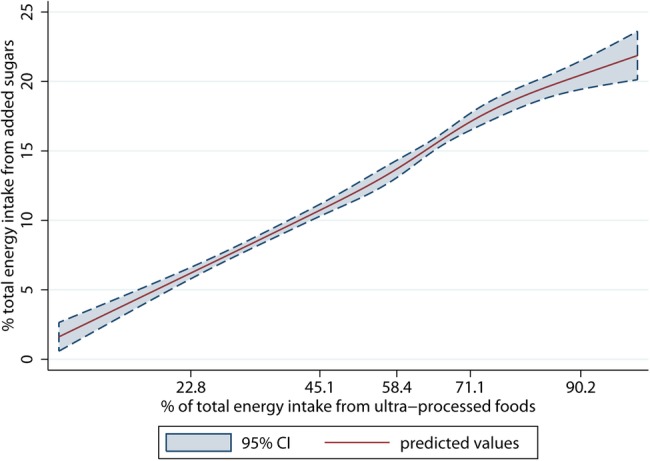
Objectives: To investigate the contribution of ultra-processed foods to the intake of added sugars in the USA. Ultra-processed foods were defined as industrial formulations which, besides salt, sugar, oils and fats, include substances not used in culinary preparations, in particular additives used to imitate sensorial qualities of minimally processed foods and their culinary preparations. Design: Cross-sectional study. Setting: National Health and Nutrition Examination Survey 2009–2010. Participants: We evaluated 9317 participants aged 1+ years with at least one 24 h dietary recall. Main outcome measures: Average dietary content of added sugars and proportion of individuals consuming more than 10% of total energy from added sugars. Data analysis: Gaussian and Poisson regressions estimated the association between consumption of ultra-processed foods and intake of added sugars. All models incorporated survey sample weights and adjusted for age, sex, race/ethnicity, family income and educational attainment. Results: Ultra-processed foods comprised 57.9% of energy intake, and contributed 89.7% of the energy intake from added sugars. The content of added sugars in ultra-processed foods (21.1% of calories) was eightfold higher than in processed foods (2.4%) and fivefold higher than in unprocessed or minimally processed foods and processed culinary ingredients grouped together (3.7%). Both in unadjusted and adjusted models, each increase of 5 percentage points in proportional energy intake from ultra-processed foods increased the proportional energy intake from added sugars by 1 percentage point. Consumption of added sugars increased linearly across quintiles of ultra-processed food consumption: from 7.5% of total energy in the lowest quintile to 19.5% in the highest. A total of 82.1% of Americans in the highest quintile exceeded the recommended limit of 10% energy from added sugars, compared with 26.4% in the lowest. Conclusions: Decreasing the consumption of ultra-processed foods could be an effective way of reducing the excessive intake of added sugars in the USA.
Overview
The claims and statistics of this paper haven’t been checked yet.
Free: it reads the open-access text and checks the first 5 claims that cite a source we can check. Create a free account to check every claim.
Integrity signals
Registry
Cites
Statistics
Figures
Verification
Claims the paper makes
The claims and statistics of this paper haven’t been checked yet.
Free: it reads the open-access text and checks the first 5 claims that cite a source we can check. Create a free account to check every claim.
Claims other papers make about this one
Each is checked against this paper’s own text: does it say what the citing paper says it does?
The cited source says what the claim attributes to it.
In the citing paper
“Ultraprocessed foods13 now contribute the majority of calories consumed in America14 and their overconsumption has been implicated as a causative factor in weight gain15.”
From Maintenance of Lost Weight and Long-Term Management of Obesity (2018) · cites this paper as [14]
The cited source says what the claim attributes to it.
In the citing paper
“Overall, compared to the unprocessed diet, the measurements obtained after the ultra-processed diet were largely unchanged from baseline suggesting that these subjects likely consumed a habitual diet high in ultra-processed foods which might be expected given the high prevalence of ultra-processed food consumption in America (Martinez Steele et al., 2016).”
From Ultra-Processed Diets Cause Excess Calorie Intake and Weight Gain: An Inpatient Randomized Controlled Trial of Ad Libitum Food Intake (2019) · cites this paper as Martinez Steele et al., 2016
In the citing paper
“The typical diet that has become widely adopted in many countries over the past 40 years is relatively low in fruits, vegetables and other fiber- and prebiotic-rich foods66,123–125 and high in refined grains124, alcohol126 and ultra-processed foods125, particularly those containing emulsifiers127.”
From Chronic inflammation in the etiology of disease across the life span (2019) · cites this paper as [125]
Self-check
Percentages, sums and reported differences re-computed from the paper’s own numbers.
The self-check needs the paper’s full text.
Citations
Cites
Sontrop, J. M., Dixon, S. N., Garg, A. X., Buendia-Jimenez, I., Dohein, O., Huang, S.-H. S., & Clark, W. F. (2013) · American Journal of Nephrology · doi:10.1159/000350377 · Cited by 5,871
The United States Department of Agriculture
True, A. C. (1912) · The ANNALS of the American Academy of Political and Social Science · doi:10.1177/000271621204000113 · Cited by 5,113
Moshfegh, A. J., Rhodes, D. G., Baer, D. J., Murayi, T., Clemens, J. C., Rumpler, W. V., Paul, D. R., Sebastian, R. S., Kuczynski, K. J., Ingwersen, L. A., et al. (2008) · The American Journal of Clinical Nutrition · doi:10.1093/ajcn/88.2.324 · Cited by 1,982
Ultra‐processed products are becoming dominant in the global food system
Monteiro, C. A., Moubarac, J. ‐., Cannon, G., Ng, S. W., & Popkin, B. (2013) · Obesity Reviews · doi:10.1111/obr.12107 · Cited by 1,827
Self-citationMoodie, R., Stuckler, D., Monteiro, C., Sheron, N., Neal, B., Thamarangsi, T., Lincoln, P., & Casswell, S. (2013) · The Lancet · doi:10.1016/s0140-6736(12)62089-3 · Cited by 1,663
Self-citationNational health and nutrition examination survey: analytic guidelines, 1999-2010.
Cl, J., Paulose‐Ram, R., Ogden, C. L., Carroll, Kruszon‐Moran, D., Dohrmann, S. M., & Curtin, L. R. (2013) · PubMed · Cited by 1,522
Johnson, R. K., Appel, L. J., Brands, M., Howard, B. V., Lefevre, M., Lustig, R. H., Sacks, F., Steffen, L. M., & Wylie-Rosett, J. (2009) · Circulation · doi:10.1161/circulationaha.109.192627 · Cited by 1,207
Monteiro, C. A., Levy, R. B., Claro, R. M., de Castro, I. R. R., & Cannon, G. (2010) · Public Health Nutrition · doi:10.1017/s1368980010003241 · Cited by 1,060 · cited 1×
“38 Being based on household purchasing data, these two prior studies and others based on the NOVA classi fi cation system 23 39 – 42 could not evaluate the fraction of wasted food nor purchases at restaurants, which represent a substantial proportion of US calories.”
MethodSelf-citationMcGuire, S. (2011) · Advances in Nutrition · doi:10.3945/an.111.000430 · Cited by 1,028
A new classification of foods based on the extent and purpose of their processing
Monteiro, C. A., Levy, R. B., Claro, R. M., Castro, I. R. R. D., & Cannon, G. (2010) · Cadernos de Saúde Pública · doi:10.1590/s0102-311x2010001100005 · Cited by 991 · cited 1×
“38 Being based on household purchasing data, these two prior studies and others based on the NOVA classi fi cation system 23 39 – 42 could not evaluate the fraction of wasted food nor purchases at restaurants, which represent a substantial proportion of US calories.”
MethodSelf-citation
Research works printed but not linked: 4
- Guideline: sugars intake for adults and children. Geneva: World Health Organization, 2015. 25905159
- Bowman SA Diets of individuals based on energy intakes from added sugars. Fam Econ Nutr Rev 1999; 12: 31– 8.
- Monteiro CA, Cannon G, Levy RB Ultra-processing and a new classification of foods. In: Neff R, ed.. Introduction to US food system. Public health, environment, and equity. San Francisco: Jossey Bass A Wiley Brand, 2015: 338– 9.
- Monteiro CA, Cannon G, Levy RB The Food System. Processing. The big issue for disease, good health, well-being. World Nutr 2012; 3: 527– 69. http://www.wphna.org (accessed Aug 2015).
Cited by
Items 701–800 of 1,000
Вырожденные задачи синтеза систем управления линейными дискретными объектами
Львович, Б. А. (2009) · Проблемы управления · Cited by 1
Food promotion in supermarket promotional circulars: an analysis of the cover and internal content
de Oliveira, A. S. D., da Silva, A. C. F., Medina, D., Silva, T. S., Brito, F. D. S. B., & Moreira, C. C. (2022) · Research Society and Development · doi:10.33448/rsd-v11i7.29899 · Cited by 1
Gestasyonel Trofoblastik Hastalıklar ve Yönetimi
Taşkum, İ., & Soykan, Y. (2023) · Özgür Yayınları eBooks · doi:10.58830/ozgur.pub388.c1595 · Cited by 1
Evaluation of Dietary Exposure to Certain Preservative Food Additives: A Pilot Study
Ekenci, K. D., & Köksal, E. (2024) · Bandırma Onyedi Eylül Üniversitesi Sağlık Bilimleri ve Araştırmaları Dergisi · doi:10.46413/boneyusbad.1400411 · Cited by 1
Nogueira, S. F., Nomelini, Q. S. S., dos Santos, H. M., & Pascoal, G. B. (2024) · Nutrivisa Revista de Nutrição e Vigilância em Saúde · doi:10.59171/nutrivisa-2024v11e12779 · Cited by 1
Ultra-processed Foods and Food Addiction
Monteiro, C. A., & Cannon, G. (2024) · Oxford University Press eBooks · doi:10.1093/oso/9780190671051.003.0032 · Cited by 1
Self-citationKelly, A. L., Baugh, M. E., Ahrens, M., Valle, A. N., Sullivan, R. M., Oster, M. E., Fowler, M. E., Carter, B. E., Davy, B. M., Hanlon, A. L., et al. (2024) · Contemporary Clinical Trials · doi:10.1016/j.cct.2024.107717 · Cited by 1
Cho, M., Lee, H., & Lee, J. E. (2025) · Public Health Nutrition · doi:10.1017/s1368980024002337 · Cited by 1
Jayaswal, R., Frank, S. M., Steele, E. M., Rose, D. D., & Taillie, L. S. (2025) · Current Developments in Nutrition · doi:10.1016/j.cdnut.2025.107460 · Cited by 1
Schlueter, R., Cooke, J., Isaacson, K. L., & Calhoun, B. G. (2025) · Clinical Journal of the American Society of Nephrology · doi:10.2215/cjn.0000000785 · Cited by 1
McMath, A. L., Keye, S. A., Barton, J. M., Cannavale, C. N., Iwinski, S. J., Bost, K. K., Donovan, S. M., & Khan, N. A. (2025) · Current Developments in Nutrition · doi:10.1016/j.cdnut.2025.107488 · Cited by 1
Deeper Inflammation: Examples of Extracellular Matrix Involvement and Treatment
Smith, F. (2025) · Springer eBooks · doi:10.1007/978-3-031-94465-9_9 · Cited by 1
Pineño, O., & DeStefano, K. (2026) · Appetite · doi:10.1016/j.appet.2026.108606 · Cited by 1
Bussa, M., Ambrogi, F., Edefonti, V. C., O’Flaherty, M., Chavez‐Ugalde, Y., & Colombet, Z. (2025) · Public Health Nutrition · doi:10.1017/s1368980025100840 · Cited by 1
O Consumo de alimentos ultraprocessados pode ser reduzido com taxação? Evidências para o Brasil
Julião, C. C. B., Coelho, A. B., & Silva, M. M. D. C. (2025) · doi:10.38116/ppe54n3art2 · Cited by 1
Busse, K. R., Mayol, N. L., Ammerman, A. S., Martin, S. L., Avery, C. L., & Adair, L. S. (2025) · British Journal Of Nutrition · doi:10.1017/s0007114525105795 · Cited by 1
Khalfan, S. S., Said, F. A., Chunhao, L., Minani, J., & Zhang, B. (2025) · Nutrición Hospitalaria · doi:10.20960/nh.05874 · Cited by 1
Ríos-Castillo, I., Parra-Soto, S. L., Morales, G., Flores, J. A., Murillo, A., Gómez, G., Carpio-Arias, T. V., Cavagnari, B. M., Nava-Gonzalez, E., Bejarano-Roncancio, J., et al. (2025) · African Journal of Food Agriculture Nutrition and Development · doi:10.18697/ajfand.147.26340 · Cited by 1
Yussif, M. T., Annan, R. A., Edusei, A. K., Nicolaou, M., Beune, E., Darko, S. N., Danquah, I., Meeks, K. A. C., Owusu-Dabo, E., & Agyemang, C. O. (2026) · BMC Global and Public Health · doi:10.1186/s44263-025-00226-x · Cited by 1
Biodiversité du microbiote intestinal et alimentation moderne: Impact en santé humaine
Boudaud, M., Arnone, D., Touly, N., & Chassaing, B. (2026) · médecine/sciences · doi:10.1051/medsci/2025253 · Cited by 1
Mastrangelo, M. E. D. M. T., Araújo, M. C., & de Castro, M. B. T. (2026) · Ciência & Saúde Coletiva · doi:10.1590/1413-81232026312.08122024 · Cited by 1
Menon, R. M., Hunter, K., & Roy, S. (2026) · Journal of Clinical Medicine Research · doi:10.14740/jocmr6448 · Cited by 1
Hu, H., Huang, H., Cai, L., Qi, L., & Zhou, T. (2026) · British Journal Of Nutrition · doi:10.1017/s0007114526106710 · Cited by 1
Processed Foods and Food Dyes: What Are We Eating and What Is the Cardiovascular Risk?
Kaiser, M. E., Parikh, M. A., Turitto, G., Grutman, G., Frishman, W. H., & Peterson, S. J. (2026) · Cardiology in Review · doi:10.1097/crd.0000000000001256 · Cited by 1
Zhai, D., Zhang, S., Gong, Z., Liu, Y., Zhai, W., Ma, L., Wang, S., Lin, X., Zhang, S. M., Liu, X., et al. (2026) · Journal of Nutritional Science · doi:10.1017/jns.2026.10081 · Cited by 1
Rafiei, S., Nohegari, M., Sarbakhsh, P., & Vafa, M. (2026) · Nutritional Neuroscience · doi:10.1080/1028415x.2026.2674151 · Cited by 1
Dietary sugar intake and risk of depression: findings from the TwinsUK cohort
Mughal, I., Mughal, Z., Mistry, K., Dhakal, N., & Mughal, F. (2026) · Nutritional Psychiatry · doi:10.1016/j.nupsyc.2026.100025 · Cited by 2
Ultra-processed food and risk of gastric cancer: a systematic review
Rahman, M. A., Hussain, T., Afroz, M., Rahman, S., Mridha, M. K., Shamim, A. A., & Akter, F. (2026) · BMJ Public Health · doi:10.1136/bmjph-2025-003197 · Cited by 1
Diet-Oral Microbiome Crosstalk: From Microbial Modulation to Oral Health Promotion
Li, P., Qu, Z., & Xu, L. (2026) · Food Science and Human Wellness · doi:10.26599/fshw.2026.9251098 · Cited by 1
Toderescu, C. D., Pogurschi, E. N., Ştefanache, A., Munteanu, M. F., Trifunschi, S., Oancea, A., Bugi, M.-A., & Cresneac, I. G. (2026) · Frontiers in Public Health · doi:10.3389/fpubh.2026.1843650 · Cited by 1
Generational Influence on Diet Quality: An Analysis Based on Vigitel 2023
de Oliveira, J. P. L., Fróis, L. F., de Sousa, B. A., Silvério, H. L. M., Mendonça, G. O., Paiva, L. V., Ferreira, N. L., & Teixeira, L. G. (2026) · Journal of Human Nutrition and Dietetics · doi:10.1111/jhn.70320 · Cited by 1
Artificial intelligence as the new transformative driver in functional food development
Ademosun, A. O., Ademosun, M. T., Fasehun, O. I., & Oboh, G. (2026) · Food Research International Reports · doi:10.1016/j.frinr.2026.100010 · Cited by 1
Added sugar and sodium levels in New Zealand processed fruit and vegetable‐based products
Chepulis, L. M., Everson, N., Heapy, A. M., & Mearns, G. J. (2018) · Nutrition & Dietetics · doi:10.1111/1747-0080.12470 · Cited by 1
Whyte, K. (2019) · Columbia Academic Commons (Columbia University) · doi:10.7916/d8-fg29-xc95 · Cited by 1
Food security in the time of Coronavirus (COVID-19). The Argentine case
Giannuzzi, L. (2020) · International Journal of Food and Nutrition Research · doi:10.28933/ijfnr-2020-09-2505 · Cited by 1
What Is a Healthy Diet? From Nutritional Science to Food Guides
Temple, N. J. (2017) · Springer eBooks · doi:10.1007/978-3-319-49929-1_28 · Cited by 1
Nisar, A., Kathade, S. A., Aswani, M. A., Harsulkar, A., Jagtap, S., & Kunchiraman, B. N. (2022) · Biosciences Biotechnology Research Asia · doi:10.13005/bbra/2992 · Cited by 1
COVID-19 and its genomic variants: Molecular pathogenesis and therapeutic interventions
Manna, P. R., Gray, Z. C., Sikdar, M., & Reddy, H. (2022) · EXCLI journal · doi:10.17179/excli2022-5315 · Cited by 1
Urbanization, Transition in Diet and Voice
Nasreddine, L., Hamdan, A., Sataloff, R. T., & Hawkshaw, M. J. (2022) · Springer eBooks · doi:10.1007/978-3-031-15750-9_6 · Cited by 1
Climate Changes and Cancer: Oncology-Climate Change
Ghosh, S., Jha, S. K., Elamin, M. O., Kumar, A., & Ghate, V. U. (2023) · International Journal of Trends in OncoScience · doi:10.22376/ijtos.2023.1.4.23-31 · Cited by 1
Changes in the Gut Microbiome as Seen in Diabetes and Obesity
Barlow, G. M., Celly, S., & Mathur, R. (2023) · Springer eBooks · doi:10.1007/978-3-031-46712-7_5 · Cited by 1
Benton, D. (2024) · Springer eBooks · doi:10.1007/978-3-031-48197-0_11 · Cited by 1
The relationship of ultra-processed foods with some diseases
Karadoğan, S. R., & Canpolat, E. (2024) · Food and Health · doi:10.3153/fh24029 · Cited by 1
Angarita‐Díaz, M. D. P., Colmenares-Pedraza, J. A., Ramírez, J. C. A., Arango, C. L. C., Hidalgo, C. A. C., Muñoz-Espitia, S. D., & Garzon-Baquero, J. A. (2024) · PLoS ONE · doi:10.1371/journal.pone.0312288 · Cited by 1
Ultra-processed foods and the risk of diabetes: a review
Pramodkumar, T. A., Anjana, R. M., Lakshmi, N., Popova, P., & Mohan, V. (2024) · Current Science · doi:10.18520/cs/v127/i10/1153-1158 · Cited by 1
Kuczmarski, M. F., Cotugna, N., Evans, M. K., & Zonderman, A. B. (2025) · Dietetics · doi:10.3390/dietetics4010010 · Cited by 1
Emerging Global Health Challenges and Integrated Health Models
Wilcox, B. A. (2019) · Journal of Health Science and Alternative Medicine · doi:10.14456/jhsam.2019.8 · Cited by 1
Acceptability, Short Term Impacts, and Relationships of Variables of a Processed Food Module
Corbett, J. (2016) · Digital Commons - URI (University of Rhode Island) · doi:10.23860/thesis-corbett-jacqueline-2016 · Cited by 1
Planning for Sustainable Food Systems: Students and Food Swamps in Waterloo Region
Persaud, T. (2016) · UWSpace (University of Waterloo) · Cited by 1
Feasibility of Following a Low Free Sugars Diet in New Zealand: A Mixed-Methods Exploratory Study
Olney, S. (2017) · Otago University Research Archive (University of Otago) · Cited by 1
Humbwavali, J. B. (2016) · LA Referencia (Red Federada de Repositorios Institucionales de Publicaciones Científicas) · Cited by 1
Santos, A. L., & León, M. D. M. V. (2017) · Repositorio Académico UPC (Universidad Peruana de Ciencias Aplicadas) · Cited by 1
Pomier-Layrargues, C. (2017) · Papyrus : Institutional Repository (Université de Montréal) · doi:10.71781/30500 · Cited by 1
Zummach, D. (2017) · UWSpace (University of Waterloo) · Cited by 1
Menegassi, B. (2018) · Digital Library of Theses and Dissertations (Universidade de São Paulo) · doi:10.11606/t.6.2018.tde-12042018-152652 · Cited by 1
The Determinants of Discretionary Front-of-Package Food Labelling
Christoforou, A. (2017) · TSpace (University of Toronto) · Cited by 1
Coelho, K. S. (2018) · Digital Library of Theses and Dissertations (Universidade de São Paulo) · doi:10.11606/t.89.2018.tde-05112018-162055 · Cited by 1
Pacheco, P. M. (2019) · LA Referencia (Red Federada de Repositorios Institucionales de Publicaciones Científicas) · Cited by 1
Dias, L. M. (2020) · LA Referencia (Red Federada de Repositorios Institucionales de Publicaciones Científicas) · Cited by 1
Evaluating the Role of Selective Daily Mobility Bias in Retail Food Environment Research
Plue, R. M. (2020) · TSpace (University of Toronto) · Cited by 1
Towards sustainable Dutch diets : From research to policy
Vellinga, R. E. (2024) · doi:10.18174/644521 · Cited by 1
Exposition aux additifs alimentaires et risque de pathologies chroniques : approche épidémiologique
Chazelas, E. (2021) · theses.fr (ABES) · doi:10.70675/bcb16bf8z3e12z4209zbf65z863359f7469d · Cited by 1
Lee, M. (2021) · Cross Connect (Southern Cross University) · doi:10.25918/thesis.305 · Cited by 1
Sweet Food Preferences and Associated Appetite Regulatory Mechanisms
O'Connor, D. J. (2023) · White Rose eTheses Online (University of Leeds, The University of Sheffield, University of York) · Cited by 1
Marin, B. (2021) · LA Referencia (Red Federada de Repositorios Institucionales de Publicaciones Científicas) · Cited by 1
Lazzeri, B. (2020) · LA Referencia (Red Federada de Repositorios Institucionales de Publicaciones Científicas) · Cited by 1
Effect of ultra-processed food consumption on the cardiovascular system
Abascal Sabaté, A. (2021) · Rovira & Virgili repository · Cited by 1
Echeverría, C. E., Ahmed, M., Gao, J., Stewart, S. L., Nathoo, I., Debarba, L. K., Lafourcade, C., Ahmed, T., Shamieva, O., Perrier, T., et al. (2026) · bioRxiv (Cold Spring Harbor Laboratory) · doi:10.64898/2026.06.03.729910 · Cited by 1
Boyd, G. (2016)
Een belasting op bewerkte voeding & het effect op de gezondheid
Suzuki, E. (2016)
Dietary Manipulation of Gut Microbiota for Improvement of Metabolic Health
Bomhof, M. R. (2016) · Libraries and Cultural Resources (University of Calgary) · doi:10.11575/prism/25704
Hawk, T. (2017) · ResearchWorks at the University of Washington (University of Washington)
Alimentos ultraprocessados e a qualidade nutricional das dietas dos EUA
Steele, E. M. (2017) · Digital Library of Theses and Dissertations (Universidade de São Paulo) · doi:10.11606/t.6.2017.tde-19062017-135838
Bell, K. M. (2017) · Arizona State University Library Digital Repository (Arizona State University)
Kawasaki, M. (2018) · ScholarWorks -A service of University of Vermont Libraries (University of Vermont)
Chen, S. (2018) · ScholarWorks@UMassAmherst (University of Massachusetts Amherst) · doi:10.7275/11862579.0
Reliability and validity of the Humboldt food addiction questionnaire
Taylor, S. R. (2018)
Krutman, L. (2018) · Institutional Repository of the University of Granada (University of Granada)
Scott, C. M. (2019) · UWSpace (University of Waterloo)
Alimentos ultraprocessados e saúde
Martins, S. R. R. (2019) · Portuguese National Funding Agency for Science, Research and Technology (RCAAP Project by FCT)
Condron, K. (2019) · DigitalCommons - CalPoly (California State Polytechnic University) · doi:10.15368/theses.2020.1
Diabetes, Poverty, and Sustainable Foods
Malkin-Washeim, D. L., & Vogliano, C. (2020) · US Endocrinology · doi:10.17925/use.2020.16.1.11
The Influence of Body Mass Index on Sweet Taste Preference in Women
O'Connor, D. J. (2019) · White Rose eTheses Online (University of Leeds, The University of Sheffield, University of York)
Krall, E. A., & Marshall, T. A. (2020) · Elsevier eBooks · doi:10.1016/b978-0-323-55484-8.00023-x
Rivero‐Mendoza, D., & Dahl, W. J. (2020) · EDIS · doi:10.32473/edis-fs405-2020
Yuhas, M. (2019) · VTechWorks (Virginia Tech)
Hayes, M. (2021) · NCSU Libraries Repository (North Carolina State University Libraries)
Modulation of Octopaminergic Signaling on a High Sugar Diet
Dennis, E. (2020) · Deep Blue (University of Michigan)
Andrade, G. C. (2021) · Digital Library of Theses and Dissertations (Universidade de São Paulo) · doi:10.11606/t.5.2021.tde-08092021-104715
Relationship between a poor diet, anxiety, and depressive symptoms in adolescents
Dean, J. (2020) · CSUN ScholarWorks (California State University, Northridge)
Shrimpton, R., Sanders, D. A., & Thow, A. M. (2021) · doi:10.1093/med/9780198816805.003.0013
Reducing Dietary Sodium and Improving Human Health
Webster, J. L. (2018) · MDPI eBooks · doi:10.3390/books978-3-03842-926-5
Alert: Ultra-processed Food Is Overwhelming American’s Diet
Tao, J. (2022) · Journal of Agricultural Science · doi:10.5539/jas.v14n4p188
Noll, P. R. E. S. (2022) · Digital Library of Theses and Dissertations (Universidade de São Paulo) · doi:10.11606/t.5.2022.tde-02052022-095100 · Cited by 1
Kohutiar, M., Krejčí, H., Vyjídák, J., & Obr, A. (2022) · Preprints.org · doi:10.20944/preprints202204.0048.v1
Metadata
- Authors
- Martínez Steele, E., Baraldi, L. G., Louzada, M. L. D. C., Moubarac, J.-C., Mozaffarian, D., & Monteiro, C. A.
- Affiliations
- Department of Nutrition, School of Public Health, University of São Paulo, São Paulo, Brazil
- Universidade de São Paulo (BR)
- Tufts University (US)
- Corresponding author
- Monteiro, Carlos Augusto
- ORCID
- Venue
- BMJ Open
- Publisher
- BMJ
- Published
- 2016-01
- Volume
- 6
- Issue
- 3
- Pages
- e009892
- ISSN
- 2044-6055 (ISSN-L)
- PMC
- PMC4785287
- OpenAlex
- W2293621304
- Cited by
- 838
- References
- 29
- Citations by year
- 2026: 48 · 2025: 68 · 2024: 84 · 2023: 112 · 2022: 122 · 2021: 104 · 2020: 92 · 2019: 94 · 2018: 37 · 2017: 58 · 2016: 18
- FWCI
- 68.41
- Type
- journal article
- Language
- en
- Open access
- gold
- doi.org
- Licence
- cc-by-nc
- Locations
- BMJ Open (publishedVersion, cc-by-nc)
- PubMed Central (publishedVersion, cc-by-nc)
- PubMed (publishedVersion)
- HighWire Press Open Archive (submittedVersion)
- Funders
- Amarin Corporation
- South Dakota Governor's Office of Economic Development
- Ministério da Ciência, Tecnologia e Inovação (14/2014)
- Conselho Nacional de Desenvolvimento Científico e Tecnológico (14‐2014, MCTI/CNPq/Universal 14/, Universal 14/2014)
- Topics
- Health Sciences › Medicine › Public Health, Environmental and Occupational Health › Consumer Attitudes and Food Labeling
- Health Sciences › Medicine › Endocrinology, Diabetes and Metabolism › Diet, Metabolism, and Disease
- Health Sciences › Medicine › Public Health, Environmental and Occupational Health › Global Public Health Policies and Epidemiology
- Keywords
- ultra-processed foods, added sugars, dietary intake, energy intake, sugar-sweetened beverages, processed foods, minimally processed foods, food additives
- MeSH terms
- Adolescent, Adult, Aged, Aged, 80 and over, Energy Intake, Child, Child, Preschool, Cross-Sectional Studies, Diet, Female, Humans, Infant, Male, Middle Aged, Nutrition Surveys, Regression Analysis, Socioeconomic Factors, United States, Dietary Sucrose, Young Adult, Fast Foods
About these checks
Registry, retraction, Cites and statistics results are computed, not judged, with one exception: a printed reference that no index lists is read once by a model before it counts as a citation error. Claims are extracted by a model and kept only when their quote appears verbatim in the text; each cited source is then checked, with a model’s help, for whether it says what the claim relies on. Those verdicts can be wrong — read the claim’s quote and the cited source before relying on one.
Statistics and arithmetic are recomputed, not judged.
Confidence bands are shown only for fields calibrated on our annotated test set. None is calibrated yet, so no band is shown.
What counts as a claim ›How we measure confidence ›How we check this ›
Are you an author, or do you see a problem with this page? Request a review
Data sources
Bibliographic data: Semantic Scholar, OpenAlex, Crossref.
Contains information from the Semantic Scholar Academic Graph Datasets, made available under the ODC Attribution License (ODC-BY 1.0).
Semantic Scholar’s data is described in: Kinney, R., et al. (2023). The Semantic Scholar Open Data Platform. arXiv:2301.10140.
