

The DOI matches its Crossref record; 142 of the 144 references it cites were found in a registry or an index.
Impact of bacterial probiotics on obesity, diabetes and non-alcoholic fatty liver disease related variables: a systematic review and meta-analysis of randomised controlled trials
Open accessAbstract
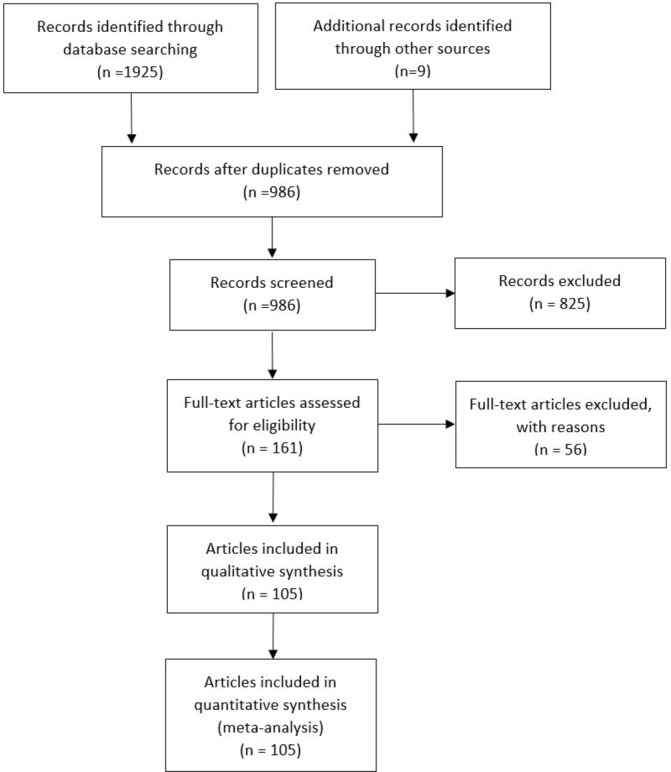
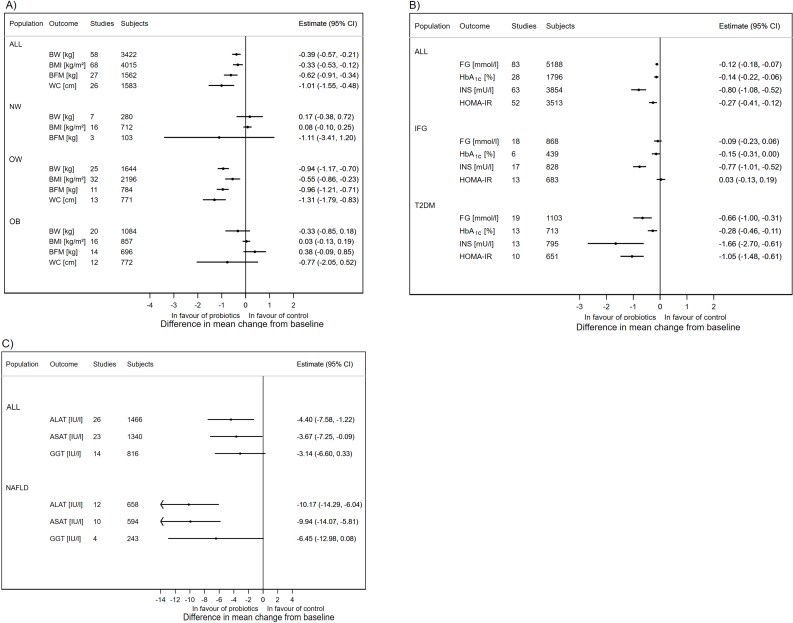
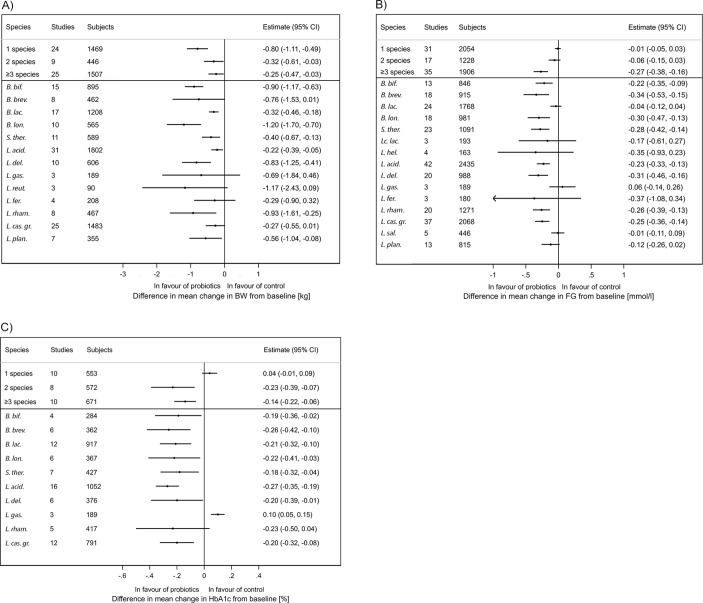
Objective: To systematically review the effect of oral intake of bacterial probiotics on 15 variables related to obesity, diabetes and non-alcoholic fatty liver disease. Design: Systematic review and meta-analysis. Data sources: Medline, EMBASE and COCHRANE from 1990 to June 2018. Eligibility criteria: Randomised controlled trials (≥14 days) excluding hypercholesterolaemia, alcoholic liver disease, polycystic ovary syndrome and children <3 years. Results: One hundred and five articles met inclusion criteria, representing 6826 subjects. In overweight but not obese subjects, probiotics induced improvements in: body weight (k=25 trials, d=−0.94 kg mean difference, 95% CI −1.17 to −0.70, I²=0.0%), body mass index (k=32, d=−0.55 kg/m², 95% CI −0.86 to −0.23, I²=91.9%), waist circumference (k=13, d=−1.31 cm, 95% CI −1.79 to −0.83, I²=14.5%), body fat mass (k=11, d=−0.96 kg, 95% CI −1.21 to −0.71, I²=0.0%) and visceral adipose tissue mass (k=5, d=−6.30 cm², 95% CI −9.05 to −3.56, I²=0.0%). In type 2 diabetics, probiotics reduced fasting glucose (k=19, d=−0.66 mmol/L, 95% CI −1.00 to −0.31, I²=27.7%), glycated haemoglobin (k=13, d=−0.28 pp, 95% CI −0.46 to −0.11, I²=54.1%), insulin (k=13, d=−1.66 mU/L, 95% CI −2.70 to −0.61, I²=37.8%) and homeostatic model of insulin resistance (k=10, d=−1.05 pp, 95% CI −1.48 to −0.61, I²=18.2%). In subjects with fatty liver diseases, probiotics reduced alanine (k=12, d=−10.2 U/L, 95% CI −14.3 to −6.0, I²=93.50%) and aspartate aminotransferases (k=10, d=−9.9 U/L, 95% CI −14.1 to -5.8, I²=96.1%). These improvements were mostly observed with bifidobacteria ( Bifidobacterium breve , B. longum ), Streptococcus salivarius subsp . thermophilus and lactobacilli ( Lactobacillus acidophilus , L. casei , L. delbrueckii ) containing mixtures and influenced by trials conducted in one country. Conclusions: The intake of probiotics resulted in minor but consistent improvements in several metabolic risk factors in subjects with metabolic diseases. Trial registration number: CRD42016033273.
Overview
The claims and statistics of this paper haven’t been checked yet.
Run the check — free, no account needed. It reads the open-access text and checks the sources it cites.
Integrity signals
Registry
Cites
Statistics
Figures
Verification
Claims the paper makes
The claims and statistics of this paper haven’t been checked yet.
Run the check — free, no account needed. It reads the open-access text and checks the sources it cites.
Claims other papers make about this one
Each is checked against this paper’s own text: does it say what the citing paper says it does?
In the citing paper
“Therapies targeted against the gut microbiota have been shown to improve the metabolic function in humans [2, 3]”
From Dietary lipids, gut microbiota and lipid metabolism (2019) · cites this paper as [3]
In the citing paper
“In another meta-analysis study, it was shown that the probiotic strains B. breve, B. longum, S. thermophilus, L. acidophilus, L. delbrueckii, and L. casei can have a positive impact on anthropometric results and also on the metabolic risk factors (e.g., fasting glucose in individual glucose or insulin) in subjects with metabolic diseases [141].”
From The Potential Impact of Probiotics on Human Health: An Update on Their Health-Promoting Properties (2024) · cites this paper as [141]
In the citing paper
“Interestingly, a meta-analysis showed that probiotic strains from specific taxa (Bifidobacterium breve, B. longum Streptococcus thermophilus Lactobacillus acidophilus, L. delbrueckii, and Lacticaseibacillus casei) may positively impact anthropometric outcomes and metabolic risk factors such as fasting glucose or insulin in individuals with metabolic diseases (Koutnikova et al., 2019).”
From Viral Infections, the Microbiome, and Probiotics (2021) · cites this paper as Koutnikova et al., 2019
Self-check
Percentages, sums and reported differences re-computed from the paper’s own numbers.
The self-check needs the paper’s full text.
Citations
Cites
4 retracted
Kouchaki, E., Tamtaji, O. R., Salami, M., Bahmani, F., Daneshvar Kakhaki, R., Akbari, E., Tajabadi-Ebrahimi, M., Jafari, P., & Asemi, Z. (2017) · Clinical Nutrition · doi:10.1016/j.clnu.2016.08.015 · Cited by 317
RetractedAsemi, Z., Khoramirad, A., Alizadeh, S., Shakeri, H., & Esmaillzadeh, A. (2013) · Clinical Nutrition · doi:10.1016/j.clnu.2013.05.015 · Cited by 192
RetractedBadehnoosh, B., Karamali, M., Zarrati, M., Jamilian, M., Bahmani, F., Ebrahimi, M. T., Jafari, P., Rahmani, E., & Asemi, Z. (2017) · The Journal of Maternal-Fetal & Neonatal Medicine · doi:10.1080/14767058.2017.1310193 · Cited by 131
RetractedBahmani, F., Tajadadi-Ebrahimi, M., Kolahdooz, F., Mazouchi, M., Hadaegh, H., Jamal, A.-S., Mazroii, N., Asemi, S., & Asemi, Z. (2015) · Journal of the American College of Nutrition · doi:10.1080/07315724.2015.1032443 · Cited by 92
RetractedMeasuring inconsistency in meta-analyses
Higgins, J. P. T., Thompson, S. G., Deeks, J. J., & Altman, D. G. (2003) · BMJ · doi:10.1136/bmj.327.7414.557 · Cited by 63,139
Bias in meta-analysis detected by a simple, graphical test
Egger, M., Smith, G. D., Schneider, M., & Minder, C. (1997) · BMJ · doi:10.1136/bmj.315.7109.629 · Cited by 56,722
Meta-analysis in clinical trials
DerSimonian, R., & Laird, N. (1986) · Controlled Clinical Trials · doi:10.1016/0197-2456(86)90046-2 · Cited by 39,552
Operating characteristics of a rank correlation test for publication bias
Begg, C. B., & Mazumdar, M. (1994) · Biometrics · doi:10.2307/2533446 · Cited by 16,955
Diet rapidly and reproducibly alters the human gut microbiome
David, L. A., Maurice, C. F., Carmody, R. N., Gootenberg, D. B., Button, J. E., Wolfe, B. E., Ling, A. V., Devlin, A. S., Varma, Y., Fischbach, M. A., et al. (2014) · Nature · doi:10.1038/nature12820 · Cited by 10,100
Hill (2014) · doi:10.1038/nrgastro.2014.66 · Cited by 9,592
Research works printed but not linked: 3
- 2018, EFSA Journal, 16, e05315
- 10.2307/2669529 · DOI
- 10.1177/1074248414555004 · DOI · Paper page
Cited by
Sorted by citations
Dietary lipids, gut microbiota and lipid metabolism
Schoeler, M., & Caesar, R. (2019) · Reviews in Endocrine and Metabolic Disorders · doi:10.1007/s11154-019-09512-0 · Cited by 1,163
Anti-Inflammatory and Immunomodulatory Effects of Probiotics in Gut Inflammation: A Door to the Body
Cristofori, F., Dargenio, V. N., Dargenio, C., Miniello, V. L., Barone, M., & Francavilla, R. (2021) · Frontiers in Immunology · doi:10.3389/fimmu.2021.578386 · Cited by 991
Shaping the Future of Probiotics and Prebiotics
Cunningham, M., Azcarate-Peril, M. A., Barnard, A., Benoit, V., Grimaldi, R., Guyonnet, D., Holscher, H. D., Hunter, K., Manurung, S., Obis, D., et al. (2021) · Trends in Microbiology · doi:10.1016/j.tim.2021.01.003 · Cited by 637
The Potential Impact of Probiotics on Human Health: An Update on Their Health-Promoting Properties
Maftei, N.-M., Raileanu, C. R., Balta, A. A., Ambrose, L., Boev, M., Marin, D. B., & Lisa, E. L. (2024) · Microorganisms · doi:10.3390/microorganisms12020234 · Cited by 381
Aoun, A., Darwish, F., & Hamod, N. (2020) · Preventive Nutrition and Food Science · doi:10.3746/pnf.2020.25.2.113 · Cited by 291
Metadata
- Authors
- Koutnikova, H., Genser, B., Monteiro-Sepulveda, M., Faurie, J.-M., Rizkalla, S., Schrezenmeir, J., & Clément, K.
- Affiliations
- Danone Nutricia Research, Palaiseau, France
- University of Mannheim (DE)
- Assistance Publique – Hôpitaux de Paris (FR)
- Danone (France) (FR)
- Johannes Gutenberg University Mainz (DE)
- Inserm (FR)
- Corresponding author
- Clément, Karine
- Venue
- BMJ Open
- Publisher
- BMJ
- Published
- 2019-03
- Volume
- 9
- Issue
- 3
- Pages
- e017995
- ISSN
- 2044-6055 (ISSN-L)
- PMC
- PMC6475231
- OpenAlex
- W2925399545
- Cited by
- 299
- References
- 144
- Citations by year
- 2026: 22 · 2025: 31 · 2024: 52 · 2023: 39 · 2022: 53 · 2021: 45 · 2020: 45 · 2019: 11
- FWCI
- 3.47
- Type
- journal article
- Language
- en
- Open access
- gold
- doi.org
- Licence
- cc-by-nc
- Locations
- BMJ Open (publishedVersion, cc-by-nc)
- PubMed Central (publishedVersion, cc-by-nc)
- PubMed (publishedVersion)
- HAL (submittedVersion, other-oa)
- HighWire Press Open Archive (submittedVersion)
- Funders
- Danone Research
- Topics
- Life Sciences › Agricultural and Biological Sciences › Food Science › Probiotics and Fermented Foods
- Life Sciences › Biochemistry, Genetics and Molecular Biology › Molecular Biology › Gut microbiota and health
- Health Sciences › Medicine › Hepatology › Liver Disease Diagnosis and Treatment
- Keywords
- probiotics, obesity, type 2 diabetes, non-alcoholic fatty liver disease, overweight, body weight, body mass index, waist circumference, visceral adipose tissue, fasting blood glucose, HbA1c, insulin resistance, insulin sensitivity, gut microbiota, intestinal barrier, intestinal permeability
- MeSH terms
- Diabetes Mellitus, Humans, Obesity, Randomized Controlled Trials as Topic, Treatment Outcome, Dietary Supplements, Probiotics, Non-alcoholic Fatty Liver Disease
About these checks
Registry, retraction, Cites and statistics results are computed, not judged, with one exception: a printed reference that no index lists is read once by a model before it counts as a citation error. Claims are extracted by a model and kept only when their quote appears verbatim in the text; each cited source is then checked, with a model’s help, for whether it says what the claim relies on. Those verdicts can be wrong — read the claim’s quote and the cited source before relying on one.
Statistics and arithmetic are recomputed, not judged.
Confidence bands are shown only for fields calibrated on our annotated test set. None is calibrated yet, so no band is shown.
What counts as a claim ›How we measure confidence ›How we check this ›
Are you an author, or do you see a problem with this page? Request a review
