

Novel ACT-based eHealth psychoeducational intervention for students with mental distress: a study protocol for a mixed-methodology pilot trial
Open accessThe DOI matches its Crossref record; 82 of the 88 references it cites were found in a registry or an index; 34 of the 83 sources its claims cite were checked for support.
Abstract
Introduction Recent studies have revealed a high prevalence of depression, anxiety and stress symptoms among university students, highlighting an urgent need for preventative measures at low cost to better support often overwhelmed support services. Objective Here we propose a protocol for assessing the feasibility of a randomised controlled trial (RCT) for an online transdiagnostic psychoeducational intervention called â € A Bite of ACT' compared with a waitlist control. Methods and analysis This is an RCT with crossover design involving baseline assessments and two follow-up periods. The primary outcome measure will be the Acceptance Checklist for Clinical Effectiveness Pilot Trials (ACCEPT) for measuring the feasibility of the trial design and methods. Secondary outcomes include measures of well-being, social connectedness, quality of life (EuroQol Five Dimensions), depression, anxiety and stress (Depression Anxiety Stress Scales-21), as well as the process measures: psychological flexibility (Acceptance and Action Questionnaire-Second Version and the Mindful Attention Awareness Scale) and heart rate variability. Analysis will involve calculating descriptive statistics, examining trial feasibility outcomes through ACCEPT, and determining effect size measures to determine the sample size needed in a future trial (if indicated). Qualitative interviews and preliminary health economics analysis will provide additional insights into the feasibility of the intervention and trial methods. Ethics and dissemination This study has been approved by the Department of Psychology Research Ethics Committee in the College of Human and Health Sciences at Swansea University. Dissemination will involve publication in international peer-reviewed journals, presentation of findings at relevant local, national and international conferences, and promotion of study outcomes using social media and other channels for disseminating findings to the wider community. Trial registration number NCT03810131; Pre-results. © 2019 Author(s).
Overview
CoChat Summary
## TL;DR
This paper is a study protocol for a mixed-methodology pilot randomized controlled trial of “A Bite of ACT” (BOA), an online, brief ACT-based psychoeducational intervention for university students with mental distress. The trial is designed to test feasibility, acceptability, preliminary outcomes, and mediators against a waitlist control.
## Key findings
- Not stated in the paper.
- The planned pilot trial will randomize 60 participants to BOA or waitlist control, with an assumed 30% attrition rate and an expected 70% retention.
- The protocol states that at least 15 participants will be recruited into at least three focus groups (5 per group) to assess acceptability and feasibility, with more interviews/focus groups if needed until saturation.
- The intervention is designed as four half-hour sessions over 2 weeks, with sessions delivered twice per week; the authors hypothesize improvements in well-being, quality of life, social connectedness, acceptance, mindfulness, and reductions in stress, anxiety, and depression, plus mediation by vagal function and psychological flexibility.
## Methods
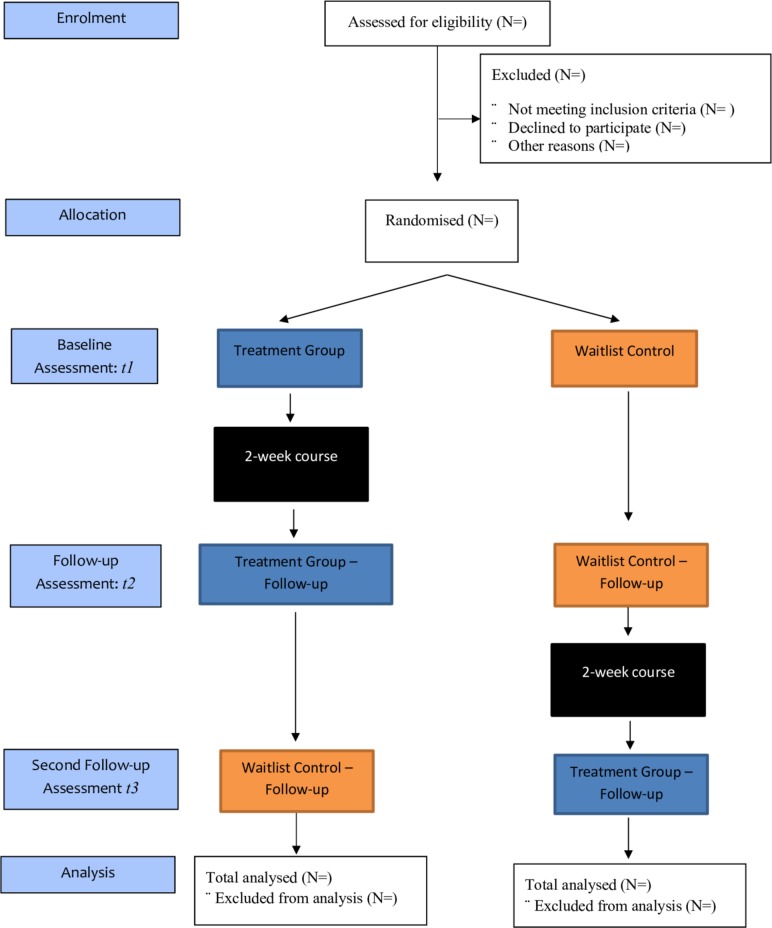
- Design: Prospective randomized controlled pilot trial with crossover design, plus qualitative focus groups/interviews and a preliminary health economics analysis.
- Sample/data: 60 university students aged 18+ with feelings of depression, anxiety and/or stress; participants must have internet access and be able to read/write English. The trial includes three assessment time points and resting-state ECG recordings for HRV at baseline, 2 weeks, and 4 weeks.
- Analysis: Feasibility will be assessed using the ACCEPT checklist; quantitative analyses include descriptive statistics, mixed-effects analysis of covariance for secondary outcomes, mixed-effects analysis of variance in the focus-group section, and mediation analysis for HRV and psychological flexibility. Qualitative data will use thematic analysis.
## Limitations
- The paper itself notes that this is a pilot study and that clinical effectiveness will not be formally evaluated at this stage; only preliminary evidence will be inspected.
- The protocol anticipates 30% attrition, which is a practical limitation for feasibility.
- Evident from the text: because this is a protocol for a planned trial, it reports no outcome results yet and cannot establish whether the intervention is effective.
Model-written summary. Check it against the paper before relying on it.
Integrity signals
Registry
Cites
Statistics
Figures
Verification
Claims the paper makes
29 Valid · 1 Not valid · 33 Not checked · 29 Own results and interpretations
Every source the paper cites for this claim was checked and supports it.
In the paper
“another meta-analysis25 of computer-delivered and web-based interventions (14 trials, n=1795 university students) reported that the interventions—relative to an inactive control—were effective for anxiety (SDM: −0.56; 95% CI −0.77 to −0.35, p<0.001), depression (SDM: −0.43; 95% CI −0.63 to −0.22, p<0.001) and stress (SDM: −0.73; 95% CI −1.27 to −0.19, p=0.008).”
§ Novel ACT-based eHealth psychoeducational intervention for students with mental distress: a study protocol for a mixed-methodology pilot trial > Introduction
What the sources say
- Supportedcites [25] Davies EB, Morriss R, Glazebrook C Computer-delivered and web-based interventions to improve depression, anxiety, and psychological well-being of university students: a systematic review and meta-analysis. J Med Internet Res 2014; 16: e130 10.2196/jmir.3142 24836465 PMC4051748 source
The Results section on interventions compared with inactive controls reports the cited effect sizes, confidence intervals, and P values for anxiety, depression, and stress in sensitivity analyses. The Abstract Results reports 14 trials with sufficient data for meta-analysis and 1,795 participants randomized. These findings concern inactive controls, not active controls. (LLM, conf=0.95)
plainstates a causen = 1,795 ·- Asserted: passes — The authors put it forward as true.
- Checkable: passes — It can be checked against evidence.
- Load-bearing: passes — The paper’s conclusions depend on it.
- Based: passes — The paper gives a reason why it holds.
- Supported
The sources with a verdict support this claim; the rest weren’t checked yet, have no full text we could read, or their verdicts aren’t rated yet.
In the paper
“The attrition rates predicted are in line with reported rates in similar eHealth studies57 71”
§ Novel ACT-based eHealth psychoeducational intervention for students with mental distress: a study protocol for a mixed-methodology pilot trial > Methods > Trial design
What the sources say
- Not checked — no full text of the sourcecites [57] O’Connor M, Munnelly A, Whelan R, et al The efficacy and acceptability of third-wave behavioral and cognitive ehealth treatments: a systematic review and meta-analysis of randomized controlled trials. Behav Ther 2018; 49 10.1016/j.beth.2017.07.007 29704973 source
- Supportedcites [71] Melville KM, Casey LM, Kavanagh DJ Dropout from Internet-based treatment for psychological disorders. Br J Clin Psychol 2010; 49: 455– 71. 10.1348/014466509X472138 19799804 source
The ‘Extent of Dropout’ section reports attrition rates across 16 internet-based psychological treatment studies, ranging from 2% to 83%, with a weighted average of 35%. This supports the citation’s role as a source of reported rates in similar studies; the comparison with the citing authors’ predicted rates is their own. (LLM, conf=0.88)
plain- Asserted: passes — The authors put it forward as true.
- Checkable: passes — It can be checked against evidence.
- Load-bearing: unclear — It is unclear whether the paper’s conclusions depend on it.
- Based: passes — The paper gives a reason why it holds.
The cited sources support only part of this claim — read each source’s verdict below.
In the paper
“A recent uncontrolled pre–post evaluation of the AYL course55 showed significant improvements in mindfulness, psychological flexibility, self-efficacy, anxiety, depression and life satisfaction.”
§ Novel ACT-based eHealth psychoeducational intervention for students with mental distress: a study protocol for a mixed-methodology pilot trial > Introduction
What the sources say
- Partly supportedcites [55] Cartwright J, Hooper N Evaluating a transdiagnostic acceptance and commitment therapy psychoeducation intervention. The Cognitive Behaviour Therapist 2017; 10– 10. 10.1017/S1754470X17000125 sourceExperimental — accuracy not yet measured
The Results report significant pre–post improvements in anxiety, depression, life satisfaction, psychological flexibility and mindfulness-based self-efficacy, including in an analysis accounting for dropout. The Process measures section identifies mindfulness-based self-efficacy as one measure; the paper does not report separate improvements in mindfulness and self-efficacy as the citing sentence implies. (LLM, conf=0.88)
plainstates a cause- Asserted: passes — The authors put it forward as true.
- Checkable: passes — It can be checked against evidence.
- Load-bearing: passes — The paper’s conclusions depend on it.
- Based: passes — The paper gives a reason why it holds.
- Partly supported
The cited sources support only part of this claim — read each source’s verdict below.
In the paper
“For ACT-specific studies, longer, intensive online interventions (eg, 45 min each session, 6 sessions) have reported a 45% attrition,33 while shorter ACT online studies (eg, 15 min per session, 3 sessions) have reported as little as 8% attrition.31”
§ Novel ACT-based eHealth psychoeducational intervention for students with mental distress: a study protocol for a mixed-methodology pilot trial > Methods > Feasibility
What the sources say
- Partly supportedcites [33] Levin ME, Haeger JA, Pierce BG, et al Web-based acceptance and commitment therapy for mental health problems in college students: a randomized controlled trial. Behav Modif 2017; 41: 141– 62. 10.1177/0145445516659645 27440189 sourceExperimental — accuracy not yet measured
The ACT program usage and satisfaction section reports that 55% completed all six sessions, supporting 45% noncompletion of the program. It reports an average of 17.19 minutes per completed session, however, not 45 minutes; the Analysis plan also reports a different measure—80% of ACT participants completed the posttreatment survey. Page numbers are unavailable in our copy. (LLM, conf=0.90)
plainstates an association- Asserted: passes — The authors put it forward as true.
- Checkable: passes — It can be checked against evidence.
- Load-bearing: passes — The paper’s conclusions depend on it.
- Based: passes — The paper gives a reason why it holds.
- Partly supported
The cited sources support only part of this claim — read each source’s verdict below.
In the paper
“For ACT-specific studies, longer, intensive online interventions (eg, 45 min each session, 6 sessions) have reported a 45% attrition,33 while shorter ACT online studies (eg, 15 min per session, 3 sessions) have reported as little as 8% attrition.31”
§ Novel ACT-based eHealth psychoeducational intervention for students with mental distress: a study protocol for a mixed-methodology pilot trial > Methods > Feasibility
What the sources say
- Partly supportedcites [31] Levin ME, Pistorello J, Seeley JR, et al Feasibility of a prototype web-based acceptance and commitment therapy prevention program for college students. J Am Coll Health 2014; 62: 20– 30. 10.1080/07448481.2013.843533 24313693 PMC3858823 sourceExperimental — accuracy not yet measured
The Results (Program Usage and Usability; page unavailable) say 92% of participants who used the program completed both lessons, implying 8% did not complete the program. But the Methods (ACT-CL; page unavailable) describe two lessons, not three 15-minute sessions, and the reported mean time in the program was 81.98 minutes. The Methods (Data Analysis Plan; page unavailable) separately report three study dropouts, so the 8% figure should not be presented without distinguishing program noncompletion from study attrition. (LLM, conf=0.88)
plainstates an association- Asserted: passes — The authors put it forward as true.
- Checkable: passes — It can be checked against evidence.
- Load-bearing: passes — The paper’s conclusions depend on it.
- Based: passes — The paper gives a reason why it holds.
- Partly supported
14 more claims · 2 with their cited sources checked
Create a free account to see all 92 claims and every source verdict.
- It may state two separate claims as one. 27
- Probably not a substantial claim. 63
Claims other papers make about this one
Each is checked against this paper’s own text: does it say what the citing paper says it does?
The cited source says what the claim attributes to it.
In the citing paper
“ACT has been usefully applied to many forms of mental health issues and has been applied in many different forms of delivery. This includes web-based interventions,40–42 teleconference43 and a downloadable app for smartphones.44 45”
From A novel ACT-based video game to support mental health through embedded learning: A mixed-methods feasibility study protocol (2020) · cites this paper as [40]
Citations
Cites
Using thematic analysis in psychology
Braun, V., & Clarke, V. (2006) · Qualitative Research in Psychology · doi:10.1191/1478088706qp063oa · Cited by 194,414
Heart Rate Variability: Standards of Measurement, Physiological Interpretation, and Clinical Use
Electrophysiology, T. F. O. T. E. S. O. C. T. N. A. (1996) · Circulation · doi:10.1161/01.cir.93.5.1043 · Cited by 17,159
The benefits of being present: Mindfulness and its role in psychological well-being
Brown, K. W., & Ryan, R. M. (2003) · Journal of Personality and Social Psychology · doi:10.1037/0022-3514.84.4.822 · Cited by 13,448
CONSORT 2010 Statement: updated guidelines for reporting parallel group randomised trials
the CONSORT Group, Schulz, K. F., Altman, D. G., & Moher, D. (2010) · BMC Medicine · doi:10.1186/1741-7015-8-18 · Cited by 13,371
Fereday, J., & Muir-Cochrane, E. (2006) · International Journal of Qualitative Methods · doi:10.1177/160940690600500107 · Cited by 11,829 · cited 2×
“Rigour will also be ensured by following the inductive and deductive code development as outlined by Fereday and Muir-Cochrane.90 Key overarching themes relating to feasibility of the study design and acceptability of the intervention, as well as potential adverse effects, will be outlined and reported.”
MethodDeveloping and evaluating complex interventions: the new Medical Research Council guidance
Craig, P., Dieppe, P., Macintyre, S., Michie, S., Nazareth, I., & Petticrew, M. (2008) · BMJ · doi:10.1136/bmj.a1655 · Cited by 10,995
Hoffmann, T. C., Glasziou, P. P., Boutron, I., Milne, R., Perera, R., Moher, D., Altman, D. G., Barbour, V., Macdonald, H., Johnston, M., et al. (2014) · BMJ · doi:10.1136/bmj.g1687 · Cited by 10,548
Moher, D., Hopewell, S., Schulz, K. F., Montori, V., Gotzsche, P. C., Devereaux, P. J., Elbourne, D., Egger, M., & Altman, D. G. (2010) · BMJ · doi:10.1136/bmj.c869 · Cited by 8,883
Social Relationships and Mortality Risk: A Meta-analytic Review
Holt-Lunstad, J., Smith, T. B., & Layton, J. B. (2010) · PLoS Medicine · doi:10.1371/journal.pmed.1000316 · Cited by 7,272 · cited 1×
“51 More diverse and rewarding social relationships also lead to better physical health and increased longevity according to a meta-analytic review on 148 studies which included more than 300 000 participants.(5) Researchers(46) have reported that increases in positive emotions after training in loving-kindness meditat…”
BackgroundAcceptance and commitment therapy: model, processes and outcomes
Hayes, S. C., Luoma, J. B., Bond, F. W., Masuda, A., & Lillis, J. (2006) · Behaviour Research and Therapy · doi:10.1016/j.brat.2005.06.006 · Cited by 6,587
Loneliness and Social Isolation as Risk Factors for Mortality: A Meta-Analytic Review
Holt-Lunstad, J., Smith, T. B., Baker, M., Harris, T., & Stephenson, D. (2015) · Perspectives on Psychological Science · doi:10.1177/1745691614568352 · Cited by 6,043
(1999) · Cited by 5,934
Henry, J. D., & Crawford, J. R. (2005) · British Journal of Clinical Psychology · doi:10.1348/014466505x29657 · Cited by 5,801
The Warwick-Edinburgh Mental Well-being Scale (WEMWBS): development and UK validation
Tennant, R., Hiller, L., Fishwick, R., Platt, S., Joseph, S., Weich, S., Parkinson, J., Secker, J., & Stewart-Brown, S. (2007) · Health and Quality of Life Outcomes · doi:10.1186/1477-7525-5-63 · Cited by 5,031
Bond, F. W., Hayes, S. C., Baer, R. A., Carpenter, K. M., Guenole, N., Orcutt, H. K., Waltz, T., & Zettle, R. D. (2011) · Behavior Therapy · doi:10.1016/j.beth.2011.03.007 · Cited by 3,950
Psychological flexibility as a fundamental aspect of health
Kashdan, T. B., & Rottenberg, J. (2010) · Clinical Psychology Review · doi:10.1016/j.cpr.2010.03.001 · Cited by 3,054 · cited 2×
“It is thought that these skills lead to a more flexible sense of self, where the individual may start at a point where they believe their thoughts and behave according to them (called self-as-content), and then develop in a more flexible way where they are aware of thoughts, but are completely detached from the conten…”
BackgroundMethodCONSORT 2010 statement: extension to randomised pilot and feasibility trials
on behalf of the PAFS consensus group, Eldridge, S. M., Chan, C. L., Campbell, M. J., Bond, C. M., Hopewell, S., Thabane, L., & Lancaster, G. A. (2016) · Pilot and Feasibility Studies · doi:10.1186/s40814-016-0105-8 · Cited by 2,843
Kubios HRV–heart rate variability analysis software.
Tarvainen, M. P., Niskanen, J.-P., Lipponen, J. A., Ranta-aho, P. O., & Karjalainen, P. A. (2014) · Computer Methods and Programs in Biomedicine · doi:10.1016/j.cmpb.2013.07.024 · Cited by 2,720 · cited 1×
“HRV component will then be obtained using established protocols.(76)”
MethodLaborde, S., Mosley, E., & Thayer, J. F. (2017) · Frontiers in Psychology · doi:10.3389/fpsyg.2017.00213 · Cited by 2,336
(2011) · Cited by 2,032
The prevalence and correlates of depression, anxiety, and stress in a sample of college students
Beiter, R., Nash, R., McCrady, M., Rhoades, D., Linscomb, M., Clarahan, M., & Sammut, S. (2015) · Journal of Affective Disorders · doi:10.1016/j.jad.2014.10.054 · Cited by 2,030
A systematic review of studies of depression prevalence in university students
Ibrahim, A. K., Kelly, S. J., Adams, C. E., & Glazebrook, C. (2013) · Journal of Psychiatric Research · doi:10.1016/j.jpsychires.2012.11.015 · Cited by 1,988 · cited 1×
“7%.(6) 7 A study on a sample of 1002 students registered at a university-based general practice in the UK reported that 48% of students have high levels of anxiety and 10% have high levels of depression.”
BackgroundTwenge, J. M., Joiner, T. E., Rogers, M. L., & Martin, G. N. (2018) · Clinical Psychological Science · doi:10.1177/2167702617723376 · Cited by 1,705 · cited 1×
“For instance, two national US surveys (total number of both surveys=506 820) found that for adolescents aged between 13 and 18, depressive symptoms, suicide-related outcomes and suicide rates have increased between 2010 and 2015.(9) Clinicians heading university counselling centres have reported more case work after 2…”
BackgroundDeveloping and evaluating complex interventions: the new Medical Research Council guidance
Craig, P., Dieppe, P., Macintyre, S., Michie, S., Nazareth, I., & Petticrew, M. (2013) · International Journal of Nursing Studies · doi:10.1016/j.ijnurstu.2012.09.010 · Cited by 1,658
Savović, J., Jones, H. E., Altman, D. G., Harris, R. J., Jüni, P., Pildal, J., Als-Nielsen, B., Balk, E. M., Gluud, C., Gluud, L. L., et al. (2012) · Annals of Internal Medicine · doi:10.7326/0003-4819-157-6-201209180-00537 · Cited by 1,049
Scheier, M. F., Matthews, K. A., Owens, J. F., Magovern, G. J., Lefebvre, R. C., Abbott, R. A., & Carver, C. S. (1989) · Journal of Personality and Social Psychology · doi:10.1037//0022-3514.57.6.1024 · Cited by 1,023
Interventions to reduce stress in university students: A review and meta-analysis
Regehr, C., Glancy, D., & Pitts, A. (2013) · Journal of Affective Disorders · doi:10.1016/j.jad.2012.11.026 · Cited by 956
The Association between Job Strain and Atrial Fibrillation: Results from the Swedish WOLF Study
Fransson, E. I., Stadin, M., Nordin, M., Malm, D., Knutsson, A., Alfredsson, L., & Westerholm, P. J. M. (2015) · BioMed Research International · doi:10.1155/2015/371905 · Cited by 914
Boehm, J. K., & Kubzansky, L. D. (2012) · Psychological Bulletin · doi:10.1037/a0027448 · Cited by 909 · cited 1×
“Positive emotions, such as those promoted through psychological flexibility, have been shown to increase rewards across many domains in life, such as work,(47) coping(48) and marriage,(49) and over the longer term are associated with improved cardiovascular health.(50) 51 More diverse and rewarding social relationship…”
Background(2015) · Wiley eBooks · doi:10.1002/9781118996874 · Cited by 809
Kok, B. E., Coffey, K. A., Cohn, M. A., Catalino, L. I., Vacharkulksemsuk, T., Algoe, S. B., Brantley, M., & Fredrickson, B. L. (2013) · Psychological Science · doi:10.1177/0956797612470827 · Cited by 755
The New Psychology of Health: Unlocking the Social Cure
Haslam, C., Jetten, J., Cruwys, T., Dingle, G. A., & Haslam, S. A. (2018) · doi:10.4324/9781315648569 · Cited by 748 · cited 1×
“However, other approaches are available, which include ACT,(36) 37 positive psychology(38) and facilitation of positive social relationships.(39) 40 ACT is different from more traditional (second-wave) therapies such as CBT as it emphasises psychological flexibility, a fundamental component of individual health and we…”
BackgroundForman, E. M., Herbert, J. D., Moitra, E., Yeomans, P. D., & Geller, P. A. (2007) · Behavior Modification · doi:10.1177/0145445507302202 · Cited by 687
What about N? A methodological study of sample-size reporting in focus group studies
Carlsen, B., & Glenton, C. (2011) · BMC Medical Research Methodology · doi:10.1186/1471-2288-11-26 · Cited by 670 · cited 1×
“More participants may be recruited in additional focus groups and/or interviews until saturation is met in line with established recommendations for focus group thematic analysis.(72)”
Background(2009) · Cited by 655
Russ, T. C., Stamatakis, E., Hamer, M., Starr, J. M., Kivimaki, M., & Batty, G. D. (2012) · BMJ · doi:10.1136/bmj.e4933 · Cited by 637
Mediators of change in emotion-focused and problem-focused worksite stress management interventions
Bond, F. W., & Bunce, D. (2000) · Journal of Occupational Health Psychology · doi:10.1037/1076-8998.5.1.156 · Cited by 607
Dropout from Internet‐based treatment for psychological disorders
Melville, K. M., Casey, L. M., & Kavanagh, D. J. (2010) · British Journal of Clinical Psychology · doi:10.1348/014466509x472138 · Cited by 597 · cited 1×
“This is in line with similar eHealth studies where one meta-analysis reported a 23% dropout overall for eHealth interventions(57) and another which reported a weighted average attrition of 35% for online interventions.(71) For ACT-specific studies, longer, intensive online interventions (eg, 45 min each session, 6 ses…”
ResultChanges in undergraduate students’ psychological well‐being as they progress through university
Bewick, B., Koutsopoulou, G., Miles, J., Slaa, E., & Barkham, M. (2010) · Studies in Higher Education · doi:10.1080/03075070903216643 · Cited by 597
Heart rate variability in depressive and anxiety disorders
Gorman, J. M., & Sloan, R. P. (2000) · American Heart Journal · doi:10.1067/mhj.2000.109981 · Cited by 510
Wetherell, J. L., Afari, N., Rutledge, T., Sorrell, J. T., Stoddard, J. A., Petkus, A. J., Solomon, B. C., Lehman, D. H., Liu, L., Lang, A. J., et al. (2011) · PAIN · doi:10.1016/j.pain.2011.05.016 · Cited by 508
Davies, E. B., Morriss, R., & Glazebrook, C. (2014) · Journal of Medical Internet Research · doi:10.2196/jmir.3142 · Cited by 499
Medical student depression, anxiety and distress outside North America: a systematic review
Hope, V., & Henderson, M. (2014) · Medical Education · doi:10.1111/medu.12512 · Cited by 477
Quintana, D. S., Alvares, G. A., & Heathers, J. A. J. (2016) · Translational Psychiatry · doi:10.1038/tp.2016.73 · Cited by 420
Letting go: Mindfulness and negative automatic thinking
Frewen, P. A., Evans, E. M., Maraj, N., Dozois, D. J. A., & Partridge, K. (2008) · Cognitive Therapy and Research · doi:10.1007/s10608-007-9142-1 · Cited by 401
Hayes, S. C., Bissett, R., Roget, N., Padilla, M., Kohlenberg, B. S., Fisher, G., Masuda, A., Pistorello, J., Rye, A. K., Berry, K., et al. (2004) · Behavior Therapy · doi:10.1016/s0005-7894(04)80022-4 · Cited by 358
The Therapeutic Relationship in E-Therapy for Mental Health: A Systematic Review
Sucala, M., Schnur, J. B., Constantino, M. J., Miller, S. J., Brackman, E. H., & Montgomery, G. H. (2012) · Journal of Medical Internet Research · doi:10.2196/jmir.2084 · Cited by 344 · cited 1×
“Using eTherapies such as internet or telephone support is becoming increasingly popular, although it is unclear which eTherapies students may benefit from the most.(21) Several studies have explored the efficacy of using innovative interventions to improve student mental health.”
BackgroundSchrag, A. (2000) · Journal of Neurology, Neurosurgery & Psychiatry · doi:10.1136/jnnp.69.1.67 · Cited by 327
Influences and Consequences of Well-being Among Australian Young People: 1980–1995
Marks, G. N., & Fleming, N. (1999) · Social Indicators Research · doi:10.1023/a:1006928507272 · Cited by 228
Daya, Z., & Hearn, J. H. (2018) · Medical Teacher · doi:10.1080/0142159x.2017.1394999 · Cited by 224
Räsänen, P., Lappalainen, P., Muotka, J., Tolvanen, A., & Lappalainen, R. (2016) · Behaviour Research and Therapy · doi:10.1016/j.brat.2016.01.001 · Cited by 221
Newbury-Birch, D., Lowry, R. J., & Kamali, F. (2002) · British Dental Journal · doi:10.1038/sj.bdj.4801448a · Cited by 209
Newbury-Birch, D., Lowry, R. J., & Kamali, F. (2002) · British Dental Journal · doi:10.1038/sj.bdj.4801448 · Cited by 207 · cited 1×
“A longitudinal study of student dentists reported that anxiety increases over time from 47% at second year to 67% in the final year.(15) It has also been reported that 39% of adults (aged 16 and over) diagnosed with anxiety or depression were accessing mental health treatment.”
BackgroundLevin, M. E., Haeger, J. A., Pierce, B. G., & Twohig, M. P. (2017) · Behavior Modification · doi:10.1177/0145445516659645 · Cited by 207
Levin, M. E., Pistorello, J., Seeley, J. R., & Hayes, S. C. (2014) · Journal of American College Health · doi:10.1080/07448481.2013.843533 · Cited by 179 · cited 1×
“For ACT-specific studies, longer, intensive online interventions (eg, 45 min each session, 6 sessions) have reported a 45% attrition,(33) while shorter ACT online studies (eg, 15 min per session, 3 sessions) have reported as little as 8% attrition.(31) We have conservatively estimated a 30% attrition despite our inter…”
BackgroundHewitt, C., Hahn, S., Torgerson, D. J., Watson, J., & Bland, J. M. (2005) · BMJ · doi:10.1136/bmj.38413.576713.ae · Cited by 176
Positive psychological attributes and cardiac outcomes: associations, mechanisms, and interventions
DuBois, C. M., Beach, S. R., Kashdan, T. B., Nyer, M. B., Park, E. R., Celano, C. M., & Huffman, J. C. (2012) · Psychosomatics · doi:10.1016/j.psym.2012.04.004 · Cited by 152
Muto, T., Hayes, S. C., & Jeffcoat, T. (2011) · Behavior Therapy · doi:10.1016/j.beth.2010.08.009 · Cited by 144
Ly, K. H., Asplund, K., & Andersson, G. (2014) · Internet Interventions · doi:10.1016/j.invent.2014.06.003 · Cited by 133
Kemp, A. H., Koenig, J., & Thayer, J. F. (2017) · Neuroscience & Biobehavioral Reviews · doi:10.1016/j.neubiorev.2017.09.006 · Cited by 114 · cited 1×
“Psychological distress increases morbidity from a host of conditions and increases risk for premature mortality in a dose–response relationship.(2) 3 This highlights the importance of tackling such issues early before the adverse downstream effects impact on individuals and society.”
BackgroundThe Promise of Sustainable Happiness
Boehm, J. K., & Lyubomirsky, S. (2009) · The Oxford Handbook of Positive Psychology · doi:10.1093/oxfordhb/9780195187243.013.0063 · Cited by 102
de Vente, W., van Amsterdam, J. G. C., Olff, M., Kamphuis, J. H., & Emmelkamp, P. M. G. (2015) · BioMed Research International · doi:10.1155/2015/431725 · Cited by 90 · cited 1×
“This is an important measure of the hypothalamic-pituitary-adrenal axis, which regulates the stress response control and relates to other mental health symptoms such as anxiety, depression and burn-out.(43) 44 The vagus nerve also facilitates capacity for social engagement(45) and has been shown to sustain positive em…”
BackgroundAcceptance checklist for clinical effectiveness pilot trials: a systematic approach
Charlesworth, G., Burnell, K., Hoe, J., Orrell, M., & Russell, I. (2013) · BMC Medical Research Methodology · doi:10.1186/1471-2288-13-78 · Cited by 87 · cited 1×
“The specific aims are as follows: ► The primary research question is: are the design and methodology of this BOA pilot trial feasible? This includes the acceptability of the intervention itself as described by the ACCEPT framework.(58) ► Secondary questions include the following: is there”
Background“Social Ties, Health and Wellbeing: A Literature Review and Model”,
Kemp, A. H., Arias, J. A., & Fisher, Z. (2017) · Neuroscience and Social Science · doi:10.1007/978-3-319-68421-5_17 · Cited by 79 · cited 1×
“This is a commonly indexed measure of vagal function and an important mediator of the association between health and well-being, emotion regulation and longevity.(40) Measurements of HRV are used to assess autonomic changes, which can be performed using a sensitive and non-invasive technique through an ECG.”
MethodSelf-citationViskovich, S., & Pakenham, K. I. (2018) · Journal of Clinical Psychology · doi:10.1002/jclp.22656 · Cited by 77
SPIRIT (Standard Protocol Items: Recommendations for Interventional Trials)
Moher, D., & Chan, A. (2014) · Guidelines for Reporting Health Research: A User's Manual · doi:10.1002/9781118715598.ch7 · Cited by 66
O’Connor, M., Munnelly, A., Whelan, R., & McHugh, L. (2018) · Behavior Therapy · doi:10.1016/j.beth.2017.07.007 · Cited by 62
Allocation concealment in randomised controlled trials: are we getting better?: Table 1
Clark, L., Fairhurst, C., & Torgerson, D. J. (2016) · BMJ · doi:10.1136/bmj.i5663 · Cited by 60
Eustis, E. H., Hayes-Skelton, S. A., Orsillo, S. M., & Roemer, L. (2018) · Behavior Therapy · doi:10.1016/j.beth.2018.05.009 · Cited by 57 · cited 1×
“52).(34) There are some key differences in some of the interventions mentioned which are commonly used to treat for these types of disorders.”
BackgroundGaudiano, B. A., & Herbert, J. D. (2006) · Behavioural and Cognitive Psychotherapy · doi:10.1017/s1352465806003080 · Cited by 55
Randall, E. M., & Bewick, B. M. (2015) · British Journal of Guidance and Counselling · doi:10.1080/03069885.2015.1017801 · Cited by 42 · cited 1×
“Others have called for more innovative approaches by student counselling services and pathways of support.(19) One of the recommendations is that effective therapeutic support needs to be provided even when students are off campus and to increase existing counselling capacity on campus.”
BackgroundThe derived generalization of thought suppression
Hooper, N., Saunders, J., & McHugh, L. (2010) · Learning & Behavior · doi:10.3758/lb.38.2.160 · Cited by 39 · cited 1×
“There is some evidence to suggest that attempting to suppress thoughts can be actually counterproductive.(77) So acceptance is perhaps a preferred approach if one seeks to reduce the frequency and intensity of these thoughts.”
BackgroundClark, L., Fairhurst, C., Hewitt, C. E., Birks, Y., Brabyn, S., Cockayne, S., Rodgers, S., Hicks, K., Hodgson, R., Littlewood, E., et al. (2014) · Journal of Clinical Epidemiology · doi:10.1016/j.jclinepi.2014.04.007 · Cited by 36 · cited 1×
“Poor randomisation methods with no concealment can lead to exaggerated treatment effects,(79) 80 which can then lead to further problems with overexaggerated systematic reviews.(81) For this reason, individuals involved Table 1 Overview of ‘A Bite of ACT’ intervention”
BackgroundSaracutu, M., Edwards, D. J., Davies, H., & Rance, J. (2018) · BMJ Open · doi:10.1136/bmjopen-2018-021866 · Cited by 29 · cited 1×
“The questions to be asked of participants (see table 3) are based on another novel (non-internet-based) ACT-based protocol for chronic pain.(89) The data will be analysed after the study has been completed.”
MethodSelf-citationNovotney, A. (2014) · PsycEXTRA Dataset · doi:10.1037/e522492014-013 · Cited by 28
Burns, P., Kellett, S., & Donohoe, G. (2016) · Behavioural and Cognitive Psychotherapy · doi:10.1017/s1352465815000491 · Cited by 20 · cited 1×
“LLW provides low-intensity psychoeducational courses that are delivered live to attendees; for instance, it offers a CBT-based psychoeducation course called Stress Control,(53) which has been shown to be well tolerated and effective.(54) The LLW programme also offers the ACTivate Your Life (AYL) programme, which is de…”
BackgroundShort-term Counselling in Higher Education
(2015) · Routledge eBooks · doi:10.4324/9781315751078 · Cited by 16
ACT process measures: specificity and incremental value
Gootzeit, J. H. (2014) · doi:10.17077/etd.grjd6zw4 · Cited by 10 · cited 1×
“Process measures (mediating measures) Process (mediator) measures operationally define the hypothesised processes and quality of the intervention through mediation analysis.(85) Examining process measures will help to explain how BOA decreases depression and anxiety, and whether such decreases are mediated by increase…”
BackgroundEvaluating a transdiagnostic acceptance and commitment therapy psychoeducation intervention
Cartwright, J., & Hooper, N. (2017) · The Cognitive Behaviour Therapist · doi:10.1017/s1754470x17000125 · Cited by 7 · cited 1×
“The LLW programme also offers the ACTivate Your Life (AYL) programme, which is delivered over four 2-hour sessions by trained presenters.(55) These initiatives are consistent with the National Institute for Health and Care Excellence guidelines for managing mild symptoms of depression and anxiety,(56) and indicate tha…”
MethodCan I have cheese on my ham sandwich?
Joshi, K. G. (2016) · BMJ · doi:10.1136/bmj.i6024 · Cited by 3
Tang, N. K. Y. (2002) · Behavioural and Cognitive Psychotherapy · doi:10.1017/s1352465802213132 · Cited by 1
(1996) · PubMed
Research works printed but not linked: 4
- Shiels C, Gabbay M, Exley D Psychological distress in students registered at a university-based general practice. Primary Care and Community Psychiatry 2008; 13: 9– 18.
- Hayes S Acceptance and commitment therapy: the process and practice of mindful change: Guilford Press, 2011.
- Seligman ME Positive psychology in practice: John Wiley & Sons, 2012.
- National Institute for Health and Clinical Excellence. Common mental health problems: identification and pathways to care. 2011 https://www.nice.org.uk/guidance/cg123 (20 Feb 2018). 31877005
Cited by
Ponzo, S., Morelli, D., Kawadler, J. M., Hemmings, N. R., Bird, G., & Plans, D. (2020) · JMIR mHealth and uHealth · doi:10.2196/17767 · Cited by 100
“Nearly half (48%) of the students registered at a UK university-based general practice report high levels of anxiety [3].”
BackgroundThe Complex Construct of Wellbeing and the Role of Vagal Function
Wilkie, L., Fisher, Z., & Kemp, A. H. (2022) · Frontiers in Integrative Neuroscience · doi:10.3389/fnint.2022.925664 · Cited by 18
“, behavioral alignment) to bring about a more connected (transcendent) self (Edwards et al., 2019; Hayes, 2019).”
BackgroundSelf-citationImproving Student Wellbeing: Evidence From a Mixed Effects Design and Comparison to Normative Data
Kemp, A. H., Mead, J., & Fisher, Z. (2022) · Teaching of Psychology · doi:10.1177/00986283221112428 · Cited by 16
“First, students are at a high risk of developing mental health dif-fi culties (Edwards et al., 2019; Sheldon et al., 2021) and as student demand for mental health typically exceeds support available in the general and student populations (Brown, 2018; Limone & Toto, 2022), there is an opportunity…”
Self-citationEdwards, D. J., & Kemp, A. H. (2020) · BMJ Open · doi:10.1136/bmjopen-2020-041667 · Cited by 11
Self-citationPalupi, K. C., Anggraini, A., Sa’pang, M., & Kuswari, M. (2022) · Journal of Nutrition College · doi:10.14710/jnc.v11i1.31924 · Cited by 26
Metadata
- Authors
- Edwards, D. J., Rainey, E., Boukouvala, V., Wells, Y., Bennett, P., Tree, J., & Kemp, A. H.
- Affiliations
- Swansea University (GB)
- Corresponding author
- Edwards, Darren J
- Venue
- BMJ Open
- Publisher
- BMJ
- Published
- 2019-07
- Volume
- 9
- Issue
- 7
- Pages
- e029411
- ISSN
- 2044-6055 (ISSN-L)
- PMC
- PMC6661604
- OpenAlex
- W2958981248
- Cited by
- 9
- References
- 88
- Citations by year
- 2023: 3 · 2022: 4 · 2020: 2
- FWCI
- 1.75
- Type
- journal article
- Language
- en
- Open access
- gold
- doi.org
- Licence
- cc-by-nc
- Locations
- BMJ Open (publishedVersion, cc-by-nc)
- Europe PMC (PubMed Central) (publishedVersion, cc-by-nc)
- PubMed Central (publishedVersion, cc-by-nc)
- PubMed (publishedVersion)
- DOAJ (DOAJ: Directory of Open Access Journals) (acceptedVersion)
- HighWire Press Open Archive (acceptedVersion)
- Topics
- Social Sciences › Psychology › Clinical Psychology › Mindfulness and Compassion Interventions
- Social Sciences › Psychology › Applied Psychology › Digital Mental Health Interventions
- Social Sciences › Psychology › Developmental and Educational Psychology › Student Stress and Coping
- Keywords
- acceptance and commitment therapy, digital health interventions, psychoeducational intervention, university students, psychological distress, depression, anxiety, stress, transdiagnostic treatment, online intervention, psychological flexibility, mindfulness, heart rate variability, social connectedness, quality of life, well-being, feasibility
- MeSH terms
- Anxiety, Depression, Feasibility Studies, Health Education, Humans, Pilot Projects, Research Design, Stress, Psychological, Students, Randomized Controlled Trials as Topic, Telemedicine, Acceptance and Commitment Therapy
About these checks
Registry, retraction, Cites and statistics results are computed, not judged, with one exception: a printed reference that no index lists is read once by a model before it counts as a citation error. Claims are extracted by a model and kept only when their quote appears verbatim in the text; each cited source is then checked, with a model’s help, for whether it says what the claim relies on. Those verdicts can be wrong — read the claim’s quote and the cited source before relying on one.
The claim verdicts this report counts are experimental: their accuracy is not yet measured.
A language model drew the claims from the paper on 2026-10-11, under version 3 of the claim definition (model deepseek-v4.1-flash, prompt extract-v3).
A second model labelled each claim on 2026-10-11 (model jev-1.13-20260917, definition revision gold-guideline-v0.2).
Cited sources are checked with a language model’s help (gpt-6-sol).
Statistics and arithmetic are recomputed, not judged.
Confidence bands are shown only for fields calibrated on our annotated test set. None is calibrated yet, so no band is shown.
What counts as a claim ›How we measure confidence ›How we check this ›
Are you an author, or do you see a problem with this page? Request a review
Data sources
Bibliographic data: Semantic Scholar, OpenAlex, Crossref.
Contains information from the Semantic Scholar Academic Graph Datasets, made available under the ODC Attribution License (ODC-BY 1.0).
Semantic Scholar’s data is described in: Kinney, R., et al. (2023). The Semantic Scholar Open Data Platform. arXiv:2301.10140.
