

What is the evidence for the impact of gardens and gardening on health and well-being: a scoping review and evidence-based logic model to guide healthcare strategy decision making on the use of gardening approaches as a social prescription
Open accessThe DOI matches its Crossref record; 108 of the 109 references it cites were found in a registry or an index; 7 of the 48 sources its claims cite were checked for support.
Abstract
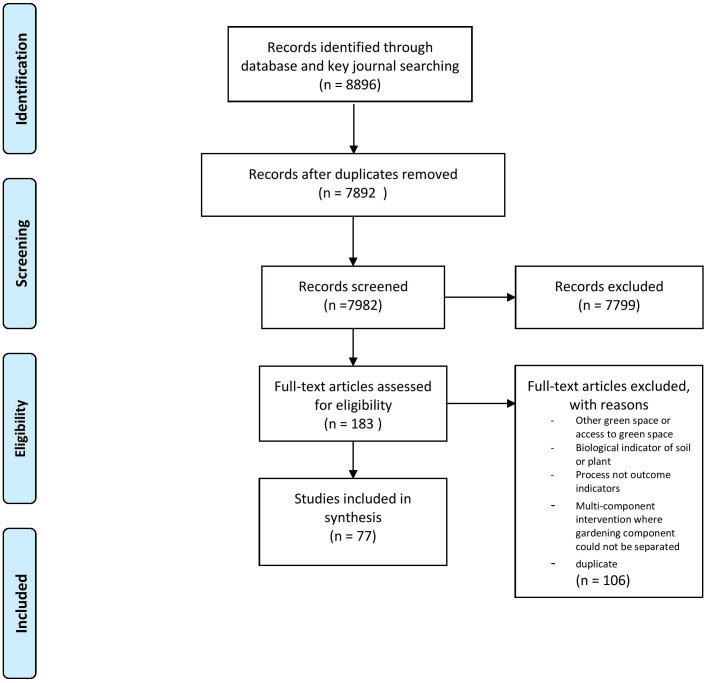
Objective: To systematically identify and describe studies that have evaluated the impact of gardens and gardening on health and well-being. A secondary objective was to use this evidence to build evidence-based logic models to guide health strategy decision making about gardens and gardening as a non-medical, social prescription. Design: Scoping review of the impact of gardens and gardening on health and well-being. Gardens include private spaces and those open to the public or part of hospitals, care homes, hospices or third sector organisations. Data sources: A range of biomedical and health management journals was searched including Medline, CINAHL, Psychinfo, Web of Knowledge, ASSIA, Cochrane, Joanna Briggs, Greenfile, Environment Complete and a number of indicative websites were searched to locate context-specific data and grey literature. We searched from 1990 to November 2019. Eligibility criteria: We included research studies (including systematic reviews) that assessed the effect, value or impact of any garden that met the gardening definition. Data extraction and synthesis: Three reviewers jointly screened 50 records by titles and abstracts to ensure calibration. Each record title was screened independently by 2 out of 3 members of the project team and each abstract was screened by 1 member of a team of 3. Random checks on abstract and full-text screening were conducted by a fourth member of the team and any discrepancies were resolved through double-checking and discussion. Results: From the 8896 papers located, a total of 77 * studies was included. Over 35 validated health, well-being and functional biometric outcome measures were reported. Interventions ranged from viewing gardens, taking part in gardening or undertaking therapeutic activities. The findings demonstrated links between gardens and improved mental well-being, increased physical activity and a reduction in social isolation enabling the development of 2 logic models. Conclusions: Gardens and gardening can improve the health and well-being for people with a range of health and social needs. The benefits of gardens and gardening could be used as a ‘social prescription’ globally, for people with long-term conditions (LTCs). Our logic models provide an evidence-based illustration that can guide health strategy decision making about the referral of people with LTCs to socially prescribed, non-medical interventions involving gardens and gardening.
Overview
CoChat Summary
TL;DR
This scoping review identified 77 studies on gardens and gardening and found links with improved mental well-being, increased physical activity, and reduced social isolation. It developed two evidence-based logic models to support gardening as a non-medical social prescription for people with long-term conditions.
Key findings
- From 8896 citations, 77 studies were included; over 35 validated health, well-being, and functional biometric outcome measures were reported.
- Most outcomes related to mental health (36%) or general well-being (32%), with physical outcomes (14%) and nutrition (18%) also reported; gardening interventions had a positive impact on nutritional intake of fruit and vegetables in 81% of relevant findings.
- Examples of reported effects include significantly stronger cortisol decreases during recovery in gardening versus reading (F(1,11)=24.15, p<0.001 vs F(1,13)=5.33, p<0.05), and in one RCT, greater reductions in BMI z-score (−0.1 vs −0.04, p=0.01) and waist circumference (−1.2 vs 0.1 cm, p<0.001) in the LA Sprouts gardening group.
- Systematic review evidence included gardening associated with reduced dementia risk (RR=0.53, 95% CI 0.28 to 0.99; HR=0.64, 95% CI 0.50 to 0.83) and modest positive impact on body mass index reduction.
Methods
- Scoping review using Arksey and O’Malley’s framework, with searches from 1990 to November 2019 across 15 electronic databases and six key journals, plus grey literature and websites.
- Included research studies and systematic reviews assessing any garden meeting the review’s garden definition, with a measurable health or well-being outcome, published in English after 1990; no restrictions on study design, biometric indicators, or population groups.
- Three reviewers calibrated screening on 50 records; titles were screened independently by two of three team members, abstracts by one of three, full texts by one of three, with random checks by a fourth reviewer; data were charted in Excel and synthesised narratively to build two logic models.
Limitations
- Stated: gardening as a construct lacks definition, and the lack of a standardised garden or gardening approach produced heterogeneous research designs that prevented meta-analysis.
- Stated: many included studies were of poor quality, often relying on self-report, small samples, or convenience samples; one systematic review of horticultural therapy RCTs reported no cost-effectiveness studies and low methodological quality.
- Evident: the review reports only 3.7% meta-analyses and notes methodological challenges in determining causality with complex interventions; patient and public involvement was limited, as patients were not involved in design, outcome development, or interpretation.
Model-written summary. Check it against the paper before relying on it.
Integrity signals
Registry
Cites
Statistics
Figures
Verification
Claims the paper makes
4 Valid · 2 Not valid · 27 Not checked · 66 Own results and interpretations
Some cited sources support this claim and some don’t — read each source’s verdict below.
In the paper
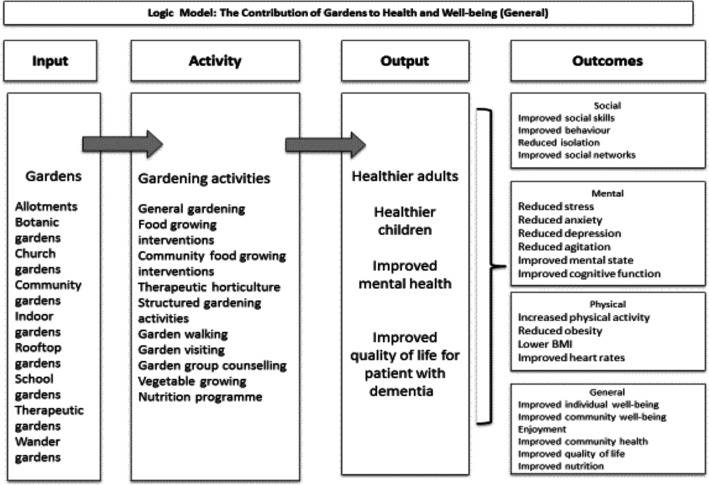
“There were 13 studies that explicated the impact of gardens and gardening on nutritional intake.29 31 42 51 54 58 60 75 81 86 96 98”
§ What is the evidence for the impact of gardens and gardening on health and well-being: a scoping review and evidence-based logic model to guide healthcare strategy decision making on the use of gardening approaches as a social prescription > Results > Logic model: evidence evaluating the impact of gardens on general well-being
What the sources say
- Supportedcites [29] Blair CK, Madan-Swain A, Locher JL, et al Harvest for health gardening intervention feasibility study in cancer survivors. Acta Oncol 2013; 52: 1110– 8. 10.3109/0284186X.2013.770165 23438359 PMC3718632 source
Blair et al. (2013) is a gardening-intervention study whose stated outcomes include dietary intake: the Abstract Methods (p. 1) pairs 12 adult and child cancer survivors with Master Gardeners 'to explore effects on fruit and vegetable intake, physical activity, quality-of-life, and physical function', and the Results (Health Outcomes) report that 'Forty percent of survivors increased their fruit and vegetable intake by ≥1 serving(s)/day', with serum carotenoids measured as a biomarker of intake (Methods, Study Outcomes). The Discussion likewise states the intervention provides 'preliminary support for improvements in fruit and vegetable intake'. So the source is indeed a study explicating gardening's impact on nutritional (fruit/vegetable) intake, fitting an identifying citation. Its own hedged, uncontrolled feasibility framing and the count of '13 studies' belong to the citing paper, not to this source. (LLM, conf=0.82)
- Partly supportedcites [31] Christian MS, Evans CEL, Cade JE Does the royal horticultural society campaign for school gardening increase intake of fruit and vegetables in children? results from two randomised controlled trials. Public Health Res; 2: 1– 162. 10.3310/phr02040 27466653 sourceExperimental — accuracy not yet measured
Our copy of Christian et al. (2014) does engage with the body of gardening-and-intake literature — the Discussion (p. ~82, 'Fruit and vegetable consumption') states that 'Only five other studies measured the relationship between children's fruit and vegetable intake and a gardening intervention' (refs 14, 47, 48, 125, 126), and the Discussion elsewhere tallies 'the four studies that did show an effect on fruit or vegetable intake'. The introduction/Conclusions chapter also notes that 'Previous studies of school gardening are limited and none have been randomised controlled trials'. So the source supports the general point that a small number of prior studies have examined gardening's effect on children's fruit and vegetable intake, but it nowhere gives a count of 13 studies, and its own enumerated figures (five, four) are lower; the specific number attributed to this source is not in our copy. Note also that our copy is truncated, so a later chapter table of prior studies cannot be ruled out. (LLM, conf=0.65)
- Disputedcites [42] Garcia MT, Ribeiro SM, Germani ACCG, et al The impact of urban gardens on adequate and healthy food: a systematic review. Public Health Nutr 2018; 21: 416– 25. 10.1017/S1368980017002944 29160186 PMC10260856 sourceExperimental — accuracy not yet measured
Our copy of Garcia et al.'s systematic review states a different count from the one attributed to it: the Study selection section reports that 'a total of twelve articles were included in the present systematic review (28-39)', and the flowchart (Fig. 1) confirms 'Studies included in qualitative summary (n 12)'. Of these twelve, the section 'Studies reporting outcomes on healthy food practices' — the dimension covering nutritional intake (amount and variety of F&V consumed, healthier diet, improved family nutrition) — states 'Seven studies reported outcomes on healthy food practices' (refs 29,31,33,34,35,37,39), while five (28,30,32,36,38) did not. The other dimensions are eight studies for healthy food access and nine for healthy food beliefs, knowledge and attitudes; no figure of thirteen studies appears anywhere in our copy, so the review cannot support '13 studies ... on nutritional intake'. (LLM, conf=0.70)
Checked by a reasoning model — may be wrong.
plain- Asserted: passes — The authors put it forward as true.
- Checkable: passes — It can be checked against evidence.
- Load-bearing: unclear — It is unclear whether the paper’s conclusions depend on it.
- Based: passes — The paper gives a reason why it holds.
- Supported
The cited sources support only part of this claim — read each source’s verdict below.
In the paper
“A popular social prescribing approach offered by place-based organisations is the use of gardens and gardening as a nature-based activity to improve health and well-being.11”
§ What is the evidence for the impact of gardens and gardening on health and well-being: a scoping review and evidence-based logic model to guide healthcare strategy decision making on the use of gardening approaches as a social prescription > Rationale
What the sources say
- Partly supportedcites [11] Soga M, Gaston KJ, Yamaura Y Gardening is beneficial for health: a meta-analysis. Prev Med Rep 2017; 5: 92– 9. 10.1016/j.pmedr.2016.11.007 27981022 PMC5153451 sourceExperimental — accuracy not yet measured
Soga et al. (2017) support the substance of the claim's health part: the Introduction (p.1) states gardening is 'one of the most common ways of interacting with nature and indeed is enjoyed as a popular pastime in many countries', the Conclusions report 'robust evidence for the positive effects of gardening on health' and urge that 'government and health organizations should consider gardening as a beneficial health intervention', and the Discussion (final paragraph) frames gardens as 'an important and promising health resource for the local community'. However, our copy nowhere mentions social prescribing or place-based organisations as providers of gardening, so that specific framing of the citing sentence is not attributable to this source; the citation backs gardening as a popular nature-based activity with health and well-being benefits, not its status as a social prescribing approach. (LLM, conf=0.72)
plainstates a cause- Asserted: passes — The authors put it forward as true.
- Checkable: passes — It can be checked against evidence.
- Load-bearing: passes — The paper’s conclusions depend on it.
- Based: passes — The paper gives a reason why it holds.
- Partly supported
The sources with a verdict support this claim; the rest weren’t checked yet, have no full text we could read, or their verdicts aren’t rated yet.
In the paper
“Typical LTCs studied included chronic lung disease27 diabetes, hypertension and kidney disease.70”
§ What is the evidence for the impact of gardens and gardening on health and well-being: a scoping review and evidence-based logic model to guide healthcare strategy decision making on the use of gardening approaches as a social prescription > Results > Logic model: evidence evaluating the impact of gardens on general well-being
What the sources say
- Not checked yetcites [27] Austin EN, Johnston YAM, Morgan LL Community gardening in a senior center: a therapeutic intervention to improve the health of older adults. Ther Recreation J 2006; 40: 48– 57.
- Supportedcites [70] Lêng CH, Wang J-D Daily home gardening improved survival for older people with mobility limitations: an 11-year follow-up study in Taiwan. Clin Interv Aging 2016; 11: 947– 59. 10.2147/CIA.S107197 27486315 PMC4956070 source
The Methods (Measurements, ‘Comorbidities, mobility, and depression’) explicitly lists diabetes, hypertension and kidney disease among the conditions included in the study. It also lists lung disease, although the citing sentence attaches a different citation to that condition. (LLM, conf=0.93)
plain- Asserted: passes — The authors put it forward as true.
- Checkable: passes — It can be checked against evidence.
- Load-bearing: unclear — It is unclear whether the paper’s conclusions depend on it.
- Based: passes — The paper gives a reason why it holds.
The cited sources support only part of this claim — read each source’s verdict below.
In the paper
“The benefits of gardening on mental health outcomes also extends to other LTCs known to influence frequent attendance to Accident & Emergency (A&E,) front-line health providers or GPs.108”
§ What is the evidence for the impact of gardens and gardening on health and well-being: a scoping review and evidence-based logic model to guide healthcare strategy decision making on the use of gardening approaches as a social prescription > Discussion
What the sources say
- Partly supportedcites [108] Hajek A, Bock J-O, König H-H Association of general psychological factors with frequent attendance in primary care: a population-based cross-sectional observational study. BMC Fam Pract 2017; 18: 48. 10.1186/s12875-017-0621-5 28340559 PMC5366110 sourceExperimental — accuracy not yet measured
Our copy of Hajek et al. (2017) supports only the GP limb of the claim: the Results ('Bivariate associations', Table 1) show frequent attenders (highest decile of GP visits) had a significantly higher number of physical illnesses (mean 4.0 vs 2.5), and the Background notes a cited literature review found a high illness level to be associated with frequent attendance to general practices. However, the study's outcome is self-reported number of GP visits in primary care in a German community sample aged 40+; it makes no measurement or claim about attendance at Accident & Emergency or other front-line health providers, so that extension is not supported. Emergency-department and secondary-care use appear only as asides credited to other works (Conclusions, citing Reid et al. 2002 on secondary care; reference 18, Williams et al. 2001 on ED attenders' psychiatric status and somatisation, not long-term conditions), and the paper never frames the associated conditions as 'long-term conditions'. (LLM, conf=0.72)
plainstates a cause- Asserted: passes — The authors put it forward as true.
- Checkable: passes — It can be checked against evidence.
- Load-bearing: passes — The paper’s conclusions depend on it.
- Based: passes — The paper gives a reason why it holds.
- Partly supported
A result the paper reports from its own data — it cites no other source for it, so there is none to check. The quote shows it is in the paper.
In the paper
“The findings demonstrated links between gardens and improved mental well-being, increased physical activity and a reduction in social isolation enabling the development of 2 logic models.”
§ What is the evidence for the impact of gardens and gardening on health and well-being: a scoping review and evidence-based logic model to guide healthcare strategy decision making on the use of gardening approaches as a social prescription > Abstract > Results
boostedstates an association- Asserted: passes — The authors put it forward as true.
- Checkable: passes — It can be checked against evidence.
- Load-bearing: passes — The paper’s conclusions depend on it.
- Based: passes — The paper gives a reason why it holds.
45 more claims
Create a free account to see all 99 claims and to verify the 41 references still open.
- Probably not a substantial claim. 31
- It may state two separate claims as one. 26
Claims other papers make about this one
Each is checked against this paper’s own text: does it say what the citing paper says it does?
The cited source says what the claim attributes to it.
In the citing paper
“A scoping review of the impact of gardens and gardening on health and wellbeing showed that viewing gardens, taking part in gardening, or undertaking therapeutic activities were associated with improved wellbeing, increased physical activity and reduced social isolation (Howarth et al., 2020).”
From Nature-based outdoor activities for mental and physical health: Systematic review and meta-analysis (2021) · cites this paper as Howarth et al., 2020
Statistics recomputed
Every reported test result, recomputed from its test statistic and degrees of freedom. A result shows as not adding up only once an independent check has confirmed it.
- Consistentz = -1.544reported p = .123 · recomputed p = .123
“(z=−1.544, p = .123”
- Consistentz = -0.086reported p = .932 · recomputed p = .931
“(z=−0.086, p = .932”
- Consistentz = -1.26reported p = .208 · recomputed p = .208
“(z=−1.26, p = .208”
- Consistentz = -2.9reported p = 0 · recomputed p = .004
“(z=−2.90, p = .00”
- Consistentz = -2.72reported p = .01 · recomputed p = .007
“(z=−2.72, p = .01”
7 more recomputed tests
Create a free account to see every test the Stats check recomputed.
Self-check
Percentages, sums and reported differences re-computed from the paper’s own numbers.
Each contradiction between two passages listed here was confirmed by an independent check.
Rated minor: it would not touch a result — a value no result rests on, a p-value that stays on the same side of the significance level, or a conflict that is clerical, resolved elsewhere in the paper, or outside its own findings.
In the paper
“A total of 77 studies was included in this review.11 25–100”
§ What is the evidence for the impact of gardens and gardening on health and well-being: a scoping review and evidence-based logic model to guide healthcare strategy decision making on the use of gardening approaches as a social prescription > Results > Description of studies
Reported 9 · recomputed 10.38961
Rated minor: it would not touch a result — a value no result rests on, a p-value that stays on the same side of the significance level, or a conflict that is clerical, resolved elsewhere in the paper, or outside its own findings.
In the paper
“There were 8 randomised controlled trials (9%)28 31 35 43 56 59 65 96 and 13 (16%) systematic reviews.”
§ What is the evidence for the impact of gardens and gardening on health and well-being: a scoping review and evidence-based logic model to guide healthcare strategy decision making on the use of gardening approaches as a social prescription > Results > Description of studies
Reported 16 · recomputed 16.883117
Rated minor: it would not touch a result — a value no result rests on, a p-value that stays on the same side of the significance level, or a conflict that is clerical, resolved elsewhere in the paper, or outside its own findings.
In the paper
“38 papers (3 systematic reviews/meta-analysis, 6 randomised controlled trials, 12 non-randomised trials, 14 observational, 4 qualitative) published between May 1980 and 2009 were included.”
§ What is the evidence for the impact of gardens and gardening on health and well-being: a scoping review and evidence-based logic model to guide healthcare strategy decision making on the use of gardening approaches as a social prescription > Results > Description of studies
Reported 38 · recomputed 39
Rated minor: it would not touch a result — a value no result rests on, a p-value that stays on the same side of the significance level, or a conflict that is clerical, resolved elsewhere in the paper, or outside its own findings.
In the paper
§ What is the evidence for the impact of gardens and gardening on health and well-being: a scoping review and evidence-based logic model to guide healthcare strategy decision making on the use of gardening approaches as a social prescription > Results > Logic model: evidence evaluating the impact of gardens on mental health
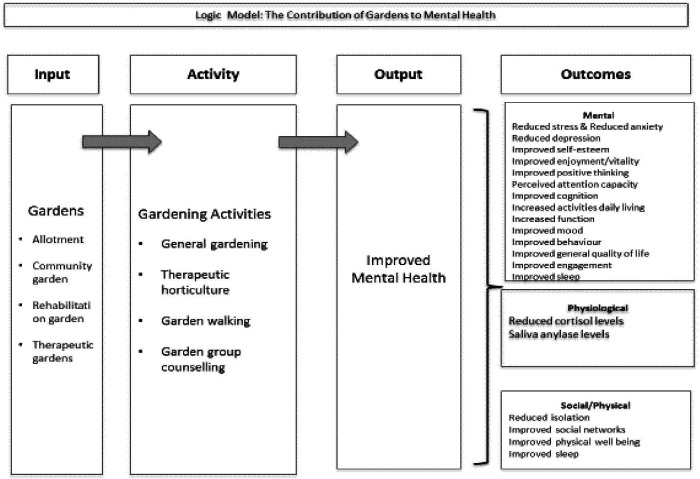
“Additionally, the logic model graphic enables visual representation of how mental health was improved through enhancing sociological outcomes leading to reduced socialisation through improved social networks.”
§ What is the evidence for the impact of gardens and gardening on health and well-being: a scoping review and evidence-based logic model to guide healthcare strategy decision making on the use of gardening approaches as a social prescription > Results > Logic model: evidence evaluating the impact of gardens on mental health
“Typically, gardening enabled greater social interaction with others92 and improved physical activity,100 thus improving overall mental well-being,32 reducing depression76 and anxiety.59”
Citations
Cites
Preferred Reporting Items for Systematic Reviews and Meta-Analyses: the PRISMA statement
Moher, D., Liberati, A., Tetzlaff, J., Altman, D. G., & for the PRISMA Group (2009) · BMJ · doi:10.1136/bmj.b2535 · Cited by 83,823
Preferred Reporting Items for Systematic Reviews and Meta-Analyses: The PRISMA Statement
Moher, D., Liberati, A., Tetzlaff, J., Altman, D. G., & The PRISMA Group (2009) · PLoS Medicine · doi:10.1371/journal.pmed.1000097 · Cited by 64,042
Preferred reporting items for systematic reviews and meta-analyses: the PRISMA Statement.
(2009) · PubMed Central · Cited by 44,859
Scoping studies: towards a methodological framework
Arksey, H., & O'Malley, L. (2005) · International Journal of Social Research Methodology · doi:10.1080/1364557032000119616 · Cited by 36,742 · cited 1×
“17 This was particularly relevant as the aim of the scoping review was to explicate the impact of gardens and gardening on diverse outcomes and populations.”
Wang, G., Ma, R., Qiao, G., Wada, K., Aizawa, Y., & Satoh, T. (2015) · Integrative Medicine International · doi:10.1159/000368408 · Cited by 18,657
Scoping studies: advancing the methodology
Levac, D., Colquhoun, H., & O'Brien, K. K. (2010) · Implementation Science · doi:10.1186/1748-5908-5-69 · Cited by 15,268 · cited 2×
“19 Correspond-ingly, our team was interdisciplinary with subject and methodological expertise comprising a nurse with experience in social prescribing and nature-based approaches, a geographer with expertise in urban agriculture and sustainable cities, and two health information specialists with…”
Munn, Z., Peters, M. D. J., Stern, C., Tufanaru, C., McArthur, A., & Aromataris, E. (2018) · BMC Medical Research Methodology · doi:10.1186/s12874-018-0611-x · Cited by 11,385 · cited 1×
“16 We employed Arksey and O’Mal-ley’s validated framework to map the evidence.”
Developing and evaluating complex interventions: the new Medical Research Council guidance
Craig, P., Dieppe, P., Macintyre, S., Michie, S., Nazareth, I., & Petticrew, M. (2008) · BMJ · doi:10.1136/bmj.a1655 · Cited by 10,995
The Warwick-Edinburgh Mental Well-being Scale (WEMWBS): development and UK validation
Tennant, R., Hiller, L., Fishwick, R., Platt, S., Joseph, S., Weich, S., Parkinson, J., Secker, J., & Stewart-Brown, S. (2007) · Health and Quality of Life Outcomes · doi:10.1186/1477-7525-5-63 · Cited by 5,031 · cited 1×
“Commonly reported data collection methods included validated tools such as the Warwick-Edinburgh Mental Well-being Scale 103 or New Economic Foundation’s Five Ways to Well-being, 104 which offer observational subjective data as opposed to direct causality.”
The challenge of defining wellbeing
Dodge, R., Daly, A., Huyton, J., & Sanders, L. (2012) · International Journal of Wellbeing · doi:10.5502/ijw.v2i3.4 · Cited by 2,166 · cited 2×
“96 Additionally, the logic model graphic enables visual representation of how mental health was improved through enhancing sociological outcomes leading to reduced socialisation through improved social networks. logic model: evidence evaluating the impact of gardens on general well-being In determining a parameter for…”
Research works printed but not linked: 2
- Holland L Diversity and connections in community gardens: a contribution to local sustainability, local environment. Int J Justice Sustainability 2004; 9: 285– 305.
- Bragg R, Atkins G A review of nature-based interventions for mental health care, 2016.
Cited by
Nature-based outdoor activities for mental and physical health: Systematic review and meta-analysis
Coventry, P. A., Brown, J. E., Pervin, J., Brabyn, S., Pateman, R., Breedvelt, J., Gilbody, S., Stancliffe, R., McEachan, R., & White, P. L. (2021) · SSM - Population Health · doi:10.1016/j.ssmph.2021.100934 · Cited by 453
Dzhambov, A. M., Lercher, P., Browning, M. H. E. M., Stoyanov, D., Petrova, N., Novakov, S., & Dimitrova, D. D. (2021) · Environmental Research · doi:10.1016/j.envres.2020.110420 · Cited by 285
The Socio-Cultural Benefits of Urban Agriculture: A Review of the Literature
Ilieva, R. T., Cohen, N., Israel, M., Specht, K., Fox-Kämper, R., Fargue‐Lelièvre, A., Poniży, L., Schoen, V., Caputo, S., Kirby, C. K., et al. (2022) · Land · doi:10.3390/land11050622 · Cited by 193
“For instance, in a recent scoping review, Michelle Howarth and colleagues [5] synthesized evidence from 77 studies on the physical and mental health benefits of gardens and gardening and pointed to the value of this evidence to inform decision making on the use of gardening approaches as a social prescription.”
BackgroundGardening can relieve human stress and boost nature connection during the COVID-19 pandemic
Egerer, M., Lin, B. B., Kingsley, J., Marsh, P., Diekmann, L. O., & Ossola, A. (2022) · Urban forestry & urban greening · doi:10.1016/j.ufug.2022.127483 · Cited by 129
Gunapala, R., Gangahagedara, R., Wanasinghe, W. C. S., Samaraweera, A., Gamage, A., Rathnayaka, C., Hameed, Z., Baki, Z. A., Madhujith, T., & Merah, O. (2025) · Farming System · doi:10.1016/j.farsys.2025.100150 · Cited by 109
PANȚIRU, I., Ronaldson, A., Sima, N., Dregan, A., & Sima, R. (2024) · Systematic Reviews · doi:10.1186/s13643-024-02457-9 · Cited by 112
“…that focused on specific populations also documented that horticulture-based therapy had a positive impact on the mental and physical well-being of people with dementia [46, 52], mental disorders [19, 50], those with physical long-term conditions as well as older populations [11, 24, 38, 47].”
BackgroundSachs, A. L., Kolster, A., Wrigley, J., Papon, V., Opačin, N., Hill, N., Howarth, M. L., Rochau, U., Hidalgo, L., Casajuana, C., et al. (2024) · Landscape and Urban Planning · doi:10.1016/j.landurbplan.2024.105071 · Cited by 79
Self-citationTambyah, R., Olcoń, K., Allan, J., Destry, P., & Astell‐Burt, T. (2022) · BMC Health Services Research · doi:10.1186/s12913-022-08223-8 · Cited by 70
“NBIs vary from nature walking groups [13], forest bathing [14], community gardening [15], and talking therapies delivered in a natural setting [16], among others.”
BackgroundWhere birds felt louder: The garden as a refuge during COVID-19
Marsh, P., Diekmann, L. O., Egerer, M., Lin, B. B., Ossola, A., & Kingsley, J. (2021) · Wellbeing Space and Society · doi:10.1016/j.wss.2021.100055 · Cited by 81
Lõhmus, M., Stenfors, C. U. D., Lind, T., Lauber, A., & Georgelis, A. (2021) · International Journal of Environmental Research and Public Health · doi:10.3390/ijerph18063303 · Cited by 69
“Below risk 831 (48) 885 (52) Preprints (www.”
Wood, C., Polley, M. J., Barton, J., & Wicks, C. L. (2022) · International Journal of Environmental Research and Public Health · doi:10.3390/ijerph192013612 · Cited by 67
“In addition to the three-core green social prescribing elements, therapeutic community gardening also promotes participation in moderate-intensity physical activity [21,22] and healthy eating [20].”
BackgroundKrols, J., Aerts, R., Vanlessen, N., Dewaelheyns, V., Dujardin, S., & Somers, B. (2022) · Landscape and Urban Planning · doi:10.1016/j.landurbplan.2022.104414 · Cited by 68
Experiences of gardening during the early stages of the COVID-19 pandemic
Kingsley, J., Diekmann, L. O., Egerer, M., Lin, B. B., Ossola, A., & Marsh, P. (2022) · Health & Place · doi:10.1016/j.healthplace.2022.102854 · Cited by 54
“provements in overall physical health (Park et al., 2017; Bail et al., 2018; Litt et al., 2017; Soga et al., 2017a,b; Howarth et al., 2020) and psychological wellbeing (van den Berg and Custers, 2011; Clatworthy et al.”
COVID‐19 gardening could herald a greener, healthier future
Lin, B. B., Egerer, M., Kingsley, J., Marsh, P., Diekmann, L. O., & Ossola, A. (2021) · Frontiers in Ecology and the Environment · doi:10.1002/fee.2416 · Cited by 53
Briggs, R., Morris, P. G., & Rees, K. (2022) · Journal of Mental Health · doi:10.1080/09638237.2022.2118687 · Cited by 53
“…prescribing, a method of linking patients to non-clinical support within their communities to address the complex multimorbidity and psycho-social needs of patients, represents an opportunity for wider implementation of these interventions across the UK (Howarth et al., 2020; Thomson et al., 2015).”
BackgroundMethodSmyth, N., Thorn, L., Wood, C., Hall, D., & Lister, C. (2022) · Healthcare · doi:10.3390/healthcare10060978 · Cited by 46
Dzhambov, A. M., Dimitrova, V., Germanova, N., Burov, A., Brezov, D. S., Hlebarov, I., & Dimitrova, R. N. (2023) · Environmental Research · doi:10.1016/j.envres.2023.116087 · Cited by 47
Mainstreaming Urban Agriculture: Opportunities and Barriers to Upscaling City Farming
Hardman, M. L., Clark, A., & Sherriff, G. (2022) · Agronomy · doi:10.3390/agronomy12030601 · Cited by 49
“The authors continue to argue that care farms and wider UA practices can be vital tools in reducing hospital admissions and reducing General Practice (GP) appointments [13].”
InfluentialSelf-citationNigg, C., Petersen, E., & Macintyre, T. E. (2023) · Journal of Environmental Psychology · doi:10.1016/j.jenvp.2023.102009 · Cited by 40
Litt, J., Coll‐Planas, L., Sachs, A. L., Rochau, U., Jansson, A. H., Dostálová, V., Daher, C., Beacom, A. M., Bachinski, K., García, G., et al. (2024) · Cities & Health · doi:10.1080/23748834.2023.2300207 · Cited by 43
“A logic model represents a standard tool in program evaluation designed at the beginning of a project to illustrate the shared relationships among the resources (inputs), activities, outputs, outcomes, and impact of a program (Frechtling 2007, Howarth et al .”
MethodFjaestad, S. L., Mackelprang, J. L., Sugiyama, T., Chandrabose, M., Owen, N. G., Turrell, G., & Kingsley, J. (2023) · Journal of Environmental Psychology · doi:10.1016/j.jenvp.2023.101993 · Cited by 38
The relative effects of access to public greenspace and private gardens on mental health
Collins, R., Smith, D. M., Ogutu, B., Brown, K. A., Eigenbrod, F., & Spake, R. (2023) · Landscape and Urban Planning · doi:10.1016/j.landurbplan.2023.104902 · Cited by 28
Current Trends and Future Directions in Urban Social Prescribing
Litt, J., Coll‐Planas, L., Sachs, A. L., Aguado, M. M., & Howarth, M. L. (2023) · Current Environmental Health Reports · doi:10.1007/s40572-023-00419-2 · Cited by 30
“An additional 14 published realist reviews focused on unpacking how SP works and for whom [18, 44]; SP effectiveness for specialty prescription programs involving exercise, gardening, and nature-based interactions [5, 23, 24, 45]; blue space programming [46]; and arts-and nature-based programs [47].”
Self-citationShentova, R., de Vries, S., & Verboom, J. (2022) · Sustainability · doi:10.3390/su141610256 · Cited by 31
Wood, C., Barton, J., & Wicks, C. L. (2025) · Frontiers in Psychiatry · doi:10.3389/fpsyt.2024.1507354 · Cited by 35
Bu, F., Hayes, D., Burton, A., & Fancourt, D. E. (2024) · The British Journal of Psychiatry · doi:10.1192/bjp.2024.141 · Cited by 36
Veldheer, S., Tuan, W., Al‐Shaar, L., Wadsworth, M. E., Sinoway, L. I., Schmitz, K. H., Sciamanna, C., & Gao, X. (2022) · Journal of the Academy of Nutrition and Dietetics · doi:10.1016/j.jand.2022.10.018 · Cited by 27
Does urban agriculture contribute to food security, and how might this be achieved?
Mead, B. R., Duncombe, T., Gillespie, R., Pugh, N., & Hardman, C. A. (2024) · Proceedings of The Nutrition Society · doi:10.1017/s0029665124002209 · Cited by 29
Wood, C., Barton, J., & Wicks, C. L. (2022) · International Journal of Environmental Research and Public Health · doi:10.3390/ijerph192013166 · Cited by 32
“Therapeutic community gardening is a specific type of green social prescription which is focused on using garden space and gardening activities to help people improve their mental health, build social skills, and develop confidence; with qualified therapist input or mental health support [20].”
BackgroundInfluentialTracey, D., Gray, T. L., Manohar, N., Kingsley, J., Bailey, A., & Pettitt, P. (2023) · Health & Social Care in the Community · doi:10.1155/2023/5570089 · Cited by 30
“[28], where only limited outcomes have been considered.”
BackgroundBotanic Garden Tourism, Social Value, Health, and Well-Being
Catahan, N., Hopwood, M., & Suraweera, P. (2024) · Journal of Zoological and Botanical Gardens · doi:10.3390/jzbg5020013 · Cited by 22
“…sector to innovate on ecosystemic thinking [22], service ecosystems [32,99], transformative service [26], and sustainability in terms of social value and good health and well-being in all its wondrous forms as a starting point for creative, interested individuals and collectives [29,56,75,84–87,”
BackgroundHunt, L., Pettinger, C., & Wagstaff, C. (2023) · BMC Public Health · doi:10.1186/s12889-023-16804-3 · Cited by 25
“…some community organisations offered learning opportunities via gardening and cooking projects, which are known to offer (mental health) benefits [115], and although the family was noted as somewhere where dietary habits form and skills develop, learning about food within families was important,…”
BackgroundEffect of gardening activities on domains of health: a systematic review and meta-analysis
Wang, F., & Boros, S. (2025) · BMC Public Health · doi:10.1186/s12889-025-22263-9 · Cited by 23
“Typically, gardens or gardening comprises a broad spectrum of interventions, activities and outcomes that include plants, the natural environment and living creatures to support people living with chronic health conditions [6].”
Schanbacher, W. D., & Cavendish, J. C. (2023) · Frontiers in Public Health · doi:10.3389/fpubh.2023.1147967 · Cited by 17
Howarth, M. L., Lawler, C., & da Silva, A. (2021) · Health & Place · doi:10.1016/j.healthplace.2021.102654 · Cited by 24
Self-citationOlcoń, K., Destry, P., Astell‐Burt, T., & Allan, J. (2023) · Environmental Advances · doi:10.1016/j.envadv.2023.100393 · Cited by 20
McNamara, G., Robertson, C. V., Hartmann, T. E., & Rossiter, R. C. (2022) · Journal of Aging and Physical Activity · doi:10.1123/japa.2021-0514 · Cited by 18
van Iperen, I. D., Maas, J., & Spronk, P. E. (2023) · Intensive Care Medicine · doi:10.1007/s00134-023-07185-7 · Cited by 18
Green spaces and the impact on cognitive frailty: a scoping review
Fowler‐Davis, S., Benkowitz, C., Nield, L., & Dayson, C. (2024) · Frontiers in Public Health · doi:10.3389/fpubh.2023.1278542 · Cited by 22
Exposure to green spaces and schizophrenia: a systematic review
Marcham, L., & Ellett, L. (2024) · Psychological Medicine · doi:10.1017/s0033291724001533 · Cited by 18
Jauk, D., & Blackwood, A. (2022) · Women & Criminal Justice · doi:10.1080/08974454.2022.2053031 · Cited by 17
“…and well-being evaluated 77 studies and found positive impacts of gardening on over 35 validated health, well-being, and functional biometric outcome measures; concluding that gardening can improve the health and well-being encompassing a range of health and social needs (Howarth et al., 2020).”
BackgroundImplementation and Impact of Health Care Gardens: A Systematic Scoping Review
Carroll, C., Higgs, J., McCray, S. J., & Utter, J. (2023) · Journal of Integrative and Complementary Medicine · doi:10.1089/jicm.2023.0212 · Cited by 19
Tohan, M. M., Ahmed, F., Juie, I. J., Kabir, A., & Rahman, M. A. (2024) · Discover Psychology · doi:10.1007/s44202-024-00131-8 · Cited by 17
“Prior studies have similarly identified that outdoor hobbies, which facilitate physical activity, social interaction, and emotional expression, contribute to individuals feeling happier [22, 64].”
Perceived functions of allotment gardens and their importance during the COVID-19 pandemic in Poland
Janus, E., Szewczyk-Taranek, B., & Smrokowska-Reichmann, A. (2022) · Folia Horticulturae · doi:10.2478/fhort-2022-0006 · Cited by 19
Mead, B. R., Davies, J. A. C., Falagán, N., Kourmpetli, S., Liu, L., & Hardman, C. A. (2021) · Emerald Open Research · doi:10.1108/eor-06-2023-0009 · Cited by 13
Surugiu, R., Iancu, M. A., Lăcătuș, A. M., Dogaru, C. A., Stepan, M. D., Eremia, I. A., Neculau, A. E., & Dumitra, G. G. (2023) · Sustainability · doi:10.3390/su151511652 · Cited by 16
Enhancing green infrastructure in cities: Urban car parks as an opportunity space
Evans, A., & Hardman, M. L. (2023) · Land Use Policy · doi:10.1016/j.landusepol.2023.106914 · Cited by 12
“Howarth et al. (2020) demonstrate how key actors are also realising the wider benefits of these systems, with concepts such as social prescribing becoming more prominent within our cities.”
Self-citationBirau, M. M. (2024) · Psychology and Marketing · doi:10.1002/mar.22112 · Cited by 20
Vuong, Q., Sari, N. P. W. P., La, V., & Nguyen, M.-H. (2025) · Discover Public Health · doi:10.1186/s12982-025-00987-8 · Cited by 13
“In healthcare economics, if research continues to demonstrate that gardening reduces healthcare utilization—such as fewer doctor visits due to improved mental health or chronic disease management [204, 228]—insurance providers may even begin covering gardening-related expenses.”
Kingsley, J., Hadgraft, N. T., Owen, N. G., Sugiyama, T., Dunstan, D. W., & Chandrabose, M. (2021) · Journal of Aging and Physical Activity · doi:10.1123/japa.2021-0207 · Cited by 11
Cruz-Piedrahita, C., Roscoe, C., Howe, C., Fecht, D., & de Nazelle, A. J. (2022) · Frontiers in Public Health · doi:10.3389/fpubh.2022.886608 · Cited by 11
“In the latter, urban agriculture is linked to environmental and social movements (20, 21), its potential to improve public health (22), and to address urban problems related to environmental injustice and food security (23–25).”
BackgroundBaik, H., Choi, S., An, M., Jin, H., Kang, I.-S., Yoon, W., & Yoo, Y. (2024) · Healthcare · doi:10.3390/healthcare12090919 · Cited by 13
Keech, D., Milford, A. B., Gillund, F., & Reed, M. (2023) · European Countryside · doi:10.2478/euco-2023-0008 · Cited by 10
Thwaites, O., Mizen, A., & Fry, R. (2024) · Landscape and Urban Planning · doi:10.1016/j.landurbplan.2023.104971 · Cited by 10
Community Activities in Primary Care: A Literature Review
Mosteiro-Miguéns, D. G., Rodríguez-Fernández, A., Zapata‐Cachafeiro, M., Pérez, N. V., Carrera, F. J. R., & Novío, S. (2024) · Journal of Primary Care & Community Health · doi:10.1177/21501319231223362 · Cited by 13
Surfacing political clarity in farm and garden education
Jadallah, C. C. (2024) · Environmental Education Research · doi:10.1080/13504622.2024.2407862 · Cited by 13
“…2013), nature connectedness and ecoliteracy (Wallace 2019); social-emotional development (lohr et al. 2021), improved mental and physical health (howarth et al. 2020), opportunities for civic engagement (Russ and Gaus 2021), improved nutrition (Chan, Tan, and Gong 2022), and community…”
Emmanuel, R., Read, U. M., Grande, A. J., & Harding, S. (2023) · Nutrients · doi:10.3390/nu15030791 · Cited by 12
“Non-randomized designs and pre–post-test designs were commonly used to evaluate outcomes [45].”
MethodAlaimo, K., Coringrato, E., Lacy, K., Hébert, J. R., & Beavers, A. W. (2024) · People and Nature · doi:10.1002/pan3.10696 · Cited by 13
Lan, Y., Browning, M. H. E. M., & Helbich, M. (2024) · Landscape and Urban Planning · doi:10.1016/j.landurbplan.2024.105288 · Cited by 11
Sosnowska, M., Kępkowicz, A., Woźniak-Kostecka, I., Lipińska, H., & Renaudie, L. (2022) · Urban forestry & urban greening · doi:10.1016/j.ufug.2022.127689 · Cited by 13
Housing and gardening: Developing a health equity-focused research agenda
Kingsley, J., Goodall, Z., Chandrabose, M., Sugiyama, T., Stone, W. M., Veeroja, P., & Hadgraft, N. T. (2024) · Landscape and Urban Planning · doi:10.1016/j.landurbplan.2024.105014 · Cited by 11
It is time for more holistic practices in mental health
Ribeiro, S. T. G., Pimentel, A. P., Fernandes, V. D. R., Deslandes, A. C., & Amarante, P. (2024) · PLOS mental health. · doi:10.1371/journal.pmen.0000028 · Cited by 17
Gargano, V. (2022) · Intervention · doi:10.7202/1089312ar · Cited by 18
Park, Y., & Shin, Y.-W. (2022) · Journal of people, plants, and environment · doi:10.11628/ksppe.2022.25.5.447 · Cited by 8
“Theodorou et al. (2021) claimed that gardening activities reduce stress and help promote mental health, and Howarth et al. (2020) reported that gardening activities improve mental well-being, such as increased physical activity and decreased social isolation.”
BackgroundThe relationship between green space and physical activity. A systematic review and meta-analysis
Kreisler, T., Kambach, S., Becker, O. A., & Bruelheide, H. (2025) · Urban forestry & urban greening · doi:10.1016/j.ufug.2025.128971 · Cited by 9
Vassányi, I., Szakonyi, B., Loi, D., Mantur-Vierendeel, A., Quintas, J. M., Solinas, A., Blažica, B., Raffo, L., Guicciardi, M., Manca, A., et al. (2023) · Geriatric Nursing · doi:10.1016/j.gerinurse.2023.12.014 · Cited by 11
Advantages of greenery in hospital environment - a literature review
Kalender-Smajlović, S., & Dovjak, M. (2023) · Sanitarno inženirstvo · doi:10.2478/ijser-2023-0002 · Cited by 9
Exploring the role of stakeholders in place branding - a case analysis of the 'City of Liverpool'
Maheshwari, V., Lodorfos, G., & Vandewalle, I. (2014) · International Journal of Business and Globalisation · doi:10.1504/ijbg.2014.063398 · Cited by 13
Foster‐Collins, H., Calitri, R., Tarrant, M., Orr, N., Whear, R., & Lamont, R. A. (2024) · Ageing and Society · doi:10.1017/s0144686x23000892 · Cited by 8
“…are positively associated with improvements in wellbeing and psychological health (Genter et al ., 2015; Wood et al ., 2016; Howarth et al ., 2020; Briggs et al ., 2023), as well as social connectedness and sense of community (Genter et al ., 2015; Howarth et al ., 2020; Spano et al ., 2020).”
Court, A., Kelly, A., & Hardman, M. L. (2022) · Cogent Social Sciences · doi:10.1080/23311886.2022.2109261 · Cited by 10
“…educational workshops, larger-scale produce sales and other activities generate revenue for UA projects, social prescribing offers another avenue; in this sense, the National Health Service (NHS) and other key organisations pay for therapeutic programmes on these sites (Howarth et al., 2020).”
BackgroundSelf-citationDennis, D., Henderson‐Wilson, C., Watson, J., & Lawson, J. T. (2024) · Sustainability · doi:10.3390/su16031077 · Cited by 12
Bendall, R. C. A., Royle, S., Dodds, J. N., Watmough, H., Gillman, J. C., Beevers, D., Cassidy, S., Short, B., Metcalfe, C., Lomas, M. J., et al. (2024) · Behavior Research Methods · doi:10.3758/s13428-024-02556-4 · Cited by 7
An Interdisciplinary Collaboration for Environmental Education
Gibbs, A. J., Henderson, K., Luckett, M., Luks, L., & Walton, A. (2021) · The Journal for Nurse Practitioners · doi:10.1016/j.nurpra.2021.11.011 · Cited by 8
Missen, K., Alindogan, M. A., Forrest, S., & Waller, S. (2021) · Australian Journal of Primary Health · doi:10.1071/py20294 · Cited by 8
Nigg, C., Petersen, E., & Macintyre, T. E. (2021) · PsyArXiv (OSF Preprints) · doi:10.31234/osf.io/a9unf · Cited by 9
The purpose of the school garden is more than just growing plants
Strgar, J., Torkar, G., & Krajšek, S. S. (2025) · Journal of Biological Education · doi:10.1080/00219266.2025.2489512 · Cited by 6
“School gardens allow students to have outdoor experiences, provide opportunities for physical activity (Howarth et al. 2020; Rees-Punia et al. 2017), and improve their mental wellbeing (Howarth et al. 2020).”
Zhu, Z., Zhao, X., Ouyang, Q., Cong, S., Zhou, M., Xiong, Y., Zhang, M., Luo, X., & Cheng, M. (2022) · Annals of Translational Medicine · doi:10.21037/atm-22-3787 · Cited by 6
“Relevant studies in Germany have demonstrated that the natural environment can contribute to releasing stress, and Germany has taken the lead in establishing the first forest recreation sites in the world (10-13).”
Research With Marginalized Communities: Reflections on Engaging Roma Women in Northern England
Hubbard, L., Hardman, M. L., Race, O., Palmai, M., & Vamosi, G. (2023) · Qualitative Inquiry · doi:10.1177/10778004231176770 · Cited by 8
“…and approaches to tackling these health inequalities affecting marginalized communities: from creating a more accessible health care system at a meta level (Coronini-Cronberg et al., 2020), to upscaling radical approaches, such as social prescription, at a more microlevel (Howarth et al., 2020).”
BackgroundInfluentialSelf-citationThe nexus of urban agriculture and health resilience: Insights from Addis Ababa, Ethiopia
Ebissa, G., Desta, H., & Fetene, A. (2024) · Urban Agriculture & Regional Food Systems · doi:10.1002/uar2.20069 · Cited by 7
“…accentuated as physical exercises by the respondents are land preparation and leveling, furrowing, sowing, seedling planting, watering, weeding, and harvesting, and all are performed manually for about 10 h where these activities are slightly different from those reported by Howarth et al. (2020).”
The Role of Place in Social Prescribing: A State‐of‐the‐Art Literature Review
McSwiggan, E., Donaghy, E., Gulland, J., O'Donnell, A. J., & Mercer, S. W. (2025) · Health & Social Care in the Community · doi:10.1155/hsc/9920046 · Cited by 8
Horticultural Therapy: An Ancient Integrative Approach for Modern Times
Dabrh, A. M. A., Meore, A., Wilson, E. W., & Perlman, A. I. (2022) · Journal of Integrative and Complementary Medicine · doi:10.1089/jicm.2021.0174 · Cited by 6
Sutcliffe, C., Chalmin‐Pui, L. S., Gush, M. B., & Griffiths, A. (2024) · Urban forestry & urban greening · doi:10.1016/j.ufug.2024.128423 · Cited by 6
The effects of therapeutic horticulture on student well-being and academic resilience
Diehl, E. R. M., Diehl, D. C., & Tham, S. Y. (2025) · Frontiers in Psychology · doi:10.3389/fpsyg.2025.1619827 · Cited by 7
Mamirkulova, G., & Menhas, R. (2026) · Frontiers in Psychology · doi:10.3389/fpsyg.2026.1767661 · Cited by 6
“A considerable body of research has examined the relationship between gardening and mental health and wellbeing in developed nations (Howarth et al., 2020; Wang and Boros, 2025).”
The Role of Horticultural Therapy in Promoting Physical and Mental Health
Zhou, C., & Zeng, C. (2023) · Research in Health Science · doi:10.22158/rhs.v8n3p43 · Cited by 6
Gardening and cognitive ageing: Longitudinal findings from the Lothian Birth Cohort of 1921
Corley, J., Pattie, A., Deary, I. J., & Cox, S. R. (2024) · Journal of Environmental Psychology · doi:10.1016/j.jenvp.2024.102361 · Cited by 5
Transformative value, communities and service designs for sustainability
Catahan, N. (2024) · Journal of Services Marketing · doi:10.1108/jsm-03-2024-0098 · Cited by 6
Exploring the impact of community gardens on mental health: a scoping review
Zinaic, R., Correa, T., Etowa, E. B., Owolabi, R., Bhatt, Y., & Wong, J. P. (2025) · Wellbeing Space and Society · doi:10.1016/j.wss.2025.100263 · Cited by 7
Crossen-White, H. L., Hemingway, A., Ladkin, A., Jones, A., Burke, A., & Timmermans, O. (2022) · Quality in Ageing and Older Adults · doi:10.1108/qaoa-02-2022-0012 · Cited by 5
Gardening and Garden Therapy as a Resource for Human Psychological Well-Being
Andzaurova, P. O., & Кимовна, Н.-Б. С. (2023) · Вестник Российского университета дружбы народов. Серия: Психология и педагогика · doi:10.22363/2313-1683-2023-20-2-331-351 · Cited by 5
Social prescribing of urban agriculture: The importance of minimizing risks from soil contamination
Beesley, L., & Hardman, M. L. (2024) · Cities · doi:10.1016/j.cities.2024.104971 · Cited by 5
Self-citationCoringrato, E., Alaimo, K., Leiferman, J. A., Villalobos, A., Buchenau, H., Decker, E., Fahnestock, L., Quist, P., & Litt, J. (2024) · Scientific Reports · doi:10.1038/s41598-024-63889-w · Cited by 6
Conceptualising social prescribing in urgent and emergency care
Cooper, M., Nazar, H., Flynn, D., Redelsteiner, C., Agarwal, G., & Scott, J. (2024) · Future Healthcare Journal · doi:10.1016/j.fhj.2024.100199 · Cited by 6
Jauk, D., Everhardt, S. L., Caruana, C. L., & Gill, B. I. (2022) · Journal of Applied Social Science · doi:10.1177/19367244221129185 · Cited by 7
“Besides being a valuable source of fresh fruit and vegetables, nature-based interventions and therapy have been very effective in institutional mental health settings (Moeller et al. 2018; Howarth et al. 2020).”
BackgroundSymes, L., Hadgraft, N. T., Marsh, P., Nuttman, S., & Kingsley, J. (2023) · Health Promotion International · doi:10.1093/heapro/daad010 · Cited by 6
Edible Garden Cities: Rethinking Boundaries and Integrating Hedges into Scalable Urban Food Systems
Adams, D., Larkham, P. J., & Hardman, M. L. (2023) · Land · doi:10.3390/land12101915 · Cited by 8
Self-citationThe Impact of Urban Allotment Gardens on Physical and Mental Health in Norway
Johnsrud, M., Goth, U. S., & Skjerve, H. (2024) · International Journal of Environmental Research and Public Health · doi:10.3390/ijerph21060720 · Cited by 7
“Only recently have studies begun to shed light on the allotment gardens’ positive impact on experienced health, lifestyle, and activity levels [4] due to the higher intake of fruits and vegetables [5–7] and the reduction in lifestyle diseases [4,5,8,9].”
BackgroundInfluentialA present from the forest: Focus group interviews on cancer survivors’ forest experiences
Park, E. Y., An, M. Y., & Sung, J. H. (2022) · Asia-Pacific Journal of Oncology Nursing · doi:10.1016/j.apjon.2022.100105 · Cited by 7
Daiz, B. G., Rosales, E. L., Rosales, L. G. O., & Santos, J. A. A. D. L. (2022) · The Malaysian Journal of Nursing · doi:10.31674/mjn.2022.v13i04.007 · Cited by 10
Pujinda, P., Sirikhan, K., & Sanit, P. (2025) · Cities · doi:10.1016/j.cities.2025.105884 · Cited by 4
Metadata
- Authors
- Howarth, M., Brettle, A., Hardman, M., & Maden, M.
- Affiliations
- University of Salford (GB)
- University of Liverpool (GB)
- Corresponding author
- Howarth, Michelle
- Venue
- BMJ Open
- Publisher
- BMJ
- Published
- 2020-07
- Volume
- 10
- Issue
- 7
- Pages
- e036923
- ISSN
- 2044-6055 (ISSN-L)
- PMC
- PMC7371129
- OpenAlex
- W3030620435
- Semantic Scholar
- 45359c9112ca603c555d93d3c0d74d8e5ba49676
- Cited by
- 198
- References
- 109
- Citations by year
- 2026: 24 · 2025: 31 · 2024: 52 · 2023: 35 · 2022: 35 · 2021: 19 · 2020: 1
- FWCI
- 1.95
- Type
- journal article
- Language
- en
- Open access
- gold
- doi.org
- Licence
- Locations
- BMJ Open (publishedVersion, cc-by-nc)
- PubMed Central (publishedVersion, cc-by-nc)
- PubMed (publishedVersion)
- University of Salford Institutional Repository (University of Salford) (submittedVersion, cc-by)
- DOAJ (DOAJ: Directory of Open Access Journals) (submittedVersion, cc-by-sa)
- HighWire Press Open Archive (submittedVersion)
- Edge Hill University Research Information Repository (Edge Hill University) (submittedVersion, cc-by-nc)
- Topics
- Social Sciences › Urban Studies › Urban Green Space and Health
- Social Sciences › Urban Studies › Urban Agriculture and Sustainability
- Social Sciences › Psychology › Clinical Psychology › Art Therapy and Mental Health
- Keywords
- gardens, gardening, social prescribing, health and well-being, psychological well-being, physical activity, social isolation, chronic disease, therapeutic gardens, non-medical interventions
- MeSH terms
- Gardens, Activities of Daily Living, Decision Making, Delivery of Health Care, Humans, Logic, Prospective Studies, Quality of Life, Gardening, Prescriptions
About these checks
Registry, retraction, Cites and statistics results are computed, not judged, with one exception: a printed reference that no index lists is read once by a model before it counts as a citation error. Claims are extracted by a model and kept only when their quote appears verbatim in the text; each cited source is then checked, with a model’s help, for whether it says what the claim relies on. Those verdicts can be wrong — read the claim’s quote and the cited source before relying on one.
The claim verdicts this report counts are experimental: their accuracy is not yet measured.
A language model drew the claims from the paper on 2026-10-05, under version 3 of the claim definition (model deepseek-v4.1-flash, prompt extract-v3).
A second model labelled each claim on 2026-10-05 (model jev-1.13-20260917, definition revision gold-guideline-v0.2).
Cited sources are checked with a language model’s help (qwen3.8-omni-flash and gpt-6-sol).
Statistics and arithmetic are recomputed, not judged.
Confidence bands are shown only for fields calibrated on our annotated test set. None is calibrated yet, so no band is shown.
What counts as a claim ›How we measure confidence ›How we check this ›
Are you an author, or do you see a problem with this page? Request a review
Data sources
Bibliographic data: Semantic Scholar, OpenAlex, Crossref.
Contains information from the Semantic Scholar Academic Graph Datasets, made available under the ODC Attribution License (ODC-BY 1.0).
Semantic Scholar’s data is described in: Kinney, R., et al. (2023). The Semantic Scholar Open Data Platform. arXiv:2301.10140.
