

What is the evidence for the impact of gardens and gardening on health and well-being: a scoping review and evidence-based logic model to guide healthcare strategy decision making on the use of gardening approaches as a social prescription
Open accessThe DOI matches its Crossref record; 108 of the 109 references it cites were found in a registry or an index; 7 of the 48 sources its claims cite were checked for support.
Abstract
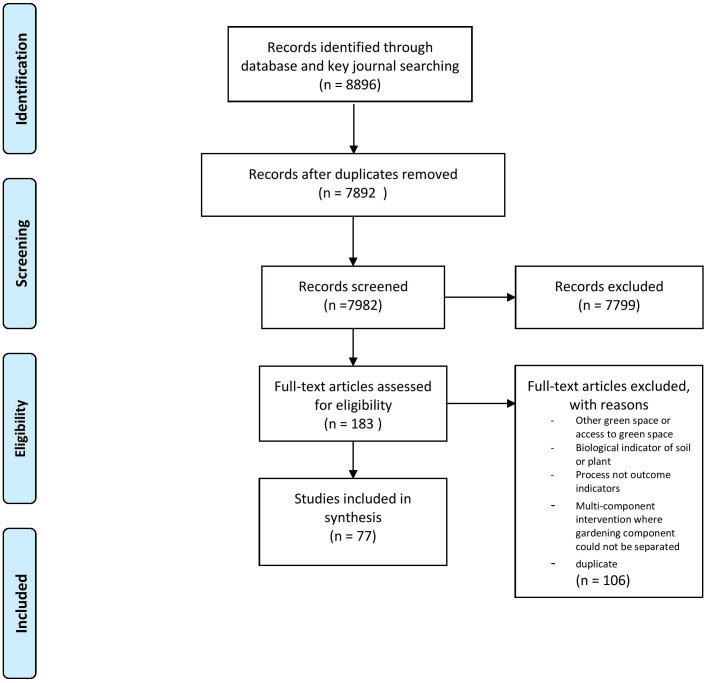
Objective: To systematically identify and describe studies that have evaluated the impact of gardens and gardening on health and well-being. A secondary objective was to use this evidence to build evidence-based logic models to guide health strategy decision making about gardens and gardening as a non-medical, social prescription. Design: Scoping review of the impact of gardens and gardening on health and well-being. Gardens include private spaces and those open to the public or part of hospitals, care homes, hospices or third sector organisations. Data sources: A range of biomedical and health management journals was searched including Medline, CINAHL, Psychinfo, Web of Knowledge, ASSIA, Cochrane, Joanna Briggs, Greenfile, Environment Complete and a number of indicative websites were searched to locate context-specific data and grey literature. We searched from 1990 to November 2019. Eligibility criteria: We included research studies (including systematic reviews) that assessed the effect, value or impact of any garden that met the gardening definition. Data extraction and synthesis: Three reviewers jointly screened 50 records by titles and abstracts to ensure calibration. Each record title was screened independently by 2 out of 3 members of the project team and each abstract was screened by 1 member of a team of 3. Random checks on abstract and full-text screening were conducted by a fourth member of the team and any discrepancies were resolved through double-checking and discussion. Results: From the 8896 papers located, a total of 77 * studies was included. Over 35 validated health, well-being and functional biometric outcome measures were reported. Interventions ranged from viewing gardens, taking part in gardening or undertaking therapeutic activities. The findings demonstrated links between gardens and improved mental well-being, increased physical activity and a reduction in social isolation enabling the development of 2 logic models. Conclusions: Gardens and gardening can improve the health and well-being for people with a range of health and social needs. The benefits of gardens and gardening could be used as a ‘social prescription’ globally, for people with long-term conditions (LTCs). Our logic models provide an evidence-based illustration that can guide health strategy decision making about the referral of people with LTCs to socially prescribed, non-medical interventions involving gardens and gardening.
Overview
CoChat Summary
TL;DR
This scoping review identified 77 studies on gardens and gardening and found links with improved mental well-being, increased physical activity, and reduced social isolation. It developed two evidence-based logic models to support gardening as a non-medical social prescription for people with long-term conditions.
Key findings
- From 8896 citations, 77 studies were included; over 35 validated health, well-being, and functional biometric outcome measures were reported.
- Most outcomes related to mental health (36%) or general well-being (32%), with physical outcomes (14%) and nutrition (18%) also reported; gardening interventions had a positive impact on nutritional intake of fruit and vegetables in 81% of relevant findings.
- Examples of reported effects include significantly stronger cortisol decreases during recovery in gardening versus reading (F(1,11)=24.15, p<0.001 vs F(1,13)=5.33, p<0.05), and in one RCT, greater reductions in BMI z-score (−0.1 vs −0.04, p=0.01) and waist circumference (−1.2 vs 0.1 cm, p<0.001) in the LA Sprouts gardening group.
- Systematic review evidence included gardening associated with reduced dementia risk (RR=0.53, 95% CI 0.28 to 0.99; HR=0.64, 95% CI 0.50 to 0.83) and modest positive impact on body mass index reduction.
Methods
- Scoping review using Arksey and O’Malley’s framework, with searches from 1990 to November 2019 across 15 electronic databases and six key journals, plus grey literature and websites.
- Included research studies and systematic reviews assessing any garden meeting the review’s garden definition, with a measurable health or well-being outcome, published in English after 1990; no restrictions on study design, biometric indicators, or population groups.
- Three reviewers calibrated screening on 50 records; titles were screened independently by two of three team members, abstracts by one of three, full texts by one of three, with random checks by a fourth reviewer; data were charted in Excel and synthesised narratively to build two logic models.
Limitations
- Stated: gardening as a construct lacks definition, and the lack of a standardised garden or gardening approach produced heterogeneous research designs that prevented meta-analysis.
- Stated: many included studies were of poor quality, often relying on self-report, small samples, or convenience samples; one systematic review of horticultural therapy RCTs reported no cost-effectiveness studies and low methodological quality.
- Evident: the review reports only 3.7% meta-analyses and notes methodological challenges in determining causality with complex interventions; patient and public involvement was limited, as patients were not involved in design, outcome development, or interpretation.
Model-written summary. Check it against the paper before relying on it.
Integrity signals
Registry
Cites
Statistics
Figures
Verification
Claims the paper makes
4 Valid · 2 Not valid · 27 Not checked · 66 Own results and interpretations
Some cited sources support this claim and some don’t — read each source’s verdict below.
In the paper
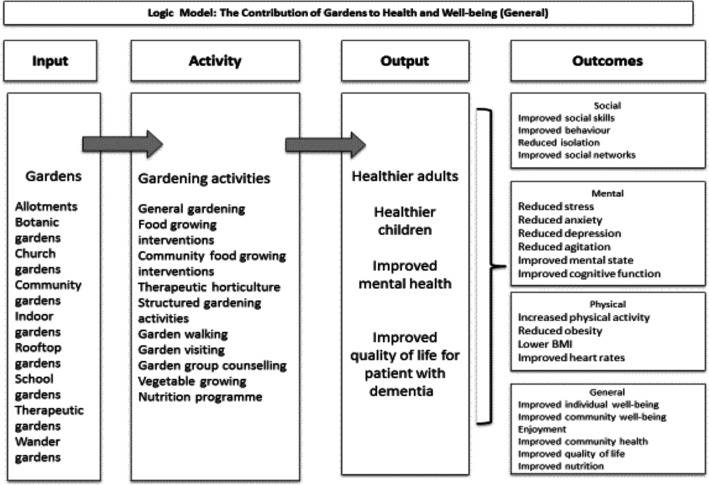
“There were 13 studies that explicated the impact of gardens and gardening on nutritional intake.29 31 42 51 54 58 60 75 81 86 96 98”
§ What is the evidence for the impact of gardens and gardening on health and well-being: a scoping review and evidence-based logic model to guide healthcare strategy decision making on the use of gardening approaches as a social prescription > Results > Logic model: evidence evaluating the impact of gardens on general well-being
What the sources say
- Supportedcites [29] Blair CK, Madan-Swain A, Locher JL, et al Harvest for health gardening intervention feasibility study in cancer survivors. Acta Oncol 2013; 52: 1110– 8. 10.3109/0284186X.2013.770165 23438359 PMC3718632 source
Blair et al. (2013) is a gardening-intervention study whose stated outcomes include dietary intake: the Abstract Methods (p. 1) pairs 12 adult and child cancer survivors with Master Gardeners 'to explore effects on fruit and vegetable intake, physical activity, quality-of-life, and physical function', and the Results (Health Outcomes) report that 'Forty percent of survivors increased their fruit and vegetable intake by ≥1 serving(s)/day', with serum carotenoids measured as a biomarker of intake (Methods, Study Outcomes). The Discussion likewise states the intervention provides 'preliminary support for improvements in fruit and vegetable intake'. So the source is indeed a study explicating gardening's impact on nutritional (fruit/vegetable) intake, fitting an identifying citation. Its own hedged, uncontrolled feasibility framing and the count of '13 studies' belong to the citing paper, not to this source. (LLM, conf=0.82)
- Partly supportedcites [31] Christian MS, Evans CEL, Cade JE Does the royal horticultural society campaign for school gardening increase intake of fruit and vegetables in children? results from two randomised controlled trials. Public Health Res; 2: 1– 162. 10.3310/phr02040 27466653 sourceExperimental — accuracy not yet measured
Our copy of Christian et al. (2014) does engage with the body of gardening-and-intake literature — the Discussion (p. ~82, 'Fruit and vegetable consumption') states that 'Only five other studies measured the relationship between children's fruit and vegetable intake and a gardening intervention' (refs 14, 47, 48, 125, 126), and the Discussion elsewhere tallies 'the four studies that did show an effect on fruit or vegetable intake'. The introduction/Conclusions chapter also notes that 'Previous studies of school gardening are limited and none have been randomised controlled trials'. So the source supports the general point that a small number of prior studies have examined gardening's effect on children's fruit and vegetable intake, but it nowhere gives a count of 13 studies, and its own enumerated figures (five, four) are lower; the specific number attributed to this source is not in our copy. Note also that our copy is truncated, so a later chapter table of prior studies cannot be ruled out. (LLM, conf=0.65)
- Disputedcites [42] Garcia MT, Ribeiro SM, Germani ACCG, et al The impact of urban gardens on adequate and healthy food: a systematic review. Public Health Nutr 2018; 21: 416– 25. 10.1017/S1368980017002944 29160186 PMC10260856 sourceExperimental — accuracy not yet measured
Our copy of Garcia et al.'s systematic review states a different count from the one attributed to it: the Study selection section reports that 'a total of twelve articles were included in the present systematic review (28-39)', and the flowchart (Fig. 1) confirms 'Studies included in qualitative summary (n 12)'. Of these twelve, the section 'Studies reporting outcomes on healthy food practices' — the dimension covering nutritional intake (amount and variety of F&V consumed, healthier diet, improved family nutrition) — states 'Seven studies reported outcomes on healthy food practices' (refs 29,31,33,34,35,37,39), while five (28,30,32,36,38) did not. The other dimensions are eight studies for healthy food access and nine for healthy food beliefs, knowledge and attitudes; no figure of thirteen studies appears anywhere in our copy, so the review cannot support '13 studies ... on nutritional intake'. (LLM, conf=0.70)
Checked by a reasoning model — may be wrong.
plain- Asserted: passes — The authors put it forward as true.
- Checkable: passes — It can be checked against evidence.
- Load-bearing: unclear — It is unclear whether the paper’s conclusions depend on it.
- Based: passes — The paper gives a reason why it holds.
- Supported
The cited sources support only part of this claim — read each source’s verdict below.
In the paper
“A popular social prescribing approach offered by place-based organisations is the use of gardens and gardening as a nature-based activity to improve health and well-being.11”
§ What is the evidence for the impact of gardens and gardening on health and well-being: a scoping review and evidence-based logic model to guide healthcare strategy decision making on the use of gardening approaches as a social prescription > Rationale
What the sources say
- Partly supportedcites [11] Soga M, Gaston KJ, Yamaura Y Gardening is beneficial for health: a meta-analysis. Prev Med Rep 2017; 5: 92– 9. 10.1016/j.pmedr.2016.11.007 27981022 PMC5153451 sourceExperimental — accuracy not yet measured
Soga et al. (2017) support the substance of the claim's health part: the Introduction (p.1) states gardening is 'one of the most common ways of interacting with nature and indeed is enjoyed as a popular pastime in many countries', the Conclusions report 'robust evidence for the positive effects of gardening on health' and urge that 'government and health organizations should consider gardening as a beneficial health intervention', and the Discussion (final paragraph) frames gardens as 'an important and promising health resource for the local community'. However, our copy nowhere mentions social prescribing or place-based organisations as providers of gardening, so that specific framing of the citing sentence is not attributable to this source; the citation backs gardening as a popular nature-based activity with health and well-being benefits, not its status as a social prescribing approach. (LLM, conf=0.72)
plainstates a cause- Asserted: passes — The authors put it forward as true.
- Checkable: passes — It can be checked against evidence.
- Load-bearing: passes — The paper’s conclusions depend on it.
- Based: passes — The paper gives a reason why it holds.
- Partly supported
The sources with a verdict support this claim; the rest weren’t checked yet, have no full text we could read, or their verdicts aren’t rated yet.
In the paper
“Typical LTCs studied included chronic lung disease27 diabetes, hypertension and kidney disease.70”
§ What is the evidence for the impact of gardens and gardening on health and well-being: a scoping review and evidence-based logic model to guide healthcare strategy decision making on the use of gardening approaches as a social prescription > Results > Logic model: evidence evaluating the impact of gardens on general well-being
What the sources say
- Not checked yetcites [27] Austin EN, Johnston YAM, Morgan LL Community gardening in a senior center: a therapeutic intervention to improve the health of older adults. Ther Recreation J 2006; 40: 48– 57.
- Supportedcites [70] Lêng CH, Wang J-D Daily home gardening improved survival for older people with mobility limitations: an 11-year follow-up study in Taiwan. Clin Interv Aging 2016; 11: 947– 59. 10.2147/CIA.S107197 27486315 PMC4956070 source
The Methods (Measurements, ‘Comorbidities, mobility, and depression’) explicitly lists diabetes, hypertension and kidney disease among the conditions included in the study. It also lists lung disease, although the citing sentence attaches a different citation to that condition. (LLM, conf=0.93)
plain- Asserted: passes — The authors put it forward as true.
- Checkable: passes — It can be checked against evidence.
- Load-bearing: unclear — It is unclear whether the paper’s conclusions depend on it.
- Based: passes — The paper gives a reason why it holds.
The cited sources support only part of this claim — read each source’s verdict below.
In the paper
“The benefits of gardening on mental health outcomes also extends to other LTCs known to influence frequent attendance to Accident & Emergency (A&E,) front-line health providers or GPs.108”
§ What is the evidence for the impact of gardens and gardening on health and well-being: a scoping review and evidence-based logic model to guide healthcare strategy decision making on the use of gardening approaches as a social prescription > Discussion
What the sources say
- Partly supportedcites [108] Hajek A, Bock J-O, König H-H Association of general psychological factors with frequent attendance in primary care: a population-based cross-sectional observational study. BMC Fam Pract 2017; 18: 48. 10.1186/s12875-017-0621-5 28340559 PMC5366110 sourceExperimental — accuracy not yet measured
Our copy of Hajek et al. (2017) supports only the GP limb of the claim: the Results ('Bivariate associations', Table 1) show frequent attenders (highest decile of GP visits) had a significantly higher number of physical illnesses (mean 4.0 vs 2.5), and the Background notes a cited literature review found a high illness level to be associated with frequent attendance to general practices. However, the study's outcome is self-reported number of GP visits in primary care in a German community sample aged 40+; it makes no measurement or claim about attendance at Accident & Emergency or other front-line health providers, so that extension is not supported. Emergency-department and secondary-care use appear only as asides credited to other works (Conclusions, citing Reid et al. 2002 on secondary care; reference 18, Williams et al. 2001 on ED attenders' psychiatric status and somatisation, not long-term conditions), and the paper never frames the associated conditions as 'long-term conditions'. (LLM, conf=0.72)
plainstates a cause- Asserted: passes — The authors put it forward as true.
- Checkable: passes — It can be checked against evidence.
- Load-bearing: passes — The paper’s conclusions depend on it.
- Based: passes — The paper gives a reason why it holds.
- Partly supported
A result the paper reports from its own data — it cites no other source for it, so there is none to check. The quote shows it is in the paper.
In the paper
“The findings demonstrated links between gardens and improved mental well-being, increased physical activity and a reduction in social isolation enabling the development of 2 logic models.”
§ What is the evidence for the impact of gardens and gardening on health and well-being: a scoping review and evidence-based logic model to guide healthcare strategy decision making on the use of gardening approaches as a social prescription > Abstract > Results
boostedstates an association- Asserted: passes — The authors put it forward as true.
- Checkable: passes — It can be checked against evidence.
- Load-bearing: passes — The paper’s conclusions depend on it.
- Based: passes — The paper gives a reason why it holds.
45 more claims
Create a free account to see all 99 claims and to verify the 41 references still open.
- Probably not a substantial claim. 31
- It may state two separate claims as one. 26
Claims other papers make about this one
Each is checked against this paper’s own text: does it say what the citing paper says it does?
The cited source says what the claim attributes to it.
In the citing paper
“A scoping review of the impact of gardens and gardening on health and wellbeing showed that viewing gardens, taking part in gardening, or undertaking therapeutic activities were associated with improved wellbeing, increased physical activity and reduced social isolation (Howarth et al., 2020).”
From Nature-based outdoor activities for mental and physical health: Systematic review and meta-analysis (2021) · cites this paper as Howarth et al., 2020
Statistics recomputed
Every reported test result, recomputed from its test statistic and degrees of freedom. A result shows as not adding up only once an independent check has confirmed it.
- Consistentz = -1.544reported p = .123 · recomputed p = .123
“(z=−1.544, p = .123”
- Consistentz = -0.086reported p = .932 · recomputed p = .931
“(z=−0.086, p = .932”
- Consistentz = -1.26reported p = .208 · recomputed p = .208
“(z=−1.26, p = .208”
- Consistentz = -2.9reported p = 0 · recomputed p = .004
“(z=−2.90, p = .00”
- Consistentz = -2.72reported p = .01 · recomputed p = .007
“(z=−2.72, p = .01”
7 more recomputed tests
Create a free account to see every test the Stats check recomputed.
Self-check
Percentages, sums and reported differences re-computed from the paper’s own numbers.
Each contradiction between two passages listed here was confirmed by an independent check.
Rated minor: it would not touch a result — a value no result rests on, a p-value that stays on the same side of the significance level, or a conflict that is clerical, resolved elsewhere in the paper, or outside its own findings.
In the paper
“A total of 77 studies was included in this review.11 25–100”
§ What is the evidence for the impact of gardens and gardening on health and well-being: a scoping review and evidence-based logic model to guide healthcare strategy decision making on the use of gardening approaches as a social prescription > Results > Description of studies
Reported 9 · recomputed 10.38961
Rated minor: it would not touch a result — a value no result rests on, a p-value that stays on the same side of the significance level, or a conflict that is clerical, resolved elsewhere in the paper, or outside its own findings.
In the paper
“There were 8 randomised controlled trials (9%)28 31 35 43 56 59 65 96 and 13 (16%) systematic reviews.”
§ What is the evidence for the impact of gardens and gardening on health and well-being: a scoping review and evidence-based logic model to guide healthcare strategy decision making on the use of gardening approaches as a social prescription > Results > Description of studies
Reported 16 · recomputed 16.883117
Rated minor: it would not touch a result — a value no result rests on, a p-value that stays on the same side of the significance level, or a conflict that is clerical, resolved elsewhere in the paper, or outside its own findings.
In the paper
“38 papers (3 systematic reviews/meta-analysis, 6 randomised controlled trials, 12 non-randomised trials, 14 observational, 4 qualitative) published between May 1980 and 2009 were included.”
§ What is the evidence for the impact of gardens and gardening on health and well-being: a scoping review and evidence-based logic model to guide healthcare strategy decision making on the use of gardening approaches as a social prescription > Results > Description of studies
Reported 38 · recomputed 39
Rated minor: it would not touch a result — a value no result rests on, a p-value that stays on the same side of the significance level, or a conflict that is clerical, resolved elsewhere in the paper, or outside its own findings.
In the paper
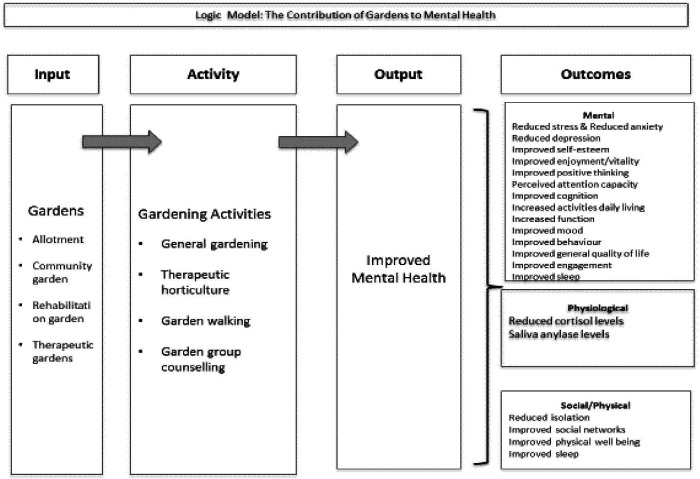
§ What is the evidence for the impact of gardens and gardening on health and well-being: a scoping review and evidence-based logic model to guide healthcare strategy decision making on the use of gardening approaches as a social prescription > Results > Logic model: evidence evaluating the impact of gardens on mental health
“Additionally, the logic model graphic enables visual representation of how mental health was improved through enhancing sociological outcomes leading to reduced socialisation through improved social networks.”
§ What is the evidence for the impact of gardens and gardening on health and well-being: a scoping review and evidence-based logic model to guide healthcare strategy decision making on the use of gardening approaches as a social prescription > Results > Logic model: evidence evaluating the impact of gardens on mental health
“Typically, gardening enabled greater social interaction with others92 and improved physical activity,100 thus improving overall mental well-being,32 reducing depression76 and anxiety.59”
Citations
Cites
Preferred Reporting Items for Systematic Reviews and Meta-Analyses: the PRISMA statement
Moher, D., Liberati, A., Tetzlaff, J., Altman, D. G., & for the PRISMA Group (2009) · BMJ · doi:10.1136/bmj.b2535 · Cited by 83,823
Preferred Reporting Items for Systematic Reviews and Meta-Analyses: The PRISMA Statement
Moher, D., Liberati, A., Tetzlaff, J., Altman, D. G., & The PRISMA Group (2009) · PLoS Medicine · doi:10.1371/journal.pmed.1000097 · Cited by 64,042
Preferred reporting items for systematic reviews and meta-analyses: the PRISMA Statement.
(2009) · PubMed Central · Cited by 44,859
Scoping studies: towards a methodological framework
Arksey, H., & O'Malley, L. (2005) · International Journal of Social Research Methodology · doi:10.1080/1364557032000119616 · Cited by 36,742 · cited 1×
“17 This was particularly relevant as the aim of the scoping review was to explicate the impact of gardens and gardening on diverse outcomes and populations.”
Wang, G., Ma, R., Qiao, G., Wada, K., Aizawa, Y., & Satoh, T. (2015) · Integrative Medicine International · doi:10.1159/000368408 · Cited by 18,657
Scoping studies: advancing the methodology
Levac, D., Colquhoun, H., & O'Brien, K. K. (2010) · Implementation Science · doi:10.1186/1748-5908-5-69 · Cited by 15,268 · cited 2×
“19 Correspond-ingly, our team was interdisciplinary with subject and methodological expertise comprising a nurse with experience in social prescribing and nature-based approaches, a geographer with expertise in urban agriculture and sustainable cities, and two health information specialists with…”
Munn, Z., Peters, M. D. J., Stern, C., Tufanaru, C., McArthur, A., & Aromataris, E. (2018) · BMC Medical Research Methodology · doi:10.1186/s12874-018-0611-x · Cited by 11,385 · cited 1×
“16 We employed Arksey and O’Mal-ley’s validated framework to map the evidence.”
Developing and evaluating complex interventions: the new Medical Research Council guidance
Craig, P., Dieppe, P., Macintyre, S., Michie, S., Nazareth, I., & Petticrew, M. (2008) · BMJ · doi:10.1136/bmj.a1655 · Cited by 10,995
The Warwick-Edinburgh Mental Well-being Scale (WEMWBS): development and UK validation
Tennant, R., Hiller, L., Fishwick, R., Platt, S., Joseph, S., Weich, S., Parkinson, J., Secker, J., & Stewart-Brown, S. (2007) · Health and Quality of Life Outcomes · doi:10.1186/1477-7525-5-63 · Cited by 5,031 · cited 1×
“Commonly reported data collection methods included validated tools such as the Warwick-Edinburgh Mental Well-being Scale 103 or New Economic Foundation’s Five Ways to Well-being, 104 which offer observational subjective data as opposed to direct causality.”
The challenge of defining wellbeing
Dodge, R., Daly, A., Huyton, J., & Sanders, L. (2012) · International Journal of Wellbeing · doi:10.5502/ijw.v2i3.4 · Cited by 2,166 · cited 2×
“96 Additionally, the logic model graphic enables visual representation of how mental health was improved through enhancing sociological outcomes leading to reduced socialisation through improved social networks. logic model: evidence evaluating the impact of gardens on general well-being In determining a parameter for…”
Daudt, H. M., van Mossel, C., & Scott, S. J. (2013) · BMC Medical Research Methodology · doi:10.1186/1471-2288-13-48 · Cited by 1,891
Social prescribing: less rhetoric and more reality. A systematic review of the evidence
Bickerdike, L., Booth, A., Wilson, P. M., Farley, K., & Wright, K. (2017) · BMJ Open · doi:10.1136/bmjopen-2016-013384 · Cited by 773
(2016) · City Research Online (City University London) · Cited by 747
Gardening is beneficial for health: A meta-analysis
Soga, M., Gaston, K. J., & Yamaura, Y. (2017) · Preventive Medicine Reports · doi:10.1016/j.pmedr.2016.11.007 · Cited by 688
Evidence-based healthcare: how to make health policy and management decisions
(1999) · Journal of Vascular Surgery · doi:10.1016/s0741-5214(99)70404-0 · Cited by 608
‘Cultivating health’: Therapeutic landscapes and older people in northern England
Milligan, C., Gatrell, A., & Bingley, A. (2004) · Social Science & Medicine · doi:10.1016/s0277-9536(03)00397-6 · Cited by 571
Gardening promotes neuroendocrine and affective restoration from stress
Van Den Berg, A. E., & Custers, M. H. G. (2011) · Journal of Health Psychology · doi:10.1177/1359105310365577 · Cited by 470
Masset, E., Haddad, L., Cornelius, A., & Isaza-Castro, J. (2012) · BMJ · doi:10.1136/bmj.d8222 · Cited by 397
Nature-assisted therapy: Systematic review of controlled and observational studies
Annerstedt, M., & Währborg, P. (2011) · Scandinavian Journal of Public Health · doi:10.1177/1403494810396400 · Cited by 369
Impact of Garden-Based Youth Nutrition Intervention Programs: A Review
Robinson-O'Brien, R., Story, M., & Heim, S. (2009) · Journal of the American Dietetic Association · doi:10.1016/j.jada.2008.10.051 · Cited by 324
Natural experiments: an underused tool for public health?
Petticrew, M., Cummins, S., Ferrell, C., Findlay, A., Higgins, C., Hoy, C., Kearns, A., & Sparks, L. (2005) · Public Health · doi:10.1016/j.puhe.2004.11.008 · Cited by 318 · cited 1×
“109 However, challenges associated with refining nature-based interventions and controlling confounders may have influenced the dearth noted in natural experiments within this review.”
Biodiversity and Health in the Face of Climate Change
(2019) · Springer eBooks · doi:10.1007/978-3-030-02318-8 · Cited by 308
Gardening as a mental health intervention: A review
Clatworthy, J., Hinds, J., & M. Camic, P. (2013) · Mental Health Review Journal · doi:10.1108/mhrj-02-2013-0007 · Cited by 279
Soga, M., Cox, D., Yamaura, Y., Gaston, K., Kurisu, K., & Hanaki, K. (2017) · International Journal of Environmental Research and Public Health · doi:10.3390/ijerph14010071 · Cited by 237
Cognitive leisure activities and their role in preventing dementia: a systematic review
Stern, C., & Munn, Z. (2010) · International Journal of Evidence-Based Healthcare · doi:10.1111/j.1744-1609.2010.00150.x · Cited by 228
Whear, R., Coon, J. T., Bethel, A., Abbott, R., Stein, K., & Garside, R. (2014) · Journal of the American Medical Directors Association · doi:10.1016/j.jamda.2014.05.013 · Cited by 225
Ohly, H., Gentry, S., Wigglesworth, R., Bethel, A., Lovell, R., & Garside, R. (2016) · BMC Public Health · doi:10.1186/s12889-016-2941-0 · Cited by 211 · cited 1×
“Similar findings were identified by Nicklett et al 84 and Ohly et al 86 who reported positive physiological outcome measures on a range of biometrics including urinalysis, total fat, body mass index and systolic/diastolic blood pressure as outcomes.”
Advancing complexity science in healthcare research: the logic of logic models
Mills, T., Lawton, R., & Sheard, L. (2019) · BMC Medical Research Methodology · doi:10.1186/s12874-019-0701-4 · Cited by 190
The Benefits of Gardening for Older Adults: A Systematic Review of the Literature
Wang, D., & MacMillan, T. (2013) · Activities, Adaptation & Aging · doi:10.1080/01924788.2013.784942 · Cited by 189
Harvesting more than vegetables: the potential weight control benefits of community gardening
Zick, C. D., Smith, K. R., Kowaleski-Jones, L., Uno, C., & Merrill, B. J. (2013) · American Journal of Public Health · doi:10.2105/ajph.2012.301009 · Cited by 184 · cited 1×
“Typically, gardening enabled greater social interaction with others 92 and improved physical activity, 100 thus improving overall mental well-being, 32 reducing depression 76 and anxiety.”
Community Gardens for Refugee and Immigrant Communities as a Means of Health Promotion
Hartwig, K. A., & Mason, M. (2016) · Journal of Community Health · doi:10.1007/s10900-016-0195-5 · Cited by 171
Genter, C., Roberts, A., Richardson, J., & Sheaff, M. (2015) · British Journal of Occupational Therapy · doi:10.1177/0308022615599408 · Cited by 168 · cited 1×
“44 66 76 These evidence-based logic models report the diversity of gardens and gardening interventions and subsequent benefits on a range of populations that may typically live with LTCs.”
Effectiveness of horticultural therapy: A systematic review of randomized controlled trials
Kamioka, H., Tsutani, K., Yamada, M., Park, H., Okuizumi, H., Honda, T., Okada, S., Park, S., Kitayuguchi, J., Abe, T., et al. (2014) · Complementary Therapies in Medicine · doi:10.1016/j.ctim.2014.08.009 · Cited by 164
A case–control study of the health and well-being benefits of allotment gardening
Wood, C. J., Pretty, J., & Griffin, M. (2016) · Journal of Public Health · doi:10.1093/pubmed/fdv146 · Cited by 163
Savoie-Roskos, M. R., Wengreen, H., & Durward, C. (2017) · Journal of the Academy of Nutrition and Dietetics · doi:10.1016/j.jand.2016.10.014 · Cited by 163
McLaughlin, J. A., & Jordan, G. B. (2015) · Handbook of Practical Program Evaluation · doi:10.1002/9781119171386.ch3 · Cited by 158
Perceived Benefits to Human Well-being of Urban Gardens
Dunnett, N., & Qasim, M. (2000) · HortTechnology · doi:10.21273/horttech.10.1.40 · Cited by 150
Sustainable food planning: evolving theory and practice
Wiskerke, J. S. C. (2012) · doi:10.3920/978-90-8686-187-3 · Cited by 147
Korpela, K., De Bloom, J., Sianoja, M., Pasanen, T., & Kinnunen, U. (2017) · Landscape and Urban Planning · doi:10.1016/j.landurbplan.2016.12.005 · Cited by 140
Edwards, C. A., McDonnell, C., & Merl, H. (2012) · Dementia · doi:10.1177/1471301211435188 · Cited by 138
Han, A.-R., Park, S.-A., & Ahn, B.-E. (2018) · Complementary Therapies in Medicine · doi:10.1016/j.ctim.2018.03.011 · Cited by 133
Gardens, Transitions and Identity Reconstruction among Older Chinese Immigrants to New Zealand
Li, W. W., Hodgetts, D., & Ho, E. (2010) · Journal of Health Psychology · doi:10.1177/1359105310368179 · Cited by 132
Evaluation of a horticultural activity programme for persons with psychiatric illness
Kam, M. C. Y., & Siu, A. M. H. (2010) · Hong Kong Journal of Occupational Therapy · doi:10.1016/s1569-18611170007-9 · Cited by 130
Refugees Connecting with a New Country through Community Food Gardening
Harris, N., Minniss, F., & Somerset, S. (2014) · International Journal of Environmental Research and Public Health · doi:10.3390/ijerph110909202 · Cited by 126
Rohwer, A., Pfadenhauer, L., Burns, J., Brereton, L., Gerhardus, A., Booth, A., Oortwijn, W., & Rehfuess, E. (2017) · Journal of Clinical Epidemiology · doi:10.1016/j.jclinepi.2016.06.012 · Cited by 121
A systematic review of the effects of horticultural therapy on persons with mental health conditions
Cipriani, J., Benz, A., Holmgren, A., Kinter, D., McGarry, J., & Rufino, G. (2017) · Occupational Therapy in Mental Health · doi:10.1080/0164212x.2016.1231602 · Cited by 118 · cited 2×
“Typically, gardening enabled greater social interaction with others 92 and improved physical activity, 100 thus improving overall mental well-being, 32 reducing depression 76 and anxiety.”
Anchor Institutions: Best Practices to Address Social Needs and Social Determinants of Health
Koh, H. K., Bantham, A., Geller, A. C., Rukavina, M. A., Emmons, K. M., Yatsko, P., & Restuccia, R. (2020) · American Journal of Public Health · doi:10.2105/ajph.2019.305472 · Cited by 114
Therapeutic Horticulture in Clinical Depression: A Prospective Study
Gonzalez, M. T., Hartig, T., Patil, G. G., Martinsen, E. W., & Kirkevold, M. (2009) · Research and Theory for Nursing Practice · doi:10.1891/1541-6577.23.4.312 · Cited by 111
Allotment Gardening and Other Leisure Activities for Stress Reduction and Healthy Aging
Hawkins, J. L., Thirlaway, K. J., Backx, K., & Clayton, D. A. (2011) · HortTechnology · doi:10.21273/horttech.21.5.577 · Cited by 111
Exploring the health and wellbeing benefits of gardening for older adults
SCOTT, T. L., MASSER, B. M., & PACHANA, N. A. (2015) · Ageing and Society · doi:10.1017/s0144686x14000865 · Cited by 110
Gardening increases vegetable consumption in school-aged children: a meta-analytical synthesis
Langellotto, G. A., & Gupta, A. (2012) · HortTechnology · doi:10.21273/horttech.22.4.430 · Cited by 110
Effects of indoor gardening on sleep, agitation, and cognition in dementia patients—a pilot study
Lee, Y., & Kim, S. (2008) · International Journal of Geriatric Psychiatry · doi:10.1002/gps.1920 · Cited by 108
Heim, S., Bauer, K. W., Stang, J. L., & Ireland, M. (2011) · Journal of Nutrition Education and Behavior · doi:10.1016/j.jneb.2010.01.003 · Cited by 104
The impact of urban gardens on adequate and healthy food: a systematic review
Garcia, M. T., Ribeiro, S. M., Germani, A. C. C. G., & Bógus, C. M. (2018) · Public Health Nutrition · doi:10.1017/s1368980017002944 · Cited by 104
Gatto, N. M., Martinez, L. C., Spruijt‐Metz, D., & Davis, J. N. (2017) · Pediatric Obesity · doi:10.1111/ijpo.12102 · Cited by 95 · cited 1×
“…reported impact on general well-being also included outcome measures that indicated increased physical activity resulting in reduced body mass index 43 and healthier blood glucose levels, 43 and general well-being that benefited community growth, 66 social interaction 62 68 and quality of life.”
The Effectiveness of Horticultural Therapy on Older Adults: A Systematic Review
Nicholas, S. O., Giang, A. T., & Yap, P. L. K. (2019) · Journal of the American Medical Directors Association · doi:10.1016/j.jamda.2019.06.021 · Cited by 95
Comparing Responses to Horticultural-Based and Traditional Activities in Dementia Care Programs
Jarrott, S. E., & Gigliotti, C. M. (2010) · American Journal of Alzheimer's Disease & Other Dementias® · doi:10.1177/1533317510385810 · Cited by 88
Community Gardens as Environmental Health Interventions: Benefits Versus Potential Risks
Al‐Delaimy, W. K., & Webb, M. (2017) · Current Environmental Health Reports · doi:10.1007/s40572-017-0133-4 · Cited by 88
(2002) · Cited by 82
Austin, E. N., Johnston, Y., & Morgan, L. L. (2006) · Victoria University Research Repository (Victoria University) · Cited by 82
Polley, M. J., & Pilkington, K. (2017) · WestminsterResearch (University of Westminster) · Cited by 81
Bail, J. R., Frugé, A. D., Cases, M. G., De Los Santos, J. F., Locher, J. L., Smith, K. P., Cantor, A. B., Cohen, H. J., & Demark‐Wahnefried, W. (2018) · Cancer · doi:10.1002/cncr.31559 · Cited by 78
Effects of Therapeutic Gardens in Special Care Units for People with Dementia: Two Case Studies
Hernandez, R. O. (2007) · Journal of Housing For the Elderly · doi:10.1300/j081v21n01_07 · Cited by 76
Oh, Y.-A., Park, S.-A., & Ahn, B.-E. (2017) · Complementary Therapies in Medicine · doi:10.1016/j.ctim.2017.11.019 · Cited by 75
Hewitt, P., Watts, C., Hussey, J., Power, K., & Williams, T. (2013) · British Journal of Occupational Therapy · doi:10.4276/030802213x13757040168270 · Cited by 74
Horticultural Therapy in Patients With Dementia: A Systematic Review and Meta-Analysis
Lu, L., Lan, S., Hsieh, Y., Yen, Y., Chen, J., & Lan, S. (2019) · American Journal of Alzheimer s Disease & Other Dementias® · doi:10.1177/1533317519883498 · Cited by 72
An Observational Assessment of a Dementia-specific Horticultural Therapy Program
Jarrott, S. E., Kwack, H. R., & Relf, D. (2002) · HortTechnology · doi:10.21273/horttech.12.3.403 · Cited by 66
Kunpeuk, W., Spence, W. D., Phulkerd, S., Suphanchaimat, R., & Pitayarangsarit, S. (2019) · Health Promotion International · doi:10.1093/heapro/daz027 · Cited by 65
Heliker, D., Chadwick, A., & O'Connell, T. (2000) · Activities, Adaptation & Aging · doi:10.1300/j016v24n03_03 · Cited by 63
Detweiler, M. B., Self, J. A., Lane, S. D., Spencer, L., Lutgens, B., Kim, D.-Y., Halling, M. H., Rudder, T. C., & Lehmann, L. P. (2015) · PubMed · Cited by 61
Cultivating Community Collaboration and Community Health Through Community Gardens
Lanier, J., Schumacher, J., & Calvert, K. (2015) · Journal of Community Practice · doi:10.1080/10705422.2015.1096316 · Cited by 60 · cited 1×
“…reported impact on general well-being also included outcome measures that indicated increased physical activity resulting in reduced body mass index 43 and healthier blood glucose levels, 43 and general well-being that benefited community growth, 66 social interaction 62 68 and quality of life.”
The Effect of Healing Gardens and Art Therapy on Older Adults With Mild to Moderate Depression
McCaffrey, R. G. (2007) · Holistic Nursing Practice · doi:10.1097/01.hnp.0000262022.80044.06 · Cited by 60
Gardening Activities and Physical Health Among Older Adults: A Review of the Evidence
Nicklett, E. J., Anderson, L. A., & Yen, I. H. (2016) · Journal of Applied Gerontology · doi:10.1177/0733464814563608 · Cited by 59
Effects of Horticulture on Frail and Prefrail Nursing Home Residents: A Randomized Controlled Trial
Lai, C. K. Y., Kwan, R. Y. C., Lo, S. K. L., Fung, C. Y. Y., Lau, J. K. H., & Tse, M. Y. M. (2018) · Journal of the American Medical Directors Association · doi:10.1016/j.jamda.2018.04.002 · Cited by 58
Social Isolation Predicts Frequent Attendance in Primary Care
Cruwys, T., Wakefield, J. R. H., Sani, F., Dingle, G. A., & Jetten, J. (2018) · Annals of Behavioral Medicine · doi:10.1093/abm/kax054 · Cited by 57
The effects of social and therapeutic horticulture on aspects of social behaviour
Sempik, J., Rickhuss, C., & Beeston, A. (2014) · British Journal of Occupational Therapy · doi:10.4276/030802214x14018723138110 · Cited by 56 · cited 1×
“Typically, gardening enabled greater social interaction with others 92 and improved physical activity, 100 thus improving overall mental well-being, 32 reducing depression 76 and anxiety.”
Murphy, P. F., Miyazaki, Y., Detweiler, M. B., & Kim, K. Y. (2010) · Dementia · doi:10.1177/1471301210375336 · Cited by 55
A walk through the garden: can a visit to a botanic garden reduce stress?
Kohlleppel, T., Bradley, J. C., & Jacob, S. (2002) · HortTechnology · doi:10.21273/horttech.12.3.489 · Cited by 54
Harvest for health gardening intervention feasibility study in cancer survivors
Blair, C. K., Madan-Swain, A., Locher, J. L., Desmond, R. A., de Los Santos, J., Affuso, O., Glover, T., Smith, K., Carley, J., Lipsitz, M., et al. (2013) · Acta Oncologica · doi:10.3109/0284186x.2013.770165 · Cited by 53
Experiences of Women with Stress-Related Ill Health in a Therapeutic Gardening Program
Eriksson, T., Westerberg, Y., & Jonsson, H. (2011) · Canadian Journal of Occupational Therapy · doi:10.2182/cjot.2011.78.5.2 · Cited by 53
Mental health and wellbeing benefits from a prisons horticultural programme
Farrier, A., Baybutt, M., & Dooris, M. (2019) · International Journal of Prisoner Health · doi:10.1108/ijph-11-2017-0055 · Cited by 52
Informal Urban Agriculture: The Secret Lives of Guerrilla Gardeners
Hardman, M., & J. Larkham, P. (2014) · Urban Agriculture · doi:10.1007/978-3-319-09534-9 · Cited by 50 · cited 1×
“…living creatures, and of interest here, is the recognition that gardening supports people with LTCs. 12 People with chronic conditions can engage in nature through being in gardens and through gardening activities such as allot-ment gardening 13 to guerrilla gardening 14 and community gardening.”
Self-citationPhysiologically relaxing effect of a hospital rooftop forest on older women requiring care
Matsunaga, K., Park, B., Kobayashi, H., & Miyazaki, Y. (2011) · Journal of the American Geriatrics Society · doi:10.1111/j.1532-5415.2011.03651.x · Cited by 49
A Case Study Exploring the Influence of a Gardening Therapy Group on Well-Being
Joyce, J., & Warren, A. (2016) · Occupational Therapy in Mental Health · doi:10.1080/0164212x.2015.1111184 · Cited by 45
Garden Walking for Depression: A Research Report
McCaffrey, R. G., Hanson, C., & McCaffrey, W. (2010) · Holistic Nursing Practice · doi:10.1097/hnp.0b013e3181f1acd7 · Cited by 44
Horticultural therapy for schizophrenia
Liu, Y., Li, B., Sampson, S. J., Roberts, S. A., Zhang, G., & Wu, W. (2014) · Cochrane Database of Systematic Reviews · doi:10.1002/14651858.cd009413.pub2 · Cited by 41
D'Andrea, S., Batavia, M., & Sasson, N. J. (2008) · Cited by 39
Park, S.-A., Lee, A.-Y., Park, H.-G., Son, K.-C., Kim, D.-S., & Lee, W.-L. (2017) · HortScience · doi:10.21273/hortsci11232-16 · Cited by 36
Biodiversity and Health in the Face of Climate Change: Implications for Public Health
Cook, P. A., Howarth, M. L., & Wheater, C. P. (2019) · Springer eBooks · doi:10.1007/978-3-030-02318-8_11 · Cited by 36 · cited 8×
“In the latter, we resolved that mental status included pathological disorders such as dementia, schizophrenia, bipolar and other chronic LTCs.”
InfluentialSelf-citationSwank, J. M., & Shin, S. M. (2015) · The Journal for Specialists in Group Work · doi:10.1080/01933922.2015.1056570 · Cited by 34
Growing spaces: an evaluation of the mental health recovery programme using mixed methods
Howarth, M. L., Rogers, M. M., Withnell, N., & McQuarrie, C. (2018) · Journal of research in nursing · doi:10.1177/1744987118766207 · Cited by 34
Self-citationExercise Intensities of Gardening Tasks Within Older Adult Allotment Gardeners in Wales
Hawkins, J. L., Smith, A. D., Backx, K., & Clayton, D. A. (2014) · Journal of Aging and Physical Activity · doi:10.1123/japa.2013-0171 · Cited by 31
Wang, J.-D., & Lêng, C. H. (2016) · Clinical Interventions in Aging · doi:10.2147/cia.s107197 · Cited by 31
The effect of horticultural activities on agitation in nursing home residents with dementia
Luk, K. Y., Lai, C. K. Y., Li, C. C., Cheung, W. H., Lam, S. M. R., Li, H. Y., Ng, K. P., Shiu, W. H., So, C. Y., & Wan, S. F. (2011) · International Journal of Geriatric Psychiatry · doi:10.1002/gps.2493 · Cited by 29
Masuya, J. (2014) · International Journal of Nursing & Clinical Practices · doi:10.15344/2394-4978/2014/109 · Cited by 29
Hajek, A., Bock, J.-O., & König, H.-H. (2017) · BMC Family Practice · doi:10.1186/s12875-017-0621-5 · Cited by 29 · cited 2×
“The benefits of gardening on mental health outcomes also extends to other LTCs known to influence frequent attendance to Accident & Emergency (A&E,) front-line health providers or GPs. 108 Our scoping review has implications for researchers seeking to explicate the impact of nature-based solutions on populations.”
Collins, C. C., & O'Callaghan, A. M. (2008) · HortTechnology · doi:10.21273/horttech.18.4.611 · Cited by 28 · cited 8×
“In the latter, we resolved that mental status included pathological disorders such as dementia, schizophrenia, bipolar and other chronic LTCs.”
InfluentialDewi, N. S., Komatsuzaki, M., 山川, 百., Takahashi, H., Saori, S., Yasue, T., Okayama, T., Toyoda, A., Shimonishi, H., & Sasaki, S. (2017) · Sustainability · doi:10.3390/su9010063 · Cited by 24
The Effect of Reflective Garden Walking on Adults With Increased Levels of Psychological Stress
McCaffrey, R. G., & Liehr, P. R. (2015) · Journal of Holistic Nursing · doi:10.1177/0898010115594934 · Cited by 23
Masuya, J. (2014) · International Journal of Nursing & Clinical Practices · doi:10.15344/2394-4978/2014/101 · Cited by 19
Kim, M. Y., Kim, G. S., Mattson, N. S., & Kim, W. S. (2010) · Horticultural Science and Technology · Cited by 16
Christian, M. S., Evans, C. E., & Cade, J. E. (2014) · Public Health Research · doi:10.3310/phr02040 · Cited by 13
The effect of horticultural therapy on the quality of life of palliative care patients
Lai, C. K.-Y., Lau, C. K.-Y., Kan, W. Y., Lam, W. M., & Fung, C. Y. Y. (2017) · Journal of Psychosocial Oncology · doi:10.1080/07347332.2017.1286699 · Cited by 12
Social prescribing in cardiology: rediscovering the nature within us
Howarth, M. L., & Lister, C. (2019) · British Journal of Cardiac Nursing · doi:10.12968/bjca.2019.0036 · Cited by 9 · cited 1×
“106 Open access Salutogenesis influences the question ‘what makes people healthy?’ rather than, ‘how do we treat disease?’.”
Self-citationSelf-direction and the Social Determinants of Health
Croft, B. (2020) · Community Mental Health Journal · doi:10.1007/s10597-020-00597-5 · Cited by 7
An overview of using an asset-based approach to nursing
Henry, H., & Howarth, M. L. (2018) · University of Salford Institutional Repository (University of Salford) · Cited by 4
Self-citation高齢者に対する園芸療法の有効性:系統的レビュー【JST・京大機械翻訳】
Sean, O. N., Anh, T. G., & Philip, L. (2019) · Journal of the American Medical Directors Association · Cited by 4
Jeong, M.-H., Lee, I.-S., YongMo, C., Jeong, S.-J., Youn, C., Cho, H.-G., & Yi, Y. (2004) · 원예과학기술지 · Cited by 3
Research works printed but not linked: 2
- Holland L Diversity and connections in community gardens: a contribution to local sustainability, local environment. Int J Justice Sustainability 2004; 9: 285– 305.
- Bragg R, Atkins G A review of nature-based interventions for mental health care, 2016.
Cited by
Nature-based outdoor activities for mental and physical health: Systematic review and meta-analysis
Coventry, P. A., Brown, J. E., Pervin, J., Brabyn, S., Pateman, R., Breedvelt, J., Gilbody, S., Stancliffe, R., McEachan, R., & White, P. L. (2021) · SSM - Population Health · doi:10.1016/j.ssmph.2021.100934 · Cited by 453
Dzhambov, A. M., Lercher, P., Browning, M. H. E. M., Stoyanov, D., Petrova, N., Novakov, S., & Dimitrova, D. D. (2021) · Environmental Research · doi:10.1016/j.envres.2020.110420 · Cited by 285
The Socio-Cultural Benefits of Urban Agriculture: A Review of the Literature
Ilieva, R. T., Cohen, N., Israel, M., Specht, K., Fox-Kämper, R., Fargue‐Lelièvre, A., Poniży, L., Schoen, V., Caputo, S., Kirby, C. K., et al. (2022) · Land · doi:10.3390/land11050622 · Cited by 193
“For instance, in a recent scoping review, Michelle Howarth and colleagues [5] synthesized evidence from 77 studies on the physical and mental health benefits of gardens and gardening and pointed to the value of this evidence to inform decision making on the use of gardening approaches as a social prescription.”
BackgroundGardening can relieve human stress and boost nature connection during the COVID-19 pandemic
Egerer, M., Lin, B. B., Kingsley, J., Marsh, P., Diekmann, L. O., & Ossola, A. (2022) · Urban forestry & urban greening · doi:10.1016/j.ufug.2022.127483 · Cited by 129
Gunapala, R., Gangahagedara, R., Wanasinghe, W. C. S., Samaraweera, A., Gamage, A., Rathnayaka, C., Hameed, Z., Baki, Z. A., Madhujith, T., & Merah, O. (2025) · Farming System · doi:10.1016/j.farsys.2025.100150 · Cited by 109
Metadata
- Authors
- Howarth, M., Brettle, A., Hardman, M., & Maden, M.
- Affiliations
- University of Salford (GB)
- University of Liverpool (GB)
- Corresponding author
- Howarth, Michelle
- Venue
- BMJ Open
- Publisher
- BMJ
- Published
- 2020-07
- Volume
- 10
- Issue
- 7
- Pages
- e036923
- ISSN
- 2044-6055 (ISSN-L)
- PMC
- PMC7371129
- OpenAlex
- W3030620435
- Semantic Scholar
- 45359c9112ca603c555d93d3c0d74d8e5ba49676
- Cited by
- 198
- References
- 109
- Citations by year
- 2026: 24 · 2025: 31 · 2024: 52 · 2023: 35 · 2022: 35 · 2021: 19 · 2020: 1
- FWCI
- 1.95
- Type
- journal article
- Language
- en
- Open access
- gold
- doi.org
- Licence
- Locations
- BMJ Open (publishedVersion, cc-by-nc)
- PubMed Central (publishedVersion, cc-by-nc)
- PubMed (publishedVersion)
- University of Salford Institutional Repository (University of Salford) (submittedVersion, cc-by)
- DOAJ (DOAJ: Directory of Open Access Journals) (submittedVersion, cc-by-sa)
- HighWire Press Open Archive (submittedVersion)
- Edge Hill University Research Information Repository (Edge Hill University) (submittedVersion, cc-by-nc)
- Topics
- Social Sciences › Urban Studies › Urban Green Space and Health
- Social Sciences › Urban Studies › Urban Agriculture and Sustainability
- Social Sciences › Psychology › Clinical Psychology › Art Therapy and Mental Health
- Keywords
- gardens, gardening, social prescribing, health and well-being, psychological well-being, physical activity, social isolation, chronic disease, therapeutic gardens, non-medical interventions
- MeSH terms
- Gardens, Activities of Daily Living, Decision Making, Delivery of Health Care, Humans, Logic, Prospective Studies, Quality of Life, Gardening, Prescriptions
About these checks
Registry, retraction, Cites and statistics results are computed, not judged, with one exception: a printed reference that no index lists is read once by a model before it counts as a citation error. Claims are extracted by a model and kept only when their quote appears verbatim in the text; each cited source is then checked, with a model’s help, for whether it says what the claim relies on. Those verdicts can be wrong — read the claim’s quote and the cited source before relying on one.
The claim verdicts this report counts are experimental: their accuracy is not yet measured.
A language model drew the claims from the paper on 2026-10-05, under version 3 of the claim definition (model deepseek-v4.1-flash, prompt extract-v3).
A second model labelled each claim on 2026-10-05 (model jev-1.13-20260917, definition revision gold-guideline-v0.2).
Cited sources are checked with a language model’s help (qwen3.8-omni-flash and gpt-6-sol).
Statistics and arithmetic are recomputed, not judged.
Confidence bands are shown only for fields calibrated on our annotated test set. None is calibrated yet, so no band is shown.
What counts as a claim ›How we measure confidence ›How we check this ›
Are you an author, or do you see a problem with this page? Request a review
Data sources
Bibliographic data: Semantic Scholar, OpenAlex, Crossref.
Contains information from the Semantic Scholar Academic Graph Datasets, made available under the ODC Attribution License (ODC-BY 1.0).
Semantic Scholar’s data is described in: Kinney, R., et al. (2023). The Semantic Scholar Open Data Platform. arXiv:2301.10140.
