

Remote cognitive assessment of older adults in rural areas by telemedicine and automatic speech and video analysis: protocol for a cross-over feasibility study
Open accessThe DOI matches its Crossref record; 39 of the 41 references it cites were found in a registry or an index.
Abstract
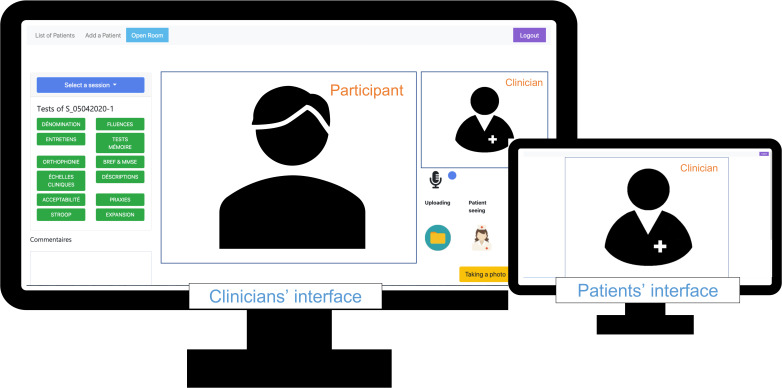
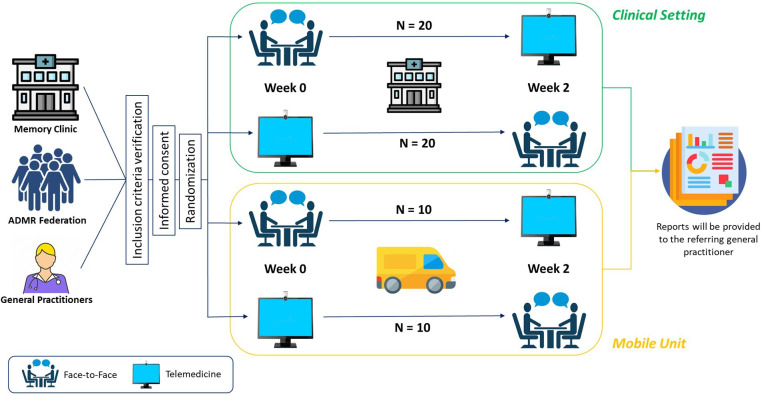
Introduction: Early detection of cognitive impairments is crucial for the successful implementation of preventive strategies. However, in rural isolated areas or so-called ‘medical deserts’, access to diagnosis and care is very limited. With the current pandemic crisis, now even more than ever, remote solutions such as telemedicine platforms represent great potential and can help to overcome this barrier. Moreover, current advances made in voice and image analysis can help overcome the barrier of physical distance by providing additional information on a patients’ emotional and cognitive state. Therefore, the aim of this study is to evaluate the feasibility and reliability of a videoconference system for remote cognitive testing empowered by automatic speech and video analysis. Methods and analysis: 60 participants (aged 55 and older) with and without cognitive impairment will be recruited. A complete neuropsychological assessment including a short clinical interview will be administered in two conditions, once by telemedicine and once by face-to-face. The order of administration procedure will be counterbalanced so half of the sample starts with the videoconference condition and the other half with the face-to-face condition. Acceptability and user experience will be assessed among participants and clinicians in a qualitative and quantitative manner. Speech and video features will be extracted and analysed to obtain additional information on mood and engagement levels. In a subgroup, measurements of stress indicators such as heart rate and skin conductance will be compared. Ethics and dissemination: The procedures are not invasive and there are no expected risks or burdens to participants. All participants will be informed that this is an observational study and their consent taken prior to the experiment. Demonstration of the effectiveness of such technology makes it possible to diffuse its use across all rural areas (‘medical deserts’) and thus, to improve the early diagnosis of neurodegenerative pathologies, while providing data crucial for basic research. Results from this study will be published in peer-reviewed journals.
Overview
The claims and statistics of this paper haven’t been checked yet.
Free: it reads the open-access text and checks the first 5 claims that cite a source we can check. Create a free account to check every claim.
Integrity signals
Registry
Cites
Statistics
Figures
Verification
Claims the paper makes
The claims and statistics of this paper haven’t been checked yet.
Free: it reads the open-access text and checks the first 5 claims that cite a source we can check. Create a free account to check every claim.
Claims other papers make about this one
Each is checked against this paper’s own text: does it say what the citing paper says it does?
The check wasn’t confident either way, so it gives no verdict — never disputed.
In the citing paper
“Both traditional ML approaches (e.g., support vector machines, logistic regression, XGBoost) and deep learning methods (e.g., convolutional and recurrent neural networks, transformers) have shown success in distinguishing individuals with AD, MCI, FTD, including PPA, or PD from healthy controls.93–96”
From Review of Artificial Intelligence for Clinical Use in Alzheimer's Disease and Related Dementias (2026) · cites this paper as [93]
Experimental — accuracy not yet measured
Self-check
Percentages, sums and reported differences re-computed from the paper’s own numbers.
The self-check needs the paper’s full text.
Citations
Cites
Folstein, M. F., Folstein, S. E., & McHugh, P. R. (1975) · Journal of Psychiatric Research · doi:10.1016/0022-3956(75)90026-6 · Cited by 88,282
Hirono, N., Mori, E., Ikejiri, Y., Imamura, T., Shimomura, T., Hashimoto, M., Yamashita, H., & Ikeda, M. (1997) · Brain and nerve · Cited by 21,039
Kok, J. S., Berg, I. J., & Scherder, E. J. A. (2013) · Dementia and Geriatric Cognitive Disorders Extra · doi:10.1159/000353441 · Cited by 20,589
Older Adults' Reasons for Using Technology while Aging in Place
Peek, S. T. M., Luijkx, K. G., Rijnaard, M. D., Nieboer, M. E., van der Voort, C. S., Aarts, S., van Hoof, J., Vrijhoef, H. J. M., & Wouters, E. J. M. (2016) · Gerontology · doi:10.1159/000430949 · Cited by 19,690
Sensitivity and False Alarm Rate of a Fall Sensor in Long-Term Fall Detection in the Elderly
Kangas, M., Korpelainen, R., Vikman, I., Nyberg, L., & Jämsä, T. (2015) · Gerontology · doi:10.1159/000362720 · Cited by 18,909
Usability Evaluation In Industry
(1996) · CRC Press eBooks · doi:10.1201/9781498710411 · Cited by 4,354
COVID-19 and the consequences of isolating the elderly
Armitage, R., & Nellums, L. B. (2020) · The Lancet Public Health · doi:10.1016/s2468-2667(20)30061-x · Cited by 1,597
Almeida, O. P., & Almeida, S. A. (1999) · International Journal of Geriatric Psychiatry · doi:10.1002/(sici)1099-1166(199910)14:10<858::aid-gps35>3.0.co;2-8 · Cited by 1,299
A review of depression and suicide risk assessment using speech analysis
Cummins, N., Scherer, S., Krajewski, J., Schnieder, S., Epps, J., & Quatieri, T. F. (2015) · Speech Communication · doi:10.1016/j.specom.2015.03.004 · Cited by 1,003
Linguistic Features Identify Alzheimer’s Disease in Narrative Speech
Fraser, K. C., Meltzer, J. A., & Rudzicz, F. (2015) · Journal of Alzheimer's Disease · doi:10.3233/jad-150520 · Cited by 797
Boston Diagnostic Aphasia Examination
(2012) · SpringerReference · doi:10.1007/springerreference_183639 · Cited by 527
AVEC 2016: Depression, Mood, and Emotion Recognition Workshop and Challenge
Valstar, M., Gratch, J., Schuller, B., Ringeval, F., Lalanne, D., Torres Torres, M., Scherer, S., Stratou, G., Cowie, R., & Pantic, M. (2016) · Proceedings of the 6th International Workshop on Audio/Visual Emotion Challenge · doi:10.1145/2988257.2988258 · Cited by 503
Detecting depression from facial actions and vocal prosody
Cohn, J. F., Kruez, T. S., Matthews, I., Yang, Y., Nguyen, M. H., Padilla, M. T., Zhou, F., & De la Torre, F. (2009) · 2009 3rd International Conference on Affective Computing and Intelligent Interaction and Workshops · doi:10.1109/acii.2009.5349358 · Cited by 494
Lexis. Tests pour le diagnostic des troubles lexicaux chez le patient aphasique
de Courtray, M.-P. D. P., Bilocq, V., Wilde, V., Seron, X., & Pillon, A. (2001) · Digital Access to Libraries (Université catholique de Louvain (UCL), l'Université de Namur (UNamur) and the Université Saint-Louis (USL-B)) · Cited by 418
Robert, P. H., Clairet, S., Benoit, M., Koutaich, J., Bertogliati, C., Tible, O., Caci, H., Borg, M., Brocker, P., & Bedoucha, P. (2002) · International Journal of Geriatric Psychiatry · doi:10.1002/gps.755 · Cited by 405
Self-citationNeuropsychological test administration by videoconference: a systematic review and meta-analysis
Brearly, T. W., Shura, R. D., Martindale, S. L., Lazowski, R. A., Luxton, D. D., Shenal, B. V., & Rowland, J. A. (2017) · Neuropsychology Review · doi:10.1007/s11065-017-9349-1 · Cited by 353
Engagement detection in online learning: a review
Dewan, M. A. A., Murshed, M., & Lin, F. (2019) · Smart Learning Environments · doi:10.1186/s40561-018-0080-z · Cited by 350
["The 5 words": a simple and sensitive test for the diagnosis of Alzheimer's disease].
Dubois, B., Touchon, J., Portet, F., Ousset, P., Vellas, B. J., & Michel, B. F. (2002) · PubMed · Cited by 326
Memory, related functions, and age
Botwinick, J., & Storandt, M. (1974) · Cited by 204
Strategies for dementia prevention: latest evidence and implications
Rakesh, G., Szabo, S. T., Alexopoulos, G. S., & Zannas, A. S. (2017) · Therapeutic Advances in Chronic Disease · doi:10.1177/2040622317712442 · Cited by 146
Automatic audiovisual behavior descriptors for psychological disorder analysis
Scherer, S. J., Stratou, G., Lucas, G., Mahmoud, M., Boberg, J., Gratch, J. S., Rizzo, A., & Morency, L. (2014) · Image and Vision Computing · doi:10.1016/j.imavis.2014.06.001 · Cited by 144
Can body expressions contribute to automatic depression analysis?
Joshi, J., Goecke, R., Parker, G. B., & Breakspear, M. J. (2013) · International Conference on Automatic Face and Gesture Recognition · doi:10.1109/fg.2013.6553796 · Cited by 138
Automatically detecting pain using facial actions
Lucey, P., Cohn, J., Lucey, S., Matthews, I., Sridharan, S., & Prkachin, K. M. (2009) · 2009 3rd International Conference on Affective Computing and Intelligent Interaction and Workshops · doi:10.1109/acii.2009.5349321 · Cited by 125
Armaignac, D. L., Saxena, A., Rubens, M., Valle, C. A., Williams, L.-M. S., Veledar, E., & Gidel, L. T. (2018) · Critical Care Medicine · doi:10.1097/ccm.0000000000002994 · Cited by 86
Godefroy, O., Gibbons, L. E., Diouf, M., Nyenhuis, D. L., Roussel, M., Black, S. E., & Bugnicourt, J. M. (2014) · Cortex · doi:10.1016/j.cortex.2014.01.016 · Cited by 86
Free and cued selective reminding and selective reminding in the elderly
Grober, E. H., Merling, A., Heimlich, T., & Lipton, R. B. (1997) · Journal of Clinical and Experimental Neuropsychology · doi:10.1080/01688639708403750 · Cited by 85
The Dutch Parelsnoer Institute - Neurodegenerative diseases; methods, design and baseline results
Aalten, P., Ramakers, I. H., Biessels, G. J., de Deyn, P. P., Koek, H. L., OldeRikkert, M. G., Oleksik, A. M., Richard, E., Smits, L. L., van Swieten, J. C., et al. (2014) · BMC Neurology · doi:10.1186/s12883-014-0254-4 · Cited by 83
Self-citationThe effect of telemedicine on cognitive decline in patients with dementia
Kim, H. S., Jhoo, J. H., & Jang, J. (2016) · Journal of Telemedicine and Telecare · doi:10.1177/1357633x15615049 · Cited by 79
Fully Automatic Speech-Based Analysis of the Semantic Verbal Fluency Task
König, A., Linz, N., Tröger, J., Wolters, M., Alexandersson, J., & Robert, P. (2018) · Dementia and Geriatric Cognitive Disorders · doi:10.1159/000487852 · Cited by 77
Self-citationDetecting Apathy in Older Adults with Cognitive Disorders Using Automatic Speech Analysis
König, A., Linz, N., Zeghari, R., Klinge, X., Tröger, J., Alexandersson, J., & Robert, P. (2019) · Journal of Alzheimer’s Disease · doi:10.3233/jad-181033 · Cited by 57
Self-citationDario, C., Luisotto, E., Pozzo, E. D., Mancin, S., Aletras, V. H., Newman, S. P., Gubian, L., & Saccavini, C. (2016) · International Journal of Integrated Care · doi:10.5334/ijic.2219 · Cited by 54
Présentation d'une batterie neuropsychologique et cognitive pour l'évaluation de l'apraxie gestuelle
Peigneux, P., & der Linden, M. V. (2000) · Dépôt institutionnel de l'Université libre de Bruxelles (Université Libre de Bruxelles) · Cited by 48
Recommendations for ICT use in Alzheimer's disease assessment: Monaco CTAD expert meeting
Robert, P. H., Konig, A., Andrieu, S., Bremond, F., Chemin, I., Chung, P. C., Dartigues, J. F., Dubois, B., Feutren, G., Guillemaud, R., et al. (2013) · The Journal of nutrition, health and aging · doi:10.1007/s12603-013-0046-3 · Cited by 46
Self-citationDiagnosis of cognitive decline and dementia in rural areas — A scoping review
Barth, J., Nickel, F., & Kolominsky‐Rabas, P. L. (2018) · International Journal of Geriatric Psychiatry · doi:10.1002/gps.4841 · Cited by 45
Videoconference-Based Mini Mental State Examination: A Validation Study
Timpano, F., Pirrotta, F., Bonanno, L., Marino, S., Marra, A., Bramanti, P., & Lanzafame, P. (2013) · Telemedicine and e-Health · doi:10.1089/tmj.2013.0035 · Cited by 36
Using Neural Word Embeddings in the Analysis of the Clinical Semantic Verbal Fluency Task
Linz, N., Tröger, J., Alexandersson, J., & König, A. (2017) · HAL · Cited by 35
Self-citationPredicting Dementia Screening and Staging Scores from Semantic Verbal Fluency Performance
Linz, N., Tröger, J., Alexandersson, J., Wolters, M. K., König, A., & Robert, P. H. (2017) · IEEE ... International Conference on Data Mining workshops · doi:10.1109/icdmw.2017.100 · Cited by 34
Self-citationThe Importance of Eye Gaze and Head Pose to Estimating Levels of Attention
Asteriadis, S., Karpouzis, K. C., & Kollias, S. (2011) · International Conference on Games and Virtual Worlds for Serious Applications · doi:10.1109/vs-games.2011.38 · Cited by 25
Haralambous, B., Subramaniam, S., Hwang, K., Dow, B., & LoGiudice, D. (2019) · Asia-Pacific Psychiatry · doi:10.1111/appy.12355 · Cited by 23
Research works printed but not linked: 3
- 16. Real-Time physiological data streaming and visualization. Available: https://www. empatica. com/ en-eu/ research/ e4/ on September 3, 2021 by guest. Protected by copyright. http://bmjopen.bmj.com/ BMJ Open: first published as 10.1136/bmjopen-2020-047083 on 2 September 2021. Downloaded from
- 35. Goodglass H, Kaplan E, Bar-resi B. Boston Diagnostic Aphasia Examina-tion. Lippincott Williams & Wilkins, 2000.
- 37. Deloche G, Hannequin D. Test de Dénomination Orale d'Images. Paris : les Éditions du Centre de Psychologie Appliquée, 1997. on September 3, 2021 by guest. Protected by copyright. http://bmjopen.bmj.com/ BMJ Open: first published as 10.1136/bmjopen-2020-047083 on 2 September 2021. Downloaded from
Cited by
Gagliardi, G. (2023) · International Journal of Language & Communication Disorders · doi:10.1111/1460-6984.12870 · Cited by 37
AI‐based assessments of speech and language impairments in dementia
Parsapoor, M. (2023) · Alzheimer s & Dementia · doi:10.1002/alz.13395 · Cited by 19
Butterbrod, E., van den Heuvel, D. M. J., Zevenhoven, P., Waterink, L., van Leeuwenstijn, M. S. S. A., Jutten, R. J., van der Flier, W. M., & Sikkes, S. A. M. (2024) · Journal of the International Neuropsychological Society · doi:10.1017/s1355617724000432 · Cited by 11
Mateus, M., Alho, I., Neves, A. L., Lopes, H. F. M., & Correia, M. M. B. (2026) · BMC Medical Ethics · doi:10.1186/s12910-025-01372-5 · Cited by 10
Review of Artificial Intelligence for Clinical Use in Alzheimer's Disease and Related Dementias
Breithaupt, A. G., Tang, A., Paolillo, E. W., Bibars, M., Johnson, E. C. B., Saloner, R., Possin, K. L., Windon, C. C., Hill-Jarrett, T. G., Giorgio, J., et al. (2026) · Seminars in Neurology · doi:10.1055/a-2744-9871 · Cited by 6
Metadata
- Authors
- König, A., Zeghari, R., Guerchouche, R., Duc Tran, M., Bremond, F., Linz, N., Lindsay, H., Langel, K., Ramakers, I., Lemoine, P., Bultingaire, V., & Robert, P.
- Affiliations
- Institut national de recherche en sciences et technologies du numérique (FR)
- Université Côte d'Azur (FR)
- German Research Centre for Artificial Intelligence (DE)
- Janssen (Belgium) (BE)
- Maastricht University (NL)
- Corresponding author
- König, Alexandra
- ORCID
- Venue
- BMJ Open
- Publisher
- BMJ
- Published
- 2021-09
- Volume
- 11
- Issue
- 9
- Pages
- e047083
- ISSN
- 2044-6055 (ISSN-L)
- PMC
- PMC8413472
- OpenAlex
- W3198248295
- Cited by
- 17
- References
- 41
- Citations by year
- 2026: 4 · 2025: 5 · 2024: 3 · 2023: 5
- FWCI
- 1.73
- Type
- journal article
- Language
- en
- Open access
- gold
- doi.org
- Licence
- cc-by-nc
- Locations
- BMJ Open (publishedVersion, cc-by-nc)
- PubMed Central (publishedVersion, cc-by-nc)
- PubMed (publishedVersion)
- Research Publications (Maastricht University) (acceptedVersion, cc-by-nc)
- Research Publications (Maastricht University) (acceptedVersion, other-oa)
- HAL (submittedVersion, other-oa)
- DOAJ (DOAJ: Directory of Open Access Journals) (submittedVersion, cc-by-sa)
- Funders
- European Institute for Innovation and Technology (19249)
- Topics
- Health Sciences › Medicine › Public Health, Environmental and Occupational Health › Telemedicine and Telehealth Implementation
- Health Sciences › Medicine › Psychiatry and Mental health › Dementia and Cognitive Impairment Research
- Health Sciences › Medicine › Geriatrics and Gerontology › Technology Use by Older Adults
- Keywords
- remote cognitive assessment, telemedicine, older adults, rural health, medical deserts, automated speech analysis, video analysis, videoconferencing, cognitive impairment, early diagnosis, neuropsychological assessment, user acceptance, heart rate, skin conductance, stress symptoms, mood
- MeSH terms
- Aged, Cognition, Feasibility Studies, Humans, Speech, Reproducibility of Results, Telemedicine, Observational Studies as Topic
About these checks
Registry, retraction, Cites and statistics results are computed, not judged, with one exception: a printed reference that no index lists is read once by a model before it counts as a citation error. Claims are extracted by a model and kept only when their quote appears verbatim in the text; each cited source is then checked, with a model’s help, for whether it says what the claim relies on. Those verdicts can be wrong — read the claim’s quote and the cited source before relying on one.
Statistics and arithmetic are recomputed, not judged.
Confidence bands are shown only for fields calibrated on our annotated test set. None is calibrated yet, so no band is shown.
What counts as a claim ›How we measure confidence ›How we check this ›
Are you an author, or do you see a problem with this page? Request a review
Data sources
Bibliographic data: Semantic Scholar, OpenAlex, Crossref.
Contains information from the Semantic Scholar Academic Graph Datasets, made available under the ODC Attribution License (ODC-BY 1.0).
Semantic Scholar’s data is described in: Kinney, R., et al. (2023). The Semantic Scholar Open Data Platform. arXiv:2301.10140.
