

Factors associated with self-reported health among New Zealand military veterans: a cross-sectional study
Open accessPublished version of a preprint
The DOI matches its Crossref record; 34 of the 34 references it cites were found in a registry or an index; 6 of the 18 sources its claims cite were checked for support.
Abstract
Objective To identify factors associated with better or poorer self-reported health status in New Zealand military Veterans. Design A cross-sectional survey. Participants The participants of interest were the 3874 currently serving Veterans who had been deployed to a conflict zone, but all Veterans were eligible to participate. Study variables The EQ-5D-5L, asking about problems across five dimensions (mobility, self-care, usual activities, pain or discomfort and anxiety or depression), with five levels of severity (eg, no, slight, moderate, severe or extreme problems), also containing a Visual Analogue Scale (EQ-VAS) to self-assess health state, scaled from 0 (worst) to 100 (best) imagined health. Hypothetical relationships with better health were positive social support, sleep and psychological flexibility; with poorer health, post-traumatic stress, exposure to psychological trauma, distress and hazardous drinking. Results The EQ5-D-5L was completed by 1767 Veterans, 1009 serving, a response rate of 26% from that group, 1767 completing the EQ5-D, 1458 who had deployed, 288 who had not and the 21 who did not provide deployment data. Of these, 247 were not used in the analysis due to missing values in one or more variables, leaving 1520 for analysis. A significantly higher proportion of Veterans reported any problems' rather than no problems' with four EQ-5D dimensions: mobility, self-care, usual activities and pain or discomfort, but no difference in anxiety or depression. Age, length of service, deployment, psychological flexibility and better sleep quality were associated with higher EQ-VAS scores; distress with lower EQ-VAS scores. Conclusion In this sample of New Zealand Veterans, psychological flexibility and good sleep are associated with better self-rated health, and distress and poor sleep with diminished health. These factors might be used as sentinel health indicators in assessing Veteran health status, and cognitive-behavioural therapy encompassing these domains may be useful in improving the health of New Zealand Veterans. © 2022 BMJ Publishing Group. All rights reserved.
Overview
CoChat Summary
TL;DR
This cross-sectional survey of New Zealand military veterans found that better self-rated health was associated with psychological flexibility, better sleep, greater length of service, and deployment, while distress and exposure to traumatic events were linked to poorer health. The study used EQ-5D-5L and EQ-VAS outcomes in a final analytic sample of 1520 veterans.
Key findings
- Of 1767 Veterans who completed the EQ-5D-5L, 1520 were included in analysis after excluding 247 with missing values.
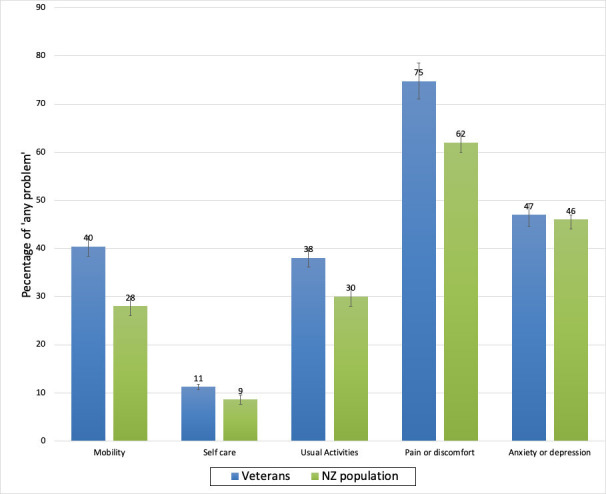
- Veterans reported significantly more “any problems” than the general New Zealand population in 4 of 5 EQ-5D-5L dimensions: mobility, self-care, usual activities, and pain or discomfort; there was no difference in anxiety or depression.
- In the multivariable model, age, length of service, deployment, psychological flexibility, and better sleep quality were associated with higher EQ-VAS scores, while distress was associated with lower EQ-VAS scores.
- In the final model, social support and AUDIT-C hazardous drinking were not retained; exposure to traumatic events also remained part of the final set of independently associated variables, and deployment had a positive association with health state.
Methods
- Cross-sectional online/postal survey of New Zealand Veterans; the paper states 3874 currently serving veterans with operational service were a key group of interest, and all veterans were eligible to participate.
- Health was measured with EQ-5D-5L and EQ-VAS; predictors included demographics, PTSD symptoms (PCL-M), distress (GHQ-12), social support, alcohol use (AUDIT-C), sleep quality (SCI), psychological flexibility (AAQ-II), and trauma exposure (BTQ).
- Analysis used complete-case ordinary least-squares regression with robust standard errors, univariate screening followed by multivariable backward selection; Z tests compared EQ-5D-5L dimensions with New Zealand normative values.
Limitations
- The paper states the exact response rate is unknown and that sampling bias may be a limitation.
- The cross-sectional design means the study cannot assess cause-and-effect relationships.
- Evident from the text: 247 of 1767 respondents were excluded for missing data, so complete-case analysis may have reduced the sample and could affect precision or introduce bias.
Model-written summary. Check it against the paper before relying on it.
Integrity signals
Registry
Cites
Statistics
Figures
Verification
Claims the paper makes
5 Valid · 1 Not valid · 9 Not checked · 30 Own results and interpretations
The cited sources support only part of this claim — read each source’s verdict below.
In the paper
“A significantly higher proportion of Veterans reported ‘any problems’ rather than ‘no problems’ with four EQ-5D dimensions: mobility, self-care, usual activities and pain or discomfort, but no difference in anxiety or depression.”
- Also stated in: § Principal findings · plain
“With the exception of anxiety or depression, Veterans had a significantly greater proportion of ‘any problem’ responses in the EQ-5D-5L dimensions than the general population of New Zealand.”
§ Factors associated with self-reported health among New Zealand military veterans: a cross-sectional study > Abstract > Results
What the sources say
- Partly supportedcites [24] Sullivan T, Hansen P, Ombler F, et al. A new tool for creating personal and social EQ-5D-5L value sets, including valuing 'dead'. Soc Sci Med 2020; 246: 112707. 10.1016/j.socscimed.2019.112707 31945596 sourceExperimental — accuracy not yet measured
Section 2.4 describes a survey designed to represent New Zealand adults and says participants rated their health using the EQ-5D-5L; the Results say their self-assessed health is summarised in Appendix 2. The paper can therefore serve as a New Zealand population comparator, but our copy reports no Veterans comparison or statistical test showing higher proportions in four dimensions. (LLM, conf=0.83)
plainstates an association- Asserted: passes — The authors put it forward as true.
- Checkable: passes — It can be checked against evidence.
- Load-bearing: passes — The paper’s conclusions depend on it.
- Based: passes — The paper gives a reason why it holds.
- Also stated in: § Principal findings · plain
The cited sources support only part of this claim — read each source’s verdict below.
In the paper
“However, the physical and psychological stressors of military service have been found to erode this effect.2”
§ Factors associated with self-reported health among New Zealand military veterans: a cross-sectional study > Introduction
What the sources say
- Partly supportedcites [2] Bollinger MJ, Schmidt S, Pugh JA, et al. Erosion of the healthy soldier effect in veterans of US military service in Iraq and Afghanistan. Popul Health Metr 2015; 13: 8. 10.1186/s12963-015-0040-6 25798075 PMC4367975 sourceExperimental — accuracy not yet measured
The Conclusion (page not provided) reports that the healthy soldier effect had eroded in the studied Iraq and Afghanistan veteran cohorts. It suggests repeated deployments and survival from severe injuries as possible contributors, but does not establish that physical and psychological stressors caused the erosion; the Background mentions psychological conditions without linking them to that finding. (LLM, conf=0.86)
plainstates a cause- Asserted: passes — The authors put it forward as true.
- Checkable: passes — It can be checked against evidence.
- Load-bearing: unclear — It is unclear whether the paper’s conclusions depend on it.
- Based: passes — The paper gives a reason why it holds.
- Partly supported
The cited sources that could be checked couldn’t confirm or dispute this claim.
In the paper
“A significantly higher proportion of Veterans reported ‘any problems’ rather than ‘no problems’ with four EQ-5D dimensions: mobility, self-care, usual activities and pain or discomfort, but no difference in anxiety or depression.”
- Also stated in: § Principal findings · plain
“With the exception of anxiety or depression, Veterans had a significantly greater proportion of ‘any problem’ responses in the EQ-5D-5L dimensions than the general population of New Zealand.”
§ Factors associated with self-reported health among New Zealand military veterans: a cross-sectional study > Abstract > Results
What the sources say
- Could not verifycites [24] Sullivan T, Hansen P, Ombler F, et al. A new tool for creating personal and social EQ-5D-5L value sets, including valuing 'dead'. Soc Sci Med 2020; 246: 112707. 10.1016/j.socscimed.2019.112707 31945596 sourceExperimental — accuracy not yet measured
The New Zealand survey section describes a sample of NZ adults completing the EQ-5D-5L, and the Results discuss anxiety/depression values. Neither passage reports a comparison with Veterans or tests whether the proportions reporting anxiety/depression problems differ. Searches for Veterans and for anxiety/depression proportions found no such comparison in our copy. (LLM, conf=0.75)
plain- Asserted: passes — The authors put it forward as true.
- Checkable: passes — It can be checked against evidence.
- Load-bearing: passes — The paper’s conclusions depend on it.
- Based: passes — The paper gives a reason why it holds.
- Also stated in: § Principal findings · plain
A result the paper reports from its own data — it cites no other source for it, so there is none to check. The quote shows it is in the paper.
In the paper
“The final model identified variables independently associated with the EQ-VAS score: age, length of service, deployment, the GHQ score, psychological flexibility, the sleep score and exposure to traumatic events.”
§ Factors associated with self-reported health among New Zealand military veterans: a cross-sectional study > Discussion > Principal findings
plainstates an association- Asserted: passes — The authors put it forward as true.
- Checkable: passes — It can be checked against evidence.
- Load-bearing: passes — The paper’s conclusions depend on it.
- Based: passes — The paper gives a reason why it holds.
A result the paper reports from its own data — it cites no other source for it, so there is none to check. The quote shows it is in the paper.
In the paper
“Positive associations with health state were found for psychological flexibility as measured by the AAQ-II, better sleep scores, the total social support score and the individual dimensions of support.”
§ Factors associated with self-reported health among New Zealand military veterans: a cross-sectional study > Results
plainstates an association- Asserted: passes — The authors put it forward as true.
- Checkable: passes — It can be checked against evidence.
- Load-bearing: unclear — It is unclear whether the paper’s conclusions depend on it.
- Based: passes — The paper gives a reason why it holds.
10 more claims
Create a free account to see all 45 claims and every source verdict.
- Probably not a substantial claim. 20
- It may state two separate claims as one. 18
Self-check
Percentages, sums and reported differences re-computed from the paper’s own numbers.
Each contradiction between two passages listed here was confirmed by an independent check.
Rated minor: it would not touch a result — a value no result rests on, a p-value that stays on the same side of the significance level, or a conflict that is clerical, resolved elsewhere in the paper, or outside its own findings.
In the paper
§ Factors associated with self-reported health among New Zealand military veterans: a cross-sectional study > Abstract > Results
“The EQ5-D-5L was completed by 1767 Veterans, 1009 serving, a response rate of 26% from that group, 1767 completing the EQ5-D, 1458 who had deployed, 288 who had not and the 21 who did not provide deployment data.”
§ Factors associated with self-reported health among New Zealand military veterans: a cross-sectional study > Results
“The EQ-5D-5L was completed by 1767 Veterans, 1009 who were serving (26% of that group), 458 who had retired, 288 who had not deployed and 21 who did not provide deployment data.”
Citations
Cites
Diagnostic and Statistical Manual of Mental Disorders
American Psychiatric Association (2013) · doi:10.1176/appi.books.9780890425596 · Cited by 116,369
Coefficient Alpha and the Internal Structure of Tests
Cronbach, L. J. (1951) · Psychometrika · doi:10.1007/bf02310555 · Cited by 43,931
Acceptance and commitment therapy: model, processes and outcomes
Hayes, S. C., Luoma, J. B., Bond, F. W., Masuda, A., & Lillis, J. (2006) · Behaviour Research and Therapy · doi:10.1016/j.brat.2005.06.006 · Cited by 6,587
Bush, K. (1998) · Archives of Internal Medicine · doi:10.1001/archinte.158.16.1789 · Cited by 6,196
Statistics notes: Cronbach's alpha: Table 1
Bland, J. M., & Altman, D. G. (1997) · BMJ · doi:10.1136/bmj.314.7080.572 · Cited by 5,300
Combat Duty in Iraq and Afghanistan, Mental Health Problems, and Barriers to Care
Hoge, C. W., Castro, C. A., Messer, S. C., McGurk, D., Cotting, D. I., & Koffman, R. L. (2004) · New England Journal of Medicine · doi:10.1056/nejmoa040603 · Cited by 4,778
Bond, F. W., Hayes, S. C., Baer, R. A., Carpenter, K. M., Guenole, N., Orcutt, H. K., Waltz, T., & Zettle, R. D. (2011) · Behavior Therapy · doi:10.1016/j.beth.2011.03.007 · Cited by 3,950
The Sleep Condition Indicator: a clinical screening tool to evaluate insomnia disorder
Espie, C. A., Kyle, S. D., Hames, P., Gardani, M., Fleming, L., & Cape, J. (2014) · BMJ Open · doi:10.1136/bmjopen-2013-004183 · Cited by 517
What Does the Acceptance and Action Questionnaire (AAQ-II) Really Measure?
Wolgast, M. (2014) · Behavior Therapy · doi:10.1016/j.beth.2014.07.002 · Cited by 421
Assessing the performance of the EQ-VAS in the NHS PROMs programme
Feng, Y., Parkin, D., & Devlin, N. J. (2014) · Quality of Life Research · doi:10.1007/s11136-013-0537-z · Cited by 319
Trauma in the Lives of Older Men: Findings from the Normative Aging Study
Schnurr, P. P., Spiro, A., Vielhauer, M. J., Findler, M. N., & Hamblen, J. L. (2002) · Journal of Clinical Geropsychology · doi:10.1023/a:1015992110544 · Cited by 204
Sleep in the Military: Promoting Healthy Sleep Among U.S. Servicemembers
Troxel, W., Shih, R. A., Pedersen, E. R., Geyer, L., Fisher, M., Griffin, B. A., Haas, A. C., Kurz, J., & Steinberg, P. S. (2015) · Rand health quarterly · doi:10.7249/rhq-05-02-19 · Cited by 195
Musculoskeletal Lower Limb Injury Risk in Army Populations
Andersen, K. A., GRIMSHAW, P. N., Kelso, R. M., & Bentley, D. J. (2016) · Sports Medicine - Open · doi:10.1186/s40798-016-0046-z · Cited by 163
An Evaluation of the Effect of Military Service on Mortality: Quantifying the Healthy Soldier Effect
McLaughlin, R., Nielsen, L., & Waller, M. (2008) · Annals of Epidemiology · doi:10.1016/j.annepidem.2008.09.002 · Cited by 153
Positive and Negative Consequences of a Military Deployment
Newby, J. H., McCarroll, J. E., Ursano, R. J., Fan, Z., Shigemura, J., & Tucker-Harris, Y. (2005) · Military Medicine · doi:10.7205/milmed.170.10.815 · Cited by 138
Accident compensation corporation.
(1983) · PubMed · Cited by 131
Long-term Outcomes of Military Service in Aging and the Life Course: A Positive Re-envisioning
Spiro, A., Settersten, R. A., & Aldwin, C. M. (2016) · The Gerontologist · doi:10.1093/geront/gnv093 · Cited by 125
The health and wellbeing needs of veterans: a rapid review
Oster, C., Morello, A., Venning, A., Redpath, P., & Lawn, S. (2017) · BMC Psychiatry · doi:10.1186/s12888-017-1547-0 · Cited by 98
Non-deployment factors affecting psychological wellbeing in military personnel: literature review
Brooks, S. K., & Greenberg, N. (2018) · Journal of Mental Health · doi:10.1080/09638237.2016.1276536 · Cited by 96
Lang, A. J., Schnurr, P. P., Jain, S., He, F., Walser, R. D., Bolton, E., Benedek, D. M., Norman, S. B., Sylvers, P., Flashman, L., et al. (2017) · Psychological Trauma: Theory, Research, Practice, and Policy · doi:10.1037/tra0000127 · Cited by 83
Health-Related Quality of Life of U.S. Military Personnel: A Population-Based Study
Boehmer, T. K., Boothe, V. L., Flanders, W. D., & Barrett, D. H. (2003) · Military Medicine · doi:10.1093/milmed/168.11.941 · Cited by 56
PTSD Checklist--Military Version
Weathers, F. W., Litz, B. T., Herman, D. S., Huska, J. A., & Keane, T. M. (1993) · PsycTESTS Dataset · doi:10.1037/t05198-000 · Cited by 54
A new tool for creating personal and social EQ-5D-5L value sets, including valuing 'dead'
Sullivan, T., Hansen, P., Ombler, F., Derrett, S., & Devlin, N. (2020) · Social Science & Medicine · doi:10.1016/j.socscimed.2019.112707 · Cited by 51
Self-citationErosion of the healthy soldier effect in veterans of US military service in Iraq and Afghanistan
Bollinger, M. J., Schmidt, S., Pugh, J. A., Parsons, H. M., Copeland, L. A., & Pugh, M. J. (2015) · Population Health Metrics · doi:10.1186/s12963-015-0040-6 · Cited by 49
Military-to-civilian transition theories and frameworks
Pedlar, D., Thompson, J. M., & Andrew Castro, C. (2019) · Military Veteran Reintegration · doi:10.1016/b978-0-12-815312-3.00003-6 · Cited by 49
The impact of military service on health and well-being
Williamson, V, Diehle, J., Dunn, R., Jones, N., & Greenberg, N. (2019) · Occupational Medicine · doi:10.1093/occmed/kqy139 · Cited by 39
Richardson, A., Gurung, G., Samaranayaka, A., Gardner, D. H., deGraaf, B., Wyeth, E., Derrett, S., Shepherd, D., & McBride, D. I. (2020) · PLoS ONE · doi:10.1371/journal.pone.0231460 · Cited by 30
Self-citationMcCarthy, E., DeViva, J. C., Norman, S. B., Southwick, S. M., & Pietrzak, R. H. (2019) · Psychological Trauma Theory Research Practice and Policy · doi:10.1037/tra0000436 · Cited by 21
A step-by-step model for a brief behavioural treatment for insomnia in Australian general practice
Sweetman, A., Zwar, N. A., Grivell, N., Lovato, N., & Lack, L. C. (2021) · Australian Journal of General Practice · doi:10.31128/ajgp-04-20-5391 · Cited by 19
Health Status of Gulf War and Era Veterans Serving in the US Military in 2000
Porter, B., Long, K., Rull, R. P., & Dursa, E. K. (2018) · Journal of Occupational and Environmental Medicine · doi:10.1097/jom.0000000000001280 · Cited by 16
Díaz-Santana, M. V., Eber, S. M., Barth, S. K., Cypel, Y., Dursa, E. K., & Schneiderman, A. (2017) · Military Medicine · doi:10.7205/milmed-d-17-00020 · Cited by 12
Austin, G., Calvert, T., Fasi, N., Fuimaono, R., Galt, T., Jackson, S., Lepaio, L., Liu, B., Ritchie, D., Theis, N., et al. (2020) · Journal of Military Veteran and Family Health · doi:10.3138/jmvfh-co19-0007 · Cited by 6
Duel, J., & Reijnen, A. (2021) · Military Behavioral Health · doi:10.1080/21635781.2020.1819488 · Cited by 5
(1983) · doi:10.1002/1520-6629(198304)11:2<133::aid-jcop2290110207>3.0.co;2-l
Research works printed but not linked: 1
- Goldberg DP. The detection of psychiatric illness by questionnaire. Maudsley monograph No. 21. London: Oxford University Press, 1972.
Cited by
Sánchez, J. G. S. (2022) · Revista Estudios Psicológicos · doi:10.35622/j.rep.2023.01.003 · Cited by 9
Resilience and Emotional Intelligence in Spanish Army Personnel: The Impact of Marital Status
Sánchez, J. G. S. (2025) · Psychology International · doi:10.3390/psycholint7010007 · Cited by 3
“In fact, a high resilience score is negatively correlated with burnout syndrome (McBride et al., 2022).”
Narratives of holistic mental health recovery in New Zealand Defence Force personnel
Grimm, C. J., de Terte, I., Hodgetts, D., & Kearney, S. (2023) · Military Psychology · doi:10.1080/08995605.2023.2250708 · Cited by 5
“While NZDF personnel exhibit healthy soldier effects (McBride et al., 2022; McLaughlin et al., 2008), NZDF has a high proportion of at-risk groups for mental distress and suicidal behavior, specifically young males and Māori (Stuart & Bennett, 2017).”
Ishikawa, S., Konta, T., Susa, S., et al. (2022) · Scientific Reports · doi:10.1038/s41598-022-25690-5 · Cited by 2
Carins, J., Kennedy, A., & Veer, E. (2025) · Health Expectations · doi:10.1111/hex.70262 · Cited by 1
“Many veterans experience transition difficulties [3, 7, 8].”
Metadata
- Authors
- McBride, D., Samaranayaka, A., Richardson, A., Gardner, D., Shepherd, D., Wyeth, E., de Graaf, B., & Derrett, S.
- Affiliations
- University of Otago (NZ)
- Biostatistics Centre, University of Otago Division of Health Sciences, Dunedin, New Zealand
- Massey University (NZ)
- Auckland University of Technology (NZ)
- Corresponding author
- McBride, David
- ORCID
- Venue
- BMJ Open
- Publisher
- BMJ
- Published
- 2022-05
- Volume
- 12
- Issue
- 5
- Pages
- e056916
- ISSN
- 2044-6055 (ISSN-L)
- PMC
- PMC9134175
- OpenAlex
- W4281492460
- Semantic Scholar
- b1421ffb53c47d155a16e0a4015584ffc09367d0
- Cited by
- 12
- References
- 31
- Citations by year
- 2026: 1 · 2025: 5 · 2024: 1 · 2023: 3 · 2022: 2
- FWCI
- 2.14
- Type
- journal article
- Language
- en
- Open access
- gold
- doi.org
- Licence
- Locations
- BMJ Open (publishedVersion, cc-by-nc)
- medRxiv (submittedVersion, cc-by-nc-nd)
- PubMed Central (publishedVersion, cc-by-nc)
- PubMed (publishedVersion)
- DOAJ (DOAJ: Directory of Open Access Journals) (submittedVersion, cc-by-sa)
- Funders
- Lottery Health Research (LHR-2017-49146)
- Royal New Zealand Returned and Services Association (Not applicable)
- War Pensions Medical Research Trust Fund (Not applicable)
- Topics
- Social Sciences › Psychology › Clinical Psychology › Posttraumatic Stress Disorder Research
- Health Sciences › Medicine › Public Health, Environmental and Occupational Health › Occupational Health and Performance
- Social Sciences › Psychology › Clinical Psychology › Health and Well-being Studies
- Keywords
- military veterans, self-rated health, EQ-5D-5L, EQ-VAS, psychological flexibility, sleep quality, psychological distress, post-traumatic stress, deployment, hazardous drinking, social support, cognitive behavioral therapy
- MeSH terms
- Cross-Sectional Studies, Health Status, Humans, New Zealand, Pain, Quality of Life, Surveys and Questionnaires, Veterans, Self Report
About these checks
Registry, retraction, Cites and statistics results are computed, not judged, with one exception: a printed reference that no index lists is read once by a model before it counts as a citation error. Claims are extracted by a model and kept only when their quote appears verbatim in the text; each cited source is then checked, with a model’s help, for whether it says what the claim relies on. Those verdicts can be wrong — read the claim’s quote and the cited source before relying on one.
The claim verdicts this report counts are experimental: their accuracy is not yet measured.
A language model drew the claims from the paper on 2026-10-11, under version 3 of the claim definition (model deepseek-v4.1-flash, prompt extract-v3).
A second model labelled each claim on 2026-10-11 (model jev-1.13-20260917, definition revision gold-guideline-v0.2).
Cited sources are checked with a language model’s help (gpt-6-sol).
Statistics and arithmetic are recomputed, not judged.
Confidence bands are shown only for fields calibrated on our annotated test set. None is calibrated yet, so no band is shown.
What counts as a claim ›How we measure confidence ›How we check this ›
Are you an author, or do you see a problem with this page? Request a review
Data sources
Bibliographic data: Semantic Scholar, OpenAlex, Crossref.
Contains information from the Semantic Scholar Academic Graph Datasets, made available under the ODC Attribution License (ODC-BY 1.0).
Semantic Scholar’s data is described in: Kinney, R., et al. (2023). The Semantic Scholar Open Data Platform. arXiv:2301.10140.
