

The frequency of diagnostic errors in outpatient care: estimations from three large observational studies involving US adult populations
Open accessThe DOI matches its Crossref record; 28 of the 28 references it cites were found in a registry or an index.
Abstract
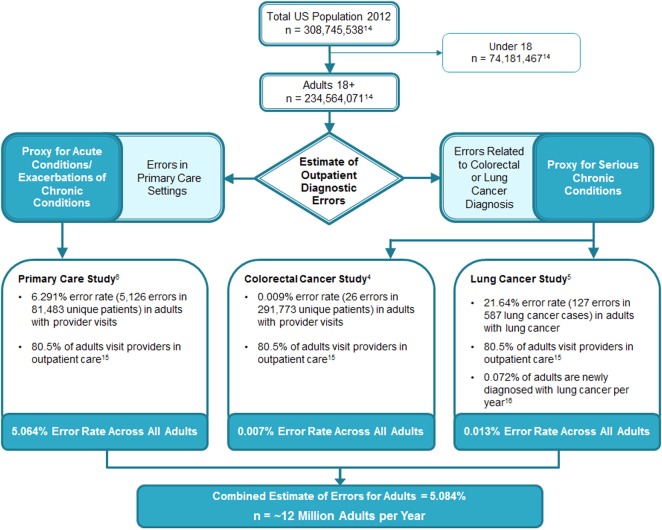
Background: The frequency of outpatient diagnostic errors is challenging to determine due to varying error definitions and the need to review data across multiple providers and care settings over time. We estimated the frequency of diagnostic errors in the US adult population by synthesising data from three previous studies of clinic-based populations that used conceptually similar definitions of diagnostic error. Methods: Data sources included two previous studies that used electronic triggers, or algorithms, to detect unusual patterns of return visits after an initial primary care visit or lack of follow-up of abnormal clinical findings related to colorectal cancer, both suggestive of diagnostic errors. A third study examined consecutive cases of lung cancer. In all three studies, diagnostic errors were confirmed through chart review and defined as missed opportunities to make a timely or correct diagnosis based on available evidence. We extrapolated the frequency of diagnostic error obtained from our studies to the US adult population, using the primary care study to estimate rates of diagnostic error for acute conditions (and exacerbations of existing conditions) and the two cancer studies to conservatively estimate rates of missed diagnosis of colorectal and lung cancer (as proxies for other serious chronic conditions). Results: Combining estimates from the three studies yielded a rate of outpatient diagnostic errors of 5.08%, or approximately 12 million US adults every year. Based upon previous work, we estimate that about half of these errors could potentially be harmful. Conclusions: Our population-based estimate suggests that diagnostic errors affect at least 1 in 20 US adults. This foundational evidence should encourage policymakers, healthcare organisations and researchers to start measuring and reducing diagnostic errors.
Overview
The claims and statistics of this paper haven’t been checked yet.
Free: it reads the open-access text and checks the first 5 claims that cite a source we can check. Create a free account to check every claim.
Integrity signals
Registry
Cites
Statistics
Figures
Verification
Claims the paper makes
The claims and statistics of this paper haven’t been checked yet.
Free: it reads the open-access text and checks the first 5 claims that cite a source we can check. Create a free account to check every claim.
Claims other papers make about this one
Each is checked against this paper’s own text: does it say what the citing paper says it does?
The source backs part of the claim, not all of it — or backs it for a different population, condition or comparison.
In the citing paper
“Approximately 5% of patients in U.S. outpatient settings suffer from diagnostic errors [8]”
From Toward Safer Diagnoses: A SEIPS-Based Narrative Review of Diagnostic Errors (2026) · cites this paper as [8]
Experimental — accuracy not yet measuredIn the citing paper
“The opportunity costs of not using our best available tools for disease detection and treatment are substantial-12 million people a year receive misdiagnoses in the United States, with about six million facing potential harm as a result. 17”
From Clinical applications of machine learning algorithms: beyond the black box (2019) · cites this paper as [17]
In the citing paper
“The opportunity costs of not using our best available tools for disease detection and treatment are substantial-12 million people a year receive misdiagnoses in the United States, with about six million facing potential harm as a result. 17”
From Clinical applications of machine learning algorithms: beyond the black box (2019) · cites this paper as [17]
Self-check
Percentages, sums and reported differences re-computed from the paper’s own numbers.
The self-check needs the paper’s full text.
Citations
Cites
Summary health statistics for U.S. adults: national health interview survey, 2012.
Blackwell, D. L., Lucas, J. W., & Clarke, T. C. (2014) · PubMed · Cited by 1,884
Incidence and Types of Adverse Events and Negligent Care in Utah and Colorado
Thomas, E. J., Studdert, D. M., Burstin, H. R., Orav, E. J., Zeena, T., Williams, E. J., Howard, K. M., Weiler, P. C., & Brennan, T. A. (2000) · Medical Care · doi:10.1097/00005650-200003000-00003 · Cited by 1,673
Self-citationClinical Reasoning in the Health Professions
Higgs, J., & Jones, M. A. (2000) · Cited by 920
Summary health statistics for U.S. adults: National Health Interview Survey, 2010.
Schiller, J. S., Lucas, J. W., Ward, B. W., & Peregoy, J. A. (2012) · PubMed · Cited by 760
Missed and delayed diagnoses in the ambulatory setting: a study of closed malpractice claims
Gandhi, T. K., Kachalia, A., Thomas, E. J., Puopolo, A. L., Yoon, C., Brennan, T. A., & Studdert, D. M. (2006) · Annals of Internal Medicine · doi:10.7326/0003-4819-145-7-200610030-00006 · Cited by 662 · cited 1×
“11 20 23 – 25 On the other hand, population-based studies have relied on medical record reviews, which are generally a gold standard for determining diagnostic error.”
BackgroundSelf-citationDiagnostic Error in Medicine: Analysis of 583 Physician-Reported Errors
Schiff, G. D. (2009) · Archives of Internal Medicine · doi:10.1001/archinternmed.2009.333 · Cited by 638 · cited 1×
“5 7 – 12 In many of these studies, lung cancer and CRC are the most common cancers for which diagnosis is delayed.”
BackgroundThe incidence of diagnostic error in medicine
Graber, M. L. (2013) · BMJ Quality & Safety · doi:10.1136/bmjqs-2012-001615 · Cited by 626
Types and Origins of Diagnostic Errors in Primary Care Settings
Singh, H., Giardina, T. D., Meyer, A. N. D., Forjuoh, S. N., Reis, M. D., & Thomas, E. J. (2013) · JAMA Internal Medicine · doi:10.1001/jamainternmed.2013.2777 · Cited by 559 · cited 2×
“Based on our previous work, 17 we estimated that about one-half of errors would have the potential to lead to severe harm.”
BackgroundSelf-citationMeasuring errors and adverse events in health care
Thomas, E. J., & Petersen, L. A. (2003) · Journal of General Internal Medicine · doi:10.1046/j.1525-1497.2003.20147.x · Cited by 455 · cited 1×
“11 20 23 – 25 On the other hand, population-based studies have relied on medical record reviews, which are generally a gold standard for determining diagnostic error.”
BackgroundSelf-citationThe Vanishing Nonforensic Autopsy
Shojania, K. G., & Burton, E. C. (2008) · New England Journal of Medicine · doi:10.1056/nejmp0707996 · Cited by 294
Cited by
Items 101–200 of 797
Schiff, G. D., & Shojania, K. G. (2021) · BMJ Quality & Safety · doi:10.1136/bmjqs-2021-014163 · Cited by 41
Bell, S. K., Bourgeois, F. C., Dong, J., Gillespie, A., Ngo, L. H., Reader, T. W., Thomas, E. J., & DesRoches, C. M. (2022) · Milbank Quarterly · doi:10.1111/1468-0009.12593 · Cited by 42
Self-citationDiagnostic Errors in Primary Care Pediatrics: Project RedDE
Rinke, M. L., Singh, H., Heo, M., Adelman, J. S., O’Donnell, H. C., Choi, S. J., Norton, A., Stein, R. E. K., Brady, T. M., Lehmann, C. U., et al. (2017) · Academic Pediatrics · doi:10.1016/j.acap.2017.08.005 · Cited by 41
“4 (2) American Indian/Alaska Native 0.”
Self-citationStrategies to Improve Bedside Clinical Skills Teaching
Garibaldi, B. T., & Russell, S. W. (2021) · CHEST Journal · doi:10.1016/j.chest.2021.06.055 · Cited by 40
Hong, G., Smith, M., & Lin, S. (2022) · JMIR Formative Research · doi:10.2196/37028 · Cited by 35
“Information gaps can lead to errors or delays in diagnosis and failures to address actionable risk factors, which affect an estimated 12 million Americans each year [3].”
BackgroundCrowe, B., Shah, S., Teng, D., Ma, S. P., DeCamp, M. W., Rosenberg, E. I., Rodriguez, J. A., Collins, B. X., Huber, K., Karches, K. E., et al. (2024) · Journal of General Internal Medicine · doi:10.1007/s11606-024-09102-0 · Cited by 39
“14 Better diagnostic supports would be a welcome contribution given that diagnostic harm affects nearly 5% of encounters for outpatients 15 and 0.7% of encounters for inpatients.”
InfluentialRoosan, D., Law, A. V., Karim, M., & Roosan, M. R. (2019) · JMIR Research Protocols · doi:10.2196/16047 · Cited by 39
“only when the team is discussing or communicating with each other regarding the patient case [34-40].”
BackgroundDeepUWF: An Automated Ultra-Wide-Field Fundus Screening System via Deep Learning
Zhang, W., Zhao, X., Chen, Y., Zhong, J., & Zhang, Y. (2020) · IEEE Journal of Biomedical and Health Informatics · doi:10.1109/jbhi.2020.3046771 · Cited by 39
Diagnostic Error in Stroke—Reasons and Proposed Solutions
Bakradze, E., & Liberman, A. L. (2018) · Current Atherosclerosis Reports · doi:10.1007/s11883-018-0712-3 · Cited by 41
Checklists to Prevent Diagnostic Errors: A Pilot Randomized Controlled Trial
Ely, J. W., & Graber, M. A. (2015) · Diagnosis · doi:10.1515/dx-2015-0008 · Cited by 37
“The incidence of diagnostic errors in emergency departments and primary care clinics is unknown but estimated to be 5%–10% [1, 2].”
BackgroundDiagnostic Decision-Making in the Emergency Department
Medford-Davis, L. N., Singh, H., & Mahajan, P. (2018) · Pediatric Clinics of North America · doi:10.1016/j.pcl.2018.07.003 · Cited by 37
Self-citationProvider Misinterpretation, Documentation, and Follow-Up of Definitive Urine Drug Testing Results
Chua, I. S., Petrides, A. K., Schiff, G. D., Ransohoff, J. R., Kantartjis, M., Streid, J. L., Demetriou, C. A., & Melanson, S. E. F. (2019) · Journal of General Internal Medicine · doi:10.1007/s11606-019-05514-5 · Cited by 37
“The prevalence of diagnostic error of opioid misuse and compliance is unknown, but diagnostic error in the ambulatory setting is estimated to occur in 5% of encounters.(37) We found that providers had the most inaccuracies interpreting aberrant results, which is not surprising given the complexity of the opioid metabo…”
BackgroundFraser, H., Cohan, G., Koehler, C., Anderson, J. S., Lawrence, A., Patena, J. V., Bacher, I., & Ranney, M. L. (2022) · JMIR mhealth and uhealth · doi:10.2196/38364 · Cited by 39
“Improving medical diagnosis is a high priority, with evidence that the average American will experience at least one important misdiagnosis in their lifetime and that 5% of outpatient diagnoses are incorrect [1].”
BackgroundSuzuki, R., Yajima, N., Sakurai, K., Oguro, N., Wakita, T., Thom, D. H., & Kurita, N. (2021) · Journal of General Internal Medicine · doi:10.1007/s11606-021-06950-y · Cited by 36
Kawamura, R., Harada, Y., Sugimoto, S., Nagase, Y., Katsukura, S., & Shimizu, T. (2022) · JMIR Medical Informatics · doi:10.2196/35225 · Cited by 37
“Third, diagnostic errors frequently occur in several settings of clinical practice; approximately 5% of patients can experience diagnostic errors in primary health care and hospital practice in the United States [13].”
Giardina, T. D., Hunte, H. E. R., Hill, M. A., Heimlich, S. L., Singh, H., & Smith, K. M. (2022) · Journal of Patient Safety · doi:10.1097/pts.0000000000000999 · Cited by 36
Self-citationAI Enabled Internet of Medical Things in Smart Healthcare
Jayachitra, S., Prasanth, A., Hariprasath, S., Begam, R. B., & Madiajagan, M. (2023) · Engineering cyber-physical systems and critical infrastructures · doi:10.1007/978-3-031-31952-5_7 · Cited by 36
Advancing Diagnostic Safety Research: Results of a Systematic Research Priority Setting Exercise
Zwaan, L., El-Kareh, R. E., Meyer, A. N. D., Hooftman, J., & Singh, H. (2021) · Journal of General Internal Medicine · doi:10.1007/s11606-020-06428-3 · Cited by 35
Self-citationUse of artificial intelligence in sports medicine: a report of 5 fictional cases
Rigamonti, L., Estel, K., Gehlen, T., Wolfarth, B., Lawrence, J. B., & Back, D. A. (2021) · BMC Sports Science Medicine and Rehabilitation · doi:10.1186/s13102-021-00243-x · Cited by 35
Diagnosis is a team sport – partnering with allied health professionals to reduce diagnostic errors
Thomas, D. B., & Newman‐Toker, D. E. (2016) · Diagnosis · doi:10.1515/dx-2016-0009 · Cited by 35
Posner-Schlossman syndrome in Wenzhou, China: a retrospective review study
Jiang, J., Zhang, S. D., Dai, M. L., Yang, J., Xie, Y. Q., Hu, C., Mao, G. Y., Lü, F., & Liang, Y. (2017) · British Journal of Ophthalmology · doi:10.1136/bjophthalmol-2016-309863 · Cited by 35
Lagha, R. R., Burningham, Z. R., Sauer, B. C., Leng, J., Peters, C. B., Huynh, T., Patel, S. A., Halwani, A. S., & Kramer, B. J. (2020) · Applied Clinical Informatics · doi:10.1055/s-0040-1714693 · Cited by 35
“32 While we cannot control how well a user documents or codes in the EHR, we can be more transparent about the source of our data and our de fi nitions of clinical concepts.”
Borrelli, E. P., Lucaci, J. D., Wilson, N., Taneja, A., Weiss, M., & Beer, I. (2025) · Medical Devices Evidence and Research · doi:10.2147/mder.s522534 · Cited by 35
A Separation‐Sensing Membrane Performing Precise Real‐Time Serum Analysis During Blood Drawing
Chu, Z., Zhang, W., You, Q., Yao, X., Liu, T., Liu, G., Zhang, G., Gu, X., Ma, Z., & Jin, W. (2020) · Angewandte Chemie International Edition · doi:10.1002/anie.202008241 · Cited by 34
A Nordic Perspective on Patient Online Record Access and the European Health Data Space
Hägglund, M., Kharko, A., Bärkås, A., Blease, C., Cajander, Å., DesRoches, C. M., Fagerlund, A. J., Hagström, J., Huvila, I., Hörhammer, I., et al. (2024) · Journal of Medical Internet Research · doi:10.2196/49084 · Cited by 34
“Between 1 in 20 and 1 in every 6 medical consultations results in missed, wrong, or delayed diagnoses [53].”
Cipparone, C. W., Withiam-Leitch, M. L., Kimminau, K. S., Fox, C. H., Singh, R. K. P. G., & Kahn, L. (2015) · The Journal of the American Board of Family Medicine · doi:10.3122/jabfm.2015.05.140136 · Cited by 34
Fernholm, R., Holzmann, M. J., Malm-Willadsen, K., Härenstam, K. P., Carlsson, A. C., Nilsson, G. H., & Wachtler, C. (2020) · Scandinavian Journal of Primary Health Care · doi:10.1080/02813432.2020.1717095 · Cited by 33
“The frequency of diagnostic errors in outpatient care has been estimated at 5% [6,10].”
BackgroundThe critical need for nursing education to address the diagnostic process
Gleason, K. T., Harkless, G., Stanley, J. M., Olson, A. P. J., & Graber, M. L. (2021) · Nursing Outlook · doi:10.1016/j.outlook.2020.12.005 · Cited by 34
Delayed Diagnoses in Children with Constipation: Multicenter Retrospective Cohort Study
Freedman, S. B., Rodean, J., Hall, M., Alpern, E. R., Aronson, P. L., Simon, H. K., Shah, S. S., Marín, J. R., Cohen, E., Morse, R. B., et al. (2017) · The Journal of Pediatrics · doi:10.1016/j.jpeds.2017.03.061 · Cited by 33
“Diagnostic errors, including inaccurate or delayed diagnoses,harm up to 12 million patients in the US each year.(11) Although major misdiagnoses are uncommon in children diagnosed with constipation in EDs (0.”
BackgroundRisk of misdiagnosis and delayed diagnosis with COVID-19: A Syndemic Approach
Muhrer, J. C. (2021) · The Nurse Practitioner · doi:10.1097/01.npr.0000731572.91985.98 · Cited by 32
“Estimates suggest that 12 million Americans or 1 in 20 adults suffer an error each year in primary care alone with 33% of these causing serious damage or death.(3) By Jill C.”
BackgroundHertzog, R., Johnson, J. D., Smith, J., McStay, F. W., da Graca, B., Haneke, T. W., Heavener, T. E., & Couchman, G. R. (2019) · Mayo Clinic Proceedings · doi:10.1016/j.mayocp.2019.02.011 · Cited by 33
Sharma, A. E., Yang, J., Rosario, J. B. D., Hoskote, M., Rivadeneira, N. A., & Sarkar, U. (2020) · The Joint Commission Journal on Quality and Patient Safety · doi:10.1016/j.jcjq.2020.08.010 · Cited by 32
Sharp, A. L., Baecker, A. S., Nassery, N., Park, S., Hassoon, A., Lee, M. S., Peterson, S., Pitts, S. I., Wang, Z., Zhu, Y., et al. (2020) · Diagnosis · doi:10.1515/dx-2020-0049 · Cited by 31
Mahajan, P., Mollen, C. J., Alpern, E. R., Baird-Cox, K., Boothman, R. C., Chamberlain, J. M., Cosby, K. S., Epstein, H. M., Gegenheimer-Holmes, J., Gerardi, M. J., et al. (2019) · Journal of Patient Safety · doi:10.1097/pts.0000000000000624 · Cited by 31
“Newer multifaceted approaches that account for the complexity of the ED-related diagnostic process are needed to advance understanding and for developing interventions.(2,16,17) To advance the research agenda in this area, we sought consensus from a multidisciplinary expert panel to create an operational definition an…”
BackgroundMethodSelf-citationRosen, M. A., Bertram, A. K., Tung, M. L., Desai, S. V., & Garibaldi, B. T. (2022) · JAMA Network Open · doi:10.1001/jamanetworkopen.2022.15885 · Cited by 32
Impact of Physician Payment Scheme on Diagnostic Effort and Testing
Adida, E., & Dai, T. (2023) · Management Science · doi:10.1287/mnsc.2023.4937 · Cited by 32
“Over the last few decades, cutaneous melanoma has become the third most frequently diagnosed cancer in the United States, but with little improvement in survival.”
BackgroundPreventing Genetic Testing Order Errors With a Laboratory Utilization Management Program
Mathias, P. C., Conta, J. H., Konnick, E. Q., Sternen, D. L., Stasi, S. M., Cole, B., Astion, M. L., & Dickerson, J. A. (2016) · American Journal of Clinical Pathology · doi:10.1093/ajcp/aqw105 · Cited by 31
Henriksen, K., Dymek, C., Harrison, M. I., Brady, P., & Arnold, S. B. (2017) · Diagnosis · doi:10.1515/dx-2017-0016 · Cited by 31
AI-driven Optimization in Healthcare: the Diagnostic Process
Lyon, J. Y., Bogodistov, Y., & Moormann, J. (2021) · European Journal of Management Issues · doi:10.15421/192121 · Cited by 30
Clinical Reasoning among Registered Nurses in Emergency Medical Services: A Case Study
Andersson, U., Hagiwara, M. A., Sundström, B. W., Andersson, H., & Söderholm, H. M. (2022) · Journal of Cognitive Engineering and Decision Making · doi:10.1177/15553434221097788 · Cited by 30
“This is crucial if we are to understand how CR can be supported, given its decisive impact on patient safety along the healthcare chain (Croskerry, 2017; Hagiwara et al., 2019; Singh et al., 2014).”
Diagnostic error and neuro-ophthalmology
Stunkel, L., Newman, N. J., & Biousse, V. (2019) · Current Opinion in Neurology · doi:10.1097/wco.0000000000000635 · Cited by 29
“Large study (n¼198 817) of strokes that were missed in the emergency department, which estimates the annual rate in the United States.”
InfluentialLiu, T., Tsang, W., Huang, F., Lau, O. Y., Chen, Y., Sheng, J., Guo, Y., Akinwunmi, B. O., Zhang, C. J. P., & Ming, W. (2021) · Journal of Medical Internet Research · doi:10.2196/22841 · Cited by 29
“According to a recent study, over 12 million patients in the United States have experienced one or more misdiagnoses, and the misdiagnosis rate is 5.08% [1].”
InfluentialCan decision support combat incompleteness and bias in routine primary care data?
Kostopoulou, O., Tracey, C., & Delaney, B. C. (2021) · Journal of the American Medical Informatics Association · doi:10.1093/jamia/ocab025 · Cited by 29
“One in 20 US outpatients are estimated to be affected by diagnostic error, which translates to about 12 million adults every year.(22) Primary care is considered a high-risk area for diagnostic error due to high patient volume, early and thus undifferentiated disease presentation, diagnosis unfolding over several epis…”
BackgroundMisdiagnosis in the Emergency Department: Time for a System Solution
Edlow, J. A., & Pronovost, P. J. (2023) · JAMA · doi:10.1001/jama.2023.0577 · Cited by 29
Diagnostic error in hospitals: finding forests not just the big trees
Zwaan, L., & Singh, H. (2020) · BMJ Quality & Safety · doi:10.1136/bmjqs-2020-011099 · Cited by 30
Self-citationClinical Criteria to Screen for Inpatient Diagnostic Errors: A Scoping Review
Shenvi, E. C., & El-Kareh, R. (2015) · Diagnosis · doi:10.1515/dx-2014-0047 · Cited by 28
“One in 20 US adults in the outpatient setting is estimated to be affected by a diagnostic error, [6] and about half of these errors are considered to be potentially harmful.”
Tracking Progress in Improving Diagnosis: A Framework for Defining Undesirable Diagnostic Events
Olson, A. P. J., Graber, M. L., & Singh, H. (2018) · Journal of General Internal Medicine · doi:10.1007/s11606-018-4304-2 · Cited by 28
Self-citationPatients’ Perspectives of Diagnostic Error: A Qualitative Study
Sacco, A. Y., Self, Q. R., Worswick, E., Couperus, C., Kolli, S. S., Munoz, S. A., Carney, J. K., & Repp, A. B. (2020) · Journal of Patient Safety · doi:10.1097/pts.0000000000000642 · Cited by 28
“(4) Communication between clinicians (1) “The situation is complicated.”
BackgroundInfluentialNovel three-way decision model in medical diagnosis based on inexact reasoning
Yin, L., Zhang, Q., Wu, C., & Qiong, M. (2023) · Engineering Applications of Artificial Intelligence · doi:10.1016/j.engappai.2023.107731 · Cited by 28
Ruedinger, E., Olson, M. E., Yee, J. Y., Borman-Shoap, E. C., & Olson, A. P. J. (2016) · American Journal of Medical Quality · doi:10.1177/1062860616681626 · Cited by 29
Diagnostic Error of Neuro-ophthalmologic Conditions: State of the Science
Stunkel, L. D., Newman‐Toker, D. E., Newman, N. J., & Biousse, V. (2020) · Journal of Neuro-Ophthalmology · doi:10.1097/wno.0000000000001031 · Cited by 28
“Correct diagnosis is a prerequisite for providing appropriate medical treatment, yet experts suggest that diagnostic errors may occur in 10%– 15% of all medical encounters in the United States, and an estimated 12 million Americans are affected by diagnostic error each year in outpatient settings alone (3).”
BackgroundPerry, M. F., Melvin, J. E., Kasick, R. T., Kersey, K. E., Scherzer, D. J., Kamboj, M. K., Gajarski, R. J., Noritz, G. H., Bode, R. S., Novak, K. J., et al. (2020) · The Journal of Pediatrics · doi:10.1016/j.jpeds.2020.11.065 · Cited by 28
Olson, A. P. J., Linzer, M., & Schiff, G. D. (2021) · Journal of General Internal Medicine · doi:10.1007/s11606-021-06611-0 · Cited by 28
Kostopoulou, O., Lionis, C. D., Angelaki, A., Ayis, S. A., Durbaba, S., & Delaney, B. C. (2015) · Family Practice · doi:10.1093/fampra/cmv012 · Cited by 27
Esmaeilzadeh, P. (2025) · BMC Medical Informatics and Decision Making · doi:10.1186/s12911-025-03182-6 · Cited by 26
“[56, 57], which is particularly concerning given that our cases were presented with complete information, unlike real clinical scenarios with incomplete or evolving data.”
Integrating strategies for improving diagnostic reasoning and error reduction
Nordick, C. L. (2020) · Journal of the American Association of Nurse Practitioners · doi:10.1097/jxx.0000000000000464 · Cited by 26
Määttä, J. H., Lindell, R., Hayward, N., Martikainen, S., Honkanen, K., Inkala, M., Hirvonen, P., & Martikainen, T. J. (2023) · JMIR Medical Informatics · doi:10.2196/46760 · Cited by 26
“Physicians have been estimated to have a 5% diagnostic error rate [9], with half of these errors being potentially harmful [10].”
Gleason, K. T., Peterson, S., Himmelfarb, C. D., Villanueva, M., Wynn, T., Bondal, P., Berg, D., Jerde, W., & Newman‐Toker, D. E. (2020) · Diagnosis · doi:10.1515/dx-2020-0014 · Cited by 27
Malpractice Claims of Internal Medicine Involving Diagnostic and System Errors in Japan
Watari, T. (2021) · Internal Medicine · doi:10.2169/internalmedicine.6652-20 · Cited by 26
“The most common initial diagnosis in medical trials was “no abnormality” (including misdiagnosis and delayed diagnosis) (9, 16, 18), followed by ischemic heart disease (9.”
BackgroundTip of the iceberg: patient safety incidents in primary care
Sarkar, U. (2015) · BMJ Quality & Safety · doi:10.1136/bmjqs-2015-005006 · Cited by 27
“21 22 The frequency of lasting harm in delayed or missed diagnoses adds to the concern about addressing this often-overlooked safety problem.”
BackgroundBourgeois, F. C., Fossa, A., Gerard, M., Davis, M. E., Taylor, Y. J., Connor, C. D., Vaden, T., McWilliams, A., Spencer, M. D., Folcarelli, P., et al. (2019) · Journal of the American Medical Informatics Association · doi:10.1093/jamia/ocz142 · Cited by 25
“Number of completed reports 780 402 258 Understood the note 734 (94) 363 (90) 215 (87) Understood the care plan 739 (95) 377 (94) 225 (92) Expected to follow the care plan 313 (98) 367 (97) N/A Potential documentation inaccuracy 193 (25) 139 (35) 66 (28) Yes 175 (22) 123 (30) 55(23) Not sure 18 (2) 16 (4) 11 (5) Conce…”
BackgroundError and cognitive bias in diagnostic radiology
Tee, Q. X., Nambiar, M., & STUCKEY, S. L. (2021) · Journal of Medical Imaging and Radiation Oncology · doi:10.1111/1754-9485.13320 · Cited by 25
“Three large observational studies suggest that a minimum of one in 20 adults are affected by diagnostic errors in their lifetime with up to 20% being affected by major errors that are clinically significant.(6,7) The rate of errors and the implication of those errors will in part reflect the risk profile of the practi…”
BackgroundA Feature Space-Restricted Attention Attack on Medical Deep Learning Systems
Wang, Z., Shu, X., Wang, Y., Feng, Y., Zhang, L., & Zhang, Y. (2022) · IEEE Transactions on Cybernetics · doi:10.1109/tcyb.2022.3209175 · Cited by 25
“Meanwhile, the generation of data in massive quantities is in contrast to the limited time and quantity of physicians, and these are from high-resolution medical imaging, genome sequencing, electronic medical records, and so on [4].”
BackgroundShankar, V., Yousefi, E., Manashty, A., Blair, D., & Teegapuram, D. (2023) · Artificial Intelligence in Medicine · doi:10.1016/j.artmed.2023.102507 · Cited by 25
Diagnostic delays among COVID‐19 patients with a second concurrent diagnosis
Freund, O., Azolai, L., Sror, N., Zeeman, I., Kozlovsky, T., Greenberg, S. A., Weiss, T. E., Bornstein, G., Tchebiner, J. Z., & Frydman, S. (2023) · Journal of Hospital Medicine · doi:10.1002/jhm.13063 · Cited by 25
Shanmugam, D., Hou, K., & Pierson, E. (2024) · npj Women s Health · doi:10.1038/s44294-024-00011-5 · Cited by 25
Increasing Physician Reporting of Diagnostic Learning Opportunities
Marshall, T. L., Ipsaro, A. J., Le, M., Sump, C., Darrell, H., Mapes, K. G., Bick, J., Ferris, S. A., Bolser, B., Simmons, J. M., et al. (2021) · PEDIATRICS · doi:10.1542/peds.2019-2400 · Cited by 25
Clinical decision-making in complex healthcare delivery systems
Miller, K., Singh, H., Arnold, R. C., & Klein, G. L. (2019) · Elsevier eBooks · doi:10.1016/b978-0-12-813467-2.00123-1 · Cited by 24
Self-citationIntroduction to Generative Artificial Intelligence: Contextualizing the Future
Singh, R., Kim, J. Y., Glassy, E. F., Dash, R. C., Brodsky, V., Seheult, J. N., de Baca, M. E., Gu, Q., Hoekstra, S., & Pritt, B. S. (2024) · Archives of Pathology & Laboratory Medicine · doi:10.5858/arpa.2024-0221-ra · Cited by 25
Using Fault Trees to Advance Understanding of Diagnostic Errors
Rogith, D., Iyengar, M. S., & Singh, H. (2017) · The Joint Commission Journal on Quality and Patient Safety · doi:10.1016/j.jcjq.2017.06.007 · Cited by 24
Self-citationPrevalence of atypical presentations among outpatients and associations with diagnostic error
Harada, Y., Otaka, Y., Katsukura, S., & Shimizu, T. (2023) · Diagnosis · doi:10.1515/dx-2023-0060 · Cited by 23
Harada, Y., Sakamoto, T., Sugimoto, S., & Shimizu, T. (2024) · JMIR Formative Research · doi:10.2196/53985 · Cited by 23
Achieving Value in Primary Care: The Primary Care Value Model
Rollow, W., & Cucchiara, P. (2016) · The Annals of Family Medicine · doi:10.1370/afm.1893 · Cited by 23
Diagnostic Challenges in Outpatient Stroke: Stroke Chameleons and Atypical Stroke Syndromes
Wallace, E., & Liberman, A. L. (2021) · Neuropsychiatric Disease and Treatment · doi:10.2147/ndt.s275750 · Cited by 24
“1% of primary care visits resulting in a misdiagnosis.(13) In a large study of medical malpractice claims from 1986 to 2010, of the nearly 100,000 US diagnostic error-related claims reviewed, significantly more occurred in the outpatient than inpatient setting (68.”
BackgroundSarkar, U., Simchowitz, B., Bonacum, D., Strull, W. M., López, A., Rotteau, L., & Shojania, K. G. (2014) · The Joint Commission Journal on Quality and Patient Safety · doi:10.1016/s1553-7250(14)40059-x · Cited by 22
The Dangers of Ignoring the Beers Criteria—The Prescribing Cascade
DeRhodes, K. (2019) · JAMA Internal Medicine · doi:10.1001/jamainternmed.2019.1288 · Cited by 22
Common Diseases in Clinical Cohorts — Not Always What They Seem
Rahimov, F., Jacobs, B. M., Lee, J. S., Mahi, N. A., Blumenfeld, A. M., Alsheikh, A. J., Abbasi, A., Reppell, M., Pivorunas, V. L., Sigurðsson, H. J., et al. (2025) · New England Journal of Medicine · doi:10.1056/nejmoa2405459 · Cited by 22
A Changing Environment: 2016 NCSBN Environmental Scan
(2016) · Journal of Nursing Regulation · doi:10.1016/s2155-8256(16)31007-9 · Cited by 21
Schwitzguébel, A., Jeckelmann, C., Gavinio, R., Levallois, C., Benaïm, C., & Spechbach, H. (2019) · JMIR Medical Informatics · doi:10.2196/14044 · Cited by 21
“A prevalence of diagnostic errors in outpatient care of at least 5% has been reported [7].”
BackgroundConvolutional Neural Networks for Medical Diagnosis from Admission NotesPreprint
Li, C. Y., Konomis, D., Neubig, G., Xie, P., Cheng, C. H. F., & Xing, E. P. (2017) · arXiv (Cornell University) · doi:10.48550/arxiv.1712.02768 · Cited by 21
“As reported by (Hardeep Singh, April 17, 2014), approximately 12 million adults are misdiagnosed in outpatient medical care, which amounts to 1 out of 20 adult patients.”
BackgroundAdvancing Diagnostic Equity Through Clinician Engagement, Community Partnerships, and Connected Care
Giardina, T. D., Woodard, L., & Singh, H. (2023) · Journal of General Internal Medicine · doi:10.1007/s11606-022-07966-8 · Cited by 21
Self-citationThe economics of diagnostic safety
Slawomirski, L., Kelly, D., de Bienassis, K., Kallas, K.-A., & Klazinga, N. (2025) · OECD Health Working Papers · doi:10.1787/fc61057a-en · Cited by 20
Herasevich, S., Soleimani, J., Huang, C., Pinevich, Y., Dong, Y., Pickering, B. W., Murad, M. H., & Barwise, A. K. (2023) · BMJ Quality & Safety · doi:10.1136/bmjqs-2022-015038 · Cited by 20
Misdiagnosis of Acute Appendicitis Cases in the Emergency Room
Mostafa, R., & El-Atawi, K. (2024) · Cureus · doi:10.7759/cureus.57141 · Cited by 20
“It is estimated that around 80% of these errors could be prevented [11], and nearly half of all diagnostic errors may harm patients [12].”
BackgroundIdentifying no-harm incidents in home healthcare: a cohort study using trigger tool methodology
Lindblad, M., Unbeck, M., Nilsson, L. M., Schildmeijer, K. G. I., & Ekstedt, M. (2020) · BMC Health Services Research · doi:10.1186/s12913-020-05139-z · Cited by 21
Quantum Computing for Healthcare: A ReviewPreprint
Rasool, R. U., Ahmad, H. F., Rafique, W., Qayyum, A., Qadir, J., & Anwar, Z. (2023) · doi:10.36227/techrxiv.17198702 · Cited by 20
Mykhailov, D. (2021) · Human Affairs · doi:10.1515/humaff-2021-0013 · Cited by 19
Changing the research paradigm for digital transformation in healthcare delivery
Regan, E. A. (2022) · Frontiers in Digital Health · doi:10.3389/fdgth.2022.911634 · Cited by 20
“According to estimates, up to one-third of healthcare spending in the US each year may be classified as waste that relates largely to failures of care delivery, care coordination, and overuse (10, 32, 33).”
Diagnostic Reasoning Outcomes in Nurse Practitioner Education: A Scoping Review
Griffith, P. B., Mariani, B. A., & Kelly, M. M. (2022) · Journal of Nursing Education · doi:10.3928/01484834-20220803-08 · Cited by 19
Miller, A. C., Cavanaugh, J. E., Arakkal, A. T., Koeneman, S., & Polgreen, P. M. (2023) · BMC Medical Informatics and Decision Making · doi:10.1186/s12911-023-02148-w · Cited by 19
“Yet, many opportunities to diagnose a disease occur in outpatient clinics,[14, 15] and patient care often occurs across a wide spectrum of disconnected facilities.”
BackgroundImplementation of Electronic Triggers to Identify Diagnostic Errors in Emergency Departments
Vaghani, V., Gupta, A., Mir, U., Wei, L., Murphy, D. R., Mushtaq, U., Sittig, D. F., Zimolzak, A. J., & Singh, H. (2024) · JAMA Internal Medicine · doi:10.1001/jamainternmed.2024.6214 · Cited by 20
Self-citationDevelopment and Evaluation of a GPT4-Based Orofacial Pain Clinical Decision Support System
Vueghs, C., Shakeri, H., Renton, T. F., & der Cruyssen, F. V. (2024) · Diagnostics · doi:10.3390/diagnostics14242835 · Cited by 19
Teaching and Assessing Critical Thinking and Clinical Reasoning Skills in Medical Education
Majumder, M. A. A., Sa, B., Alateeq, F. A., & Rahman, S. (2019) · Advances in higher education and professional development book series · doi:10.4018/978-1-5225-7829-1.ch012 · Cited by 19
Fernholm, R., Holzmann, M. J., Wachtler, C., Szulkin, R., Carlsson, A. C., & Härenstam, K. P. (2020) · BMC Family Practice · doi:10.1186/s12875-020-1087-4 · Cited by 18
Identifying trigger concepts to screen emergency department visits for diagnostic errors
Mahajan, P., Pai, C.-W., Cosby, K. S., Mollen, C. J., Shaw, K. N., Chamberlain, J. M., El-Kareh, R. E., Ruddy, R. M., Alpern, E. R., Epstein, H. M., et al. (2020) · Diagnosis · doi:10.1515/dx-2020-0122 · Cited by 19
Self-citationValidation of an electronic trigger to measure missed diagnosis of stroke in emergency departments
Vaghani, V., Wei, L., Mushtaq, U., Sittig, D. F., Bradford, A. M., & Singh, H. (2021) · Journal of the American Medical Informatics Association · doi:10.1093/jamia/ocab121 · Cited by 19
“The e-trigger had a higher PPV and interrater reliability to detect missed opportunities than e-triggers used in several previous studies on diagnostic errors.(1,45,63,76,77) Further refinement of diagnostic Table 4.”
BackgroundMethodSelf-citationImproving Efficiency in Medical Diagnosis
Agha, L., Skinner, J., & Chan, D. C. (2022) · JAMA · doi:10.1001/jama.2022.8587 · Cited by 19
Wiegand, A. A., Sheikh, T., Zannath, F., Trudeau, N. M., Dukhanin, V., & McDonald, K. M. (2023) · BMJ Quality & Safety · doi:10.1136/bmjqs-2022-015629 · Cited by 18
Mamede, S., Zandbergen, A. A. M., Filho, C., Choi, G., Goeijenbier, M., van Ginkel, J. R., Zwaan, L., PAAS, F. G. W. C., & Schmidt, H. G. (2024) · BMJ Quality & Safety · doi:10.1136/bmjqs-2023-016621 · Cited by 18
Payment Innovations To Improve Diagnostic Accuracy And Reduce Diagnostic Error
Berenson, R. A., & Singh, H. (2018) · Health Affairs · doi:10.1377/hlthaff.2018.0714 · Cited by 18
Self-citation
Metadata
- Authors
- Singh, H., Meyer, A. N. D., & Thomas, E. J.
- Affiliations
- Michael E. DeBakey VA Medical Center (US)
- Memorial Hermann (US)
- Corresponding author
- Singh, Hardeep
- Venue
- BMJ Quality & Safety
- Publisher
- BMJ
- Published
- 2014-04-17
- Volume
- 23
- Issue
- 9
- Pages
- 727-731
- ISSN
- 1475-3898 (ISSN-L)
- 2044-5415
- 2044-5423
- PMC
- PMC4145460
- OpenAlex
- W2154651644
- Cited by
- 677
- References
- 28
- Citations by year
- 2026: 61 · 2025: 67 · 2024: 70 · 2023: 77 · 2022: 75 · 2021: 89 · 2020: 68 · 2019: 41 · 2018: 34 · 2017: 32 · 2016: 26 · 2015: 26 · 2014: 8
- FWCI
- 31.48
- Type
- journal article
- Language
- en
- Open access
- hybrid
- doi.org
- Licence
- cc-by-nc
- Locations
- BMJ Quality & Safety (publishedVersion, cc-by-nc)
- PubMed Central (publishedVersion, cc-by-nc)
- PubMed (publishedVersion)
- HighWire Press Open Archive (submittedVersion)
- Funders
- National Institutes of Health (UL1TR000371, CIN13-413)
- Agency for Healthcare Research and Quality (R18HS017244, R18HS017820)
- Center for Innovations in Quality, Effectiveness and Safety (CIN 13–413, 13–413)
- National Cancer Institute (K23CA125585)
- National Center for Advancing Translational Sciences
- Topics
- Health Sciences › Medicine › Family Practice › Clinical Reasoning and Diagnostic Skills
- Health Sciences › Medicine › Public Health, Environmental and Occupational Health › Patient Safety and Medication Errors
- Health Sciences › Medicine › Family Practice › Primary Care and Health Outcomes
- Keywords
- diagnostic errors, outpatient care, missed diagnosis, primary care, return visits, colorectal cancer, lung cancer
- MeSH terms
- Adult, Ambulatory Care, Diagnostic Errors, Humans, Lung Neoplasms, United States, Colorectal Neoplasms
About these checks
Registry, retraction, Cites and statistics results are computed, not judged, with one exception: a printed reference that no index lists is read once by a model before it counts as a citation error. Claims are extracted by a model and kept only when their quote appears verbatim in the text; each cited source is then checked, with a model’s help, for whether it says what the claim relies on. Those verdicts can be wrong — read the claim’s quote and the cited source before relying on one.
Statistics and arithmetic are recomputed, not judged.
Confidence bands are shown only for fields calibrated on our annotated test set. None is calibrated yet, so no band is shown.
What counts as a claim ›How we measure confidence ›How we check this ›
Are you an author, or do you see a problem with this page? Request a review
Data sources
Bibliographic data: Semantic Scholar, OpenAlex, Crossref.
Contains information from the Semantic Scholar Academic Graph Datasets, made available under the ODC Attribution License (ODC-BY 1.0).
Semantic Scholar’s data is described in: Kinney, R., et al. (2023). The Semantic Scholar Open Data Platform. arXiv:2301.10140.
