

The frequency of diagnostic errors in outpatient care: estimations from three large observational studies involving US adult populations
Open accessThe DOI matches its Crossref record; 28 of the 28 references it cites were found in a registry or an index.
Abstract
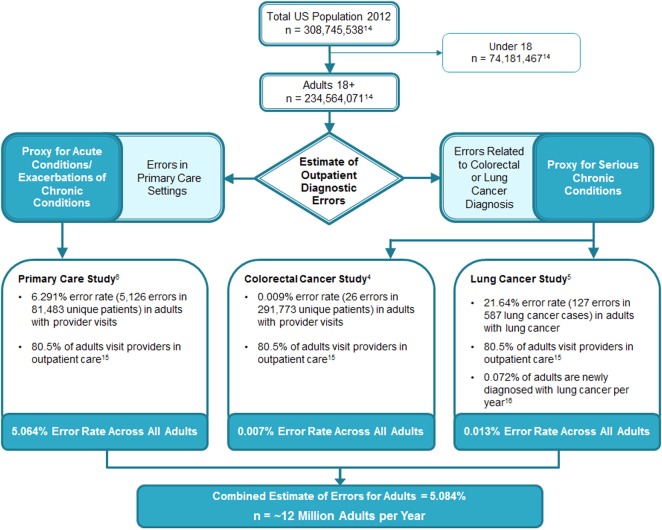
Background: The frequency of outpatient diagnostic errors is challenging to determine due to varying error definitions and the need to review data across multiple providers and care settings over time. We estimated the frequency of diagnostic errors in the US adult population by synthesising data from three previous studies of clinic-based populations that used conceptually similar definitions of diagnostic error. Methods: Data sources included two previous studies that used electronic triggers, or algorithms, to detect unusual patterns of return visits after an initial primary care visit or lack of follow-up of abnormal clinical findings related to colorectal cancer, both suggestive of diagnostic errors. A third study examined consecutive cases of lung cancer. In all three studies, diagnostic errors were confirmed through chart review and defined as missed opportunities to make a timely or correct diagnosis based on available evidence. We extrapolated the frequency of diagnostic error obtained from our studies to the US adult population, using the primary care study to estimate rates of diagnostic error for acute conditions (and exacerbations of existing conditions) and the two cancer studies to conservatively estimate rates of missed diagnosis of colorectal and lung cancer (as proxies for other serious chronic conditions). Results: Combining estimates from the three studies yielded a rate of outpatient diagnostic errors of 5.08%, or approximately 12 million US adults every year. Based upon previous work, we estimate that about half of these errors could potentially be harmful. Conclusions: Our population-based estimate suggests that diagnostic errors affect at least 1 in 20 US adults. This foundational evidence should encourage policymakers, healthcare organisations and researchers to start measuring and reducing diagnostic errors.
Overview
The claims and statistics of this paper haven’t been checked yet.
Free: it reads the open-access text and checks the first 5 claims that cite a source we can check. Create a free account to check every claim.
Integrity signals
Registry
Cites
Statistics
Figures
Verification
Claims the paper makes
The claims and statistics of this paper haven’t been checked yet.
Free: it reads the open-access text and checks the first 5 claims that cite a source we can check. Create a free account to check every claim.
Claims other papers make about this one
Each is checked against this paper’s own text: does it say what the citing paper says it does?
The source backs part of the claim, not all of it — or backs it for a different population, condition or comparison.
In the citing paper
“Approximately 5% of patients in U.S. outpatient settings suffer from diagnostic errors [8]”
From Toward Safer Diagnoses: A SEIPS-Based Narrative Review of Diagnostic Errors (2026) · cites this paper as [8]
Experimental — accuracy not yet measuredIn the citing paper
“The opportunity costs of not using our best available tools for disease detection and treatment are substantial-12 million people a year receive misdiagnoses in the United States, with about six million facing potential harm as a result. 17”
From Clinical applications of machine learning algorithms: beyond the black box (2019) · cites this paper as [17]
In the citing paper
“The opportunity costs of not using our best available tools for disease detection and treatment are substantial-12 million people a year receive misdiagnoses in the United States, with about six million facing potential harm as a result. 17”
From Clinical applications of machine learning algorithms: beyond the black box (2019) · cites this paper as [17]
Self-check
Percentages, sums and reported differences re-computed from the paper’s own numbers.
The self-check needs the paper’s full text.
Citations
Cites
Summary health statistics for U.S. adults: national health interview survey, 2012.
Blackwell, D. L., Lucas, J. W., & Clarke, T. C. (2014) · PubMed · Cited by 1,884
Incidence and Types of Adverse Events and Negligent Care in Utah and Colorado
Thomas, E. J., Studdert, D. M., Burstin, H. R., Orav, E. J., Zeena, T., Williams, E. J., Howard, K. M., Weiler, P. C., & Brennan, T. A. (2000) · Medical Care · doi:10.1097/00005650-200003000-00003 · Cited by 1,673
Self-citationClinical Reasoning in the Health Professions
Higgs, J., & Jones, M. A. (2000) · Cited by 920
Summary health statistics for U.S. adults: National Health Interview Survey, 2010.
Schiller, J. S., Lucas, J. W., Ward, B. W., & Peregoy, J. A. (2012) · PubMed · Cited by 760
Missed and delayed diagnoses in the ambulatory setting: a study of closed malpractice claims
Gandhi, T. K., Kachalia, A., Thomas, E. J., Puopolo, A. L., Yoon, C., Brennan, T. A., & Studdert, D. M. (2006) · Annals of Internal Medicine · doi:10.7326/0003-4819-145-7-200610030-00006 · Cited by 662 · cited 1×
“11 20 23 – 25 On the other hand, population-based studies have relied on medical record reviews, which are generally a gold standard for determining diagnostic error.”
BackgroundSelf-citationDiagnostic Error in Medicine: Analysis of 583 Physician-Reported Errors
Schiff, G. D. (2009) · Archives of Internal Medicine · doi:10.1001/archinternmed.2009.333 · Cited by 638 · cited 1×
“5 7 – 12 In many of these studies, lung cancer and CRC are the most common cancers for which diagnosis is delayed.”
BackgroundThe incidence of diagnostic error in medicine
Graber, M. L. (2013) · BMJ Quality & Safety · doi:10.1136/bmjqs-2012-001615 · Cited by 626
Types and Origins of Diagnostic Errors in Primary Care Settings
Singh, H., Giardina, T. D., Meyer, A. N. D., Forjuoh, S. N., Reis, M. D., & Thomas, E. J. (2013) · JAMA Internal Medicine · doi:10.1001/jamainternmed.2013.2777 · Cited by 559 · cited 2×
“Based on our previous work, 17 we estimated that about one-half of errors would have the potential to lead to severe harm.”
BackgroundSelf-citationMeasuring errors and adverse events in health care
Thomas, E. J., & Petersen, L. A. (2003) · Journal of General Internal Medicine · doi:10.1046/j.1525-1497.2003.20147.x · Cited by 455 · cited 1×
“11 20 23 – 25 On the other hand, population-based studies have relied on medical record reviews, which are generally a gold standard for determining diagnostic error.”
BackgroundSelf-citationThe Vanishing Nonforensic Autopsy
Shojania, K. G., & Burton, E. C. (2008) · New England Journal of Medicine · doi:10.1056/nejmp0707996 · Cited by 294
Cited by
Items 701–797 of 797
Rogers, C. (2021) · Seton Hall University eRepository (Seton Hall University)
Andersson, U. (2023) · DiVA - University of Borås (Högskolan i Borås)
Effective Primary Healthcare Differential Diagnosis: A Machine Learning Approach
Agba, O. (2020) · Research Repository (Delft University of Technology)
Investigation of a Data and Knowledge Driven System for Sequential Diagnosis
Xue, D. (2023) · D-Scholarship@Pitt (University of Pittsburgh)
Fernández‐Aguilar, C. (2021) · Institutional Repository of the University of Granada (University of Granada)
Система підтримки прийняття лікарських рішень для лікування хворих з підтвердженим випадком COVID-19
Черниш, К. (2022) · Електронний архів наукових та освітніх матеріалів КПІ ім. Ігоря Сікорського (КПІ ім. Ігоря Сікорського)
Affect and error: A qualitative study of affective processes when things go wrong in radiotherapy.
Jenkins, P. (2024) · ORCA Online Research @Cardiff (Cardiff University)
Wang, F., & Wang, H. (2025) · Open Journal of Medical Imaging · doi:10.4236/ojmi.2025.153012
Alshammri, S. N. N., Al-Malq, A. S. A., Alshammari, Z. O. H., Alanazi, M. F. H., Shammari, S. N. A., Almuhawwis, K. S., Alshammari, M. A., Enazi, H. A. A., & Alnazhah, S. A. (2024) · Saudi Journal of Medicine and Public Health · doi:10.64483/202412239
Fischer, M. E., Schmidt‐Graf, F., & München, T. U. (2025)
Cardiovascular risk prediction using machine learning
Soler Trias, À. (2025) · UPCommons institutional repository (Universitat Politècnica de Catalunya)
Best Practices for Diagnostic Excellence in Primary Care
Harada, Y., Watanuki, S., Aoki, T., Ito, M., Iyasu, A., Uehara, T., Ishimaru, H., Ashino, A., & Yamaguchi, A. (2025) · An Official Journal of the Japan Primary Care Association · doi:10.14442/generalist.48.141
Formal analysis of machine learning-based systems using colored petri nets.
SILVEIRA, A. C. M. D. (2024) · LA Referencia (Red Federada de Repositorios Institucionales de Publicaciones Científicas)
ケアを実践するための医療者の倫理 : 終末期医療における患者と医療者の対話に着目して
田淵, 綾. (2025) · Institutional Repositories DataBase (IRDB)
Moraes, S. C., Damião, E. T., Fernandes, B. H. R., & Santin, A. O. (2024) · LA Referencia (Red Federada de Repositorios Institucionales de Publicaciones Científicas)
A scoping review of crowdsourcing and collective intelligence in oral healthcare
Mariño, R. J., Ganhewa, M., Lau, A., von Marttens, R., & Cirillo, N. (2026) · BMC Oral Health · doi:10.1186/s12903-026-07670-7
“On the other hand, if the team members are too similar and therefore their collective skill base is narrow, different perspectives may not be considered even if a deliberative approach is undertaken [4].”
Alenizi, S. F., Al-Mutairi, F. Z. E., Alabsi, A. A. O., Alotaibi, Y. S. W., Almarzoghi, A. G., Shehatah, A. A., Aldossari, J. B. A., Zaylaee, N. Y. A., Alotaibi, R. A. T., Alruweaili, T. R. M., et al. (2024) · Saudi Journal of Medicine and Public Health · doi:10.64483/202412566
EVALUASI NILAI SIGMA PADA ALAT KIMIA KLINIK MENGGUNAKAN KONTROL KUALITAS PEMERIKSAAN ASAM URAT
Hadziqoh, N., & Hafizh, A. (2025) · Biomedical and Environmental Health Technology · doi:10.35328/c185fb47
Alshammry, A. D. M., Oraybi, M. M. A., Oaribi, T. H. T., Arishi, A. M. B. M., Arabi, H. T. M., Mohor, M. A. H., Alqarni, S. M., Almashali, D. M. A., Albaqshi, M. A., Mangahi, F. M. M., et al. (2024) · Saudi Journal of Medicine and Public Health · doi:10.64483/202412598
Guo, X. H., Zhou, R. H. F. L., Feng, P., Liu, Y., Qi, Y., Yang, T., & Cu, B. (2025) · IEEE International Conference on Bioinformatics and Biomedicine (BIBM) · doi:10.1109/bibm66473.2025.11357089
The Future of Patient and Family Engagement in Quality and Patient Safety
(2026) · Frontiers research topics · doi:10.3389/978-2-8325-7457-7
Enhanced medical diagnostic reasoning in small language models using reinforcement learning
Gebreab, S. A., Musamih, A., Salah, K., & Jayaraman, R. (2026) · International Journal of Cognitive Computing in Engineering · doi:10.1016/j.ijcce.2026.02.002
Sağlık Yönetiminde Güncel Konular
SEYHAN, F., Hatipler, Ç., Ekinci, G., Danayiyen, A., Çalışal, S., Altın, U., Dönmez, B., Altan, F., Aksoy, M. R., Alu, A., et al. (2026) · Akademisyen Kitabevi eBooks · doi:10.37609/akya.3999
Tayebi, L., Shetty, S. P., & Imani, S. (2026) · Springer eBooks · doi:10.1007/978-3-032-15977-9_2
Treacher, A., Moran, B., Case, M., Oliver, G., Miff, S., Adejumobi, O., & Karam, A. (2026) · NEJM Catalyst · doi:10.1056/cat.25.0401
Barazarte, J. N. A., Enseñat, J. C., Peralta, N. C., Ramirez, B. S. M., Arteaga, J. D. G., Tafur, E. A. G., Vargas, L. D. A., & Ocampo, F. J. R. (2026) · IECCMEXICO · doi:10.64784/131
Gleason, K. T., McDonald, K. M., Grob, R., Yuan, C. T., Dhingra, I., Warne, E., & Schlesinger, M. J. (2026) · Medical Care · doi:10.1097/mlr.0000000000002302
Nursing in the mirror of artificial intelligence: driving a new era of research
Cañadas-Aragón, C. P. (2026) · Enfermería Clínica (English Edition) · doi:10.1016/j.enfcle.2026.502414
Hassoon, A., Hussain, S., Galiatsatos, P., Lehmann, H. P., McDonald, K. M., Berg, C. D., & Brawley, O. W. (2026) · Diagnosis · doi:10.1515/dx-2025-0074
“Although diagnostic uncertainties and delays in lung cancer diagnosis are recognized problem a ff ecting patient outcomes and treatment e ffi cacy [4, 5, 7], there is a growing body of research aimed at understanding and mitigating these issues in clinical practice.”
Nardone, D. A. (2026) · Journal of General Internal Medicine · doi:10.1007/s11606-025-10138-z
“For adult outpatients, the error rate was 5%, with approximately twelve million individuals affected each 33 Behçet Disease (Rare/Zebra) 5.2 per 100,000 (Up-to-Date) Positive HLA B51 Dysuria and Scrotal Ulcer year 44 .”
InfluentialMartinroche, G. (2024) · theses.fr (ABES) · doi:10.70675/7aeee875z2286z46d5z98e4z51e699b8b387
KaiMed: A Hybrid Multi-Agent AI Platform for Clinical Reasoning and Cross-Specialty Discovery
Barbato, F., Sorichetti, F., Ielo, E., & Megliola, L. (2026) · Communications in computer and information science · doi:10.1007/978-3-032-16708-8_5
Park, E. H., Lloyd, A., Min, S. Y., Choi, D., & Replogle, K. J. (2026) · Applied Sciences · doi:10.3390/app16094404
Decreasing Hemoglobin A1c: Progress or Pathology?
Gehlbach, D. L., Arnold, C. L., & Moreno, G. (2026) · Cureus · doi:10.7759/cureus.108194
“Outpatient care poses challenges, and diagnostic errors are not unique to trainees, with an estimated diagnostic error rate of around 5% per year, affecting approximately 12 million US adults [11].”
Professional Burnout in Contemporary Health Systems Through the Lens of Electronic Health
Balaska, D., Karaferis, D. C., Konstantakopoulou, D., & Pollalis, Y. (2026) · International Journal of Medical Science and Clinical Research Studies · doi:10.47191/ijmscrs/v6-i5-21
Patient-Centered Care: Strengthening Trust and Communication in Healthcare Relationships
(2026) · Frontiers research topics · doi:10.3389/978-2-8325-7910-7
The Popeye signs: A case study in the pitfalls of medical eponyms
Mathis, S., & Masson, G. L. (2026) · The American Journal of Medicine · doi:10.1016/j.amjmed.2026.05.046
Faheem, S., Qasim, R., & Zaidi, S. J. A. (2026) · BMC Health Services Research · doi:10.1186/s12913-026-14918-z
Das, S., Tripathy, D., & Ponnu, P. (2026) · Cureus · doi:10.7759/cureus.110769
“…estimated that approximately 12 million US adults are affected annually in outpatient care, defined as missed opportunities to make a timely or correct diagnosis based on available evidence [39], and that the framework provides a population-level accounting structure for these error types.”
横瀬, 允. (2023) · Institutional Repositories DataBase (IRDB)
Cusácovich, I., Martin, M. P., & Castro, R. G. (2026) · JMIR Formative Research · doi:10.2196/104579
“Diagnostic accuracy in primary care is critical, yet missed, delayed, or incorrect diagnoses remain common in ambulatory care and contribute to avoidable morbidity, fragmented follow-up, and increased health care costs [1,2].”
Mao, Y., Mao, Z., Dai, L., & Han, J. (2026) · Results in Engineering · doi:10.1016/j.rineng.2026.111549
Impact of clinical reasoning and diagnostic error education for nurses
Kobayashi, A., Miyagami, T., Nishizaki, Y., Sanbe, K., Kushiro, S., & Naito, T. (2026) · Diagnosis · doi:10.1515/dx-2026-0053
“In the United States, diagnostic errors are estimated to occur in 10 – 15 % of patients [1], and approximately 5 % of adult patients experience diagnostic mistakes annually in outpatient settings [2].”
Tran, L. (2026) · Digital Access to Scholarship at Harvard (DASH) (Harvard University)
Nguyen, T. H., Nguyen, H. A., Thi, Y.-V. T., Nguyen, H. T., Cao, A., Do, Q. L., Bui, T. T., Duc, T. C., & Cao, H. (2026) · Biotechnology Journal · doi:10.1002/biot.70274 · Cited by 1
“More than half of these mistakes resulted in severe harm being inflicted on the patient [279, 280].”
Ghozlan, H. H., Baker, M., Abdo, N., Mistareehi, A. J., Ma'adat, L., Alnajjar, D., Alqtami, H. A., Albaoull, S., AL-Radaideh, S., Abu-Zaitoun, E., et al. (2026) · BMC Health Services Research · doi:10.1186/s12913-026-15053-5
“Physicians in low-risk settings may still work under conditions associated with diagnostic uncertainty, high patient volume, and limited access to specialist support [40–44].”
Artificial Intelligence in the Prehospital Stage of Stroke: Can Virtual Assistants Optimize Triage?
Alessandro, L., Crema, S., Bianciotti, N., Lombán, J., Arana, C. P., Orsingher, F. B., Kañevsky, A. L., Lereis, V. P., Slezak, D. F., & Farez, M. (2026) · The Neurologist · doi:10.1097/nrl.0000000000000682
Li, J., Huang, S., Qiu, Y., Chen, W., Zhang, Y., Zhao, X., Qu, G., Bu, Y., Feng, X., Xu, J., et al. (2026) · JMIR Metascience and Research Integrity · doi:10.2196/preprints.105947
Bigelow, L., Foresman, G., Selden, E. B., Spaar, P. A., Kathuria, Y., Lotfibagha, P., Gallagher, W., Miller, K., & Capan, M. (2026) · doi:10.2196/preprints.106041
Gupta, Y. K. (2026) · Diagnosis · doi:10.1515/dx-2026-0086 · Cited by 1
Hamilton, E., She, A., & Jenney, F. E. (2026) · Digital Commons - PCOM (Philadelphia College of Osteopathic Medicine)
Aljohani, M. A. (2026) · Frontiers in Medicine · doi:10.3389/fmed.2026.1813990
“The rate of misdiagnosis reported in many studies has not changed significantly over the years despite advances in discovery (3).”
Clinical Validation of the ZaiDoc™ AI Digital Health Platform: A Real-World Study
Edris, M. M. (2026) · International Research Journal of Multidisciplinary Scope · doi:10.47857/irjms.2026.v07i03.012310
Matin, R., Meyer, A. N. D., Singh, H., Olson, A. P. J., Cook, D. A., & Zwaan, L. (2026) · Diagnosis · doi:10.1515/dx-2026-0018
“Conservative estimates suggest at least 5 % of all US adults experience a diagnostic error in any given year [7], causing substantial harm to patients [8 – 10] and burden to health care systems [11].”
Self-citationMulheres e meninas na Ciência: publicações pesquisa para Elas 2025
Reis, A. V. D., & da Silva, G. B. (2026) · Wissen Editora eBooks · doi:10.52832/wed.210
Bigge, S. (2026) · Cureus · doi:10.7759/cureus.113832
“One analysis estimated that approximately 5% of US adults experience a diagnostic error in outpatient care each year [14].”
Noël, V. (2021) · Knowledge UdeS (Institutional Deposit of the University of Sherbrooke)
Naswir, N., Maileni, D. A., Bhakti, R. T. A., & Hutasoit, I. (2026) · Jurnal Ragam Pengabdian · doi:10.62710/bfg5f351
Cifra, C. L., Melton, K., Walsh, K. E., Lipstein, E. A., Khan, A., Chien, A. T., Rasooly, I. R., Marshall, T. L., Brady, P. W., Ahmed, S., et al. (2026) · BMJ Quality & Safety · doi:10.1136/bmjqs-2026-020175
Rosner, B. I., Hammer, M., Tabacco, A., Adler‐Milstein, J., & Ranji, S. R. (2026) · Diagnosis · doi:10.1515/dx-2026-0112
“Diagnostic errors a ff ect an estimated 12 million adults annually in the United States ambulatory care setting alone, with approximately half of these errors carrying the potential for harm [1].”
Methods to measure clinicians’ diagnostic calibration: an appraisal for real world application
Bradford, A., Shahid, U., Cholankeril, R. T., Astik, G. J., Olson, A. P. J., Singh, H., & Meyer, A. N. D. (2026) · Diagnosis · doi:10.1515/dx-2026-0039
“Diagnostic errors including missed, delayed, and wrong diagnoses, pose serious risks to patient safety [1, 2] and have been attributed to over 10 % of healthcare expenditures [3].”
Self-citation地域病院における診断エラーの現状とそれに関連する要因-後ろ向きコホート-
Fujimori, T. (2026) · Institutional Repositories DataBase (IRDB)
Unsupervised Discovery of Care-Path Clusters Indicative of Missed Diagnoses in EHRs
Neeralgimath, K., Kulkarni, P., Saqib, M., Deshpande, L. K., & Nandkuma, K. A. (2026) · Lecture notes in networks and systems · doi:10.1007/978-3-032-27711-4_34
Uncertain Pretest Probabilities in Diagnostic Reasoning: The Prevalence Threshold as a Tipping Point
Nadler, M., & Balayla, J. (2026) · Journal of Evaluation in Clinical Practice · doi:10.1111/jep.70582
Dong, Z., Huang, G., Geng, L., Zhang, R., 袁声贤, Xia, Y., & Liu, H. (2026) · Research Square · doi:10.21203/rs.3.rs-10750173/v1
Elango, D. J., & Mani, A. P. (2026) · Genetics and Molecular Research · doi:10.4238/3z5h3b51
What Not to Miss or Misdiagnose on Abdominal and Pelvic Imaging
Bagga, B., Karajgikar, J., Rambhia, S. H., Virk, M. S., Narang, M., & Berkovich, G. Y. (2026) · Radiologic Clinics of North America · doi:10.1016/j.rcl.2026.08.007
Teddy, K., & Ayebanengimote, V. (2026) · American Journal of Health Research · doi:10.11648/j.ajhr.20261405.11
Warpudkar, D., Sandeep, & Jain, Y. (2026) · International Journal of Engineering Development and Research · doi:10.56975/ijedr.v14i3.309426
Castano-Villegas, N., Barrientos, K. M., Villa, M. C., Gómez, O. I. Q., Velásquez, L., & Zea, J. (2026) · medRxiv · doi:10.64898/2026.09.23.26363806
Streiffer, C., Press, M. J., Bishop, N. S., Schmid, B. E., Sliwa, A., Vyas, A. L., Ungar, L., Peifer, M. K., & Weissman, G. E. (2026) · Journal of the American Medical Informatics Association · doi:10.1093/jamia/ocag132
Usability and Acceptability of a Symptom Checker App by Patients Seeking Urgent Care
Fraser, H., Bacher, I., Khatri, I. S., Raman, S., Nagle, D., Crossland, D., Madsen, T., & Hilliard, R. (2026) · Applied Clinical Informatics · doi:10.1055/a-2962-9261
“Multiple-Choice Questions 1.”
Presentation patterns for initial incorrect diagnosis in diagnostic errors
Harada, Y., Kunitomo, K., Amano, M., Hiraga, M., Ishizuka, K., Isoda, S., Komatsu, M., Sakamoto, T., Wada, Y., Aita, T., et al. (2026) · Diagnosis · doi:10.1515/dx-2026-0120
“Diagnostic errors are among the most important patient safety issues worldwide [1], and internal medicine is among the highest-risk fi elds due to its broad spectrum of diseases and clinical presentations [2 – 4].”
Nadir Hassan Dagriri, B. R. A., Altalhi, B. R., Alyami, H. J., Alabssi, H. A., Gazwani, S. S., Alsharif, A. H., Mohammed, A. A., & Alzahrani, M. A. M. (2025) · The Review of Diabetic Studies · doi:10.70082/23qzns05
Alrithi, Y. S. (2025) · The Review of Diabetic Studies · doi:10.70082/vn34ry09
Rashid Musad Almalki, Y. S. H. A., & Mohammed Saleh Abdullah Sawwan, N. S. A. (2025) · The Review of Diabetic Studies · doi:10.70082/wd0tmv27
Diagnostic Errors and Patient Safety in Surgery at the Gabriel Toure University Hospital
Konaté, M., Ganmenon, M., Traore, A., Diarra, B., Sissoko, M., Wida, L., Dourra, M., Diarra, A., Nouhoeflin, J., Cissé, A., et al. (2026) · SAS Journal of Medicine · doi:10.36347/sasjm.2026.v12i10.001
Pasangulapati, S. (2021) · Journal for ReAttach Therapy and Developmental Diversities
A Comparative Study On Medical Errors In Hospitals Related To Integration
Dorle, D. S., Chaudhary, B., Jani, K. G., Saini, B., & Sharma, D. S. (2024) · Educational Administration Theory and Practice journal
Saad Fahad Saad Alqahtani, M. N. A., Alajmi, M. N., Alansari, M. A., Otudi, A. S. I., Alshehri, R. A., Jahlan, E. M., Otudi, G. S. I., Alahmari, A. A., Hamdan, A. E. A. A. A., & Alenezi, F. S. (2025) · Cultura · doi:10.5281/zenodo.24014322
Missed specialty consultation and hospital admission in 72-hour emergency department return visits
Ertekin, A., Soyugüzel, M., & Rakip, U. (2026) · Annals of Saudi Medicine · doi:10.5144/0256-4947.2026.339
Metacognition-related education in medical residency: a scoping reviewPreprint
Yepes, A., Barrios, D. D., & Gomez, L. A. (2026) · Research Square · doi:10.21203/rs.3.rs-10217839/v1
Ahluwalia, P. S. (2026) · International Journal of Healthcare and Hospital Management Studies
The Super Intelligence Paradigm in Clinical Diagnosis: Methodological and Ethical Challenges
Ahluwalia, P. S. (2026) · International Journal of Healthcare and Hospital Management Studies
ARTIFICIAL INTELLIGENCE DRIVEN DIAGNOSIS IN HEALTHCARE
Singh, D. P., & Singh, D. (2026) · INTERANTIONAL JOURNAL OF SCIENTIFIC RESEARCH IN ENGINEERING AND MANAGEMENT · doi:10.55041/ijsrem68044
Sánchez, J. D. (2026) · Frontiers in Digital Health · doi:10.3389/fdgth.2026.1949323
Diagnostische Fehler von Ärzten in der Inneren Medizin
Frey, J. (2026) · Elektronische Hochschulschriften der LMU München (Ludwig-Maximilians-Universität München) · doi:10.5282/edoc.37823
Oloko-Oba, M., Esenogho, E., Aruleba, K., & Cameron, M. (2026) · AI · doi:10.3390/ai7110439
Shinde, A. (2026) · Journal of Evaluation in Clinical Practice · doi:10.1111/jep.70701
Sawesi, S., Dolezel, D. M., Soltana, M. I., Presingu, P., Rashrash, B. M.-E., & Adamczak, A. (2026) · International Medical Education · doi:10.3390/ime5040115
Qu, Y., Hill, M. A., Tabaie, A., Ni, K., Kazi, S., Giardina, T. D., Haskell, H. W., Miller, K., & Smith, K. M. (2026) · JMIR AI · doi:10.2196/98901
Wang, Y., Lin, Z., Liu, J., Zhang, T., & 汪南玥 (2026) · arXiv (Cornell University) · doi:10.48550/arxiv.2610.40663
“Diagnostic error is among the most consequential threats to patient safety: an estimated 5.08% of US adult outpatients experience one each year [1], and misdiagnosis-related serious harms reach about 795,000 disabilities or deaths annually [2].”
InfluentialThe Trust Inversion: Why Patients Are Embracing AI Alongside Their Doctors
Mate, K. S., & Sheridan, S. E. (2026) · Journal of Patient Experience · doi:10.1177/23743735261481152
Draganović, Š. (2026) · Journal of Healthcare Leadership · doi:10.2147/jhl.s637714
Metadata
- Authors
- Singh, H., Meyer, A. N. D., & Thomas, E. J.
- Affiliations
- Michael E. DeBakey VA Medical Center (US)
- Memorial Hermann (US)
- Corresponding author
- Singh, Hardeep
- Venue
- BMJ Quality & Safety
- Publisher
- BMJ
- Published
- 2014-04-17
- Volume
- 23
- Issue
- 9
- Pages
- 727-731
- ISSN
- 1475-3898 (ISSN-L)
- 2044-5415
- 2044-5423
- PMC
- PMC4145460
- OpenAlex
- W2154651644
- Cited by
- 677
- References
- 28
- Citations by year
- 2026: 61 · 2025: 67 · 2024: 70 · 2023: 77 · 2022: 75 · 2021: 89 · 2020: 68 · 2019: 41 · 2018: 34 · 2017: 32 · 2016: 26 · 2015: 26 · 2014: 8
- FWCI
- 31.48
- Type
- journal article
- Language
- en
- Open access
- hybrid
- doi.org
- Licence
- cc-by-nc
- Locations
- BMJ Quality & Safety (publishedVersion, cc-by-nc)
- PubMed Central (publishedVersion, cc-by-nc)
- PubMed (publishedVersion)
- HighWire Press Open Archive (submittedVersion)
- Funders
- National Institutes of Health (UL1TR000371, CIN13-413)
- Agency for Healthcare Research and Quality (R18HS017244, R18HS017820)
- Center for Innovations in Quality, Effectiveness and Safety (CIN 13–413, 13–413)
- National Cancer Institute (K23CA125585)
- National Center for Advancing Translational Sciences
- Topics
- Health Sciences › Medicine › Family Practice › Clinical Reasoning and Diagnostic Skills
- Health Sciences › Medicine › Public Health, Environmental and Occupational Health › Patient Safety and Medication Errors
- Health Sciences › Medicine › Family Practice › Primary Care and Health Outcomes
- Keywords
- diagnostic errors, outpatient care, missed diagnosis, primary care, return visits, colorectal cancer, lung cancer
- MeSH terms
- Adult, Ambulatory Care, Diagnostic Errors, Humans, Lung Neoplasms, United States, Colorectal Neoplasms
About these checks
Registry, retraction, Cites and statistics results are computed, not judged, with one exception: a printed reference that no index lists is read once by a model before it counts as a citation error. Claims are extracted by a model and kept only when their quote appears verbatim in the text; each cited source is then checked, with a model’s help, for whether it says what the claim relies on. Those verdicts can be wrong — read the claim’s quote and the cited source before relying on one.
Statistics and arithmetic are recomputed, not judged.
Confidence bands are shown only for fields calibrated on our annotated test set. None is calibrated yet, so no band is shown.
What counts as a claim ›How we measure confidence ›How we check this ›
Are you an author, or do you see a problem with this page? Request a review
Data sources
Bibliographic data: Semantic Scholar, OpenAlex, Crossref.
Contains information from the Semantic Scholar Academic Graph Datasets, made available under the ODC Attribution License (ODC-BY 1.0).
Semantic Scholar’s data is described in: Kinney, R., et al. (2023). The Semantic Scholar Open Data Platform. arXiv:2301.10140.
