

The frequency of diagnostic errors in outpatient care: estimations from three large observational studies involving US adult populations
Open accessThe DOI matches its Crossref record; 28 of the 28 references it cites were found in a registry or an index.
Abstract
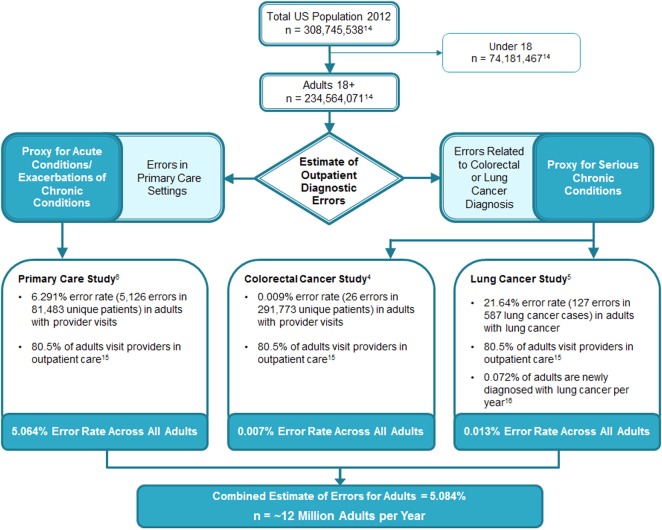
Background: The frequency of outpatient diagnostic errors is challenging to determine due to varying error definitions and the need to review data across multiple providers and care settings over time. We estimated the frequency of diagnostic errors in the US adult population by synthesising data from three previous studies of clinic-based populations that used conceptually similar definitions of diagnostic error. Methods: Data sources included two previous studies that used electronic triggers, or algorithms, to detect unusual patterns of return visits after an initial primary care visit or lack of follow-up of abnormal clinical findings related to colorectal cancer, both suggestive of diagnostic errors. A third study examined consecutive cases of lung cancer. In all three studies, diagnostic errors were confirmed through chart review and defined as missed opportunities to make a timely or correct diagnosis based on available evidence. We extrapolated the frequency of diagnostic error obtained from our studies to the US adult population, using the primary care study to estimate rates of diagnostic error for acute conditions (and exacerbations of existing conditions) and the two cancer studies to conservatively estimate rates of missed diagnosis of colorectal and lung cancer (as proxies for other serious chronic conditions). Results: Combining estimates from the three studies yielded a rate of outpatient diagnostic errors of 5.08%, or approximately 12 million US adults every year. Based upon previous work, we estimate that about half of these errors could potentially be harmful. Conclusions: Our population-based estimate suggests that diagnostic errors affect at least 1 in 20 US adults. This foundational evidence should encourage policymakers, healthcare organisations and researchers to start measuring and reducing diagnostic errors.
Overview
The claims and statistics of this paper haven’t been checked yet.
Free: it reads the open-access text and checks the first 5 claims that cite a source we can check. Create a free account to check every claim.
Integrity signals
Registry
Cites
Statistics
Figures
Verification
Claims the paper makes
The claims and statistics of this paper haven’t been checked yet.
Free: it reads the open-access text and checks the first 5 claims that cite a source we can check. Create a free account to check every claim.
Claims other papers make about this one
Each is checked against this paper’s own text: does it say what the citing paper says it does?
The source backs part of the claim, not all of it — or backs it for a different population, condition or comparison.
In the citing paper
“Approximately 5% of patients in U.S. outpatient settings suffer from diagnostic errors [8]”
From Toward Safer Diagnoses: A SEIPS-Based Narrative Review of Diagnostic Errors (2026) · cites this paper as [8]
Experimental — accuracy not yet measuredIn the citing paper
“The opportunity costs of not using our best available tools for disease detection and treatment are substantial-12 million people a year receive misdiagnoses in the United States, with about six million facing potential harm as a result. 17”
From Clinical applications of machine learning algorithms: beyond the black box (2019) · cites this paper as [17]
In the citing paper
“The opportunity costs of not using our best available tools for disease detection and treatment are substantial-12 million people a year receive misdiagnoses in the United States, with about six million facing potential harm as a result. 17”
From Clinical applications of machine learning algorithms: beyond the black box (2019) · cites this paper as [17]
Self-check
Percentages, sums and reported differences re-computed from the paper’s own numbers.
The self-check needs the paper’s full text.
Citations
Cites
Summary health statistics for U.S. adults: national health interview survey, 2012.
Blackwell, D. L., Lucas, J. W., & Clarke, T. C. (2014) · PubMed · Cited by 1,884
Incidence and Types of Adverse Events and Negligent Care in Utah and Colorado
Thomas, E. J., Studdert, D. M., Burstin, H. R., Orav, E. J., Zeena, T., Williams, E. J., Howard, K. M., Weiler, P. C., & Brennan, T. A. (2000) · Medical Care · doi:10.1097/00005650-200003000-00003 · Cited by 1,673
Self-citationClinical Reasoning in the Health Professions
Higgs, J., & Jones, M. A. (2000) · Cited by 920
Summary health statistics for U.S. adults: National Health Interview Survey, 2010.
Schiller, J. S., Lucas, J. W., Ward, B. W., & Peregoy, J. A. (2012) · PubMed · Cited by 760
Missed and delayed diagnoses in the ambulatory setting: a study of closed malpractice claims
Gandhi, T. K., Kachalia, A., Thomas, E. J., Puopolo, A. L., Yoon, C., Brennan, T. A., & Studdert, D. M. (2006) · Annals of Internal Medicine · doi:10.7326/0003-4819-145-7-200610030-00006 · Cited by 662 · cited 1×
“11 20 23 – 25 On the other hand, population-based studies have relied on medical record reviews, which are generally a gold standard for determining diagnostic error.”
BackgroundSelf-citationDiagnostic Error in Medicine: Analysis of 583 Physician-Reported Errors
Schiff, G. D. (2009) · Archives of Internal Medicine · doi:10.1001/archinternmed.2009.333 · Cited by 638 · cited 1×
“5 7 – 12 In many of these studies, lung cancer and CRC are the most common cancers for which diagnosis is delayed.”
BackgroundThe incidence of diagnostic error in medicine
Graber, M. L. (2013) · BMJ Quality & Safety · doi:10.1136/bmjqs-2012-001615 · Cited by 626
Types and Origins of Diagnostic Errors in Primary Care Settings
Singh, H., Giardina, T. D., Meyer, A. N. D., Forjuoh, S. N., Reis, M. D., & Thomas, E. J. (2013) · JAMA Internal Medicine · doi:10.1001/jamainternmed.2013.2777 · Cited by 559 · cited 2×
“Based on our previous work, 17 we estimated that about one-half of errors would have the potential to lead to severe harm.”
BackgroundSelf-citationMeasuring errors and adverse events in health care
Thomas, E. J., & Petersen, L. A. (2003) · Journal of General Internal Medicine · doi:10.1046/j.1525-1497.2003.20147.x · Cited by 455 · cited 1×
“11 20 23 – 25 On the other hand, population-based studies have relied on medical record reviews, which are generally a gold standard for determining diagnostic error.”
BackgroundSelf-citationThe Vanishing Nonforensic Autopsy
Shojania, K. G., & Burton, E. C. (2008) · New England Journal of Medicine · doi:10.1056/nejmp0707996 · Cited by 294
Cited by
Items 501–600 of 797
Tran, A., Blackall, L. M., Hill, M. A., & Gallagher, W. J. (2025) · Frontiers in Health Services · doi:10.3389/frhs.2024.1474195 · Cited by 2
Diagnostic Expertise in the Emergency Department
Newsome, E., Klein, G. A., Hoy, K., Eisenberg, E. M., Perry, S. J., Osei, P., Peterson, S., & Gürses, A. P. (2025) · Journal of Cognitive Engineering and Decision Making · doi:10.1177/15553434251335732 · Cited by 2
“Another estimate indicated that the overall rate of diagnostic error in US-based outpatient settings may be as high as 1 in 20 adults each year, though only approximately half of these errors were considered harmful to patients (Singh et al., 2014).”
Avoiding Clinical Errors With Bedside Echocardiography: A Randomized Clinical Study
Moayedi, Y., Posada, J. D., Nesbitt, G. C., Ross, H. J., Bell, C. M., Dorian, P., & Sibbald, M. (2017) · Canadian Journal of Cardiology · doi:10.1016/j.cjca.2017.10.018 · Cited by 2
Key concepts for improving primary care diagnosis in Japan: Diagnostic error in primary health care
Watari, T. (2018) · Journal of General and Family Medicine · doi:10.1002/jgf2.228 · Cited by 2
Coats, T., Bean, D. M., Vatopoulou, T., Dhanapal, V., El‐Bashir, R., Panopoulou, A., Wood, H., Wimalachandra, M., Coppell, J., Medd, P. G., et al. (2021) · eJHaem · doi:10.1002/jha2.182 · Cited by 2
“Poor documentation may lead on to inefficiencies of clinical service, incorrect treatment strategies and poor quality of data for local and national audit [4].”
BackgroundResponsabilità professionale nei laboratori medici in rete
Pradella, M. (2018) · La Rivista Italiana della Medicina di Laboratorio - Italian Journal of Laboratory Medicine · doi:10.1007/s13631-018-0186-x · Cited by 2
Improving patient safety culture through low cost innovation
Flott, K., Gage, W., Batey, M., Redhead, J., & Darzi, A. W. (2018) · Journal of Surgical Simulation · doi:10.1102/2051-7726.2018.a005 · Cited by 2
Building an Ambulatory Safety Program at an Academic Health System
Desai, S. P., Fiumara, K., & Kachalia, A. B. (2019) · Journal of Patient Safety · doi:10.1097/pts.0000000000000594 · Cited by 2
“adults, or 12 million individuals, are affected by diagnostic error in the outpatient setting each year.(25) These ambulatory safety risks are often underpinned by failures in communication and teamwork, lack of patient engagement in the care delivery process, and a lack of infrastructure to support safer care through…”
Systems and Causal Loop Thinking in Medicine: From Healthcare Delivery to Healthcare Policy Making
Theocharopoulos, C. (2020) · Acta Europeana Systemica · doi:10.14428/aes.v8i1.56513 · Cited by 2
Lububu, S., & Kabaso, B. (2023) · International Conference on Artificial Intelligence, Big Data, Computing and Data Communication Systems (icABCD) · doi:10.1109/icabcd59051.2023.10220551 · Cited by 2
Learning Concept Credible Models for Mitigating Shortcuts.
Wang, J., Jabbour, S., Makar, M., Sjoding, M. W., & Wiens, J. (2022) · PubMed · Cited by 2
Eubank, B., Martyn, J., Schneider, G. M., McMorland, G., Lackey, S. W., Zhao, X. R., Slomp, M., Werle, J. R., Robert, J., & Thomas, K. C. (2024) · Journal of Evidence-Based Medicine · doi:10.1111/jebm.12582 · Cited by 2
Deciphering Medical Errors: What Matters for Patients on Social Media
Nasralah, T., Wahbeh, A., El-Gayar, O., & Lee, Y. W. (2023) · Hawaii International Conference on System Sciences (HICSS) · doi:10.24251/hicss.2023.416 · Cited by 2
“…limited to lack of diagnostic testing ( Zhang et al., 2016), healthcare professional inexperience and/or overconfidence (K. McDonald et al., 2013), fragmentation of care (Laugaland et al., 2011), lack of time with patients (Walsh et al., 2018), and lack of or delayed follow up (Singh et al., 2014).”
Harnessing robot experimentation to optimise the regulatory framing of emerging robot technologies
Calleja, C., Drukarch, H., & Fosch‐Villaronga, E. (2021) · Zenodo (CERN European Organization for Nuclear Research) · doi:10.5281/zenodo.5211109 · Cited by 11
Diagnostic Error in Japan : Call for papers!
Tokuda, Y. (2015) · Journal of General and Family Medicine · doi:10.14442/jgfm.16.4_227 · Cited by 2
Reconciling patient safety and liability : lessons from a just culture
Oosthuizen, W. T. (2017) · UpSpace Institutional Repository (University of Pretoria) · Cited by 2
Applications of images anomalies detection using deep learning in department store
Banstola, R. (2020) · Jyväskylä University Digital Archive (University of Jyväskylä) · Cited by 2
Júnior, A. J. D. L. (2021) · Digital Library of Theses and Dissertations (Universidade de São Paulo) · doi:10.11606/t.22.2021.tde-24082021-142538 · Cited by 2
Donaldson, L. (2016) · Oxford University Press eBooks · doi:10.1093/obo/9780199756797-0186 · Cited by 2
Okutoyi, L., Godia, P., Adam, M. B., Sitati, F. C., & Jaoko, W. G. (2024) · medRxiv · doi:10.1101/2024.05.21.24307687 · Cited by 2
“Medical error reporting systems, while essential for patient safety, often present incomplete pictures of incidents due to the timing of reporting and the inherent limitations of individual clinical judgment [3, 11].”
BackgroundDirect-to-consumer telemedicine: navigating the implications for quality and safety of care
Neves, A. L. (2024) · BMJ Quality & Safety · doi:10.1136/bmjqs-2024-017374 · Cited by 2
Deng, J., Peng, W., Lu, Q., Wang, Z., Fu, Q., Zhou, X., Cai, Y., Mu, Y., Pan, T., Liu, Z., et al. (2023) · Research Square · doi:10.21203/rs.3.rs-2913988/v1 · Cited by 2
Aslan, Y. (2019) · Dspace Repository (Marmara Üniversitesi) · Cited by 2
Toward Automated Detection of Documentation Inconsistencies in Electronic Health RecordsPreprint
Lu, J., Chen, P., Treggiari, M., Blessing, R., Zhuo, D., Weng, C., Stead, W. W., & Zhang, A. R. (2026) · arXiv (Cornell University) · doi:10.48550/arxiv.2607.22954 · Cited by 2
“[10] Error of documentation is a widely recognized safety risk and can lead to inappropriate or delayed care.”
Ülgü, M. M., & Birinci, Ş. (2023) · Ankara Medical Journal · doi:10.5505/amj.2023.47887 · Cited by 1
Zhou, Q. X., He, H., Li, Q., Estill, J. A. M., Luo, Z., Yang, K., Tang, J., & Chen, Y. (2024) · Journal of Evidence-Based Medicine · doi:10.1111/jebm.12624 · Cited by 1
“5,6 Moreover, findings from a survey on thyroid cancer in China indicate that approximately 80% of thyroid cancer cases are overdiagnoses.”
BackgroundMahmudah, N. A., Im, D., & Ock, M. (2024) · Journal of Patient Safety · doi:10.1097/pts.0000000000001256 · Cited by 1
Inteligencia artificial como herramienta de prevención de errores en la atención clínica
Cañadas-Aragón, C. P., & Orjuela, A. A. G. (2024) · Enfermería Clínica · doi:10.1016/j.enfcli.2024.09.001 · Cited by 1
What Matters Most: an Age-Friendly approach to pathology and laboratory medicine
Nelson, M. B., & Coffey, C. R. (2025) · Clinical Chemistry and Laboratory Medicine (CCLM) · doi:10.1515/cclm-2025-0616 · Cited by 1
From the “Doctor’s Doctor” to the Patient’s Partner: Redefining Pathology Reporting
Cardona, D. M., & Skau, C. T. (2025) · Archives of Pathology & Laboratory Medicine · doi:10.5858/arpa.2025-0132-ed · Cited by 1
Olson, A. P. J., Sloane, J., Zimolzak, A. J., Kaul, B., Vaghani, V., Matin, R., Cholankeril, R. T., & Singh, H. (2025) · Diagnosis · doi:10.1515/dx-2025-0034 · Cited by 1
“Diagnostic errors a ff ect at least 5 % of outpatients annually in the U.S. [2], with similarly high rates of errors in inpatients [3].”
Self-citationChronic maxillary sinusitis masquerading as a maxillary sinus neoplasm: A case report
Oh, J.-H., Kim, S., & Kim, S. (2025) · Experimental and Therapeutic Medicine · doi:10.3892/etm.2025.13011 · Cited by 1
“In general diagnostic practice, the prevalence of misdiagnosis has been reported to range from 5 to 15%, highlighting the importance of coordinated clinicopathologic and radiologic evaluation to ensure appropriate management (16,17).”
Annan, G., Mills-Annoh, A., Persad, D., Orji, O., & Osmanu, I. (2025) · Cureus · doi:10.7759/cureus.99533 · Cited by 1
“Diagnostic errors remain a significant contributor to patient harm, with estimates suggesting they affect 5-25% of patients [11,12].”
Kunitomo, K., Harada, Y., Suzuki, T., Ishizuka, K., Nishizawa, T., Kawamura, R., Miyagami, T., Harada, T., Watanuki, S., Shimizu, T., et al. (2026) · Diagnosis · doi:10.1515/dx-2026-0015 · Cited by 1
“Evidence indicates that diagnostic errors occur in approximately 5 % of adult outpatients [2], 0.7 % of inpatients [3], and 5.7 % of patients in emergency departments [4].”
InfluentialRisk Factors Associated with Delayed Breast Cancer Diagnoses: What Are We Missing?
Kufer, K. S., Wellis, L. K., Harris, A., Short, M. I., Bharthuar, A., Gunturi, A., Pennacchio, J. P., LeClair, A. M., Buchsbaum, R. J., & Weingart, S. N. (2026) · Journal of General Internal Medicine · doi:10.1007/s11606-026-10566-5 · Cited by 1
Bigge, S. (2026) · Cureus · doi:10.7759/cureus.112563 · Cited by 1
“Outpatient diagnostic error has been estimated to affect a substantial number of patients in US primary care and is recognized as a major patient safety concern [39].”
Mtonga, T. M. (2020) · D-Scholarship@Pitt (University of Pittsburgh) · Cited by 1
Marcin, T., Lüthi, A., Graf, R., Krummrey, G., Schauber, S. K., Breakey, N., Hautz, W. E., & Hautz, S. C. (2023) · Diagnosis · doi:10.1515/dx-2023-0047 · Cited by 1
The Role of Artificial Intelligence in Medicine Applications
Betti, A. A. (2023) · Journal of Al-Qadisiyah for Computer Science and Mathematics · doi:10.29304/jqcm.2023.15.1.1163 · Cited by 1
“6%-17% of medical accidents in hospitals are the result of misdiagnosis [3,2,40].”
InfluentialImpact of checklists on inpatient safety: A review of recent literature
Wani, M. S., Kaur, A., Chew, A., & Alobaidi, H. A. (2023) · International journal of applied research · doi:10.22271/allresearch.2023.v9.i11a.11336 · Cited by 1
FIT-graph: A multi-grained evolutionary graph based framework for disease diagnosis
Liu, Z., Cao, Q., Du, N., Shu, H., Zhong, E., Jiang, N., Chen, Q., Shen, Y., & Chen, K. (2023) · Artificial Intelligence in Medicine · doi:10.1016/j.artmed.2023.102735 · Cited by 1
Patient Safety: Modern Challenges and Means of Ensuring in the Medical Field
Manea, M., Pisarenco, S., Martiniuc, C., Pisarenco, C., & Nicolaev, V. (2024) · Bulletin of the Academy of Sciences of Moldova Medical Sciences · doi:10.52692/1857-0011.2023.3-77.32 · Cited by 1
Influence of child structure and means of eldercare on equitable distribution of family assets
Chen, Y., & Ji, H. (2024) · PLoS ONE · doi:10.1371/journal.pone.0312921 · Cited by 1
Future Trends in Artificial Intelligence for Medical Applications
Chaudhuri, T., & Ghosh, J. (2025) · Advances in medical diagnosis, treatment, and care (AMDTC) book series · doi:10.4018/979-8-3693-9816-6.ch020 · Cited by 1
Zare, M. E., Kansestani, A. N., Meshkani, R., Vaidyanathan, K., Qi, C., Dai, G., Zhao, F., An, R., & Zhang, J. (2025) · Clinica Chimica Acta · doi:10.1016/j.cca.2025.120407 · Cited by 1
Performance of pulmonary physical exam skills by internal medicine interns
Chou, S. Y., Liu, Y., Bertram, A. K., Stein, A. A., Niessen, T. M., Murphy, E. M., & Garibaldi, B. T. (2025) · Diagnosis · doi:10.1515/dx-2025-0118 · Cited by 1
“This decline in PE skills is an important source of diagnostic error [6, 7], threatens the doctor-patient relationship and contributes to a loss of professional ful fi llment [8].”
Mohammaddokht, S., Azami-Aghdash, S., Rezapour, R., Abdolahi, H. M., Jeddi, A., & Tabrizi, J. S. (2025) · Journal of Patient Safety · doi:10.1097/pts.0000000000001418 · Cited by 1
Wang, L., Cheng, S., Liu, Y., Yang, L., Wang, G., Meng, Y., & Ji, M. (2026) · EAI Endorsed Transactions on Pervasive Health and Technology · doi:10.4108/eetpht.11.11667 · Cited by 1
“Diagnostic error creates a heavy burden on healthcare, and L. Wang et al. poor description of symptoms is a key determinant of clinical decision-making [6].”
Luty, J. T., Corby, S., Jungbauer, R. M., Syrowatka, A., Mohan, V., Krevat, S. A., Ratwani, R. M., Bates, D. W., & Gold, J. A. (2026) · Journal of General Internal Medicine · doi:10.1007/s11606-026-10483-7 · Cited by 1
Guan, G. Y., Fu, Y., & Wang, Y. (2026) · BMC Medical Education · doi:10.1186/s12909-026-09404-3 · Cited by 1
“Diagnostic error remains a major contributor to preventable patient harm worldwide and has been recognized as a central challenge in healthcare quality and patient safety [3, 4].”
A Framework to Characterize the Costs of Delayed Diagnoses
Berdahl, C. T., Hero, J. M., McCleskey, S. G., Baiocchi, D., Marsolais, E. B., Yang, D. A., Schiff, G. D., Kern‐Goldberger, A. R., & Ahluwalia, S. C. (2026) · The Joint Commission Journal on Quality and Patient Safety · doi:10.1016/j.jcjq.2026.06.005 · Cited by 1
Pohlkamp, C., & Haferlach, T. (2026) · EClinicalMedicine · doi:10.1016/j.eclinm.2026.104184 · Cited by 1
“20 The US National Academies subsequently concluded that most people will experience at least one diagnostic error in their lifetime, framing diagnostic safety as a major public health challenge.”
Lubin, I. M., Lockhart, E. R., Frank, J., See, V. Y., Vashist, S., & Greene, C. L. (2019) · Diagnosis · doi:10.1515/dx-2019-0018 · Cited by 1
“Introduction A 2015 National Academies report, Improving Diagnosis in Healthcare, reported that as many as 5% of US adults receiving outpatient healthcare experience a diagnostic error [1, 2].”
BackgroundPetscavage-Thomas, J. M., Beatty-Chadha, J., Chetlen, A. L., Artrip, R., Welkie, J. M., & Neutze, J. A. (2021) · Academic Radiology · doi:10.1016/j.acra.2020.12.027 · Cited by 1
Raju, B., Jumah, F., Nagaraj, A., & Nanda, A. (2022) · Springer eBooks · doi:10.1007/978-3-031-02078-0_7 · Cited by 1
Brady, P. W., Ruddy, R. M., Ehrhardt, J., Corathers, S. D., Kirkendall, E. S., & Walsh, K. E. (2024) · Diagnosis · doi:10.1515/dx-2023-0166 · Cited by 1
Otaka, Y., Harada, Y., Katsukura, S., & Shimizu, T. (2024) · Diagnosis · doi:10.1515/dx-2024-0041 · Cited by 1
van Sassen, C., van den Broek, W. W., Bindels, P., & Zwaan, L. (2025) · Perspectives on Medical Education · doi:10.5334/pme.1730 · Cited by 1
Feasibility of Pediatric Diagnostic Quality Measurement in All United States Hospitals
Michelson, K., & Grubenhoff, J. A. (2025) · Annals of Emergency Medicine · doi:10.1016/j.annemergmed.2025.07.035 · Cited by 1
Zagar, R. J., Zagar, A. K., Busch, K. G., Garbarino, J., Ferrari, T., Hughes, J. R., Patzer, G. L., Kovach, J. W., Grove, W. M., Tippins, S., et al. (2016) · Review of European Studies · doi:10.5539/res.v8n1p212 · Cited by 1
Developing the PC PMOS, a Primary-Care Patient Measure Of Safety
Hernan, A. L. (2015) · ANU Open Research (Australian National University) · Cited by 1
Sosa, E. A., Montes, M. E. D., & Beltrán, L. P. P. (2020) · Revista CIFE Lecturas de Economía Social · doi:10.15332/22484914.6134 · Cited by 1
Artificial Intelligence beyond Chess: Opportunities for Medicine, Public Health, and Social Medicine
Ak, B. (2021) · Journal of Comprehensive Health · doi:10.53553/jch.v08i01.002 · Cited by 1
“A review revealed more than 12 million medical errors in US yearly among outpatients.[9]”
BackgroundQuality in the Vascular Laboratory
Costanza, M. J., Lilly, A., & Lilly, M. P. (2021) · Springer eBooks · doi:10.1007/978-3-030-49616-6_3-1 · Cited by 1
Misdiagnosis of Sexually Transmitted Diseases in Hong Kong Outpatient Private Healthcare
Lau, A., & Ho, D. W. (2023) · Open Journal of Medical Microbiology · doi:10.4236/ojmm.2023.131003 · Cited by 1
Towards a Classical-Quantum Platform for Pharmacogenetic Simulations
Alvarado‐Valiente, J., Romero‐Álvarez, J., Moguel, E., García-Alonso, J. M., & Murillo, J. M. (2023) · Lecture notes in bioengineering · doi:10.1007/978-3-031-29067-1_20 · Cited by 1
Hashing-based Undersampling for Large Scale Histopathology Image Classification
Tian, X., Qiu, L., Li, Q., Ng, W. W. Y., Zhang, J. J., Kwong, S., Wang, H., Dong, X., Liu, B., Hu, Y., et al. (2022) · IEEE International Conference on Cognitive Informatics & Cognitive Computing (ICCI*CC) · doi:10.1109/iccicc57084.2022.10101547 · Cited by 1
“It is estimated that 5.3 to 33.5 % of cancer cases in the United States have been misdiagnosed [12] and 24.4% of diagnosed cancer cases are actually benign [13, 14].”
BackgroundInfluentialAbdel-Aziz, B. F. (2023) · Journal of Advance Research in Medical & Health Science · doi:10.53555/nnmhs.v9i8.1804 · Cited by 1
Patient Safety in Outpatient Care
Sarkar, U., & Gupta, K. B. (2023) · Springer eBooks · doi:10.1007/978-3-031-35933-0_21 · Cited by 1
Cohen, A., Thammasitboon, S., Singhal, G., & Epner, P. L. (2023) · Springer eBooks · doi:10.1007/978-3-031-35933-0_15 · Cited by 1
Petrov, S. Y., Okhotsimskaya, T. D., & Markelova, O. I. (2024) · Medicina · doi:10.29234/2308-9113-2024-12-1-1-10 · Cited by 1
Acton, J. H., McFadzean, I. J., Lau, C., Foo, J. W., & Carson‐Stevens, A. (2025) · Eye · doi:10.1038/s41433-025-03669-6 · Cited by 1
“There are growing patient safety concerns in healthcare with around one in 20 patients exposed to preventable harm [6] and in primary care, greater levels of harm were associated with diagnostic and medication incidents [6–8].”
Profissionais da imagenologia e responsabilidade civil
Gomes, R. S. L. D. C. E. S. (2025) · Research Society and Development · doi:10.33448/rsd-v14i6.49037 · Cited by 1
Artificial Intelligence in Ophthalmology: Promises, Hazards and Challenges
Grzybowski, A. E. (2025) · Springer eBooks · doi:10.1007/978-3-031-83756-2_1 · Cited by 1
Improving Diagnostic Safety and Quality in Healthcare Through Measurement
Cosby, K. S. (2025) · Wiley eBooks · doi:10.1002/9781394219421.ch12 · Cited by 1
Gampetro, P. J. (2018) · Loyola eCommons (Loyola University of Chicago) · Cited by 1
Revolutionizing Healthcare: Data Integration on Hospital Care Efficiency
Aryee, S., Owusu, G., Wang, X., & Moqbel, M. (2025) · AIS Electronic Library (AISeL) · Cited by 1
Iswanto, A. H. (2015) · SSRN Electronic Journal · doi:10.2139/ssrn.2632810 · Cited by 1
Emerging Challenges and Opportunities in Medical Microbiology
Bhatia, R. (2017) · Indian Journal of Medical Microbiology · doi:10.4103/ijmm.ijmm_17_88 · Cited by 1
“Singh et al.[20] estimated that in samples processed from outdoor patients in the USA, almost 5% had diagnostic errors.”
BackgroundGomes, T. R. (2017) · RIUnB Institutional Repository (University of Brasília) · doi:10.26512/2017.02.d.22983 · Cited by 1
“o paciente no ambiente hospitalar e a notificação de casos(32)(33)(53).”
BackgroundMinué, S. (2018) · Institutional Repository of the University of Granada (University of Granada) · Cited by 1
Strengthening Authentication and Integrity in Web Applications
Karapanos, N. (2018) · Repository for Publications and Research Data (ETH Zurich) · doi:10.3929/ethz-b-000279542 · Cited by 1
Potencialidades e fragilidades dos núcleos de segurança do paciente em serviços hospitalares
Andrade, K. D. S. (2019) · Digital Library of Theses and Dissertations (Universidade de São Paulo) · doi:10.11606/d.22.2019.tde-18032019-184835 · Cited by 1
Reduction of diagnostic error: Following cytopathology’s lead
Heher, Y. (2020) · Cancer Cytopathology · doi:10.1002/cncy.22308 · Cited by 1
“As many as 12 million diagnostic errors may occur each year in the United States, contributing to from 40,000 to 80,000 deaths.(1,2) One in 3 Americans report having personally experienced a diagnostic error, and one-third of those report significant harm as a result.”
BackgroundDiagnosis Prevalence vs. Efficacy in Machine-learning Based Diagnostic Decision SupportPreprint
Alon, G., Chen, E. S., Savova, G., & Eickhoff, C. (2020) · arXiv (Cornell University) · doi:10.48550/arxiv.2006.13737 · Cited by 1
“Singh et al. (2014) 2 combined data from three prior studies to estimate the frequency of misdiagnosis, finding a 5% diagnostic error rate in those three datasets.”
BackgroundImproving Ambulatory Safety: When Will the Time Come?
Classen, D. C. (2020) · The Joint Commission Journal on Quality and Patient Safety · doi:10.1016/j.jcjq.2020.11.001 · Cited by 1
Patient experience and healthcare priorities in childhood steroid sensitive nephrotic syndrome
Okpere, A. (2021) · doi:10.11575/prism/39230 · Cited by 1
How will artificial intelligence advance sleep medicine?
Watson, N. F., Goldstein, C. A., Rusk, S., & Fernandez, C. (2022) · Elsevier eBooks · doi:10.1016/b978-0-12-822963-7.00210-3 · Cited by 1
Noise and transient ischaemic attacks – A challenge?
Cassidy, T., & Chapman, L. (2023) · The Journal of the Royal College of Physicians of Edinburgh · doi:10.1177/14782715231161500 · Cited by 1
“53(2) 132 –134 © The Author(s) 2023 Article reuse guidelines: sagepub.”
BackgroundAhmed, H., Mussa, A. A., Yousuf, A. M., Mohamed, H., Ali, N. A., Ahmed, Z. M., & Abdi, Y. M. (2023) · medRxiv · doi:10.1101/2023.11.23.23298819 · Cited by 1
A Dangerous Retreat: Defunding AHRQ and the Threat to Diagnostic Safety
Schulson, L., Fischer, M. A., & Streed, C. G. (2025) · Journal of General Internal Medicine · doi:10.1007/s11606-025-10019-5 · Cited by 1
Grant, R. (2019) · Loughborough University Research Repository (Loughborough University) · doi:10.26174/thesis.lboro.10079174 · Cited by 1
Godwin, A. (2023) · Lancaster EPrints (Lancaster University) · doi:10.17635/lancaster/thesis/2013 · Cited by 1
Ribeiro, A. D. M. (2018) · LA Referencia (Red Federada de Repositorios Institucionales de Publicaciones Científicas) · Cited by 2
Process improvement through decision making based hybrid methodologies and a case study
Kalender, Z. T. (2020) · Dspace Repository (Marmara Üniversitesi) · Cited by 1
Ökonomie der Diagnosesicherheit
Slawomirski, L., Kelly, D., Bienassis, K. D., Kallas, K.-A., & Klazinga, N. (2025) · OECD health working papers · doi:10.1787/ced786a8-de · Cited by 1
Shen, Y., Wu, X., & Yu, L. (2025) · arXiv (Cornell University) · doi:10.48550/arxiv.2512.11544 · Cited by 1
Nemeth, J., Kas, P., & Atkinson, P. (2026) · Canadian Journal of Emergency Medicine · doi:10.1007/s43678-026-01134-1 · Cited by 1
Oyen, C. V., & Mirza-Haq, N. (2026) · medRxiv · doi:10.64898/2026.04.14.26350711 · Cited by 1
Three Generations of Healthcare IT: From the Digital Record to the Computable Care ProcessPreprint
Apartsin, A., & Aperstein, Y. (2026) · arXiv (Cornell University) · doi:10.48550/arxiv.2608.08806 · Cited by 1
Metadata
- Authors
- Singh, H., Meyer, A. N. D., & Thomas, E. J.
- Affiliations
- Michael E. DeBakey VA Medical Center (US)
- Memorial Hermann (US)
- Corresponding author
- Singh, Hardeep
- Venue
- BMJ Quality & Safety
- Publisher
- BMJ
- Published
- 2014-04-17
- Volume
- 23
- Issue
- 9
- Pages
- 727-731
- ISSN
- 1475-3898 (ISSN-L)
- 2044-5415
- 2044-5423
- PMC
- PMC4145460
- OpenAlex
- W2154651644
- Cited by
- 677
- References
- 28
- Citations by year
- 2026: 61 · 2025: 67 · 2024: 70 · 2023: 77 · 2022: 75 · 2021: 89 · 2020: 68 · 2019: 41 · 2018: 34 · 2017: 32 · 2016: 26 · 2015: 26 · 2014: 8
- FWCI
- 31.48
- Type
- journal article
- Language
- en
- Open access
- hybrid
- doi.org
- Licence
- cc-by-nc
- Locations
- BMJ Quality & Safety (publishedVersion, cc-by-nc)
- PubMed Central (publishedVersion, cc-by-nc)
- PubMed (publishedVersion)
- HighWire Press Open Archive (submittedVersion)
- Funders
- National Institutes of Health (UL1TR000371, CIN13-413)
- Agency for Healthcare Research and Quality (R18HS017244, R18HS017820)
- Center for Innovations in Quality, Effectiveness and Safety (CIN 13–413, 13–413)
- National Cancer Institute (K23CA125585)
- National Center for Advancing Translational Sciences
- Topics
- Health Sciences › Medicine › Family Practice › Clinical Reasoning and Diagnostic Skills
- Health Sciences › Medicine › Public Health, Environmental and Occupational Health › Patient Safety and Medication Errors
- Health Sciences › Medicine › Family Practice › Primary Care and Health Outcomes
- Keywords
- diagnostic errors, outpatient care, missed diagnosis, primary care, return visits, colorectal cancer, lung cancer
- MeSH terms
- Adult, Ambulatory Care, Diagnostic Errors, Humans, Lung Neoplasms, United States, Colorectal Neoplasms
About these checks
Registry, retraction, Cites and statistics results are computed, not judged, with one exception: a printed reference that no index lists is read once by a model before it counts as a citation error. Claims are extracted by a model and kept only when their quote appears verbatim in the text; each cited source is then checked, with a model’s help, for whether it says what the claim relies on. Those verdicts can be wrong — read the claim’s quote and the cited source before relying on one.
Statistics and arithmetic are recomputed, not judged.
Confidence bands are shown only for fields calibrated on our annotated test set. None is calibrated yet, so no band is shown.
What counts as a claim ›How we measure confidence ›How we check this ›
Are you an author, or do you see a problem with this page? Request a review
Data sources
Bibliographic data: Semantic Scholar, OpenAlex, Crossref.
Contains information from the Semantic Scholar Academic Graph Datasets, made available under the ODC Attribution License (ODC-BY 1.0).
Semantic Scholar’s data is described in: Kinney, R., et al. (2023). The Semantic Scholar Open Data Platform. arXiv:2301.10140.
