

The frequency of diagnostic errors in outpatient care: estimations from three large observational studies involving US adult populations
Open accessThe DOI matches its Crossref record; 28 of the 28 references it cites were found in a registry or an index.
Abstract
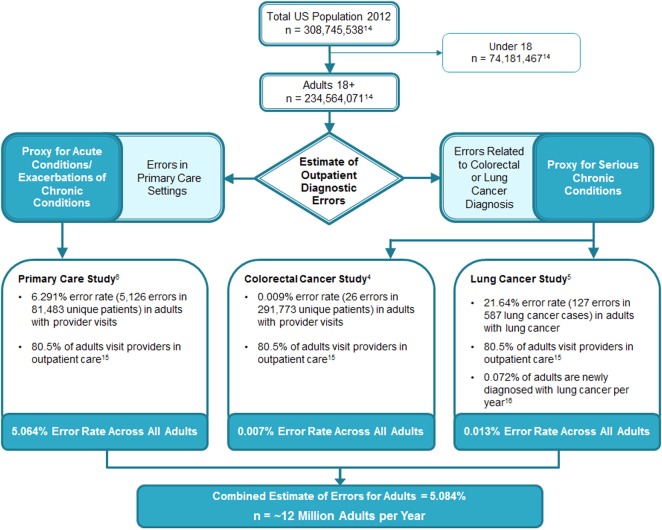
Background: The frequency of outpatient diagnostic errors is challenging to determine due to varying error definitions and the need to review data across multiple providers and care settings over time. We estimated the frequency of diagnostic errors in the US adult population by synthesising data from three previous studies of clinic-based populations that used conceptually similar definitions of diagnostic error. Methods: Data sources included two previous studies that used electronic triggers, or algorithms, to detect unusual patterns of return visits after an initial primary care visit or lack of follow-up of abnormal clinical findings related to colorectal cancer, both suggestive of diagnostic errors. A third study examined consecutive cases of lung cancer. In all three studies, diagnostic errors were confirmed through chart review and defined as missed opportunities to make a timely or correct diagnosis based on available evidence. We extrapolated the frequency of diagnostic error obtained from our studies to the US adult population, using the primary care study to estimate rates of diagnostic error for acute conditions (and exacerbations of existing conditions) and the two cancer studies to conservatively estimate rates of missed diagnosis of colorectal and lung cancer (as proxies for other serious chronic conditions). Results: Combining estimates from the three studies yielded a rate of outpatient diagnostic errors of 5.08%, or approximately 12 million US adults every year. Based upon previous work, we estimate that about half of these errors could potentially be harmful. Conclusions: Our population-based estimate suggests that diagnostic errors affect at least 1 in 20 US adults. This foundational evidence should encourage policymakers, healthcare organisations and researchers to start measuring and reducing diagnostic errors.
Overview
The claims and statistics of this paper haven’t been checked yet.
Free: it reads the open-access text and checks the first 5 claims that cite a source we can check. Create a free account to check every claim.
Integrity signals
Registry
Cites
Statistics
Figures
Verification
Claims the paper makes
The claims and statistics of this paper haven’t been checked yet.
Free: it reads the open-access text and checks the first 5 claims that cite a source we can check. Create a free account to check every claim.
Claims other papers make about this one
Each is checked against this paper’s own text: does it say what the citing paper says it does?
The source backs part of the claim, not all of it — or backs it for a different population, condition or comparison.
In the citing paper
“Approximately 5% of patients in U.S. outpatient settings suffer from diagnostic errors [8]”
From Toward Safer Diagnoses: A SEIPS-Based Narrative Review of Diagnostic Errors (2026) · cites this paper as [8]
Experimental — accuracy not yet measuredIn the citing paper
“The opportunity costs of not using our best available tools for disease detection and treatment are substantial-12 million people a year receive misdiagnoses in the United States, with about six million facing potential harm as a result. 17”
From Clinical applications of machine learning algorithms: beyond the black box (2019) · cites this paper as [17]
In the citing paper
“The opportunity costs of not using our best available tools for disease detection and treatment are substantial-12 million people a year receive misdiagnoses in the United States, with about six million facing potential harm as a result. 17”
From Clinical applications of machine learning algorithms: beyond the black box (2019) · cites this paper as [17]
Self-check
Percentages, sums and reported differences re-computed from the paper’s own numbers.
The self-check needs the paper’s full text.
Citations
Cites
Summary health statistics for U.S. adults: national health interview survey, 2012.
Blackwell, D. L., Lucas, J. W., & Clarke, T. C. (2014) · PubMed · Cited by 1,884
Incidence and Types of Adverse Events and Negligent Care in Utah and Colorado
Thomas, E. J., Studdert, D. M., Burstin, H. R., Orav, E. J., Zeena, T., Williams, E. J., Howard, K. M., Weiler, P. C., & Brennan, T. A. (2000) · Medical Care · doi:10.1097/00005650-200003000-00003 · Cited by 1,673
Self-citationClinical Reasoning in the Health Professions
Higgs, J., & Jones, M. A. (2000) · Cited by 920
Summary health statistics for U.S. adults: National Health Interview Survey, 2010.
Schiller, J. S., Lucas, J. W., Ward, B. W., & Peregoy, J. A. (2012) · PubMed · Cited by 760
Missed and delayed diagnoses in the ambulatory setting: a study of closed malpractice claims
Gandhi, T. K., Kachalia, A., Thomas, E. J., Puopolo, A. L., Yoon, C., Brennan, T. A., & Studdert, D. M. (2006) · Annals of Internal Medicine · doi:10.7326/0003-4819-145-7-200610030-00006 · Cited by 662 · cited 1×
“11 20 23 – 25 On the other hand, population-based studies have relied on medical record reviews, which are generally a gold standard for determining diagnostic error.”
BackgroundSelf-citationDiagnostic Error in Medicine: Analysis of 583 Physician-Reported Errors
Schiff, G. D. (2009) · Archives of Internal Medicine · doi:10.1001/archinternmed.2009.333 · Cited by 638 · cited 1×
“5 7 – 12 In many of these studies, lung cancer and CRC are the most common cancers for which diagnosis is delayed.”
BackgroundThe incidence of diagnostic error in medicine
Graber, M. L. (2013) · BMJ Quality & Safety · doi:10.1136/bmjqs-2012-001615 · Cited by 626
Types and Origins of Diagnostic Errors in Primary Care Settings
Singh, H., Giardina, T. D., Meyer, A. N. D., Forjuoh, S. N., Reis, M. D., & Thomas, E. J. (2013) · JAMA Internal Medicine · doi:10.1001/jamainternmed.2013.2777 · Cited by 559 · cited 2×
“Based on our previous work, 17 we estimated that about one-half of errors would have the potential to lead to severe harm.”
BackgroundSelf-citationMeasuring errors and adverse events in health care
Thomas, E. J., & Petersen, L. A. (2003) · Journal of General Internal Medicine · doi:10.1046/j.1525-1497.2003.20147.x · Cited by 455 · cited 1×
“11 20 23 – 25 On the other hand, population-based studies have relied on medical record reviews, which are generally a gold standard for determining diagnostic error.”
BackgroundSelf-citationThe Vanishing Nonforensic Autopsy
Shojania, K. G., & Burton, E. C. (2008) · New England Journal of Medicine · doi:10.1056/nejmp0707996 · Cited by 294
Cited by
Items 301–400 of 797
International dimensions of clinical decision support systems
Magrabi, F., Cresswell, K. M., & Fraser, H. (2023) · Elsevier eBooks · doi:10.1016/b978-0-323-91200-6.00013-9 · Cited by 10
Collaboration during the diagnostic decision‐making process: When does it help?
Kämmer, J. E., Ernst, K., Grab, K., Schauber, S. K., Hautz, S. C., Penders, D., & Hautz, W. E. (2023) · Journal of Behavioral Decision Making · doi:10.1002/bdm.2357 · Cited by 11
Opportunities & Challenges of Artificial Intelligent-Powered Technology in Healthcare
Anwer, M. S. (2024) · Medical Research Archives · doi:10.18103/mra.v12i3.5141 · Cited by 11
Diagnostic Discrepancies in the Emergency Department: A Retrospective Study
Schols, L. A., Maranus, M. E., Rood, P. P. M., & Zwaan, L. (2024) · Journal of Patient Safety · doi:10.1097/pts.0000000000001252 · Cited by 10
Survey on nurse-physician communication gaps focusing on diagnostic concerns and reasons for silence
Miyagami, T., Watari, T., Nishizaki, Y., Sekine, M., Shigetomi, K., Miwa, M., Chopra, V., & Naito, T. (2024) · Scientific Reports · doi:10.1038/s41598-024-68520-6 · Cited by 10
A Machine Learning Framework for Assessing Experts’ Decision Quality
Dong, W., Saar‐Tsechansky, M., & Geva, T. (2024) · Management Science · doi:10.1287/mnsc.2021.03357 · Cited by 11
Halasy, M. P., & Shafrin, J. T. (2021) · Mayo Clinic Proceedings Innovations Quality & Outcomes · doi:10.1016/j.mayocpiqo.2021.01.014 · Cited by 10
The Impact of Community Care Referral on Time to Surgery for Veterans With Carpal Tunnel Syndrome
Billig, J. I., Evans, R. R., Kerr, E. A., Hayward, R. A., & Sears, E. D. (2021) · Medical Care · doi:10.1097/mlr.0000000000001469 · Cited by 10
Next steps for electronic health records to improve the diagnostic process
Liebovitz, D. (2015) · Diagnosis · doi:10.1515/dx-2014-0070 · Cited by 10
Diagnostic error: Untapped potential for improving patient safety?
Groszkruger, D. (2014) · Journal of Healthcare Risk Management · doi:10.1002/jhrm.21149 · Cited by 10
Artificial Intelligent in Healthcare
Meiliana, A., Dewi, N. M., & Wijaya, A. (2019) · The Indonesian Biomedical Journal · doi:10.18585/inabj.v11i2.844 · Cited by 10
“(2) In deeper observations, an enormous of resources wasted, a large number of serious diagnostic errors and mistaken treatments occurred, due to inefficiencies in workflow, inequities, and inadequate time between patients and clinicians.(3,4) Eager for improvement, leaders in healthcare and computer scientists have a…”
BackgroundMichelson, K. A., Buchhalter, L., Bachur, R. G., Mahajan, P., Monuteaux, M. C., & Finkelstein, J. A. (2019) · Emergency Medicine Journal · doi:10.1136/emermed-2019-208841 · Cited by 10
Mining Misdiagnosis Patterns from Biomedical Literature
Li, C., Chen, E., Savova, G., Fraser, H., & Eickhoff, C. (2020) · PubMed · doi:10.48550/arxiv.2006.13721 · Cited by 10
El-Kareh, R. E., Schiff, G. D., & Hudspeth, J. C. (2015) · Applied Clinical Informatics · doi:10.4338/aci-2015-04-ra-0042 · Cited by 10
From second to hundredth opinion in medicine: A global consultation platform for physicians
Muse, E. D., Godino, J., Netting, J., Alexander, J. F., Moran, H. J., & Topol, E. J. (2018) · npj Digital Medicine · doi:10.1038/s41746-018-0064-y · Cited by 10
“Outpatient diagnostic error rates have been estimated at 5% affecting >12 million individuals per annum, whereas inpatient diagnostic errors range from 6 to 7%.(2) In fact, when using expert consultants as the ground truth for diagnosis, >20% of referral diagnoses in a recent study were vastly different compared with…”
BackgroundSingh, H., & Sittig, D. F. (2015) · BMJ Quality & Safety · doi:10.1136/bmjqs-2015-004140 · Cited by 10
Self-citationAdvancing Diagnostic Excellence through Medical Education in Diagnostic Equity
Connor, D. M., Lypson, M. L., & González, C. M. (2025) · New England Journal of Medicine · doi:10.1056/nejmra2411882 · Cited by 9
Atypical Presentations at Risk for Diagnostic Errors in Internal Medicine: A Scoping Review
Harada, Y., Kawamura, R., Yokose, M., Singh, H., & Shimizu, T. (2025) · Journal of General Internal Medicine · doi:10.1007/s11606-025-09901-z · Cited by 9
Self-citationA Separation‐Sensing Membrane Performing Precise Real‐Time Serum Analysis During Blood Drawing
Chu, Z., Zhang, W., You, Q., Yao, X., Liu, T., Liu, G., Zhang, G., Gu, X., Ma, Z., & Jin, W. (2020) · Angewandte Chemie · doi:10.1002/ange.202008241 · Cited by 9
Mutual Learning Algorithm for Kidney Cyst, Kidney Tumor and Kidney Stone Diagnosis
Chowdhury, S. T., Mukhopadhyay, S., & Narendra, K. S. (2023) · Annals of Computer Science and Information Systems · doi:10.15439/2023f378 · Cited by 9
“Couple of recent studies [1][2] shows that an estimated 5% of the outpatients get wrong diagnosis in US every year.”
BackgroundWannheden, C., Hagman, J., Riggare, S. S., Härenstam, K. P., & Fernholm, R. (2024) · BMJ Open · doi:10.1136/bmjopen-2024-089224 · Cited by 9
Samost, A., Thomas, E. J., Lounsbury, O., Tannenbaum, S. I., Salas, E., & Bell, S. K. (2024) · Diagnosis · doi:10.1515/dx-2024-0115 · Cited by 9
Self-citationPivoting: leveraging opportunities in a turbulent health care environment
Bandy, M. (2015) · Journal of the Medical Library Association JMLA · doi:10.3163/1536-5050.103.1.002 · Cited by 9
“Thomas found that diagnostic errors occur for about 5% of US adults and that about half of those errors could severely harm patients [48].”
BackgroundMichelson, K. A., Williams, D. N., Dart, A. H., Mahajan, P., Aaronson, E. L., Bachur, R. G., & Finkelstein, J. A. (2020) · Diagnosis · doi:10.1515/dx-2020-0035 · Cited by 9
Artificial Intelligence in Ophthalmology: Promises, Hazards and Challenges
Grzybowski, A. E. (2021) · Springer eBooks · doi:10.1007/978-3-030-78601-4_1 · Cited by 9
A call to action: next steps to advance diagnosis education in the health professions
Graber, M. L., Holmboe, E. S., Stanley, J. M., Danielson, J. H., Schoenbaum, S. C., & Olson, A. P. J. (2021) · Diagnosis · doi:10.1515/dx-2021-0103 · Cited by 9
Shimizu, T. (2022) · Diagnostics · doi:10.3390/diagnostics12020356 · Cited by 9
“Opinions of physicians and other health professionals who have previously examined the patient and those of patients and surrounding personnel who are non-experts can be reflected in subsequent reflections, leading to a better calibration of the diagnosis [2,36].”
BackgroundMichelson, K. A., Bachur, R. G., Dart, A. H., Chaudhari, P. P., Cruz, A. T., Grubenhoff, J. A., Reeves, S. D., Monuteaux, M. C., & Finkelstein, J. A. (2023) · BMJ Open · doi:10.1136/bmjopen-2022-064852 · Cited by 9
Kim, V., Shi, J. M., An, J., Bhandari, S. K., Brettler, J. W., Kanter, M. H., & Sim, J. J. (2023) · The Permanente Journal · doi:10.7812/tpp/23.096 · Cited by 9
“23 When looking at the characteristics of patients who were screened and those who screened positive, the authors observed that there may be differences in clinical cues between ha screened patients and patients who actually screened positive.”
Inteligencia artificial y salud
Oficina, C., de Ciencia, O., & Diputados, T. D. C. D. L. (2022) · Zenodo (CERN European Organization for Nuclear Research) · doi:10.57952/tcsx-b678 · Cited by 10
Harbitz, M. B., Stensland, P. S., & Abelsen, B. (2021) · BMC Health Services Research · doi:10.1186/s12913-021-06334-2 · Cited by 8
Structural equation modeling for identification of patient safety antecedents in primary care
Kosiek, K., Staniec, I., Godycki-Ćwirko, M., Depta, A., & Kowalczyk, A. (2021) · BMC Family Practice · doi:10.1186/s12875-021-01533-6 · Cited by 8
“It has been estimated that about half of these errors could potentially be harmful [2].”
BackgroundMahajan, P., Grubenhoff, J. A., Cranford, J., Bhatt, M., Chamberlain, J. M., Chang, T. P., Lyttle, M. D., Oostenbrink, R., Roland, D., Ruddy, R. M., et al. (2023) · BMJ Open Quality · doi:10.1136/bmjoq-2022-002062 · Cited by 8
Self-citationHuang, T.-Y., Chong, C., Lin, H.-Y., Chen, T.-Y., Chang, Y.-C., & Lin, M. (2024) · International Journal of Medical Informatics · doi:10.1016/j.ijmedinf.2024.105564 · Cited by 8
Learning from what goes right: a Safety-II framework for improving diagnosis at the point of care
Shimizu, T. (2025) · Diagnosis · doi:10.1515/dx-2025-0086 · Cited by 8
“Although the exact rate of diagnostic errors varies by clinical setting, one of the prominent reports estimate an error rate of approximately 5 % [6], which conversely suggests that 95 % of diagnoses are successful.”
Biddle, G., Assadsangabi, R., Broadhead, K., Hacein‐Bey, L., & Ivanović, V. (2022) · American Journal of Neuroradiology · doi:10.3174/ajnr.a7596 · Cited by 8
Performance of Cardiovascular Physical Exam Skills by Internal Medicine Residents
Lang, K., Chew, C., Rosa, M. D. L., Bertram, A. K., Sharma, A., Niessen, T. M., Stein, A. A., & Garibaldi, B. T. (2024) · The American Journal of Medicine · doi:10.1016/j.amjmed.2024.04.039 · Cited by 8
Fontil, V., Radcliffe, K. G., Lyson, H. C., Ratanawongsa, N., Lyles, C. R., Tuot, D. S., Yuen, K., & Sarkar, U. (2019) · JAMIA Open · doi:10.1093/jamiaopen/ooy058 · Cited by 8
“Diagnostic errors (defined as missed, delayed, or wrong diagnoses) in primary care impact an estimated 1 in 20 US adults every year.(1) These errors can lead to serious preventable harm, but few interventions have been developed and tested to reduce diagnostic errors in real-world primary care settings.”
BackgroundBundy, D. G., Singh, H., Stein, R. E. K., Brady, T. M., Lehmann, C. U., Heo, M., O’Donnell, H. C., Rice‐Conboy, E., & Rinke, M. L. (2019) · Clinical Trials · doi:10.1177/1740774518820522 · Cited by 8
Self-citationInformationstechnologie und E-Health zur Verbesserung der Patientensicherheit
Müller, T. (2020) · Der Internist · doi:10.1007/s00108-020-00780-6 · Cited by 8
Zhou, X., Cohen, E., Zhou, X., & Montague, E. N. H. (2025) · Frontiers in Medicine · doi:10.3389/fmed.2025.1631565 · Cited by 7
“Diagnostic errors in primary care are a significant concern, with studies indicating that they occur in approximately 5 to 15% of encounters, depending on the conditions examined and the study parameters (8, 9).”
Sarvari, P., Al-Fagih, Z., Abou-Chedid, A., Jewell, P., Taylor, R., & Imtiaz, A. (2025) · JMIR Biomedical Engineering · doi:10.2196/66691 · Cited by 7
“Considering the 1.3 billion health care visits annually in the United States as an example, this percentage translates to a staggering 65 to 260 million diagnostic errors each year in the United States alone [23].”
InfluentialPatient safety as a global health priority
Kim, O. T. (2022) · CARDIOVASCULAR THERAPY AND PREVENTION · doi:10.15829/1728-8800-2022-3427 · Cited by 7
The role of accuracy in children's judgments of experts' knowledge
Williams, A. J., & Danovitch, J. H. (2023) · Child Development · doi:10.1111/cdev.13965 · Cited by 7
Andreacchi, A. T., Brini, A., van den Heuvel, E. R., Terrera, G. M., Mayhew, A., John, P. S., Stirland, L., & Griffith, L. E. (2023) · Journal of Aging and Health · doi:10.1177/08982643231215476 · Cited by 7
“It is also possible that an inconsistent response may be a result of a misdiagnosis which the respondent believed was present at baseline but understood not to be present at follow-up (Singh et al., 2014).”
Leulseged, H., Rees, C. A., Alemu, A., Barr, B. A. T., Dheresa, M., Madrid, L., Scott, A. G., & Assefa, N. (2024) · BMC Pediatrics · doi:10.1186/s12887-024-04854-4 · Cited by 7
Framing diagnostic error: an epidemiological perspective
Hunter, M. K., Singareddy, C., & Mundt, K. A. (2024) · Frontiers in Public Health · doi:10.3389/fpubh.2024.1479750 · Cited by 7
Alsharari, S. M. F., Al-Sharari, H. S. B., Awad, D. A., Alsharari, N. L., Alsharari, Y. S., Al-Yami, S. S., Sofyani, A. A. A., Khawaji, M. M. I., Khiswi, A. A. M., Alzahrani, R. K. A., et al. (2024) · Journal of Ecohumanism · doi:10.62754/joe.v3i8.5815 · Cited by 7
Epidemiology of diagnostic errors in pediatric emergency departments using electronic triggers
Mahajan, P., White, E. N., Shaw, K. N., Parker, S. J., Chamberlain, J. M., Ruddy, R. M., Alpern, E. R., Corboy, J. B., Krack, A. T., Ku, B. C., et al. (2025) · Academic Emergency Medicine · doi:10.1111/acem.15087 · Cited by 7
Self-citationSmith, S., Benbenek, M. M., & Petersen, L. A. (2025) · AACN Advanced Critical Care · doi:10.4037/aacnacc2025354 · Cited by 7
Five things to know about diagnostic error
Yermak, D., Cram, P. M., & Kwan, J. L. (2017) · Diagnosis · doi:10.1515/dx-2016-0043 · Cited by 7
“At least 1 in 20 adults are affected by diagnostic errors annually [2]”
BackgroundStahl, K., Reisinger, A., & Groene, O. (2022) · BMJ Open · doi:10.1136/bmjopen-2021-049237 · Cited by 7
Burt, L., & Olson, A. P. J. (2023) · Journal of Professional Nursing · doi:10.1016/j.profnurs.2023.01.008 · Cited by 7
Marcin, T., Hautz, S. C., Singh, H., Zwaan, L., Schwappach, D. L. B., Krummrey, G., Schauber, S. K., NENDAZ, M. R., Exadaktylos, A. K., Müller, M., et al. (2023) · BMJ Open · doi:10.1136/bmjopen-2023-072649 · Cited by 7
Self-citationLama, A. M., Hogg, J. P., & Olson, A. P. J. (2019) · Diagnosis · doi:10.1515/dx-2019-0046 · Cited by 7
“Diagnostic error is a major problem in United States health care: 15% of inpatient and 5% of outpatient diagnoses are in error [8, 9].”
BackgroundRajendran, R., Salazar, J. H., Seymour, R. L., Laposata, M., & Zahner, C. J. (2021) · Diagnosis · doi:10.1515/dx-2020-0139 · Cited by 7
The predictive brain model in diagnostic reasoning
Lim, T. K. (2021) · The Asia Pacific Scholar · doi:10.29060/taps.2021-6-2/ra2370 · Cited by 7
khaph, S. A., Mahmoud, N. S., & Khaton, S. E. (2021) · Tanta Scientific Nursing Journal · doi:10.21608/tsnj.2021.210229 · Cited by 7
Researching nurses’ adherence to patient safety guidelines in emergency departments
Asmoro, C. P., Hariyati, R. T. S., Ayuningtyas, D., Umar, J., & Tartila, D. Y. R. (2022) · Emergency Nurse · doi:10.7748/en.2022.e2129 · Cited by 7
Quantum Computing in Healthcare and Medicines
Dhande, C., & Bagchi, P. (2023) · Advances in intelligent systems research/Advances in Intelligent Systems Research · doi:10.2991/978-94-6463-294-1_21 · Cited by 7
Diagnostic Errors: Impact of an Educational Intervention on Pediatric Primary Care
Walsh, J. N., Knight, M. M., & Lee, A. J. (2017) · Journal of Pediatric Health Care · doi:10.1016/j.pedhc.2017.07.004 · Cited by 7
Pragmatic Insights on Patient Safety Priorities and Intervention Strategies in Ambulatory Settings
Sarkar, U., McDonald, K. M., Motala, A., Smith, P., Zipperer, L., Wachter, R. M., Shanman, R., & Shekelle, P. (2017) · The Joint Commission Journal on Quality and Patient Safety · doi:10.1016/j.jcjq.2017.06.009 · Cited by 7
DeWaters, A. L., Mejía, D., Thomas, J. A. L., Elwood, B., & Bowen, M. E. (2020) · Mayo Clinic Proceedings Innovations Quality & Outcomes · doi:10.1016/j.mayocpiqo.2020.04.002 · Cited by 7
“4% overall diagnostic error rate for glycemic abnormalities in our study is much higher than the 5% diagnostic error rate reported for colorectal and lung cancer screening.(19) Clinical consequences associated with diagnostic errors for prediabetes and type 2 diabetes include missed opportunities for counseling on lif…”
ResultAre maladaptive brain changes the reason for burnout and medical error?
Manji, R. A., Manji, J. S., & Arora, R. C. (2020) · Journal of Thoracic and Cardiovascular Surgery · doi:10.1016/j.jtcvs.2020.06.146 · Cited by 7
Online public reactions to frequency of diagnostic errors in US outpatient care
Giardina, T. D., Sarkar, U., Gourley, G., Modi, V., Meyer, A. N. D., & Singh, H. (2016) · Diagnosis · doi:10.1515/dx-2015-0022 · Cited by 7
“This work is supported in part by the Houston VA Health Services Research and Development Center for Innovations in Quality, Effectiveness and Safety (CIN 13–413).”
InfluentialSelf-citationToward Safer Diagnoses: A SEIPS-Based Narrative Review of Diagnostic Errors
Yen, C., Epling, J. W., Rockwell, M., & Vaughn-Cooke, M. (2026) · Diagnostics · doi:10.3390/diagnostics16020347 · Cited by 6
“Approximately 5% of patients in U.S. outpatient settings suffer from diagnostic errors [8], and most people experience at least one diagnostic error in their lifetime [9].”
Status of patient safety in selected Ghanaian hospitals: a national cross-sectional study
Ashinyo, M. E., Amegah, K. E., Kariyo, P. C., Ackon, A. A., Asrat, S. G., & Dubik, S. D. (2022) · BMJ Open Quality · doi:10.1136/bmjoq-2022-001938 · Cited by 6
Diagnostic Errors in Japanese Community Hospitals and Related Factors: A Retrospective Cohort Study
Fujimori, T., Ohta, R., & Sano, C. (2023) · Healthcare · doi:10.3390/healthcare11111539 · Cited by 6
“, 12 million patients annually) experience a diagnostic error [3].”
BackgroundHussain, S., Ahmad, S., & Wasid, M. (2024) · Computers in Biology and Medicine · doi:10.1016/j.compbiomed.2024.109342 · Cited by 7
Artificial intelligence vs. emergency physicians: who diagnoses better?
Kilci, A. İ., Okyay, R. A., Kaya, E., Gedik, M. S., Hakkoymaz, H., & Tepe, M. (2025) · Revista da Associação Médica Brasileira · doi:10.1590/1806-9282.20250546 · Cited by 6
“Emergency physicians must balance time constraints, cognitive workload, and the need for precise diagnoses, contributing to significant stress and diagnostic errors affecting millions annually 1,2 .”
Reger, K. C., Schneider, G., Line, K. T., Kaliappan, A., Buscaglia, R., & Garbett, N. C. (2025) · Cancers · doi:10.3390/cancers18010060 · Cited by 6
“Each year, an estimated twelve million patients in the U.S. are misdiagnosed [1], leading to delays in appropriate treatment and substantial preventable morbidity and mortality.”
Multimodal large language models challenge NEJM image challenge
Sheng, C., Shen, S., Wang, L., Chen, J., Chen, W. J., Wang, S., & Wang, N. (2026) · Scientific Reports · doi:10.1038/s41598-026-39201-3 · Cited by 7
Monitoring Diagnostic Safety Risks in Emergency Departments: Protocol for a Machine Learning Study
Enayati, M., Sır, M. Y., Zhang, X., Parker, S. J., Duffy, E. A., Singh, H., Mahajan, P., & Pasupathy, K. S. (2021) · JMIR Research Protocols · doi:10.2196/24642 · Cited by 6
“A conservative estimate suggests that 1 out of every 10 diagnoses is subject to some level of error, and half of the errors cause harm or escalation of the health condition [1,8-10].”
BackgroundSelf-citationDiagnostic Trajectories in Primary Care at 12 Months: An Observational Cohort Study
Fontil, V., Khoong, E. C., Lyles, C. R., Rivadeneira, N. A., Olazo, K., Hoskote, M., & Sarkar, U. (2022) · The Joint Commission Journal on Quality and Patient Safety · doi:10.1016/j.jcjq.2022.04.010 · Cited by 6
Providers’ and Patients’ Perspectives on Diagnostic Errors in the Acute Care Setting
Schnock, K. O., Garber, A., Fraser, H., Carnie, M. B., Schnipper, J. L., Dalal, A. K., Bates, D. W., & Rozenblum, R. (2022) · The Joint Commission Journal on Quality and Patient Safety · doi:10.1016/j.jcjq.2022.11.009 · Cited by 6
Zhang, D., Yan, B., He, S., Tong, S., Huang, P., Zhang, Q., Cao, Y., Ding, Z., & Ba‐Thein, W. (2023) · BMC Pediatrics · doi:10.1186/s12887-023-03995-2 · Cited by 6
“Since diagnostic errors are relatively common in primary care, the National Academy of Medicine (formerly Institute of Medicine) estimated that most adults in the United States will likely experience one diagnostic error in their lifetime [6].”
BackgroundAn artificial intelligence approach for segmenting and classifying brain lesions caused by stroke
Mena, R., Peláez, E., Loayza, F. R., Macas, A., & Franco-Maldonado, H. (2023) · Computer Methods in Biomechanics and Biomedical Engineering Imaging & Visualization · doi:10.1080/21681163.2023.2264410 · Cited by 6
“However, there are some limitations, such as the non-clear lesion identification, mainly for the transient ischaemic attack or minor strokes (Singh et al. 2014).”
BackgroundDelays in Care During the COVID-19 Pandemic in the Veterans Health Administration
Mills, P. D., Louis, R. P., & Yackel, E. E. (2023) · Journal for Healthcare Quality · doi:10.1097/jhq.0000000000000383 · Cited by 6
“Singh et al.(3) found that diagnostic medical errors affect more than 12 million US adults each year and estimated that approximately half of these errors have the potential to lead to severe patient harm.”
BackgroundSuárez, N. R. E., Hargraves, I. G., Ospina, N. S., Sivly, A. L., Majka, A. J., & Brito, J. P. (2023) · Mayo Clinic Proceedings Innovations Quality & Outcomes · doi:10.1016/j.mayocpiqo.2023.06.001 · Cited by 6
“Mayo Clin Proc Inn Qual Out n August 2023;7(4):291-300 n https:/ www.”
BackgroundInfluentialDownie, R. S. (2017) · The Journal of the Royal College of Physicians of Edinburgh · doi:10.4997/jrcpe.2017.311 · Cited by 6
Elevating diagnostic skills with logical reasoning
Gilliam, S. (2019) · The Nurse Practitioner · doi:10.1097/01.npr.0000554675.55073.5a · Cited by 6
Iloh, G. U. P., Emeka, E. A., Ikwudinma, A., & Amadi, A. (2020) · Nigerian Postgraduate Medical Journal · doi:10.4103/npmj.npmj_45_20 · Cited by 6
Sethole, K. M., Rudman, E. M., & Hazell, L. J. (2020) · Journal of medical imaging and radiation sciences · doi:10.1016/j.jmir.2019.12.010 · Cited by 7
Huang, C., Barwise, A. K., Soleimani, J., Dong, Y., Svetlana, H., Khan, S. A., Gavin, A., Helgeson, S. A., Moreno-Franco, P., Pinevich, Y., et al. (2021) · Journal of Patient Safety · doi:10.1097/pts.0000000000000840 · Cited by 6
“Clinicians in our study perceived a failure to involve specialists sufficiently early was frequent and associated with potential DE.”
BackgroundInfluentialTeaching about diagnostic errors through virtual patient cases: a pilot exploration
Geha, R. M., Trowbridge, R. L., Dhaliwal, G., & Olson, A. P. J. (2018) · Diagnosis · doi:10.1515/dx-2018-0023 · Cited by 6
Revolutionizing Disease Diagnosis with Large Language Models: A Systematic ReviewPreprint
Bojesomo, A., Seghier, M. L., Hadjileontiadis, L. J., & Shehhi, A. A. (2024) · Research Square · doi:10.21203/rs.3.rs-5704278/v1 · Cited by 6
Diagnostic scope: the AI can’t see what the mind doesn’t know
Weissman, G. E., Zwaan, L., & Bell, S. K. (2024) · Diagnosis · doi:10.1515/dx-2024-0151 · Cited by 5
The global progress for improving diagnosis: what we’ve learned, what comes next
Shimizu, T., Hautz, W. E., van Sassen, C., & Zwaan, L. (2025) · Diagnosis · doi:10.1515/dx-2025-0109 · Cited by 6
Jeong, M.-A., & Kim, S.-D. (2026) · Applied Sciences · doi:10.3390/app16105146 · Cited by 5
Isolating red flags to enhance diagnosis (I-RED): An experimental vignette study
Chartan, C. A., Singh, H., Krishnamurthy, P., Sur, M., Meyer, A. N. D., Lutfi, R., Stark, J. E., & Thammasitboon, S. (2019) · International Journal for Quality in Health Care · doi:10.1093/intqhc/mzz082 · Cited by 5
Self-citationAjmal, E., Meyer, T., Sobol', G. N., Silver, M., & Nicastro, J. M. (2024) · Journal of surgical education · doi:10.1016/j.jsurg.2024.07.029 · Cited by 5
Diagnostic errors in patients admitted directly from new outpatient visits
Watanabe, Y., Miyagami, T., Shimizu, T., Nishizaki, Y., Ukishima, S., Santo, K., Kushiro, S., Aoki, N., Suzuki, M., Kanazawa, A., et al. (2024) · Diagnosis · doi:10.1515/dx-2024-0088 · Cited by 5
Maulidina, F., Rustam, Z., Novita, M., Setiawan, Q. S., & Sagiran, S. (2021) · International Conference on Decision Aid Sciences and Applications (DASA) · doi:10.1109/dasa53625.2021.9682286 · Cited by 5
How Health Systems Decide to Use Artificial Intelligence for Clinical Decision Support
Gonzalez-Smith, J., Shen, H., Singletary, E. A., & Silcox, C. (2022) · NEJM Catalyst · doi:10.1056/cat.21.0416 · Cited by 5
Artificial Intelligence (AI) in Ophthalmology: An Overview
Kadir, S. M. U., Rehnuma, R., Rahman, M. S., Raihani, M. Z., Ali, M., & Moniruzzaman, M. (2022) · Ophthalmology Research · doi:10.33425/2639-9482.1024 · Cited by 5
“A study published in 2014 estimated that diagnostic errors affect at least 5% of US adults (12 million people) per year [1].”
BackgroundJapanese Internists' Most Memorable Diagnostic Error Cases: A Self-reflection Survey
Watari, T., Gupta, A. B., Amano, Y., & Tokuda, Y. (2023) · Internal Medicine · doi:10.2169/internalmedicine.1494-22 · Cited by 5
“Previous studies have hypothesized that cognitive biases contribute more significantly to errors than physician memory and experience (11, 17-23).”
BackgroundHow online healthcare team evolve into organization: A social network analysis
Ding, X., Zhang, X., Wang, W. H., & You, X. (2024) · Digital Health · doi:10.1177/20552076241286634 · Cited by 5
Debiasing anchoring bias in the context of telemedicine
Chua, A. Y. K., Seth, N., & Banerjee, S. (2025) · Behaviour and Information Technology · doi:10.1080/0144929x.2024.2444548 · Cited by 5
“…by time constraints, fatigue, or simply choosing to take mental shortcuts, anchoring bias raises safety concerns due to delays in delivering appropriate care and contributes to medical errors (Croskerry 2003; Loncharich et al. 2023; Satya-Murti and Lockhart 2015; Singh, Meyer, and Thomas 2014).”
FAKTOR-FAKTOR YANG MEMPENGARUHI PENERAPAN BUDAYA KESELAMATAN PASIEN DI RSI UNISMA MALANG
Susatia, B. (2021) · Jurnal Informasi Kesehatan Indonesia (JIKI) · doi:10.31290/jiki.v7i1.2265 · Cited by 5
Igila, A. F., & Ojule Aaron, C. (2020) · Journal of Health and Medical Sciences · doi:10.31014/aior.1994.03.01.90 · Cited by 5
Metadata
- Authors
- Singh, H., Meyer, A. N. D., & Thomas, E. J.
- Affiliations
- Michael E. DeBakey VA Medical Center (US)
- Memorial Hermann (US)
- Corresponding author
- Singh, Hardeep
- Venue
- BMJ Quality & Safety
- Publisher
- BMJ
- Published
- 2014-04-17
- Volume
- 23
- Issue
- 9
- Pages
- 727-731
- ISSN
- 1475-3898 (ISSN-L)
- 2044-5415
- 2044-5423
- PMC
- PMC4145460
- OpenAlex
- W2154651644
- Cited by
- 677
- References
- 28
- Citations by year
- 2026: 61 · 2025: 67 · 2024: 70 · 2023: 77 · 2022: 75 · 2021: 89 · 2020: 68 · 2019: 41 · 2018: 34 · 2017: 32 · 2016: 26 · 2015: 26 · 2014: 8
- FWCI
- 31.48
- Type
- journal article
- Language
- en
- Open access
- hybrid
- doi.org
- Licence
- cc-by-nc
- Locations
- BMJ Quality & Safety (publishedVersion, cc-by-nc)
- PubMed Central (publishedVersion, cc-by-nc)
- PubMed (publishedVersion)
- HighWire Press Open Archive (submittedVersion)
- Funders
- National Institutes of Health (UL1TR000371, CIN13-413)
- Agency for Healthcare Research and Quality (R18HS017244, R18HS017820)
- Center for Innovations in Quality, Effectiveness and Safety (CIN 13–413, 13–413)
- National Cancer Institute (K23CA125585)
- National Center for Advancing Translational Sciences
- Topics
- Health Sciences › Medicine › Family Practice › Clinical Reasoning and Diagnostic Skills
- Health Sciences › Medicine › Public Health, Environmental and Occupational Health › Patient Safety and Medication Errors
- Health Sciences › Medicine › Family Practice › Primary Care and Health Outcomes
- Keywords
- diagnostic errors, outpatient care, missed diagnosis, primary care, return visits, colorectal cancer, lung cancer
- MeSH terms
- Adult, Ambulatory Care, Diagnostic Errors, Humans, Lung Neoplasms, United States, Colorectal Neoplasms
About these checks
Registry, retraction, Cites and statistics results are computed, not judged, with one exception: a printed reference that no index lists is read once by a model before it counts as a citation error. Claims are extracted by a model and kept only when their quote appears verbatim in the text; each cited source is then checked, with a model’s help, for whether it says what the claim relies on. Those verdicts can be wrong — read the claim’s quote and the cited source before relying on one.
Statistics and arithmetic are recomputed, not judged.
Confidence bands are shown only for fields calibrated on our annotated test set. None is calibrated yet, so no band is shown.
What counts as a claim ›How we measure confidence ›How we check this ›
Are you an author, or do you see a problem with this page? Request a review
Data sources
Bibliographic data: Semantic Scholar, OpenAlex, Crossref.
Contains information from the Semantic Scholar Academic Graph Datasets, made available under the ODC Attribution License (ODC-BY 1.0).
Semantic Scholar’s data is described in: Kinney, R., et al. (2023). The Semantic Scholar Open Data Platform. arXiv:2301.10140.
