

The DOI matches its Crossref record; 42 of the 43 references it cites were found in a registry or an index.
Psychological impact of the COVID-19 pandemic on healthcare workers: A cross-sectional study in China
Open accessAbstract
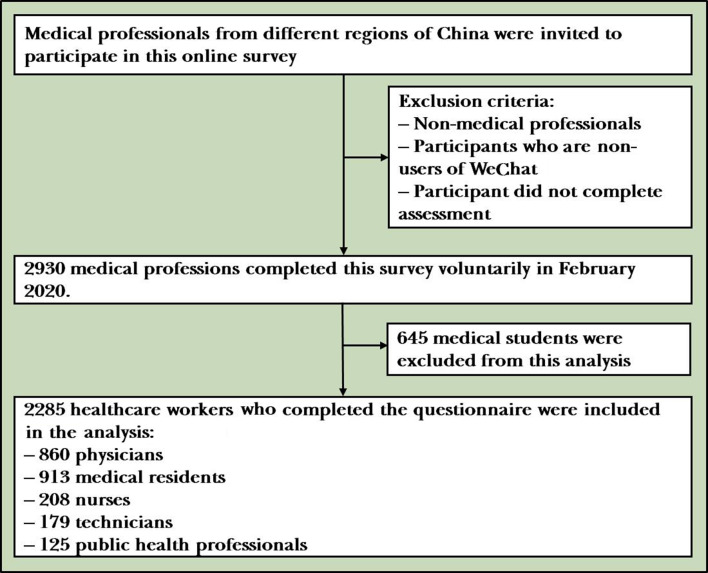
BACKGROUND: Healthcare workers fighting against the coronavirus disease 2019 (COVID-19) pandemic are under tremendous pressure, which puts them at an increased risk of developing psychological problems. AIMS: This study aimed to investigate the prevalence of psychological problems in different healthcare workers (ie, physicians, medical residents, nurses, technicians and public health professionals) during the COVID-19 pandemic in China and explore factors that are associated with the onset of psychological problems in this population during this public health crisis. METHODS: A cross-sectional, web-based survey was conducted in February 2020 among healthcare workers during the COVID-19 pandemic. Psychological problems were assessed using the Generalized Anxiety Disorder Scale, Patient Health Questionnaire and Insomnia Severity Index. Logistic regression analyses were used to explore the factors that were associated with psychological problems. RESULTS: The prevalence of symptoms of anxiety, depression, insomnia and the overall psychological problems in healthcare workers during the COVID-19 pandemic in China was 46.04%, 44.37%, 28.75% and 56.59%, respectively. The prevalence of the overall psychological problems in physicians, medical residents, nurses, technicians and public health professionals was 60.35%, 50.82%, 62.02%, 57.54% and 62.40%, respectively. Compared with healthcare workers who did not participate in front-line work, front-line healthcare workers had a higher risk of anxiety, insomnia and overall psychological problems. In addition, attention to negative or neutral information about the pandemic, receiving negative feedback from families and friends who joined front-line work, and unwillingness to join front-line work if given a free choice were three major factors for these psychological problems. CONCLUSIONS: Psychological problems are pervasive among healthcare workers during the COVID-19 pandemic. Receiving negative information and participating in front-line work appear to be important risk factors for psychological problems. The psychological health of different healthcare workers should be protected during the COVID-19 pandemic with timely interventions and proper information feedback.
Overview
The claims and statistics of this paper haven’t been checked yet.
Run the check — free, no account needed. It reads the open-access text and checks the sources it cites.
Integrity signals
Registry
Cites
Statistics
Figures
Verification
Claims the paper makes
The claims and statistics of this paper haven’t been checked yet.
Run the check — free, no account needed. It reads the open-access text and checks the sources it cites.
Claims other papers make about this one
Each is checked against this paper’s own text: does it say what the citing paper says it does?
The source backs part of the claim, not all of it — or backs it for a different population, condition or comparison.
In the citing paper
“the prevalence of psychological distress was low compared to previous studies from Singapore (8.9%, 14.5%, and 6.6% for depression, anxiety and stress, respectively) [6] and China (44.4%, 46.0%, and 28.8%, respectively) [45].”
From Seroprevalence of COVID-19 and Psychological Distress among Front Liners at the Universiti Malaysia Sabah Campus during the Third Wave of COVID-19 (2022) · cites this paper as [45]
Experimental — accuracy not yet measured
Self-check
Percentages, sums and reported differences re-computed from the paper’s own numbers.
The self-check needs the paper’s full text.
Citations
Cites
The PHQ-9: Validity of a brief depression severity measure
Kroenke, K., Spitzer, R. L., & Williams, J. B. W. (2001) · Journal of General Internal Medicine · doi:10.1046/j.1525-1497.2001.016009606.x · Cited by 44,910
A Brief Measure for Assessing Generalized Anxiety Disorder: The GAD-7
Spitzer, R. L., Kroenke, K., Williams, J. B. W., & Löwe, B. (2006) · Archives of Internal Medicine · doi:10.1001/archinte.166.10.1092 · Cited by 31,765
Spitzer, R. L. (1999) · JAMA · doi:10.1001/jama.282.18.1737 · Cited by 9,802
Validation of the Insomnia Severity Index as an outcome measure for insomnia research
Bastien, C. (2001) · Sleep Medicine · doi:10.1016/s1389-9457(00)00065-4 · Cited by 8,067
Lai, J., Ma, S., Wang, Y., Cai, Z., Hu, J., Wei, N., Wu, J., Du, H., Chen, T., Li, R., et al. (2020) · JAMA Network Open · doi:10.1001/jamanetworkopen.2020.3976 · Cited by 8,015
A novel coronavirus outbreak of global health concern
Wang, C., Horby, P. W., Hayden, F. G., & Gao, G. F. (2020) · The Lancet · doi:10.1016/s0140-6736(20)30185-9 · Cited by 7,700
Morin, C. M., Belleville, G., Bélanger, L., & Ivers, H. (2011) · Sleep · doi:10.1093/sleep/34.5.601 · Cited by 4,620
Löwe, B., Decker, O., Müller, S., Brähler, E., Schellberg, D., Herzog, W., & Herzberg, P. Y. (2008) · Medical Care · doi:10.1097/mlr.0b013e318160d093 · Cited by 4,527
Qiu, J., Shen, B., Zhao, M., Wang, Z., Xie, B., & Xu, Y. (2020) · General Psychiatry · doi:10.1136/gpsych-2020-100213 · Cited by 4,307
The Epidemiology of Depression Across Cultures
Kessler, R. C., & Bromet, E. J. (2013) · Annual Review of Public Health · doi:10.1146/annurev-publhealth-031912-114409 · Cited by 2,657
Mental health care for medical staff in China during the COVID-19 outbreak
Chen, Q., Liang, M., Li, Y., Guo, J., Fei, D., Wang, L., He, L., Sheng, C., Cai, Y., Li, X., et al. (2020) · The Lancet Psychiatry · doi:10.1016/s2215-0366(20)30078-x · Cited by 2,233
Managing mental health challenges faced by healthcare workers during covid-19 pandemic
Greenberg, N., Docherty, M., Gnanapragasam, S., & Wessely, S. (2020) · BMJ · doi:10.1136/bmj.m1211 · Cited by 2,135
The mental health of medical workers in Wuhan, China dealing with the 2019 novel coronavirus.
Kang, L., Li, Y., Hu, S., Chen, M., Yang, C., Yang, B. X., Wang, Y., Hu, J., Lai, J., Ma, X., et al. (2020) · The Lancet Psychiatry · doi:10.1016/s2215-0366(20)30047-x · Cited by 2,061
2019-nCoV epidemic: Address mental health care to empower society
Bao, Y., Sun, Y., Meng, S., Shi, J., & Lu, L. (2020) · The Lancet · doi:10.1016/s0140-6736(20)30309-3 · Cited by 2,038
Online mental health services in China during the COVID-19 outbreak
Liu, S., Yang, L., Zhang, C., Xiang, Y.-T., Liu, Z., Hu, S., & Zhang, B. (2020) · The Lancet Psychiatry · doi:10.1016/s2215-0366(20)30077-8 · Cited by 1,992
Zhang, W.-R., Wang, K., Yin, L., Zhao, W.-F., Xue, Q., Peng, M., Min, B.-Q., Tian, Q., Leng, H.-X., Du, J.-L., et al. (2020) · Psychotherapy and Psychosomatics · doi:10.1159/000507639 · Cited by 1,690
Wu, P., Fang, Y., Guan, Z., Fan, B., Kong, J., Yao, Z., Liu, X., Fuller, C. J., Susser, E., Lü, J., et al. (2009) · The Canadian Journal of Psychiatry · doi:10.1177/070674370905400504 · Cited by 1,651
COVID-19: Protecting health-care workers
Lancet, T. (2020) · The Lancet · doi:10.1016/s0140-6736(20)30644-9 · Cited by 1,247
Work stress among Chinese nurses to support Wuhan in fighting against COVID‐19 epidemic
Mo, Y., Deng, L., Zhang, L., Lang, Q., Liao, C., Wang, N., Qin, M., & Huang, H. (2020) · Journal of Nursing Management · doi:10.1111/jonm.13014 · Cited by 1,133
Maunder, R., Lancee, W., Balderson, K., Bennett, J., Borgundvaag, B., Evans, S., Fernandes, C., Goldbloom, D., Gupta, M., Hunter, J., et al. (2006) · Emerging Infectious Diseases · doi:10.3201/eid1212.060584 · Cited by 1,109
McAlonan, G. M., Lee, A. M., Cheung, V., Cheung, C., Tsang, K. W., Sham, P. C., Chua, S. E., & Wong, J. G. (2007) · The Canadian Journal of Psychiatry · doi:10.1177/070674370705200406 · Cited by 755
TAM, C. W. C., PANG, E. P. F., LAM, L. C. W., & CHIU, H. F. K. (2004) · Psychological Medicine · doi:10.1017/s0033291704002247 · Cited by 735
Mahase, E. (2020) · BMJ · doi:10.1136/bmj.m641 · Cited by 727
Psychological impact of severe acute respiratory syndrome on health workers in a tertiary hospital
Chong, M.-Y., Wang, W.-C., Hsieh, W.-C., Lee, C.-Y., Chiu, N.-M., Yeh, W.-C., Huang, T.-L., Wen, J.-K., & Chen, C.-L. (2004) · British Journal of Psychiatry · doi:10.1192/bjp.185.2.127 · Cited by 724
Psychosocial effects of SARS on hospital staff: survey of a large tertiary care institution
Nickell, L. A. (2004) · Canadian Medical Association Journal · doi:10.1503/cmaj.1031077 · Cited by 711
Brooks, S. K., Dunn, R., Amlôt, R., Rubin, G. J., & Greenberg, N. L. (2017) · Journal of Occupational and Environmental Medicine · doi:10.1097/jom.0000000000001235 · Cited by 547
Exercise and the Prevention of Depression: Results of the HUNT Cohort Study
Harvey, S. B., Øverland, S., Hatch, S. L., Wessely, S., Mykletun, A., & Hotopf, M. (2018) · American Journal of Psychiatry · doi:10.1176/appi.ajp.2017.16111223 · Cited by 493
Psychological effects of the SARS outbreak in Hong Kong on high-risk health care workers
Chua, S. E., Cheung, V., Cheung, C., McAlonan, G. M., Wong, J. W., Cheung, E. P., Chan, M. T., Wong, M. M., Tang, S. W., Choy, K. M., et al. (2004) · The Canadian Journal of Psychiatry · doi:10.1177/070674370404900609 · Cited by 462
Roth, T., Jaeger, S., Jin, R., Kalsekar, A., Stang, P. E., & Kessler, R. C. (2006) · Biological Psychiatry · doi:10.1016/j.biopsych.2006.05.039 · Cited by 422
Maunder, R. (2004) · Philosophical Transactions of the Royal Society B Biological Sciences · doi:10.1098/rstb.2004.1483 · Cited by 405
Maunder, R. G., Lancee, W. J., Rourke, S., Hunter, J. J., Goldbloom, D., Balderson, K., Petryshen, P., Steinberg, R., Wasylenki, D., Koh, D., et al. (2004) · Psychosomatic Medicine · doi:10.1097/01.psy.0000145673.84698.18 · Cited by 368
Covid-19 — The Search for Effective Therapy
Baden, L. R., & Rubin, E. J. (2020) · New England Journal of Medicine · doi:10.1056/nejme2005477 · Cited by 324
Alcohol Dependence and Its Relationship With Insomnia and Other Sleep Disorders
Chakravorty, S., Chaudhary, N. S., & Brower, K. J. (2016) · Alcoholism Clinical and Experimental Research · doi:10.1111/acer.13217 · Cited by 262
Global challenges in health and health care for nurses and midwives everywhere
Catton, H. (2020) · International Nursing Review · doi:10.1111/inr.12578 · Cited by 238
Disaster Media Coverage and Psychological Outcomes: Descriptive Findings in the Extant Research
Pfefferbaum, B., Newman, E., Nelson, S. D., Nitiéma, P., Pfefferbaum, R. L., & Rahman, A. (2014) · Current Psychiatry Reports · doi:10.1007/s11920-014-0464-x · Cited by 230
[Reliability and validity of depression scales of Chinese version: a systematic review].
Sun, X., Li, Y. X., Yu, C., & Li, L. (2017) · PubMed · doi:10.3760/cma.j.issn.0254-6450.2017.01.021 · Cited by 182
Phua, D. H., Tang, H. K., & Tham, K. Y. (2005) · Academic Emergency Medicine · doi:10.1111/j.1553-2712.2005.tb01951.x · Cited by 176
The Occupational and Psychosocial Impact of SARS on Academic Physicians in Three Affected Hospitals
Grace, S. L., Hershenfield, K., Robertson, E., & Stewart, D. E. (2005) · Psychosomatics · doi:10.1176/appi.psy.46.5.385 · Cited by 125
SARS Risk Perceptions in Healthcare Workers, Japan
Imai, T., Takahashi, K., Hoshuyama, T., Hasegawa, N., Lim, M.-K., & Koh, D. S. Q. (2005) · Emerging infectious diseases · doi:10.3201/eid1103.040631 · Cited by 106
Hall, B. J., Xiong, Y. X., Yip, P. S. Y., Lao, C. K., Shi, W., Sou, E. K. L., Chang, K., Wang, L., & Lam, A. I. F. (2019) · European Journal of Psychotraumatology · doi:10.1080/20008198.2018.1558709 · Cited by 102
COVID-19 infection epidemic: the medical management strategies in Heilongjiang Province, China
Wang, H., Wang, S., & Yu, K. (2020) · Critical Care · doi:10.1186/s13054-020-2832-8 · Cited by 69
Wong, W. C. W., Wong, S. Y. S., Lee, A., & Goggins, W. B. (2007) · American Journal of Infection Control · doi:10.1016/j.ajic.2006.06.009 · Cited by 54
Research works printed but not linked: 4
- Li N, 2001, An investigation on the mental health status of tobacco dependent soldiers, Chin J Behav Med Sci, 10, 23
- He X, 2010, Reliability and validity of a generalized anxiety disorder scale in general hospital outpatients, Shanghai Arch Psychiatry, 22, 200
- Li E, 2019, Psychometric property of the insomnia severity index in students of a commercial school, J Neurosci Ment Health, 19, 268
- 10.1197/j.aem.2004.11.015 · DOI · Paper page
Cited by
Sorted by citations
Serrano-Ripoll, M. J., Meneses-Echavez, J. F., Ricci-Cabello, I., Fraile-Navarro, D., Fiol-deRoque, M. A., Pastor-Moreno, G., Castro, A., Ruiz-Pérez, I., Zamanillo Campos, R., & Gonçalves-Bradley, D. C. (2020) · Journal of Affective Disorders · doi:10.1016/j.jad.2020.08.034 · Cited by 592
Li, Y., Scherer, N., Felix, L., & Kuper, H. (2021) · PLOS ONE · doi:10.1371/journal.pone.0246454 · Cited by 536
Al Maqbali, M., Al Sinani, M., & Al-Lenjawi, B. (2021) · Journal of Psychosomatic Research · doi:10.1016/j.jpsychores.2020.110343 · Cited by 501
Marvaldi, M., Mallet, J., Dubertret, C., Moro, M. R., & Guessoum, S. B. (2021) · Neuroscience & Biobehavioral Reviews · doi:10.1016/j.neubiorev.2021.03.024 · Cited by 562
Alnazly, E. K., Khraisat, O. M. A., Al-Bashaireh, A. M., & Bryant, C. L. (2021) · PLoS ONE · doi:10.1371/journal.pone.0247679 · Cited by 452
Metadata
- Authors
- Que, J., Shi, L., Deng, J., Liu, J., Zhang, L., Wu, S., Gong, Y., Huang, W., Yuan, K., Yan, W., Sun, Y., Ran, M., Bao, Y., & Lu, L.
- Affiliations
- Peking University (CN)
- Xiamen City Xianyue Hospital Xiamen Fujian China
- Peking University Sixth Hospital Peking University Institute of Mental Health NHC Key Laboratory of Mental Health (Peking University) National Clinical Research Center for Mental Disorders (Peking University Sixth Hospital) Beijing China
- Department of Social Work and Social Administration University of Hong Kong Hong Kong China
- Corresponding author
- Bao, Yanping
- Venue
- General Psychiatry
- Publisher
- Wiley
- Published
- 2020-06
- Volume
- 33
- Issue
- 3
- Pages
- e100259-e100259
- ISSN
- 2096-5923 (ISSN-L)
- 2517-729X
- PMC
- PMC7299004
- OpenAlex
- W3034574392
- Cited by
- 568
- References
- 43
- Citations by year
- 2026: 7 · 2025: 20 · 2024: 46 · 2023: 84 · 2022: 161 · 2021: 210 · 2020: 39
- FWCI
- 49.35
- Type
- journal article
- Language
- en
- Open access
- diamond
- doi.org
- Licence
- Locations
- General Psychiatry (publishedVersion, cc-by-nc)
- PubMed Central (publishedVersion, cc-by-nc)
- PubMed (publishedVersion)
- DOAJ (DOAJ: Directory of Open Access Journals) (submittedVersion, cc-by-sa)
- Funders
- National Natural Science Foundation of China (31900805, 81761128036, 81821092)
- Natural Science Foundation of Beijing Municipality (7194336)
- Special Research Fund of PKUHSC for Prevention and Control of COVID-19 (BMU2020HKYZX008)
- Beijing Natural Science Foundation (7194336)
- Topics
- Social Sciences › Psychology › Clinical Psychology › COVID-19 and Mental Health
- Health Sciences › Health Professions › General Health Professions › Healthcare professionals’ stress and burnout
- Health Sciences › Medicine › Public Health, Environmental and Occupational Health › Occupational Health and Burnout
- Keywords
- COVID-19 pandemic, healthcare workers, mental illness, anxiety, depression, insomnia, physicians, nurses, medical residents, public health workforce, risk factors
About these checks
Registry, retraction, Cites and statistics results are computed, not judged, with one exception: a printed reference that no index lists is read once by a model before it counts as a citation error. Claims are extracted by a model and kept only when their quote appears verbatim in the text; each cited source is then checked, with a model’s help, for whether it says what the claim relies on. Those verdicts can be wrong — read the claim’s quote and the cited source before relying on one.
Statistics and arithmetic are recomputed, not judged.
Confidence bands are shown only for fields calibrated on our annotated test set. None is calibrated yet, so no band is shown.
What counts as a claim ›How we measure confidence ›How we check this ›
Are you an author, or do you see a problem with this page? Request a review
