

Dysbiotic gut microbiota causes transmissible Crohn's disease-like ileitis independent of failure in antimicrobial defence
Open accessThe DOI matches its Crossref record; 75 of the 75 references it cites were found in a registry or an index.
Abstract
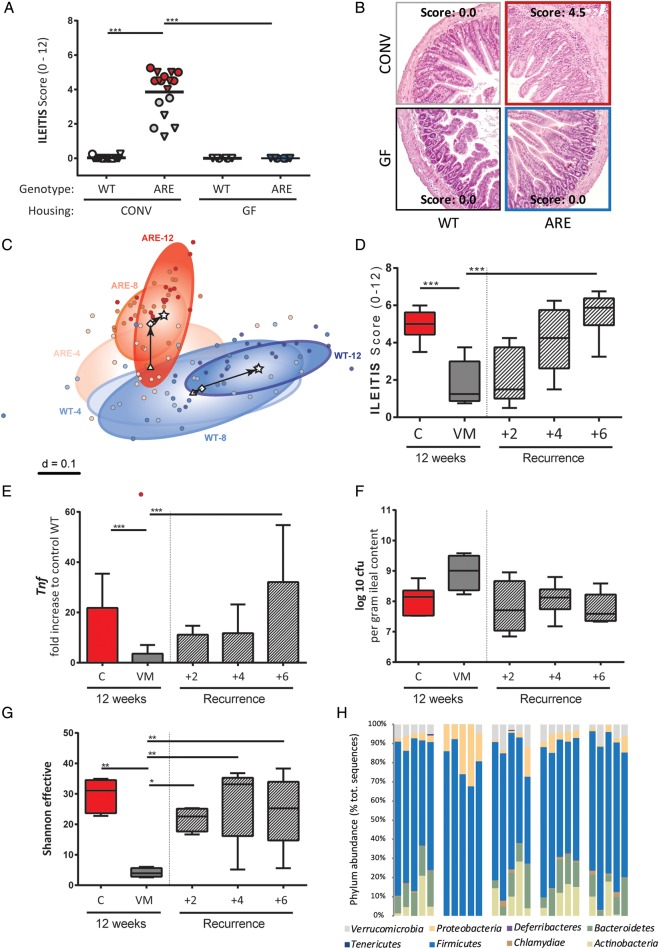
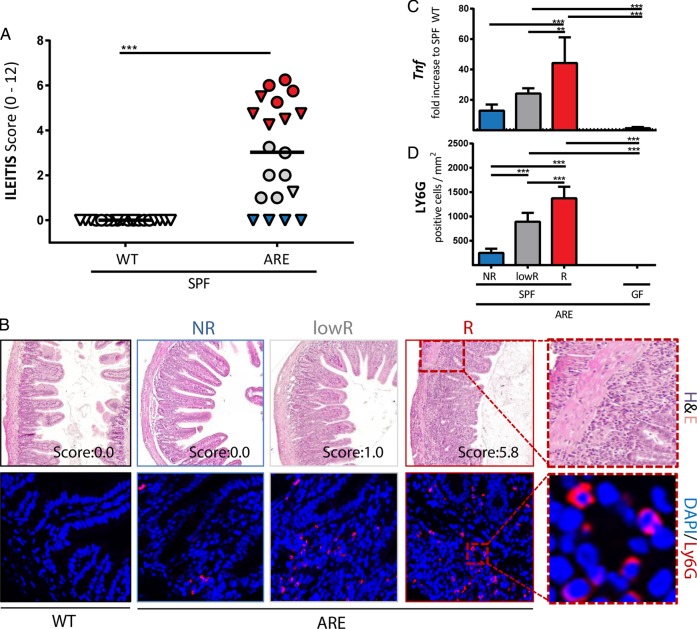
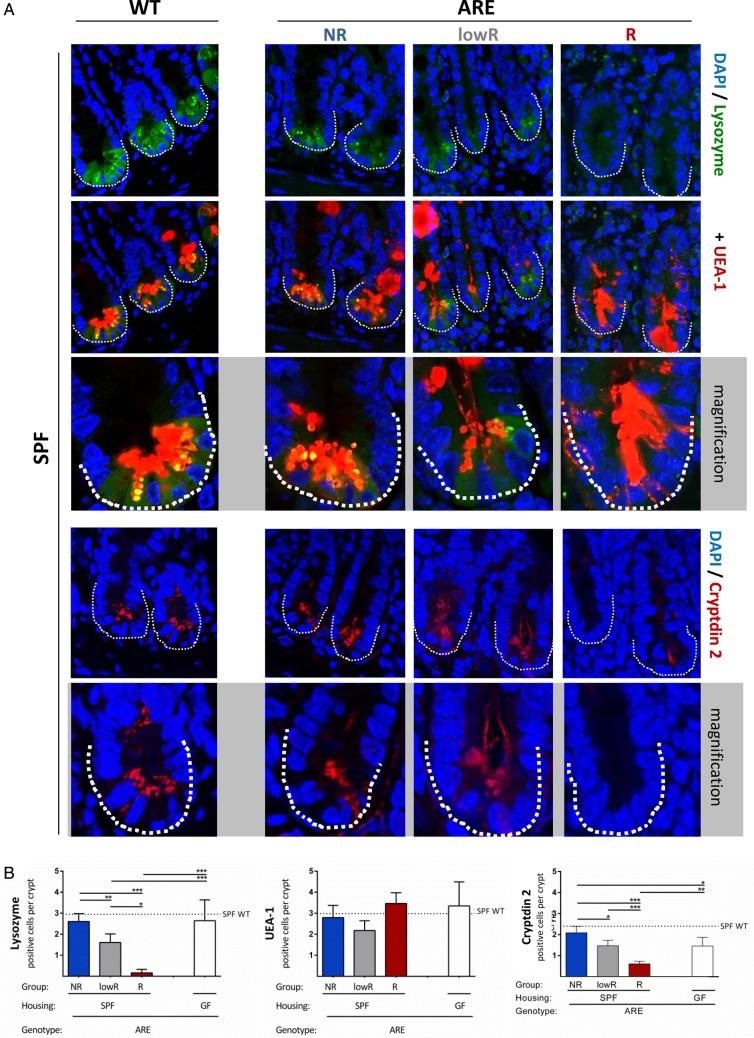
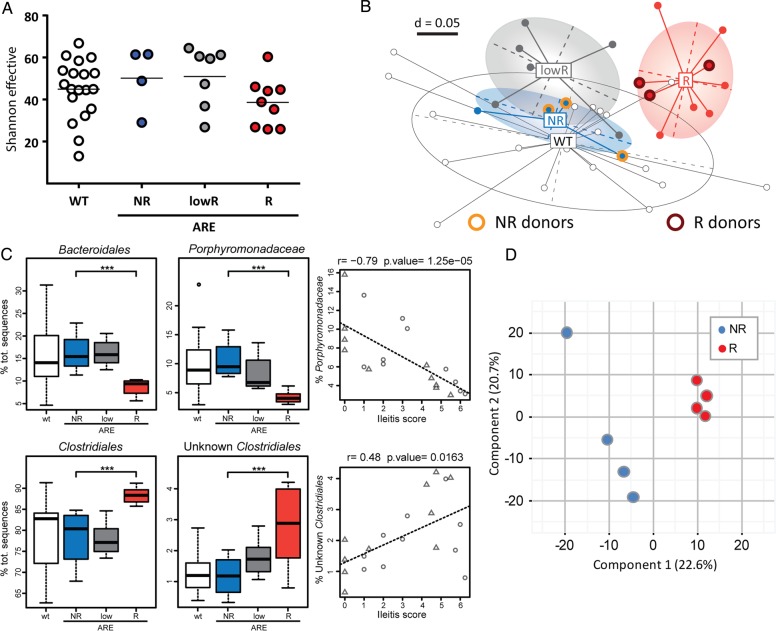
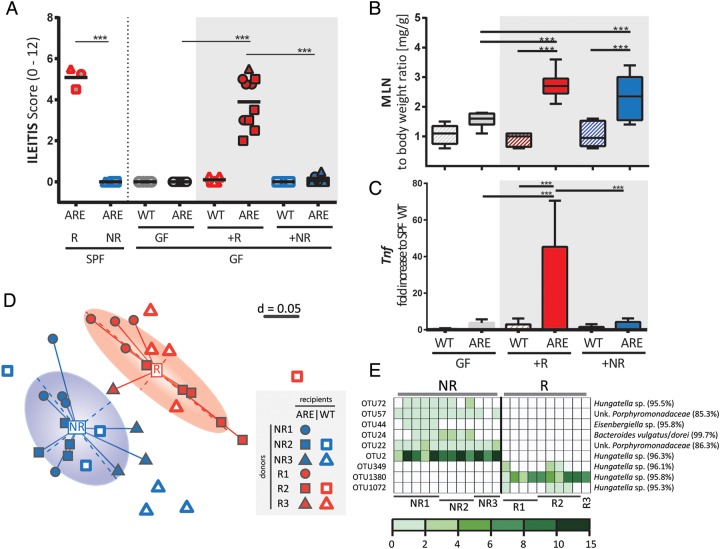
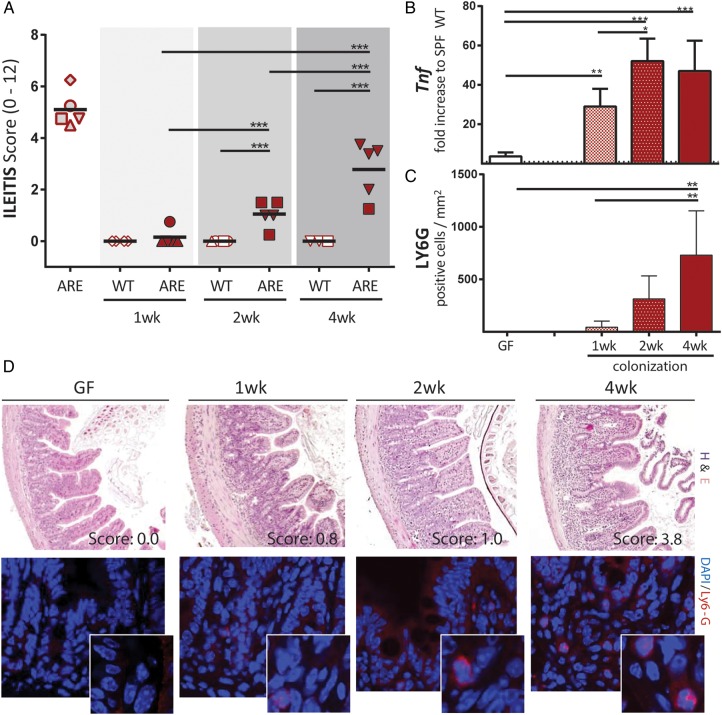
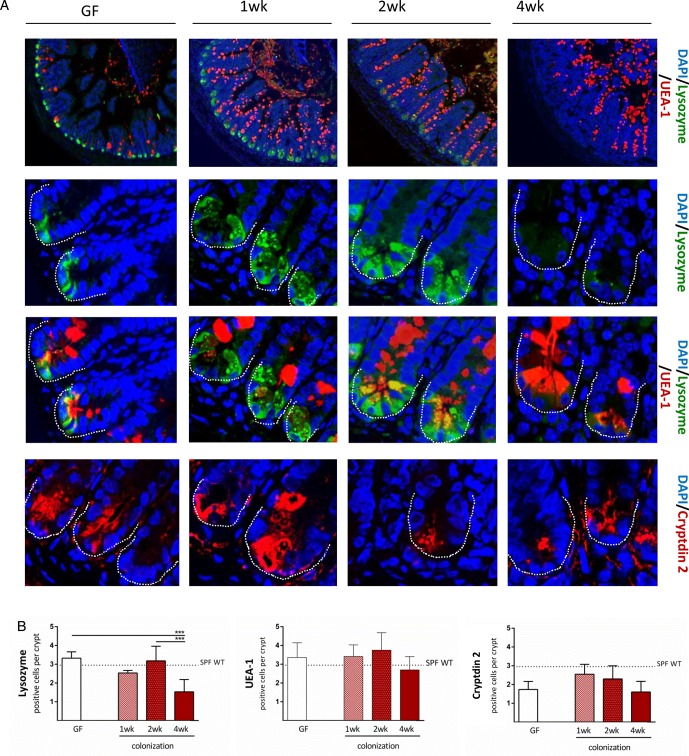
Objectives: Dysbiosis of the intestinal microbiota is associated with Crohn's disease (CD). Functional evidence for a causal role of bacteria in the development of chronic small intestinal inflammation is lacking. Similar to human pathology, TNF deltaARE mice develop a tumour necrosis factor (TNF)-driven CD-like transmural inflammation with predominant ileal involvement. Design: Heterozygous TNF deltaARE mice and wildtype (WT) littermates were housed under conventional (CONV), specific pathogen-free (SPF) and germ-free (GF) conditions. Microbial communities were analysed by high-throughput 16S ribosomal RNA gene sequencing. Metaproteomes were measured using LC-MS. Temporal and spatial resolution of disease development was followed after antibiotic treatment and transfer of microbial communities into GF mice. Granulocyte infiltration and Paneth cell function was assessed by immunofluorescence and gene expression analysis. Results: GF-TNF deltaARE mice were free of inflammation in the gut and antibiotic treatment of CONV-TNF deltaARE mice attenuated ileitis but not colitis, demonstrating that disease severity and location are microbiota-dependent. SPF-TNF deltaARE mice developed distinct ileitis-phenotypes associated with gradual loss of antimicrobial defence. 16S analysis and metaproteomics revealed specific compositional and functional alterations of bacterial communities in inflamed mice. Transplantation of disease-associated but not healthy microbiota transmitted CD-like ileitis to GF-TNF deltaARE recipients and triggered loss of lysozyme and cryptdin-2 expression. Monoassociation of GF-TNF deltaARE mice with the human CD-related Escherichia coli LF82 did not induce ileitis. Conclusions: We provide clear experimental evidence for the causal role of gut bacterial dysbiosis in the development of chronic ileal inflammation with subsequent failure of Paneth cell function.
Overview
The claims and statistics of this paper haven’t been checked yet.
Free: it reads the open-access text and checks the first 5 claims that cite a source we can check. Create a free account to check every claim.
Integrity signals
Registry
Cites
Statistics
Figures
Verification
Claims the paper makes
The claims and statistics of this paper haven’t been checked yet.
Free: it reads the open-access text and checks the first 5 claims that cite a source we can check. Create a free account to check every claim.
Claims other papers make about this one
Each is checked against this paper’s own text: does it say what the citing paper says it does?
The cited source says what the claim attributes to it.
In the citing paper
“transfer of disease-associated microbiota triggers CD-like inflammation in genetically susceptible GF recipient mice.163”
From Interaction between microbiota and immunity in health and disease (2020) · cites this paper as [163]
Self-check
Percentages, sums and reported differences re-computed from the paper’s own numbers.
The self-check needs the paper’s full text.
Citations
Cites
Analysis of Relative Gene Expression Data Using Real-Time Quantitative PCR and the 2−ΔΔCT Method
Livak, K. J., & Schmittgen, T. D. (2001) · Methods · doi:10.1006/meth.2001.1262 · Cited by 180,860
A human gut microbial gene catalogue established by metagenomic sequencing
MetaHIT Consortium, Qin, J., Li, R., Raes, J., Arumugam, M., Burgdorf, K. S., Manichanh, C., Nielsen, T., Pons, N., Levenez, F., et al. (2010) · Nature · doi:10.1038/nature08821 · Cited by 11,624
Host–microbe interactions have shaped the genetic architecture of inflammatory bowel disease
The International IBD Genetics Consortium (IIBDGC), Jostins, L., Ripke, S., Weersma, R. K., Duerr, R. H., McGovern, D. P., Hui, K. Y., Lee, J. C., Philip Schumm, L., Sharma, Y., et al. (2012) · Nature · doi:10.1038/nature11582 · Cited by 4,722
Frank, D. N., St. Amand, A. L., Feldman, R. A., Boedeker, E. C., Harpaz, N., & Pace, N. R. (2007) · Proceedings of the National Academy of Sciences · doi:10.1073/pnas.0706625104 · Cited by 4,611
Autophagy and Viruses: Adversaries or Allies?
Dong, X., & Levine, B. (2013) · Journal of Innate Immunity · doi:10.1159/000346388 · Cited by 4,430
Mutation of the mouse klotho gene leads to a syndrome resembling ageing
Kuro-o, M., Matsumura, Y., Aizawa, H., Kawaguchi, H., Suga, T., Utsugi, T., Ohyama, Y., Kurabayashi, M., Kaname, T., Kume, E., et al. (1997) · Nature · doi:10.1038/36285 · Cited by 3,837
Duodenal Infusion of Donor Feces for Recurrent Clostridium difficile
van Nood, E., Vrieze, A., Nieuwdorp, M., Fuentes, S., Zoetendal, E. G., de Vos, W. M., Visser, C. E., Kuijper, E. J., Bartelsman, J. F. W. M., Tijssen, J. G. P., et al. (2013) · New England Journal of Medicine · doi:10.1056/nejmoa1205037 · Cited by 3,708
Antimicrobial Autophagy: A Conserved Innate Immune Response in Drosophila
Moy, R. H., & Cherry, S. (2013) · Journal of Innate Immunity · doi:10.1159/000350326 · Cited by 3,539
The Treatment-Naive Microbiome in New-Onset Crohn’s Disease
Gevers, D., Kugathasan, S., Denson, L. A., Vázquez-Baeza, Y., Van Treuren, W., Ren, B., Schwager, E., Knights, D., Song, S. J., Yassour, M., et al. (2014) · Cell Host & Microbe · doi:10.1016/j.chom.2014.02.005 · Cited by 3,220 · cited 1×
“9 – 11 Changes in bacterial communities were shown to be shaped by Paneth cell (PC)-derived anti-microbial peptides.”
BackgroundFord Alexander, C., Paul, M., Hanauer Steven, B., 谭蓓, & Dong, W. Z. (2001) · Cited by 3,021
Cited by
Items 201–300 of 455
The emerging role of the microbiome in Alzheimer's disease
Wasén, C., Simonsen, E., Ekwudo, M. N., Profant, M. R., & Cox, L. M. (2022) · International review of neurobiology · doi:10.1016/bs.irn.2022.09.001 · Cited by 25
Interaction between gut microbiota and immunity in health and intestinal disease
Wang, Q., Meng, Q., Chen, Y., Liu, Y., Li, X., Zhou, J., Ma, Y., Yu, Z., & Chen, X. (2025) · Frontiers in Immunology · doi:10.3389/fimmu.2025.1673852 · Cited by 52
“Nonetheless, emerging evidence supports a contributory role for dysbiosis: Fecal microbiota transplantation from CD patients into germ-free mice harboring susceptibility genes triggers CD-like in fl ammation (131).”
Cuív, P. Ó., Begun, J., Keely, S., Lewindon, P. J., & Morrison, M. (2016) · Food & Function · doi:10.1039/c5fo01196e · Cited by 25
Interleukin-37 exacerbates experimental colitis in an intestinal microbiome-dependent fashion
Cong, J., Wu, D., Dai, H., Ma, Y., Liao, C., Li, L., Ye, L., & Huang, Z. W. (2022) · Theranostics · doi:10.7150/thno.69616 · Cited by 23
Modeling microbiota-associated human diseases: from minimal models to complex systems
Aguanno, D., Metwaly, A., Coleman, O. I., & Haller, D. (2022) · Microbiome Research Reports · doi:10.20517/mrr.2022.01 · Cited by 25
Self-citationSympathetic Innervation Modulates Mucosal Immune Homeostasis and Epithelial Host Defense
Mallesh, S., ten Hove, A. S., Schneider, R., Schneiker, B., Efferz, P., Kalff, J. C., de Jonge, W. J., & Wehner, S. (2022) · Cells · doi:10.3390/cells11162606 · Cited by 24
“In inflammatory bowel disease, the findings seem inconsistent, as some researchers observed an inflammationassociated increase [53,54], while others observed a decrease [55].”
BackgroundEnteric α-defensins on the verge of intestinal immune tolerance and inflammation
Filipp, D., Brabec, T., Vobořil, M., & Dobeš, J. (2018) · Seminars in Cell and Developmental Biology · doi:10.1016/j.semcdb.2018.01.007 · Cited by 25
The role of gut microbiota in lupus: what we know in 2018?
Ruíz, L., López, P., Suárez, A., Sánchez, B., & Margollés, A. (2018) · Expert Review of Clinical Immunology · doi:10.1080/1744666x.2018.1519395 · Cited by 25
Parenteral Nutrition, Inflammatory Bowel Disease, and Gut Barrier: An Intricate Plot
Covello, C., Becherucci, G., Di Vincenzo, F., Del Gaudio, A., Pizzoferrato, M., Cammarota, G., Gasbarrini, A., Scaldaferri, F., & Mentella, M. C. (2024) · Nutrients · doi:10.3390/nu16142288 · Cited by 21
“The transplantation of disease-associated microbiota transmitted the clinical symptoms of a CD-like ileitis to germ-free TNF (deltaARE) mice [77].”
BackgroundRosell‐Cardona, C., Amat, C., Griñán‐Ferré, C., Polo, J., Pallàs, M., Pérez‐Bosque, A., Moretó, M., & Miró, L. (2022) · Nutrients · doi:10.3390/nu14112211 · Cited by 26
“For instance, aging increased the abundance of the Erysipelotrichaceae family, and of the Johnsonella and Erysipelothrix genera, which are involved in inflammatory processes [50].”
BackgroundRodriguez, D. M., Hintze, K. J., Rompato, G., Wettere, A. J. V., Ward, R. E., Phatak, S., Neal, C., Armbrust, T., Stewart, E. C., Thomas, A. J., et al. (2022) · Nutrients · doi:10.3390/nu14245270 · Cited by 24
“observed a significant increase in Erysipelotrichaceae in mice that developed tumor necrosis factor (TNF)-driven CD-like transmural inflammation [58].”
BackgroundLi, S., Xu, K., Cheng, Y., Chen, L., Yi, A., Xiao, Z., Zhao, X., Chen, M., Tian, Y., Wei, M., et al. (2023) · Frontiers in Microbiology · doi:10.3389/fmicb.2023.1188455 · Cited by 29
Mesenchymal Stromal Cells: New Generation Treatment of Inflammatory Bowel Disease
Wei, S., Li, M., Wang, Q. L., Zhao, Y., Du, F., Chen, Y., Deng, S., Shen, J., Wu, K., Yang, J., et al. (2024) · Journal of Inflammation Research · doi:10.2147/jir.s458103 · Cited by 25
“42 Meanwhile, in another animal experiment investigating the effect of sugar on the pathogenesis of colitis, major alterations in the intestinal microbiota were discovered in mice fed sugar by short-term gavage.”
BackgroundBjörkqvist, O., Repsilber, D., Seifert, M., Brislawn, C., Jansson, J. K., Engstrand, L. G., Rangel, I., & Halfvarson, J. (2019) · Scandinavian Journal of Gastroenterology · doi:10.1080/00365521.2019.1599417 · Cited by 22
“genesis [3,4], it still remains to be determined whether the inflammation is induced by specific bacterial taxa, and the”
BackgroundSudhakar, P., Andrighetti, T., Verstockt, S., Caenepeel, C., Ferrante, M., Sabino, J., Verstockt, B., & Vermeire, S. (2022) · iScience · doi:10.1016/j.isci.2022.103963 · Cited by 22
Attia, H., ElBanna, S. A., Khattab, R. A., Farag, M. A., Yassin, A. S., & Aziz, R. K. (2023) · International Journal of Molecular Sciences · doi:10.3390/ijms241310691 · Cited by 21
“Family Erysipelotrichaceae (including genus Allobaculum) has been associated with inflammatory gastrointestinal disorders and higher levels of proinflammatory tumor necrosis factor [94,95].”
BackgroundChoi, S.-I., Shin, Y. C., Lee, J. S., Yoon, Y. C., Kim, J. M., & Sung, M. (2023) · Food & Function · doi:10.1039/d3fo00282a · Cited by 25
Microbiota as key factors in inflammatory bowel disease
White, Z., Cabrera, I., Kapustka, I., & Sano, T. (2023) · Frontiers in Microbiology · doi:10.3389/fmicb.2023.1155388 · Cited by 24
Exploring the Connections: Autophagy, Gut Microbiota, and Inflammatory Bowel Disease Pathogenesis
Subramanian, A., Jahabardeen, A., Thamaraikani, T., Kumarasamy, V., Begum, M. Y., Sekar, M., Subramaniyan, V., Wong, L. S., & Fatease, A. M. A. (2024) · Journal of Inflammation Research · doi:10.2147/jir.s483958 · Cited by 22
“23 As the field of microbiome research and autophagy’s role in immunity continues to evolve, so does our understanding of IBD’s pathogenesis, bringing us closer to a future where patients can find relief from this debilitating condition.”
Wong, E. O.-Y., Brownlie, E., Ng, K. M., Kathirgamanathan, S., Yu, F. B., Merrill, B. D., Huang, K. C., Martín, A., Tropini, C., & Navarre, W. W. (2022) · mBio · doi:10.1128/mbio.02949-21 · Cited by 22
Vijaya, A. K., Kuras, S., Šimoliūnas, E., Mingaila, J., Makovskytė, K., Buišas, R., Daliri, E. B., Meškys, R., Baltriukienė, D., & Burokas, A. (2024) · Brain Behavior and Immunity · doi:10.1016/j.bbi.2024.08.022 · Cited by 23
“HFD feeding promoted the growth of pro-inflammatory bacterial families such as Erysipelotrichaceae (Dinh et al., 2015; Schaubeck et al., 2016) and Lachnospiraceae (Bolte et al., 2021) and considering that HFD promotes gut permeability, the abundance of these bacteria may have contributed to the…”
Dysbiosis in Crohn's disease - Joint action of stochastic injuries and focal inflammation in the gut
Buttó, L. F., & Haller, D. (2017) · Gut Microbes · doi:10.1080/19490976.2016.1270810 · Cited by 22
“In contrast, microbiota derived from wild-type (WT) as well as from healthy but disease susceptible hosts (so-called non-responder, “NR,” or non-aggressive microbiota) is unable to trigger disease once transferred into GF TNF mice.(1) These results provide functional evidence that dynamic alterations of the microbial…”
BackgroundResultSelf-citationAhmed, N., Mahmoud, N., Solyman, S. M., & Hanora, A. (2019) · OMICS A Journal of Integrative Biology · doi:10.1089/omi.2019.0144 · Cited by 19
“…have a direct effect on human microbiome; intrinsic factors include health state, genetic factors, and the presence of chronic diseases (Chen et al., 2016; Costello et al., 2009; Nicholson et al., 2012; Qin et al., 2012; Schaubeck et al., 2016; Scher et al., 2012; Schroeder and Ba¨ckhed, 2016).”
Yang, Y., Cui, G., Qian, J., Xu, Y., Li, B., Shi, Y., Le, G., & Xie, Y. (2024) · Food Bioscience · doi:10.1016/j.fbio.2024.104255 · Cited by 20
Krela‐Kaźmierczak, I., Zakerska‐Banaszak, O., Skrzypczak-Zielińska, M., Łykowska‐Szuber, L., Szymczak‐Tomczak, A., Zawada, A. E., Rychter, A. M., Ratajczak, A. E., Skoracka, K., Skrzypczak, D., et al. (2022) · Nutrients · doi:10.3390/nu14122520 · Cited by 19
“Nevertheless, the transfer of dysbiotic bacteria to the healthy mice induces and develops inflammation [111].”
BackgroundTNF ΔARE Pigs: A Translational Crohn’s Disease Model
Winogrodzki, T., Metwaly, A., Grodziecki, A., Liang, W., Klinger, B., Flisikowska, T., Fischer, K., Flisikowski, K., Steiger, K., Haller, D., et al. (2023) · Journal of Crohn s and Colitis · doi:10.1093/ecco-jcc/jjad034 · Cited by 19
Self-citationPhage therapy in gut microbiome
Chen, X., Mendes, B. G., Alves, B. S., & Duan, Y. (2023) · Progress in molecular biology and translational science · doi:10.1016/bs.pmbts.2023.04.005 · Cited by 21
Mining gut microbiome oligopeptides by functional metaproteome display
Zantow, J., Just, S., Lagkouvardos, I., Kisling, S., Dübel, S., Lepage, P., Clavel, T., & Hust, M. (2016) · Scientific Reports · doi:10.1038/srep34337 · Cited by 21
Self-citationProteomic interrogation of the gut microbiota: potential clinical impact
Haange, S., & Jehmlich, N. (2016) · Expert Review of Proteomics · doi:10.1080/14789450.2016.1190652 · Cited by 18
Self-citationGloux, K., & Anba‐Mondoloni, J. (2016) · PLoS ONE · doi:10.1371/journal.pone.0148291 · Cited by 17
“Two different microbiota dysbioses have been observed: one preceding CD and another inducing chronic CD-like ileitis [12 – 15].”
Iliopoulou, L., & Kollias, G. A. (2021) · Mucosal Immunology · doi:10.1038/s41385-021-00433-3 · Cited by 22
Agrawal, G. K., Borody, T. J., & Aitken, J. M. (2024) · Digestive Diseases and Sciences · doi:10.1007/s10620-024-08508-4 · Cited by 17
“Dysbio-sis has also been observed, characterized by an imbalance in microbial composition and function with an increase in gram-negative organisms [8, 9].”
Kennedy, M. S., & Chang, E. B. (2025) · Journal of Clinical Investigation · doi:10.1172/jci193969 · Cited by 18
Effects of Qi-Fu-Yin on aging of APP/PS1 transgenic mice by regulating the intestinal microbiome
Xiao, Q., Ye, T., Wang, X., Qi, D., & Cheng, X. (2023) · Frontiers in Cellular and Infection Microbiology · doi:10.3389/fcimb.2022.1048513 · Cited by 18
“Alzheimer’s disease (AD) is one of the most common diseases in the elderly and is the most predominant type of dementia, with clinical manifestations of progressive memory loss and cognitive impairment (Atri, 2019; Scheltens et al., 2021).”
BackgroundUtilizing a reductionist model to study host-microbe interactions in intestinal inflammation
Tsou, A. M., Goettel, J. A., Bao, B., Biswas, A., Kang, Y. H., Redhu, N. S., Peng, K., Putzel, G., Saltzman, J. S., Kelly, R., et al. (2021) · Microbiome · doi:10.1186/s40168-021-01161-3 · Cited by 24
Wang, Z., Liu, H., Liu, J., Ren, X., Song, G., Xia, X., & Qin, N. (2021) · Foods · doi:10.3390/foods10122990 · Cited by 20
“infected with Toxoplasma gondii or Giardia muris or TNF-divern Crohn’s disease (CD)-like transmural inflammation [42,43].”
BackgroundZhao, H., Zhang, W., Cheng, D., You, L., Huang, Y., & Lu, Y. (2022) · Frontiers in Medicine · doi:10.3389/fmed.2022.1023896 · Cited by 19
“(59) have reported that compared with experimental mice, germ-free mice do not develop CDlike ileitis, suggesting that the microbiota would be necessary for the development of intestinal inflammation.”
BackgroundFischer, M., Bittar, M. N., Papa, E., Kassam, Z., & Smith, M. B. (2017) · Gut Microbes · doi:10.1080/19490976.2017.1283469 · Cited by 16
Comparative Metaproteomics to Study Environmental Changes
Surget, S. M., Jagtap, P. D., Griffin, T. J., Beraud, M., & Wattiez, R. (2017) · Elsevier eBooks · doi:10.1016/b978-0-08-102268-9.00017-3 · Cited by 22
Regulation of gut microbiota and alleviation of DSS-induced colitis by vitexin
Li, S., Luo, L., Wang, S., Sun, Q., Zhang, Y., Huang, K., & Guan, X. (2023) · European Journal of Nutrition · doi:10.1007/s00394-023-03237-2 · Cited by 16
“Other studies suggest that transferring gut microbiota from patients with IBD or mice with colitis to healthy mice can induce inflammation [14, 16].”
BackgroundGong, D., Yu, X., Wang, L., Kong, L., Gong, X., & Dong, Q. (2017) · BioMed Research International · doi:10.1155/2017/8102589 · Cited by 17
“mice, included a reduction of Bacteroidetes, and significantly attenuated the ileitis; however, the microbiota composition returned to pretreatment levels 2 weeks later, which was followed by the subsequently increased severity of inflammation [47].”
BackgroundMethodInfluentialInfluence of diet and dietary nanoparticles on gut dysbiosis
Jiang, Z., Jacob, J. A., Jian-yue, L., Wu, X., Wei, G., Arunprasanna, V., Mani, R., Nainangu, P., Rajadurai, U. M., & Chen, B. (2018) · Microbial Pathogenesis · doi:10.1016/j.micpath.2018.03.017 · Cited by 18
Convergence of External Crohn’s Disease Risk Factors on Intestinal Bacteria
Oberc, A. M., & Coombes, B. K. (2015) · Frontiers in Immunology · doi:10.3389/fimmu.2015.00558 · Cited by 19
Tsopmejio, I. S. N., Ding, M., Wei, J., Zhao, C., Jiang, Y., Li, Y., & Song, H. (2021) · Food Bioscience · doi:10.1016/j.fbio.2021.101426 · Cited by 21
Li, E., Wang, T., Zhou, R., Zhou, Z., Zhang, C., Wu, W., & He, K. (2021) · Journal of Functional Foods · doi:10.1016/j.jff.2021.104790 · Cited by 17
Wallen-Russell, C., Pearlman, N., Wallen-Russell, S., Cretoiu, D., Thompson, D. C., & Voinea, S. C. (2023) · Microorganisms · doi:10.3390/microorganisms11112784 · Cited by 14
“In the gut, decreased biodiversity precedes allergy onset [183–185] and triggers Crohn’s disease in mice [186].”
BackgroundZakerska‐Banaszak, O., Żuraszek-Szymańska, J., Eder, P., Ladziak, K., Słomski, R., & Skrzypczak-Zielińska, M. (2024) · International Journal of Molecular Sciences · doi:10.3390/ijms25179589 · Cited by 19
“Studies have revealed that in germ-free mice, a reduced amount of Th 17 cells, lymphocytes, and immunoglobulin (Ig) A in the intestinal mucosa was observed compared to the controls [10–12].”
BackgroundDysregulation of γδ intraepithelial lymphocytes precedes Crohn’s disease–like ileitis
Xu, W., Golovchenko, N. B., Martínez-Vargas, I. U., Fong, A., Rout, P., Achi, S. C., Bucar, E. B., Hsieh, J. J., Vidmar, K. J., Zhang, L., et al. (2025) · Science Immunology · doi:10.1126/sciimmunol.adk7429 · Cited by 17
Hernández-Juárez, L. E., Camorlinga, M., Méndez-Tenorio, A., Flores-Calderón, J., Huang, B. C., Bandoy, D. D. R., Weimer, B. C., & Torres, J. (2021) · Virulence · doi:10.1080/21505594.2021.1950955 · Cited by 15
Bovine lactoferrin and Crohn’s disease: a case study
Alexander, D. B., Iigo, M., Abdelgied, M., Ozeki, K., Tanida, S., Joh, T., Takahashi, S., & Tsuda, H. (2016) · Biochemistry and Cell Biology · doi:10.1139/bcb-2016-0107 · Cited by 14
The Role of Intestinal Microbiota and Immune System Interactions in Autoimmune Diseases
Yurtseven, B., Aydemir, E., & Ayaz, F. (2025) · ImmunoTargets and Therapy · doi:10.2147/itt.s569016 · Cited by 26
“88 Therapeutically, ImmunoTargets and Therapy 2025:14 https://doi.org/10.2147/ITT.S569016 1359 therapies aimed at restoring microbial homeostasis—probiotics, dietary fiber, or Fecal Microbiota Transplantation (FMT)— have been successfully demonstrated to alleviate symptoms and reduce inflammation…”
InfluentialKelly, C., Jawahar, J., Davey, L. E., Everitt, J. I., Galanko, J. A., Anderson, C., Avendano, J. E., McCann, J. R., Sartor, R. B., Valdivia, R. H., et al. (2023) · mBio · doi:10.1128/mbio.01504-23 · Cited by 17
S1PR1 regulates lymphatic valve development and tertiary lymphoid organ formation in the ileum
Geng, X., Chen, L., Ahmed, Z., Formigari, G. P., Ho, Y., Gaudio, I. D., Dátilo, M. N., Azartash-Namin, Z. J., Heron, C., Shan, X., et al. (2025) · The Journal of Experimental Medicine · doi:10.1084/jem.20241799 · Cited by 18
“Microbiota dysbiosis was also observed in mouse models of ileitis (Lamas et al., 2016; Petnicki-Ocwieja et al., 2009; Schaubeck et al., 2016).”
Sterile triggers drive joint inflammation in TNF‐ and IL‐1β‐dependent mouse arthritis models
Thiran, A., Πέττα, Ι., Blancke, G., Thorp, M., Planckaert, G., Jans, M., Andries, V., Barbry, K., Gilis, E., Coudenys, J., et al. (2023) · EMBO Molecular Medicine · doi:10.15252/emmm.202317691 · Cited by 13
“Previous studies have shown that TNF D ARE mice are characterized by microbial dysbiosis, and that intestinal inflammation is microbiota-dependent (Roulis et al , 2016; Schaubeck et al , 2016).”
Zhu, Y., Jiang, Y., Du, X., Zhu, X., Zhou, L., Niu, Y., Liu, C., Kan, H., & Chen, R. (2025) · Environment & Health · doi:10.1021/envhealth.5c00032 · Cited by 14
Gelmez, E., Lehr, K., Kershaw, O., Frentzel, S., Vilchez‐Vargas, R., Bank, U., Link, A., Schüler, T., Jeron, A., & Bruder, D. (2022) · Biomedicines · doi:10.3390/biomedicines10081903 · Cited by 13
“To date, IBD is believed to be a multi-causal disease with many influential factors including genetic and immunological predisposition, dietary and microbial gut flora composition [3].”
BackgroundSatka, S., Frýbortová, V., Zapletalová, I., Anzenbacher, P., Anzenbacherová, E., Kozáková, H., Šrůtková, D., Hudcovic, T., & Jourová, L. (2022) · International Journal of Molecular Sciences · doi:10.3390/ijms231911627 · Cited by 14
“Lines of evidence point to the finding that particularly the microorganisms living in the gut seem to play an essential role in the pathogenesis of UC [2,3].”
BackgroundThe TNF∆ARE Model of Crohn’s Disease-like Ileitis
Metwaly, A., & Haller, D. (2023) · Inflammatory Bowel Diseases · doi:10.1093/ibd/izad205 · Cited by 15
Self-citationDysregulated NOX1-NOS2 activity as hallmark of ileitis in mice
Rochelle, J. D. L., Ward, J. K., Stenke, E., Yin, Y., Matsumoto, M., Jennings, R., Aviello, G., & Knaus, U. G. (2024) · Mucosal Immunology · doi:10.1016/j.mucimm.2024.08.012 · Cited by 14
Chronic TNFα-driven injury delays cell migration to villi in the intestinal epithelium
Muraro, D., Parker, A., Vaux, L., Filippi, S., Almet, A. A., Fletcher, A. G., Watson, A. J. M., Pin, C., Maini, P. K., & Byrne, H. M. (2018) · Journal of The Royal Society Interface · doi:10.1098/rsif.2018.0037 · Cited by 12
“[24] Schaubeck M, Clavel T, Calasan J, Lagkouvardos I, Haange SB et al.”
BackgroundRetinoic Acid Signaling Is Compromised in DSS-Induced Dysbiosis
Li, Y., Sheng, L., Jena, P. K., Gilbert, M. C., Wan, Y. Y., & Mao, H. (2022) · Nutrients · doi:10.3390/nu14142788 · Cited by 12
“In addition, the expansion of Erysipelotrichaceae in mice with chronic ileal inflammation has also been observed [57].”
BackgroundAlaba, T., Holman, J. M., Ishaq, S. L., & Li, Y. (2024) · Current Developments in Nutrition · doi:10.1016/j.cdnut.2024.102160 · Cited by 15
“In UC, pathogenic microbiota can initiate IBD-like in fl ammation in germ-free mice [52,54], and some bacterial species of Clostridium, Escherichia coli, and Shigella fl exneri can induce pathogenicity of commensals in the early development of IBD [55].”
BackgroundDazıroğlu, M. E. Ç., Tek, N. A., Akdulum, M. F. C., Yılmaz, C., & Yalınay, A. M. (2024) · Food Science & Nutrition · doi:10.1002/fsn3.4212 · Cited by 15
“In addition, in mice that developed transmural inflammation similar to another disease, TNF-induced Crohn's disease, the authors reported significant increases in Erysipelotrichaceae abundance (Schaubeck et al., 2016).”
BackgroundNew thoughts on the gut–immune axis of arthritis
Thiran, A., & Vereecke, L. (2025) · Trends in Immunology · doi:10.1016/j.it.2025.01.006 · Cited by 14
Julien, C., Anakok, E., Tréton, X., Nachury, M., Nancey, S., Buisson, A., Fuméry, M., Filippi, J., Maggiori, L., Panis, Y. H., et al. (2022) · Journal of Crohn s and Colitis · doi:10.1093/ecco-jcc/jjac026 · Cited by 16
El‐Deeb, O. S., El‐Esawy, R. O., Eltokhy, A. K., Alshenawy, H. A., Ghanem, H. B., Rizk, F. H., Barhoma, R. A., Shalaby, R. H., Abdelsattar, A. M., Mashal, S. S. A., et al. (2023) · International Journal of Molecular Sciences · doi:10.3390/ijms24032711 · Cited by 12
“Additionally, colitis is exacerbated by the colonization of the intestine of the mouse microbiota from persons who have an IBD by changing the immune responses, as well as by the transfer of pro-inflammatory microbiota or bacteria from sick to normal mice, which can cause inflammation [9,10].”
BackgroundCipelli, M., da Silva, E. M., & Câmara, N. O. S. (2023) · Current Clinical Microbiology Reports · doi:10.1007/s40588-023-00207-4 · Cited by 12
Microbial Colonization in Adulthood Shapes the Intestinal Macrophage Compartment
Schmidt, F., Dahlke, K., Batra, A., Keye, J., Wu, H., Friedrich, M., Glauben, R., Ring, C., Loh, G., Schaubeck, M., et al. (2019) · Journal of Crohn s and Colitis · doi:10.1093/ecco-jcc/jjz036 · Cited by 12
Self-citationBerkowitz, L., Pardo‐Roa, C., Ramírez, G., Vallejos, O. P., Sebastián, V. P., Riedel, C. A., Álvarez-Lobos, M., & Bueno, S. M. (2019) · PLoS ONE · doi:10.1371/journal.pone.0221618 · Cited by 13
Parker, C., Zhao, J., Pearce, D. A., & Kovács, A. (2020) · Archives of Microbiology · doi:10.1007/s00203-020-02007-6 · Cited by 11
Wang, J., Shen, Y., Li, L., Li, L., Zhang, J., Li, M., & Qiu, F. (2024) · The Journal of Nutritional Biochemistry · doi:10.1016/j.jnutbio.2024.109777 · Cited by 12
Zhao, B., Zhou, H., Lin, K., Xu, J., Zhou, B., Xie, D., Ma, J., Yang, L., Su, C., & Yang, L. (2025) · MedComm · doi:10.1002/mco2.70085 · Cited by 12
Scarlata, G. G. M., Morano, D., Ismaiel, A., Spagnuolo, R., Luzza, F., Dumitrascu, D. L., & Abenavoli, L. (2025) · Current Issues in Molecular Biology · doi:10.3390/cimb47100847 · Cited by 13
“[46]”
Cai, Q., Song, Y., Wang, S., Wang, W., Sun, X., Yu, J., & Wei, Y. (2022) · Journal of Food Biochemistry · doi:10.1111/jfbc.14248 · Cited by 11
Bacterial Quorum-Sensing Molecules in Serum: A Potential Tool for Crohn's Disease Management
O'Connor, G., Quintero, M. A., Deo, S. K., Abreu, M. T., & Daunert, S. (2022) · Clinical and Translational Gastroenterology · doi:10.14309/ctg.0000000000000547 · Cited by 10
“The microbiome playsa criticalrole in the initiation and perpetuation of intestinal in fl ammation in patients with CD (3).”
Liu, A., Li, C., Wang, C., Liang, X., & Zhang, X. (2023) · Current Stem Cell Research & Therapy · doi:10.2174/011574888x250413230920051715 · Cited by 11
Lu, X., Xv, Y., Hu, W., Sun, B., & Hu, H. (2025) · Frontiers in Cellular and Infection Microbiology · doi:10.3389/fcimb.2025.1557331 · Cited by 9
Mims, B. M., Enriquez, J., dos Santos, A. P., Jones‐Hall, Y., Dowd, S. E., Furr, K. L., & Grisham, M. B. (2021) · PLoS ONE · doi:10.1371/journal.pone.0254845 · Cited by 9
Teng, C., Ma, K., Ma, K., Feng, J., Xu, L., & Li, Y. (2023) · Food Bioscience · doi:10.1016/j.fbio.2023.103191 · Cited by 10
Inflammatory Bowel Disease: Influence and Implications in Reproduction
Glover, L. E., Fennimore, B. P., & Wingfield, M. B. (2016) · Inflammatory Bowel Diseases · doi:10.1097/mib.0000000000000884 · Cited by 9
“function in germ-free TNFDARE mice, whereas antibiotic treatment reduced disease severity and relapse of established ileitis.(84) Gut microbiome profiling studies revealed that prenatal methyl donor exposure induces significant shifts in microbial diversity.”
BackgroundZhang, S., Lin, G., Han, J., Lin, Y., Wang, F., Lu, D., Xie, J., & Zhao, J. (2022) · Animals · doi:10.3390/ani12162155 · Cited by 12
Marcos-Fernández, R., Riestra, S., Alonso‐Arias, R., Ruíz, L., Sánchez, B., & Margollés, A. (2023) · Microbiology Spectrum · doi:10.1128/spectrum.01817-22 · Cited by 11
Dietary phosphate disturbs of gut microbiome in mice
Oda, N., Sugihara, K., Uebanso, T., Ohminami, H., Ohnishi, K., Masuda, M., Yamanaka‐Okumura, H., & Taketani, Y. (2023) · Journal of Clinical Biochemistry and Nutrition · doi:10.3164/jcbn.23-9 · Cited by 12
“(23,32,33) These reports suggest that Erysipelotrichaceae is related to inflammation in the gastroin‐ testinal tract.”
BackgroundDistinct roles for B cell-derived LTα3 and LTα1β2 in TNF-mediated ileitis
Erlich, E. C., Alayo, Q. A., Kim, A., Han, J., Mintz, R. L., Huckstep, C. G., Ruiz, H. S., Field, R. L., Dunning, T. J., Saleh, L. S., et al. (2025) · Nature Immunology · doi:10.1038/s41590-025-02263-y · Cited by 9
“Increased tumor necrosis factor (TNF), whose expression is initiated by signals from the microbiome, promotes ileitis 9–11 .”
La, C., de de Toeuf, B., Bindels, L. B., Maele, L. V., Assabban, A., Melchior, M., Smout, J., Köhler, A., Nguyen, M., Thomas, S., et al. (2020) · Mucosal Immunology · doi:10.1038/s41385-020-0302-x · Cited by 9
Shifts in the seagrass leaf microbiome associated with wasting disease in Zostera muelleri
Hurtado-McCormick, V., Krix, D. W., Tschitschko, B., Siboni, N., Ralph, P. J., & Seymour, J. R. (2021) · Marine and Freshwater Research · doi:10.1071/mf20209 · Cited by 8
Bacterial Characteristics of Intestinal Tissues From Patients With Crohn’s Disease
Sun, D., Ge, X., Tang, S., Liu, Y., Sun, J., Zhou, Y., Luo, L., Xu, Z., Zhou, W. M., & Sheng, J. (2021) · Frontiers in Cellular and Infection Microbiology · doi:10.3389/fcimb.2021.711680 · Cited by 9
Colitis and Colorectal Carcinogenesis: The Focus on Isolated Lymphoid Follicles
Műzes, G., Barta, B. B., & Sípos, F. (2022) · Biomedicines · doi:10.3390/biomedicines10020226 · Cited by 9
“The temporal onset of arthritis correlates with luminal dysbiosis and the development of intestinal TLOs in a TNF-transgenic model of CD and polyarthritis [86,87].”
BackgroundCellular Carcinogenesis: Role of Polarized Macrophages in Cancer Initiation
Undi, R. B., Filiberti, A., Ali, N., & Huycke, M. M. (2022) · Cancers · doi:10.3390/cancers14112811 · Cited by 9
Zhang, P., Minardi, L. M., Kuenstner, J. T., Zekan, S. M., Zhu, F., Hu, Y., & Kruzelock, R. (2017) · bioRxiv (Cold Spring Harbor Laboratory) · doi:10.1101/116574 · Cited by 9
Ye, Z., Kini, A., Tan, Q., Woltemate, S., Vital, M., Nikolovska, K., & Seidler, U. E. (2025) · The Journal of Nutritional Biochemistry · doi:10.1016/j.jnutbio.2025.109847 · Cited by 9
Xu, J., Lao, Y., Zhang, W., Chen, L., Zhang, H., Liu, H., Yan, T., Huang, R., Xu, Y., Ye, L., et al. (2025) · The Journal of Nutritional Biochemistry · doi:10.1016/j.jnutbio.2025.110069 · Cited by 11
Newman, K. L., Standke, A. K., James, G., Vendrov, K. C., Inohara, N., Bergin, I. L., Higgins, P., Rao, K., Young, V. B., & Kamada, N. (2025) · Gut Microbes · doi:10.1080/19490976.2025.2604875 · Cited by 8
“21,38,39 Therefore, we tested whether IBD microbiotas propagated in MBRAs retained the same functional features as the original samples.”
A Focus on Microbiome Completeness and Optimized Colonization Resistance in Neonatology
Dietert, R. R. (2018) · NeoReviews · doi:10.1542/neo.19-2-e78 · Cited by 8
Intestinal microbiota dysbiosis contributes to the liver damage in subchronic arsenic-exposed mice
Dong, L., Luo, P., & Zhang, A. (2024) · Acta Biochimica et Biophysica Sinica · doi:10.3724/abbs.2024131 · Cited by 8
Chu, F., Esworthy, R. S., Shen, B., & Doroshow, J. H. (2020) · MicrobiologyOpen · doi:10.1002/mbo3.1107 · Cited by 6
In inflammatory bowel disease and extraintestinal manifestations: What role does microbiome play?
Shen, Y., Zhu, H., Zhou, L., Zheng, Y.-Q., Zhang, Z., Xie, Y., Liu, Z., Peng, C., Wang, L., Zhao, C., et al. (2023) · Engineered Regeneration · doi:10.1016/j.engreg.2023.04.005 · Cited by 14
Decision-Making and Credition Under a Microbial Perspective
Berg, G., & Sensen, M. (2017) · New approaches to the scientific study of religion · doi:10.1007/978-3-319-50924-2_32 · Cited by 6
The Gut Microbial Profile of Preclinical Crohn’s Disease Is Similar to That of Healthy Controls
Kuballa, A., Geraci, M., Johnston, M., & Sorrentino, D. R. (2020) · Inflammatory Bowel Diseases · doi:10.1093/ibd/izaa072 · Cited by 7
Modeling microbe-host interaction in the pathogenesis of Crohn’s disease
Ahmed, M., Metwaly, A., & Haller, D. (2021) · International Journal of Medical Microbiology · doi:10.1016/j.ijmm.2021.151489 · Cited by 9
Self-citation
Metadata
- Authors
- Schaubeck, M., Clavel, T., Calasan, J., Lagkouvardos, I., Haange, S. B., Jehmlich, N., Basic, M., Dupont, A., Hornef, M., Bergen, M. V., Bleich, A., & Haller, D.
- Affiliations
- Technical University of Munich (DE)
- Chair of Nutrition and Immunology, Technische Universität München, Freising-Weihenstephan, Germany
- Helmholtz Centre for Environmental Research (DE)
- RWTH Aachen University (DE)
- Medizinische Hochschule Hannover (DE)
- Department of Proteomics, Helmholtz-Centre for Environmental Research—UFZ, Leipzig, Germany
- Corresponding author
- Haller, Dirk
- ORCID
- Venue
- Gut
- Publisher
- BMJ
- Published
- 2015-04-17
- Volume
- 65
- Issue
- 2
- Pages
- 225-237
- ISSN
- 0017-5749 (ISSN-L)
- 1468-3288
- PMC
- PMC4752651
- OpenAlex
- W1980475824
- Cited by
- 447
- References
- 75
- Citations by year
- 2026: 29 · 2025: 43 · 2024: 38 · 2023: 36 · 2022: 52 · 2021: 55 · 2020: 32 · 2019: 40 · 2018: 32 · 2017: 46 · 2016: 31 · 2015: 13
- FWCI
- 17.64
- Type
- journal article
- Language
- en
- Open access
- hybrid
- doi.org
- Licence
- cc-by-nc
- Locations
- Gut (publishedVersion, cc-by-nc)
- Europe PMC (PubMed Central) (publishedVersion, cc-by-nc)
- PubMed Central (publishedVersion, cc-by-nc)
- VBN Forskningsportal (Aalborg Universitet) (publishedVersion, cc-by-nc)
- PubMed (publishedVersion)
- HighWire Press Open Archive (submittedVersion)
- RWTH Publications (RWTH Aachen) (submittedVersion)
- Funders
- Deutsche Forschungsgemeinschaft (SPP-1656)
- Helmholtz-Zentrum für Umweltforschung
- European Regional Development Fund
- Topics
- Life Sciences › Biochemistry, Genetics and Molecular Biology › Molecular Biology › Gut microbiota and health
- Health Sciences › Medicine › Gastroenterology › Inflammatory Bowel Disease
- Health Sciences › Medicine › Gastroenterology › Gastrointestinal motility and disorders
- Keywords
- Crohn's disease, ileitis, gut dysbiosis, germ-free mice, specific pathogen-free mice, microbiota transplantation, Paneth cells, lysozyme, antimicrobial defense, antibiotic therapy, small bowel inflammation, metaproteomics
- MeSH terms
- Animals, Anti-Bacterial Agents, Colitis, Crohn Disease, Germ-Free Life, Ileitis, Inflammation, Intestines, Tumor Necrosis Factor-alpha, Fluoroimmunoassay, Mice, Microbiota, Dysbiosis
About these checks
Registry, retraction, Cites and statistics results are computed, not judged, with one exception: a printed reference that no index lists is read once by a model before it counts as a citation error. Claims are extracted by a model and kept only when their quote appears verbatim in the text; each cited source is then checked, with a model’s help, for whether it says what the claim relies on. Those verdicts can be wrong — read the claim’s quote and the cited source before relying on one.
Statistics and arithmetic are recomputed, not judged.
Confidence bands are shown only for fields calibrated on our annotated test set. None is calibrated yet, so no band is shown.
What counts as a claim ›How we measure confidence ›How we check this ›
Are you an author, or do you see a problem with this page? Request a review
Data sources
Bibliographic data: Semantic Scholar, OpenAlex, Crossref.
Contains information from the Semantic Scholar Academic Graph Datasets, made available under the ODC Attribution License (ODC-BY 1.0).
Semantic Scholar’s data is described in: Kinney, R., et al. (2023). The Semantic Scholar Open Data Platform. arXiv:2301.10140.
