

Dysbiotic gut microbiota causes transmissible Crohn's disease-like ileitis independent of failure in antimicrobial defence
Open accessThe DOI matches its Crossref record; 75 of the 75 references it cites were found in a registry or an index.
Abstract
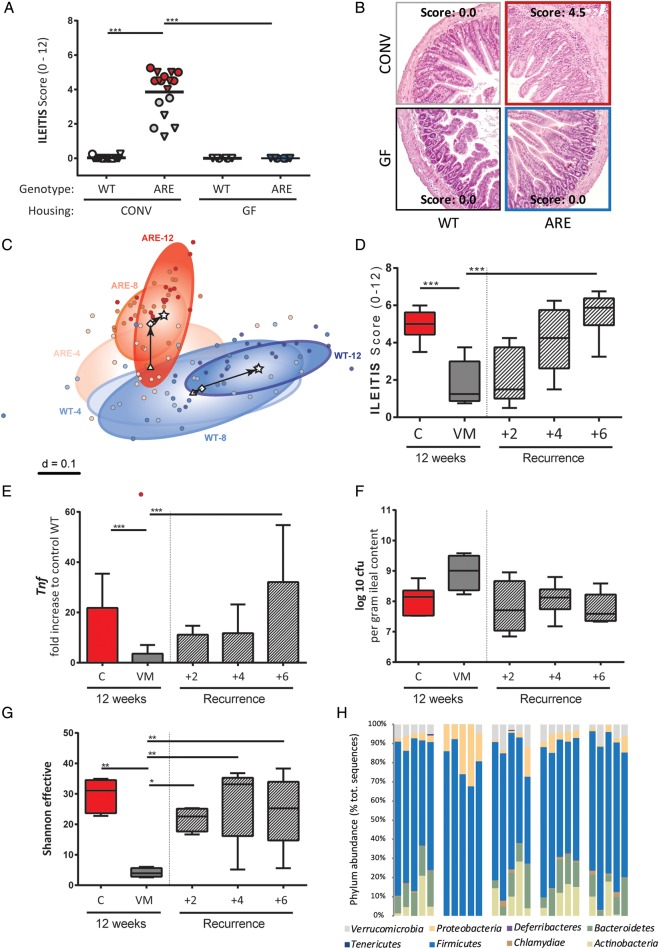
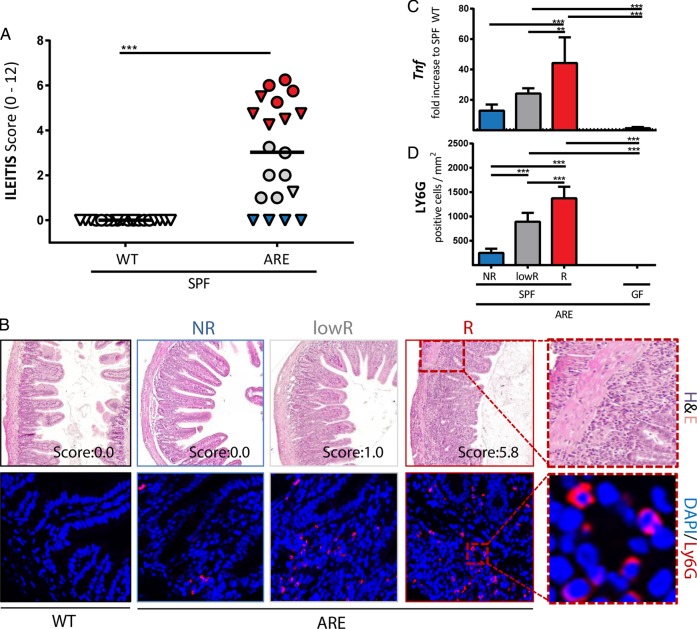
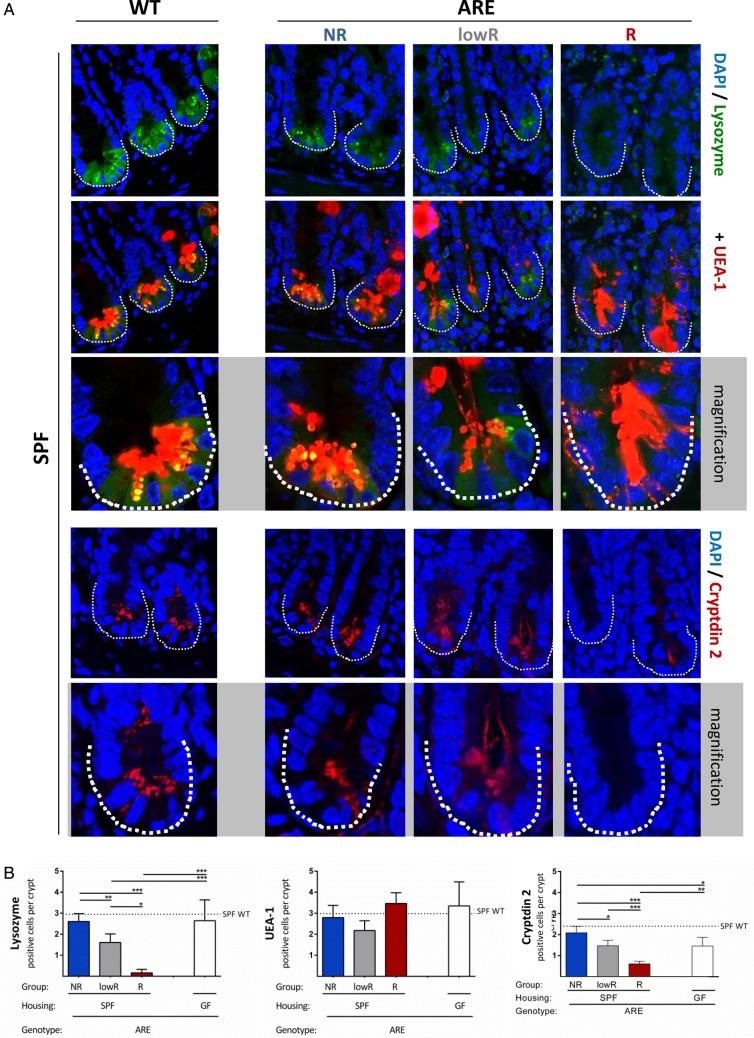
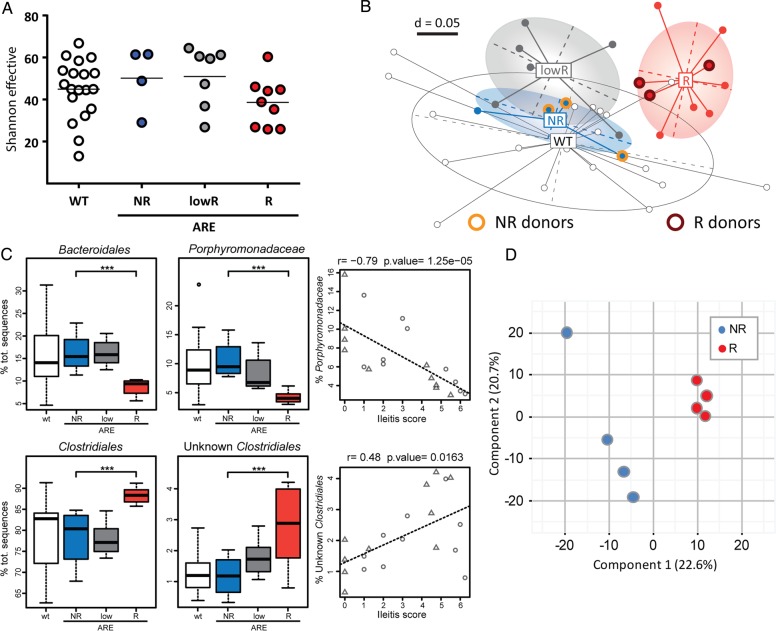
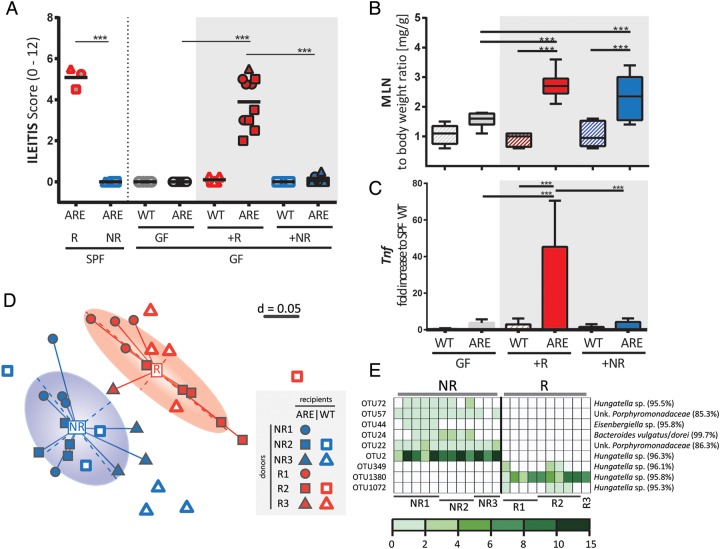
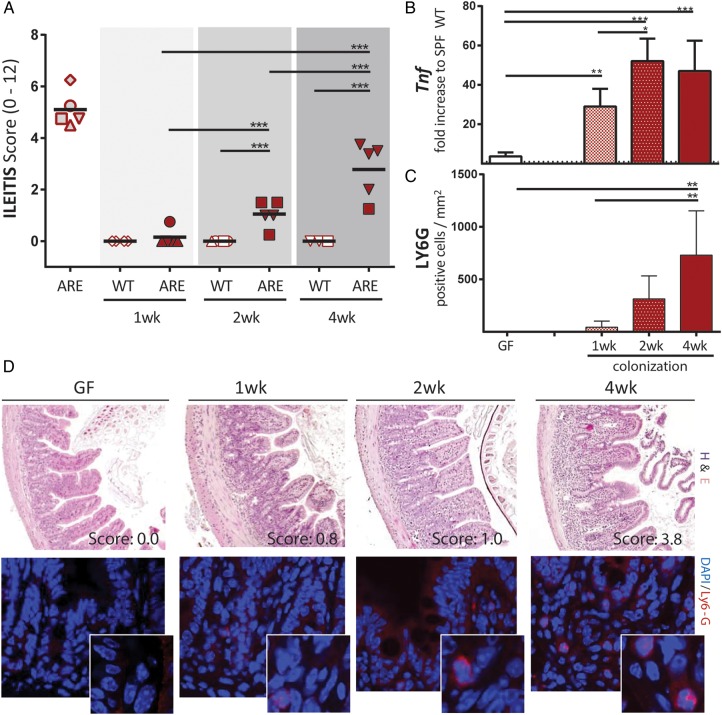
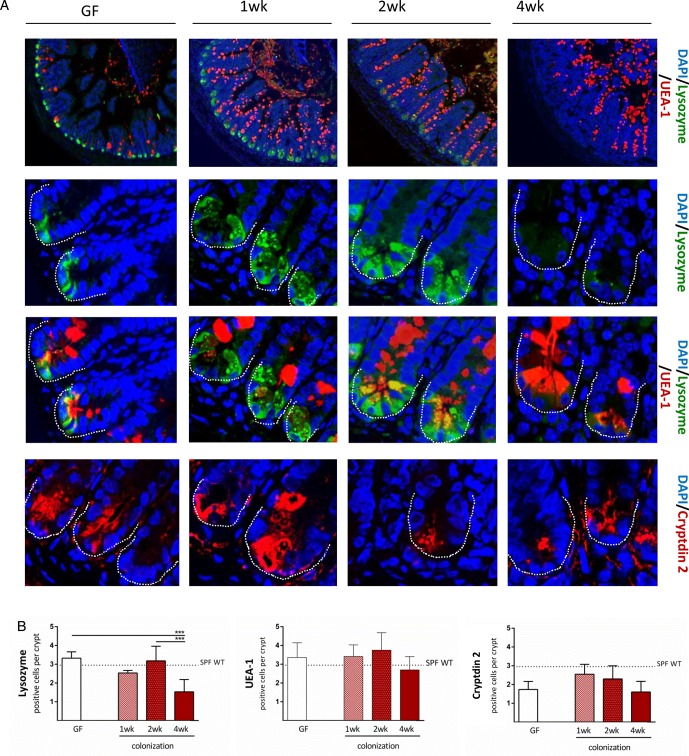
Objectives: Dysbiosis of the intestinal microbiota is associated with Crohn's disease (CD). Functional evidence for a causal role of bacteria in the development of chronic small intestinal inflammation is lacking. Similar to human pathology, TNF deltaARE mice develop a tumour necrosis factor (TNF)-driven CD-like transmural inflammation with predominant ileal involvement. Design: Heterozygous TNF deltaARE mice and wildtype (WT) littermates were housed under conventional (CONV), specific pathogen-free (SPF) and germ-free (GF) conditions. Microbial communities were analysed by high-throughput 16S ribosomal RNA gene sequencing. Metaproteomes were measured using LC-MS. Temporal and spatial resolution of disease development was followed after antibiotic treatment and transfer of microbial communities into GF mice. Granulocyte infiltration and Paneth cell function was assessed by immunofluorescence and gene expression analysis. Results: GF-TNF deltaARE mice were free of inflammation in the gut and antibiotic treatment of CONV-TNF deltaARE mice attenuated ileitis but not colitis, demonstrating that disease severity and location are microbiota-dependent. SPF-TNF deltaARE mice developed distinct ileitis-phenotypes associated with gradual loss of antimicrobial defence. 16S analysis and metaproteomics revealed specific compositional and functional alterations of bacterial communities in inflamed mice. Transplantation of disease-associated but not healthy microbiota transmitted CD-like ileitis to GF-TNF deltaARE recipients and triggered loss of lysozyme and cryptdin-2 expression. Monoassociation of GF-TNF deltaARE mice with the human CD-related Escherichia coli LF82 did not induce ileitis. Conclusions: We provide clear experimental evidence for the causal role of gut bacterial dysbiosis in the development of chronic ileal inflammation with subsequent failure of Paneth cell function.
Overview
The claims and statistics of this paper haven’t been checked yet.
Free: it reads the open-access text and checks the first 5 claims that cite a source we can check. Create a free account to check every claim.
Integrity signals
Registry
Cites
Statistics
Figures
Verification
Claims the paper makes
The claims and statistics of this paper haven’t been checked yet.
Free: it reads the open-access text and checks the first 5 claims that cite a source we can check. Create a free account to check every claim.
Claims other papers make about this one
Each is checked against this paper’s own text: does it say what the citing paper says it does?
The cited source says what the claim attributes to it.
In the citing paper
“transfer of disease-associated microbiota triggers CD-like inflammation in genetically susceptible GF recipient mice.163”
From Interaction between microbiota and immunity in health and disease (2020) · cites this paper as [163]
Self-check
Percentages, sums and reported differences re-computed from the paper’s own numbers.
The self-check needs the paper’s full text.
Citations
Cites
Analysis of Relative Gene Expression Data Using Real-Time Quantitative PCR and the 2−ΔΔCT Method
Livak, K. J., & Schmittgen, T. D. (2001) · Methods · doi:10.1006/meth.2001.1262 · Cited by 180,860
A human gut microbial gene catalogue established by metagenomic sequencing
MetaHIT Consortium, Qin, J., Li, R., Raes, J., Arumugam, M., Burgdorf, K. S., Manichanh, C., Nielsen, T., Pons, N., Levenez, F., et al. (2010) · Nature · doi:10.1038/nature08821 · Cited by 11,624
Host–microbe interactions have shaped the genetic architecture of inflammatory bowel disease
The International IBD Genetics Consortium (IIBDGC), Jostins, L., Ripke, S., Weersma, R. K., Duerr, R. H., McGovern, D. P., Hui, K. Y., Lee, J. C., Philip Schumm, L., Sharma, Y., et al. (2012) · Nature · doi:10.1038/nature11582 · Cited by 4,722
Frank, D. N., St. Amand, A. L., Feldman, R. A., Boedeker, E. C., Harpaz, N., & Pace, N. R. (2007) · Proceedings of the National Academy of Sciences · doi:10.1073/pnas.0706625104 · Cited by 4,611
Autophagy and Viruses: Adversaries or Allies?
Dong, X., & Levine, B. (2013) · Journal of Innate Immunity · doi:10.1159/000346388 · Cited by 4,430
Mutation of the mouse klotho gene leads to a syndrome resembling ageing
Kuro-o, M., Matsumura, Y., Aizawa, H., Kawaguchi, H., Suga, T., Utsugi, T., Ohyama, Y., Kurabayashi, M., Kaname, T., Kume, E., et al. (1997) · Nature · doi:10.1038/36285 · Cited by 3,837
Duodenal Infusion of Donor Feces for Recurrent Clostridium difficile
van Nood, E., Vrieze, A., Nieuwdorp, M., Fuentes, S., Zoetendal, E. G., de Vos, W. M., Visser, C. E., Kuijper, E. J., Bartelsman, J. F. W. M., Tijssen, J. G. P., et al. (2013) · New England Journal of Medicine · doi:10.1056/nejmoa1205037 · Cited by 3,708
Antimicrobial Autophagy: A Conserved Innate Immune Response in Drosophila
Moy, R. H., & Cherry, S. (2013) · Journal of Innate Immunity · doi:10.1159/000350326 · Cited by 3,539
The Treatment-Naive Microbiome in New-Onset Crohn’s Disease
Gevers, D., Kugathasan, S., Denson, L. A., Vázquez-Baeza, Y., Van Treuren, W., Ren, B., Schwager, E., Knights, D., Song, S. J., Yassour, M., et al. (2014) · Cell Host & Microbe · doi:10.1016/j.chom.2014.02.005 · Cited by 3,220 · cited 1×
“9 – 11 Changes in bacterial communities were shown to be shaped by Paneth cell (PC)-derived anti-microbial peptides.”
BackgroundFord Alexander, C., Paul, M., Hanauer Steven, B., 谭蓓, & Dong, W. Z. (2001) · Cited by 3,021
Cited by
Items 101–200 of 455
Cominelli, F., Arseneau, K. O., Rodriguez‐Palacios, A., & Pizarro, T. T. (2017) · Cellular and Molecular Gastroenterology and Hepatology · doi:10.1016/j.jcmgh.2017.02.010 · Cited by 76
LRRK2 but not ATG16L1 is associated with Paneth cell defect in Japanese Crohn’s disease patients
Liu, T.-C., Naito, T., Liu, Z., VanDussen, K. L., Haritunians, T., Li, D., Endo, K., Kawai, Y., Nagasaki, M., Kinouchi, Y., et al. (2017) · JCI Insight · doi:10.1172/jci.insight.91917 · Cited by 68
Dobranowski, P., Tang, C., Sauvé, J. P., Menzies, S. C., & Sly, L. M. (2019) · Gut Microbes · doi:10.1080/19490976.2018.1560767 · Cited by 71
Hrncirova, L., Machova, V., Trckova, E., Krejsek, J., & Hrncir, T. (2019) · Microorganisms · doi:10.3390/microorganisms7100383 · Cited by 76
“Moreover, microbiota transfers from gnotobiotic to germ-free mice show that it is possible to transfer disease phenotype suggesting a causative role of gut microbiota in the pathogenesis of immune-mediated and metabolic disorders [10,11].”
BackgroundMicrobiome-phage interactions in inflammatory bowel disease
Federici, S., Kviatcovsky, D., Valdés‐Mas, R., & Elinav, E. (2022) · Clinical Microbiology and Infection · doi:10.1016/j.cmi.2022.08.027 · Cited by 81
Guardians of the Gut: Enteric Defensins
Sankaran‐Walters, S., Hart, R., & Dills, C. (2017) · Frontiers in Microbiology · doi:10.3389/fmicb.2017.00647 · Cited by 78
“Evidence for microbe-driven ileitis comes from observations that transfer of dysbiotic microbial communities to germ-free mice induces symptoms similar to Crohn’s disease, with loss of Paneth cell secretion of defensins following these inflammatory conditions (Schaubeck et al., 2016).”
BackgroundBretin, A., Lucas, C., Larabi, A. B., Dalmasso, G., Billard, E., Barnich, N., Bonnet, R., & Nguyen, H. T. T. (2018) · Scientific Reports · doi:10.1038/s41598-018-30055-y · Cited by 77
Sudhakar, P., Machiels, K., Verstockt, B., Korcsmáros, T., & Vermeire, S. (2021) · Frontiers in Microbiology · doi:10.3389/fmicb.2021.618856 · Cited by 70
“For example, Crohn’s disease, a sub-type of IBD, is characterized by the dysbiosis of the gut microbiome (Joossens et al., 2011; Schaubeck et al., 2016; Shaw et al., 2016).”
BackgroundA guide to germ‐free and gnotobiotic mouse technology to study health and disease
Jans, M., & Vereecke, L. (2024) · FEBS Journal · doi:10.1111/febs.17124 · Cited by 69
Differential Susceptibility to T Cell-Induced Colitis in Mice: Role of the Intestinal Microbiota
Webb, C. R., den Bakker, H., Koboziev, I., Jones‐Hall, Y., Kottapalli, K. R., Ostanin, D. V., Furr, K. L., Mu, Q., Luo, X., & Grisham, M. B. (2018) · Inflammatory Bowel Diseases · doi:10.1093/ibd/izx014 · Cited by 70
Depletion of dietary aryl hydrocarbon receptor ligands alters microbiota composition and function
Brawner, K. M., Yeramilli, V. A., Duck, L. W., Van Der Pol, W., Smythies, L. E., Morrow, C. D., Elson, C. O., & Martin, C. A. (2019) · Scientific Reports · doi:10.1038/s41598-019-51194-w · Cited by 64
microRNA-20a in human faeces as a non-invasive biomarker for colorectal cancer
Yau, T. O., Wu, C. W., Tang, C., Chen, Y., Fang, J., Dong, Y., Liang, Q., Ng, S. S. M., Chan, F. K. L., Sung, J. J. �., et al. (2015) · Oncotarget · doi:10.18632/oncotarget.6403 · Cited by 66
“It is also known that over time, gut flora may alter gene expression in colonocytes [30, 31].”
BackgroundDietary Patterns and Gut Microbiota: The Crucial Actors in Inflammatory Bowel Disease
He, P., Yu, L., Tian, F., Zhang, H., Chen, W., & Zhai, Q. (2022) · Advances in Nutrition · doi:10.1093/advances/nmac029 · Cited by 73
Airway Microbiota and the Implications of Dysbiosis in Asthma
Durack, J., Boushey, H. A., & Lynch, S. V. (2016) · Current Allergy and Asthma Reports · doi:10.1007/s11882-016-0631-8 · Cited by 68
He, L., Zhou, X., Liu, Y., Zhou, L., & Li, F. (2021) · Molecular Therapy · doi:10.1016/j.ymthe.2021.08.025 · Cited by 67
Sohn, J., Li, L., Zhang, L., Settem, R. P., Honma, K., Sharma, A., Falkner, K. L., Novak, J. M., Sun, Y., & Kirkwood, K. L. (2022) · Molecular Oral Microbiology · doi:10.1111/omi.12359 · Cited by 68
Xie, H., Yu, S. B., Tang, M., Xun, Y., Shen, Q., & Wu, G. (2025) · Frontiers in Cellular and Infection Microbiology · doi:10.3389/fcimb.2025.1608025 · Cited by 92
Gu, Q., Xia, C., Liu, N., Chen, Z., Zhou, Q., & Li, P. (2023) · Food & Function · doi:10.1039/d2fo02567a · Cited by 57
Paneth Cell Alterations in the Development and Phenotype of Crohn’s Disease
Stappenbeck, T. S., & McGovern, D. P. B. (2017) · Gastroenterology · doi:10.1053/j.gastro.2016.10.003 · Cited by 57
Using murine colitis models to analyze probiotics–host interactions
Martín, R., Chain, F., Miquel, S., Motta, J., Vergnolle, N., Sokol, H., & Langella, P. (2017) · FEMS Microbiology Reviews · doi:10.1093/femsre/fux035 · Cited by 69
Walujkar, S. A., Kumbhare, S. V., Marathe, N. P., Patangia, D. V., Lawate, P. S., Bharadwaj, R. S., & Shouche, Y. S. (2018) · World Journal of Microbiology and Biotechnology · doi:10.1007/s11274-018-2449-0 · Cited by 66
“But there are several pieces of evidences; including recent experiments with animal models which strongly suggests that the intestinal microbiota may have a causal role in activation and exacerbation of IBD (Sartor and Wu 2016; Schaubeck et al. 2016; Halfvarson et al. 2017).”
BackgroundChen, G., Huang, B., Fu, S., Li, B., Ran, X., He, D., Jiang, L., Li, Y., Liu, B., Xie, L., et al. (2018) · Frontiers in Immunology · doi:10.3389/fimmu.2018.02079 · Cited by 55
Shang, L., Yu, H., Liu, H., Chen, M., Zeng, X., & Qiao, S. (2021) · Biomedicine & Pharmacotherapy · doi:10.1016/j.biopha.2020.111127 · Cited by 60
Villar, S. S., Rojo, D., Martínez‐Martínez, M., Deusch, S., Vázquez-Castellanos, J. F., Sainz, T., Vera, M., Moreno, S., Estrada, V., Gosalbes, M. J., et al. (2016) · Scientific Reports · doi:10.1038/srep26192 · Cited by 60
Robinson, A. M., Gondalia, S. V., Karpe, A. V., Eri, R. D., Beale, D. J., Morrison, P. D., Palombo, E. A., & Nurgali, K. (2016) · Inflammatory Bowel Diseases · doi:10.1097/mib.0000000000000970 · Cited by 60
Gut microbiota and inflammatory bowel disease: The current status and perspectives
Zheng, L., & Wen, X. (2021) · World Journal of Clinical Cases · doi:10.12998/wjcc.v9.i2.321 · Cited by 56
Dawson, A., Dyer, C., Macfie, J., Davies, J., Karsai, L., Greenman, J., & Jacobsen, M. (2016) · Biomicrofluidics · doi:10.1063/1.4964813 · Cited by 53
Intestinal Microbiota and the Innate Immune System – A Crosstalk in Crohn’s Disease Pathogenesis
Haag, L.-M., & Siegmund, B. (2015) · Frontiers in Immunology · doi:10.3389/fimmu.2015.00489 · Cited by 52
Koch's postulates, microbial dysbiosis and inflammatory bowel disease
Singh, V., Proctor, S. D., & Willing, B. P. (2016) · Clinical Microbiology and Infection · doi:10.1016/j.cmi.2016.04.018 · Cited by 65
Urbauer, E., Rath, E., & Haller, D. (2021) · Frontiers in Cell and Developmental Biology · doi:10.3389/fcell.2020.602814 · Cited by 62
Self-citationMetabolic Nanoregulator Remodels Gut Microenvironment for Treatment of Inflammatory Bowel Disease
Xu, T., Ning, X., Wu, J., Wang, Q., Wang, Z., Chen, Z., Tang, X., Bai, P., Pu, K., Li, L., et al. (2024) · ACS Nano · doi:10.1021/acsnano.3c11496 · Cited by 53
Host and microbiota interactions are critical for development of murine Crohn's-like ileitis
Roulis, M., Bongers, G., Armaka, M., Salviano, T. L., He, Z., Singh, A. K., Seidler, U. E., Becker, C., Demengeot, J., Furtado, G. C., et al. (2015) · Mucosal Immunology · doi:10.1038/mi.2015.102 · Cited by 54
Shukla, S. K., Ye, Z., Sandberg, S., Reyes, I., Fritsche, T. R., & Keifer, M. (2017) · PLoS ONE · doi:10.1371/journal.pone.0183898 · Cited by 60
The EBI2-oxysterol axis promotes the development of intestinal lymphoid structures and colitis
Wyss, A., Raselli, T., Perkins, N., Ruiz, F., Schmelczer, G., Klinke, G., Moncsek, A., Roth, R., Spalinger, M. R., Hering, L., et al. (2019) · Mucosal Immunology · doi:10.1038/s41385-019-0140-x · Cited by 48
Miao, X., Xiao, B., Shui, S., Yang, J., Huang, R., & Dong, J.-X. (2018) · Journal of Pharmaceutical and Biomedical Analysis · doi:10.1016/j.jpba.2018.01.028 · Cited by 51
The Role of Fecal Microbiota Transplantation in IBD
Fanizzi, F., D’Amico, F., Bombassaro, I., Zilli, A., Furfaro, F., Parigi, T. L., Cicerone, C., Fiorino, G., Peyrin‐Biroulet, L., Danese, S., et al. (2024) · Microorganisms · doi:10.3390/microorganisms12091755 · Cited by 52
“Data from various animal models strongly support the hypothesis that an altered microbiome or an abnormal immune response to the microbiome plays a crucial role in the development of intestinal inflammation [2,27].”
Tong, L., Xiao, T., Wang, L., Lü, C., Liu, L., Zhou, X., Wang, A., Qin, W., & Wang, F. (2021) · iScience · doi:10.1016/j.isci.2021.103435 · Cited by 53
Crosstalk between microbiota, pathogens and the innate immune responses
Günther, C., Josenhans, C., & Wehkamp, J. (2016) · International Journal of Medical Microbiology · doi:10.1016/j.ijmm.2016.03.003 · Cited by 54
Radulović, K., Mak’Anyengo, R., Kaya, B., Steinert, A., & Niess, J. H. (2018) · Journal of Visualized Experiments · doi:10.3791/57610 · Cited by 55
Guo, J., Song, C., Liu, Y., Wu, X., Dong, W., Zhu, H., Xiang, Z., & Qin, C. (2022) · Animal Models and Experimental Medicine · doi:10.1002/ame2.12257 · Cited by 47
Smolińska, S., Groeger, D., Pérez, N. R., Schiavi, E., Ferstl, R., Frei, R., Konieczna, P., Akdiş, C. A., Jutel, M., & O’Mahony, L. (2016) · Inflammatory Bowel Diseases · doi:10.1097/mib.0000000000000825 · Cited by 48
“Components of the intestinal microbiota can drive protective or pathological responses in IBD models, highlighting the importance of host–microbe communication in the development of these diseases.(2,3) The innate immune system responds to microbial components or products through activation of pattern recognition rece…”
BackgroundGilis, E., Mortier, C., Venken, K., Debusschere, K., Vereecke, L., & Elewaut, D. S. (2018) · The Journal of Rheumatology · doi:10.3899/jrheum.180135 · Cited by 49
Cage and maternal effects on the bacterial communities of the murine gut
Singh, G., Brass, A., Cruickshank, S. M., & Cg, K. (2021) · Scientific Reports · doi:10.1038/s41598-021-89185-5 · Cited by 50
Understanding Horizontal Gene Transfer network in human gut microbiota
Li, C., Chen, J., & Li, S. C. (2020) · Gut Pathogens · doi:10.1186/s13099-020-00370-9 · Cited by 55
“The gut microbiota plays an important role in IBD [36].”
BackgroundHaange, S., Jehmlich, N., Hoffmann, M., Weber, K., Lehmann, J., von Bergen�, M., & Slanina, U. (2019) · Journal of Proteome Research · doi:10.1021/acs.jproteome.8b00974 · Cited by 43
Self-citationMicrobiome sequencing: challenges and opportunities for molecular medicine
Clavel, T., Lagkouvardos, I., & Hiergeist, A. (2016) · Expert Review of Molecular Diagnostics · doi:10.1080/14737159.2016.1184574 · Cited by 46
“Importantly, some cases of gut microbial disturbances were shown to transfer disease traits to germfree recipient mice (mice born and bred in sterile conditions that can be colonized by specific bacteria or complex mixtures [15]) [16,17].”
BackgroundSelf-citationEctopic Tertiary Lymphoid Tissue in Inflammatory Bowel Disease: Protective or Provocateur?
McNamee, E. N., & Rivera–Nieves, J. (2016) · Frontiers in Immunology · doi:10.3389/fimmu.2016.00308 · Cited by 45
“Our work and others has further demonstrated that in the TNFΔARE/+ mouse model of Crohn’s-like ileitis [TNFΔARE/+; a transgenic mouse line with a 69-bp deletion of the 3′UTR for TNF, allowing for overexpression of TNF mRNA (50)], TLT develop during chronic disease and correspond with both a loss of immune tolerance an…”
BackgroundThe oxysterol receptor GPR183 in inflammatory bowel diseases
Misselwitz, B., Wyss, A., Raselli, T., Cerovic, V., Sailer, A. W., Krupka, N., Ruiz, F., Pot, C., & Pabst, O. (2021) · British Journal of Pharmacology · doi:10.1111/bph.15311 · Cited by 43
“Inhibits replication of Listeria monocytogenes, Shigella flexneri (Preuss et al., 2014) Antiviral defence " Inhibits replication of a number of viruses (Schaubeck et al., 2016; Tedde et al., 2008) 7α,25-diHC, 7α,27-diHC GPR183 " Positioning of B cells, T cells, DCs, ILC3s.”
ResultDuan, M., Liu, F., Fu, H., Lu, S., & Wang, T. (2021) · Frontiers in Cellular and Infection Microbiology · doi:10.3389/fcimb.2021.592842 · Cited by 44
“, 2012), irritable bowel disease (IBD), and Crohn’s disease (Schaubeck et al., 2016), while a high abundance of Erysipelotrichaceae_UCG-003 was observed in healthy aging cohorts (Singh et al.”
BackgroundZhang, T., Li, X., Li, J., Sun, F., & Duan, L. (2024) · Journal of Gastroenterology and Hepatology · doi:10.1111/jgh.16795 · Cited by 48
Alula, K. M., Dowdell, A. S., LeBere, B. E., Lee, J. S., Levens, C. L., Kuhn, K. A., Kaipparettu, B. A., Thompson, W. E., Blumberg, R. S., Colgan, S. P., et al. (2023) · Microbiome · doi:10.1186/s40168-023-01686-9 · Cited by 46
“Interestingly, a previous study using GF mice colonized with dysbi-otic cecal microbiota of TNF ∆ARE mice, which develop spontaneous ileitis due to upregulation of TNFα, demonstrated an induction of ileitis after colonization that was preceded by the loss of Paneth cell function [49].”
BackgroundPorphyromonas gingivalis: a potential trigger of neurodegenerative disease
Huang, Z., Hao, M., Shi, N., Wang, X., Lin, Y., Yuan, H., & Wang, X. (2025) · Frontiers in Immunology · doi:10.3389/fimmu.2025.1482033 · Cited by 53
Hradická, P., Beal, J., Kassayová, M., Foey, A., & Demečková, V. (2020) · Microorganisms · doi:10.3390/microorganisms8030387 · Cited by 43
“On the other hand, alterations in microbial composition are associated with many diseases, such as inflammatory bowel disease [5] and colorectal cancer (CRC) [6].”
BackgroundAshrafi, M., Kuhn, K. A., & Weisman, M. H. (2021) · RMD Open · doi:10.1136/rmdopen-2020-001558 · Cited by 48
Yang-Jensen, S. K., Nägele, N. S., & Jensen, B. A. H. (2025) · American Journal of Physiology-Cell Physiology · doi:10.1152/ajpcell.00704.2025 · Cited by 49
Niu, W., Yang, F., Fu, Z., Dong, Y., Zhang, Z., & Ju, J. (2021) · Microbial Pathogenesis · doi:10.1016/j.micpath.2021.105381 · Cited by 40
Dash, N. R., & Al Bataineh, M. T. (2021) · Diabetes & Metabolism Journal · doi:10.4093/dmj.2019.0202 · Cited by 37
“Erysipelotrichaceae is a gram-positive bacterium that considered highly immunogenic and implicated in inflammatory bowel diseases [39-41].”
BackgroundYoon, H., Schaubeck, M., Lagkouvardos, I., Blesl, A., Heinzlmeir, S., Hahne, H., Clavel, T., Panda, S., Ludwig, C., Küster, B., et al. (2018) · Cellular and Molecular Gastroenterology and Hepatology · doi:10.1016/j.jcmgh.2018.05.008 · Cited by 42
Self-citationHe, J., Zhou, S., Li, Y., Wang, Y., Liu, L., Shi, S., Xin, X., Li, R., Falchi, M., Lv, J., et al. (2021) · mSystems · doi:10.1128/msystems.00819-20 · Cited by 43
Reciprocal interactions between gut microbiota and autophagy
Lapaquette, P., Bizeau, J.-B., Acar, N., & Bringer, M.-A. (2021) · World Journal of Gastroenterology · doi:10.3748/wjg.v27.i48.8283 · Cited by 39
Analysis of microbiota in elderly patients with Acute Cerebral Infarction
Huang, L., Wang, T., Wu, Q., Dong, X., Shen, F., Liu, D., Qin, X., Yan, L., & Wan, Q. (2019) · PeerJ · doi:10.7717/peerj.6928 · Cited by 40
Haidmayer, A., Bösch, P., Lackner, A., D’Orazio, M., Fessler, J., & Stradner, M. H. (2020) · Nutrients · doi:10.3390/nu12082337 · Cited by 42
“Recently, studies reported PsA-like gut and joint pathology does not develop under germ-free conditions shown in SKG and TNF∆ARE/+ mice [4,25].”
BackgroundTan, J., Li, X., Zhu, Y., Sullivan, M. A., Deng, B., Zhai, X., & Lu, Y. (2022) · Frontiers in Pharmacology · doi:10.3389/fphar.2022.828595 · Cited by 42
“Erysipelotrichaceae, a family related to inflammation, is also abundant in Alzheimer’s disease (Bäuerl et al., 2018) and inflammatory bowel disease (Schaubeck et al., 2016).”
BackgroundNúñez‐Sánchez, M. Á., Melgar, S., O'DONOGHUE, K., Martínez‐Sánchez, M. A., Fernández-Ruiz, V. E., Ferrer‐Gómez, M., Ruiz‐Alcaraz, A. J., & Ramos‐Molina, B. (2022) · International Journal of Molecular Sciences · doi:10.3390/ijms23158361 · Cited by 42
“Further evidence indicating a key role of microbial involvement in CD comes from animal models, where the transfer of fecal microbiota from mice with colitis-initiated inflammation in healthy mice [49].”
BackgroundLi, J., Zhang, J., Zhang, Y., Shi, Y., Feng, D., Zuo, Y., & Hu, P. (2022) · Foods · doi:10.3390/foods11244108 · Cited by 41
“In addition, the abundance of Erysipelotrichaceae was found to be significantly increased in patients with inflammatory bowel disease [47], colorectal cancer [48], and other inflammatory diseases.”
BackgroundDing, J., Tan, L., Wu, L., Li, J., Zhang, Y., Shen, Z., Zhang, C., Zhao, C., & Gao, L. (2025) · npj Biofilms and Microbiomes · doi:10.1038/s41522-025-00669-y · Cited by 43
Personalized microbiome dynamics – Cytometric fingerprints for routine diagnostics
Koch, C., & Müller, S. (2017) · Molecular Aspects of Medicine · doi:10.1016/j.mam.2017.06.005 · Cited by 34
It Takes “Guts” to Cause Joint Inflammation: Role of Innate-Like T Cells
Mortier, C., Govindarajan, S., Venken, K., & Elewaut, D. S. (2018) · Frontiers in Immunology · doi:10.3389/fimmu.2018.01489 · Cited by 40
“Interestingly, SpA-like gut and joint pathology shown in TNF- and IL-23-dependent animal models, such SKG and TNFΔARE/+ mice does not develop under germ-free conditions (98, 99).”
Hart, L., Verburgt, C. M., Wine, E., Zachos, M., Poppen, A., Chavannes, M., Limbergen, J. V., & Pai, N. (2021) · Nutrients · doi:10.3390/nu14010004 · Cited by 36
“Transfer of proinflammatory bacteria from diseased mice to healthy mice induces inflammation [5,6].”
BackgroundBrabec, T., Vobořil, M., Schierová, D., Valter, E., Šplíchalová, I., Dobeš, J., Březina, J., Dobešová, M., Aidarova, A., Jakubec, M., et al. (2023) · Mucosal Immunology · doi:10.1016/j.mucimm.2023.01.005 · Cited by 32
Host–pathobiont interactions in Crohn’s disease
Caruso, R., Lo, B. C., Chen, G., & Núñez, G. (2024) · Nature Reviews Gastroenterology & Hepatology · doi:10.1038/s41575-024-00997-y · Cited by 44
“Faecal microbiota transplantation (FMT) studies in mice have also suggested that the composition of the microbiota is important for Crohn’s disease pathogenesis 136,138 .”
Effects of oral antibiotics and isotretinoin on the murine gut microbiota
Becker, E., Schmidt, T., Bengs, S., Poveda, L., Opitz, L., Atrott, K., Stanzel, C., Biedermann, L., Rehman, A., Jonas, D., et al. (2017) · International Journal of Antimicrobial Agents · doi:10.1016/j.ijantimicag.2017.03.017 · Cited by 38
Tyakht, A., Manolov, A. I., Kanygina, A. V., Ischenko, D. S., Kovarsky, B. A., Popenko, A., Pavlenko, A. V., Elizarova, A., Rakitina, D. V., Baikova, I. P., et al. (2018) · BMC Genomics · doi:10.1186/s12864-018-5306-5 · Cited by 36
“The increase of Bacteroides has been associated with the risk for the development of intestinal inflammation [65].”
BackgroundStolzer, I., Kaden-Volynets, V., Ruder, B., Letizia, M., Bittel, M., Rausch, P., Basic, M., Bleich, A., Baines, J. F., Neurath, M. F., et al. (2019) · Inflammatory Bowel Diseases · doi:10.1093/ibd/izz142 · Cited by 32
Self-citationKye, Y.-J., Lee, S., Kim, H.-R., Lee, B., Park, J., Park, M.-S., Ji, G. E., & Sung, M. (2021) · Journal of Applied Microbiology · doi:10.1111/jam.15406 · Cited by 33
Bai, J., Shen, N., & Liu, Y. (2022) · Pain Management Nursing · doi:10.1016/j.pmn.2022.06.002 · Cited by 36
Approaches to discern if microbiome associations reflect causation in metabolic and immune disorders
Basic, M., Dardevet, D. P., Abuja, P. M., Bolsega, S., Bornes, S., Caesar, R., Calabrese, F. M., Collino, M., Angelis, M. D., Gérard, P., et al. (2022) · Gut Microbes · doi:10.1080/19490976.2022.2107386 · Cited by 36
“Frequency of administration also varies from study to study ranging from single to multiple gavage cycles.(10,12,17,18) All these variations might have impact on the outcome of a phenotype.”
BackgroundSelf-citationChanges in Gut Microbiome Structure and Function of Rats with Isoproterenol-Induced Heart Failure
Zheng, A., Yi, H., Li, F., Han, L., Yu, J., Cheng, X., Su, H., Hong, K., & Li, J. (2019) · International Heart Journal · doi:10.1536/ihj.18-194 · Cited by 32
Axelrod, C. L., Brennan, C. J., Cresci, G., Paul, D., Hull, M. M., Fealy, C. E., & Kirwan, J. P. (2019) · Physiological Reports · doi:10.14814/phy2.14276 · Cited by 38
“Supporting this notion, mice with a mutation leading to spontaneous irritable bowel syndrome display increased Verrucomicrobiaceae abundance (Schaubeck et al. 2016).”
BackgroundPutative Pathobionts in HLA-B27-Associated Spondyloarthropathy
Gill, T., & Rosenbaum, J. T. (2021) · Frontiers in Immunology · doi:10.3389/fimmu.2020.586494 · Cited by 34
Klüber, P., Meurer, S. K., Lambertz, J., Schwarz, R., Zechel-Gran, S., Braunschweig, T. A., Hurka, S., Domann, E., & Weiskirchen, R. (2021) · International Journal of Molecular Sciences · doi:10.3390/ijms222313156 · Cited by 36
Cytokine competent gut-joint migratory T Cells contribute to inflammation in the joint
Lefferts, A. R., Norman, E., Claypool, D. J., Kantheti, U., & Kuhn, K. A. (2022) · Frontiers in Immunology · doi:10.3389/fimmu.2022.932393 · Cited by 31
“Similar to other models of SpA, such as the SKG and B27 transgenic rat, the TNF shows a dependence on the microbiota, as germ-free animals display no meaningful disease in the gut (27, 28), although arthritic disease was not assessed in these mice.”
BackgroundResultYu, J., Liu, T., Gao, Z., Liu, R., Wang, Z., Chen, Y., Cao, J., & Dong, Y. (2022) · Nutrients · doi:10.3390/nu14153164 · Cited by 31
“Intestinal bacterial imbalance can cause intestinal inflammation and subsequent Paneth cell dysfunction [5].”
BackgroundAssociation of suboptimal health status with intestinal microbiota in Chinese youths
Sun, Q., Xu, X., Zhang, J., Sun, M., Tian, Q., Li, Q., Cao, W., Zhang, X., Wang, H., Liu, J., et al. (2019) · Journal of Cellular and Molecular Medicine · doi:10.1111/jcmm.14880 · Cited by 29
Puértolas-Balint, F., & Schroeder, B. O. (2020) · Frontiers in Immunology · doi:10.3389/fimmu.2020.01164 · Cited by 30
Liu, A., Wang, X., Liang, X., Wang, W., Li, C., Qian, J., & Zhang, X. (2022) · Frontiers in Cellular and Infection Microbiology · doi:10.3389/fcimb.2022.960208 · Cited by 30
Modulation of gut microbiota: The effects of a fruits and vegetables supplement
Lakshmanan, A. P., Mingione, A., Pivari, F., Dogliotti, E., Brasacchio, C., Murugesan, S., Cusi, D., Lazzaroni, M., Soldati, L., & Terranegra, A. (2022) · Frontiers in Nutrition · doi:10.3389/fnut.2022.930883 · Cited by 30
Mohamed, A. A. A., al-Ramadi, B. K., & Fernández-Cabezudo, M. J. (2024) · International Journal of Molecular Sciences · doi:10.3390/ijms25031747 · Cited by 32
“IBD is an inflammatory gastrointestinal disease with different etiologies including the gut microbiota [113,114].”
BackgroundKim, S., Thapa, I., Zhang, L., & Ali, H. (2019) · BMC Genomics · doi:10.1186/s12864-019-6288-7 · Cited by 28
“In the CDS split graph, two highly correlated bacterial families, Lach-nospiraceae and Bacteroidaceae , have been reported in previous studies to be decreased in Crohn’s disease samples and to increase the risk of disease related to intestinal inflammation [25–27].”
ResultMetwaly, A., Jović, J., Waldschmitt, N., Khaloian, S., Heimes, H., Häcker, D., Ahmed, M., Hammoudi, N., Bourhis, L. L., Mayorgas, A., et al. (2023) · Microbiome · doi:10.1186/s40168-023-01508-y · Cited by 30
Self-citationCortés‐Martín, A., Iglesias‐Aguirre, C. E., Meoro, A., Selma, M. V., & Espín, J. C. (2020) · Microorganisms · doi:10.3390/microorganisms8030416 · Cited by 27
Vladimirovna, G. M., Burakova, I. Y., Dmitrievna, S. Y., Morozova, P., Chirkin, E. A., Gureev, A. P., Mikhaylov, E., Korneeva, O. S., & Syromyatnikov, M. (2024) · Microorganisms · doi:10.3390/microorganisms12071341 · Cited by 28
“An increase in these bacteria has been repeatedly shown in colorectal cancer [71], Crohn’s disease [72], IBD [73], and others.”
BackgroundGray, S. M., Moss, A. D., Herzog, J., Kashiwagi, S., Liu, B., Young, J. B., Sun, S., Bhatt, A. P., Fodor, A. A., & Sartor, R. B. (2024) · Microbiome · doi:10.1186/s40168-024-01857-2 · Cited by 28
“…in most experimental colitis models (i.e., Il-10 − / − , Il2 − / − , Tcrab − / − , Naïve CD4 + T cell transfer to Rag1/2 − / − , Tlr5 − / − , Tnf ΔARE mice) in which GF mice have no inflammation but develop progressive intestinal inflammation after colonization with complex microbiota [11–16].”
BackgroundTailoring Multi-omics to Inflammatory Bowel Diseases: All for One and One for All
Sudhakar, P., Alsoud, D., Wellens, J., Verstockt, S., Arnauts, K., Verstockt, B., & Vermeire, S. (2022) · Journal of Crohn s and Colitis · doi:10.1093/ecco-jcc/jjac027 · Cited by 28
In the Wnt of Paneth Cells: Immune-Epithelial Crosstalk in Small Intestinal Crohn’s Disease
Armbruster, N. S., Stange, E. F., & Wehkamp, J. (2017) · Frontiers in Immunology · doi:10.3389/fimmu.2017.01204 · Cited by 29
Bolsega, S., Bleich, A., & Basic, M. (2021) · Nutrients · doi:10.3390/nu13114173 · Cited by 29
Self-citationSi, X., Jia, H., Liu, N., Li, J., Pan, L., Wang, J., & Wu, Z. (2022) · Molecular Nutrition & Food Research · doi:10.1002/mnfr.202100955 · Cited by 25
Teh, J. J., Berendsen, E. M., Hoedt, E. C., Kang, S., Zhang, J., Zhang, F., Liu, Q., Hamilton, A. L., Wilson-O'Brien, A. L., Ching, J. Y. L., et al. (2021) · The ISME Journal · doi:10.1038/s41396-021-00991-1 · Cited by 24
“and in fecal samples from a mouse model of Crohn’s disease [45].”
BackgroundPoppe, J., Boesmans, L., Vieira‐Silva, S., Deroover, L., Tito, R. Y., Vandeputte, D., Vandermeulen, G., Preter, V. D., Raes, J., Vermeire, S., et al. (2024) · Gut Microbes · doi:10.1080/19490976.2024.2424913 · Cited by 28
Functional relevance of microbiome signatures: The correlation era requires tools for consolidation
Buttó, L. F., & Haller, D. (2017) · Journal of Allergy and Clinical Immunology · doi:10.1016/j.jaci.2017.02.010 · Cited by 26
Self-citation
Metadata
- Authors
- Schaubeck, M., Clavel, T., Calasan, J., Lagkouvardos, I., Haange, S. B., Jehmlich, N., Basic, M., Dupont, A., Hornef, M., Bergen, M. V., Bleich, A., & Haller, D.
- Affiliations
- Technical University of Munich (DE)
- Chair of Nutrition and Immunology, Technische Universität München, Freising-Weihenstephan, Germany
- Helmholtz Centre for Environmental Research (DE)
- RWTH Aachen University (DE)
- Medizinische Hochschule Hannover (DE)
- Department of Proteomics, Helmholtz-Centre for Environmental Research—UFZ, Leipzig, Germany
- Corresponding author
- Haller, Dirk
- ORCID
- Venue
- Gut
- Publisher
- BMJ
- Published
- 2015-04-17
- Volume
- 65
- Issue
- 2
- Pages
- 225-237
- ISSN
- 0017-5749 (ISSN-L)
- 1468-3288
- PMC
- PMC4752651
- OpenAlex
- W1980475824
- Cited by
- 447
- References
- 75
- Citations by year
- 2026: 29 · 2025: 43 · 2024: 38 · 2023: 36 · 2022: 52 · 2021: 55 · 2020: 32 · 2019: 40 · 2018: 32 · 2017: 46 · 2016: 31 · 2015: 13
- FWCI
- 17.64
- Type
- journal article
- Language
- en
- Open access
- hybrid
- doi.org
- Licence
- cc-by-nc
- Locations
- Gut (publishedVersion, cc-by-nc)
- Europe PMC (PubMed Central) (publishedVersion, cc-by-nc)
- PubMed Central (publishedVersion, cc-by-nc)
- VBN Forskningsportal (Aalborg Universitet) (publishedVersion, cc-by-nc)
- PubMed (publishedVersion)
- HighWire Press Open Archive (submittedVersion)
- RWTH Publications (RWTH Aachen) (submittedVersion)
- Funders
- Deutsche Forschungsgemeinschaft (SPP-1656)
- Helmholtz-Zentrum für Umweltforschung
- European Regional Development Fund
- Topics
- Life Sciences › Biochemistry, Genetics and Molecular Biology › Molecular Biology › Gut microbiota and health
- Health Sciences › Medicine › Gastroenterology › Inflammatory Bowel Disease
- Health Sciences › Medicine › Gastroenterology › Gastrointestinal motility and disorders
- Keywords
- Crohn's disease, ileitis, gut dysbiosis, germ-free mice, specific pathogen-free mice, microbiota transplantation, Paneth cells, lysozyme, antimicrobial defense, antibiotic therapy, small bowel inflammation, metaproteomics
- MeSH terms
- Animals, Anti-Bacterial Agents, Colitis, Crohn Disease, Germ-Free Life, Ileitis, Inflammation, Intestines, Tumor Necrosis Factor-alpha, Fluoroimmunoassay, Mice, Microbiota, Dysbiosis
About these checks
Registry, retraction, Cites and statistics results are computed, not judged, with one exception: a printed reference that no index lists is read once by a model before it counts as a citation error. Claims are extracted by a model and kept only when their quote appears verbatim in the text; each cited source is then checked, with a model’s help, for whether it says what the claim relies on. Those verdicts can be wrong — read the claim’s quote and the cited source before relying on one.
Statistics and arithmetic are recomputed, not judged.
Confidence bands are shown only for fields calibrated on our annotated test set. None is calibrated yet, so no band is shown.
What counts as a claim ›How we measure confidence ›How we check this ›
Are you an author, or do you see a problem with this page? Request a review
Data sources
Bibliographic data: Semantic Scholar, OpenAlex, Crossref.
Contains information from the Semantic Scholar Academic Graph Datasets, made available under the ODC Attribution License (ODC-BY 1.0).
Semantic Scholar’s data is described in: Kinney, R., et al. (2023). The Semantic Scholar Open Data Platform. arXiv:2301.10140.
