

Plasma tau is increased in frontotemporal dementia
Open accessThe DOI matches its Crossref record; 11 of the 11 references it cites were found in a registry or an index.
Abstract
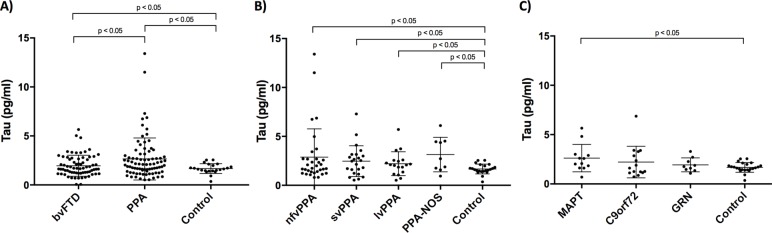
Background: Frontotemporal dementia (FTD) is a heterogeneous neurodegenerative disorder presenting clinically with personality change (behavioural variant FTD (bvFTD)) or language deficits (primary progressive aphasia (PPA)). About a third of FTD is familial with mutations in GRN , MAPT and C9orf72 being the major genetic causes. Robust biomarkers of the underlying pathology are still lacking in FTD with no markers currently being able to distinguish those with tau and TDP-43 inclusions during life. Methods: This study used an ultrasensitive single molecule methodology to measure plasma tau concentrations in 176 participants: 71 with bvFTD, 83 with PPA and 22 healthy controls. The patient group included 36 with pathogenic mutations in either MAPT (n=12), GRN (n=9) or C9orf72 (n=15). Group comparisons were performed between clinical and genetic groups and controls using a linear regression model with bias-corrected bootstrap CIs. Correlative analyses were performed to investigate associations with measures of disease severity and progression. Results: Higher plasma tau concentrations were seen in bvFTD (mean 1.96 (SD 1.07) pg/mL) and PPA (2.65 (2.15) pg/mL) compared with controls (1.67 (0.50) pg/mL). Investigating the PPA group further showed significantly higher levels compared with controls in each of the PPA subtypes (non-fluent, semantic and logopenic variants, as well as a fourth group not meeting criteria for one of the three main variants). In the genetic groups, only the MAPT group had significantly increased concentrations (2.62 (1.39) pg/mL) compared with controls. No significant correlations were seen with cross-sectional or longitudinal brain volumes, serum neurofilament light chain concentrations or disease duration. Conclusion: Plasma tau levels are increased in FTD in all clinical groups, but in the genetic subtypes only in MAPT mutations, the group of patients who definitively have tau pathology at postmortem. Future studies will be required in pathologically confirmed cohorts to investigate this association further, and whether plasma tau will be helpful in differentiating patients with FTD with tau from those with other pathologies.
Overview
The claims and statistics of this paper haven’t been checked yet.
Free: it reads the open-access text and checks the first 5 claims that cite a source we can check. Create a free account to check every claim.
Integrity signals
Registry
Cites
Statistics
Figures
Verification
Claims the paper makes
The claims and statistics of this paper haven’t been checked yet.
Free: it reads the open-access text and checks the first 5 claims that cite a source we can check. Create a free account to check every claim.
Claims other papers make about this one
Each is checked against this paper’s own text: does it say what the citing paper says it does?
The cited source says what the claim attributes to it.
In the citing paper
“Only a single previous study, however, investigated plasma t-tau levels in FTLD-S.38”
From Plasma Tau and Neurofilament Light in Frontotemporal Lobar Degeneration and Alzheimer Disease (2021) · cites this paper as [38]
Experimental — accuracy not yet measuredThe cited source says what the claim attributes to it.
In the citing paper
“but the effect sizes were small, pathologic data were not available, and analyses for prediction of disease progression with clinical scales, neuropsychological testing, and survival were not conducted.”
From Plasma Tau and Neurofilament Light in Frontotemporal Lobar Degeneration and Alzheimer Disease (2021) · cites this paper as [38]
The cited source says what the claim attributes to it.
In the citing paper
“In that study, plasma t-tau was elevated in bvFTD, PPA, and symptomatic MAPT mutation carriers”
From Plasma Tau and Neurofilament Light in Frontotemporal Lobar Degeneration and Alzheimer Disease (2021) · cites this paper as [38]
The cited source says what the claim attributes to it.
In the citing paper
“In agreement with our results, no associations were found between plasma t-tau and baseline measures of disease severity or brain volume and AD pathophysiology (as measured by the CSF tau/Aβ 1-42 ratio).38”
From Plasma Tau and Neurofilament Light in Frontotemporal Lobar Degeneration and Alzheimer Disease (2021) · cites this paper as [38]
In the citing paper
“Cross-sectional studies on other AD-related proteins showed alternations in bvFTD as well, such as plasma tau and the phosphorylated-tau/total-tau ratio (Foiani et al., 2018; Meeter et al., 2018).”
From The pursuit for markers of disease progression in behavioral variant frontotemporal dementia: a scoping review to optimize outcome measures for clinical trials (2024) · cites this paper as Foiani et al., 2018
2 more claims about this paper
Create a free account to see every claim other papers make about this one.
Self-check
Percentages, sums and reported differences re-computed from the paper’s own numbers.
The self-check needs the paper’s full text.
Citations
Cites
Sensitivity of revised diagnostic criteria for the behavioural variant of frontotemporal dementia
Rascovsky, K., Hodges, J. R., Knopman, D., Mendez, M. F., Kramer, J. H., Neuhaus, J., van Swieten, J. C., Seelaar, H., Dopper, E. G. P., Onyike, C. U., et al. (2011) · Brain · doi:10.1093/brain/awr179 · Cited by 5,221
Self-citationClassification of primary progressive aphasia and its variants
Gorno-Tempini, M. L., Hillis, A. E., Weintraub, S., Kertesz, A., Mendez, M., Cappa, S. F., Ogar, J. M., Rohrer, J. D., Black, S., Boeve, B. F., et al. (2011) · Neurology · doi:10.1212/wnl.0b013e31821103e6 · Cited by 5,141
Self-citationAppelhof, B., Bakker, C., Van Duinen-van den Ijssel, J. C. L., Zwijsen, S. A., Smalbrugge, M., Verhey, F. R. J., de Vugt, M. E., Zuidema, S. U., & Koopmans, R. T. C. M. (2017) · Dementia and Geriatric Cognitive Disorders · doi:10.1159/000477087 · Cited by 2,760
Qualitative Assessment of Verbal Fluency Performance in Frontotemporal Dementia
van den Berg, E., Jiskoot, L. C., Grosveld, M. J. H., van Swieten, J. C., & Papma, J. M. (2017) · Dementia and Geriatric Cognitive Disorders · doi:10.1159/000477538 · Cited by 2,046
Strong, M. J., Abrahams, S., Goldstein, L. H., Woolley, S., Mclaughlin, P., Snowden, J., Mioshi, E., Roberts-South, A., Benatar, M., HortobáGyi, T., et al. (2017) · Amyotrophic Lateral Sclerosis and Frontotemporal Degeneration · doi:10.1080/21678421.2016.1267768 · Cited by 909
Rohrer, J. D., Nicholas, J. M., Cash, D. M., van Swieten, J., Dopper, E., Jiskoot, L., van Minkelen, R., Rombouts, S. A., Cardoso, M. J., Clegg, S., et al. (2015) · The Lancet Neurology · doi:10.1016/s1474-4422(14)70324-2 · Cited by 538
Self-citationPlasma tau in Alzheimer disease
Mattsson, N., Zetterberg, H., Janelidze, S., Insel, P. S., Andreasson, U., Stomrud, E., Palmqvist, S., Baker, D., Tan Hehir, C. A., Jeromin, A., et al. (2016) · Neurology · doi:10.1212/wnl.0000000000003246 · Cited by 502
Self-citationSerum neurofilament light chain protein is a measure of disease intensity in frontotemporal dementia
Rohrer, J. D., Woollacott, I. O. C., Dick, K. M., Brotherhood, E., Gordon, E., Fellows, A., Toombs, J., Druyeh, R., Cardoso, M. J., Ourselin, S., et al. (2016) · Neurology · doi:10.1212/wnl.0000000000003154 · Cited by 432
Self-citationClassification and pathology of primary progressive aphasia
Harris, J. M., Gall, C., Thompson, J. C., Richardson, A. M. T., Neary, D., du Plessis, D., Pal, P., Mann, D. M. A., Snowden, J. S., & Jones, M. (2013) · Neurology · doi:10.1212/01.wnl.0000436070.28137.7b · Cited by 232
Imaging and fluid biomarkers in frontotemporal dementia
Meeter, L. H., Kaat, L. D., Rohrer, J. D., & van Swieten, J. C. (2017) · Nature Reviews Neurology · doi:10.1038/nrneurol.2017.75 · Cited by 210
Self-citation
Cited by
Blood-based biomarkers for Alzheimer's disease: towards clinical implementation
Teunissen, C. E., Verberk, I. M. W., Thijssen, E. H., Vermunt, L., Hansson, O., Zetterberg, H., van der Flier, W. M., Mielke, M. M., & del Campo, M. (2022) · The Lancet Neurology · doi:10.1016/s1474-4422(21)00361-6 · Cited by 1,045
Self-citationNeurofilament Proteins as Biomarkers to Monitor Neurological Diseases and the Efficacy of Therapies
Yuan, A., & Nixon, R. A. (2021) · Frontiers in Neuroscience · doi:10.3389/fnins.2021.689938 · Cited by 290
“Although amyloid-beta and tau proteins are widely regarded as useful diagnostic biomarkers of AD, tau proteins increase only in specific neurodegenerative diseases such as AD and unaltered in other neurological diseases that are clearly neurodegenerative, such as tau-negative FTD caused by granulin or C9orf72 mutation…”
BackgroundFrom the prion-like propagation hypothesis to therapeutic strategies of anti-tau immunotherapy
Colin, M., Dujardin, S., Schraen-Maschke, S., Meno-Tetang, G., Duyckaerts, C., Courade, J.-P., & Buée, L. (2020) · Acta Neuropathologica · doi:10.1007/s00401-019-02087-9 · Cited by 187
An update on blood-based biomarkers for non-Alzheimer neurodegenerative disorders
Ashton, N. J., Hye, A., Rajkumar, A. P., Leuzy, A., Snowden, S., Suárez-Calvet, M., Karikari, T. K., Schöll, M., La Joie, R., Rabinovici, G. D., et al. (2020) · Nature Reviews Neurology · doi:10.1038/s41582-020-0348-0 · Cited by 185
Self-citationDiagnostic and prognostic value of serum NfL and p-Tau181in frontotemporal lobar degeneration
Benussi, A., Karikari, T. K., Ashton, N., Gazzina, S., Premi, E., Benussi, L., Ghidoni, R., Rodriguez, J. L., Emeršič, A., Simrén, J., et al. (2020) · Journal of Neurology, Neurosurgery & Psychiatry · doi:10.1136/jnnp-2020-323487 · Cited by 155
Self-citationPlasma Tau and Neurofilament Light in Frontotemporal Lobar Degeneration and Alzheimer Disease
Illán-Gala, I., Lleo, A., Karydas, A., Staffaroni, A. M., Zetterberg, H., Sivasankaran, R., Grinberg, L. T., Spina, S., Kramer, J. H., Ramos, E. M., et al. (2021) · Neurology · doi:10.1212/wnl.0000000000011226 · Cited by 150
“Tau is a microtubule-stabilizing protein encoded by MAPT and has been implicated in the pathophysiology of AD and FTLD. Tau hyperphosphorylation leads to the formation of paired helical filaments that aggregate in neurofibrillary tangles, a defining pathologic hallmark of AD.3 Elevated CSF levels of t-tau and p-tau ar…”
BackgroundInfluentialSelf-citationFrontotemporal Dementia, Where Do We Stand? A Narrative Review
Antonioni, A., Raho, E. M., Lopriore, P., Pace, A. P., Latino, R. R., Assogna, M., Mancuso, M., Gragnaniello, D., Granieri, E., Pugliatti, M., et al. (2023) · International Journal of Molecular Sciences · doi:10.3390/ijms241411732 · Cited by 145
McCartney, D. L., Stevenson, A. J., Walker, R. M., Gibson, J., Morris, S. W., Campbell, A., Murray, A. D., Whalley, H. C., Porteous, D. J., McIntosh, A. M., et al. (2018) · Alzheimer's & Dementia: Diagnosis, Assessment & Disease Monitoring · doi:10.1016/j.dadm.2018.05.006 · Cited by 137
“However, the recent development of high-performance assays for plasma-based tau and amyloid-b may provide a noninvasive, cost-effective alternative for future analyses [56,57].”
Development of disease-modifying drugs for frontotemporal dementia spectrum disorders
Panza, F., Lozupone, M., Seripa, D., Daniele, A., Watling, M., Giannelli, G., & Imbimbo, B. P. (2020) · Nature Reviews Neurology · doi:10.1038/s41582-020-0330-x · Cited by 122
Benussi, A., Ashton, N. J., Karikari, T. K., Gazzina, S., Premi, E., Benussi, L., Ghidoni, R., Rodriguez, J. L., Emeršič, A., Binetti, G., et al. (2020) · Journal of Alzheimer’s Disease · doi:10.3233/jad-200608 · Cited by 113
“It has been clearly proven that concentrations of blood neurofilament light (NfL), a marker of axonal damage, are increased in FTLD and may be related to parameters of disease severity and prognosis [9–11].”
Self-citationAn update on fluid biomarkers for neurodegenerative diseases: recent success and challenges ahead
Simrén, J., Ashton, N. J., Blennow, K., & Zetterberg, H. (2020) · Current Opinion in Neurobiology · doi:10.1016/j.conb.2019.11.019 · Cited by 107
Self-citationFrontotemporal Dementia: A Clinical Review
Sivasathiaseelan, H., Marshall, C. R., Agustus, J. L., Benhamou, E., Bond, R. L., van Leeuwen, J. E. P., Hardy, C. J. D., Rohrer, J. D., & Warren, J. D. (2019) · Seminars in Neurology · doi:10.1055/s-0039-1683379 · Cited by 112
Self-citationStaffaroni, A. M., Kramer, A. O., Casey, M., Kang, H., Rojas, J. C., Orrú, C. D., Caughey, B., Allen, I. E., Kramer, J. H., Rosen, H. J., et al. (2019) · JAMA Neurology · doi:10.1001/jamaneurol.2019.1071 · Cited by 100
Self-citationDing, X., Zhang, S., Jiang, L., Wang, L., Li, T., & Lei, P. (2021) · Translational Neurodegeneration · doi:10.1186/s40035-021-00234-5 · Cited by 68
Biomarkers for diseases with TDP-43 pathology
Steinacker, P., Barschke, P., & Otto, M. (2019) · Molecular and Cellular Neuroscience · doi:10.1016/j.mcn.2018.10.003 · Cited by 57
Tau and neurofilament light‐chain as fluid biomarkers in spinocerebellar ataxia type 3
Garcia‐Moreno, H., Prudencio, M., Thomas‐Black, G., Solanky, N., Jansen‐West, K. R., Hanna AL‐Shaikh, R., Heslegrave, A., Zetterberg, H., Santana, M. M., Pereira de Almeida, L., et al. (2022) · European Journal of Neurology · doi:10.1111/ene.15373 · Cited by 49
Self-citationReview: Fluid biomarkers for frontotemporal dementias
Zetterberg, H., van Swieten, J. C., Boxer, A. L., & Rohrer, J. D. (2019) · Neuropathology and Applied Neurobiology · doi:10.1111/nan.12530 · Cited by 48
Self-citationBiomarker discovery and development for frontotemporal dementia and amyotrophic lateral sclerosis
Katzeff, J. S., Bright, F., Phan, K., Kril, J. J., Ittner, L. M., Kassiou, M., Hodges, J. R., Piguet, O., Kiernan, M. C., Halliday, G. M., et al. (2022) · Brain · doi:10.1093/brain/awac077 · Cited by 48
“Additionally, plasma p-tau181 levels are only significantly altered in the MAPT genetic subtype of frontotemporal dementia.(37) Tau can also aid in the differentiation between frontotemporal dementia and Alzheimer’s disease, with a higher t-tau:”
BackgroundZerr, I., Villar‐Piqué, A., Hermann, P., Schmitz, M., Varges, D., Ferrer, I., Riggert, J., Zetterberg, H., Blennow, K., & Llorens, F. (2021) · Alzheimer s Research & Therapy · doi:10.1186/s13195-021-00815-6 · Cited by 49
Self-citationWilczyńska, K., & Waszkiewicz, N. (2020) · Journal of Clinical Medicine · doi:10.3390/jcm9113452 · Cited by 43
Progranulin in neurodegenerative dementia
Wang, X., Zeng, P. H., Fang, Y., Zhang, T., & Tian, Q. (2021) · Journal of Neurochemistry · doi:10.1111/jnc.15378 · Cited by 40
“The total level of tau protein was found to be reduced in the brain (Papegaey et al., 2016) but increased in the plasma (Foiani et al., 2018) of FTLD patients.”
BackgroundLlorens, F., Villar‐Piqué, A., Schmitz, M., Lucena, D. D., Wohlhage, M. C., Hermann, P., Goebel, S., Schmidt, I., Glatzel, M., Hauw, J., et al. (2019) · Neuropathology and Applied Neurobiology · doi:10.1111/nan.12573 · Cited by 36
The Role of Tau beyond Alzheimer’s Disease: A Narrative Review
Virgilio, E., Marchi, F. D., Contaldi, E., Dianzani, U., Cantello, R. M., Mazzini, L., & Comi, C. (2022) · Biomedicines · doi:10.3390/biomedicines10040760 · Cited by 36
“On the contrary, there were no correlations of Tau levels with brain volumes, serum NfL concentrations, or disease duration [86].”
BackgroundBlood biomarkers in frontotemporal dementia: Review and meta-analysis
Ntymenou, S., Tsantzali, I., Kalamatianos, T., Voumvourakis, K. I., Kapaki, E., Tsivgoulis, G., Stranjalis, G., & Paraskevas, G. P. (2021) · Brain Sciences · doi:10.3390/brainsci11020244 · Cited by 31
“A study including 176 participants, with different FTD variants, demonstrated increased plasma tau levels in all clinical FTD subgroups, but in regard to the genetic subtypes only in MAPT mutations [29].”
BackgroundLogroscino, G., Imbimbo, B. P., Lozupone, M., Sardone, R., Capozzo, R., Battista, P., Zecca, C., Dibello, V., Giannelli, G., Bellomo, A., et al. (2019) · Expert Opinion on Pharmacotherapy · doi:10.1080/14656566.2019.1598377 · Cited by 39
“not in the C9orf72 and the GRN groups [48].”
BackgroundMethodBiomarkers in frontotemporal dementia: Current landscape and future directions
Gifford, A., Praschan, N. C., Newhouse, A. L., & Chemali, Z. N. (2023) · Biomarkers in Neuropsychiatry · doi:10.1016/j.bionps.2023.100065 · Cited by 33
Challenges and Advances in Antemortem Diagnosis of Human Transmissible Spongiform Encephalopathies
Ascari, L. M., Rocha, S. C., Gonçalves, P. B., Vieira, T. C. R. G., & Cordeiro, Y. (2020) · Frontiers in Bioengineering and Biotechnology · doi:10.3389/fbioe.2020.585896 · Cited by 30
Nascimento, C. F., Nunes, P. V., Rodriguez, R. D., Takada, L. T., Suemoto, C. K., Grinberg, L. T., Nitríni, R., & Lafer, B. (2019) · Progress in Neuro-Psychopharmacology and Biological Psychiatry · doi:10.1016/j.pnpbp.2019.04.008 · Cited by 31
“50) (Foiani et al., 2018), but its importance as a diagnostic tool has yet to be established.”
BackgroundTau proteins in blood as biomarkers of Alzheimer’s disease and other proteinopathies
Verde, F. (2022) · Journal of Neural Transmission · doi:10.1007/s00702-022-02471-y · Cited by 28
Blood-Based Biomarkers in Frontotemporal Dementia: A Narrative Review
Liampas, I., Kyriakoulopoulou, P., Karakoida, V., Kavvoura, P. A., Sgantzos, M. N., Bogdanos, D. P., Stamati, P., Dardiotis, E., & Siokas, V. (2024) · International Journal of Molecular Sciences · doi:10.3390/ijms252111838 · Cited by 25
“At the same time, similar levels of total tau were documented in cases with AD and FTD [45,63,92,93].”
BackgroundResultInfluentialFrontotemporal dementia. How to deal with its diagnostic complexity?
Antonioni, A., Raho, E. M., Granieri, E., & Koch, G. (2025) · Expert Review of Neurotherapeutics · doi:10.1080/14737175.2025.2461758 · Cited by 25
“Indeed, only MAPT mutation carriers display alterations in plasma levels of pTau181 [34].”
Progress in blood biomarkers of subjective cognitive decline in preclinical Alzheimer's disease
Yu, X., Shao, K., Wan, K., Li, T., Li, Y., Zhu, X., & Han, Y. (2023) · Chinese Medical Journal · doi:10.1097/cm9.0000000000002566 · Cited by 24
“513 tau levels have found too much overlap between clinical groups, suggesting its limited diagnostic value.([42,43]) This is in contrast with the recent results obtained in the analysis of post-translational modifications of tau.”
ResultAn Introduction to Ultrasensitive Assays for Plasma Tau Detection
Ding, X., Tuo, Q., & Lei, P. (2021) · Journal of Alzheimer s Disease · doi:10.3233/jad-201499 · Cited by 20
“InADandotherdementiapatients,plasma tauissignificantlyhigherthanhealthycontrols,using either Simoa [26, 27] or IMR [28, 29] assays.”
Language impairment in the genetic forms of behavioural variant frontotemporal dementia
Samra, K., MacDougall, A. M., Bouzigues, A., Bocchetta, M., Cash, D. M., Greaves, C. V., Convery, R. S., Swieten, J. C. V., Seelaar, H., Jiskoot, L. C., et al. (2022) · Journal of Neurology · doi:10.1007/s00415-022-11512-1 · Cited by 20
Self-citationWilczyńska, K., Maciejczyk, M., Zalewska, A., & Waszkiewicz, N. (2021) · Frontiers in Psychiatry · doi:10.3389/fpsyt.2021.725511 · Cited by 20
“Some studies have confirmed the increase of total tau protein (t-tau) in the serum of AD (14–16) and FTD subjects (17).”
BackgroundClinical usefulness of cerebrospinal fluid biomarkers in Alzheimer's disease
Peña‐Bautista, C., Álvarez‐Sánchez, L., Pascual, R., Moreno, M. J., Baquero, M., & Cháfer‐Pericás, C. (2022) · European Journal of Clinical Investigation · doi:10.1111/eci.13910 · Cited by 18
Hromádková, L., & Ovsepian, S. V. (2019) · Journal of Immunology Research · doi:10.1155/2019/7406810 · Cited by 18
“Disruption of the vascular barriers of the brain has been suggested to contribute to rise in the levels of tau in AD [35–38] as well as in frontotemporal dementia (FTD) [39] and Down syndrome [40].”
Younas, A., Younas, N., Iqbal, M. J., Ferrer, I., & Zerr, I. (2024) · Neuropathology and Applied Neurobiology · doi:10.1111/nan.12964 · Cited by 16
“Pathogenic variants of the Tau gene ( MAPT ) lead to neurodegenerative disorders like frontotemporal dementia (FTDP) [1, 2].”
BackgroundAltered plasma protein profiles in genetic FTD – a GENFI study
Ullgren, A., Öijerstedt, L., Olofsson, J., Bergström, S., Remnestål, J., Swieten, J. C. V., Jiskoot, L. C., Seelaar, H., Borroni, B., Sánchez‐Valle, R., et al. (2023) · Molecular Neurodegeneration · doi:10.1186/s13024-023-00677-6 · Cited by 14
Self-citationMcInvale, J. J., Canoll, P., & Hargus, G. (2024) · Brain Pathology · doi:10.1111/bpa.13231 · Cited by 11
“Increased t-and p-tau has been observed in the plasma of FTD patients compared with healthy controls [163], though other studies have found that only p-tau is increased in FTD plasma compared with controls [164].”
ResultTau biomarkers for neurodegenerative diseases: Current state and perspectives
Vacchi, E., Ruíz‐Barrio, I., & Melli, G. (2025) · Parkinsonism & Related Disorders · doi:10.1016/j.parkreldis.2025.107772 · Cited by 12
Plasma Phospho-Tau-181 as a Diagnostic Aid in Alzheimer’s Disease
Tsantzali, I., Foska, A., Sideri, E., Routsi, E., Tsomaka, E., Kitsos, D. K., Zompola, C., Bonakis, A., Giannopoulos, S., Voumvourakis, K. I., et al. (2022) · Biomedicines · doi:10.3390/biomedicines10081879 · Cited by 9
Fieldhouse, J. L. P., van Paassen, D. N., van Engelen, M.-P. E., De Boer, S. C. M., Hartog, W. L., Braak, S., Schoonmade, L. J., Schouws, S. N. T. M., Krudop, W. A., Oudega, M. L., et al. (2024) · Frontiers in Aging Neuroscience · doi:10.3389/fnagi.2024.1382593 · Cited by 8
“Also interpreted as a more general response to neuronal injury, first cross-sectional results showed CSF sTREM2 levels increased during neuro-inflammation in familial bvFTD associated with GRN mutations ( N = 3) (Woollacott et al., 2018).”
BackgroundResultInfluentialMahmoud, N. S., Elbaset, M. A., Mohawed, O. A. M., & Ahmed, H. H. (2024) · Journal of Applied Pharmaceutical Science · doi:10.7324/japs.2024.166458 · Cited by 8
“A recent study by Foiani et al. [50] indicated that plasma tau levels are raised in frontotemporal dementia, a neurodegenerative condition that causes personality changes or language difficulties.”
BackgroundDevelopment of language composites for enhanced sensitivity to multiple plasma biomarkers
He, D., Langhough, R. E., Hulle, C. V., Basche, K. E., Jonaitis, E. M., Wilson, R. H., Hermann, B. P., Zetterberg, H., Johnson, S. C., & Mueller, K. D. (2025) · Alzheimer s & Dementia · doi:10.1002/alz.70975 · Cited by 5
“16 Similarly, plasma neurofilament light (NfL) and glial fibrillary acidic protein (GFAP) – while enhancing clinical diagnostic confidence in AD 17–19 – are associated with faster declineinalanguagecompositederivedfromsingle-wordtasks;incon-trast, other plasma biomarkers (A β 42/40, p-tau181)…”
Self-citationPlasma biomarkers in neuropsychiatric syndromes: A narrative review
Ismail, Z., Guan, D. X., Babulal, G. M., Bateman, J. R., Cantillon, M., Creese, B., D’Antonio, F., Fischer, C. E., Gatchel, J. R., Ghahremani, M., et al. (2025) · Journal of Alzheimer s Disease · doi:10.1177/13872877251392185 · Cited by 4
“210 FTD can be challenging to diagnose, especially at its early stages, as its NPS often overlap with symptoms due to other etiologies.”
Angelopoulou, E., Papatriantafyllou, J. D., Papageorgiou, S. G., & Villa, C. (2026) · International Journal of Molecular Sciences · doi:10.3390/ijms27073341 · Cited by 4
Surrogate Molecular Biomarkers for Poststroke Cognitive Impairment: A Narrative Review
Gorostiola-Oyarzabal, N., Joya, A., Freijo, M. D. M., Martín, A., & Mancini, S. (2025) · Stroke · doi:10.1161/strokeaha.124.050507 · Cited by 4
Les marqueurs biologiques des démences fronto-temporales
Escal, J., & Fourier, A. (2021) · Revue Francophone des Laboratoires · doi:10.1016/s1773-035x(21)00193-3 · Cited by 3
Early Diagnosis of Alzheimer's Disease with Blood Test; Tempting but Challenging.
Farvadi, F., Hashemi, F., Amini, A., Vakilinezhad, M. A., & Raee, M. J. (2023) · PubMed Central · doi:10.22088/ijmcm.bums.12.2.172 · Cited by 6
Poszwa, J., Słowikowski, B. K., Owecki, W., Szymanowicz, O., Jagodziński, P. P., Kozubski, W. P., & Dorszewska, J. (2025) · Current Alzheimer Research · doi:10.2174/0115672050390340250716061313 · Cited by 2
Martins, D. R., Vandermeeren, M., Kolen, K. V., Brepoels, E., Borgers, M., Wintmolders, C., Delay, C., Bottelbergs, A., Mercken, M. H., & Theunis, C. (2023) · Journal of Alzheimer s Disease · doi:10.3233/jad-221266 · Cited by 1
Fluid Biomarkers in the Frontotemporal Dementia Spectrum
Meeter, L. H. H. (2018) · RePub (Erasmus University Rotterdam)
Immune Markers in the Blood of Patients with Frontotemporal Dementia
Androsova, L. V., Mikhaylova, N. M., Fyodorova, Y. B., Zozulya, S. A., & Klyushnik, T. P. (2019) · Psikhiatriya · doi:10.30629/2618-6667-2019-17-2-45-53
Tau proteolysis mechanisms and relevance for tauopathies
Quinn, J. P. (2019) · Research Explorer (The University of Manchester)
Isolamento de oligômeros tóxicos do peptídeo B-amiloide usando o anticorpo de cadeia única NUsc1
Bitencourt, A. L. B. (2020) · Digital Library of Theses and Dissertations (Universidade de São Paulo) · doi:10.11606/t.17.2020.tde-12022020-170537 · Cited by 1
Frontotemporal Dementia: A Conference Report From the 2nd Finftd Symposium
Hoffmann, D. B., Huber, N., Leskelä, S., Rostalski, H., Solje, E., Remes, A. M., & Haapasalo, A. (2020) · Neurodegenerative Disease Management · doi:10.2217/nmt-2019-0039
Guía para la elaboración de un plan de empresas del sector servicios (IV)
Dorrego, J. D. B. (2004) · Phytoma España: La revista profesional de sanidad vegetal
A review on shared clinical and biological aspects of bipolar disorder and frontotemporal dementiaPreprint
Nascimento, C. F., Nunes, P. V., Rodriguez, R. D., Takada, L. T., Suemoto, C. K., Grinberg, L. T., Nitríni, R., & Lafer, B. (2018) · OSF Preprints (OSF Preprints) · doi:10.31219/osf.io/7gjzn
Rôle des vésicules extracellulaires dans la propagation de la protéine Tau
Perbet, R. (2020) · theses.fr (ABES) · doi:10.70675/802e7677zdb6ez4691za867z39ef5b6ba8f2
Vésicules extracellulaires : actrices de la propagation de la pathologie tau dans les tauopathies
Leroux, É. (2021) · theses.fr (ABES) · doi:10.70675/3318b243z20aez4b6bzace8zda153701cc2b
Additional file 1 of Altered plasma protein profiles in genetic FTD – a GENFI study
Ullgren, A., Öijerstedt, L., Olofsson, J., Bergström, S., Remnestål, J., Swieten, J. C. V., Jiskoot, L. C., Seelaar, H., Borroni, B., Sánchez‐Valle, R., et al. (2024) · Figshare · doi:10.6084/m9.figshare.26640538
Self-citationZerr, I., Villar‐Piqué, A., Hermann, P., Schmitz, M., Varges, D., Ferrer, I., Riggert, J., Zetterberg, H., Blennow, K., & Llorens, F. (2021) · Figshare · doi:10.6084/m9.figshare.14462590
Self-citationZerr, I., Villar‐Piqué, A., Hermann, P., Schmitz, M., Varges, D., Ferrer, I., Riggert, J., Zetterberg, H., Blennow, K., & Llorens, F. (2021) · Figshare · doi:10.6084/m9.figshare.14462596
Self-citationDing, X., Zhang, S., Jiang, L., Wang, L., Li, T., & Lei, P. (2021) · Figshare · doi:10.6084/m9.figshare.14211689
Ding, X., Zhang, S., Jiang, L., Wang, L., Li, T., & Lei, P. (2021) · Figshare · doi:10.6084/m9.figshare.14211686
Novel digital biomarkers for frontotemporal dementia
Convery, R. S. (2023) · UCL Discovery (University College London)
Validations of Plasma Biomarker Tests
Yang, C. S.-Y., & Sabbagh, M. N. (2026) · Springer eBooks · doi:10.1007/978-3-032-23863-4_4
Hauser, W., Keller, J. E., Pasnoor, M., & Wright, D. E. (2026) · Frontiers in Aging Neuroscience · doi:10.3389/fnagi.2026.1854989
Metadata
- Authors
- Foiani, M. S., Woollacott, I. O., Heller, C., Bocchetta, M., Heslegrave, A., Dick, K. M., Russell, L. L., Marshall, C. R., Mead, S., Schott, J. M., Fox, N. C., Warren, J. D., Zetterberg, H., & Rohrer, J. D.
- Affiliations
- UK Dementia Research Institute (GB)
- UCL Queen Square Institute of Neurology (GB)
- MRC Prion Unit (GB)
- Sahlgrenska University Hospital (SE)
- Corresponding author
- Rohrer, Jonathan D
- ORCID
- Venue
- Journal of Neurology, Neurosurgery & Psychiatry
- Publisher
- BMJ
- Published
- 2018-02-13
- Volume
- 89
- Issue
- 8
- Pages
- 804-807
- ISSN
- 0022-3050 (ISSN-L)
- 1468-330X
- PMC
- PMC6204947
- OpenAlex
- W2786797583
- Cited by
- 64
- References
- 11
- Citations by year
- 2026: 2 · 2025: 5 · 2024: 6 · 2023: 6 · 2022: 7 · 2021: 14 · 2020: 9 · 2019: 10 · 2018: 4
- FWCI
- 7.28
- Type
- journal article
- Language
- en
- Open access
- hybrid
- doi.org
- Licence
- cc-by
- Locations
- Journal of Neurology Neurosurgery & Psychiatry (publishedVersion, cc-by)
- Europe PMC (PubMed Central) (publishedVersion, other-oa)
- PubMed Central (publishedVersion, cc-by)
- PubMed (publishedVersion)
- UCL Discovery (University College London) (submittedVersion)
- HighWire Press Open Archive (submittedVersion)
- Queen Mary Research Online (Queen Mary University of London) (submittedVersion, cc-by)
- Funders
- Wellcome Trust
- National Institute for Health Research
- Medical Research Council
- Topics
- Health Sciences › Medicine › Psychiatry and Mental health › Dementia and Cognitive Impairment Research
- Life Sciences › Neuroscience › Cellular and Molecular Neuroscience › Alzheimer's disease research and treatments
- Health Sciences › Medicine › Clinical Neurology › Amyotrophic Lateral Sclerosis Research
- Keywords
- frontotemporal dementia, plasma tau, behavioral variant frontotemporal dementia, primary progressive aphasia, MAPT mutations, GRN mutations, C9orf72 mutation, tau pathology, TDP-43 pathology, disease biomarkers, single-molecule detection, neurodegeneration
- MeSH terms
- Aged, Brain, Female, Humans, Magnetic Resonance Imaging, Male, Middle Aged, Case-Control Studies, tau Proteins, Frontotemporal Dementia, Neuroimaging
About these checks
Registry, retraction, Cites and statistics results are computed, not judged, with one exception: a printed reference that no index lists is read once by a model before it counts as a citation error. Claims are extracted by a model and kept only when their quote appears verbatim in the text; each cited source is then checked, with a model’s help, for whether it says what the claim relies on. Those verdicts can be wrong — read the claim’s quote and the cited source before relying on one.
Statistics and arithmetic are recomputed, not judged.
Confidence bands are shown only for fields calibrated on our annotated test set. None is calibrated yet, so no band is shown.
What counts as a claim ›How we measure confidence ›How we check this ›
Are you an author, or do you see a problem with this page? Request a review
Data sources
Bibliographic data: Semantic Scholar, OpenAlex, Crossref.
Contains information from the Semantic Scholar Academic Graph Datasets, made available under the ODC Attribution License (ODC-BY 1.0).
Semantic Scholar’s data is described in: Kinney, R., et al. (2023). The Semantic Scholar Open Data Platform. arXiv:2301.10140.
