

A unifying theory for cognitive abnormalities in functional neurological disorders, fibromyalgia and chronic fatigue syndrome: systematic review
Open accessThe DOI matches its Crossref record; 189 of the 189 references it cites were found in a registry or an index.
Abstract
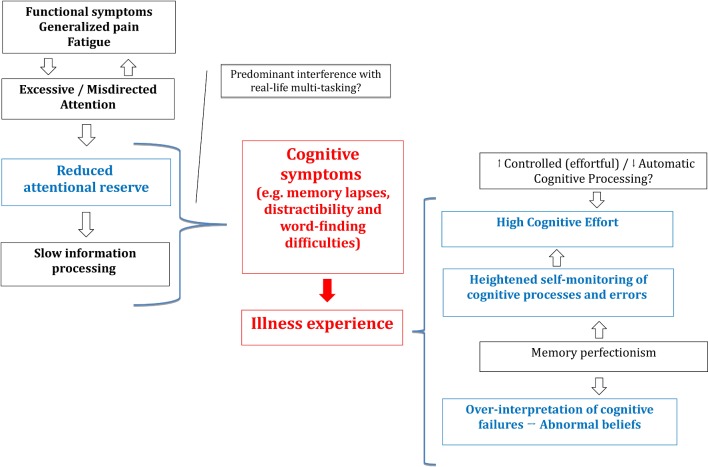
Background: Functional cognitive disorder (FCD) describes cognitive dysfunction in the absence of an organic cause. It is increasingly prevalent in healthcare settings yet its key neuropsychological features have not been reported in large patient cohorts. We hypothesised that cognitive profiles in fibromyalgia (FM), chronic fatigue syndrome (CFS) and functional neurological disorders (FNDs) would provide a template for characterising FCD. Methods: We conducted a systematic review of studies with cognition-related outcomes in FM, CFS and FND. Results: We selected 52 studies on FM, 95 on CFS and 39 on FND. We found a general discordance between high rates of subjective cognitive symptoms, including forgetfulness, distractibility and word-finding difficulties, and inconsistent objective neuropsychological deficits. Objective deficits were reported, including poor selective and divided attention, slow information processing and vulnerability to distraction. In some studies, cognitive performance was inversely correlated with pain, exertion and fatigue. Performance validity testing demonstrated poor effort in only a minority of subjects, and patients with CFS showed a heightened perception of effort. Discussion: The cognitive profiles of FM, CFS and non-cognitive FND are similar to the proposed features of FCD, suggesting common mechanistic underpinnings. Similar findings have been reported in patients with mild traumatic brain injury and whiplash. We hypothesise that pain, fatigue and excessive interoceptive monitoring produce a decrease in externally directed attention. This increases susceptibility to distraction and slows information processing, interfering with cognitive function, in particular multitasking. Routine cognitive processes are experienced as unduly effortful. This may reflect a switch from an automatic to a less efficient controlled or explicit cognitive mode, a mechanism that has also been proposed for impaired motor control in FND. These experiences might then be overinterpreted due to memory perfectionism and heightened self-monitoring of cognitive performance.
Overview
The claims and statistics of this paper haven’t been checked yet.
Free: it reads the open-access text and checks the first 5 claims that cite a source we can check. Create a free account to check every claim.
Integrity signals
Registry
Cites
Statistics
Figures
Verification
Claims the paper makes
The claims and statistics of this paper haven’t been checked yet.
Free: it reads the open-access text and checks the first 5 claims that cite a source we can check. Create a free account to check every claim.
Claims other papers make about this one
Each is checked against this paper’s own text: does it say what the citing paper says it does?
The cited source says what the claim attributes to it.
In the citing paper
“Disturbance of attention is thought to be responsible for the symptoms,4 as with other functional neurological disorders,5 although the underlying pathophysiological mechanisms remain unknown.”
From Feasibility randomised controlled trial of online group Acceptance and Commitment Therapy for Functional Cognitive Disorder (ACT4FCD) (2023) · cites this paper as [4]
Self-check
Percentages, sums and reported differences re-computed from the paper’s own numbers.
The self-check needs the paper’s full text.
Citations
Cites
Functional somatic syndromes: one or many?
Wessely, S., Nimnuan, C., & Sharpe, M. (1999) · The Lancet · doi:10.1016/s0140-6736(98)08320-2 · Cited by 1,211 · cited 1×
“15 In our clinical practice, it is very common to see patients with FND and comorbid FM and/or CFS. Importantly, FM and CFS are also associated with subjective cognitive difficulties, sometimes referred to as ‘brain fog’.”
BackgroundToward a rational and mechanistic account of mental effort
Shenhav, A., Musslick, S., Lieder, F., Kool, W., Griffiths, T. L., Cohen, J. D., & Botvinick, M. M. (2017) · Annual Review of Neuroscience · doi:10.1146/annurev-neuro-072116-031526 · Cited by 1,077 · cited 1×
“160 A switch from an automatic to a controlled mode of cognitive processing may therefore underlie the increase in cognitive effort.”
BackgroundWhite, P., Goldsmith, K., Johnson, A., Potts, L., Walwyn, R., DeCesare, J., Baber, H., Burgess, M., Clark, L., Cox, D., et al. (2011) · The Lancet · doi:10.1016/s0140-6736(11)60096-2 · Cited by 897
An internet survey of 2,596 people with fibromyalgia
Bennett, R. M., Jones, J., Turk, D. C., Russell, I. J., & Matallana, L. (2007) · BMC Musculoskeletal Disorders · doi:10.1186/1471-2474-8-27 · Cited by 865
A Bayesian account of ‘hysteria’
Edwards, M. J., Adams, R. A., Brown, H., Parees, I., & Friston, K. J. (2012) · Brain · doi:10.1093/brain/aws129 · Cited by 825 · cited 1×
“14 limitations Evidence for the presence and characteristics of cognitive abnormalities in FNDs, FM and CFS is remarkably heterogeneous.”
BackgroundSelf-citationNeurobiology of fibromyalgia and chronic widespread pain
Sluka, K. A., & Clauw, D. J. (2016) · Neuroscience · doi:10.1016/j.neuroscience.2016.06.006 · Cited by 671
A comprehensive review of the Paced Auditory Serial Addition Test (PASAT)
TOMBAUGH, T. (2006) · Archives of Clinical Neuropsychology · doi:10.1016/j.acn.2005.07.006 · Cited by 648
Symptoms following mild head injury: expectation as aetiology.
Mittenberg, W., DiGiulio, D. V., Perrin, S., & Bass, A. E. (1992) · Journal of Neurology, Neurosurgery & Psychiatry · doi:10.1136/jnnp.55.3.200 · Cited by 510
Wessely, S., & Powell, R. (1989) · Journal of Neurology, Neurosurgery & Psychiatry · doi:10.1136/jnnp.52.8.940 · Cited by 481
Cognitive-behavioral therapy for psychogenic nonepileptic seizures: A pilot RCT
Goldstein, L. H., Chalder, T., Chigwedere, C., Khondoker, M. R., Moriarty, J., Toone, B. K., & Mellers, J. D. C. (2010) · Neurology · doi:10.1212/wnl.0b013e3181e39658 · Cited by 477
Cited by
Items 201–240 of 240
Alves, M. F., Silva, A. B. D. B., Ferreira, K. G., Cruz, B. G. R., Machado, L. C. D. S., de Souza, M. C. M. C., Júdice, M. G., & da Silva, R. C. D. (2020) · Journal Health NPEPS
Pennington, C., & Coulthard, E. J. (2019) · Elsevier eBooks · doi:10.1016/b978-0-12-809324-5.23551-7
Goldenberg, D. L., & Dichter, M. A. (2022) · Wiley eBooks · doi:10.1002/9781119891338.ch4
Villarejo‐Galende, A. (2025) · Kranion · doi:10.24875/kranion.m22000045
Crisi psicogene non epilettiche (funzionali/dissociative)
Leroy, A., Tarrada, A., Garcin, B., & Hingray, C. (2023) · EMC - Neurologia · doi:10.1016/s1634-7072(22)47362-4
PVT in patients presenting with post-acute sequelae of COVID-19Preprint
Chakrabarti, S., Krishnan, K., & Galioto, R. (2023) · medRxiv · doi:10.1101/2023.12.14.23299928
Rivas-Grajales, A. M., Millstein, D. J., & Perez, D. L. (2024) · Elsevier eBooks · doi:10.1016/b978-0-323-95702-1.00122-6
Fibromialgia: Manifestaciones neuropsiquiátricas y abordaje terapéutico en la atención primaria
Gruezo, P., Cusme-Diaz, N., León-Llanos, H. A., Benavides-López, A., & Morquecho, V. L. Y. (2022) · Revista Reumatología al Día. · doi:10.62484/rad.v16i3.5261 · Cited by 2
Funktionelle kognitive und amnestische Störungen
Popkirov, S. (2024) · Springer eBooks · doi:10.1007/978-3-662-69215-8_12
Popkirov, S. (2024) · Springer eBooks · doi:10.1007/978-3-662-69215-8_5
Popkirov, S. (2024) · Springer eBooks · doi:10.1007/978-3-662-69215-8_13
Chronische polysymptomatische Syndrome
Popkirov, S. (2024) · Springer eBooks · doi:10.1007/978-3-662-69215-8_14
Crises psychogènes non épileptiques (fonctionnelles/dissociatives)
Leroy, A., Tarrada, A., Garcin, B., & Hingray, C. (2022) · HAL · doi:10.1016/s0246-1072(22)43624-8 · Cited by 1
Physical Therapy and Intrinsic Relaxation for Fibromyalgia − A Comparative Cohort Study from Romania
Borze, T. F., Pallag, A., Dragan, A., CIOBANU, D. I., Suciu, R. N., Nistor-Cseppento, C. D., & Muresan, M. E. (2025) · Balneo and PRM Research Journal · doi:10.12680/balneo.2025.788
“…after prolonged rest, hypersensitivity to pressure during the pal-pation of several bilateral points on the body, being accompanied by symptoms such as headache, paresthesias, poor sleep, fatigue, attention disorders myalgia, voiding disorders, cognitive disorders, depression and anxiety [5,6,8,9].”
Functional Neurological Disorder
Keatley, E. S., & Molton, I. R. (2025) · Oxford University Press eBooks · doi:10.1093/oxfordhb/9780197525456.013.0040
Nelson, B. K., Picon, E. L., Sayers, L., Farah, L. N., Saint, S. A., Chen, J., Sossi, V., Sekhon, M. S., Stoessl, A. J., Wellington, C. L., et al. (2025) · Journal of Clinical and Experimental Neuropsychology · doi:10.1080/13803395.2025.2555610
“More specifically, excessive worrying (rumination) regarding cognitive abilities after COVID-19 may have also contributed to the perception of cognitive symptoms (McWhirter et al., 2020; Szyszkowska & Bala, 2023; Teodoro et al., 2018; Winter & Braw, 2023).”
Lunov, V., Matiash, M. M., Yevdokymova, N., Tkach, B., Rozhkova, I., Ilin, M., Pavlov, A., & Prints, V. (2025) · medRxiv · doi:10.1101/2025.09.12.25335642 · Cited by 1
“Patients frequently describe these deficits as “brain fog,” reflecting not only performance decrements but also an altered subjective experience of cognitive effort (Teodoro et al., 2018).”
InfluentialPick, S., Millman, L. S. M., Gursoy, E. G., Basamh, Y., Uloyok-Job, J., Davies, J., Blunstone, L., Bhuma, S., Coebergh, J. A., David, A. S., et al. (2025) · medRxiv · doi:10.1101/2025.09.25.25336646
Self-citationFatigue in myalgic encephalomyelitis/chronic fatigue syndrome (ME/CFS): linking in brain fog
Azcue, N., Pino, R. D., Merino, B. T., & Gómez‐Esteban, J. C. (2025) · Elsevier eBooks · doi:10.1016/b978-0-443-24080-5.00032-1 · Cited by 1
Ure, R. J., Kiss, A., Mikolić, A., McLellan, E., Silverberg, N. D., Feinstein, A., & Burke, M. J. (2025) · Journal of Neurotrauma · doi:10.1177/08977151251394006
“13 However, there is a colinear relationship between some of the psychiatric questions on the RPQ and GHQ, which may partially account for the association found.”
Nelson, A., Gavelin, H. M., Boraxbekk, C.-J., Eskilsson, T., Josefsson, M., Järvholm, L. S., & Neely, A. S. (2021) · Figshare · doi:10.6084/m9.figshare.14615402
Franke Föyen, L., Sennerstam, V., Kontio, E., Lekander, M., Hedman-Lagerlöf, E., & Lindsäter, E. (2023) · Figshare · doi:10.6084/m9.figshare.23902993
Serum ADAM12 as a Biomarker in Fibromyalgia Syndrome: Inflammatory and Clinical Correlates
Ağbektaş, T., Hayta, E., & Siliğ, Y. (2026) · Cumhuriyet Science Journal · doi:10.17776/csj.1781092
Psychogenic Nonepileptic Seizures and Comorbid Epilepsy in Youth
Plioplys, S., & Jutla, A. (2026) · Springer eBooks · doi:10.1007/978-3-032-10099-3_26
Functional Neurological Disorder: A Primer for Neuropsychologists
Kavish, N., & Maietta, J. E. (2026) · Springer eBooks · doi:10.1007/978-3-032-07777-6_20
Perception Is Everything: Functional Cognitive Disorders
Hayden, S. (2026) · Springer eBooks · doi:10.1007/978-3-032-21818-6_6
Context Matters: Psychosocial Factors and Cognition
Hayden, S. (2026) · Springer eBooks · doi:10.1007/978-3-032-21818-6_7
Roberts, S. K., Kuznetsova, V., D’Aprano, F., Zheng, C. J., Kalincik, T., & Malpas, C. B. (2026) · BJPsych Open · doi:10.1192/bjo.2026.11041
“39 In specialist memory clinic populations, individuals presenting with cognitive complaints in the absence of objective cognitive impairment frequently exhibit a similar cluster of non-cognitive symptoms, including poor sleep, excessive fatigue, depression and anxiety, 40 with cross-sectional and…”
Kapfhammer, H. (2026) · Springer Reference Medizin · doi:10.1007/978-3-642-45028-0_73-2
Funktionelle kognitive Störungen erkennen und verstehen
Beckers, J., Popkirov, S., Michaelis, R., Seliger, C., & Jungilligens, J. (2026) · Zeitschrift für Neuropsychologie · doi:10.1024/1016-264x/a000443
Mavroudis, I. A., Petridis, F., Ciobîcă, A., Pădurariu, M., Papagiannopoulos, S., & Kazis, D. A. (2026) · Life · doi:10.3390/life16060926 · Cited by 1
“…(2018) reported that patients with FND, fibromyalgia, and chronic fatigue syndrome demonstrate prominent subjective cognitive complaints despite mild and inconsistent objective neuropsychological deficits, a pattern that the authors explicitly extended to mTBI and whiplash populations [22].”
(2026) · Український медичний часопис · doi:10.32471/umj.1680-3051.279254
Melo-Alonso, M., Villafaina, S., Moledo, C. P., Martínez-Sánchez, A., Bohn, L., Llamas, J. L. L., & Gusi, N. (2026) · Sport Sciences for Health · doi:10.1007/s11332-026-01882-8
“In women with FM, gait and postural control are frequently compromised by chronic pain [14], balance impairments, and fear of falling, collectively elevating fall risk [15].”
Correlates and Predictors of Metamemory in an Online Sample
Hoots, J. K., Chan, L., Cook, N. E., LaFrance, W. C., Jr., & Patten, R. V. (2026) · Journal of Neuropsychiatry · doi:10.1176/appi.neuropsych.20250292
Treatment of Functional Neurological Disorders
Park, J. E. (2026) · Journal of Clinical Neurology · doi:10.3988/jcn.2026.0223 · Cited by 1
“23 The proposed diagnostic criteria for FCD, adapted from Ball et al., 20 are presented in Table 3.”
Chare, I. A., Mhanna, E., Palisson, J., & Garcin, B. (2026) · La Revue de Médecine Interne · doi:10.1016/j.revmed.2026.08.009
Wylie, G. R. (2026) · Philosophical Transactions of the Royal Society B Biological Sciences · doi:10.1098/rstb.2024.0462 · Cited by 2
Mavroudis, I., Das, O., Petridis, F., & Kazis, D. A. (2026) · Brain Sciences · doi:10.3390/brainsci16101026
“Excessive self-focused monitoring, which forces a shift from automatic to effortful processing, supplies the mechanism by which fluent, generalised use of memory is lost [57].”
InfluentialPain and Sensitization in Voice Patients with Fibromyalgia: A Preliminary Report
Yüksel, P., Baek, S., & Sataloff, R. T. (2026) · Journal of Voice · doi:10.1016/j.jvoice.2026.09.049
Silverberg, N. D., Burke, M. J., Debert, C. T., Klotz, T., Zemek, R. L., Schmidt, J., Panenka, W. J., Perez, D. L., Bayley, M. T., Tartaglia, M. C., et al. (2026) · BMJ Open · doi:10.1136/bmjopen-2026-125787
Metadata
- Authors
- Teodoro, T., Edwards, M. J., & Isaacs, J. D.
- Affiliations
- National Health Service (GB)
- Corresponding author
- Isaacs, Jeremy D
- Venue
- Journal of Neurology, Neurosurgery & Psychiatry
- Publisher
- BMJ
- Published
- 2018-05-07
- Volume
- 89
- Issue
- 12
- Pages
- 1308-1319
- ISSN
- 0022-3050 (ISSN-L)
- 1468-330X
- PMC
- PMC6288708
- OpenAlex
- W2802124756
- Cited by
- 241
- References
- 189
- Citations by year
- 2026: 22 · 2025: 37 · 2024: 32 · 2023: 33 · 2022: 39 · 2021: 26 · 2020: 26 · 2019: 18 · 2018: 6
- FWCI
- 2.89
- Type
- journal article
- Language
- en
- Open access
- bronze
- doi.org
- Locations
- Journal of Neurology Neurosurgery & Psychiatry (publishedVersion)
- Europe PMC (PubMed Central) (publishedVersion, cc-by)
- PubMed Central (publishedVersion, cc-by)
- PubMed (publishedVersion)
- St George's Online Research Archive (St George's University of London) (acceptedVersion)
- HighWire Press Open Archive (submittedVersion)
- Funders
- Fundação para a Ciência e Tecnologia
- Wellcome Trust
- Medical Research Council
- Topics
- Health Sciences › Medicine › Psychiatry and Mental health › Fibromyalgia and Chronic Fatigue Syndrome Research
- Health Sciences › Medicine › Psychiatry and Mental health › Psychosomatic Disorders and Their Treatments
- Health Sciences › Medicine › Clinical Neurology › Long-Term Effects of COVID-19
- Keywords
- functional cognitive disorder, conversion disorder, fibromyalgia, chronic fatigue syndrome, cognitive impairment, attention deficits, divided attention, performance validity, effort perception, pain and fatigue, interoception, self-monitoring, neuropsychological deficits
- MeSH terms
- Cognition Disorders, Fibromyalgia, Humans, Nervous System Diseases, Psychological Theory, Fatigue Syndrome, Chronic
About these checks
Registry, retraction, Cites and statistics results are computed, not judged, with one exception: a printed reference that no index lists is read once by a model before it counts as a citation error. Claims are extracted by a model and kept only when their quote appears verbatim in the text; each cited source is then checked, with a model’s help, for whether it says what the claim relies on. Those verdicts can be wrong — read the claim’s quote and the cited source before relying on one.
Statistics and arithmetic are recomputed, not judged.
Confidence bands are shown only for fields calibrated on our annotated test set. None is calibrated yet, so no band is shown.
What counts as a claim ›How we measure confidence ›How we check this ›
Are you an author, or do you see a problem with this page? Request a review
Data sources
Bibliographic data: Semantic Scholar, OpenAlex, Crossref.
Contains information from the Semantic Scholar Academic Graph Datasets, made available under the ODC Attribution License (ODC-BY 1.0).
Semantic Scholar’s data is described in: Kinney, R., et al. (2023). The Semantic Scholar Open Data Platform. arXiv:2301.10140.
