

A Survey on Measuring Cognitive Workload in Human-Computer Interaction
Open accessThe DOI matches its Crossref record; 267 of the 271 references it cites were found in a registry or an index, and 2 are not checked yet; 16 of the 76 sources its claims cite were checked for support.
Abstract
The ever-increasing number of computing devices around us results in more and more systems competing for our attention, making cognitive workload a crucial factor for the user experience of human-computer interfaces. Research in Human-Computer Interaction (HCI) has used various metrics to determine users’ mental demands. However, there needs to be a systematic way to choose an appropriate and effective measure for cognitive workload in experimental setups, posing a challenge to their reproducibility. We present a literature survey of past and current metrics for cognitive workload used throughout HCI literature to address this challenge. By initially exploring what cognitive workload resembles in the HCI context, we derive a categorization supporting researchers and practitioners in selecting cognitive workload metrics for system design and evaluation. We conclude with three following research gaps: (1) defining and interpreting cognitive workload in HCI, (2) the hidden cost of the NASA-TLX, and (3) HCI research as a catalyst for workload-aware systems, highlighting that HCI research has to deepen and conceptualize the understanding of cognitive workload in the context of interactive computing systems.
Verified 2026-11-19 · 2 references not checked yet
Overview
CoChat Summary
TL;DR
This ACM Computing Surveys paper systematically reviews how cognitive workload has been measured in HCI, drawing on a final corpus of 579 records. It categorizes subjective, physiological, behavioral, and performance-based metrics and proposes a step-by-step procedure for selecting suitable measures, while identifying three research gaps around definition, NASA-TLX reliance, and workload-aware systems.
Key findings
- The review’s final corpus contains 579 records: 482 from 26 conferences and 97 from 11 journals, derived from an initial corpus of 6,414 papers (4,408 conference, 2,006 journal).
- Questionnaires are the most used metric, with the NASA-TLX described as the most frequently used questionnaire in the corpus; the paper argues its dominance may reflect community convention and an “academic tradition” rather than demonstrated HCI-specific validity.
- The authors identify three research gaps: (1) defining and interpreting cognitive workload in HCI, (2) the hidden cost of the NASA-TLX, and (3) HCI research as a catalyst for workload-aware systems.
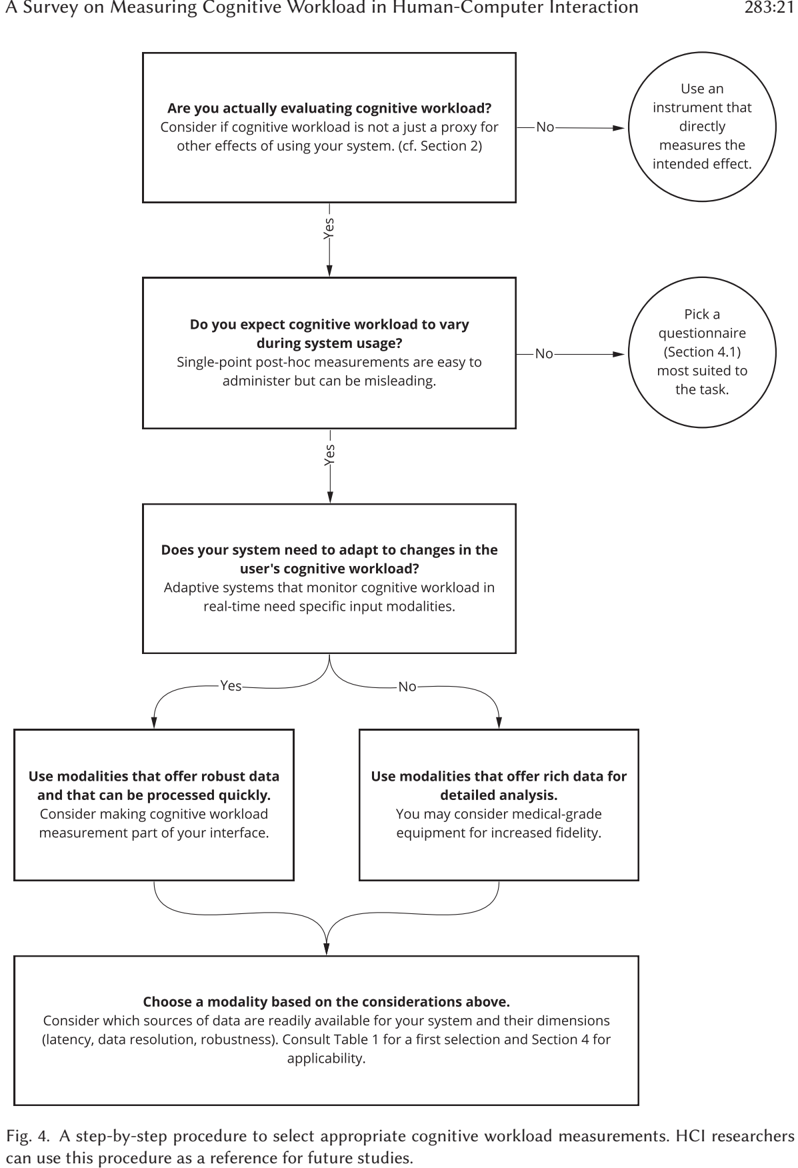
- They propose a four-step procedure for choosing cognitive workload metrics, covering whether cognitive workload is the right concept, whether it varies during use, whether the system must adapt to it, and which modality to choose.
Methods
- Systematic literature review following PRISMA procedures, with a keyword search in HCI-related proceedings and journals; venues included the top 20 conferences plus six conferences in the top 40, and all top 10 journals, confirmed via CORE 4 rankings, with a final cut-off date of 30 April 2020.
- The search used a regular expression matching terms such as “cognitive/mental load/workload” and “working memory”; the initial corpus was 6,414 papers.
- Filtering used paper eligibility (archival, peer-reviewed papers only; 904 excluded) and relevance via a double decision scheme with four researchers; 4,931 papers were excluded at relevance, yielding 579 records. Categorization used qualitative coding, a naming scheme agreed by four researchers, and affinity diagramming to build a taxonomy of measures.
Limitations
- The paper states that its qualitative analysis cannot guarantee the proposed taxonomy is the only correct one, though it aims for comprehensiveness.
- The paper states that the final choice of cognitive workload modality is almost always a trade-off between ecological validity and the requirements of the measurement modality, and that NASA-TLX validity in HCI is unclear because no empirical evidence determines the range of artifacts or experiences to which it applies.
- Evident from the text: the search is limited to selected top HCI venues and a cut-off of 30 April 2020, and many irrelevant papers were excluded due to ambiguity of the term “working memory,” especially in computer science venues.
Model-written summary. Check it against the paper before relying on it.
Integrity signals
Registry
Cites
Statistics
Figures



Verification
Claims the paper makes
6 Valid · 16 Not valid · 23 Not checked · 86 Own results and interpretations
At least one cited source doesn’t support this claim or points to a different paper, and none confirmed it — see the verdicts below.
In the paper
“Previous research has shown that the size and speed of saccades are highly discriminatory parameters for an increased cognitive workload: Here, an increased cognitive workload is indicated by larger or faster saccades [47].”
§ A Survey on Measuring Cognitive Workload in Human-Computer Interaction > 4.3.2 Saccades.
What the sources say
- Disputedcites [47] 47. Siyuan Chen, Julien Epps, Natalie Ruiz, and Fang Chen. 2011. Eye activity as a measure of human mental effort in HCI. In Proceedings of the 16th International Conference on Intelligent User Interfaces (IUI'11). ACM, New York, NY, USA, 315-318. https://doi.org/10.1145/1943403.1943454 sourceExperimental — accuracy not yet measured
The Discussion says saccade speed and especially size were highly discriminatory, but reports that both decreased as the task demanded more working memory and attention. The cited paper therefore supports their usefulness as measures, but gives the opposite direction from the claim’s ‘larger or faster’ saccades. (LLM, conf=0.90)
Checked by a reasoning model — may be wrong.
boostedstates an association- Asserted: passes — The authors put it forward as true.
- Checkable: passes — It can be checked against evidence.
- Load-bearing: unclear — It is unclear whether the paper’s conclusions depend on it.
- Based: passes — The paper gives a reason why it holds.
- Disputed
At least one cited source doesn’t support this claim or points to a different paper, and none confirmed it — see the verdicts below.
In the paper
“Similarly, touch input [39] -especially finger trajectories [173] -were used to measure cognitive workload.”
§ A Survey on Measuring Cognitive Workload in Human-Computer Interaction > 4.7 Haptic Interaction
What the sources say
- Not checked — no full text of the sourcecites [39] 39. Davide Maria Calandra, Antonio Caso, Francesco Cutugno, Antonio Origlia, and Silvia Rossi. 2013. CoWME: A gen- eral framework to evaluate cognitive workload during multimodal interaction. In Proceedings of the 15th ACM on International Conference on Multimodal Interaction (ICMI'13). ACM, Sydney, Australia, 111-118. https://doi.org/10. 1145/2522848.2522867 source
- Disputedcites [173] 173. E. M. Peck, E. Carlin, and R. Jacob. 2015. Designing brain-computer interfaces for attention-aware systems. Computer 48, 10 (Oct. 2015), 34-42. https://doi.org/10.1109/MC.2015.315 sourceExperimental — accuracy not yet measured
The citation [173] is attached specifically to “finger trajectories.” In “Training CARSON to Read the Brain” and Figure 3 (page not provided), the paper instead describes predicting cognitive workload from fNIRS brain-sensing signals, not finger trajectories or touch input. (LLM, conf=0.85)
Checked by a reasoning model — may be wrong.
plainstates an association- Asserted: passes — The authors put it forward as true.
- Checkable: passes — It can be checked against evidence.
- Load-bearing: unclear — It is unclear whether the paper’s conclusions depend on it.
- Based: passes — The paper gives a reason why it holds.
The cited sources that could be checked couldn’t confirm or dispute this claim.
In the paper
“Similarly, beta power is widely used as a metric for mental workload, including alertness, arousal, frustration, engagement, and workload states [141].”
§ A Survey on Measuring Cognitive Workload in Human-Computer Interaction > 4.2.1 Electroencephalography (EEG).
What the sources say
- Could not verifycites [141] 141. Kristiyan Lukanov, Horia A. Maior, and Max L. Wilson. 2016. Using fNIRS in Usability Testing: Understanding the Effect of Web Form Layout on Mental Workload. In Proceedings of the 2016 CHI Conference on Human Factors in Computing Systems (CHI'16). ACM, Santa Clara, California, USA, 4011-4016. https://doi.org/10.1145/2858036.2858236 sourceExperimental — accuracy not yet measured
The Measuring Mental Workload and Objective Measures sections discuss psychophysiological measures and fNIRS haemoglobin measurements, but do not address beta power. Searches for beta power and EEG spectral power found no passage linking beta power to alertness, arousal, frustration, engagement, or workload states. The available passages have no page numbers. (LLM, conf=0.76)
plainstates an association- Asserted: passes — The authors put it forward as true.
- Checkable: passes — It can be checked against evidence.
- Load-bearing: unclear — It is unclear whether the paper’s conclusions depend on it.
- Based: passes — The paper gives a reason why it holds.
- Could not verify
Every source the paper cites for this claim was checked and supports it.
In the paper
“Previous research shows that the rate and duration of fixation are indicators of an attention shift due to increasing task complexity [47].”
§ A Survey on Measuring Cognitive Workload in Human-Computer Interaction > 4.3.4 Fixations.
What the sources say
- Supportedcites [47] 47. Siyuan Chen, Julien Epps, Natalie Ruiz, and Fang Chen. 2011. Eye activity as a measure of human mental effort in HCI. In Proceedings of the 16th International Conference on Intelligent User Interfaces (IUI'11). ACM, New York, NY, USA, 315-318. https://doi.org/10.1145/1943403.1943454 source
The Discussion reports that fixation duration and fixation rate changed with task complexity and interprets those results as indicating that significantly more attention was needed for the more complex task. It also specifies that fixation duration increased while fixation rate decreased as attentional demands rose. (LLM, conf=0.92)
plainstates an association- Asserted: passes — The authors put it forward as true.
- Checkable: passes — It can be checked against evidence.
- Load-bearing: unclear — It is unclear whether the paper’s conclusions depend on it.
- Based: passes — The paper gives a reason why it holds.
- Supported
The cited sources support only part of this claim — read each source’s verdict below.
In the paper
“Previous research has shown that pupils dilate with increasing task difficulty [47] across tasks like reading, problem-solving, or visual search activities [208], where the cognitive demand can be estimated in real-time using machine learning [131].”
§ A Survey on Measuring Cognitive Workload in Human-Computer Interaction > 4.3.1 Pupil Diameter.
What the sources say
- Partly supportedcites [47] 47. Siyuan Chen, Julien Epps, Natalie Ruiz, and Fang Chen. 2011. Eye activity as a measure of human mental effort in HCI. In Proceedings of the 16th International Conference on Intelligent User Interfaces (IUI'11). ACM, New York, NY, USA, 315-318. https://doi.org/10.1145/1943403.1943454 sourceExperimental — accuracy not yet measured
The Discussion reports increased pupil size when participants performed the more demanding visual training task, supporting the link between pupil dilation and task difficulty. The paper does not establish that pattern across the cited examples of reading, problem-solving, and visual search; its own task involved recalling player positions in a basketball video. (LLM, conf=0.86)
- Not checked — no full text of the sourcecites [208] 208. Namrata Srivastava, Eduardo Velloso, Jason M. Lodge, Sarah Erfani, and James Bailey. 2019. Continuous evaluation of video lectures from real-time difficulty self-report. In Proceedings of the 2019 CHI Conference on Human Factors in Computing Systems (CHI'19). Association for Computing Machinery, Glasgow, Scotland, UK, 1-12. https://doi.org/ 10.1145/3290605.3300816 source
- Could not verifycites [131] 131. Moira LeMay and Eric Hird. 1986. Operator work load: When is enough enough? Commun. ACM 29, 7 (July 1986), 638-642. https://doi.org/10.1145/6138.6147 sourceExperimental — accuracy not yet measured
The Results report that time-stress ratings increased with workload, and the introduction lists physiological measures as a category, but neither addresses pupil dilation. Searches for pupil diameter, task difficulty, and pupillary response found no passage supporting the claim attributed to this paper; the task examples are attached to a different citation. (LLM, conf=0.75)
plainstates a cause- Asserted: passes — The authors put it forward as true.
- Checkable: passes — It can be checked against evidence.
- Load-bearing: unclear — It is unclear whether the paper’s conclusions depend on it.
- Based: passes — The paper gives a reason why it holds.
- Partly supported
52 more claims · 4 with their cited sources checked
Create a free account to see all 131 claims and every source verdict.
- It may state two separate claims as one. 35
- Probably not a substantial claim. 49
Self-check
Percentages, sums and reported differences re-computed from the paper’s own numbers.
Each contradiction between two passages listed here was confirmed by an independent check.
Rated minor: it would not touch a result — a value no result rests on, a p-value that stays on the same side of the significance level, or a conflict that is clerical, resolved elsewhere in the paper, or outside its own findings.
In the paper
§ A Survey on Measuring Cognitive Workload in Human-Computer Interaction > 4.1 Questionnaires
“Questionnaires lack real-time capabilities since they are employed after an experimental condition.”
§ A Survey on Measuring Cognitive Workload in Human-Computer Interaction > 4.1.3 Instantaneous Self-Assessment.
“Participants rate their perceived workload in predefined intervals during the execution of a task -allowing for real-time assessment of cognitive workload.”
Citations
Cites
Preferred Reporting Items for Systematic Reviews and Meta-Analyses: The PRISMA Statement
Moher, D., Liberati, A., Tetzlaff, J., Altman, D. G., & The PRISMA Group (2009) · PLoS Medicine · doi:10.1371/journal.pmed.1000097 · Cited by 64,042 · cited 1×
“The first phase of our review was a systematic keyword search in the digital library databases relevant to the HCI field.”
Development of NASA-TLX (Task Load Index): Results of Empirical and Theoretical Research
(1988) · Advances in Psychology · doi:10.1016/s0166-4115(08)62386-9 · Cited by 15,003 · cited 5×
“The NASA Task Load Index (NASA-TLX) [90, 91] is a multi-scale questionnaire to assess participants’ perceived subjective workload.”
InfluentialCognitive Load During Problem Solving: Effects on Learning
Sweller, J. (1988) · Cognitive Science · doi:10.1016/0364-0213(88)90023-7 · Cited by 11,048 · cited 3×
“Sweller developed the cognitive load theory [231–233], a theoretical framework that explains how learning is limited through instructional design.”
SUS: A 'Quick and Dirty' Usability Scale
(1996) · Usability Evaluation In Industry · doi:10.1201/9781498710411-35 · Cited by 8,989
Brain–computer interfaces for communication and control
Wolpaw, J. R., Birbaumer, N., McFarland, D. J., Pfurtscheller, G., & Vaughan, T. M. (2002) · Clinical Neurophysiology · doi:10.1016/s1388-2457(02)00057-3 · Cited by 7,927 · cited 1×
“Participants rate their perceived work-load in predefined intervals during the execution of a task – allowing for real-time assessment of cognitive workload.”
Cognitive Architecture and Instructional Design
Sweller, J., van Merrienboer, J. J. G., & Paas, F. G. W. C. (1998) · Educational Psychology Review · doi:10.1023/a:1022193728205 · Cited by 6,023 · cited 3×
“…workload helps interface designers in two ways: using a constructive approach (e.g., during early design phases), where cognitive workload is measured to improve the design of novel interactive systems, or using a summative approach (e.g., using existing systems) to compare the cognitive…”
(2005) · Cited by 5,977
Systematic Literature Reviews in Software Engineering—A Systematic Literature Review
Kitchenham, B., Pearl Brereton, O., Budgen, D., Turner, M., Bailey, J., & Linkman, S. (2009) · Information and Software Technology · doi:10.1016/j.infsof.2008.09.009 · Cited by 4,537 · cited 1×
“We followed the PRISMA procedures [121, 174] for systematic reviews and meta-analyses.”
(2001) · doi:10.1017/cbo9780511546396 · Cited by 4,482
NASA-Task Load Index (NASA-TLX); 20 Years Later
Hart, S. G. (2006) · Proceedings of the Human Factors and Ergonomics Society Annual Meeting · doi:10.1177/154193120605000909 · Cited by 4,297 · cited 3×
“The NASA-TLX [90, 91] questionnaire has become a household name in HCI research, and it is widely taught in HCI education.”
Research works printed but not linked: 9
- 10.5555/2993778.2993801 · doi:10.5555/2993778.2993801
- S. G. Hart, M. E. Childress, and J. R. Hauser. 1982. Individual definitions of the term “workload”. In Eighth Symposium on Psychology in the Department of Defense. 478–485.
- Sandra G. Hart. 1986. Theory and measurement of human workload. Human Productivity Enhancement 1 (1986), 396–456.
- A. V. Korshakov, A. A. Frolov, and P. D. Bobrov. 2010. On-line automatic suppression of artifacts in multi-dimensional signals using ICA. In Abstr. 10th Europ. Conf. on Non-Destructive Testing. 370.
- Thomas Kosch and Lewis L. Chuang. 2019. Investigating the influence of RSVP display parameters on working memory load using electroencephalography. In 2nd International Conference on Neuroadaptive Technology.
- Gerald Matthews, James Szalma, April Rose Panganiban, Catherine Neubauer, and Joel S. Warm. 2013. Profiling task stress with the Dundee Stress State Questionnaire. Psychology of Stress: New Research 1 (2013), 49–90.
- Christopher D. Wickens. 1984. Processing resources in attention. Varieties of Attention (1984).
- 10.5555/2993778.2993814 · doi:10.5555/2993778.2993814
- F. R. H. Zijlstra and L. Van Doorn. 1985. The Construction of a Scale to Measure Perceived Effort. University of Technology.
Cited by
Items 101–200 of 299
Sehrt, J., Ferreira, L. L., Weyers, K., Mahmood, A., Kosch, T., & Schwind, V. (2024) · CHI Conference on Human Factors in Computing Systems · doi:10.1145/3613904.3642091 · Cited by 3
Self-citationDesigning Effective LLM-Assisted Interfaces for Curriculum Development
Faraji, A., Tavakoli, M., Moein, M., Molavi, M., & Kismihók, G. (2025) · Lecture notes in computer science · doi:10.1007/978-3-031-98414-3_31 · Cited by 3
Challenges and Opportunities for Collaborative Immersive Analytics with Hybrid User Interfaces
Zagermann, J., Hubenschmid, S., Fink, D. I., Wieland, J., Reiterer, H., & Feuchtner, T. (2023) · IEEE International Symposium on Mixed and Augmented Reality Adjunct (ISMAR-Adjunct) · doi:10.1109/ismar-adjunct60411.2023.00044 · Cited by 6
“The fewer resources users spend for operating tools (e.g., cognitive load [18]), the more resources are left to interpret the visual representation and to gain insight.”
BackgroundSelf-citationLi, X., Jia, L., Sun, Q., Guo, G., & Li, W. (2025) · Expert Systems with Applications · doi:10.1016/j.eswa.2025.129317 · Cited by 4
CoAffinity: A Multimodal Dataset for Cognitive Load and Affect Assessment in Remote Collaboration
Gunasekaran, T. S., Gupta, K., Pai, Y. S., Bai, H., & Billinghurst, M. (2025) · IEEE Transactions on Affective Computing · doi:10.1109/taffc.2025.3562559 · Cited by 5
“Cognitive Load Assessment: Recent surveys by Kosch et al. and Giannakakis et al. [14], [26] highlight advances in cognitive load measurement.”
SearchSense: Haptic Directional Guidance for Emergency Response
Huard, A., Nargund, A. A., Aponte, A., Ondo, M., & Sra, M. (2025) · IEEE Access · doi:10.1109/access.2025.3610656 · Cited by 2
“However, interpreting novel haptic stimuli can be difficult under stress, and training in controlled settings may not prepare responders for real-world conditions [24], [78].”
Cognitive Load in Web Interface Design: A Study Based on Visual Complexity and Task Difficulty
Liao, Q. (2025) · International Conference on Intelligent Design (ICID) · doi:10.1109/icid67979.2025.11351397 · Cited by 2
“Recent surveys emphasize measuring cognitive workload in HCI [8], while approaches to task complexity through element interactivity provide foundational insights [9].”
Streaming, Fast and Slow: Cognitive Load-Aware Streaming for Efficient LLM Serving
Xiao, C., & Yang, Z. (2025) · ACM Symposium on User Interface Software and Technology (UIST) · doi:10.1145/3746059.3747721 · Cited by 12
Can individual differences in cognitive capacity predict cybersecurity performance?
Cole, K. A., Francis, A. L., Rogers, M., & Balazs, J. (2025) · Computers & Security · doi:10.1016/j.cose.2025.104497 · Cited by 2
Bridging HCI and Industrial Manufacturing
Suzuki, S., Mandel, I., Terao, K., Martelaro, N., Iga, S., Kwatra, A., Yasuda, H., Inobori, Y., Igoe, T., Robert, L., et al. (2025) · CHI Conference Extended Abstracts on Human Factors in Computing Systems (CHI EA) · doi:10.1145/3706599.3706728 · Cited by 2
Opportunities and Challenges of Hybrid User Interfaces for Optimization of Mixed Reality Interfaces
Zaky, A. S., Zagermann, J., Reiterer, H., & Feuchtner, T. (2023) · IEEE International Symposium on Mixed and Augmented Reality Adjunct (ISMAR-Adjunct) · doi:10.1109/ismar-adjunct60411.2023.00050 · Cited by 4
“For example, we can analyze cognitive load through eye gaze and physiological data [4,16], to establish models that allow us to predict and quantify cognitive load.”
MethodSelf-citationYang, Y., Peng, M., Yi, L., Duo, J., Pei, Y., & Fan, Z. (2026) · Journal of Environmental Psychology · doi:10.1016/j.jenvp.2026.103009 · Cited by 3
Cognitive load in AR-Supported indoor wayfinding performance: A correlation study
Xu, F., Zhou, T., You, H., Wu, J., Ledgerwood, S., & Du, J. (2026) · Developments in the Built Environment · doi:10.1016/j.dibe.2026.100865 · Cited by 4
Balayogi, G., & Kuppusamy, K. S. (2024) · Security and Privacy · doi:10.1002/spy2.447 · Cited by 2
Chen, J., Tu, P., Qiu, Z., Zheng, Z., & Chen, Z. (2024) · IEEE Access · doi:10.1109/access.2024.3432860 · Cited by 2
“After improving the traditional Seq2Seq model using BERT and bi-directional GRU as well as AM, the features extracted by the improved model module cover multiple dimensional information of the text, although they are comparatively limited in their capacity for temporal capture [25], [26], [27].”
MethodWhose mind is it anyway? A systematic review and exploration on agency in cognitive augmentation
Villa, S., Barth, L. L., Chiossi, F., Welsch, R., & Kosch, T. (2025) · Computers in Human Behavior Artificial Humans · doi:10.1016/j.chbah.2025.100158 · Cited by 5
Self-citationHigher Cognitive Load Increases Unintended Positional Drift during Navigation in Virtual Reality
Brument, H., Gerdenich, M., & Kaufmann, H. (2025) · ACM Symposium on Virtual Reality Software and Technology (VRST) · doi:10.1145/3756884.3765968 · Cited by 2
Riemannian spatio-temporal graph neural network for enhanced cognitive load detection using EEG
Huang, J., Li, D., Yang, P., Shi, J., Zhang, W., Wang, Q., & Zhang, Z. (2026) · Neurocomputing · doi:10.1016/j.neucom.2026.133650 · Cited by 3
Haptic guidance: Advancements, challenges, and future directions in human-computer interaction
Sirwal, S. A., Ahmad, B., & Koul, M. H. (2026) · Proceedings of the Institution of Mechanical Engineers Part C Journal of Mechanical Engineering Science · doi:10.1177/09544062261416177 · Cited by 7
“39,242 UCD not only supports ethical design but also enhances task performance, learning retention, and technology adoption.”
Gao, E., Yuan, H., Zhong, H., Yuan, R., & Chen, Z. (2026) · CHI Conference on Human Factors in Computing Systems · doi:10.1145/3772318.3790990 · Cited by 4
Brata, K. C., Funabiki, N., Kyaw, H. H. S., Riyantoko, P. A., Noprianto, N., & Mentari, M. (2025) · Information · doi:10.3390/info16100908 · Cited by 3
“This approach ensures that the most impactful dimensions have a proportionally greater influence on the final workload assessment, leading to more accurate and meaningful interpretations of how the different navigation systems affect user effort and mental load [52].”
Fractional-Order Meta-Reinforcement Learning for Space Noncooperative Object Active Visual Tracking
Yu, Z., Su, X., & Sun, G. (2024) · IEEE Transactions on Aerospace and Electronic Systems · doi:10.1109/taes.2024.3499894 · Cited by 2
“The main application areas of active object tracking algorithms involve continuous tracking of criminal vehicles [7], perception and understanding of object movement postures [8], and human–computer interaction [9].”
Workload Does Not Work: On the Many Problems of the NASA-TLX
Taylor, S., & Bolton, M. L. (2026) · IEEE Transactions on Human-Machine Systems · doi:10.1109/thms.2026.3664262 · Cited by 2
Travel Experience in Public Transport: A Geospatial Analysis by Experience Mapping
Bosch, E., Luther, A., & Ihme, K. A. (2023) · Mensch und Computer (MuC) · doi:10.1145/3603555.3608537 · Cited by 3
“new insights into reasons for positive and negative experiences, such as frustration [3] or cognitive workload [14, 15].”
BackgroundLaviola, E., Gattullo, M., Romano, S., & Uva, A. E. (2025) · IEEE Transactions on Visualization and Computer Graphics · doi:10.1109/tvcg.2025.3549164 · Cited by 3
“Thanks to the eye movements, we collected objective data to evaluate the cognitive load [57].”
Thangarasu, G., & Alla, K. R. (2023) · International Conference On Smart Technologies For Smart Nation (SmartTechCon) · doi:10.1109/smarttechcon57526.2023.10391492 · Cited by 2
“These interfaces have become pervasive in our daily lives, from smartphones and laptops to smart home devices and wearable gadgets [1].”
BackgroundA Serious Game for Mould Prevention Education: A Comparative Study With Video‐Based Learning
Daemei, A. B., Feng, Z., & Paes, D. (2026) · Journal of Computer Assisted Learning · doi:10.1002/jcal.70227 · Cited by 4
Graph network learning for human skeleton modeling: a survey
Yang, X. N., Li, S., Niu, S., & Yue, X. (2025) · Artificial Intelligence Review · doi:10.1007/s10462-025-11442-0 · Cited by 4
Dispatch under pressure: An investigation into the cognitive load of Kuwait’s emergency responders
Alzayed, M. A., & Alsardi, N. (2025) · Journal of Engineering Research · doi:10.1016/j.jer.2025.06.004 · Cited by 4
Exploration of interaction modality for civil aircraft flying task: A laboratory study
Yu, R., Sun, Y., & Guo, C. (2025) · International Journal of Industrial Ergonomics · doi:10.1016/j.ergon.2025.103823 · Cited by 2
Real-time siamese neural network based algorithm for user recognition by their eye blinkingPreprint
Malinowski, K., & Saeed, K. (2024) · Research Square · doi:10.21203/rs.3.rs-3933137/v1 · Cited by 1
Pasumarthy, N., Nguyen, M. H., Krishnan, A. R., Montoya, M. F., Patibanda, R., Danaher, J., Khot, R. A., van den Hoven, E., & Mueller, F. (2026) · CHI Conference on Human Factors in Computing Systems · doi:10.1145/3772318.3790973 · Cited by 1
He, T., Kang, M. Q., Ye, G., Xiang, Q., Li, C., & Liu, Y. (2026) · Engineering Construction & Architectural Management · doi:10.1108/ecam-05-2025-0886 · Cited by 2
Maeng, J. B., & Kwon, H. (2026) · Machine Vision and Applications · doi:10.1007/s00138-025-01779-5 · Cited by 1
“Deep learning [1–9] has transformed video understanding [10] across domains such as surveillance [11], sports analytics [12], human–computer interaction [13], and driver assistance [14].”
Exploring multidimensional brain mechanisms in robot-assisted surgical simulation
Cui, H., Liang, Y.-J., Sun, F., Li, D., Wang, X., Wang, R., & Zheng, N. (2025) · NeuroImage · doi:10.1016/j.neuroimage.2025.121294 · Cited by 1
MorphoHaptics: An Open-Source Tool for Visuohaptic Exploration of Morphological Image Datasets
Rodrigues, L. S., Kosch, T., Nyakatura, J. A., Zachow, S., & Israel, J. H. (2024) · International Conference on Culture and Computer Science (KUI) · doi:10.1145/3719236.3719271 · Cited by 5
Self-citationEvaluating Explainability: Metrics, Benchmarks, and Human-Centered Evaluation Methods
Yousefi, N., & Zamanifar, A. (2026) · Springer eBooks · doi:10.1007/978-3-032-15088-2_10 · Cited by 1
Towards large language model for cognitive industrial mixed reality: A survey
Fang, W., Xu, Y., Zhang, T., Wang, Y., & Zheng, L. (2025) · Advanced Engineering Informatics · doi:10.1016/j.aei.2025.104276 · Cited by 6
Redesigning Educational Videos for Deaf and Hard-of-Hearing Learners
Chen, S., Cheng, H., Su, S., Ming, L., Masud, S., Wang, Q., & Huang, Y. (2026) · CHI Conference on Human Factors in Computing Systems · doi:10.1145/3772318.3791470 · Cited by 1
Enhancing Student Performance Evaluation Through Optimized Fuzzy Rule Techniques
Hussein, M. K., Ali, A. A., Subhi, M. A., & Mohammed, S. M. (2024) · Baghdad Science Journal · doi:10.21123/bsj.2024.10319 · Cited by 1
Ma, Y., & Yao, H. (2025) · International Journal of Human-Computer Interaction · doi:10.1080/10447318.2025.2578393 · Cited by 3
“In general, external cognitive load is determined by the presentation format of the human-machine interface graphic symbols (Kosch et al., 2023).”
Toward secure mobile applications through proper authentication mechanisms
Albesher, A. S., Alkhaldi, A. R., & Aljughaiman, A. (2024) · PLoS ONE · doi:10.1371/journal.pone.0315201 · Cited by 9
Beyond Words: The Impact of Eye-Gaze Sharing on Collaboration and Cognitive LoadPreprint
Chakraborty, S., Kiefer, P., & Raubal, M. (2025) · SSRN Electronic Journal · doi:10.2139/ssrn.5100355 · Cited by 1
Shaposhnyk, O. A., & Yanushkevich, S. N. (2026) · IEEE International Conference on Acoustics Speech and Signal Processing · doi:10.1109/icassp55912.2026.11463684 · Cited by 1
SIG PhysioCHI: Human-Centered Physiological Computing in Practice
Mitrevska, T., Tag, B., Perusquía-Hernández, M., Niijima, A., Sidenmark, L., Solovey, E., Ali, A. E., Mayer, S., & Chiossi, F. (2025) · CHI Conference Extended Abstracts on Human Factors in Computing Systems (CHI EA) · doi:10.1145/3706599.3716289 · Cited by 2
Hossain, M. I., Akhter, S., Yang, S., & Huh, E. (2024) · Lecture notes in computer science · doi:10.1007/978-3-031-76977-1_1 · Cited by 3
CADModelScope: Revealing the Dependency Structure Behind Parametric Computer-Aided Design Models
Deng, Y., Zhang, Z., Zhou, S., & Olechowski, A. (2026) · CHI Conference on Human Factors in Computing Systems · doi:10.1145/3772318.3791070
Sensing What Surveys Miss: Understanding and Personalizing Proactive LLM Support by User Modeling
Liu, A., Karoui, Y., Draxler, F., Kreuter, F., & Chiossi, F. (2026) · CHI Conference on Human Factors in Computing Systems · doi:10.1145/3772318.3791191 · Cited by 9
Human-Computer Interaction in Augmented Reality: Applications and Challenges
Shudayfat, E. A., Alazaidah, R., Aljaidi, M., Yusoff, M., Al-Safarini, M. Y., & Alidmat, O. K. A. (2023) · International Engineering Conference on Electrical, Energy, and Artificial Intelligence (EICEEAI) · doi:10.1109/eiceeai60672.2023.10590290 · Cited by 2
“The term "Human-Computer Interaction" (HCI) in the context of Augmented Reality (AR) describes how people use technology interfaces to engage with digital content and virtual aspects in their physical surroundings [1].”
BackgroundJia, L. (2026) · Lecture notes in computer science · doi:10.1007/978-3-032-29548-4_9 · Cited by 1
“Complementing this perspective, Kosch et al. [19] survey methods for measuring cognitive workload in HCI, providing broader context for understanding how EEG-based workload assessment fits within established evaluation practices.”
Application of multiple difference feature network and speech recognition in dance training system
Du, L., & Ju, X. (2023) · International Journal of Systems Assurance Engineering and Management · doi:10.1007/s13198-023-02176-9 · Cited by 1
Bu, L., Cui, B., Chen, H., Pan, W., & Li, H. (2025) · Behaviour and Information Technology · doi:10.1080/0144929x.2025.2604586 · Cited by 2
Kaiss, A., Yang, J. G., & Kiourti, A. (2025) · Sensors · doi:10.3390/s25154806 · Cited by 2
“Similarly, CW assessment is critical in a variety of clinical and healthcare contexts, where mental effort, attention, or fatigue can significantly affect safety, performance, and therapeutic outcomes [6–8].”
Determinant Factors Impacting Employees' Emotional Well-Being in the Digital Work Environment
Rezki Amelia Aminuddin, A. P., Purnomo, H., Soewardi, H., & Rezki Amelia Aminuddin, A. P. (2024) · IEEE Technology & Engineering Management Conference - Asia Pacific (TEMSCON-ASPAC) · doi:10.1109/temscon-aspac62480.2024.11025004 · Cited by 1
Cyberpsychology and its Impact on Mental Health
Fatima, A. (2025) · Trends in Social Sciences · doi:10.21124/tss.2025.10.17 · Cited by 1
Uma, S., Ghosh, S., & Mustaqim, D. D. A. (2026) · ACM International Conference on Intelligent User Interfaces (IUI) · doi:10.1145/3742413.3789130
Wu, X., Xie, Y., Hu, Y., Zeng, Y., Wu, L., Li, X., & Xiang, Y. (2026) · Frontiers in Psychology · doi:10.3389/fpsyg.2026.1787071 · Cited by 1
“In design practice, a good interaction experience can reduce cognitive load, enhance work eÿciency, and increase overall user satisfaction with the tool (Kosch et al., 2023).”
SpatialMouse: A Hybrid Pointing Device for Seamless Interaction Across 2D and 3D Spaces
Hubenschmid, S., Zagermann, J., Erb, R., Feuchtner, T., Grubert, J., Tatzgern, M., Schmalstieg, D., & Reiterer, H. (2025) · ACM Symposium on Virtual Reality Software and Technology (VRST) · doi:10.1145/3756884.3766047 · Cited by 2
Self-citationXR-based technical instructions in organized testing: User behaviour and design performancePreprint
Rantakokko, S., & Rousi, R. A. (2023) · Research Square · doi:10.21203/rs.3.rs-3037074/v1 · Cited by 2
Cognitive Overload in Indoor Wayfinding Tasks: Correlation with PerformancePreprint
Xu, F., Zhou, T., You, H., Wu, J., Ledgerwood, S., & Du, J. (2025) · SSRN Electronic Journal · doi:10.2139/ssrn.5251689 · Cited by 1
Dong, M., Li, L., Yan, H., & Hu, C. (2024) · Smart Science · doi:10.1080/23080477.2024.2389681 · Cited by 1
“While the tools are simple to use, they lack real-time feedback, objectivity, and exact findings [5].”
Bunt, S., Berdanier, C., Menold, J., & Brown, N. C. (2025) · Journal of Engineering Design · doi:10.1080/09544828.2025.2489648 · Cited by 2
“The second main concept is mentalworkload , which refers directly to cognitive resources allocated by a task (Kosch et al. 2023).”
Wibirama, S., Fikri, M. A., Aliza, I. K., Nugraha, K. A., Alfarozi, S. A. I., Setiawan, N. A., Suhari, A. R., & Kusrohmaniah, S. (2026) · Array · doi:10.1016/j.array.2025.100669 · Cited by 2
AUTOVI: Empowering Effective Tracing and Visualizations with AI
AbouWard, F., Salem, A., & Sharaf, N. (2024) · International Conference Information Visualisation (IV) · doi:10.1109/iv64223.2024.00057 · Cited by 1
“Three standard surveys used were the System Usability Scale (SUS) SUS [3], the Nasa TLX Workload [7] and an engagement survey [10].”
MethodResearch on Eye-Tracking Control Methods Based on an Improved YOLOv11 Model
Sun, X., Wu, J., Zhang, W., et al. (2025) · Sensors · doi:10.3390/s25196236 · Cited by 1
Differentiating Frustration from Cognitive Workload in a Dual-task System
Wang, H. (2025) · INTERNATIONAL CONFERENCE ON MULTIMODAL INTERACTION · doi:10.1145/3716553.3750830
The Potential of Cognitive Circles to Measure Mental Load
Méndez, G. G., Galárraga, L. A., Quijije, R., & Nacenta, M. A. (2025) · ACM Symposium on User Interface Software and Technology (UIST) · doi:10.1145/3746059.3747716 · Cited by 2
EyeGPT: A Cognitive Load-Adaptive GenAI Assistant with Eye Tracking for Programming Education
Schulz, T., Krisam, C., & Seitz, J. (2025) · Lecture notes in information systems and organisation · doi:10.1007/978-3-032-00815-2_4 · Cited by 4
Improving Stress Detection Using Doddington’s Menagerie
Shaposhnyk, O. A., & Yanushkevich, S. N. (2026) · IEEE Access · doi:10.1109/access.2026.3736316
“A vast body of works investigated monitoring cognitive states using signal analysis of physiological data [21], [22], [23], subjective questionnaires [6], [24], and machine learning (ML) [3], [25].”
Li, X. Q., & Wu, X. (2026) · Lecture notes in computer science · doi:10.1007/978-3-032-29456-2_3
Biomedical Devices: Design, Development, and Implementation
Jawad, F. K., Ali, H. A. K. Q., Qader, M. H., Fakhri, S. S., & Abdullah, A. S. L. (2025) · Bright Sky Publications eBooks · doi:10.62906/bs.book.315
Liang, Z., Wu, Y.-M., Zhi, J.-Y., Qin, P.-R., Wang, H.-B., & Xiang, Z. (2026) · International Journal of Industrial Ergonomics · doi:10.1016/j.ergon.2026.104005
Hussain, M. (2026) · Turkish Journal of Special Education Research and Practice · doi:10.37233/trsped.drr.2004007 · Cited by 1
An, J., Cai, C., Gallou, O., Fabrikant, S. I., Indiveri, G., & Donati, E. (2025) · International Conference on Neuromorphic Systems (ICONS) · doi:10.1109/icons69015.2025.00028
PhysioCHI: Lessons Learned from Implementing Human-Centered Physiological Computing
Schnizer, K., Mitrevska, T., Tag, B., Ali, A. E., & Mayer, S. (2026) · CHI Conference Extended Abstracts on Human Factors in Computing Systems (CHI EA) · doi:10.1145/3772363.3778794
He, D., & Jatel, D. (2025) · Frontiers in Humanities and Social Sciences · doi:10.54691/epgcyy04
Wang, J., Zhan, J., Zou, Q., et al. (2026) · Behavioral Sciences · doi:10.3390/bs16071066
“These results are different from those of the study (Laviola et al., 2025), where static AR information required longer fixation times and a higher number of fixations during the orientation task of rigid-part mechanical assembly, which means more cognitive load was needed (Kosch et al., 2023).”
Yuan, X., Zhou, D., Sun, Y., & Wu, Y. (2026) · Journal of Engineering Design · doi:10.1080/09544828.2026.2683732
Zając, P., & Królak, A. (2025) · World Congress on Medical Physics and Biomedical Engineering, September 7 - 12, 2009, Munich, Germany · doi:10.1007/978-3-031-96538-8_2
Türkyılmaz, B., Ayaz, A., & Bahçekapılı, E. (2026) · Journal of Technology in Behavioral Science · doi:10.1007/s41347-026-00671-x
Sun, Y., & Nembhard, D. A. (2024) · Behaviour and Information Technology · doi:10.1080/0144929x.2024.2438776 · Cited by 3
“Further, several studies seek to develop new measures of cognitive load in computer learning environments, see e.g. Dönmez et al. (2022), Kosch et al. (2023).”
Temporal Network Analysis of Cognitive-Metacognitive Dynamics in Human-AI Conversations
Cruz, C., Ghanem, H., Jabbar, S., Bertolim, M. A., & Cherifi, H. (2026) · Studies in computational intelligence · doi:10.1007/978-3-032-16723-1_26
Sun, P., Tian, X., & Wang, Y. (2025) · International Conference on Computer Information Science and Artificial Intelligence (CISAI) · doi:10.1145/3773365.3773512
“The front panel of the human-computer interaction interface mainly includes the communication connection function area [ 4 ] , the main-parameter function area, and the sub-parameter selection function area.”
Božak, T., Goyal, S., Langheinrich, M., Gjoreski, M., & Slapničar, G. (2026) · AI · doi:10.3390/ai7080325
“Kosch et al. [2] is discussed here as a survey-level reference rather than a directly comparable empirical study, and is listed in the extended comparison in Supplementary Table S8, because it provides the field’s most comprehensive synthesis of measurement and evaluation practice and serves as the…”
Xu, L., Hou, B., Liang, Y., Jin, X., Bai, H., Wang, Y., & Yu, L. (2026) · Expert Systems with Applications · doi:10.1016/j.eswa.2026.134296
ZOMA: Integrating Gen-AI in hybrid crafts to promote cultural heritage transmission
Chen, B., Li, Y., Wang, K., Zhang, W., Je, S., & Li, X. (2026) · International Journal of Human-Computer Studies · doi:10.1016/j.ijhcs.2026.103856
Wang, J., & Shi, X. (2025) · SSRN Electronic Journal · doi:10.2139/ssrn.5261451
Lu, H., Xie, N., Zhang, Z., Pang, W., Yu, B., & Zhang, Y. (2026) · Information Sciences · doi:10.1016/j.ins.2026.123954
Khubrani, M. M. (2026) · Journal of King Saud University - Computer and Information Sciences · doi:10.1007/s44443-026-00765-9
Wagner, T., Rukzio, E., & Hirzle, T. (2026) · ACM Conference on User Modeling, Adaptation and Personalization (UMAP) · doi:10.1145/3774935.3806155
Understanding How People Manage their Lives in Terms of Mental WorkloadPreprint
Shaban, J., Wilson, M. L., & Sharples, S. (2026) · SSRN Electronic Journal · doi:10.2139/ssrn.6265319
Shreekumar, J., Qiu, Q., & Brunswicker, S. (2026) · Neurocomputing · doi:10.1016/j.neucom.2026.133118
Degachi, S., Niforatos, E., & Kortuem, G. (2026) · Behaviour and Information Technology · doi:10.1080/0144929x.2026.2638907 · Cited by 1
Xu, M., Strecker, J., Guitton, C., Bektaş, K., Tamò‐Larrieux, A., & Mayer, S. (2026) · Behaviour and Information Technology · doi:10.1080/0144929x.2026.2692098
Wei, X., Peng, S., & Zhao, B. (2026) · Technologies · doi:10.3390/technologies14050297 · Cited by 1
“…forecasting facilitates the setting of safety margins under given failure probability constraints in scenarios like navigation avoidance or human–robot collaboration, preventing the pursuit of “average optimality” at the expense of performance boundaries under extreme conditions [129,130,143,144].”
Darejeh, A., Marcus, N., Mohammadi, G., & Sweller, J. (2026) · Human Factors The Journal of the Human Factors and Ergonomics Society · doi:10.1177/00187208261427867 · Cited by 57
Zhao, K. (2025) · Guangdong-Hong Kong-Macao Greater Bay Area International Conference on Digital Economy and Artificial Intelligence (DEAI) · doi:10.1145/3745238.3745458
Audience Reception of Simultaneous Speech-to-Text Translation Subtitles: A Mixed-Methods Study
Zhou, Y., Xie, F., & Zhou, Y. (2026) · International Journal of Human-Computer Interaction · doi:10.1080/10447318.2026.2734668
Lachowicz, M., Wilk, I., Hrehorowicz, I., Bałamucki, S., Lisowski, M., Jamro, D., Żurek, G., & Andrzejewski, W. (2026) · Frontiers in Physiology · doi:10.3389/fphys.2026.1917630 · Cited by 1
“Physiological workload research has focused on cardiovascular measures, EDA, respiration, eye tracking, electroencephalography (EEG), and multimodal sensor combinations (Charles and Nixon, 2019; Tao et al., 2019; Kosch et al., 2023).”
Li, X. D., Guo, G., Sun, Q., Wu, Y., & Li, W. (2026) · Multimodal Technologies and Interaction · doi:10.3390/mti10070073
“Cognitive channel: While not directly visible, cognitive load is reflected in physiological and behavioral features such as blink frequency and duration [18], which have been repeatedly linked to distraction [22].”
Metadata
- Authors
- Kosch, T., Karolus, J., Zagermann, J., Reiterer, H., Schmidt, A., & Woźniak, P. W.
- Affiliations
- Humboldt-Universität zu Berlin (DE)
- German Research Centre for Artificial Intelligence (DE)
- University of Konstanz (DE)
- Ludwig-Maximilians-Universität München (DE)
- Chalmers University of Technology (SE)
- ORCID
- Venue
- ACM Computing Surveys
- Published
- 2023-07-13
- Volume
- 55
- Issue
- 13s
- Pages
- 1-39
- ISSN
- 0360-0300 (ISSN-L)
- 1557-7341
- OpenAlex
- W4318618520
- Cited by
- 304
- References
- 259
- Citations by year
- 2026: 120 · 2025: 95 · 2024: 64 · 2023: 25
- FWCI
- 89.72
- Type
- journal article
- Language
- en
- Open access
- hybrid
- doi.org
- Licence
- Locations
- ACM Computing Surveys (publishedVersion, cc-by)
- Chalmers Research (Chalmers University of Technology) (submittedVersion)
- Funders
- Deutsche Forschungsgemeinschaft (251654672 – TRR 161 and 414984028 – CRC 1404 FONDA)
- Topics
- Social Sciences › Human Factors and Ergonomics › Human-Automation Interaction and Safety
- Physical Sciences › Computer Science › Human-Computer Interaction › Usability and User Interface Design
- Physical Sciences › Computer Science › Human-Computer Interaction › Innovative Human-Technology Interaction
- Keywords
- mental workload, workload metrics, NASA-TLX, mental demand, user experience, reproducibility, interactive systems
About these checks
Registry, retraction, Cites and statistics results are computed, not judged, with one exception: a printed reference that no index lists is read once by a model before it counts as a citation error. Claims are extracted by a model and kept only when their quote appears verbatim in the text; each cited source is then checked, with a model’s help, for whether it says what the claim relies on. Those verdicts can be wrong — read the claim’s quote and the cited source before relying on one.
The claim verdicts this report counts are experimental: their accuracy is not yet measured.
A language model drew the claims from the paper on 2026-09-29, under version 3 of the claim definition (model deepseek-v4.1-flash, prompt extract-v3).
A second model labelled each claim on 2026-09-29 (model jev-1.13-20260917, definition revision gold-guideline-v0.2).
Cited sources are checked with a language model’s help (gpt-6-sol).
Statistics and arithmetic are recomputed, not judged.
Confidence bands are shown only for fields calibrated on our annotated test set. None is calibrated yet, so no band is shown.
What counts as a claim ›How we measure confidence ›How we check this ›
Are you an author, or do you see a problem with this page? Request a review
Data sources
Bibliographic data: Semantic Scholar, OpenAlex, Crossref.
Contains information from the Semantic Scholar Academic Graph Datasets, made available under the ODC Attribution License (ODC-BY 1.0).
Semantic Scholar’s data is described in: Kinney, R., et al. (2023). The Semantic Scholar Open Data Platform. arXiv:2301.10140.
