

A Survey on Measuring Cognitive Workload in Human-Computer Interaction
Open accessThe DOI matches its Crossref record; 267 of the 271 references it cites were found in a registry or an index, and 2 are not checked yet; 16 of the 76 sources its claims cite were checked for support.
Abstract
The ever-increasing number of computing devices around us results in more and more systems competing for our attention, making cognitive workload a crucial factor for the user experience of human-computer interfaces. Research in Human-Computer Interaction (HCI) has used various metrics to determine users’ mental demands. However, there needs to be a systematic way to choose an appropriate and effective measure for cognitive workload in experimental setups, posing a challenge to their reproducibility. We present a literature survey of past and current metrics for cognitive workload used throughout HCI literature to address this challenge. By initially exploring what cognitive workload resembles in the HCI context, we derive a categorization supporting researchers and practitioners in selecting cognitive workload metrics for system design and evaluation. We conclude with three following research gaps: (1) defining and interpreting cognitive workload in HCI, (2) the hidden cost of the NASA-TLX, and (3) HCI research as a catalyst for workload-aware systems, highlighting that HCI research has to deepen and conceptualize the understanding of cognitive workload in the context of interactive computing systems.
Verified 2026-11-19 · 2 references not checked yet
Overview
CoChat Summary
TL;DR
This ACM Computing Surveys paper systematically reviews how cognitive workload has been measured in HCI, drawing on a final corpus of 579 records. It categorizes subjective, physiological, behavioral, and performance-based metrics and proposes a step-by-step procedure for selecting suitable measures, while identifying three research gaps around definition, NASA-TLX reliance, and workload-aware systems.
Key findings
- The review’s final corpus contains 579 records: 482 from 26 conferences and 97 from 11 journals, derived from an initial corpus of 6,414 papers (4,408 conference, 2,006 journal).
- Questionnaires are the most used metric, with the NASA-TLX described as the most frequently used questionnaire in the corpus; the paper argues its dominance may reflect community convention and an “academic tradition” rather than demonstrated HCI-specific validity.
- The authors identify three research gaps: (1) defining and interpreting cognitive workload in HCI, (2) the hidden cost of the NASA-TLX, and (3) HCI research as a catalyst for workload-aware systems.
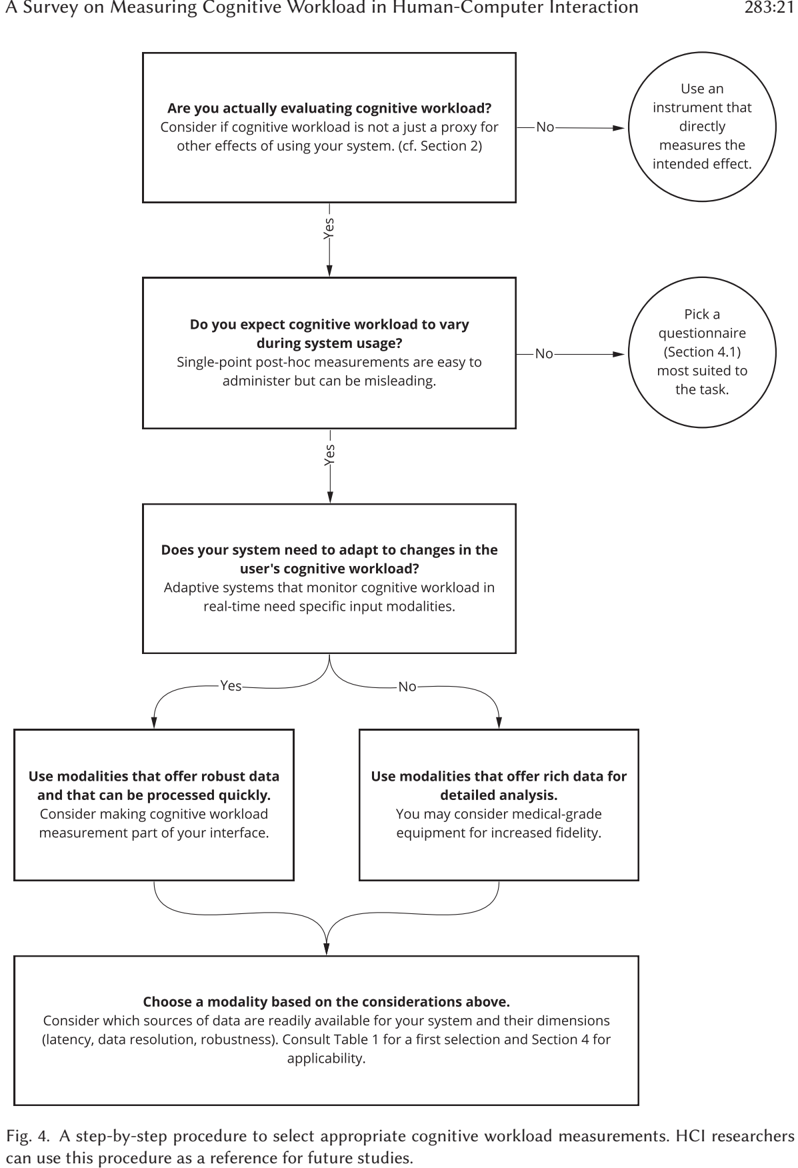
- They propose a four-step procedure for choosing cognitive workload metrics, covering whether cognitive workload is the right concept, whether it varies during use, whether the system must adapt to it, and which modality to choose.
Methods
- Systematic literature review following PRISMA procedures, with a keyword search in HCI-related proceedings and journals; venues included the top 20 conferences plus six conferences in the top 40, and all top 10 journals, confirmed via CORE 4 rankings, with a final cut-off date of 30 April 2020.
- The search used a regular expression matching terms such as “cognitive/mental load/workload” and “working memory”; the initial corpus was 6,414 papers.
- Filtering used paper eligibility (archival, peer-reviewed papers only; 904 excluded) and relevance via a double decision scheme with four researchers; 4,931 papers were excluded at relevance, yielding 579 records. Categorization used qualitative coding, a naming scheme agreed by four researchers, and affinity diagramming to build a taxonomy of measures.
Limitations
- The paper states that its qualitative analysis cannot guarantee the proposed taxonomy is the only correct one, though it aims for comprehensiveness.
- The paper states that the final choice of cognitive workload modality is almost always a trade-off between ecological validity and the requirements of the measurement modality, and that NASA-TLX validity in HCI is unclear because no empirical evidence determines the range of artifacts or experiences to which it applies.
- Evident from the text: the search is limited to selected top HCI venues and a cut-off of 30 April 2020, and many irrelevant papers were excluded due to ambiguity of the term “working memory,” especially in computer science venues.
Model-written summary. Check it against the paper before relying on it.
Integrity signals
Registry
Cites
Statistics
Figures



Verification
Claims the paper makes
6 Valid · 16 Not valid · 23 Not checked · 86 Own results and interpretations
At least one cited source doesn’t support this claim or points to a different paper, and none confirmed it — see the verdicts below.
In the paper
“Previous research has shown that the size and speed of saccades are highly discriminatory parameters for an increased cognitive workload: Here, an increased cognitive workload is indicated by larger or faster saccades [47].”
§ A Survey on Measuring Cognitive Workload in Human-Computer Interaction > 4.3.2 Saccades.
What the sources say
- Disputedcites [47] 47. Siyuan Chen, Julien Epps, Natalie Ruiz, and Fang Chen. 2011. Eye activity as a measure of human mental effort in HCI. In Proceedings of the 16th International Conference on Intelligent User Interfaces (IUI'11). ACM, New York, NY, USA, 315-318. https://doi.org/10.1145/1943403.1943454 sourceExperimental — accuracy not yet measured
The Discussion says saccade speed and especially size were highly discriminatory, but reports that both decreased as the task demanded more working memory and attention. The cited paper therefore supports their usefulness as measures, but gives the opposite direction from the claim’s ‘larger or faster’ saccades. (LLM, conf=0.90)
Checked by a reasoning model — may be wrong.
boostedstates an association- Asserted: passes — The authors put it forward as true.
- Checkable: passes — It can be checked against evidence.
- Load-bearing: unclear — It is unclear whether the paper’s conclusions depend on it.
- Based: passes — The paper gives a reason why it holds.
- Disputed
At least one cited source doesn’t support this claim or points to a different paper, and none confirmed it — see the verdicts below.
In the paper
“Similarly, touch input [39] -especially finger trajectories [173] -were used to measure cognitive workload.”
§ A Survey on Measuring Cognitive Workload in Human-Computer Interaction > 4.7 Haptic Interaction
What the sources say
- Not checked — no full text of the sourcecites [39] 39. Davide Maria Calandra, Antonio Caso, Francesco Cutugno, Antonio Origlia, and Silvia Rossi. 2013. CoWME: A gen- eral framework to evaluate cognitive workload during multimodal interaction. In Proceedings of the 15th ACM on International Conference on Multimodal Interaction (ICMI'13). ACM, Sydney, Australia, 111-118. https://doi.org/10. 1145/2522848.2522867 source
- Disputedcites [173] 173. E. M. Peck, E. Carlin, and R. Jacob. 2015. Designing brain-computer interfaces for attention-aware systems. Computer 48, 10 (Oct. 2015), 34-42. https://doi.org/10.1109/MC.2015.315 sourceExperimental — accuracy not yet measured
The citation [173] is attached specifically to “finger trajectories.” In “Training CARSON to Read the Brain” and Figure 3 (page not provided), the paper instead describes predicting cognitive workload from fNIRS brain-sensing signals, not finger trajectories or touch input. (LLM, conf=0.85)
Checked by a reasoning model — may be wrong.
plainstates an association- Asserted: passes — The authors put it forward as true.
- Checkable: passes — It can be checked against evidence.
- Load-bearing: unclear — It is unclear whether the paper’s conclusions depend on it.
- Based: passes — The paper gives a reason why it holds.
The cited sources that could be checked couldn’t confirm or dispute this claim.
In the paper
“Similarly, beta power is widely used as a metric for mental workload, including alertness, arousal, frustration, engagement, and workload states [141].”
§ A Survey on Measuring Cognitive Workload in Human-Computer Interaction > 4.2.1 Electroencephalography (EEG).
What the sources say
- Could not verifycites [141] 141. Kristiyan Lukanov, Horia A. Maior, and Max L. Wilson. 2016. Using fNIRS in Usability Testing: Understanding the Effect of Web Form Layout on Mental Workload. In Proceedings of the 2016 CHI Conference on Human Factors in Computing Systems (CHI'16). ACM, Santa Clara, California, USA, 4011-4016. https://doi.org/10.1145/2858036.2858236 sourceExperimental — accuracy not yet measured
The Measuring Mental Workload and Objective Measures sections discuss psychophysiological measures and fNIRS haemoglobin measurements, but do not address beta power. Searches for beta power and EEG spectral power found no passage linking beta power to alertness, arousal, frustration, engagement, or workload states. The available passages have no page numbers. (LLM, conf=0.76)
plainstates an association- Asserted: passes — The authors put it forward as true.
- Checkable: passes — It can be checked against evidence.
- Load-bearing: unclear — It is unclear whether the paper’s conclusions depend on it.
- Based: passes — The paper gives a reason why it holds.
- Could not verify
Every source the paper cites for this claim was checked and supports it.
In the paper
“Previous research shows that the rate and duration of fixation are indicators of an attention shift due to increasing task complexity [47].”
§ A Survey on Measuring Cognitive Workload in Human-Computer Interaction > 4.3.4 Fixations.
What the sources say
- Supportedcites [47] 47. Siyuan Chen, Julien Epps, Natalie Ruiz, and Fang Chen. 2011. Eye activity as a measure of human mental effort in HCI. In Proceedings of the 16th International Conference on Intelligent User Interfaces (IUI'11). ACM, New York, NY, USA, 315-318. https://doi.org/10.1145/1943403.1943454 source
The Discussion reports that fixation duration and fixation rate changed with task complexity and interprets those results as indicating that significantly more attention was needed for the more complex task. It also specifies that fixation duration increased while fixation rate decreased as attentional demands rose. (LLM, conf=0.92)
plainstates an association- Asserted: passes — The authors put it forward as true.
- Checkable: passes — It can be checked against evidence.
- Load-bearing: unclear — It is unclear whether the paper’s conclusions depend on it.
- Based: passes — The paper gives a reason why it holds.
- Supported
The cited sources support only part of this claim — read each source’s verdict below.
In the paper
“Previous research has shown that pupils dilate with increasing task difficulty [47] across tasks like reading, problem-solving, or visual search activities [208], where the cognitive demand can be estimated in real-time using machine learning [131].”
§ A Survey on Measuring Cognitive Workload in Human-Computer Interaction > 4.3.1 Pupil Diameter.
What the sources say
- Partly supportedcites [47] 47. Siyuan Chen, Julien Epps, Natalie Ruiz, and Fang Chen. 2011. Eye activity as a measure of human mental effort in HCI. In Proceedings of the 16th International Conference on Intelligent User Interfaces (IUI'11). ACM, New York, NY, USA, 315-318. https://doi.org/10.1145/1943403.1943454 sourceExperimental — accuracy not yet measured
The Discussion reports increased pupil size when participants performed the more demanding visual training task, supporting the link between pupil dilation and task difficulty. The paper does not establish that pattern across the cited examples of reading, problem-solving, and visual search; its own task involved recalling player positions in a basketball video. (LLM, conf=0.86)
- Not checked — no full text of the sourcecites [208] 208. Namrata Srivastava, Eduardo Velloso, Jason M. Lodge, Sarah Erfani, and James Bailey. 2019. Continuous evaluation of video lectures from real-time difficulty self-report. In Proceedings of the 2019 CHI Conference on Human Factors in Computing Systems (CHI'19). Association for Computing Machinery, Glasgow, Scotland, UK, 1-12. https://doi.org/ 10.1145/3290605.3300816 source
- Could not verifycites [131] 131. Moira LeMay and Eric Hird. 1986. Operator work load: When is enough enough? Commun. ACM 29, 7 (July 1986), 638-642. https://doi.org/10.1145/6138.6147 sourceExperimental — accuracy not yet measured
The Results report that time-stress ratings increased with workload, and the introduction lists physiological measures as a category, but neither addresses pupil dilation. Searches for pupil diameter, task difficulty, and pupillary response found no passage supporting the claim attributed to this paper; the task examples are attached to a different citation. (LLM, conf=0.75)
plainstates a cause- Asserted: passes — The authors put it forward as true.
- Checkable: passes — It can be checked against evidence.
- Load-bearing: unclear — It is unclear whether the paper’s conclusions depend on it.
- Based: passes — The paper gives a reason why it holds.
- Partly supported
52 more claims · 4 with their cited sources checked
Create a free account to see all 131 claims and every source verdict.
- It may state two separate claims as one. 35
- Probably not a substantial claim. 49
Self-check
Percentages, sums and reported differences re-computed from the paper’s own numbers.
Each contradiction between two passages listed here was confirmed by an independent check.
Rated minor: it would not touch a result — a value no result rests on, a p-value that stays on the same side of the significance level, or a conflict that is clerical, resolved elsewhere in the paper, or outside its own findings.
In the paper
§ A Survey on Measuring Cognitive Workload in Human-Computer Interaction > 4.1 Questionnaires
“Questionnaires lack real-time capabilities since they are employed after an experimental condition.”
§ A Survey on Measuring Cognitive Workload in Human-Computer Interaction > 4.1.3 Instantaneous Self-Assessment.
“Participants rate their perceived workload in predefined intervals during the execution of a task -allowing for real-time assessment of cognitive workload.”
Citations
Cites
Preferred Reporting Items for Systematic Reviews and Meta-Analyses: The PRISMA Statement
Moher, D., Liberati, A., Tetzlaff, J., Altman, D. G., & The PRISMA Group (2009) · PLoS Medicine · doi:10.1371/journal.pmed.1000097 · Cited by 64,042 · cited 1×
“The first phase of our review was a systematic keyword search in the digital library databases relevant to the HCI field.”
Development of NASA-TLX (Task Load Index): Results of Empirical and Theoretical Research
(1988) · Advances in Psychology · doi:10.1016/s0166-4115(08)62386-9 · Cited by 15,003 · cited 5×
“The NASA Task Load Index (NASA-TLX) [90, 91] is a multi-scale questionnaire to assess participants’ perceived subjective workload.”
InfluentialCognitive Load During Problem Solving: Effects on Learning
Sweller, J. (1988) · Cognitive Science · doi:10.1016/0364-0213(88)90023-7 · Cited by 11,048 · cited 3×
“Sweller developed the cognitive load theory [231–233], a theoretical framework that explains how learning is limited through instructional design.”
SUS: A 'Quick and Dirty' Usability Scale
(1996) · Usability Evaluation In Industry · doi:10.1201/9781498710411-35 · Cited by 8,989
Brain–computer interfaces for communication and control
Wolpaw, J. R., Birbaumer, N., McFarland, D. J., Pfurtscheller, G., & Vaughan, T. M. (2002) · Clinical Neurophysiology · doi:10.1016/s1388-2457(02)00057-3 · Cited by 7,927 · cited 1×
“Participants rate their perceived work-load in predefined intervals during the execution of a task – allowing for real-time assessment of cognitive workload.”
Cognitive Architecture and Instructional Design
Sweller, J., van Merrienboer, J. J. G., & Paas, F. G. W. C. (1998) · Educational Psychology Review · doi:10.1023/a:1022193728205 · Cited by 6,023 · cited 3×
“…workload helps interface designers in two ways: using a constructive approach (e.g., during early design phases), where cognitive workload is measured to improve the design of novel interactive systems, or using a summative approach (e.g., using existing systems) to compare the cognitive…”
(2005) · Cited by 5,977
Systematic Literature Reviews in Software Engineering—A Systematic Literature Review
Kitchenham, B., Pearl Brereton, O., Budgen, D., Turner, M., Bailey, J., & Linkman, S. (2009) · Information and Software Technology · doi:10.1016/j.infsof.2008.09.009 · Cited by 4,537 · cited 1×
“We followed the PRISMA procedures [121, 174] for systematic reviews and meta-analyses.”
(2001) · doi:10.1017/cbo9780511546396 · Cited by 4,482
NASA-Task Load Index (NASA-TLX); 20 Years Later
Hart, S. G. (2006) · Proceedings of the Human Factors and Ergonomics Society Annual Meeting · doi:10.1177/154193120605000909 · Cited by 4,297 · cited 3×
“The NASA-TLX [90, 91] questionnaire has become a household name in HCI research, and it is widely taught in HCI education.”
A review of classification algorithms for EEG-based brain–computer interfaces
Lotte, F., Congedo, M., Lécuyer, A., Lamarche, F., & Arnaldi, B. (2007) · Journal of Neural Engineering · doi:10.1088/1741-2560/4/2/r01 · Cited by 2,665 · cited 1×
“While this can be done using pen and paper, traditionally, an additional keypad consisting of five buttons (each button representing a workload level) and a flashlight (flashing when a rating is requested) is required.”
Boucsein, W. (2012) · doi:10.1007/978-1-4614-1126-0 · Cited by 2,526 · cited 3×
“…and the diameter can range from 1.5mm up to 8mm. Previous research has shown that pupils dilate with increasing task difficulty [47] across tasks like reading, problem-solving, or visual search activities [208], where the cognitive demand can be estimated in real-time using machine learning [131].”
Ferrari, M., & Quaresima, V. (2012) · NeuroImage · doi:10.1016/j.neuroimage.2012.03.049 · Cited by 2,274 · cited 2×
“Another non-invasive modality to measure brain activity is fNIRS [69]. fNIRS utilizes near-infrared light within a range of 650 nm and 1000 nm to measure changes in the concentration of Oxygenated Hemoglobin (HBO) and Deoxygenated Hemoglobin (HbR) in the human brain.”
A review of classification algorithms for EEG-based brain–computer interfaces: A 10 year update
Lotte, F., Bougrain, L., Cichocki, A., Clerc, M., Congedo, M., Rakotomamonjy, A., & Yger, F. (2018) · Journal of Neural Engineering · doi:10.1088/1741-2552/aab2f2 · Cited by 2,239 · cited 1×
“Machine learning has been used on these features to retrieve insights into cognitive processes [155, 156].”
Proceedings of the 2017 CHI Conference on Human Factors in Computing Systems
(2017) · doi:10.1145/3025453 · Cited by 2,207
Multiple Resources and Mental Workload
Wickens, C. D. (2008) · Human Factors: The Journal of the Human Factors and Ergonomics Society · doi:10.1518/001872008x288394 · Cited by 2,164 · cited 2×
“Intrinsic load describes the inherent complexity of a task.”
Brain Computer Interfaces, a Review
Nicolas-Alonso, L. F., & Gomez-Gil, J. (2012) · Sensors · doi:10.3390/s120201211 · Cited by 2,143 · cited 1×
“EEG is commonly leveraged in clinical applications and yields a non-invasive method to estimate cortical activity [166, 180, 254].”
Strimbu, K., & Tavel, J. A. (2010) · Current Opinion in HIV and AIDS · doi:10.1097/coh.0b013e32833ed177 · Cited by 2,062 · cited 1×
“Within our autonomic nervous systems (ANS), two 12 opposing systems – the sympathetic (activating) and the parasympathetic (inhibiting) nervous system [145] – control bodily functions, such as heart rate (HR).”
Proceedings of the 2020 CHI Conference on Human Factors in Computing Systems
(2020) · doi:10.1145/3313831 · Cited by 1,951
BioelectromagnetismPrinciples and Applications of Bioelectric and Biomagnetic Fields
Malmivuo, J., & Plonsey, R. (1995) · doi:10.1093/acprof:oso/9780195058239.001.0001 · Cited by 1,834
The human brain in numbers: a linearly scaled-up primate brain
Herculano-Houzel, S. (2009) · Frontiers in Human Neuroscience · doi:10.3389/neuro.09.031.2009 · Cited by 1,778 · cited 1×
“Past research used this questionnaire to measure cognitive workload, assuming that stressful situations are associated with negative emotions that lead to higher cognitive demand.”
Robert J. Hockey, G. (1997) · Biological Psychology · doi:10.1016/s0301-0511(96)05223-4 · Cited by 1,753 · cited 1×
“We built our literature corpus by systematically identifying relevant papers through a keyword search in all proceedings and journals related to the field of HCI.”
Gevins, A. (1997) · Cerebral Cortex · doi:10.1093/cercor/7.4.374 · Cited by 1,623 · cited 1×
“In contrast, changes in alpha and theta frequencies are correlated with the mental demand placed on working memory and increase or decrease in task engagement [77].”
Salivary Cortisol in Psychobiological Research: An Overview
Kirschbaum, C., & Hellhammer, D. H. (2008) · Neuropsychobiology · doi:10.1159/000118611 · Cited by 1,532 · cited 1×
“While the study of salivary cortisol is a reliable indicator for stress and workload [120], the need for a laboratory analysis restricts the real-time capabilities of interactive systems.”
The Handbook of Mathematical Cognition
Campbell, J. I. D. (2005) · Psychology Press eBooks · doi:10.4324/9780203998045 · Cited by 1,494
Engel, S. A., Rumelhart, D. E., Wandell, B. A., Lee, A. T., Glover, G. H., Chichilnisky, E.-J., & Shadlen, M. N. (1994) · Nature · doi:10.1038/369525a0 · Cited by 990 · cited 1×
“The psychophysical scaling procedure assigns an arbitrary workload score to a reference task.”
fNIRS-based brain-computer interfaces: a review
Naseer, N., & Hong, K.-S. (2015) · Frontiers in Human Neuroscience · doi:10.3389/fnhum.2015.00003 · Cited by 988
Analysis of Heart Rate Variability
SAYKRS, B. M. (1973) · Ergonomics · doi:10.1080/00140137308924479 · Cited by 946 · cited 1×
“These changes are reflected in the cardiac cycle, and related metrics, e.g., heart rate variability (HRV) [212].”
Melamed, S., Shirom, A., Toker, S., Berliner, S., & Shapira, I. (2006) · Psychological Bulletin · doi:10.1037/0033-2909.132.3.327 · Cited by 943 · cited 1×
“We built our literature corpus by systematically identifying relevant papers through a keyword search in all proceedings and journals related to the field of HCI.”
Pupil size variation as an indication of affective processing
Partala, T., & Surakka, V. (2003) · International Journal of Human-Computer Studies · doi:10.1016/s1071-5819(03)00017-x · Cited by 836 · cited 1×
“Pupil Diameter [4, 5, 9–11, 18–22, 27, 28, 39, 44–47, 55, 58, 62, 63, 72, 87, 92, 94, 99, 103, 107, 108, 112, 142, 143, 153, 154, 157, 165, 175, 187–189, 195, 199–201, 207, 215, 227, 236, 239, 248, 249, 255, 257, 266] Saccades [10, 21, 27, 44–47, 76, 87, 99, 165, 184, 193, 228, 236, 258] Eye Blinks…”
SAUSENG, P., KLIMESCH, W., SCHABUS, M., & DOPPELMAYR, M. (2005) · International Journal of Psychophysiology · doi:10.1016/j.ijpsycho.2005.03.018 · Cited by 814 · cited 2×
“Since it is unknown if correlations between the demand of working memory (i.e., alpha power) and task engagement (i.e., theta power) might elicit a flow state, researchers use the theta-alpha ratio as a metric for cognitive demand [213].”
Real-time neuroimaging and cognitive monitoring using wearable dry EEG
Mullen, T. R., Kothe, C. A. E., Chi, Y. M., Ojeda, A., Kerth, T., Makeig, S., Jung, T.-P., & Cauwenberghs, G. (2015) · IEEE Transactions on Biomedical Engineering · doi:10.1109/tbme.2015.2481482 · Cited by 795 · cited 1×
“This value represents the perceived workload of a participant.”
EEG delta oscillations as a correlate of basic homeostatic and motivational processes
Knyazev, G. G. (2012) · Neuroscience & Biobehavioral Reviews · doi:10.1016/j.neubiorev.2011.10.002 · Cited by 776 · cited 1×
“Delta power is associated with varying levels of attention, salience, detection, and subliminal perception [125].”
A Reconsideration of Cognitive Load Theory
Schnotz, W., & Kürschner, C. (2007) · Educational Psychology Review · doi:10.1007/s10648-007-9053-4 · Cited by 755 · cited 1×
“Hence, it becomes increasingly more challenging to maintain an overview of the most appropriate cognitive workload measurement modalities.”
Cognitive Load Theory: How Many Types of Load Does It Really Need?
Kalyuga, S. (2011) · Educational Psychology Review · doi:10.1007/s10648-010-9150-7 · Cited by 725 · cited 1×
“Hence, it becomes increasingly more challenging to maintain an overview of the most appropriate cognitive workload measurement modalities.”
Malik, M., & Camm, A. J. (1990) · Clinical Cardiology · doi:10.1002/clc.4960130811 · Cited by 722 · cited 1×
“Among others, external influences such as stress, emotion, and work impact these metrics and can be used to infer those [162].”
Proceedings of the SIGCHI Conference on Human Factors in Computing Systems
(2008) · doi:10.1145/1357054 · Cited by 547
Alpha frequency, cognitive load and memory performance
Klimesch, W., Schimke, H., & Pfurtscheller, G. (1993) · Brain Topography · doi:10.1007/bf01128991 · Cited by 530 · cited 1×
“It consists of a hierarchical decision tree, and participants are asked whether (1) it was possible to complete the task, (2) the workload was tolerable, and (3) the workload was satisfactory without reduction.”
Krakauer, J. W., & Shadmehr, R. (2006) · Trends in Neurosciences · doi:10.1016/j.tins.2005.10.003 · Cited by 516 · cited 1×
“In addition, specialized measurements techniques, such as Elec-tromyography (EMG), which records the electrical activity of muscles [110, 111, 171], can assess co-occurring physical demand to decompose cognitive load factors, such as the impact of motor memory [139].”
Surface Electromyography : Physiology, Engineering, and Applications
(2016) · doi:10.1002/9781119082934 · Cited by 462 · cited 1×
“Previous work has also shown that smooth pursuit eye movements deviate from a given trajectory in situations with a higher cognitive demand [133] while being less prone to changes in light intensity (cf. pupil diameter).”
Usability measurement in context
BEVAN, N., & MACLEOD, M. (1994) · Behaviour & Information Technology · doi:10.1080/01449299408914592 · Cited by 455 · cited 1×
“We built our literature corpus by systematically identifying relevant papers through a keyword search in all proceedings and journals related to the field of HCI.”
Proceedings of the International Conference on New Interfaces for Musical Expression
Jensenius, A. R., Skogstad, S. A. V. D., Nymoen, K., Tveit, A., Godøy, R. I., & Overholt, D. (2011) · NORA - Norwegian Open Research Archives · Cited by 445
Estimating workload using EEG spectral power and ERPs in the n-back task
Brouwer, A.-M., Hogervorst, M. A., van Erp, J. B. F., Heffelaar, T., Zimmerman, P. H., & Oostenveld, R. (2012) · Journal of Neural Engineering · doi:10.1088/1741-2560/9/4/045008 · Cited by 407 · cited 2×
“This value represents the perceived workload of a participant.”
What is the relationship between mental workload factors and cognitive load types?
Galy, E., Cariou, M., & Mélan, C. (2012) · International Journal of Psychophysiology · doi:10.1016/j.ijpsycho.2011.09.023 · Cited by 395 · cited 1×
“This concept is often referred to as Cognition-Aware Computing [37] and Workload-Aware Computing [128].”
Berka, C., Levendowski, D. J., Cvetinovic, M. M., Petrovic, M. M., Davis, G., Lumicao, M. N., Zivkovic, V. T., Popovic, M. V., & Olmstead, R. (2004) · International Journal of Human-Computer Interaction · doi:10.1207/s15327590ijhc1702_3 · Cited by 388
Psycho-physiological measures for assessing cognitive load
Haapalainen, E., Kim, S., Forlizzi, J. F., & Dey, A. K. (2010) · Proceedings of the 12th ACM international conference on Ubiquitous computing · doi:10.1145/1864349.1864395 · Cited by 382 · cited 3×
“Knowing the pupil diameter for a given light intensity allows us to calculate the effect due to cognitive workload.”
Estimating cognitive load using remote eye tracking in a driving simulator
Palinko, O., Kun, A. L., Shyrokov, A., & Heeman, P. (2010) · Proceedings of the 2010 Symposium on Eye-Tracking Research & Applications - ETRA '10 · doi:10.1145/1743666.1743701 · Cited by 371
(2015) · CRC Press eBooks · doi:10.1201/b18362 · Cited by 347
Effects of Relaxing Music on Salivary Cortisol Level after Psychological Stress
KHALFA, S., BELLA, S. D., ROY, M., PERETZ, I., & LUPIEN, S. J. (2003) · Annals of the New York Academy of Sciences · doi:10.1196/annals.1284.045 · Cited by 341 · cited 1×
“Salivary cortisol, usually used as a biological marker for stress [114], has recently been utilized for cognitive workload measurements [49].”
A general framework for brain-computer interface design
Mason, S. G., & Birch, G. E. (2003) · IEEE Transactions on Neural Systems and Rehabilitation Engineering · doi:10.1109/tnsre.2003.810426 · Cited by 331 · cited 1×
“EEG is commonly leveraged in clinical applications and yields a non-invasive method to estimate cortical activity [166, 180, 254].”
Integrating cognitive load theory and concepts of human–computer interaction
Hollender, N., Hofmann, C., Deneke, M., & Schmitz, B. (2010) · Computers in Human Behavior · doi:10.1016/j.chb.2010.05.031 · Cited by 328 · cited 4×
“Our work focuses explicitly on HCI’s implicit understanding of cognitive workload rather than drawing from a theoretical background as suggested by past work [98].”
InfluentialBailey, B. P., & Iqbal, S. T. (2008) · ACM Transactions on Computer-Human Interaction · doi:10.1145/1314683.1314689 · Cited by 325
Proceedings of the SIGCHI Conference on Human Factors in Computing Systems
(2005) · doi:10.1145/1054972 · Cited by 314
Pay attention!: designing adaptive agents that monitor and improve user engagement
Szafir, D., & Mutlu, B. (2012) · Proceedings of the SIGCHI Conference on Human Factors in Computing Systems · doi:10.1145/2207676.2207679 · Cited by 304 · cited 1×
“Cerebral EEG Frequencies [16, 17, 26, 52, 67, 70, 83, 86, 87, 100, 105, 106, 124, 130, 135, 138, 148, 150, 184, 197, 198, 207, 235, 243, 244, 268] EEG ERPs [23, 26, 59, 81, 184, 214, 227, 243] Hemodynamic Response (fNIRS) [3, 5, 32, 80, 96, 97, 104, 159, 161, 191, 192, 196, 221–223, 227, 261, 262]…”
The Index of Cognitive Activity: measuring cognitive workload
Marshall, S. P. (2003) · Proceedings of the IEEE 7th Conference on Human Factors and Power Plants · doi:10.1109/hfpp.2002.1042860 · Cited by 266 · cited 1×
“In addition to the established questionnaires, previous research has incorporated various custom questionnaires to subjectively measure cognitive workload – tailored to their specific use cases or tasks.”
Robust classification of EEG signal for brain-computer interface
Thulasidas, M., Guan, C., & Wu, J. (2006) · IEEE Transactions on Neural Systems and Rehabilitation Engineering · doi:10.1109/tnsre.2005.862695 · Cited by 261 · cited 1×
“It consists of a hierarchical decision tree, and participants are asked whether (1) it was possible to complete the task, (2) the workload was tolerable, and (3) the workload was satisfactory without reduction.”
Diagnosticity and multidimensional subjective workload ratings
TSANG, P. S., & VELAZQUEZ, V. L. (1996) · Ergonomics · doi:10.1080/00140139608964470 · Cited by 260 · cited 1×
“The “Workload Profile” questionnaire [241] combines a Psychophysical Scale , the Bedford Workload Scale , and a Workload Profile to measure cognitive workload.”
Context-Aware Online Adaptation of Mixed Reality Interfaces
Lindlbauer, D., Feit, A. M., & Hilliges, O. (2019) · Proceedings of the 32nd Annual ACM Symposium on User Interface Software and Technology · doi:10.1145/3332165.3347945 · Cited by 254 · cited 1×
“Pupil Diameter [4, 5, 9–11, 18–22, 27, 28, 39, 44–47, 55, 58, 62, 63, 72, 87, 92, 94, 99, 103, 107, 108, 112, 142, 143, 153, 154, 157, 165, 175, 187–189, 195, 199–201, 207, 215, 227, 236, 239, 248, 249, 255, 257, 266] Saccades [10, 21, 27, 44–47, 76, 87, 99, 165, 184, 193, 228, 236, 258] Eye Blinks…”
A method to assess the driver mental workload: The driving activity load index (DALI)
Pauzié, A. (2008) · IET Intelligent Transport Systems · doi:10.1049/iet-its:20080023 · Cited by 246 · cited 2×
“Traditionally, research in HCI employed questionnaires [90, 91] or think-aloud protocols [190] as cognitive workload measures.”
A User Study of Visualization Effectiveness Using EEG and Cognitive Load
Anderson, E. W., Potter, K. C., Matzen, L. E., Shepherd, J. F., Preston, G. A., & Silva, C. T. (2011) · Computer Graphics Forum · doi:10.1111/j.1467-8659.2011.01928.x · Cited by 245 · cited 4×
“Although these concepts do not originate from the HCI field, we decided to include them in this survey paper since an increasing number of HCI papers started to mention the cognitive load theory to justify their workload assessment (cf. [6, 98]).”
InfluentialMonitoring of mental workload levels during an everyday life office-work scenario
Cinaz, B., Arnrich, B., La Marca, R., & Tröster, G. (2013) · Personal and Ubiquitous Computing · doi:10.1007/s00779-011-0466-1 · Cited by 235 · cited 6×
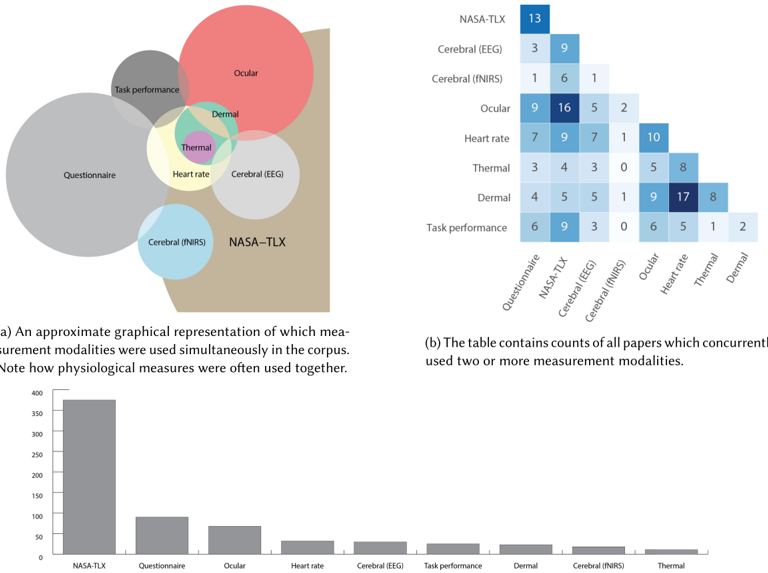
“…[25, 50, 51, 76, 78, 87, 99, 106, 134, 182–185, 194, 201, 202, 215–217, 224, 225, 227, 268] Task Performance Number of Errors [13, 30, 61, 113, 266 Salivary Cortisol [49] The bold values refer to the most used and prominent cognitive workload measurement modalities highlighted in Figures 3 and 4.”
InfluentialFunctional Optical Brain Imaging Using Near-Infrared During Cognitive Tasks
Izzetoglu, K., Bunce, S., Onaral, B., Pourrezaei, K., & Chance, B. (2004) · International Journal of Human-Computer Interaction · doi:10.1207/s15327590ijhc1702_6 · Cited by 231 · cited 1×
“…52, 67, 70, 83, 86, 87, 100, 105, 106, 124, 130, 135, 138, 148, 150, 184, 197, 198, 207, 235, 243, 244, 268] EEG ERPs [23, 26, 59, 81, 184, 214, 227, 243] Hemodynamic Response (fNIRS) [3, 5, 32, 80, 96, 97, 104, 159, 161, 191, 192, 196, 221–223, 227, 261, 262] Electromagnetic Changes (fMRI) [220]”
Duchowski, A. T., Krejtz, K., Krejtz, I., Biele, C., Niedzielska, A., Kiefer, P., Raubal, M., & Giannopoulos, I. (2018) · Proceedings of the 2018 CHI Conference on Human Factors in Computing Systems · doi:10.1145/3173574.3173856 · Cited by 228 · cited 3×
“Pupil Diameter [4, 5, 9–11, 18–22, 27, 28, 39, 44–47, 55, 58, 62, 63, 72, 87, 92, 94, 99, 103, 107, 108, 112, 142, 143, 153, 154, 157, 165, 175, 187–189, 195, 199–201, 207, 215, 227, 236, 239, 248, 249, 255, 257, 266] Saccades [10, 21, 27, 44–47, 76, 87, 99, 165, 184, 193, 228, 236, 258] Eye Blinks…”
The Validity of Physiological Measures to Identify Differences in Intrinsic Cognitive Load
Ayres, P., Lee, J. Y., Paas, F., & van Merriënboer, J. J. G. (2021) · Frontiers in Psychology · doi:10.3389/fpsyg.2021.702538 · Cited by 222 · cited 2×
“A careful evaluation of the actual measurement is inevitable, as external stressors, e.g., the social-evaluative threat of performing well in a study, may impact biomarkers [49].”
Using galvanic skin response for cognitive load measurement in arithmetic and reading tasks
Nourbakhsh, N., Wang, Y., Chen, F., & Calvo, R. A. (2012) · Proceedings of the 24th Australian Computer-Human Interaction Conference · doi:10.1145/2414536.2414602 · Cited by 219
What does germane load mean? An empirical contribution to the cognitive load theory
Debue, N., & van de Leemput, C. (2014) · Frontiers in Psychology · doi:10.3389/fpsyg.2014.01099 · Cited by 209 · cited 1×
“Thus, the definition and interpretation of cognitive workload including its underlying theories and models is a subject of controversy in psychology [57].”
Using task-induced pupil diameter and blink rate to infer cognitive load.
Chen, S., & Epps, J. (2014) · Human–Computer Interaction · doi:10.1080/07370024.2014.892428 · Cited by 200 · cited 2×
“Pupil Diameter [4, 5, 9–11, 18–22, 27, 28, 39, 44–47, 55, 58, 62, 63, 72, 87, 92, 94, 99, 103, 107, 108, 112, 142, 143, 153, 154, 157, 165, 175, 187–189, 195, 199–201, 207, 215, 227, 236, 239, 248, 249, 255, 257, 266] Saccades [10, 21, 27, 44–47, 76, 87, 99, 165, 184, 193, 228, 236, 258] Eye Blinks…”
Nikulin, V. V., Nolte, G., & Curio, G. (2011) · NeuroImage · doi:10.1016/j.neuroimage.2011.01.057 · Cited by 198 · cited 1×
“Researchers are concerned about this and invest significant effort to reduce the number of measurement artifacts [53, 73, 127, 181].”
Towards an index of opportunity: understanding changes in mental workload during task execution
Iqbal, S. T., Adamczyk, P. D., Zheng, X. S., & Bailey, B. P. (2005) · Proceedings of the SIGCHI Conference on Human Factors in Computing Systems · doi:10.1145/1054972.1055016 · Cited by 196 · cited 1×
“Pupil Diameter [4, 5, 9–11, 18–22, 27, 28, 39, 44–47, 55, 58, 62, 63, 72, 87, 92, 94, 99, 103, 107, 108, 112, 142, 143, 153, 154, 157, 165, 175, 187–189, 195, 199–201, 207, 215, 227, 236, 239, 248, 249, 255, 257, 266] Saccades [10, 21, 27, 44–47, 76, 87, 99, 165, 184, 193, 228, 236, 258] Eye Blinks…”
Feasibility and pragmatics of classifying working memory load with an electroencephalograph
Grimes, D., Tan, D. S., Hudson, S. E., Shenoy, P., & Rao, R. P. N. (2008) · Proceedings of the SIGCHI Conference on Human Factors in Computing Systems · doi:10.1145/1357054.1357187 · Cited by 192 · cited 2×
“EEG has been used to discriminate between cognitive states [71, 83, 148], as a measurement for user experience evaluation [70], and as an input method [14, 238].”
An experimental evaluation of instantaneous self-assessment as a measure of workload
TATTERSALL, A. J., & FOORD, P. S. (1996) · Ergonomics · doi:10.1080/00140139608964495 · Cited by 184 · cited 2×
“For example, Zijlstra’s [267] RSME is a single-item rating and may enable rapid evaluations or be used in experience sampling; the ISA scale [237] can provide near real-time assessment; while the Bedford Workload Scale [205] can provide insights into potential mental overload situations for the…”
Multivariate workload evaluation combining physiological and subjective measures
Miyake, S. (2001) · International Journal of Psychophysiology · doi:10.1016/s0167-8760(00)00191-4 · Cited by 184 · cited 2×
“We begin by exploring theories, measurements, and assessments adopted in past HCI studies.”
Multimodal Fusion for Objective Assessment of Cognitive Workload: A Review
Debie, E., Fernandez Rojas, R., Fidock, J., Barlow, M., Kasmarik, K., Anavatti, S., Garratt, M., & Abbass, H. A. (2021) · IEEE Transactions on Cybernetics · doi:10.1109/tcyb.2019.2939399 · Cited by 184 · cited 1×
“Realizing new schemes or patterns that help solve a task may increase task engagement and foster learning.”
Classifying driver workload using physiological and driving performance data: two field studies
Solovey, E. T., Zec, M., Garcia Perez, E. A., Reimer, B., & Mehler, B. (2014) · Proceedings of the SIGCHI Conference on Human Factors in Computing Systems · doi:10.1145/2556288.2557068 · Cited by 182 · cited 3×
“…Cardiovascular Heart Rate [4, 10, 25, 27, 40, 41, 49, 50, 76, 78, 82, 85, 87, 99, 106, 146, 152, 160, 169, 184, 185, 194, 201, 202, 214, 216, 217, 224, 225, 227, 240, 244, 264, 264, 266, 268] Respiration [87, 99, 106, 184, 185, 194] Temperature [1, 2, 8, 87, 184, 185, 194, 216, 217, 268] Dermal…”
A Model Relating Pupil Diameter to Mental Workload and Lighting Conditions
Pfleging, B., Fekety, D. K., Schmidt, A., & Kun, A. L. (2016) · Proceedings of the 2016 CHI Conference on Human Factors in Computing Systems · doi:10.1145/2858036.2858117 · Cited by 179 · cited 2×
“Thus, different methods and models (e.g., [195]) were developed to ensure a valid measurement of cognitive workload using pupil dilation: Here, the total pupil dilation is seen as the sum of dilation due to light intensity and cognitive workload.”
Self-citationEye activity as a measure of human mental effort in HCI
Chen, S., Epps, J., Ruiz, N., & Chen, F. (2011) · Proceedings of the 16th international conference on Intelligent user interfaces · doi:10.1145/1943403.1943454 · Cited by 174 · cited 7×
“Pupil Diameter [4, 5, 9–11, 18–22, 27, 28, 39, 44–47, 55, 58, 62, 63, 72, 87, 92, 94, 99, 103, 107, 108, 112, 142, 143, 153, 154, 157, 165, 175, 187–189, 195, 199–201, 207, 215, 227, 236, 239, 248, 249, 255, 257, 266] Saccades [10, 21, 27, 44–47, 76, 87, 99, 165, 184, 193, 228, 236, 258] Eye Blinks…”
InfluentialUsing a low-cost electroencephalograph for task classification in HCI research
Lee, J. C., & Tan, D. S. (2006) · Proceedings of the 19th annual ACM symposium on User interface software and technology · doi:10.1145/1166253.1166268 · Cited by 165 · cited 2×
“EEG has been used to discriminate between cognitive states [71, 83, 148], as a measurement for user experience evaluation [70], and as an input method [14, 238].”
Cognitive Load Estimation in the Wild
Fridman, L., Reimer, B., Mehler, B., & Freeman, W. T. (2018) · Proceedings of the 2018 CHI Conference on Human Factors in Computing Systems · doi:10.1145/3173574.3174226 · Cited by 161 · cited 1×
“Pupil Diameter [4, 5, 9–11, 18–22, 27, 28, 39, 44–47, 55, 58, 62, 63, 72, 87, 92, 94, 99, 103, 107, 108, 112, 142, 143, 153, 154, 157, 165, 175, 187–189, 195, 199–201, 207, 215, 227, 236, 239, 248, 249, 255, 257, 266] Saccades [10, 21, 27, 44–47, 76, 87, 99, 165, 184, 193, 228, 236, 258] Eye Blinks…”
Controlling interruptions: awareness displays and social motivation for coordination
Dabbish, L., & Kraut, R. E. (2004) · Proceedings of the 2004 ACM conference on Computer supported cooperative work · doi:10.1145/1031607.1031638 · Cited by 155 · cited 1×
“…[10, 21, 27, 44–47, 76, 87, 99, 165, 184, 193, 228, 236, 258] Eye Blinks [4, 5, 27, 43–47, 76, 87, 99, 175, 182, 184, 236, 268] Fixations [1, 10, 54, 68, 99, 140, 153, 184, 219, 228] Smooth Pursuits and Ocular Movements [133] Cardiovascular Heart Rate [4, 10, 25, 27, 40, 41, 49, 50, 76, 78, 82,…”
Cognitive Heat: Exploring the Usage of Thermal Imaging to Unobtrusively Estimate Cognitive Load
Abdelrahman, Y., Velloso, E., Dingler, T., Schmidt, A., & Vetere, F. (2017) · Proceedings of the ACM on Interactive, Mobile, Wearable and Ubiquitous Technologies · doi:10.1145/3130898 · Cited by 154
Self-citationMeasurement of Cognitive Load in HCI Systems Using EEG Power Spectrum: An Experimental Study
Kumar, N., & Kumar, J. (2016) · Procedia Computer Science · doi:10.1016/j.procs.2016.04.068 · Cited by 153 · cited 2×
“In contrast, gamma power indicates high mental activity at the somatosensory cortex [141].”
Differentiating Different Types of Cognitive Load: a Comparison of Different Measures
Korbach, A., Brünken, R., & Park, B. (2018) · Educational Psychology Review · doi:10.1007/s10648-017-9404-8 · Cited by 153 · cited 2×
“Choosing the right assessment for the right task has been recently discussed in various research publications (cf. [15, 60, 64, 65, 126, 186, 265]), but especially HCI research needs to deepen and conceptualize our understanding of cognitive workload in interacting with computer systems.”
Assessing Cognitive Load with Physiological Sensors
Ikehara, C. S., & Crosby, M. E. (2005) · Proceedings of the 38th Annual Hawaii International Conference on System Sciences · doi:10.1109/hicss.2005.103 · Cited by 150 · cited 1×
“However, previous research has shown that various eye movements can also indicate increased cognitive demand [63, 131, 133] or derive the user proficiency during interaction [151].”
Dynamic difficulty using brain metrics of workload
Afergan, D., Peck, E. M., Solovey, E. T., Jenkins, A., Hincks, S. W., Brown, E. T., Chang, R., & Jacob, R. J. K. (2014) · Proceedings of the SIGCHI Conference on Human Factors in Computing Systems · doi:10.1145/2556288.2557230 · Cited by 148 · cited 1×
“…52, 67, 70, 83, 86, 87, 100, 105, 106, 124, 130, 135, 138, 148, 150, 184, 197, 198, 207, 235, 243, 244, 268] EEG ERPs [23, 26, 59, 81, 184, 214, 227, 243] Hemodynamic Response (fNIRS) [3, 5, 32, 80, 96, 97, 104, 159, 161, 191, 192, 196, 221–223, 227, 261, 262] Electromagnetic Changes (fMRI) [220]”
Steichen, B., Carenini, G., & Conati, C. (2013) · Proceedings of the 2013 international conference on Intelligent user interfaces · doi:10.1145/2449396.2449439 · Cited by 146 · cited 2×
“…165, 184, 193, 228, 236, 258] Eye Blinks [4, 5, 27, 43–47, 76, 87, 99, 175, 182, 184, 236, 268] Fixations [1, 10, 54, 68, 99, 140, 153, 184, 219, 228] Smooth Pursuits and Ocular Movements [133] Cardiovascular Heart Rate [4, 10, 25, 27, 40, 41, 49, 50, 76, 78, 82, 85, 87, 99, 106, 146, 152, 160,…”
Yuksel, B. F., Oleson, K. B., Harrison, L., Peck, E. M., Afergan, D., Chang, R., & Jacob, R. J. (2016) · Proceedings of the 2016 CHI Conference on Human Factors in Computing Systems · doi:10.1145/2858036.2858388 · Cited by 137 · cited 2×
“…52, 67, 70, 83, 86, 87, 100, 105, 106, 124, 130, 135, 138, 148, 150, 184, 197, 198, 207, 235, 243, 244, 268] EEG ERPs [23, 26, 59, 81, 184, 214, 227, 243] Hemodynamic Response (fNIRS) [3, 5, 32, 80, 96, 97, 104, 159, 161, 191, 192, 196, 221–223, 227, 261, 262] Electromagnetic Changes (fMRI) [220]”
The Placebo Effect of Artificial Intelligence in Human–Computer Interaction
Kosch, T., Welsch, R., Chuang, L., & Schmidt, A. (2022) · ACM Transactions on Computer-Human Interaction · doi:10.1145/3529225 · Cited by 137
Self-citationA data set of real world driving to assess driver workload
Schneegass, S., Pfleging, B., Broy, N., Heinrich, F., & Schmidt, A. (2013) · Proceedings of the 5th International Conference on Automotive User Interfaces and Interactive Vehicular Applications · doi:10.1145/2516540.2516561 · Cited by 135 · cited 5×
“Here, temperature-related measures such as heat flux (heat transfer rate) are more robust [87, 217], most likely due to the less noise-prone method to measure them.”
InfluentialSelf-citationGiraud, S., Thérouanne, P., & Steiner, D. D. (2017) · International Journal of Human-Computer Studies · doi:10.1016/j.ijhcs.2017.10.011 · Cited by 129 · cited 1×
“Research showed various links between respiratory activities and an increased cognitive workload: Here, respiration belts or thermistor-based flow sensors underneath the participant’s nose were used to measure the respiration rate, its variance, and depth [106].”
Efficient mental workload estimation using task-independent EEG features
Roy, R. N., Charbonnier, S., Campagne, A., & Bonnet, S. (2016) · Journal of Neural Engineering · doi:10.1088/1741-2560/13/2/026019 · Cited by 128 · cited 1×
“Depending on the decision, participants then have to rank their perceived workload on a rating scale with endpoints from workload insignificant (1) to task abandoned (10).”
Biomarkers of stress in behavioural medicine
Nater, U. M., Skoluda, N., & Strahler, J. (2013) · Current Opinion in Psychiatry · doi:10.1097/yco.0b013e328363b4ed · Cited by 125 · cited 1×
“Typical markers include cortisol, alpha-amylase, and pro-inflammatory cytokines for different biological stress systems 13 [178].”
Overview of the DARPA Augmented Cognition Technical Integration Experiment
St. John, M., Kobus, D. A., Morrison, J. G., & Schmorrow, D. (2004) · International Journal of Human-Computer Interaction · doi:10.1207/s15327590ijhc1702_2 · Cited by 124 · cited 5×
“…52, 67, 70, 83, 86, 87, 100, 105, 106, 124, 130, 135, 138, 148, 150, 184, 197, 198, 207, 235, 243, 244, 268] EEG ERPs [23, 26, 59, 81, 184, 214, 227, 243] Hemodynamic Response (fNIRS) [3, 5, 32, 80, 96, 97, 104, 159, 161, 191, 192, 196, 221–223, 227, 261, 262] Electromagnetic Changes (fMRI) [220]”
InfluentialCOGCAM: Contact-free Measurement of Cognitive Stress During Computer Tasks with a Digital Camera
McDuff, D. J., Hernandez, J., Gontarek, S., & Picard, R. W. (2016) · Proceedings of the 2016 CHI Conference on Human Factors in Computing Systems · doi:10.1145/2858036.2858247 · Cited by 113 · cited 1×
“…Smooth Pursuits and Ocular Movements [133] Cardiovascular Heart Rate [4, 10, 25, 27, 40, 41, 49, 50, 76, 78, 82, 85, 87, 99, 106, 146, 152, 160, 169, 184, 185, 194, 201, 202, 214, 216, 217, 224, 225, 227, 240, 244, 264, 264, 266, 268] Respiration [87, 99, 106, 184, 185, 194] Temperature [1, 2,…”
Using fNIRS brain sensing to evaluate information visualization interfaces
Peck, E. M. M., Yuksel, B. F., Ottley, A., Jacob, R. J. K., & Chang, R. (2013) · Proceedings of the SIGCHI Conference on Human Factors in Computing Systems · doi:10.1145/2470654.2470723 · Cited by 113
A short history of causal modeling of fMRI data
Stephan, K. E., & Roebroeck, A. (2012) · NeuroImage · doi:10.1016/j.neuroimage.2012.01.034 · Cited by 112 · cited 1×
“…investigate the oxygen levels in the blood, or Functional Magnetic Resonance Imaging (fMRI) that measures the electro-magnetic responses of the brain, was introduced in the 70s [69] and 90s [229], respectively, to obtain more accurate brain imaging measurements at the cost of temporal resolution.”
Hirshfield, L. M., Solovey, E. T., Girouard, A., Kebinger, J., Jacob, R. J. K., Sassaroli, A., & Fantini, S. (2009) · Proceedings of the SIGCHI Conference on Human Factors in Computing Systems · doi:10.1145/1518701.1519035 · Cited by 105 · cited 1×
“…52, 67, 70, 83, 86, 87, 100, 105, 106, 124, 130, 135, 138, 148, 150, 184, 197, 198, 207, 235, 243, 244, 268] EEG ERPs [23, 26, 59, 81, 184, 214, 227, 243] Hemodynamic Response (fNIRS) [3, 5, 32, 80, 96, 97, 104, 159, 161, 191, 192, 196, 221–223, 227, 261, 262] Electromagnetic Changes (fMRI) [220]”
The design and evaluation of an auditory-enhanced scrollbar
Brewster, S. A., Wright, P. C., & Edwards, A. D. N. (1994) · Proceedings of the SIGCHI Conference on Human Factors in Computing Systems · doi:10.1145/191666.191733 · Cited by 105 · cited 3×
“The HCI community used cognitive workload measures as early as 1994 [33], but the concept’s generic applicability to computer systems remained a largely unexplored topic.”
Review of the Use of Electroencephalography as an Evaluation Method for Human-Computer Interaction
Frey, J., Mühl, C., Lotte, F., & Hachet, M. (2014) · International Conference on Physiological Computing Systems (PhyCS) · doi:10.5220/0004708102140223 · Cited by 103 · cited 1×
“While this can be done using pen and paper, traditionally, an additional keypad consisting of five buttons (each button representing a workload level) and a flashlight (flashing when a rating is requested) is required.”
Framework for Electroencephalography-based Evaluation of User Experience
Frey, J., Daniel, M., Castet, J., Hachet, M., & Lotte, F. (2016) · CHI Conference on Human Factors in Computing Systems · doi:10.1145/2858036.2858525 · Cited by 101 · cited 3×
“EEG has been used to discriminate between cognitive states [71, 83, 148], as a measurement for user experience evaluation [70], and as an input method [14, 238].”
GSR and Blink Features for Cognitive Load Classification
Nourbakhsh, N., Wang, Y., & Chen, F. (2013) · Lecture Notes in Computer Science · doi:10.1007/978-3-642-40483-2_11 · Cited by 98 · cited 3×
“While some work showed feasible accuracy [182, 202], other work argues that other modalities are superior [87, 201].”
Processing Resources in Attention, Dual Task Performance, and Workload Assessment.
Wickens, C. D. (1981) · Defense Technical Information Center (DTIC) · Cited by 98
A framework to estimate cognitive load using physiological data
Ahmad, M., Keller, I., Robb, D. A., & Lohan, K. S. (2020) · Personal and Ubiquitous Computing · doi:10.1007/s00779-020-01455-7 · Cited by 97 · cited 3×
“Pupil Diameter [4, 5, 9–11, 18–22, 27, 28, 39, 44–47, 55, 58, 62, 63, 72, 87, 92, 94, 99, 103, 107, 108, 112, 142, 143, 153, 154, 157, 165, 175, 187–189, 195, 199–201, 207, 215, 227, 236, 239, 248, 249, 255, 257, 266] Saccades [10, 21, 27, 44–47, 76, 87, 99, 165, 184, 193, 228, 236, 258] Eye Blinks…”
Chevalier, A., & Kicka, M. (2006) · International Journal of Human-Computer Studies · doi:10.1016/j.ijhcs.2006.06.002 · Cited by 96 · cited 1×
“Here, various studies report on task completion time (e.g., [45, 61]) and reaction time (e.g., [48, 82]) or the number of errors (e.g., [13, 61]) and task accuracy (e.g., [45, 153]) – all highly related to changes in cognitive workload.”
Interruptibility of Software Developers and its Prediction Using Psycho-Physiological Sensors
Züger, M., & Fritz, T. (2015) · Proceedings of the 33rd Annual ACM Conference on Human Factors in Computing Systems · doi:10.1145/2702123.2702593 · Cited by 96 · cited 5×
“…27, 40, 41, 49, 50, 76, 78, 82, 85, 87, 99, 106, 146, 152, 160, 169, 184, 185, 194, 201, 202, 214, 216, 217, 224, 225, 227, 240, 244, 264, 264, 266, 268] Respiration [87, 99, 106, 184, 185, 194] Temperature [1, 2, 8, 87, 184, 185, 194, 216, 217, 268] Dermal Skin Conductance (EDA) [25, 50, 51, 76,…”
InfluentialTwitch crowdsourcing: crowd contributions in short bursts of time
Vaish, R., Wyngarden, K., Chen, J., Cheung, B., & Bernstein, M. S. (2014) · Proceedings of the SIGCHI Conference on Human Factors in Computing Systems · doi:10.1145/2556288.2556996 · Cited by 95 · cited 1×
“Research showed various links between respiratory activities and an increased cognitive workload: Here, respiration belts or thermistor-based flow sensors underneath the participant’s nose were used to measure the respiration rate, its variance, and depth [106].”
2019 International Conference on Multimodal Interaction
(2019) · doi:10.1145/3340555 · Cited by 95
The Low/High Index of Pupillary Activity
Duchowski, A. T., Krejtz, K., Gehrer, N. A., Bafna, T., & Bækgaard, P. (2020) · Proceedings of the 2020 CHI Conference on Human Factors in Computing Systems · doi:10.1145/3313831.3376394 · Cited by 94 · cited 2×
“Pupil Diameter [4, 5, 9–11, 18–22, 27, 28, 39, 44–47, 55, 58, 62, 63, 72, 87, 92, 94, 99, 103, 107, 108, 112, 142, 143, 153, 154, 157, 165, 175, 187–189, 195, 199–201, 207, 215, 227, 236, 239, 248, 249, 255, 257, 266] Saccades [10, 21, 27, 44–47, 76, 87, 99, 165, 184, 193, 228, 236, 258] Eye Blinks…”
Cognitive Load Theory in Computing Education Research: A Review
Duran, R., Zavgorodniaia, A., & Sorva, J. (2022) · ACM Transactions on Computing Education · doi:10.1145/3483843 · Cited by 92 · cited 4×
“For example, interfaces that require users to search for items or memorize lengthy menu structures can increase cognitive workload by straining their memory [24].”
InfluentialUnderstanding Programming Expertise: An Empirical Study of Phasic Brain Wave Changes
Crk, I., Kluthe, T., & Stefik, A. (2015) · ACM Transactions on Computer-Human Interaction · doi:10.1145/2829945 · Cited by 90
Measuring Cognitive Load: Are There More Valid Alternatives to Likert Rating Scales?
Ouwehand, K., Kroef, A. V. D., Wong, J., & Paas, F. (2021) · Frontiers in Education · doi:10.3389/feduc.2021.702616 · Cited by 90 · cited 2×
“A careful evaluation of the actual measurement is inevitable, as external stressors, e.g., the social-evaluative threat of performing well in a study, may impact biomarkers [49].”
From Tool to Partner: The Evolution of Human-Computer Interaction
Grudin, J. T. (2016) · Synthesis lectures on human-centered informatics · doi:10.2200/s00745ed1v01y201612hci035 · Cited by 87
Brainput: enhancing interactive systems with streaming fnirs brain input
Solovey, E., Schermerhorn, P., Scheutz, M., Sassaroli, A., Fantini, S., & Jacob, R. (2012) · Proceedings of the SIGCHI Conference on Human Factors in Computing Systems · doi:10.1145/2207676.2208372 · Cited by 86 · cited 1×
“…52, 67, 70, 83, 86, 87, 100, 105, 106, 124, 130, 135, 138, 148, 150, 184, 197, 198, 207, 235, 243, 244, 268] EEG ERPs [23, 26, 59, 81, 184, 214, 227, 243] Hemodynamic Response (fNIRS) [3, 5, 32, 80, 96, 97, 104, 159, 161, 191, 192, 196, 221–223, 227, 261, 262] Electromagnetic Changes (fMRI) [220]”
Lin, Y., Zhang, W. J., & Watson, L. G. (2003) · International Journal of Human-Computer Studies · doi:10.1016/s1071-5819(03)00122-8 · Cited by 82 · cited 2×
“Research showed various links between respiratory activities and an increased cognitive workload: Here, respiration belts or thermistor-based flow sensors underneath the participant’s nose were used to measure the respiration rate, its variance, and depth [106].”
Towards an affordable brain computer interface for the assessment of programmers’ mental workload
Kosti, M. V., Georgiadis, K., Adamos, D. A., Laskaris, N., Spinellis, D., & Angelis, L. (2018) · International Journal of Human-Computer Studies · doi:10.1016/j.ijhcs.2018.03.002 · Cited by 81 · cited 1×
“Cerebral EEG Frequencies [16, 17, 26, 52, 67, 70, 83, 86, 87, 100, 105, 106, 124, 130, 135, 138, 148, 150, 184, 197, 198, 207, 235, 243, 244, 268] EEG ERPs [23, 26, 59, 81, 184, 214, 227, 243] Hemodynamic Response (fNIRS) [3, 5, 32, 80, 96, 97, 104, 159, 161, 191, 192, 196, 221–223, 227, 261, 262]…”
Multimodal Intelligent Eye-Gaze Tracking System
Biswas, P., & Langdon, P. (2015) · International Journal of Human-Computer Interaction · doi:10.1080/10447318.2014.1001301 · Cited by 81 · cited 1×
“Pupil Diameter [4, 5, 9–11, 18–22, 27, 28, 39, 44–47, 55, 58, 62, 63, 72, 87, 92, 94, 99, 103, 107, 108, 112, 142, 143, 153, 154, 157, 165, 175, 187–189, 195, 199–201, 207, 215, 227, 236, 239, 248, 249, 255, 257, 266] Saccades [10, 21, 27, 44–47, 76, 87, 99, 165, 184, 193, 228, 236, 258] Eye Blinks…”
Distinguishing Difficulty Levels with Non-invasive Brain Activity Measurements
Girouard, A., Solovey, E., Hirshfield, L., Chauncey, K., Sassaroli, A., Fantini, S., & Jacob, R. J. K. (2009) · Lecture notes in computer science · doi:10.1007/978-3-642-03655-2_50 · Cited by 79 · cited 1×
“…52, 67, 70, 83, 86, 87, 100, 105, 106, 124, 130, 135, 138, 148, 150, 184, 197, 198, 207, 235, 243, 244, 268] EEG ERPs [23, 26, 59, 81, 184, 214, 227, 243] Hemodynamic Response (fNIRS) [3, 5, 32, 80, 96, 97, 104, 159, 161, 191, 192, 196, 221–223, 227, 261, 262] Electromagnetic Changes (fMRI) [220]”
Making Regular Eyeglasses Smart
Amft, O., Wahl, F., Ishimaru, S., & Kunze, K. S. (2015) · IEEE Pervasive Computing · doi:10.1109/mprv.2015.60 · Cited by 79 · cited 3×
“…52, 67, 70, 83, 86, 87, 100, 105, 106, 124, 130, 135, 138, 148, 150, 184, 197, 198, 207, 235, 243, 244, 268] EEG ERPs [23, 26, 59, 81, 184, 214, 227, 243] Hemodynamic Response (fNIRS) [3, 5, 32, 80, 96, 97, 104, 159, 161, 191, 192, 196, 221–223, 227, 261, 262] Electromagnetic Changes (fMRI) [220]”
Your Eyes Tell: Leveraging Smooth Pursuit for Assessing Cognitive Workload
Kosch, T., Hassib, M., Woźniak, P. W., Buschek, D., & Alt, F. (2018) · Proceedings of the 2018 CHI Conference on Human Factors in Computing Systems · doi:10.1145/3173574.3174010 · Cited by 79 · cited 3×
“Previous work has also shown that smooth pursuit eye movements deviate from a given trajectory in situations with a higher cognitive demand [133] while being less prone to changes in light intensity (cf. pupil diameter).”
Self-citationInvestigating Representation of Text and Audio in Educational VR using Learning Outcomes and EEG
Baceviciute, S., Mottelson, A., Terkildsen, T., & Makransky, G. (2020) · Proceedings of the 2020 CHI Conference on Human Factors in Computing Systems · doi:10.1145/3313831.3376872 · Cited by 78
Cognitive Load Measurement and Application
Zheng, R. Z. (2017) · Routledge eBooks · doi:10.4324/9781315296258 · Cited by 77
Employing Consumer Wearables to Detect Office Workers' Cognitive Load for Interruption Management
Schaule, F., Johanssen, J. O., Bruegge, B., & Loftness, V. (2018) · Proceedings of the ACM on Interactive, Mobile, Wearable and Ubiquitous Technologies · doi:10.1145/3191764 · Cited by 77 · cited 1×
“In a darker environment, pupils dilate to acquire more light – pupils contract to reduce the amount of light in a brighter environment.”
Bulling, A., & Zander, T. O. (2014) · IEEE Pervasive Computing · doi:10.1109/mprv.2014.42 · Cited by 76
Reimer, B., Mehler, B., Coughlin, J. F., Godfrey, K. M., & Tan, C. (2009) · Proceedings of the 1st International Conference on Automotive User Interfaces and Interactive Vehicular Applications · doi:10.1145/1620509.1620531 · Cited by 75 · cited 2×
“In a darker environment, pupils dilate to acquire more light – pupils contract to reduce the amount of light in a brighter environment.”
Solovey, E., Afergan, D., Peck, E. M., Hincks, S. W., & Jacob, R. J. K. (2015) · ACM Transactions on Computer-Human Interaction · doi:10.1145/2687926 · Cited by 70 · cited 1×
“…52, 67, 70, 83, 86, 87, 100, 105, 106, 124, 130, 135, 138, 148, 150, 184, 197, 198, 207, 235, 243, 244, 268] EEG ERPs [23, 26, 59, 81, 184, 214, 227, 243] Hemodynamic Response (fNIRS) [3, 5, 32, 80, 96, 97, 104, 159, 161, 191, 192, 196, 221–223, 227, 261, 262] Electromagnetic Changes (fMRI) [220]”
National Cancer Institute (2020) · Definitions · doi:10.32388/atwc4o · Cited by 70
The Effect of Stress on Cognitive Load Measurement
Conway, D., Dick, I., Li, Z., Wang, Y., & Chen, F. (2013) · Lecture notes in computer science · doi:10.1007/978-3-642-40498-6_58 · Cited by 68 · cited 1×
“…266, 268] Respiration [87, 99, 106, 184, 185, 194] Temperature [1, 2, 8, 87, 184, 185, 194, 216, 217, 268] Dermal Skin Conductance (EDA) [25, 50, 51, 76, 78, 87, 99, 106, 134, 182–185, 194, 201, 202, 215–217, 224, 225, 227, 268] Task Performance Number of Errors [13, 30, 61, 113, 266 Salivary…”
Classifying Attention Types with Thermal Imaging and Eye Tracking
Abdelrahman, Y., Khan, A. A., Newn, J., Velloso, E., Safwat, S., Bailey, J., Bulling, A., Vetere, F., & Schmidt, A. (2019) · Proceedings of the ACM on Interactive Mobile Wearable and Ubiquitous Technologies · doi:10.1145/3351227 · Cited by 68
Self-citationKhawaja, M. A., Chen, F., & Marcus, N. (2014) · International Journal of Human-Computer Interaction · doi:10.1080/10447318.2013.860579 · Cited by 67 · cited 1×
“Additionally, linguistic features were analyzed to study participants’ cognitive workload [116, 246].”
Perceived Time as a Measure of Mental Workload: Effects of Time Constraints and Task Success
Hertzum, M., & Holmegaard, K. D. (2012) · International Journal of Human-Computer Interaction · doi:10.1080/10447318.2012.676538 · Cited by 65 · cited 1×
“Pupil Diameter [4, 5, 9–11, 18–22, 27, 28, 39, 44–47, 55, 58, 62, 63, 72, 87, 92, 94, 99, 103, 107, 108, 112, 142, 143, 153, 154, 157, 165, 175, 187–189, 195, 199–201, 207, 215, 227, 236, 239, 248, 249, 255, 257, 266] Saccades [10, 21, 27, 44–47, 76, 87, 99, 165, 184, 193, 228, 236, 258] Eye Blinks…”
A comparison of four methods for cognitive load measurement
Chen, S., Epps, J., & Chen, F. (2011) · Proceedings of the 23rd Australian Computer-Human Interaction Conference · doi:10.1145/2071536.2071547 · Cited by 63 · cited 3×
“Research showed various links between respiratory activities and an increased cognitive workload: Here, respiration belts or thermistor-based flow sensors underneath the participant’s nose were used to measure the respiration rate, its variance, and depth [106].”
A multi-measure approach for connecting cognitive workload and automation
Evans, D. C., & Fendley, M. E. (2016) · International Journal of Human-Computer Studies · doi:10.1016/j.ijhcs.2016.05.008 · Cited by 62 · cited 1×
“…21, 27, 44–47, 76, 87, 99, 165, 184, 193, 228, 236, 258] Eye Blinks [4, 5, 27, 43–47, 76, 87, 99, 175, 182, 184, 236, 268] Fixations [1, 10, 54, 68, 99, 140, 153, 184, 219, 228] Smooth Pursuits and Ocular Movements [133] Cardiovascular Heart Rate [4, 10, 25, 27, 40, 41, 49, 50, 76, 78, 82, 85,…”
Neerincx, M. A. (2003) · Human factors and ergonomics · doi:10.1201/9781410607775.ch13 · Cited by 60
Palinko, O., & Kun, A. L. (2012) · Proceedings of the Symposium on Eye Tracking Research and Applications · doi:10.1145/2168556.2168650 · Cited by 59 · cited 1×
“Pupil Diameter [4, 5, 9–11, 18–22, 27, 28, 39, 44–47, 55, 58, 62, 63, 72, 87, 92, 94, 99, 103, 107, 108, 112, 142, 143, 153, 154, 157, 165, 175, 187–189, 195, 199–201, 207, 215, 227, 236, 239, 248, 249, 255, 257, 266] Saccades [10, 21, 27, 44–47, 76, 87, 99, 165, 184, 193, 228, 236, 258] Eye Blinks…”
Lyu, Y., Luo, X., Zhou, J., Yu, C., Miao, C., Wang, T., Shi, Y., & Kameyama, K.-I. (2015) · Proceedings of the 33rd Annual ACM Conference on Human Factors in Computing Systems · doi:10.1145/2702123.2702399 · Cited by 59 · cited 1×
“…228] Smooth Pursuits and Ocular Movements [133] Cardiovascular Heart Rate [4, 10, 25, 27, 40, 41, 49, 50, 76, 78, 82, 85, 87, 99, 106, 146, 152, 160, 169, 184, 185, 194, 201, 202, 214, 216, 217, 224, 225, 227, 240, 244, 264, 264, 266, 268] Respiration [87, 99, 106, 184, 185, 194] Temperature…”
Inducing and Mitigating Stereotype Threat Through Gendered Virtual Body-Swap Illusions
Peck, T. C., Good, J. J., & Bourne, K. A. (2020) · CHI Conference on Human Factors in Computing Systems · doi:10.1145/3313831.3376419 · Cited by 58 · cited 1×
“…153, 154, 157, 165, 175, 187–189, 195, 199–201, 207, 215, 227, 236, 239, 248, 249, 255, 257, 266] Saccades [10, 21, 27, 44–47, 76, 87, 99, 165, 184, 193, 228, 236, 258] Eye Blinks [4, 5, 27, 43–47, 76, 87, 99, 175, 182, 184, 236, 268] Fixations [1, 10, 54, 68, 99, 140, 153, 184, 219, 228] Smooth…”
Workload Estimation in Physical Human–Robot Interaction Using Physiological Measurements
Novak, D., Beyeler, B., Omlin, X., & Riener, R. (2015) · Interacting with Computers · doi:10.1093/iwc/iwu021 · Cited by 57 · cited 8×
“…85, 87, 99, 106, 146, 152, 160, 169, 184, 185, 194, 201, 202, 214, 216, 217, 224, 225, 227, 240, 244, 264, 264, 266, 268] Respiration [87, 99, 106, 184, 185, 194] Temperature [1, 2, 8, 87, 184, 185, 194, 216, 217, 268] Dermal Skin Conductance (EDA) [25, 50, 51, 76, 78, 87, 99, 106, 134, 182–185,…”
InfluentialMise-Unseen: Using Eye Tracking to Hide Virtual Reality Scene Changes in Plain Sight
Marwecki, S., Wilson, A. D., Ofek, E., Franco, M. G., & Holz, C. (2019) · ACM Symposium on User Interface Software and Technology (UIST) · doi:10.1145/3332165.3347919 · Cited by 56 · cited 2×
“Pupil Diameter [4, 5, 9–11, 18–22, 27, 28, 39, 44–47, 55, 58, 62, 63, 72, 87, 92, 94, 99, 103, 107, 108, 112, 142, 143, 153, 154, 157, 165, 175, 187–189, 195, 199–201, 207, 215, 227, 236, 239, 248, 249, 255, 257, 266] Saccades [10, 21, 27, 44–47, 76, 87, 99, 165, 184, 193, 228, 236, 258] Eye Blinks…”
Automatic cognitive load detection from speech features
Yin, B., Ruiz, N., Chen, F., & Khawaja, M. A. (2007) · Proceedings of the 19th Australasian conference on Computer-Human Interaction: Entertaining User Interfaces · doi:10.1145/1324892.1324946 · Cited by 55 · cited 1×
“The fixation duration was found to indicate an increased strain on cognitive workload.”
Workload Alerts—Using Physiological Measures of Mental Workload to Provide Feedback During Tasks
Maior, H. A., Wilson, M. L., & Sharples, S. (2018) · ACM Transactions on Computer-Human Interaction · doi:10.1145/3173380 · Cited by 54 · cited 1×
“…52, 67, 70, 83, 86, 87, 100, 105, 106, 124, 130, 135, 138, 148, 150, 184, 197, 198, 207, 235, 243, 244, 268] EEG ERPs [23, 26, 59, 81, 184, 214, 227, 243] Hemodynamic Response (fNIRS) [3, 5, 32, 80, 96, 97, 104, 159, 161, 191, 192, 196, 221–223, 227, 261, 262] Electromagnetic Changes (fMRI) [220]”
Utilizing linguistically enhanced keystroke dynamics to predict typist cognition and demographics
Brizan, D. G., Goodkind, A., Koch, P., Balagani, K., Phoha, V. V., & Rosenberg, A. (2015) · International Journal of Human-Computer Studies · doi:10.1016/j.ijhcs.2015.04.005 · Cited by 54 · cited 1×
“Additionally, keystroke dynamics and linguistic markers of typed text (i.e., language production) were highly related to cognitive workload [34, 245].”
Hirshfield, L. M., Gulotta, R., Hirshfield, S., Hincks, S., Russell, M., Ward, R., Williams, T., & Jacob, R. (2011) · Proceedings of the SIGCHI Conference on Human Factors in Computing Systems · doi:10.1145/1978942.1978996 · Cited by 54 · cited 1×
“…52, 67, 70, 83, 86, 87, 100, 105, 106, 124, 130, 135, 138, 148, 150, 184, 197, 198, 207, 235, 243, 244, 268] EEG ERPs [23, 26, 59, 81, 184, 214, 227, 243] Hemodynamic Response (fNIRS) [3, 5, 32, 80, 96, 97, 104, 159, 161, 191, 192, 196, 221–223, 227, 261, 262] Electromagnetic Changes (fMRI) [220]”
Sensing cognitive multitasking for a brain-based adaptive user interface
Solovey, E. T., Lalooses, F., Chauncey, K., Weaver, D., Parasi, M., Scheutz, M., Sassaroli, A., Fantini, S., Schermerhorn, P., Girouard, A., et al. (2011) · Proceedings of the SIGCHI Conference on Human Factors in Computing Systems · doi:10.1145/1978942.1978997 · Cited by 53
Cross-subject workload classification using pupil-related measures
Appel, T., Scharinger, C., Gerjets, P., & Kasneci, E. (2018) · Proceedings of the 2018 ACM Symposium on Eye Tracking Research & Applications · doi:10.1145/3204493.3204531 · Cited by 53 · cited 1×
“Pupil Diameter [4, 5, 9–11, 18–22, 27, 28, 39, 44–47, 55, 58, 62, 63, 72, 87, 92, 94, 99, 103, 107, 108, 112, 142, 143, 153, 154, 157, 165, 175, 187–189, 195, 199–201, 207, 215, 227, 236, 239, 248, 249, 255, 257, 266] Saccades [10, 21, 27, 44–47, 76, 87, 99, 165, 184, 193, 228, 236, 258] Eye Blinks…”
Measuring the effect of think aloud protocols on workload using fNIRS
Pike, M. F., Maior, H. A., Porcheron, M., Sharples, S. C., & Wilson, M. L. (2014) · Proceedings of the SIGCHI Conference on Human Factors in Computing Systems · doi:10.1145/2556288.2556974 · Cited by 53 · cited 1×
“…52, 67, 70, 83, 86, 87, 100, 105, 106, 124, 130, 135, 138, 148, 150, 184, 197, 198, 207, 235, 243, 244, 268] EEG ERPs [23, 26, 59, 81, 184, 214, 227, 243] Hemodynamic Response (fNIRS) [3, 5, 32, 80, 96, 97, 104, 159, 161, 191, 192, 196, 221–223, 227, 261, 262] Electromagnetic Changes (fMRI) [220]”
Subject-dependent biosignal features for increased accuracy in psychological stress detection
Giakoumis, D., Tzovaras, D. K., & Hassapis, G. D. (2012) · International Journal of Human-Computer Studies · doi:10.1016/j.ijhcs.2012.10.016 · Cited by 52 · cited 2×
“…10, 54, 68, 99, 140, 153, 184, 219, 228] Smooth Pursuits and Ocular Movements [133] Cardiovascular Heart Rate [4, 10, 25, 27, 40, 41, 49, 50, 76, 78, 82, 85, 87, 99, 106, 146, 152, 160, 169, 184, 185, 194, 201, 202, 214, 216, 217, 224, 225, 227, 240, 244, 264, 264, 266, 268] Respiration [87,…”
Predicting Cognitive Load in an Emergency Simulation Based on Behavioral and Physiological Measures
Appel, T., Sevcenko, N., Wortha, F., Tsarava, K., Moeller, K., Ninaus, M., Kasneci, E., & Gerjets, P. (2019) · 2019 International Conference on Multimodal Interaction · doi:10.1145/3340555.3353735 · Cited by 52 · cited 3×
“…[10, 21, 27, 44–47, 76, 87, 99, 165, 184, 193, 228, 236, 258] Eye Blinks [4, 5, 27, 43–47, 76, 87, 99, 175, 182, 184, 236, 268] Fixations [1, 10, 54, 68, 99, 140, 153, 184, 219, 228] Smooth Pursuits and Ocular Movements [133] Cardiovascular Heart Rate [4, 10, 25, 27, 40, 41, 49, 50, 76, 78,…”
Collins, J., Regenbrecht, H., Langlotz, T., Said Can, Y., Ersoy, C., & Butson, R. (2019) · 2019 IEEE International Symposium on Mixed and Augmented Reality (ISMAR) · doi:10.1109/ismar.2019.00033 · Cited by 52 · cited 2×
“…[1, 10, 54, 68, 99, 140, 153, 184, 219, 228] Smooth Pursuits and Ocular Movements [133] Cardiovascular Heart Rate [4, 10, 25, 27, 40, 41, 49, 50, 76, 78, 82, 85, 87, 99, 106, 146, 152, 160, 169, 184, 185, 194, 201, 202, 214, 216, 217, 224, 225, 227, 240, 244, 264, 264, 266, 268] Respiration…”
Measuring Cognitive Workload with Low-Cost Electroencephalograph
Knoll, A., Wang, Y., Chen, F., Xu, J., Ruiz, N., Epps, J., & Zarjam, P. (2011) · Lecture notes in computer science · doi:10.1007/978-3-642-23768-3_84 · Cited by 52 · cited 1×
“Cerebral EEG Frequencies [16, 17, 26, 52, 67, 70, 83, 86, 87, 100, 105, 106, 124, 130, 135, 138, 148, 150, 184, 197, 198, 207, 235, 243, 244, 268] EEG ERPs [23, 26, 59, 81, 184, 214, 227, 243] Hemodynamic Response (fNIRS) [3, 5, 32, 80, 96, 97, 104, 159, 161, 191, 192, 196, 221–223, 227, 261, 262]…”
Dundee Stress State Questionnaire
Matthews, G., Joyner, L., Gilliland, K., Campbell, S., Falconer, S., & Huggins, J. (2014) · PsycTESTS Dataset · doi:10.1037/t27031-000 · Cited by 51
The History of EEG Hans Berger
Vaque, T. J. L. (1999) · Journal of Neurotherapy · doi:10.1300/j184v03n02_01 · Cited by 50 · cited 1×
“The DSSQ employs 11 state factors, which are associated with the three dimensions of Task Engagement (factors: Energetic Arousal, Tense Arousal, Hedonic Tone), Distress (Intrinsic Motivation), and Worry (Self-focus of Attention, Self-Esteem,”
Yamakoshi, T., Yamakoshi, K.-I., Tanaka, S., Nogawa, M., Shibata, M., Sawada, Y., Rolfe, P. J., & Hirose, Y. (2007) · Conference proceedings · doi:10.1109/iembs.2007.4352392 · Cited by 50 · cited 1×
“However, previous research has shown that various eye movements can also indicate increased cognitive demand [63, 131, 133] or derive the user proficiency during interaction [151].”
Lu, S., Zhang, M. Y., Ersal, T., & Yang, X. J. (2019) · International Journal of Human–Computer Interaction · doi:10.1080/10447318.2019.1574059 · Cited by 50 · cited 1×
“Pupil Diameter [4, 5, 9–11, 18–22, 27, 28, 39, 44–47, 55, 58, 62, 63, 72, 87, 92, 94, 99, 103, 107, 108, 112, 142, 143, 153, 154, 157, 165, 175, 187–189, 195, 199–201, 207, 215, 227, 236, 239, 248, 249, 255, 257, 266] Saccades [10, 21, 27, 44–47, 76, 87, 99, 165, 184, 193, 228, 236, 258] Eye Blinks…”
Blum, S., Debener, S., Emkes, R., Volkening, N., Fudickar, S., & Bleichner, M. G. (2017) · BioMed Research International · doi:10.1155/2017/3072870 · Cited by 48 · cited 1×
“However, recent technical advances ameliorate these disadvantages [176], which allows artifact corrections for EEG during mobile settings [29].”
Kosch, T., Funk, M., Schmidt, A., & Chuang, L. L. (2018) · Proceedings of the ACM on Human-Computer Interaction · doi:10.1145/3229093 · Cited by 46
Self-citationCognitive load evaluation of handwriting using stroke-level features
Yu, K., Epps, J., & Chen, F. (2011) · Proceedings of the 16th international conference on Intelligent user interfaces · doi:10.1145/1943403.1943481 · Cited by 45 · cited 1×
“During handwriting with a stylus, the velocity [211, 260], frequency [210], trajectory duration [209], and pressure of strokes [260] were studied as indicators for cognitive workload.”
Pollmann, K., Stefani, O., Bengsch, A., Peißner, M., & Vukelić, M. (2019) · CHI Conference on Human Factors in Computing Systems · doi:10.1145/3290605.3300284 · Cited by 44 · cited 1×
“Cerebral EEG Frequencies [16, 17, 26, 52, 67, 70, 83, 86, 87, 100, 105, 106, 124, 130, 135, 138, 148, 150, 184, 197, 198, 207, 235, 243, 244, 268] EEG ERPs [23, 26, 59, 81, 184, 214, 227, 243] Hemodynamic Response (fNIRS) [3, 5, 32, 80, 96, 97, 104, 159, 161, 191, 192, 196, 221–223, 227, 261, 262]…”
Look into my Eyes: Using Pupil Dilation to Estimate Mental Workload for Task Complexity Adaptation
Kosch, T., Hassib, M., Buschek, D., & Schmidt, A. (2018) · Extended Abstracts of the 2018 CHI Conference on Human Factors in Computing Systems · doi:10.1145/3170427.3188643 · Cited by 43
Self-citationFacial muscle activity and EEG recordings: redundancy analysis
Friedman, B. H., & Thayer, J. F. (1991) · Electroencephalography and Clinical Neurophysiology · doi:10.1016/0013-4694(91)90200-n · Cited by 41 · cited 1×
“This value represents the perceived workload of a participant.”
Pupil responses to continuous aiming movements.
Jiang, X., Zheng, B., Bednarik, R., & Atkins, M. S. (2015) · International Journal of Human-Computer Studies · doi:10.1016/j.ijhcs.2015.05.006 · Cited by 41 · cited 1×
“Pupil Diameter [4, 5, 9–11, 18–22, 27, 28, 39, 44–47, 55, 58, 62, 63, 72, 87, 92, 94, 99, 103, 107, 108, 112, 142, 143, 153, 154, 157, 165, 175, 187–189, 195, 199–201, 207, 215, 227, 236, 239, 248, 249, 255, 257, 266] Saccades [10, 21, 27, 44–47, 76, 87, 99, 165, 184, 193, 228, 236, 258] Eye Blinks…”
Pupillary Response Based Cognitive Workload Measurement under Luminance Changes
Xu, J., Wang, Y., Chen, F., & Choi, E. (2011) · Lecture Notes in Computer Science · doi:10.1007/978-3-642-23771-3_14 · Cited by 41 · cited 1×
“…55, 58, 62, 63, 72, 87, 92, 94, 99, 103, 107, 108, 112, 142, 143, 153, 154, 157, 165, 175, 187–189, 195, 199–201, 207, 215, 227, 236, 239, 248, 249, 255, 257, 266] Saccades [10, 21, 27, 44–47, 76, 87, 99, 165, 184, 193, 228, 236, 258] Eye Blinks [4, 5, 27, 43–47, 76, 87, 99, 175, 182, 184, 236,…”
Towards a Physiological Model of User Interruptability
Chen, D., Hart, J., & Vertegaal, R. (2007) · Lecture Notes in Computer Science · doi:10.1007/978-3-540-74800-7_39 · Cited by 40 · cited 1×
“Research showed various links between respiratory activities and an increased cognitive workload: Here, respiration belts or thermistor-based flow sensors underneath the participant’s nose were used to measure the respiration rate, its variance, and depth [106].”
Automatic and continuous user task analysis via eye activity
Chen, S., Epps, J., & Chen, F. (2013) · ACM International Conference on Intelligent User Interfaces (IUI) · doi:10.1145/2449396.2449406 · Cited by 39
Using multiple data sources to get closer insights into user cost and task performance
Lin, T., Imamiya, A., & Mao, X. (2008) · Interacting with Computers · doi:10.1016/j.intcom.2007.12.002 · Cited by 39 · cited 1×
“…219, 228] Smooth Pursuits and Ocular Movements [133] Cardiovascular Heart Rate [4, 10, 25, 27, 40, 41, 49, 50, 76, 78, 82, 85, 87, 99, 106, 146, 152, 160, 169, 184, 185, 194, 201, 202, 214, 216, 217, 224, 225, 227, 240, 244, 264, 264, 266, 268] Respiration [87, 99, 106, 184, 185, 194]…”
Eyetracking in cognitive state detection for HCI
Rudmann, D. S., McConkie, G. W., & Zheng, X. S. (2003) · Proceedings of the 5th international conference on Multimodal interfaces · doi:10.1145/958432.958464 · Cited by 39 · cited 2×
“In 1929, Hans Berger published his first report about cortical electrical measurements that can be captured by placing electrodes on the outer scalp of the brain [144].”
Pupil size as an indicator of visual-motor workload and expertise in microsurgical training tasks
Bednarik, R., Bartczak, P., Vrzáková, H., Koskinen, J., Elomaa, A.-P., Huotarinen, A., Pérez, D. G. D. G., & zu Fraunberg, M. V. U. (2018) · ACM Symposium on Eye Tracking Research and Applications (ETRA) · doi:10.1145/3204493.3204577 · Cited by 38 · cited 1×
“Pupil Diameter [4, 5, 9–11, 18–22, 27, 28, 39, 44–47, 55, 58, 62, 63, 72, 87, 92, 94, 99, 103, 107, 108, 112, 142, 143, 153, 154, 157, 165, 175, 187–189, 195, 199–201, 207, 215, 227, 236, 239, 248, 249, 255, 257, 266] Saccades [10, 21, 27, 44–47, 76, 87, 99, 165, 184, 193, 228, 236, 258] Eye Blinks…”
Assessing Cognitive Demand during Natural Language Interactions with a Digital Driving Assistant
Large, D. R., Burnett, G., Anyasodo, B., & Skrypchuk, L. (2016) · Proceedings of the 8th International Conference on Automotive User Interfaces and Interactive Vehicular Applications · doi:10.1145/3003715.3005408 · Cited by 38 · cited 1×
“…184, 219, 228] Smooth Pursuits and Ocular Movements [133] Cardiovascular Heart Rate [4, 10, 25, 27, 40, 41, 49, 50, 76, 78, 82, 85, 87, 99, 106, 146, 152, 160, 169, 184, 185, 194, 201, 202, 214, 216, 217, 224, 225, 227, 240, 244, 264, 264, 266, 268] Respiration [87, 99, 106, 184, 185, 194]…”
Indexing cognitive workload based on pupillary response under luminance and emotional changes
Wang, W., Li, Z., Wang, Y., & Chen, F. (2013) · Proceedings of the 2013 international conference on Intelligent user interfaces · doi:10.1145/2449396.2449428 · Cited by 37 · cited 1×
“…44–47, 55, 58, 62, 63, 72, 87, 92, 94, 99, 103, 107, 108, 112, 142, 143, 153, 154, 157, 165, 175, 187–189, 195, 199–201, 207, 215, 227, 236, 239, 248, 249, 255, 257, 266] Saccades [10, 21, 27, 44–47, 76, 87, 99, 165, 184, 193, 228, 236, 258] Eye Blinks [4, 5, 27, 43–47, 76, 87, 99, 175, 182,…”
Opportunities and Challenges of Text Input in Portable Virtual Reality
Knierim, P., Kosch, T., Groschopp, J., & Schmidt, A. (2020) · CHI Conference Extended Abstracts on Human Factors in Computing Systems (CHI EA) · doi:10.1145/3334480.3382920 · Cited by 37 · cited 1×
“The final choice of modality should be based on good research practice and the requirements for ecological validity in conducting studies using a particular modality.”
Self-citationAsif, A., & Boll, S. (2010) · Proceedings of the 2nd International Conference on Automotive User Interfaces and Interactive Vehicular Applications · doi:10.1145/1969773.1969786 · Cited by 36 · cited 2×
“Here, various studies report on task completion time (e.g., [45, 61]) and reaction time (e.g., [48, 82]) or the number of errors (e.g., [13, 61]) and task accuracy (e.g., [45, 153]) – all highly related to changes in cognitive workload.”
Evaluating Photoplethysmogram as a Real-Time Cognitive Load Assessment during Game Playing
Zhang, X., Lyu, Y., Hu, X., Hu, Z., Shi, Y., & Yin, H. (2018) · International Journal of Human-Computer Interaction · doi:10.1080/10447318.2018.1461763 · Cited by 35 · cited 2×
“…10, 25, 27, 40, 41, 49, 50, 76, 78, 82, 85, 87, 99, 106, 146, 152, 160, 169, 184, 185, 194, 201, 202, 214, 216, 217, 224, 225, 227, 240, 244, 264, 264, 266, 268] Respiration [87, 99, 106, 184, 185, 194] Temperature [1, 2, 8, 87, 184, 185, 194, 216, 217, 268] Dermal Skin Conductance (EDA) [25,…”
Predicting Cognitive Load in Future Code Puzzles
Kelleher, C. L., & Hnin, W. Y. (2019) · CHI Conference on Human Factors in Computing Systems · doi:10.1145/3290605.3300487 · Cited by 35
Lee, B. C., Chung, K., & Kim, S.-H. (2018) · Applied Sciences · doi:10.3390/app8101780 · Cited by 35 · cited 1×
“For example, users interrupted by notifications revert faster to their previous mental state when multiple disruptions during long-term tasks demand higher cognitive abilities [147].”
Identifying and reducing noise in psychophysiological recordings
Cutmore, T. (1999) · International Journal of Psychophysiology · doi:10.1016/s0167-8760(99)00014-8 · Cited by 35 · cited 1×
“This value represents the perceived workload of a participant.”
Pupil responses during discrete goal-directed movements
Jiang, X., Atkins, M. S., Tien, G., Bednarik, R., & Zheng, B. (2014) · CHI Conference on Human Factors in Computing Systems · doi:10.1145/2556288.2557086 · Cited by 35 · cited 1×
“Pupil Diameter [4, 5, 9–11, 18–22, 27, 28, 39, 44–47, 55, 58, 62, 63, 72, 87, 92, 94, 99, 103, 107, 108, 112, 142, 143, 153, 154, 157, 165, 175, 187–189, 195, 199–201, 207, 215, 227, 236, 239, 248, 249, 255, 257, 266] Saccades [10, 21, 27, 44–47, 76, 87, 99, 165, 184, 193, 228, 236, 258] Eye Blinks…”
Combining EEG with Pupillometry to Improve Cognitive Workload Detection
Rozado, D., & Dunser, A. (2015) · Computer · doi:10.1109/mc.2015.314 · Cited by 35 · cited 2×
“…5, 9–11, 18–22, 27, 28, 39, 44–47, 55, 58, 62, 63, 72, 87, 92, 94, 99, 103, 107, 108, 112, 142, 143, 153, 154, 157, 165, 175, 187–189, 195, 199–201, 207, 215, 227, 236, 239, 248, 249, 255, 257, 266] Saccades [10, 21, 27, 44–47, 76, 87, 99, 165, 184, 193, 228, 236, 258] Eye Blinks [4, 5, 27, 43–47,…”
Using fNIRS in Usability Testing: Understanding the Effect of Web Form Layout on Mental Workload
Lukanov, K., Maior, H. A., & Wilson, M. L. (2016) · Proceedings of the 2016 CHI Conference on Human Factors in Computing Systems · doi:10.1145/2858036.2858236 · Cited by 34 · cited 1×
“…52, 67, 70, 83, 86, 87, 100, 105, 106, 124, 130, 135, 138, 148, 150, 184, 197, 198, 207, 235, 243, 244, 268] EEG ERPs [23, 26, 59, 81, 184, 214, 227, 243] Hemodynamic Response (fNIRS) [3, 5, 32, 80, 96, 97, 104, 159, 161, 191, 192, 196, 221–223, 227, 261, 262] Electromagnetic Changes (fMRI) [220]”
Kosch, T., Wennrich, K., Topp, D., Muntzinger, M., & Schmidt, A. (2019) · International Conference on PErvasive Technologies Related to Assistive Environments (PETRA) · doi:10.1145/3316782.3321524 · Cited by 34 · cited 1×
“The final choice of modality should be based on good research practice and the requirements for ecological validity in conducting studies using a particular modality.”
Self-citationUsing pen input features as indices of cognitive load
Ruiz, N., Taib, R., Shi, Y. (., Choi, E., & Chen, F. (2007) · Proceedings of the 9th international conference on Multimodal interfaces · doi:10.1145/1322192.1322246 · Cited by 34 · cited 1×
“During handwriting with a stylus, the velocity [211, 260], frequency [210], trajectory duration [209], and pressure of strokes [260] were studied as indicators for cognitive workload.”
Hussain, M. S., Calvo, R. A., & Chen, F. (2014) · Interacting with Computers · doi:10.1093/iwc/iwt032 · Cited by 34 · cited 8×
“…21, 27, 44–47, 76, 87, 99, 165, 184, 193, 228, 236, 258] Eye Blinks [4, 5, 27, 43–47, 76, 87, 99, 175, 182, 184, 236, 268] Fixations [1, 10, 54, 68, 99, 140, 153, 184, 219, 228] Smooth Pursuits and Ocular Movements [133] Cardiovascular Heart Rate [4, 10, 25, 27, 40, 41, 49, 50, 76, 78, 82, 85, 87,…”
InfluentialModality effects on cognitive load and performance in high-load information presentation
Cao, Y., Theune, M., & Nijholt, A. (2009) · ACM International Conference on Intelligent User Interfaces (IUI) · doi:10.1145/1502650.1502697 · Cited by 33 · cited 1×
“…268] Fixations [1, 10, 54, 68, 99, 140, 153, 184, 219, 228] Smooth Pursuits and Ocular Movements [133] Cardiovascular Heart Rate [4, 10, 25, 27, 40, 41, 49, 50, 76, 78, 82, 85, 87, 99, 106, 146, 152, 160, 169, 184, 185, 194, 201, 202, 214, 216, 217, 224, 225, 227, 240, 244, 264, 264, 266, 268]…”
Schartmüller, C., Weigl, K., Wintersberger, P., Riener, A., & Steinhauser, M. (2019) · International Conference on Automotive User Interfaces and Interactive Vehicular Applications (AutomotiveUI) · doi:10.1145/3342197.3344547 · Cited by 32 · cited 2×
“…Temperature [1, 2, 8, 87, 184, 185, 194, 216, 217, 268] Dermal Skin Conductance (EDA) [25, 50, 51, 76, 78, 87, 99, 106, 134, 182–185, 194, 201, 202, 215–217, 224, 225, 227, 268] Task Performance Number of Errors [13, 30, 61, 113, 266 Salivary Cortisol [49] The bold values refer to the most used…”
Using language complexity to measure cognitive load for adaptive interaction design
Khawaja, M. A., Chen, F., & Marcus, N. (2010) · Proceedings of the 15th international conference on Intelligent user interfaces · doi:10.1145/1719970.1720024 · Cited by 32 · cited 1×
“Here, speech features such as the flow of words (e.g., tempo [42] or pauses [117, 118]), but also more nuanced features such as the lexical density [115], the spectral domain [259], or the pitch contour [39] while talking were shown to be indicators of changes in participants’ cognitive workload.”
PupilWare: towards pervasive cognitive load measurement using commodity devices
Rafiqi, S., Wangwiwattana, C., Kim, J., Fernandez, E., Nair, S., & Larson, E. C. (2015) · Proceedings of the 8th ACM International Conference on PErvasive Technologies Related to Assistive Environments · doi:10.1145/2769493.2769506 · Cited by 30
Think before you talk: an empirical study of relationship between speech pauses and cognitive load
Khawaja, M. A., Ruiz, N., & Chen, F. (2008) · Proceedings of the 20th Australasian Conference on Computer-Human Interaction: Designing for Habitus and Habitat · doi:10.1145/1517744.1517814 · Cited by 30 · cited 1×
“The fixation rate of an area of interest describes the number of times an object was looked at – this can be interpreted as a repeated interest in an area and relevant for the current cognitive activity [208].”
The response of eye-movement and pupil size to audio instruction while viewing a moving target
Takahashi, K., Nakayama, M., & Shimizu, Y. (2000) · Proceedings of the symposium on Eye tracking research & applications - ETRA '00 · doi:10.1145/355017.355043 · Cited by 30 · cited 3×
“…249, 255, 257, 266] Saccades [10, 21, 27, 44–47, 76, 87, 99, 165, 184, 193, 228, 236, 258] Eye Blinks [4, 5, 27, 43–47, 76, 87, 99, 175, 182, 184, 236, 268] Fixations [1, 10, 54, 68, 99, 140, 153, 184, 219, 228] Smooth Pursuits and Ocular Movements [133] Cardiovascular Heart Rate [4, 10, 25, 27,…”
InfluentialExploring the effects of size and luminance of visual targets on the pupillary light reflex
Kun, A. L., Palinko, O., & Razumenić, I. (2012) · International Conference on Automotive User Interfaces and Interactive Vehicular Applications (AutomotiveUI) · doi:10.1145/2390256.2390287 · Cited by 30 · cited 1×
“Pupil Diameter [4, 5, 9–11, 18–22, 27, 28, 39, 44–47, 55, 58, 62, 63, 72, 87, 92, 94, 99, 103, 107, 108, 112, 142, 143, 153, 154, 157, 165, 175, 187–189, 195, 199–201, 207, 215, 227, 236, 239, 248, 249, 255, 257, 266] Saccades [10, 21, 27, 44–47, 76, 87, 99, 165, 184, 193, 228, 236, 258] Eye Blinks…”
Toker, D., Lallé, S., & Conati, C. (2017) · ACM International Conference on Intelligent User Interfaces (IUI) · doi:10.1145/3025171.3025187 · Cited by 29 · cited 1×
“…28, 39, 44–47, 55, 58, 62, 63, 72, 87, 92, 94, 99, 103, 107, 108, 112, 142, 143, 153, 154, 157, 165, 175, 187–189, 195, 199–201, 207, 215, 227, 236, 239, 248, 249, 255, 257, 266] Saccades [10, 21, 27, 44–47, 76, 87, 99, 165, 184, 193, 228, 236, 258] Eye Blinks [4, 5, 27, 43–47, 76, 87, 99, 175,…”
UX Heatmaps: Mapping User Experience on Visual Interfaces
Georges, V., Courtemanche, F., Senecal, S., Baccino, T., Fredette, M., & Leger, P.-M. (2016) · Proceedings of the 2016 CHI Conference on Human Factors in Computing Systems · doi:10.1145/2858036.2858271 · Cited by 29 · cited 5×
“Measurements of EDA and derived metrics have been successfully applied, including, e.g., user experience evaluation tools [76], detecting office workload [216] and driver-related tasks [202, 217, 224].”
InfluentialMeasuring linguistically-induced cognitive load during driving using the ConTRe task
Demberg, V., Sayeed, A., Mahr, A., & Müller, C. (2013) · Proceedings of the 5th International Conference on Automotive User Interfaces and Interactive Vehicular Applications · doi:10.1145/2516540.2516546 · Cited by 28 · cited 1×
“Pupil Diameter [4, 5, 9–11, 18–22, 27, 28, 39, 44–47, 55, 58, 62, 63, 72, 87, 92, 94, 99, 103, 107, 108, 112, 142, 143, 153, 154, 157, 165, 175, 187–189, 195, 199–201, 207, 215, 227, 236, 239, 248, 249, 255, 257, 266] Saccades [10, 21, 27, 44–47, 76, 87, 99, 165, 184, 193, 228, 236, 258] Eye Blinks…”
(2023) · UiTM Institutional Repositories (Universiti Teknologi MARA) · doi:10.3389/fpsyg.2021 · Cited by 28
Investigating Mental Workload Changes in a Long Duration Supervisory Control Task
Boyer, M. W., Cummings, M. L., Spence, L. B., & Solovey, E. (2015) · Interacting with Computers · doi:10.1093/iwc/iwv012 · Cited by 27 · cited 1×
“…52, 67, 70, 83, 86, 87, 100, 105, 106, 124, 130, 135, 138, 148, 150, 184, 197, 198, 207, 235, 243, 244, 268] EEG ERPs [23, 26, 59, 81, 184, 214, 227, 243] Hemodynamic Response (fNIRS) [3, 5, 32, 80, 96, 97, 104, 159, 161, 191, 192, 196, 221–223, 227, 261, 262] Electromagnetic Changes (fMRI) [220]”
Going beyond performance scores: understanding cognitive-affective states in kindergarteners
Sridhar, P. K., Chan, S., & Nanayakkara, S. C. (2018) · ACM International Conference on Interaction Design and Children (IDC) · doi:10.1145/3202185.3202739 · Cited by 27 · cited 2×
“…Heart Rate [4, 10, 25, 27, 40, 41, 49, 50, 76, 78, 82, 85, 87, 99, 106, 146, 152, 160, 169, 184, 185, 194, 201, 202, 214, 216, 217, 224, 225, 227, 240, 244, 264, 264, 266, 268] Respiration [87, 99, 106, 184, 185, 194] Temperature [1, 2, 8, 87, 184, 185, 194, 216, 217, 268] Dermal Skin…”
Babu, A. R., Rajavenkatanarayanan, A., Brady, J., & Makedon, F. S. (2018) · doi:10.1145/3279810.3279849 · Cited by 26
Glatz, C., Krupenia, S. S., Bülthoff, H. H., & Chuang, L. L. (2018) · Proceedings of the 2018 CHI Conference on Human Factors in Computing Systems · doi:10.1145/3173574.3174046 · Cited by 26 · cited 1×
“…[16, 17, 26, 52, 67, 70, 83, 86, 87, 100, 105, 106, 124, 130, 135, 138, 148, 150, 184, 197, 198, 207, 235, 243, 244, 268] EEG ERPs [23, 26, 59, 81, 184, 214, 227, 243] Hemodynamic Response (fNIRS) [3, 5, 32, 80, 96, 97, 104, 159, 161, 191, 192, 196, 221–223, 227, 261, 262] Electromagnetic…”
Wangwiwattana, C., Ding, X., & Larson, E. C. (2018) · Proceedings of the ACM on Interactive, Mobile, Wearable and Ubiquitous Technologies · doi:10.1145/3161164 · Cited by 26
Potential speech features for cognitive load measurement
Khawaja, M. A., Ruiz, N., & Chen, F. (2007) · Proceedings of the 19th Australasian conference on Computer-Human Interaction: Entertaining User Interfaces · doi:10.1145/1324892.1324902 · Cited by 26 · cited 1×
“, tempo [42] or pauses [117, 118]), but also more nuanced features such as the lexical density [115], the spectral domain [259], or the pitch contour [39] while talking were shown to be indicators of changes in participants’ cognitive workload.”
Feel your route: a tactile display for car navigation
Boll, S., Asif, A., & Heuten, W. (2011) · IEEE Pervasive Computing · doi:10.1109/mprv.2011.39 · Cited by 26
Your skin resists: exploring electrodermal activity as workload indicator during manual assembly
Kosch, T., Karolus, J., Ha, H., & Schmidt, A. (2019) · ACM SIGCHI Symposium on Engineering Interactive Computing Systems (EICS) · doi:10.1145/3319499.3328230 · Cited by 25 · cited 1×
“…[87, 99, 106, 184, 185, 194] Temperature [1, 2, 8, 87, 184, 185, 194, 216, 217, 268] Dermal Skin Conductance (EDA) [25, 50, 51, 76, 78, 87, 99, 106, 134, 182–185, 194, 201, 202, 215–217, 224, 225, 227, 268] Task Performance Number of Errors [13, 30, 61, 113, 266 Salivary Cortisol [49] The bold…”
Self-citationEEG-based Evaluation of Cognitive Workload Induced by Acoustic Parameters for Data Sonification
Bilalpur, M., Kankanhalli, M., WINKLER, S. S., & Subramanian, R. (2018) · INTERNATIONAL CONFERENCE ON MULTIMODAL INTERACTION · doi:10.1145/3242969.3243016 · Cited by 25 · cited 2×
“…Frequencies [16, 17, 26, 52, 67, 70, 83, 86, 87, 100, 105, 106, 124, 130, 135, 138, 148, 150, 184, 197, 198, 207, 235, 243, 244, 268] EEG ERPs [23, 26, 59, 81, 184, 214, 227, 243] Hemodynamic Response (fNIRS) [3, 5, 32, 80, 96, 97, 104, 159, 161, 191, 192, 196, 221–223, 227, 261, 262]…”
Facilitating Bodily Insights Using Electromyography-Based Biofeedback during Physical Activity
Karolus, J., Bachmann, F., Kosch, T., Schmidt, A., & Woźniak, P. W. (2021) · Proceedings of the 23rd International Conference on Mobile Human-Computer Interaction · doi:10.1145/3447526.3472027 · Cited by 25 · cited 1×
“In addition, specialized measurements techniques, such as Electromyography (EMG), which records the electrical activity of muscles [110, 111, 172], can assess co-occurring physical demand to decompose cognitive load factors, such as the impact of motor memory [140].”
Self-citation
Research works printed but not linked: 9
- 10.5555/2993778.2993801 · doi:10.5555/2993778.2993801
- S. G. Hart, M. E. Childress, and J. R. Hauser. 1982. Individual definitions of the term “workload”. In Eighth Symposium on Psychology in the Department of Defense. 478–485.
- Sandra G. Hart. 1986. Theory and measurement of human workload. Human Productivity Enhancement 1 (1986), 396–456.
- A. V. Korshakov, A. A. Frolov, and P. D. Bobrov. 2010. On-line automatic suppression of artifacts in multi-dimensional signals using ICA. In Abstr. 10th Europ. Conf. on Non-Destructive Testing. 370.
- Thomas Kosch and Lewis L. Chuang. 2019. Investigating the influence of RSVP display parameters on working memory load using electroencephalography. In 2nd International Conference on Neuroadaptive Technology.
- Gerald Matthews, James Szalma, April Rose Panganiban, Catherine Neubauer, and Joel S. Warm. 2013. Profiling task stress with the Dundee Stress State Questionnaire. Psychology of Stress: New Research 1 (2013), 49–90.
- Christopher D. Wickens. 1984. Processing resources in attention. Varieties of Attention (1984).
- 10.5555/2993778.2993814 · doi:10.5555/2993778.2993814
- F. R. H. Zijlstra and L. Van Doorn. 1985. The Construction of a Scale to Measure Perceived Effort. University of Technology.
Cited by
Digital deception: generative artificial intelligence in social engineering and phishing
Schmitt, M., & Flechais, I. (2024) · Artificial Intelligence Review · doi:10.1007/s10462-024-10973-2 · Cited by 198
“The expectation that individuals can scrutinize every email they receive is impractical and counterproductive, especially in today’s fast-paced digital environment, that comes with heavy cognitive workload (Kosch et al. 2023 ).”
Industrial applications of large language models
Raza, M., Jahangir, Z., Riaz, M. B., Saeed, M. J., & Sattar, M. A. (2025) · Scientific Reports · doi:10.1038/s41598-025-98483-1 · Cited by 163
Workplace Well-Being in Industry 5.0: A Worker-Centered Systematic Review
Antonaci, F. G., Olivetti, E. C., Marcolin, F., Jiménez, I. A. C., Eynard, B., Vezzetti, E., & Moos, S. (2024) · Sensors · doi:10.3390/s24175473 · Cited by 121
“In recent years, there has been a proliferation of studies seeking the best physiological parameters to characterize and detect these emotional states [89,90], but most of these have been carried out in the laboratory under controlled conditions.”
BackgroundChiossi, F., Turgut, Y., Welsch, R., & Mayer, S. (2023) · Proceedings of the ACM on Human-Computer Interaction · doi:10.1145/3604243 · Cited by 59
“The idea is that physiological arousal can be used as a proxy for cognitive load [21, 64].”
BackgroundChiossi, F., Ou, C., Gerhardt, C., Putze, F., & Mayer, S. (2024) · International Journal of Human-Computer Studies · doi:10.1016/j.ijhcs.2024.103433 · Cited by 75
Metadata
- Authors
- Kosch, T., Karolus, J., Zagermann, J., Reiterer, H., Schmidt, A., & Woźniak, P. W.
- Affiliations
- Humboldt-Universität zu Berlin (DE)
- German Research Centre for Artificial Intelligence (DE)
- University of Konstanz (DE)
- Ludwig-Maximilians-Universität München (DE)
- Chalmers University of Technology (SE)
- ORCID
- Venue
- ACM Computing Surveys
- Published
- 2023-07-13
- Volume
- 55
- Issue
- 13s
- Pages
- 1-39
- ISSN
- 0360-0300 (ISSN-L)
- 1557-7341
- OpenAlex
- W4318618520
- Cited by
- 304
- References
- 259
- Citations by year
- 2026: 120 · 2025: 95 · 2024: 64 · 2023: 25
- FWCI
- 89.72
- Type
- journal article
- Language
- en
- Open access
- hybrid
- doi.org
- Licence
- Locations
- ACM Computing Surveys (publishedVersion, cc-by)
- Chalmers Research (Chalmers University of Technology) (submittedVersion)
- Funders
- Deutsche Forschungsgemeinschaft (251654672 – TRR 161 and 414984028 – CRC 1404 FONDA)
- Topics
- Social Sciences › Human Factors and Ergonomics › Human-Automation Interaction and Safety
- Physical Sciences › Computer Science › Human-Computer Interaction › Usability and User Interface Design
- Physical Sciences › Computer Science › Human-Computer Interaction › Innovative Human-Technology Interaction
- Keywords
- mental workload, workload metrics, NASA-TLX, mental demand, user experience, reproducibility, interactive systems
About these checks
Registry, retraction, Cites and statistics results are computed, not judged, with one exception: a printed reference that no index lists is read once by a model before it counts as a citation error. Claims are extracted by a model and kept only when their quote appears verbatim in the text; each cited source is then checked, with a model’s help, for whether it says what the claim relies on. Those verdicts can be wrong — read the claim’s quote and the cited source before relying on one.
The claim verdicts this report counts are experimental: their accuracy is not yet measured.
A language model drew the claims from the paper on 2026-09-29, under version 3 of the claim definition (model deepseek-v4.1-flash, prompt extract-v3).
A second model labelled each claim on 2026-09-29 (model jev-1.13-20260917, definition revision gold-guideline-v0.2).
Cited sources are checked with a language model’s help (gpt-6-sol).
Statistics and arithmetic are recomputed, not judged.
Confidence bands are shown only for fields calibrated on our annotated test set. None is calibrated yet, so no band is shown.
What counts as a claim ›How we measure confidence ›How we check this ›
Are you an author, or do you see a problem with this page? Request a review
Data sources
Bibliographic data: Semantic Scholar, OpenAlex, Crossref.
Contains information from the Semantic Scholar Academic Graph Datasets, made available under the ODC Attribution License (ODC-BY 1.0).
Semantic Scholar’s data is described in: Kinney, R., et al. (2023). The Semantic Scholar Open Data Platform. arXiv:2301.10140.
