

A Survey on Measuring Cognitive Workload in Human-Computer Interaction
Open accessThe DOI matches its Crossref record; 267 of the 271 references it cites were found in a registry or an index, and 2 are not checked yet; 16 of the 76 sources its claims cite were checked for support.
Abstract
The ever-increasing number of computing devices around us results in more and more systems competing for our attention, making cognitive workload a crucial factor for the user experience of human-computer interfaces. Research in Human-Computer Interaction (HCI) has used various metrics to determine users’ mental demands. However, there needs to be a systematic way to choose an appropriate and effective measure for cognitive workload in experimental setups, posing a challenge to their reproducibility. We present a literature survey of past and current metrics for cognitive workload used throughout HCI literature to address this challenge. By initially exploring what cognitive workload resembles in the HCI context, we derive a categorization supporting researchers and practitioners in selecting cognitive workload metrics for system design and evaluation. We conclude with three following research gaps: (1) defining and interpreting cognitive workload in HCI, (2) the hidden cost of the NASA-TLX, and (3) HCI research as a catalyst for workload-aware systems, highlighting that HCI research has to deepen and conceptualize the understanding of cognitive workload in the context of interactive computing systems.
Verified 2026-11-19 · 2 references not checked yet
Overview
CoChat Summary
TL;DR
This ACM Computing Surveys paper systematically reviews how cognitive workload has been measured in HCI, drawing on a final corpus of 579 records. It categorizes subjective, physiological, behavioral, and performance-based metrics and proposes a step-by-step procedure for selecting suitable measures, while identifying three research gaps around definition, NASA-TLX reliance, and workload-aware systems.
Key findings
- The review’s final corpus contains 579 records: 482 from 26 conferences and 97 from 11 journals, derived from an initial corpus of 6,414 papers (4,408 conference, 2,006 journal).
- Questionnaires are the most used metric, with the NASA-TLX described as the most frequently used questionnaire in the corpus; the paper argues its dominance may reflect community convention and an “academic tradition” rather than demonstrated HCI-specific validity.
- The authors identify three research gaps: (1) defining and interpreting cognitive workload in HCI, (2) the hidden cost of the NASA-TLX, and (3) HCI research as a catalyst for workload-aware systems.
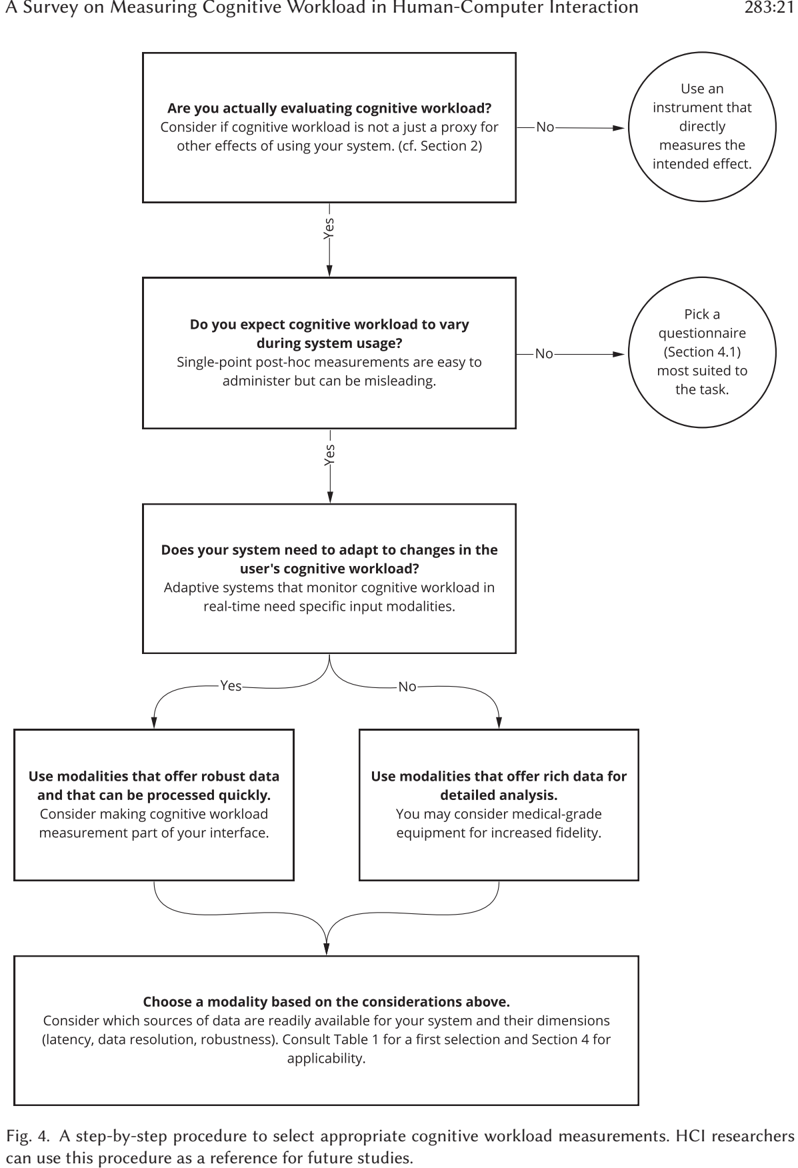
- They propose a four-step procedure for choosing cognitive workload metrics, covering whether cognitive workload is the right concept, whether it varies during use, whether the system must adapt to it, and which modality to choose.
Methods
- Systematic literature review following PRISMA procedures, with a keyword search in HCI-related proceedings and journals; venues included the top 20 conferences plus six conferences in the top 40, and all top 10 journals, confirmed via CORE 4 rankings, with a final cut-off date of 30 April 2020.
- The search used a regular expression matching terms such as “cognitive/mental load/workload” and “working memory”; the initial corpus was 6,414 papers.
- Filtering used paper eligibility (archival, peer-reviewed papers only; 904 excluded) and relevance via a double decision scheme with four researchers; 4,931 papers were excluded at relevance, yielding 579 records. Categorization used qualitative coding, a naming scheme agreed by four researchers, and affinity diagramming to build a taxonomy of measures.
Limitations
- The paper states that its qualitative analysis cannot guarantee the proposed taxonomy is the only correct one, though it aims for comprehensiveness.
- The paper states that the final choice of cognitive workload modality is almost always a trade-off between ecological validity and the requirements of the measurement modality, and that NASA-TLX validity in HCI is unclear because no empirical evidence determines the range of artifacts or experiences to which it applies.
- Evident from the text: the search is limited to selected top HCI venues and a cut-off of 30 April 2020, and many irrelevant papers were excluded due to ambiguity of the term “working memory,” especially in computer science venues.
Model-written summary. Check it against the paper before relying on it.
Integrity signals
Registry
Cites
Statistics
Figures



Verification
Claims the paper makes
6 Valid · 16 Not valid · 23 Not checked · 86 Own results and interpretations
At least one cited source doesn’t support this claim or points to a different paper, and none confirmed it — see the verdicts below.
In the paper
“Previous research has shown that the size and speed of saccades are highly discriminatory parameters for an increased cognitive workload: Here, an increased cognitive workload is indicated by larger or faster saccades [47].”
§ A Survey on Measuring Cognitive Workload in Human-Computer Interaction > 4.3.2 Saccades.
What the sources say
- Disputedcites [47] 47. Siyuan Chen, Julien Epps, Natalie Ruiz, and Fang Chen. 2011. Eye activity as a measure of human mental effort in HCI. In Proceedings of the 16th International Conference on Intelligent User Interfaces (IUI'11). ACM, New York, NY, USA, 315-318. https://doi.org/10.1145/1943403.1943454 sourceExperimental — accuracy not yet measured
The Discussion says saccade speed and especially size were highly discriminatory, but reports that both decreased as the task demanded more working memory and attention. The cited paper therefore supports their usefulness as measures, but gives the opposite direction from the claim’s ‘larger or faster’ saccades. (LLM, conf=0.90)
Checked by a reasoning model — may be wrong.
boostedstates an association- Asserted: passes — The authors put it forward as true.
- Checkable: passes — It can be checked against evidence.
- Load-bearing: unclear — It is unclear whether the paper’s conclusions depend on it.
- Based: passes — The paper gives a reason why it holds.
- Disputed
At least one cited source doesn’t support this claim or points to a different paper, and none confirmed it — see the verdicts below.
In the paper
“Similarly, touch input [39] -especially finger trajectories [173] -were used to measure cognitive workload.”
§ A Survey on Measuring Cognitive Workload in Human-Computer Interaction > 4.7 Haptic Interaction
What the sources say
- Not checked — no full text of the sourcecites [39] 39. Davide Maria Calandra, Antonio Caso, Francesco Cutugno, Antonio Origlia, and Silvia Rossi. 2013. CoWME: A gen- eral framework to evaluate cognitive workload during multimodal interaction. In Proceedings of the 15th ACM on International Conference on Multimodal Interaction (ICMI'13). ACM, Sydney, Australia, 111-118. https://doi.org/10. 1145/2522848.2522867 source
- Disputedcites [173] 173. E. M. Peck, E. Carlin, and R. Jacob. 2015. Designing brain-computer interfaces for attention-aware systems. Computer 48, 10 (Oct. 2015), 34-42. https://doi.org/10.1109/MC.2015.315 sourceExperimental — accuracy not yet measured
The citation [173] is attached specifically to “finger trajectories.” In “Training CARSON to Read the Brain” and Figure 3 (page not provided), the paper instead describes predicting cognitive workload from fNIRS brain-sensing signals, not finger trajectories or touch input. (LLM, conf=0.85)
Checked by a reasoning model — may be wrong.
plainstates an association- Asserted: passes — The authors put it forward as true.
- Checkable: passes — It can be checked against evidence.
- Load-bearing: unclear — It is unclear whether the paper’s conclusions depend on it.
- Based: passes — The paper gives a reason why it holds.
The cited sources that could be checked couldn’t confirm or dispute this claim.
In the paper
“Similarly, beta power is widely used as a metric for mental workload, including alertness, arousal, frustration, engagement, and workload states [141].”
§ A Survey on Measuring Cognitive Workload in Human-Computer Interaction > 4.2.1 Electroencephalography (EEG).
What the sources say
- Could not verifycites [141] 141. Kristiyan Lukanov, Horia A. Maior, and Max L. Wilson. 2016. Using fNIRS in Usability Testing: Understanding the Effect of Web Form Layout on Mental Workload. In Proceedings of the 2016 CHI Conference on Human Factors in Computing Systems (CHI'16). ACM, Santa Clara, California, USA, 4011-4016. https://doi.org/10.1145/2858036.2858236 sourceExperimental — accuracy not yet measured
The Measuring Mental Workload and Objective Measures sections discuss psychophysiological measures and fNIRS haemoglobin measurements, but do not address beta power. Searches for beta power and EEG spectral power found no passage linking beta power to alertness, arousal, frustration, engagement, or workload states. The available passages have no page numbers. (LLM, conf=0.76)
plainstates an association- Asserted: passes — The authors put it forward as true.
- Checkable: passes — It can be checked against evidence.
- Load-bearing: unclear — It is unclear whether the paper’s conclusions depend on it.
- Based: passes — The paper gives a reason why it holds.
- Could not verify
Every source the paper cites for this claim was checked and supports it.
In the paper
“Previous research shows that the rate and duration of fixation are indicators of an attention shift due to increasing task complexity [47].”
§ A Survey on Measuring Cognitive Workload in Human-Computer Interaction > 4.3.4 Fixations.
What the sources say
- Supportedcites [47] 47. Siyuan Chen, Julien Epps, Natalie Ruiz, and Fang Chen. 2011. Eye activity as a measure of human mental effort in HCI. In Proceedings of the 16th International Conference on Intelligent User Interfaces (IUI'11). ACM, New York, NY, USA, 315-318. https://doi.org/10.1145/1943403.1943454 source
The Discussion reports that fixation duration and fixation rate changed with task complexity and interprets those results as indicating that significantly more attention was needed for the more complex task. It also specifies that fixation duration increased while fixation rate decreased as attentional demands rose. (LLM, conf=0.92)
plainstates an association- Asserted: passes — The authors put it forward as true.
- Checkable: passes — It can be checked against evidence.
- Load-bearing: unclear — It is unclear whether the paper’s conclusions depend on it.
- Based: passes — The paper gives a reason why it holds.
- Supported
The cited sources support only part of this claim — read each source’s verdict below.
In the paper
“Previous research has shown that pupils dilate with increasing task difficulty [47] across tasks like reading, problem-solving, or visual search activities [208], where the cognitive demand can be estimated in real-time using machine learning [131].”
§ A Survey on Measuring Cognitive Workload in Human-Computer Interaction > 4.3.1 Pupil Diameter.
What the sources say
- Partly supportedcites [47] 47. Siyuan Chen, Julien Epps, Natalie Ruiz, and Fang Chen. 2011. Eye activity as a measure of human mental effort in HCI. In Proceedings of the 16th International Conference on Intelligent User Interfaces (IUI'11). ACM, New York, NY, USA, 315-318. https://doi.org/10.1145/1943403.1943454 sourceExperimental — accuracy not yet measured
The Discussion reports increased pupil size when participants performed the more demanding visual training task, supporting the link between pupil dilation and task difficulty. The paper does not establish that pattern across the cited examples of reading, problem-solving, and visual search; its own task involved recalling player positions in a basketball video. (LLM, conf=0.86)
- Not checked — no full text of the sourcecites [208] 208. Namrata Srivastava, Eduardo Velloso, Jason M. Lodge, Sarah Erfani, and James Bailey. 2019. Continuous evaluation of video lectures from real-time difficulty self-report. In Proceedings of the 2019 CHI Conference on Human Factors in Computing Systems (CHI'19). Association for Computing Machinery, Glasgow, Scotland, UK, 1-12. https://doi.org/ 10.1145/3290605.3300816 source
- Could not verifycites [131] 131. Moira LeMay and Eric Hird. 1986. Operator work load: When is enough enough? Commun. ACM 29, 7 (July 1986), 638-642. https://doi.org/10.1145/6138.6147 sourceExperimental — accuracy not yet measured
The Results report that time-stress ratings increased with workload, and the introduction lists physiological measures as a category, but neither addresses pupil dilation. Searches for pupil diameter, task difficulty, and pupillary response found no passage supporting the claim attributed to this paper; the task examples are attached to a different citation. (LLM, conf=0.75)
plainstates a cause- Asserted: passes — The authors put it forward as true.
- Checkable: passes — It can be checked against evidence.
- Load-bearing: unclear — It is unclear whether the paper’s conclusions depend on it.
- Based: passes — The paper gives a reason why it holds.
- Partly supported
52 more claims · 4 with their cited sources checked
Create a free account to see all 131 claims and every source verdict.
- It may state two separate claims as one. 35
- Probably not a substantial claim. 49
Self-check
Percentages, sums and reported differences re-computed from the paper’s own numbers.
Each contradiction between two passages listed here was confirmed by an independent check.
Rated minor: it would not touch a result — a value no result rests on, a p-value that stays on the same side of the significance level, or a conflict that is clerical, resolved elsewhere in the paper, or outside its own findings.
In the paper
§ A Survey on Measuring Cognitive Workload in Human-Computer Interaction > 4.1 Questionnaires
“Questionnaires lack real-time capabilities since they are employed after an experimental condition.”
§ A Survey on Measuring Cognitive Workload in Human-Computer Interaction > 4.1.3 Instantaneous Self-Assessment.
“Participants rate their perceived workload in predefined intervals during the execution of a task -allowing for real-time assessment of cognitive workload.”
Citations
Cites
Preferred Reporting Items for Systematic Reviews and Meta-Analyses: The PRISMA Statement
Moher, D., Liberati, A., Tetzlaff, J., Altman, D. G., & The PRISMA Group (2009) · PLoS Medicine · doi:10.1371/journal.pmed.1000097 · Cited by 64,042 · cited 1×
“The first phase of our review was a systematic keyword search in the digital library databases relevant to the HCI field.”
Development of NASA-TLX (Task Load Index): Results of Empirical and Theoretical Research
(1988) · Advances in Psychology · doi:10.1016/s0166-4115(08)62386-9 · Cited by 15,003 · cited 5×
“The NASA Task Load Index (NASA-TLX) [90, 91] is a multi-scale questionnaire to assess participants’ perceived subjective workload.”
InfluentialCognitive Load During Problem Solving: Effects on Learning
Sweller, J. (1988) · Cognitive Science · doi:10.1016/0364-0213(88)90023-7 · Cited by 11,048 · cited 3×
“Sweller developed the cognitive load theory [231–233], a theoretical framework that explains how learning is limited through instructional design.”
SUS: A 'Quick and Dirty' Usability Scale
(1996) · Usability Evaluation In Industry · doi:10.1201/9781498710411-35 · Cited by 8,989
Brain–computer interfaces for communication and control
Wolpaw, J. R., Birbaumer, N., McFarland, D. J., Pfurtscheller, G., & Vaughan, T. M. (2002) · Clinical Neurophysiology · doi:10.1016/s1388-2457(02)00057-3 · Cited by 7,927 · cited 1×
“Participants rate their perceived work-load in predefined intervals during the execution of a task – allowing for real-time assessment of cognitive workload.”
Cognitive Architecture and Instructional Design
Sweller, J., van Merrienboer, J. J. G., & Paas, F. G. W. C. (1998) · Educational Psychology Review · doi:10.1023/a:1022193728205 · Cited by 6,023 · cited 3×
“…workload helps interface designers in two ways: using a constructive approach (e.g., during early design phases), where cognitive workload is measured to improve the design of novel interactive systems, or using a summative approach (e.g., using existing systems) to compare the cognitive…”
(2005) · Cited by 5,977
Systematic Literature Reviews in Software Engineering—A Systematic Literature Review
Kitchenham, B., Pearl Brereton, O., Budgen, D., Turner, M., Bailey, J., & Linkman, S. (2009) · Information and Software Technology · doi:10.1016/j.infsof.2008.09.009 · Cited by 4,537 · cited 1×
“We followed the PRISMA procedures [121, 174] for systematic reviews and meta-analyses.”
(2001) · doi:10.1017/cbo9780511546396 · Cited by 4,482
NASA-Task Load Index (NASA-TLX); 20 Years Later
Hart, S. G. (2006) · Proceedings of the Human Factors and Ergonomics Society Annual Meeting · doi:10.1177/154193120605000909 · Cited by 4,297 · cited 3×
“The NASA-TLX [90, 91] questionnaire has become a household name in HCI research, and it is widely taught in HCI education.”
Research works printed but not linked: 9
- 10.5555/2993778.2993801 · doi:10.5555/2993778.2993801
- S. G. Hart, M. E. Childress, and J. R. Hauser. 1982. Individual definitions of the term “workload”. In Eighth Symposium on Psychology in the Department of Defense. 478–485.
- Sandra G. Hart. 1986. Theory and measurement of human workload. Human Productivity Enhancement 1 (1986), 396–456.
- A. V. Korshakov, A. A. Frolov, and P. D. Bobrov. 2010. On-line automatic suppression of artifacts in multi-dimensional signals using ICA. In Abstr. 10th Europ. Conf. on Non-Destructive Testing. 370.
- Thomas Kosch and Lewis L. Chuang. 2019. Investigating the influence of RSVP display parameters on working memory load using electroencephalography. In 2nd International Conference on Neuroadaptive Technology.
- Gerald Matthews, James Szalma, April Rose Panganiban, Catherine Neubauer, and Joel S. Warm. 2013. Profiling task stress with the Dundee Stress State Questionnaire. Psychology of Stress: New Research 1 (2013), 49–90.
- Christopher D. Wickens. 1984. Processing resources in attention. Varieties of Attention (1984).
- 10.5555/2993778.2993814 · doi:10.5555/2993778.2993814
- F. R. H. Zijlstra and L. Van Doorn. 1985. The Construction of a Scale to Measure Perceived Effort. University of Technology.
Cited by
Items 201–299 of 299
A Study on the Accessibility of Technology for Users with Disabilities
Tyarla, S. (2025) · International Journal of Applied Information Systems · doi:10.5120/ijais2025452001
“Research done by Kosch, Thomas, et al. (2023) tackles the issue of inconsistent and repeatable HCI research due to the absence of a common technique to assess cognitive workload [6].”
Zhang, J., Wang, M., & Liu, Z. (2026) · International Conference on Artificial Intelligence and Product Design · doi:10.1145/3829918.3829963
Brito, S. D. S., Vieira, E. E., & de Medeiros, F. P. A. (2026) · International Conference on Information Technology Based Higher Education and Training (ITHET) · doi:10.1109/ithet69978.2026.11585087
“Regarding cognition, [8] describes the NASA Task Load Index (NASA-TLX) as an efficient instrument for evaluating cognitive workload during task performance.”
DAGAR: Domain-Adaptive Gesture In-Air Recognition for AI Agents Under Limited Labels
Tian, J., Zou, Y., Liang, Z., Chen, W., Zhang, B., Huo, Y., & Liu, F. (2026) · IEEE Internet of Things Journal · doi:10.1109/jiot.2026.3699528
“Gesture-based interaction has emerged as a promising modality due to its contactless, intuitive, and natural characteristics [7].”
Wang, Z., Ren, X., Wang, Y., Du, L., Tang, Z., Dong, Q., Cui, X., Jiang, Z., & Gong, C. (2026) · International Journal of Human-Computer Studies · doi:10.1016/j.ijhcs.2026.103951
A Software Tool to Support the Communicability Evaluation Method
Ramos, C., Moquillaza, A., Falconi, F., et al. (2026) · Lecture notes in computer science · doi:10.1007/978-3-032-30080-5_22
Understanding Users' Perceptions and Barriers to Mental Workload Self-Tracking
Chen, Y. C., Mitrevska, T., Dingler, T., & Schneegass, C. (2025) · Australian Conference on Human-Computer Interaction (OzCHI) · doi:10.1145/3764687.3769928
Kaur, D., Wijaya, L., Meng, C. K., Wagle, S., Wahono, J. W., & Sari, N. (2026) · International Conference on ICT for Smart Society (ICISS) · doi:10.1109/iciss71466.2026.11715111
“When interaction quality is good, it is easier to lower the cognitive load and it will also help to engage more deeply, however a poorly designed interaction may lead to frustration and disagreement [21].”
Zhang, S., Bai, X., Beyer, F., & Noreika, V. (2026) · CHI Conference Extended Abstracts on Human Factors in Computing Systems (CHI EA) · doi:10.1145/3772363.3798603
The Role of Human–Computer Interaction in Shaping User Engagement with E-Commerce Applications
Razzaqi, H., Akbar, M., N.A., J. P. S., & Ramayah, T. (2026) · Informatics · doi:10.3390/informatics13040064 · Cited by 2
Källbäcker, J., Vriend, S. A., & Cajander, Å. (2026) · Nordic Conference on Human-Computer Interaction · doi:10.1145/3829807.3829853
Sinatra, M., Monacis, L., Bertacchini, F., Demarco, F., Lamonaca, F., Bilotta, E., & Pantano, P. (2025) · IEEE International Workshop on Metrology for Living Environment (MetroLivEnv) · doi:10.1109/metrolivenv64961.2025.11107117
Cognitive-Hierarchy-Driven Display Layout Optimization for Deep-Sea Human-Machine Interfaces
Xie, L., & Zhou, R. (2026) · International Symposium on Computer Technology and Information Science (ISCTIS) · doi:10.1109/isctis70043.2026.11572183
“In such environments, display layout is not merely a matter of equipment arrangement, but a key factor affecting visual search efficiency, interaction accessibility, and cognitive workload[1].”
Ricardo, H., Andersen, E., Masaling, N. A. P., & Chowanda, A. (2025) · IEEE International Conference on Cryptography, Informatics, and Cybersecurity (ICoCICs) · doi:10.1109/icocics68032.2025.11383935
“Subtle feedback animations and clear hierarchies help maintain user focus and reduce uncertainty during tasks [7].”
InfluentialHao, S., Xu, X., & Wei, W. (2026) · International Journal of Human-Computer Interaction · doi:10.1080/10447318.2026.2697352
TinyML-Based Hand Gesture Recognition for Device Control
Yahyati, C., Lamaakal, I., Makkaoui, K. E., & Ouahbi, I. (2026) · International Conference on Innovative Research in Applied Science, Engineering and Technology (IRASET) · doi:10.1109/iraset68627.2026.11538444
“The proliferation of embedded systems [1] and the Internet of Things (IoT) [3] has catalyzed a paradigm shift towards more intuitive and natural forms of human-computer interaction (HCI) [5].”
A Platform for Physiological and Behavioral Security
Dietz, F., Heubl, P., Haliburton, L., Bothe, D., Hörnemann, J., Sasse, M. A., & Alt, F. (2025) · New Security Paradigms Workshop · doi:10.1145/3774761.3774915
Daemei, A. B., Feng, Z., & Paes, D. (2026) · E3S Web of Conferences · doi:10.1051/e3sconf/202671601001
Multi-agent system for emergent care (MAS-EC): Focused on workload, efficiency, and user experience
Walji, Z., Badhwar, R., Dave, P., Choi, D., Virani, S., & Park, J. (2026) · Human Factors in Healthcare · doi:10.1016/j.hfh.2026.100133
Research on Algorithm Thinking in Higher Education Pedagogies Based on Knowledge Engineering
Li, Y., & Wang, H. (2025) · International Conference on Information and Education Technology (ICIET) · doi:10.1109/iciet66371.2025.11046303 · Cited by 1
Exploring the Potential of Virtual Reality for Model-Based Systems Architecting
Wang, H. (2024) · theses.fr (ABES) · doi:10.70675/f74147ccz8761z487azb5f1z125c1f8027e4 · Cited by 1
Xue, Q., Zhang, Y., Wu, H., et al. (2026) · Engineering Applications of Artificial Intelligence · doi:10.1016/j.engappai.2026.115694
Dell’Oca, S., Rotondi, V., Cutrona, V., Landolfi, G., Bettoni, A., & Canetta, L. (2026) · SSRN Electronic Journal · doi:10.2139/ssrn.6949565
Chen, Y., & Kaixuan, W. A. N. G. (2026) · International Journal of Human-Computer Interaction · doi:10.1080/10447318.2026.2629558
Shen, C., Zhang, Y., & Ding, Y. (2026) · Frontiers in Public Health · doi:10.3389/fpubh.2026.1753674
Xu, W. J., Liu, Z., Miao, S., et al. (2025) · IEEE International Conference on Communication Systems and Network Technologies (CSNT) · doi:10.1109/csnt64827.2025.10968167
“Kosch et al. [10] aimed to study the challenges and opportunities of human-centered metaverse technology in the field of learning, thereby accelerating research in this field.”
Hsu, C.-W., & Cheng, J.-H. (2026) · Lecture notes in computer science · doi:10.1007/978-3-032-29583-5_2
Tomori, M., Ofori, J. N. A., Ogunseiju, O. R., Wen, J., Yang, E., Franklin, K. M., & Tummalapudi, M. (2026) · International Journal of Human-Computer Interaction · doi:10.1080/10447318.2026.2619627
“…CLT. CLT differentiates intrinsic, extraneous, and germane cognitive load linked to instructional design and learning materials (Sweller et al., 1998), whereas NASA-TLX captures broader task-related mental workload rather than these three CLT components (Kosch et al., 2023; Sweller et al., 1998).”
Visual-Tactile Fusion for Multimodal Semantic Communication with Foundation Models
Wang, Z., Chen, M., He, X., et al. (2025) · IEEE Vehicular Technology Conference · doi:10.1109/vtc2025-spring65109.2025.11174935
“Technologies such as remote control [2], human-machine interaction (HMI) [3], and robot control [4] show strong long-term potential.”
Which Works Best for Inspiration? Finding Ideal Creative Platform for Beginner Industrial Designers
Wang, Z., Hu, R., & Yang, M. (2025) · Communications in computer and information science · doi:10.1007/978-3-031-94168-9_21
Beyond Words: The Impact of Eye-gaze Sharing on Collaboration and Cognitive LoadPreprint
Chakraborty, S., Kiefer, P., & Raubal, M. (2025) · SSRN Electronic Journal · doi:10.2139/ssrn.5346838
Re-streamed Validation of Real-Time Cognitive Load Measurement
Duchowski, A. T., Zamanifard, S., Cecchetti, S., Cavallo, M., & Edmonds, A. (2026) · Lecture notes in computer science · doi:10.1007/978-3-032-39382-1_42
RETRACTED: DMS-yolov8 A gesture recognition algorithm based on improved yolov8 1
Zhan, H., Han, C., Li, J., & Wei, G. (2024) · Journal of Intelligent & Fuzzy Systems · doi:10.3233/jifs-238629
RetractedEEG-Based Cognitive Load Comparison in Construction Sensor Data Analytics
Khalid, M., Akanmu, A. A., Okunola, A., Awolusi, I., & Murzi, H. (2024) · EPiC series in built environment · doi:10.29007/48rn
“Additionally, a persistent high CL, stemming from subjective task complexity can detrimentally affect attention and concentration, leading to distractions and errors (Kosch et al., 2023).”
BackgroundDecision-Fatigue Mitigation in Automotive HMI System
K, S. K. Y., & Dhoot, D. (2026) · SAE technical papers on CD-ROM/SAE technical paper series · doi:10.4271/2026-26-0652
Lee, J., Starner, T. E., Kunze, K. S., Kosch, T., Pospelova, M., & Woo, W. (2026) · ACM Transactions on Computer-Human Interaction · doi:10.1145/3837858 · Cited by 3
Self-citationOppelt, M. P., Lang-Richter, N. R., & Eskofier, B. M. (2026) · Lecture notes in computer science · doi:10.1007/978-3-032-30015-7_7
Wang, H., Pinquié, R., & Noël, F. (2026) · International Journal of Human-Computer Interaction · doi:10.1080/10447318.2026.2667476
Generalized Eye Tracking Metrics (GEMs): An Interactive Guide for Learning Eye Tracking Metrics
Horde, L. E., McGarry, S. P. D., Sibley, C. M., Brown, N. L., Foroughi, C. K., & Coyne, J. T. (2026) · Proceedings of the Human Factors and Ergonomics Society Annual Meeting · doi:10.1177/10711813261475183
Flights and Airports - A Visual Analytics Perspective
Burch, M., Kuriger, A., Pehar, F., et al. (2025) · MIPRO ICT and Electronics Convention (MIPRO) · doi:10.1109/mipro65660.2025.11131856
“Human-computer interaction (HCI) [10] also plays a crucial role when exploring data from several perspectives.”
A multimodal tableware system for supporting mindful eating in solo dining: a pilot study
Zhang, M., Ding, S., Zhang, Z., Kong, Q., & Li, X. (2026) · Frontiers in Public Health · doi:10.3389/fpubh.2026.1830317
“To assess perceived workload (RQ3), three selected NASA-TLX dimensions—Mental Demand, Performance, and Frustration—were each assessed using a separate single-item rating (58).”
Zhu, Y., Jia, Q., Liu, S., Chen, X., & Zhang, T. (2026) · International Journal of Human-Computer Interaction · doi:10.1080/10447318.2026.2639095
Do We View Robots as We Do Ourselves? Examining Robotic Face Processing Using EEG
Pérez-Arenas, X., Rivera-Rei, Á. A., Huepe, D., & Soto, V. (2025) · Brain Sciences · doi:10.3390/brainsci16010009 · Cited by 1
“Crucially, these distinctions extend to affective processing, where studies report that emotional avatars elicit unique ERP patterns compared to humans [42].”
Niu, H., Wang, Y., Hao, J., Yang, X., & Di, F. (2026) · Journal on Multimodal User Interfaces · doi:10.1007/s12193-026-00481-8
SOC Estimation and Bubble Detection System Based on Ultrasonic for Lithium Batteries
Wei, P., & Li, S. (2025) · doi:10.1109/ieeeconf65522.2025.11136980
“…transducer to generate 5MHz ultrasonic wave, and the probe is used to make it interact with the internal materials of the battery to collect the echo analysis[4], so as to obtain the internal information of the lithium battery, such as the battery bubbles, dendrites, and electrode changes.”
A Few-Channel Brain–Computer Interface System Based on a Heuristic Algorithm
Luo, J., Yu, J., Cao, H., Tan, Q., Chen, J., & Xiao, J. (2026) · Biomimetics · doi:10.3390/biomimetics11090613
“The NASA-TLX is a multidimensional method for assessing workload [31].”
Beyond Words: The Impact of Eye-Gaze Sharing on Collaboration and Cognitive Load
Chakraborty, S., Kiefer, P., & Raubal, M. (2025) · International Journal of Human-Computer Interaction · doi:10.1080/10447318.2025.2594138
Spiking Neural Networks for Mental Workload Classification with a Multimodal Approach
An, J., Fabrikant, S. I., Indiveri, G., & Donati, E. (2025) · IEEE Conference on Computational Intelligence in Bioinformatics and Computational Biology (CIBCB) · doi:10.1109/cibcb66090.2025.11177083
Mikulski, C., & Riegner, K. L. (2025) · SAE International Journal of Advances and Current Practices in Mobility · doi:10.4271/2025-01-8340
Kaufmann, M., & Beltrame, G. (2026) · ACM Transactions on Human-Robot Interaction · doi:10.1145/3822499
Human-Computer Interaction System for Virtual Display in Digital Museums
Ju, H. (2026) · doi:10.1109/iehns68708.2026.11606931
“Its overall architecture adopts a layered modular design [11][12].”
Assessing the Accuracy and Mental Workload of Electromyography Inputs at Different Body Parts
Kataoka, Y., Nozaki, H., Mori, S., Nakamura, F., Shibata, F., & Kimura, A. (2026) · Journal of Information Processing · doi:10.2197/ipsjjip.34.612
Gagné, G., Azad, A., Labbé, T., et al. (2025) · doi:10.1109/embc58623.2025.11252918
“After each trial, the system was evaluated both subjectively—using a NASA Task Load Index (NASA-TLX) survey [13], [14]—and objectively, based on classification accuracy as well as online task-specific metrics like completion rate and time spent on each object.”
Augmented Reality Learning Board Fits Intellectual Disability Cognitive Needs
Alwani, A. A., Tranggono, T., & Islami, M. C. P. A. (2026) · Academia Open · doi:10.21070/acopen.11.2026.14275
Khaleghi, A., Baloochi, S. A., Majidi, H., & Shahi, K. (2025) · Computer Methods in Biomechanics & Biomedical Engineering · doi:10.1080/10255842.2025.2571424
Hariyati, N., Setyowati, S., Amalia, K., & Islamiah, N. (2024) · Jurnal Pedagogi dan Pembelajaran · doi:10.23887/jp2.v7i3.86799
Duraisamy, S., Attygalle, N. T., Emami, P., Vanderdonckt, J. M., & Leiva, L. A. (2026) · ACM SIGCHI Symposium on Engineering Interactive Computing Systems (EICS) · doi:10.1145/3807968.3810932
Vardar, N., & GÜMÜŞ, Ç. (2026) · Electronics · doi:10.3390/electronics15153458 · Cited by 1
Aplicação de Diretrizes de Acessibilidade em Apps para Pessoas com TEA: Desafios e Lições Aprendidas
de Carvalho, M. G. G., Souto, H. M. D., Brito, T. D., et al. (2026) · doi:10.5753/clihc.2026.21215
“O instrumento NASA Task Load Index (NASA-TLX) [Kosch et al. 2023] foi adotado para mensurar esforço cognitivo, físico, temporal, desempenho e nível de frustração na aplicação do AutismGuide.”
Faisal, C. M. N., Piccinno, A., Rodríguez, M. G., Fernández-Lanvin, D., & Suárez, J. D. A. (2026) · Behaviour and Information Technology · doi:10.1080/0144929x.2026.2732018
The Effectiveness and Efficiency of Using E-Learning in a Digital Learning Environment
Othman, N. A., Alamsyah, D. P., Kerta, J. M., et al. (2024) · E3S Web of Conferences · doi:10.1051/e3sconf/202457601004
“HCI is related to the evaluation of e-learning users, in this case students and instructors [2].”
BackgroundRobust 3D Human Mesh Recovery with Silhouette-Assisted Joint Attention Network
Zeng, Y., & Tan, Y. (2025) · International Conference on Computer Vision, Image and Deep Learning (CVIDL) · doi:10.1109/cvidl65390.2025.11085519
“It has important application value in fields such as human-computer interaction [3], human action recognition [4], AR/VR [5], etc.”
Introduction to an Smarter HCI for Employees
Ghanghorkar, Y., & Deshpande, A. (2025) · IGI Global eBooks · doi:10.4018/979-8-3373-6385-1.ch004
Shi, Y., Kuerban, M., Jin, Y., Wang, C., & Chen, L. (2026) · Sensors · doi:10.3390/s26072181 · Cited by 1
Poerwadiredja, R. S., & Alamsyah, D. P. (2025) · International Conference on Data Science and Its Applications (ICoDSA) · doi:10.1109/icodsa67155.2025.11156966
“HCI has the fundamentals of enhancing usability, efficiency, and user satisfaction due to factors such as ergonomics, cognitive psychology, and interaction design [1].”
Jiang, Y. (2025) · International Conference on IoT Based Control Networks and Intelligent Systems (ICICNIS) · doi:10.1109/icicnis66685.2025.11315733
“Additionally, sign language is particularly significant in cross-lingual communication since it provides a visual representation of natural language [2].”
Chen, X. (2024) · International Conference on Artificial Intelligence, Virtual Reality and Visualization (AIVRV) · doi:10.1109/aivrv63595.2024.10860150
“Kosch et al. [6] believe that human-computer interaction research serves as a catalyst for workload perception systems, emphasizing that human-computer interaction research must deepen the understanding and conceptualization of cognitive workload in the context of interactive computing systems.”
Capturing Campus Dynamics Through Mobile Crowdsourcing
Su, W., Ji, Y., Zhu, Z., et al. (2025) · Communications in computer and information science · doi:10.1007/978-981-95-2751-9_16
Human-in/on-the-Loop Design for Human Controllability
Cheruvu, R. (2026) · Springer eBooks · doi:10.1007/978-981-95-3658-0_75 · Cited by 4
Bu, L., Cui, B., Pan, W., et al. (2025) · SSRN Electronic Journal · doi:10.2139/ssrn.5078838
CuesTrack:Multi-Object Tracking Based on Weak Clues and Trajectory Prediction
Zheng, Y. (2024) · International Conference on Machine Learning and Computer Application (ICMLCA) · doi:10.1109/icmlca63499.2024.10754464 · Cited by 1
“MOT is applicable in diverse areas such as human-computer interaction[1], intelligent video analysis, and autonomous driving.”
Towards Neuroadaptive Systems for Bilingual Interfaces: Neural Differences in Arabic–English Reading
Herwis, M., Bintalib, A., Badawi, M., Salah, S., Hassan, M., & Al‐Wabil, A. (2026) · Lecture notes in computer science · doi:10.1007/978-3-032-29656-6_1
Hirschberg, D. O. W., Hein, O., Alt, F., & Rauschnabel, P. A. (2026) · International Journal of Human-Computer Studies · doi:10.1016/j.ijhcs.2026.103848
Narrative Plasticity and State Stickiness: Designing Hybrid AI Systems for High-Stakes Communication
Kessler, D. T., Overney, C., Shen, J. J., & Roy, D. K. (2026) · Designing Interactive Systems Conference · doi:10.1145/3800645.3813073 · Cited by 1
STGR: Self-Training Cross-Domain Air-Writing Gesture Recognition Using FMCW Radar
Tian, J., Zou, Y., Lai, J., et al. (2025) · IEEE World AI IoT Congress (AIIoT) · doi:10.1109/aiiot65859.2025.11105355
“Among these, gesture-based interaction has emerged as a particularly intuitive and expressive means of conveying user intent [2].”
Chou, W.-H., Ko, Y.-L., Tian-yi, Y., Xu, Y.-Y., & YU, W.-W. (2026) · International Journal of Human-Computer Interaction · doi:10.1080/10447318.2026.2664701
Creative Attention: Detecting Creativity Stages Through Human Attention Dynamics
Kalateh, S., Farhadighalati, N., Estrada-Jimenez, L. A., Nikghadam-Hojjati, S., & Barata, J. (2026) · Communications in computer and information science · doi:10.1007/978-3-032-15576-4_23 · Cited by 1
Integrating EEG-SVM Confidence and RT via cBCI Enhances Team Decisions in a VR Drone TaskPreprint
Baker, C., Hinton, S., Nijjar, A., Poli, R., Cinel, C., Reed, T., & Fairclough, S. H. (2025) · Research Square · doi:10.21203/rs.3.rs-6985673/v1
Wu, Y. (2026) · Procedia Computer Science · doi:10.1016/j.procs.2026.03.228
Wang, S. (2026) · International Journal of Human-Computer Interaction · doi:10.1080/10447318.2026.2713806
When More Is Not Better: Multimodal Information Efficiency in Conversational Interfaces
Chen, X., Shi, H., & Zhao, H. (2026) · ACM Conference on Conversational User Interfaces (CUI) · doi:10.1145/3816046.3816267
Evaluating Visuohaptic Integration on Memory Retention of Morphological Tomographic Images
Rodrigues, L. S., Nyakatura, J. A., Zachow, S., Israel, J. H., & Kosch, T. (2024) · ACM SIGGRAPH International Conference on Virtual-Reality Continuum and its Applications in Industry (VRCAI) · doi:10.1145/3703619.3706055 · Cited by 2
Self-citationHuman-AI Interaction and Visualization Perspectives on ADR
Kucher, K., Bång, M., & Lundberg, J. (2026) · Springer eBooks · doi:10.1007/978-3-032-10561-5_22 · Cited by 1
Fogelberg, E., Oden, P., & Thorvald, P. (2026) · IFIP advances in information and communication technology · doi:10.1007/978-3-032-38610-6_1
Ma, Y., & Yao, H. (2024) · SSRN Electronic Journal · doi:10.2139/ssrn.4903645
A survey of machine learning for estimating workload: considering unknown tasks
Smith, J. B., & Adams, J. A. (2026) · Frontiers in Robotics and AI · doi:10.3389/frobt.2026.1872363 · Cited by 2
“Prior work has predominantly employed subjective metrics to connect wearable sensor data to relative workload levels (i.e., low, medium, high) (Kosch et al., 2023; Matthews et al., 2020; Tamantini et al., 2025; Tierney et al., 2025); however, this is insufficient for real-world human-robot teams.”
The interplay of cognitive load and user experience: a systematic literature review across domains
Jafar, A., Shabnam, S., & Khan, A. (2026) · Theoretical Issues in Ergonomics Science · doi:10.1080/1463922x.2026.2644284 · Cited by 2
Matulewski, J., Meszyński, S., Sokołov, O., & Barańska, A. (2026) · ACM Symposium on Eye Tracking Research and Applications (ETRA) · doi:10.1145/3797246.3804832
“…aim at objective measurement of physiological parameters in real time, moving away from traditional subjective self-assessment [Aricò et al., 2017], although the NASA Task Load Index (NASA-TLX) [Hart and Staveland, 1988] [Hart, 2006] remains very popular [Kosch et al., 2023] [Longo et al., 2022].”
da Costa, M. B., Chan, E. S. M., Langberg, J. M., Cuber, I., Jamalinabijan, F., Kurgan, A., Fritz, T., & Shepherd, D. C. (2026) · International Journal of Human-Computer Studies · doi:10.1016/j.ijhcs.2025.103724 · Cited by 1
Transformer-Enhanced YOLO11 and Vision–Language Model for Intelligent Classroom Behavior Monitoring
Zhu, S., Fang, Q., Zheng, R., & Zhu, D. Z. (2026) · IEEE Access · doi:10.1109/access.2026.3718693
“By leveraging image recognition, object detection, and pose estimation techniques, AI-enabled observation systems can monitor gestures, facial expressions, postures, and interactions in real time [11], [12], [13], [14].”
Kreimeier, J., Prasad, P., Li, S., et al. (2026) · Virtual Reality · doi:10.1007/s10055-026-01491-3
“For subjective and objective measures, we use established metrics (Merino et al. 2009; Kosch et al. 2023).”
Deng, H., Shang, Y., Zhang, F., Qian, Z., Chen, K., & Wang, H. (2026) · IEEE Conference on Virtual Reality and 3D User Interfaces (VR) · doi:10.1109/vr67842.2026.00033 · Cited by 1
“Notably, during cognitive overload, when task demands exceed an individual’s information processing capacity [11, 32], users exhibit difficulty concentrating on regions of interest (ROIs), and ocu-lometric patterns serve as salient indicators of cognitive overload [12, 16, 25].”
From Black-Box to Glass-Box: A User-Centric Framework for Explainable Visualization with LLMs
Shehata, A., & Sharaf, N. (2025) · International Conference on Information Visualisation (IV) · doi:10.1109/iv68685.2025.00064
“To ensure methodological rigor, the questionnaire incorporated standardized evaluation tools such as the System Usability Scale (SUS) [11] and NASA Task Load Index (TLX) [14], enriching the insights obtained and supporting cross-study comparability.”
After Significant Interface Redesign: Retrain or Replace Operators?Preprint
Li, W., Yao, X., & Li, Z. (2023) · SSRN Electronic Journal · doi:10.2139/ssrn.4578798
CLUES: Cognitive Load Understanding through Experimental Sensing Dataset
Krstevska, A., Goyal, S., Fiorini, L., Bona, F. B. D., Kirilenko, D., Li, M., Trojer, S., Božak, T., Anžur, Z., Luštrek, M., et al. (2026) · Proceedings of the ACM on Interactive Mobile Wearable and Ubiquitous Technologies · doi:10.1145/3831656 · Cited by 2
The Impact of Data Aggregation: Advocating for Individualized Analysis in Wearable Sensor Research
König, J. L., Penaredondo, J., Lim, N., Hinze, A., & Bowen, J. (2024) · Australian Conference on Human-Computer Interaction (OzCHI) · doi:10.1145/3726986.3727031
Physiological and behavioral modeling of stress and cognitive load in web-based question answering
Liu, A., Chiossi, F., Henninger, F., Andersen, L. B., Wistuba, T., Greven, S., Kreuter, F., & Draxler, F. (2026) · International Journal of Human-Computer Studies · doi:10.1016/j.ijhcs.2026.103952 · Cited by 1
Designing Teacher-Centered Interfaces to Elicit Pedagogical Context for LLM-Based Content Generation
Faraji, A., Tavakoli, M., Moein, M. M., Molavi, M., & Kismihók, G. (2026) · Lecture notes in computer science · doi:10.1007/978-3-032-37979-5_13
Gestures for Human-Robot Interaction
Carfì, A., & Mastrogiovanni, F. (2026) · Springer tracts in advanced robotics · doi:10.1007/978-3-032-19374-2_19
Metadata
- Authors
- Kosch, T., Karolus, J., Zagermann, J., Reiterer, H., Schmidt, A., & Woźniak, P. W.
- Affiliations
- Humboldt-Universität zu Berlin (DE)
- German Research Centre for Artificial Intelligence (DE)
- University of Konstanz (DE)
- Ludwig-Maximilians-Universität München (DE)
- Chalmers University of Technology (SE)
- ORCID
- Venue
- ACM Computing Surveys
- Published
- 2023-07-13
- Volume
- 55
- Issue
- 13s
- Pages
- 1-39
- ISSN
- 0360-0300 (ISSN-L)
- 1557-7341
- OpenAlex
- W4318618520
- Cited by
- 304
- References
- 259
- Citations by year
- 2026: 120 · 2025: 95 · 2024: 64 · 2023: 25
- FWCI
- 89.72
- Type
- journal article
- Language
- en
- Open access
- hybrid
- doi.org
- Licence
- Locations
- ACM Computing Surveys (publishedVersion, cc-by)
- Chalmers Research (Chalmers University of Technology) (submittedVersion)
- Funders
- Deutsche Forschungsgemeinschaft (251654672 – TRR 161 and 414984028 – CRC 1404 FONDA)
- Topics
- Social Sciences › Human Factors and Ergonomics › Human-Automation Interaction and Safety
- Physical Sciences › Computer Science › Human-Computer Interaction › Usability and User Interface Design
- Physical Sciences › Computer Science › Human-Computer Interaction › Innovative Human-Technology Interaction
- Keywords
- mental workload, workload metrics, NASA-TLX, mental demand, user experience, reproducibility, interactive systems
About these checks
Registry, retraction, Cites and statistics results are computed, not judged, with one exception: a printed reference that no index lists is read once by a model before it counts as a citation error. Claims are extracted by a model and kept only when their quote appears verbatim in the text; each cited source is then checked, with a model’s help, for whether it says what the claim relies on. Those verdicts can be wrong — read the claim’s quote and the cited source before relying on one.
The claim verdicts this report counts are experimental: their accuracy is not yet measured.
A language model drew the claims from the paper on 2026-09-29, under version 3 of the claim definition (model deepseek-v4.1-flash, prompt extract-v3).
A second model labelled each claim on 2026-09-29 (model jev-1.13-20260917, definition revision gold-guideline-v0.2).
Cited sources are checked with a language model’s help (gpt-6-sol).
Statistics and arithmetic are recomputed, not judged.
Confidence bands are shown only for fields calibrated on our annotated test set. None is calibrated yet, so no band is shown.
What counts as a claim ›How we measure confidence ›How we check this ›
Are you an author, or do you see a problem with this page? Request a review
Data sources
Bibliographic data: Semantic Scholar, OpenAlex, Crossref.
Contains information from the Semantic Scholar Academic Graph Datasets, made available under the ODC Attribution License (ODC-BY 1.0).
Semantic Scholar’s data is described in: Kinney, R., et al. (2023). The Semantic Scholar Open Data Platform. arXiv:2301.10140.
