

The DOI matches its Crossref record; 81 of the 82 references it cites were found in a registry or an index, and 1 are not checked yet; none of the 13 sources its claims cite is checked for support yet.
Enhancing AI-Assisted Group Decision Making through LLM-Powered Devil's Advocate
Open accessAbstract
Group decision making plays a crucial role in our complex and interconnected world. The rise of AI technologies has the potential to provide data-driven insights to facilitate group decision making, although it is found that groups do not always utilize AI assistance appropriately. In this paper, we aim to examine whether and how the introduction of a devil’s advocate in the AI-assisted group decision making processes could help groups better utilize AI assistance and change the perceptions of group processes during decision making. Inspired by the exceptional conversational capabilities exhibited by modern large language models (LLMs), we design four different styles of devil’s advocate powered by LLMs, varying their interactivity (i.e., interactive vs. non-interactive) and their target of objection (i.e., challenge the AI recommendation or the majority opinion within the group). Through a randomized human-subject experiment, we find evidence suggesting that LLM-powered devil’s advocates that argue against the AI model’s decision recommendation have the potential to promote groups’ appropriate reliance on AI. Meanwhile, the introduction of LLM-powered devil’s advocate usually does not lead to substantial increases in people’s perceived workload for completing the group decision making tasks, while interactive LLM-powered devil’s advocates are perceived as more collaborating and of higher quality. We conclude by discussing the practical implications of our findings.
Checked 2026-11-14 · 1 reference not checked yet
Overview
CoChat Summary
TL;DR
This paper tests LLM-powered devil’s advocates in AI-assisted group decision making through a randomized Prolific experiment. It finds that an interactive devil’s advocate challenging AI recommendations improves groups’ appropriate reliance and accuracy, while challenging the majority opinion has limited effects and interactive advocates are perceived as more collaborating and higher quality.
Key findings
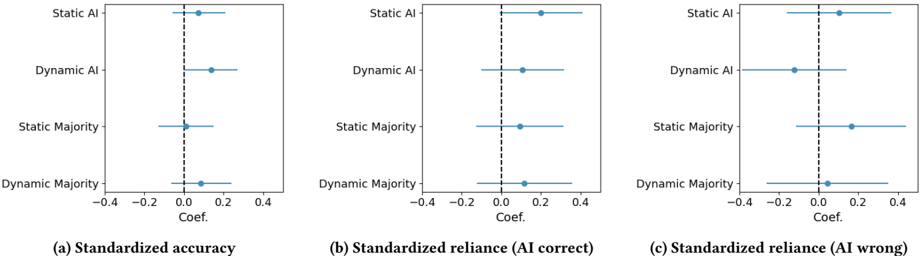
- Groups in the Dynamic-AI treatment had significantly higher standardized decision accuracy than Control (β = 0.135, SE = 0.068, 95% CI [0.002, 0.269], p = 0.047); Static-AI marginally increased reliance on correct AI recommendations (β = 0.200, SE = 0.107, 95% CI [−0.010, 0.410], p = 0.062).
- Target of objection had a marginal main effect on standardized accuracy (F(1, 92) = 3.500, p = 0.064, η² = 0.029), with AI-target higher (M = 0.042, SD = 0.261) than majority-target (M = −0.036, SD = 0.227); interactive devil’s advocates marginally reduced reliance on incorrect AI versus non-interactive (M = −0.013, SD = 0.351 vs. M = 0.029, SD = 0.252; F(1, 91) = 3.554, p = 0.063, η² = 0.038).
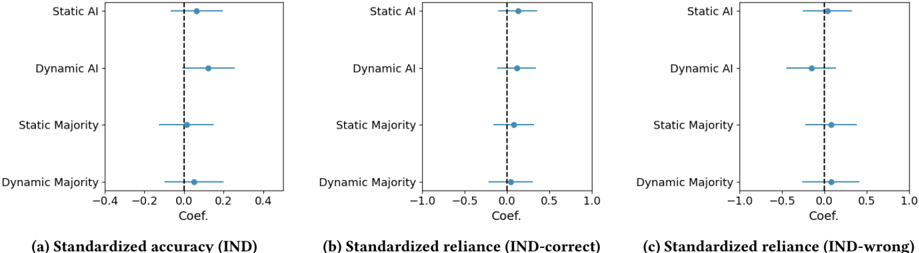
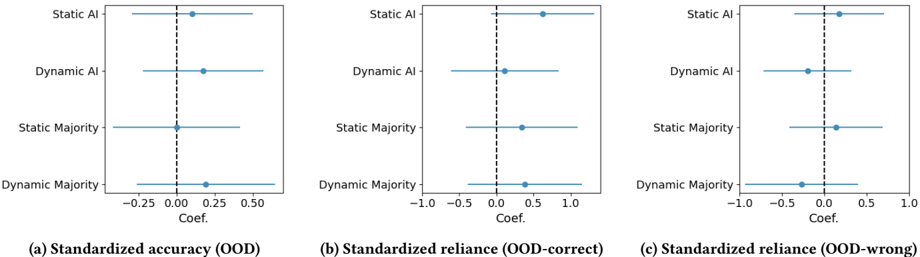
- Dynamic-AI’s accuracy increase mainly occurred on in-distribution tasks (β = 0.122, SE = 0.067, 95% CI [−0.009, 0.254], p = 0.069); Static-AI’s increase in reliance on correct AI mainly came from out-of-distribution tasks (β = 0.619, SE = 0.355, 95% CI [−0.077, 1.315], p = 0.081).
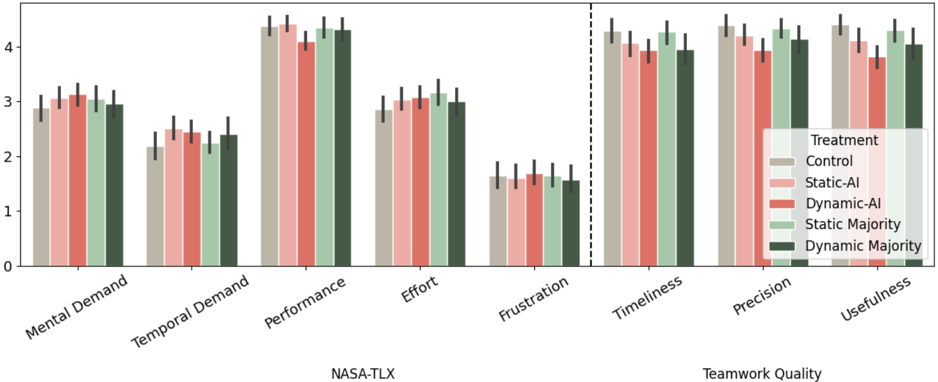
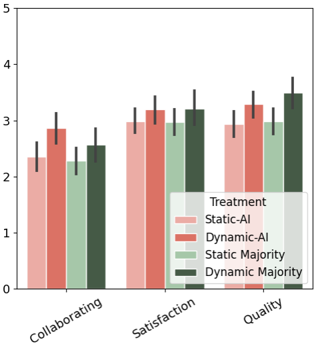
- Interactive devil’s advocates were perceived as more collaborating (F(1, 268) = 9.757, p = 0.002, η² = 0.035) and of higher quality (F(1, 268) = 11.211, p = 0.001, η² = 0.040); Dynamic-AI participants reported the lowest self-perceived performance (M = 4.107, SD = 0.791) and lower perceived teammate precision/usefulness than Control or Static-Majority.
Methods
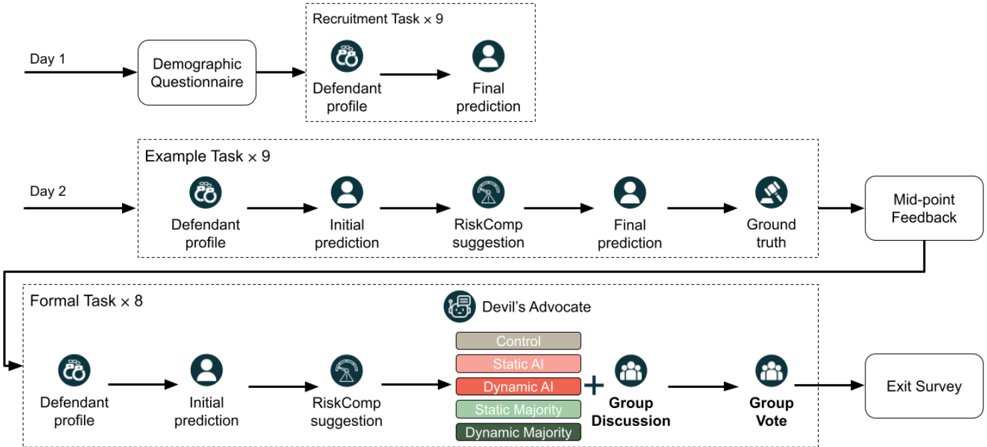
- Randomized human-subject experiment on Prolific: 350 participants formed 120 groups (Control: 24, Static-AI: 28, Static-Majority: 23, Dynamic-AI: 28, Dynamic-Majority: 17), completing 8 formal recidivism risk prediction tasks using COMPAS profiles and AI model RiskComp.
- Five treatments: Control plus a 2×2 LLM-powered devil’s advocate design varying target of objection (AI recommendation vs. majority opinion) and interactivity (static vs. dynamic), implemented with OpenAI GPT-3.5-turbo.
- Main analysis used linear regression with Control as reference, two-way ANOVA for design factors, one-way ANOVA for perceptions, and qualitative coding of chat logs (Cohen’s Kappa = 0.75); outcomes included standardized accuracy/reliance z-scores, NASA-TLX workload, teamwork quality, and devil’s advocate perceptions.
Limitations
- Stated: online setting may not generalize to in-person group decision making; anonymity, one-shot collaborations, no domain expertise, and one recidivism domain limit generalizability; no data on dropouts; the intentionally biased AI model limits generalizability to other biases or performance levels.
- Stated/evident: the LLM devil’s advocate sometimes repeated arguments, suggested unavailable features, and had time lag/out-of-context responses in multi-person chat; participants sometimes ignored, mocked, or expressed frustration toward it.
- Evident: groups could end with only two members due to dropout/removal, and effects on out-of-distribution over-reliance were not statistically significant.
Model-written summary. Check it against the paper before relying on it.
Integrity signals
Registry
Cites
Statistics
Figures
Verification
Claims the paper makes
0 Valid · 0 Not valid · 9 Not checked · 80 Own results and interpretations
A result the paper reports from its own data — it cites no other source for it, so there is none to check. The quote shows it is in the paper.
In the paper
“Overall, we find that the increase in groups' decision accuracy that is brought about by the interactive devil's advocate challenging the correctness of the AI model's recommendation (i.e., the one used in the Dynamic-AI treatment) mainly occurs on in-distribution task instances (Figure 4a, 𝛽 = 0.122, SE = 0.067, 95% CI = [-0.009,0.254], 𝑝 = 0.069).”
§ Enhancing AI-Assisted Group Decision Making through LLM-Powered Devil's Advocate > 4.3 RQ3: How does LLM-powered devil's
plainstates a cause- Asserted: passes — The authors put it forward as true.
- Checkable: passes — It can be checked against evidence.
- Load-bearing: passes — The paper’s conclusions depend on it.
- Based: passes — The paper gives a reason why it holds.
A result the paper reports from its own data — it cites no other source for it, so there is none to check. The quote shows it is in the paper.
In the paper
“we found that its overall accuracy was 66%.”
§ Enhancing AI-Assisted Group Decision Making through LLM-Powered Devil's Advocate > 3.1 Experimental Task
plain- Asserted: passes — The authors put it forward as true.
- Checkable: passes — It can be checked against evidence.
- Load-bearing: unclear — It is unclear whether the paper’s conclusions depend on it.
- Based: passes — The paper gives a reason why it holds.
A result the paper reports from its own data — it cites no other source for it, so there is none to check. The quote shows it is in the paper.
In the paper
“In general, participants' satisfaction with the devil's advocate is also not significantly different across treatments.”
§ Enhancing AI-Assisted Group Decision Making through LLM-Powered Devil's Advocate > 4.4 RQ4: How does LLM-powered devil's
plain- Asserted: passes — The authors put it forward as true.
- Checkable: passes — It can be checked against evidence.
- Load-bearing: unclear — It is unclear whether the paper’s conclusions depend on it.
- Based: passes — The paper gives a reason why it holds.
A result the paper reports from its own data — it cites no other source for it, so there is none to check. The quote shows it is in the paper.
In the paper
“However, on those decision making tasks where AI recommendations are wrong, we find that the use of an interactive devil's advocate marginally reduces groups' reliance on AI than a non-interactive devil's advocate (non-interactive: 𝑀 = 0.029, 𝑆𝐷 = 0.252; interactive: 𝑀 = -0.013,𝑆𝐷 = 0.351; 𝐹 (1, 91) = 3.554, 𝑝 = 0.063, 𝜂 2 = 0.038).”
§ Enhancing AI-Assisted Group Decision Making through LLM-Powered Devil's Advocate > 4.2 RQ2: How do the target of objection and
plainstates a cause- Asserted: passes — The authors put it forward as true.
- Checkable: passes — It can be checked against evidence.
- Load-bearing: passes — The paper’s conclusions depend on it.
- Based: passes — The paper gives a reason why it holds.
A result the paper reports from its own data — it cites no other source for it, so there is none to check. The quote shows it is in the paper.
In the paper
“In addition, we also find that participants in different treatments exhibited significantly different perceptions regarding the precision and usefulness of the information provided by other members of their group (𝐹 (4, 328) = 3.396, 𝑝 = 0.010, 𝜂 2 = 0.040 for precision, and 𝐹 (4, 328) = 4.813, 𝑝 < 0.001, 𝜂 2 = 0.055 for usefulness).”
§ Enhancing AI-Assisted Group Decision Making through LLM-Powered Devil's Advocate > 4.4 RQ4: How does LLM-powered devil's
plainstates an association- Asserted: passes — The authors put it forward as true.
- Checkable: passes — It can be checked against evidence.
- Load-bearing: passes — The paper’s conclusions depend on it.
- Based: passes — The paper gives a reason why it holds.
42 more claims
Create a free account to see all 89 claims and every source verdict.
- It may state two separate claims as one. 29
- The quote only partly states this claim. 1
- Probably not a substantial claim. 19
Statistics that don’t add up
Each reported p-value recomputed from its test statistic and degrees of freedom.
Rated minor: it would not touch a result — a value no result rests on, a p-value that stays on the same side of the significance level, or a conflict that is clerical, resolved elsewhere in the paper, or outside its own findings.
In the paper
“𝐹 (1, 92) = 3.500, 𝑝 = 0.064”
§ Enhancing AI-Assisted Group Decision Making through LLM-Powered Devil's Advocate > 4.2 RQ2: How do the target of objection and
Reported p = .064 · recomputed p = .065
Statistics recomputed
Every reported test result, recomputed from its test statistic and degrees of freedom. A result shows as not adding up only once an independent check has confirmed it.
- Doesn’t add upF(1, 92) = 3.5reported p = .064 · recomputed p = .065
“F (1, 92) = 3.500, p = .064”
- Not confirmedF(4, 328) = 2.417reported p = .048 · recomputed p = .049
“F (4, 328) = 2.417, p = .048”
- ConsistentF(1, 91) = 3.554reported p = .063 · recomputed p = .063
“F (1, 91) = 3.554, p = .063”
- ConsistentF(4, 328) = 3.396reported p = .01 · recomputed p = .010
“F (4, 328) = 3.396, p = .010”
- ConsistentF(4, 328) = 4.813reported p < .001 · recomputed p < .001
“F (4, 328) = 4.813, p < .001”
2 more recomputed tests
Create a free account to see every test the Stats check recomputed.
Self-check
Percentages, sums and reported differences re-computed from the paper’s own numbers.
Self-check results appear here once an independent check has confirmed them.
Citations
Cites
Language Models are Few-Shot Learners
Brown, T. B., Mann, B., Ryder, N., Subbiah, M., Kaplan, J., Dhariwal, P., Neelakantan, A., Shyam, P., Sastry, G., Askell, A., et al. (2020) · arXiv · doi:10.48550/arxiv.2005.14165 · Cited by 23,372
Training language models to follow instructions with human feedback
Ouyang, L., Wu, J., Jiang, X., Almeida, D., Wainwright, C. L., Mishkin, P., Zhang, C., Agarwal, S., Slama, K., Ray, A., et al. (2022) · arXiv · doi:10.48550/arxiv.2203.02155 · Cited by 4,208
What is AI Literacy? Competencies and Design Considerations
Long, D., & Magerko, B. (2020) · Proceedings of the 2020 CHI Conference on Human Factors in Computing Systems · doi:10.1145/3313831.3376727 · Cited by 3,241 · cited 1×
“…that can influence people’s trust in AI recommendations, including the AI model’s accuracy and confidence [80, 111, 112], people’s AI literacy [16, 55], the degree of alignment between the AI model’s recommendations and people’s own judgments [59, 115], the timing and nature of errors made by the…”
BackgroundBuçinca, Z., Malaya, M. B., & Gajos, K. Z. (2021) · arXiv · doi:10.48550/arxiv.2102.09692 · Cited by 1,124
Does the Whole Exceed its Parts? The Effect of AI Explanations on Complementary Team Performance
Bansal, G., Wu, T., Zhou, J., Fok, R., Nushi, B., Kamar, E., Ribeiro, M. T., & Weld, D. (2021) · Proceedings of the 2021 CHI Conference on Human Factors in Computing Systems · doi:10.1145/3411764.3445717 · Cited by 757 · cited 1×
“To enhance human-AI decision performance in AI-assisted decision making, a long line of research has looked into how humans trust and rely on the decision recommendations provided by AI models [7, 9, 50, 57].”
BackgroundDoes the Whole Exceed its Parts? The Effect of AI Explanations on Complementary Team Performance
Bansal, G., Wu, T., Zhou, J., Fok, R., Nushi, B., Kamar, E., Ribeiro, M. T., & Weld, D. S. (2020) · arXiv · doi:10.48550/arxiv.2006.14779 · Cited by 754
Manipulating and Measuring Model Interpretability
Poursabzi-Sangdeh, F., Goldstein, D. G., Hofman, J. M., Wortman Vaughan, J. W., & Wallach, H. (2021) · Proceedings of the 2021 CHI Conference on Human Factors in Computing Systems · doi:10.1145/3411764.3445315 · Cited by 728
Schweiger, D. M., Sandberg, W. R., & Ragan, J. W. (1986) · Academy of Management Journal · doi:10.2307/255859 · Cited by 682
Cai, C. J., Winter, S., Steiner, D., Wilcox, L., & Terry, M. (2019) · Proceedings of the ACM on Human-Computer Interaction · doi:10.1145/3359206 · Cited by 594
Understanding the Effect of Accuracy on Trust in Machine Learning Models
Yin, M., Wortman Vaughan, J., & Wallach, H. (2019) · Proceedings of the 2019 CHI Conference on Human Factors in Computing Systems · doi:10.1145/3290605.3300509 · Cited by 527 · cited 1×
“…identified a wide range of factors that can influence people’s trust in AI recommendations, including the AI model’s accuracy and confidence [80, 111, 112], people’s AI literacy [16, 55], the degree of alignment between the AI model’s recommendations and people’s own judgments [59, 115], the…”
BackgroundSelf-citationSCHWEIGER, D. M., SANDBERG, W. R., & RECHNER, P. L. (1989) · Academy of Management Journal · doi:10.2307/256567 · Cited by 488
Beyond Accuracy: The Role of Mental Models in Human-AI Team Performance
Bansal, G., Nushi, B., Kamar, E., Lasecki, W. S., Weld, D. S., & Horvitz, E. (2019) · Proceedings of the AAAI Conference on Human Computation and Crowdsourcing · doi:10.1609/hcomp.v7i1.5285 · Cited by 466
Making sense of recommendations
Yeomans, M., Shah, A., Mullainathan, S., & Kleinberg, J. (2019) · Journal of Behavioral Decision Making · doi:10.1002/bdm.2118 · Cited by 459
The effects of argumentation scaffolds on argumentation and problem solving
Cho, K.-L., & Jonassen, D. H. (2002) · Educational Technology Research and Development · doi:10.1007/bf02505022 · Cited by 444
Rao, A., Pang, M., Kim, J., Kamineni, M., Lie, W., Prasad, A. K., Landman, A., Dreyer, K., & Succi, M. D. (2023) · Journal of Medical Internet Research · doi:10.2196/48659 · Cited by 412
Wordcraft: Story Writing With Large Language Models
Yuan, A., Coenen, A., Reif, E., & Ippolito, D. (2022) · 27th International Conference on Intelligent User Interfaces · doi:10.1145/3490099.3511105 · Cited by 374
Creative problem solving as a result of majority vs minority influence
Nemeth, C. J., & Wachtler, J. (1983) · European Journal of Social Psychology · doi:10.1002/ejsp.2420130103 · Cited by 322
Wang, X., & Yin, M. (2021) · 26th International Conference on Intelligent User Interfaces · doi:10.1145/3397481.3450650 · Cited by 320 · cited 1×
“For example, many studies specifically examine whether people exhibit any over-reliance or under-reliance on AI recommendations [11, 15, 23, 33, 37, 45, 53, 56, 72, 76, 84, 98, 99, 105, 109, 110].”
BackgroundSelf-citationSchulz-Hardt, S., Jochims, M., & Frey, D. (2002) · Organizational Behavior and Human Decision Processes · doi:10.1016/s0749-5978(02)00001-8 · Cited by 303
Zhou, J., Zhang, Y., Luo, Q., Parker, A. G., & De Choudhury, M. (2023) · Proceedings of the 2023 CHI Conference on Human Factors in Computing Systems · doi:10.1145/3544548.3581318 · Cited by 288
The Impact of AI on Developer Productivity: Evidence from GitHub Copilot
Peng, S., Kalliamvakou, E., Cihon, P., & Demirer, M. (2023) · arXiv · doi:10.48550/arxiv.2302.06590 · Cited by 287
Updates in Human-AI Teams: Understanding and Addressing the Performance/Compatibility Tradeoff
Bansal, G., Nushi, B., Kamar, E., Weld, D. S., Lasecki, W. S., & Horvitz, E. (2019) · Proceedings of the AAAI Conference on Artificial Intelligence · doi:10.1609/aaai.v33i01.33012429 · Cited by 284 · cited 1×
“…accuracy and confidence [80, 111, 112], people’s AI literacy [16, 55], the degree of alignment between the AI model’s recommendations and people’s own judgments [59, 115], the timing and nature of errors made by the AI model [23, 43, 58, 83], people’s mental model of the AI model [7, 8], and more.”
BackgroundCo-Writing with Opinionated Language Models Affects Users’ Views
Jakesch, M., Bhat, A., Buschek, D., Zalmanson, L., & Naaman, M. (2023) · Proceedings of the 2023 CHI Conference on Human Factors in Computing Systems · doi:10.1145/3544548.3581196 · Cited by 265
Ross, S. I., Martinez, F., Houde, S., Muller, M., & Weisz, J. D. (2023) · Proceedings of the 28th International Conference on Intelligent User Interfaces · doi:10.1145/3581641.3584037 · Cited by 258
How to Evaluate Trust in AI-Assisted Decision Making? A Survey of Empirical Methodologies
Vereschak, O., Bailly, G., & Caramiaux, B. (2021) · Proceedings of the ACM on Human-Computer Interaction · doi:10.1145/3476068 · Cited by 229
Devil's advocate versus authentic dissent: stimulating quantity and quality
Nemeth, C. J., Brown, K., & Rogers, J. (2001) · European Journal of Social Psychology · doi:10.1002/ejsp.58 · Cited by 228
Deciding Fast and Slow: The Role of Cognitive Biases in AI-assisted Decision-making
Rastogi, C., Zhang, Y., Wei, D., Varshney, K. R., Dhurandhar, A., & Tomsett, R. (2022) · Proceedings of the ACM on Human-Computer Interaction · doi:10.1145/3512930 · Cited by 216
Appropriate Reliance on AI Advice: Conceptualization and the Effect of Explanations
Schemmer, M., Kuehl, N., Benz, C., Bartos, A., & Satzger, G. (2023) · Proceedings of the 28th International Conference on Intelligent User Interfaces · doi:10.1145/3581641.3584066 · Cited by 208 · cited 1×
“For example, many studies specifically examine whether people exhibit any over-reliance or under-reliance on AI recommendations [11, 15, 23, 33, 37, 45, 53, 56, 72, 76, 84, 98, 99, 105, 109, 110].”
BackgroundHow do visual explanations foster end users' appropriate trust in machine learning?
Yang, F., Huang, Z., Scholtz, J., & Arendt, D. L. (2020) · Proceedings of the 25th International Conference on Intelligent User Interfaces · doi:10.1145/3377325.3377480 · Cited by 200
New Evidence About the Existence of a Bandwagon Effect in the Opinion Formation Process
Nadeau, R., Cloutier, E., & Guay, J.-H. (1993) · International Political Science Review · doi:10.1177/019251219301400204 · Cited by 199
He, X., Bresson, X., Laurent, T., Perold, A., LeCun, Y., & Hooi, B. (2023) · arXiv (Cornell University) · doi:10.48550/arxiv.2305.19523 · Cited by 199
Jo, E., Epstein, D. A., Jung, H., & Kim, Y.-H. (2023) · Proceedings of the 2023 CHI Conference on Human Factors in Computing Systems · doi:10.1145/3544548.3581503 · Cited by 174
Miller, T. (2023) · 2023 ACM Conference on Fairness Accountability and Transparency · doi:10.1145/3593013.3594001 · Cited by 172
When computers take the lead: The automation of leadership
Wesche, J. S., & Sonderegger, A. (2019) · Computers in Human Behavior · doi:10.1016/j.chb.2019.07.027 · Cited by 157
Enabling Conversational Interaction with Mobile UI using Large Language Models
Wang, B., Li, G., & Li, Y. (2023) · Proceedings of the 2023 CHI Conference on Human Factors in Computing Systems · doi:10.1145/3544548.3580895 · Cited by 156
Relating Collaborative Technology Use to Teamwork Quality and Performance: An Empirical Analysis
Easley, R. F., Devaraj, S., & Crant, J. M. (2003) · Journal of Management Information Systems · doi:10.1080/07421222.2003.11045747 · Cited by 156
Agreement and thinking alike: ingredients for poor decisions
Cosier, R. A., & Schwenk, C. R. (1990) · Academy of Management Perspectives · doi:10.5465/ame.1990.4274710 · Cited by 151
Human-AI Collaboration via Conditional Delegation: A Case Study of Content Moderation
Lai, V., Carton, S., Bhatnagar, R., Liao, Q. V., Zhang, Y., & Tan, C. (2022) · CHI Conference on Human Factors in Computing Systems · doi:10.1145/3491102.3501999 · Cited by 145
Ma, S., Lei, Y., Wang, X., Zheng, C., Shi, C., Yin, M., & Ma, X. (2023) · Proceedings of the 2023 CHI Conference on Human Factors in Computing Systems · doi:10.1145/3544548.3581058 · Cited by 143
Self-citationLi, Z., Zhu, H., Lu, Z., & Yin, M. (2023) · Proceedings of the 2023 Conference on Empirical Methods in Natural Language Processing · doi:10.18653/v1/2023.emnlp-main.647 · Cited by 139
Self-citationHuman Reliance on Machine Learning Models When Performance Feedback is Limited: Heuristics and Risks
Lu, Z., & Yin, M. (2021) · Proceedings of the 2021 CHI Conference on Human Factors in Computing Systems · doi:10.1145/3411764.3445562 · Cited by 131
Self-citation"Why is 'Chicago' deceptive?" Towards Building Model-Driven Tutorials for Humans
Lai, V., Liu, H., & Tan, C. (2020) · Proceedings of the 2020 CHI Conference on Human Factors in Computing Systems · doi:10.1145/3313831.3376873 · Cited by 123
Liu, M. X., Sarkar, A., Negreanu, C., Zorn, B., Williams, J., Toronto, N., & Gordon, A. D. (2023) · Proceedings of the 2023 CHI Conference on Human Factors in Computing Systems · doi:10.1145/3544548.3580817 · Cited by 119
Who/What Is My Teammate? Team Composition Considerations in Human–AI Teaming
McNeese, N. J., Schelble, B. G., Canonico, L. B., & Demir, M. (2021) · IEEE Transactions on Human-Machine Systems · doi:10.1109/thms.2021.3086018 · Cited by 119
Kim, S., Eun, J., Seering, J., & Lee, J. (2021) · Proceedings of the ACM on Human-Computer Interaction · doi:10.1145/3449161 · Cited by 115
Liu, H., Lai, V., & Tan, C. (2021) · Proceedings of the ACM on Human-Computer Interaction · doi:10.1145/3479552 · Cited by 111
Danry, V., Pataranutaporn, P., Mao, Y., & Maes, P. (2023) · Proceedings of the 2023 CHI Conference on Human Factors in Computing Systems · doi:10.1145/3544548.3580672 · Cited by 110
Adapt and overcome: Perceptions of adaptive autonomous agents for human-AI teaming
Hauptman, A. I., Schelble, B. G., McNeese, N. J., & Madathil, K. C. (2023) · Computers in Human Behavior · doi:10.1016/j.chb.2022.107451 · Cited by 110
Knowing About Knowing: An Illusion of Human Competence Can Hinder Appropriate Reliance on AI Systems
He, G., Kuiper, L., & Gadiraju, U. (2023) · Proceedings of the 2023 CHI Conference on Human Factors in Computing Systems · doi:10.1145/3544548.3581025 · Cited by 107
Musick, G., O’Neill, T., Schelble, B. G., McNeese, N. J., & Henke, J. B. (2021) · Computers in Human Behavior · doi:10.1016/j.chb.2021.106852 · Cited by 105
AngleKindling: Supporting Journalistic Angle Ideation with Large Language Models
Petridis, S., Diakopoulos, N., Crowston, K., Hansen, M., Henderson, K., Jastrzebski, S., Nickerson, J. V., & Chilton, L. B. (2023) · Proceedings of the 2023 CHI Conference on Human Factors in Computing Systems · doi:10.1145/3544548.3580907 · Cited by 98
Rechkemmer, A., & Yin, M. (2022) · CHI Conference on Human Factors in Computing Systems · doi:10.1145/3491102.3501967 · Cited by 97
Self-citationHemmer, P., Westphal, M., Schemmer, M., Vetter, S., Vössing, M., & Satzger, G. (2023) · Proceedings of the 28th International Conference on Intelligent User Interfaces · doi:10.1145/3581641.3584052 · Cited by 93
Curșeu, P. L., Chappin, M. M. H., & Jansen, R. J. G. (2017) · Social Psychology of Education · doi:10.1007/s11218-017-9419-5 · Cited by 84
DEVIL'S ADVOCACY IN MANAGERIAL DECISION‐MAKING
Schwenk, C. R. (1984) · Journal of Management Studies · doi:10.1111/j.1467-6486.1984.tb00229.x · Cited by 80
Towards a Science of Human-AI Decision Making: A Survey of Empirical Studies
Lai, V., Chen, C., Liao, Q. V., Smith-Renner, A., & Tan, C. (2021) · arXiv · doi:10.48550/arxiv.2112.11471 · Cited by 75
Chiang, C.-W., Lu, Z., Li, Z., & Yin, M. (2023) · CHI Conference on Human Factors in Computing Systems · doi:10.1145/3544548.3581015 · Cited by 75
Self-citationDo I trust my machine teammate?: an investigation from perception to decision
Yu, K., Berkovsky, S., Taib, R., Zhou, J., & Chen, F. (2019) · Proceedings of the 24th International Conference on Intelligent User Interfaces · doi:10.1145/3301275.3302277 · Cited by 71
Capable but Amoral? Comparing AI and Human Expert Collaboration in Ethical Decision Making
Tolmeijer, S., Christen, M., Kandul, S., Kneer, M., & Bernstein, A. (2022) · CHI Conference on Human Factors in Computing Systems · doi:10.1145/3491102.3517732 · Cited by 70
Lu, Z., Li, P., Wang, W., & Yin, M. (2022) · Proceedings of the ACM on Human-Computer Interaction · doi:10.1145/3555562 · Cited by 69
Self-citationDissonance Between Human and Machine Understanding
Zhang, Z., Singh, J., Gadiraju, U., & Anand, A. (2019) · Proceedings of the ACM on Human-Computer Interaction · doi:10.1145/3359158 · Cited by 65
Will You Accept the AI Recommendation? Predicting Human Behavior in AI-Assisted Decision Making
Wang, X., Lu, Z., & Yin, M. (2022) · International World Wide Web Conference (WWW) · doi:10.1145/3485447.3512240 · Cited by 63
Self-citationArgument structures in decision‐making groups
Canary, D. J., Brossmann, B. G., & Seibold, D. R. (1987) · Southern Speech Communication Journal · doi:10.1080/10417948709372710 · Cited by 61
Does More Advice Help? The Effects of Second Opinions in AI-Assisted Decision Making
Lu, Z., Wang, D., & Yin, M. (2024) · Proceedings of the ACM on Human-Computer Interaction · doi:10.1145/3653708 · Cited by 58
Self-citationYou’d Better Stop! Understanding Human Reliance on Machine Learning Models under Covariate Shift
Chiang, C.-W., & Yin, M. (2021) · 13th ACM Web Science Conference 2021 · doi:10.1145/3447535.3462487 · Cited by 53
Self-citationPutting GPT-3's Creativity to the (Alternative Uses) Test
Stevenson, C., Smal, I., Baas, M., Grasman, R., & van der Maas, H. (2022) · arXiv · doi:10.48550/arxiv.2206.08932 · Cited by 51
Zheng, C., Wu, Y., Shi, C., Ma, S., Luo, J., & Ma, X. (2023) · Proceedings of the 2023 CHI Conference on Human Factors in Computing Systems · doi:10.1145/3544548.3581131 · Cited by 48
Holstein, K., De‐Arteaga, M., Tumati, L., & Cheng, Y. (2023) · Proceedings of the ACM on Human-Computer Interaction · doi:10.1145/3579628 · Cited by 46
AI-Assisted Human Labeling: Batching for Efficiency without Overreliance
Ashktorab, Z., Desmond, M., Andres, J., Muller, M., Joshi, N. N., Brachman, M., Sharma, A., Brimijoin, K., Pan, Q., Wolf, C. T., et al. (2021) · Proceedings of the ACM on Human-Computer Interaction · doi:10.1145/3449163 · Cited by 45
When Socratic Dialogue is Flagging: Questions and Strategies for Engaging Students
Gose, M. D. (2008) · College Teaching · doi:10.3200/ctch.57.1.45-50 · Cited by 42
PromptInfuser: Bringing User Interface Mock-ups to Life with Large Language Models
Petridis, S., Terry, M. A., & Cai, C. J. (2023) · CHI Conference Extended Abstracts on Human Factors in Computing Systems (CHI EA) · doi:10.1145/3544549.3585628 · Cited by 40
Wang, X., & Yin, M. (2023) · Proceedings of the 2023 CHI Conference on Human Factors in Computing Systems · doi:10.1145/3544548.3581366 · Cited by 38
Self-citationJamieson, J. P., Valdesolo, P., & Peters, B. J. (2014) · Journal of Experimental Social Psychology · doi:10.1016/j.jesp.2014.07.011 · Cited by 29
Xue, S., Zhou, F., Xu, Y., Jin, M., Wen, Q., Hao, H., Dai, Q., Jiang, C., Zhao, H., Xie, S., et al. (2023) · arXiv (Cornell University) · doi:10.48550/arxiv.2308.05361 · Cited by 28
Modeling Human Trust and Reliance in AI-Assisted Decision Making: A Markovian Approach
Li, Z., Lu, Z., & Yin, M. (2023) · Proceedings of the AAAI Conference on Artificial Intelligence · doi:10.1609/aaai.v37i5.25748 · Cited by 26
Self-citationImproving Multiparty Interactions with a Robot Using Large Language Models
Murali, P., Steenstra, I., Yun, H. S., Shamekhi, A., & Bickmore, T. (2023) · CHI Conference Extended Abstracts on Human Factors in Computing Systems (CHI EA) · doi:10.1145/3544549.3585602 · Cited by 25
Decoding AI’s Nudge: A Unified Framework to Predict Human Behavior in AI-Assisted Decision Making
Li, Z., Lu, Z., & Yin, M. (2024) · Proceedings of the AAAI Conference on Artificial Intelligence · doi:10.1609/aaai.v38i9.28872 · Cited by 25
Self-citationStrategic Adversarial Attacks in AI-assisted Decision Making to Reduce Human Trust and Reliance
Lu, Z., Li, Z., Chiang, C.-W., & Yin, M. (2023) · International Joint Conference on Artificial Intelligence · doi:10.24963/ijcai.2023/337 · Cited by 9
Self-citationTowards Better Detection of Biased Language with Scarce, Noisy, and Biased Annotations
Li, Z., Lu, Z., & Yin, M. (2022) · Proceedings of the AAAI/ACM Conference on AI Ethics and Society · doi:10.1145/3514094.3534142 · Cited by 8
Self-citationRelating Collaborative Technology Use to Teamwork Quality and Performance
EasleyRobert, F., DevarajSarv, & Michael, C. (2003) · Journal of Management Information Systems · doi:10.5555/1289765.1289775 · Cited by 4
Farkas, J. (2016) · Magyar Rendészet · Cited by 3
Research works printed but not linked: 34
- Ramon J Aldag and Sally R Fuller. 1993. Beyond fiasco: A reappraisal of the groupthink phenomenon and a new model of group decision processes.Psychological bulletin 113, 3 (1993), 533.
- Kiana Alikhademi, Emma Drobina, Diandra Prioleau, Brianna Richardson, Duncan Purves, and Juan E Gilbert. 2022. A review of predictive policing from the perspective of fairness. Artificial Intelligence and Law (2022), 1–17.
- Hussam Alkaissi and Samy I McFarlane. 2023. Artificial hallucinations in ChatGPT: implications in scientific writing. Cureus 15, 2 (2023).
- Julia Angwin, Jeff Larson, Surya Mattu, and Lauren Kirchner. 2016. Machine Bias. ProPublica (2016). URL: https://www. propublica. org/article/machine-bias-risk-asses sments-in-criminal-sentencing (2016).
- Chun-Wei Chiang and Ming Yin. 2022. Exploring the Effects of Machine Learning Literacy Interventions on Laypeople’s Reliance on Machine Learning Models. In 27th International Conference on Intelligent User Interfaces. 148–161.
- Mustafa Demir, Nathan J McNeese, and Nancy J Cooke. 2016. Team communication behaviors of the human-automation teaming. In 2016 IEEE international multi-disciplinary conference on cognitive methods in situation awareness and decision support (CogSIMA). IEEE, 28–34.
- Berkeley J Dietvorst, Joseph P Simmons, and Cade Massey. 2015. Algorithm aversion: people erroneously avoid algorithms after seeing them err.Journal of Experimental Psychology: General 144, 1 (2015), 114.
- Julia Dressel and Hany Farid. 2018. The accuracy, fairness, and limits of predicting recidivism. Science advances 4, 1 (2018), eaao5580.
- Danielle Ensign, Sorelle A Friedler, Scott Neville, Carlos Scheidegger, and Suresh Venkatasubramanian. 2018. Runaway feedback loops in predictive policing. In Conference on fairness, accountability and transparency. PMLR, 160–171.
- Nicolas Fay, Simon Garrod, and Jean Carletta. 2000. Group discussion as interactive dialogue or as serial monologue: The influence of group size. Psychological science 11, 6 (2000), 481–486.
- Adrian Furnham and Hua Chu Boo. 2011. A literature review of the anchoring effect. The journal of socio-economics 40, 1 (2011), 35–42.
- Daniel Gigone and Reid Hastie. 1993. The common knowledge effect: Information sharing and group judgment.Journal of Personality and social Psychology 65, 5 (1993), 959.
- Sandra G Hart and Lowell E Staveland. 1988. Development of NASA-TLX (Task Load Index): Results of empirical and theoretical research. In Advances in psychology. Vol. 52. Elsevier, 139–183.
- Tatsuya Kameda and Shinkichi Sugimori. 1993. Psychological entrapment in group decision making: An assigned decision rule and a groupthink phenomenon.Journal of personality and social psychology 65, 2 (1993), 282.
- Antino Kim, Mochen Yang, and Jingjng Zhang. 2020. When Algorithms Err: Differential Impact of Early vs. Late Errors on Users’ Reliance on Algorithms. Late Errors on Users’ Reliance on Algorithms (July 2020) (2020).
- Colin MacDougall and Frances Baum. 1997. The devil’s advocate: A strategy to avoid groupthink and stimulate discussion in focus groups. Qualitative health research 7, 4 (1997), 532–541.
- Richard O Mason. 1969. A dialectical approach to strategic planning. Management science 15, 8 (1969), B–403.
- David G Myers and George D Bishop. 1971. Enhancement of dominant attitudes in group discussion.Journal of personality and social psychology 20, 3 (1971), 386.
- Samir Passi and Mihaela Vorvoreanu. 2022. Overreliance on AI Literature Review. Microsoft Research (2022).
- Dean G Pruitt. 1971. Choice shifts in group discussion: An introductory review.Journal of personality and social psychology 20, 3 (1971), 339.
- Fabian Reinkemeier, Ulrich Gnewuch, and Waldemar Toporowski. 2022. Can Humanizing Voice Assistants Unleash the Potential of Voice Commerce? (2022).
- Julian Sanchez, Wendy A Rogers, Arthur D Fisk, and Ericka Rovira. 2014. Understanding reliance on automation: effects of error type, error distribution, age and experience. Theoretical issues in ergonomics science 15, 2 (2014), 134–160.
- Daniel L Schwartz. 1999. The productive agency that drives collaborative learning. Collaborative learning: Cognitive and computational approaches 200 (1999).
- David M Schweiger, William R Sandberg, and James W Ragan. 1985. An Empirical Evaluation of Dialectial Inquiry, Devil’s Advocate, and Consensus Approaches to Strategic Decision Making.. In Academy of Management Proceedings, Vol. 1985. Academy of Management Briarcliff Manor, NY 10510, 40–44.
- David M Schweiger, Wiliam R Sandberg, and Paula Rechner. 1988. A Longitudinal Comparative Analysis of Dialectical Inquiry, Devil’s Advocacy and Consensus Approaches to Strategic Decision Making.. In Academy of Management Proceedings, Vol. 1988. Academy of Management Briarcliff Manor, NY 10510, 32–36.
- Charles Schwenk and Joseph S Valacich. 1994. Effects of devil’s advocacy and dialectical inquiry on individuals versus groups. Organizational behavior and human decision processes 59, 2 (1994), 210–222.
- Margaret Chase Smith and US Senator from Maine. 2018. The Naysayer Mindset. Unlocking Creativity: How to Solve Any Problem and Make the Best Decisions by Shifting Creative Mindsets (2018), 137.
- Gerry Stahl. 2002. Rediscovering cscl. In Cscl Vol. 2. 169–181.
- Garold Stasser and Dennis Stewart. 1992. Discovery of hidden profiles by decision-making groups: Solving a problem versus making a judgment.Journal of personality and social psychology 63, 3 (1992), 426.
- Garold Stasser, Laurie A Taylor, and Coleen Hanna. 1989. Information sampling in structured and unstructured discussions of three-and six-person groups.Journal of personality and social psychology 57, 1 (1989), 67.
- Harini Suresh, Natalie Lao, and Ilaria Liccardi. 2020. Misplaced Trust: Measuring the Interference of Machine Learning in Human Decision-Making. In 12th ACM Conference on Web Science. 315–324.
- John E Tropman. 2013. Effective meetings: Improving group decision making. Vol. 17. Sage Publications.
- Daisuke Wakabayashi. 2018. Self-driving Uber car kills pedestrian in Arizona, where robots roam. The New York Times 19, 03 (2018).
- Rui Zhang, Nathan J McNeese, Guo Freeman, and Geoff Musick. 2021. " An ideal human" expectations of AI teammates in human-AI teaming. Proceedings of the ACM on Human-Computer Interaction 4, CSCW3 (2021), 1–25.
Cited by
Tun, H. M., Rahman, H. A., Naing, L., & Malik, O. A. (2025) · Journal of Medical Internet Research · doi:10.2196/69678 · Cited by 210
PersonaFlow: Designing LLM-Simulated Expert Perspectives for Enhanced Research Ideation
Liu, Y., Sharma, P., Oswal, M., Xia, H., & Huang, Y. (2025) · Designing Interactive Systems Conference · doi:10.1145/3715336.3735789 · Cited by 77
Buçinca, Z., Swaroop, S., Paluch, A. E., Doshi‐Velez, F., & Gajos, K. Z. (2025) · CHI Conference on Human Factors in Computing Systems · doi:10.1145/3706598.3713229 · Cited by 63
Fan, H., Chen, G., Wang, X., & Peng, Z. (2024) · ACM Symposium on User Interface Software and Technology (UIST) · doi:10.1145/3654777.3676390 · Cited by 62
Reicherts, L., Zhang, Z. T., von Oswald, E., Liu, Y., Rogers, Y., & Hassib, M. E. (2025) · CHI Conference on Human Factors in Computing Systems · doi:10.1145/3706598.3713295 · Cited by 50
Metadata
- Authors
- Chiang, C.-W., Lu, Z., Li, Z., & Yin, M.
- Affiliations
- Purdue University West Lafayette (US)
- Venue
- Proceedings of the 29th International Conference on Intelligent User Interfaces
- Publisher
- ACM
- Published
- 2024-03-18
- Pages
- 103-119
- OpenAlex
- W4393970695
- Semantic Scholar
- 6e2845e3099e2b300dc085b4d0b9180c2d9d139a
- Cited by
- 142
- References
- 81
- Citations by year
- 2026: 80 · 2025: 55 · 2024: 7
- FWCI
- 51.05
- Type
- conference paper
- Language
- en
- Open access
- hybrid
- doi.org
- Licence
- Locations
- ACM International Conference on Intelligent User Interfaces (IUI) (publishedVersion, cc-by)
- Funders
- National Science Foundation (IIS-2229876)
- Topics
- Social Sciences › Human Factors and Ergonomics › Human-Automation Interaction and Safety
- Social Sciences › Psychology › Social Psychology › Team Dynamics and Performance
- Social Sciences › Business, Management and Accounting › Management Information Systems › Decision Support System Applications
- Keywords
- group decision making, AI-assisted decision-making, devil's advocate, large language models, AI reliance, perceived workload
About these checks
Registry, retraction, Cites and statistics results are computed, not judged, with one exception: a printed reference that no index lists is read once by a model before it counts as a citation error. Claims are extracted by a model and kept only when their quote appears verbatim in the text; each cited source is then checked, with a model’s help, for whether it says what the claim relies on. Those verdicts can be wrong — read the claim’s quote and the cited source before relying on one.
A language model drew the claims from the paper on 2026-11-14, under version 3 of the claim definition (model deepseek-v4.1-flash, prompt extract-v3).
A second model labelled each claim on 2026-11-14 (model jev-1.13-20260917, definition revision gold-guideline-v0.2).
Statistics and arithmetic are recomputed, not judged.
Confidence bands are shown only for fields calibrated on our annotated test set. None is calibrated yet, so no band is shown.
What counts as a claim ›How we measure confidence ›How we check this ›
Are you an author, or do you see a problem with this page? Request a review
Data sources
Bibliographic data: Semantic Scholar, OpenAlex, Crossref.
Contains information from the Semantic Scholar Academic Graph Datasets, made available under the ODC Attribution License (ODC-BY 1.0).
Semantic Scholar’s data is described in: Kinney, R., et al. (2023). The Semantic Scholar Open Data Platform. arXiv:2301.10140.
