

The DOI matches its Crossref record; 180 of the 180 references it cites were found in a registry or an index.
Adipo-myokines: two sides of the same coin–mediators of inflammation and mediators of exercise
Open accessAbstract
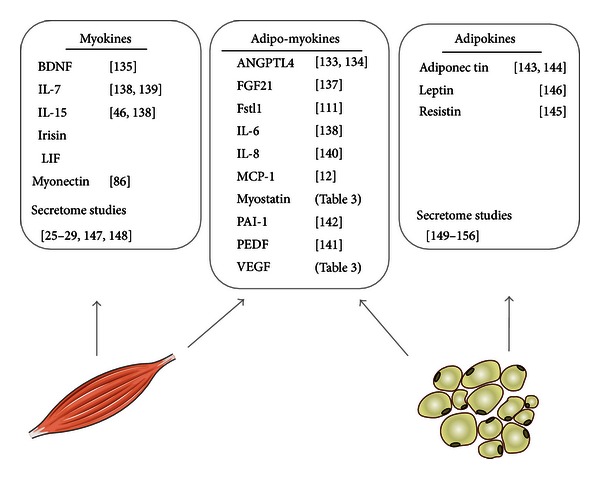
This review summarizes the current literature regarding the most discussed contraction-regulated moykines like IL-6, IL-15, irisin, BDNF, ANGPTL4, FGF21, myonectin and MCP-1. It is suggested that the term myokine is restricted to proteins secreted from skeletal muscle cells, excluding proteins that are secreted by other cell types in skeletal muscle tissue and excluding proteins which are only described on the mRNA level. Interestingly, many of the contraction-regulated myokines described in the literature are additionally known to be secreted by adipocytes. We termed these proteins adipo-myokines. Within this review, we try to elaborate on the question why pro-inflammatory adipokines on the one hand are upregulated in the obese state, and have beneficial effects after exercise on the other hand. Both, adipokines and myokines do have autocrine effects within their corresponding tissues. In addition, they are involved in an endocrine crosstalk with other tissues. Depending on the extent and the kinetics of adipo-myokines in serum, these molecules seem to have a beneficial or an adverse effect on the target tissue.
Overview
The claims and statistics of this paper haven’t been checked yet.
Run the check — free, no account needed. It reads the open-access text and checks the sources it cites.
Integrity signals
Registry
Cites
Statistics
Figures
Verification
Claims the paper makes
The claims and statistics of this paper haven’t been checked yet.
Run the check — free, no account needed. It reads the open-access text and checks the sources it cites.
Claims other papers make about this one
Each is checked against this paper’s own text: does it say what the citing paper says it does?
The source backs part of the claim, not all of it — or backs it for a different population, condition or comparison.
In the citing paper
“Specifically, plasma ANGPTL4 acts on myotubes, and is well-established as a myokine derived from physical exercise (exercise factor; Raschke and Eckel, 2013; Ingerslev et al., 2017).”
From Physical Exercise-Induced Myokines and Muscle-Adipose Tissue Crosstalk: A Review of Current Knowledge and the Implications for Health and Metabolic Diseases (2018) · cites this paper as Raschke and Eckel, 2013
Experimental — accuracy not yet measuredThe cited source says what the claim attributes to it.
In the citing paper
“The performance of this protein is related to several physiological processes, among them are insulin sensitivity, lipid metabolism, adipogenesis (Cinkajzlova et al., 2018), and the increase of circulating fatty acids, which are generated mainly by chronic caloric restrictions, fasting, and aerobic physical training (Raschke and Eckel, 2013).”
From Physical Exercise-Induced Myokines and Muscle-Adipose Tissue Crosstalk: A Review of Current Knowledge and the Implications for Health and Metabolic Diseases (2018) · cites this paper as Raschke and Eckel, 2013
Self-check
Percentages, sums and reported differences re-computed from the paper’s own numbers.
The self-check needs the paper’s full text.
Citations
Cites
Positional cloning of the mouse obese gene and its human homologue
Zhang, Y., Proenca, R., Maffei, M., Barone, M., Leopold, L., & Friedman, J. M. (1994) · Nature · doi:10.1038/372425a0 · Cited by 13,419
Adipose Tissue as an Endocrine Organ
Kershaw, E. E., & Flier, J. S. (2004) · The Journal of Clinical Endocrinology & Metabolism · doi:10.1210/jc.2004-0395 · Cited by 5,522
A PGC1-α-dependent myokine that drives brown-fat-like development of white fat and thermogenesis
Boström, P., Wu, J., Jedrychowski, M. P., Korde, A., Ye, L., Lo, J. C., Rasbach, K. A., Boström, E. A., Choi, J. H., Long, J. Z., et al. (2012) · Nature · doi:10.1038/nature10777 · Cited by 4,810
Adipokines in inflammation and metabolic disease
Ouchi, N., Parker, J. L., Lugus, J. J., & Walsh, K. (2011) · Nature Reviews Immunology · doi:10.1038/nri2921 · Cited by 4,625
Effects of the obese Gene Product on Body Weight Regulation in ob / ob Mice
Pelleymounter, M. A., Cullen, M. J., Baker, M. B., Hecht, R., Winters, D., Boone, T., & Collins, F. (1995) · Science · doi:10.1126/science.7624776 · Cited by 4,017
Campfield, L. A., Smith, F. J., Guisez, Y., Devos, R., & Burn, P. (1995) · Science · doi:10.1126/science.7624778 · Cited by 3,243
A Novel Serum Protein Similar to C1q, Produced Exclusively in Adipocytes
Scherer, P. E., Williams, S. P., Fogliano, M., Baldini, G., & Lodish, H. F. (1995) · Journal of Biological Chemistry · doi:10.1074/jbc.270.45.26746 · Cited by 3,238
Muscles, exercise and obesity: skeletal muscle as a secretory organ
Pedersen, B. K., & Febbraio, M. A. (2012) · Nature Reviews Endocrinology · doi:10.1038/nrendo.2012.49 · Cited by 2,909
Muscle as an Endocrine Organ: Focus on Muscle-Derived Interleukin-6
Pedersen, B. K., & Febbraio, M. A. (2008) · Physiological Reviews · doi:10.1152/physrev.90100.2007 · Cited by 2,388
AdipoQ Is a Novel Adipose-specific Gene Dysregulated in Obesity
Hu, E., Liang, P., & Spiegelman, B. M. (1996) · Journal of Biological Chemistry · doi:10.1074/jbc.271.18.10697 · Cited by 2,261
Research works printed but not linked: 27
- 10.1042/0300-5127:0290072 · DOI
- 2012, PLoS ONE, 7
- 2011, American Journal of Physiology, 301, E1013
- 2012, PLoS ONE, 7
- 1996, American Journal of Physiology, 271, E601
- 2006, Exercise immunology review, 12, 6
- 2012, Journal of Sports Medicine and Physical Fitness, 52, 448
- 2012, Endocrine, 43, 579
- 2012, Nature, 488, 9
- 2013, PLOS ONE, 8
- 1994, Advances in Immunology, 55, 97
- 2012, American Journal of Physiology, 302, R667
- 2012, Diabetologia, 55, article s598
- 2012, PLoS ONE, 7
- 2012, PLOS ONE, 7
- 2012, Inflammation, 36, 226
- 10.1210/jc.87.5.2084 · DOI
- 2003, American Journal of Physiology, 285, E527
- 2012, Molecular & Cellular Proteomics, 11, M111
- 2009, General Physiology and Biophysics, 28, 179
- 10.2337/db07-1438 · DOI · Paper page
- 1999, Journal of Physiology, 515, 287, 10.1111/j.1469-7793.1999.287ad.x · DOI · Paper page
- 10.1113/jphysiol.2007.139618 · DOI · Paper page
- 2004, Diabetologia, 47, 1029
- 10.2337/db05-1404 · DOI · Paper page
- 2012, PLOS ONE, 7
- 2012, Acta Diabetologica, 49, 161
Cited by
Sorted by citations
Muscle–Organ Crosstalk: The Emerging Roles of Myokines
Severinsen, M. C. K., & Pedersen, B. K. (2020) · Endocrine Reviews · doi:10.1210/endrev/bnaa016 · Cited by 1,226
“The role of myokines has previously been reviewed (7, 11-37), identifying more than 650 myokines (38).”
BackgroundKalinkovich, A., & Livshits, G. (2017) · Ageing Research Reviews · doi:10.1016/j.arr.2016.09.008 · Cited by 882
Young, D. R., Hivert, M.-F., Alhassan, S., Camhi, S. M., Ferguson, J. F., Katzmarzyk, P. T., Lewis, C. E., Owen, N., Perry, C. K., Siddique, J., et al. (2016) · Circulation · doi:10.1161/cir.0000000000000440 · Cited by 791
Physical activity and muscle-brain crosstalk
Pedersen, B. K. (2019) · Nature Reviews Endocrinology · doi:10.1038/s41574-019-0174-x · Cited by 772
Skeletal muscle: A review of molecular structure and function, in health and disease
Mukund, K., & Subramaniam, S. (2019) · WIREs Systems Biology and Medicine · doi:10.1002/wsbm.1462 · Cited by 805
Metadata
- Authors
- Raschke, S., & Eckel, J.
- Affiliations
- Deutsches Diabetes-Zentrum e.V. (DE)
- Corresponding author
- Eckel, Jürgen
- Venue
- Mediators of Inflammation
- Publisher
- Wiley
- Published
- 2013
- Volume
- 2013
- Pages
- 1-16
- ISSN
- 0962-9351 (ISSN-L)
- 1466-1861
- PMC
- PMC3686148
- OpenAlex
- W2116932335
- Cited by
- 296
- References
- 179
- Citations by year
- 2026: 12 · 2025: 11 · 2024: 16 · 2023: 17 · 2022: 26 · 2021: 21 · 2020: 24 · 2019: 18 · 2018: 30 · 2017: 30 · 2016: 37 · 2015: 28 · 2014: 22 · 2013: 3
- FWCI
- 4.98
- Type
- journal article
- Language
- en
- Open access
- gold
- doi.org
- Locations
- Mediators of Inflammation (publishedVersion, cc-by)
- Europe PMC (PubMed Central) (publishedVersion, cc-by)
- PubMed Central (publishedVersion, cc-by)
- PubMed (publishedVersion)
- DOAJ (DOAJ: Directory of Open Access Journals) (submittedVersion, cc-by-sa)
- Funders
- Bundesministerium für Bildung und Forschung
- Bundesministerium für Gesundheit
- Ministerium für Wissenschaft und Forschung des Landes Nordrhein-Westfalen
- Topics
- Health Sciences › Medicine › Physiology (medical) › Exercise and Physiological Responses
- Health Sciences › Medicine › Endocrinology, Diabetes and Metabolism › Adipokines, Inflammation, and Metabolic Diseases
- Health Sciences › Medicine › Physiology (medical) › Adipose Tissue and Metabolism
- Keywords
- myokines, adipokines, skeletal muscle contraction, interleukin-6, irisin, brain-derived neurotrophic factor, ANGPTL4, FGF21, myonectin, MCP-1, IL-15, obesity, inflammation, physical activity, autocrine signaling, adipocytes
- MeSH terms
- Angiopoietin-Like Protein 4, Adipose Tissue, Animals, Endocrine System, Fibroblast Growth Factors, Gene Expression Regulation, Humans, Inflammation, RNA, Messenger, Exercise, Interleukin-6, Muscle, Skeletal, Chemokine CCL2, Brain-Derived Neurotrophic Factor, Interleukin-15, Leptin, Follistatin-Related Proteins, Angiopoietins, Adipokines
About these checks
Registry, retraction, Cites and statistics results are computed, not judged, with one exception: a printed reference that no index lists is read once by a model before it counts as a citation error. Claims are extracted by a model and kept only when their quote appears verbatim in the text; each cited source is then checked, with a model’s help, for whether it says what the claim relies on. Those verdicts can be wrong — read the claim’s quote and the cited source before relying on one.
Statistics and arithmetic are recomputed, not judged.
Confidence bands are shown only for fields calibrated on our annotated test set. None is calibrated yet, so no band is shown.
What counts as a claim ›How we measure confidence ›How we check this ›
Are you an author, or do you see a problem with this page? Request a review
