

The DOI matches its Crossref record; 197 of the 199 references it cites were found in a registry or an index.
Ceramides in Alzheimer’s Disease: Key Mediators of Neuronal Apoptosis Induced by Oxidative Stress and A β Accumulation
Open accessAbstract
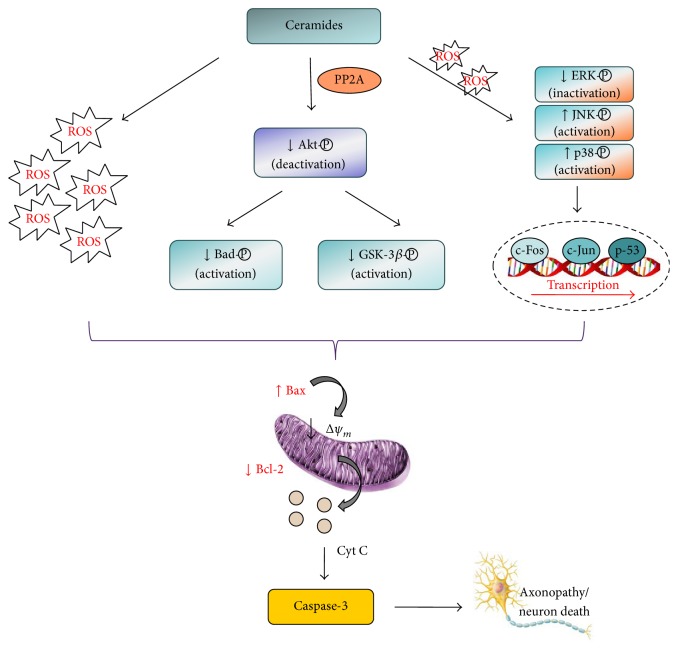
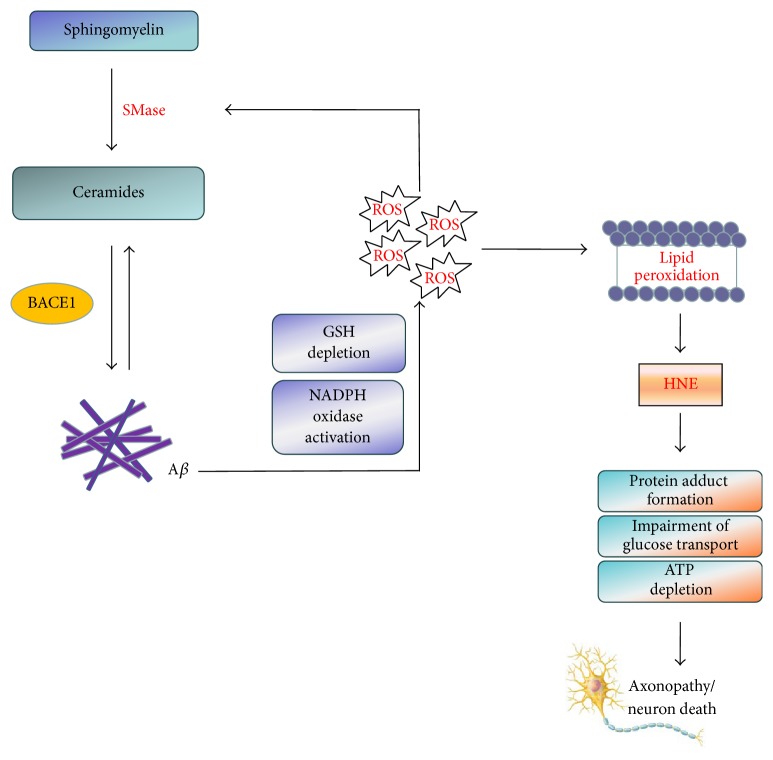
Alzheimer’s disease (AD), the most common chronic and progressive neurodegenerative disorder, is characterized by extracellular deposits of amyloid β -peptides (A β ) and intracellular deposits of hyperphosphorylated tau (phospho-tau) protein. Ceramides, the major molecules of sphingolipid metabolism and lipid second messengers, have been associated with AD progression and pathology via A β generation. Enhanced levels of ceramides directly increase A β through stabilization of β -secretase, the key enzyme in the amyloidogenic processing of A β precursor protein (APP). As a positive feedback loop, the generated oligomeric and fibrillar A β induces a further increase in ceramide levels by activating sphingomyelinases that catalyze the catabolic breakdown of sphingomyelin to ceramide. Evidence also supports important role of ceramides in neuronal apoptosis. Ceramides may initiate a cascade of biochemical alterations, which ultimately leads to neuronal death by diverse mechanisms, including depolarization and permeabilization of mitochondria, increased production of reactive oxygen species (ROS), cytochrome c release, Bcl-2 depletion, and caspase-3 activation, mainly by modulating intracellular signalling, particularly along the pathways related to Akt/PKB kinase and mitogen-activated protein kinases (MAPKs). This review summarizes recent findings related to the role of ceramides in oxidative stress-driven neuronal apoptosis and interplay with A β in the cascade of events ending in neuronal degeneration.
Overview
The claims and statistics of this paper haven’t been checked yet.
Run the check — free, no account needed. It reads the open-access text and checks the sources it cites.
Integrity signals
Registry
Cites
Statistics
Figures
Verification
Claims the paper makes
The claims and statistics of this paper haven’t been checked yet.
Run the check — free, no account needed. It reads the open-access text and checks the sources it cites.
Claims other papers make about this one
Each is checked against this paper’s own text: does it say what the citing paper says it does?
The source backs part of the claim, not all of it — or backs it for a different population, condition or comparison.
In the citing paper
“Elevated Cer levels have been associated with AD pathology, including promoting Aβ accumulation, mitochondrial dysfunction, and inflammation. 24 , 25”
From Protective mechanisms against Alzheimer's disease in APOE3‐Christchurch homozygous astrocytes (2025) · cites this paper as [25]
Experimental — accuracy not yet measuredThe cited source says what the claim attributes to it.
In the citing paper
“Ceramides are also known to initiate some of the pathological changes that drive AD progression. 24 , 25”
From Protective mechanisms against Alzheimer's disease in APOE3‐Christchurch homozygous astrocytes (2025) · cites this paper as [25]
Self-check
Percentages, sums and reported differences re-computed from the paper’s own numbers.
The self-check needs the paper’s full text.
Citations
Cites
1 retracted
Puglielli, L., Ellis, B. C., Saunders, A. J., & Kovacs, D. M. (2003) · Journal of Biological Chemistry · doi:10.1074/jbc.m300466200 · Cited by 265
RetractedLi, P., Nijhawan, D., Budihardjo, I., Srinivasula, S. M., Ahmad, M., Alnemri, E. S., & Wang, X. (1997) · Cell · doi:10.1016/s0092-8674(00)80434-1 · Cited by 7,289
Apolipoprotein E and Alzheimer disease: risk, mechanisms and therapy
Liu, C.-C., Kanekiyo, T., Xu, H., & Bu, G. (2013) · Nature Reviews Neurology · doi:10.1038/nrneurol.2012.263 · Cited by 3,459
Principles of bioactive lipid signalling: lessons from sphingolipids
Hannun, Y. A., & Obeid, L. M. (2008) · Nature Reviews Molecular Cell Biology · doi:10.1038/nrm2329 · Cited by 3,411
Uttara, B., Singh, A., Zamboni, P., & Mahajan, R. (2009) · Current Neuropharmacology · doi:10.2174/157015909787602823 · Cited by 3,378
Reactive oxygen species, cellular redox systems, and apoptosis
Circu, M. L., & Aw, T. Y. (2010) · Free Radical Biology and Medicine · doi:10.1016/j.freeradbiomed.2009.12.022 · Cited by 3,340
Blennow, K., de Leon, M. J., & Zetterberg, H. (2006) · The Lancet · doi:10.1016/s0140-6736(06)69113-7 · Cited by 3,134
Copper toxicity, oxidative stress, and antioxidant nutrients
Gaetke, L. M. (2003) · Toxicology · doi:10.1016/s0300-483x(03)00159-8 · Cited by 2,223
Copper, iron and zinc in Alzheimer's disease senile plaques
Lovell, M. A., Robertson, J. D., Teesdale, W. J., Campbell, J. L., & Markesbery, W. R. (1998) · Journal of the Neurological Sciences · doi:10.1016/s0022-510x(98)00092-6 · Cited by 2,120
Janssens, V., & Goris, J. (2001) · Biochemical Journal · doi:10.1042/0264-6021:3530417 · Cited by 1,927
Research works printed but not linked: 8
- 1998, Periodicum Biologorum, 100, 165
- 10.1002/(sici)1096-9861(19970324)379:4lt;482::aid-cne2>3.0.co;2-z · DOI
- 2011, International Journal of Biochemistry and Molecular Biology, 2, 347
- 10.1016/j.freeradbiomed.2004.12.019 · DOI
- 2008, Collegium Antropologicum, 32, 51
- 2014, The Biochemical Journal, 465, 371
- 2009, Molecular Neurodegeneration, 4, article 47
- 10.1002/(sici)1097-4547(19971101)50:360;466::aid-jnr1362;3.0.co;2-4 · DOI
Cited by
Sorted by citations
Regulation of apoptosis in health and disease: the balancing act of BCL-2 family proteins
Singh, R., Letai, A., & Sarosiek, K. (2019) · Nature Reviews Molecular Cell Biology · doi:10.1038/s41580-018-0089-8 · Cited by 2,111
Park, M. W., Cha, H. W., Kim, J., Kim, J. H., Yang, H., Yoon, S., Boonpraman, N., Yi, S. S., Yoo, I. D., & Moon, J.-S. (2021) · Redox Biology · doi:10.1016/j.redox.2021.101947 · Cited by 683
Activation of microglia and astrocytes: a roadway to neuroinflammation and Alzheimer’s disease
Kaur, D., Sharma, V., & Deshmukh, R. R. (2019) · Inflammopharmacology · doi:10.1007/s10787-019-00580-x · Cited by 503
Lipids and Alzheimer’s Disease
Kao, Y.-C., Ho, P.-C., Tu, Y.-K., Jou, I.-M., & Tsai, K.-J. (2020) · International Journal of Molecular Sciences · doi:10.3390/ijms21041505 · Cited by 485
Varma, V. R., Oommen, A. M., Varma, S., Casanova, R., An, Y., Andrews, R. M., O’Brien, R., Pletniková, O., Troncoso, J. C., Toledo, J. B., et al. (2018) · PLoS Medicine · doi:10.1371/journal.pmed.1002482 · Cited by 469
Metadata
- Authors
- Jazvinšćak Jembrek, M., Hof, P. R., & Šimić, G.
- Affiliations
- Laboratory for Molecular Neuropharmacology, Division of Molecular Medicine, Rudjer Bošković Institute, 10000 Zagreb, Croatia
- Icahn School of Medicine at Mount Sinai (US)
- University of Zagreb (HR)
- Venue
- Oxidative Medicine and Cellular Longevity
- Publisher
- Wiley
- Published
- 2015
- Volume
- 2015
- Pages
- 1-17
- ISSN
- 1942-0994 (ISSN-L)
- 1942-0900
- PMC
- PMC4458271
- OpenAlex
- W1484835368
- Cited by
- 244
- References
- 199
- Citations by year
- 2026: 13 · 2025: 22 · 2024: 26 · 2023: 23 · 2022: 27 · 2021: 29 · 2020: 21 · 2019: 29 · 2018: 20 · 2017: 21 · 2016: 10 · 2015: 3
- FWCI
- 1.74
- Type
- journal article
- Language
- en
- Open access
- hybrid
- doi.org
- Locations
- Oxidative Medicine and Cellular Longevity (publishedVersion, cc-by)
- Europe PMC (PubMed Central) (publishedVersion, cc-by)
- PubMed Central (publishedVersion, cc-by)
- PubMed (publishedVersion)
- Repository of the Medical Faculty of the University of Zagreb (University of Zagreb) (acceptedVersion)
- DOAJ (DOAJ: Directory of Open Access Journals) (submittedVersion)
- Institutional Repository of the Ruđer Bošković Institute (Ruđer Bošković Institute) (submittedVersion, cc-by)
- Institutional Repository of the Ruđer Bošković Institute (Ruđer Bošković Institute) (submittedVersion, other-oa)
- Funders
- Croatian Ministry of Science, Education and Sport (098-0000000-2448, 09/16, AG005138)
- Croatian Science Foundation (098-0000000-2448, 09/16, AG005138)
- National Institutes of Health (098-0000000-2448, 09/16, AG005138)
- Topics
- Life Sciences › Biochemistry, Genetics and Molecular Biology › Molecular Biology › Sphingolipid Metabolism and Signaling
- Life Sciences › Neuroscience › Cellular and Molecular Neuroscience › Alzheimer's disease research and treatments
- Health Sciences › Medicine › Genetics (clinical) › Lysosomal Storage Disorders Research
- Keywords
- ceramide, Alzheimer's disease, amyloid-beta, oxidative stress, neuronal apoptosis, sphingolipid metabolism, beta-secretase, sphingomyelinase, tau hyperphosphorylation, mitochondrial membrane permeabilization, reactive oxygen species, caspase-3, Akt signaling, MAPK signaling, neurodegeneration
- MeSH terms
- Alzheimer Disease, Animals, Ceramides, Humans, Neurons, Amyloid beta-Peptides, Apoptosis, Oxidative Stress
About these checks
Registry, retraction, Cites and statistics results are computed, not judged, with one exception: a printed reference that no index lists is read once by a model before it counts as a citation error. Claims are extracted by a model and kept only when their quote appears verbatim in the text; each cited source is then checked, with a model’s help, for whether it says what the claim relies on. Those verdicts can be wrong — read the claim’s quote and the cited source before relying on one.
Statistics and arithmetic are recomputed, not judged.
Confidence bands are shown only for fields calibrated on our annotated test set. None is calibrated yet, so no band is shown.
What counts as a claim ›How we measure confidence ›How we check this ›
Are you an author, or do you see a problem with this page? Request a review
