

The DOI matches its Crossref record; 59 of the 59 references it cites were found in a registry or an index; 24 of the 39 sources its claims cite were checked for support.
Allosteric folding correction of F508del and rare CFTR mutants by elexacaftor-tezacaftor-ivacaftor (Trikafta) combination
Open accessAbstract
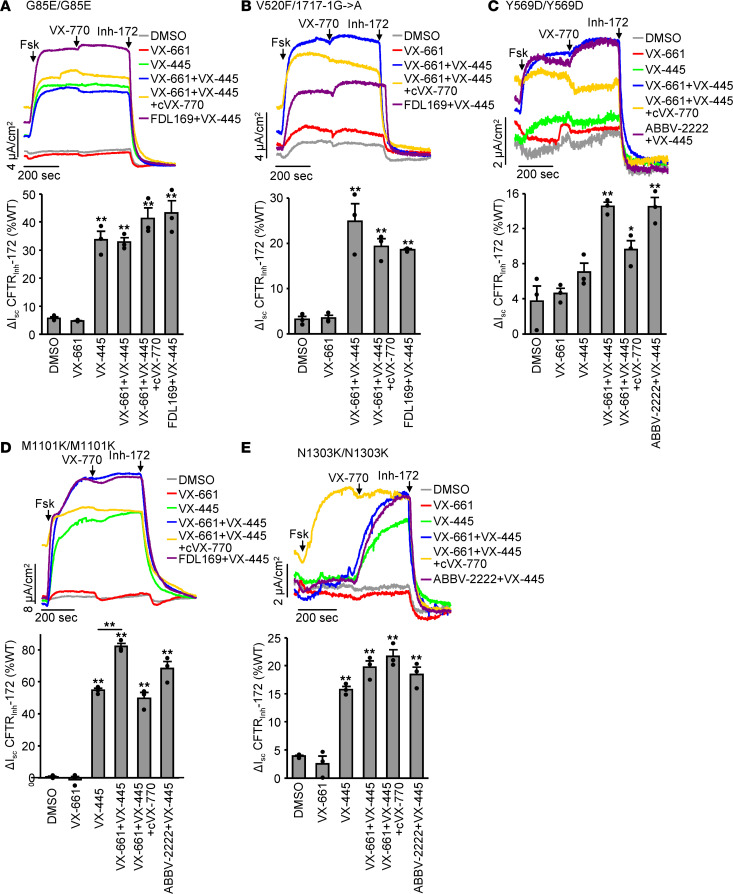
Based on its clinical benefits, Trikafta — the combination of folding correctors VX-661 (tezacaftor), VX-445 (elexacaftor), and the gating potentiator VX-770 (ivacaftor) — was FDA approved for treatment of patients with cystic fibrosis (CF) carrying deletion of phenylalanine at position 508 (F508del) of the CF transmembrane conductance regulator ( CFTR ) on at least 1 allele. Neither the mechanism of action of VX-445 nor the susceptibility of rare CF folding mutants to Trikafta are known. Here, we show that, in human bronchial epithelial cells, VX-445 synergistically restores F508del-CFTR processing in combination with type I or II correctors that target the nucleotide binding domain 1 (NBD1) membrane spanning domains (MSDs) interface and NBD2, respectively, consistent with a type III corrector mechanism. This inference was supported by the VX-445 binding to and unfolding suppression of the isolated F508del-NBD1 of CFTR. The VX-661 plus VX-445 treatment restored F508del-CFTR chloride channel function in the presence of VX-770 to approximately 62% of WT CFTR in homozygous nasal epithelia. Substantial rescue of rare misprocessing mutations (S13F, R31C, G85E, E92K, V520F, M1101K, and N1303K), confined to MSD1, MSD2, NBD1, and NBD2 of CFTR, was also observed in airway epithelia, suggesting an allosteric correction mechanism and the possible application of Trikafta for patients with rare misfolding mutants of CFTR.
Overview
AI snapshot
Written from the paper’s full text.
TL;DR
VX-445 (elexacaftor) behaves as a type III CFTR corrector that binds F508del-NBD1, suppresses its unfolding/aggregation, and synergizes with type I/II correctors to restore F508del-CFTR processing and function. VX-661 plus VX-445 also rescued several rare CFTR folding mutants, reaching therapeutically relevant correction levels in airway epithelial models.
Key findings
- VX-445 plus VX-661 increased F508del-CFTR plasma membrane density to ~45% of WT with an EC50 of ~0.28 μM; VX-445 alone reached ~15% and VX-661 alone ~3.5% of WT. The VX-445 enantiomer EN2 was less efficacious (~25% of WT, EC50 ~1.1 μM).
- VX-445 bound F508del–NBD1-1S with a KD of ~80 μM, similar to WT–NBD1-1S, and decreased the rate/extent of F508del–NBD1-1S aggregation by 50% at 100 μM; VX-661 did not suppress aggregation and only partially suppressed thermal ellipticity loss.
- In homozygous F508del human nasal epithelia, VX-661 plus VX-445 restored F508del-CFTR current to 76% of WT with acute VX-770 and 62% with chronic VX-770; VX-809 increased current from 9% to 25% of WT.
- VX-661 plus VX-445 significantly increased PM density for 9 of 10 rare mutants tested, reaching >20% of WT for S13F, R31C, E92K, R352G, V520F, and L1077P; corrected Isc in HNE reached 20%, 41%, 50%, and 22% of WT for V520F, G85E, M1101K, and N1303K, respectively, with chronic VX-770.
Methods
- CFBE41o- cells expressing inducible 3HA-tagged CFTR variants were used for PM density measurements by cell-surface ELISA, normalized to viability and CFTR mRNA; primary human nasal epithelia were differentiated at air-liquid interface and assayed by Ussing chamber short-circuit current.
- Biophysical assays included surface plasmon resonance binding to biotinylated NBD1 constructs, NBD1 aggregation monitored by absorbance at 400 nm, and circular dichroism spectroscopy; corrector combinations were analyzed by combinatorial profiling and clustering.
- VX-445 and ABBV-2222 were synthesized and validated; statistics used 1-way ANOVA with Tukey’s HSD, paired 2-tailed Student’s t test with Bonferroni’s FDR correction, dose-response fitting, and Heatmapper clustering.
Limitations
- The paper does not include a dedicated limitations section. It states that the cause of the large variation in CFTR Isc across individuals is not known, and that WT and corrected F508del Isc values partly overlapped.
- The paper states that combinatorial profiling was not possible for some mutant CFTRs because of nonresponse, high single-corrector PM density, or partial additivity.
- The paper notes that the apparent discrepancy between only partially mitigated CF lung disease in adults and patient-derived epithelial cell data may be accounted for by long-term chronic infection, inflammation, and tissue damage; it also notes that VX-445’s increased in vivo potency may reflect intracellular accumulation and/or a binding surface modulated by full-length CFTR context.
Model-written summary. Check it against the paper before relying on it.
Integrity signals
Registry
Cites
Statistics
Figures
Verification
Claims the paper makes
37 Own result · 15 Own interpretation · 10 Partly supported · 8 Own method · 4 Supported · 3 No full text of the sources · 3 Not checked yet · 2 Supported so far · 1 No basis given · accuracy not yet measured
The cited sources support only part of this claim — read each source’s verdict below.
In the paper
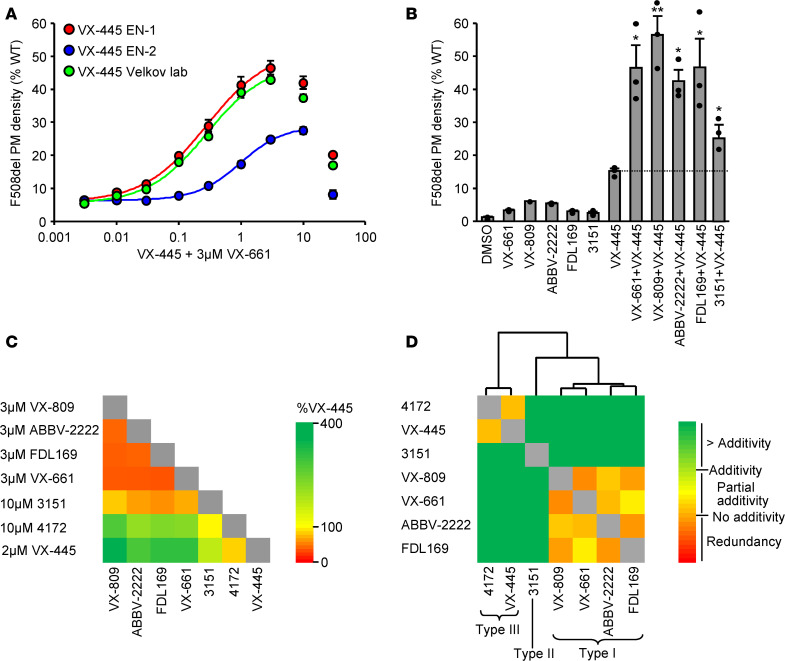
“Combination of VX-445 with the investigational type II corrector 3151 (21) also increased the F508del-CFTR PM density to ~25% of the WT (Figure 1B).”
§ Allosteric folding correction of F508del and rare CFTR mutants by elexacaftor-tezacaftor-ivacaftor (Trikafta) combination > Results > Synergistic rescue of F508del-CFTR misprocessing with VX-445 and type I and II correctors.
What the sources say
- Partly supportedcites [21] sourceExperimental — accuracy not yet measured
The Results (Clustering corrector hits based on mechanism of action; page unavailable) identify 3151 as a type II corrector. The Results (Cooperative rescue of biogenesis, PM expression and stability by corrector combinations; page unavailable) report increased F508del-CFTR PM density with combinations containing 3151, but the combinations described use VX-809 and 4172, not VX-445. Our copy does not establish the claimed VX-445–3151 result or its ~25%-of-WT value. (LLM, conf=0.82)
plaindirect- Asserted: passes — The authors put it forward as true.
- Checkable: passes — It can be checked against evidence.
- Load-bearing: passes — The paper’s conclusions depend on it.
- Based: passes — The paper gives a reason why it holds.
- Partly supported
The cited sources support only part of this claim — read each source’s verdict below.
In the paper
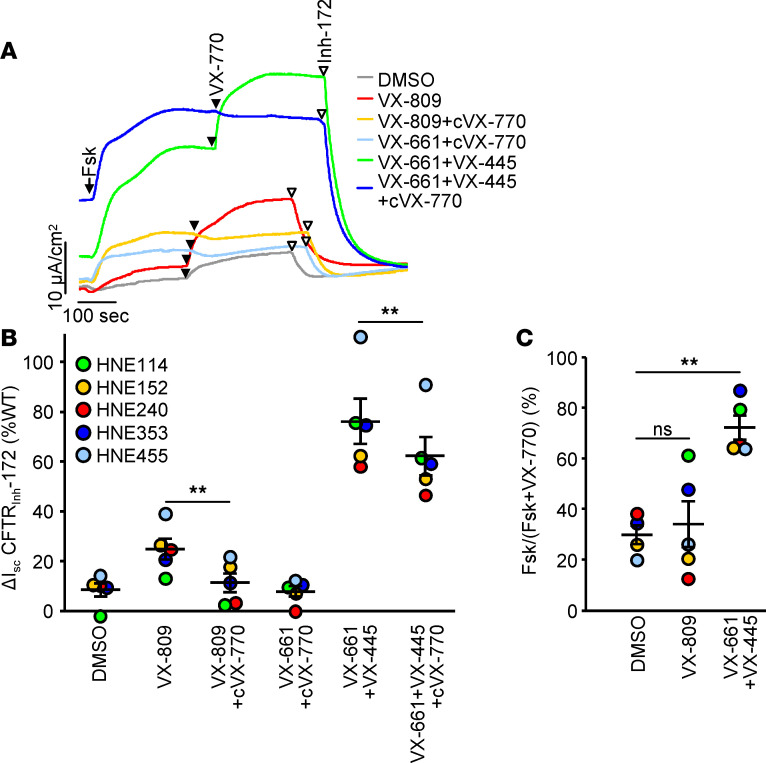
“Chronic treatment with 1 μM VX-770, a concentration that is therapeutically reached in respiratory epithelia (34), was reported to significantly decrease the functional correction by VX-809 in the presence of acute potentiator addition (Figure 3, A and B), as observed in CF-HBE (35, 36) and CF-HNE (21).”
§ Allosteric folding correction of F508del and rare CFTR mutants by elexacaftor-tezacaftor-ivacaftor (Trikafta) combination > Results > Functional correction of human CFTRF508del/F508del nasal epithelia.
What the sources say
- Supportedcites [34] Guimbellot JS, et al. Variable cellular ivacaftor concentrations in people with cystic fibrosis on modulator therapy [published ahead of print February 7, 2020]. J Cyst Fibros. https://doi.org/10.1016/j.jcf.2020.01.011 source
Citation (34) is attached to the statement that a 1 μM VX-770 exposure is therapeutically reached in respiratory epithelia, not to the reported decrease in VX-809 correction. The Results (Cellular quantitation of ivacaftor; page unavailable) report a broad range of ivacaftor concentrations in nasal epithelial cells from people receiving modulator therapy, consistent with that exposure. This paper does not itself test the functional effect described later in the sentence. (LLM, conf=0.86)
- Partly supportedcites [35] sourceExperimental — accuracy not yet measured
The Results section on chloride conductance reports that 24 hours of VX-770 reduced VX-809–corrected ΔF508-CFTR current in primary HBE cells, with current measured after acute potentiator addition. But the reported chronic dose for those functional measurements was 100 nM, not the claimed 1 μM; our copy mentions 1 μM in a different, pulse-chase experiment (Materials and Methods). No page numbers are available in our copy. (LLM, conf=0.88)
- Partly supportedcites [36] sourceExperimental — accuracy not yet measured
The Results section on dose dependence (Fig. 4; page unavailable) reports that chronic 1 µM VX-770 reduced VX-809-corrected functional responses and eliminated responses to acute VX-770. It does not report a statistically significant reduction for 1 µM versus VX-809 alone; the stated significant comparison is between the 1 µM and 5 µM conditions. (LLM, conf=0.84)
- Partly supportedcites [21] sourceExperimental — accuracy not yet measured
The Results section on functional correction in bronchial and nasal epithelia (page unavailable) states that chronic VX-770 treatment decreased VX-809 corrector efficacy in CF-HNE, consistent with the reported CF-HBE response. The passages do not establish the specified 1 μM concentration, statistical significance, or that the decrease was measured in the presence of acute potentiator addition. (LLM, conf=0.83)
plaindirect- Asserted: passes — The authors put it forward as true.
- Checkable: passes — It can be checked against evidence.
- Load-bearing: unclear — It is unclear whether the paper’s conclusions depend on it.
- Based: passes — The paper gives a reason why it holds.
- Supported
The cited sources support only part of this claim — read each source’s verdict below.
In the paper
“The clinical trials with Trikafta showed only partial normalization of the 60%–65% mean baseline ppFEV1 after 24 weeks of treatment in compound heterozygous F508del (16) or at 4 weeks in homozygous F508del patients (15).”
§ Allosteric folding correction of F508del and rare CFTR mutants by elexacaftor-tezacaftor-ivacaftor (Trikafta) combination > Discussion
What the sources say
- Partly supportedcites [16] sourceExperimental — accuracy not yet measured
The Results (Efficacy; page unavailable) report a sustained improvement in ppFEV1 through 24 weeks in patients with one Phe508del allele and a minimal-function mutation, consistent with improvement short of full normalization. The passages do not give the claimed 60%–65% mean baseline ppFEV1 or a week-24 value establishing the degree of normalization. The homozygous-patient result is attached to a different citation and is not assessed here. (LLM, conf=0.82)
- Partly supportedcites [15] sourceExperimental — accuracy not yet measured
For the homozygous F508del patients to whom this citation is attached, Results > Efficacy reports a 10.0-percentage-point ppFEV1 improvement versus tezacaftor/ivacaftor at week 4. The retrieved passages do not give the claimed 60%–65% mean baseline ppFEV1 or establish the resulting degree of ‘partial normalization.’ The sentence cites a different study for the heterozygous patients’ 24-week result. (LLM, conf=0.82)
plaindirect- Asserted: passes — The authors put it forward as true.
- Checkable: passes — It can be checked against evidence.
- Load-bearing: passes — The paper’s conclusions depend on it.
- Based: passes — The paper gives a reason why it holds.
- Partly supported
The cited sources support only part of this claim — read each source’s verdict below.
In the paper
“which likely does not give rise to correctable protein expression (2).”
§ Allosteric folding correction of F508del and rare CFTR mutants by elexacaftor-tezacaftor-ivacaftor (Trikafta) combination > Results > Identification of rare folding mutants showing partial functional correction by VX-661 plus VX-445 in HNE.
What the sources say
- Partly supportedcites [2] sourceExperimental — accuracy not yet measured
The Results (Functional analysis; page unavailable) say that variants affecting canonical splice-site nucleotides can lead to mRNA decay and no protein production, which supports the claim’s general rationale. Our copy does not identify 1717-1G->A specifically or assess whether protein from that variant is correctable. (LLM, conf=0.78)
hedged- Asserted: passes — The authors put it forward as true.
- Checkable: passes — It can be checked against evidence.
- Load-bearing: passes — The paper’s conclusions depend on it.
- Based: passes — The paper gives a reason why it holds.
- Partly supported
The cited sources support only part of this claim — read each source’s verdict below.
In the paper
“The VX-661 plus VX-445 also permits allosteric correction of the global conformation defect elicited by other missense CF mutation located in the MSD1, MSD2, NBD1, or NBD2, in agreement with our previous results (21).”
§ Allosteric folding correction of F508del and rare CFTR mutants by elexacaftor-tezacaftor-ivacaftor (Trikafta) combination > Discussion
What the sources say
- Partly supportedcites [21] sourceExperimental — accuracy not yet measured
The Discussion (page unavailable) says that corrector combinations can allosterically correct conformational defects caused by missense mutations in MSD1, MSD2, NBD1, or NBD2. The Results identify the combination tested for these mutants as VX-809, 3151, and 4172, not VX-661 plus VX-445. The cited paper therefore supports the allosteric-correction principle but not its attribution to that specific drug pair. (LLM, conf=0.88)
plaindirect- Asserted: passes — The authors put it forward as true.
- Checkable: passes — It can be checked against evidence.
- Load-bearing: passes — The paper’s conclusions depend on it.
- Based: passes — The paper gives a reason why it holds.
- Partly supported
Every source the paper cites for this claim was checked and supports it.
In the paper
“It is plausible that improved conformational rescue with VX-661 and VX-445 combination at least partly accounts for the attenuated gating defect of the F508del-CFTR, indicated by a 2-fold increase in the forskolin-induced, potentiator-independent fractional activation of the Isc (Figure 3C), similar to that observed earlier for triple corrector combination (21).”
§ Allosteric folding correction of F508del and rare CFTR mutants by elexacaftor-tezacaftor-ivacaftor (Trikafta) combination > Results > Functional correction of human CFTRF508del/F508del nasal epithelia.
What the sources say
- Supportedcites [21] source
Split into 2 atoms — 2 confirmed, 0 partially supported, 0 disputed, 0 misattributed, 0 unverifiable. Expand the claim to see per-atom verdicts.
hedgedconditional- Asserted: passes — The authors put it forward as true.
- Checkable: passes — It can be checked against evidence.
- Load-bearing: passes — The paper’s conclusions depend on it.
- Based: passes — The paper gives a reason why it holds.
- Supported
The cited sources support only part of this claim — read each source’s verdict below.
In the paper
“VX-809 treatment increased the forskolin-activated and acutely VX-770–potentiated short-circuit current (Isc) of F508del-CFTR from 9% to 25%, relative to that of the WT (Figure 3, A and B, and Supplemental Figure 3) as reported before (21, 33).”
§ Allosteric folding correction of F508del and rare CFTR mutants by elexacaftor-tezacaftor-ivacaftor (Trikafta) combination > Results > Functional correction of human CFTRF508del/F508del nasal epithelia.
What the sources say
- Partly supportedcites [21] sourceExperimental — accuracy not yet measured
The Results section, “Functional correction of human CFTRΔF508/ΔF508 bronchial and nasal epithelia” (page unavailable), confirms that VX-809 increased forskolin-activated, potentiated F508del-CFTR short-circuit current relative to WT. It reports an increase from 6% to 27%, however, not the claimed 9% to 25%; the 9% figure appears in a separate result for forskolin-activated current. (LLM, conf=0.86)
- Not checked yetcites [33] source
Checked before — its earlier verdict is held back until a new check runs.
plaindirectn = 5- Asserted: passes — The authors put it forward as true.
- Checkable: passes — It can be checked against evidence.
- Load-bearing: unclear — It is unclear whether the paper’s conclusions depend on it.
- Based: passes — The paper gives a reason why it holds.
- Partly supported
The cited sources support only part of this claim — read each source’s verdict below.
In the paper
“The apparent discrepancy between the only partially mitigated CF lung disease in adult patients and the patient-derived epithelial cell data may be accounted for by the long-term effects of chronic lung infection and inflammation, and consequential tissue damage (45).”
§ Allosteric folding correction of F508del and rare CFTR mutants by elexacaftor-tezacaftor-ivacaftor (Trikafta) combination > Discussion
What the sources say
- Partly supportedcites [45] sourceExperimental — accuracy not yet measured
The Pathogenesis of CF Lung Disease and Endobronchial Infections sections describe chronic infection and inflammation damaging airway structure, and the Abstract says treatment delays but does not prevent lung-disease progression. The paper does not compare adult patients with patient-derived epithelial cell data or explicitly offer tissue damage as an explanation for that discrepancy. Page numbers were not available in our copy. (LLM, conf=0.84)
hedgedconditional- Asserted: passes — The authors put it forward as true.
- Checkable: passes — It can be checked against evidence.
- Load-bearing: passes — The paper’s conclusions depend on it.
- Based: passes — The paper gives a reason why it holds.
- Partly supported
A result the paper reports from its own data — it cites no other source for it, so there is none to check. The quote shows it is in the paper.
In the paper
“Combinatorial profiling identified VX-445 as a putative type III corrector”
§ Allosteric folding correction of F508del and rare CFTR mutants by elexacaftor-tezacaftor-ivacaftor (Trikafta) combination > Discussion
hedgedcorrelational- Asserted: passes — The authors put it forward as true.
- Checkable: passes — It can be checked against evidence.
- Load-bearing: passes — The paper’s conclusions depend on it.
- Based: passes — The paper gives a reason why it holds.
A result the paper reports from its own data — it cites no other source for it, so there is none to check. The quote shows it is in the paper.
In the paper
“Substantial rescue of rare misprocessing mutations (S13F, R31C, G85E, E92K, V520F, M1101K, and N1303K), confined to MSD1, MSD2, NBD1, and NBD2 of CFTR, was also observed in airway epithelia”
§ Allosteric folding correction of F508del and rare CFTR mutants by elexacaftor-tezacaftor-ivacaftor (Trikafta) combination > Abstract
plaindirect- Asserted: passes — The authors put it forward as true.
- Checkable: passes — It can be checked against evidence.
- Load-bearing: passes — The paper’s conclusions depend on it.
- Based: passes — The paper gives a reason why it holds.
- It may state two separate claims as one. 27
- Probably not a substantial claim. 11
Every source the paper cites for this claim was checked and supports it.
In the paper
“localized stabilization of CFTR domains by correctors (or pharmacochaperones) may be propagated to distant regions of the channel; thereby, corrector combinations may synergistically stabilize a variety of mutant proteins (21).”
§ Allosteric folding correction of F508del and rare CFTR mutants by elexacaftor-tezacaftor-ivacaftor (Trikafta) combination > Introduction
What the sources say
- Supportedcites [21] source
The Results section reports that corrector treatment improved folding across individual CFTR domains, suggesting that the effect was allosterically propagated through the channel. In “Allosteric rescue of some CFTR2 mutants,” the authors report improved correction for many tested mutants and suggest that combinations stabilizing distinct domains could benefit patients with a variety of folding mutations. (LLM, conf=0.91)
hedgedconditional- Asserted: passes — The authors put it forward as true.
- Checkable: passes — It can be checked against evidence.
- Load-bearing: passes — The paper’s conclusions depend on it.
- Based: passes — The paper gives a reason why it holds.
It may state two separate claims as one.
- Supported
The sources with a verdict support this claim; the rest weren’t checked yet, have no full text we could read, or their verdicts aren’t rated yet.
In the paper
“F508del impairs the NBD1 stability and the coupled or cooperative domain folding of the channel (9–11).”
§ Allosteric folding correction of F508del and rare CFTR mutants by elexacaftor-tezacaftor-ivacaftor (Trikafta) combination > Introduction
What the sources say
- Supportedcites [9] source
In “Linking NBD1 misfolding in ΔF508 CFTR to domain misassembly,” the paper reports kinetic and thermodynamic folding defects in ΔF508 NBD1. The same section describes impaired domain-interface assembly and cooperative misassembly of CFTR domains, supporting both parts of the paraphrase. (LLM, conf=0.91)
- Not checked — no full text of the sourcecites [10] source
- Not checked — no full text of the sourcecites [11] source
plaindirect- Asserted: passes — The authors put it forward as true.
- Checkable: passes — It can be checked against evidence.
- Load-bearing: passes — The paper’s conclusions depend on it.
- Based: passes — The paper gives a reason why it holds.
It may state two separate claims as one.
- Supported
The cited sources support only part of this claim — read each source’s verdict below.
In the paper
“This hypothesis gained traction by demonstrating that rescuing the structural defects of the NBD1-MSDs and NBD2-domain interfaces — as well as the NBD1 stability by type I, II, and III correctors, respectively — reinstated folding for not only the F508del-CFTR (18, 19, 21), but also a subset of rare folding mutants located in the MSD1, MSD2, and NBD2 domains (21).”
§ Allosteric folding correction of F508del and rare CFTR mutants by elexacaftor-tezacaftor-ivacaftor (Trikafta) combination > Introduction
What the sources say
- Partly supportedcites [18] sourceExperimental — accuracy not yet measured
Split into 2 atoms — 0 confirmed, 2 partially supported, 0 disputed, 0 misattributed, 0 unverifiable. Expand the claim to see per-atom verdicts.
- Partly supportedcites [19] sourceExperimental — accuracy not yet measured
Split into 2 atoms — 1 confirmed, 1 partially supported, 0 disputed, 0 misattributed, 0 unverifiable. Expand the claim to see per-atom verdicts.
- Supportedcites [21] source
Split into 2 atoms — 2 confirmed, 0 partially supported, 0 disputed, 0 misattributed, 0 unverifiable. Expand the claim to see per-atom verdicts.
boosteddirect- Asserted: passes — The authors put it forward as true.
- Checkable: passes — It can be checked against evidence.
- Load-bearing: passes — The paper’s conclusions depend on it.
- Based: passes — The paper gives a reason why it holds.
It may state two separate claims as one.
- Partly supported
The cited sources support only part of this claim — read each source’s verdict below.
In the paper
“PM density values were normalized with cell viability measured by alamarBlue Assay (Invitrogen) and related to WT-CFTR by normalizing with CFTR mRNA abundance determined by qPCR as previously (21).”
§ Allosteric folding correction of F508del and rare CFTR mutants by elexacaftor-tezacaftor-ivacaftor (Trikafta) combination > Methods > CFTR PM density measurement.
What the sources say
- Partly supportedcites [21] sourceExperimental — accuracy not yet measured
The Online Methods section “PM density measurement” (page unavailable) explicitly says PM density was normalized to cell viability measured by the alamarBlue Assay. The “qPCR” section describes measuring CFTR transcript abundance, but our copy does not say that PM density was normalized by that abundance to relate it to WT-CFTR. (LLM, conf=0.85)
plaincorrelational- Asserted: passes — The authors put it forward as true.
- Checkable: passes — It can be checked against evidence.
- Load-bearing: passes — The paper’s conclusions depend on it.
- Based: passes — The paper gives a reason why it holds.
Probably not a substantial claim. It may state two separate claims as one.
- Partly supported
The sources with a verdict support this claim; the rest weren’t checked yet, have no full text we could read, or their verdicts aren’t rated yet.
In the paper
“Patient-derived HNE are precision medicine tools that can predict the clinical responsiveness of individuals and likely inform on the theratype of individual mutations or mutation combinations (38–40).”
§ Allosteric folding correction of F508del and rare CFTR mutants by elexacaftor-tezacaftor-ivacaftor (Trikafta) combination > Results > Identification of rare folding mutants showing partial functional correction by VX-661 plus VX-445 in HNE.
What the sources say
- Supportedcites [38] source
The Conclusion says that restoration of CFTR function in patient-derived HNE cultures can predict clinical benefit from a CFTR modulator. The Discussion proposes using patient-specific HNE responses to guide treatment and classify responsiveness by “theratype” rather than genotype alone. (LLM, conf=0.93)
- Not checked — no full text of the sourcecites [39] source
- Not checked yetcites [40] Brewington, 2018, Brushed nasal epithelial cells are a surrogate for bronchial epithelial CFTR studies, JCI Insight source
Checked before — its earlier verdict is held back until a new check runs.
hedgedconditional- Asserted: passes — The authors put it forward as true.
- Checkable: passes — It can be checked against evidence.
- Load-bearing: passes — The paper’s conclusions depend on it.
- Based: passes — The paper gives a reason why it holds.
It may state two separate claims as one.
- Supported
Every source the paper cites for this claim was checked and supports it.
In the paper
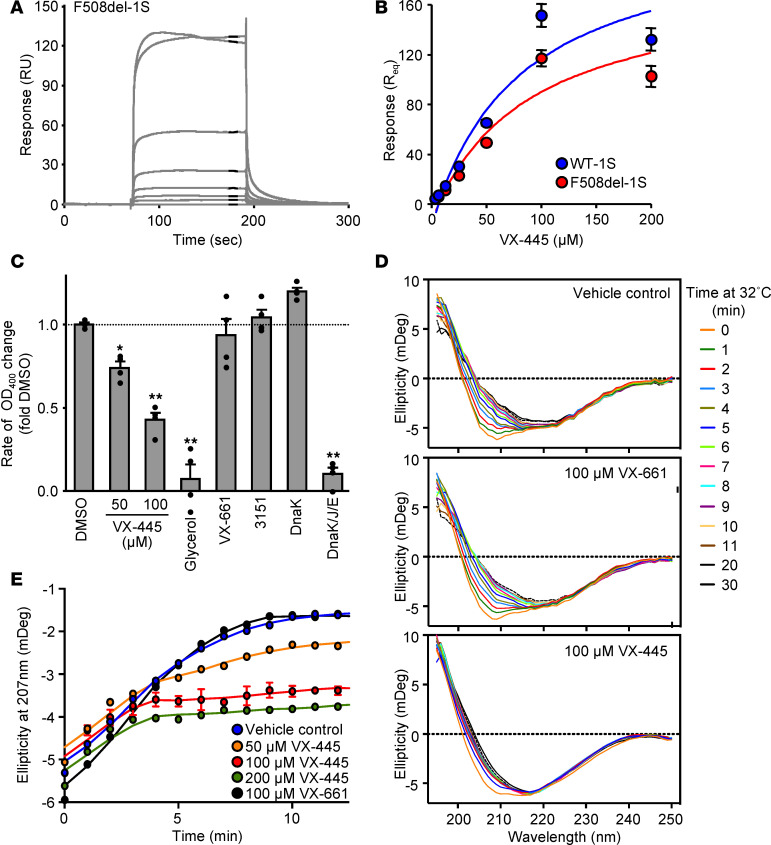
“VX-445 displayed saturable, dose-dependent binding to immobilized F508del–NBD1-1S with a KD of ~80 μM, similar to the type III corrector 4172 (21) (Figure 2, A and B; Supplemental Figure 2; and Supplemental Table 1).”
§ Allosteric folding correction of F508del and rare CFTR mutants by elexacaftor-tezacaftor-ivacaftor (Trikafta) combination > Results > VX-445 mechanism of action.
What the sources say
- Supportedcites [21] source
The citation is attached to the comparison with 4172, not to the citing paper’s VX-445 measurement. The Results section identifies 4172 as a type III corrector and reports dose-dependent binding to immobilized ΔF508-NBD1 with a KD of 38 μM, supporting the comparison in binding behavior and approximate affinity. (LLM, conf=0.90)
plaincorrelational- Asserted: passes — The authors put it forward as true.
- Checkable: passes — It can be checked against evidence.
- Load-bearing: passes — The paper’s conclusions depend on it.
- Based: passes — The paper gives a reason why it holds.
It may state two separate claims as one.
- Supported
The cited sources support only part of this claim — read each source’s verdict below.
In the paper
“The concentrations of VX-661 and VX-770 used for this study fall within the range of VX-661 plasma concentrations and of VX-770 concentrations in the plasma and nasal tissue of CF patients (34).”
§ Allosteric folding correction of F508del and rare CFTR mutants by elexacaftor-tezacaftor-ivacaftor (Trikafta) combination > Discussion
What the sources say
- Partly supportedcites [34] Guimbellot JS, et al. Variable cellular ivacaftor concentrations in people with cystic fibrosis on modulator therapy [published ahead of print February 7, 2020]. J Cyst Fibros. https://doi.org/10.1016/j.jcf.2020.01.011 sourceExperimental — accuracy not yet measured
The Results sections report tezacaftor (VX-661) concentrations in plasma and ivacaftor (VX-770) concentrations in plasma and nasal biopsy cells from people with CF. Those measurements provide the cited patient ranges, but our copy does not give the concentrations used in the citing study, so it cannot establish that those concentrations fall within the reported ranges. (LLM, conf=0.78)
plain- Asserted: passes — The authors put it forward as true.
- Checkable: passes — It can be checked against evidence.
- Load-bearing: passes — The paper’s conclusions depend on it.
- Based: passes — The paper gives a reason why it holds.
It may state two separate claims as one.
- Partly supported
Every source the paper cites for this claim was checked and supports it.
In the paper
“it was suggested that the correction of distinct folding defects is required to robustly restore the mutant channel folding (18–20).”
§ Allosteric folding correction of F508del and rare CFTR mutants by elexacaftor-tezacaftor-ivacaftor (Trikafta) combination > Introduction
What the sources say
- Supportedcites [18] source
The Discussion states that restoring ΔF508-CFTR domain assembly and function close to wild-type requires simultaneous correction of NBD1 energetic and interface defects. This supports the citing sentence’s paraphrase that distinct folding defects must be corrected to robustly restore mutant-channel folding. No page number is available in our copy. (LLM, conf=0.94)
- Supportedcites [19] source
The Abstract states that efficient correction of both primary structural defects—NBD1 destabilization and the NBD1–MSD2 interface defect—is necessary to restore ΔF508-CFTR function close to wild-type levels. It also reports robust folding rescue when suppressor mutations address both defects, supporting the citing sentence’s suggested requirement. (LLM, conf=0.93)
- Supportedcites [20] source
The Discussion identifies two distinct ΔF508 CFTR folding defects—NBD1 folding and a later step involving NBD1 and ICL4—and says correcting only one has limited efficacy. It further states that correction of both defective steps could provide efficacy, directly supporting the citing sentence's hedged claim. (LLM, conf=0.94)
hedgeddirect- Asserted: passes — The authors put it forward as true.
- Checkable: passes — It can be checked against evidence.
- Load-bearing: passes — The paper’s conclusions depend on it.
- Based: passes — The paper gives a reason why it holds.
Probably not a substantial claim.
- Supported
A result the paper reports from its own data — it cites no other source for it, so there is none to check. The quote shows it is in the paper.
In the paper
“The magnitude of CFTR Isc varied between 19 and 36 μA/cm2 in corrected CF-HNE and between 14 and 50 μA/cm2 in WT-HNE, isolated from different individuals.”
§ Allosteric folding correction of F508del and rare CFTR mutants by elexacaftor-tezacaftor-ivacaftor (Trikafta) combination > Results > Functional correction of human CFTRF508del/F508del nasal epithelia.
plain- Asserted: passes — The authors put it forward as true.
- Checkable: passes — It can be checked against evidence.
- Load-bearing: unclear — It is unclear whether the paper’s conclusions depend on it.
- Based: passes — The paper gives a reason why it holds.
It may state two separate claims as one.
A result the paper reports from its own data — it cites no other source for it, so there is none to check. The quote shows it is in the paper.
In the paper
“Similar to 4172, the efficacy of VX-445 was increased in the presence of type I or type II correctors (Figure 1C and Supplemental Figure 1B).”
§ Allosteric folding correction of F508del and rare CFTR mutants by elexacaftor-tezacaftor-ivacaftor (Trikafta) combination > Results > VX-445 mechanism of action.
plaindirect- Asserted: passes — The authors put it forward as true.
- Checkable: passes — It can be checked against evidence.
- Load-bearing: passes — The paper’s conclusions depend on it.
- Based: passes — The paper gives a reason why it holds.
It may state two separate claims as one.
A result the paper reports from its own data — it cites no other source for it, so there is none to check. The quote shows it is in the paper.
In the paper
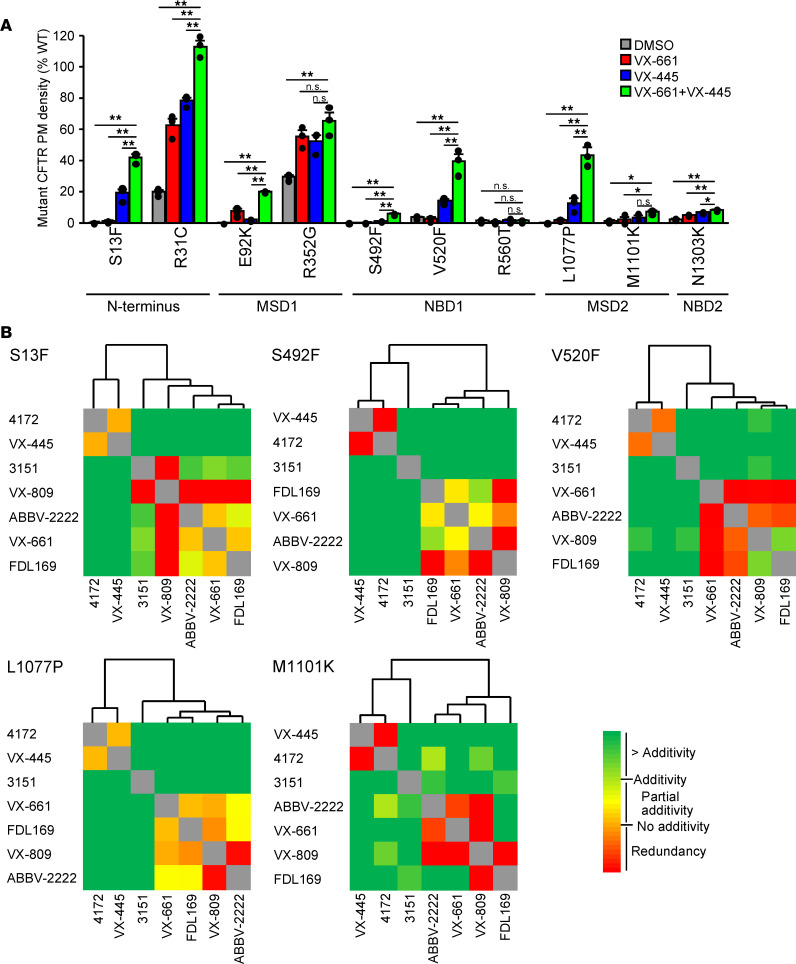
“Cluster analysis of the combination profiles in these mutant proteins and M1101K-CFTR, similar to that of F508del-CFTR, indicated 3 clusters of compounds; type I correctors VX-661, VX-809, ABBV-2222, and FDL169 clustered together; type III correctors 4172 and VX-445 formed a cluster; and the type II corrector 3151 formed its own category with variable distance to the other clusters (Figure 4B).”
§ Allosteric folding correction of F508del and rare CFTR mutants by elexacaftor-tezacaftor-ivacaftor (Trikafta) combination > Results > Allosteric rescue of rare CFTR folding mutants with VX-661 and VX-445.
hedgedcorrelational- Asserted: passes — The authors put it forward as true.
- Checkable: passes — It can be checked against evidence.
- Load-bearing: passes — The paper’s conclusions depend on it.
- Based: passes — The paper gives a reason why it holds.
It may state two separate claims as one.
A result the paper reports from its own data — it cites no other source for it, so there is none to check. The quote shows it is in the paper.
In the paper
“this mutant protein and V520F-CFTR were responsive to VX-445 plus type I corrector combinations (Figure 5, B and C).”
§ Allosteric folding correction of F508del and rare CFTR mutants by elexacaftor-tezacaftor-ivacaftor (Trikafta) combination > Results > Identification of rare folding mutants showing partial functional correction by VX-661 plus VX-445 in HNE.
plaindirect- Asserted: passes — The authors put it forward as true.
- Checkable: passes — It can be checked against evidence.
- Load-bearing: passes — The paper’s conclusions depend on it.
- Based: passes — The paper gives a reason why it holds.
It may state two separate claims as one.
A result the paper reports from its own data — it cites no other source for it, so there is none to check. The quote shows it is in the paper.
In the paper
“At concentrations of ≥ 10 μM, VX-445 decreased F508del-CFTR PM density without affecting the cell viability (Figure 1A).”
§ Allosteric folding correction of F508del and rare CFTR mutants by elexacaftor-tezacaftor-ivacaftor (Trikafta) combination > Results > Synergistic rescue of F508del-CFTR misprocessing with VX-445 and type I and II correctors.
plaindirect- Asserted: passes — The authors put it forward as true.
- Checkable: passes — It can be checked against evidence.
- Load-bearing: passes — The paper’s conclusions depend on it.
- Based: passes — The paper gives a reason why it holds.
It may state two separate claims as one.
A result the paper reports from its own data — it cites no other source for it, so there is none to check. The quote shows it is in the paper.
In the paper
“In the presence of VX-661, both VX-445 preparations increased the PM density of F508del-CFTR to ~45% of the WT, with an EC50 of ~0.28 μM (Figure 1A).”
§ Allosteric folding correction of F508del and rare CFTR mutants by elexacaftor-tezacaftor-ivacaftor (Trikafta) combination > Results > Synergistic rescue of F508del-CFTR misprocessing with VX-445 and type I and II correctors.
plaindirect- Asserted: passes — The authors put it forward as true.
- Checkable: passes — It can be checked against evidence.
- Load-bearing: passes — The paper’s conclusions depend on it.
- Based: passes — The paper gives a reason why it holds.
It may state two separate claims as one.
A result the paper reports from its own data — it cites no other source for it, so there is none to check. The quote shows it is in the paper.
In the paper
“VX-445, but not VX-661 or 3151, decreased the rate and the extent of F508del–NBD1-1S aggregation by 50% at 100 μM (Figure 2C and Supplemental Figure 2D).”
§ Allosteric folding correction of F508del and rare CFTR mutants by elexacaftor-tezacaftor-ivacaftor (Trikafta) combination > Results > VX-445 mechanism of action.
plaindirect- Asserted: passes — The authors put it forward as true.
- Checkable: passes — It can be checked against evidence.
- Load-bearing: passes — The paper’s conclusions depend on it.
- Based: passes — The paper gives a reason why it holds.
It may state two separate claims as one.
None of the sources cited for this claim have been checked yet.
In the paper
“The extent of aggregation inhibition of the F508del-NBD1 by VX-445 was similar to that by the bacterial DnaK-DnaJ-GroE chaperone system and to that reported for the Hsc70/Hdj-2 chaperone/cochaperone pair (30)”
§ Allosteric folding correction of F508del and rare CFTR mutants by elexacaftor-tezacaftor-ivacaftor (Trikafta) combination > Discussion
What the sources say
- Not checked yetcites [30] source
Checked before — its earlier verdict is held back until a new check runs.
plain- Asserted: passes — The authors put it forward as true.
- Checkable: passes — It can be checked against evidence.
- Load-bearing: passes — The paper’s conclusions depend on it.
- Based: passes — The paper gives a reason why it holds.
It may state two separate claims as one.
- Not checked yet
A result the paper reports from its own data — it cites no other source for it, so there is none to check. The quote shows it is in the paper.
In the paper
“Interestingly, the enantiomer of VX-445 (VX-445 EN2), harboring a (4R)-methyl instead of (4S)-methyl in the trimethylpyrrolidin ring, exhibited ~50% reduced efficacy in presence of VX-661, rescuing ~25% of the WT PM density with an EC50 of ~1.1 μM (Figure 1A).”
§ Allosteric folding correction of F508del and rare CFTR mutants by elexacaftor-tezacaftor-ivacaftor (Trikafta) combination > Results > Synergistic rescue of F508del-CFTR misprocessing with VX-445 and type I and II correctors.
plaindirect- Asserted: passes — The authors put it forward as true.
- Checkable: passes — It can be checked against evidence.
- Load-bearing: unclear — It is unclear whether the paper’s conclusions depend on it.
- Based: passes — The paper gives a reason why it holds.
It may state two separate claims as one.
A result the paper reports from its own data — it cites no other source for it, so there is none to check. The quote shows it is in the paper.
In the paper
“suppresses the unfolding trajectory and the aggregation propensity of the mutant domain”
§ Allosteric folding correction of F508del and rare CFTR mutants by elexacaftor-tezacaftor-ivacaftor (Trikafta) combination > Discussion
plaindirect- Asserted: passes — The authors put it forward as true.
- Checkable: passes — It can be checked against evidence.
- Load-bearing: passes — The paper’s conclusions depend on it.
- Based: passes — The paper gives a reason why it holds.
It may state two separate claims as one.
A result the paper reports from its own data — it cites no other source for it, so there is none to check. The quote shows it is in the paper.
In the paper
“In combination with these type I correctors, the impact of the VX-445 is synergistic and increases the F508del-CFTR PM density to 42%–56% of the WT (Figure 1B).”
§ Allosteric folding correction of F508del and rare CFTR mutants by elexacaftor-tezacaftor-ivacaftor (Trikafta) combination > Results > Synergistic rescue of F508del-CFTR misprocessing with VX-445 and type I and II correctors.
plaindirect- Asserted: passes — The authors put it forward as true.
- Checkable: passes — It can be checked against evidence.
- Load-bearing: passes — The paper’s conclusions depend on it.
- Based: passes — The paper gives a reason why it holds.
It may state two separate claims as one.
A result the paper reports from its own data — it cites no other source for it, so there is none to check. The quote shows it is in the paper.
In the paper
“Importantly, VX-445 but not the type I corrector (VX-661) partially suppressed the F508del–NBD1-1S thermal ellipticity loss (Figure 2, D and E).”
§ Allosteric folding correction of F508del and rare CFTR mutants by elexacaftor-tezacaftor-ivacaftor (Trikafta) combination > Results > VX-445 mechanism of action.
plaindirect- Asserted: passes — The authors put it forward as true.
- Checkable: passes — It can be checked against evidence.
- Load-bearing: passes — The paper’s conclusions depend on it.
- Based: passes — The paper gives a reason why it holds.
It may state two separate claims as one.
What the paper did — it cites no source for this, so there is none to check. The quote shows it is in the paper.
In the paper
“To analyze the VX-661 plus VX-445 response on individual mutations rather than compound heterozygous genotypes, we used homozygous HNE with the mutations G85E, Y569D, M1101K, D1152H, or N1303K, as well as HNE with the folding mutation G85E or V520F on 1 allele and the splice mutation 1717-1G->A on the second allele”
§ Allosteric folding correction of F508del and rare CFTR mutants by elexacaftor-tezacaftor-ivacaftor (Trikafta) combination > Results > Identification of rare folding mutants showing partial functional correction by VX-661 plus VX-445 in HNE.
plain- Asserted: passes — The authors put it forward as true.
- Checkable: passes — It can be checked against evidence.
- Load-bearing: passes — The paper’s conclusions depend on it.
- Based: passes — The paper gives a reason why it holds.
Probably not a substantial claim.
What the paper did — it cites no source for this, so there is none to check. The quote shows it is in the paper.
In the paper
“The isolation of HNE from healthy and CF human subjects was performed under the protocol and consent form approved by the McGill MUHC Research Ethics Board (MP-37-2018-4089).”
§ Allosteric folding correction of F508del and rare CFTR mutants by elexacaftor-tezacaftor-ivacaftor (Trikafta) combination > Methods > Study approval.
plain- Asserted: passes — The authors put it forward as true.
- Checkable: passes — It can be checked against evidence.
- Load-bearing: fails — The paper’s conclusions may not depend on it.
- Based: passes — The paper gives a reason why it holds.
Probably not a substantial claim. The paper’s conclusions may not depend on it.
What the paper did — it cites no source for this, so there is none to check. The quote shows it is in the paper.
In the paper
“The rescue effect of corrector pairs on the F508del-CFTR PM density was determined at or near saturating concentrations, to minimize possible additivity of compounds competing for the same binding site, and the results were analyzed by combinatorial profiling.”
§ Allosteric folding correction of F508del and rare CFTR mutants by elexacaftor-tezacaftor-ivacaftor (Trikafta) combination > Results > VX-445 mechanism of action.
plain- Asserted: passes — The authors put it forward as true.
- Checkable: passes — It can be checked against evidence.
- Load-bearing: passes — The paper’s conclusions depend on it.
- Based: passes — The paper gives a reason why it holds.
Probably not a substantial claim.
What the paper did — it cites no source for this, so there is none to check. The quote shows it is in the paper.
In the paper
“Structural validation of ABBV-2222 and VX-445 were performed by 1H-NMR and liquid chromatography–mass spectrometry (LC-MS).”
§ Allosteric folding correction of F508del and rare CFTR mutants by elexacaftor-tezacaftor-ivacaftor (Trikafta) combination > Methods > Synthesis of VX-445.
plain- Asserted: passes — The authors put it forward as true.
- Checkable: passes — It can be checked against evidence.
- Load-bearing: fails — The paper’s conclusions may not depend on it.
- Based: passes — The paper gives a reason why it holds.
Probably not a substantial claim. The paper’s conclusions may not depend on it.
In the paper
“All double-referenced data (55) presented are representative of duplicate injections acquired from at least 3 independent trials.”
§ Allosteric folding correction of F508del and rare CFTR mutants by elexacaftor-tezacaftor-ivacaftor (Trikafta) combination > Methods > SPR.
What the sources say
- Not checked — no full text of the sourcecites [55] source
plain- Asserted: passes — The authors put it forward as true.
- Checkable: passes — It can be checked against evidence.
- Load-bearing: passes — The paper’s conclusions depend on it.
- Based: passes — The paper gives a reason why it holds.
Probably not a substantial claim.
None of the sources cited for this claim have been checked yet.
In the paper
“This leads to a combination of defects, consisting of severely impaired processing, plasma membrane (PM) expression, and stability, as well as defective gating of the F508del-CFTR (12–14).”
§ Allosteric folding correction of F508del and rare CFTR mutants by elexacaftor-tezacaftor-ivacaftor (Trikafta) combination > Introduction
What the sources say
plaindirect- Asserted: passes — The authors put it forward as true.
- Checkable: passes — It can be checked against evidence.
- Load-bearing: passes — The paper’s conclusions depend on it.
- Based: passes — The paper gives a reason why it holds.
It may state two separate claims as one.
What the paper did — it cites no source for this, so there is none to check. The quote shows it is in the paper.
In the paper
“The rapid, steady-state binding responses (Req) were independent of mass transport limitations and subjected to DMSO solvent correction.”
§ Allosteric folding correction of F508del and rare CFTR mutants by elexacaftor-tezacaftor-ivacaftor (Trikafta) combination > Methods > SPR.
plain- Asserted: passes — The authors put it forward as true.
- Checkable: passes — It can be checked against evidence.
- Load-bearing: fails — The paper’s conclusions may not depend on it.
- Based: fails — The paper may give no reason why it holds.
Probably not a substantial claim. The paper’s conclusions may not depend on it. The paper may give no reason why it holds. It may state two separate claims as one.
What the paper did — it cites no source for this, so there is none to check. The quote shows it is in the paper.
In the paper
“VX-445 was synthesized according to the publicly available patent description (WO 2018/107100), and its structure was validated as described in Methods.”
§ Allosteric folding correction of F508del and rare CFTR mutants by elexacaftor-tezacaftor-ivacaftor (Trikafta) combination > Results > Synergistic rescue of F508del-CFTR misprocessing with VX-445 and type I and II correctors.
plain- Asserted: passes — The authors put it forward as true.
- Checkable: passes — It can be checked against evidence.
- Load-bearing: fails — The paper’s conclusions may not depend on it.
- Based: passes — The paper gives a reason why it holds.
Probably not a substantial claim. The paper’s conclusions may not depend on it. It may state two separate claims as one.
A conclusion the paper draws from its own results — it cites no other source for it, so there is none to check. The quote shows it is in the paper.
In the paper
“these findings suggest that VX-445 is potentially the first FDA-approved type III corrector with possible utility for a wide range of folding mutants.”
§ Allosteric folding correction of F508del and rare CFTR mutants by elexacaftor-tezacaftor-ivacaftor (Trikafta) combination > Introduction
hedgedconditional- Asserted: passes — The authors put it forward as true.
- Checkable: passes — It can be checked against evidence.
- Load-bearing: passes — The paper’s conclusions depend on it.
- Based: passes — The paper gives a reason why it holds.
It may state two separate claims as one.
A conclusion the paper draws from its own results — it cites no other source for it, so there is none to check. The quote shows it is in the paper.
In the paper
“In light of these observations and VX-445 clustering with 4172, it is likely that VX-445 exerts a type III corrector mechanism.”
§ Allosteric folding correction of F508del and rare CFTR mutants by elexacaftor-tezacaftor-ivacaftor (Trikafta) combination > Results > VX-445 mechanism of action.
hedgedconditional- Asserted: passes — The authors put it forward as true.
- Checkable: passes — It can be checked against evidence.
- Load-bearing: passes — The paper’s conclusions depend on it.
- Based: passes — The paper gives a reason why it holds.
It may state two separate claims as one.
A conclusion the paper draws from its own results — it cites no other source for it, so there is none to check. The quote shows it is in the paper.
In the paper
“While the cause for the large variation of the CFTR Isc is not known, values of the WT samples partly overlapped with the VX-661 plus VX-445 corrected F508del-CFTR Isc, suggesting that near WT-like channel activity could be achieved in F508del-CFTR HNE (Supplemental Figure 3).”
§ Allosteric folding correction of F508del and rare CFTR mutants by elexacaftor-tezacaftor-ivacaftor (Trikafta) combination > Results > Functional correction of human CFTRF508del/F508del nasal epithelia.
hedgedcorrelational- Asserted: passes — The authors put it forward as true.
- Checkable: passes — It can be checked against evidence.
- Load-bearing: passes — The paper’s conclusions depend on it.
- Based: passes — The paper gives a reason why it holds.
It may state two separate claims as one.
A conclusion the paper draws from its own results — it cites no other source for it, so there is none to check. The quote shows it is in the paper.
In the paper
“These results jointly suggest that VX-445 binds to and changes the unfolding trajectory of the NBD1 domain, consistent with a type III corrector mechanism.”
§ Allosteric folding correction of F508del and rare CFTR mutants by elexacaftor-tezacaftor-ivacaftor (Trikafta) combination > Results > VX-445 mechanism of action.
hedgeddirect- Asserted: passes — The authors put it forward as true.
- Checkable: passes — It can be checked against evidence.
- Load-bearing: passes — The paper’s conclusions depend on it.
- Based: passes — The paper gives a reason why it holds.
It may state two separate claims as one.
What the paper did — it cites no source for this, so there is none to check. The quote shows it is in the paper.
In the paper
“The transepithelial resistance of differentiated HNE was 423 ± 71 Ω × cm2.”
§ Allosteric folding correction of F508del and rare CFTR mutants by elexacaftor-tezacaftor-ivacaftor (Trikafta) combination > Methods > Isc measurement.
plain- Asserted: passes — The authors put it forward as true.
- Checkable: passes — It can be checked against evidence.
- Load-bearing: fails — The paper’s conclusions may not depend on it.
- Based: passes — The paper gives a reason why it holds.
Probably not a substantial claim. The paper’s conclusions may not depend on it.
What the paper did — it cites no source for this, so there is none to check. The quote shows it is in the paper.
In the paper
“Unless otherwise specified, statistical analysis was performed by 1-way ANOVA with post hoc Tukey’s HSD test with the means of at least 3 independent experiments, and the 95% CI was considered significant.”
§ Allosteric folding correction of F508del and rare CFTR mutants by elexacaftor-tezacaftor-ivacaftor (Trikafta) combination > Methods > Statistics.
plain- Asserted: passes — The authors put it forward as true.
- Checkable: passes — It can be checked against evidence.
- Load-bearing: passes — The paper’s conclusions depend on it.
- Based: passes — The paper gives a reason why it holds.
Probably not a substantial claim.
A conclusion the paper draws from its own results — it cites no other source for it, so there is none to check. The quote shows it is in the paper.
In the paper
“Although VX-661 bound to F508del–NBD1-1S, saturation of the binding sites was not reached up to 200 μM, suggesting a weak or unspecific interaction (Supplemental Figure 2B).”
§ Allosteric folding correction of F508del and rare CFTR mutants by elexacaftor-tezacaftor-ivacaftor (Trikafta) combination > Results > VX-445 mechanism of action.
hedgedcorrelational- Asserted: passes — The authors put it forward as true.
- Checkable: passes — It can be checked against evidence.
- Load-bearing: unclear — It is unclear whether the paper’s conclusions depend on it.
- Based: passes — The paper gives a reason why it holds.
It may state two separate claims as one.
The paper relies on this without support.
Heterozygous carriers of F508del lack disease symptoms.
“since heterozygous carriers lack disease symptoms.”
The paper relies on this without support.
A CFTR PM density of >20% of WT is therapeutically significant.
“reaching therapeutically significant levels of > 20% of WT in S13F-, R31C-, E92K-, R352G-, V520F-, and L1077P-CFTR (Figure 4A).”
The paper relies on this without support.
A CFTR activity correction reaching 20%–50% of WT Isc is associated with therapeutic benefit.
“indicating that the fraction of CFTR activity correction of these mutants would likely be associated with therapeutic benefit.”
The paper relies on this without support.
Correction levels of >20% of WT CFTR are therapeutically relevant.
“reaching therapeutically relevant correction levels of > 20% of the WT in CFBE41o- cells or HNE”
The paper relies on this without support.
Binding of VX-445 to isolated F508del–NBD1-1S reflects its interaction with full-length F508del-CFTR.
“The increased in vivo potency of VX-445, however, may indicate its intracellular accumulation similar to that observed for VX-770 (36) and/or the exposure of a VX-445 binding surface, which is either modulated by or also constitutes the MSD1/2 and/or NBD2 segments in the context of the full-length F508del-CFTR.”
The paper relies on this without support.
Selection of modulator combinations requires knowledge of the mechanism of action of individual CFTR modulators.
“Selection of modulator combinations, however, requires the knowledge of the mechanism of action of individual CFTR modulators.”
Self-check
Percentages, sums and reported differences re-computed from the paper’s own numbers.
Each contradiction between two passages listed here was confirmed by an independent check.
Rated minor: it would not touch a result — a value no result rests on, a p-value that stays on the same side of the significance level, or a conflict that is clerical, resolved elsewhere in the paper, or outside its own findings.
In the paper
§ Allosteric folding correction of F508del and rare CFTR mutants by elexacaftor-tezacaftor-ivacaftor (Trikafta) combination > Methods > CFTR modulators.
“The combination of VX-661 (lumacaftor), VX-445 (elexacaftor), and VX-770 (ivacaftor) is sold by Vertex Pharmaceuticals under the trade name Trikafta.”
§ Allosteric folding correction of F508del and rare CFTR mutants by elexacaftor-tezacaftor-ivacaftor (Trikafta) combination > Abstract
“Trikafta — the combination of folding correctors VX-661 (tezacaftor), VX-445 (elexacaftor), and the gating potentiator VX-770 (ivacaftor)”
Citations
Cites
Webb, A. K. (2006) · Cited by 4,369
Elexacaftor–Tezacaftor–Ivacaftor for Cystic Fibrosis with a Single Phe508del Allele
Middleton, P. G., Mall, M. A., Dřevínek, P., Lands, L. C., McKone, E. F., Polineni, D., Ramsey, B. W., Taylor-Cousar, J. L., Tullis, E., Vermeulen, F., et al. (2019) · New England Journal of Medicine · doi:10.1056/nejmoa1908639 · Cited by 2,198
A CFTR Potentiator in Patients with Cystic Fibrosis and the G551D Mutation
Ramsey, B. W., Davies, J., McElvaney, N. G., Tullis, E., Bell, S. C., Dřevínek, P., Griese, M., McKone, E. F., Wainwright, C. E., Konstan, M. W., et al. (2011) · New England Journal of Medicine · doi:10.1056/nejmoa1105185 · Cited by 2,195
Molecular mechanisms of CFTR chloride channel dysfunction in cystic fibrosis
Welsh, M. J., & Smith, A. E. (1993) · Cell · doi:10.1016/0092-8674(93)90353-r · Cited by 1,485
Heijerman, H. G. M., McKone, E. F., Downey, D. G., Van Braeckel, E., Rowe, S. M., Tullis, E., Mall, M. A., Welter, J. J., Ramsey, B. W., McKee, C. M., et al. (2019) · The Lancet · doi:10.1016/s0140-6736(19)32597-8 · Cited by 1,414
Rowe, S. M., Miller, S., & Sorscher, E. J. (2005) · New England Journal of Medicine · doi:10.1056/nejmra043184 · Cited by 1,398
Cystic fibrosis genetics: from molecular understanding to clinical application
Cutting, G. R. (2014) · Nature Reviews Genetics · doi:10.1038/nrg3849 · Cited by 1,015
ROCK Inhibitor and Feeder Cells Induce the Conditional Reprogramming of Epithelial Cells
Liu, X., Ory, V., Chapman, S., Yuan, H., Albanese, C., Kallakury, B., Timofeeva, O. A., Nealon, C., Dakic, A., Simic, V., et al. (2012) · The American Journal of Pathology · doi:10.1016/j.ajpath.2011.10.036 · Cited by 726
VX-445–Tezacaftor–Ivacaftor in Patients with Cystic Fibrosis and One or Two Phe508del Alleles
Keating, D., Marigowda, G., Burr, L., Daines, C., Mall, M. A., McKone, E. F., Ramsey, B. W., Rowe, S. M., Sass, L. A., Tullis, E., et al. (2018) · New England Journal of Medicine · doi:10.1056/nejmoa1807120 · Cited by 726
Altered chloride ion channel kinetics associated with the ΔF508 cystic fibrosis mutation
Dalemans, W., Barbry, P., Champigny, G., Jallat, S., Jallat, S., Dott, K., Dreyer, D., Crystal, R. G., Pavirani, A., Lecocq, J.-P., et al. (1991) · Nature · doi:10.1038/354526a0 · Cited by 707
Cited by
Sorted by citations
Pharmacological targeting of endoplasmic reticulum stress in disease
Marciniak, S. J., Chambers, J. E., & Ron, D. (2021) · Nature Reviews Drug Discovery · doi:10.1038/s41573-021-00320-3 · Cited by 548
Worldwide rates of diagnosis and effective treatment for cystic fibrosis
Guo, J., Garratt, A., & Hill, A. M. (2022) · Journal of Cystic Fibrosis · doi:10.1016/j.jcf.2022.01.009 · Cited by 395
Ong, T., & Ramsey, B. W. (2023) · JAMA · doi:10.1001/jama.2023.8120 · Cited by 346
Mechanism of CFTR correction by type I folding correctors
Fiedorczuk, K., & Chen, J. (2022) · Cell · doi:10.1016/j.cell.2021.12.009 · Cited by 208
Molecular structures reveal synergistic rescue of Δ508 CFTR by Trikafta modulators
Fiedorczuk, K., & Chen, J. (2022) · Science · doi:10.1126/science.ade2216 · Cited by 176
Metadata
- Authors
- Veit, G., Roldan, A., Hancock, M. A., Da Fonte, D. F., Xu, H., Hussein, M., Frenkiel, S., Matouk, E., Velkov, T., & Lukacs, G. L.
- Affiliations
- Department of Physiology and
- McGill University (CA)
- The University of Melbourne (AU)
- Department of Otolaryngology-Head and Neck Surgery,
- Montreal Chest Institute (CA)
- Corresponding author
- Veit, Guido
- ORCID
- Venue
- JCI Insight
- Published
- 2020-09-17
- Volume
- 5
- Issue
- 18
- ISSN
- 2379-3708 (ISSN-L)
- PMC
- PMC7526550
- OpenAlex
- W3081438953
- Semantic Scholar
- 71ed07362e7120150975302f83921245a657c47e
- Cited by
- 250
- References
- 59
- Citations by year
- 2026: 18 · 2025: 45 · 2024: 39 · 2023: 38 · 2022: 58 · 2021: 48 · 2020: 4
- FWCI
- 21.23
- Type
- journal article
- Language
- en
- Open access
- gold
- doi.org
- Licence
- Locations
- JCI Insight (publishedVersion, cc-by)
- PubMed Central (publishedVersion, cc-by)
- PubMed (publishedVersion)
- Minerva Access (University of Melbourne) (submittedVersion, cc-by)
- DOAJ (DOAJ: Directory of Open Access Journals) (submittedVersion, cc-by-sa)
- Funders
- Canadian Institutes of Health Research (MOP-142221,PJT-153095)
- National Institute of Diabetes & Digestive & Kidney Diseases (5R01DK075302)
- Topics
- Health Sciences › Medicine › Pulmonary and Respiratory Medicine › Cystic Fibrosis Research Advances
- Life Sciences › Biochemistry, Genetics and Molecular Biology › Molecular Biology › Ion Transport and Channel Regulation
- Health Sciences › Medicine › Pulmonary and Respiratory Medicine › Inhalation and Respiratory Drug Delivery
- Keywords
- cystic fibrosis, CFTR, F508del mutation, elexacaftor/tezacaftor/ivacaftor, elexacaftor, tezacaftor, ivacaftor, NBD1, transmembrane domain, protein folding, chloride channel function, airway epithelium
- MeSH terms
- Aminophenols, Bronchi, Cells, Cultured, Cystic Fibrosis, Drug Combinations, Humans, Indoles, Mutation, Pyrazoles, Pyridines, Quinolines, Protein Folding, Cystic Fibrosis Transmembrane Conductance Regulator, Benzodioxoles
About these checks
Registry, retraction, Cites and statistics results are computed, not judged, with one exception: a printed reference that no index lists is read once by a model before it counts as a citation error. Claims are extracted by a model and kept only when their quote appears verbatim in the text; each cited source is then checked, with a model’s help, for whether it says what the claim relies on. Those verdicts can be wrong — read the claim’s quote and the cited source before relying on one.
A language model drew the claims from the paper on 2026-11-04, under version 3 of the claim definition (model deepseek-v4.1-flash, prompt extract-v3).
A second model labelled each claim on 2026-11-04 (model jev-1.13-20260917, definition revision gold-guideline-v0.2).
Cited sources are checked with a language model’s help (gpt-6-sol).
Statistics and arithmetic are recomputed, not judged.
Confidence bands are shown only for fields calibrated on our annotated test set. None is calibrated yet, so no band is shown.
What counts as a claim ›How we measure confidence ›How we check this ›
Are you an author, or do you see a problem with this page? Request a review
