

Toward Quantifying Trust Dynamics: How People Adjust Their Trust After Moment-to-Moment Interaction With Automation
Open accessThe DOI matches its Crossref record; 47 of the 48 references it cites were found in a registry or an index; none of the 43 sources its claims cite is checked for support yet.
Abstract
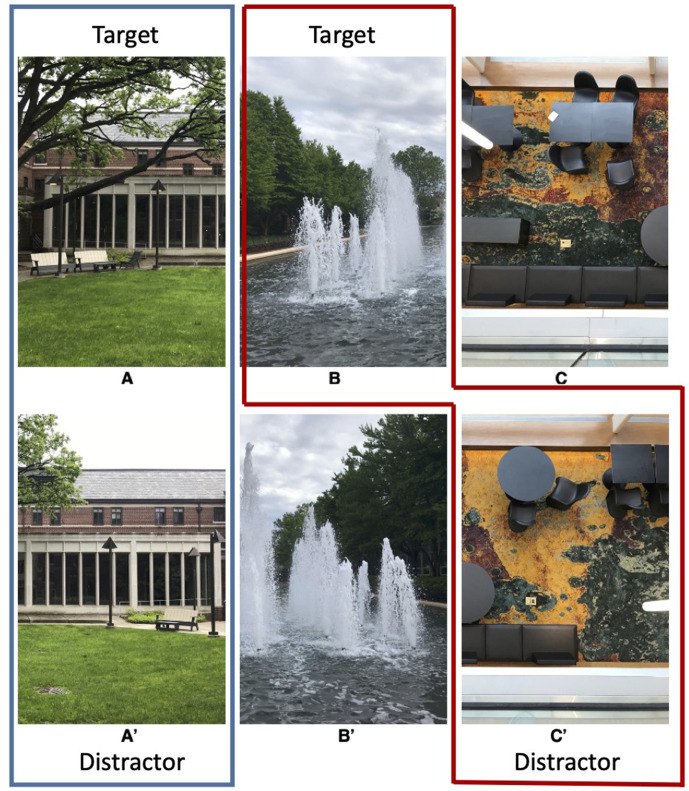
OBJECTIVE: We examine how human operators adjust their trust in automation as a result of their moment-to-moment interaction with automation. BACKGROUND: Most existing studies measured trust by administering questionnaires at the end of an experiment. Only a limited number of studies viewed trust as a dynamic variable that can strengthen or decay over time. METHOD: Seventy-five participants took part in an aided memory recognition task. In the task, participants viewed a series of images and later on performed 40 trials of the recognition task to identify a target image when it was presented with a distractor. In each trial, participants performed the initial recognition by themselves, received a recommendation from an automated decision aid, and performed the final recognition. After each trial, participants reported their trust on a visual analog scale. RESULTS: Outcome bias and contrast effect significantly influence human operators' trust adjustments. An automation failure leads to a larger trust decrement if the final outcome is undesirable, and a marginally larger trust decrement if the human operator succeeds the task by him/herself. An automation success engenders a greater trust increment if the human operator fails the task. Additionally, automation failures have a larger effect on trust adjustment than automation successes. CONCLUSION: Human operators adjust their trust in automation as a result of their moment-to-moment interaction with automation. Their trust adjustments are significantly influenced by decision-making heuristics/biases. APPLICATION: Understanding the trust adjustment process enables accurate prediction of the operators' moment-to-moment trust in automation and informs the design of trust-aware adaptive automation.
Overview
CoChat Summary
## TL;DR
This experiment tracked 75 adults’ trust in an automated decision aid trial-by-trial during a 40-trial aided memory recognition task. Trust rose after automation successes and fell after failures, but the size of the adjustment was also shaped by outcome bias and contrast effect.
## Key findings
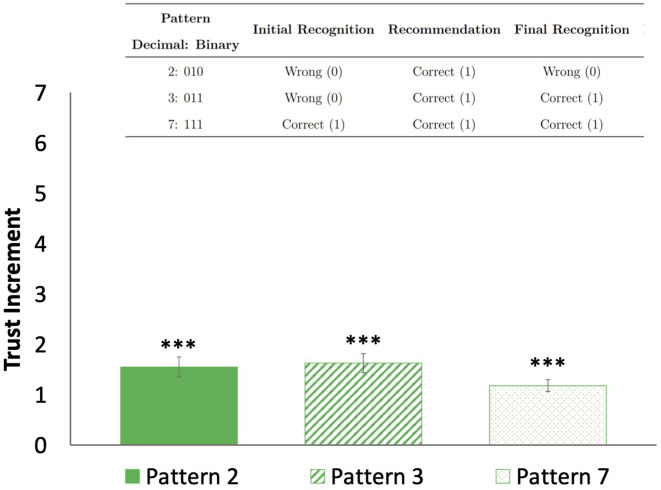
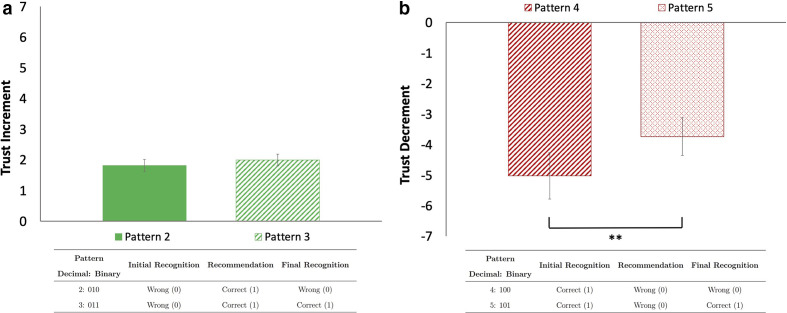
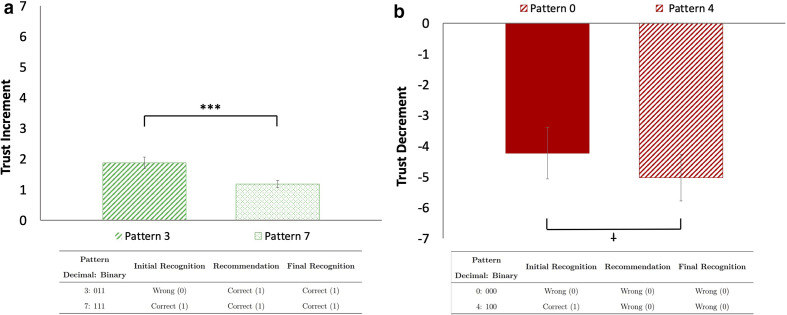
- In one-sample t-tests with Bonferroni adjustment, correct recommendations increased trust for all reported success patterns: Pattern 2, *t*(1,71)=7.81, *p*<.001, *d*=0.92; Pattern 3, *t*(1,70)=12.6, *p*<.001, *d*=1.48; Pattern 7, *t*(1,72)=9.94, *p*<.001, *d*=1.17.
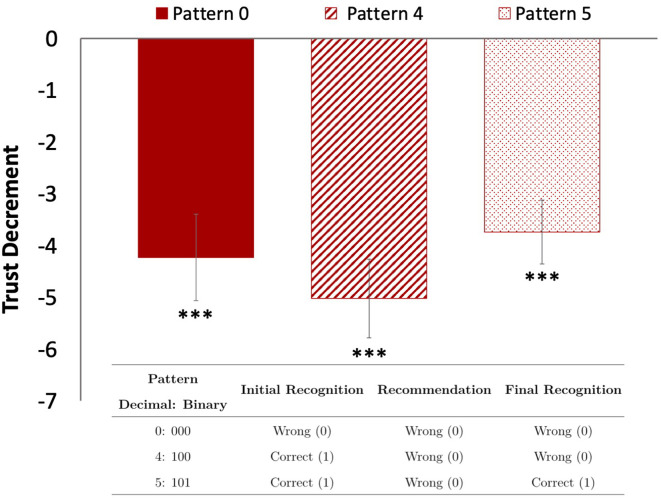
- Wrong recommendations decreased trust for all reported failure patterns: Pattern 0, *t*(1,67)=−8.29, *p*<.001, *d*=1.00; Pattern 4, *t*(1,62)=−8.72, *p*<.001, *d*=1.10; Pattern 5, *t*(1,62)=−6.74, *p*<.001, *d*=0.85.
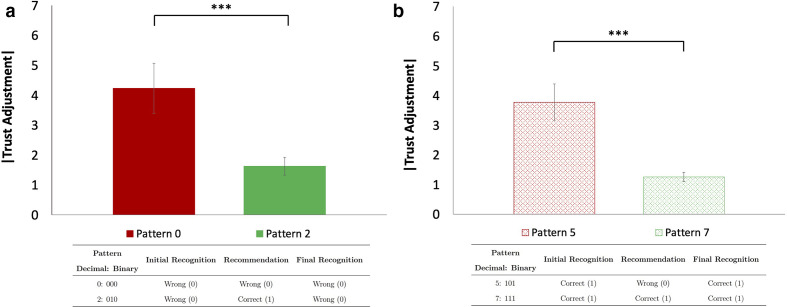
- Automation failures had a larger impact on trust than automation successes: Pattern 0 vs. 2, *t*(1,65)=5.34, *p*<.001, *d*=0.66; Pattern 5 vs. 7, *t*(1,60)=4.81, *p*<.001, *d*=0.62.
- Heuristic effects were observed: an automation failure produced a larger trust decrement when the final outcome was undesirable, *t*(1,52)=−2.63, *p*=.01, *d*=0.36; and an automation success produced a greater trust increment when the human operator initially failed the task, *t*(1,69)=4.40, *p*<.001, *d*=0.53.
## Methods
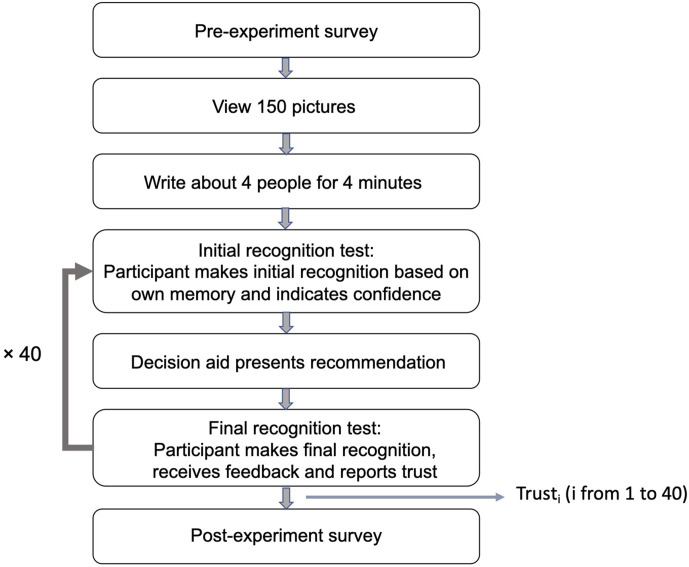
- Mixed design with 75 adults (mean age 23.4 years, SD 4.1); between-subjects automation reliability had 3 levels (70%, 80%, 90%), and within-subjects performance pattern had 8 possible patterns across 40 two-alternative forced-choice trials.
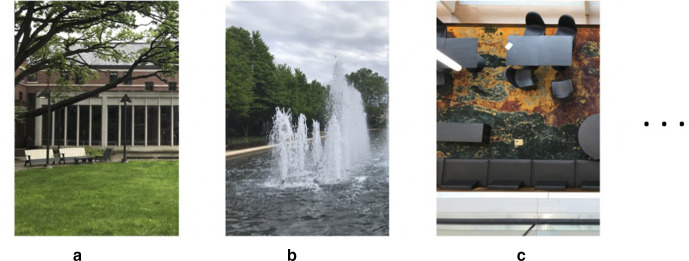
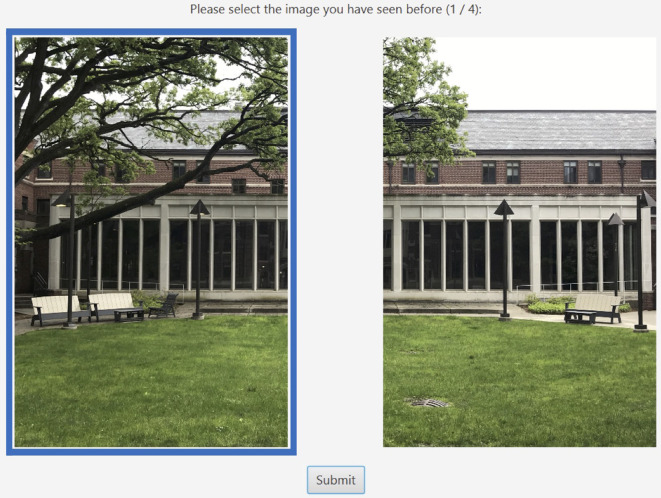
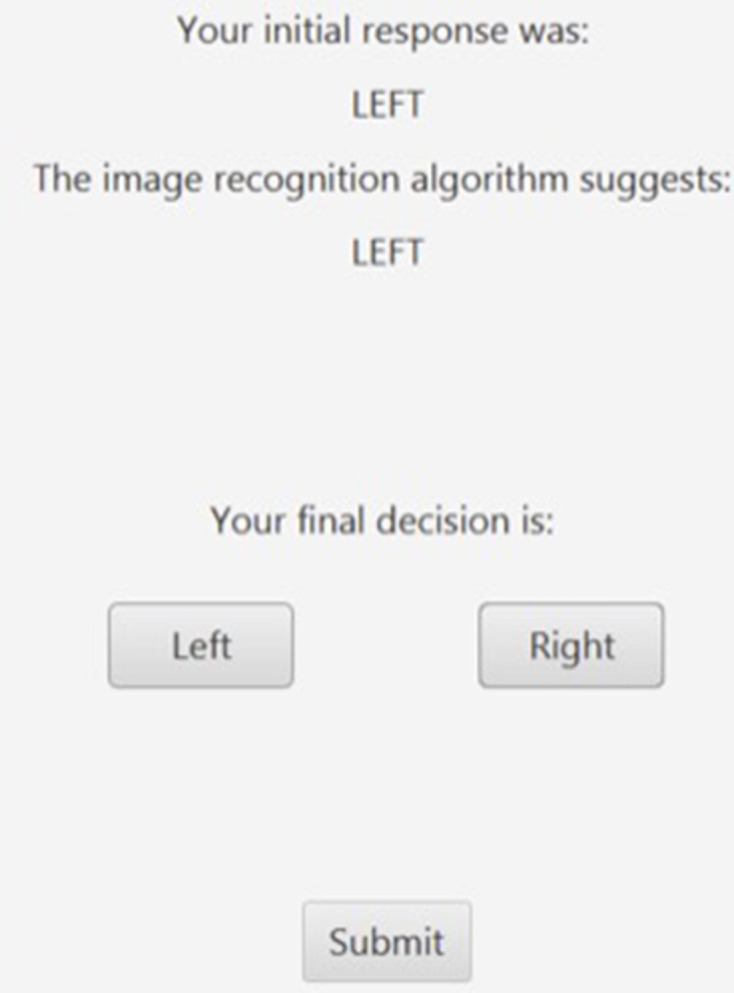
- Participants completed a simulated memory recognition task: viewed 150 images, did an interpolated memory task, then completed 40 trials where they made an initial recognition, received an automated recommendation, made a final recognition, and rated trust after each trial on a visual analog scale.
- Main analyses included planned comparisons, ANCOVAs, one-sample and paired-samples t-tests with Bonferroni adjustments, and linear regressions; trust propensity was tested as a covariate and then removed when nonsignificant.
## Limitations
- The paper states that it used a one-item trust scale, which may not capture all subdimensions of trust as well as multidimensional measures; the authors suggest developing a succinct multi-scale trust measure for repeated interactions.
- Patterns 1 and 6 were excluded from data analysis because they occurred too rarely; the paper says further research should purposely induce these patterns.
- Evident from the text: the task was “fairly simple,” and the authors note that the outcome-bias finding should be explored further in more cognitively demanding tasks such as medical decision making.
Model-written summary. Check it against the paper before relying on it.
Integrity signals
Registry
Cites
Statistics
Figures

Verification
Claims the paper makes
0 Valid · 0 Not valid · 25 Not checked · 40 Own results and interpretations
A result the paper states — it cites no source for it, so there is none to check. The quote shows it is in the paper.
In the paper
“Additionally, automation failures have a larger effect on trust adjustment than automation successes.”
§ Toward Quantifying Trust Dynamics: How People Adjust Their Trust After Moment-to-Moment Interaction With Automation > Abstract > Results
plainstates a cause- Asserted: passes — The authors put it forward as true.
- Checkable: passes — It can be checked against evidence.
- Load-bearing: passes — The paper’s conclusions depend on it.
- Based: passes — The paper gives a reason why it holds.
A result the paper states — it cites no source for it, so there is none to check. The quote shows it is in the paper.
In the paper
“An automation success engenders a greater trust increment if the human operator fails the task.”
§ Toward Quantifying Trust Dynamics: How People Adjust Their Trust After Moment-to-Moment Interaction With Automation > Abstract > Results
plainstates a cause- Asserted: passes — The authors put it forward as true.
- Checkable: passes — It can be checked against evidence.
- Load-bearing: passes — The paper’s conclusions depend on it.
- Based: passes — The paper gives a reason why it holds.
A result the paper reports from its own data — it cites no other source for it, so there is none to check. The quote shows it is in the paper.
In the paper
“Outcome bias and contrast effect significantly influence human operators’ trust adjustments.”
§ Toward Quantifying Trust Dynamics: How People Adjust Their Trust After Moment-to-Moment Interaction With Automation > Abstract > Results
plainstates a cause- Asserted: passes — The authors put it forward as true.
- Checkable: passes — It can be checked against evidence.
- Load-bearing: passes — The paper’s conclusions depend on it.
- Based: passes — The paper gives a reason why it holds.
A result the paper reports from its own data — it cites no other source for it, so there is none to check. The quote shows it is in the paper.
In the paper
“An automation failure leads to a larger trust decrement if the final outcome is undesirable”
§ Toward Quantifying Trust Dynamics: How People Adjust Their Trust After Moment-to-Moment Interaction With Automation > Abstract > Results
plainstates a cause- Asserted: passes — The authors put it forward as true.
- Checkable: passes — It can be checked against evidence.
- Load-bearing: passes — The paper’s conclusions depend on it.
- Based: passes — The paper gives a reason why it holds.
A result the paper reports from its own data — it cites no other source for it, so there is none to check. The quote shows it is in the paper.
In the paper
“and a marginally larger trust decrement if the human operator succeeds the task by him/herself.”
§ Toward Quantifying Trust Dynamics: How People Adjust Their Trust After Moment-to-Moment Interaction With Automation > Abstract > Results
plainstates a cause- Asserted: passes — The authors put it forward as true.
- Checkable: passes — It can be checked against evidence.
- Load-bearing: passes — The paper’s conclusions depend on it.
- Based: passes — The paper gives a reason why it holds.
36 more claims
Create a free account to see all 65 claims and to verify the 6 references still open.
- It may state two separate claims as one. 15
- Probably not a substantial claim. 15
- The quote only partly states this claim. 1
Claims other papers make about this one
Each is checked against this paper’s own text: does it say what the citing paper says it does?
The cited source says what the claim attributes to it.
In the citing paper
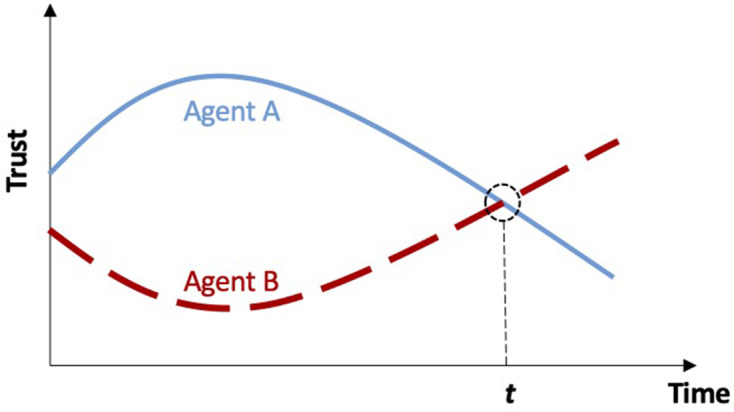
“Trust can rapidly change with a single interaction (Chung & Yang, 2024; Yang et al., 2023).”
From Calibrating Trust, Reliance and Dependence in Variable-Reliability Automation (2024) · cites this paper as Yang et al., 2023
Statistics recomputed
Every reported test result, recomputed from its test statistic and degrees of freedom. A result shows as not adding up only once an independent check has confirmed it.
- ConsistentF(1, 73) = 0.73reported p = .4 · recomputed p = .396
“F(1,73)=.73, p = .40”
- Consistentt(72) = 4.91reported p < .001 · recomputed p < .001
“t(72)=4.91, p < .001”
- Consistentt(72) = 2.72reported p < .01 · recomputed p = .008
“t(72)=2.72, p < .01”
- Consistentt(72) = 3.6reported p < .001 · recomputed p < .001
“t(72)=3.60, p < .001”
- Consistentt(72) = 2.74reported p < .01 · recomputed p = .008
“t(72)=2.74, p < .01”
2 more recomputed tests
Create a free account to see every test the Stats check recomputed.
Self-check
Percentages, sums and reported differences re-computed from the paper’s own numbers.
Self-check results appear here once an independent check has confirmed them.
Citations
Cites
An attributional theory of achievement motivation and emotion
Weiner, B. (1985) · Psychological Review · doi:10.1037/0033-295x.92.4.548 · Cited by 7,846 · cited 1×
“This non-significant result could have been due to the self-serving bias (Duval & Silvia, 2002; Miller & Ross, 1975; Weiner, 1985).”
BackgroundA model for types and levels of human interaction with automation
Parasuraman, R., Sheridan, T. B., & Wickens, C. D. (2000) · IEEE Transactions on Systems, Man, and Cybernetics - Part A: Systems and Humans · doi:10.1109/3468.844354 · Cited by 4,195 · cited 2×
“The study employs a simulated memory recognition task adapted from Tulving (1981). Figure 2”
BackgroundMethodSelf-serving biases in the attribution of causality: Fact or fiction?
Miller, D. T., & Ross, M. (1975) · Psychological Bulletin · doi:10.1037/h0076486 · Cited by 2,575 · cited 1×
“This non-significant result could have been due to the self-serving bias (Duval & Silvia, 2002; Miller & Ross, 1975; Weiner, 1985).”
BackgroundHindsight is not equal to foresight: The effect of outcome knowledge on judgment under uncertainty.
Fischhoff, B. (1975) · Journal of Experimental Psychology Human Perception & Performance · doi:10.1037//0096-1523.1.3.288 · Cited by 1,837 · cited 2×
“Hindsight bias, as described by Fischhoff (1975), is the tendency to adjust the estimates of various likelihoods of possible event outcomes in uncertain situations after the event has occurred and the outcome is known.”
BackgroundFoundations for an Empirically Determined Scale of Trust in Automated Systems
Jian, J.-Y., Bisantz, A. M., & Drury, C. G. (2000) · International Journal of Cognitive Ergonomics · doi:10.1207/s15327566ijce0401_04 · Cited by 1,799
Trust, control strategies and allocation of function in human-machine systems
LEE, J., & MORAY, N. (1992) · Ergonomics · doi:10.1080/00140139208967392 · Cited by 1,459 · cited 9×
“Our finding that the magnitude of trust decrements is larger than that of trust increments (supporting H1b) is in line with previous studies in which the number of automation successes significantly exceeded that of automation failures (Lee & Moray, 1992; Manzey et al., 2012).”
BackgroundMethodResultInfluentialMUIR, B. M., & MORAY, N. (1996) · Ergonomics · doi:10.1080/00140139608964474 · Cited by 993 · cited 5×
“After the experiment, participants complete a 12-item trust survey (Jian et al., n.d.) and an 8-item trust survey (Muir & Moray, 1996).”
BackgroundMethodInfluentialTrust, self-confidence, and operators' adaptation to automation
Lee, J. D., & Moray, N. (1994) · International Journal of Human-Computer Studies · doi:10.1006/ijhc.1994.1007 · Cited by 932 · cited 3×
“…that a person’s moment-to-moment trust increases after automation successes and decreases after automation failures (Lee & Moray, 1992; Moray et al., 2000; Yang et al., 2017, 2016), and automation failures have a larger influence on trust adjustment (Lee & Moray, 1992, 1994; Manzey et al., 2012).”
BackgroundOutcome Bias in Decision Evaluation
Baron, J., & Hershey, J. C. (1988) · Journal of Personality and Social Psychology · doi:10.1037/0022-3514.54.4.569 · Cited by 873 · cited 6×
“The probabilities of each outcome are held constant and in some cases even made explicit to participants (Baron & Hershey, 1988; Brownback & Kuhn, 2019), suggesting that any differences between the pre- and post-outcome decision quality judgments can be attributed to the only new information…”
BackgroundResultInfluentialHindsight: Biased judgments of past events after the outcomes are known.
Hawkins, S. A., & Hastie, R. (1990) · Psychological Bulletin · doi:10.1037//0033-2909.107.3.311 · Cited by 855 · cited 2×
“(2003) and Lee and Moray (1994) found that trust tion dependence behaviors—human operators use”
BackgroundMerritt, S. M., & Ilgen, D. R. (2008) · Human Factors: The Journal of the Human Factors and Ergonomics Society · doi:10.1518/001872008x288574 · Cited by 527 · cited 1×
“Trust propensity has been shown to influence a person’s (snapshot) trust in automation after interacting with an automated system (Merritt & Ilgen, 2008).”
MethodThe Relationship Between Eyewitness Confidence and Identification Accuracy: A New Synthesis
Wixted, J. T., & Wells, G. L. (2017) · Psychological Science in the Public Interest · doi:10.1177/1529100616686966 · Cited by 467 · cited 1×
“Because of the strong association between self-confidence and ability (Wixted & Wells, 2017), people’s self-confidence and trust are probably not independent either, and therefore should not be viewed as independent constructs.”
BackgroundRoese, N. J., & Vohs, K. D. (2012) · Perspectives on Psychological Science · doi:10.1177/1745691612454303 · Cited by 457 · cited 1×
“…been documented in auditory processing, labor disputes, medical diagnoses, consumer satisfaction, personnel management, sporting events, political strategy, legal proceedings, and nuclear accident analysis (Bernstein, Wilson, Pernat, & Meilleur, 2012; 7 Hawkins & Hastie, 1990; Roese & Vohs, 2012).”
BackgroundTowards a Theory of Longitudinal Trust Calibration in Human–Robot Teams
de Visser, E. J., Peeters, M. M. M., Jung, M. F., Kohn, S., Shaw, T. H., Pak, R., & Neerincx, M. A. (2020) · International Journal of Social Robotics · doi:10.1007/s12369-019-00596-x · Cited by 447 · cited 1×
“With few exceptions, we have little understanding of how trust strengthens or decays due to moment-to-moment interactions with automation (de Visser et al., 2020; Guo & Yang, 2020; Yang, Guo, & Schemanske, To appear; Yang, Unhelkar, Li, & Shah, 2017).”
BackgroundThe benefits of imperfect diagnostic automation: a synthesis of the literature
Wickens, C. D., & Dixon, S. R. (2007) · Theoretical Issues in Ergonomics Science · doi:10.1080/14639220500370105 · Cited by 423 · cited 1×
“In their study of sequential effects on 8 perceptions of job candidates, Wexley et al. (1972) found that up to 12% of variance in ratings of candidates could be attributed to a contrast effect from the two candidates preceding the target candidate.”
BackgroundContrast effects and judgments of physical attractiveness: When beauty becomes a social problem.
Kenrick, D. T., & Gutierres, S. E. (1980) · Journal of Personality and Social Psychology · doi:10.1037//0022-3514.38.1.131 · Cited by 388 · cited 1×
“…judgments of shape perception (Suzuki & Cavanagh, 1998), facial recognition (Hsu & Lee, 2016), job candidate interviews (Wexley, Yukl, Kovacs, & Sanders, 1972), physical attractiveness (Kenrick & Gutierres, 1980; Thornton & Maurice, 1997), and consumer reports (Lynch, Chakravarti, & Mitra, 1991).”
Adaptive automation, trust, and self-confidence in fault management of time-critical tasks.
Moray, N., Inagaki, T., & Itoh, M. (2000) · Journal of Experimental Psychology: Applied · doi:10.1037//1076-898x.6.1.44 · Cited by 345 · cited 2×
“…showed that a person’s moment-to-moment trust increases after automation successes and decreases after automation failures (Lee & Moray, 1992; Moray et al., 2000; Yang et al., 2017, 2016), and automation failures have a larger influence on trust adjustment (Lee & Moray, 1992, 1994; Manzey…”
BackgroundResultMerritt, S. M., Heimbaugh, H., LaChapell, J., & Lee, D. (2013) · Human Factors: The Journal of the Human Factors and Ergonomics Society · doi:10.1177/0018720812465081 · Cited by 329
International Journal of Social Robotics
(2013) · International Journal of Social Robotics · doi:10.1007/12369.1875-4805 · Cited by 313
Wood, G. S. (1978) · Journal of Experimental Psychology Human Perception & Performance · doi:10.1037//0096-1523.4.2.345 · Cited by 288 · cited 1×
“Hindsight bias is also known as the creeping determinism (Fischhoff, 1975) and knew-it-all-along effect (Wood, 1978).”
BackgroundSelf-awareness, probability of improvement, and the self-serving bias.
Duval, T. S., & Silvia, P. J. (2002) · Journal of Personality and Social Psychology · doi:10.1037/0022-3514.82.1.49 · Cited by 280 · cited 1×
“This non-significant result could have been due to the self-serving bias (Duval & Silvia, 2002; Miller & Ross, 1975; Weiner, 1985).”
BackgroundManzey, D., Reichenbach, J., & Onnasch, L. (2012) · Journal of Cognitive Engineering and Decision Making · doi:10.1177/1555343411433844 · Cited by 277 · cited 9×
“Our finding that the magnitude of trust decrements is larger than that of trust increments (supporting H1b) is in line with previous studies in which the number of automation successes significantly exceeded that of automation failures (Lee & Moray, 1992; Manzey et al., 2012).”
BackgroundMethodResultInfluentialde Vries, P., Midden, C., & Bouwhuis, D. (2003) · International Journal of Human-Computer Studies · doi:10.1016/s1071-5819(03)00039-9 · Cited by 264 · cited 1×
“For example, de Vries, Midden, and Bouwhuis (2003) and Lee and Moray (1994) found that trust and self-confidence predict participants’ automation dependence behaviors – human operators use automation when trust exceeds self-confidence and use manual control when self-confidence exceeds trust.”
BackgroundLynch, Jr., Chakravarti, D., & Mitra, A. (1991) · Journal of Consumer Research · doi:10.1086/209260 · Cited by 239
Effects of communication style and culture on ability to accept recommendations from robots
Rau, P. L. P., Li, Y., & Li, D. (2009) · Computers in Human Behavior · doi:10.1016/j.chb.2008.12.025 · Cited by 221
Hindsight bias, outcome knowledge and adaptive learning
Henriksen, K. (2003) · Quality and Safety in Health Care · doi:10.1136/qhc.12.suppl_2.ii46 · Cited by 216
Evaluating Effects of User Experience and System Transparency on Trust in Automation
Yang, X. J., Unhelkar, V. V., Li, K., & Shah, J. A. (2017) · Proceedings of the 2017 ACM/IEEE International Conference on Human-Robot Interaction · doi:10.1145/2909824.3020230 · Cited by 208
Self-citationde Visser, E., & Parasuraman, R. (2011) · Journal of Cognitive Engineering and Decision Making · doi:10.1177/1555343411410160 · Cited by 207 · cited 2×
“Previous research has revealed consistently a positive relationship between automation reliability and the (snapshot) trust in automation measured at the end of an experiment (de Visser & Parasuraman, 2011; Wickens & Dixon, 2007).”
BackgroundResultA Meta-Analysis of Research on Hindsight Bias
Guilbault, R. L., Bryant, F. B., Brockway, J. H., & Posavac, E. J. (2004) · Basic and Applied Social Psychology · doi:10.1080/01973533.2004.9646399 · Cited by 183
A shape-contrast effect for briefly presented stimuli.
Suzuki, S., & Cavanagh, P. (1998) · Journal of Experimental Psychology: Human Perception and Performance · doi:10.1037//0096-1523.24.5.1315 · Cited by 170 · cited 2×
“The two types of biases/heuristics have been observed in various judgment and decision-making tasks (Baron & Hershey, 1988; Henriksen & Kaplan, 2003; Hsu & Lee, 2016; Suzuki & Cavanagh, 1998).”
BackgroundSimilarity relations in recognition
Tulving, E. (1981) · Journal of Verbal Learning and Verbal Behavior · doi:10.1016/s0022-5371(81)90129-8 · Cited by 165 · cited 2×
“The interpolated task is used in the study of Tulving (1981) to bring the hit rate into the middle performance range.”
MethodHockey, G. R. J., Wastell, D. G., & Sauer, J. (1998) · Human Factors: The Journal of the Human Factors and Ergonomics Society · doi:10.1518/001872098779480479 · Cited by 148
Modeling and predicting trust dynamics in human–robot teaming: A Bayesian inference approach
Guo, Y., & Yang, X. J. (2021) · International Journal of Social Robotics · doi:10.1007/s12369-020-00703-3 · Cited by 133 · cited 3×
“Based on the three properties, a computational model for predicting the moment-to-moment trust was developed (Guo, Shi, & Yang, 2021; Guo & Yang, 2020; Yang et al., To appear).”
BackgroundMethodSelf-citationFalse Alerts in Air Traffic Control Conflict Alerting System: Is There a “Cry Wolf” Effect?
Wickens, C. D., Rice, S., Keller, D., Hutchins, S., Hughes, J., & Clayton, K. (2009) · Human Factors: The Journal of the Human Factors and Ergonomics Society · doi:10.1177/0018720809344720 · Cited by 113 · cited 1×
“…Rogers, & Fisk, 2011; Rau, Li, & Li, 2009), system factors such as reliability and level of automation (Du, Huang, & Yang, 2020; Parasuraman, Sheridan, & Wickens, 2000; Wickens & Dixon, 2007; Wickens et al., 2009), and environmental factors such as multi-tasking requirement (Zhang & Yang, 2017).”
A Meta-Analysis of Research on Hindsight Bias
Guilbault, R. L., Bryant, F. B., Brockway, J. H., & Posavac, E. J. (2004) · Basic and Applied Social Psychology · doi:10.1207/s15324834basp2602&3_1 · Cited by 105
Importance of contrast effects in employment interviews.
Wexley, K. N., Yukl, G. A., Kovacs, S. Z., & Sanders, R. E. (1972) · Journal of Applied Psychology · doi:10.1037/h0032132 · Cited by 95 · cited 1×
“In their study of sequential effects on 8 perceptions of job candidates, Wexley et al. (1972) found that up to 12% of variance in ratings of candidates could be attributed to a contrast effect from the two candidates preceding the target candidate.”
BackgroundPhysique Contrast Effect: Adverse Impact of Idealized Body Images for Women
Thornton, B., & Maurice, J. K. (1997) · Sex Roles · doi:10.1023/a:1025609624848 · Cited by 92 · cited 1×
“…judgments of shape perception (Suzuki & Cavanagh, 1998), facial recognition (Hsu & Lee, 2016), job candidate interviews (Wexley, Yukl, Kovacs, & Sanders, 1972), physical attractiveness (Kenrick & Gutierres, 1980; Thornton & Maurice, 1997), and consumer reports (Lynch, Chakravarti, & Mitra, 1991).”
Understanding the Effect of Workload on Automation Use for Younger and Older Adults
McBride, S. E., Rogers, W. A., & Fisk, A. D. (2011) · Human Factors: The Journal of the Human Factors and Ergonomics Society · doi:10.1177/0018720811421909 · Cited by 61
Overcoming the outcome bias: Making intentions matter
Sezer, O., Zhang, T., Gino, F., & Bazerman, M. H. (2016) · Organizational Behavior and Human Decision Processes · doi:10.1016/j.obhdp.2016.07.001 · Cited by 56 · cited 1×
“In line with previous research in medical, gambling and business decisions (Baron & Hershey, 1988; Brownback & Kuhn, 2019; Gino et al., 2009; Sezer et al., 2016), human operators demonstrate outcome biases in trust adjustments when the automation is wrong: an automation error is forgiven to some…”
ResultDu, N., Huang, K. Y., & Yang, X. J. (2020) · Human Factors: The Journal of the Human Factors and Ergonomics Society · doi:10.1177/0018720819862916 · Cited by 55
Self-citationBrownback, A., & Kuhn, M. A. (2019) · Games and Economic Behavior · doi:10.1016/j.geb.2019.07.003 · Cited by 40 · cited 3×
“Outcome bias has been observed in laboratory tasks evaluating medical decisions (Baron & Hershey, 1988), gambling (Baron & Hershey, 1988; Brownback & Kuhn, 2019; Sezer, Zhang, Gino, & Bazerman, 2016), and business decisions (Gino, Moore, & Bazerman, 2009), and in real-world evaluations of soccer…”
BackgroundResultReverse psychology in trust-aware human-robot interaction
Guo, Y., Shi, C., & Yang, X. J. (2021) · IEEE Robotics and Automation Letters · doi:10.1109/lra.2021.3067626 · Cited by 33
Self-citationOutcome bias in subjective ratings of performance: Evidence from the (football) field
Kausel, E. E., Ventura, S., & Rodríguez, A. (2018) · Journal of Economic Psychology · doi:10.1016/j.joep.2018.12.006 · Cited by 31
How users adjust trust in automation: Contrast effect and hindsight bias
Yang, X. J., Wickens, C. D., & Hölttä-Otto, K. (2016) · Proceedings of the Human Factors and Ergonomics Society Annual Meeting · doi:10.1177/1541931213601044 · Cited by 26 · cited 3×
“The number of famous people and the duration of the interpolated task are determined in a preliminary study (Yang et al., 2016).”
BackgroundResultSelf-citationBernstein, D. M., Wilson, A. M., Pernat, N. L. M., & Meilleur, L. R. (2012) · Psychonomic Bulletin & Review · doi:10.3758/s13423-012-0268-0 · Cited by 22 · cited 6×
“after the 40th trial. Automation reliability ( β ) and trust propensity β periment trust measured by the scale of Jian et al. (2000). Automation reliability ( β ) and trust Figure 11.”
MethodInfluentialZhang, M. Y., & Yang, X. J. (2017) · Proceedings of the Human Factors and Ergonomics Society Annual Meeting · doi:10.1177/1541931213601932 · Cited by 19 · cited 1×
“…Rogers, & Fisk, 2011; Rau, Li, & Li, 2009), system factors such as reliability and level of automation (Du, Huang, & Yang, 2020; Parasuraman, Sheridan, & Wickens, 2000; Wickens & Dixon, 2007; Wickens et al., 2009), and environmental factors such as multi-tasking requirement (Zhang & Yang, 2017).”
Self-citationRelative judgment in facial identity perception as revealed by sequential effects
Hsu, S.-M., & Lee, J.-S. (2016) · Attention, Perception, & Psychophysics · doi:10.3758/s13414-015-0979-1 · Cited by 15
Research works printed but not linked: 2
- Gino F. Moore D. A. Bazerman M. H. (2009). See no evil: When we overlook other people’s unethical behavior. Social Decision Making: Social Dilemmas, Social Values, and Ethical Judgments, 241– 263. 10.1037/0096-1523.1.3.288 · doi:10.1037/0096-1523.1.3.288 · Paper page
- Yang X. J. Guo Y. Schemanske C. (in press). From trust to trust dynamics: Combining empirical and computational approaches to model and predict trust dynamics in human-autonomy interaction. In Duffy V. G. Landry S. J. Lee J. D. Stanton N. A. (Eds.), Human-automation interaction: Transportation. Springer.
Cited by
Liang, C., Le, T.-H., Ham, Y., Mantha, B. R. K., Cheng, M. H., & Lin, J. J. (2024) · Automation in Construction · doi:10.1016/j.autcon.2024.105369 · Cited by 225
Wischnewski, M., Krämer, N., & Müller, E. (2023) · Proceedings of the 2023 CHI Conference on Human Factors in Computing Systems · doi:10.1145/3544548.3581197 · Cited by 146
“trust game [3, 23], collaboration game [24], fanker task [25], image recognition [138, 144], Gaming fnance game [62], frst-person shooter game [67, 129], Pong [50]”
BackgroundSimón, C., Revilla, E., & Sáenz, M. J. (2024) · Journal of Business Research · doi:10.1016/j.jbusres.2024.114783 · Cited by 158
“However, trust is not a binary phenomenon but rather operates as a continuum where there is a continuous calibration over interactions between the agents (Yang et al., 2023), and how this works for AI is yet to be fully explored (Dorton & Harper, 2022a).”
Mark My Words: Analyzing and Evaluating Language Model Watermarks
Piet, J., Sitawarin, C., Fang, V., Mu, N., & Wagner, D. (2023) · arXiv · doi:10.48550/arxiv.2312.00273 · Cited by 61
Roesler, E., Vollmann, M., Manzey, D., & Onnasch, L. (2023) · Computers in Human Behavior · doi:10.1016/j.chb.2023.108008 · Cited by 80
Metadata
- Authors
- Yang, X. J., Schemanske, C., & Searle, C.
- Affiliations
- University of Michigan (US)
- Corresponding author
- Yang, X. Jessie
- Venue
- Human Factors: The Journal of the Human Factors and Ergonomics Society
- Publisher
- SAGE Publications
- Published
- 2021-08-29
- Volume
- 65
- Issue
- 5
- Pages
- 862-878
- ISSN
- 0018-7208 (ISSN-L)
- 1547-8181
- PMC
- PMC10374998
- OpenAlex
- W3180190266
- Cited by
- 132
- References
- 48
- Citations by year
- 2026: 46 · 2025: 29 · 2024: 32 · 2023: 16 · 2022: 9
- FWCI
- 9.90
- Type
- journal article
- Language
- en
- Open access
- hybrid
- doi.org
- Licence
- Locations
- Human Factors The Journal of the Human Factors and Ergonomics Society (publishedVersion, cc-by-nc)
- PubMed Central (publishedVersion, cc-by-nc)
- PubMed (publishedVersion)
- arXiv (Cornell University) (submittedVersion)
- arXiv (Cornell University) (cc-by)
- University of Michigan Library
- Funders
- National Science Foundation (2045009)
- Topics
- Social Sciences › Human Factors and Ergonomics › Human-Automation Interaction and Safety
- Social Sciences › Psychology › Social Psychology › Social Robot Interaction and HRI
- Physical Sciences › Engineering › Safety, Risk, Reliability and Quality › Risk and Safety Analysis
- Keywords
- trust in automation, trust dynamics, human-automation interaction, outcome bias, contrast effects, heuristic decision making, automated decision aids, automation failure
- MeSH terms
- Heuristics, Automation, Awareness, Humans, Male, Man-Machine Systems, Task Performance and Analysis, Trust
About these checks
Registry, retraction, Cites and statistics results are computed, not judged, with one exception: a printed reference that no index lists is read once by a model before it counts as a citation error. Claims are extracted by a model and kept only when their quote appears verbatim in the text; each cited source is then checked, with a model’s help, for whether it says what the claim relies on. Those verdicts can be wrong — read the claim’s quote and the cited source before relying on one.
A language model drew the claims from the paper on 2026-10-11, under version 3 of the claim definition (model deepseek-v4.1-flash, prompt extract-v3).
A second model labelled each claim on 2026-10-11 (model jev-1.13-20260917, definition revision gold-guideline-v0.2).
Statistics and arithmetic are recomputed, not judged.
Confidence bands are shown only for fields calibrated on our annotated test set. None is calibrated yet, so no band is shown.
What counts as a claim ›How we measure confidence ›How we check this ›
Are you an author, or do you see a problem with this page? Request a review
Data sources
Bibliographic data: Semantic Scholar, OpenAlex, Crossref.
Contains information from the Semantic Scholar Academic Graph Datasets, made available under the ODC Attribution License (ODC-BY 1.0).
Semantic Scholar’s data is described in: Kinney, R., et al. (2023). The Semantic Scholar Open Data Platform. arXiv:2301.10140.
