

Collaboration, Coordination, and Cooperation Among Organizations: Establishing the Distinctive Meanings of These Terms Through a Systematic Literature Review
Open accessThe DOI matches its Crossref record; 175 of the 182 references it cites were found in a registry or an index, and 1 are not checked yet; 6 of the 78 sources its claims cite were checked for support.
Abstract
Collaboration, coordination, and cooperation lie at the core of interorganizational activities. This systematic review of definitions in nine top general management journals identifies temporal stage and type of goal as discriminating dimensions for distinguishing the three terms.
Verified 2026-11-19 · 1 reference not checked yet
Overview
CoChat Summary
## TL;DR
This systematic literature review examines how collaboration, coordination, and cooperation are defined across nine top management journals and argues that the three terms are conceptually distinct only when differentiated by two new dimensions: temporal stage and type of goal. The authors propose redefinitions that separate coordination as goal determination, cooperation as goal implementation, and collaboration as voluntary helping toward common or private goals.
## Key findings
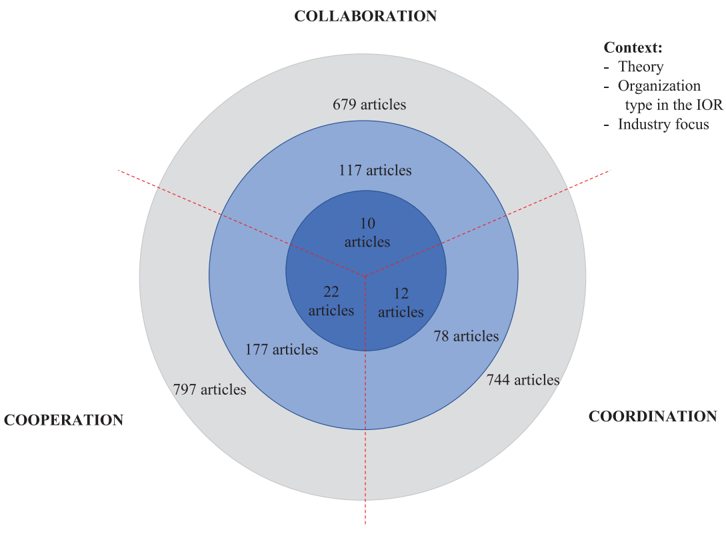
- The review screened 2,220 articles, found 372 relevant articles, and identified only 43 definitions across 44 articles; just 11.83% of relevant articles provided a definition, underscoring how rarely the terms are explicitly defined.
- Across the definitions, the authors found three recurring “interactional dimensions”: attitude, behavior, and outcome; however, overlap across the three terms meant these dimensions alone could not distinguish collaboration, coordination, and cooperation.
- Coordination definitions evoked behaviors in all 12 cases, cooperation definitions spread across attitude (6), behavior (15), and outcome (1), and collaboration definitions split between behavior (6 of 9) and outcome (3 of 9), with no attitude-based collaboration definitions.
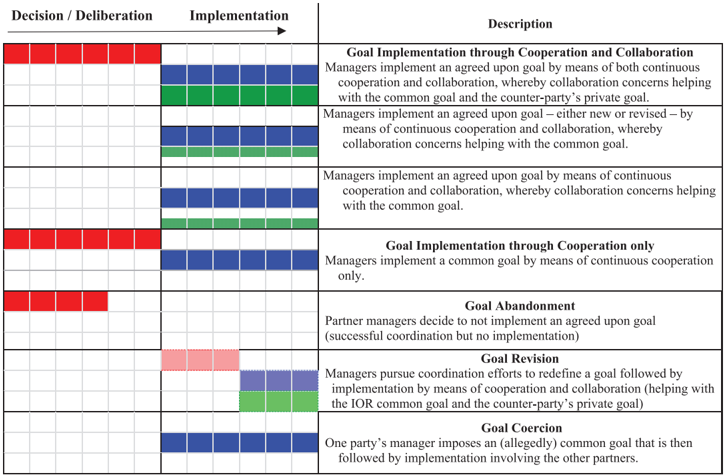
- The paper’s proposed redefinitions are: coordination = the attitudes, behaviors, and outcomes of joint determination of common goals; cooperation = the attitudes, behaviors, and outcomes of implementing those agreed-on goals; collaboration = voluntarily helping others achieve a common IOR goal or one or more private goals.
## Methods
- Systematic literature review of nine top-tier general management journals: Academy of Management Journal, Academy of Management Review, Administrative Science Quarterly, Journal of Management, Journal of Management Studies, Management Science, Organization Science, Organization Studies, and Strategic Management Journal.
- Search covered articles from journal inception through 2017, used direct IOR-related keywords plus the three focal terms, and yielded 2,220 articles; 372 were judged relevant to direct interorganizational relationships.
- The authors manually extracted definitional passages, coded them using a multiple-case study approach, and assessed coding reliability with independent raters; reported agreement was high (Krippendorff’s alpha = 0.92 for relevance screening and 0.84 for coding attitude/behavior/outcome).
## Limitations
- The authors state that their journal list is a boundary condition: it covers only top-tier journals in general management, so the findings may not generalize to specialist or applied journals.
- They also note that the review focuses on a coherent set of direct interorganizational relationships and excludes mergers and acquisitions, board interlocks, and some other network forms; this narrows scope by design.
- Evident from the text: the paper studies only definitions that appear in the body text and only “intensional” definitions, which means it does not capture all possible usages or extensional meanings of the terms.
Model-written summary. Check it against the paper before relying on it.
Integrity signals
Registry
Cites
Statistics
Figures

Verification
Claims the paper makes
3 Valid · 5 Not valid · 46 Not checked · 88 Own results and interpretations
Every source the paper cites for this claim was checked and supports it.
In the paper
“Hardy et al. (2003: 323) define collaboration as “a cooperative, interorganizational relationship that is negotiated in an ongoing communicative process”; thus, the amalgamation of collaboration and cooperation renders limited discriminant validity.”
§ Collaboration, Coordination, and Cooperation Among Organizations: Establishing the Distinctive Meanings of These Terms Through a Systematic Literature Review > Collaboration
What the sources say
- Supportedcites Hardy et al. (2003) matched to “Resources, Knowledge and Influence: The Organizational Effects of Interorganizational Collaboration*” (2003) source
The 'THE EFFECTS OF COLLABORATION' section states the definition verbatim: 'we define collaboration as a cooperative, interorganizational relationship that is negotiated in an ongoing communicative process, and which relies on neither market nor hierarchical mechanisms of control'. The part attributed to this source — that Hardy et al. (2003) define collaboration in those terms — is therefore accurate. The follow-on judgement about 'amalgamation' and 'limited discriminant validity' is the citing authors' own critique, not a claim about this paper, and is not judged here; for completeness, the source's full definition adds the market/hierarchy clause and explicitly asserts it 'provides a set of critical characteristics that distinguishes it from other forms of interorganizational activity'. Our copy carries no page numbers, so the printed '323' could not be checked. (LLM, conf=0.85)
plainstates a cause- Asserted: passes — The authors put it forward as true.
- Checkable: passes — It can be checked against evidence.
- Load-bearing: passes — The paper’s conclusions depend on it.
- Based: passes — The paper gives a reason why it holds.
- Supported
The cited sources support only part of this claim — read each source’s verdict below.
In the paper
“However, the distinction among these terms remains unclear.”
§ Collaboration, Coordination, and Cooperation Among Organizations: Establishing the Distinctive Meanings of These Terms Through a Systematic Literature Review > Keywords: cooperative strategy; coopetition; interorganizational relations; alliances; joint ventures; networks; buyer-supplier relations; consortia; partnerships; discriminant validity; parsimony
What the sources say
- Partly supportedcites Hardy, Phillips, and Lawrence (2003) matched to “Resources, Knowledge and Influence: The Organizational Effects of Interorganizational Collaboration*” (2003) sourceExperimental — accuracy not yet measured
In “The Effects of Collaboration” (page unavailable), the paper says that definitions of collaboration vary across the literature, which lends some support to the claim of conceptual uncertainty. But it offers criteria distinguishing collaboration from other cooperative relationships and does not address a three-way distinction involving coordination. (LLM, conf=0.82)
plain- Asserted: passes — The authors put it forward as true.
- Checkable: passes — It can be checked against evidence.
- Load-bearing: passes — The paper’s conclusions depend on it.
- Based: passes — The paper gives a reason why it holds.
- Partly supported
Every source the paper cites for this claim was checked and supports it.
In the paper
“two separate articles that share a coauthor define collaboration by evoking behaviors (Hardy & Phillips, 1998; see also Hardy et al., 2003) and outcomes (Hardy et al., 2005).”
§ Collaboration, Coordination, and Cooperation Among Organizations: Establishing the Distinctive Meanings of These Terms Through a Systematic Literature Review > Collaboration
What the sources say
- Supportedcites Hardy & Phillips, 1998 matched to “Strategies of Engagement: Lessons from the Critical Examination of Collaboration and Conflict in an Interorganizational Domain” (1998) source
Our copy characterizes collaboration in terms of what parties do rather than what results they produce: the Compliance section (p. n/a) states 'Collaboration operates on a model of shared power... power to define the problem and to propose a solution is effectively shared among the decision makers' and 'Collaboration is thus a mutual engagement strategy in which all partners voluntarily participate,' and the Collaboration – The Community Development Team section describes it through joint action, pooling of resources and shared power. The Abstract frames collaboration as one of several 'strategies of engagement used by organizations,' i.e., a pattern of conduct; the paper offers no outcome-based definition and indeed cautions against judging collaboration by its stated outcomes (Conclusions). This supports the citing sentence's attribution of a behaviour-evoking definition to Hardy & Phillips (1998); the paired 2005 'outcomes' citation is a different paper and not judged here. (LLM, conf=0.80)
- Supportedcites Hardy et al., 2003 matched to “Resources, Knowledge and Influence: The Organizational Effects of Interorganizational Collaboration*” (2003) source
The 'THE EFFECTS OF COLLABORATION' section states the paper's own definition in behavioural/processual terms — a cooperative interorganizational relationship 'negotiated in an ongoing communicative process' that relies on neither market nor hierarchical control — with no reference to outcomes, which is exactly what the 'see also Hardy et al., 2003' tag supports. The 'Characteristics of Collaboration' section reinforces this by operationalising collaboration as patterns of interaction, coalition structure and information flow rather than as its effects. The paper is by Hardy, Phillips and Lawrence, so the shared-coauthor framing with Hardy & Phillips (1998) holds, and although the study examines collaborative effects/outcomes, its definition of collaboration itself is behavioural. (LLM, conf=0.85)
- Supportedcites Hardy et al., 2005 matched to “Discourse and Collaboration: The Role of Conversations and Collective Identity” (2005) source
The Abstract (p. 58) of Hardy, Lawrence & Grant (2005) defines effective collaboration in outcome terms — 'cooperative, interorganizational action that produces innovative, synergistic solutions and balances divergent stakeholder concerns' — and repeats this outcome-based formulation in the Conclusion, so citing it for a definition of collaboration that evokes outcomes is apt. The nuance is that their definition of collaboration as such is relational/mechanism-based ('a cooperative, interorganizational relationship in which participants rely on neither market nor hierarchical mechanisms of control'), with the outcome criteria attached specifically to *effective* collaboration; the citing sentence elides that qualifier but does not misstate the source. The authorship point (Hardy as shared coauthor) is confirmed by our copy's running head 'Hardy, Lawrence, and Grant'. (LLM, conf=0.85)
plain- Asserted: passes — The authors put it forward as true.
- Checkable: passes — It can be checked against evidence.
- Load-bearing: unclear — It is unclear whether the paper’s conclusions depend on it.
- Based: passes — The paper gives a reason why it holds.
- Supported
The cited sources that could be checked couldn’t confirm or dispute this claim.
In the paper
“Prior literature discusses both private and common goals for collaboration, coordination, and cooperation.”
§ Collaboration, Coordination, and Cooperation Among Organizations: Establishing the Distinctive Meanings of These Terms Through a Systematic Literature Review > 5.
What the sources say
- Could not verifycites Olsen, Sofka, & Grimpe, 2016 matched to “Coordinated Exploration for Grand Challenges: The Role of Advocacy Groups in Search Consortia” (2016) sourceExperimental — accuracy not yet measured
Our copy of Olsen, Sofka & Grimpe (2016) holds only the institutional-record metadata — the title/author block (untitled section, p. n.), and the 'Abstract' sections that are in fact the Handle.net/Pure record (keywords 'Advocacy groups, Grand challenges, Coordinated exploration, Stakeholder theory', volume 59(6), pp. 2232-2255, RIS/BIBTEX citation strings). No body text (introduction, literature review, or theory) is present, so nothing states or discusses prior literature on collaboration, coordination and cooperation addressing private versus common goals. Searches on 'private and common goals', 'collaboration coordination cooperation literature', 'common goals versus private interests', and 'search consortia advocacy groups' returned only these metadata blocks. Absence here is not contradiction; the claim simply cannot be checked against our copy. (LLM, conf=0.72)
- Not matchedcites Bae & Gargiulo, 2004;Doz, 1996
A range of references, not one source.
- Not matchedcites Davis & Eisenhardt, 2011;De Rond & Bouchikhi, 2004
A range of references, not one source.
plain- Asserted: passes — The authors put it forward as true.
- Checkable: passes — It can be checked against evidence.
- Load-bearing: unclear — It is unclear whether the paper’s conclusions depend on it.
- Based: passes — The paper gives a reason why it holds.
- Could not verify
A result the paper reports from its own data — it cites no other source for it, so there is none to check. The quote shows it is in the paper.
In the paper
“we observe that the behavioral dimension is featured across all three.”
§ Collaboration, Coordination, and Cooperation Among Organizations: Establishing the Distinctive Meanings of These Terms Through a Systematic Literature Review > Interactional Dimensions of Collaboration, Coordination, and Cooperation Among Organizations
plain- Asserted: passes — The authors put it forward as true.
- Checkable: passes — It can be checked against evidence.
- Load-bearing: passes — The paper’s conclusions depend on it.
- Based: passes — The paper gives a reason why it holds.
72 more claims
Create a free account to see all 142 claims and to verify the 11 references still open.
- Probably not a substantial claim. 47
- It may state two separate claims as one. 23
Self-check
Percentages, sums and reported differences re-computed from the paper’s own numbers.
Each contradiction between two passages listed here was confirmed by an independent check.
Rated minor: it would not touch a result — a value no result rests on, a p-value that stays on the same side of the significance level, or a conflict that is clerical, resolved elsewhere in the paper, or outside its own findings.
In the paper
§ Collaboration, Coordination, and Cooperation Among Organizations: Establishing the Distinctive Meanings of These Terms Through a Systematic Literature Review > Sourcing of Definitions
“Across the three terms, the percentage of relevant articles that provide a definition is low (11.83%).”
§ Collaboration, Coordination, and Cooperation Among Organizations: Establishing the Distinctive Meanings of These Terms Through a Systematic Literature Review > Sourcing of Definitions
“We identified 45 articles providing an intensional definition of any of three terms of interest.”
Rated minor: it would not touch a result — a value no result rests on, a p-value that stays on the same side of the significance level, or a conflict that is clerical, resolved elsewhere in the paper, or outside its own findings.
In the paper
§ Collaboration, Coordination, and Cooperation Among Organizations: Establishing the Distinctive Meanings of These Terms Through a Systematic Literature Review > Sourcing of Definitions
“We identified 45 articles providing an intensional definition of any of three terms of interest.”
§ Collaboration, Coordination, and Cooperation Among Organizations: Establishing the Distinctive Meanings of These Terms Through a Systematic Literature Review > 7.
“It also explains why the number of definitions (43 definitions) is different from the number of articles with definitions (44 articles).”
Citations
Cites
Prospect Theory: An Analysis of Decision under Risk
Kahneman, D., & Tversky, A. (1979) · Econometrica · doi:10.2307/1914185 · Cited by 48,524
DiMaggio, P. J., & Powell, W. W. (1983) · American Sociological Review · doi:10.2307/2095101 · Cited by 38,435
The Structure of Scientific Revolutions
Kuhn, T. S., & Schlegel, R. (1963) · Physics Today · doi:10.1063/1.3050879 · Cited by 35,538
Prospect theory: An analysis of decision under risk
Kahneman, D., & Tversky, A. (1988) · Decision, Probability and Utility · doi:10.1017/cbo9780511609220.014 · Cited by 32,474
Economic Action and Social Structure: The Problem of Embeddedness
Granovetter, M. (1985) · American Journal of Sociology · doi:10.1086/228311 · Cited by 28,745
Social Capital in the Creation of Human Capital
Coleman, J. S. (1988) · American Journal of Sociology · doi:10.1086/228943 · Cited by 26,975
DiMaggio, P. J., & Powell, W. W. (2004) · Advances in Strategic Management · doi:10.1016/s0742-3322(00)17011-1 · Cited by 25,802
Social Capital in the Creation of Human Capital
COLEMAN, J. (2000) · Knowledge and Social Capital · doi:10.1016/b978-0-7506-7222-1.50005-2 · Cited by 21,666
Axelrod, R., & Hamilton, W. D. (1981) · Science · doi:10.1126/science.7466396 · Cited by 20,065
Building Theories from Case Study Research
Eisenhardt, K. M. (1989) · The Academy of Management Review · doi:10.2307/258557 · Cited by 17,455
Research works printed but not linked: 2
- 104. Macneil, I. R. 1980. Economic analysis of contractual relations: Its shortfalls and the need for a rich classificatory apparatus. Northwestern University Law Review, 75: 1018-1041.
- 142. Thompson, J. D. 1967. Organization in action. New York: McGraw-Hill.
Cited by
Wang, H., & Ran, B. (2023) · Public Management Review · doi:10.1080/14719037.2021.2011389 · Cited by 272
Paul, T., Islam, N., Mondal, S., & Rakshit, S. (2022) · Industrial Marketing Management · doi:10.1016/j.indmarman.2021.12.003 · Cited by 107
Generative AI-enabled supply chain management: The critical role of coordination and dynamism
Li, L., Liu, Y., Jin, Y. J., Cheng, T. C. E., & Zhang, Q. (2024) · International Journal of Production Economics · doi:10.1016/j.ijpe.2024.109388 · Cited by 163
Factors Affecting ESG towards Impact on Investment: A Structural Approach
Aich, S., Thakur, A., Nanda, D., Tripathy, S., & Kim, H. (2021) · Sustainability · doi:10.3390/su131910868 · Cited by 177
Organization Design: Current Insights and Future Research Directions
Joseph, J., & Sengul, M. (2024) · Journal of Management · doi:10.1177/01492063241271242 · Cited by 158
Moving the stakeholder journey forward
Hollebeek, L. D., Kumar, V., Srivastava, R. K., & Clark, M. K. (2022) · Journal of the Academy of Marketing Science · doi:10.1007/s11747-022-00878-3 · Cited by 91
Cooperation between large companies and start-ups: An overview of the current state of research
Giglio, C., Corvello, V., Coniglio, I. M., Kraus, S., & Gast, J. (2023) · European Management Journal · doi:10.1016/j.emj.2023.08.002 · Cited by 123
Adomako, S., Amankwah‐Amoah, J., Debrah, Y. A., Khan, Z., Chu, I., & Robinson, C. (2020) · British Journal of Management · doi:10.1111/1467-8551.12443 · Cited by 105
Marković, S., Jovanovic, M., Bagherzadeh, M., Sancha, C., Sarafinovska, M., & Qiu, Y. (2020) · Industrial Marketing Management · doi:10.1016/j.indmarman.2020.06.001 · Cited by 78
Nyamboga, T. O., Ugwu, O. P.-C., Ugwu, C. N., Alum, E. U., Eze, V. H. U., Basajja, M., Ugwu, J. N., Ogenyi, F. C., Okon, M. B., & Ejemot-Nwadiaro, R. I. (2025) · Medicine · doi:10.1097/md.0000000000041279 · Cited by 128
Servitization innovation: A systematic review, integrative framework, and future research directions
Xing, Y., Liu, Y., & Davies, P. (2022) · Technovation · doi:10.1016/j.technovation.2022.102641 · Cited by 85
Shou, Y., Zhao, X., Dai, J., & Xu, D. (2020) · Transportation Research Part E Logistics and Transportation Review · doi:10.1016/j.tre.2020.102181 · Cited by 80
Pereira, V., Basílio, M. P., & Santos, C. H. T. (2025) · Data Technologies and Applications · doi:10.1108/dta-08-2023-0461 · Cited by 133
Tailor-to-Target: Configuring Collaborative Shareholder Engagements on Climate Change
Slager, R. C., Chuah, K., Gond, J., Furnari, S., & Homanen, M. (2023) · Management Science · doi:10.1287/mnsc.2023.4806 · Cited by 72
Digital Literacy 5.0 to Enhance Multicultural Education
Anurogo, D., Ramba, H. L., Putri, N. D., & Putri, U. M. P. (2023) · Multicultural Islamic Education Review · doi:10.23917/mier.v1i2.3414 · Cited by 141
Wang, H., Zheng, L. J., Zhang, Z., Kumar, A., & Srivastava, P. R. (2023) · Technological Forecasting and Social Change · doi:10.1016/j.techfore.2023.122974 · Cited by 62
Bai, X., Coelho, A., & Cancela, B. L. (2023) · Corporate Social Responsibility and Environmental Management · doi:10.1002/csr.2619 · Cited by 67
Nguyen, P.-H., Nguyen, L.-A. T., Pham, H.-A. T., & Pham, M.-A. T. (2023) · Journal of Open Innovation Technology Market and Complexity · doi:10.1016/j.joitmc.2023.100136 · Cited by 55
Open social innovation: taking stock and moving forward*
Gegenhuber, T. K., & Mair, J. (2023) · Industry and Innovation · doi:10.1080/13662716.2023.2271863 · Cited by 61
Ali, F., & Haapasalo, H. J. O. (2023) · International Journal of Managing Projects in Business · doi:10.1108/ijmpb-03-2022-0066 · Cited by 97
Cooperation between universities and SMEs: A systematic literature review
Pereira, M. R. D. S., & Franco, M. (2021) · Industry and Higher Education · doi:10.1177/0950422221995114 · Cited by 61
Ying, Z., Tavalaei, M. M., Parry, G., & Zhou, P. (2024) · Technological Forecasting and Social Change · doi:10.1016/j.techfore.2024.123710 · Cited by 61
HR practices and work relationships: A 20 year review of relational HRM research
Bannya, A. R., Bainbridge, H. T. J., & Chan‐Serafin, S. (2022) · Human Resource Management · doi:10.1002/hrm.22151 · Cited by 59
Business networks and sustainability: Past, present and future
Harrison, D., Prenkert, F., Hasche, N., & Carlborg, P. (2023) · Industrial Marketing Management · doi:10.1016/j.indmarman.2023.03.011 · Cited by 60
Coopetition with platforms: Balancing the interplay of cooperation and competition in hospitality
Bahar, V. S., Nenonen, S., & Starr, R. G., Jr. (2021) · Tourism Management · doi:10.1016/j.tourman.2021.104417 · Cited by 50
Allenbacher, J., & Berg, N. (2023) · Journal of Cleaner Production · doi:10.1016/j.jclepro.2023.136852 · Cited by 58
Kostić, N., & Sedej, T. (2020) · Accounting Horizons · doi:10.2308/horizons-19-147 · Cited by 63
Roehrich, J. K., Davies, A. C., Tyler, B. B., Mishra, A., & Bendoly, E. (2023) · Journal of Operations Management · doi:10.1002/joom.1280 · Cited by 52
Operations & supply chain management: principles and practice
Petropoulos, F., Akkermans, H. A., Akşin, O. Z., Ali, I., Babai, M. Z., Barbosa‐Póvoa, A. P., Battaïa, O., Besiou, M., Boysen, N., Brammer, S. J., et al. (2025) · International Journal of Production Research · doi:10.1080/00207543.2025.2555531 · Cited by 104
Battisti, E., Graziano, E. A., Pereira, V. E., Vrontis, D., & Giovanis, A. N. (2023) · Management Decision · doi:10.1108/md-10-2021-1327 · Cited by 56
Strategic Alliance Outcomes: Consolidation and New Directions
Ryan‐Charleton, T., Gnyawalị, D. R., & Oliveira, N. (2022) · Academy of Management Annals · doi:10.5465/annals.2020.0346 · Cited by 55
Self-citationToward temporally complex collaboration in an interorganizational research network
Jarvenpaa, S., & Välikangas, L. (2021) · doi:10.1177/14761270211042934 · Cited by 32
Workforce agility: a systematic literature review and research agenda
Alviani, D., Hilmiana, H., Widianto, S., & Muizu, W. O. Z. (2024) · Frontiers in Psychology · doi:10.3389/fpsyg.2024.1376399 · Cited by 91
Supply chains and ecosystems for servitization: a systematic review and future research agenda
Davies, P., Liu, Y., Cooper, M., & Xing, Y. (2022) · International Marketing Review · doi:10.1108/imr-10-2021-0318 · Cited by 39
Bai, C. A., & Şatır, A. (2022) · Journal of Cleaner Production · doi:10.1016/j.jclepro.2022.132443 · Cited by 42
Zahoor, N., Khan, Z., Wu, J., Tarba, S. Y., Donbesuur, F., & Khan, H. (2022) · Technovation · doi:10.1016/j.technovation.2022.102588 · Cited by 42
Franco, M., & Haase, H. (2020) · Journal of strategy and management · doi:10.1108/jsma-01-2020-0012 · Cited by 36
Ferrigno, G., Martín, X., & Dagnino, G. B. (2023) · International Journal of Management Reviews · doi:10.1111/ijmr.12351 · Cited by 43
Innovation Ecosystems: A Cross-Industry Examination of Knowledge Flows and Collaboration Dynamics
Nan, M., & Huang, L. (2024) · Journal of the Knowledge Economy · doi:10.1007/s13132-024-01986-x · Cited by 54
Fernandes, A. J. C., & Franco, M. (2021) · EuroMed Journal of Business · doi:10.1108/emjb-05-2021-0075 · Cited by 39
Methodological Rigor in Management Research Reviews
Şimşek, Z., Fox, B. C., Heavey, C., & Liu, S. (2024) · Journal of Management · doi:10.1177/01492063241237222 · Cited by 65
Multidisciplinary Research as a Complex System
Dalton, A., Wolff, K. E., & Bekker, B. (2021) · International Journal of Qualitative Methods · doi:10.1177/16094069211038400 · Cited by 55
Stål, H. I., Riumkin, I., & Bengtsson, M. E. (2023) · Business Strategy and the Environment · doi:10.1002/bse.3343 · Cited by 43
Cooperation in rural tourism routes: Evidence and insights
Leite, H. D. L. K., Binotto, E., Padilha, A. C. M., & Hoeckel, P. H. D. O. (2023) · Journal of Hospitality and Tourism Management · doi:10.1016/j.jhtm.2023.09.005 · Cited by 55
Afandi, M. N., Anomsari, E. T., Novira, A., & Sudartini, S. (2023) · Development Studies Research · doi:10.1080/21665095.2023.2212868 · Cited by 94
Disaster Collaborative Exercises for Healthcare Teamwork in a Saudi Context
Sultan, M. A. S., Khorram‐Manesh, A., Sørensen, J. L., Berlin, J. M., & Carlström, E. (2023) · International Journal of Disaster Risk Science · doi:10.1007/s13753-023-00484-z · Cited by 37
Gutner, T. (2022) · Review of International Political Economy · doi:10.1080/09692290.2022.2073461 · Cited by 29
Digitalization in agriculture. Towards an integrative approach
Romera, A. J. J., Sharifi, M., & Charters, S. (2024) · Computers and Electronics in Agriculture · doi:10.1016/j.compag.2024.108817 · Cited by 26
Uddin, M. B., Jayaram, J., & Akhter, B. (2024) · Production Planning & Control · doi:10.1080/09537287.2024.2374816 · Cited by 35
Hoang, P.-D., Nguyen, T.-L., & Tran, B.-Q. (2024) · Cogent Engineering · doi:10.1080/23311916.2023.2297509 · Cited by 42
Project planning, top management support and communication: A trident in search of an explanation
Sicotte, H., & Delerue, H. (2021) · Journal of Engineering and Technology Management · doi:10.1016/j.jengtecman.2021.101626 · Cited by 38
Social entrepreneurship organisations and collaboration: taking stock and looking forward
Kosmynin, M. (2021) · International Journal of Entrepreneurial Behaviour & Research · doi:10.1108/ijebr-02-2021-0144 · Cited by 35
Cancela, B. L., Coelho, A., & Neves, M. E. (2023) · Benchmarking An International Journal · doi:10.1108/bij-05-2023-0332 · Cited by 35
Deng, J. Q., Zhao, Y. L., Li, X., Wang, Y., & Zhou, Y. (2023) · Journal of Construction Engineering and Management · doi:10.1061/jcemd4.coeng-12941 · Cited by 27
Scaffolding individuality: coordination, cooperation, collaboration and community
Griesemer, J. R., & Shavit, A. (2023) · Philosophical Transactions of the Royal Society B Biological Sciences · doi:10.1098/rstb.2021.0398 · Cited by 28
Group Incentives for Environmental Protection and Natural Resource Management
Segerson, K. (2022) · Annual Review of Resource Economics · doi:10.1146/annurev-resource-111920-020235 · Cited by 23
Horizontal Integration Through Knowledge Sharing in the Supply Chain Under Uncertainty
Jafari, M., Khanachah, S. N., & Akhavan, P. (2024) · IEEE Transactions on Engineering Management · doi:10.1109/tem.2024.3459609 · Cited by 25
Expert perspectives on blockchain in the circular economy: A Delphi study with industry specialists
Caldarelli, G. (2024) · Journal of Cleaner Production · doi:10.1016/j.jclepro.2024.142781 · Cited by 30
Coordination of marine multi robot systems with communication constraints
Martorell-Torres, A., Guerrero, J., & Oliver, G. (2023) · Applied Ocean Research · doi:10.1016/j.apor.2023.103848 · Cited by 26
Enabling value retention in circular ecosystems for the second life of electric vehicle batteries
Stefan, I., & Chirumalla, K. (2024) · Resources Conservation and Recycling · doi:10.1016/j.resconrec.2024.107942 · Cited by 27
Tian, B., Fu, J., Xu, Y., & Sun, L. (2022) · Engineering Construction & Architectural Management · doi:10.1108/ecam-03-2022-0222 · Cited by 20
Xie, J., & Jain, T. (2023) · Journal of Business Research · doi:10.1016/j.jbusres.2023.114451 · Cited by 25
Tannir, M., Mills, G., Krystallis, I., & Kalra, T. (2023) · International Journal of Operations & Production Management · doi:10.1108/ijopm-08-2022-0485 · Cited by 29
The key to happiness in collaborative workplaces. Evidence from coworking spaces
Berdicchia, D., Fortezza, F., & Masino, G. (2022) · Review of Managerial Science · doi:10.1007/s11846-022-00558-0 · Cited by 35
Interacting with Machines: Can an Artificially Intelligent Agent Be a Partner?
Schmidt, P., & Loidolt, S. (2023) · Philosophy & Technology · doi:10.1007/s13347-023-00656-1 · Cited by 31
Lee, C.-Y., Chong, H., Tanko, B. L., & Klufallah, M. M. A. (2022) · Journal of Construction Engineering and Management · doi:10.1061/(asce)co.1943-7862.0002299 · Cited by 23
Processes Underlying Interfirm Cooperation
Lahiri, S., Kundu, S. K., & Munjal, S. (2021) · British Journal of Management · doi:10.1111/1467-8551.12476 · Cited by 19
Antonacopoulou, E. P. (2022) · The Journal of Applied Behavioral Science · doi:10.1177/00218863221113316 · Cited by 19
Platform evolution in large inter‐organizational collaborative research programs
Radaelli, G., Spyridonidis, D., & Currie, G. (2023) · Journal of Operations Management · doi:10.1002/joom.1273 · Cited by 21
University–industry cooperation: a taxonomy of intermediaries
Santos, T. N., Dias, J. G., & Mendonça, S. (2023) · Science and Public Policy · doi:10.1093/scipol/scac078 · Cited by 22
Yakimova, R., Owens, M., & Freeman, S. (2021) · Industrial Marketing Management · doi:10.1016/j.indmarman.2021.02.006 · Cited by 20
Shi, J., & Xiao, Z. (2024) · Systems · doi:10.3390/systems12060211 · Cited by 23
Comparing climate pledges and eco-taxation in a networked agricultural supply chain organisation
Dragicevic, A. Z., & Péreau, J.-C. (2024) · European Review of Agricultural Economics · doi:10.1093/erae/jbae001 · Cited by 21
Cross-sector collaboration in cities: learning journey or blame game?
Pulido-Gómez, S., de Jong, J., & Rivkin, J. W. (2025) · Journal of Public Administration Research and Theory · doi:10.1093/jopart/muae026 · Cited by 24
Zhong, Y., Fryer, L. K., Zheng, S., Shum, A., & Chu, S. K. W. (2025) · International Journal of Educational Technology in Higher Education · doi:10.1186/s41239-024-00500-2 · Cited by 26
Design flexibility in managing infrastructure projects: Contributing factors and research avenues
Atli, K., & Krystallis, I. (2025) · International Journal of Project Management · doi:10.1016/j.ijproman.2025.102675 · Cited by 21
Perceptive Biases in Construction Mediation: Evidence and Application of Artificial Intelligence
Cao, N., Cheung, S. O., & Li, K. (2023) · Buildings · doi:10.3390/buildings13102460 · Cited by 23
Krystallis, I., Kalra, T., & Locatelli, G. (2025) · International Journal of Production Economics · doi:10.1016/j.ijpe.2025.109637 · Cited by 18
Sørensen, S. B., Hoetker, G., Leiblein, M. J., & Mellewigt, T. (2022) · Journal of Management · doi:10.1177/01492063221115061 · Cited by 17
Eckenschwiller, M., Wodociag, S., & Mercier, S. (2022) · Management & Avenir · doi:10.3917/mav.131.0015 · Cited by 24
Knowledge transfer and protection in international joint ventures: An integrative review
Kim, H., Park, B. I., Al‐Tabbaa, O., & Khan, Z. (2024) · International Business Review · doi:10.1016/j.ibusrev.2024.102300 · Cited by 27
Wang, J., Wang, X., Sun, F. G., & Li, X. (2024) · Systems · doi:10.3390/systems12090378 · Cited by 25
International trade and investment: A review and research agenda
Singh, D., Keshari, A., & Gautam, A. (2024) · Global Business and Organizational Excellence · doi:10.1002/joe.22254 · Cited by 24
Bai, B. (2022) · Kybernetes · doi:10.1108/k-09-2021-0853 · Cited by 18
Gerke, A., Fehrer, J. A., Benson‐Rea, M., & McCullough, B. P. (2024) · Journal of Sport Management · doi:10.1123/jsm.2023-0093 · Cited by 22
Homo digitalis : narrative for a new political economy of digital transformation and transition
Torrent‐Sellens, J. (2023) · New Political Economy · doi:10.1080/13563467.2023.2227577 · Cited by 17
Human Resource Management (HRM) Strategy in Improving Organisational Innovation
Susantinah, N., Krishernawan, I., & Murthada, M. (2023) · Journal of Contemporary Administration and Management (ADMAN) · doi:10.61100/adman.v1i3.80 · Cited by 44
The idea of adaptation in transaction cost economics: an application to stakeholder theory
Valentinov, V., & Iliopoulos, C. N. (2024) · Society and Business Review · doi:10.1108/sbr-03-2023-0072 · Cited by 12
Lawrence, B., Zhang, J. J., Hsu, L., & Zheng, S. Y. (2021) · Production and Operations Management · doi:10.1111/poms.13383 · Cited by 21
Startups Knowledge Sharing Through Entrepreneurial Networks and the Catalytic Role of Incubators
de Andrade, R. D., & Pinheiro, P. G. (2023) · Communications in computer and information science · doi:10.1007/978-3-031-34045-1_1 · Cited by 15
Social Entrepreneurship: The Logic of Paradox
Weller, S., & Ran, B. (2020) · Sustainability · doi:10.3390/su122410642 · Cited by 17
Bresnen, M., Lennie, S., & Marshall, N. (2024) · Construction Management and Economics · doi:10.1080/01446193.2024.2416035 · Cited by 19
Socialized Learning: A Survey of the Paradigm Shift for Edge Intelligence in Networked Systems
Wang, X., Zhao, Y., Qiu, C., Hu, Q., & Leung, V. C. M. (2024) · IEEE Communications Surveys & Tutorials · doi:10.1109/comst.2024.3482978 · Cited by 17
Integration of 21st Century Skills in Thematic Learning in Elementary School
Alifah, L., & Sukartono (2023) · Jurnal Ilmiah Sekolah Dasar · doi:10.23887/jisd.v7i1.55050 · Cited by 40
Bäck, A., Asper, M. M., Madsen, S., Eriksson, L., Costea, V.-A., Hasson, H., & Bergström, A. (2025) · BMJ Open · doi:10.1136/bmjopen-2024-092525 · Cited by 11
Carlini, J., Lehman, K., Dharmesti, M., & Knox, K. (2023) · Journal of Philanthropy and Marketing · doi:10.1002/nvsm.1796 · Cited by 17
Elgar Introduction to Designing Organizations
Cunha, M. P. E., Clegg, S. R., Gaim, M., & Giustiniano, L. (2022) · Edward Elgar Publishing eBooks · doi:10.4337/9781803922195 · Cited by 20
Harrison, D., Munksgaard, K. B., & Prenkert, F. (2022) · British Journal of Management · doi:10.1111/1467-8551.12650 · Cited by 14
Metadata
- Authors
- Castañer, X., & Oliveira, N.
- Affiliations
- University of Lausanne (CH)
- Tilburg University (NL)
- Corresponding author
- Oliveira, Nuno
- Venue
- Journal of Management
- Publisher
- SAGE Publications
- Published
- 2020-02-24
- Volume
- 46
- Issue
- 6
- Pages
- 965-1001
- ISSN
- 0149-2063 (ISSN-L)
- 1557-1211
- OpenAlex
- W3008299625
- Cited by
- 525
- References
- 182
- Citations by year
- 2026: 62 · 2025: 134 · 2024: 122 · 2023: 103 · 2022: 60 · 2021: 35 · 2020: 9
- FWCI
- 8.07
- Type
- journal article
- Language
- en
- Open access
- hybrid
- doi.org
- Licence
- Locations
- Journal of Management (publishedVersion, cc-by-nc)
- Research portal (Tilburg University) (publishedVersion, other-oa)
- Data Archiving and Networked Services (DANS) (submittedVersion, other-oa)
- IRIS (submittedVersion)
- SERVAL (Université de Lausanne) (submittedVersion)
- Topics
- Social Sciences › Business, Management and Accounting › Strategy and Management › Business Strategy and Innovation
- Social Sciences › Business, Management and Accounting › Organizational Behavior and Human Resource Management › Management and Organizational Studies
- Social Sciences › Public Administration › Public Policy and Administration Research
- Keywords
- collaboration, coordination, cooperation, interorganizational relationships, inter-organizational alliances, conceptual definitions, goal types, theory development
About these checks
Registry, retraction, Cites and statistics results are computed, not judged, with one exception: a printed reference that no index lists is read once by a model before it counts as a citation error. Claims are extracted by a model and kept only when their quote appears verbatim in the text; each cited source is then checked, with a model’s help, for whether it says what the claim relies on. Those verdicts can be wrong — read the claim’s quote and the cited source before relying on one.
The claim verdicts this report counts are experimental: their accuracy is not yet measured.
A language model drew the claims from the paper on 2026-10-10, under version 3 of the claim definition (model deepseek-v4.1-flash, prompt extract-v3).
A second model labelled each claim on 2026-10-10 (model jev-1.13-20260917, definition revision gold-guideline-v0.2).
Cited sources are checked with a language model’s help (qwen3.8-omni-flash and gpt-6-sol).
Statistics and arithmetic are recomputed, not judged.
Confidence bands are shown only for fields calibrated on our annotated test set. None is calibrated yet, so no band is shown.
What counts as a claim ›How we measure confidence ›How we check this ›
Are you an author, or do you see a problem with this page? Request a review
Data sources
Bibliographic data: Semantic Scholar, OpenAlex, Crossref.
Contains information from the Semantic Scholar Academic Graph Datasets, made available under the ODC Attribution License (ODC-BY 1.0).
Semantic Scholar’s data is described in: Kinney, R., et al. (2023). The Semantic Scholar Open Data Platform. arXiv:2301.10140.
