

Collaboration, Coordination, and Cooperation Among Organizations: Establishing the Distinctive Meanings of These Terms Through a Systematic Literature Review
Open accessThe DOI matches its Crossref record; 175 of the 182 references it cites were found in a registry or an index, and 1 are not checked yet; 6 of the 78 sources its claims cite were checked for support.
Abstract
Collaboration, coordination, and cooperation lie at the core of interorganizational activities. This systematic review of definitions in nine top general management journals identifies temporal stage and type of goal as discriminating dimensions for distinguishing the three terms.
Verified 2026-11-19 · 1 reference not checked yet
Overview
CoChat Summary
## TL;DR
This systematic literature review examines how collaboration, coordination, and cooperation are defined across nine top management journals and argues that the three terms are conceptually distinct only when differentiated by two new dimensions: temporal stage and type of goal. The authors propose redefinitions that separate coordination as goal determination, cooperation as goal implementation, and collaboration as voluntary helping toward common or private goals.
## Key findings
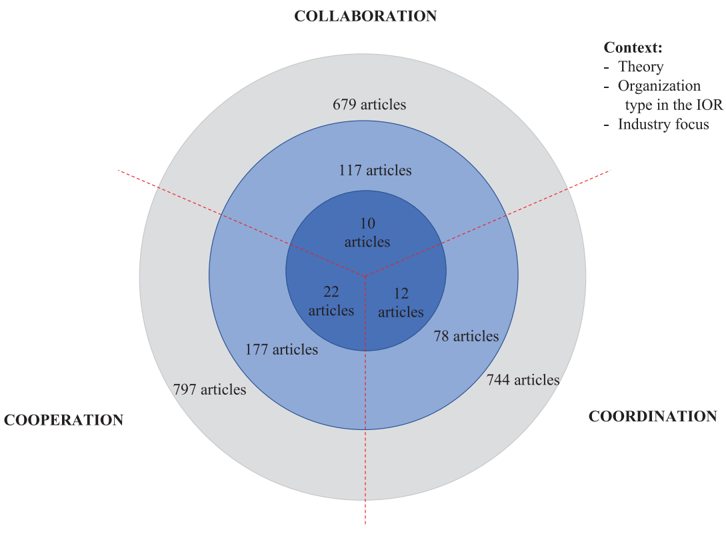
- The review screened 2,220 articles, found 372 relevant articles, and identified only 43 definitions across 44 articles; just 11.83% of relevant articles provided a definition, underscoring how rarely the terms are explicitly defined.
- Across the definitions, the authors found three recurring “interactional dimensions”: attitude, behavior, and outcome; however, overlap across the three terms meant these dimensions alone could not distinguish collaboration, coordination, and cooperation.
- Coordination definitions evoked behaviors in all 12 cases, cooperation definitions spread across attitude (6), behavior (15), and outcome (1), and collaboration definitions split between behavior (6 of 9) and outcome (3 of 9), with no attitude-based collaboration definitions.
- The paper’s proposed redefinitions are: coordination = the attitudes, behaviors, and outcomes of joint determination of common goals; cooperation = the attitudes, behaviors, and outcomes of implementing those agreed-on goals; collaboration = voluntarily helping others achieve a common IOR goal or one or more private goals.
## Methods
- Systematic literature review of nine top-tier general management journals: Academy of Management Journal, Academy of Management Review, Administrative Science Quarterly, Journal of Management, Journal of Management Studies, Management Science, Organization Science, Organization Studies, and Strategic Management Journal.
- Search covered articles from journal inception through 2017, used direct IOR-related keywords plus the three focal terms, and yielded 2,220 articles; 372 were judged relevant to direct interorganizational relationships.
- The authors manually extracted definitional passages, coded them using a multiple-case study approach, and assessed coding reliability with independent raters; reported agreement was high (Krippendorff’s alpha = 0.92 for relevance screening and 0.84 for coding attitude/behavior/outcome).
## Limitations
- The authors state that their journal list is a boundary condition: it covers only top-tier journals in general management, so the findings may not generalize to specialist or applied journals.
- They also note that the review focuses on a coherent set of direct interorganizational relationships and excludes mergers and acquisitions, board interlocks, and some other network forms; this narrows scope by design.
- Evident from the text: the paper studies only definitions that appear in the body text and only “intensional” definitions, which means it does not capture all possible usages or extensional meanings of the terms.
Model-written summary. Check it against the paper before relying on it.
Integrity signals
Registry
Cites
Statistics
Figures

Verification
Claims the paper makes
3 Valid · 5 Not valid · 46 Not checked · 88 Own results and interpretations
Every source the paper cites for this claim was checked and supports it.
In the paper
“Hardy et al. (2003: 323) define collaboration as “a cooperative, interorganizational relationship that is negotiated in an ongoing communicative process”; thus, the amalgamation of collaboration and cooperation renders limited discriminant validity.”
§ Collaboration, Coordination, and Cooperation Among Organizations: Establishing the Distinctive Meanings of These Terms Through a Systematic Literature Review > Collaboration
What the sources say
- Supportedcites Hardy et al. (2003) matched to “Resources, Knowledge and Influence: The Organizational Effects of Interorganizational Collaboration*” (2003) source
The 'THE EFFECTS OF COLLABORATION' section states the definition verbatim: 'we define collaboration as a cooperative, interorganizational relationship that is negotiated in an ongoing communicative process, and which relies on neither market nor hierarchical mechanisms of control'. The part attributed to this source — that Hardy et al. (2003) define collaboration in those terms — is therefore accurate. The follow-on judgement about 'amalgamation' and 'limited discriminant validity' is the citing authors' own critique, not a claim about this paper, and is not judged here; for completeness, the source's full definition adds the market/hierarchy clause and explicitly asserts it 'provides a set of critical characteristics that distinguishes it from other forms of interorganizational activity'. Our copy carries no page numbers, so the printed '323' could not be checked. (LLM, conf=0.85)
plainstates a cause- Asserted: passes — The authors put it forward as true.
- Checkable: passes — It can be checked against evidence.
- Load-bearing: passes — The paper’s conclusions depend on it.
- Based: passes — The paper gives a reason why it holds.
- Supported
The cited sources support only part of this claim — read each source’s verdict below.
In the paper
“However, the distinction among these terms remains unclear.”
§ Collaboration, Coordination, and Cooperation Among Organizations: Establishing the Distinctive Meanings of These Terms Through a Systematic Literature Review > Keywords: cooperative strategy; coopetition; interorganizational relations; alliances; joint ventures; networks; buyer-supplier relations; consortia; partnerships; discriminant validity; parsimony
What the sources say
- Partly supportedcites Hardy, Phillips, and Lawrence (2003) matched to “Resources, Knowledge and Influence: The Organizational Effects of Interorganizational Collaboration*” (2003) sourceExperimental — accuracy not yet measured
In “The Effects of Collaboration” (page unavailable), the paper says that definitions of collaboration vary across the literature, which lends some support to the claim of conceptual uncertainty. But it offers criteria distinguishing collaboration from other cooperative relationships and does not address a three-way distinction involving coordination. (LLM, conf=0.82)
plain- Asserted: passes — The authors put it forward as true.
- Checkable: passes — It can be checked against evidence.
- Load-bearing: passes — The paper’s conclusions depend on it.
- Based: passes — The paper gives a reason why it holds.
- Partly supported
Every source the paper cites for this claim was checked and supports it.
In the paper
“two separate articles that share a coauthor define collaboration by evoking behaviors (Hardy & Phillips, 1998; see also Hardy et al., 2003) and outcomes (Hardy et al., 2005).”
§ Collaboration, Coordination, and Cooperation Among Organizations: Establishing the Distinctive Meanings of These Terms Through a Systematic Literature Review > Collaboration
What the sources say
- Supportedcites Hardy & Phillips, 1998 matched to “Strategies of Engagement: Lessons from the Critical Examination of Collaboration and Conflict in an Interorganizational Domain” (1998) source
Our copy characterizes collaboration in terms of what parties do rather than what results they produce: the Compliance section (p. n/a) states 'Collaboration operates on a model of shared power... power to define the problem and to propose a solution is effectively shared among the decision makers' and 'Collaboration is thus a mutual engagement strategy in which all partners voluntarily participate,' and the Collaboration – The Community Development Team section describes it through joint action, pooling of resources and shared power. The Abstract frames collaboration as one of several 'strategies of engagement used by organizations,' i.e., a pattern of conduct; the paper offers no outcome-based definition and indeed cautions against judging collaboration by its stated outcomes (Conclusions). This supports the citing sentence's attribution of a behaviour-evoking definition to Hardy & Phillips (1998); the paired 2005 'outcomes' citation is a different paper and not judged here. (LLM, conf=0.80)
- Supportedcites Hardy et al., 2003 matched to “Resources, Knowledge and Influence: The Organizational Effects of Interorganizational Collaboration*” (2003) source
The 'THE EFFECTS OF COLLABORATION' section states the paper's own definition in behavioural/processual terms — a cooperative interorganizational relationship 'negotiated in an ongoing communicative process' that relies on neither market nor hierarchical control — with no reference to outcomes, which is exactly what the 'see also Hardy et al., 2003' tag supports. The 'Characteristics of Collaboration' section reinforces this by operationalising collaboration as patterns of interaction, coalition structure and information flow rather than as its effects. The paper is by Hardy, Phillips and Lawrence, so the shared-coauthor framing with Hardy & Phillips (1998) holds, and although the study examines collaborative effects/outcomes, its definition of collaboration itself is behavioural. (LLM, conf=0.85)
- Supportedcites Hardy et al., 2005 matched to “Discourse and Collaboration: The Role of Conversations and Collective Identity” (2005) source
The Abstract (p. 58) of Hardy, Lawrence & Grant (2005) defines effective collaboration in outcome terms — 'cooperative, interorganizational action that produces innovative, synergistic solutions and balances divergent stakeholder concerns' — and repeats this outcome-based formulation in the Conclusion, so citing it for a definition of collaboration that evokes outcomes is apt. The nuance is that their definition of collaboration as such is relational/mechanism-based ('a cooperative, interorganizational relationship in which participants rely on neither market nor hierarchical mechanisms of control'), with the outcome criteria attached specifically to *effective* collaboration; the citing sentence elides that qualifier but does not misstate the source. The authorship point (Hardy as shared coauthor) is confirmed by our copy's running head 'Hardy, Lawrence, and Grant'. (LLM, conf=0.85)
plain- Asserted: passes — The authors put it forward as true.
- Checkable: passes — It can be checked against evidence.
- Load-bearing: unclear — It is unclear whether the paper’s conclusions depend on it.
- Based: passes — The paper gives a reason why it holds.
- Supported
The cited sources that could be checked couldn’t confirm or dispute this claim.
In the paper
“Prior literature discusses both private and common goals for collaboration, coordination, and cooperation.”
§ Collaboration, Coordination, and Cooperation Among Organizations: Establishing the Distinctive Meanings of These Terms Through a Systematic Literature Review > 5.
What the sources say
- Could not verifycites Olsen, Sofka, & Grimpe, 2016 matched to “Coordinated Exploration for Grand Challenges: The Role of Advocacy Groups in Search Consortia” (2016) sourceExperimental — accuracy not yet measured
Our copy of Olsen, Sofka & Grimpe (2016) holds only the institutional-record metadata — the title/author block (untitled section, p. n.), and the 'Abstract' sections that are in fact the Handle.net/Pure record (keywords 'Advocacy groups, Grand challenges, Coordinated exploration, Stakeholder theory', volume 59(6), pp. 2232-2255, RIS/BIBTEX citation strings). No body text (introduction, literature review, or theory) is present, so nothing states or discusses prior literature on collaboration, coordination and cooperation addressing private versus common goals. Searches on 'private and common goals', 'collaboration coordination cooperation literature', 'common goals versus private interests', and 'search consortia advocacy groups' returned only these metadata blocks. Absence here is not contradiction; the claim simply cannot be checked against our copy. (LLM, conf=0.72)
- Not matchedcites Bae & Gargiulo, 2004;Doz, 1996
A range of references, not one source.
- Not matchedcites Davis & Eisenhardt, 2011;De Rond & Bouchikhi, 2004
A range of references, not one source.
plain- Asserted: passes — The authors put it forward as true.
- Checkable: passes — It can be checked against evidence.
- Load-bearing: unclear — It is unclear whether the paper’s conclusions depend on it.
- Based: passes — The paper gives a reason why it holds.
- Could not verify
A result the paper reports from its own data — it cites no other source for it, so there is none to check. The quote shows it is in the paper.
In the paper
“we observe that the behavioral dimension is featured across all three.”
§ Collaboration, Coordination, and Cooperation Among Organizations: Establishing the Distinctive Meanings of These Terms Through a Systematic Literature Review > Interactional Dimensions of Collaboration, Coordination, and Cooperation Among Organizations
plain- Asserted: passes — The authors put it forward as true.
- Checkable: passes — It can be checked against evidence.
- Load-bearing: passes — The paper’s conclusions depend on it.
- Based: passes — The paper gives a reason why it holds.
72 more claims
Create a free account to see all 142 claims and to verify the 11 references still open.
- Probably not a substantial claim. 47
- It may state two separate claims as one. 23
Self-check
Percentages, sums and reported differences re-computed from the paper’s own numbers.
Each contradiction between two passages listed here was confirmed by an independent check.
Rated minor: it would not touch a result — a value no result rests on, a p-value that stays on the same side of the significance level, or a conflict that is clerical, resolved elsewhere in the paper, or outside its own findings.
In the paper
§ Collaboration, Coordination, and Cooperation Among Organizations: Establishing the Distinctive Meanings of These Terms Through a Systematic Literature Review > Sourcing of Definitions
“Across the three terms, the percentage of relevant articles that provide a definition is low (11.83%).”
§ Collaboration, Coordination, and Cooperation Among Organizations: Establishing the Distinctive Meanings of These Terms Through a Systematic Literature Review > Sourcing of Definitions
“We identified 45 articles providing an intensional definition of any of three terms of interest.”
Rated minor: it would not touch a result — a value no result rests on, a p-value that stays on the same side of the significance level, or a conflict that is clerical, resolved elsewhere in the paper, or outside its own findings.
In the paper
§ Collaboration, Coordination, and Cooperation Among Organizations: Establishing the Distinctive Meanings of These Terms Through a Systematic Literature Review > Sourcing of Definitions
“We identified 45 articles providing an intensional definition of any of three terms of interest.”
§ Collaboration, Coordination, and Cooperation Among Organizations: Establishing the Distinctive Meanings of These Terms Through a Systematic Literature Review > 7.
“It also explains why the number of definitions (43 definitions) is different from the number of articles with definitions (44 articles).”
Citations
Cites
Prospect Theory: An Analysis of Decision under Risk
Kahneman, D., & Tversky, A. (1979) · Econometrica · doi:10.2307/1914185 · Cited by 48,524
DiMaggio, P. J., & Powell, W. W. (1983) · American Sociological Review · doi:10.2307/2095101 · Cited by 38,435
The Structure of Scientific Revolutions
Kuhn, T. S., & Schlegel, R. (1963) · Physics Today · doi:10.1063/1.3050879 · Cited by 35,538
Prospect theory: An analysis of decision under risk
Kahneman, D., & Tversky, A. (1988) · Decision, Probability and Utility · doi:10.1017/cbo9780511609220.014 · Cited by 32,474
Economic Action and Social Structure: The Problem of Embeddedness
Granovetter, M. (1985) · American Journal of Sociology · doi:10.1086/228311 · Cited by 28,745
Social Capital in the Creation of Human Capital
Coleman, J. S. (1988) · American Journal of Sociology · doi:10.1086/228943 · Cited by 26,975
DiMaggio, P. J., & Powell, W. W. (2004) · Advances in Strategic Management · doi:10.1016/s0742-3322(00)17011-1 · Cited by 25,802
Social Capital in the Creation of Human Capital
COLEMAN, J. (2000) · Knowledge and Social Capital · doi:10.1016/b978-0-7506-7222-1.50005-2 · Cited by 21,666
Axelrod, R., & Hamilton, W. D. (1981) · Science · doi:10.1126/science.7466396 · Cited by 20,065
Building Theories from Case Study Research
Eisenhardt, K. M. (1989) · The Academy of Management Review · doi:10.2307/258557 · Cited by 17,455
Research works printed but not linked: 2
- 104. Macneil, I. R. 1980. Economic analysis of contractual relations: Its shortfalls and the need for a rich classificatory apparatus. Northwestern University Law Review, 75: 1018-1041.
- 142. Thompson, J. D. 1967. Organization in action. New York: McGraw-Hill.
Cited by
Items 301–400 of 518
Zimmerman, J., Khorram‐Manesh, A., Carlström, E., Robinson, Y., & Björås, J. (2025) · International Journal of Emergency Medicine · doi:10.1186/s12245-025-01027-7 · Cited by 4
Andersson, R., & Wernholm, M. (2025) · Cogent Education · doi:10.1080/2331186x.2025.2478308 · Cited by 1
Fenanlampir, A., Budiatin, Y., & Hasbullah, B. (2023) · JOURNAL SPORT AREA · doi:10.25299/sportarea.2023.vol8(3).12802 · Cited by 1
Impact of Ambiversion on Collaboration Among Diverse Groups
Adeoye, M. A., Tiamiyu, K. A., Mahmud, M. A., & Jimoh, H. A. (2023) · Jurnal Pedagogi dan Pembelajaran · doi:10.23887/jp2.v6i2.64911 · Cited by 1
Leadership in security media: Impact on community safety – Insights from Oman Police
Awashreh, R. A., & Alshuhoomi, S. (2025) · SA Journal of Human Resource Management · doi:10.4102/sajhrm.v23i0.2828 · Cited by 3
Championing “Exchange and Cooperation” Efforts in Frontier Science: Epilogue to the Special Issue
Houran, J., & Schofield, M. B. (2023) · Journal of Scientific Exploration · doi:10.31275/20233207 · Cited by 2
Sim, C. S. L., Asharani, P. V., Subramaniam, M., & Yi, H. (2024) · Health Systems & Reform · doi:10.1080/23288604.2024.2314525 · Cited by 2
Chen, W., & Zhang, H. (2025) · Risk Analysis · doi:10.1111/risa.70168 · Cited by 4
Fernández, Á. R. A. (2024) · Paradigma Revista de investigación educativa · doi:10.5377/paradigma.v31i52.19501 · Cited by 1
Measuring joint attention in co-creation through automatic human activity recognition
Shen, T., Li, Y., Lou, Y., Liu, C., Ji, D., Zhang, M., & Li, Y. (2025) · Design Science · doi:10.1017/dsj.2025.10021 · Cited by 1
Saleh, H., Manda, D., Maidin, D. A. M. R., Maulana, Z., & Rizal, A. (2024) · International Journal of Religion · doi:10.61707/z7mzsk64 · Cited by 2
Acquirer Strategic Orientations, Integration Decisions, and Performance
Bauer, F., King, D. R., Covin, J. G., Schriber, S., Brueller, N. N., & Weng, Q. D. (2026) · Journal of Management Studies · doi:10.1111/joms.70082 · Cited by 3
Tam, T. V., Bańka, M. S., & Tien, N. H. (2025) · Cogent Business & Management · doi:10.1080/23311975.2025.2496733 · Cited by 2
Relational Competence Building in Sustainable Development: A Systems-Thinking Approach
Rutherford, G. (2025) · World sustainability series · doi:10.1007/978-3-031-80380-2_16 · Cited by 2
Institutional strengthening in village ecotourism development
Suhendri, S., Helena, D., & Pahrudin, P. (2023) · Jurnal Inovasi Ilmu Sosial dan Politik (JISoP) · doi:10.33474/jisop.v5i1.19798 · Cited by 4
Strategic development of retail firms: Three essays
Wagner, F. D. T. (2024) · doi:10.51363/unifr.eth.2024.015 · Cited by 1
Determinants of inter-organizational cooperation in SMEs innovation
Xiang-feng, X., Getele, G. K., & Zhou, T. (2025) · Economics of Innovation and New Technology · doi:10.1080/10438599.2025.2481316 · Cited by 4
How can industrial management contribute to a brighter future?
Deuse, J. (2023) · doi:10.30844/wgab_2023 · Cited by 1
Sackett, E., & Mayo, A. T. (2025) · Health Care Management Review · doi:10.1097/hmr.0000000000000456 · Cited by 2
Kostopoulos, K. C., Mammassis, C. S., & Papalexandris, A. (2020) · SSRN Electronic Journal · doi:10.2139/ssrn.3651309 · Cited by 1
Slapničar, S., Vuko, T., Čular, M., et al. (2025) · SSRN Electronic Journal · doi:10.2139/ssrn.5458454 · Cited by 1
Local Culture and Character Education Research Trends: A Decade-Long Bibliometric Study
Ruswinarsih, S., Budimansyah, D., Wahyu, W., Sauri, S., & Arofah, L. (2025) · IJORER International Journal of Recent Educational Research · doi:10.46245/ijorer.v6i5.912 · Cited by 6
Maintaining equilibrium: toward a homeostatic theory of organizations
Shertzer, Y., & Nitzan, A. (2026) · International journal of organizational analysis · doi:10.1108/ijoa-05-2026-7070 · Cited by 2
The Effects of Coordination in Multilevel Governance System on Water Services Management in Kenya
Otieno, J. O., Obosi, J. O., & Magutu, J. (2023) · Journal of Public Administration and Governance · doi:10.5296/jpag.v13i2.21095 · Cited by 1
Not Just Cocreation: Exploring the Shifting Interaction Logics in Sustainable Innovation
Perriton, E., Korsgaard, S., Gustafsson, S., Evald, M. R., & Ingstrup, M. B. (2025) · Business Strategy and the Environment · doi:10.1002/bse.4244 · Cited by 3
Collaborative Working, Crowdsourcing, Partnering and Networking
Virkus, S. (2024) · Elsevier eBooks · doi:10.1016/b978-0-323-95689-5.00207-8 · Cited by 1
Organizational Practices and Socio-Technical Design of Human-Centered AI
Herrmann, T. A. (2025) · Springer eBooks · doi:10.1007/978-981-97-8440-0_66-1 · Cited by 5
Glas, A. H., & Eßig, M. (2025) · Journal of Purchasing and Supply Management · doi:10.1016/j.pursup.2025.101031 · Cited by 1
Shahvar, S., & Tang, R. (2022) · Journal of Education for Library and Information Science · doi:10.3138/jelis-2021-0039 · Cited by 2
Inter-team knowledge collaboration across boundaries in multi-team consulting projects
Li, Y., Ning, S., Liu, X., & Ning, Y. (2026) · International Journal of Project Management · doi:10.1016/j.ijproman.2026.102817 · Cited by 1
Santana, M. K. A., & Chagas, M. D. F. (2025) · Journal of Aerospace Technology and Management · doi:10.1590/jatm.v17.1363 · Cited by 2
Klöters, M., & Pijnenburg, V. (2025) · Journal of Borderlands Studies · doi:10.1080/08865655.2025.2565574 · Cited by 2
Human Rights and Peacebuilding: Bridging the Gap
Hillert, L. (2023) · Journal of Human Rights Practice · doi:10.1093/jhuman/huad037 · Cited by 3
Maracajá, K. F. B., & Monticelli, J. M. (2024) · Turismo - Visão e Ação · doi:10.14210/tva.v26.20101 · Cited by 5
Yao, L., & Li, J. (2026) · Journal of Business Research · doi:10.1016/j.jbusres.2026.116191 · Cited by 4
Chiriboga-Mendoza, F. R., Mayor, X. M., & Zambrano-Pilay, E. C. (2024) · Salud Ciencia y Tecnología - Serie de Conferencias · doi:10.56294/sctconf20241004 · Cited by 15
Evaluating eurozone financial assistance collaboration: A case study
Korhonen, K. T., Hinkenhuis, M., Francová, O., Kovačević, D., & Goossen, J. E. (2025) · World Development · doi:10.1016/j.worlddev.2025.107031 · Cited by 2
Bosun-Arije, F. S., Alomari, A. M. A., & Jaramillo, J. (2024) · Nurse Education in Practice · doi:10.1016/j.nepr.2024.104157 · Cited by 1
Factors influencing top management team dynamics for successful strategy implementation
Mvubu, Y. S., Madziva, T., & Mathibe, M. S. (2025) · South African Journal of Business Management · doi:10.4102/sajbm.v56i1.4970 · Cited by 1
Nivestam, A., Haak, M., Westergren, A., & Hedin, G. (2026) · Health & Social Care in the Community · doi:10.1155/hsc/8842580 · Cited by 2
Empowering Voices: Analyzing the Impact of Student Activism on Campus Democratic Governance
Asrifan, A., Rinantanti, Y., & Kumar, L. S. (2025) · Advances in higher education and professional development book series · doi:10.4018/979-8-3693-5683-8.ch005 · Cited by 1
Circular Economy and Sustainable Development Goals 3 and 17: The Case of the PlastiCity Ecosystem
Litaudon, V., Ciliacus, Y. M. C., & Brughmans, P. (2023) · Greening of industry networks studies · doi:10.1007/978-3-031-25436-9_13 · Cited by 1
Krisenbewältigung und interorganisationale Zusammenarbeit
(2022) · doi:10.1007/978-3-658-37141-8_3 · Cited by 1
Bakko, M., Jacobs, L. A., Fixler, A. L., Murray, B. J., Leotti, S. M., Erwin, J., Allen, E., Tomczak, S. M., & Hostetter, C. R. (2026) · Social Service Review · doi:10.1086/742180 · Cited by 1
Tracing collaboration threads in social entrepreneurship literature
Millán-Franco, M. A., Aparisi-Torrijo, S., Calvo, S., & Palacios‐Marqués, D. (2025) · Journal of Enterprising Communities People and Places in the Global Economy · doi:10.1108/jec-04-2024-0068 · Cited by 1
Adaptability of Governance Structures and Processes for Sustainable Livestock in Jalisco, Mexico
Špirić, J. (2026) · Review of Policy Research · doi:10.1111/ropr.70079 · Cited by 3
Critical Infrastructures for Disaster Risk Reduction
(2025) · doi:10.1007/978-981-97-4547-0_215-1 · Cited by 1
A Framework for Cooperation Among Power Distribution System ApplicationsPreprint
Slay, T., Mukherjee, M., Poudel, S. R., Black, G. D., & Reiman, A. P. (2023) · SSRN Electronic Journal · doi:10.2139/ssrn.4523739 · Cited by 3
Uddin, M. A., & Reberio, M. (2022) · Nursing & Care Open Access Journal · doi:10.15406/ncoaj.2022.08.00248 · Cited by 1
Tissioui, M., Joffre, C., Scouarnec, A., & Payre, S. (2021) · RIMHE Revue Interdisciplinaire Management Homme(s) & Entreprise · doi:10.3917/rimhe.043.0053 · Cited by 1
Assistance for Youth Counselors in Efforts to Improve the Implementation of PIK-R
Djama, N. T., & Marsaoly, S. (2024) · International Journal of Community Service Learning · doi:10.23887/ijcsl.v7i4.70925
Jarynowski, A. K., Romanowska, M., Maksymowicz, S., & Belik, V. (2024) · One Health Journal · doi:10.31073/onehealthjournal2024-iii-06 · Cited by 2
Cregård, A., & Forsberg, T. (2024) · Public Management Review · doi:10.1080/14719037.2024.2387170 · Cited by 1
Ethical considerations in laboratory, pharmacy, and nursing collaboration: Challenges and solutions
Alshammari, K. S. F., Albakr, M. S. B., Almughamis, F. K. S., Albugami, D. M., ALKhabbaz, G. G., Khrami, S. A., Al-Enazi, S. H. S., Aidrose, A. A. H., Hamzy, I. A., Aljehani, M. R., et al. (2024) · International Journal of Health Sciences · doi:10.53730/ijhs.v8ns1.15336
Jahrbuch der berufs- und wirtschaftspädagogischen Forschung 2022
Kögler, K., Weyland, U., & Kremer, H.-H. (2022) · Verlag Barbara Budrich eBooks · doi:10.2307/j.ctv34h090b · Cited by 6
Cooperative interaction: A taxonomy of human-GenAI interaction patterns in tourism
Zhao, Y., Gao, Y., Wang, Y., Zhang, H., & Zheng, B. (2026) · Journal of Hospitality and Tourism Management · doi:10.1016/j.jhtm.2026.101472 · Cited by 1
COMPLEXITY, DESIGN AND PROJECT COMPLETION: A STUDY OF CLINICAL TRIALS
Vural, M. O. (2023) · Editora Artemis eBooks · doi:10.37572/edart_15122313013
Navigating Ecosystem Virtuality
Rose, R., Maul, V., Hölzle, K., & Bauer, W. (2023) · doi:10.30844/wgab_2023_8
Alexius, K., Bjørktomta, S.-B., & Jacobsson, M. (2025) · Journal of Social Work Practice · doi:10.1080/02650533.2025.2566640 · Cited by 1
Multi-robot System Architectures
Baumann, C., Erünsal, İ. K., & Martinoli, A. (2024) · Springer eBooks · doi:10.1007/978-3-642-41610-1_225-1
Work context and cooperation in workgroups: a conceptual framework
Kahmei, G. (2026) · Asia-Pacific Journal of Business Administration · doi:10.1108/apjba-02-2026-0132
Rosário, C., Varum, C., & Botelho, A. (2024) · Sustainability · doi:10.3390/su16072643
Rahmah, N., Sidharta, E. A., & Sudarto, T. A. (2024) · Journal of Applied Business Taxation and Economics Research · doi:10.54408/jabter.v3i6.299 · Cited by 7
The influence of motivation and collaboration on organizational performance
Sutrisno, A., Anggreni, L., & Prasetyaningtyas, S. W. (2021) · Turkish Online Journal of Qualitative Inquiry
Machida, S. (2021) · DUT Open Scholar (Durban University of Technology) · doi:10.51415/10321/4230 · Cited by 1
Kidritsch, A., Lagiou, A., Sakellariou, D., & Sakellari, Ε. (2023) · International Journal of Health Professions · doi:10.2478/ijhp-2023-0010 · Cited by 2
Jin, X., Senaratne, S., Portelli, C., Webber, R. J., & Kukah, A. S. K. (2026) · Construction Innovation · doi:10.1108/ci-07-2025-0316
de Wit, P., Wickert, C. M. J., & Gümüşay, A. A. (2026) · Journal of Management · doi:10.1177/01492063261443476
Interorganizational Learning in Innovation Networks and Ecosystems: A Scoping ReviewPreprint
Lemos, D. D. C., Steil, A. V., Hoffmann, M. G., Murad, E. P., & Fabris, M. M. D. S. (2025) · SSRN Electronic Journal · doi:10.2139/ssrn.5253807
Wang, J., Zhang, S., He, H., Zhang, Z., Liu, Y., Jia, M., & 詹智涵 (2026) · Journal of Business Research · doi:10.1016/j.jbusres.2026.116410
Gosula, E. (2023) · ShodhKosh Journal of Visual and Performing Arts · doi:10.29121/shodhkosh.v4.i2.2023.2465
Board governance in interorganisational collaborations: A case study of the homelessness sector
Leebeek, M. (2023) · Queensland University of Technology · doi:10.5204/thesis.eprints.243277
(2024) · Advances in business strategy and competitive advantage book series · doi:10.4018/979-8-3693-3482-9.ch004
Nichols, C. R., Wright, L. D., & Zarillo, G. A. (2024) · Synthesis lectures on ocean systems engineering · doi:10.1007/978-3-031-68153-0_2
Organizational Practices and Socio-Technical Design of Human-Centered AI
Herrmann, T. (2026) · Springer eBooks · doi:10.1007/978-981-95-3658-0_66
Online Classroom Engagement and Group Collaboration
Zulfqar, A., & Niazi, A. (2026) · IGI Global eBooks · doi:10.4018/979-8-2600-0934-5.ch005
Acero, L. (2025) · International Journal of Social Sciences and Management Review · doi:10.37602/ijssmr.2025.8221 · Cited by 2
Letor, C. (2026) · Enseignement et recherche en administration de l’éducation · doi:10.7202/1128130ar
Yang, R., Liu, B., & Li, N. (2025) · International Journal of Disaster Risk Reduction · doi:10.1016/j.ijdrr.2025.105510 · Cited by 5
Nivestam, A., Westergren, A., Haak, M., & Hedin, G. (2026) · Scandinavian Journal of Caring Sciences · doi:10.1111/scs.70325
What Collaboration Entails: From the Traitorous to Team Care
Fox, S. (2022) · Prologi · doi:10.33352/prlg.122549 · Cited by 1
Metadata
- Authors
- Castañer, X., & Oliveira, N.
- Affiliations
- University of Lausanne (CH)
- Tilburg University (NL)
- Corresponding author
- Oliveira, Nuno
- Venue
- Journal of Management
- Publisher
- SAGE Publications
- Published
- 2020-02-24
- Volume
- 46
- Issue
- 6
- Pages
- 965-1001
- ISSN
- 0149-2063 (ISSN-L)
- 1557-1211
- OpenAlex
- W3008299625
- Cited by
- 525
- References
- 182
- Citations by year
- 2026: 62 · 2025: 134 · 2024: 122 · 2023: 103 · 2022: 60 · 2021: 35 · 2020: 9
- FWCI
- 8.07
- Type
- journal article
- Language
- en
- Open access
- hybrid
- doi.org
- Licence
- Locations
- Journal of Management (publishedVersion, cc-by-nc)
- Research portal (Tilburg University) (publishedVersion, other-oa)
- Data Archiving and Networked Services (DANS) (submittedVersion, other-oa)
- IRIS (submittedVersion)
- SERVAL (Université de Lausanne) (submittedVersion)
- Topics
- Social Sciences › Business, Management and Accounting › Strategy and Management › Business Strategy and Innovation
- Social Sciences › Business, Management and Accounting › Organizational Behavior and Human Resource Management › Management and Organizational Studies
- Social Sciences › Public Administration › Public Policy and Administration Research
- Keywords
- collaboration, coordination, cooperation, interorganizational relationships, inter-organizational alliances, conceptual definitions, goal types, theory development
About these checks
Registry, retraction, Cites and statistics results are computed, not judged, with one exception: a printed reference that no index lists is read once by a model before it counts as a citation error. Claims are extracted by a model and kept only when their quote appears verbatim in the text; each cited source is then checked, with a model’s help, for whether it says what the claim relies on. Those verdicts can be wrong — read the claim’s quote and the cited source before relying on one.
The claim verdicts this report counts are experimental: their accuracy is not yet measured.
A language model drew the claims from the paper on 2026-10-10, under version 3 of the claim definition (model deepseek-v4.1-flash, prompt extract-v3).
A second model labelled each claim on 2026-10-10 (model jev-1.13-20260917, definition revision gold-guideline-v0.2).
Cited sources are checked with a language model’s help (qwen3.8-omni-flash and gpt-6-sol).
Statistics and arithmetic are recomputed, not judged.
Confidence bands are shown only for fields calibrated on our annotated test set. None is calibrated yet, so no band is shown.
What counts as a claim ›How we measure confidence ›How we check this ›
Are you an author, or do you see a problem with this page? Request a review
Data sources
Bibliographic data: Semantic Scholar, OpenAlex, Crossref.
Contains information from the Semantic Scholar Academic Graph Datasets, made available under the ODC Attribution License (ODC-BY 1.0).
Semantic Scholar’s data is described in: Kinney, R., et al. (2023). The Semantic Scholar Open Data Platform. arXiv:2301.10140.
