

Collaboration, Coordination, and Cooperation Among Organizations: Establishing the Distinctive Meanings of These Terms Through a Systematic Literature Review
Open accessThe DOI matches its Crossref record; 175 of the 182 references it cites were found in a registry or an index, and 1 are not checked yet; 6 of the 78 sources its claims cite were checked for support.
Abstract
Collaboration, coordination, and cooperation lie at the core of interorganizational activities. This systematic review of definitions in nine top general management journals identifies temporal stage and type of goal as discriminating dimensions for distinguishing the three terms.
Verified 2026-11-19 · 1 reference not checked yet
Overview
CoChat Summary
## TL;DR
This systematic literature review examines how collaboration, coordination, and cooperation are defined across nine top management journals and argues that the three terms are conceptually distinct only when differentiated by two new dimensions: temporal stage and type of goal. The authors propose redefinitions that separate coordination as goal determination, cooperation as goal implementation, and collaboration as voluntary helping toward common or private goals.
## Key findings
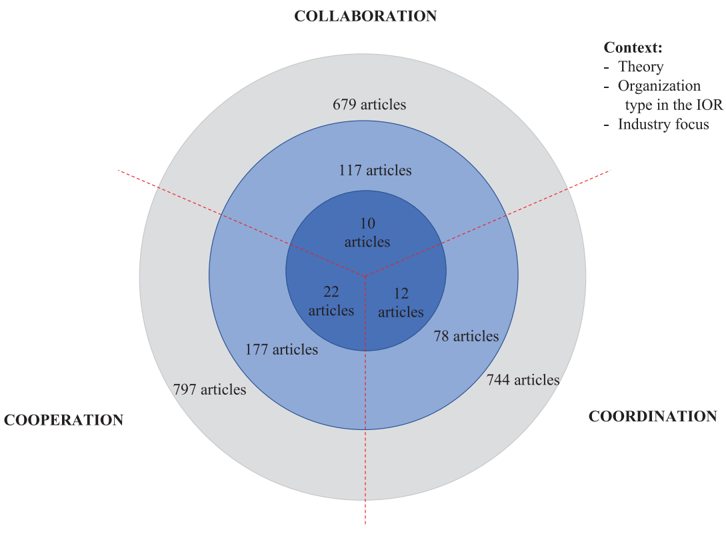
- The review screened 2,220 articles, found 372 relevant articles, and identified only 43 definitions across 44 articles; just 11.83% of relevant articles provided a definition, underscoring how rarely the terms are explicitly defined.
- Across the definitions, the authors found three recurring “interactional dimensions”: attitude, behavior, and outcome; however, overlap across the three terms meant these dimensions alone could not distinguish collaboration, coordination, and cooperation.
- Coordination definitions evoked behaviors in all 12 cases, cooperation definitions spread across attitude (6), behavior (15), and outcome (1), and collaboration definitions split between behavior (6 of 9) and outcome (3 of 9), with no attitude-based collaboration definitions.
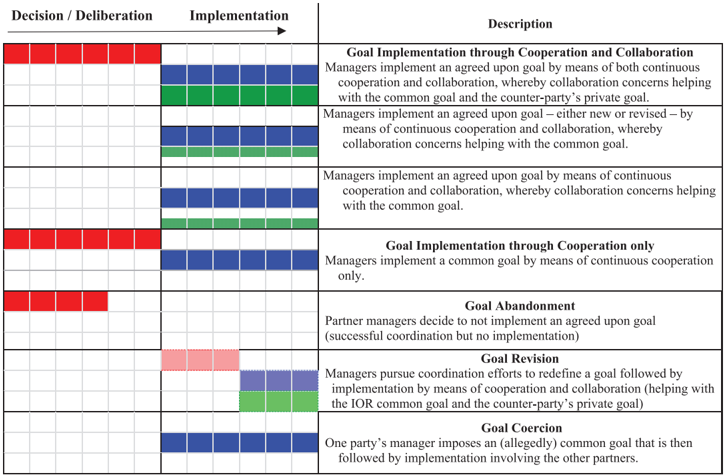
- The paper’s proposed redefinitions are: coordination = the attitudes, behaviors, and outcomes of joint determination of common goals; cooperation = the attitudes, behaviors, and outcomes of implementing those agreed-on goals; collaboration = voluntarily helping others achieve a common IOR goal or one or more private goals.
## Methods
- Systematic literature review of nine top-tier general management journals: Academy of Management Journal, Academy of Management Review, Administrative Science Quarterly, Journal of Management, Journal of Management Studies, Management Science, Organization Science, Organization Studies, and Strategic Management Journal.
- Search covered articles from journal inception through 2017, used direct IOR-related keywords plus the three focal terms, and yielded 2,220 articles; 372 were judged relevant to direct interorganizational relationships.
- The authors manually extracted definitional passages, coded them using a multiple-case study approach, and assessed coding reliability with independent raters; reported agreement was high (Krippendorff’s alpha = 0.92 for relevance screening and 0.84 for coding attitude/behavior/outcome).
## Limitations
- The authors state that their journal list is a boundary condition: it covers only top-tier journals in general management, so the findings may not generalize to specialist or applied journals.
- They also note that the review focuses on a coherent set of direct interorganizational relationships and excludes mergers and acquisitions, board interlocks, and some other network forms; this narrows scope by design.
- Evident from the text: the paper studies only definitions that appear in the body text and only “intensional” definitions, which means it does not capture all possible usages or extensional meanings of the terms.
Model-written summary. Check it against the paper before relying on it.
Integrity signals
Registry
Cites
Statistics
Figures

Verification
Claims the paper makes
3 Valid · 5 Not valid · 46 Not checked · 88 Own results and interpretations
Every source the paper cites for this claim was checked and supports it.
In the paper
“Hardy et al. (2003: 323) define collaboration as “a cooperative, interorganizational relationship that is negotiated in an ongoing communicative process”; thus, the amalgamation of collaboration and cooperation renders limited discriminant validity.”
§ Collaboration, Coordination, and Cooperation Among Organizations: Establishing the Distinctive Meanings of These Terms Through a Systematic Literature Review > Collaboration
What the sources say
- Supportedcites Hardy et al. (2003) matched to “Resources, Knowledge and Influence: The Organizational Effects of Interorganizational Collaboration*” (2003) source
The 'THE EFFECTS OF COLLABORATION' section states the definition verbatim: 'we define collaboration as a cooperative, interorganizational relationship that is negotiated in an ongoing communicative process, and which relies on neither market nor hierarchical mechanisms of control'. The part attributed to this source — that Hardy et al. (2003) define collaboration in those terms — is therefore accurate. The follow-on judgement about 'amalgamation' and 'limited discriminant validity' is the citing authors' own critique, not a claim about this paper, and is not judged here; for completeness, the source's full definition adds the market/hierarchy clause and explicitly asserts it 'provides a set of critical characteristics that distinguishes it from other forms of interorganizational activity'. Our copy carries no page numbers, so the printed '323' could not be checked. (LLM, conf=0.85)
plainstates a cause- Asserted: passes — The authors put it forward as true.
- Checkable: passes — It can be checked against evidence.
- Load-bearing: passes — The paper’s conclusions depend on it.
- Based: passes — The paper gives a reason why it holds.
- Supported
The cited sources support only part of this claim — read each source’s verdict below.
In the paper
“However, the distinction among these terms remains unclear.”
§ Collaboration, Coordination, and Cooperation Among Organizations: Establishing the Distinctive Meanings of These Terms Through a Systematic Literature Review > Keywords: cooperative strategy; coopetition; interorganizational relations; alliances; joint ventures; networks; buyer-supplier relations; consortia; partnerships; discriminant validity; parsimony
What the sources say
- Partly supportedcites Hardy, Phillips, and Lawrence (2003) matched to “Resources, Knowledge and Influence: The Organizational Effects of Interorganizational Collaboration*” (2003) sourceExperimental — accuracy not yet measured
In “The Effects of Collaboration” (page unavailable), the paper says that definitions of collaboration vary across the literature, which lends some support to the claim of conceptual uncertainty. But it offers criteria distinguishing collaboration from other cooperative relationships and does not address a three-way distinction involving coordination. (LLM, conf=0.82)
plain- Asserted: passes — The authors put it forward as true.
- Checkable: passes — It can be checked against evidence.
- Load-bearing: passes — The paper’s conclusions depend on it.
- Based: passes — The paper gives a reason why it holds.
- Partly supported
Every source the paper cites for this claim was checked and supports it.
In the paper
“two separate articles that share a coauthor define collaboration by evoking behaviors (Hardy & Phillips, 1998; see also Hardy et al., 2003) and outcomes (Hardy et al., 2005).”
§ Collaboration, Coordination, and Cooperation Among Organizations: Establishing the Distinctive Meanings of These Terms Through a Systematic Literature Review > Collaboration
What the sources say
- Supportedcites Hardy & Phillips, 1998 matched to “Strategies of Engagement: Lessons from the Critical Examination of Collaboration and Conflict in an Interorganizational Domain” (1998) source
Our copy characterizes collaboration in terms of what parties do rather than what results they produce: the Compliance section (p. n/a) states 'Collaboration operates on a model of shared power... power to define the problem and to propose a solution is effectively shared among the decision makers' and 'Collaboration is thus a mutual engagement strategy in which all partners voluntarily participate,' and the Collaboration – The Community Development Team section describes it through joint action, pooling of resources and shared power. The Abstract frames collaboration as one of several 'strategies of engagement used by organizations,' i.e., a pattern of conduct; the paper offers no outcome-based definition and indeed cautions against judging collaboration by its stated outcomes (Conclusions). This supports the citing sentence's attribution of a behaviour-evoking definition to Hardy & Phillips (1998); the paired 2005 'outcomes' citation is a different paper and not judged here. (LLM, conf=0.80)
- Supportedcites Hardy et al., 2003 matched to “Resources, Knowledge and Influence: The Organizational Effects of Interorganizational Collaboration*” (2003) source
The 'THE EFFECTS OF COLLABORATION' section states the paper's own definition in behavioural/processual terms — a cooperative interorganizational relationship 'negotiated in an ongoing communicative process' that relies on neither market nor hierarchical control — with no reference to outcomes, which is exactly what the 'see also Hardy et al., 2003' tag supports. The 'Characteristics of Collaboration' section reinforces this by operationalising collaboration as patterns of interaction, coalition structure and information flow rather than as its effects. The paper is by Hardy, Phillips and Lawrence, so the shared-coauthor framing with Hardy & Phillips (1998) holds, and although the study examines collaborative effects/outcomes, its definition of collaboration itself is behavioural. (LLM, conf=0.85)
- Supportedcites Hardy et al., 2005 matched to “Discourse and Collaboration: The Role of Conversations and Collective Identity” (2005) source
The Abstract (p. 58) of Hardy, Lawrence & Grant (2005) defines effective collaboration in outcome terms — 'cooperative, interorganizational action that produces innovative, synergistic solutions and balances divergent stakeholder concerns' — and repeats this outcome-based formulation in the Conclusion, so citing it for a definition of collaboration that evokes outcomes is apt. The nuance is that their definition of collaboration as such is relational/mechanism-based ('a cooperative, interorganizational relationship in which participants rely on neither market nor hierarchical mechanisms of control'), with the outcome criteria attached specifically to *effective* collaboration; the citing sentence elides that qualifier but does not misstate the source. The authorship point (Hardy as shared coauthor) is confirmed by our copy's running head 'Hardy, Lawrence, and Grant'. (LLM, conf=0.85)
plain- Asserted: passes — The authors put it forward as true.
- Checkable: passes — It can be checked against evidence.
- Load-bearing: unclear — It is unclear whether the paper’s conclusions depend on it.
- Based: passes — The paper gives a reason why it holds.
- Supported
The cited sources that could be checked couldn’t confirm or dispute this claim.
In the paper
“Prior literature discusses both private and common goals for collaboration, coordination, and cooperation.”
§ Collaboration, Coordination, and Cooperation Among Organizations: Establishing the Distinctive Meanings of These Terms Through a Systematic Literature Review > 5.
What the sources say
- Could not verifycites Olsen, Sofka, & Grimpe, 2016 matched to “Coordinated Exploration for Grand Challenges: The Role of Advocacy Groups in Search Consortia” (2016) sourceExperimental — accuracy not yet measured
Our copy of Olsen, Sofka & Grimpe (2016) holds only the institutional-record metadata — the title/author block (untitled section, p. n.), and the 'Abstract' sections that are in fact the Handle.net/Pure record (keywords 'Advocacy groups, Grand challenges, Coordinated exploration, Stakeholder theory', volume 59(6), pp. 2232-2255, RIS/BIBTEX citation strings). No body text (introduction, literature review, or theory) is present, so nothing states or discusses prior literature on collaboration, coordination and cooperation addressing private versus common goals. Searches on 'private and common goals', 'collaboration coordination cooperation literature', 'common goals versus private interests', and 'search consortia advocacy groups' returned only these metadata blocks. Absence here is not contradiction; the claim simply cannot be checked against our copy. (LLM, conf=0.72)
- Not matchedcites Bae & Gargiulo, 2004;Doz, 1996
A range of references, not one source.
- Not matchedcites Davis & Eisenhardt, 2011;De Rond & Bouchikhi, 2004
A range of references, not one source.
plain- Asserted: passes — The authors put it forward as true.
- Checkable: passes — It can be checked against evidence.
- Load-bearing: unclear — It is unclear whether the paper’s conclusions depend on it.
- Based: passes — The paper gives a reason why it holds.
- Could not verify
A result the paper reports from its own data — it cites no other source for it, so there is none to check. The quote shows it is in the paper.
In the paper
“we observe that the behavioral dimension is featured across all three.”
§ Collaboration, Coordination, and Cooperation Among Organizations: Establishing the Distinctive Meanings of These Terms Through a Systematic Literature Review > Interactional Dimensions of Collaboration, Coordination, and Cooperation Among Organizations
plain- Asserted: passes — The authors put it forward as true.
- Checkable: passes — It can be checked against evidence.
- Load-bearing: passes — The paper’s conclusions depend on it.
- Based: passes — The paper gives a reason why it holds.
72 more claims
Create a free account to see all 142 claims and to verify the 11 references still open.
- Probably not a substantial claim. 47
- It may state two separate claims as one. 23
Self-check
Percentages, sums and reported differences re-computed from the paper’s own numbers.
Each contradiction between two passages listed here was confirmed by an independent check.
Rated minor: it would not touch a result — a value no result rests on, a p-value that stays on the same side of the significance level, or a conflict that is clerical, resolved elsewhere in the paper, or outside its own findings.
In the paper
§ Collaboration, Coordination, and Cooperation Among Organizations: Establishing the Distinctive Meanings of These Terms Through a Systematic Literature Review > Sourcing of Definitions
“Across the three terms, the percentage of relevant articles that provide a definition is low (11.83%).”
§ Collaboration, Coordination, and Cooperation Among Organizations: Establishing the Distinctive Meanings of These Terms Through a Systematic Literature Review > Sourcing of Definitions
“We identified 45 articles providing an intensional definition of any of three terms of interest.”
Rated minor: it would not touch a result — a value no result rests on, a p-value that stays on the same side of the significance level, or a conflict that is clerical, resolved elsewhere in the paper, or outside its own findings.
In the paper
§ Collaboration, Coordination, and Cooperation Among Organizations: Establishing the Distinctive Meanings of These Terms Through a Systematic Literature Review > Sourcing of Definitions
“We identified 45 articles providing an intensional definition of any of three terms of interest.”
§ Collaboration, Coordination, and Cooperation Among Organizations: Establishing the Distinctive Meanings of These Terms Through a Systematic Literature Review > 7.
“It also explains why the number of definitions (43 definitions) is different from the number of articles with definitions (44 articles).”
Citations
Cites
Prospect Theory: An Analysis of Decision under Risk
Kahneman, D., & Tversky, A. (1979) · Econometrica · doi:10.2307/1914185 · Cited by 48,524
DiMaggio, P. J., & Powell, W. W. (1983) · American Sociological Review · doi:10.2307/2095101 · Cited by 38,435
The Structure of Scientific Revolutions
Kuhn, T. S., & Schlegel, R. (1963) · Physics Today · doi:10.1063/1.3050879 · Cited by 35,538
Prospect theory: An analysis of decision under risk
Kahneman, D., & Tversky, A. (1988) · Decision, Probability and Utility · doi:10.1017/cbo9780511609220.014 · Cited by 32,474
Economic Action and Social Structure: The Problem of Embeddedness
Granovetter, M. (1985) · American Journal of Sociology · doi:10.1086/228311 · Cited by 28,745
Social Capital in the Creation of Human Capital
Coleman, J. S. (1988) · American Journal of Sociology · doi:10.1086/228943 · Cited by 26,975
DiMaggio, P. J., & Powell, W. W. (2004) · Advances in Strategic Management · doi:10.1016/s0742-3322(00)17011-1 · Cited by 25,802
Social Capital in the Creation of Human Capital
COLEMAN, J. (2000) · Knowledge and Social Capital · doi:10.1016/b978-0-7506-7222-1.50005-2 · Cited by 21,666
Axelrod, R., & Hamilton, W. D. (1981) · Science · doi:10.1126/science.7466396 · Cited by 20,065
Building Theories from Case Study Research
Eisenhardt, K. M. (1989) · The Academy of Management Review · doi:10.2307/258557 · Cited by 17,455
Research works printed but not linked: 2
- 104. Macneil, I. R. 1980. Economic analysis of contractual relations: Its shortfalls and the need for a rich classificatory apparatus. Northwestern University Law Review, 75: 1018-1041.
- 142. Thompson, J. D. 1967. Organization in action. New York: McGraw-Hill.
Cited by
Items 401–500 of 518
JOKIEL, M. (2023) · Scientific Papers of Silesian University of Technology Organization and Management Series · doi:10.29119/1641-3466.2023.173.18
Silalahi, S. A. F., Hutomo, A. S., Sutoto, A., Susilo, S. R. T., Yuniarti, L., Mulyadi, M., & Sipahutar, H. (2025) · Problems and Perspectives in Management · doi:10.21511/ppm.23(4).2025.02
Minà, A., Dagnino, G. B., & Damaraju, N. L. (2024) · SSRN Electronic Journal · doi:10.2139/ssrn.4845406
The actor-network theory analysis of applying detective analytics in a financial institution
Mlambo, N., & Iyamu, T. (2026) · Journal of Business Analytics · doi:10.1080/2573234x.2026.2696508
Sources of project tool misalignment in multistakeholder projects
Rankinen, J.-A., & Haapasalo, H. J. O. (2025) · International journal of information systems and project management · doi:10.12821/ijispm130303
Heinze, W., & Ormiston, J. (2026) · International Journal of Management Reviews · doi:10.1111/ijmr.70031 · Cited by 2
Hwang, H. (2025) · International Review of Public Administration · doi:10.1080/12294659.2025.2457175
Vanags, A., & Driņķe, Z. (2021) · SHS Web of Conferences · doi:10.1051/shsconf/20219202065 · Cited by 1
Papalexandris, A., Mammassis, C. S., & Kostopoulos, K. C. (2020) · SSRN Electronic Journal · doi:10.2139/ssrn.3659865
Case Study and Evaluation of East Sumba Covid 19 Self-Isolation Sufferers
Liunokas, O. B., Sila, O., Landi, M., & Maryati, T. (2023) · Jurnal Penelitian Pendidikan IPA · doi:10.29303/jppipa.v9ispecialissue.6413
Lecoq, D. (2020) · theses.fr (ABES) · doi:10.70675/ca95858az95e0z46e8z8e0fzf377c0131457 · Cited by 1
Caldarelli, G. (2023) · RePEc: Research Papers in Economics · doi:10.48550/arxiv.2312.13774
Barriers to Coordination and the Role of Technology in Community-Managed Watersheds
Tobias, M. M., McLain, M., Webster, N. J., & Kerkez, B. (2025) · ACM SIGCAS/SIGCHI Conference on Computing and Sustainable Societies (COMPASS) · doi:10.1145/3715335.3735469 · Cited by 1
Humanidades e Ciências Sociais: Perspectivas Teóricas, Metodológicas e de Investigação III
Beltrán, L. F. G. (2023) · Editora Artemis eBooks · doi:10.37572/edart_151223130
Yang, S., Boonlab, S., & Lamprom, W. (2026) · Discover Sustainability · doi:10.1007/s43621-026-02724-w
Managing Collaboration Dynamics Under Pressure: Lessons From the COVID ‐19 Medical Supply Shortage
Bowers, C., Hu, Q., & Olds, J. (2026) · Public Administration Review · doi:10.1111/puar.70208
Proactive law in contemporary legal landscape: five main barriers and potential pathways to success
Imperiale, M. (2025) · TalTech Journal of European Studies · doi:10.2478/bjes-2025-0015 · Cited by 3
Maritime security and the inter-agency challenge: The case of Ghana
Agyekum, H. A., Ali, K.-D., Bueger, C., & Larsen, S. L. (2024) · African Security Review · doi:10.1080/10246029.2024.2314467 · Cited by 1
Zarghooni-Hoffmann, S., & Ylönen, M. (2025) · European Security · doi:10.1080/09662839.2025.2566513
Facilitative Leadership in Managing and Empowering Street Vendors in Tasikmalaya City
Durangga, T. B. A., Bustomi, T., & Alamsyah, K. (2023) · Journal of Propulsion Technology · doi:10.52783/tjjpt.v44.i5.2721
Inter-Ministerial Coordination and Policy PerformancePreprint
Demir, F. (2025) · SSRN Electronic Journal · doi:10.2139/ssrn.5522418
Inter-Organizational Collaboration for Digital Service InnovationsPreprint
Raddats, C., Momeni, K., Rathi, D., & Bigdeli, A. Z. (2026) · SSRN Electronic Journal · doi:10.2139/ssrn.6351777
Crisan, C., Dijk, P. V., Oxley, J. A., & de Silva, A. M. (2025) · Australian Journal of Public Administration · doi:10.1111/1467-8500.70023 · Cited by 1
ElSayed, S. M. (2024) · SSRN Electronic Journal · doi:10.2139/ssrn.4826223
Bello-Bravo, J., Lutomia, A. N., Medendorp, J. W., & Pittendrigh, B. R. (2025) · Springer eBooks · doi:10.1007/978-3-032-03360-4_3
Actor engagement management in multi-actor settings
Jaakkola, E., Nenonen, S., Alexander, M., & Storbacka, K. (2026) · Journal of the Academy of Marketing Science · doi:10.1007/s11747-026-01182-0 · Cited by 1
Rahamaddulla, S. R., Sorooshian, S., Osman, A. A., Kamar, A. N. N., & Leman, Z. (2025) · Frontiers in Mechanical Engineering · doi:10.3389/fmech.2025.1540287 · Cited by 2
IS SUSTAINABLE COMPETITIVE ADVANTAGE ANTEDILUVIAN?
Kriel, V., & Goldman, G. A. (2024) · Eastern European Journal for Regional Studies · doi:10.53486/2537-6179.10-1.04 · Cited by 1
Community Engagement in Implementing Education Policies to Improve Learning Quality in Remote Areas
Yusron, A. (2025) · Didaktika Jurnal Kependidikan · doi:10.58230/27454312.2424 · Cited by 3
Pérez-Armenteros, R., Gimeno-Arias, F., Santos-Jaén, J., & Pérez-Escamez, P. (2026) · Corporate Social Responsibility and Environmental Management · doi:10.1002/csr.70987
Foschi, E., Alimehmeti, G., & Paletta, A. (2025) · World sustainability series · doi:10.1007/978-3-031-84959-6_7 · Cited by 3
Coopetition in sport: cooperation among athletes in competition
Martínková, I. (2026) · Sport Ethics and Philosophy · doi:10.1080/17511321.2026.2701661
Ngatmini, Handayani, P. M., & Rozzaqi, R. A. (2025) · European Journal of Contemporary Education and E-Learning · doi:10.59324/ejceel.2025.3(2).16
Krom, L. (2024) · MOspace Institutional Repository (University of Missouri) · doi:10.32469/10355/105904
Determinants of collaborative research partnerships for innovation in food science
Munshi, A., & Singla, A. R. (2025) · Global Knowledge, Memory and Communication · doi:10.1108/gkmc-07-2024-0458 · Cited by 1
Development of STEM E-Book Integrated with Religion Values in IPAS Subject
Deprizon, D., Vilmala, B. K., & Refika (2025) · Jurnal Penelitian Pendidikan IPA · doi:10.29303/jppipa.v11i2.10085
CHEO Case Study Examining the Financial Relationship Between a Hospital and its Foundations
Sykes, A. K. (2022) · Carleton University's Institutional Repository (MacOdrum Library, Carleton University) · doi:10.22215/etd/2022-14992
Achard, P. O. (2026) · BENTHAM SCIENCE PUBLISHERS eBooks · doi:10.2174/9798898815943126010011
Yang, Q., Han, Y., Pang, J., & Tian, P. (2026) · International Journal of Managing Projects in Business · doi:10.1108/ijmpb-08-2025-0349
Streightiff, S. (2023) · Dominican Scholar (Dominican University of California) · doi:10.33015/dominican.edu/2023.at.04
Tella, A., & Dlamini, P. N. (2026) · Emerald Group Publishing Limited eBooks · doi:10.1108/978-1-80592-965-920261010
Healthcare resilience - A meta-narrative systematic review and synthesisPreprint
Tan, M. Z. Y., Prager, G., Mcclelland, A., & Dark, P. M. (2022) · Research Square · doi:10.21203/rs.3.rs-1803116/v1
Digitalization in Agriculture. Towards an Integrative ApproachPreprint
Romera, A. J. J., Srarifi, M., & Charters, S. (2023) · SSRN Electronic Journal · doi:10.2139/ssrn.4571004
Napitupulu, P., Syafnan, S., Dongoran, S. R., & Huakbar, S. W. (2024) · RADINKA JOURNAL OF SCIENCE AND SYSTEMATIC LITERATURE REVIEW · doi:10.56778/rjslr.v2i3.399
Marketing und Mitgliedergewinnung
Hann, T. (2026) · Springer eBooks · doi:10.1007/978-3-658-50508-0_8
Haraoubia, I. E., Carton, S., Ismail, S., & Benedittis, J. D. (2024) · Management & Avenir · doi:10.3917/mav.140.0115
Prosociality in performance management: integrating second nature
Tweedie, D. (2025) · Qualitative Research in Accounting & Management · doi:10.1108/qram-06-2025-0158
Understanding crowdfunding as collaborative networks for startups: A research agenda
Telles, R., Goes, W., Ferreira, G. G., Zenke, A. A., & Ferraro, R. (2024) · REGEPE Entrepreneurship and Small Business Journal · doi:10.14211/regepe.esbj.e2581 · Cited by 1
Culturally sensitive decision-making in Australia–China mining alliances
Ralph, R., Dirghangi, P. K., & Parida, S. (2026) · International Journal of Intercultural Relations · doi:10.1016/j.ijintrel.2026.102437
Schlüter, L. (2026) · Business Strategy and the Environment · doi:10.1002/bse.71428
“Hopeful Determination” as an Urban Anticipatory System—An Enactive Approach
Ugarte, B. N. M., & Borrero, M. Á. F. (2025) · The urban book series · doi:10.1007/978-3-031-78162-9_3
Schwarz, N., Hartwich, N. J., Salge, T. O., & Antons, D. (2026) · International Journal of Innovation Management · doi:10.1142/s1363919626500313
What types and conditions foster active collaboration?: a theory-driven agent-based model
Lee, S., & Yoon, T. (2026) · International Review of Public Administration · doi:10.1080/12294659.2026.2727213
Andersson, A. (2021) · Lund University Publications Student Papers (Lund University)
Akhter, B., Amin, A., & Uddin, M. B. (2026) · Benchmarking An International Journal · doi:10.1108/bij-05-2025-0488 · Cited by 3
Hermanu, A. I., Suhartoyo, H., Munawaroh, M., Firmansyah, D., Rahmawati, F., Setyowati, E., Yuliana, M., & Siringoringo, H. (2026) · Journal of Science and Technology Policy Management · doi:10.1108/jstpm-02-2025-0036
Browning, S. (2023) · Voluntary Sector Review · doi:10.1332/204080521x16714876887979
Prioritizing collaboration alternatives for ports: strategic choices and key drivers
D'agostini, E., & Woo, S. (2026) · Maritime Policy & Management · doi:10.1080/03088839.2026.2737441
Lad, L. J., Lad, L. E., Pérez-Macías, N., Ongenae, P., & Fernandez, J. L. (2026) · Business and Society Review · doi:10.1111/basr.70046
False Confessions: An Analysis using MAC Theory
Mao, Y. (2023) · Journal of Education Humanities and Social Sciences · doi:10.54097/ehss.v8i.4475
Ostrem, J., & Hvenegaard, G. T. (2025) · Society & Natural Resources · doi:10.1080/08941920.2025.2589241
Ricci, P., Luca, M. D., Ferraro, G., & Russo, A. (2023) · Journal of Digital Business and Management Studies · doi:10.68159/s266538595
Community Involvement and Entrepreneurial Outcomes in Sustainable Open Innovation
Almeida, F. L. (2025) · Environment Innovation and Management · doi:10.1142/s3060901125500243
The impact of status on inter-destination coopetition
Norheim‐Hansen, A., Aarstad, J., Haugland, S. A., & Ness, H. (2026) · Annals of Tourism Research · doi:10.1016/j.annals.2026.104253
Strategic Cooperation and Contract Design in Collaborative Governance: Lessons From Game Theory
Malatesta, D., & Smith, C. R. (2026) · International Journal of Commerce and Contracting · doi:10.1177/29768829251415220
Zhang, H., Chang, L., Yang, Z., & Lu, J. (2024) · Systems · doi:10.3390/systems12120579 · Cited by 6
Innovative Approaches to Bridging the Digital Divide: A Focus on Public Organizations
Thomas, J. V., & Mallika Sankar, M. (2024) · Advances in logistics, operations, and management science book series · doi:10.4018/978-1-6684-9833-0.ch007
Wolf, V., Stumpf-Wollersheim, J., & Vaswani, R. R. (2026) · Journal of Business and Industrial Marketing · doi:10.1108/jbim-12-2024-0980
Cremers, D., Goedee, J., Raab, J., et al. (2026) · Public Management Review · doi:10.1080/14719037.2026.2738184
CAN BRAND AWARENESS INFLUENCE COOPERATIVE PERFORMANCE? EVIDENCE FROM MWALIMU NATIONAL SACCO, KENYA
MUMA, P., Aila, F., Mise, J. K., et al. (2024) · Strategic Journal of Business & Change Management · doi:10.61426/sjbcm.v11i1.2869
Work-Integrated Learning as a Model to Strengthen Industry-Academia Collaboration
Nuuyoma, V., Mbambo, K., & Kambeyo, L. (2024) · Advances in higher education and professional development book series · doi:10.4018/979-8-3693-0517-1.ch006
Developing a Community of Partners
Wolfberg, A. (2025) · Professional practice in governance and public organizations · doi:10.1007/978-3-031-86259-5_15
Collaborative Readiness in Open Innovation: A Model of Scale-Up–Corporate PartnershipsPreprint
de Assis, M. F. S., & Wood, T. (2025) · SSRN Electronic Journal · doi:10.2139/ssrn.5244251
HarmonizeAI: Enhancing Group Dynamics Through AI-Assisted Collaborative Music Generation
Chi, M., Tang, H., Wang, M. Y., Chen, Y., & Yang, B. (2025) · Artificial Intelligence x Humanities, Education, and Art (AIxHEART) · doi:10.1109/aixheart65685.2025.00011
Unpacking digital co-production - A scenario-based framework for comparing digital public services
Wang, H., Shi, Q., & Ran, B. (2026) · Public Policy and Administration · doi:10.1177/09520767261460134
Metadata
- Authors
- Castañer, X., & Oliveira, N.
- Affiliations
- University of Lausanne (CH)
- Tilburg University (NL)
- Corresponding author
- Oliveira, Nuno
- Venue
- Journal of Management
- Publisher
- SAGE Publications
- Published
- 2020-02-24
- Volume
- 46
- Issue
- 6
- Pages
- 965-1001
- ISSN
- 0149-2063 (ISSN-L)
- 1557-1211
- OpenAlex
- W3008299625
- Cited by
- 525
- References
- 182
- Citations by year
- 2026: 62 · 2025: 134 · 2024: 122 · 2023: 103 · 2022: 60 · 2021: 35 · 2020: 9
- FWCI
- 8.07
- Type
- journal article
- Language
- en
- Open access
- hybrid
- doi.org
- Licence
- Locations
- Journal of Management (publishedVersion, cc-by-nc)
- Research portal (Tilburg University) (publishedVersion, other-oa)
- Data Archiving and Networked Services (DANS) (submittedVersion, other-oa)
- IRIS (submittedVersion)
- SERVAL (Université de Lausanne) (submittedVersion)
- Topics
- Social Sciences › Business, Management and Accounting › Strategy and Management › Business Strategy and Innovation
- Social Sciences › Business, Management and Accounting › Organizational Behavior and Human Resource Management › Management and Organizational Studies
- Social Sciences › Public Administration › Public Policy and Administration Research
- Keywords
- collaboration, coordination, cooperation, interorganizational relationships, inter-organizational alliances, conceptual definitions, goal types, theory development
About these checks
Registry, retraction, Cites and statistics results are computed, not judged, with one exception: a printed reference that no index lists is read once by a model before it counts as a citation error. Claims are extracted by a model and kept only when their quote appears verbatim in the text; each cited source is then checked, with a model’s help, for whether it says what the claim relies on. Those verdicts can be wrong — read the claim’s quote and the cited source before relying on one.
The claim verdicts this report counts are experimental: their accuracy is not yet measured.
A language model drew the claims from the paper on 2026-10-10, under version 3 of the claim definition (model deepseek-v4.1-flash, prompt extract-v3).
A second model labelled each claim on 2026-10-10 (model jev-1.13-20260917, definition revision gold-guideline-v0.2).
Cited sources are checked with a language model’s help (qwen3.8-omni-flash and gpt-6-sol).
Statistics and arithmetic are recomputed, not judged.
Confidence bands are shown only for fields calibrated on our annotated test set. None is calibrated yet, so no band is shown.
What counts as a claim ›How we measure confidence ›How we check this ›
Are you an author, or do you see a problem with this page? Request a review
Data sources
Bibliographic data: Semantic Scholar, OpenAlex, Crossref.
Contains information from the Semantic Scholar Academic Graph Datasets, made available under the ODC Attribution License (ODC-BY 1.0).
Semantic Scholar’s data is described in: Kinney, R., et al. (2023). The Semantic Scholar Open Data Platform. arXiv:2301.10140.
