

Collaboration, Coordination, and Cooperation Among Organizations: Establishing the Distinctive Meanings of These Terms Through a Systematic Literature Review
Open accessThe DOI matches its Crossref record; 175 of the 182 references it cites were found in a registry or an index, and 1 are not checked yet; 6 of the 78 sources its claims cite were checked for support.
Abstract
Collaboration, coordination, and cooperation lie at the core of interorganizational activities. This systematic review of definitions in nine top general management journals identifies temporal stage and type of goal as discriminating dimensions for distinguishing the three terms.
Verified 2026-11-19 · 1 reference not checked yet
Overview
CoChat Summary
## TL;DR
This systematic literature review examines how collaboration, coordination, and cooperation are defined across nine top management journals and argues that the three terms are conceptually distinct only when differentiated by two new dimensions: temporal stage and type of goal. The authors propose redefinitions that separate coordination as goal determination, cooperation as goal implementation, and collaboration as voluntary helping toward common or private goals.
## Key findings
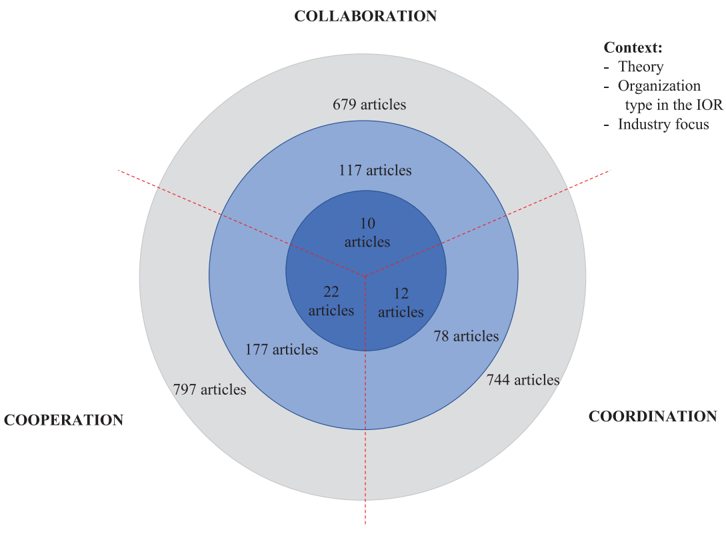
- The review screened 2,220 articles, found 372 relevant articles, and identified only 43 definitions across 44 articles; just 11.83% of relevant articles provided a definition, underscoring how rarely the terms are explicitly defined.
- Across the definitions, the authors found three recurring “interactional dimensions”: attitude, behavior, and outcome; however, overlap across the three terms meant these dimensions alone could not distinguish collaboration, coordination, and cooperation.
- Coordination definitions evoked behaviors in all 12 cases, cooperation definitions spread across attitude (6), behavior (15), and outcome (1), and collaboration definitions split between behavior (6 of 9) and outcome (3 of 9), with no attitude-based collaboration definitions.
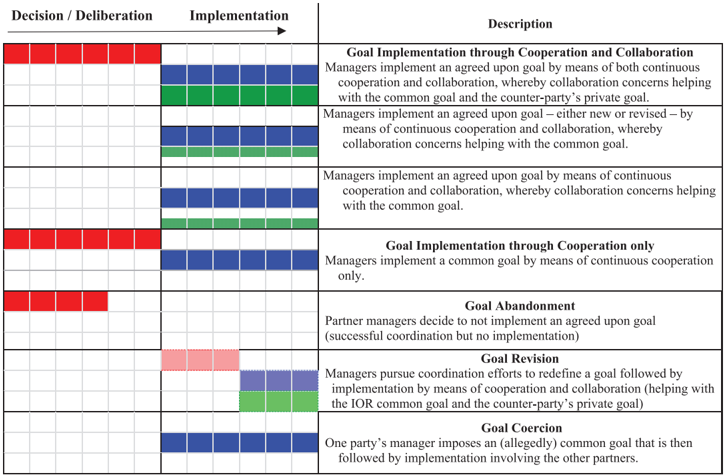
- The paper’s proposed redefinitions are: coordination = the attitudes, behaviors, and outcomes of joint determination of common goals; cooperation = the attitudes, behaviors, and outcomes of implementing those agreed-on goals; collaboration = voluntarily helping others achieve a common IOR goal or one or more private goals.
## Methods
- Systematic literature review of nine top-tier general management journals: Academy of Management Journal, Academy of Management Review, Administrative Science Quarterly, Journal of Management, Journal of Management Studies, Management Science, Organization Science, Organization Studies, and Strategic Management Journal.
- Search covered articles from journal inception through 2017, used direct IOR-related keywords plus the three focal terms, and yielded 2,220 articles; 372 were judged relevant to direct interorganizational relationships.
- The authors manually extracted definitional passages, coded them using a multiple-case study approach, and assessed coding reliability with independent raters; reported agreement was high (Krippendorff’s alpha = 0.92 for relevance screening and 0.84 for coding attitude/behavior/outcome).
## Limitations
- The authors state that their journal list is a boundary condition: it covers only top-tier journals in general management, so the findings may not generalize to specialist or applied journals.
- They also note that the review focuses on a coherent set of direct interorganizational relationships and excludes mergers and acquisitions, board interlocks, and some other network forms; this narrows scope by design.
- Evident from the text: the paper studies only definitions that appear in the body text and only “intensional” definitions, which means it does not capture all possible usages or extensional meanings of the terms.
Model-written summary. Check it against the paper before relying on it.
Integrity signals
Registry
Cites
Statistics
Figures

Verification
Claims the paper makes
3 Valid · 5 Not valid · 46 Not checked · 88 Own results and interpretations
Every source the paper cites for this claim was checked and supports it.
In the paper
“Hardy et al. (2003: 323) define collaboration as “a cooperative, interorganizational relationship that is negotiated in an ongoing communicative process”; thus, the amalgamation of collaboration and cooperation renders limited discriminant validity.”
§ Collaboration, Coordination, and Cooperation Among Organizations: Establishing the Distinctive Meanings of These Terms Through a Systematic Literature Review > Collaboration
What the sources say
- Supportedcites Hardy et al. (2003) matched to “Resources, Knowledge and Influence: The Organizational Effects of Interorganizational Collaboration*” (2003) source
The 'THE EFFECTS OF COLLABORATION' section states the definition verbatim: 'we define collaboration as a cooperative, interorganizational relationship that is negotiated in an ongoing communicative process, and which relies on neither market nor hierarchical mechanisms of control'. The part attributed to this source — that Hardy et al. (2003) define collaboration in those terms — is therefore accurate. The follow-on judgement about 'amalgamation' and 'limited discriminant validity' is the citing authors' own critique, not a claim about this paper, and is not judged here; for completeness, the source's full definition adds the market/hierarchy clause and explicitly asserts it 'provides a set of critical characteristics that distinguishes it from other forms of interorganizational activity'. Our copy carries no page numbers, so the printed '323' could not be checked. (LLM, conf=0.85)
plainstates a cause- Asserted: passes — The authors put it forward as true.
- Checkable: passes — It can be checked against evidence.
- Load-bearing: passes — The paper’s conclusions depend on it.
- Based: passes — The paper gives a reason why it holds.
- Supported
The cited sources support only part of this claim — read each source’s verdict below.
In the paper
“However, the distinction among these terms remains unclear.”
§ Collaboration, Coordination, and Cooperation Among Organizations: Establishing the Distinctive Meanings of These Terms Through a Systematic Literature Review > Keywords: cooperative strategy; coopetition; interorganizational relations; alliances; joint ventures; networks; buyer-supplier relations; consortia; partnerships; discriminant validity; parsimony
What the sources say
- Partly supportedcites Hardy, Phillips, and Lawrence (2003) matched to “Resources, Knowledge and Influence: The Organizational Effects of Interorganizational Collaboration*” (2003) sourceExperimental — accuracy not yet measured
In “The Effects of Collaboration” (page unavailable), the paper says that definitions of collaboration vary across the literature, which lends some support to the claim of conceptual uncertainty. But it offers criteria distinguishing collaboration from other cooperative relationships and does not address a three-way distinction involving coordination. (LLM, conf=0.82)
plain- Asserted: passes — The authors put it forward as true.
- Checkable: passes — It can be checked against evidence.
- Load-bearing: passes — The paper’s conclusions depend on it.
- Based: passes — The paper gives a reason why it holds.
- Partly supported
Every source the paper cites for this claim was checked and supports it.
In the paper
“two separate articles that share a coauthor define collaboration by evoking behaviors (Hardy & Phillips, 1998; see also Hardy et al., 2003) and outcomes (Hardy et al., 2005).”
§ Collaboration, Coordination, and Cooperation Among Organizations: Establishing the Distinctive Meanings of These Terms Through a Systematic Literature Review > Collaboration
What the sources say
- Supportedcites Hardy & Phillips, 1998 matched to “Strategies of Engagement: Lessons from the Critical Examination of Collaboration and Conflict in an Interorganizational Domain” (1998) source
Our copy characterizes collaboration in terms of what parties do rather than what results they produce: the Compliance section (p. n/a) states 'Collaboration operates on a model of shared power... power to define the problem and to propose a solution is effectively shared among the decision makers' and 'Collaboration is thus a mutual engagement strategy in which all partners voluntarily participate,' and the Collaboration – The Community Development Team section describes it through joint action, pooling of resources and shared power. The Abstract frames collaboration as one of several 'strategies of engagement used by organizations,' i.e., a pattern of conduct; the paper offers no outcome-based definition and indeed cautions against judging collaboration by its stated outcomes (Conclusions). This supports the citing sentence's attribution of a behaviour-evoking definition to Hardy & Phillips (1998); the paired 2005 'outcomes' citation is a different paper and not judged here. (LLM, conf=0.80)
- Supportedcites Hardy et al., 2003 matched to “Resources, Knowledge and Influence: The Organizational Effects of Interorganizational Collaboration*” (2003) source
The 'THE EFFECTS OF COLLABORATION' section states the paper's own definition in behavioural/processual terms — a cooperative interorganizational relationship 'negotiated in an ongoing communicative process' that relies on neither market nor hierarchical control — with no reference to outcomes, which is exactly what the 'see also Hardy et al., 2003' tag supports. The 'Characteristics of Collaboration' section reinforces this by operationalising collaboration as patterns of interaction, coalition structure and information flow rather than as its effects. The paper is by Hardy, Phillips and Lawrence, so the shared-coauthor framing with Hardy & Phillips (1998) holds, and although the study examines collaborative effects/outcomes, its definition of collaboration itself is behavioural. (LLM, conf=0.85)
- Supportedcites Hardy et al., 2005 matched to “Discourse and Collaboration: The Role of Conversations and Collective Identity” (2005) source
The Abstract (p. 58) of Hardy, Lawrence & Grant (2005) defines effective collaboration in outcome terms — 'cooperative, interorganizational action that produces innovative, synergistic solutions and balances divergent stakeholder concerns' — and repeats this outcome-based formulation in the Conclusion, so citing it for a definition of collaboration that evokes outcomes is apt. The nuance is that their definition of collaboration as such is relational/mechanism-based ('a cooperative, interorganizational relationship in which participants rely on neither market nor hierarchical mechanisms of control'), with the outcome criteria attached specifically to *effective* collaboration; the citing sentence elides that qualifier but does not misstate the source. The authorship point (Hardy as shared coauthor) is confirmed by our copy's running head 'Hardy, Lawrence, and Grant'. (LLM, conf=0.85)
plain- Asserted: passes — The authors put it forward as true.
- Checkable: passes — It can be checked against evidence.
- Load-bearing: unclear — It is unclear whether the paper’s conclusions depend on it.
- Based: passes — The paper gives a reason why it holds.
- Supported
The cited sources that could be checked couldn’t confirm or dispute this claim.
In the paper
“Prior literature discusses both private and common goals for collaboration, coordination, and cooperation.”
§ Collaboration, Coordination, and Cooperation Among Organizations: Establishing the Distinctive Meanings of These Terms Through a Systematic Literature Review > 5.
What the sources say
- Could not verifycites Olsen, Sofka, & Grimpe, 2016 matched to “Coordinated Exploration for Grand Challenges: The Role of Advocacy Groups in Search Consortia” (2016) sourceExperimental — accuracy not yet measured
Our copy of Olsen, Sofka & Grimpe (2016) holds only the institutional-record metadata — the title/author block (untitled section, p. n.), and the 'Abstract' sections that are in fact the Handle.net/Pure record (keywords 'Advocacy groups, Grand challenges, Coordinated exploration, Stakeholder theory', volume 59(6), pp. 2232-2255, RIS/BIBTEX citation strings). No body text (introduction, literature review, or theory) is present, so nothing states or discusses prior literature on collaboration, coordination and cooperation addressing private versus common goals. Searches on 'private and common goals', 'collaboration coordination cooperation literature', 'common goals versus private interests', and 'search consortia advocacy groups' returned only these metadata blocks. Absence here is not contradiction; the claim simply cannot be checked against our copy. (LLM, conf=0.72)
- Not matchedcites Bae & Gargiulo, 2004;Doz, 1996
A range of references, not one source.
- Not matchedcites Davis & Eisenhardt, 2011;De Rond & Bouchikhi, 2004
A range of references, not one source.
plain- Asserted: passes — The authors put it forward as true.
- Checkable: passes — It can be checked against evidence.
- Load-bearing: unclear — It is unclear whether the paper’s conclusions depend on it.
- Based: passes — The paper gives a reason why it holds.
- Could not verify
A result the paper reports from its own data — it cites no other source for it, so there is none to check. The quote shows it is in the paper.
In the paper
“we observe that the behavioral dimension is featured across all three.”
§ Collaboration, Coordination, and Cooperation Among Organizations: Establishing the Distinctive Meanings of These Terms Through a Systematic Literature Review > Interactional Dimensions of Collaboration, Coordination, and Cooperation Among Organizations
plain- Asserted: passes — The authors put it forward as true.
- Checkable: passes — It can be checked against evidence.
- Load-bearing: passes — The paper’s conclusions depend on it.
- Based: passes — The paper gives a reason why it holds.
72 more claims
Create a free account to see all 142 claims and to verify the 11 references still open.
- Probably not a substantial claim. 47
- It may state two separate claims as one. 23
Self-check
Percentages, sums and reported differences re-computed from the paper’s own numbers.
Each contradiction between two passages listed here was confirmed by an independent check.
Rated minor: it would not touch a result — a value no result rests on, a p-value that stays on the same side of the significance level, or a conflict that is clerical, resolved elsewhere in the paper, or outside its own findings.
In the paper
§ Collaboration, Coordination, and Cooperation Among Organizations: Establishing the Distinctive Meanings of These Terms Through a Systematic Literature Review > Sourcing of Definitions
“Across the three terms, the percentage of relevant articles that provide a definition is low (11.83%).”
§ Collaboration, Coordination, and Cooperation Among Organizations: Establishing the Distinctive Meanings of These Terms Through a Systematic Literature Review > Sourcing of Definitions
“We identified 45 articles providing an intensional definition of any of three terms of interest.”
Rated minor: it would not touch a result — a value no result rests on, a p-value that stays on the same side of the significance level, or a conflict that is clerical, resolved elsewhere in the paper, or outside its own findings.
In the paper
§ Collaboration, Coordination, and Cooperation Among Organizations: Establishing the Distinctive Meanings of These Terms Through a Systematic Literature Review > Sourcing of Definitions
“We identified 45 articles providing an intensional definition of any of three terms of interest.”
§ Collaboration, Coordination, and Cooperation Among Organizations: Establishing the Distinctive Meanings of These Terms Through a Systematic Literature Review > 7.
“It also explains why the number of definitions (43 definitions) is different from the number of articles with definitions (44 articles).”
Citations
Cites
Prospect Theory: An Analysis of Decision under Risk
Kahneman, D., & Tversky, A. (1979) · Econometrica · doi:10.2307/1914185 · Cited by 48,524
DiMaggio, P. J., & Powell, W. W. (1983) · American Sociological Review · doi:10.2307/2095101 · Cited by 38,435
The Structure of Scientific Revolutions
Kuhn, T. S., & Schlegel, R. (1963) · Physics Today · doi:10.1063/1.3050879 · Cited by 35,538
Prospect theory: An analysis of decision under risk
Kahneman, D., & Tversky, A. (1988) · Decision, Probability and Utility · doi:10.1017/cbo9780511609220.014 · Cited by 32,474
Economic Action and Social Structure: The Problem of Embeddedness
Granovetter, M. (1985) · American Journal of Sociology · doi:10.1086/228311 · Cited by 28,745
Social Capital in the Creation of Human Capital
Coleman, J. S. (1988) · American Journal of Sociology · doi:10.1086/228943 · Cited by 26,975
DiMaggio, P. J., & Powell, W. W. (2004) · Advances in Strategic Management · doi:10.1016/s0742-3322(00)17011-1 · Cited by 25,802
Social Capital in the Creation of Human Capital
COLEMAN, J. (2000) · Knowledge and Social Capital · doi:10.1016/b978-0-7506-7222-1.50005-2 · Cited by 21,666
Axelrod, R., & Hamilton, W. D. (1981) · Science · doi:10.1126/science.7466396 · Cited by 20,065
Building Theories from Case Study Research
Eisenhardt, K. M. (1989) · The Academy of Management Review · doi:10.2307/258557 · Cited by 17,455
Research works printed but not linked: 2
- 104. Macneil, I. R. 1980. Economic analysis of contractual relations: Its shortfalls and the need for a rich classificatory apparatus. Northwestern University Law Review, 75: 1018-1041.
- 142. Thompson, J. D. 1967. Organization in action. New York: McGraw-Hill.
Cited by
Items 201–300 of 518
Fernandes, A. R., & Santos, J. B. (2025) · Scandinavian Journal of Management · doi:10.1016/j.scaman.2025.101424 · Cited by 4
Bridging the Gap: Integrating Food Security into Healthcare for Healthier Futures – A Scoping Review
Tohit, N. F. M., Ya, R. M., & Haque, M. (2025) · Advances in Human Biology · doi:10.4103/aihb.aihb_22_25 · Cited by 9
Ding, L., Zhang, H., Zhou, J., & Chen, B. (2025) · Behavioral Sciences · doi:10.3390/bs15101327 · Cited by 5
Exploring Whistleblowing Trends Through Bibliometric Analysis: A Global Perspective
Supendi, S., Hasanudin, A. I., Yazid, H., & Ibrani, E. Y. (2023) · Indian Journal of Corporate Governance · doi:10.1177/09746862231205650 · Cited by 5
How Innovative Work Behavior Affects Employee Performance: The Mediating Role of Curiosity
(2024) · Quality - Access to Success · doi:10.47750/qas/25.200.30 · Cited by 6
Nikolić, M., & Bjelica, D. (2025) · PLoS ONE · doi:10.1371/journal.pone.0331229 · Cited by 8
Frames of cooperation: interactional dynamics of pandemic governance networks
Kork, A., Paananen, H., Kihlström, L., & Tynkkynen, L. (2025) · Public Management Review · doi:10.1080/14719037.2025.2557860 · Cited by 5
Investigation of distinguished approaches towards synergy
Holubčík, M., Soviar, J., & Lendel, V. (2023) · Journal of Entrepreneurship and Sustainability Issues · doi:10.9770/jesi.2023.10.4(18 · Cited by 2
Sage, K. D., Stockdale, K., & Mauer, L. (2023) · Discover Education · doi:10.1007/s44217-023-00078-3 · Cited by 5
The research on the impact of industry governance on trust after group product-harm crisis
Li, Y., & Zhao, M. (2024) · Heliyon · doi:10.1016/j.heliyon.2024.e35229 · Cited by 4
Nene, S. E. (2024) · Curationis · doi:10.4102/curationis.v47i1.2574 · Cited by 5
Exploring the field of NGO cooperation in Lebanon: Snapshot from the field
Haddad, P. E., & Zardet, V. (2023) · Management international · doi:10.59876/a-na6k-7pyf · Cited by 3
Networked solidarity economy: Gender in interorganizational networks. An evaluation with ERGMs
Garrido-Skurkowicz, N., & Steglich, C. (2022) · Applied Network Science · doi:10.1007/s41109-022-00458-y · Cited by 6
Knowledge production and commercialization from R&D: the pharmaceutical sector
Valderrama, T. G., Ortiz, J. S., & Mendigorri, E. M. M. (2023) · Management Decision · doi:10.1108/md-05-2022-0567 · Cited by 3
Sunarso, B. (2024) · Technology and Society Perspectives (TACIT) · doi:10.61100/tacit.v2i1.143 · Cited by 3
Victor Tillberg, L., Berndtsson, J., & Tillberg, P. (2025) · Scandinavian Journal of Military Studies · doi:10.31374/sjms.288 · Cited by 5
Cooperative Abilities and Cognitive Learning Outcomes: Study Group Investigation on Life Cycle Topic
Leasa, M., & Wuarlela, M. E. (2023) · International Journal of Elementary Education · doi:10.23887/ijee.v7i1.56162 · Cited by 9
Competency Development Strategies for Employees in the Context of Community Empowerment
Krishernawan, I., Kamar, K., Yani, A., Zen, A., & Jusman, I. A. (2024) · Jurnal Terobosan Peduli Masyarakat (TIRAKAT) · doi:10.61100/j.tirakat.v1i1.104 · Cited by 7
Effectiveness of health partners coordination for COVID-19 pandemic response in Nepal
Mishra, S., Adhikari, S. K., Sah, P. K., Gocotano, A., Neupane, S., Thapa, B., & Devkota, G. (2024) · PLoS ONE · doi:10.1371/journal.pone.0308941 · Cited by 3
Observed and Potential Conflicts in Management of Interdependent Infrastructure Systems
Gerst, M. D., Coelho, M., Yazdi-Samadi, M. R., Reilly, A., & Kenney, M. A. (2024) · Journal of Management in Engineering · doi:10.1061/jmenea.meeng-5907 · Cited by 6
Wang, H., Gao, X., Xu, C., & Chen, W. (2025) · Social Neuroscience · doi:10.1080/17470919.2025.2535011 · Cited by 5
Unlocking the Code to Continuous Innovation: A Study of Key Determinants for Serial Innovators
Rosário, C., Varum, C., & Botelho, A. (2024) · Administrative Sciences · doi:10.3390/admsci14030045 · Cited by 10
Koh, L. Y., Chua, C., Wang, X., & Yuen, K. F. (2025) · Corporate Social Responsibility and Environmental Management · doi:10.1002/csr.70290 · Cited by 6
How to Improve Collaboration in Sustainable Urban Community Renewal? An Evolutionary Game Model
Sun, H., Zhang, Y., Wang, Y., Chen, J., & Wu, H. (2025) · Land · doi:10.3390/land14091863 · Cited by 4
Djalil, M. A., Chan, S., Putra, T. R. I., Tabrani, M., & Agustina, M. (2025) · Revista de Gestão Social e Ambiental · doi:10.24857/rgsa.v19n1-030 · Cited by 9
Corporate Social Responsibility Knowledge Transfer in Interfirm Networks
Almashayekhi, A. O. (2023) · International Journal of Knowledge Management · doi:10.4018/ijkm.317101 · Cited by 3
Östberg, L., Snyder, K., & Lilja, J. (2025) · Journal of Service Theory and Practice · doi:10.1108/jstp-05-2025-0177 · Cited by 12
Widodo, G., Avenzora, R., Malihah, E., & Sunarminto, T. (2023) · Indonesian Journal of Forestry Research · doi:10.59465/ijfr.2023.10.1.113-134 · Cited by 7
Milekhina, O. V., Aslanova, I., & Sirik, E. E. (2024) · University Management Practice and Analysis · doi:10.15826/umpa.2024.01.004 · Cited by 5
Bell, M., & Fandrem, H. (2025) · International Journal of Bullying Prevention · doi:10.1007/s42380-024-00277-y · Cited by 5
Studi Pemetaan Sistematis: Strategi Employer Branding dalam Keberlanjutan Organisasi di Era VUCA
Annisa, S. (2022) · JURNAL MANAJEMEN DAN BISNIS SRIWIJAYA · doi:10.29259/jmbs.v19i3.15666 · Cited by 4
Aghazadeh, H., & Maleki, H. (2023) · Journal of the Knowledge Economy · doi:10.1007/s13132-023-01180-5 · Cited by 4
Oamen, T. E. (2023) · Journal of Interprofessional Care · doi:10.1080/13561820.2023.2240857 · Cited by 4
Digitale Plattformen in der Industrie und ihre Bedeutung für die zwischenbetriebliche Zusammenarbeit
Brechtel, M., Altmann, S. M., & Hölzle, K. (2024) · Schwerpunkt Business Model Innovation · doi:10.1007/978-3-658-43130-3_3 · Cited by 2
Conceptualising total defence: inter-organisational structures in a comparative perspective
Obling, A. R., Berndtsson, J., & Østensen, Å. G. (2026) · European Security · doi:10.1080/09662839.2026.2620708 · Cited by 5
Critical Infrastructures for Disaster Risk Reduction
(2025) · doi:10.1007/978-981-97-4547-0_215-2 · Cited by 2
Enabling Public Service Collaborations Through Network Leadership
Rønningstad, C. (2025) · Human Services Organizations Management Leadership & Governance · doi:10.1080/23303131.2025.2500586 · Cited by 2
Teariki, M. A., Penny, G., & Howden‐Chapman, P. (2025) · Urban Science · doi:10.3390/urbansci9060200 · Cited by 2
Interprofessional Collaboration in Early Childhood Education and Care
Ališauskienė, S., Kairienė, D., Hanssen, N. B., Kangas, J., & Harju‐Luukkainen, H. (2023) · Critical cultural studies of childhood · doi:10.1007/978-3-031-34023-9_2 · Cited by 4
Alderman, L., & Beck, E. (2025) · Public Health Reports · doi:10.1177/00333549251349417 · Cited by 4
Carretta, A., Fattobene, L., Graziano, E. A., & Schwizer, P. (2024) · Journal of Management & Governance · doi:10.1007/s10997-024-09727-7 · Cited by 4
Klimas, P., Radomska, J., Kościewicz, D., Strzelec, G., & Wrona, S. (2025) · Games and Culture · doi:10.1177/15554120251317276 · Cited by 7
Multas, A., Suorsa, A. R., Keränen, T., & Enwald, H. (2025) · Library & Information Science Research · doi:10.1016/j.lisr.2025.101355 · Cited by 2
Meier, D. R. (2021) · Commonwealth and Comparative Politics · doi:10.1080/14662043.2021.1992847 · Cited by 2
Otoo, F. N. K. (2026) · Employee Relations · doi:10.1108/er-03-2025-0234 · Cited by 4
Rukchart, N., Buakate, P., Shamsudin, F. M., & Chutipattana, N. (2022) · Cogent Education · doi:10.1080/2331186x.2022.2151249 · Cited by 4
Jeon, J., & Jang, S. (2025) · Journal of Enterprising Communities People and Places in the Global Economy · doi:10.1108/jec-05-2024-0087 · Cited by 2
Song, P., Zuo, L., Peng, X., & Fang, E. (2024) · Journal of Operations Management · doi:10.1002/joom.1328 · Cited by 3
When Domains Collide: An Activity Theory Exploration of Cross-Disciplinary Collaboration
Feng, Z., Zimmermann, T., Pisani, L., Gooley, C., Wander, J., & Sarma, A. (2025) · 2025 ACM/IEEE International Symposium on Empirical Software Engineering and Measurement (ESEM) · doi:10.1109/esem64174.2025.00017 · Cited by 4
Johnson, K., Biddell, C. B., Combs, K. G., Wiesman, J., Lupi, M. V., & Lich, K. H. (2023) · Health Promotion Practice · doi:10.1177/15248399231192989 · Cited by 5
Cyber Security Norms: Trust and Cooperation
Wylde, A. (2022) · European Conference on Cyber Warfare and Security · doi:10.34190/eccws.21.1.498 · Cited by 4
Lin, M., Zhonghe, Z., Wei, F., & Arif, M. (2025) · Humanities and Social Sciences Communications · doi:10.1057/s41599-025-06057-3 · Cited by 2
Alaghbari, M. A., Ateeq, A. A., Milhem, M., Garad, A., & Yusuf, A. Y. A. (2024) · International Conference on Decision Aid Sciences and Applications (DASA) · doi:10.1109/dasa63652.2024.10836407 · Cited by 5
In Which Areas of Technical AI Safety Could Geopolitical Rivals Cooperate?
Bucknall, B., Siddiqui, S., Thurnherr, L., McGurk, C., Harack, B., Reuel, A., Paskov, P., Mahoney, C., Mindermann, S., Singer, S., et al. (2025) · SuperIntelligence - Robotics - Safety & Alignment · doi:10.70777/si.v2i5.15509 · Cited by 5
L’entreprise libérée : proposition de critères de caractérisation
Khoury, M. E., Jaouen, A., & Sammut, S. (2022) · Revue de l’organisation responsable · doi:10.54695/ror.173.0009 · Cited by 5
Wu, A., & Zhai, X. (2024) · Industrial Marketing Management · doi:10.1016/j.indmarman.2024.09.011 · Cited by 2
Slapničar, S., Vuko, T., Čular, M., & Drašček, M. (2026) · Contemporary Accounting Research · doi:10.1111/1911-3846.70052 · Cited by 8
Izharuddin, M., & Sukoco, B. M. (2024) · Industry and Higher Education · doi:10.1177/09504222241287068 · Cited by 5
Human Capital Becomes An Important Component In The Performance Of The Islamic Bank Of Thailand
Choi, C. (2022) · Tamansiswa Management Journal International · doi:10.54204/tmji/vol412022009 · Cited by 2
Coopetition in practice: Managerial practices for navigating cooperation with competitors
Gur, F. A., & Greckhamer, T. (2025) · European Management Journal · doi:10.1016/j.emj.2025.01.003 · Cited by 4
Ylisirniö, M., Laukka, E., Huhtakangas, M., Kuha, S., Hammarén, M., & Kanste, O. I. (2024) · Hallinnon Tutkimus · doi:10.37450/ht.127101 · Cited by 2
Freeing transdisciplinarity from the project straightjacket: reframing the problem
Romera, A. J. J., Bratman, E. Z., de Plaza, M. A. P., Descalzo, A. M., & Ghneim‐Herrera, T. (2025) · Social Sciences & Humanities Open · doi:10.1016/j.ssaho.2025.101483 · Cited by 5
Guan, J.-L., Lee, T., Mostert, P. G., Svensson, G., & Høgevold, N. M. (2023) · Journal of Contemporary Marketing Science · doi:10.1108/jcmars-02-2022-0003 · Cited by 4
‘We all have the same goals’? Goal diversity in cross-sector collaborations of cultural education
Arnold, M.-T., & Kolleck, N. (2025) · Frontiers in Education · doi:10.3389/feduc.2025.1478472 · Cited by 2
Supply chain response to food safety incidents
van Beusekom, P. (2022) · Research Publications (Maastricht University) · doi:10.26481/dis.20220706pb · Cited by 1
Leadership style analysis of the Head of Sukahurip Village, Pangandaran District
Azzahra, D. H., Rizkiani, N. A., & Katiah, K. (2023) · Dedicated Journal of Community Services (Pengabdian kepada Masyarakat) · doi:10.17509/dedicated.v1i2.62002 · Cited by 1
Pangestu, A., & Firdaus, F. M. (2024) · Jurnal Ilmiah Sekolah Dasar · doi:10.23887/jisd.v8i1.64923 · Cited by 8
Isaeva, I., Ooms, W., & Johansen, J. P. (2022) · IEEE Transactions on Engineering Management · doi:10.1109/tem.2022.3209013 · Cited by 3
Evaluating the wisdom of scholar crowds from the perspective of knowledge diffusion
Song, L., Zhu, G., & Yin, X. (2024) · Scientometrics · doi:10.1007/s11192-024-05090-4 · Cited by 2
Value Creation and Tension in Coopetition: The Emergence of Virtuous and Vicious Cycles
Ryan‐Charleton, T., & Gnyawalị, D. R. (2021) · Academy of Management Proceedings · doi:10.5465/ambpp.2021.10535abstract · Cited by 1
AI, Firms, and Inoperative Communication Risks with the Fragmented-Social Collective
Jackson, R. A., & Heath, B. L. (2025) · Voice of the Publisher · doi:10.4236/vp.2025.114045 · Cited by 1
Compreensão do crowdfunding como redes colaborativas para startups: Uma agenda de pesquisa
Telles, R., Goes, W., Ferreira, G. G., Zenke, A. A., & Ferraro, R. (2024) · REGEPE Entrepreneurship and Small Business Journal · doi:10.14211/regepe.esbj.e2416 · Cited by 3
Personalization of an Intelligent Assistant for Complex Sociotechnical Systems
Petukhov, I., Steshina, L., Velev, D. G., & Златева, П. (2025) · International Russian Automation Conference (RusAutoCon) · doi:10.1109/rusautocon65989.2025.11177263 · Cited by 2
Trang, T. T. V., & Khương, M. N. (2023) · Zbornik radova Ekonomskog fakulteta u Rijeci · doi:10.18045/zbefri.2023.2.449 · Cited by 2
Business Participation in Regulation: A Multifocal Perspective on Management Studies
van den Broek, O. M., Schrempf‐Stirling, J., de Bakker, F. G. A., & Kourula, A. E. (2025) · Regulation & Governance · doi:10.1111/rego.70110 · Cited by 1
Exploring crisis governance: Quest for functional resilience during COVID-19 in Lithuania
Žilinskas, R., & Sakalauskas, L. L. (2021) · Scientific Journal of the Military University of Land Forces · doi:10.5604/01.3001.0015.6180 · Cited by 4
Istianti, T., Muh. Asriadi, A. M., & Silawati, E. (2026) · International Journal of Educational Reform · doi:10.1177/10567879261458316 · Cited by 1
Contracting for circularity: How circular economy clauses shape market and financial performance
Castro-López, A., Iglesias, V., & Vijande, M. L. S. (2026) · Journal of Purchasing and Supply Management · doi:10.1016/j.pursup.2026.101153 · Cited by 5
Huang, H., Kasaija, P., Nantanda, R., & Okello, G. (2024) · Research Square · doi:10.21203/rs.3.rs-4488886/v1 · Cited by 1
Virtual Collaboration Evolution: Trends and Innovations on the Horizon
Asrifan, A., Syamsu, T., Apriani, E., Vargheese, K. J., Rasyid, R. E., & Aqad, M. H. A. (2024) · Advances in human resources management and organizational development book series · doi:10.4018/979-8-3693-6839-8.ch001 · Cited by 1
Kooperationen unter Konsensfiktion durch Mehrdeutigkeit
Sailer, P. (2021) · Uniscope · doi:10.1007/978-3-658-34497-9_12 · Cited by 1
Strategic Alliance Outcomes: Consolidation and New Directions (WITHDRAWN)
Ryan‐Charleton, T., Gnyawalị, D. R., & Oliveira, N. R. B. D. (2022) · Academy of Management Proceedings · doi:10.5465/ambpp.2022.10615abstract · Cited by 1
Self-citation
Metadata
- Authors
- Castañer, X., & Oliveira, N.
- Affiliations
- University of Lausanne (CH)
- Tilburg University (NL)
- Corresponding author
- Oliveira, Nuno
- Venue
- Journal of Management
- Publisher
- SAGE Publications
- Published
- 2020-02-24
- Volume
- 46
- Issue
- 6
- Pages
- 965-1001
- ISSN
- 0149-2063 (ISSN-L)
- 1557-1211
- OpenAlex
- W3008299625
- Cited by
- 525
- References
- 182
- Citations by year
- 2026: 62 · 2025: 134 · 2024: 122 · 2023: 103 · 2022: 60 · 2021: 35 · 2020: 9
- FWCI
- 8.07
- Type
- journal article
- Language
- en
- Open access
- hybrid
- doi.org
- Licence
- Locations
- Journal of Management (publishedVersion, cc-by-nc)
- Research portal (Tilburg University) (publishedVersion, other-oa)
- Data Archiving and Networked Services (DANS) (submittedVersion, other-oa)
- IRIS (submittedVersion)
- SERVAL (Université de Lausanne) (submittedVersion)
- Topics
- Social Sciences › Business, Management and Accounting › Strategy and Management › Business Strategy and Innovation
- Social Sciences › Business, Management and Accounting › Organizational Behavior and Human Resource Management › Management and Organizational Studies
- Social Sciences › Public Administration › Public Policy and Administration Research
- Keywords
- collaboration, coordination, cooperation, interorganizational relationships, inter-organizational alliances, conceptual definitions, goal types, theory development
About these checks
Registry, retraction, Cites and statistics results are computed, not judged, with one exception: a printed reference that no index lists is read once by a model before it counts as a citation error. Claims are extracted by a model and kept only when their quote appears verbatim in the text; each cited source is then checked, with a model’s help, for whether it says what the claim relies on. Those verdicts can be wrong — read the claim’s quote and the cited source before relying on one.
The claim verdicts this report counts are experimental: their accuracy is not yet measured.
A language model drew the claims from the paper on 2026-10-10, under version 3 of the claim definition (model deepseek-v4.1-flash, prompt extract-v3).
A second model labelled each claim on 2026-10-10 (model jev-1.13-20260917, definition revision gold-guideline-v0.2).
Cited sources are checked with a language model’s help (qwen3.8-omni-flash and gpt-6-sol).
Statistics and arithmetic are recomputed, not judged.
Confidence bands are shown only for fields calibrated on our annotated test set. None is calibrated yet, so no band is shown.
What counts as a claim ›How we measure confidence ›How we check this ›
Are you an author, or do you see a problem with this page? Request a review
Data sources
Bibliographic data: Semantic Scholar, OpenAlex, Crossref.
Contains information from the Semantic Scholar Academic Graph Datasets, made available under the ODC Attribution License (ODC-BY 1.0).
Semantic Scholar’s data is described in: Kinney, R., et al. (2023). The Semantic Scholar Open Data Platform. arXiv:2301.10140.
