

Anti-inflammatory treatment for major depressive disorder: implications for patients with an elevated immune profile and non-responders to standard antidepressant therapy
Open accessThe DOI matches its Crossref record; 174 of the 175 references it cites were found in a registry or an index.
Abstract
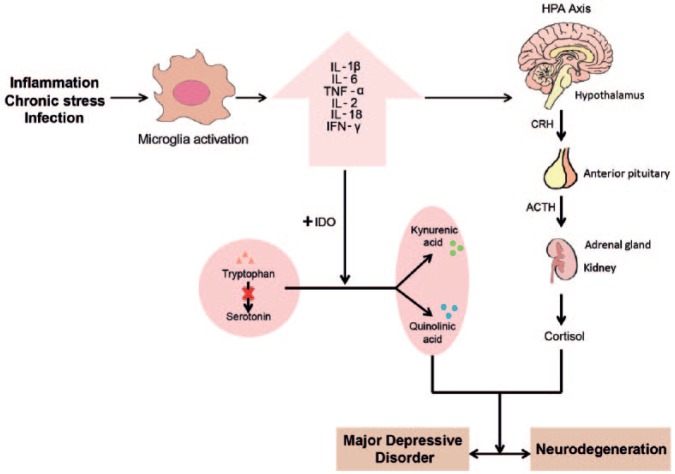
Major depressive disorder (MDD) is a prevalent and disabling psychiatric disease with rates of non-responsiveness to antidepressants ranging from 30–50%. Historically, the monoamine depletion hypothesis has dominated the view on the pathophysiology of depression. However, the lack of responsiveness to antidepressants and treatment resistance suggests that additional mechanisms might play a role. Evidence has shown that a subgroup of depressive patients may have an underlying immune deregulation that could explain the lack of therapeutic benefit from antidepressants. Stimuli like inflammation and infection can trigger the activation of microglia to release pro-inflammatory cytokines, acting on two main pathways: (1) activation of the hypothalamic–pituitary adrenal axis, generating an imbalance in the serotonergic and noradrenergic circuits; (2) increased activity of the enzyme indoleamine-2,3-dioxygenase, resulting in depletion of serotonin levels and the production of quinolinic acid. If this hypothesis is proven true, the subgroup of MDD patients with increased levels of pro-inflammatory cytokines, mainly IL-6, TNF-α and IL-1β, might benefit from an anti-inflammatory intervention. Here, we discuss the pre-clinical and clinical studies that have provided support for treatment with non-steroidal anti-inflammatory drugs in depressed patients with inflammatory comorbidities or an elevated immune profile, as well as evidences for anti-inflammatory properties of standard antidepressants.
Overview
The claims and statistics of this paper haven’t been checked yet.
Free: it reads the open-access text and checks the first 5 claims that cite a source we can check. Create a free account to check every claim.
Integrity signals
Registry
Cites
Statistics
Figures
Verification
Claims the paper makes
The claims and statistics of this paper haven’t been checked yet.
Free: it reads the open-access text and checks the first 5 claims that cite a source we can check. Create a free account to check every claim.
Claims other papers make about this one
Each is checked against this paper’s own text: does it say what the citing paper says it does?
The source backs part of the claim, not all of it — or backs it for a different population, condition or comparison.
In the citing paper
“Evidence of altered inflammation-related markers across psychiatric conditions [6–8], along with reports of anti-inflammatory effects from psychotropic medications [9, 10] and the ameliorative impact of anti-inflammatory drugs on psychiatric symptoms [11–14], suggests a strong link between abnormal inflammatory responses and major psychiatric disorders.”
From Inflammatory ratios as predictors of length of hospitalization in psychiatric patients: A multicenter study (2025) · doi:10.1007/s00406-025-02033-9 · cites this paper as [11]
Experimental — accuracy not yet measuredThe source backs part of the claim, not all of it — or backs it for a different population, condition or comparison.
In the citing paper
“On one hand, drugs that target IRFs have been proposed for treating psychiatric disorders, including major depression (MDD)10–12, schizophrenia (SCZ)13 and bipolar disorder (BD)14, particularly in a subset of patients with chronic inflammation10”
From Inflammation-related biomarkers in major psychiatric disorders: a cross-disorder assessment of reproducibility and specificity in 43 meta-analyses (2019) · cites this paper as [12]
Experimental — accuracy not yet measured
Self-check
Percentages, sums and reported differences re-computed from the paper’s own numbers.
The self-check needs the paper’s full text.
Citations
Cites
Diagnostic and Statistical Manual of Mental Disorders
American Psychiatric Association (2013) · doi:10.1176/appi.books.9780890425596 · Cited by 116,369
Hamilton, M. (1960) · Journal of Neurology, Neurosurgery & Psychiatry · doi:10.1136/jnnp.23.1.56 · Cited by 32,817 · cited 2×
“Moreover, PET tracer uptake (microglia activation) was correlated with the Hamilton Depression Rating Scale (HDRS) score (Hamilton, 1960) in the anterior cingulated cortex (Setiawan et al., 2015).”
MethodPolazzi, E., Mengoni, I., Caprini, M., Peña-Altamira, E., Kurtys, E., & Monti, B. (2013) · Neurosignals · doi:10.1159/000337115 · Cited by 8,994
Molecular Mechanisms of Depression: Perspectives on New Treatment Strategies
Lang, U. E., & Borgwardt, S. (2013) · Cellular Physiology and Biochemistry · doi:10.1159/000350094 · Cited by 8,475
Kessler, R. C., Berglund, P., Demler, O., Jin, R., Koretz, D., Merikangas, K. R., Rush, A. J., Walters, E. E., & Wang, P. S. (2003) · JAMA · doi:10.1001/jama.289.23.3095 · Cited by 7,988 · cited 1×
“Not only the high incidence of MDD and the disability associated with the disease, but also the high rate of inadequate treatment of the disorder remains a serious concern (Kessler et al., 2003).”
BackgroundGlutamate neurotoxicity and diseases of the nervous system
CHOI, D. (1988) · Neuron · doi:10.1016/0896-6273(88)90162-6 · Cited by 7,972
From inflammation to sickness and depression: when the immune system subjugates the brain
Dantzer, R., O'Connor, J. C., Freund, G. G., Johnson, R. W., & Kelley, K. W. (2008) · Nature Reviews Neuroscience · doi:10.1038/nrn2297 · Cited by 7,395 · cited 4×
“vagus nerve), delivering cytokine signals to relevant brain regions including the nucleus of the solitary tract and hypothalamus (Dantzer et al., 2008; Miller et al., 2009).”
BackgroundInfluentialRush, A. J., Trivedi, M. H., Wisniewski, S. R., Nierenberg, A. A., Stewart, J. W., Warden, D., Niederehe, G., Thase, M. E., Lavori, P. W., Lebowitz, B. D., et al. (2006) · American Journal of Psychiatry · doi:10.1176/ajp.2006.163.11.1905 · Cited by 5,643 · cited 2×
“It is estimated that 30–50% of the patients do not respond to treatment with antidepressants (Bschor et al., 2012) due to either lack of efficacy or intolerable side effects (Rush et al., 2006).”
BackgroundA Meta-Analysis of Cytokines in Major Depression
Dowlati, Y., Herrmann, N., Swardfager, W., Liu, H., Sham, L., Reim, E. K., & Lanctôt, K. L. (2010) · Biological Psychiatry · doi:10.1016/j.biopsych.2009.09.033 · Cited by 4,729 · cited 8×
“Major depression disorder (MDD) is an important public health issue (Dowlati et al., 2010; Miller et al., 2009), predicted to be the second leading cause of disability by the year of 2020 behind only ischemic heart disease (Rush et al.”
BackgroundInfluentialOverweight, Obesity, and Depression: A Systematic Review and Meta-analysis of Longitudinal Studies
Luppino, F. S., de Wit, L. M., Bouvy, P. F., Stijnen, T., Cuijpers, P., Penninx, B. W. J. H., & Zitman, F. G. (2010) · Archives of General Psychiatry · doi:10.1001/archgenpsychiatry.2010.2 · Cited by 4,322 · cited 2×
“Depression’s causal role in obesity might be due to neuroendocrine disturbances, through a long-term activation of the HPA axis and release of cortisol, along with an unhealthy lifestyle (Luppino et al., 2010).”
BackgroundResult
Cited by
Role of oxidative stress in depression
Bhatt, S., Nagappa, A. N., & Patil, C. R. (2020) · Drug Discovery Today · doi:10.1016/j.drudis.2020.05.001 · Cited by 821
Microglia in depression: an overview of microglia in the pathogenesis and treatment of depression
Wang, H., He, Y., Sun, Z., Ren, S., Liu, M., Wang, G., & Yang, J. (2022) · Journal of Neuroinflammation · doi:10.1186/s12974-022-02492-0 · Cited by 571
Yuan, N., Chen, Y., Xia, Y., Dai, J., & Liu, C. (2019) · Translational Psychiatry · doi:10.1038/s41398-019-0570-y · Cited by 428
Beyond a neurotransmitter: The role of serotonin in inflammation and immunity
Wu, H., Denna, T. H., Storkersen, J. N., & Gerriets, V. A. (2019) · Pharmacological Research · doi:10.1016/j.phrs.2018.06.015 · Cited by 338
Microglia in depression: current perspectives
Jia, X., Gao, Z., & Hu, H. (2021) · Science China Life Sciences · doi:10.1007/s11427-020-1815-6 · Cited by 282
“…the selective serotonin reuptake inhibitors (SSRIs), serotonin/norepinephrine reuptake inhibitors (SNRIs), tricyclic antidepressants (TCAs) and monoamine oxidase inhibitors (MAOIs), have been shown to have an impact on microglial activation and neuroinflammation (Kopschina Feltes et al., 2017).”
BackgroundImpact of COVID-19 in the Mental Health in Elderly: Psychological and Biological Updates
Grolli, R. E., Mingoti, M. E. D., Bertollo, A. G., Luzardo, A. R., Quevedo, J., Réus, G. Z., & Ignácio, Z. M. (2021) · Molecular Neurobiology · doi:10.1007/s12035-020-02249-x · Cited by 258
On inflammatory hypothesis of depression: what is the role of IL-6 in the middle of the chaos?
Roohi, E., Jaafari, N., & Hashemian, F. (2021) · Journal of Neuroinflammation · doi:10.1186/s12974-021-02100-7 · Cited by 225
Liu, C.-H., Yang, M.-H., Zhang, G.-Z., Wang, X.-X., Li, B., Li, M., Woelfer, M., Walter, M., & Wang, L. (2020) · Journal of Neuroinflammation · doi:10.1186/s12974-020-01732-5 · Cited by 210
Kouba, B. R., de Araujo Borba, L., Borges de Souza, P., Gil-Mohapel, J., & Rodrigues, A. L. S. (2024) · Cells · doi:10.3390/cells13050423 · Cited by 209
“Therefore, it has been suggested that inhibiting this enzyme could be beneficial in depression [245].”
BackgroundZhang, Y., Long, Y., Yu, S., Li, D., Yang, M., Guan, Y., Zhang, D., Wan, J., Liu, S., Shi, A., et al. (2021) · Pharmacological Research · doi:10.1016/j.phrs.2020.105376 · Cited by 201
Depression, dementia and immune dysregulation
Hayley, S., Hakim, A. M., & Albert, P. R. (2021) · Brain · doi:10.1093/brain/awaa405 · Cited by 186
The Impact of Nutrients on Mental Health and Well-Being: Insights From the Literature
Muscaritoli, M. (2021) · Frontiers in Nutrition · doi:10.3389/fnut.2021.656290 · Cited by 183
Mechanistic Insights into the Link between Gut Dysbiosis and Major Depression: An Extensive Review
Sonali, S., Ray, B., Ahmed Tousif, H., Rathipriya, A. G., Sunanda, T., Mahalakshmi, A. M., Rungratanawanich, W., Essa, M. M., Qoronfleh, M. W., Chidambaram, S. B., et al. (2022) · Cells · doi:10.3390/cells11081362 · Cited by 156
Role of inflammation in depression relapse
Liu, C.-H., Zhang, G.-Z., Li, B., Li, M., Woelfer, M., Walter, M., & Wang, L. (2019) · Journal of Neuroinflammation · doi:10.1186/s12974-019-1475-7 · Cited by 162
Yin, Y., Ju, T., Zeng, D., Duan, F., Zhu, Y., Liu, J., Li, Y., & Lu, W. (2024) · Pharmacological Research · doi:10.1016/j.phrs.2024.107322 · Cited by 179
Nowak, W., Grendas, L. N., Sanmarco, L. M., Estecho, I. G., Arena, Á. R., Eberhardt, N., Rodante, D. E., Aoki, M. P., Daray, F. M., Carrera Silva, E. A., et al. (2019) · EBioMedicine · doi:10.1016/j.ebiom.2019.10.063 · Cited by 159
“The inflammation theory of depression involve a complex interaction of innate and adaptive immune cells, inflammatory cytokines, endocrine signalling molecules, and neuromodulatory processes in the periphery and the central nervous system that may have a profound effect on behavioural alterations and the development o…”
BackgroundDonoso, F., Cryan, J. F., Olavarría‐Ramírez, L., Nolan, Y. M., & Clarke, G. (2023) · Clinical Pharmacology & Therapeutics · doi:10.1002/cpt.2581 · Cited by 142
Neurobiological Highlights of Cognitive Impairment in Psychiatric Disorders
Morozova, A., Zorkina, Y., Abramova, O., Pavlova, O., Pavlov, K., Soloveva, K., Volkova, M., Alekseeva, P., Andryshchenko, A., Kostyuk, G., et al. (2022) · International Journal of Molecular Sciences · doi:10.3390/ijms23031217 · Cited by 114
“Activated microglia produces pro-inflammatory cytokines, which can lead to neurodegeneration and depressive disorders through hyperactivation of the hypothalamic-pituitary-adrenal axis and an increase in IDO activity [219].”
BackgroundFeng, X., Jia, M., Cai, M., Zhu, T., Hashimoto, K., & Yang, J. (2025) · Molecular Psychiatry · doi:10.1038/s41380-025-03085-y · Cited by 156
“Theactivation of in fl ammatory pathways in the brain can result in the upregulation of cyclooxygenase (COX), suggesting that COX inhibition may serve as a therapeutic approach for depression [214].”
Novel neuroimmunologic therapeutics in depression: A clinical perspective on what we know so far
Roman, M., & Irwin, M. R. (2020) · Brain, Behavior, and Immunity · doi:10.1016/j.bbi.2019.09.016 · Cited by 132
Childhood trauma, HPA axis activity and antidepressant response in patients with depression
Nikkheslat, N., McLaughlin, A. P., Hastings, C., Zajkowska, Z., Nettis, M. A., Mariani, N., Enache, D., Lombardo, G., Pointon, L., Cowen, P. J., et al. (2020) · Brain, Behavior, and Immunity · doi:10.1016/j.bbi.2019.11.024 · Cited by 124
“…et al., 2008) and that depressed patients with higher inflammation are less responsive to standard antidepressant treatments (Carvalho et al., 2013, Kopschina Feltes et al., 2017); a recent metaanalysis does not support hyperactivation of HPA axis as a predictor for antidepressant treatment…”
BackgroundAnti-TNF-α Compounds as a Treatment for Depression
Uzzan, S., & Azab, A. N. (2021) · Molecules · doi:10.3390/molecules26082368 · Cited by 126
Zhao, X., Kong, D., Zhou, Q., Wei, G., Song, J., Liang, Y., & Du, G. (2021) · Biomedicine & Pharmacotherapy · doi:10.1016/j.biopha.2021.111556 · Cited by 116
Meta‐analysis of total and differential white blood cell counts in schizophrenia
Jackson, A. J., & Miller, B. J. (2020) · Acta Psychiatrica Scandinavica · doi:10.1111/acps.13140 · Cited by 103
Kim, Y.-K., Kim, O. Y., & Song, J. (2020) · Frontiers in Pharmacology · doi:10.3389/fphar.2020.01270 · Cited by 109
“Over the past two decades, several studies have indicated that neuroinflammation is a critical reason for the onset, deterioration, relapse, and maintenance of depression (Figure 2) (Kopschina Feltes et al., 2017; Paudel et al., 2018; Woelfer et al., 2019).”
BackgroundThe cytokine profile of women with severe anxiety and depression during pregnancy
Leff, P., Mancilla‐Herrera, I., Flores‐Ramos, M., Takashima, M. F. S., Coronel, F., Cruz-Fuentes, C. S., Molina, A., Hernández-Ruiz, J., Silva-Aguilera, F. S., Farfán-Labonne, B. E., et al. (2019) · BMC Psychiatry · doi:10.1186/s12888-019-2087-6 · Cited by 103
Tayab, M. A., Islam, M. N., Chowdhury, K. A. A., & Tasnim, F. M. (2022) · Biomedicine & Pharmacotherapy · doi:10.1016/j.biopha.2022.112668 · Cited by 96
Böttcher, C., Fernández-Zapata, C., Snijders, G. J. L., Schlickeiser, S., Sneeboer, M. A. M., Kunkel, D., De Witte, L. D., & Priller, J. (2020) · Translational Psychiatry · doi:10.1038/s41398-020-00992-2 · Cited by 90
Basal and LPS-stimulated inflammatory markers and the course of individual symptoms of depression
van Eeden, W. A., van Hemert, A. M., Carlier, I. V. E., Penninx, B. W. J. H., Lamers, F., Fried, E. I., Schoevers, R., & Giltay, E. J. (2020) · Translational Psychiatry · doi:10.1038/s41398-020-00920-4 · Cited by 82
Li, H., Song, L., Cen, M., Fu, X., Gao, X., Zuo, Q., & Wu, J. L. (2023) · Journal of Affective Disorders · doi:10.1016/j.jad.2023.04.134 · Cited by 91
Yanuck, S. F. (2019) · Frontiers in Psychiatry · doi:10.3389/fpsyt.2019.00712 · Cited by 78
“have suggested that a clinical approach that addresses neuroimmunological factors might have greatest utility in MDD patients with elevated inflammatory cytokines, particularly IL-6, TNF-α and IL-1β, who have been resistant to treatment aimed at monoamine repletion (195, 196).”
Tang, M., Liu, T., Jiang, P., & Dang, R. (2021) · Pharmacological Research · doi:10.1016/j.phrs.2021.105586 · Cited by 88
Targeting inflammation: a potential approach for the treatment of depression
Bhatt, S., Devadoss, T., Jha, N. K., Baidya, M., Gupta, G., Chellappan, D. K., Singh, S. K., & Dua, K. (2022) · Metabolic Brain Disease · doi:10.1007/s11011-022-01095-1 · Cited by 92
Detka, J., & Głombik, K. (2021) · Pharmacological Reports · doi:10.1007/s43440-021-00274-8 · Cited by 79
Hoepner, C. T., McIntyre, R. S., & Papakostas, G. I. (2021) · Nutrients · doi:10.3390/nu13030767 · Cited by 81
“Hyperactivation of the HPA axis can cause an imbalance in serotonergic and noradrenergic circuits, affecting mood [33,118].”
BackgroundAnjum, S., Qusar, M. M. A. S., Shahriar, M., Islam, S. M. A., Bhuiyan, M. A., & Islam, M. R. (2020) · Therapeutic Advances in Psychopharmacology · doi:10.1177/2045125320916655 · Cited by 70
Nagy, E. E., Frigy, A., Sz�sz, J., & Horv�th, E. (2020) · Experimental and Therapeutic Medicine · doi:10.3892/etm.2020.8933 · Cited by 87
Neuroinflammation, Gut-Brain Axis and Depression
Evrensel, A., Ünsalver, B. Ö., & Ceylan, M. E. (2019) · Psychiatry Investigation · doi:10.30773/pi.2019.08.09 · Cited by 76
Mokhtari, T., Lu, M., & El-Kenawy, A. E.-M. (2023) · International Immunopharmacology · doi:10.1016/j.intimp.2023.110520 · Cited by 80
Mood‐related central and peripheral clocks
Ketchesin, K. D., Becker‐Krail, D., & McClung, C. A. (2020) · European Journal of Neuroscience · doi:10.1111/ejn.14253 · Cited by 61
“Moreover, anti- inflammatory treatments can be beneficial in certain people with increased levels of inflammatory cytokines and depression- related symptoms (Kopschina Feltes et al., 2017).”
BackgroundBrain-immune crosstalk in the treatment of major depressive disorder
Branchi, I., Poggini, S., Capuron, L., Benedetti, F., Poletti, S., Tamouza, R., Drexhage, H. A., Penninx, B. W. J. H., & Pariante, C. M. (2021) · European Neuropsychopharmacology · doi:10.1016/j.euroneuro.2020.11.016 · Cited by 64
Qiu, J., Liu, R., Ma, Y., Li, Y., Chen, Z., He, H., Chen, J., Tong, L., Huang, C., & You, Q. (2020) · Pharmacology · doi:10.1159/000505132 · Cited by 57
How Stress Shapes Neuroimmune Function: Implications for the Neurobiology of Psychiatric Disorders
Koo, J. W., & Wohleb, E. S. (2020) · Biological Psychiatry · doi:10.1016/j.biopsych.2020.11.007 · Cited by 66
Association between vegetarian and vegan diets and depression: A systematic review
Jain, R., Larsuphrom, P., Degremont, A., Latunde-Dada, G. O., & Philippou, E. (2022) · Nutrition Bulletin · doi:10.1111/nbu.12540 · Cited by 66
Stress, pain, anxiety, and depression in endometriosis–Targeting glial activation and inflammation
Mokhtari, T., Irandoost, E., & Sheikhbahaei, F. (2024) · International Immunopharmacology · doi:10.1016/j.intimp.2024.111942 · Cited by 69
COVID-19 and ethnicity: A novel pathophysiological role for inflammation
Vepa, A., Bae, J. P., Ahmed, F., Pareek, M., & Khunti, K. (2020) · Diabetes & Metabolic Syndrome Clinical Research & Reviews · doi:10.1016/j.dsx.2020.06.056 · Cited by 63
“Supporting this notion of neuroendocrine-immune crosstalk, there are promising ongoing clinical trials evaluating the use of anti-inflammatory drugs in the treatment of mental health disorders [113,114].”
Vaseghi, S., Mostafavijabbari, A., Alizadeh, M.-S., Ghaffarzadegan, R., Kholghi, G., & Zarrindast, M. (2022) · Metabolic Brain Disease · doi:10.1007/s11011-022-01124-z · Cited by 65
Schiweck, C., Claes, S., Van Oudenhove, L., Lafit, G., Vaessen, T., de Beeck, G. O., Berghmans, R., Wijkhuijs, A., Müller, N., Arolt, V., et al. (2020) · Translational Psychiatry · doi:10.1038/s41398-020-00979-z · Cited by 59
Li, J., Wang, H., Du, C., Jin, X., Geng, Y., Han, B., Ma, Q., Li, Q., Wang, Q., Guo, Y., et al. (2020) · Brain Research Bulletin · doi:10.1016/j.brainresbull.2020.07.004 · Cited by 56
Song, Z., Shen, F., Zhang, Z., Wu, S.-B., & Zhu, G. (2020) · Neuropharmacology · doi:10.1016/j.neuropharm.2020.108175 · Cited by 57
Kalkman, H. O., Hersberger, M., Walitza, S., & Berger, G. E. (2021) · International Journal of Molecular Sciences · doi:10.3390/ijms22094393 · Cited by 58
Tsai, W.-H., Sung, F.-C., Chiu, L.-T., Shih, Y.-H., Tsai, M.-C., & Wu, S.-I. (2022) · Frontiers in Pharmacology · doi:10.3389/fphar.2022.765446 · Cited by 44
Nitric oxide: Antidepressant mechanisms and inflammation
Ghasemi, M. (2019) · Advances in pharmacology · doi:10.1016/bs.apha.2019.04.004 · Cited by 54
Singh, R., Kisku, A., Kungumaraj, H. J., Nagaraj, V., Pal, A., Kumar, S., & Sulakhiya, K. (2023) · Biomedicines · doi:10.3390/biomedicines11010115 · Cited by 52
Baj, J., Bargieł, J., Cabaj, J., Skierkowski, B., Hunek, G., Portincasa, P., Flieger, J., & Smoleń, A. (2023) · International Journal of Molecular Sciences · doi:10.3390/ijms242015071 · Cited by 53
“It was shown that impaired levels of selenium in the diet (namely, too low supply) might lead to greater anxiety, depressive symptoms, and tiredness [165].”
BackgroundNeuro-immune interactions: Exploring the anti-inflammatory role of the vagus nerve
Liu, L., Lou, S., Fu, D., Ji, P., Xia, P., Shuang, S., Dong, W., Yuan, X., Wang, J., Xie, K., et al. (2025) · International Immunopharmacology · doi:10.1016/j.intimp.2025.114941 · Cited by 50
Döme, P., Tombor, L., Lazáry, J., Gonda, X., & Rihmer, Z. (2018) · Brain Research Bulletin · doi:10.1016/j.brainresbull.2018.12.015 · Cited by 54
Is Autophagy Involved in the Diverse Effects of Antidepressants?
Rein, T. (2019) · Cells · doi:10.3390/cells8010044 · Cited by 46
Deng, Z., Yuan, C., Yang, J. M., Peng, Y., Wang, W., Wang, Y., & Gao, W. (2019) · Annals of Translational Medicine · doi:10.21037/atm.2018.12.08 · Cited by 48
“Studies suggest that Momordica charantia polysaccharide (MCP) possesses various beneficial effects, including antioxidant and anti-inflammatory responses, which are involved in the pathophysiology of depression (25,26).”
BackgroundCai, Z., Ye, T., Xu, X., Gao, M., Zhang, Y.-R., Wang, D., Gu, Y., Zhu, H., Tong, L., Lu, J., et al. (2020) · Progress in Neuro-Psychopharmacology and Biological Psychiatry · doi:10.1016/j.pnpbp.2020.109931 · Cited by 46
Zhang, L., Zhang, X., Zheng, J., Liu, Y., Wang, J., Wang, G., Zhang, H. P., Kang, D. Y., Peng, Z. G., Ji, Y. L., et al. (2019) · Clinical & Experimental Allergy · doi:10.1111/cea.13346 · Cited by 47
“As an inflammatory disease, in which neuro‐ immune inflammation and cell‐mediated immune activation are involved,(9,16,46) major depressive disorder is accompanied by elevated IL‐1β, TNF‐α and IFN‐γ; the subgroup of major depressive disorder patients with increased levels of these cytokines might benefit from an anti‐…”
BackgroundXu, Y., Liang, J., Sun, Y., Zhang, Y., Shan, F., Ge, J., & Xia, Q. (2023) · International Immunopharmacology · doi:10.1016/j.intimp.2023.110108 · Cited by 41
Göttert, R., Fidzinski, P., Kraus, L., Schneider, U. C., Holtkamp, M., Endres, M., Gertz, K. R., & Kronenberg, G. (2021) · Glia · doi:10.1002/glia.24123 · Cited by 43
“…seem to play an important role in the etiopathogenesis of affective disorders in human patients and social-defeat induced behavioral changes in rodents (e.g. (Jeon and Kim, 2016; Kopschina Feltes et al., 2017; McKim et al., 2018; Nie et al., 2018; Torres-Platas et al., 2014; Yirmiya et al., 2015)).”
BackgroundMajor depressive disorder: Biomarkers and biosensors
Dadkhah, M., Jafarzadehgharehziaaddin, M., Molaei, S., Akbari, M., Gholizadeh, N., & Fathi, F. (2023) · Clinica Chimica Acta · doi:10.1016/j.cca.2023.117437 · Cited by 43
Rachayon, M., Jirakran, K., Sodsai, P., Sughondhabirom, A., & Maes, M. H. J. (2024) · Scientific Reports · doi:10.1038/s41598-024-61865-y · Cited by 42
“There is now some evidence that anti-inflammatory agents may be useful to treat MDD patients with an elevated immune profile 71 .”
BackgroundSeo, M. K., Lee, J. G., & Park, S. W. (2018) · Neuroscience Letters · doi:10.1016/j.neulet.2018.12.033 · Cited by 40
Barone, P. R. (2019) · Behavioural Pharmacology · doi:10.1097/fbp.0000000000000477 · Cited by 39
Antidepressant mechanisms of ketamine’s action: NF-κB in the spotlight
Sokołowska, P., Karbownik, M. S., Jóźwiak-Bębenista, M., Dobielska, M., Kowalczyk, E., & Wiktorowska‐Owczarek, A. (2023) · Biochemical Pharmacology · doi:10.1016/j.bcp.2023.115918 · Cited by 43
Khedr, L. H., Eladawy, R. M., Nassar, N. N., & Saad, M. A. E. (2022) · Neuropharmacology · doi:10.1016/j.neuropharm.2022.109293 · Cited by 39
Zhu, X., Ran, L. I., Zhu, Y., Zhou, J., Xiaole, H. A. N., Yongsheng, T. O. N. G., & Yunlong, T. A. N. (2023) · Bratislavské lekárske listy/Bratislava medical journal · doi:10.4149/bll_2023_072 · Cited by 41
Liu, H., Du, Y., Liu, L. L., Liu, Q. S., Mao, H. H., & Cheng, Y. (2023) · European Journal of Pharmacology · doi:10.1016/j.ejphar.2023.175828 · Cited by 40
Drug repositioning for treatment-resistant depression: Hypotheses from a pharmacogenomic study
Fabbri, C., Kasper, S., Zohar, J., Souery, D., Montgomery, S., Albani, D., Forloni, G., Ferentinos, P. P., Rujescu, D., Mendlewicz, J., et al. (2020) · Progress in Neuro-Psychopharmacology and Biological Psychiatry · doi:10.1016/j.pnpbp.2020.110050 · Cited by 39
Partoazar, A., Seyyedian, Z., Zamanian, G., Saffari, P. M., Muhammadnejad, A., Dehpour, A. R., & Goudarzi, R. (2021) · Psychopharmacology · doi:10.1007/s00213-021-05783-1 · Cited by 37
Repurposing Immunomodulatory Imide Drugs (IMiDs) in Neuropsychiatric and Neurodegenerative Disorders
Jung, Y. J., Tweedie, D., Scerba, M. T., Kim, D. S., Palmas, M. F., Pisanu, A., Carta, A. R., & Greig, N. H. (2021) · Frontiers in Neuroscience · doi:10.3389/fnins.2021.656921 · Cited by 38
Scotton, E., Antqueviezc, B., Vasconcelos, M., Dalpiaz, G., Géa, L. P., Goularte, J. F., Colombo, R., & Rosa, A. R. (2022) · Biochemical Pharmacology · doi:10.1016/j.bcp.2022.114963 · Cited by 40
Blocking TNF signaling may save lives in COVID-19 infection
Ablamunits, V. G., & Lepsy, C. S. (2022) · Molecular Biology Reports · doi:10.1007/s11033-022-07166-x · Cited by 36
Acupuncture may play a key role in anti-depression through various mechanisms in depression
Li, P., Zhao, J., Wei, X., Luo, L., Chu, Y., Zhang, T., Zhu, A., & Yan, J. (2024) · Chinese Medicine · doi:10.1186/s13020-024-00990-2 · Cited by 39
Zhang, Y., Xu, H., Zhang, F., Shao, F., Ellenbroek, B. A., Wang, J., & Wang, W. (2019) · Brain Behavior and Immunity · doi:10.1016/j.bbi.2019.02.010 · Cited by 36
Rahman, S., Shanta, A. A., Daria, S., Nahar, Z., Shahriar, M., Qusar, M. S., Islam, S. M. A., Bhuiyan, M. A., & Islam, M. R. (2022) · PLoS ONE · doi:10.1371/journal.pone.0264404 · Cited by 36
“Altogether they cause neurodegeneration and ultimately MDD development [20].”
BackgroundImpact of early and recent stress on white matter microstructure in major depressive disorder
Poletti, S., Aggio, V., Brioschi, S., Bollettini, I., Falini, A., Colombo, C., & Benedetti, F. (2017) · Journal of Affective Disorders · doi:10.1016/j.jad.2017.08.017 · Cited by 37
Ketamine – A New Antidepressant Drug with Anti-Inflammatory Properties
Jóźwiak-Bębenista, M., Sokołowska, P., Wiktorowska‐Owczarek, A., Kowalczyk, E., & Sienkiewicz, M. (2023) · Journal of Pharmacology and Experimental Therapeutics · doi:10.1124/jpet.123.001823 · Cited by 39
Kalkman, H. O. (2019) · Pharmaceuticals · doi:10.3390/ph12030113 · Cited by 34
Czarny, P. L., Białek, K. I., Ziółkowska, S., Strycharz, J., & Śliwiński, T. (2019) · Mutagenesis · doi:10.1093/mutage/gez035 · Cited by 34
Cyclooxygenase Inhibition Safety and Efficacy in Inflammation-Based Psychiatric Disorders
Perrone, M. G., Centonze, A., Miciaccia, M., Ferorelli, S., & Scilimati, A. (2020) · Molecules · doi:10.3390/molecules25225388 · Cited by 36
Kalkman, H. O. (2020) · Pharmaceuticals · doi:10.3390/ph13050092 · Cited by 34
“Notably, a poor response to antidepressant treatment occurs in 30–50% of patients with major depressive disorder [198].”
BackgroundBreit, S., Mazza, E. A., Poletti, S., & Benedetti, F. (2023) · Journal of Psychiatric Research · doi:10.1016/j.jpsychires.2022.12.009 · Cited by 33
Peripheral mitochondrial DNA as a neuroinflammatory biomarker for major depressive disorder
Ye, J., Duan, C., Han, J., Chen, J., Sun, N., Li, Y., Yuan, T., & Peng, D. (2024) · Neural Regeneration Research · doi:10.4103/nrr.nrr-d-23-01878 · Cited by 35
Strekalova, T. V., Pavlov, D., Трофимов, А. Н., Anthony, D. C., Svistunov, A. A., Proshin, A. T., Umriukhin, A., Lyundup, A. V., Lesch, K., & Cespuglio, R. (2022) · International Journal of Molecular Sciences · doi:10.3390/ijms23042061 · Cited by 32
Varied Composition and Underlying Mechanisms of Gut Microbiome in Neuroinflammation
Farooq, R. K., Alamoudi, W., Alhibshi, A., Rehman, S., Sharma, A. R., & Abdulla, F. A. (2022) · Microorganisms · doi:10.3390/microorganisms10040705 · Cited by 34
Al‐Hakeim, H. K., Twayej, A. J., Al-Dujaili, A. H., & Maes, M. H. J. (2020) · CNS & Neurological Disorders - Drug Targets · doi:10.2174/1871527319666200102100307 · Cited by 31
Association between hs-CRP and depressive symptoms: a cross-sectional study
Ji, Y., Wang, J., Chen, H., Li, J., & Chen, M. (2024) · Frontiers in Psychiatry · doi:10.3389/fpsyt.2024.1339208 · Cited by 31
Tian, Q., Fan, X., Ma, J., Han, Y., Li, D., Jiang, S., Zhang, F., Guang, H., Shan, X., Chen, R., et al. (2020) · Toxicology and Applied Pharmacology · doi:10.1016/j.taap.2020.115261 · Cited by 29
Linking depression and neuroinflammation: Crosstalk between glial cells
Yang, X., Wang, H., Wang, Z.-Z., & Chen, N. (2025) · European Journal of Pharmacology · doi:10.1016/j.ejphar.2025.177408 · Cited by 30
Inflammatory neuropsychiatric disorders and COVID-19 neuroinflammation
Tang, S. W., Helmeste, D. M., & Leonard, B. E. (2021) · Acta Neuropsychiatrica · doi:10.1017/neu.2021.13 · Cited by 35
“These patients may benefit from anti-inflammatory agents (Kopschina Feltes et al., 2017).”
BackgroundDissection of depression heterogeneity using proteomic clusters
van Haeringen, M., Milaneschi, Y., Lamers, F., Penninx, B. W. J. H., & Jansen, R. (2022) · Psychological Medicine · doi:10.1017/s0033291721004888 · Cited by 28
Abdel-Rasoul, A. A., Saleh, N. A., Hosny, E. N., El-Gizawy, M. M., & Ibrahim, E. A. (2023) · Journal of Ethnopharmacology · doi:10.1016/j.jep.2023.116254 · Cited by 30
Su, W., Hu, T., & Jiang, C. (2023) · Current Neuropharmacology · doi:10.2174/1570159x21666230809112028 · Cited by 29
“Kopschina Feltes et al. [210] and Shariq et al. [211] hold the same viewpoints.”
BackgroundRossi, G. N., Hallak, J. E. C., Bouso, J. C., & SANTOS, R. G. D. (2022) · Expert Opinion on Drug Safety · doi:10.1080/14740338.2022.2066650 · Cited by 29
“Moreover, currently approved treatments do not work for a considerable number of patients and present other disadvantages such as the delayed onset of therapeutic effects, the need for daily intake and adverse events (AEs) [3,4].”
BackgroundYu, H., Yu, B., Qin, X., & Shan, W. (2023) · Journal of Affective Disorders · doi:10.1016/j.jad.2023.07.005 · Cited by 26
Nandeesh, R., Vijayakumar, S., Munnolli, A., Alreddy, A., Veerapur, V. P., Chandramohan, V., & Manjunatha, E. (2018) · Biomedicine & Pharmacotherapy · doi:10.1016/j.biopha.2018.10.004 · Cited by 32
Metadata
- Authors
- Kopschina Feltes, P., Doorduin, J., Klein, H. C., Juárez-Orozco, L. E., Dierckx, R. A., Moriguchi-Jeckel, C. M., & de Vries, E. F.
- Affiliations
- Department of Nuclear Medicine and Molecular Imaging, University Medical Center Groningen, Groningen, the Netherlands
- University Medical Center Groningen (NL)
- Instituto de Geriatria e Gerontologia, Pontifícia Universidade Católica do Rio Grande do Sul, Porto Alegre, Brasil
- Venue
- Journal of Psychopharmacology
- Publisher
- SAGE Publications
- Published
- 2017-06-27
- Volume
- 31
- Issue
- 9
- Pages
- 1149-1165
- ISSN
- 0269-8811 (ISSN-L)
- 1461-7285
- PMC
- PMC5606303
- OpenAlex
- W2730275538
- Cited by
- 279
- References
- 175
- Citations by year
- 2026: 19 · 2025: 27 · 2024: 28 · 2023: 41 · 2022: 41 · 2021: 36 · 2020: 39 · 2019: 29 · 2018: 17 · 2017: 2
- FWCI
- 1.62
- Type
- journal article
- Language
- en
- Open access
- hybrid
- doi.org
- Licence
- cc-by-nc
- journals.sagepub.com/page/policies/text-and-data-mining-license (tdm)
- Locations
- Journal of Psychopharmacology (publishedVersion, cc-by-nc)
- Europe PMC (PubMed Central) (publishedVersion, cc-by-nc)
- PubMed Central (publishedVersion, cc-by-nc)
- PubMed (publishedVersion)
- University of Groningen research database (University of Groningen / Centre for Information Technology) (submittedVersion, cc-by-nc)
- Topics
- Life Sciences › Neuroscience › Biological Psychiatry › Tryptophan and brain disorders
- Health Sciences › Medicine › Pharmacology (medical) › Treatment of Major Depression
- Life Sciences › Neuroscience › Behavioral Neuroscience › Stress Responses and Cortisol
- Keywords
- major depressive disorder, treatment-resistant depression, anti-inflammatory therapy, nonsteroidal anti-inflammatory drugs, immune dysregulation, inflammatory cytokines, microglial activation, hypothalamic-pituitary-adrenal axis, indoleamine 2,3-dioxygenase, serotonin depletion, quinolinic acid, inflammatory comorbidities
- MeSH terms
- Anti-Inflammatory Agents, Antidepressive Agents, Depressive Disorder, Major, Major Depressive Disorder, Humans, Hypothalamo-Hypophyseal System, Inflammation, Pituitary-Adrenal System, Serotonin
About these checks
Registry, retraction, Cites and statistics results are computed, not judged, with one exception: a printed reference that no index lists is read once by a model before it counts as a citation error. Claims are extracted by a model and kept only when their quote appears verbatim in the text; each cited source is then checked, with a model’s help, for whether it says what the claim relies on. Those verdicts can be wrong — read the claim’s quote and the cited source before relying on one.
Statistics and arithmetic are recomputed, not judged.
Confidence bands are shown only for fields calibrated on our annotated test set. None is calibrated yet, so no band is shown.
What counts as a claim ›How we measure confidence ›How we check this ›
Are you an author, or do you see a problem with this page? Request a review
Data sources
Bibliographic data: Semantic Scholar, OpenAlex, Crossref.
Contains information from the Semantic Scholar Academic Graph Datasets, made available under the ODC Attribution License (ODC-BY 1.0).
Semantic Scholar’s data is described in: Kinney, R., et al. (2023). The Semantic Scholar Open Data Platform. arXiv:2301.10140.
