

‘People should be allowed to do what they like’: Autistic adults’ views and experiences of stimming
Open accessThe DOI matches its Crossref record; 53 of the 53 references it cites were found in a registry or an index.
Abstract
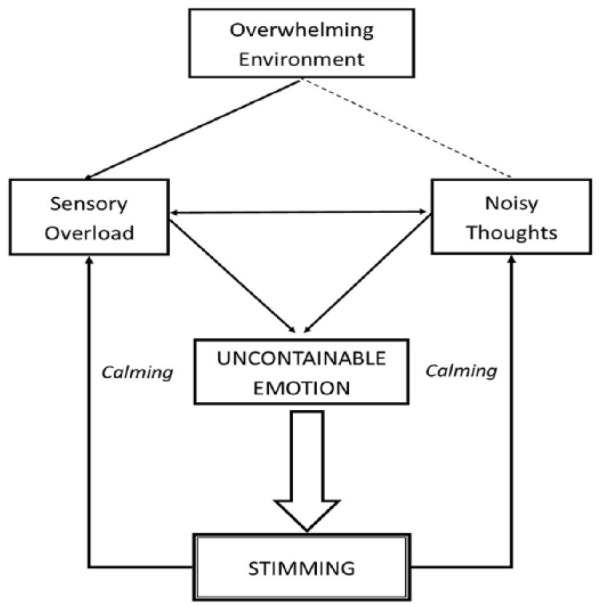
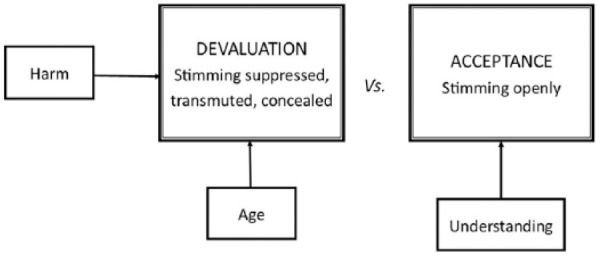
‘Stereotyped or repetitive motor movements’ are characterised as core features in the diagnosis of autism, yet many autistic adults (and the neurodiversity movement) have reclaimed them as ‘stimming’. Supported by a growing body of scientific research, autistic adults argue that these behaviours may serve as useful coping mechanisms, yet little research has examined stimming from the perspective of autistic adults. Through interviews and focus groups, we asked 32 autistic adults to share their perceptions and experiences of stimming, including the reasons they stim, any value doing so may hold for them and their perceptions of others’ reactions to stimming. Using thematic analysis, we identified two themes: stimming as (1) a self-regulatory mechanism and (2) lacking in social acceptance, but can become accepted through understanding. Autistic adults highlighted the importance of stimming as an adaptive mechanism that helps them to soothe or communicate intense emotions or thoughts and thus objected to treatment that aims to eliminate the behaviour.
Overview
The claims and statistics of this paper haven’t been checked yet.
Free: it reads the open-access text and checks the first 5 claims that cite a source we can check. Create a free account to check every claim.
Integrity signals
Registry
Cites
Statistics
Figures
Verification
Claims the paper makes
The claims and statistics of this paper haven’t been checked yet.
Free: it reads the open-access text and checks the first 5 claims that cite a source we can check. Create a free account to check every claim.
Claims other papers make about this one
Each is checked against this paper’s own text: does it say what the citing paper says it does?
The source backs part of the claim, not all of it — or backs it for a different population, condition or comparison.
In the citing paper
“workplace practices often remain oriented towards normative expectations surrounding communication, behavior, and participation in work (Kapp et al., 2019; Erbil et al., 2024)”
From The system-level organisational design framework: a neuro-cognitive trait interaction approach to workplace inclusion for autistic people (2026) · cites this paper as Kapp et al., 2019
Experimental — accuracy not yet measuredThe source backs part of the claim, not all of it — or backs it for a different population, condition or comparison.
In the citing paper
“Repetitive behaviors and focused interests are important to the internal regulation and well-being of many Autistic individuals (Kapp et al., 2019; Manor-Binyamini & Schreiber-Divon, 2019; Milton & Sims, 2016; see also Grove et al., 2018).”
From Neurodiversity and Autism Intervention: Reconciling Perspectives Through a Naturalistic Developmental Behavioral Intervention Framework (2022) · cites this paper as Kapp et al., 2019
Experimental — accuracy not yet measuredThe cited source says what the claim attributes to it.
In the citing paper
“repetitive behaviour or 'stimming' is common and usual (Kapp et al, 2019; Charlton et al, 2021).”
From Autistic SPACE: a novel framework for meeting the needs of autistic people in healthcare settings (2023) · cites this paper as Kapp et al, 2019
The cited source says what the claim attributes to it.
In the citing paper
“In fact, it now seems likely that they often serve a regulatory, soothing function for autistic people (e.g. Joyce, Honey, Leekam, Barrett, & Rodgers, 2017; Kapp et al., 2019).”
From Annual Research Review: Shifting from ‘normal science’ to neurodiversity in autism science (2022) · cites this paper as Kapp et al., 2019
The cited source says what the claim attributes to it.
In the citing paper
“Non-harmful self-stimulatory or repetitive behavior is often used to regulate emotions, and these behaviors may serve as adaptive coping skills for many individuals (Kapp et al., 2019; Manor-Binyamini & Schreiber-Divon, 2019).”
From Neurodiversity and Autism Intervention: Reconciling Perspectives Through a Naturalistic Developmental Behavioral Intervention Framework (2022) · cites this paper as Kapp et al., 2019
1 more claim about this paper
Create a free account to see every claim other papers make about this one.
Self-check
Percentages, sums and reported differences re-computed from the paper’s own numbers.
The self-check needs the paper’s full text.
Citations
Cites
Using thematic analysis in psychology
Braun, V., & Clarke, V. (2006) · Qualitative Research in Psychology · doi:10.1191/1478088706qp063oa · Cited by 194,414 · cited 1×
“Data were analysed thematically, following Braun and Clarke (2006).”
MethodDiagnostic and Statistical Manual of Mental Disorders
American Psychiatric Association (2013) · doi:10.1176/appi.books.9780890425596 · Cited by 116,369
Braun, V., & Clarke, V. (2012) · APA handbook of research methods in psychology, Vol 2: Research designs: Quantitative, qualitative, neuropsychological, and biological. · doi:10.1037/13620-004 · Cited by 10,299
(1943) · The Nervous child · Cited by 8,870
Autistic disturbances of affective contact.
Kanner, L. (1968) · PubMed · Cited by 3,130
On the ontological status of autism: the ‘double empathy problem’
Milton, D. E. M. (2012) · Disability & Society · doi:10.1080/09687599.2012.710008 · Cited by 2,082 · cited 1×
“Potentially, other people’s imitation of their stims may facilitate autistic people’s self-other awareness (see Kapp, 2016, p. 70) and help bridge the difficulties autistic and non-autistic people share in understanding one another, which Milton (2012) terms the ‘double empathy problem’.”
BackgroundWhen the world becomes ‘too real’: a Bayesian explanation of autistic perception
Pellicano, E., & Burr, D. (2012) · Trends in Cognitive Sciences · doi:10.1016/j.tics.2012.08.009 · Cited by 1,156 · cited 3×
“Email: s.k.kapp@exeter.ac.uk have suggested that stimming may provide familiar and reliable self-generated feedback in response to difficulties with unpredictable, overwhelming and novel circumstances (e.g. Lawson, Rees, & Friston, 2014; Pellicano & Burr, 2012).”
BackgroundResultSelf-citationConcept Evolution in Sensory Integration: A Proposed Nosology for Diagnosis
Miller, L. J., Anzalone, M. E., Lane, S. J., Cermak, S. A., & Osten, E. T. (2007) · American Journal of Occupational Therapy · doi:10.5014/ajot.61.2.135 · Cited by 953
‘Autistic psychopathy’ in childhood
Asperger, H. (1991) · Autism and Asperger Syndrome · doi:10.1017/cbo9780511526770.002 · Cited by 765
Research works printed but not linked: 5
- Bascom J., 2012, Loud hands: Autistic people, speaking
- Kanner L., 1943, Nervous Child, 2, 217
- Lilley R, 2018, What’s in a flap? The curious history of autism and hand stereotypies
- Nicolaidis C., 2012, Virtual Mentor: American Medical Association Journal of Ethics, 14, 503
- World Health Organization, 1992, The ICD-10 Classification of Mental and Behavioural Disorders: Diagnostic Criteria for Research, 2
Cited by
Items 301–400 of 600
Kabakov, S. A., Surgent, O. J., Skaletski, E. C., Sideris, J. H., Ausderau, K., & Travers, B. G. (2025) · Journal of Autism and Developmental Disorders · doi:10.1007/s10803-025-06995-6 · Cited by 2
Husu, E., Helminen, T. M., Muuvila, M., Lauttia, J., Eriksson, K. J., Nevalainen, J., & Kylliäinen, A. (2025) · Research in Autism · doi:10.1016/j.reia.2025.202697 · Cited by 3
Autistic and neurotypical variance in the appraisal of emotional and interoceptive words
Hausen, F. V., Larraín-Valenzuela, M. J., Cárcamo, B., & Salgado-Obregon, N. (2025) · Frontiers in Communication · doi:10.3389/fcomm.2025.1655879 · Cited by 2
Wain, D., Williams, G., Charura, D., Hamilton, L., Milton, D. E. M., Wortman, D., & Heasman, B. (2026) · Counselling and Psychotherapy Research · doi:10.1002/capr.70073 · Cited by 2
Hinze, E., Dargue, N., Paynter, J. M., & Adams, D. (2026) · Autism in Adulthood · doi:10.1177/25739581261421856 · Cited by 3
Ashburner, J. K., Tomkins, V., Downing, C., Rietberg, E., Hill, J. R., Copley, J., & Bobir, N. (2026) · Occupational Therapy International · doi:10.1155/oti/4779496 · Cited by 2
“Stimming behaviours are perceived by autistic people to help with self-regulation when they experience sensory over-load, dysregulated thoughts or uncontainable emotions [33].”
Halkowski, M., Kubina, R. M., Leitao, N. D. L., & Winn, K. (2026) · International Journal of Social Robotics · doi:10.1007/s12369-026-01380-4 · Cited by 2
“Unlike par - ticipants in prior research (e.g., [30]), three children in our study, Naeem, Emilia, and Jacob, exhibited elevated levels of motor stereotypies and other repetitive behaviors (i.e., stimming) during their interactions with the robot (American Psychiatric Association, [1]; [60 ]).”
Jiang, X., Zhang, X., & Drani, S. (2026) · Review Journal of Autism and Developmental Disorders · doi:10.1007/s40489-026-00544-2 · Cited by 2
Autistic injustice as affective injustice: the double empathy problem is not about empathy
Goffin, K. (2026) · Philosophical Psychology · doi:10.1080/09515089.2026.2651512 · Cited by 2
Autistic Pupil's Self-Reported and Observed Experiences of Multi-Sensory Environments in Schools
Dyer, A. M., Powell, G., Crossman, E., Bowsher-Murray, C., & Jones, C. R. G. (2026) · Neurodiversity · doi:10.1177/27546330261448357 · Cited by 2
Meng, Y., Ye, L., Feng, Y., Fu, R., Liu, B., Li, L., & Gao, N. (2026) · Creativity and Cognition · doi:10.1145/3803784.3807531 · Cited by 4
“Repetitive movements and sensory behaviors (often referred to as “stimming”) are common in autism and can function as self-regulation strategies for managing arousal and emotion [55].”
Cultural Humility, a Path to Equity
Wright, P. I., & Murphy, J. (2022) · Autism and child psychopathology series · doi:10.1007/978-3-030-98507-3_12 · Cited by 2
Detection of Autism Spectrum Disorder by a Fast Deep Neural Network
Luzio, F. D., Colonnese, F., Rosato, A., & Panella, M. (2022) · Communications in computer and information science · doi:10.1007/978-3-031-24801-6_38 · Cited by 2
Wilke, A. K., Brown, K. R., Crosby, D., & Engler, J. S. (2023) · International Journal of Qualitative Studies in Education · doi:10.1080/09518398.2023.2258105 · Cited by 4
“Assimilation, “masking” or “passing,” requires energy and is stressful (Kapp et al., 2019; Kidwell et al., 2023).”
Grandits, J. B., Kent, H. W., Sanborn, S. M., & Pilcher, J. J. (2023) · Frontiers in Psychology · doi:10.3389/fpsyg.2023.1292439 · Cited by 2
Sastriya, I., & Pratisti, W. D. (2023) · Jurnal Bimbingan Penyuluhan Islam · doi:10.32332/jbpi.v5i2.7744 · Cited by 2
Conform or be ostracised: restricted and repetitive behaviours in non-autistic persons
Lam, C. F. (2024) · Disability & Society · doi:10.1080/09687599.2023.2300955 · Cited by 2
“Autistic people have their own causes of ongoing distress that are not strictly social, such as sensory overload (Kapp et al. 2019) and more frequent gastrointestinal issues (Madra, Ringel, and Margolis 2020).”
InfluentialSmees, R., Rinaldi, L. J., & Simner, J. (2024) · Creativity Research Journal · doi:10.1080/10400419.2024.2333633 · Cited by 5
“Charlton, Entecott, Belova, & Nwaordu, 2021; Kapp et al., 2019) It is possible that absorbing creative arts activities also serve an ameliorative function for the higher anxieties associated with sensory sensitivities in children (Green, Ben-Sasson, Soto, & Carter, 2012; Lane, Reynolds, & Dumenci,…”
Akhtar, N., & Dinishak, J. (2024) · Neurodiversity · doi:10.1177/27546330241249274 · Cited by 3
“For example, in one review, behaviors that are often targeted for “ intervention ” were highlighted as having value ( “ stimming … is unfairly condemned in many educational or clinical settings ” ), suggesting that these behaviors not be targeted (Kapp et al., 2019).”
Lee, H. N., Jadav, N., Wilkinson, E. H., & Bal, V. H. (2024) · Healthcare · doi:10.3390/healthcare12090911 · Cited by 2
“Recently, however, first-person accounts of these behaviors have afforded a more strengths-based view, providing insight into the potential benefits and adaptive aspects of those behaviors that could serve as advantages [2–4].”
BackgroundResultInfluentialExploring the Paradigm of Co-Produced Research Within the Context of the COVID-19 Pandemic
Kenny, N., Neilson, S., O’Kelly, J., Doyle, J. K., & McDonald, J. (2024) · International perspectives on inclusive education · doi:10.1108/s1479-363620240000023012 · Cited by 2
Frequency of Autism in Nuclear and Joint family system
Fayyaz, H., Khan, A., ullah, H. S., Khursheed, F., Aziz, S., & Riaz, M. (2024) · Liaquat Medical Research Journal · doi:10.38106/lmrj.2024.6.2-05 · Cited by 2
Schuck, R. K., Baiden, K. M. P., Wang, M., Olis, S., Ingram, C., & Fisher, G. (2024) · Review of Research in Education · doi:10.3102/0091732x241281268 · Cited by 2
“See the following for a discussion on how some autistic traits can be harmless and even beneficial (e.g., some self-stimulatory movements; Kapp et al., 2019) and how targeting these for intervention can potentially lead to masking and negative outcomes.”
Mok, T., Hartley, T., Tang, A., McCrimmon, A. W., & Oehlberg, L. (2025) · ACM Transactions on Accessible Computing · doi:10.1145/3706575 · Cited by 4
“For instance, on Twitter, empowerment and support were the most common themes in messages posted by active members of autism-related communities [5].”
Solution Focused Practice and Autism Within the Primary Classroom: A Retrospective Case Study
Kellett, S., & Bell, G. (2025) · Journal of solution-focused brief therapy · doi:10.59874/001c.129824 · Cited by 2
Environmental Crafting at Work: Learning from Two Autistic Volunteers and Their Allies
Nguyen, P., Jelić, A., & Heylighen, A. (2025) · Springer eBooks · doi:10.1007/978-3-031-84681-6_18 · Cited by 2
How Autistic Adults Cope with Loneliness: What Helps and What Doesn’t?
Su, D. J., Schiltz, H. K., & Lord, C. (2025) · Autism in Adulthood · doi:10.1089/aut.2024.0341 · Cited by 2
Baker-Ericzén, M. J., Schuck, R. K., Herrera, J., Miller, I. G., & MacDonald, R. (2025) · Autism in Adulthood · doi:10.1089/aut.2024.0104 · Cited by 4
“44,45 Social Cognitive Strategies.”
Alak, G., Akçamuş, M. Ç. Ö., Kudret, Z. B., & Bakkaloğlu, H. (2025) · Journal of Research in Special Educational Needs · doi:10.1111/1471-3802.70027 · Cited by 2
Clements-Cortés, A., & Yip, J. J. Y. (2022) · The Arts in Psychotherapy · doi:10.1016/j.aip.2022.101965 · Cited by 2
Current Knowledge of Emotion Regulation: The Autistic Experience
Bradley, R. S., Onovbiona, H., del Rosario, E.-A., & Quetsch, L. B. (2023) · IntechOpen eBooks · doi:10.5772/intechopen.1000222 · Cited by 5
Bolton, M. J. (2023) · PsyArXiv (OSF Preprints) · doi:10.31234/osf.io/b54ua · Cited by 3
Lee, J., Lee, K., Hwang, I., Park, S., & Kim, Y. (2025) · arXiv (Cornell University) · doi:10.48550/arxiv.2509.17608 · Cited by 2
“In summary, our work suggests that AI systems for behavioral guidance should take into consideration the everyday contexts of parenting—how they approach, communicate, and engage with their children.”
Surveillance and Disability in Online Proctored Exams: Student Perspectives and Design ImplicationsPreprint
Kwapisz, M., Ackerman, Y., Nguyen, J., & Rajivan, P. (2025) · arXiv (Cornell University) · doi:10.48550/arxiv.2511.10826 · Cited by 2
Millington, E. (2024) · Enlighten: Theses (The University of Glasgow) · doi:10.5525/gla.thesis.84280 · Cited by 3
Harding, M. (2024) · Open Access at Essex (University of Essex) · Cited by 2
The role of informational support in online groups for people on the autism spectrum
Duffin, S. (2024) · White Rose eTheses Online (University of Leeds, The University of Sheffield, University of York) · Cited by 2
(2022) · Journal of Development and Social Sciences · doi:10.47205/jdss.2022(3-ii)01 · Cited by 1
COVID-19 and Clinical Training: Diverse Interns’ Perspectives and Collaborative Recommendations
Eppler, C., Schuur, D. M. V., & Correa, N. (2022) · Journal of Feminist Family Therapy · doi:10.1080/08952833.2022.2141956 · Cited by 1
“Kapp et al. (2019) argued that stimming behaviors may serve as useful self-regulatory mechanisms which create a calming feedback loop.”
BackgroundNémeth, N., & Stiller, A. (2023) · Behindertenpädagogik · doi:10.30820/0341-7301-2023-1-54 · Cited by 1
The use of a picture activity schedule for vocal stereotypy reduction in a child with autism
Arsić, B., Gajić, A., & Vidojković, S. (2023) · Odgojno-obrazovne teme · doi:10.53577/oot.6.1.4 · Cited by 1
Working with Neurodiversity in Forensic Rehabilitation Interventions
Kandola, S. S., & Walton, J. S. (2024) · Wiley eBooks · doi:10.1002/9781119893073.ch12 · Cited by 2
Disordering Dance: Foundations of an emerging neuroqueer choreography
Watson, A. (2024) · Choreographic Practices · doi:10.1386/chor_00071_1 · Cited by 2
A case for the reconceptualisation of autism in Vietnam
Boyle, L., & Bailey, J. (2022) · Southeast Asia Early Childhood Journal · doi:10.37134/saecj.vol11.1.6.2022 · Cited by 1
Using Photovoice to Capture the Quality of Life of the Australian Autistic Community
Kuzminski, R., Black, M. H., Bölte, S., Lawson, W. B., Falkmer, M., Philips, S., Girdler, S. J., & Milbourn, B. T. (2025) · Autism in Adulthood · doi:10.1089/aut.2023.0178 · Cited by 1
“31 Autistic adults may, however, experience challenges participating in these methods given their differences in social communication.”
The role of the concept of neurodiversity in teaching English for professional communication
Simkova, I. (2024) · The Journal of V N Karazin Kharkiv National University Series Foreign Philology Methods of Foreign Language Teaching · doi:10.26565/2786-5312-2024-100-14 · Cited by 1
Unwin, K. L., Philpott‐Robinson, K., Barbaro, J., Dwyer, P. S. R., Sadka, N., Date, P., & Lane, A. E. (2025) · Autism · doi:10.1177/13623613251335069 · Cited by 1
“Likewise, repetitive behaviours (i.e. ‘stim-ming’) have also been described as enjoyable and soothing (e.g. Kapp et al., 2019).”
Trzmielewska, W. D., Duras, J., Juchacz, A., & Rak, T. (2025) · Roczniki Psychologiczne · doi:10.18290/rpsych2024.0019 · Cited by 1
“…no gestures; Ż ywiczy ń ski et al., 2017), or behaviors encountered in clinical or neurodiverse populations (where gesturing is naturally reduced; Kapp et al., 2019; Poliakoff & Gowen, 2025), may result in interactional losses for both speakers and listeners (e.g., making communication less…”
InfluentialBreeman, S. L., Vladescu, J. C., Sidener, T. M., DeBar, R. M., & Gureghian, D. L. (2025) · Journal of Applied Behavior Analysis · doi:10.1002/jaba.70021 · Cited by 1
“Some autistic advocates and individuals with autism spectrum disorder (ASD) disparage the treatment of stereotypic behaviors, reporting that these responses help to self-soothe (Kapp et al., 2019) with a potential root in individuals ’ autonomic nervous systems (Lory et al., 2023).”
Sensory Sensitivity and Strengths in Autism
Hassmén, P., & Hindman, E. (2025) · Global perspectives in applied sport and performance psychology. · doi:10.1007/978-3-031-95433-7_5 · Cited by 1
Rethinking Face‐to‐Face Interaction: Lessons from Studies of “Autistic Sociality”
Johannessen, L. E. F. (2025) · Symbolic Interaction · doi:10.1002/symb.70017 · Cited by 1
Expanding Descriptions of Autistic Rituals and Routines: A Co‐Produced Update
Petty, S., Cantwell, A., Clayton, L., Matthews, L., & Angell‐McGregor, S. (2025) · Diversity & Inclusion Research · doi:10.1002/dvr2.70039 · Cited by 1
“When a repetitive behaviour is judged to be without meaning or as being difficult to understand by an observer it can be judged more negatively (Kapp et al. 2019; Pantazakos and Vanaken 2023; Pearson and Rose 2021), in part due to negative judgments that come from outside the family (Sethi et al.…”
Smith, C. M., & Baker, D. H. (2025) · PLoS ONE · doi:10.1371/journal.pone.0332583 · Cited by 1
“Stimming behaviours are commonly seen in individuals with diagnoses of autism and/or ADHD, and involve repetitive movements, typically featuring the arms, hands, or entire body [24], for example hand flapping [6].”
InfluentialA Review of the Effectiveness of Three Main Types of Stress-Reduction Products
Weng, J. (2025) · Humanities and Social Science Research · doi:10.30560/hssr.v8n5p141 · Cited by 2
“Kapp et al. (2019), through interviews with 32 autistic adults, identified stimming as a key self-regulatory mechanism for emotional and sensory modulation.”
Moore, H. L., Brice, S., Spraggon, N., Ingham, B., Freeston, M. H., Parr, J. R., & Rodgers, J. (2025) · Autism Research · doi:10.1002/aur.70145 · Cited by 1
“Recent evidence from autistic adults supports this, with reports of RRB acting, at times, as a self-regulatory response to overstimulation (Charlton et al. 2021; Collis et al. 2022; Kapp et al. 2019; Steward 2015).”
Processes Associated with the Development of Depression in Autistic Individuals: A Narrative Review
Wallenberger, Y. H., Uljarević, M., Chetcuti, L., & Putnam, S. P. (2025) · Healthcare · doi:10.3390/healthcare13233112 · Cited by 1
“For autistic individuals, stimming can be relaxing or enjoyable in its own right: up to 80% of autistic adults reported that they generally enjoyed stimming, with another 11% reporting that it depended on the particular stim [27].”
Riosa, P. V. B. (2025) · Behavior Analysis in Practice · doi:10.1007/s40617-025-01118-0 · Cited by 1
“In autism research, for example, meaningfully engaging people on the autism spectrum and their supporters is becoming increasingly important (Kapp et al., 2019; Monk et al., 2022).”
Crafting Livable Worlds: Sensory, Creative, and Nonhuman Supports in Autistic Adults’ Everyday Lives
Rose, M. C., & Lupton, D. (2026) · Autism in Adulthood · doi:10.1177/25739581261426633 · Cited by 1
Caregiver mental health burden in families of children with autism in Saudi Arabia
Alfakeh, S. A., Aljahdali, G. H., & Benfeef, S. T. (2026) · Discover Mental Health · doi:10.1007/s44192-026-00379-7 · Cited by 1
Adamou, M., Kehagias, A., & Antoniou, G. (2026) · Frontiers in Psychiatry · doi:10.3389/fpsyt.2026.1787120 · Cited by 1
Neuronormative atmospheres and the language of the pathology paradigm
Kadodia, Z. (2026) · Phenomenology and the Cognitive Sciences · doi:10.1007/s11097-026-10180-0 · Cited by 1
Defining Autistic Flourishing: Exploring Lived Experiences through a Neurodivergent Lens
Hedlund, Å., Lindström, T., Bölte, S., Black, M. H., Hirvikoski, T., Isakson, K., Unéus, D., Ingard, C., Wik, J., & Rosqvist, H. B. (2026) · Autism in Adulthood · doi:10.1177/25739581261462070 · Cited by 1
Unmasking Authenticity: Introducing the Integrative Neuroaffirming Framework for Theory and Practice
Pyland, C. P., & Tackett, A. R. (2026) · The Counseling Psychologist · doi:10.1177/00110000261462571 · Cited by 4
Pearson, A., Knight, H., Winter, R., Rose, K., & Rees, J. (2026) · Autism in Adulthood · doi:10.1177/25739581261478008 · Cited by 1
Purposeless? Says Who? A Scoping Review of Potential Functions of Stimming in Autistic Adults
Camin, M., Hudry, K., Jellett, R., & Flower, R. L. (2026) · Autism in Adulthood · doi:10.1177/25739581261497840 · Cited by 1
Ableism in Applied Behavior Analysis: Historical Context of Services for Autistic People
McComas, J. J., Drossel, C., Sundberg, S., Cerda, M.-L., Wilczynski, S., & Beavis, H. S. (2025) · Behavior Analysis in Practice · doi:10.1007/s40617-025-01100-w · Cited by 1
“A key concern raised by Autistic people is the use of procedures designed to reduce stereotypic behavior (see Kapp et al., 2019).”
Nuzzolo, R., Speckman, J., & Greer, R. D. (2025) · Behavioral Interventions · doi:10.1002/bin.70068 · Cited by 1
O’Kelly, J., Kenny, N., Butler, S., & Scully, C. (2024) · Dublin City University Open Access Institutional Repository (Dublin City University) · Cited by 1
Affording autistic persons epistemic justice
Nešić, J. (2023) · PhilPapers (PhilPapers Foundation) · Cited by 1
Pallathra, A. A., Rankin, J. A., Day‐Watkins, J., Calkins, M. E., Maddox, B. B., Miller, J. S., Parish‐Morris, J., Herrington, J. D., Kangovi, S., Tomlinson, R. C., et al. (2026) · Research in Autism · doi:10.1016/j.reia.2025.202770 · Cited by 1
Zacharová, Z. J., & Liliková, L. (2026) · European Early Childhood Education Research Journal · doi:10.1080/1350293x.2026.2628096 · Cited by 1
“Such behaviours may help regulate anxiety or sensory overload (Kapp et al. 2019; Morris et al. 2025), support intersubjective communication (Chen 2024), or even function as a form of thinking and meaning-making (Tan-credi and Abrahamson 2024).”
Bozin, D., Sullivan, K. A., Denault, V., Kennon, C., Cradduck, L., & Hews, R. (2026) · Australian Journal of Social Issues · doi:10.1002/ajs4.70102 · Cited by 1
Perception as self-organizing interaction: embodied cognition, artificial intelligence, and autism
Leisman, G., Roy, R., & Alfasi, R. (2026) · Frontiers in Psychology · doi:10.3389/fpsyg.2026.1803234 · Cited by 1
“This interpretation helps explain why repetitive behaviors and restricted action patterns in autism may function to reduce perceptual uncertainty by stabilizing sensorimotor contingencies, rather than reflecting simple behavioral rigidity (Kapp et al., 2020; Lawson et al., 2022; Kapp, 2020).”
DeMonte, K. H., Lugo‐Neris, M. J., & Perry, B. J. (2026) · Language Speech and Hearing Services in Schools · doi:10.1044/2026_lshss-25-00080 · Cited by 1
Exploring Patterns of Self-Harm in Autistic Adults Using the Card Sort Task for Self-Harm
Pelton, M., Newell, V., French, B., Wadman, R., Townsend, E., & Cassidy, S. (2026) · Autism · doi:10.1177/13623613261447926 · Cited by 1
“…suggest that movement provides an alternative way of coping in place of seeking access to means to self-harm, reflecting research describing how repetitive movement and self-stimulatory behaviours (‘stimming’) play an important role in emotion regulation for autistic people (Kapp et al., 2019).”
Turner, S. A., Josselin, D., & Barnicot, K. (2026) · Advances in Neurodevelopmental Disorders · doi:10.1007/s41252-026-00499-9 · Cited by 1
Freckelton, I. R. (2020) · Forensic Research & Criminology International Journal · doi:10.15406/frcij.2020.08.00308 · Cited by 1
Social Behavior and Social Interventions for Adults on the Autism Spectrum
Moody, C. T., & Laugeson, E. A. (2022) · Autism and child psychopathology series · doi:10.1007/978-3-030-98507-3_20 · Cited by 2
Material Cultures of Psychiatry
Ankele, M., & Majerus, B. (2020) · transcript Verlag eBooks · doi:10.1515/9783839447888-002 · Cited by 1
The Diversity within Neurodiversity: Recommendations for a New Approach to ASD Treatment Priorities
Hsu, I. (2022) · International journal of high school research · doi:10.36838/v4i6.8 · Cited by 1
Rabeyron, T. (2023) · In Analysis · doi:10.1016/j.inan.2023.100331 · Cited by 2
Leading Systems Change to Support Autistic Students
Martin, R. J., Kleinert, W. L., Weddle, S. A., Martin, D. F., & Anderson, C. M. (2023) · Issues in clinical child psychology · doi:10.1007/978-3-031-20006-9_17 · Cited by 1
Fitting in an Unfit Society With Autism Spectrum Disorder: Case Report
Morrisroe, K., Longo, K., Pebley, P., & Jain, L. (2023) · Cureus · doi:10.7759/cureus.36966 · Cited by 1
“” Up to 72% of patients describe using these behaviors, such as hand-flapping, body-rocking, or pacing, to reduce anxiety and cope with overstimulation [13,14].”
BackgroundA Comparison of Maternal and Clinician Perception of Communication in Autistic Toddlers
Stern, Y. S., Lee, J., Levy, R., Glickman, A., Grauzer, J. M., Kaat, A. J., & Roberts, M. Y. (2023) · Journal of Speech Language and Hearing Research · doi:10.1044/2023_jslhr-22-00200 · Cited by 1
Autism: Insights from Brain, Mind, and Education
Béné, R. (2023) · Springer eBooks · doi:10.1007/978-3-031-33013-1_27 · Cited by 1
Studi Literatur Stigma pada Anak Autis
Salsabila, R. E., & Hamdan, S. R. (2024) · Bandung Conference Series Psychology Science · doi:10.29313/bcsps.v4i1.10097 · Cited by 2
Neurodiversity-Affirming EMDR Therapy with Autism and ADHD
Clarke, A., & Darker-Smith, S. M. (2024) · Oxford University Press eBooks · doi:10.1093/oxfordhb/9780192898357.013.59 · Cited by 1
Drzazga‐Lech, M., & Kłeczek, M. (2024) · Zeszyty Naukowe Katolickiego Uniwersytetu Lubelskiego Jana Pawła II · doi:10.31743/znkul.17134 · Cited by 1
Preliminary assessment of augmentative and alternative communication‐related stereotypy
Andzik, N. R., Walker, S. F., O’Hara, C. A., Camacho, S. A., Landmeier, L., & Brander, M. (2024) · Behavioral Interventions · doi:10.1002/bin.2042 · Cited by 1
Anne M. Donnellan (1943–2024): a tribute to an autism legend, mentor, and friend
Kapp, S. K. (2024) · Frontiers in Integrative Neuroscience · doi:10.3389/fnint.2024.1469778 · Cited by 1
Self-citationClassifiers and Image Processıng to Identify Sign Language Phonemes
EFEOĞLU, E., & Tuna, A. (2024) · Kırklareli Üniversitesi Mühendislik ve Fen Bilimleri Dergisi · doi:10.34186/klujes.1546178 · Cited by 1
Brickwood, E. (2025) · IGI Global eBooks · doi:10.4018/979-8-3373-4445-4.ch007 · Cited by 1
Amaia Hervas, G. (2021) · Springer eBooks · doi:10.1007/978-3-319-91280-6_416 · Cited by 1
Carter, V. J. (2025) · FHSU Scholars Repository (Fort Hays State University) · doi:10.58809/rsij7168 · Cited by 1
Goodman, J. (2025) · PsyArXiv (OSF Preprints) · doi:10.31234/osf.io/wh2ns_v1 · Cited by 1
The lived experiences of autistic children in mainstream primary schools in England
Billington, J. (2023) · CentAUR (University of Reading) · doi:10.48683/1926.00115830 · Cited by 1
Botha, M., Grant, A., Memmott, A., Milton, D., Pearson, A., Williams, G. L., & Woods, R. (2021) · OSF Preprints (OSF Preprints) · doi:10.31219/osf.io/9578b · Cited by 1
Pritchard-Rowe, E. (2024) · Apollo (University of Cambridge) · doi:10.17863/cam.108972 · Cited by 1
Foster, A. (2022) · Kent Academic Repository (University of Kent) · doi:10.22024/unikent/01.02.95638 · Cited by 2
“No one wants to understand me enough to make it better”
Denisen, C. A. (2024) · Iowa Research Online (The University of Iowa) · doi:10.25820/etd.007740 · Cited by 1
Metadata
- Authors
- Kapp, S. K., Steward, R., Crane, L., Elliott, D., Elphick, C., Pellicano, E., & Russell, G.
- Affiliations
- University of Exeter (GB)
- University College London (GB)
- Corresponding author
- Kapp, Steven K
- Venue
- Autism
- Publisher
- SAGE Publications
- Published
- 2019-02-28
- Volume
- 23
- Issue
- 7
- Pages
- 1782-1792
- ISSN
- 1362-3613 (ISSN-L)
- 1461-7005
- PMC
- PMC6728747
- OpenAlex
- W2912195587
- Semantic Scholar
- 8e9fcb1de03b4ce92ab15abdadbbb112c8e48ce3
- Cited by
- 495
- References
- 53
- Citations by year
- 2026: 89 · 2025: 89 · 2024: 106 · 2023: 80 · 2022: 71 · 2021: 33 · 2020: 20 · 2019: 7
- FWCI
- 19.04
- Type
- journal article
- Language
- en
- Open access
- hybrid
- doi.org
- Licence
- cc-by
- journals.sagepub.com/page/policies/text-and-data-mining-license (tdm)
- Locations
- Autism (publishedVersion, cc-by)
- PubMed Central (publishedVersion, cc-by)
- PubMed (publishedVersion)
- UCL Discovery (University College London) (submittedVersion)
- Figshare (submittedVersion, cc-by)
- Open Research Exeter (University of Exeter) (submittedVersion, cc-by)
- University of Birmingham Research Portal (University of Birmingham) (submittedVersion)
- Funders
- Wellcome Trust (108676/Z/15/Z)
- leverhulme trust
- Topics
- Life Sciences › Neuroscience › Cognitive Neuroscience › Autism Spectrum Disorder Research
- Social Sciences › Psychology › Developmental and Educational Psychology › Behavioral and Psychological Studies
- Social Sciences › Psychology › Clinical Psychology › Obsessive-Compulsive Spectrum Disorders
- Keywords
- stimming, autistic adults, self-regulation, coping strategies, neurodiversity movement, autistic identity, sensory regulation, autism treatment
- MeSH terms
- Adaptation, Psychological, Adult, Attitude, Autistic Disorder, Female, Humans, Interviews as Topic, Male, Middle Aged, Focus Groups, Stereotypic Movement Disorder, Young Adult
About these checks
Registry, retraction, Cites and statistics results are computed, not judged, with one exception: a printed reference that no index lists is read once by a model before it counts as a citation error. Claims are extracted by a model and kept only when their quote appears verbatim in the text; each cited source is then checked, with a model’s help, for whether it says what the claim relies on. Those verdicts can be wrong — read the claim’s quote and the cited source before relying on one.
Statistics and arithmetic are recomputed, not judged.
Confidence bands are shown only for fields calibrated on our annotated test set. None is calibrated yet, so no band is shown.
What counts as a claim ›How we measure confidence ›How we check this ›
Are you an author, or do you see a problem with this page? Request a review
Data sources
Bibliographic data: Semantic Scholar, OpenAlex, Crossref.
Contains information from the Semantic Scholar Academic Graph Datasets, made available under the ODC Attribution License (ODC-BY 1.0).
Semantic Scholar’s data is described in: Kinney, R., et al. (2023). The Semantic Scholar Open Data Platform. arXiv:2301.10140.
