

‘People should be allowed to do what they like’: Autistic adults’ views and experiences of stimming
Open accessThe DOI matches its Crossref record; 53 of the 53 references it cites were found in a registry or an index.
Abstract
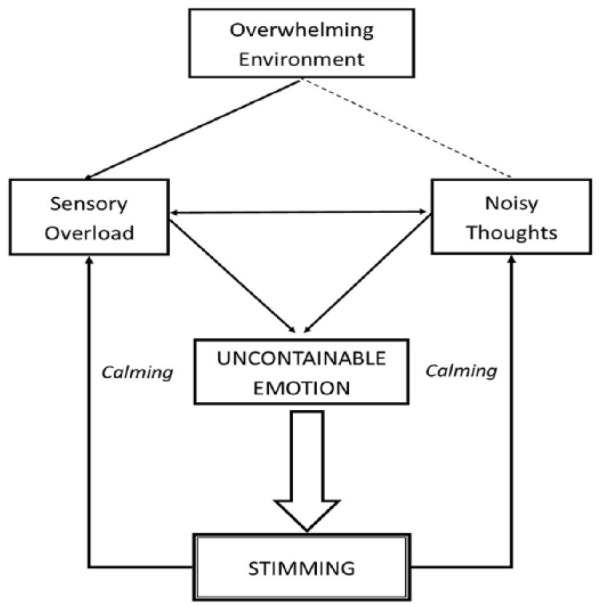
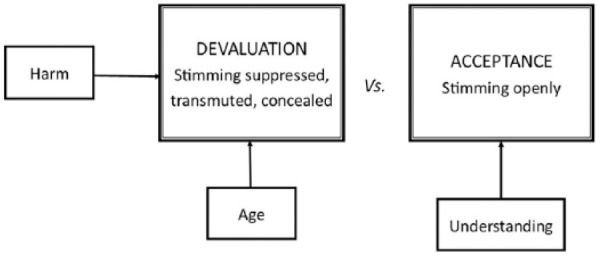
‘Stereotyped or repetitive motor movements’ are characterised as core features in the diagnosis of autism, yet many autistic adults (and the neurodiversity movement) have reclaimed them as ‘stimming’. Supported by a growing body of scientific research, autistic adults argue that these behaviours may serve as useful coping mechanisms, yet little research has examined stimming from the perspective of autistic adults. Through interviews and focus groups, we asked 32 autistic adults to share their perceptions and experiences of stimming, including the reasons they stim, any value doing so may hold for them and their perceptions of others’ reactions to stimming. Using thematic analysis, we identified two themes: stimming as (1) a self-regulatory mechanism and (2) lacking in social acceptance, but can become accepted through understanding. Autistic adults highlighted the importance of stimming as an adaptive mechanism that helps them to soothe or communicate intense emotions or thoughts and thus objected to treatment that aims to eliminate the behaviour.
Overview
The claims and statistics of this paper haven’t been checked yet.
Free: it reads the open-access text and checks the first 5 claims that cite a source we can check. Create a free account to check every claim.
Integrity signals
Registry
Cites
Statistics
Figures
Verification
Claims the paper makes
The claims and statistics of this paper haven’t been checked yet.
Free: it reads the open-access text and checks the first 5 claims that cite a source we can check. Create a free account to check every claim.
Claims other papers make about this one
Each is checked against this paper’s own text: does it say what the citing paper says it does?
The source backs part of the claim, not all of it — or backs it for a different population, condition or comparison.
In the citing paper
“workplace practices often remain oriented towards normative expectations surrounding communication, behavior, and participation in work (Kapp et al., 2019; Erbil et al., 2024)”
From The system-level organisational design framework: a neuro-cognitive trait interaction approach to workplace inclusion for autistic people (2026) · cites this paper as Kapp et al., 2019
Experimental — accuracy not yet measuredThe source backs part of the claim, not all of it — or backs it for a different population, condition or comparison.
In the citing paper
“Repetitive behaviors and focused interests are important to the internal regulation and well-being of many Autistic individuals (Kapp et al., 2019; Manor-Binyamini & Schreiber-Divon, 2019; Milton & Sims, 2016; see also Grove et al., 2018).”
From Neurodiversity and Autism Intervention: Reconciling Perspectives Through a Naturalistic Developmental Behavioral Intervention Framework (2022) · cites this paper as Kapp et al., 2019
Experimental — accuracy not yet measuredThe cited source says what the claim attributes to it.
In the citing paper
“repetitive behaviour or 'stimming' is common and usual (Kapp et al, 2019; Charlton et al, 2021).”
From Autistic SPACE: a novel framework for meeting the needs of autistic people in healthcare settings (2023) · cites this paper as Kapp et al, 2019
The cited source says what the claim attributes to it.
In the citing paper
“In fact, it now seems likely that they often serve a regulatory, soothing function for autistic people (e.g. Joyce, Honey, Leekam, Barrett, & Rodgers, 2017; Kapp et al., 2019).”
From Annual Research Review: Shifting from ‘normal science’ to neurodiversity in autism science (2022) · cites this paper as Kapp et al., 2019
The cited source says what the claim attributes to it.
In the citing paper
“Non-harmful self-stimulatory or repetitive behavior is often used to regulate emotions, and these behaviors may serve as adaptive coping skills for many individuals (Kapp et al., 2019; Manor-Binyamini & Schreiber-Divon, 2019).”
From Neurodiversity and Autism Intervention: Reconciling Perspectives Through a Naturalistic Developmental Behavioral Intervention Framework (2022) · cites this paper as Kapp et al., 2019
1 more claim about this paper
Create a free account to see every claim other papers make about this one.
Self-check
Percentages, sums and reported differences re-computed from the paper’s own numbers.
The self-check needs the paper’s full text.
Citations
Cites
Using thematic analysis in psychology
Braun, V., & Clarke, V. (2006) · Qualitative Research in Psychology · doi:10.1191/1478088706qp063oa · Cited by 194,414 · cited 1×
“Data were analysed thematically, following Braun and Clarke (2006).”
MethodDiagnostic and Statistical Manual of Mental Disorders
American Psychiatric Association (2013) · doi:10.1176/appi.books.9780890425596 · Cited by 116,369
Braun, V., & Clarke, V. (2012) · APA handbook of research methods in psychology, Vol 2: Research designs: Quantitative, qualitative, neuropsychological, and biological. · doi:10.1037/13620-004 · Cited by 10,299
(1943) · The Nervous child · Cited by 8,870
Autistic disturbances of affective contact.
Kanner, L. (1968) · PubMed · Cited by 3,130
On the ontological status of autism: the ‘double empathy problem’
Milton, D. E. M. (2012) · Disability & Society · doi:10.1080/09687599.2012.710008 · Cited by 2,082 · cited 1×
“Potentially, other people’s imitation of their stims may facilitate autistic people’s self-other awareness (see Kapp, 2016, p. 70) and help bridge the difficulties autistic and non-autistic people share in understanding one another, which Milton (2012) terms the ‘double empathy problem’.”
BackgroundWhen the world becomes ‘too real’: a Bayesian explanation of autistic perception
Pellicano, E., & Burr, D. (2012) · Trends in Cognitive Sciences · doi:10.1016/j.tics.2012.08.009 · Cited by 1,156 · cited 3×
“Email: s.k.kapp@exeter.ac.uk have suggested that stimming may provide familiar and reliable self-generated feedback in response to difficulties with unpredictable, overwhelming and novel circumstances (e.g. Lawson, Rees, & Friston, 2014; Pellicano & Burr, 2012).”
BackgroundResultSelf-citationConcept Evolution in Sensory Integration: A Proposed Nosology for Diagnosis
Miller, L. J., Anzalone, M. E., Lane, S. J., Cermak, S. A., & Osten, E. T. (2007) · American Journal of Occupational Therapy · doi:10.5014/ajot.61.2.135 · Cited by 953
‘Autistic psychopathy’ in childhood
Asperger, H. (1991) · Autism and Asperger Syndrome · doi:10.1017/cbo9780511526770.002 · Cited by 765
Research works printed but not linked: 5
- Bascom J., 2012, Loud hands: Autistic people, speaking
- Kanner L., 1943, Nervous Child, 2, 217
- Lilley R, 2018, What’s in a flap? The curious history of autism and hand stereotypies
- Nicolaidis C., 2012, Virtual Mentor: American Medical Association Journal of Ethics, 14, 503
- World Health Organization, 1992, The ICD-10 Classification of Mental and Behavioural Disorders: Diagnostic Criteria for Research, 2
Cited by
Items 401–500 of 600
Mayhew, E. (2023) · White Rose eTheses Online (University of Leeds, The University of Sheffield, University of York) · Cited by 1
An exploration of pathways to emotional outbursts and violence in autistic adults
Platt, M. (2023) · University of Birmingham Institutional Research Archive (University of Birmingham) · Cited by 1
van Beusekom, F. (2023) · Otago University Research Archive (University of Otago) · Cited by 1
Dark, J. (2026) · Frontiers in Psychology · doi:10.3389/fpsyg.2026.1826284
“Consequently, workplace practices often remain oriented towards normative expectations surrounding communication, behavior, and participation in work (Kapp et al., 2019; Erbil et al., 2024).”
Between World Borders: Situating the Reality of a Child Labelled Schizophrenic as Real
Tavares, J. (2019) · Canadian Journal of Children s Rights / Revue canadienne des droits des enfants · doi:10.22215/cjcr.v6i1.1919
"The Magical Device": Temple Grandin's Hug Machine
Göhlsdorf, N. (2020) · transcript Verlag eBooks · doi:10.14361/9783839447888-016 · Cited by 1
Taber, J. L. (2020) · Scholar Commons (University of South Carolina)
Reconstructions identitaires chez les femmes autistes diagnostiquées à l’âge adulte
Laflamme, M. (2020) · doi:10.71781/21586 · Cited by 4
Including Autistic-Neurodivergent Perspectives in Adapted Physical Activity Textbooks
Nguyen, H. A. (2021) · ERA: Education and Research Archive (University of Alberta) · doi:10.7939/r3-mbaz-vz31 · Cited by 1
CAT-Q MSCS BASC2 Pre-PrintPreprint
Aime, H., Scheerer, N. E., Boucher, T. Q., & Iarocci, G. (2021) · PsyArXiv (OSF Preprints) · doi:10.31234/osf.io/s93c4
Amaia Hervas, G. (2020) · Springer eBooks · doi:10.1007/978-1-4614-6435-8_416-3
Autismus – eine einleitende Charakterisierung
Habermann, L., & Kißler, C. (2022) · Springer eBooks · doi:10.1007/978-3-658-37602-4_2
Johnson, A. L., M'gadzah, S. H., & Watson, S. D. (2022) · Advances in higher education and professional development book series · doi:10.4018/978-1-7998-9628-9.ch010
Reducing Anxiety in Autistic Persons
Westby, C. E. (2023) · Word of Mouth · doi:10.1177/10483950231161474b
“…2023 The authors of this research acknowledge the current discussion on neurodiversity that social skills interventions may perpetuate a cycle of defining acceptable behavior and support while masking symptoms or camouflaging so as to fit into society (Kapp et al., 2019; Russell et al., 2019).”
BackgroundIs autism a biological entity?
Waterhouse, L., Volkmar, F., Gillberg, C., & Mottron, L. (2023) · Frontiers research topics · doi:10.3389/978-2-8325-2422-0
Meaningful Social Interactions as a Foundation for Affection and Learning for Autistic Individuals
Wachholtz, D., Vidal, V., Latimer, O., & Jiménez, M. (2023) · Springer eBooks · doi:10.1007/978-3-031-31709-5_33 · Cited by 1
A Review on Designing Electronic books for Children with Autism
Beili, W., Ramli, S. H., & Na, D. (2023) · International Journal of Academic Research in Business and Social Sciences · doi:10.6007/ijarbss/v13-i8/18222 · Cited by 1
Psychodrame auprès d’enfants autistes en hôpital de jour
Blanc, A., & Schlosser, N. (2023) · Le Carnet PSY · doi:10.3917/lcp.262.0031
Anxiety as a Predictor of Movement During a Math Task in Elementary School Children
Snetkov, G., Youngkin, A. E., Lui, M., Marzoratti, A., & Evans, T. M. (2023) · American Journal of Undergraduate Research · doi:10.33697/ajur.2023.098
Jeppsson, S. M. I. (2024) · Springer eBooks · doi:10.1007/978-94-017-8706-2_94-1
Update in Autism Spectrum Disorder
Smith, R. G., Samdup, D. Z., & Akberzai, S. (2023) · Springer eBooks · doi:10.1007/978-3-031-41542-5_7
Neurodivergent Learners: Inclusive and Accessible Practices in Higher Education
Keates, N., & Waldock, K. E. (2024) · Advances in educational technologies and instructional design book series · doi:10.4018/979-8-3693-0868-4.ch002
Farley, M. A., McMahon, W. M., & Kirby, A. V. (2024) · Springer eBooks · doi:10.1007/978-3-031-46463-8_11
Non-pharmacological Interventions for Mental Disorders
Pinho, L. G. D., Fonseca, C., Lopes, M., Schneider, B., & Gawęda, Ł. (2024) · Frontiers research topics · doi:10.3389/978-2-8325-4708-3
Rice, L. B. (2023) · Yearbook of Conrad Studies · doi:10.4467/20843941yc.20.004.19287
Jamil, H., Tariq, Z., & Bashir, N. (2024) · Clinical and Counselling Psychology Review · doi:10.32350/ccpr.51.05
“It is likely that a repetitive or stereotypic behavior is functionally related to sensory sensitivity and is performed to cope with hyper or hyposensitivity in the environment (Kapp et al., 2019).”
Background(2024) · Elsevier eBooks · doi:10.1016/b978-0-443-15632-8.09989-5
Jeppsson, S. M. I. (2024) · Springer eBooks · doi:10.1007/978-94-017-8706-2_94-2
Social Validity and the Consideration of Neurodiversity in Relation to Ethics
Johnson, J. F., & Sadavoy, J. A. (2024) · The International Library of Bioethics · doi:10.1007/978-3-031-61565-8_12
TRANCE STEREOTYPIES IN HUMAN AND PRIMATE PANTOMIMICRY
Goncharenko, E. V., Mikvabiya, Z. Y., Taisaeva, S. B., Argun, S., Анатольевна, М. О., Johnovna, D. S., Ardashelia, S. N., & Vladimirovna, C. A. (2024) · Вестник Костромского государственного университета им. Н.А. Некрасова · doi:10.34216/1998-0817-2024-30-3-247-258
Wachholtz, D., Vidal, V., Latimer, O., & Jiménez, M. (2024) · Springer eBooks · doi:10.1007/978-3-031-58979-9_33
Scheerer, N. E., Hargreaves, A., Ng, C. S. M., & Lerner, M. (2024) · Frontiers research topics · doi:10.3389/978-2-8325-5703-7
Slanzi, C. M., Morris, S. L., Conine, D. E., Kronfli, F. R., Breaux, C. A., & Salzer, M. S. (2024) · Behavior and Social Issues · doi:10.1007/s42822-024-00191-4
“In particular, questions have been raised with respect to interventions for certain types of nonharmful behaviors, such as stereotypy (e.g., Kapp et al., 2019; McGill & Robinson, 2021), as well as interventions for challenging or potentially harmful behaviors, such as compliance training and escape…”
Otizm Spektrum Bozuklukları “Klinisyenler İçin Klinik Deneyimler Penceresinden Güncel Veriler”
ÇELİK, Y. S., Macit, Ş. S., Yamak, Y. H., Tunca, R. D., GÜRBÜZ, Ş., Aydos, B. S., Acehan, T., Öz, T., Kaşak, M., Aliyev, E. S. A., et al. (2024) · Bidge Yayınları eBooks · doi:10.70269/mz8qfxw818dl
Writing the experience of the Grand Union Canal in Harlesden as an intersensorial spatial practice
Rowlands, E. (2024) · Journal of Arts & Communities · doi:10.1386/jaac_00065_3
Saleemi, B., Fatima, A., Hameed, H., Liaqat, S., Farooq, M., Imran, M. A., & Abbasi, Q. H. (2025) · International Conference on Microwave, Antennas & Circuits (ICMAC) · doi:10.1109/icmac64768.2025.11003255 · Cited by 2
“Self-stimulatory behaviors, or ”stimming”, are terms used to describe physical behaviors associated with neurological conditions such as Autism Spectrum Disorder (ASD) [1].”
Sivakami, M. A. (2025) · RICSH Revista Iberoamericana de las Ciencias Sociales y Humanísticas · doi:10.23913/ricsh.v14i27.365
An Exploratory Network Analysis of Discussion Topics About Autism Across Subreddit Communities
DeWitt, S., Mills, K., & Briggs, A. M. (2025) · Behavioral Sciences · doi:10.3390/bs15060812
“For example, Kapp et al. (2019) performed an inductive qualitative analysis to gather 32 autistic adults’ perspectives and experiences related to ‘stimming’ (i.e., stereotypic behavior, a core autism symptom) via a combination of in-depth interviews and focus group methodologies.”
Terlop Technique: Stimming That Informs Educational and Artistic Practice
Terlop, R. E. (2025) · IGI Global eBooks · doi:10.4018/979-8-3373-4445-4.ch013
Spirituality at the Workplace and Female ADHD Employees’ Flourishing
Rocha, Y. G., & Rocha, R. G. (2025) · Springer eBooks · doi:10.1007/978-3-031-32257-0_244-1
An Interest-Based Exploration of Monotropism and Its Use in the Classroom
Atkinson, A. (2025) · IGI Global eBooks · doi:10.4018/979-8-3693-8044-4.ch007
Moore, A. (2025) · IGI Global eBooks · doi:10.4018/979-8-3693-8044-4.ch010 · Cited by 2
Inclusive Group Work for Neurodivergent Students
Santhanam, S. P., Gürbüz, E., & VanUitert, V. J. (2025) · IGI Global eBooks · doi:10.4018/979-8-3373-6350-9.ch007
Early Intensive Behavioral Intervention for Autism
Stadlober, L., Arnold-Saritepe, A. M., Phillips, K. J., Sharp, R. A., García, V. R., Larsson, E., Tarifa‐Rodríguez, A., Purdy, S. C., & Ortega, J. V. (2025) · Oxford University Press eBooks · doi:10.1093/oso/9780197635841.003.0014
Integrating Polyvagal Theory and the Neurodiversity Paradigm for Inclusive Practice
Dwan, S., & Brice, A. E. (2025) · Perspectives of the ASHA Special Interest Groups · doi:10.1044/2025_persp-24-00322 · Cited by 1
Pose Estimation for Stimming Behavior Detection in Autism Spectrum Disorder: A Short Review
Rozaidi, W. N. F., Fadilah, N., Ibrahim, M. Z., Saelal, M. S., Yakno, M., & Samad, R. (2025) · International Conference on Electrical, Control and Computer Engineering · doi:10.1109/inecce64959.2025.11150948
“They are repetitive movements such as hand flapping, rocking, or head banging, which serve as a self-regulatory mechanism for sensory input [4].”
Toward Sensory Accounts of Autistic Masking: A Perspective
Poulsen, R. E., Heyworth, M., Chan, T., & Tan, D. W. (2026) · Autism in Adulthood · doi:10.1177/25739581261501687
Garcia, J. M. C. B. D., Tate, H. K., Sicherer, M., & Schmidt, E. K. (2025) · American Journal of Sexuality Education · doi:10.1080/15546128.2025.2546864
“Specifically, previous research has suggested some kink practices may be similar to a form of stimming - a mechanism often utilized by autistic individuals to regulate and navigate sensory input (Kapp et al., 2019).”
Malone, E. J., White, B. L., Aavatsmark, F. W., Contreras, B. P., & Tuck, K. N. (2025) · Behavior Analysis in Practice · doi:10.1007/s40617-025-01085-6
“…conversation (Robledo et al., 2012), increasing time sitting in a chair rather than standing (Schuck et al., 2024), reducing stimming behaviors (Kapp et al., 2019), or increasing engagement with objects that may trigger sensory sensitivities (Joyce et al., 2017) can be countertherapeutic if…”
Jeppsson, S. M. I. (2025) · Springer eBooks · doi:10.1007/978-94-024-2252-8_94
Stereotypies and Self-Stimulatory Behaviors as Means of Self-Regulation in Autism
Pfuhl, G., & Ekblad, L. (2025) · IntechOpen eBooks · doi:10.5772/intechopen.1009858
A Case Study of a Deaf Autistic Adolescent’s Affective and Linguistic Expressions
Walker, K., Singleton, J. L., & Shield, A. (2025) · Behavioral Sciences · doi:10.3390/bs15111435
“There is a high co-occurrence of anxiety in autistic individuals (between 11% and 84% of children; White et al., 2009) and like other autistic individuals, Brent might have been utilizing stimming to regulate his anxiety (Kapp et al., 2019).”
Mukhopadhyay, A., & Das, A. (2025) · International Journal For Multidisciplinary Research · doi:10.36948/ijfmr.2025.v07i05.58391
Aponte, E. A., Tillmann, J., Gleissl, T., Rubido, M. D. V., Murtagh, L., Sanders, K. B., Chatham, C. H., Wiese, T., & Suter, E. E. (2025) · Scientific Reports · doi:10.1038/s41598-025-22659-y
Karhson, D. S., LaFrance, E. M., & Cuttler, C. (2025) · Scientific Reports · doi:10.1038/s41598-025-23472-3
“…reports from the autistic community suggest that the use of self-stimulatory behaviors is an adaptive and compensatory mechanism to assists in increasing calm comfort, while reducing the impact of internal or environmental factors like overpowering emotion or intense sensory environments 51,52 .”
Chau, T., Carmichael, J. J., Tiego, J., Forbes, M. K., Kerestes, R., Ure, A. M., Brignell, A., Dadds, M. R., Eapen, V., Hawes, D. J., et al. (2025) · Research Square · doi:10.21203/rs.3.rs-8197536/v1
Chong, L. C. (2024) · CentAUR (University of Reading) · doi:10.48683/1926.00119848
Sartor, T. (2024) · Technische Universität Dortmund Eldorado (Technische Universität Dortmund) · doi:10.17877/de290r-24386
Mechanisms underpinning sleep problems and links to mental ill health in autism
Zahir, R. (2025) · ERA · doi:10.7488/era/6059 · Cited by 1
Bristol, S. K. (2023) · Carolina Digital Repository (University of North Carolina at Chapel Hill) · doi:10.17615/2wj6-gm47 · Cited by 1
Jones, C. R. G., Livingston, L. A., Fretwell, C., Uljarević, M., Carrington, S. J., Shah, P., & Leekam, S. (2024) · Figshare · doi:10.6084/m9.figshare.25989201
Literacy Based Behavioral Interventions for Autistic and Neurotypical Children
Pepkin Dataram, S. A. (2024) · University Libraries (University of Maryland) · doi:10.13016/dtky-citg
Autism and Internationalised Schools
Hay, J. (2024) · Lancaster EPrints (Lancaster University) · doi:10.17635/lancaster/thesis/2587
Marsden, S. J. E. (2023) · Lancaster EPrints (Lancaster University) · doi:10.17635/lancaster/thesis/2083
Hietala, S. (2025) · UTUPub (University of Turku)
Huovinen, K. (2025) · UTUPub (University of Turku) · Cited by 1
Pulido Flórez, V., & López Velásquez, N. (2023) · DSPACE System - Metalibrary (University of the Coast)
Exploring the Experiences of Autistic Graduate Women in Navigating the World of Work
Gleeson, C. (2024) · Trinity's Access to Research Output (TARA) (Trinity College Dublin)
Armstrong, M. (2021) · TigerPrints (Clemson University)
Kamuflering hos personer med autismespekterforstyrrelse – En systematisk litteraturgjennomgang
Lehre, E. E. (2021) · Duo Research Archive (University of Oslo)
Learning Styles and Techniques Used Among Undergraduates with Autism Spectrum Disorders
Flores, A. V. (2021) · OakTrust (Texas A&M University Libraries)
Gilbey, B., Baliousis, M., Tickle, A., Varela, J., & Woodrow, C. (2024)
Affirming neurodiversity : a study on the ethics of early autism detection and intervention
Vanaken, G.-J. (2023) · Lirias · Cited by 12
van Grunsven, J., & Roeser, S. (2024) · PhilPapers (PhilPapers Foundation)
Developing a new self-harm assessment tool with and for autistic adults
Newell, V. (2025) · Nottingham ePrints (University of Nottingham)
Waizbard‐Bartov, E. (2023) · eScholarship (California Digital Library)
Umagami, K. (2023) · UCL Discovery (University College London) · Cited by 7
Níelsdóttir, G. E., Þórisdóttir, S. Ó., & Hauksdóttir, M. Í. (2021) · Skemman
Werner, C. (2025) · Diva portal (Dalarna University Library)
Marttinen, H., Nordström, M., & Utoslahti, K. (2023) · Theseus (Ammattikorkeakoulujen)
Autistic Authenticity: A Qualitative Study on Psychedelics, Self-concept and Autism
Krzyzanowski, H. (2024) · UCL Discovery (University College London)
Lord-Laverick, A. (2024) · Research at York St John (York St John University)
Kroeker, S. (2023) · Spectrum Research Repository (Concordia University)
Neurodiversity, Autism, ASD, and Other Categories in Psychiatry and Mental Health
Vanaken, G.-J. (2024) · Lirias
Ashworth, M. (2024) · UCL Discovery (University College London)
Overton, G. L. (2023) · UEA Digital Repository (University of East Anglia) · Cited by 1
Marshall, N. S. (2024) · YorkSpace (York University) · Cited by 1
Kohti neuroinklusiivisempaa työyhteisöä - tietoa autismikirjosta lähijohtajille
Honkanen, E. (2025) · Theseus (Ammattikorkeakoulujen)
Chambers, K. (2025) · Nottingham ePrints (University of Nottingham)
Cross Media Arts: Creative Assemblages for Social Impact
Pinto, P. R. (2025) · Caleidoscópio eBooks · doi:10.30618/978-989-658-977-6
Sisodiya, C. (2025) · Canadian Journal for New Scholars in Education/ Revue canadienne des jeunes chercheures et chercheurs en éducation
Socialization and Social Skills Programs for Autistic People Across the Lifespan
Warner, B. E., & Laugeson, E. A. (2025) · Autism and child psychopathology series · doi:10.1007/978-3-032-01237-1_15
Pretending to be myself: on camouflaging and selfhood in the experience of anxiety
Bortolan, A. (2026) · Philosophical Psychology · doi:10.1080/09515089.2025.2596269
Premodern Perspectives, Disability Studies, and Public Writing
Crassons, K. (2026) · New Chaucer Studies Pedagogy and Profession · doi:10.5070/nc3.50760
Spirituality at the Workplace and Female ADHD Employees’ Flourishing
Rocha, Y. G., & Rocha, R. G. (2026) · Springer eBooks · doi:10.1007/978-3-031-76750-0_244
Salvo, M. D. (2026) · Revista de Discapacidad Clínica y Neurociencias · doi:10.14198/dcn.30763
Borisinkoff, E. D. (2026) · Journal of the American Academy of Special Education Professionals · doi:10.64546/jaasep.600
MDMA and Psychosocial Change in Autistic Adults: Implications for Mental Health
Witham, L. (2025) · UCL Discovery (University College London)
Etherington, J. (2026) · Autism in Adulthood · doi:10.1177/25739581261421861
Metadata
- Authors
- Kapp, S. K., Steward, R., Crane, L., Elliott, D., Elphick, C., Pellicano, E., & Russell, G.
- Affiliations
- University of Exeter (GB)
- University College London (GB)
- Corresponding author
- Kapp, Steven K
- Venue
- Autism
- Publisher
- SAGE Publications
- Published
- 2019-02-28
- Volume
- 23
- Issue
- 7
- Pages
- 1782-1792
- ISSN
- 1362-3613 (ISSN-L)
- 1461-7005
- PMC
- PMC6728747
- OpenAlex
- W2912195587
- Semantic Scholar
- 8e9fcb1de03b4ce92ab15abdadbbb112c8e48ce3
- Cited by
- 495
- References
- 53
- Citations by year
- 2026: 89 · 2025: 89 · 2024: 106 · 2023: 80 · 2022: 71 · 2021: 33 · 2020: 20 · 2019: 7
- FWCI
- 19.04
- Type
- journal article
- Language
- en
- Open access
- hybrid
- doi.org
- Licence
- cc-by
- journals.sagepub.com/page/policies/text-and-data-mining-license (tdm)
- Locations
- Autism (publishedVersion, cc-by)
- PubMed Central (publishedVersion, cc-by)
- PubMed (publishedVersion)
- UCL Discovery (University College London) (submittedVersion)
- Figshare (submittedVersion, cc-by)
- Open Research Exeter (University of Exeter) (submittedVersion, cc-by)
- University of Birmingham Research Portal (University of Birmingham) (submittedVersion)
- Funders
- Wellcome Trust (108676/Z/15/Z)
- leverhulme trust
- Topics
- Life Sciences › Neuroscience › Cognitive Neuroscience › Autism Spectrum Disorder Research
- Social Sciences › Psychology › Developmental and Educational Psychology › Behavioral and Psychological Studies
- Social Sciences › Psychology › Clinical Psychology › Obsessive-Compulsive Spectrum Disorders
- Keywords
- stimming, autistic adults, self-regulation, coping strategies, neurodiversity movement, autistic identity, sensory regulation, autism treatment
- MeSH terms
- Adaptation, Psychological, Adult, Attitude, Autistic Disorder, Female, Humans, Interviews as Topic, Male, Middle Aged, Focus Groups, Stereotypic Movement Disorder, Young Adult
About these checks
Registry, retraction, Cites and statistics results are computed, not judged, with one exception: a printed reference that no index lists is read once by a model before it counts as a citation error. Claims are extracted by a model and kept only when their quote appears verbatim in the text; each cited source is then checked, with a model’s help, for whether it says what the claim relies on. Those verdicts can be wrong — read the claim’s quote and the cited source before relying on one.
Statistics and arithmetic are recomputed, not judged.
Confidence bands are shown only for fields calibrated on our annotated test set. None is calibrated yet, so no band is shown.
What counts as a claim ›How we measure confidence ›How we check this ›
Are you an author, or do you see a problem with this page? Request a review
Data sources
Bibliographic data: Semantic Scholar, OpenAlex, Crossref.
Contains information from the Semantic Scholar Academic Graph Datasets, made available under the ODC Attribution License (ODC-BY 1.0).
Semantic Scholar’s data is described in: Kinney, R., et al. (2023). The Semantic Scholar Open Data Platform. arXiv:2301.10140.
