

‘People should be allowed to do what they like’: Autistic adults’ views and experiences of stimming
Open accessThe DOI matches its Crossref record; 53 of the 53 references it cites were found in a registry or an index.
Abstract
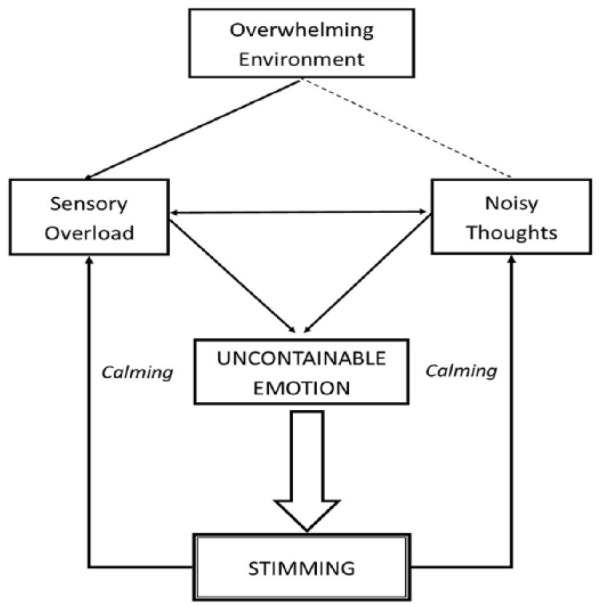
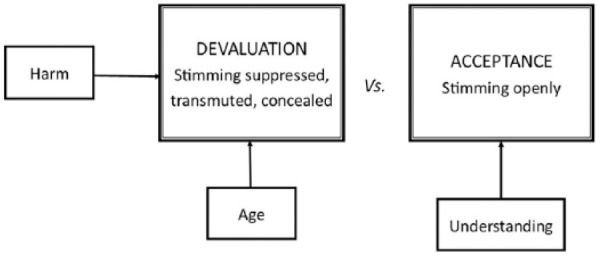
‘Stereotyped or repetitive motor movements’ are characterised as core features in the diagnosis of autism, yet many autistic adults (and the neurodiversity movement) have reclaimed them as ‘stimming’. Supported by a growing body of scientific research, autistic adults argue that these behaviours may serve as useful coping mechanisms, yet little research has examined stimming from the perspective of autistic adults. Through interviews and focus groups, we asked 32 autistic adults to share their perceptions and experiences of stimming, including the reasons they stim, any value doing so may hold for them and their perceptions of others’ reactions to stimming. Using thematic analysis, we identified two themes: stimming as (1) a self-regulatory mechanism and (2) lacking in social acceptance, but can become accepted through understanding. Autistic adults highlighted the importance of stimming as an adaptive mechanism that helps them to soothe or communicate intense emotions or thoughts and thus objected to treatment that aims to eliminate the behaviour.
Overview
The claims and statistics of this paper haven’t been checked yet.
Free: it reads the open-access text and checks the first 5 claims that cite a source we can check. Create a free account to check every claim.
Integrity signals
Registry
Cites
Statistics
Figures
Verification
Claims the paper makes
The claims and statistics of this paper haven’t been checked yet.
Free: it reads the open-access text and checks the first 5 claims that cite a source we can check. Create a free account to check every claim.
Claims other papers make about this one
Each is checked against this paper’s own text: does it say what the citing paper says it does?
The source backs part of the claim, not all of it — or backs it for a different population, condition or comparison.
In the citing paper
“workplace practices often remain oriented towards normative expectations surrounding communication, behavior, and participation in work (Kapp et al., 2019; Erbil et al., 2024)”
From The system-level organisational design framework: a neuro-cognitive trait interaction approach to workplace inclusion for autistic people (2026) · cites this paper as Kapp et al., 2019
Experimental — accuracy not yet measuredThe source backs part of the claim, not all of it — or backs it for a different population, condition or comparison.
In the citing paper
“Repetitive behaviors and focused interests are important to the internal regulation and well-being of many Autistic individuals (Kapp et al., 2019; Manor-Binyamini & Schreiber-Divon, 2019; Milton & Sims, 2016; see also Grove et al., 2018).”
From Neurodiversity and Autism Intervention: Reconciling Perspectives Through a Naturalistic Developmental Behavioral Intervention Framework (2022) · cites this paper as Kapp et al., 2019
Experimental — accuracy not yet measuredThe cited source says what the claim attributes to it.
In the citing paper
“repetitive behaviour or 'stimming' is common and usual (Kapp et al, 2019; Charlton et al, 2021).”
From Autistic SPACE: a novel framework for meeting the needs of autistic people in healthcare settings (2023) · cites this paper as Kapp et al, 2019
The cited source says what the claim attributes to it.
In the citing paper
“In fact, it now seems likely that they often serve a regulatory, soothing function for autistic people (e.g. Joyce, Honey, Leekam, Barrett, & Rodgers, 2017; Kapp et al., 2019).”
From Annual Research Review: Shifting from ‘normal science’ to neurodiversity in autism science (2022) · cites this paper as Kapp et al., 2019
The cited source says what the claim attributes to it.
In the citing paper
“Non-harmful self-stimulatory or repetitive behavior is often used to regulate emotions, and these behaviors may serve as adaptive coping skills for many individuals (Kapp et al., 2019; Manor-Binyamini & Schreiber-Divon, 2019).”
From Neurodiversity and Autism Intervention: Reconciling Perspectives Through a Naturalistic Developmental Behavioral Intervention Framework (2022) · cites this paper as Kapp et al., 2019
1 more claim about this paper
Create a free account to see every claim other papers make about this one.
Self-check
Percentages, sums and reported differences re-computed from the paper’s own numbers.
The self-check needs the paper’s full text.
Citations
Cites
Using thematic analysis in psychology
Braun, V., & Clarke, V. (2006) · Qualitative Research in Psychology · doi:10.1191/1478088706qp063oa · Cited by 194,414 · cited 1×
“Data were analysed thematically, following Braun and Clarke (2006).”
MethodDiagnostic and Statistical Manual of Mental Disorders
American Psychiatric Association (2013) · doi:10.1176/appi.books.9780890425596 · Cited by 116,369
Braun, V., & Clarke, V. (2012) · APA handbook of research methods in psychology, Vol 2: Research designs: Quantitative, qualitative, neuropsychological, and biological. · doi:10.1037/13620-004 · Cited by 10,299
(1943) · The Nervous child · Cited by 8,870
Autistic disturbances of affective contact.
Kanner, L. (1968) · PubMed · Cited by 3,130
On the ontological status of autism: the ‘double empathy problem’
Milton, D. E. M. (2012) · Disability & Society · doi:10.1080/09687599.2012.710008 · Cited by 2,082 · cited 1×
“Potentially, other people’s imitation of their stims may facilitate autistic people’s self-other awareness (see Kapp, 2016, p. 70) and help bridge the difficulties autistic and non-autistic people share in understanding one another, which Milton (2012) terms the ‘double empathy problem’.”
BackgroundWhen the world becomes ‘too real’: a Bayesian explanation of autistic perception
Pellicano, E., & Burr, D. (2012) · Trends in Cognitive Sciences · doi:10.1016/j.tics.2012.08.009 · Cited by 1,156 · cited 3×
“Email: s.k.kapp@exeter.ac.uk have suggested that stimming may provide familiar and reliable self-generated feedback in response to difficulties with unpredictable, overwhelming and novel circumstances (e.g. Lawson, Rees, & Friston, 2014; Pellicano & Burr, 2012).”
BackgroundResultSelf-citationConcept Evolution in Sensory Integration: A Proposed Nosology for Diagnosis
Miller, L. J., Anzalone, M. E., Lane, S. J., Cermak, S. A., & Osten, E. T. (2007) · American Journal of Occupational Therapy · doi:10.5014/ajot.61.2.135 · Cited by 953
‘Autistic psychopathy’ in childhood
Asperger, H. (1991) · Autism and Asperger Syndrome · doi:10.1017/cbo9780511526770.002 · Cited by 765
Research works printed but not linked: 5
- Bascom J., 2012, Loud hands: Autistic people, speaking
- Kanner L., 1943, Nervous Child, 2, 217
- Lilley R, 2018, What’s in a flap? The curious history of autism and hand stereotypies
- Nicolaidis C., 2012, Virtual Mentor: American Medical Association Journal of Ethics, 14, 503
- World Health Organization, 1992, The ICD-10 Classification of Mental and Behavioural Disorders: Diagnostic Criteria for Research, 2
Cited by
Items 501–600 of 600
10-Year Outcome of Community-based Early Intensive Behavioral Intervention for Autistic Children
Iadarola, S., Oakes, L. A., Keith, J. M., Hochheimer, S., & Wang, H. (2026) · Research on Child and Adolescent Psychopathology · doi:10.1007/s10802-025-01410-1
“Relatedly, stereotypic behaviors are often reported by autistic individuals as either enjoyable or an important coping mechanism in stressful situations (Kapp et al., 2019).”
Le corps stimmant ou la beauté de la répétition
Hénique, F. (2025) · Recherches en psychanalyse · doi:10.3917/e.rep2.038.0037
Rozenblat, S., Lapidot, R., Zachor, D. A., Avni, E., Zaidman‐Zait, A., & Koller, J. (2026) · Child Psychiatry & Human Development · doi:10.1007/s10578-026-02118-z
An Arts-Based Inquiry into Autistic Meltdown
Gumert, L. (2026) · Voices A World Forum for Music Therapy · doi:10.15845/voices.v26i1.4463
“…individuals share that masking and reducing stimming behaviors leads to increased emotional dysregulation, autistic women are more susceptible to experiences of meltdown (Charlton et al., 2021; Hull et al., 2017; Kapp et al., 2019) and mental health challenges (Cage & Troxell-Whitman, 2019).”
Grossrieder, T., & García, T. (2026) · Springer eBooks · doi:10.1007/978-3-662-71516-1_40
Exploring the role of technology in the lives of autistic youth
Pirritano, M. A. (n.d.) · Summit (Simon Fraser University)
Disabled DJs and Dance Music Culture
Witek, M. A. G., Cooke, C., Nash, G., & Heywood, L. (2026) · Popular Music · doi:10.1017/s026114302610141x
“…that metal fans often engage in at concerts can be understood as a culturally accepted form of ‘ stimming ’ – a self-regulatory autistic behaviour defined as ‘ repetitive, usually rhythmic behaviour that [is] commonly expressed through body-Disabled movements ’ (Kapp et al. 2019, p. 1785).”
Gormley, L., Grennan, C., & McGrath, L. (2026) · British Journal of Special Education · doi:10.1111/1467-8578.70101
La sensibilité maternelle en contexte d’autisme : interaction avec les traits autistiques
Vigneault, M. (2025) · Le dépôt institutionnel (Université du Québec à Trois-Rivières)
Erdal, K., Kröger, M., & Finnemann, J. (2026) · Journal of Autism and Developmental Disorders · doi:10.1007/s10803-026-07507-w
Stages in Becoming an Autistic Psychotherapist: A Grounded Theory Study
Cooper, M. B. (2026) · TSpace (University of Toronto)
Naamioituminen: Jatkuva muutoksen tila
Sarenius, A. (2022) · Aaltodoc (Aalto University)
Emborg, C. (2026) · Discourse Studies · doi:10.1177/14614456261417492
“…also includes spontaneous, stereotypical movements such as flapping arms, rocking bodies and toe-walking, and verbal stereotypies, for example repetition of certain sounds or phrases (Cunningham and Schreibman, 2008; Turner, 1999: 839; read more on so-called ‘stimming’ in Kapp et al., 2019).”
Visual Hyper-reactivity and the ability to disembed visual stimuli
Hegner, P., Crossman, E., & Sumner, P. (2026) · Research in Autism · doi:10.1016/j.reia.2026.202918 · Cited by 1
Brouche, S. (2024) · theses.fr (ABES) · doi:10.70675/bf70d134z3677z4719zb982zf6ca37f69ed7
Blanc, C. (2023) · theses.fr (ABES) · doi:10.70675/482020b8z2684z4f9bza44fz65537e312848
Hi, how do I human this: Neurodiversity-Affirming Design for Autistic Adults' Formation of Identity
Silva, M. P., Steeds, M., & Doherty, K. (2026) · CHI Conference on Human Factors in Computing Systems · doi:10.1145/3772318.3791446
“…the objective of suppressing self-stimulatory behaviours (stimming) —repetitive actions that serve the purpose of self-soothing for autistic people [59]) can be problematic, for example, if the intervention implies judgement of the behaviour without understanding its motivations and…”
Exploring Autistic Children’s Play Cycles Using the Play Cycle Observation Method (PCOM)
Mugford, E. C., & King, P. (2026) · International Journal of Playwork Practice · doi:10.25035/ijpp.06.01.03
Music as Autistic Sense-Making: Toward an Enactive Framework of Neuro-affirming Music Therapy
Hambrook, M., Kadodia, Z., & Krueger, J. W. (2026) · Journal of Consciousness Studies · doi:10.53765/20512201.33.3.197
Modern Parenting Styles and Behavioral Challenges in Children: A Neurodiversity-Informed Perspective
Gaur, K. (2026) · The Family Journal · doi:10.1177/10664807261440851
“…particularly those who are on the spectrum, can bene fi t from the use of Augmentative and Alternative Communication devices for supporting their communication, increasing social connections, easing academic learning, even learning emotional exploration (Kapp et al., 2019; Shane & Albert, 2021).”
On Avoiding Inappropriate Assessment of Autistic Adolescents in Psychiatric Settings
Richman, K. A. (2026) · The American Journal of Bioethics · doi:10.1080/15265161.2026.2645578
“(Kapp et al. 2019) Behavior that looks like “Responds negatively to affection” (Aman et al. n.d.) could be misunderstood by a rater who expresses affection in ways that don’t match an autistic person’s needs.”
Cluck, M., Purcell, A. B., Kazan, Z., Robinson, J. O., McGuire, A. L., & Neitzke‐Spruill, L. (2026) · Psychedelics · doi:10.1016/j.psyche.2026.100020
Varghese, S., Carlson, E., & Alluri, V. (2026) · Psychology of Music · doi:10.1177/03057356261429810
Enhancing adaptation and learning in educational environments (SENSE project): a case series study
Maggio, R., Pino, C., Catalfamo, L., Gregorio, M. A., Martina, A., Rao, G., Cara, M. D., Quattrocchi, G. L. J. E., & Cucinotta, F. (2026) · Frontiers in Psychiatry · doi:10.3389/fpsyt.2026.1810785
“According to self-reports from autistic people, stereotypies can alleviate feelings of anxiety or being overwhelmed (71, 72).”
Identification, Assessment, and Diagnosis of Autism in Adulthood
Rabba, A. S., Taylor, L., Lawson, W. B., & Magiati, I. (2026) · Autism and child psychopathology series · doi:10.1007/978-3-032-11802-8_6
Mikołajewska, J., & Płatos, M. (2026) · Research in Neurodiversity · doi:10.1016/j.rin.2026.100034 · Cited by 1
Bozin, D., Denault, V., Sullivan, K. A., Kennon, C., Cradduck, L., & Hews, R. (2026) · Psychiatry Psychology and Law · doi:10.1080/13218719.2026.2663445
Brooker, J., & Jenks, E. (2026) · Journal of Research in Special Educational Needs · doi:10.1111/1471-3802.70108
Navigating the Noise: Strategies Used by Autistic Adults to Manage Difficult Listening Situations
Sturrock, A., Bendo, G. J., Jarvis, E., Hanks, G., Gowen, E., Plack, C. J., & Guest, H. (2026) · Journal of Speech Language and Hearing Research · doi:10.1044/2026_jslhr-25-00137
Thoughts of medical students. Collection of written projects (2024)
Pišl, V., Vevera, J., Krůtová, K., Teplá, M., Bečvářová, K., Brousil, M., Černá, L., Debus, Q., Filipe, D. M., Haasová, T., et al. (2024) · CU Research Publications Repository
Bottini, S. B., Kortanek, E., Rajagopal, S., Gomez, M., Coleman, L., Reeves, L., Muething, C., Call, N. A., & Fleck, C. R. (2026) · Behavior Analysis in Practice · doi:10.1007/s40617-026-01196-8
Klotz, R. D., Aoki, E., Faw, M., & Hepburn, S. (2026) · doi:10.25675/3.027161
Autism Spectrum Disorder in Childhood
Sterrett, K., Schiltz, H. K., Byrne, K., & Lord, C. (2026) · Cambridge University Press eBooks · doi:10.1017/9781009706896
Zhang, J., & Deng, X. (2026) · Phenomenology and the Cognitive Sciences · doi:10.1007/s11097-026-10176-w
Between Communication and Participation: Autistic Employees in Neurotypical Work Environments
Herachwati, N., Ekowati, D., Kamil, N. L. M., Rachmanhani, H., Yogatama, G. A., & Pujianto, W. E. (2026) · Proceedings of Forum Manajemen Indonesia s International Conferences · doi:10.47747/fmiic.v1i3.3578
Koteyko, N., Aiston, J., van Driel, M., & Bremner, F. (2026) · Language in Society · doi:10.1017/s0047404526102619
Herrema, R., & Laws, A. (2026) · The Cognitive Behaviour Therapist · doi:10.1017/s1754470x26100762
“Stimming can relate to seeking out sensory feedback and this can have a self-soothing, regulating impact for autistic individuals (Kapp et al ., 2019).”
Neurodiversity‑affirming models of mental health promotion are (over)due
Hoare, E., McGinty-Minister, K., Harrison, M., & Rowlings, J. (2026) · Australian Psychologist · doi:10.1080/00050067.2026.2696311
O'Brien, S. A., Marshall, M. T., Salsberg, J., & Crowley, K. (2026) · Creativity and Cognition · doi:10.1145/3803784.3816874
““Stimming” describes repetitive or unusual movements or noises associated with autism [25].”
Building new operants instead of changing behavior: Stereotypy, a case in point
Nuzzolo, R., Greer, R. D., Speckman, J., & Du, L. (2026) · Learning and Motivation · doi:10.1016/j.lmot.2026.102308
Disentangling Autism and Vision Impairment: Challenges in Differential Diagnosis
Grammatikou, M., Tavoulari, A., & Manning, C. (2026) · Autism · doi:10.1177/13623613261464680
“In autism research, qualitative studies have contributed to a shift in how repetitive behaviours are understood, highlighting that these behaviours can be beneficial and self-regulatory, rather than pathological symptoms that need intervention (Kapp et al., 2019; Nolan & McBride, 2015).”
Kelly, C. M. (2026) · University of Hertfordshire Research Archive (University of Hertfordshire) · doi:10.18745/00027164
Ouderen met autisme en/of ADHD
Wijnbelt, C., van Gestel, L., & Videler, A. (2026) · doi:10.1007/978-90-368-3222-9_14
Vasylenko, I., & Palamarchuk, O. (2026) · doi:10.70286/eoss-20.07.2026.028.327-334
Graucher, T., & Koller, J. (2026) · Research in Autism · doi:10.1016/j.reia.2026.202977
Ефективність використання інформаційних технологій в управлінні закладом освіти
Боженко, В. В., & Словінська, Ю. А. (2026) · doi:10.70286/eoss-20.07.2026
Acculturation, Mindful Parenting & Psychological Outcomes in Immigrant Families of Autistic Children
Basu, R. (2026) · Carleton University's Institutional Repository (MacOdrum Library, Carleton University) · doi:10.22215/etd/2026-17076
Gender Differences in Nonverbal Communication Barriers Across Everyday Contexts
Brown, M., Cheng, H. S., Smith, P. H., Raymaker, D., Strang, J. F., & de Marchena, A. (2026) · Autism in Adulthood · doi:10.1177/25739581261467976
A Virtual Pet for Detecting and Mitigating Autism Spectrum Disorder Stress
Hull, B. E., & Agah, A. (2026) · Computers and electronics in medicine. · doi:10.69882/adba.cem.2026073
“These behaviors are also reflected in the diagnostic criteria for autism spectrum disorder under the category of “re-stricted, repetitive patterns of behavior, interests, or activities” (American Psychiatric Association 2013; Kapp et al. 2019).”
InfluentialSingle-case design interventions for deaf disabled students: a systematic literature review
Stanley, L. A., & Scott, J. A. (2026) · The Journal of Deaf Studies and Deaf Education · doi:10.1093/jdsade/enag045
Zaid, F. A., & Boström, L. (2026) · Pastoral Care in Education · doi:10.1080/02643944.2026.2710984
Cash, C. J. (2026) · Emerald Group Publishing Limited eBooks · doi:10.1108/s1479-354720260000017007
What are professionals’ attitudes to stimming? A brief report
Morris, I. F., Hall‐Lande, J., & Hall‐Lande, J. (2026) · Research in Autism · doi:10.1016/j.reia.2026.202975
Recognition, Hatred, and the Structure of Belonging: An Evolutionary and Psychoanalytic Formulation
Sacramone, A. M. (2026) · Psychoanalytic Inquiry · doi:10.1080/07351690.2026.2703427
Shaw, A. (2025) · UBIR (University of Greater Manchester)
Mixed Methods Insights into Understandings of and Stigma Towards Autism in Children and Young Adults
Esch, N. V. (2026) · Scholars Commons (Wilfrid Laurier University)
Rituals and Routines: A Delphi Study With Autistic Young People as Experiential Experts
Petty, S., Clegg, V., & Cantwell, A. (2026) · Infant and Child Development · doi:10.1002/icd.70133
How Can We Help? Computational Assistive Technologies for Crises Intervention in ASD
Cunha, B. C. R., & Ribeiro, L. S. F. (2026) · Lecture notes in computer science · doi:10.1007/978-3-032-22934-2_27
Stimming and support assemblages: autistic improvisation, sensory worlds and wellbeing
Rose, M. C., & Lupton, D. (2026) · Disability & Society · doi:10.1080/09687599.2026.2715012
“…in ‘inappropriate’ modes of stimming and the pleasures and comfort provided by their stimming practices (Charlton et al. 2021; Felepchuk 2021; Kapp et al. 2019; Lizon, Taels, and Vanheule 2024; Rourke 2019; Sabinson 2024). in the case studies presented here, we can observe the many ways in…”
InfluentialCohn, E. G., Harrison, M., & Rowlings, J. (2026) · Journal of Research in Special Educational Needs · doi:10.1111/1471-3802.70156
Indirectly Decreasing Motor Stereotypy in Children With Autism via Increasing Motor Activities
Ahmad, A., Jameel, H. T., & Rapp, J. T. (2026) · Behavioral Interventions · doi:10.1002/bin.70140
Pantazakos, T. (2026) · Psychopathology · doi:10.1159/psp/aelag003
Toward a Critical Occupational Therapy Education: A DisCrit-Informed Framework
Niewiadomski, R., & Chiang, C.-Y. (2026) · Journal of Occupational Therapy Education · doi:10.26681/jote.2026.100318
Ahmad, A. T., Haikal, M. F., Ramdhani, C., Amaliah, R., & Ramadhani, F. I. (2026) · KLASIKAL JOURNAL OF EDUCATION LANGUAGE TEACHING AND SCIENCE · doi:10.52208/klasikal.v8i1.1841
Ahmetovic, M., Schuwerk, T., & Platte, A. (2026) · Belonging. · doi:10.1177/30290805261487074
“Within this framework, behaviours such as stimming or withdrawal, often pathologised and suppressed, emerge as adaptive strategies for maintaining sensory balance, expression, and connection (Bottema-Beutel et al., 2019; Kapp et al., 2019).”
Generative Constraint: How Baroque Musical Structures Scaffold Creativity in Neurodiverse Learners
NALÇACI, S. S., & Tuncer, K. A. (2026) · Journal of Intelligence · doi:10.3390/jintelligence14090217
“The distinction matters both scientifically, because the model claims to produce creativity and not merely to elicit existing behaviour, and ethically, because stimming is a valued form of self-regulation that should be neither pathologised nor mistaken for something it is not (Kapp et al., 2019).”
Guerrero, L. (n.d.) · PhilPapers (PhilPapers Foundation)
Trzmielewska, W. D., & Rak, T. (2026) · Journal of Nonverbal Behavior · doi:10.1007/s10919-026-00528-0
Meiners, A.-L., Schumm, L., Gerling, K., & Wolf, M. (2026) · ACM Transactions on Accessible Computing · doi:10.1145/3848126
“…of movement was problematic because it interfered with the ability to engage in self-stimulating behavior (”stimming”, e.g., fidgeting, see also [Kapp et al. 2019]), which can cause stress: ” I think that also bothers me when my whole body is tied in, because I have the feeling that I can no…”
InfluentialHowlin, C., Kovalova, A., Jaschke, A. C., Greenberg, D. M., Mason, B., Pallás-Ferrer, I., Merriam, E., Brushwood, C., Pool, J., Allison, C. L., et al. (2026) · Autism · doi:10.1177/13623613261471808
“Second, where restrictive repetitive behaviours are present, they may not always be clinically relevant (Charlton et al., 2021; Kapp et al., 2019; I. F. Morris et al., 2025).”
InfluentialMcKeown, T. (2026) · YorkSpace (York University)
Neurodivergent Needs from the Outside, Social Work with Neurodivergent Populations from a Distance
Rosqvist, H. B., Deacon, L., & Guthrie, J. (2026) · Springer eBooks · doi:10.1007/978-3-032-18034-6_3
Leppänen, S., & Räsänen, K. (2023) · UEF eRepo (University of Eastern Finland) · Cited by 1
Good Practice Guidelines for Using LTS with Autistic People
Gilbey, B., Baliousis, M., Tickle, A., Varela, J., & Woodrow, C. (2024) · Nottingham ePrints (University of Nottingham)
Dyer, A. M. (2025) · ORCA Online Research @Cardiff (Cardiff University)
SOYER, M., & Sünbül, S. Ö. (2026) · Behavioral Sciences · doi:10.3390/bs16101810
“Withdrawing to a device out of indifference, or as a way of rejecting the interaction, is not the same as using it to ease sensory hypersensitivity, support working memory, or accommodate multitasking, which is a form of adaptive self-regulation (Kapp et al., 2019).”
Parkin, P. (2026) · University of Canterbury Research Repository (University of Canterbury) · doi:10.26021/16691
Barr, T. (2026) · ODU Digital Commons (Old Dominion University) · doi:10.25777/mae7-7v71
Koski, M. (2026) · UTUPub (University of Turku)
PhD, P. J. S. M. (2026) · Wiley eBooks · doi:10.1002/9781394433346.refs
Commentary: A Neurodiversity-Affirming Framework for Evaluating Autism Support Research
Jordan, P., Tupou, J., Hammond, M. D., Uljarević, M., Patrick, L., & Waddington, H. L. (2026) · Autism · doi:10.1177/13623613261489842
Thomas, N. K. (2026) · Routledge eBooks · doi:10.4324/9781003688488
Play as epistemic practice: neuroaffirming therapeutic knowing
Perri, N. (2026) · Subjectivity · doi:10.1057/s41286-026-00258-0
Edwards, E. J., Cutrell, E. B., Tang, J. C., & Mott, M. E. (2026) · International ACM SIGACCESS Conference on Computers and Accessibility (ASSETS) · doi:10.1145/3797867.3829060
“While the urge to stim can be suppressed, the concept that autistic adults should be welcome to stim is gaining acceptance [13, 41].”
Cobbaert, L. (2026) · Journal of Eating Disorders · doi:10.1186/s40337-026-01810-8
“Autistic adults describe stimming as supporting sensory and emotional regulation [18–20], as well as communication and connection with other autistic people [21].”
InfluentialPeliltero, A., Bezelga, I., & Salazar, D. (2025) · Portuguese National Funding Agency for Science, Research and Technology (RCAAP Project by FCT)
Dower, C. G. (2026) · Durham e-Theses (Durham University)
Sahebi, M., Thorell, J., Azizi, P., & Patriciadotter, J. (2026) · International Journal of Dermatology and Clinical Research · doi:10.17352/ijdcr.000059
Teacher - parent collaboration to support learners on the autism spectrum: A PALAR approach
Rakholile, M. C. (2026) · Boloka Institutional Repository (North-west University)
Autismikirjon lapsen itseilmaisu sadutuksessa ja kuvallisessa toiminnassa
Ansalammi, N. (2026) · Jyväskylä University Digital Archive (University of Jyväskylä)
The Allistic Gaze: An (Auto)ethnographic Diary Study of Autistic Masking Experiences
Husein, Z. (2026) · The Atrium (University of Guelph)
Exploring the Impact of Everyday Music on the Lives of Autistic Females
Kang, A. S. (2026) · Oxford Journal of Student Scholarship · doi:10.65161/recbtvnwute2tqixp
Li, T., Ou, J., & Luo, W. (2026) · International Journal of Human-Computer Studies · doi:10.1016/j.ijhcs.2026.103973
Supporting the Rehabilitation of Neurodivergent Offenders: The Support Change Project
Banfield, T. (2026) · Routledge eBooks · doi:10.4324/9781003529958
Teaching for thriving: Mental health-informed neuroinclusive teaching in higher education
Rastogi, M., Vincent, L. B., Schultz-Duncan, A. M., Nerl, M., Tauber, W., & Mandrekar, A. (2026) · Elsevier eBooks · doi:10.1016/b978-0-443-43910-0.00001-4
Øverland, E., Hauge, Å. L., Orm, S., Pellicano, E., Øie, M. G., Skogli, E. W., & Andersen, P. N. (2022) · doi:10.3389/fpsyt.2022.1058601.s001
Self-citationAchuthan, S. K., Stavrinos, D., Argueta, P., Vanderburgh, C., Holm, H. B., & Kana, R. K. (2023) · doi:10.3389/fnins.2023.1279909.s001
Metadata
- Authors
- Kapp, S. K., Steward, R., Crane, L., Elliott, D., Elphick, C., Pellicano, E., & Russell, G.
- Affiliations
- University of Exeter (GB)
- University College London (GB)
- Corresponding author
- Kapp, Steven K
- Venue
- Autism
- Publisher
- SAGE Publications
- Published
- 2019-02-28
- Volume
- 23
- Issue
- 7
- Pages
- 1782-1792
- ISSN
- 1362-3613 (ISSN-L)
- 1461-7005
- PMC
- PMC6728747
- OpenAlex
- W2912195587
- Semantic Scholar
- 8e9fcb1de03b4ce92ab15abdadbbb112c8e48ce3
- Cited by
- 495
- References
- 53
- Citations by year
- 2026: 89 · 2025: 89 · 2024: 106 · 2023: 80 · 2022: 71 · 2021: 33 · 2020: 20 · 2019: 7
- FWCI
- 19.04
- Type
- journal article
- Language
- en
- Open access
- hybrid
- doi.org
- Licence
- cc-by
- journals.sagepub.com/page/policies/text-and-data-mining-license (tdm)
- Locations
- Autism (publishedVersion, cc-by)
- PubMed Central (publishedVersion, cc-by)
- PubMed (publishedVersion)
- UCL Discovery (University College London) (submittedVersion)
- Figshare (submittedVersion, cc-by)
- Open Research Exeter (University of Exeter) (submittedVersion, cc-by)
- University of Birmingham Research Portal (University of Birmingham) (submittedVersion)
- Funders
- Wellcome Trust (108676/Z/15/Z)
- leverhulme trust
- Topics
- Life Sciences › Neuroscience › Cognitive Neuroscience › Autism Spectrum Disorder Research
- Social Sciences › Psychology › Developmental and Educational Psychology › Behavioral and Psychological Studies
- Social Sciences › Psychology › Clinical Psychology › Obsessive-Compulsive Spectrum Disorders
- Keywords
- stimming, autistic adults, self-regulation, coping strategies, neurodiversity movement, autistic identity, sensory regulation, autism treatment
- MeSH terms
- Adaptation, Psychological, Adult, Attitude, Autistic Disorder, Female, Humans, Interviews as Topic, Male, Middle Aged, Focus Groups, Stereotypic Movement Disorder, Young Adult
About these checks
Registry, retraction, Cites and statistics results are computed, not judged, with one exception: a printed reference that no index lists is read once by a model before it counts as a citation error. Claims are extracted by a model and kept only when their quote appears verbatim in the text; each cited source is then checked, with a model’s help, for whether it says what the claim relies on. Those verdicts can be wrong — read the claim’s quote and the cited source before relying on one.
Statistics and arithmetic are recomputed, not judged.
Confidence bands are shown only for fields calibrated on our annotated test set. None is calibrated yet, so no band is shown.
What counts as a claim ›How we measure confidence ›How we check this ›
Are you an author, or do you see a problem with this page? Request a review
Data sources
Bibliographic data: Semantic Scholar, OpenAlex, Crossref.
Contains information from the Semantic Scholar Academic Graph Datasets, made available under the ODC Attribution License (ODC-BY 1.0).
Semantic Scholar’s data is described in: Kinney, R., et al. (2023). The Semantic Scholar Open Data Platform. arXiv:2301.10140.
