

‘People should be allowed to do what they like’: Autistic adults’ views and experiences of stimming
Open accessThe DOI matches its Crossref record; 53 of the 53 references it cites were found in a registry or an index.
Abstract
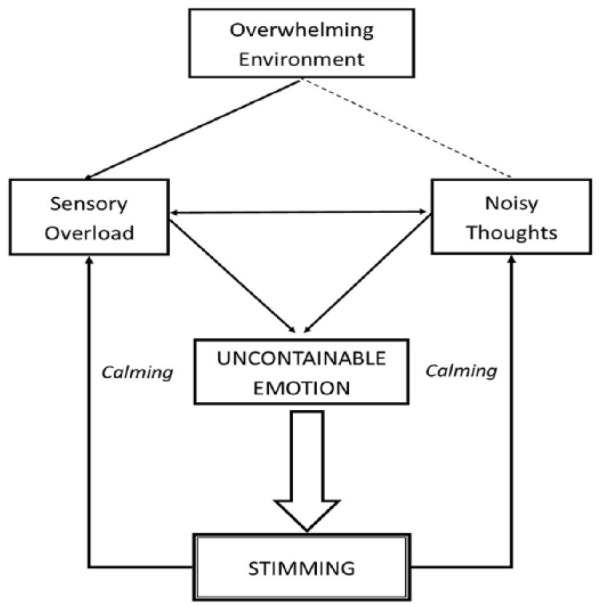
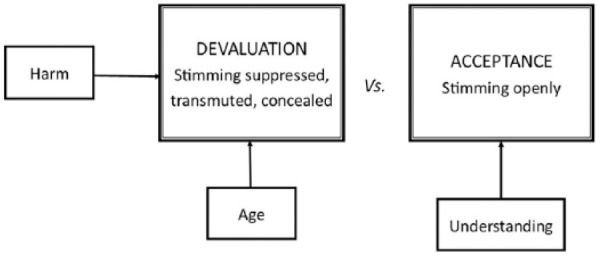
‘Stereotyped or repetitive motor movements’ are characterised as core features in the diagnosis of autism, yet many autistic adults (and the neurodiversity movement) have reclaimed them as ‘stimming’. Supported by a growing body of scientific research, autistic adults argue that these behaviours may serve as useful coping mechanisms, yet little research has examined stimming from the perspective of autistic adults. Through interviews and focus groups, we asked 32 autistic adults to share their perceptions and experiences of stimming, including the reasons they stim, any value doing so may hold for them and their perceptions of others’ reactions to stimming. Using thematic analysis, we identified two themes: stimming as (1) a self-regulatory mechanism and (2) lacking in social acceptance, but can become accepted through understanding. Autistic adults highlighted the importance of stimming as an adaptive mechanism that helps them to soothe or communicate intense emotions or thoughts and thus objected to treatment that aims to eliminate the behaviour.
Overview
The claims and statistics of this paper haven’t been checked yet.
Free: it reads the open-access text and checks the first 5 claims that cite a source we can check. Create a free account to check every claim.
Integrity signals
Registry
Cites
Statistics
Figures
Verification
Claims the paper makes
The claims and statistics of this paper haven’t been checked yet.
Free: it reads the open-access text and checks the first 5 claims that cite a source we can check. Create a free account to check every claim.
Claims other papers make about this one
Each is checked against this paper’s own text: does it say what the citing paper says it does?
The source backs part of the claim, not all of it — or backs it for a different population, condition or comparison.
In the citing paper
“workplace practices often remain oriented towards normative expectations surrounding communication, behavior, and participation in work (Kapp et al., 2019; Erbil et al., 2024)”
From The system-level organisational design framework: a neuro-cognitive trait interaction approach to workplace inclusion for autistic people (2026) · cites this paper as Kapp et al., 2019
Experimental — accuracy not yet measuredThe source backs part of the claim, not all of it — or backs it for a different population, condition or comparison.
In the citing paper
“Repetitive behaviors and focused interests are important to the internal regulation and well-being of many Autistic individuals (Kapp et al., 2019; Manor-Binyamini & Schreiber-Divon, 2019; Milton & Sims, 2016; see also Grove et al., 2018).”
From Neurodiversity and Autism Intervention: Reconciling Perspectives Through a Naturalistic Developmental Behavioral Intervention Framework (2022) · cites this paper as Kapp et al., 2019
Experimental — accuracy not yet measuredThe cited source says what the claim attributes to it.
In the citing paper
“repetitive behaviour or 'stimming' is common and usual (Kapp et al, 2019; Charlton et al, 2021).”
From Autistic SPACE: a novel framework for meeting the needs of autistic people in healthcare settings (2023) · cites this paper as Kapp et al, 2019
The cited source says what the claim attributes to it.
In the citing paper
“In fact, it now seems likely that they often serve a regulatory, soothing function for autistic people (e.g. Joyce, Honey, Leekam, Barrett, & Rodgers, 2017; Kapp et al., 2019).”
From Annual Research Review: Shifting from ‘normal science’ to neurodiversity in autism science (2022) · cites this paper as Kapp et al., 2019
The cited source says what the claim attributes to it.
In the citing paper
“Non-harmful self-stimulatory or repetitive behavior is often used to regulate emotions, and these behaviors may serve as adaptive coping skills for many individuals (Kapp et al., 2019; Manor-Binyamini & Schreiber-Divon, 2019).”
From Neurodiversity and Autism Intervention: Reconciling Perspectives Through a Naturalistic Developmental Behavioral Intervention Framework (2022) · cites this paper as Kapp et al., 2019
1 more claim about this paper
Create a free account to see every claim other papers make about this one.
Self-check
Percentages, sums and reported differences re-computed from the paper’s own numbers.
The self-check needs the paper’s full text.
Citations
Cites
Using thematic analysis in psychology
Braun, V., & Clarke, V. (2006) · Qualitative Research in Psychology · doi:10.1191/1478088706qp063oa · Cited by 194,414 · cited 1×
“Data were analysed thematically, following Braun and Clarke (2006).”
MethodDiagnostic and Statistical Manual of Mental Disorders
American Psychiatric Association (2013) · doi:10.1176/appi.books.9780890425596 · Cited by 116,369
Braun, V., & Clarke, V. (2012) · APA handbook of research methods in psychology, Vol 2: Research designs: Quantitative, qualitative, neuropsychological, and biological. · doi:10.1037/13620-004 · Cited by 10,299
(1943) · The Nervous child · Cited by 8,870
Autistic disturbances of affective contact.
Kanner, L. (1968) · PubMed · Cited by 3,130
On the ontological status of autism: the ‘double empathy problem’
Milton, D. E. M. (2012) · Disability & Society · doi:10.1080/09687599.2012.710008 · Cited by 2,082 · cited 1×
“Potentially, other people’s imitation of their stims may facilitate autistic people’s self-other awareness (see Kapp, 2016, p. 70) and help bridge the difficulties autistic and non-autistic people share in understanding one another, which Milton (2012) terms the ‘double empathy problem’.”
BackgroundWhen the world becomes ‘too real’: a Bayesian explanation of autistic perception
Pellicano, E., & Burr, D. (2012) · Trends in Cognitive Sciences · doi:10.1016/j.tics.2012.08.009 · Cited by 1,156 · cited 3×
“Email: s.k.kapp@exeter.ac.uk have suggested that stimming may provide familiar and reliable self-generated feedback in response to difficulties with unpredictable, overwhelming and novel circumstances (e.g. Lawson, Rees, & Friston, 2014; Pellicano & Burr, 2012).”
BackgroundResultSelf-citationConcept Evolution in Sensory Integration: A Proposed Nosology for Diagnosis
Miller, L. J., Anzalone, M. E., Lane, S. J., Cermak, S. A., & Osten, E. T. (2007) · American Journal of Occupational Therapy · doi:10.5014/ajot.61.2.135 · Cited by 953
‘Autistic psychopathy’ in childhood
Asperger, H. (1991) · Autism and Asperger Syndrome · doi:10.1017/cbo9780511526770.002 · Cited by 765
Ego depletion and self-control failure: An energy model of the self's executive function
Baumeister, R. F. (2002) · Self and Identity · doi:10.1080/152988602317319302 · Cited by 656
An aberrant precision account of autism
Lawson, R. P., Rees, G., & Friston, K. J. (2014) · Frontiers in Human Neuroscience · doi:10.3389/fnhum.2014.00302 · Cited by 641
Leekam, S. R., Prior, M. R., & Uljarevic, M. (2011) · Psychological Bulletin · doi:10.1037/a0023341 · Cited by 612 · cited 2×
“For example, a prominent review of repetitive behaviours in autistic people attributed the onset of stimming to a ‘self-imposed restricted environment’ (Leekam et al., 2011, p. 577).”
BackgroundRhythmical stereotypies in normal human infants
Thelen, E. (1979) · Animal Behaviour · doi:10.1016/0003-3472(79)90006-x · Cited by 573 · cited 2×
“Such stims may function to help infants transition to volitional motor activity (Thelen, 1979), yet many autistic people struggle with the initiation and execution of intentional skilled movements into adulthood (Biscaldi et al., 2014; Wild, Poliakoff, Jerrison, & Gowen, 2012).”
BackgroundJaswal, V. K., & Akhtar, N. (2019) · Behavioral and Brain Sciences · doi:10.1017/s0140525x18001826 · Cited by 436
Autistic expertise: A critical reflection on the production of knowledge in autism studies
Milton, D. E. (2014) · Autism · doi:10.1177/1362361314525281 · Cited by 421 · cited 2×
“As autistic adults may understand one another better than non-autistic people understand them (Gernsbacher, Stevenson, & Dern, 2017; Gillespie-Lynch, Kapp, Brooks, Pickens, & Schwartzman, 2017; Komeda, 2015; Milton, 2014), this study sought to examine autistic adults’ perceptions and experiences of stimming.”
BackgroundWhose Expertise Is It? Evidence for Autistic Adults as Critical Autism Experts
Gillespie-Lynch, K., Kapp, S. K., Brooks, P. J., Pickens, J., & Schwartzman, B. (2017) · Frontiers in Psychology · doi:10.3389/fpsyg.2017.00438 · Cited by 384
Self-citationEmotion regulation in Asperger’s syndrome and high-functioning autism
Samson, A. C., Huber, O., & Gross, J. J. (2012) · Emotion · doi:10.1037/a0027975 · Cited by 368
Kinnear, S. H., Link, B. G., Ballan, M. S., & Fischbach, R. L. (2016) · Journal of Autism and Developmental Disorders · doi:10.1007/s10803-015-2637-9 · Cited by 365
The journal of developmental processes
Disorders, L., & Milton (2006) · Medical Entomology and Zoology · Cited by 325
Ornitz, E. M. (1968) · Archives of General Psychiatry · doi:10.1001/archpsyc.1968.01740010078010 · Cited by 310
Robertson, S. M. (2009) · Disability Studies Quarterly · doi:10.18061/dsq.v30i1.1069 · Cited by 305 · cited 2×
“Although the sample was recruited from the general community, rather than a subsection of activists (and thus seemed to vary greatly in their identities regarding autism), this finding is consistent with the neurodiversity movement’s opposition to eliminating all stimming with the exception of behaviours harmful to in…”
ResultBauer, K. W., Yang, Y. W., & Austin, S. B. (2004) · Health Education & Behavior · doi:10.1177/1090198103255372 · Cited by 279
How Easy is it to Read the Minds of People with Autism Spectrum Disorder?
Sheppard, E., Pillai, D., Wong, G. T.-L., Ropar, D., & Mitchell, P. (2016) · Journal of Autism and Developmental Disorders · doi:10.1007/s10803-015-2662-8 · Cited by 229
Rethinking autism: implications of sensory and movement differences for understanding and support
Donnellan, A. M., Hill, D. A., & Leary, M. R. (2013) · Frontiers in Integrative Neuroscience · doi:10.3389/fnint.2012.00124 · Cited by 218
The modulation of sensory input and motor output in autistic children
Ornitz, E. M. (1974) · Journal of Autism and Childhood Schizophrenia · doi:10.1007/bf02115226 · Cited by 217 · cited 3×
“Stimming seemed to give autistic people a mechanism of behavioural control to self-regulate a state of emotional hyperarousal, amid a bombardment of overwhelming sensations or thoughts, consistent with classical and modern theories of autism (e.g. Delacato, 1974; Ornitz, 1974; Pellicano & Burr, 2012).”
BackgroundResultEvaluating Posed and Evoked Facial Expressions of Emotion from Adults with Autism Spectrum Disorder
Faso, D. J., Sasson, N. J., & Pinkham, A. E. (2014) · Journal of Autism and Developmental Disorders · doi:10.1007/s10803-014-2194-7 · Cited by 177
Joyce, C., Honey, E., Leekam, S. R., Barrett, S. L., & Rodgers, J. (2017) · Journal of Autism and Developmental Disorders · doi:10.1007/s10803-017-3027-2 · Cited by 171 · cited 1×
“Participants described stimming as helping to calm or soothe overwhelming sensations or emotions, which is consistent with self-reports of autistic individuals (e.g. Joyce et al., 2017; Steward, 2015).”
ResultAutism as a Disorder of Biological and Behavioral Rhythms: Toward New Therapeutic Perspectives
Tordjman, S., Davlantis, K. S., Georgieff, N., Geoffray, M.-M., Speranza, M., Anderson, G. M., Xavier, J., Botbol, M., Oriol, C., Bellissant, E., et al. (2015) · Frontiers in Pediatrics · doi:10.3389/fped.2015.00001 · Cited by 162 · cited 2×
“Such evidence links with theories of autism as affecting rhythms (Amos, 2013; Tordjman et al., 2015) and Luke’s description of stimming as coordinating thoughts and activity at the pace of his movements to ‘quell everything, because you’re at the same rhythm with everything’.”
BackgroundNonautistic Motor Stereotypies: Clinical Features and Longitudinal Follow-Up
Harris, K. M., Mahone, E. M., & Singer, H. S. (2008) · Pediatric Neurology · doi:10.1016/j.pediatrneurol.2007.12.008 · Cited by 156
What Can Physicians Learn from the Neurodiversity Movement?
(2012) · AMA Journal of Ethics · doi:10.1001/virtualmentor.2012.14.6.oped1-1206 · Cited by 113
Effects of reducing stereotypy on other behaviors: A systematic review
Lanovaz, M. J., Robertson, K. M., Soerono, K., & Watkins, N. (2013) · Research in Autism · doi:10.1016/j.rasd.2013.07.009 · Cited by 109
Ne'eman, A. (2010) · Disability Studies Quarterly · doi:10.18061/dsq.v30i1.1059 · Cited by 104 · cited 1×
“…of activists (and thus seemed to vary greatly in their identities regarding autism), this finding is consistent with the neurodiversity movement’s opposition to eliminating all stimming with the exception of behaviours harmful to inclusion and quality of life (c.f. Ne’eman, 2010; Robertson, 2010).”
Result'It cuts both ways': a relational approach to access and accommodation for autism.
Davidson, J. (2010) · Social Science & Medicine (1967) · doi:10.1016/j.socscimed.2009.10.017 · Cited by 104 · cited 3×
“…mostly stem from self-selected, highly articulate and self-aware segments of the autistic community, such as writers of autobiographies (e.g. Davidson, 2010), participants in advocacy organisations (e.g. Savarese, 2010) and scholars (Nolan & McBride, 2015; Richter, 2017), this study…”
BackgroundInfluentialSocial movements, knowledge and public policy: the case of autism activism in Canada and the US
Orsini, M., & Smith, M. (2010) · Critical Policy Studies · doi:10.1080/19460171003714989 · Cited by 95 · cited 2×
“Autism rights or neurodiversity activists believe that stims may serve as coping mechanisms, thus opposing attempts to eliminate non-injurious forms of stimming (e.g. Orsini & Smith, 2010).”
BackgroundToward a Behavior of Reciprocity.
Gernsbacher, M. A. (2006) · PubMed · Cited by 91
Goal-Directed and Goal-Less Imitation in Autism Spectrum Disorder
Rushton, K., Poliakoff, E., Jerrison, A., & Gowen, E. (2011) · Journal of Autism and Developmental Disorders · doi:10.1007/s10803-011-1417-4 · Cited by 86
Hartanto, T. A., Krafft, C. E., Iosif, A. M., & Schweitzer, J. B. (2016) · Child Neuropsychology · doi:10.1080/09297049.2015.1044511 · Cited by 79
Specificity, contexts, and reference groups matter when assessing autistic traits
Gernsbacher, M. A., Stevenson, J. L., & Dern, S. (2017) · PLOS ONE · doi:10.1371/journal.pone.0171931 · Cited by 74
Vestibular Dysfunction in Childhood Schizophrenia
COLBERT, E. G. (1959) · Archives of General Psychiatry · doi:10.1001/archpsyc.1959.03590060062006 · Cited by 66
The Ultimate Stranger: The Autistic Child
Delacato, C. H. (1974) · Medical Entomology and Zoology · Cited by 62
Rhythm and timing in autism: learning to dance
Amos, P. (2013) · Frontiers in Integrative Neuroscience · doi:10.3389/fnint.2013.00027 · Cited by 61 · cited 2×
“Such evidence links with theories of autism as affecting rhythms (Amos, 2013; Tordjman et al., 2015) and Luke’s description of stimming as coordinating thoughts and activity at the pace of his movements to ‘quell everything, because you’re at the same rhythm with everything’.”
BackgroundVariable sensory perception in autism
Haigh, S. M. (2018) · European Journal of Neuroscience · doi:10.1111/ejn.13601 · Cited by 61 · cited 1×
“In support of this theory, autistic people have shown high behavioural and neurological variability to the same basic stimuli over time (Colbert, Koegler, & Markham, 1959; Haigh, 2018).”
BackgroundBiscaldi, M., Rauh, R., Irion, L., Jung, N. H., Mall, V., Fleischhaker, C., & Klein, C. (2013) · European Child & Adolescent Psychiatry · doi:10.1007/s00787-013-0475-x · Cited by 60
Embodied Semiosis: Autistic ‘Stimming’ as Sensory Praxis
Nolan, J., & McBride, M. (2015) · Springer eBooks · doi:10.1007/978-94-017-9404-6_48 · Cited by 59 · cited 3×
“Autistic adults have led resistance to these efforts (Lilley, in press), reclaiming ‘self-stimulatory behaviour’ as ‘stimming’ (e.g. Nolan & McBride, 2015).”
BackgroundPATTERSON, S. Y., SMITH, V., & JELEN, M. (2010) · Developmental Medicine & Child Neurology · doi:10.1111/j.1469-8749.2009.03597.x · Cited by 58
Harrop, C. (2015) · Autism · doi:10.1177/1362361314545685 · Cited by 57
Occupying Autism: Rhetoric, Involuntarity, and the Meaning of Autistic Lives
Yergeau, M. (2015) · Springer eBooks · doi:10.1007/978-94-017-9984-3_6 · Cited by 41 · cited 1×
“In addition, autistic scholar-activists denounce attempts to reduce their bodily autonomy (Nolan & McBride, 2015; Richter, 2017) and declarations of their stimming as unacceptable or as necessarily involuntary (Yergeau, 2016).”
BackgroundKomeda, H. (2015) · Frontiers in Human Neuroscience · doi:10.3389/fnhum.2015.00124 · Cited by 36 · cited 2×
“As autistic adults may understand one another better than non-autistic people understand them (Gernsbacher, Stevenson, & Dern, 2017; Gillespie-Lynch, Kapp, Brooks, Pickens, & Schwartzman, 2017; Komeda, 2015; Milton, 2014), this study sought to examine autistic adults’ perceptions and experiences of stimming.”
BackgroundWhat We Have to Tell You: A Roundtable with Self-Advocates from AutCom
Savarese, E. T. (2009) · Disability Studies Quarterly · doi:10.18061/dsq.v30i1.1073 · Cited by 19 · cited 1×
“…segments of the autistic community, such as writers of autobiographies (e.g. Davidson, 2010), participants in advocacy organisations (e.g. Savarese, 2010) and scholars (Nolan & McBride, 2015; Richter, 2017), this study actively recruited predominantly non-activist participants largely in…”
BackgroundMelting Down the Family Unit: A Neuroqueer Critique of Table-Readiness
Richter, Z. A. (2016) · Palgrave Macmillan US eBooks · doi:10.1057/978-1-137-48769-8_14 · Cited by 10 · cited 2×
“Savarese, 2010) and scholars (Nolan & McBride, 2015; Richter, 2017), this study actively recruited predominantly non-activist participants largely in their own settings (e.”
BackgroundSocial Justice and Autism: Links to Personality and Advocacy
Kapp, S. K. (2016) · eScholarship (California Digital Library) · Cited by 7
Self-citationPellicano, E. (2013) · Autism · doi:10.1177/1362361313479218 · Cited by 2 · cited 1×
“Interventions should facilitate true reciprocity that helps non-autistic people understand and respect stimming (Gernsbacher, 2006; Pellicano, 2013).”
BackgroundSelf-citation
Research works printed but not linked: 5
- Bascom J., 2012, Loud hands: Autistic people, speaking
- Kanner L., 1943, Nervous Child, 2, 217
- Lilley R, 2018, What’s in a flap? The curious history of autism and hand stereotypies
- Nicolaidis C., 2012, Virtual Mentor: American Medical Association Journal of Ethics, 14, 503
- World Health Organization, 1992, The ICD-10 Classification of Mental and Behavioural Disorders: Diagnostic Criteria for Research, 2
Cited by
Avoiding Ableist Language: Suggestions for Autism Researchers
Bottema-Beutel, K., Kapp, S. K., Lester, J. N., Sasson, N. J., & Hand, B. N. (2021) · Autism in Adulthood · doi:10.1089/aut.2020.0014 · Cited by 1,251
Self-citationAnnual Research Review: Shifting from ‘normal science’ to neurodiversity in autism science
Pellicano, E., & den Houting, J. (2022) · Journal of Child Psychology and Psychiatry · doi:10.1111/jcpp.13534 · Cited by 744
“In fact, it now seems likely that they often serve a regulatory, soothing function for autistic people (e.g. Joyce, Honey, Leekam, Barrett, & Rodgers, 2017; Kapp et al., 2019).”
BackgroundSelf-citationThe Neurodiversity Approach(es): What Are They and What Do They Mean for Researchers?
Dwyer, P. (2022) · Human Development · doi:10.1159/000523723 · Cited by 672
Pearson, A., & Rose, K. (2021) · Autism in Adulthood · doi:10.1089/aut.2020.0043 · Cited by 596
“The further suppression of internal states and associated coping mechanisms (i.e., stimming 53 ) alongside an already present difficulty identifying one’s own emotions could potentially be disastrous, leading to further long-term difficulties in mental health and well-being (i.e., burnout and…”
Autistic Community and the Neurodiversity Movement: Stories from the Frontline
(2020) · doi:10.1007/978-981-13-8437-0 · Cited by 426
Self-citation
Metadata
- Authors
- Kapp, S. K., Steward, R., Crane, L., Elliott, D., Elphick, C., Pellicano, E., & Russell, G.
- Affiliations
- University of Exeter (GB)
- University College London (GB)
- Corresponding author
- Kapp, Steven K
- Venue
- Autism
- Publisher
- SAGE Publications
- Published
- 2019-02-28
- Volume
- 23
- Issue
- 7
- Pages
- 1782-1792
- ISSN
- 1362-3613 (ISSN-L)
- 1461-7005
- PMC
- PMC6728747
- OpenAlex
- W2912195587
- Semantic Scholar
- 8e9fcb1de03b4ce92ab15abdadbbb112c8e48ce3
- Cited by
- 495
- References
- 53
- Citations by year
- 2026: 89 · 2025: 89 · 2024: 106 · 2023: 80 · 2022: 71 · 2021: 33 · 2020: 20 · 2019: 7
- FWCI
- 19.04
- Type
- journal article
- Language
- en
- Open access
- hybrid
- doi.org
- Licence
- cc-by
- journals.sagepub.com/page/policies/text-and-data-mining-license (tdm)
- Locations
- Autism (publishedVersion, cc-by)
- PubMed Central (publishedVersion, cc-by)
- PubMed (publishedVersion)
- UCL Discovery (University College London) (submittedVersion)
- Figshare (submittedVersion, cc-by)
- Open Research Exeter (University of Exeter) (submittedVersion, cc-by)
- University of Birmingham Research Portal (University of Birmingham) (submittedVersion)
- Funders
- Wellcome Trust (108676/Z/15/Z)
- leverhulme trust
- Topics
- Life Sciences › Neuroscience › Cognitive Neuroscience › Autism Spectrum Disorder Research
- Social Sciences › Psychology › Developmental and Educational Psychology › Behavioral and Psychological Studies
- Social Sciences › Psychology › Clinical Psychology › Obsessive-Compulsive Spectrum Disorders
- Keywords
- stimming, autistic adults, self-regulation, coping strategies, neurodiversity movement, autistic identity, sensory regulation, autism treatment
- MeSH terms
- Adaptation, Psychological, Adult, Attitude, Autistic Disorder, Female, Humans, Interviews as Topic, Male, Middle Aged, Focus Groups, Stereotypic Movement Disorder, Young Adult
About these checks
Registry, retraction, Cites and statistics results are computed, not judged, with one exception: a printed reference that no index lists is read once by a model before it counts as a citation error. Claims are extracted by a model and kept only when their quote appears verbatim in the text; each cited source is then checked, with a model’s help, for whether it says what the claim relies on. Those verdicts can be wrong — read the claim’s quote and the cited source before relying on one.
Statistics and arithmetic are recomputed, not judged.
Confidence bands are shown only for fields calibrated on our annotated test set. None is calibrated yet, so no band is shown.
What counts as a claim ›How we measure confidence ›How we check this ›
Are you an author, or do you see a problem with this page? Request a review
Data sources
Bibliographic data: Semantic Scholar, OpenAlex, Crossref.
Contains information from the Semantic Scholar Academic Graph Datasets, made available under the ODC Attribution License (ODC-BY 1.0).
Semantic Scholar’s data is described in: Kinney, R., et al. (2023). The Semantic Scholar Open Data Platform. arXiv:2301.10140.
