

Pilot study of a psychotherapeutic intervention for reducing guilt feelings in highly distressed dementia family caregivers (Innovative practice).
Open accessThe DOI matches its Crossref record, with a small difference in title or year; 21 of the 22 references it cites were found in a registry or an index, and 1 are not checked yet; 4 of the 13 sources its claims cite were checked for support.
Abstract
Many caregivers of people with dementia experience guilt but few interventions have been designed to help them with these feelings. This study aimed to describe a psychological intervention specifically developed for decreasing caregivers´ guilt. The sample was composed of four caregivers, individually interviewed before and after the intervention. The intervention consisted of eight group-based sessions and was based on cognitive-behavioral, acceptance and self-compassion techniques. Three participants reported clinically reliable change in guilt. Clinically significant changes were also observed in their levels of anxiety and depression. The results suggest that carers might benefit from interventions designed to reduce their feelings of guilt.
Verified 2026-11-25 · 1 reference not checked yet
Overview
CoChat Summary
TL;DR
This pilot study describes an 8-session group psychotherapy for dementia family caregivers designed to reduce guilt using CBT, ACT, and self-compassion techniques. In four caregivers who completed post-treatment assessment, 3 showed clinically reliable reductions in guilt, with associated clinically significant changes in depression and anxiety for some participants.
Key findings
- The intervention was delivered as eight weekly group sessions, each lasting approximately two hours, and was built around three dysfunctional beliefs about caregiving, self-care, and emotional control.
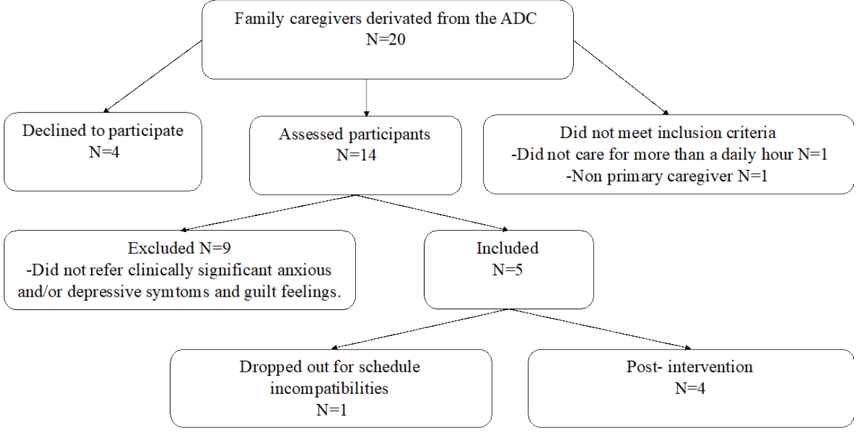
- Of the 20 caregivers initially screened, 5 met inclusion criteria and 4 were evaluated at post-treatment; among these 4, 3 caregivers showed a clinically relevant change in guilt with an RCI of 3.62 (p < .05).
- After treatment, 3 caregivers scored below the guilt cutoff; for depression, the RCI was 7.72 (p < .05) and Caregiver 4 showed a clinically relevant improvement, while Caregiver 2 showed a clinically relevant deterioration.
- For anxiety, the RCI was 3.97 (p < .05) and Caregivers 3 and 4 showed clinically relevant change; the abstract also states that clinically significant changes were observed in anxiety and depression.
Methods
- Design: A pilot study / preliminary pre-post evaluation of a group-based psychotherapeutic intervention with assessment before and after the intervention; no control group is mentioned.
- Sample: Four family caregivers of relatives with dementia completed post-treatment assessment; the broader recruitment pool was 20 caregivers from adult day care centers in Madrid, Spain, with inclusion criteria including significant guilt and clinically significant depressive and/or anxious symptoms.
- Analysis: The main analysis used the Jacobson and Truax (1991) reliable change criteria to judge clinically significant change, comparing pre- and post-intervention scores on guilt, depression, and anxiety.
Limitations
- The paper explicitly states that findings should be interpreted with caution because of the limited sample size, lack of a control group, and lack of follow-up data.
- The paper says more studies with larger samples, a randomized controlled design, and follow-up assessment are needed.
- Evident from the text: only 4 participants were assessed post-treatment, so the results are based on a very small uncontrolled sample.
Model-written summary. Check it against the paper before relying on it.
Integrity signals
Registry
Cites
Statistics
Figures
Verification
Claims the paper makes
4 Valid · 0 Not valid · 6 Not checked · 27 Own results and interpretations
The cited sources support only part of this claim — read each source’s verdict below.
In the paper
“Only one published study appears to have analyzed the efficacy of a psychological intervention (CBT) for reducing caregivers' guilt feelings”
What the sources say
- Partly supportedcites Mahmoudi, Mohammadkhani, Bonan, & Bagheri, 2017 matched to “Effectiveness of Cognitive-Behavioral Group Therapy on Guilt Feeling Among Family Caregivers of Patients With Alzheimer’s Disease” (2017) sourceExperimental — accuracy not yet measured
The Abstract and Results report that this study tested cognitive-behavioral group therapy and found reduced guilt among family caregivers of people with Alzheimer’s disease. The Discussion calls it the first such investigation in that specific population, but does not establish that it was the only published psychological-intervention study of caregivers’ guilt more generally. (LLM, conf=0.82)
hedged- Asserted: passes — The authors put it forward as true.
- Checkable: passes — It can be checked against evidence.
- Load-bearing: passes — The paper’s conclusions depend on it.
- Based: passes — The paper gives a reason why it holds.
- Partly supported
The cited sources support only part of this claim — read each source’s verdict below.
In the paper
“The results showed a reduction in guilt feelings at posttreatment and follow-up.”
What the sources say
- Partly supportedcites Mahmoudi, Mohammadkhani, Bonan, & Bagheri, 2017 matched to “Effectiveness of Cognitive-Behavioral Group Therapy on Guilt Feeling Among Family Caregivers of Patients With Alzheimer’s Disease” (2017) sourceExperimental — accuracy not yet measured
The Results (Section 3) report reduced guilt at post-test. Table 1 lists a lower follow-up mean for caregiver guilt, but the Discussion (Section 4) explicitly says a follow-up phase was unavailable due to time constraints. The paper therefore does not clearly support a follow-up finding. (LLM, conf=0.87)
plainstates a cause- Asserted: passes — The authors put it forward as true.
- Checkable: passes — It can be checked against evidence.
- Load-bearing: passes — The paper’s conclusions depend on it.
- Based: passes — The paper gives a reason why it holds.
- Partly supported
Every source the paper cites for this claim was checked and supports it.
In the paper
“Many caregivers of people with dementia experience guilt but few interventions have been deigned to help them with these feelings.”
- Also stated in: § Introduction · plain
“Considering the gap in the availability of interventions specifically developed for treating dementia family caregivers' guilt”
What the sources say
- Supportedcites Mahmoudi, Mohammadkhani, Bonan, & Bagheri, 2017 matched to “Effectiveness of Cognitive-Behavioral Group Therapy on Guilt Feeling Among Family Caregivers of Patients With Alzheimer’s Disease” (2017) source
The Discussion states that only a few studies, if any, had attempted to decrease guilt among family caregivers of people with Alzheimer’s disease. This supports the claim that few interventions had been designed to help these caregivers with guilt feelings. (LLM, conf=0.91)
plain- Asserted: passes — The authors put it forward as true.
- Checkable: passes — It can be checked against evidence.
- Load-bearing: passes — The paper’s conclusions depend on it.
- Based: passes — The paper gives a reason why it holds.
- Also stated in: § Introduction · plain
A result the paper reports from its own data — it cites no other source for it, so there is none to check. The quote shows it is in the paper.
In the paper
“Three participants reported clinically reliable change in guilt.”
- Also stated in: § Discussion · plain
“Three of the four participants reported clinically significant changes (reliable change) in guilt feelings (Caregivers 1, 3 and 4).”
plainn = 3- Asserted: passes — The authors put it forward as true.
- Checkable: passes — It can be checked against evidence.
- Load-bearing: passes — The paper’s conclusions depend on it.
- Based: passes — The paper gives a reason why it holds.
- Also stated in: § Discussion · plain
A result the paper reports from its own data — it cites no other source for it, so there is none to check. The quote shows it is in the paper.
In the paper
“The obtained RCI value for guilt was 3.62 ( p < .05).”
plain- Asserted: passes — The authors put it forward as true.
- Checkable: passes — It can be checked against evidence.
- Load-bearing: passes — The paper’s conclusions depend on it.
- Based: passes — The paper gives a reason why it holds.
19 more claims
Create a free account to see all 37 claims and to verify the 1 reference still open.
- It may state two separate claims as one. 6
- Probably not a substantial claim. 8
Claims other papers make about this one
Each is checked against this paper’s own text: does it say what the citing paper says it does?
The source backs part of the claim, not all of it — or backs it for a different population, condition or comparison.
In the citing paper
“These caregivers may feel guilt, frustration, or anger at themselves when they have negative thoughts and emotions arising from challenging caregiving situations and try to control or avoid these thoughts and emotions”
From The feasibility and preliminary effects of a pilot randomized controlled trial: Videoconferencing acceptance and commitment therapy in distressed family caregivers of people with dementia. (2023) · cites this paper as Gallego-Alberto et al., 2021
Experimental — accuracy not yet measuredThe source backs part of the claim, not all of it — or backs it for a different population, condition or comparison.
In the citing paper
“Two pilot studies conducted in Spain involved a group-based in-person guilt-focused intervention based on CBT, ACT, and compassion-focused therapy approaches and found promising findings, such as significant reductions in depression, anxiety, and guilt over time”
From The feasibility and preliminary effects of a pilot randomized controlled trial: Videoconferencing acceptance and commitment therapy in distressed family caregivers of people with dementia. (2023) · cites this paper as Gallego-Alberto et al., 2021
Experimental — accuracy not yet measured
Citations
Cites
The CES-D Scale: A Self-Report Depression Scale for Research in the General Population
Radloff, L. S. (1977) · Applied Psychological Measurement · doi:10.1177/014662167700100306 · Cited by 53,267
Jacobson, N. S., & Truax, P. (1991) · Journal of Consulting and Clinical Psychology · doi:10.1037/0022-006x.59.1.12 · Cited by 7,770
Two Shorter Forms of the CES-D Depression Symptoms Index
Kohout, F. J., Berkman, L. F., Evans, D. A., & Cornoni-Huntley, J. (1993) · Journal of Aging and Health · doi:10.1177/089826439300500202 · Cited by 2,284
Guilt: An interpersonal approach
Baumeister, R. F., Stillwell, A. M., & Heatherton, T. F. (1994) · Psychological Bulletin · doi:10.1037/0033-2909.115.2.243 · Cited by 1,884
Introducing compassion-focused therapy
Gilbert, P. (2009) · Advances in Psychiatric Treatment · doi:10.1192/apt.bp.107.005264 · Cited by 1,435 · cited 2×
“In this intervention, caregivers are guided to explore and acknowledge their guilt and other negative feelings in the frame of these irrational beliefs; however, instead of using cognitive restructuring techniques to change these beliefs, caregivers ability to tolerate and accept guilt and distressing emotions and tho…”
BackgroundPinquart, M., & Sorensen, S. (2006) · International Psychogeriatrics · doi:10.1017/s1041610206003462 · Cited by 827
On conceptualizing and assessing guilt.
Kugler, K., & Jones, W. H. (1992) · Journal of Personality and Social Psychology · doi:10.1037/0022-3514.62.2.318 · Cited by 450
Prevalence of Mental Health Disorders Among Caregivers of Patients With Alzheimer Disease
Sallim, A. B., Sayampanathan, A. A., Cuttilan, A., & Chun-Man Ho, R. (2015) · Journal of the American Medical Directors Association · doi:10.1016/j.jamda.2015.09.007 · Cited by 396
Jacobson, N. S., & Truax, P. (1992) · Methodological issues & strategies in clinical research. · doi:10.1037/10109-042 · Cited by 384
On conceptualizing and assessing guilt.
Kugler, K., & Jones, W. H. (1992) · Journal of Personality and Social Psychology · doi:10.1037//0022-3514.62.2.318 · Cited by 317
Research works printed but not linked: 2
- Hayes, S. C., Strosahl, K., & Wilson, K. G. (1999 ). Acceptance and commitment therapy: Understanding and treating human suffering. New York: Guilford.
- McNair D. M., 1971, Manual for the profile of mood states (POMS)
Cited by
“I Feel Guilty”. Exploring Guilt-Related Dynamics in Family Caregivers of People with Dementia
Gallego-Alberto, L., Losada, A., Cabrera, I., Romero-Moreno, R., Pérez-Miguel, A., Pedroso-Chaparro, M. D. S., & Márquez-González, M. (2022) · Clinical Gerontologist · doi:10.1080/07317115.2020.1769244 · Cited by 65
“The intervention was focused on reducing caregivers’ feelings of guilt, and preliminary results revealed clinically significant changes in guilt, as well as in anxious and depressive symptomatology (Gallego-Alberto et al., 2019).”
BackgroundInfluentialSelf-citationKishita, N., Contreras, M. L., West, J., & Mioshi, E. (2020) · Journal of Contextual Behavioral Science · doi:10.1016/j.jcbs.2020.07.005 · Cited by 37
Emerging topics in dementia care and services
Wolff, J. L., Benge, J. F., Cassel, C. K., Monin, J. K., & Reuben, D. B. (2021) · Journal of the American Geriatrics Society · doi:10.1111/jgs.17341 · Cited by 40
Han, A., Yuen, H. K., & Jenkins, J. (2023) · Journal of Health Psychology · doi:10.1177/13591053221141131 · Cited by 30
“These caregivers may feel guilt, frustration, or anger at themselves when they have negative thoughts and emotions arising from challenging caregiving situations and try to control or avoid these thoughts and emotions (Chan et al., 2010; Gallego-Alberto et al., 2021).”
BackgroundAtefi, G. L., de Vugt, M. E., van Knippenberg, R. J. M., Levin, M. E., Verhey, F. R. J., & Bartels, S. L. (2023) · Clinical Psychology Review · doi:10.1016/j.cpr.2023.102341 · Cited by 33
Contreras, M., Van Hout, E., Farquhar, M., McCracken, L. M., Gould, R. L., Hornberger, M., Richmond, E., & Kishita, N. (2022) · International Journal of Qualitative Studies on Health and Well-being · doi:10.1080/17482631.2022.2066255 · Cited by 24
Guilt Focused Intervention for Family Caregivers. Preliminary Results of a Randomized Clinical Trial
Romero-Moreno, R., Márquez-González, M., Gallego-Alberto, L., Cabrera, I., Vara-García, C., Pedroso-Chaparro, M. D. S., Barrera-Caballero, S., & Losada, A. (2022) · Clinical Gerontologist · doi:10.1080/07317115.2022.2048287 · Cited by 22
Self-citationKishita, N., Morimoto, H., Márquez-González, M., Barrera-Caballero, S., Vara-García, C., Van Hout, E., Contreras, M., & Losada-Baltar, A. (2023) · Journal of Geriatric Psychiatry and Neurology · doi:10.1177/08919887221130269 · Cited by 17
Self-citationContreras, M., Mioshi, E., & Kishita, N. (2021) · Health & Social Care in the Community · doi:10.1111/hsc.13552 · Cited by 26
Cabrera, I., Márquez‐González, M., Kishita, N., Vara‐García, C., & Losada‐Baltar, A. (2020) · The Psychological Record · doi:10.1007/s40732-020-00445-8 · Cited by 16
Self-citationAtefi, G. L., van Knippenberg, R. J. M., Bartels, S. L., Losada-Baltar, A., Márquez-González, M., Verhey, F. R. J., & de Vugt, M. E. (2024) · JMIR Aging · doi:10.2196/53489 · Cited by 15
Self-citationRisch, A. K., Lechner-Meichsner, F., & Wilz, G. (2025) · Clinical Gerontologist · doi:10.1080/07317115.2024.2393307 · Cited by 14
Losada‐Baltar, A., Mausbach, B. T., Romero‐Moreno, R., Jiménez‐Gonzalo, L., Huertas‐Domingo, C., Fernándes-Pires, J., Barrera‐Caballero, S., Gallego‐Alberto, L., Martín‐María, N., Olazarán, J., et al. (2024) · Journal of the American Geriatrics Society · doi:10.1111/jgs.18871 · Cited by 17
“34 Interventions that include specific techniques devoted to promoting acceptance of unchangeable issues in the care-recipient (e.g., memory related BPSD) and understanding the importance of maintaining commitment with important areas of value of the caregivers (e.g., selfcare and social relations)…”
BackgroundSelf-citationHan, A., Oster, R. A., Yuen, H. K., Jenkins, J., Hawkins, J., & Edwards, L. (2025) · JMIR Formative Research · doi:10.2196/67545 · Cited by 18
“These studies were conducted in Spain [14-17], the United States [18-21], the United Kingdom [22], Germany [23], and the Netherlands [24].”
Gallego‐Alberto, L., Smaling, H. J. A., Francke, A. L., van de Brug, T., van der Steen, J. T., & Joling, K. J. (2021) · Dementia · doi:10.1177/14713012211024015 · Cited by 11
“ACT-based interventions have demonstrated to be effective in reducing depressive, anxious, and guilt feelings in dementia family caregivers (Gallego-Alberto et al., 2019; Losada et al., 2015).”
BackgroundSelf-citationSpiers, G., Tan, M. M. C., Astbury, J. L., Hall, A., Ahmed, N., Lanyi, K., Williams, O., Beyer, F. R., Craig, D., & Hanratty, B. (2024) · BMC Geriatrics · doi:10.1186/s12877-024-04897-3 · Cited by 11
Cabrera, I., Márquez-González, M., Gallego-Alberto, L., Pedroso-Chaparro, M. D. S., Barrera-Caballero, S., & Losada, A. (2022) · Aging & Mental Health · doi:10.1080/13607863.2021.1871883 · Cited by 9
Self-citationGallego‐Alberto, L., Romero‐Moreno, R., Márquez‐González, M., Schulz, R., Cabrera, I., Olazarán, J., & Losada‐Baltar, A. (2021) · Health & Social Care in the Community · doi:10.1111/hsc.13652 · Cited by 10
Self-citationDurepos, P., MacLean, R., Ricketts, N., Boamah, S. A., Witherspoon, R., Gould, O., Olthuis, J. V., Totton, K., Tucker, K., Boulay, I., et al. (2024) · Aging & Mental Health · doi:10.1080/13607863.2023.2288864 · Cited by 4
Lero, C., Park, S., & Mroz, E. L. (2025) · Palliative & Supportive Care · doi:10.1017/s1478951524001639 · Cited by 7
Moreno‐Jiménez, J. E., Yeo‐Ayala, M. D. C., Chávez, A. P., Blanco‐Donoso, L. M., Rodríguez‐Carvajal, R., Garrosa, E., & Jiménez, B. M. (2020) · Salud Mental · doi:10.17711/sm.0185-3325.2020.030 · Cited by 8
risch, K., Lechner‐Meichsner, F., & Wilz, G. (2024) · doi:10.31234/osf.io/apbuh · Cited by 2
Zhou, L., Yaofeng, Z., Liu, S., Tang, L., Wenya, H., Huihong, Z., Min, T., Tian, R., & Li, P. (2025) · International Journal of Nursing Studies Advances · doi:10.1016/j.ijnsa.2025.100437 · Cited by 4
Wiita, F., Ho, A. K., & Weinstein, N. (2024) · JMIR Formative Research · doi:10.2196/52883 · Cited by 2
“It is recognized in the literature that caregivers can experience a sense of self-judgment or guilt [4,59].”
García‐Tizón, S. J., Bueno, B., Ortiz, M. C. P., & Navarro, A. (2026) · BMC Psychology · doi:10.1186/s40359-026-04001-x · Cited by 1
“Different articles have high-lighted this analysis and its advantages (e.g., [41–44]).”
Challenges among informal caregivers of people living with motor neuron disease in South Africa
ALLAN, B. C., & Kagee, A. (2025) · African Journal of Disability · doi:10.4102/ajod.v14i0.1832
Rodríguez, L. M., Brito, M. L., de, E. L. H. M., Hernández-Lugo, M. D. L. C., & Castillo, E. F. (2025) · Región Científica · doi:10.58763/rc2025363 · Cited by 3
Han, A., Oster, R. A., Yuen, H. K., et al. (2024) · doi:10.2196/preprints.67545
Mérida-Herrera, L., Cabrera, I., García‐Batalloso, I., Gallego‐Alberto, L., Olazarán, J., Losada‐Baltar, A., & Márquez‐González, M. (2024) · Clinical Gerontologist · doi:10.1080/07317115.2024.2385536 · Cited by 1
Self-citationLancho, M. C. P., & González, M. T. (2024) · International Journal of Developmental and Educational Psychology Revista INFAD de psicología · doi:10.17060/ijodaep.2024.n1.v2.2701
Atefi, G., van Knippenberg, R. J. M., Bartels, S. L., et al. (2023) · doi:10.2196/preprints.53489
Self-citationWiita, F., Ho, A. K., & Weinstein, N. (2023) · doi:10.2196/preprints.52883
Instrumentos sobre o sentimento de culpa dos cuidadores de pessoas com demência: revisão integrativa
Pfutzenreuter, K. C., & Falcão, D. V. D. S. (2023) · Psicologia Argumento · doi:10.7213/psicolargum.41.113.ao014
“…os três instrumentos identificados neste estudo, sendo o: Interpersonal Triggers of Guilt in Dementia Caregiving Questionnaire (ITGDCQ) (Gallego-Alberto et al., 2021), Guilt after placement questionnaire (GAP-Q) (Davis et al., 2019) e Caregiver Guilt Questionnaire (CGQ) (Losada et al.,…”
BackgroundMethodInfluentialLarochette, C. (2020) · theses.fr (ABES) · doi:10.70675/3d8105acz6ee0z43a6z8debz132ec6a6d579 · Cited by 1
加藤, 英. (1969) · 小児科臨床
Metadata
- Authors
- Gallego-Alberto, L., Márquez-González, M., Romero-Moreno, R., Cabrera, I., & Losada, A.
- Affiliations
- Biological and Health Psychology Department, Universidad Autónoma de Madrid, Madrid, Spain
- Clinical Psychology Area, Universidad Rey Juan Carlos de Madrid, Madrid, Spain
- Universidad Autónoma de Madrid (ES)
- Venue
- Dementia
- Publisher
- SAGE Publications
- Published
- 2019-11-10
- Volume
- 20
- Issue
- 2
- Pages
- 759-769
- ISSN
- 1471-3012 (ISSN-L)
- 1741-2684
- OpenAlex
- W2985436846
- Cited by
- 33
- References
- 20
- Citations by year
- 2026: 3 · 2025: 6 · 2024: 7 · 2023: 4 · 2022: 3 · 2021: 4 · 2020: 5
- FWCI
- 2.39
- Type
- journal article
- Language
- en
- Open access
- green
- hdl.handle.net
- Licence
- other-oa
- journals.sagepub.com/page/policies/text-and-data-mining-license (tdm)
- Locations
- Dementia (publishedVersion)
- PubMed (publishedVersion)
- Biblos-e Archivo (Universidad Autónoma de Madrid) (submittedVersion, other-oa)
- Hispana (submittedVersion)
- Funders
- Secretaría de Estado de Investigación, Desarrollo e Innovación (PSI2015-65152-C2-1-R)
- Topics
- Health Sciences › Medicine › Psychiatry and Mental health › Dementia and Cognitive Impairment Research
- Health Sciences › Nursing › Research and Theory › Nursing care and research
- Social Sciences › Psychology › Clinical Psychology › Family Caregiving in Mental Illness
- Keywords
- guilt, dementia caregivers, caregiver distress, psychotherapeutic interventions, group therapy, cognitive behavioral therapy, acceptance and commitment therapy, self-compassion, anxiety, depression
- MeSH terms
- Dementia, Emotions, Guilt, Humans, Pilot Projects, Caregivers
About these checks
Registry, retraction, Cites and statistics results are computed, not judged, with one exception: a printed reference that no index lists is read once by a model before it counts as a citation error. Claims are extracted by a model and kept only when their quote appears verbatim in the text; each cited source is then checked, with a model’s help, for whether it says what the claim relies on. Those verdicts can be wrong — read the claim’s quote and the cited source before relying on one.
The claim verdicts this report counts are experimental: their accuracy is not yet measured.
A language model drew the claims from the paper on 2026-10-11, under version 3 of the claim definition (model deepseek-v4.1-flash, prompt extract-v3).
A second model labelled each claim on 2026-10-11 (model jev-1.13-20260917, definition revision gold-guideline-v0.2).
Cited sources are checked with a language model’s help (gpt-6-sol).
Statistics and arithmetic are recomputed, not judged.
Confidence bands are shown only for fields calibrated on our annotated test set. None is calibrated yet, so no band is shown.
What counts as a claim ›How we measure confidence ›How we check this ›
Are you an author, or do you see a problem with this page? Request a review
Data sources
Bibliographic data: Semantic Scholar, OpenAlex, Crossref.
Contains information from the Semantic Scholar Academic Graph Datasets, made available under the ODC Attribution License (ODC-BY 1.0).
Semantic Scholar’s data is described in: Kinney, R., et al. (2023). The Semantic Scholar Open Data Platform. arXiv:2301.10140.
