

Performance of Music Elevates Pain Threshold and Positive Affect: Implications for the Evolutionary Function of Music
Open accessThe DOI matches its Crossref record; 66 of the 68 references it cites were found in a registry or an index.
Abstract
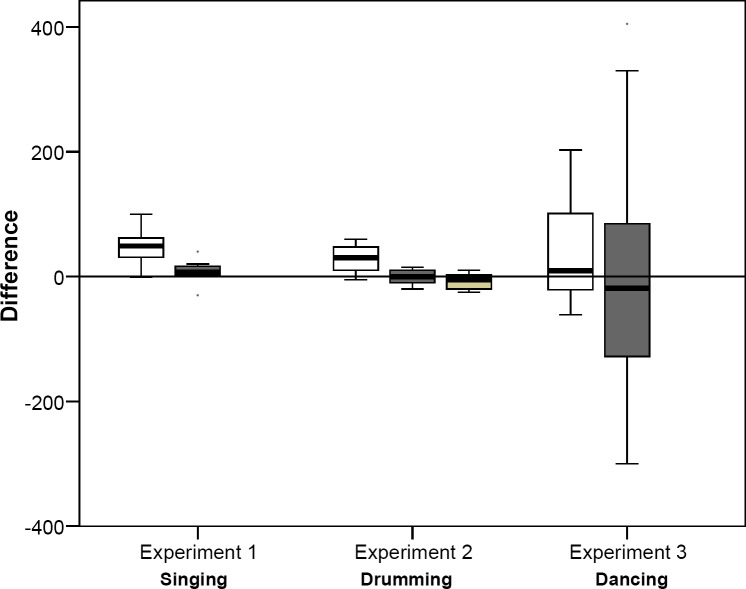
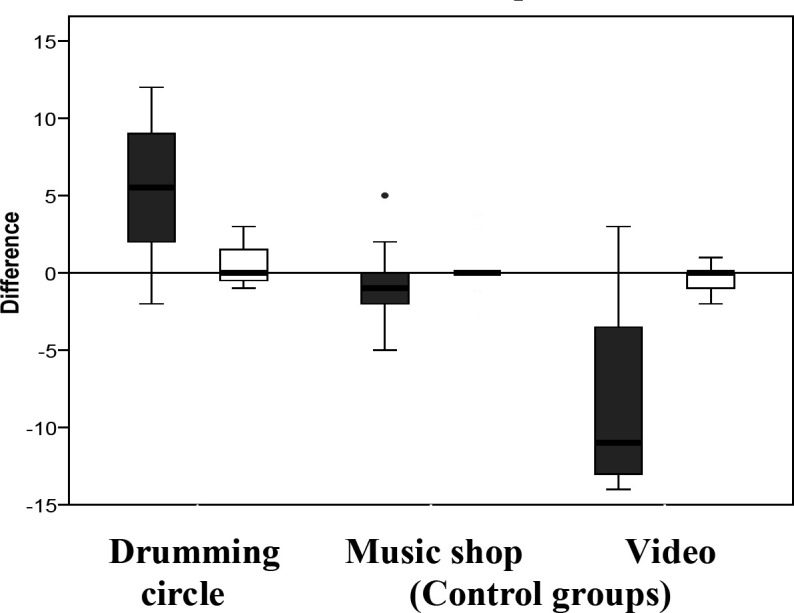
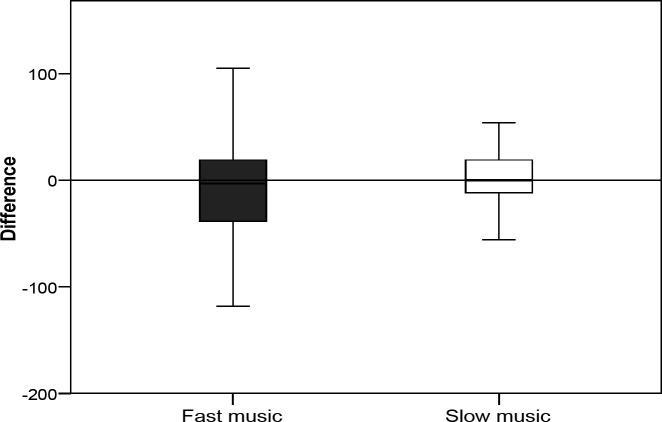
It is well known that music arouses emotional responses. In addition, it has long been thought to play an important role in creating a sense of community, especially in small scale societies. One mechanism by which it might do this is through the endorphin system, and there is evidence to support this claim. Using pain threshold as an assay for CNS endorphin release, we ask whether it is the auditory perception of music that triggers this effect or the active performance of music. We show that singing, dancing and drumming all trigger endorphin release (indexed by an increase in post-activity pain tolerance) in contexts where merely listening to music and low energy musical activities do not. We also confirm that music performance results in elevated positive (but not negative) affect. We conclude that it is the active performance of music that generates the endorphin high, not the music itself. We discuss the implications of this in the context of community bonding mechanisms that commonly involve dance and music-making.
Overview
The claims and statistics of this paper haven’t been checked yet.
Free: it reads the open-access text and checks the first 5 claims that cite a source we can check. Create a free account to check every claim.
Integrity signals
Registry
Cites
Statistics
Figures
Verification
Claims the paper makes
The claims and statistics of this paper haven’t been checked yet.
Free: it reads the open-access text and checks the first 5 claims that cite a source we can check. Create a free account to check every claim.
Claims other papers make about this one
Each is checked against this paper’s own text: does it say what the citing paper says it does?
The source backs part of the claim, not all of it — or backs it for a different population, condition or comparison.
In the citing paper
“Building on a growing body of the literature, we propose that group unity depends on behaviours that are synchronous and involve some muscular effort, which trigger the release of neuropeptides such as β-endorphin, yield enhanced positive affect, and in turn may enhance individuals’ willingness to cooperate [28,32,34,35,57].”
From The ice-breaker effect: Singing mediates fast social bonding (2015) · cites this paper as [28]
Experimental — accuracy not yet measuredThe source backs part of the claim, not all of it — or backs it for a different population, condition or comparison.
In the citing paper
“Support for this comes from the association between singing and the release of neuropeptides known to be associated with social bonding: oxytocin and β-endorphin [26–28].”
From The ice-breaker effect: Singing mediates fast social bonding (2015) · cites this paper as [28]
Experimental — accuracy not yet measuredThe source backs part of the claim, not all of it — or backs it for a different population, condition or comparison.
In the citing paper
“As a coordinated and often synchronous activity, for example, in terms of breath and heart rhythms, as well as timing and pitch [36], it is unsurprising that singing has also been linked with elevated β-endorphin levels [28].”
From The ice-breaker effect: Singing mediates fast social bonding (2015) · cites this paper as [28]
Experimental — accuracy not yet measuredThe source backs part of the claim, not all of it — or backs it for a different population, condition or comparison.
In the citing paper
“For instance, the repetitive and often strenuous actions that are involved in ritual-such as whirling, chanting, dancing, or prostrating-seem to produce anxiolytic effects by stimulating the endocannabinoid system (Dunbar, Kaskatis, MacDonald, & Barra, 2012;Xygalatas, 2008).”
From The Psychology of Rituals: An Integrative Review and Process-Based Framework (2018) · cites this paper as Dunbar, Kaskatis, MacDonald, & Barra, 2012
Experimental — accuracy not yet measuredThe cited source says what the claim attributes to it.
In the citing paper
“Pain thresholds are elevated following synchronized exertive activities such as rowing [19–21] and active musical performance in a group [22], suggesting that exertive group synchronous activities can activate the EOS, although it should be noted that endocannabinoids likely also contribute to exercise ‘highs’ [23].”
From Synchrony and exertion during dance independently raise pain threshold and encourage social bonding (2015) · cites this paper as [22]
2 more claims about this paper
Create a free account to see every claim other papers make about this one.
Self-check
Percentages, sums and reported differences re-computed from the paper’s own numbers.
The self-check needs the paper’s full text.
Citations
Cites
Flow: the psychology of optimal experience
(1990) · Choice Reviews Online · doi:10.5860/choice.28-0597 · Cited by 12,637
Flow: The Psychology of Optimal Experience
Buchanan, R., & Csikszentmihalyi, M. (1991) · Design Issues · doi:10.2307/1511458 · Cited by 9,394
The Ritual Process: Structure and Anti-Structure
Gilsenan, M., & Turner, V. W. (1976) · RAIN · doi:10.2307/3031914 · Cited by 6,725
The PANAS-X: Manual for the Positive and Negative Affect Schedule - Expanded Form
Watson, D., & Clark, L. A. (1994) · University of Iowa · doi:10.17077/48vt-m4t2 · Cited by 3,700
The Ritual Process. Structure and Anti-Structure
Welbourn, F. B., & Turner, V. W. (1971) · Journal of Religion in Africa · doi:10.2307/1594703 · Cited by 3,447
The Elementary Forms of Religious Life
Durkheim, E., & Swain, J. W. (1916) · The American Journal of Nursing · doi:10.2307/3405938 · Cited by 3,400
Blood, A. J., & Zatorre, R. J. (2001) · Proceedings of the National Academy of Sciences · doi:10.1073/pnas.191355898 · Cited by 2,814
Wiltermuth, S. S., & Heath, C. (2009) · Psychological Science · doi:10.1111/j.1467-9280.2008.02253.x · Cited by 1,717 · cited 1×
“Given the finding by Wiltermuth and Heath (2009) that synchrony enhances cooperation in economic games, this offers a plausible explanation for the role of human capacities like music that involve highly synchronised behaviour and trigger the release of endorphins in the evolution of the…”
BackgroundThe rewards of music listening: Response and physiological connectivity of the mesolimbic system
Menon, V., & Levitin, D. J. (2005) · NeuroImage · doi:10.1016/j.neuroimage.2005.05.053 · Cited by 1,067
An exploratory study of musical emotions and psychophysiology.
Krumhansl, C. L. (1997) · Canadian Journal of Experimental Psychology / Revue canadienne de psychologie expérimentale · doi:10.1037/1196-1961.51.4.336 · Cited by 1,017 · cited 1×
“Most of this interest has been focussed either on physiological responses to music (Krumhansl, 1997; Peretz and Coltheart, 2003; VanderArk and Ely, 1992, 1993; Wallin, 1991; Sevdalis and Keller, 2011) or on the role of synchrony (Janata and Grafton, 2003; Kirschner and Tomasello, 2009; Miles et…”
Background
Research works printed but not linked: 3
- Chiu P., and Kumar A. (2003). Music therapy: Loud noise or soothing notes. Music Therapy, 18, 204– 208.
- Sokal R.R., and Rohlf F.J. (1981). Biometry. San Francisco: Freeman.
- Spingte R., and Droh R. (1987). Effects of anxiolytic music on plasma levels of stress hormones in different medical specialties. In Pratt R.R. (Ed.), The fourth international symposium on music: Rehabilitation and human well-being (pp. 88– 101). Lanham, MD: University Press of America.
Cited by
Items 101–200 of 302
Why friendship and loneliness affect our health
Dunbar, R. (2025) · Annals of the New York Academy of Sciences · doi:10.1111/nyas.15309 · Cited by 21
Self-citationde Bézenac, C. E., Swindells, R., & Corcoran, R. (2018) · Frontiers in Psychology · doi:10.3389/fpsyg.2018.02114 · Cited by 22
The Effect of Different Phases of Synchrony on Pain Threshold in a Drumming Task
Sullivan, P., & Blacker, M. (2017) · Frontiers in Psychology · doi:10.3389/fpsyg.2017.01034 · Cited by 20
Clift, S. M., Page, S., Daykin, N., & Peasgood, E. (2016) · Public Health · doi:10.1016/j.puhe.2016.03.022 · Cited by 18
Exploring the relationship between church worship, social bonding and moral values
Brown, J. E., van Mulukom, V., Jong, J., Watts, F., & Farias, M. (2022) · Archive for the Psychology of Religion · doi:10.1177/00846724211070858 · Cited by 18
Music major, affects, and positive music listening experience
Chang, J., Lin, P., & Hoffman, E. (2020) · Psychology of Music · doi:10.1177/0305735619901151 · Cited by 18
Effects of an Active Music Therapy Program on Functional Fitness in Community Older Adults
Chan, S., & Chen, C.-F. (2020) · Journal of Nursing Research · doi:10.1097/jnr.0000000000000391 · Cited by 18
Mithen, S. (2022) · Levant · doi:10.1080/00758914.2022.2104559 · Cited by 20
Communities of Song: Collective Musical Participation and Group Singing Experiences In Victoria, BC
Specker, S. K. (2015) · The Arbutus Review · doi:10.18357/ar.speckersk.512014 · Cited by 18
The effects of music induction on mood and affect in an Asian context
Campbell, E. A., Berezina, E. B., & Gill, C. M. H. D. (2020) · Psychology of Music · doi:10.1177/0305735620928578 · Cited by 17
Giæver, F., Vaag, J. R., & Wennes, G. (2016) · Arts & Health · doi:10.1080/17533015.2016.1182564 · Cited by 16
Maury, S., & Rickard, N. S. (2018) · Music & Science · doi:10.1177/2059204318800607 · Cited by 16
Killin, A. (2024) · The British Journal of Aesthetics · doi:10.1093/aesthj/ayad038 · Cited by 16
Associations between musical aptitude, alexithymia, and working in a creative occupation.
Theorell, T., Madison, G., & Ullén, F. (2019) · Psychology of Aesthetics Creativity and the Arts · doi:10.1037/aca0000158 · Cited by 16
Seven Capacities of Music That Underpin its Therapeutic Value in Dementia Care
Brancatisano, O., & Thompson, W. F. (2019) · Oxford University Press eBooks · doi:10.1093/oso/9780190075934.003.0003 · Cited by 16
The evolutionary role of dance: Group bonding but not prosocial altruism.
Tarr, B., & Dunbar, R. (2024) · Evolutionary Behavioral Sciences · doi:10.1037/ebs0000330 · Cited by 16
Self-citationThe Dancing Queen: Explanatory Mechanisms of the ‘Feel-Good Effect’ in Dance
Jola, C., & Calmeiro, L. (2017) · Oxford University Press eBooks · doi:10.1093/oxfordhb/9780199949298.013.1 · Cited by 14
Free rider recognition—A missing link in the Baldwinian model of music evolution
Podlipniak, P. (2022) · Psychology of Music · doi:10.1177/03057356221129319 · Cited by 13
Effect of Music Therapy on Adult Patients Undergoing Dental Treatment Procedures
Tamgadge, S. (2017) · International Clinical Pathology Journal · doi:10.15406/icpjl.2017.05.00139 · Cited by 13
Individualizing musical tempo to spontaneous rates maximizes music-induced hypoalgesia
Yi, W., Palmėr, C., Serian, A., & Roy, M. (2025) · Pain · doi:10.1097/j.pain.0000000000003513 · Cited by 13
Maleki, A., & Youseflu, S. (2023) · Heliyon · doi:10.1016/j.heliyon.2023.e14785 · Cited by 13
Group dance, social cohesion, and social identity in the Yali society from Papua
Sorokowski, P., Luty, J., Małecki, W., & Kowal, M. (2023) · Musicae Scientiae · doi:10.1177/10298649231200549 · Cited by 12
Currie, C. L., Copeland, J. L., Voss, M. L., Swanepoel, L.-M., Ambeskovic, M., Patel, N. B., & Higa, E. K. (2019) · BMC Public Health · doi:10.1186/s12889-019-7641-0 · Cited by 12
Do Multiple Body Modifications Alter Pain Threshold?
Yamamotová, A., Hrabák, P., Hříbek, P., & Rokyta, R. (2017) · Physiological Research · doi:10.33549/physiolres.933804 · Cited by 11
Tollabzadeh, M., Rezvani, A. R., & Behzadipour, S. (2023) · Shiraz E-Medical Journal · doi:10.5812/semj-137504 · Cited by 11
Music Valence and Genre Influence Group Creativity
Hosseini, S., HATTORI, Y., Miyake, Y., & Nozawa, T. (2019) · Lecture notes in computer science · doi:10.1007/978-3-030-22507-0_32 · Cited by 10
The effect of music on pain sensitivity in healthy adults
LiKamWa, A., Cardoso, J. S., Sonke, J. K., Fillingim, R. B., & Booker, S. Q. (2020) · Arts & Health · doi:10.1080/17533015.2020.1827278 · Cited by 10
Influence of musical activities on the prosocial behaviors of preschool children
Ma, X., Xiong, S.-Q., Zhang, X., Hu, Q., Li, S., & Tao, Y. (2023) · Psychology of Music · doi:10.1177/03057356231213800 · Cited by 10
The Psychology of Rituals: An Integrative Review and Process-Based FrameworkPreprint
Hobson, N. M., Risen, J. L., & Inzlicht, M. (2017) · SSRN Electronic Journal · doi:10.2139/ssrn.2944235 · Cited by 9
Mother Schema, Obstetric Dilemma, and the Origin of Behavioral Modernity
Parncutt, R. (2019) · Behavioral Sciences · doi:10.3390/bs9120142 · Cited by 9
Pitch Syntax as an Evolutionary Prelingual Innovation
Podlipniak, P. (2020) · Musicae Scientiae · doi:10.1177/1029864920941551 · Cited by 9
Schneider, L., Egle, U. T., Klinger, D., Schulz, W. A., Villringer, A., & Fritz, T. H. (2022) · Frontiers in Pain Research · doi:10.3389/fpain.2022.944181 · Cited by 9
Kim, J., & Kim, K. (2014) · Child Abuse & Neglect · doi:10.1016/j.chiabu.2014.03.005 · Cited by 9
The Effects of Music on Pain: A Review of Systematic Reviews and Meta-Analysis
Lee, J.-H. (2015) · TUScholarShare (Temple University) · doi:10.34944/dspace/3156 · Cited by 9
Depression among older people in Bali
Suriastini, N. W., Suryani, L. K., Sikoki, B., Umaroh, R., & Qaimamunazzala, H. (2021) · Asian Journal of Gerontology and Geriatrics · doi:10.12809/ajgg-2020-400-oa · Cited by 9
Sauciuc, G.-A., Persson, T., & Madsen, E. A. (2022) · Comparative Cognition & Behavior Reviews · doi:10.3819/ccbr.2022.170003 · Cited by 8
Group Singing Has Multiple Benefits in the Context of Chronic Pain: An Exploratory Pilot Study
Irons, J. Y., Kuipers, P., Wan, A., & Stewart, D. (2019) · Pain Management Nursing · doi:10.1016/j.pmn.2019.07.008 · Cited by 8
Pace setting as an adaptive precursor of rhythmic musicality
Qirko, H. (2024) · Annals of the New York Academy of Sciences · doi:10.1111/nyas.15120 · Cited by 8
Cross-Cultural Perspectives on Music and Musicality
Trehub, S. E., Becker, J., & Morley, I. (2018) · The MIT Press eBooks · doi:10.7551/mitpress/10636.003.0011 · Cited by 8
Music Listening as Kangaroo Mother Care: From Skin-to-Skin Contact to Being Touched by the Music
Reybrouck, M. (2024) · Acoustics · doi:10.3390/acoustics6010003 · Cited by 7
The Psychology of Religious Rituals and Practices
Yaden, D. B. (2020) · Religion, spirituality and health: a social scientific approach · doi:10.1007/978-3-030-27953-0_2 · Cited by 7
van Selms, M. K. A., Reda, B., Visscher, C. M., Manfredini, D., & Lobbezoo, F. (2022) · Journal of Oral Rehabilitation · doi:10.1111/joor.13339 · Cited by 7
Mallik, A., Raessi, T., Good, A., Pachete, A., & Russo, F. (2025) · Frontiers in Neuroscience · doi:10.3389/fnins.2025.1569601 · Cited by 7
Cultural transmission of traditional songs in the Ryukyu Archipelago
Nishikawa, Y., & 井原, 泰. (2022) · PLoS ONE · doi:10.1371/journal.pone.0270354 · Cited by 7
Factors Contributing to the Reduction of Pain during Electromyography and Nerve Conduction Studies.
Delimar, V., Miloš, O., Hančević, M., Bilić, H., Skorić, M. K., Milivojević, I., Sitaš, B., Bilić, K., & Bilić, E. (2019) · PubMed · Cited by 7
Musik und Migration. Ein Theorie- und Methodenhandbuch
Gratzer, W., Grosch, N., Präger, U., Scheiblhofer, S., & Verlag, W. (2023) · Waxmann Verlag GmbH eBooks · doi:10.31244/9783830996309 · Cited by 7
Endorphins, Sexuality, and Reproduction
Khajehei, M. (2024) · Advances in neurobiology · doi:10.1007/978-3-031-45493-6_20 · Cited by 6
Mechanisms and models of interpersonal synchrony in promoting cooperation
Ma, X., & Cui, L. (2022) · Advances in Psychological Science · doi:10.3724/sp.j.1042.2022.01317 · Cited by 6
The effects of latitude on hominin social network maintenance
Pearce, E. (2013) · Oxford University Research Archive (ORA) (University of Oxford) · doi:10.5287/ora-vm0ojg24p · Cited by 6
Millard, E., & Carr, C. E. (2021) · Springer eBooks · doi:10.1007/978-3-030-76208-7_5 · Cited by 6
Giæver, F. (2018) · Springer eBooks · doi:10.1007/978-3-319-98863-4_5 · Cited by 5
Charles, S. J., van Mulukom, V., Dunbar, R., Brown, J. E., Delmonte, R., Maraldi, E. D. O., Turner, L., Watts, F., Watts, J., & Farias, M. (2026) · Proceedings of the Royal Society B Biological Sciences · doi:10.1098/rspb.2026.1174 · Cited by 5
Self-citationThe Brain, Explained: A Comprehensive Theory of Brain FunctionPreprint
Rappoport, A. (2018) · Preprints.org · doi:10.20944/preprints201805.0137.v1 · Cited by 4
Musicians and researchers: two creative professions striving to improve heart health through music
Pozzati, A., & Weiskirchen, R. (2025) · Frontiers in Cardiovascular Medicine · doi:10.3389/fcvm.2024.1536829 · Cited by 4
Make sport-related self-control better: Ritualized behavior in Chinese athletes
Yun, D., Zhang, L., Qiu, Y., Zheng, J., & Li, C. (2025) · Acta Psychologica · doi:10.1016/j.actpsy.2025.105145 · Cited by 4
Music as a Tool for Affiliative Bonding: A Second-Person Approach to Musical Engagement
Reybrouck, M. (2024) · Multimodal Technologies and Interaction · doi:10.3390/mti8090082 · Cited by 4
The Ability of Music to Facilitate Social Bonding during Imagined Intergroup Contact
Stewart, A. L. (2015) · CU Scholar (University of Colorado Boulder) · Cited by 4
Gait in Older People with Cognitive Impairments During Rhythmic Auditory Cueing: A Scoping Review
Msigwa, S., Alty, J., George, R. J. S., & Callisaya, M. L. (2025) · Experimental Aging Research · doi:10.1080/0361073x.2025.2553072 · Cited by 4
Music Interventions for Stress Reduction
de Witte, M. (2021) · UvA-DARE (University of Amsterdam) · doi:10.13140/rg.2.2.26242.20161 · Cited by 5
Acoustic Processing and the Origin of Human Vocal Communication
Bannan, N., Dunbar, R., Harvey, A. R., & Podlipniak, P. (2024) · Evolutionary Studies in Imaginative Culture · doi:10.70082/esiculture.vi.982 · Cited by 4
Self-citationEvolutionary Psychology and the Necessity for Music Education for All.
Bannan, N. (2020) · UWA Profiles and Research Repository (University of Western Australia) · Cited by 4
Tamiasso, R. S. S., da Silva, V. A., & Turrini, R. N. T. (2023) · Revista da Escola de Enfermagem da USP · doi:10.1590/1980-220x-reeusp-2022-0263en · Cited by 3
Song, K., Zhao, Z., Zhang, J., Li, J., & Lipowski, M. (2026) · Frontiers in Public Health · doi:10.3389/fpubh.2026.1799066 · Cited by 3
Malviya, S., Meredith, P. J., & Zupan, B. (2025) · Mental Health Religion & Culture · doi:10.1080/13674676.2025.2544133 · Cited by 3
Music, dance, synchrony, and conformity: Dealing with non-cooperation in early hominin culture
Liebenberg, D. (2017) · Evolution Mind and Behaviour · doi:10.1556/2050.2017.0002 · Cited by 3
Piccolo, M., dos Santos, D. W., Herold, S., & Hooley, J. M. (2025) · Scientific Reports · doi:10.1038/s41598-025-05119-5 · Cited by 3
Perceived sensorimotor synchrony enhances pain modulation and attenuates laser-evoked potentials
Pan, X., Xiao, Y., Hu, L., & Lu, X. (2025) · Communications Biology · doi:10.1038/s42003-025-09076-7 · Cited by 3
Furuta, T., Uchikawa, R., Shikura, O., Kohinata, K., Uchida, K., & Tomida, M. (2019) · Oral Health & Dental Science · doi:10.33425/2639-9490.1044 · Cited by 3
Færøske kvinders mentale sundhed under graviditet og efter fødsel
Storm, S. (2023) · VBN Forskningsportal (Aalborg Universitet) · Cited by 3
Liebenberg, D. (2017) · Tipití Journal of the Society for the Anthropology of Lowland South America · doi:10.70845/2572-3626.1250 · Cited by 3
Prasetia, D. S. (2015) · DIGILIB at Universitas 'Aisyiyah Yogyakarta (UNISA) (Universitas 'Aisyiyah Yogyakarta) · Cited by 3
Embodied Rhythm: The art and influence of live musicianship in Ecstatic Dance
Neuvonen, M. H. (2023) · Taju (University of the Arts Helsinki) · Cited by 3
Facilitating a Meaningful Work Situation—A Double-Edged Sword?
Espenes, T. C., & Giæver, F. (2017) · Springer eBooks · doi:10.1007/978-3-319-66781-2_4 · Cited by 3
Male chimpanzee vocal interactions and social bonds
Fedurek, P. (2013) · UPT. Syiah Kuala University Library (Syiah Kuala University) · Cited by 2
A substitute for the collective ritual: Synchronized movement and its mechanism in the secular world
Qiu, X. U. E., & Yin, K. (2023) · Advances in Psychological Science · doi:10.3724/sp.j.1042.2023.01303 · Cited by 2
Oesch, N. (2020) · Springer eBooks · doi:10.1007/978-3-319-16999-6_2845-1 · Cited by 2
Seki, Y. (2023) · Frontiers in Psychology · doi:10.3389/fpsyg.2023.1271552 · Cited by 2
Snaterse, M. (2013) · Summit (Simon Fraser University) · Cited by 2
Assari, A. S., AlShamrani, H. A., Alquraishi, S. I., Ghashim, A. H. A., & Alqhtani, N. R. (2024) · National Journal of Maxillofacial Surgery · doi:10.4103/njms.njms_62_23 · Cited by 2
Addressing Perceived Pain in Childbirth: A Music Therapy Voicework Intervention Design
Barbieri, J. M. (2015) · Spectrum Research Repository (Concordia University) · Cited by 2
Mogan, R. (2018) · Open Access Victoria University of Wellington | Te Herenga Waka (Figshare) · doi:10.26686/wgtn.17072576 · Cited by 2
Exploring Physiology-Based Classification of Flow During Musical Improvisation in Mixed Reality
Schlagowski, R., Mertes, S., Schiller, D., Can, Y. S., & André, E. (2024) · Communications in computer and information science · doi:10.1007/978-3-031-66694-0_18 · Cited by 2
Alao, A. G. (2023) · Lauda (University of Lapland) · Cited by 2
A Mixed-Methods Systematic Review Regarding Musical Universality in Academic Literature.
Graddy, A. (2022) · Journal of Student Research · doi:10.47611/jsrhs.v11i4.3192 · Cited by 2
Working with and in small groups
King, E. C. (2021) · Routledge eBooks · doi:10.4324/9780429295362-28 · Cited by 2
Chang, S. M. (2019) · cIRcle (University of British Columbia) · doi:10.14288/1.0375840 · Cited by 2
Ciam, A., Wijayanti, Z., & Bestari, M. G. (2025) · Arab Journal of Urology · doi:10.1080/20905998.2025.2526979 · Cited by 1
Sacco, P. L. (2026) · Frontiers in Computational Neuroscience · doi:10.3389/fncom.2026.1852750 · Cited by 1
Wellbeing in Professional Chamber Music Performance Contexts
Rocke, S., Davidson, J. W., & Krause, A. E. (2024) · Musicology Australia · doi:10.1080/08145857.2025.2457244 · Cited by 1
The Background of the Study on Interpersonal Coordination
Inui, N. (2018) · Springer eBooks · doi:10.1007/978-981-13-1765-1_2 · Cited by 1
Auditory rhetoric in music: a perceptual framework for music-induced prosocial behavior
Chen, J.-Y., Liu, T., & Yao, X.-W. (2026) · Frontiers in Psychology · doi:10.3389/fpsyg.2026.1839326 · Cited by 1
(2021) · Emerald Group Publishing Limited eBooks · doi:10.1108/978-1-83867-329-120211008 · Cited by 1
Grettenberger, M. (2020) · Cited by 1
Volkos, P., Stachteas, P., Linardakis, M. K., Skouradaki, E., Baritaki, S., Koutonen, S., Malliaraki, N. E., Kampa, M., & Symvoulakis, E. K. (2025) · EXPLORE · doi:10.1016/j.explore.2025.103263 · Cited by 1
Organisationale Rituale und ihre Bedeutung für verlässliche Kooperation
Rennung, M., & Göritz, A. S. (2021) · Uniscope · doi:10.1007/978-3-658-34497-9_8 · Cited by 1
Sauciuc, G.-A., Persson, T., & Madsen, E. A. (2021) · OSF Preprints (OSF Preprints) · doi:10.31219/osf.io/3v4dr · Cited by 1
Music in the moment: The use of a musical intervention to impact state experiences
Reiter, M. D., Li, P., Klee, S., & Sabo, K. (2023) · The Arts in Psychotherapy · doi:10.1016/j.aip.2023.102053 · Cited by 1
Musical Synchronization, Social Interaction and the Brain
Waclawik, K., Watson, S. L., & Grahn, J. A. (2016) · Cambridge University Press eBooks · doi:10.1017/cbo9781107279353.030 · Cited by 1
Partnering Up: The Social Cognition of Partnered Interaction in Life and Art
Brown, S. (2022) · Frontiers in Communication · doi:10.3389/fcomm.2022.834001 · Cited by 1
Music and philosophical naturalism
Killin, A. (2016) · Open Access Victoria University of Wellington | Te Herenga Waka (Figshare) · doi:10.26686/wgtn.17143670 · Cited by 1
Metadata
- Authors
- Dunbar, R. I. M., Kaskatis, K., MacDonald, I., & Barra, V.
- Affiliations
- University of Oxford (GB)
- University of Liverpool (GB)
- Binghamton University (US)
- Corresponding author
- Dunbar, R.I.M.
- ORCID
- Dunbar, R.I.M.
- Venue
- Evolutionary Psychology
- Publisher
- SAGE Publications
- Published
- 2012-10-01
- Volume
- 10
- Issue
- 4
- Pages
- 688-702
- ISSN
- 1474-7049 (ISSN-L)
- PMC
- PMC10426978
- OpenAlex
- W2192147421
- Cited by
- 243
- References
- 68
- Citations by year
- 2026: 26 · 2025: 20 · 2024: 14 · 2023: 22 · 2022: 18 · 2021: 17 · 2020: 22 · 2019: 17 · 2018: 21 · 2017: 25 · 2016: 15 · 2015: 12 · 2014: 8 · 2013: 6
- FWCI
- 4.25
- Type
- journal article
- Language
- en
- Open access
- gold
- doi.org
- Licence
- Locations
- Evolutionary Psychology (publishedVersion, cc-by-nc)
- PubMed Central (publishedVersion, cc-by-nc)
- PubMed (publishedVersion)
- DOAJ (DOAJ: Directory of Open Access Journals) (submittedVersion, cc-by-sa)
- Topics
- Life Sciences › Neuroscience › Cognitive Neuroscience › Neuroscience and Music Perception
- Social Sciences › Psychology › Social Psychology › Music Therapy and Health
- Social Sciences › Arts and Humanities › Music › Diverse Music Education Insights
- Keywords
- music performance, pain threshold, endorphins, positive affect, singing, dance, drumming, music listening, community bonding, emotional response to music
- MeSH terms
- Adult, Affect, Auditory Perception, Dancing, Endorphins, Biological Evolution, Female, Humans, Male, Music, Pain Threshold, Young Adult, Singing
About these checks
Registry, retraction, Cites and statistics results are computed, not judged, with one exception: a printed reference that no index lists is read once by a model before it counts as a citation error. Claims are extracted by a model and kept only when their quote appears verbatim in the text; each cited source is then checked, with a model’s help, for whether it says what the claim relies on. Those verdicts can be wrong — read the claim’s quote and the cited source before relying on one.
Statistics and arithmetic are recomputed, not judged.
Confidence bands are shown only for fields calibrated on our annotated test set. None is calibrated yet, so no band is shown.
What counts as a claim ›How we measure confidence ›How we check this ›
Are you an author, or do you see a problem with this page? Request a review
Data sources
Bibliographic data: Semantic Scholar, OpenAlex, Crossref.
Contains information from the Semantic Scholar Academic Graph Datasets, made available under the ODC Attribution License (ODC-BY 1.0).
Semantic Scholar’s data is described in: Kinney, R., et al. (2023). The Semantic Scholar Open Data Platform. arXiv:2301.10140.
