

Performance of Music Elevates Pain Threshold and Positive Affect: Implications for the Evolutionary Function of Music
Open accessThe DOI matches its Crossref record; 66 of the 68 references it cites were found in a registry or an index.
Abstract
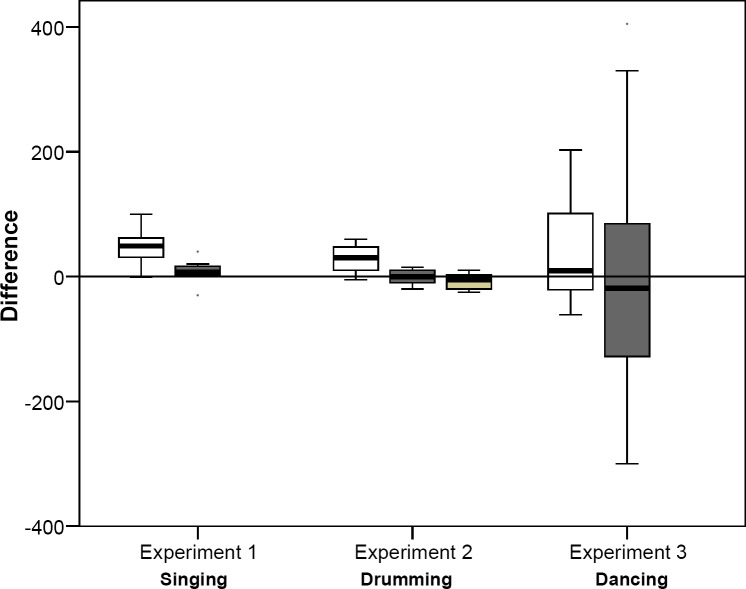
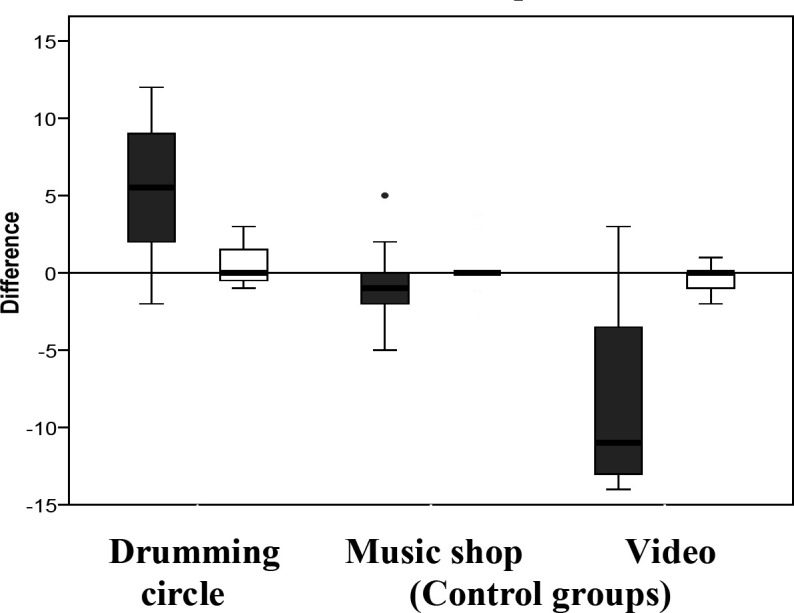
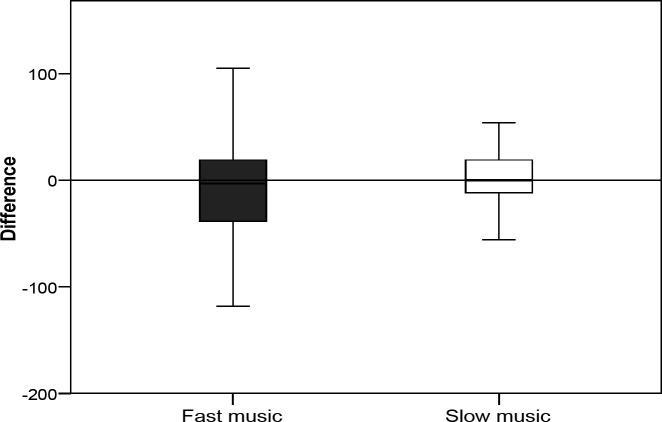
It is well known that music arouses emotional responses. In addition, it has long been thought to play an important role in creating a sense of community, especially in small scale societies. One mechanism by which it might do this is through the endorphin system, and there is evidence to support this claim. Using pain threshold as an assay for CNS endorphin release, we ask whether it is the auditory perception of music that triggers this effect or the active performance of music. We show that singing, dancing and drumming all trigger endorphin release (indexed by an increase in post-activity pain tolerance) in contexts where merely listening to music and low energy musical activities do not. We also confirm that music performance results in elevated positive (but not negative) affect. We conclude that it is the active performance of music that generates the endorphin high, not the music itself. We discuss the implications of this in the context of community bonding mechanisms that commonly involve dance and music-making.
Overview
The claims and statistics of this paper haven’t been checked yet.
Free: it reads the open-access text and checks the first 5 claims that cite a source we can check. Create a free account to check every claim.
Integrity signals
Registry
Cites
Statistics
Figures
Verification
Claims the paper makes
The claims and statistics of this paper haven’t been checked yet.
Free: it reads the open-access text and checks the first 5 claims that cite a source we can check. Create a free account to check every claim.
Claims other papers make about this one
Each is checked against this paper’s own text: does it say what the citing paper says it does?
The source backs part of the claim, not all of it — or backs it for a different population, condition or comparison.
In the citing paper
“Building on a growing body of the literature, we propose that group unity depends on behaviours that are synchronous and involve some muscular effort, which trigger the release of neuropeptides such as β-endorphin, yield enhanced positive affect, and in turn may enhance individuals’ willingness to cooperate [28,32,34,35,57].”
From The ice-breaker effect: Singing mediates fast social bonding (2015) · cites this paper as [28]
Experimental — accuracy not yet measuredThe source backs part of the claim, not all of it — or backs it for a different population, condition or comparison.
In the citing paper
“Support for this comes from the association between singing and the release of neuropeptides known to be associated with social bonding: oxytocin and β-endorphin [26–28].”
From The ice-breaker effect: Singing mediates fast social bonding (2015) · cites this paper as [28]
Experimental — accuracy not yet measuredThe source backs part of the claim, not all of it — or backs it for a different population, condition or comparison.
In the citing paper
“As a coordinated and often synchronous activity, for example, in terms of breath and heart rhythms, as well as timing and pitch [36], it is unsurprising that singing has also been linked with elevated β-endorphin levels [28].”
From The ice-breaker effect: Singing mediates fast social bonding (2015) · cites this paper as [28]
Experimental — accuracy not yet measuredThe source backs part of the claim, not all of it — or backs it for a different population, condition or comparison.
In the citing paper
“For instance, the repetitive and often strenuous actions that are involved in ritual-such as whirling, chanting, dancing, or prostrating-seem to produce anxiolytic effects by stimulating the endocannabinoid system (Dunbar, Kaskatis, MacDonald, & Barra, 2012;Xygalatas, 2008).”
From The Psychology of Rituals: An Integrative Review and Process-Based Framework (2018) · cites this paper as Dunbar, Kaskatis, MacDonald, & Barra, 2012
Experimental — accuracy not yet measuredThe cited source says what the claim attributes to it.
In the citing paper
“Pain thresholds are elevated following synchronized exertive activities such as rowing [19–21] and active musical performance in a group [22], suggesting that exertive group synchronous activities can activate the EOS, although it should be noted that endocannabinoids likely also contribute to exercise ‘highs’ [23].”
From Synchrony and exertion during dance independently raise pain threshold and encourage social bonding (2015) · cites this paper as [22]
2 more claims about this paper
Create a free account to see every claim other papers make about this one.
Self-check
Percentages, sums and reported differences re-computed from the paper’s own numbers.
The self-check needs the paper’s full text.
Citations
Cites
Flow: the psychology of optimal experience
(1990) · Choice Reviews Online · doi:10.5860/choice.28-0597 · Cited by 12,637
Flow: The Psychology of Optimal Experience
Buchanan, R., & Csikszentmihalyi, M. (1991) · Design Issues · doi:10.2307/1511458 · Cited by 9,394
The Ritual Process: Structure and Anti-Structure
Gilsenan, M., & Turner, V. W. (1976) · RAIN · doi:10.2307/3031914 · Cited by 6,725
The PANAS-X: Manual for the Positive and Negative Affect Schedule - Expanded Form
Watson, D., & Clark, L. A. (1994) · University of Iowa · doi:10.17077/48vt-m4t2 · Cited by 3,700
The Ritual Process. Structure and Anti-Structure
Welbourn, F. B., & Turner, V. W. (1971) · Journal of Religion in Africa · doi:10.2307/1594703 · Cited by 3,447
The Elementary Forms of Religious Life
Durkheim, E., & Swain, J. W. (1916) · The American Journal of Nursing · doi:10.2307/3405938 · Cited by 3,400
Blood, A. J., & Zatorre, R. J. (2001) · Proceedings of the National Academy of Sciences · doi:10.1073/pnas.191355898 · Cited by 2,814
Wiltermuth, S. S., & Heath, C. (2009) · Psychological Science · doi:10.1111/j.1467-9280.2008.02253.x · Cited by 1,717 · cited 1×
“Given the finding by Wiltermuth and Heath (2009) that synchrony enhances cooperation in economic games, this offers a plausible explanation for the role of human capacities like music that involve highly synchronised behaviour and trigger the release of endorphins in the evolution of the…”
BackgroundThe rewards of music listening: Response and physiological connectivity of the mesolimbic system
Menon, V., & Levitin, D. J. (2005) · NeuroImage · doi:10.1016/j.neuroimage.2005.05.053 · Cited by 1,067
An exploratory study of musical emotions and psychophysiology.
Krumhansl, C. L. (1997) · Canadian Journal of Experimental Psychology / Revue canadienne de psychologie expérimentale · doi:10.1037/1196-1961.51.4.336 · Cited by 1,017 · cited 1×
“Most of this interest has been focussed either on physiological responses to music (Krumhansl, 1997; Peretz and Coltheart, 2003; VanderArk and Ely, 1992, 1993; Wallin, 1991; Sevdalis and Keller, 2011) or on the role of synchrony (Janata and Grafton, 2003; Kirschner and Tomasello, 2009; Miles et…”
Background
Research works printed but not linked: 3
- Chiu P., and Kumar A. (2003). Music therapy: Loud noise or soothing notes. Music Therapy, 18, 204– 208.
- Sokal R.R., and Rohlf F.J. (1981). Biometry. San Francisco: Freeman.
- Spingte R., and Droh R. (1987). Effects of anxiolytic music on plasma levels of stress hormones in different medical specialties. In Pratt R.R. (Ed.), The fourth international symposium on music: Rehabilitation and human well-being (pp. 88– 101). Lanham, MD: University Press of America.
Cited by
Items 201–300 of 302
Oesch, N. (2021) · Springer eBooks · doi:10.1007/978-3-319-19650-3_2845 · Cited by 1
Betchikou, C. B., Estache, A., & Ginsburgh, V. A. (2013) · Cited by 1
Music, the brain, the mind, and the heart
Ginsburgh, S., & Ginsburgh, V. A. (2014) · Journal of Industrial and Business Economics · doi:10.3280/poli2014-001005 · Cited by 1
Bespoke Music - Narration for Mental Health Using Progressive Muscle Relaxation in COVID-19 Times
Ross, V., & Amir, M. '. (2020) · International Journal of Service Management and Sustainability · doi:10.24191/ijsms.v5i2.11698 · Cited by 1
La musique, pour adoucir douleur et signes fonctionnels liés à la fibromyalgie
Mick, G., & Bigand, E. (2018) · Douleurs Évaluation - Diagnostic - Traitement · doi:10.1016/j.douler.2018.02.002 · Cited by 1
Baudendistel, S. T., Tueth, L. E., Haussler, A. M., & Earhart, G. M. (2025) · Brain Sciences · doi:10.3390/brainsci15080820 · Cited by 1
Neurotransmitter-based diagnosis and treatment: A hypothesis (Part 2)
Arbuck, D. M. (2022) · Current Psychiatry · doi:10.12788/cp.0253 · Cited by 1
Dance and social bonding: synchrony and the endogenous opioid system
Tarr, B. (2014) · Oxford University Research Archive (ORA) (University of Oxford) · doi:10.5287/ora-9rnaqadxm · Cited by 1
HRs bidrag til utvikling av organisatorisk resiliens i krisehåndtering
Thon, A. N., & Gausdal, A. H. (2023) · doi:10.23865/noasp.192.ch2 · Cited by 1
Healthy Lifestyle and Educational Practices in Relation to Student Wellbeing
Matejek, Č., Kukovica, D., Janota, P. Š., & Perše, T. V. (2026) · Waxmann Verlag GmbH eBooks · doi:10.31244/9783818851439 · Cited by 1
Pour la beauté du geste : le design d'interaction au service de la jouabilité
Jacquet, H. (2024) · doi:10.71781/9143 · Cited by 1
Sarazin, M. A. C. (2018) · Oxford University Research Archive (ORA) (University of Oxford) · doi:10.5287/ora-4rjk8qan2 · Cited by 1
Finckle, S. R. (2018) · UST Research Online (University of St. Thomas - Minnesota) · Cited by 1
Karaoke Instagram: Amateur desire and the performance economy
Brown, K. (2020) · Performance Research · doi:10.1080/13528165.2020.1738893 · Cited by 1
Projeto “12&30”: um relato de experiência integrando karaokê e saúde mental na universidade
Buss, Z. D. S., de Oliveira, H. C. A., Soares, J., Metello, M. J. M., Seben, V. M. C., & CANNO, Y. M. N. (2022) · Extensio Revista Eletrônica de Extensão · doi:10.5007/1807-0221.2022.e83775 · Cited by 1
The 17th International Conference of Students of Systematic Musicology (SysMus24)
Owen, C., Sutinen, S., & Kumari, J. (2025) · Music & Science · doi:10.1177/20592043251319128 · Cited by 1
วรรณพฤกษ์, พ., เพ็งพล, ณ., วงค์พิมล, บ., สายืน, ช., & พลพุทธา, ล. (2023) · Thai Pharmaceutical and Health Science Journal - วารสารไทยเภสัชศาสตร์และวิทยาการสุขภาพ · Cited by 1
Life satisfaction evaluation in adults participating in dance activities
Καραμίχου, Ζ. Σ., & Καραμίχου, Ζ. Σ. (2023) · University of Thessaly Institutional Repository (University of Thessaly) · Cited by 1
Evoking nostalgia by presenting hit-song lists
Kawase, S., & Eguchi, K. (2026) · Frontiers in Psychology · doi:10.3389/fpsyg.2026.1800653
Tamiasso, R. S. S., da Silva, V. A., & Turrini, R. N. T. (2023) · Revista da Escola de Enfermagem da USP · doi:10.1590/1980-220x-reeusp-2022-0263pt
Edelman, S. (2022) · Springer eBooks · doi:10.1007/978-3-031-24012-6_6
van Schaik, C. P. (2015) · Wiley eBooks · doi:10.1002/9781119118206.biblio
The Power of Mimetic Performance: Cognitive Evolution and Supernatural Agency
Liebenberg, D. (2022) · Preternature Critical and Historical Studies on the Preternatural · doi:10.5325/preternature.11.2.0322
Jaber, M. D. S. (2021) · Percepta - Revista de Cognição Musical · doi:10.34018/2318-891x.9(1)27-37
Good, A., Gilmore, S. A., & Russo, F. (2026) · Arts & Health · doi:10.1080/17533015.2026.2661932
Why does singing feel so good? And is it good for your health?
Mikkelsen, K. (2026) · The Conversation · doi:10.64628/aa.upmxpthxn
Cieśla, M. M., Cieśla, P., Żok, A., Woźniak, N., Wojtyła-Buciora, P., & Mojs, E. H. (2023) · Biuletyn Głównej Biblioteki Lekarskiej · doi:10.2478/bgbl-2023-0033
THE EFFECT OF GROUP SIZE ON SYNCHRONY AND THE SYNCHRONY EFFECT
Lewis, Z. (2017) · Brock University Digital Repository (Brock University)
“Singing Their Heads Off”: Sing-Along Behavior in the Nightlife of Northern England
Pawley, A. (2024) · Oxford University Press eBooks · doi:10.1093/oxfordhb/9780197612460.013.11
Koch, C. (2024) · Springer eBooks · doi:10.1007/978-3-031-38971-9_1328-1
King, M. E. (2016) · Digital Commons (Liberty University)
Music therapy in Dentistry- A Review
(2023) · International Research Journal of Modernization in Engineering Technology and Science · doi:10.56726/irjmets42546
Reading Resilience in the Psalms
Hays, R. W. P. (2026) · Oxford University Press eBooks · doi:10.1093/9780197689226.003.0010
Receiving the Psalms as a Resource for Healing and Resilience
Hays, R. W. P. (2026) · Oxford University Press eBooks · doi:10.1093/9780197689226.003.0012
Why Read Trauma and Resilience in the Psalter?
Hays, R. W. P. (2026) · Oxford University Press eBooks · doi:10.1093/9780197689226.003.0001
Hays, R. W. P. (2026) · Oxford University Press eBooks · doi:10.1093/9780197689226.002.0005
Hays, R. W. P. (2026) · Oxford University Press eBooks · doi:10.1093/9780197689226.003.0004
Hays, R. W. P. (2026) · Oxford University Press eBooks · doi:10.1093/9780197689226.003.0007
Moving from Fragility to Resilience
Hays, R. W. P. (2026) · Oxford University Press eBooks · doi:10.1093/9780197689226.003.0009
Hays, R. W. P. (2026) · Oxford University Press eBooks · doi:10.1093/9780197689226.003.0006
Hays, R. W. P. (2026) · Oxford University Press eBooks · doi:10.1093/9780197689226.003.0003
Hays, R. W. P. (2026) · Oxford University Press eBooks · doi:10.1093/9780197689226.003.0013
Effects of musical collaboration on intergroup attitudes
Hollis, A. M. (2020) · MOspace Institutional Repository (University of Missouri) · doi:10.32469/10355/78593
The HeArt of Decolonizing Education: Creating Inclusive Classrooms
Freeborn, P. (2024) · Advances in educational marketing, administration, and leadership book series · doi:10.4018/979-8-3693-1870-6.ch001
Well-Being Through Song: A Biopsychosocial Examination of Singing in Community Dwelling Older Adults
Thompson, L. (2016) · Carleton University's Institutional Repository (MacOdrum Library, Carleton University) · doi:10.22215/etd/2016-11534
Beta-endorphin and negative well-being traits
Ruiz-Medina, S., Bella-Fernández, M., & Blasco-Fontecilla, H. (2026) · Elsevier eBooks · doi:10.1016/b978-0-443-28842-5.00012-0
An Exploratory Study of Corporate Singing and Organizational Culture
Dyck, B., & Caza, A. (2021) · Journal of Management Spirituality & Religion · doi:10.51327/mdon6306
Lu, Y., & Li, F. (2026) · Current Psychology · doi:10.1007/s12144-026-10119-3
Baudendistel, S. T., Tueth, L. E., Duncan, R. P., Haussler, A. M., Birov, L., & Earhart, G. M. (2026) · Frontiers in Human Neuroscience · doi:10.3389/fnhum.2026.1808526
Music Education and Its Impact on L2 Learning
Nilsson, J. (2018) · USF Scholarship Repository (University of San Francisco)
Herda, J. (2026) · Roczniki Filozoficzne · doi:10.18290/rf26743.8
The influence of music on the addictive trajectory: a conceptual framework
Lemaire, E. C., Loignon, C., & Bertrand, K. (2021) · Addiction Research & Theory · doi:10.1080/16066359.2021.1896710
Cabon, M., Guétin, S., & Mick, G. (2025) · Dunod eBooks · doi:10.3917/dunod.poisb.2025.01.1663
Purushothaman, G. (2025) · Research Square · doi:10.21203/rs.3.rs-8283976/v1
Purushothaman, G. (2025) · Research Square · doi:10.21203/rs.3.rs-8283976/v2
Purushothaman, G. (2025) · Research Square · doi:10.21203/rs.3.rs-8283976/v3
Beyond listening: music engagement and mood in later life
Peeples, L. B., Rooseboom, T., & Strong, J. V. (2026) · Aging & Mental Health · doi:10.1080/13607863.2026.2749610
Music as therapy: harnessing transformation through musical experiences
Garrido, S. (2025) · Elsevier eBooks · doi:10.1016/b978-0-443-24059-1.00022-x
Embodiment, Music, and Human Evolution
Bruner, E. (2026) · Biological Theory · doi:10.1007/s13752-026-00558-3
A METHOD FOR REAL-TIME GENERATION OF VIDEOKE FROM VIDEO STREAMING
Pinto, M. A. S. (2023) · doi:10.17771/pucrio.acad.66270
Music as a Medium of Personal Motion and Belief: Some Phenomenological Reflections
Ebenbauer, P. (2017) · New approaches to the scientific study of religion · doi:10.1007/978-3-319-50924-2_23
Competencies of A’ Level Graduates as Future Labor Market Participants in Uganda
Bogere, S., Tweheyo, G., & Mumanyire, M. (2023) · Journal of Human Resource Management · doi:10.11648/j.jhrm.20231103.14
Housing and mental health: an evolutionary perspective
Brar, G., Hunt, A., Mulryan, N., & O'Connell, H. P. (2025) · Irish Journal of Psychological Medicine · doi:10.1017/ipm.2025.10101
Jola, C., Goetz, L., & Bär, C. (2024) · OSF Preprints (OSF Preprints) · doi:10.31219/osf.io/g98yw
Hunter, J. F., Schueller, S. M., Walsh, L. C., & Chan, C. (2023) · Frontiers research topics · doi:10.3389/978-2-8325-3790-9
The Perceived Benefits of Participation in Community Drum Circles
Cudd, S. (2020) · SOPHIA (St. Catherine University)
The Role of Stone Tools in The Evolution of Music: Experimental Archaeology of Lithoacoustics
Duffy, K. (2024) · Durham e-Theses (Durham University)
HR i møte med det nye arbeidslivet
Thon, A. N., Traavik, L. E. M., Vedøy, K. A., Alsvik, L., Bastesen, J., Bjerke, R., Botnmark, K. M., Drake, I., Filstad, C., Mykland, S., et al. (2023) · doi:10.23865/noasp.192 · Cited by 1
Social risk factors in the aetiology, maintenance and treatment of opioid use disorder
Carlyle, M. (2019) · Figshare
Singing as a Therapeutic Technique to Improve Gait for People with Parkinson Disease
Harrison, E. C. (2018) · Digital Commons@Becker (Washington University School of Medicine) · doi:10.7936/8qzt-nf80
Four sources of pleasure associated with the experience of groove
Duman, D., & Saarikallio, S. H. (2026) · Frontiers in Psychology · doi:10.3389/fpsyg.2026.1881467
The Synergistic Effects of Nutrition and Physical Activity on Cognitive Function and Mental Health
Kang, H., Kim, T.-W., & Kim, S. (2026) · Frontiers research topics · doi:10.3389/978-2-8325-8998-4
Wadhera, M. (2021) · Tuwhera (Auckland University of Technology)
Medicina e Música: O Canto na Depressão Pós-Parto - Uma Revisão Sistemática
Alcobia, J. M. D. C. (2026) · Portuguese National Funding Agency for Science, Research and Technology (RCAAP Project by FCT)
Drumming up harmony: How rhythmic synchronisation fosters pro-sociality
Richmond, J. H. (2019) · Minerva Access (University of Melbourne) · Cited by 1
Tónelsk tegund: Tilgátur um uppruna tónlistargáfunnar í ljósi náttúruvals
Þorkelsdóttir, N. H. (2020) · Skemman
Takuulla voimaa! – Musiikkityöpajat syrjäytymisen ennaltaehkäisyssä
Leinonen, H. (2016) · Helda - University of Helsinki Institutional Repository
Sykehjem - en naturlig arena for musikk Musikk og Musikkterapi som ressurs i demensomsorgen
Seljordslia, V. (2017) · NVA (Nasjonalt vitenarkiv)
Vaikuttavaa/ Vaikuttavaa? Taiteen hyvinvointivaikutusten tarkastelua
Anu, L. (2022) · UTUPub (University of Turku)
The days after: music educators' responses to school shootings
Weiger, E. A. (2021) · Illinois Digital Environment for Access to Learning and Scholarship (University of Illinois at Urbana-Champaign)
Bamford, J. S., Vigl, J., Hämäläinen, M., & Saarikallio, S. H. (2024) · doi:10.3389/fpsyg.2024.1302548.s001
Crook, A. R. (2014) · e-space (Manchester Metropolitan University)
DRUMBEAT© for arthritis “ a shared purpose” rather than a “lonely struggle”
Warhurst, J. (2021) · Research Online (Edith Cowan University)
Tamiasso, R. S. S. (2022) · Digital Library of Theses and Dissertations (Universidade de São Paulo) · doi:10.11606/d.7.2022.tde-11112024-111452
Cultural Policies for migrant inclusion: a survey
Venturini, A., Mosso, & A., R. C. (2023) · Institutional Research Information System University of Turin (University of Turin)
Lullaby and Affective Touch Tempo: A Comparative Study of Soothing BehavioursPreprint
Rieger, B., Fairhurst, M. T., & Abra, Y. (2024) · PsyArXiv (OSF Preprints) · doi:10.31234/osf.io/enyqr
Powers, J. M., Ioachim, G., & Stroman, P. W. (2022) · doi:10.3389/fpain.2022.878258.s001
Relationship between Mental Health Stress Levels and Cognitive Function
Sawami, K., Kimura, M., Nakagawa, H., Kitamura, T., & Suishu, C. (2017) · Addiction Research · doi:10.33425/2639-8451.1003
Musica e cantautorato, un approccio diretto e partecipato nell'apprendimento dell'Italiano L2
Goattin, V. (2015) · Docta Complutense (Universidad Complutense de Madrid)
Utjecaj preferencije i aktivnog slušanja glazbe na doživljaj boli
Šarić, M. (2016) · Repozitorij Filozofskog fakulteta u Zagrebu' at University of Zagreb (University of Zagreb)
Bannan, N. (2023) · Evolutionary Studies in Imaginative Culture · doi:10.56801/esic.v7.i1.5
Gao, H., Tang, F., Wu, S., Zou, Z., Li, X., & Chen, B. (2025) · Research Square · doi:10.21203/rs.3.rs-6764110/v1
Coronary Artery By-Pass Surgery -Nurses’ Interventions in Post-operative Pain Management
Minz, E. (2024) · Theseus (Ammattikorkeakoulujen)
The evolutionary origin of selfhood in normative emotions
Thompson, D. L. (n.d.) · PhilPapers (PhilPapers Foundation)
Metadata
- Authors
- Dunbar, R. I. M., Kaskatis, K., MacDonald, I., & Barra, V.
- Affiliations
- University of Oxford (GB)
- University of Liverpool (GB)
- Binghamton University (US)
- Corresponding author
- Dunbar, R.I.M.
- ORCID
- Dunbar, R.I.M.
- Venue
- Evolutionary Psychology
- Publisher
- SAGE Publications
- Published
- 2012-10-01
- Volume
- 10
- Issue
- 4
- Pages
- 688-702
- ISSN
- 1474-7049 (ISSN-L)
- PMC
- PMC10426978
- OpenAlex
- W2192147421
- Cited by
- 243
- References
- 68
- Citations by year
- 2026: 26 · 2025: 20 · 2024: 14 · 2023: 22 · 2022: 18 · 2021: 17 · 2020: 22 · 2019: 17 · 2018: 21 · 2017: 25 · 2016: 15 · 2015: 12 · 2014: 8 · 2013: 6
- FWCI
- 4.25
- Type
- journal article
- Language
- en
- Open access
- gold
- doi.org
- Licence
- Locations
- Evolutionary Psychology (publishedVersion, cc-by-nc)
- PubMed Central (publishedVersion, cc-by-nc)
- PubMed (publishedVersion)
- DOAJ (DOAJ: Directory of Open Access Journals) (submittedVersion, cc-by-sa)
- Topics
- Life Sciences › Neuroscience › Cognitive Neuroscience › Neuroscience and Music Perception
- Social Sciences › Psychology › Social Psychology › Music Therapy and Health
- Social Sciences › Arts and Humanities › Music › Diverse Music Education Insights
- Keywords
- music performance, pain threshold, endorphins, positive affect, singing, dance, drumming, music listening, community bonding, emotional response to music
- MeSH terms
- Adult, Affect, Auditory Perception, Dancing, Endorphins, Biological Evolution, Female, Humans, Male, Music, Pain Threshold, Young Adult, Singing
About these checks
Registry, retraction, Cites and statistics results are computed, not judged, with one exception: a printed reference that no index lists is read once by a model before it counts as a citation error. Claims are extracted by a model and kept only when their quote appears verbatim in the text; each cited source is then checked, with a model’s help, for whether it says what the claim relies on. Those verdicts can be wrong — read the claim’s quote and the cited source before relying on one.
Statistics and arithmetic are recomputed, not judged.
Confidence bands are shown only for fields calibrated on our annotated test set. None is calibrated yet, so no band is shown.
What counts as a claim ›How we measure confidence ›How we check this ›
Are you an author, or do you see a problem with this page? Request a review
Data sources
Bibliographic data: Semantic Scholar, OpenAlex, Crossref.
Contains information from the Semantic Scholar Academic Graph Datasets, made available under the ODC Attribution License (ODC-BY 1.0).
Semantic Scholar’s data is described in: Kinney, R., et al. (2023). The Semantic Scholar Open Data Platform. arXiv:2301.10140.
