

Performance of Music Elevates Pain Threshold and Positive Affect: Implications for the Evolutionary Function of Music
Open accessThe DOI matches its Crossref record; 66 of the 68 references it cites were found in a registry or an index.
Abstract
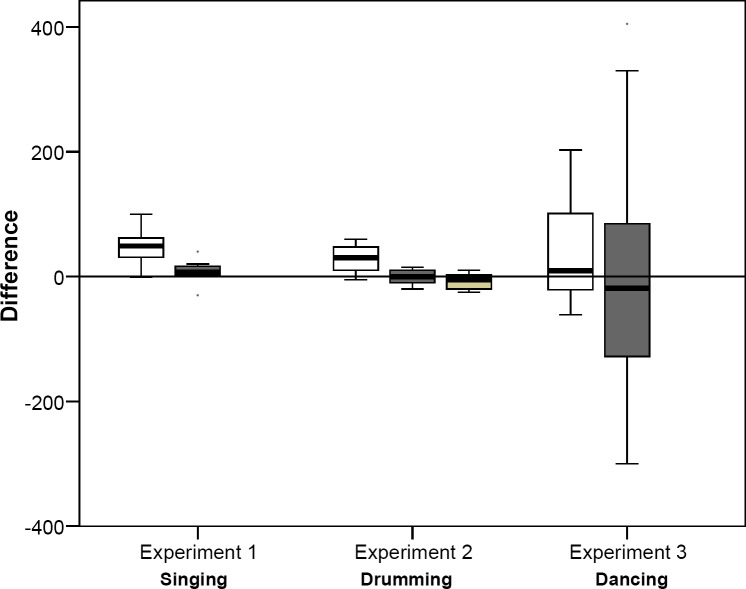
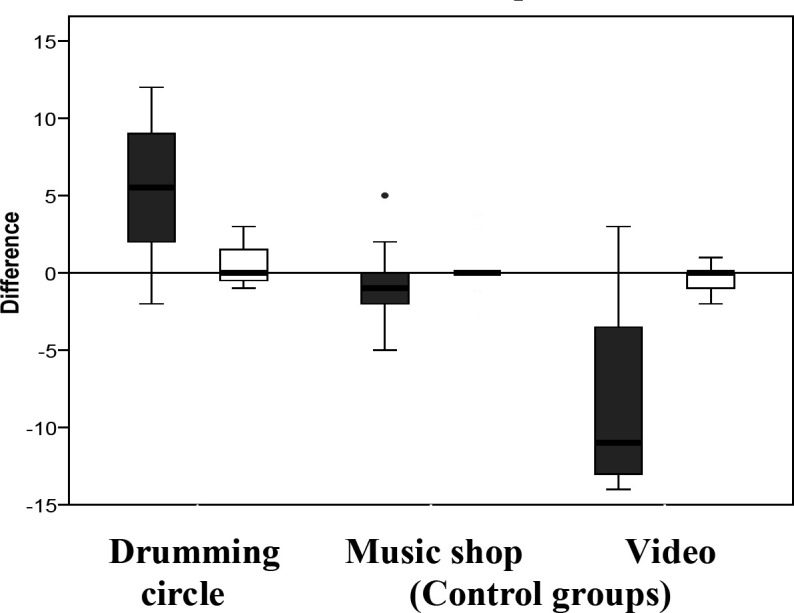
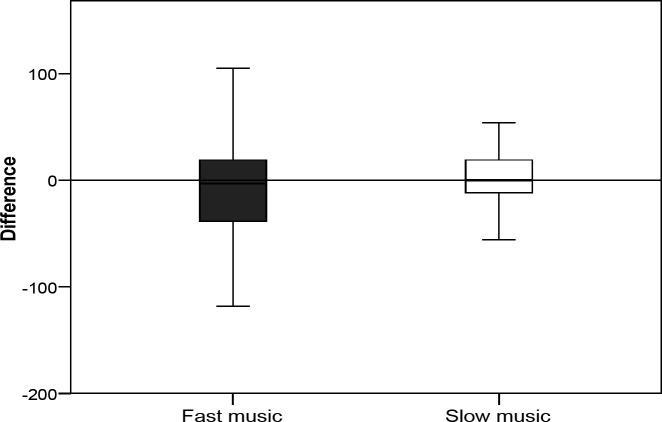
It is well known that music arouses emotional responses. In addition, it has long been thought to play an important role in creating a sense of community, especially in small scale societies. One mechanism by which it might do this is through the endorphin system, and there is evidence to support this claim. Using pain threshold as an assay for CNS endorphin release, we ask whether it is the auditory perception of music that triggers this effect or the active performance of music. We show that singing, dancing and drumming all trigger endorphin release (indexed by an increase in post-activity pain tolerance) in contexts where merely listening to music and low energy musical activities do not. We also confirm that music performance results in elevated positive (but not negative) affect. We conclude that it is the active performance of music that generates the endorphin high, not the music itself. We discuss the implications of this in the context of community bonding mechanisms that commonly involve dance and music-making.
Overview
The claims and statistics of this paper haven’t been checked yet.
Free: it reads the open-access text and checks the first 5 claims that cite a source we can check. Create a free account to check every claim.
Integrity signals
Registry
Cites
Statistics
Figures
Verification
Claims the paper makes
The claims and statistics of this paper haven’t been checked yet.
Free: it reads the open-access text and checks the first 5 claims that cite a source we can check. Create a free account to check every claim.
Claims other papers make about this one
Each is checked against this paper’s own text: does it say what the citing paper says it does?
The source backs part of the claim, not all of it — or backs it for a different population, condition or comparison.
In the citing paper
“Building on a growing body of the literature, we propose that group unity depends on behaviours that are synchronous and involve some muscular effort, which trigger the release of neuropeptides such as β-endorphin, yield enhanced positive affect, and in turn may enhance individuals’ willingness to cooperate [28,32,34,35,57].”
From The ice-breaker effect: Singing mediates fast social bonding (2015) · cites this paper as [28]
Experimental — accuracy not yet measuredThe source backs part of the claim, not all of it — or backs it for a different population, condition or comparison.
In the citing paper
“Support for this comes from the association between singing and the release of neuropeptides known to be associated with social bonding: oxytocin and β-endorphin [26–28].”
From The ice-breaker effect: Singing mediates fast social bonding (2015) · cites this paper as [28]
Experimental — accuracy not yet measuredThe source backs part of the claim, not all of it — or backs it for a different population, condition or comparison.
In the citing paper
“As a coordinated and often synchronous activity, for example, in terms of breath and heart rhythms, as well as timing and pitch [36], it is unsurprising that singing has also been linked with elevated β-endorphin levels [28].”
From The ice-breaker effect: Singing mediates fast social bonding (2015) · cites this paper as [28]
Experimental — accuracy not yet measuredThe source backs part of the claim, not all of it — or backs it for a different population, condition or comparison.
In the citing paper
“For instance, the repetitive and often strenuous actions that are involved in ritual-such as whirling, chanting, dancing, or prostrating-seem to produce anxiolytic effects by stimulating the endocannabinoid system (Dunbar, Kaskatis, MacDonald, & Barra, 2012;Xygalatas, 2008).”
From The Psychology of Rituals: An Integrative Review and Process-Based Framework (2018) · cites this paper as Dunbar, Kaskatis, MacDonald, & Barra, 2012
Experimental — accuracy not yet measuredThe cited source says what the claim attributes to it.
In the citing paper
“Pain thresholds are elevated following synchronized exertive activities such as rowing [19–21] and active musical performance in a group [22], suggesting that exertive group synchronous activities can activate the EOS, although it should be noted that endocannabinoids likely also contribute to exercise ‘highs’ [23].”
From Synchrony and exertion during dance independently raise pain threshold and encourage social bonding (2015) · cites this paper as [22]
2 more claims about this paper
Create a free account to see every claim other papers make about this one.
Self-check
Percentages, sums and reported differences re-computed from the paper’s own numbers.
The self-check needs the paper’s full text.
Citations
Cites
Flow: the psychology of optimal experience
(1990) · Choice Reviews Online · doi:10.5860/choice.28-0597 · Cited by 12,637
Flow: The Psychology of Optimal Experience
Buchanan, R., & Csikszentmihalyi, M. (1991) · Design Issues · doi:10.2307/1511458 · Cited by 9,394
The Ritual Process: Structure and Anti-Structure
Gilsenan, M., & Turner, V. W. (1976) · RAIN · doi:10.2307/3031914 · Cited by 6,725
The PANAS-X: Manual for the Positive and Negative Affect Schedule - Expanded Form
Watson, D., & Clark, L. A. (1994) · University of Iowa · doi:10.17077/48vt-m4t2 · Cited by 3,700
The Ritual Process. Structure and Anti-Structure
Welbourn, F. B., & Turner, V. W. (1971) · Journal of Religion in Africa · doi:10.2307/1594703 · Cited by 3,447
The Elementary Forms of Religious Life
Durkheim, E., & Swain, J. W. (1916) · The American Journal of Nursing · doi:10.2307/3405938 · Cited by 3,400
Blood, A. J., & Zatorre, R. J. (2001) · Proceedings of the National Academy of Sciences · doi:10.1073/pnas.191355898 · Cited by 2,814
Wiltermuth, S. S., & Heath, C. (2009) · Psychological Science · doi:10.1111/j.1467-9280.2008.02253.x · Cited by 1,717 · cited 1×
“Given the finding by Wiltermuth and Heath (2009) that synchrony enhances cooperation in economic games, this offers a plausible explanation for the role of human capacities like music that involve highly synchronised behaviour and trigger the release of endorphins in the evolution of the…”
BackgroundThe rewards of music listening: Response and physiological connectivity of the mesolimbic system
Menon, V., & Levitin, D. J. (2005) · NeuroImage · doi:10.1016/j.neuroimage.2005.05.053 · Cited by 1,067
An exploratory study of musical emotions and psychophysiology.
Krumhansl, C. L. (1997) · Canadian Journal of Experimental Psychology / Revue canadienne de psychologie expérimentale · doi:10.1037/1196-1961.51.4.336 · Cited by 1,017 · cited 1×
“Most of this interest has been focussed either on physiological responses to music (Krumhansl, 1997; Peretz and Coltheart, 2003; VanderArk and Ely, 1992, 1993; Wallin, 1991; Sevdalis and Keller, 2011) or on the role of synchrony (Janata and Grafton, 2003; Kirschner and Tomasello, 2009; Miles et…”
Backgrounddepue, R. A., & morrone-strupinsky, J. V. (2005) · Behavioral and Brain Sciences · doi:10.1017/s0140525x05000063 · Cited by 958
Regional Mu Opioid Receptor Regulation of Sensory and Affective Dimensions of Pain
Zubieta, J.-K., Smith, Y. R., Bueller, J. A., Xu, Y., Kilbourn, M. R., Jewett, D. M., Meyer, C. R., Koeppe, R. A., & Stohler, C. S. (2001) · Science · doi:10.1126/science.1060952 · Cited by 841
The social role of touch in humans and primates: Behavioural function and neurobiological mechanisms
Dunbar, R. I. M. (2010) · Neuroscience & Biobehavioral Reviews · doi:10.1016/j.neubiorev.2008.07.001 · Cited by 798 · cited 4×
“In primates, endorphin release is triggered by grooming (Keverne et al., 1989) and appears to be deeply involved in the processes involved in social bonding at the dyadic level (Nelson and Panksepp, 1998; Dunbar, 2010; Machin and Dunbar, 2011).”
BackgroundResultInfluentialSelf-citationModularity of music processing
Peretz, I., & Coltheart, M. (2003) · Nature Neuroscience · doi:10.1038/nn1083 · Cited by 769 · cited 2×
“physiological responses to music (Krumhansl, 1997; Peretz and Coltheart, 2003; VanderArk and Ely, 1992, 1993; Wallin, 1991; Sevdalis and Keller, 2011) or on the role of”
BackgroundNelson, E. E., & Panksepp, J. (1998) · Neuroscience & Biobehavioral Reviews · doi:10.1016/s0149-7634(97)00052-3 · Cited by 688 · cited 1×
“In primates, endorphin release is triggered by grooming (Keverne et al., 1989) and appears to be deeply involved in the processes involved in social bonding at the dyadic level (Nelson and Panksepp, 1998; Dunbar, 2010; Machin and Dunbar, 2011).”
BackgroundThe Runner's High: Opioidergic Mechanisms in the Human Brain
Boecker, H., Sprenger, T., Spilker, M. E., Henriksen, G., Koppenhoefer, M., Wagner, K. J., Valet, M., Berthele, A., & Tolle, T. R. (2008) · Cerebral Cortex · doi:10.1093/cercor/bhn013 · Cited by 527 · cited 1×
“Because CNS endorphins do not cross the blood-brain barrier (Bloom 1983; Boecker et al., 2008; Dearman and Francis, 1983; Kalin and Loevinger, 1983) (and PET scanning, the only viable alternative, is both extremely expensive and at present difficult to do in active subjects), we follow what has…”
BackgroundKeverne, E. B., Martensz, N. D., & Tuite, B. (1989) · Psychoneuroendocrinology · doi:10.1016/0306-4530(89)90065-6 · Cited by 525 · cited 2×
“In primates, endorphin release is triggered by grooming (Keverne et al., 1989) and appears to be deeply involved in the processes involved in social bonding at the dyadic level (Nelson and Panksepp, 1998; Dunbar, 2010; Machin and Dunbar, 2011).”
BackgroundResultThrills in response to music and other stimuli
Goldstein, A. (1980) · Physiological Psychology · doi:10.3758/bf03326460 · Cited by 522
Is Music an Evolutionary Adaptation?
HURON, D. (2001) · Annals of the New York Academy of Sciences · doi:10.1111/j.1749-6632.2001.tb05724.x · Cited by 496 · cited 2×
“However, music also has other important functional properties, having long been recognised as playing an important role in community bonding (Durkheim, 1915/1965; Turner, 1966; Ehrenreich, 2006; Freeman, 2001; Huron, 2001).”
BackgroundJoint drumming: Social context facilitates synchronization in preschool children
Kirschner, S., & Tomasello, M. (2009) · Journal of Experimental Child Psychology · doi:10.1016/j.jecp.2008.07.005 · Cited by 494 · cited 1×
“…this interest has been focussed either on physiological responses to music (Krumhansl, 1997; Peretz and Coltheart, 2003; VanderArk and Ely, 1992, 1993; Wallin, 1991; Sevdalis and Keller, 2011) or on the role of synchrony (Janata and Grafton, 2003; Kirschner and Tomasello, 2009; Miles et al., 2009).”
BackgroundThe rhythm of rapport: Interpersonal synchrony and social perception
Miles, L. K., Nind, L. K., & Macrae, C. N. (2009) · Journal of Experimental Social Psychology · doi:10.1016/j.jesp.2009.02.002 · Cited by 483 · cited 2×
“…this interest has been focussed either on physiological responses to music (Krumhansl, 1997; Peretz and Coltheart, 2003; VanderArk and Ely, 1992, 1993; Wallin, 1991; Sevdalis and Keller, 2011) or on the role of synchrony (Janata and Grafton, 2003; Kirschner and Tomasello, 2009; Miles et al., 2009).”
BackgroundEnkephalin may mediate euphoria and drive-reduction reward
BELLUZZI, J. D., & STEIN, L. (1977) · Nature · doi:10.1038/266556a0 · Cited by 450
Pattern and Process in Cultural Evolution
(2019) · University of California Press eBooks · doi:10.1525/9780520943360 · Cited by 391
Regulation of Human Affective Responses by Anterior Cingulate and Limbic µ-Opioid Neurotransmission
Zubieta, J.-K., Ketter, T. A., Bueller, J. A., Xu, Y., Kilbourn, M. R., Young, E. A., & Koeppe, R. A. (2003) · Archives of General Psychiatry · doi:10.1001/archpsyc.60.11.1145 · Cited by 377
Exertion interfaces: sports over a distance for social bonding and fun
Mueller, F., Agamanolis, S., & Picard, R. (2003) · Proceedings of the SIGCHI Conference on Human Factors in Computing Systems · doi:10.1145/642611.642709 · Cited by 359
Proceedings of the British Academy, 1931
(1933) · Notes and Queries · doi:10.1093/nq/clxv.aug05.89a · Cited by 350
The brain opioid theory of social attachment: a review of the evidence
Machin, A. J., & Dunbar, R. I. M. (2011) · Behaviour · doi:10.1163/000579511x596624 · Cited by 343 · cited 2×
“In primates, endorphin release is triggered by grooming (Keverne et al., 1989) and appears to be deeply involved in the processes involved in social bonding at the dyadic level (Nelson and Panksepp, 1998; Dunbar, 2010; Machin and Dunbar, 2011).”
BackgroundSelf-citationChlan, L. (1998) · Heart & Lung · doi:10.1016/s0147-9563(98)90004-8 · Cited by 303
Swinging in the brain: shared neural substrates for behaviors related to sequencing and music
Janata, P., & Grafton, S. T. (2003) · Nature Neuroscience · doi:10.1038/nn1081 · Cited by 298
Hilliard, R. E. (2003) · Journal of Music Therapy · doi:10.1093/jmt/40.2.113 · Cited by 264
Rowers' high: behavioural synchrony is correlated with elevated pain thresholds
Cohen, E. E. A., Ejsmond-Frey, R., Knight, N., & Dunbar, R. I. M. (2010) · Biology Letters · doi:10.1098/rsbl.2009.0670 · Cited by 261 · cited 7×
“We test between these two possibilities using a pain assay as a proxy for CNS endorphin activation.”
BackgroundMethodInfluentialSelf-citationThe effect of running on plasma β-endorphin
Colt, E. W. D., Wardlaw, S. L., & Frantz, A. G. (1981) · Life Sciences · doi:10.1016/0024-3205(81)90319-2 · Cited by 248
Lessons in exercise neurobiology: the case of endorphins.
Dishman, R. K., & O'Connor, P. J. (2009) · Mental health and physical activity · doi:10.1016/j.mhpa.2009.01.002 · Cited by 243 · cited 1×
“…any kind of physical exertion or somatic pain is an effective trigger of endorphin release, both peripherally in plasma and centrally in the CNS (Cohen et al., 2010; Colt et al., 1981; Dishman and O’Connor, 2009; Gambert et al., 1981; Harbach et al., 2000; Harte et al., 1995; Howlett et al., 1984).”
BackgroundA Neurobiological Role of Music in Social Bonding
Freeman, W. (1999) · The Origins of Music · doi:10.7551/mitpress/5190.003.0028 · Cited by 229
Social laughter is correlated with an elevated pain threshold
Dunbar, R. I. M., Baron, R., Frangou, A., Pearce, E., van Leeuwen, E. J. C., Stow, J., Partridge, G., MacDonald, I., Barra, V., & van Vugt, M. (2012) · Proceedings of the Royal Society B: Biological Sciences · doi:10.1098/rspb.2011.1373 · Cited by 228
Self-citationAVPR1a and SLC6A4 Gene Polymorphisms Are Associated with Creative Dance Performance
Bachner-Melman, R., Dina, C., Zohar, A. H., Constantini, N., Lerer, E., Hoch, S., Sella, S., Nemanov, L., Gritsenko, I., Lichtenberg, P., et al. (2005) · PLoS Genetics · doi:10.1371/journal.pgen.0010042 · Cited by 222
Genes, brains and mammalian social bonds
Curley, J. P., & Keverne, E. B. (2005) · Trends in Ecology & Evolution · doi:10.1016/j.tree.2005.05.018 · Cited by 214
Acute effects of aerobic exercise on mood.
Steptoe, A., & Cox, S. (1988) · Health Psychology · doi:10.1037//0278-6133.7.4.329 · Cited by 207
Gerra, G., Zaimovic, A., Franchini, D., Palladino, M., Giucastro, G., Reali, N., Maestri, D., Caccavari, R., Delsignore, R., & Brambilla, F. (1998) · International Journal of Psychophysiology · doi:10.1016/s0167-8760(97)00071-8 · Cited by 196
The Search for a Survival Value of Music
Roederer, J. G. (1984) · Music Perception · doi:10.2307/40285265 · Cited by 193
Bridging the bonding gap: the transition from primates to humans
Dunbar, R. I. M. (2012) · Philosophical Transactions of the Royal Society B: Biological Sciences · doi:10.1098/rstb.2011.0217 · Cited by 176
Self-citationRelaxation and music to reduce postsurgical pain
Good, M., Stanton-Hicks, M., Grass, J. A., Anderson, G. C., Lai, H.-L., Roykulcharoen, V., & Adler, P. A. (2001) · Journal of Advanced Nursing · doi:10.1046/j.1365-2648.2001.01655.x · Cited by 161
Captured by motion: Dance, action understanding, and social cognition
Sevdalis, V., & Keller, P. E. (2011) · Brain and Cognition · doi:10.1016/j.bandc.2011.08.005 · Cited by 146
The Endorphins: A Growing Family of Pharmacologically Pertinent Peptides
Bloom, F. E. (1983) · Annual Review of Pharmacology and Toxicology · doi:10.1146/annurev.pa.23.040183.001055 · Cited by 143
Music interventions for people with dementia: a review of the literature
Sherratt, K., Thornton, A., & Hatton, C. (2004) · Aging & Mental Health · doi:10.1080/13607860310001613275 · Cited by 135 · cited 1×
“…life in terminally ill cancer patients (Hilliard, 2003), reduce heart and respiratory rate as well as anxiety levels in individuals receiving ventilatory assistance (Chlan, 1998), and may even be effective in reducing some of the behavioral problems associated with dementia (Sherratt et al., 2004).”
BackgroundRelease of beta endorphin and met-enkephalin during exercise in normal women: response to training.
Howlett, T. A., Tomlin, S., Ngahfoong, L., Rees, L. H., Bullen, B. A., Skrinar, G. S., & McArthur, J. W. (1984) · BMJ · doi:10.1136/bmj.288.6435.1950 · Cited by 133
Stefano, G. B., Goumon, Y., Casares, F., Cadet, P., Fricchione, G. L., Rialas, C., Peter, D., Sonetti, D., Guarna, M., Welters, I. D., et al. (2000) · Trends in Neurosciences · doi:10.1016/s0166-2236(00)01611-8 · Cited by 117
Harte, J. L., Eifert, G. H., & Smith, R. (1995) · Biological Psychology · doi:10.1016/0301-0511(95)05118-t · Cited by 105 · cited 1×
“…any kind of physical exertion or somatic pain is an effective trigger of endorphin release, both peripherally in plasma and centrally in the CNS (Cohen et al., 2010; Colt et al., 1981; Dishman and O’Connor, 2009; Gambert et al., 1981; Harbach et al., 2000; Harte et al., 1995; Howlett et al., 1984).”
BackgroundThe Effect of Selected Classical Music and Spontaneous Imagery on Plasma β-Endorphin
McKinney, C. H., Tims, F. C., Kumar, A. M., & Kumar, M. (1997) · Journal of Behavioral Medicine · doi:10.1023/a:1025543330939 · Cited by 101 · cited 2×
“A number of authors have suggested that the sense of elation that comes from engaging in music arises from the way music (or active performance in musical contexts) triggers the release of endorphins (Chiu and Kumar, 2003; Dunbar, 2008, 2009; McKinney et al., 1996) (though plausible claims have been made, at least in…”
BackgroundTolbert, E., & Wallin, N. L. (1994) · Notes · doi:10.2307/898296 · Cited by 94
Dunbar, R. (2004) · Cited by 83
Self-citationRepressive/defensive coping, endogenous opioids and health: how a life so perfect can make you sick
Jamner, L. D., & Leigh, H. (1999) · Psychiatry Research · doi:10.1016/s0165-1781(98)00134-6 · Cited by 76
Does humor facilitate coping with physical discomfort?
Zillmann, D., Rockwell, S., Schweitzer, K., & Sundar, S. S. (1993) · Motivation and Emotion · doi:10.1007/bf00995204 · Cited by 74
Vanderark, S. D., & Ely, D. (1993) · Perceptual and Motor Skills · doi:10.2466/pms.1993.77.1.227 · Cited by 73
Psychological research: Innovative methods and strategies
(1996) · Taylor & Francis eBooks · doi:10.4324/9780203294314 · Cited by 70
Biochemical and Galvanic Skin Responses to Music Stimuli by College Students in Biology and Music
VanderArk, S. D., & Ely, D. (1992) · Perceptual and Motor Skills · doi:10.2466/pms.1992.74.3c.1079 · Cited by 65
Dearman, J., & Kt, F. (1983) · PubMed · Cited by 64
Ehrenreich, B. (2006) · Cited by 51
β-endorphin (1-31) in the plasma of male volunteers undergoing physical exercise
Harbach, H., Hell, K., Gramsch, C., Katz, N., Hempelmann, G., & Teschemacher, H. (2000) · Psychoneuroendocrinology · doi:10.1016/s0306-4530(00)00009-3 · Cited by 48 · cited 1×
“…any kind of physical exertion or somatic pain is an effective trigger of endorphin release, both peripherally in plasma and centrally in the CNS (Cohen et al., 2010; Colt et al., 1981; Dishman and O’Connor, 2009; Gambert et al., 1981; Harbach et al., 2000; Harte et al., 1995; Howlett et al., 1984).”
BackgroundDUNBAR, R. I. M. (2008) · Proceedings of the British Academy, Volume 154, 2007 Lectures · doi:10.5871/bacad/9780197264355.003.0015 · Cited by 44
Self-citationLanguage, Music, and Laughter in Evolutionary Perspective
Dunbar, R. (2004) · The MIT Press eBooks · doi:10.7551/mitpress/2879.003.0021 · Cited by 43
Self-citationMueller, C., Klega, A., Buchholz, H.-G., Rolke, R., Magerl, W., Schirrmacher, R., Schirrmacher, E., Birklein, F., Treede, R.-D., & Schreckenberger, M. (2010) · NeuroImage · doi:10.1016/j.neuroimage.2009.08.033 · Cited by 42 · cited 1×
“In a broad sense, endogenous opiates serve to combat the effects of physiological and psychological stress, and β-endorphins (and their associated µ receptors) have specifically been linked to the pain control system (Zubietta et al., 2001; Mueller et al., 2010).”
BackgroundExercise and the endogenous opioids.
Gambert, S., Hagen, T., Garthwaite, T., Duthie, E., Mccarty, D., Hawley, L., Butterfield, G., Farrell, P., Carr, D. B., Bullen, B., et al. (1981) · New England Journal of Medicine · doi:10.1056/nejm198112243052619 · Cited by 29
The darting game in snails and slugs
Schilthuizen, M. (2005) · Trends in Ecology & Evolution · doi:10.1016/j.tree.2005.08.014 · Cited by 28
The Central and Peripheral Opioid Peptides: Their Relationships and Functions
Kalin, N. H., & Loevinger, B. L. (1983) · Psychiatric Clinics of North America · doi:10.1016/s0193-953x(18)30815-3 · Cited by 19
[Effects of music on plasma stress hormones in surgical patients].
Satoh, Y., Nagao, H., Ishihara, H., Oyama, T., & Spintge, R. (1983) · PubMed · Cited by 3
Research works printed but not linked: 3
- Chiu P., and Kumar A. (2003). Music therapy: Loud noise or soothing notes. Music Therapy, 18, 204– 208.
- Sokal R.R., and Rohlf F.J. (1981). Biometry. San Francisco: Freeman.
- Spingte R., and Droh R. (1987). Effects of anxiolytic music on plasma levels of stress hormones in different medical specialties. In Pratt R.R. (Ed.), The fourth international symposium on music: Rehabilitation and human well-being (pp. 88– 101). Lanham, MD: University Press of America.
Cited by
Music and social bonding: “self-other†merging and neurohormonal mechanisms
Tarr, B., Launay, J., & Dunbar, R. I. M. (2014) · Frontiers in Psychology · doi:10.3389/fpsyg.2014.01096 · Cited by 548
Self-citationEffects of music interventions on stress-related outcomes: a systematic review and two meta-analyses
de Witte, M., Spruit, A., van Hooren, S., Moonen, X., & Stams, G.-J. (2020) · Health Psychology Review · doi:10.1080/17437199.2019.1627897 · Cited by 539
The ice-breaker effect: Singing mediates fast social bonding
Pearce, E., Launay, J., & Dunbar, R. I. M. (2015) · Royal Society Open Science · doi:10.1098/rsos.150221 · Cited by 507
Self-citationSynchrony and exertion during dance independently raise pain threshold and encourage social bonding
Tarr, B., Launay, J., Cohen, E., & Dunbar, R. (2015) · Biology Letters · doi:10.1098/rsbl.2015.0767 · Cited by 367
“Pain thresholds are elevated following synchronized exertive activities such as rowing [19–21] and active musical performance in a group [22], suggesting that exertive group synchronous activities can activate the EOS, although it should be noted that endocannabinoids likely also contribute to exercise ‘highs’ [23].”
BackgroundSelf-citationThe Psychology of Rituals: An Integrative Review and Process-Based Framework
Hobson, N. M., Schroeder, J., Risen, J. L., Xygalatas, D., & Inzlicht, M. (2018) · Personality and Social Psychology Review · doi:10.1177/1088868317734944 · Cited by 354
Metadata
- Authors
- Dunbar, R. I. M., Kaskatis, K., MacDonald, I., & Barra, V.
- Affiliations
- University of Oxford (GB)
- University of Liverpool (GB)
- Binghamton University (US)
- Corresponding author
- Dunbar, R.I.M.
- ORCID
- Dunbar, R.I.M.
- Venue
- Evolutionary Psychology
- Publisher
- SAGE Publications
- Published
- 2012-10-01
- Volume
- 10
- Issue
- 4
- Pages
- 688-702
- ISSN
- 1474-7049 (ISSN-L)
- PMC
- PMC10426978
- OpenAlex
- W2192147421
- Cited by
- 243
- References
- 68
- Citations by year
- 2026: 26 · 2025: 20 · 2024: 14 · 2023: 22 · 2022: 18 · 2021: 17 · 2020: 22 · 2019: 17 · 2018: 21 · 2017: 25 · 2016: 15 · 2015: 12 · 2014: 8 · 2013: 6
- FWCI
- 4.25
- Type
- journal article
- Language
- en
- Open access
- gold
- doi.org
- Licence
- Locations
- Evolutionary Psychology (publishedVersion, cc-by-nc)
- PubMed Central (publishedVersion, cc-by-nc)
- PubMed (publishedVersion)
- DOAJ (DOAJ: Directory of Open Access Journals) (submittedVersion, cc-by-sa)
- Topics
- Life Sciences › Neuroscience › Cognitive Neuroscience › Neuroscience and Music Perception
- Social Sciences › Psychology › Social Psychology › Music Therapy and Health
- Social Sciences › Arts and Humanities › Music › Diverse Music Education Insights
- Keywords
- music performance, pain threshold, endorphins, positive affect, singing, dance, drumming, music listening, community bonding, emotional response to music
- MeSH terms
- Adult, Affect, Auditory Perception, Dancing, Endorphins, Biological Evolution, Female, Humans, Male, Music, Pain Threshold, Young Adult, Singing
About these checks
Registry, retraction, Cites and statistics results are computed, not judged, with one exception: a printed reference that no index lists is read once by a model before it counts as a citation error. Claims are extracted by a model and kept only when their quote appears verbatim in the text; each cited source is then checked, with a model’s help, for whether it says what the claim relies on. Those verdicts can be wrong — read the claim’s quote and the cited source before relying on one.
Statistics and arithmetic are recomputed, not judged.
Confidence bands are shown only for fields calibrated on our annotated test set. None is calibrated yet, so no band is shown.
What counts as a claim ›How we measure confidence ›How we check this ›
Are you an author, or do you see a problem with this page? Request a review
Data sources
Bibliographic data: Semantic Scholar, OpenAlex, Crossref.
Contains information from the Semantic Scholar Academic Graph Datasets, made available under the ODC Attribution License (ODC-BY 1.0).
Semantic Scholar’s data is described in: Kinney, R., et al. (2023). The Semantic Scholar Open Data Platform. arXiv:2301.10140.
