

Education and Cognitive Functioning Across the Life Span
Open accessThe DOI matches its Crossref record; 261 of the 271 references it cites were found in a registry or an index, and 2 are not checked yet; none of the 238 sources its claims cite is checked for support yet.
Abstract
Cognitive abilities are important predictors of educational and occupational performance, socioeconomic attainment, health, and longevity. Declines in cognitive abilities are linked to impairments in older adults’ everyday functions, but people differ from one another in their rates of cognitive decline over the course of adulthood and old age. Hence, identifying factors that protect against compromised late-life cognition is of great societal interest. The number of years of formal education completed by individuals is positively correlated with their cognitive function throughout adulthood and predicts lower risk of dementia late in life. These observations have led to the propositions that prolonging education might (a) affect cognitive ability and (b) attenuate aging-associated declines in cognition. We evaluate these propositions by reviewing the literature on educational attainment and cognitive aging, including recent analyses of data harmonized across multiple longitudinal cohort studies and related meta-analyses. In line with the first proposition, the evidence indicates that educational attainment has positive effects on cognitive function. We also find evidence that cognitive abilities are associated with selection into longer durations of education and that there are common factors (e.g., parental socioeconomic resources) that affect both educational attainment and cognitive development. There is likely reciprocal interplay among these factors, and among cognitive abilities, during development. Education–cognitive ability associations are apparent across the entire adult life span and across the full range of education levels, including (to some degree) tertiary education. However, contrary to the second proposition, we find that associations between education and aging-associated cognitive declines are negligible and that a threshold model of dementia can account for the association between educational attainment and late-life dementia risk. We conclude that educational attainment exerts its influences on late-life cognitive function primarily by contributing to individual differences in cognitive skills that emerge in early adulthood but persist into older age. We also note that the widespread absence of educational influences on rates of cognitive decline puts constraints on theoretical notions of cognitive aging, such as the concepts of cognitive reserve and brain maintenance. Improving the conditions that shape development during the first decades of life carries great potential for improving cognitive ability in early adulthood and for reducing public-health burdens related to cognitive aging and dementia.
Checked 2026-10-05 · 2 references not checked yet
Overview
CoChat Summary
TL;DR
This review concludes that educational attainment is robustly associated with higher levels of cognitive function across adulthood and lower late-life dementia risk, but it has negligible associations with rates of aging-related cognitive decline. Education’s late-life cognitive benefits are best explained by higher peak cognitive ability in early adulthood that persists and delays threshold crossing, not by slowed decline.
Key findings
- Educational attainment is positively associated with adult cognitive-ability levels. Strenze’s meta-analysis (59 samples, total N = 84,828) found a sample-size-weighted average correlation corrected for measurement error of .56 (95% CI [0.53, 0.58]); Opdebeeck et al.’s older-adult meta-analysis (109 studies, total N = 111,684) found an average correlation of approximately .3 for general cognitive ability. Five additional years of education were associated with roughly 0.2 to 0.4 SD higher cognitive performance, or about 3 to 6 IQ points.
- Education–cognitive change associations are small and inconsistent. Seblova et al.’s meta-analysis reported point estimates of less than 0.001 SD per decade for episodic memory, 0.002 SD per decade for general intelligence, 0.002 SD per decade for processing speed, −0.004 SD per decade for verbal fluency, and less than −0.001 SD per decade for crystallized ability; none was statistically significant. A university degree versus high school diploma was estimated to yield only about 0.02 SD less decline over 20 years (upper 95% CI = 0.05 SD), compared with average episodic memory decline of about 0.4 to 0.5 SD per decade.
- Low educational attainment is associated with higher dementia risk. Meng and D’Arcy’s pooled analyses found a 2.6-fold increased risk for dementia in less educated versus more educated people in prevalence studies (95% CI [2.2, 3.1]) and a 1.9-fold increased risk in incidence studies (95% CI [1.5, 2.3]). The review argues a threshold model can account for this association without education affecting rates of cognitive decline.
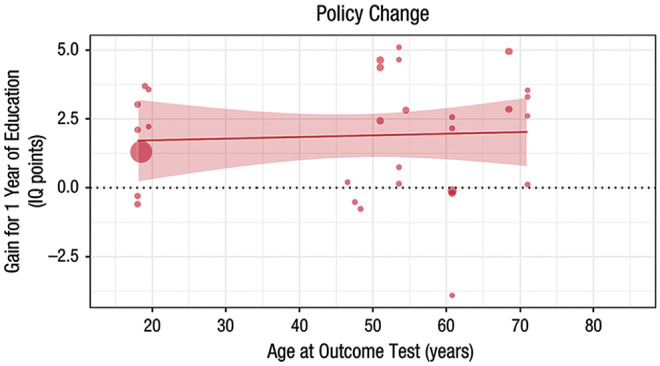
- Quasiexperimental evidence indicates education has causal effects on cognitive abilities. Ritchie and Tucker-Drob’s meta-analysis found policy-change designs yielded about 2 IQ points (0.14 SD) per year of education (95% CI [0.9, 3.1]), while school-age-cutoff designs yielded approximately 5 IQ points per year; effects appeared on fluid abilities as well as crystallized abilities.
Methods
- This is a narrative, non-systematic review synthesizing literature on educational attainment, cognitive aging, and dementia, including observational studies, harmonized longitudinal cohort analyses, and meta-analyses.
- Key evidence sources include Lipnicki et al.’s harmonized analysis of 14 longitudinal studies in 12 countries (42,170 individuals aged 54–105, 2–16 assessment waves), Seblova et al.’s meta-analysis of education and age-related cognitive change, and Ritchie and Tucker-Drob’s meta-analysis of quasiexperimental schooling effects.
- The main analysis is qualitative synthesis of effect sizes, longitudinal change models, and quasiexperimental designs; no new primary data are reported.
Limitations
- The paper states it is not a systematic review; educational attainment is indexed by qualification or years of education, which elides schooling quality, social context, and credential status, and research on those aspects is too sparse for mature conclusions.
- The paper states that cross-study heterogeneity in education–change associations remains unknown; dementia-progression studies are scarce, mixed, and subject to collider bias and ascertainment timing; effects of education after college and dose-response across all education levels remain unclear.
- Evident from the text: conclusions rely on observational and meta-analytic evidence with varying cognitive measures, reliability, ceiling effects (e.g., MMSE), and differing dementia diagnostic protocols, which limits causal and domain-specific inferences.
Model-written summary. Check it against the paper before relying on it.
Integrity signals
Registry
Cites
Statistics
Figures
Verification
Claims the paper makes
0 Valid · 2 Not valid · 150 Not checked · 143 Own results and interpretations
A result the paper reports from its own data — it cites no other source for it, so there is none to check. The quote shows it is in the paper.
In the paper
“we find that associations between education and aging-associated cognitive declines are negligible”
§ Education and Cognitive Functioning Across the Life Span > Abstract
plain- Asserted: passes — The authors put it forward as true.
- Checkable: passes — It can be checked against evidence.
- Load-bearing: passes — The paper’s conclusions depend on it.
- Based: passes — The paper gives a reason why it holds.
A result the paper states — it cites no source for it, so there is none to check. The quote shows it is in the paper.
In the paper
“We also find evidence that cognitive abilities are associated with selection into longer durations of education”
§ Education and Cognitive Functioning Across the Life Span > Abstract
plainstates an association- Asserted: passes — The authors put it forward as true.
- Checkable: passes — It can be checked against evidence.
- Load-bearing: passes — The paper’s conclusions depend on it.
- Based: passes — The paper gives a reason why it holds.
A result the paper states — it cites no source for it, so there is none to check. The quote shows it is in the paper.
In the paper
“there are common factors (e.g., parental socioeconomic resources) that affect both educational attainment and cognitive development”
§ Education and Cognitive Functioning Across the Life Span > Abstract
plainstates a cause- Asserted: passes — The authors put it forward as true.
- Checkable: passes — It can be checked against evidence.
- Load-bearing: passes — The paper’s conclusions depend on it.
- Based: passes — The paper gives a reason why it holds.
A result the paper states — it cites no source for it, so there is none to check. The quote shows it is in the paper.
In the paper
“Throughout adulthood, cognitive function in individuals with more years of schooling is, on average, better than cognitive function in those with fewer years of schooling.”
§ Education and Cognitive Functioning Across the Life Span > Evidence From Observational Studies > Summary of the evidence from observational studies in the broader context of cognitive aging and dementia
plainstates an association- Asserted: passes — The authors put it forward as true.
- Checkable: passes — It can be checked against evidence.
- Load-bearing: passes — The paper’s conclusions depend on it.
- Based: passes — The paper gives a reason why it holds.
None of the sources cited for this claim have been checked yet.
In the paper
“Two studies detected no statistically significant effect of education on cognitive change in the years before dementia diagnosis.”
§ Education and Cognitive Functioning Across the Life Span > Evidence From Observational Studies > Education and cognitive decline before and after dementia diagnosis
plain- Asserted: passes — The authors put it forward as true.
- Checkable: passes — It can be checked against evidence.
- Load-bearing: unclear — It is unclear whether the paper’s conclusions depend on it.
- Based: passes — The paper gives a reason why it holds.
186 more claims
Create a free account to see all 295 claims and to verify the 238 references still open.
- It may state two separate claims as one. 79
- Probably not a substantial claim. 31
- The quote only partly states this claim. 2
Claims other papers make about this one
Each is checked against this paper’s own text: does it say what the citing paper says it does?
The cited source says what the claim attributes to it.
In the citing paper
“overall cognitive capacities including crystallized and fluid composites, despite there being distinctions between them, have modest associations with each other, and can be summarized by a higher-order common factor (general intelligence) (Lovden, Fratiglioni, Glymour, Lindenberger, & Tucker-Drob, 2020; Lubinski, 2004; van der Maas et al., 2006).”
From Early-Initiated Childhood Reading for Pleasure: Associations with Better Cognitive Performance, Mental Well-being and Brain Structure in Young Adolescence (2024) · cites this paper as Lovden, Fratiglioni, Glymour, Lindenberger, & Tucker-Drob, 2020
The cited source says what the claim attributes to it.
In the citing paper
“Our results also suggested that early RfP showed a similar beneficial association with cognitive development as educational attainment (EA) at certain levels, since EA is positively associated with subsequent cognitive functions later-in-life (Lovden et al., 2020; Ritchie & Tucker-Drob, 2018)”
From Early-Initiated Childhood Reading for Pleasure: Associations with Better Cognitive Performance, Mental Well-being and Brain Structure in Young Adolescence (2024) · cites this paper as Lovden et al., 2020
In the citing paper
“However, educational attainment is a key driver of socioeconomic resources throughout life, such as occupation, economic outcomes, social status, and access to health care.24”
In the citing paper
“Thus, promoting continued education through early adulthood could confer benefits that contribute to lower ADRD risk directly (ie, cognitive or brain reserve, or both) and indirectly (ie, upward mobility).24”
Self-check
Percentages, sums and reported differences re-computed from the paper’s own numbers.
Each contradiction between two passages listed here was confirmed by an independent check.
Rated minor: it would not touch a result — a value no result rests on, a p-value that stays on the same side of the significance level, or a conflict that is clerical, resolved elsewhere in the paper, or outside its own findings.
In the paper
§ Education and Cognitive Functioning Across the Life Span > A Primer on Adult Cognitive Development
“Table: Table 4. Example of a Positive Association Between Educational Attainment and Cognitive Change: More Education Is Associated with Smaller Age-Related Increases in Cognitive Performance”
§ Education and Cognitive Functioning Across the Life Span > A Primer on Adult Cognitive Development
“A negative correlation between educational attainment and cognitive change can also indicate that greater educational attainment is associated with smaller increases in cognitive performance over time (e.g., in a measure of crystallized intelligence such as vocabulary). Table 4 gives an example of such a situation.”
Citations
Cites
Diagnostic and Statistical Manual of Mental Disorders
American Psychiatric Association (2013) · doi:10.1176/appi.books.9780890425596 · Cited by 116,369
Folstein, M. F., Folstein, S. E., & McHugh, P. R. (1975) · Journal of Psychiatric Research · doi:10.1016/0022-3956(75)90026-6 · Cited by 88,282
Hirono, N., Mori, E., Ikejiri, Y., Imamura, T., Shimomura, T., Hashimoto, M., Yamashita, H., & Ikeda, M. (1997) · Brain and nerve · Cited by 21,039
Kok, J. S., Berg, I. J., & Scherder, E. J. A. (2013) · Dementia and Geriatric Cognitive Disorders Extra · doi:10.1159/000353441 · Cited by 20,589
Older Adults' Reasons for Using Technology while Aging in Place
Peek, S. T. M., Luijkx, K. G., Rijnaard, M. D., Nieboer, M. E., van der Voort, C. S., Aarts, S., van Hoof, J., Vrijhoef, H. J. M., & Wouters, E. J. M. (2016) · Gerontology · doi:10.1159/000430949 · Cited by 19,690
Sensitivity and False Alarm Rate of a Fall Sensor in Long-Term Fall Detection in the Elderly
Kangas, M., Korpelainen, R., Vikman, I., Nyberg, L., & Jämsä, T. (2015) · Gerontology · doi:10.1159/000362720 · Cited by 18,909
NIA‐AA Research Framework: Toward a biological definition of Alzheimer's disease
Jack, C. R., Bennett, D. A., Blennow, K., Carrillo, M. C., Dunn, B., Haeberlein, S. B., Holtzman, D. M., Jagust, W., Jessen, F., Karlawish, J., et al. (2018) · Alzheimer's & Dementia · doi:10.1016/j.jalz.2018.02.018 · Cited by 10,537
"General Intelligence," Objectively Determined and Measured
Spearman, C. (1904) · The American Journal of Psychology · doi:10.2307/1412107 · Cited by 6,207 · cited 4×
“, 2006) is an example of an account of the positive correlations among different cognitive abilities (Spearman, 1904) that does not invoke a g factor.”
BackgroundMethodInfluentialSocioeconomic status and child development
Bradley, R. H., & Corwyn, R. F. (2002) · Annual Review of Psychology · doi:10.1146/annurev.psych.53.100901.135233 · Cited by 5,484 · cited 1×
“Individual differences in educational attainment are therefore likely to be associated with the broad constellations of environmental opportunities and advantages that come with higher parental socioeconomic status (Bradley & Corwyn, 2002; Strenze, 2007).”
BackgroundSchmidt, F. L., & Hunter, J. E. (1998) · Psychological Bulletin · doi:10.1037//0033-2909.124.2.262 · Cited by 4,180 · cited 1×
“Cognitive abilities, measured both in childhood and in adulthood, are important predictors of life achievements, health, and mortality (Batty, Deary, & Gottfredson, 2007; Gottfredson & Deary, 2004; Schmidt & Hunter, 1998; Strenze, 2007).”
BackgroundHuman Cognitive Abilities: A Survey of Factor-Analytic Studies
Carroll, J. B. (1993) · doi:10.1017/cbo9780511571312 · Cited by 4,121
What is cognitive reserve? Theory and research application of the reserve concept
STERN, Y. (2002) · Journal of the International Neuropsychological Society · doi:10.1017/s1355617702813248 · Cited by 3,951 · cited 2×
“…the combined effects of disease progression for all pathologies that are co-occurring in the brain, offset by repair or replenishment and compensation (Barulli & Stern, 2013; Cabeza et al., 2018; Nyberg, Lövdén, Riklund, Lindenberger, & Bäckman, 2012; Stern, 2002, 2006; Stern et al., 2018).”
BackgroundBaltes, P. B., & Baltes, M. M. (1990) · Successful Aging · doi:10.1017/cbo9780511665684.003 · Cited by 3,739 · cited 2×
“…situations that reveal their deficits or challenge their maximum performance; Salthouse, 2012a) or by using abilities that remain relative preserved with age (e.g., acquired knowledge) to accomplish the same tasks and maintain a high level of performance (Baltes & Baltes, 1990; Salthouse, 1984).”
BackgroundCognitive reserve in ageing and Alzheimer's disease
Stern, Y. (2012) · The Lancet Neurology · doi:10.1016/s1474-4422(12)70191-6 · Cited by 3,557 · cited 2×
“All these scenarios have been empirically observed (see, e.g., Stern, 2006, 2009, 2012, for reviews) and can be explained without evoking the concept of cognitive reserve.”
BackgroundSocioeconomic Inequalities in Health in 22 European Countries
Mackenbach, J. P., Stirbu, I., Roskam, A.-J. R., Schaap, M. M., Menvielle, G., Leinsalu, M., & Kunst, A. E. (2008) · New England Journal of Medicine · doi:10.1056/nejmsa0707519 · Cited by 3,302 · cited 1×
“Educational attainment has a robust association with survival, such that individuals with more education tend to live longer (Hamad, Elser, Tran, Rehkopf, & Goodman, 2018; Mackenbach, 2008).”
BackgroundStern, Y. (2009) · Neuropsychologia · doi:10.1016/j.neuropsychologia.2009.03.004 · Cited by 2,943
How People Make Their Own Environments: A Theory of Genotype Environment Effects
Scarr, S., & McCartney, K. (1983) · Child Development · doi:10.1111/j.1467-8624.1983.tb03884.x · Cited by 2,895 · cited 1×
“…are partly genetically influenced, these transactional processes give rise to gene–environment correlations: the tendency for individuals’ genotypes to be correlated with their environmental experiences (Beam & Turkheimer, 2013; Plomin, DeFries, & Loehlin, 1977; Scarr & McCartney, 1983).”
BackgroundBaltes, P. B. (1987) · Developmental Psychology · doi:10.1037/0012-1649.23.5.611 · Cited by 2,781 · cited 1×
“Although fluid and crystallized abilities are correlated across the life span, distinctions between them are particularly relevant in the context of aging (Baltes, 1987).”
Background23andMe Research Team, Lee, J. J., COGENT (Cognitive Genomics Consortium), Social Science Genetic Association Consortium, Wedow, R., Okbay, A., Kong, E., Maghzian, O., Zacher, M., Nguyen-Viet, T. A., et al. (2018) · Nature Genetics · doi:10.1038/s41588-018-0147-3 · Cited by 2,470 · cited 1×
“…studies of educational attainment indicated an average genetic correlation between different study cohorts of .723, well below the genetic correlation of 1.0 that would be expected if the genetic bases of educational attainment were entirely consistent across populations ( J. J. Lee et al., 2018).”
InfluentialDavis-Kean, P. E. (2005) · Journal of Family Psychology · doi:10.1037/0893-3200.19.2.294 · Cited by 2,466 · cited 1×
“…influence their child’s access to higher education by providing greater social support, financial support, access to higher-quality primary and secondary education, and otherwise difficult-to-acquire pragmatic knowledge relevant to scholastic success (e.g., Davis-Kean, 2005; Hill & Tyson, 2009).”
BackgroundBallard, C., Gauthier, S., Corbett, A., Brayne, C., Aarsland, D., & Jones, E. (2011) · The Lancet · doi:10.1016/s0140-6736(10)61349-9 · Cited by 2,336
(2015) · HAL · Cited by 2,238
Hill, N. E., & Tyson, D. F. (2009) · Developmental Psychology · doi:10.1037/a0015362 · Cited by 2,170 · cited 2×
“…(Briley, Domiteaux, & Tucker-Drob, 2014; Tucker-Drob, Briley, Engelhardt, Mann, & Harden, 2016), health (De Ridder et al., 2013), well-being (Marques, Pais-Ribeiro, & Lopez, 2011), and perception of one’s school and home environment (Hill & Tyson, 2009; Marchant, Paulson, & Rothlisberg, 2001).”
BackgroundHemispheric asymmetry reduction in older adults: The HAROLD model.
Cabeza, R. E. L. (2002) · Psychology and Aging · doi:10.1037//0882-7974.17.1.85 · Cited by 2,036
Mixed brain pathologies account for most dementia cases in community-dwelling older persons
Schneider, J. A., Arvanitakis, Z., Bang, W., & Bennett, D. A. (2007) · Neurology · doi:10.1212/01.wnl.0000271090.28148.24 · Cited by 1,992
Understanding the odd science of aging
Kirkwood, T. B. L. (2005) · Cell · doi:10.1016/j.cell.2005.01.027 · Cited by 1,984 · cited 1×
“…reasons include the possibility that individual differences in change arise from random processes or from processes that are themselves difficult to measure or are rarely measured—for example, human senescence may have an inherently random component (Kirkwood, 2005; Raz & Daugherty, 2018).”
BackgroundAbilities: Their Structure, Growth, and Action
Jensen, A. R., & Cattell, R. B. (1974) · The American Journal of Psychology · doi:10.2307/1422024 · Cited by 1,866
Role of Genes and Environments for Explaining Alzheimer Disease
Gatz, M., Reynolds, C. A., Fratiglioni, L., Johansson, B., Mortimer, J. A., Berg, S., Fiske, A., & Pedersen, N. L. (2006) · Archives of General Psychiatry · doi:10.1001/archpsyc.63.2.168 · Cited by 1,798 · cited 1×
“Estimates from twin studies put the heritability of Alzheimer’s disease at around 60% (Gatz et al., 2006).”
BackgroundSelf-citationIntelligence and educational achievement
Deary, I. J., Strand, S., Smith, P., & Fernandes, C. (2007) · Intelligence · doi:10.1016/j.intell.2006.02.001 · Cited by 1,723
Whitepaper: Defining and investigating cognitive reserve, brain reserve, and brain maintenance
Stern, Y., Arenaza‐Urquijo, E. M., Bartrés‐Faz, D., Belleville, S., Cantilon, M., Chetelat, G., Ewers, M., Franzmeier, N., Kempermann, G., Kremen, W. S., et al. (2020) · Alzheimer's & Dementia · doi:10.1016/j.jalz.2018.07.219 · Cited by 1,703
Genotype-environment interaction and correlation in the analysis of human behavior.
Plomin, R., DeFries, J. C., & Loehlin, J. C. (1977) · Psychological Bulletin · doi:10.1037/0033-2909.84.2.309 · Cited by 1,685
Defeating Alzheimer's disease and other dementias: a priority for European science and society
Winblad, B., Amouyel, P., Andrieu, S., Ballard, C., Brayne, C., Brodaty, H., Cedazo-Minguez, A., Dubois, B., Edvardsson, D., Feldman, H., et al. (2016) · The Lancet Neurology · doi:10.1016/s1474-4422(16)00062-4 · Cited by 1,676 · cited 2×
“In recent years, several neuroimaging and biofluid indicators, or biomarkers, of neurodegenerative subtypes of dementia have been identified and even used in clinical practice (Winblad et al., 2016).”
BackgroundSelf-citationThe relation between socioeconomic status and academic achievement.
White, K. R. (1982) · Psychological Bulletin · doi:10.1037//0033-2909.91.3.461 · Cited by 1,650 · cited 2×
“Individual characteristics related to how individuals navigate their way through the educational system are themselves outcomes of both sociocontextual environments (White, 1982) and genetically influenced dispositions (Tucker-Drob et al., 2016).”
BackgroundDisruption of Large-Scale Brain Systems in Advanced Aging
Andrews-Hanna, J. R., Snyder, A. Z., Vincent, J. L., Lustig, C., Head, D., Raichle, M. E., & Buckner, R. L. (2007) · Neuron · doi:10.1016/j.neuron.2007.10.038 · Cited by 1,592 · cited 1×
“Other specific examples of the broader brainmaintenance research program on cognitive aging include the white-matter-disconnection hypothesis (Andrews-Hanna et al., 2007; O’Sullivan et al., 2001), the dopamine hypothesis (Bäckman, Nyberg, Lindenberger, Li, & Farde, 2006), and the energy-and-free-radical hypothesis (Ra…”
BackgroundThe theoretical status of latent variables.
Borsboom, D., Mellenbergh, G. J., & van Heerden, J. (2003) · Psychological Review · doi:10.1037/0033-295x.110.2.203 · Cited by 1,566
Hertzog, C., Kramer, A. F., Wilson, R. S., & Lindenberger, U. (2008) · Psychological Science in the Public Interest · doi:10.1111/j.1539-6053.2009.01034.x · Cited by 1,495
Self-citationMaintenance, reserve and compensation: the cognitive neuroscience of healthy ageing
Cabeza, R., Albert, M., Belleville, S., Craik, F. I. M., Duarte, A., Grady, C. L., Lindenberger, U., Nyberg, L., Park, D. C., Reuter-Lorenz, P. A., et al. (2018) · Nature Reviews Neuroscience · doi:10.1038/s41583-018-0068-2 · Cited by 1,298 · cited 2×
“…the combined effects of disease progression for all pathologies that are co-occurring in the brain, offset by repair or replenishment and compensation (Barulli & Stern, 2013; Cabeza et al., 2018; Nyberg, Lövdén, Riklund, Lindenberger, & Bäckman, 2012; Stern, 2002, 2006; Stern et al., 2018).”
BackgroundSelf-citationThe Relationship Between Education and Adult Mortality in the United States
Lleras-Muney, A. (2005) · Review of Economic Studies · doi:10.1111/0034-6527.00329 · Cited by 1,282
LIFESPAN PSYCHOLOGY: Theory and Application to Intellectual Functioning
Baltes, P. B., Staudinger, U. M., & Lindenberger, U. (1999) · Annual Review of Psychology · doi:10.1146/annurev.psych.50.1.471 · Cited by 1,281
Self-citationMidlife cardiovascular risk factors and risk of dementia in late life
Whitmer, R. A., Sidney, S., Selby, J., Johnston, S. C., & Yaffe, K. (2005) · Neurology · doi:10.1212/01.wnl.0000149519.47454.f2 · Cited by 1,238
Memory aging and brain maintenance
Nyberg, L., Lövdén, M., Riklund, K., Lindenberger, U., & Bäckman, L. (2012) · Trends in Cognitive Sciences · doi:10.1016/j.tics.2012.04.005 · Cited by 1,223 · cited 1×
“The notion of brain maintenance implies that between-persons differences in cognitive changes can be linked to between-persons differences in taskrelevant aspects of the brain’s chemistry, structure, and function (Nyberg & Lindenberger, in press; Nyberg et al., 2012).”
BackgroundSelf-citationThe mean IQ of Americans: Massive gains 1932 to 1978.
Flynn, J. R. (1984) · Psychological Bulletin · doi:10.1037/0033-2909.95.1.29 · Cited by 1,206 · cited 1×
“…is also consistent with the observation that the massive increases in cognitive performance across birth cohorts (the so-called Flynn effect; Flynn, 1984; Rönnlund & Nilsson, 2008; Schaie, 1965, 2005) have not been accompanied by consistent birth-cohort effects in rates of cognitive aging.”
ResultDo “brain-training” programs work?
Simons, D. J., Boot, W. R., Charness, N., Gathercole, S. E., Chabris, C. F., Hambrick, D. Z., & Stine-Morrow, E. A. L. (2016) · Psychological Science in the Public Interest · doi:10.1177/1529100616661983 · Cited by 1,183 · cited 2×
“, cognitive training, music, and chess) result in limited generalization of benefits to outcome measures of cognitive performance that are not directly tapping into skills, strategies, and knowledge acquired through those activities (Melby-Lervag, Redick, & Hulme, 2016; Sala & Gobet, 2017; Simons et al., 2016).”
BackgroundKivipelto, M., Ngandu, T., Laatikainen, T., Winblad, B., Soininen, H., & Tuomilehto, J. (2006) · The Lancet Neurology · doi:10.1016/s1474-4422(06)70537-3 · Cited by 1,126 · cited 1×
“Risk indices predicting risk for dementia at middle age or later in life have been developed and validated, and education (as well as unhealthy lifestyles and cardiometabolic risk factors) is a critical factor in such indices (e.g., K. J. Anstey et al., 2014; Kivipelto et al., 2006).”
BackgroundIntelligence: Its Structure, Growth and Action
(1986) · Advances in Psychology · doi:10.1016/s0166-4115(08)x6006-6 · Cited by 1,065 · cited 3×
“…and motivations, and that those experiences may in turn affect those traits, thus both supporting cognitive development and increasing exposure to further environmental experiences relevant for cognitive development (Bouchard, 1997; R. B. Cattell, 1987; Hayes, 1962; Johnson, 2010; Sameroff, 1975).”
BackgroundA general model for the study of developmental problems.
Schaie, K. W. (1965) · Psychological Bulletin · doi:10.1037/h0022371 · Cited by 1,056 · cited 1×
“…is also consistent with the observation that the massive increases in cognitive performance across birth cohorts (the so-called Flynn effect; Flynn, 1984; Rönnlund & Nilsson, 2008; Schaie, 1965, 2005) have not been accompanied by consistent birth-cohort effects in rates of cognitive aging.”
ResultA dynamical model of general intelligence: The positive manifold of intelligence by mutualism.
Van Der Maas, H. L. J., Dolan, C. V., Grasman, R. P. P. P., Wicherts, J. M., Huizenga, H. M., & Raijmakers, M. E. J. (2006) · Psychological Review · doi:10.1037/0033-295x.113.4.842 · Cited by 1,006
Melby-Lervåg, M., Redick, T. S., & Hulme, C. (2016) · Perspectives on Psychological Science · doi:10.1177/1745691616635612 · Cited by 983
Intelligence and socioeconomic success: A meta-analytic review of longitudinal research
Strenze, T. (2007) · Intelligence · doi:10.1016/j.intell.2006.09.004 · Cited by 950 · cited 6×
“Strenze (2007) conducted a metaanalysis of the association between intelligence (mainly measures of general cognitive ability from batteries of intelligence tests) in childhood through early adulthood (3–23 years) and education (highest degree attained or years of education) measured later in life…”
BackgroundMethodResultInfluentialBlondell, S. J., Hammersley-Mather, R., & Veerman, J. L. (2014) · BMC Public Health · doi:10.1186/1471-2458-14-510 · Cited by 928
Efficiency, capacity, compensation, maintenance, plasticity: emerging concepts in cognitive reserve
Barulli, D., & Stern, Y. (2013) · Trends in Cognitive Sciences · doi:10.1016/j.tics.2013.08.012 · Cited by 915 · cited 5×
“…from aging or disease, in addition to individual differences in processing before such changes occurred (which are sometimes referred to as brain reserve, neural reserve, or just reserve rather than compensation or cognitive reserve; Barulli & Stern, 2013; Cabeza et al., 2018; Stern et al., 2018).”
BackgroundMethodResultInfluentialAge, Neuropathology, and Dementia
Savva, G. M., Wharton, S. B., Ince, P. G., Forster, G., Matthews, F. E., & Brayne, C. (2009) · New England Journal of Medicine · doi:10.1056/nejmoa0806142 · Cited by 900 · cited 1×
“In contrast to this clinical classification, neuropathological and neuroimaging studies have shown that mixed pathologies often co-occur in the brain, and most individuals diagnosed with dementia after age 75 have multiple contributing pathologies (Savva, 2009; Schneider, Arvanitakis, Bang, & Bennett, 2007).”
ResultMeng, X., & D’Arcy, C. (2012) · PLoS ONE · doi:10.1371/journal.pone.0038268 · Cited by 876 · cited 3×
“…we searched PubMed and Web of Science for papers (education AND dementia AND cognit* AND longitudinal) and searched through the reference lists of selected papers as well as major reviews in the field (e.g., Barulli & Stern, 2013; Karr, Graham, Hofer, & Muniz-Terrera, 2018; Meng & D’Arcy, 2012).”
BackgroundMethodGender Inequalities in Education
Buchmann, C., DiPrete, T. A., & McDaniel, A. (2008) · Annual Review of Sociology · doi:10.1146/annurev.soc.34.040507.134719 · Cited by 875
Satz, P. (1993) · Neuropsychology · doi:10.1037//0894-4105.7.3.273 · Cited by 850 · cited 2×
“This conclusion is more consistent with the concept of brain reserve than with compensation or cognitive reserve (Barulli & Stern, 2013; Cabeza et al., 2018; Satz, 1993; Stern et al., 2018).”
ResultRönnlund, M., Nyberg, L., Bäckman, L., & Nilsson, L.-G. (2005) · Psychology and Aging · doi:10.1037/0882-7974.20.1.3 · Cited by 839 · cited 2×
“Over the two decades (from 60 to 80 years of age) during which cognitive performance shows the most marked decline (Rönnlund et al., 2005), an individual with a university degree (5 years of education beyond high school) is expected to experience approximately 0.”
BackgroundCognitive Reserve and Alzheimer Disease
Stern, Y. (2006) · Alzheimer Disease & Associated Disorders · doi:10.1097/01.wad.0000213815.20177.19 · Cited by 838 · cited 3×
“All these scenarios have been empirically observed (see, e.g., Stern, 2006, 2009, 2012, for reviews) and can be explained without evoking the concept of cognitive reserve.”
BackgroundCeci, S. J. (1991) · Developmental Psychology · doi:10.1037/0012-1649.27.5.703 · Cited by 837 · cited 2×
“…is relevant for more fluid abilities (e.g., memory and reasoning)—for example, because it improves cognitive strategies and test-taking skills (Ceci, 1991)—or to the extent that the cognitive stimulation associated with schooling stimulates neurobiological change, we might expect education…”
BackgroundConsequences of Age-Related Cognitive Declines
Salthouse, T. (2012) · Annual Review of Psychology · doi:10.1146/annurev-psych-120710-100328 · Cited by 818
Evidence for cortical “disconnection” as a mechanism of age-related cognitive decline
O’Sullivan, M., Jones, D. K., Summers, P. E., Morris, R. G., Williams, S. C. R., & Markus, H. S. (2001) · Neurology · doi:10.1212/wnl.57.4.632 · Cited by 806
The course of adult intellectual development
Schaie, K. W. (1994) · American Psychologist · doi:10.1037/0003-066x.49.4.304 · Cited by 799 · cited 4×
“5 SD per decade in this period of life (Berggren, Nilsson, & Lövdén, 2018; Rönnlund et al., 2005; Schaie, 1994).”
BackgroundInfluentialThe Educational and Early Occupational Status Attainment Process: Replication and Revision
Sewell, W. H., Haller, A. O., & Ohlendorf, G. W. (1970) · American Sociological Review · doi:10.2307/2093379 · Cited by 793
The correlative triad among aging, dopamine, and cognition: Current status and future prospects
Bäckman, L., Nyberg, L., Lindenberger, U., Li, S.-C., & Farde, L. (2006) · Neuroscience & Biobehavioral Reviews · doi:10.1016/j.neubiorev.2006.06.005 · Cited by 765
Self-citationA theoretical framework for the study of adult cognitive plasticity
Lövdén, M., Bäckman, L., Lindenberger, U., Schaefer, S., & Schmiedek, F. (2010) · Psychological Bulletin · doi:10.1037/a0020080 · Cited by 731 · cited 1×
“Individual differences in cognition might reflect personspecific matches between environmental demands and abilities (see also Lövdén et al., 2010), and these matches may help to slow the fade-out of educational attainment’s effects, which are maintained in old age.”
BackgroundSelf-citationTransactional Models in Early Social Relations
Sameroff, A. (1975) · Human Development · doi:10.1159/000271476 · Cited by 723 · cited 2×
“…and motivations, and that those experiences may in turn affect those traits, thus both supporting cognitive development and increasing exposure to further environmental experiences relevant for cognitive development (Bouchard, 1997; R. B. Cattell, 1987; Hayes, 1962; Johnson, 2010; Sameroff, 1975).”
BackgroundGlymour, M. M., Weuve, J., Berkman, L. F., Kawachi, I., & Robins, J. M. (2005) · American Journal of Epidemiology · doi:10.1093/aje/kwi187 · Cited by 703
Self-citationHow Much Does Education Improve Intelligence? A Meta-Analysis
Ritchie, S. J., & Tucker-Drob, E. M. (2018) · Psychological Science · doi:10.1177/0956797618774253 · Cited by 680 · cited 2×
“More recently, Ritchie and Tucker-Drob (2018) conducted a meta-analysis of studies implementing any of three quasiexperimental methods to estimate the causal effect of schooling on cognitive abilities.”
BackgroundSelf-citationBeydoun, M. A., Beydoun, H. A., Gamaldo, A. A., Teel, A., Zonderman, A. B., & Wang, Y. (2014) · BMC Public Health · doi:10.1186/1471-2458-14-643 · Cited by 671 · cited 1×
“Systematic reviews and meta-analyses have confirmed that association (Beydoun et al., 2014; Caamano-Isorna, Corral, Montes-Martinez, & Takkouche, 2006; Fratiglioni & Wang, 2007; Meng & D’Arcy, 2012; Valenzuela & Sachdev, 2006; X. J. Wang et al., 2019; Xu et al., 2015; Xu et al., 2016).”
Heritability estimates versus large environmental effects: The IQ paradox resolved.
Dickens, W. T., & Flynn, J. R. (2001) · Psychological Review · doi:10.1037/0033-295x.108.2.346 · Cited by 663 · cited 1×
“…environmental experiences have causal effects on cognitive development, but—somewhat paradoxically—because the experiences are correlated with individual genotypes, they can cause heritability estimates for cognitive abilities to increase with age (Beam & Turkheimer, 2013; Dickens & Flynn, 2001).”
BackgroundIntelligence Predicts Health and Longevity, but Why?
Gottfredson, L. S., & Deary, I. J. (2004) · Current Directions in Psychological Science · doi:10.1111/j.0963-7214.2004.01301001.x · Cited by 623
The heritability of general cognitive ability increases linearly from childhood to young adulthood
Haworth, C. M. A., Wright, M. J., Luciano, M., Martin, N. G., de Geus, E. J. C., van Beijsterveldt, C. E. M., Bartels, M., Posthuma, D., Boomsma, D. I., Davis, O. S. P., et al. (2010) · Molecular Psychiatry · doi:10.1038/mp.2009.55 · Cited by 617 · cited 1×
“Indeed, there is consistent evidence of increasing heritability of cognitive abilities during development, with meta-analyses indicating increases from approximately 10% in infancy to approximately 70% by late adolescence (Briley & Tucker-Drob, 2013; Haworth et al., 2010).”
BackgroundRelationship Between Education and Dementia: An Updated Systematic Review
Sharp, E. S., & Gatz, M. (2011) · Alzheimer Disease & Associated Disorders · doi:10.1097/wad.0b013e318211c83c · Cited by 591 · cited 1×
“Indeed, since the early 1990s, several population-based studies have reported an increased risk for dementia among adults over the age of 65 with low educational attainment (Sharp & Gatz, 2011).”
BackgroundMeta-analysis of modifiable risk factors for Alzheimer's disease
Xu, W., Tan, L., Wang, H.-F., Jiang, T., Tan, M.-S., Tan, L., Zhao, Q.-F., Li, J.-Q., Wang, J., & Yu, J.-T. (2015) · Journal of Neurology, Neurosurgery & Psychiatry · doi:10.1136/jnnp-2015-310548 · Cited by 573 · cited 1×
“Systematic reviews and meta-analyses have confirmed that association (Beydoun et al., 2014; Caamano-Isorna, Corral, Montes-Martinez, & Takkouche, 2006; Fratiglioni & Wang, 2007; Meng & D’Arcy, 2012; Valenzuela & Sachdev, 2006; X. J. Wang et al., 2019; Xu et al., 2015; Xu et al., 2016).”
Effects of age and skill in typing.
Salthouse, T. A. (1984) · Journal of Experimental Psychology: General · doi:10.1037//0096-3445.113.3.345 · Cited by 566 · cited 2×
“…situations that reveal their deficits or challenge their maximum performance; Salthouse, 2012a) or by using abilities that remain relative preserved with age (e.g., acquired knowledge) to accomplish the same tasks and maintain a high level of performance (Baltes & Baltes, 1990; Salthouse, 1984).”
BackgroundGWAS on family history of Alzheimer’s disease
Marioni, R. E., Harris, S. E., Zhang, Q., McRae, A. F., Hagenaars, S. P., Hill, W. D., Davies, G., Ritchie, C. W., Gale, C. R., Starr, J. M., et al. (2018) · Translational Psychiatry · doi:10.1038/s41398-018-0150-6 · Cited by 564 · cited 1×
“, 2011), the aggregate effects of more common genetic variants with individually small effects are relevant for risk for more common, sporadic (nonfamilial) forms of the disease (Marioni et al., 2018).”
BackgroundRate of memory decline in AD is related to education and occupation: Cognitive reserve?
Stern, Y., Albert, S., Tang, M.-X., & Tsai, W.-Y. (1999) · Neurology · doi:10.1212/wnl.53.9.1942 · Cited by 557
Persistence and Fadeout in the Impacts of Child and Adolescent Interventions
Bailey, D., Duncan, G. J., Odgers, C. L., & Yu, W. (2017) · Journal of Research on Educational Effectiveness · doi:10.1080/19345747.2016.1232459 · Cited by 551
Mackintosh, N. J. (1998) · Cited by 546
Predictors of cognitive change in older persons: MacArthur studies of successful aging.
Albert, M. S., Jones, K., Savage, C. R., Berkman, L., Seeman, T., Blazer, D., & Rowe, J. W. (1995) · Psychology and Aging · doi:10.1037/0882-7974.10.4.578 · Cited by 543 · cited 1×
“The joint predictive power of those factors that are related to the rate of cognitive change is modest, especially in comparison with their much greater success in accounting for variation in levels of cognitive performance (Albert et al., 1995; Ritchie et al., 2016).”
ResultSalthouse, T. A. (1985) · Cited by 538
Intelligence and school grades: A meta-analysis
Roth, B., Becker, N., Romeyke, S., Schäfer, S., Domnick, F., & Spinath, F. M. (2015) · Intelligence · doi:10.1016/j.intell.2015.09.002 · Cited by 531 · cited 1×
“Cognitive ability is perhaps the most important of these: Reported correlations between general cognitive ability and scholastic achievement range from .4 to .7 (Deary, Strand, Smith, & Fernandes, 2007; Johnson, Deary, & Iacono, 2009; Mackintosh, 2011; Roth et al., 2015).”
BackgroundBrain reserve hypothesis in dementia
Fratiglioni, L., & Wang, H.-X. (2007) · Journal of Alzheimer's Disease · doi:10.3233/jad-2007-12103 · Cited by 499 · cited 1×
“Systematic reviews and meta-analyses have confirmed that association (Beydoun et al., 2014; Caamano-Isorna, Corral, Montes-Martinez, & Takkouche, 2006; Fratiglioni & Wang, 2007; Meng & D’Arcy, 2012; Valenzuela & Sachdev, 2006; X. J. Wang et al., 2019; Xu et al., 2015; Xu et al., 2016).”
Self-citationRelations Between Cognitive Abilities and Measures of Executive Functioning.
Salthouse, T. A. (2005) · Neuropsychology · doi:10.1037/0894-4105.19.4.532 · Cited by 498 · cited 1×
“For instance, word-fluency tasks, in which individuals are asked to name as many words from a particular category as possible within an allotted amount of time, rely on both word knowledge and fluid abilities such as processing speed (Salthouse, 2005).”
BackgroundDevelopmental Influences on Adult Intelligence: The Seattle Longitudinal Study
Schaie, K. W. (2012) · doi:10.1093/acprof:osobl/9780195386134.001.0001 · Cited by 495 · cited 3×
“…is also consistent with the observation that the massive increases in cognitive performance across birth cohorts (the so-called Flynn effect; Flynn, 1984; Rönnlund & Nilsson, 2008; Schaie, 1965, 2005) have not been accompanied by consistent birth-cohort effects in rates of cognitive aging.”
BackgroundResultPremorbid (early life) IQ and Later Mortality Risk: Systematic Review
Batty, G. D., Deary, I. J., & Gottfredson, L. S. (2007) · Annals of Epidemiology · doi:10.1016/j.annepidem.2006.07.010 · Cited by 483
Lifecourse Social Conditions and Racial and Ethnic Patterns of Cognitive Aging
Glymour, M. M., & Manly, J. J. (2008) · Neuropsychology Review · doi:10.1007/s11065-008-9064-z · Cited by 481 · cited 1×
“Existing studies of relatively homogeneous samples from a single geographic location or even country obscure the role of structural factors in determining access to education (Glymour & Manly, 2008).”
BackgroundSelf-citationCognitive reserve and cognitive function in healthy older people: a meta-analysis
Opdebeeck, C., Martyr, A., & Clare, L. (2016) · Aging, Neuropsychology, and Cognition · doi:10.1080/13825585.2015.1041450 · Cited by 465 · cited 2×
“Focusing on older adults (age > 60 years), Opdebeeck, Martyr, and Clare (2015) conducted a meta-analysis of 109 studies (total N = 111,684) reporting estimates of the association between educational attainment and some measure of cognitive performance.”
BackgroundDevelopmental Influences on Adult Intelligence: The Seattle Longitudinal Study
Schaie, K. W. (2012) · Medical Entomology and Zoology · Cited by 449
Plomin, R. (1999) · The American Journal of Human Genetics · doi:10.1086/302632 · Cited by 448
Diseth, Å. (2011) · Learning and Individual Differences · doi:10.1016/j.lindif.2011.01.003 · Cited by 440 · cited 1×
“…performance (and therefore also, ultimately, educational attainment) relate to traits such as cognitive abilities (Mackintosh, 2011), self-efficacy (Diseth, 2011), socioemotional skills (Mavroveli & Sanchez-Ruiz, 2011), personality (Briley, Domiteaux, & Tucker-Drob, 2014; Tucker-Drob, Briley,…”
Amieva, H., Jacqmin-Gadda, H., Orgogozo, J.-M., Le Carret, N., Helmer, C., Letenneur, L., Barberger-Gateau, P., Fabrigoule, C., & Dartigues, J.-F. (2005) · Brain · doi:10.1093/brain/awh451 · Cited by 434 · cited 1×
“For instance, in the Personnes Agées Quid (PAQUID) cohort, individuals who had completed primary school, compared with those who had not, showed more rapid declines on measures of verbal fluency, psychomotor speed, and, in particular, episodic memory (Amieva et al., 2005; Amieva et al., 2014; Jacqmin-Gadda, Commenges,…”
BackgroundHuman cognitive aging: Corriger la fortune?
Lindenberger, U. (2014) · Science · doi:10.1126/science.1254403 · Cited by 414 · cited 2×
“…Larger Age-Related Increases in Cognitive Performance Years of education Cognitive performance Change (Time 2 – Time 1) Correlation (education, change)Time 1 Time 2 22 10 15 5 .996 18 13 17 4 13 5 8 3 10 8 10 2 cannot simply focus on domain-specific processes (Lindenberger, 2014; Salthouse, 1985).”
BackgroundSelf-citationMaking Americans healthier: social and economic policy as health policy
(2009) · Choice Reviews Online · doi:10.5860/choice.46-5680 · Cited by 409
(2020) · The MIT Press eBooks · doi:10.7551/mitpress/11442.001.0001 · Cited by 405
A major role for cardiovascular burden in age-related cognitive decline
Qiu, C., & Fratiglioni, L. (2015) · Nature Reviews Cardiology · doi:10.1038/nrcardio.2014.223 · Cited by 398 · cited 1×
“…is supported by rather strong evidence showing that a broad range of vascular risk factors and related disorders are involved in brain health (Cox et al., 2019) and in the development of both dementia and heart disease (C. Qiu & Fratiglioni, 2015; Whitmer, Sidney, Selby, Johnston, & Yaffe, 2005).”
BackgroundSelf-citationPsychological compensation: A theoretical framework.
Bäckman, L., & Dixon, R. A. (1992) · Psychological Bulletin · doi:10.1037//0033-2909.112.2.259 · Cited by 398 · cited 1×
“The concept as originally defined therefore also incorporates changes in cognitive processing—which some have described as compensatory (Bäckman & Dixon, 1992; Cabeza, 2002; Cabeza et al., 2018)—in response to harmful brain changes resulting from aging or disease, in addition to individual…”
BackgroundRelation of Education and Occupation-based Socioeconomic Status to Incident Alzheimer's Disease
Karp, A. (2004) · American Journal of Epidemiology · doi:10.1093/aje/kwh018 · Cited by 384
Anstey, K., & Christensen, H. (2000) · Gerontology · doi:10.1159/000022153 · Cited by 377 · cited 1×
“In a narrative review of studies conducted through 1999, K. Anstey and Christensen (2000) arrived at the same conclusion, but a later narrative review of studies published since 1999 found a lack of consistent evidence that education is associated with age-related cognitive change (Lenehan,…”
BackgroundBrain reserve and cognitive decline: a non-parametric systematic review
VALENZUELA, M. J., & SACHDEV, P. (2006) · Psychological Medicine · doi:10.1017/s0033291706007744 · Cited by 373 · cited 4×
“In a nonparametric meta-analysis of longitudinal studies of changes in cognitive performance that used screening instruments such as the MMSE, Valenzuela and Sachdev (2006) concluded that greater education is associated with slower declines in cognitive performance.”
MethodInfluentialConceptual and Measurement Challenges in Research on Cognitive Reserve
Jones, R. N., Manly, J., Glymour, M. M., Rentz, D. M., Jefferson, A. L., & Stern, Y. (2011) · Journal of the International Neuropsychological Society · doi:10.1017/s1355617710001748 · Cited by 363 · cited 1×
“Although there is currently no measure of cognitive reserve with widely accepted construct validity ( Jones et al., 2011; Nilsson & Lövdén, 2018), the proposal that education may increase cognitive reserve seems to be based on the notion that education may transmit knowledge and cognitive skills (e.”
BackgroundSelf-citationVariation in the Heritability of Educational Attainment: An International Meta-Analysis
Branigan, A. R., McCallum, K. J., & Freese, J. (2013) · Social Forces · doi:10.1093/sf/sot076 · Cited by 360 · cited 3×
“In a meta-analysis of 15 studies drawn from multiple countries, Branigan, McCallum, and Freese (2013) estimated an average heritability of 40% for educational attainment, with substantial heterogeneity among countries and among demographic groups within countries.”
BackgroundMethodInfluentialEducation and rates of cognitive decline in incident Alzheimer's disease
Scarmeas, N. (2005) · Journal of Neurology, Neurosurgery & Psychiatry · doi:10.1136/jnnp.2005.072306 · Cited by 353
Lugo-Gil, J., & Tamis-LeMonda, C. S. (2008) · Child Development · doi:10.1111/j.1467-8624.2008.01176.x · Cited by 352 · cited 1×
“…with their genotypes (Plomin, 1994) and reciprocal associations in prospective longitudinal studies between mental ability and parental cognitive stimulation and between children’s motivational factors and their scholastic performance (Lugo-Gil & Tamis-LeMonda, 2008; TuckerDrob & Harden, 2012).”
BackgroundEducation policy and the heritability of educational attainment
Heath, A. C., Berg, K., Eaves, L. J., Solaas, M. H., Corey, L. A., Sundet, J., Magnus, P., & Nance, W. E. (1985) · Nature · doi:10.1038/314734a0 · Cited by 350
A life-course approach to the aetiology of late-onset dementias
Whalley, L. J., Dick, F. D., & McNeill, G. (2006) · The Lancet Neurology · doi:10.1016/s1474-4422(05)70286-6 · Cited by 343
Zahodne, L. B., Glymour, M. M., Sparks, C., Bontempo, D., Dixon, R. A., MacDonald, S. W. S., & Manly, J. J. (2011) · Journal of the International Neuropsychological Society · doi:10.1017/s1355617711001044 · Cited by 339 · cited 1×
“, 2015), others no correlation (e.g., Tucker-Drob, Johnson, & Jones, 2009; Zahodne et al., 2011), and yet others positive correlations (e.”
BackgroundSelf-citationAssociations between vascular risk factors and brain MRI indices in UK Biobank
Cox, S. R., Lyall, D. M., Ritchie, S. J., Bastin, M. E., Harris, M. A., Buchanan, C. R., Fawns-Ritchie, C., Barbu, M. C., de Nooij, L., Reus, L. M., et al. (2019) · European Heart Journal · doi:10.1093/eurheartj/ehz100 · Cited by 327
Self-citationKrapohl, E., Rimfeld, K., Shakeshaft, N. G., Trzaskowski, M., McMillan, A., Pingault, J.-B., Asbury, K., Harlaar, N., Kovas, Y., Dale, P. S., et al. (2014) · Proceedings of the National Academy of Sciences · doi:10.1073/pnas.1408777111 · Cited by 323 · cited 1×
“Many of the traits implicated in scholastic performance and educational attainment are heritable, which helps to explain the heritability of scholastic performance (Krapohl et al., 2014) and, ultimately, educational attainment (Cesarini & Visscher, 2017).”
BackgroundMarchant, G. J., Paulson, S. E., & Rothlisberg, B. A. (2001) · Psychology in the Schools · doi:10.1002/pits.1039 · Cited by 318
Does Far Transfer Exist? Negative Evidence From Chess, Music, and Working Memory Training
Sala, G., & Gobet, F. (2017) · Current Directions in Psychological Science · doi:10.1177/0963721417712760 · Cited by 309 · cited 1×
“…music, and chess) result in limited generalization of benefits to outcome measures of cognitive performance that are not directly tapping into skills, strategies, and knowledge acquired through those activities (Melby-Lervag, Redick, & Hulme, 2016; Sala & Gobet, 2017; Simons et al., 2016).”
BackgroundGenetic and Environmental Influences on Cognition Across Development and Context
Tucker-Drob, E. M., Briley, D. A., & Harden, K. P. (2013) · Current Directions in Psychological Science · doi:10.1177/0963721413485087 · Cited by 295 · cited 1×
“The nature of between-persons differences in educational attainment and its psychological correlates may partly be a moving target, in that the sources of such differences may vary with age, birth cohort, period, and society (Tucker-Drob et al., 2013).”
BackgroundSelf-citationAmieva, H., Mokri, H., Le Goff, M., Meillon, C., Jacqmin-Gadda, H., Foubert-Samier, A., Orgogozo, J.-M., Stern, Y., & Dartigues, J.-F. (2014) · Brain · doi:10.1093/brain/awu035 · Cited by 295 · cited 2×
“Indeed, empirical results have indicated that, in dementia studies, the more educated groups are less representative of the population than are the less educated groups (Amieva et al., 2014).”
BackgroundGenetic insights in Alzheimer's disease
Bettens, K., Sleegers, K., & Van Broeckhoven, C. (2013) · The Lancet Neurology · doi:10.1016/s1474-4422(12)70259-4 · Cited by 290
Education and dementia: a meta-analytic study
Caamaño-Isorna, F., Corral, M., Montes-Martínez, A., & Takkouche, B. (2006) · Neuroepidemiology · doi:10.1159/000093378 · Cited by 288
Marden, J. R., Tchetgen Tchetgen, E. J., Kawachi, I., & Glymour, M. M. (2017) · American Journal of Epidemiology · doi:10.1093/aje/kwx155 · Cited by 284
Self-citationUncoupling of Reading and IQ Over Time: Empirical Evidence for a Definition of Dyslexia
Ferrer, E., Shaywitz, B. A., Holahan, J. M., Marchione, K., & Shaywitz, S. E. (2010) · Psychological Science · doi:10.1177/0956797609354084 · Cited by 280
Tucker-Drob, E. M., Johnson, K. E., & Jones, R. N. (2009) · Developmental Psychology · doi:10.1037/a0014012 · Cited by 277
Self-citationSocial Participation Attenuates Decline in Perceptual Speed in Old and Very Old Age.
Lövdén, M., Ghisletta, P., & Lindenberger, U. (2005) · Psychology and Aging · doi:10.1037/0882-7974.20.3.423 · Cited by 274
Self-citationHofer, S. M., & Sliwinski, M. J. (2001) · Gerontology · doi:10.1159/000052825 · Cited by 272
Education and Cognitive Decline in Older Americans: Results From the AHEAD Sample
Alley, D., Suthers, K., & Crimmins, E. (2007) · Research on Aging · doi:10.1177/0164027506294245 · Cited by 269
Intelligence and education: causal perceptions drive analytic processes and therefore conclusions
Deary, I. J., & Johnson, W. (2010) · International Journal of Epidemiology · doi:10.1093/ije/dyq072 · Cited by 259 · cited 1×
“Moreover, the association between cognitive ability in childhood and later educational attainment is clear (Deary & Johnson, 2010; Ritchie, Bates, Der, Starr, & Deary, 2013).”
BackgroundEducation and Risk of Dementia: Dose-Response Meta-Analysis of Prospective Cohort Studies
Xu, W., Tan, L., Wang, H.-F., Tan, M.-S., Tan, L., Li, J.-Q., Zhao, Q.-F., & Yu, J.-T. (2016) · Molecular Neurobiology · doi:10.1007/s12035-015-9211-5 · Cited by 258 · cited 1×
“Systematic reviews and meta-analyses have confirmed that association (Beydoun et al., 2014; Caamano-Isorna, Corral, Montes-Martinez, & Takkouche, 2006; Fratiglioni & Wang, 2007; Meng & D’Arcy, 2012; Valenzuela & Sachdev, 2006; X. J. Wang et al., 2019; Xu et al., 2015; Xu et al., 2016).”
Consistency and Variability in the Growth of Intelligence from Birth to Eighteen Years
Bayley, N. (1949) · The Pedagogical Seminary and Journal of Genetic Psychology · doi:10.1080/08856559.1949.10533516 · Cited by 258
Education delays accelerated decline on a memory test in persons who develop dementia
Hall, C. B., Derby, C., LeValley, A., Katz, M. J., Verghese, J., & Lipton, R. B. (2007) · Neurology · doi:10.1212/01.wnl.0000278163.82636.30 · Cited by 257 · cited 1×
“A few studies have reported a later acceleration but faster decline after a modeled change point for more highly educated individuals on measures of episodic memory (Hall et al., 2007) and general cognitive ability (but see also C.”
BackgroundDevelopmental Influences on Adult Intelligence
Schaie, K. W. (2005) · doi:10.1093/acprof:oso/9780195156737.001.0001 · Cited by 253 · cited 3×
“…is also consistent with the observation that the massive increases in cognitive performance across birth cohorts (the so-called Flynn effect; Flynn, 1984; Rönnlund & Nilsson, 2008; Schaie, 1965, 2005) have not been accompanied by consistent birth-cohort effects in rates of cognitive aging.”
BackgroundResultNyberg, L., & Pudas, S. (2019) · Annual Review of Psychology · doi:10.1146/annurev-psych-010418-103052 · Cited by 248 · cited 1×
“The association is conceptually justified and has some empirical support, especially in relation to hippocampal maintenance and episodic memory (Nyberg & Lindenberger, in press; Nyberg & Pudas, 2019).”
BackgroundTrait emotional intelligence influences on academic achievement and school behaviour
Mavroveli, S., & Sánchez‐Ruiz, M. J. (2011) · British Journal of Educational Psychology · doi:10.1348/2044-8279.002009 · Cited by 247 · cited 1×
“…educational attainment) relate to traits such as cognitive abilities (Mackintosh, 2011), self-efficacy (Diseth, 2011), socioemotional skills (Mavroveli & Sanchez-Ruiz, 2011), personality (Briley, Domiteaux, & Tucker-Drob, 2014; Tucker-Drob, Briley, Engelhardt, Mann, & Harden, 2016), health…”
Tschanz, J. T., Corcoran, C. D., Schwartz, S., Treiber, K., Green, R. C., Norton, M. C., Mielke, M. M., Piercy, K., Steinberg, M., Rabins, P. V., et al. (2011) · The American Journal of Geriatric Psychiatry · doi:10.1097/jgp.0b013e3181faec23 · Cited by 244 · cited 9×
“Three studies (total N = 587) reported no education-related differences in declines in performance on the MMSE (Aguero-Torres, Fratiglioni, Guo, Viitanen, & Winblad, 1998; Small, Viitanen, Winblad, & Bäckman, 1997; Tschanz et al., 2011).”
BackgroundInfluentialMontez, J. K., Hummer, R. A., & Hayward, M. D. (2012) · Demography · doi:10.1007/s13524-011-0082-8 · Cited by 244
Relationship between education and age-related cognitive decline: A review of recent research
Lenehan, M. E., Summers, M. J., Saunders, N. L., Summers, J. J., & Vickers, J. C. (2015) · Psychogeriatrics · doi:10.1111/psyg.12083 · Cited by 240
Cognitive Reserve and Alzheimer’s Disease
Xu, W., Yu, J.-T., Tan, M.-S., & Tan, L. (2015) · Molecular Neurobiology · doi:10.1007/s12035-014-8720-y · Cited by 240
Were Compulsory Attendance and Child Labor Laws Effective? An Analysis from 1915 to 1939
Lleras‐Muney, A. (2002) · The Journal of Law and Economics · doi:10.1086/340393 · Cited by 236
Schooling in adolescence raises IQ scores
Brinch, C. N., & Galloway, T. A. (2012) · Proceedings of the National Academy of Sciences · doi:10.1073/pnas.1106077109 · Cited by 231
The role of occupational complexity in trajectories of cognitive aging before and after retirement.
Finkel, D., Andel, R., Gatz, M., & Pedersen, N. L. (2009) · Psychology and Aging · doi:10.1037/a0015511 · Cited by 229
Marques, S. C., Pais-Ribeiro, J. L., & Lopez, S. J. (2011) · Journal of Happiness Studies · doi:10.1007/s10902-010-9244-4 · Cited by 227
The Rationality Quotient: Toward a Test of Rational Thinking
Stanovich, K. E., West, R. F., & Toplak, M. E. (2016) · The MIT Press eBooks · doi:10.7551/mitpress/9780262034845.001.0001 · Cited by 223
BLAIR, C., GAMSON, D., THORNE, S., & BAKER, D. (2005) · Intelligence · doi:10.1016/j.intell.2004.07.008 · Cited by 219
Tucker-Drob, E. M., & Briley, D. A. (2014) · Psychological Bulletin · doi:10.1037/a0035893 · Cited by 218 · cited 5×
“According to the so-called gravitational hypothesis (Gottfredson, 2003; Wilk & Sackett, 1996), people may, through self-selection and enabled access, gravitate more and more toward environments that match their cognitive abilities (Beam & Turkheimer, 2013; Tucker-Drob & Briley, 2014).”
BackgroundInfluentialSelf-citationSeblova, D., Berggren, R., & Lövdén, M. (2020) · Ageing Research Reviews · doi:10.1016/j.arr.2019.101005 · Cited by 215
Self-citationMorris, G. P., Clark, I. A., & Vissel, B. (2018) · Acta Neuropathologica · doi:10.1007/s00401-018-1918-8 · Cited by 212
Lipnicki, D. M., Crawford, J. D., Dutta, R., Thalamuthu, A., Kochan, N. A., Andrews, G., Lima-Costa, M. F., Castro-Costa, E., Brayne, C., Matthews, F. E., et al. (2017) · PLOS Medicine · doi:10.1371/journal.pmed.1002261 · Cited by 212 · cited 1×
“…that educational attainment had small associations with changes in language and processing speed and null associations with changes in memory and executive function (see Lipnicki et al., 2017, Table S16, which reports results excluding data for individuals with a dementia diagnosis at baseline).”
ResultClouston, S. A. P., Smith, D. M., Mukherjee, S., Zhang, Y., Hou, W., Link, B. G., & Richards, M. (2020) · The Journals of Gerontology: Series B · doi:10.1093/geronb/gbz053 · Cited by 208 · cited 1×
“Evidence for effects of education on points of accelerated change is mixed so far (Christensen et al., 2001; Clouston, Glymour, & Terrera, 2015; Clouston et al., 2019).”
BackgroundLyketsos, C. G., Chen, L.-S., & Anthony, J. C. (1999) · American Journal of Psychiatry · doi:10.1176/ajp.156.1.58 · Cited by 201
(1985) · Advances in Psychology · doi:10.1016/s0166-4115(08)x6066-2 · Cited by 200 · cited 2×
“…Larger Age-Related Increases in Cognitive Performance Years of education Cognitive performance Change (Time 2 – Time 1) Correlation (education, change)Time 1 Time 2 22 10 15 5 .996 18 13 17 4 13 5 8 3 10 8 10 2 cannot simply focus on domain-specific processes (Lindenberger, 2014; Salthouse, 1985).”
BackgroundCoupled cognitive changes in adulthood: A meta-analysis.
Tucker-Drob, E. M., Brandmaier, A. M., & Lindenberger, U. (2019) · Psychological Bulletin · doi:10.1037/bul0000179 · Cited by 196 · cited 4×
“For example, level of cognitive performance has small and inconsistent associations with subsequent cognitive change (Gow et al., 2012; Salthouse, 2012b; Tucker-Drob et al., 2019).”
BackgroundInfluentialSelf-citationAnstey, K. J., Cherbuin, N., Herath, P. M., Qiu, C., Kuller, L. H., Lopez, O. L., Wilson, R. S., & Fratiglioni, L. (2014) · PLoS ONE · doi:10.1371/journal.pone.0086141 · Cited by 192
Self-citationMarchant, G. J., Paulson, S. E., & Rothlisberg, B. A. (2001) · Psychology in the Schools · doi:10.1002/pits.1039.abs · Cited by 192
Briley, D. A., & Tucker-Drob, E. M. (2013) · Psychological Science · doi:10.1177/0956797613478618 · Cited by 178 · cited 1×
“Indeed, there is consistent evidence of increasing heritability of cognitive abilities during development, with meta-analyses indicating increases from approximately 10% in infancy to approximately 70% by late adolescence (Briley & Tucker-Drob, 2013; Haworth et al., 2010).”
BackgroundSelf-citationANDEL, R., VIGEN, C., MACK, W. J., CLARK, L. J., & GATZ, M. (2006) · Journal of the International Neuropsychological Society · doi:10.1017/s1355617706060206 · Cited by 176
On the power of multivariate latent growth curve models to detect correlated change.
Hertzog, C., Lindenberger, U., Ghisletta, P., & von Oertzen, T. (2006) · Psychological Methods · doi:10.1037/1082-989x.11.3.244 · Cited by 174
Self-citationHamad, R., Elser, H., Tran, D. C., Rehkopf, D. H., & Goodman, S. N. (2018) · Social Science & Medicine · doi:10.1016/j.socscimed.2018.07.016 · Cited by 174 · cited 1×
“Though this account cannot be fully ruled out, one should note that education has robust effects on other important outcomes, including longevity (Hamad et al., 2018).”
BackgroundNeurocognitive functions and everyday functions change together in old age.
Tucker-Drob, E. M. (2011) · Neuropsychology · doi:10.1037/a0022348 · Cited by 173 · cited 1×
“Changes in cognitive abilities during aging are associated with declines in the performance of everyday tasks that are important for independent living (Allaire & Marsiske, 2002; Tucker-Drob, 2011).”
BackgroundSelf-citationLONGITUDINAL ANALYSIS OF ABILITY‐JOB COMPLEXITY FIT AND JOB CHANGE
WILK, S. L., & SACKETT, P. R. (1996) · Personnel Psychology · doi:10.1111/j.1744-6570.1996.tb02455.x · Cited by 172 · cited 1×
“According to the so-called gravitational hypothesis (Gottfredson, 2003; Wilk & Sackett, 1996), people may, through self-selection and enabled access, gravitate more and more toward environments that match their cognitive abilities (Beam & Turkheimer, 2013; Tucker-Drob & Briley, 2014).”
BackgroundRevisiting the dedifferentiation hypothesis with longitudinal multi-cohort data
de Frias, C. M., Lövdén, M., Lindenberger, U., & Nilsson, L.-G. (2007) · Intelligence · doi:10.1016/j.intell.2006.07.011 · Cited by 168
Self-citationThe Stability of Intelligence From Age 11 to Age 90 Years: The Lothian Birth Cohort of 1921
Deary, I. J., Pattie, A., & Starr, J. M. (2013) · Psychological Science · doi:10.1177/0956797613486487 · Cited by 165 · cited 1×
“For example, between-persons differences in cognitive performance are remarkably stable throughout adult life (de Frias et al., 2007; Deary et al., 2013; Hertzog & Schaie, 1986, 1988; Tucker-Drob & Briley, 2014; Tucker-Drob et al., 2019).”
BackgroundThe changing face of cognitive gender differences in Europe
Weber, D., Skirbekk, V., Freund, I., & Herlitz, A. (2014) · Proceedings of the National Academy of Sciences · doi:10.1073/pnas.1319538111 · Cited by 162 · cited 1×
“In a similar way, historical trends in gender equality have played a major role in transforming betweenpersons differences in education across cohorts (Becker, 2014; Branigan et al., 2013; Buchmann, DiPrete, & McDaniel, 2008; Fischbein, Lange, & Lichtenstein, 1997; Heath et al., 1985; Weber et al., 2014).”
BackgroundIs education associated with improvements in general cognitive ability, or in specific skills?
Ritchie, S. J., Bates, T. C., & Deary, I. J. (2015) · Developmental Psychology · doi:10.1037/a0038981 · Cited by 161
The Rationality Quotient: Toward a Test of Rational Thinking
Stanovich, K. E., West, R. F., & Toplak, M. E. (2016) · Cited by 161
Ferrer, E., & McArdle, J. J. (2004) · Developmental Psychology · doi:10.1037/0012-1649.40.6.935 · Cited by 160 · cited 1×
“Supporting this prediction, Ferrer and McArdle (2004) reported mutual longitudinal coupling between academic knowledge and fluid reasoning over childhood and adolescence.”
BackgroundCohort differences in cognitive aging and terminal decline in the Seattle Longitudinal Study.
Gerstorf, D., Ram, N., Hoppmann, C., Willis, S. L., & Schaie, K. W. (2011) · Developmental Psychology · doi:10.1037/a0023426 · Cited by 154
Trajectories of decline in cognition and daily functioning in preclinical dementia
Verlinden, V. J. A., van der Geest, J. N., de Bruijn, R. F. A. G., Hofman, A., Koudstaal, P. J., & Ikram, M. A. (2016) · Alzheimer's & Dementia · doi:10.1016/j.jalz.2015.08.001 · Cited by 152 · cited 1×
“In the large Rotterdam Study (N = 856), performance on the MMSE declined faster among more highly educated individuals than among less educated individuals in the years before they were diagnosed with dementia (Verlinden et al., 2016).”
BackgroundA Life-Course Study of Cognitive Reserve in Dementia—From Childhood to Old Age
Dekhtyar, S., Wang, H.-X., Scott, K., Goodman, A., Koupil, I., & Herlitz, A. (2015) · The American Journal of Geriatric Psychiatry · doi:10.1016/j.jagp.2015.02.002 · Cited by 152
Cliffordson, C., & Gustafsson, J. (2007) · Intelligence · doi:10.1016/j.intell.2007.03.006 · Cited by 150 · cited 1×
“…the effects of qualitative differences in education, some evidence suggests that the effects of different types of education (e.g., technical vs. social-science emphasis) may differ in magnitude across cognitive abilities (e.g., spatial ability vs. vocabulary; e.g., Cliffordson & Gustafsson, 2008).”
BackgroundOxford Textbook of Old Age Psychiatry
(2013) · Oxford Medicine Online · doi:10.1093/med/9780199644957.001.0001 · Cited by 150
Agüero‐Torres, H., Fratiglioni, L., Guo, Z., Viitanen, M., & Winblad, B. (1998) · Journal of the American Geriatrics Society · doi:10.1111/j.1532-5415.1998.tb02464.x · Cited by 147
Self-citationPredictors of ageing-related decline across multiple cognitive functions
Ritchie, S. J., Tucker-Drob, E. M., Cox, S. R., Corley, J., Dykiert, D., Redmond, P., Pattie, A., Taylor, A. M., Sibbett, R., Starr, J. M., et al. (2016) · Intelligence · doi:10.1016/j.intell.2016.08.007 · Cited by 147 · cited 2×
“The joint predictive power of those factors that are related to the rate of cognitive change is modest, especially in comparison with their much greater success in accounting for variation in levels of cognitive performance (Albert et al., 1995; Ritchie et al., 2016).”
BackgroundResultSelf-citationHeritability of cognitive abilities in adult twins: Comparison of Minnesota and Swedish data
Finkel, D., Pedersen, N. L., McGue, M. K., & McClearn, G. E. (1995) · Behavior Genetics · doi:10.1007/bf02253371 · Cited by 146
Karr, J. E., Graham, R. B., Hofer, S. M., & Muniz-Terrera, G. (2018) · Psychology and Aging · doi:10.1037/pag0000236 · Cited by 145
Tucker‐Drob, E. M., & Harden, K. P. (2012) · Developmental Science · doi:10.1111/j.1467-7687.2011.01121.x · Cited by 143
Self-citationGenetics and educational attainment
Cesarini, D., & Visscher, P. M. (2017) · npj Science of Learning · doi:10.1038/s41539-017-0005-6 · Cited by 140 · cited 1×
“Many of the traits implicated in scholastic performance and educational attainment are heritable, which helps to explain the heritability of scholastic performance (Krapohl et al., 2014) and, ultimately, educational attainment (Cesarini & Visscher, 2017).”
BackgroundGenetically-mediated associations between measures of childhood character and academic achievement.
Tucker-Drob, E. M., Briley, D. A., Engelhardt, L. E., Mann, F. D., & Harden, K. P. (2016) · Journal of Personality and Social Psychology · doi:10.1037/pspp0000098 · Cited by 139 · cited 1×
“Individual characteristics related to how individuals navigate their way through the educational system are themselves outcomes of both sociocontextual environments (White, 1982) and genetically influenced dispositions (Tucker-Drob et al., 2016).”
BackgroundSelf-citationRönnlund, M., & Nilsson, L. (2005) · Intelligence · doi:10.1016/j.intell.2005.06.004 · Cited by 134 · cited 1×
“…that, on average, declines (i.e., there is a negative average rate of change; the second assessment of performance is lower than the first assessment) in performance begin in middle age or earlier and accelerate with age (Ghisletta et al., 2019; Rönnlund & Nilsson, 2006; Schaie, 1994, 2005).”
BackgroundStability and change in adult intelligence: I. Analysis of longitudinal covariance structures.
Hertzog, C., & Schaie, K. W. (1986) · Psychology and Aging · doi:10.1037//0882-7974.1.2.159 · Cited by 133 · cited 2×
“For example, between-persons differences in cognitive performance are remarkably stable throughout adult life (de Frias et al., 2007; Deary et al., 2013; Hertzog & Schaie, 1986, 1988; Tucker-Drob & Briley, 2014; Tucker-Drob et al., 2019).”
BackgroundEffects of vascular risk factors and APOE ε4 on white matter integrity and cognitive decline
Wang, R., Fratiglioni, L., Laukka, E. J., Lövdén, M., Kalpouzos, G., Keller, L., Graff, C., Salami, A., Bäckman, L., & Qiu, C. (2015) · Neurology · doi:10.1212/wnl.0000000000001379 · Cited by 130
Self-citationQuantitative Genetic Analysis of Latent Growth Curve Models of Cognitive Abilities in Adulthood.
Reynolds, C. A., Finkel, D., McArdle, J. J., Gatz, M., Berg, S., & Pedersen, N. L. (2005) · Developmental Psychology · doi:10.1037/0012-1649.41.1.3 · Cited by 129
Allaire, J. C., & Marsiske, M. (2002) · Psychology and Aging · doi:10.1037//0882-7974.17.1.101 · Cited by 129 · cited 1×
“Changes in cognitive abilities during aging are associated with declines in the performance of everyday tasks that are important for independent living (Allaire & Marsiske, 2002; Tucker-Drob, 2011).”
BackgroundThe environment in raising early intelligence: A meta-analysis of the fadeout effect
Protzko, J. (2015) · Intelligence · doi:10.1016/j.intell.2015.10.006 · Cited by 128 · cited 3×
“, Head Start) before entry into formal education have demonstrated robust immediate effects on cognitive performance that fade substantially over time (Protzko, 2015).”
BackgroundInfluentialAging without Dementia is Achievable: Current Evidence from Epidemiological Research
Qiu, C., & Fratiglioni, L. (2018) · Journal of Alzheimer’s Disease · doi:10.3233/jad-171037 · Cited by 126 · cited 1×
“However, there is also strong scientific evidence that aging without dementia is possible, as shown by studies of secular (long-term) trends of dementia occurrence among centenarians (C. X. Qiu & Fratiglioni, 2018).”
BackgroundSelf-citationGross, A. L., Mungas, D. M., Crane, P. K., Gibbons, L. E., MacKay-Brandt, A., Manly, J. J., Mukherjee, S., Romero, H., Sachs, B., Thomas, M., et al. (2015) · Psychology and Aging · doi:10.1037/pag0000032 · Cited by 124 · cited 1×
“Indeed, some studies have reported negative correlations (e.g., Alley, Suthers, & Crimmins, 2007; Gross et al., 2015), others no correlation (e.”
ResultWang, H., Gustafson, D., Kivipelto, M., Pedersen, N. L., Skoog, I. G., Windblad, B., & Fratiglioni, L. (2011) · Neurobiology of Aging · doi:10.1016/j.neurobiolaging.2011.10.003 · Cited by 120
Self-citationBaker, D. P., Eslinger, P. J., Benavides, M., Peters, E. M., Dieckmann, N. F., & León, J. (2015) · Intelligence · doi:10.1016/j.intell.2015.01.003 · Cited by 120 · cited 1×
“Education, compared with common alternative life circumstances—such as working or being unemployed—may, on average, place greater demands on abilities such as working memory, reasoning, and declarative memory (Baker et al., 2015; Blair, Gamson, Thorne, & Baker, 2005; Wenger & Lövdén, 2016).”
BackgroundGottesman, R. F., Rawlings, A. M., Sharrett, A. R., Albert, M., Alonso, A., Bandeen-Roche, K., Coker, L. H., Coresh, J., Couper, D. J., Griswold, M. E., et al. (2014) · American Journal of Epidemiology · doi:10.1093/aje/kwu020 · Cited by 119 · cited 1×
“However, studies that have attempted to address this issue have not reported substantially altered estimates (Foverskov et al., 2018; Glymour et al., 2012; Gottesman et al., 2014).”
BackgroundVerbal ability and socioeconomic success: A trend analysis
Hauser, R. M., & Huang, M.-H. (1997) · Social Science Research · doi:10.1006/ssre.1997.0604 · Cited by 117 · cited 2×
“Although the studies measured education over periods ranging from 1929 to 2003, no robust historical changes in these associations were evident (see also Hauser & Huang, 1997).”
BackgroundGhisletta, P., Rabbitt, P., Lunn, M., & Lindenberger, U. (2012) · Intelligence · doi:10.1016/j.intell.2012.02.008 · Cited by 115
Self-citationKievit, R. A., Lindenberger, U., Goodyer, I. M., Jones, P. B., Fonagy, P., Bullmore, E. T., the Neuroscience in Psychiatry Network, & Dolan, R. J. (2017) · Psychological Science · doi:10.1177/0956797617710785 · Cited by 115
Self-citationGenetic influence on social outcomes during and after the Soviet era in Estonia
Rimfeld, K., Krapohl, E., Trzaskowski, M., Coleman, J. R. I., Selzam, S., Dale, P. S., Esko, T., Metspalu, A., & Plomin, R. (2018) · Nature Human Behaviour · doi:10.1038/s41562-018-0332-5 · Cited by 114 · cited 1×
“Differences between societies and changes within societies over time, such as those affecting the socioeconomic equality of educational opportunities, may introduce differences in the nature of the variance in education (Branigan et al., 2013; Heath et al., 1985; Johnson, Deary, Silventoinen, Tynelius, & Rasmussen, 20…”
BackgroundClouston, S. A., Kuh, D., Herd, P., Elliott, J., Richards, M., & Hofer, S. M. (2012) · International Journal of Epidemiology · doi:10.1093/ije/dys148 · Cited by 112 · cited 1×
“…discontinuity (e.g., Baltes & Reinert, 1969); (b) estimation of education-intelligence associations, controlling for earlier intelligence (e.g., Clouston et al., 2012); and (c) use of instrumental variables, which allowed the estimation of the effects of policies directly targeting education…”
BackgroundRitchie, S. J., Bates, T. C., Der, G., Starr, J. M., & Deary, I. J. (2013) · Psychology and Aging · doi:10.1037/a0030820 · Cited by 110
What Is IQ? Life Beyond “General Intelligence”
Kovacs, K., & Conway, A. R. A. (2019) · Current Directions in Psychological Science · doi:10.1177/0963721419827275 · Cited by 109 · cited 1×
“The interpretation of this evidence depends on how the g factor of cognitive abilities is viewed in the first place, a matter that continues to be hotly debated (Borsboom, Mellenbergh, & van Heerden, 2003; Kovacs & Conway, 2019).”
BackgroundRidder, K. A. A. D., Pape, K., Johnsen, R., Holmen, T. L., Westin, S., & Bjørngaard, J. H. (2013) · PLoS ONE · doi:10.1371/journal.pone.0074954 · Cited by 108
Raz, N., & Daugherty, A. M. (2018) · Gerontology · doi:10.1159/000479508 · Cited by 105 · cited 3×
“…reasons include the possibility that individual differences in change arise from random processes or from processes that are themselves difficult to measure or are rarely measured—for example, human senescence may have an inherently random component (Kirkwood, 2005; Raz & Daugherty, 2018).”
BackgroundCohort effects in cognitive development of children as revealed by cross-sectional sequences.
Baltes, P. B., & Reinert, G. (1969) · Developmental Psychology · doi:10.1037/h0026997 · Cited by 100 · cited 1×
“Those methods included (a) regression discontinuity (e.g., Baltes & Reinert, 1969); (b) estimation of education-intelligence associations, controlling for earlier intelligence (e.g., Clouston et al., 2012); and (c) use of instrumental variables, which allowed the estimation of the effects of…”
MethodCHRISTENSEN, H., HOFER, S. M., MACKINNON, A. J., KORTEN, A. E., JORM, A. F., & HENDERSON, A. S. (2001) · Psychological Medicine · doi:10.1017/s0033291799002834 · Cited by 99
Individual differences in trajectory of intellectual development over 45 years of adulthood.
Arbuckle, T. Y., Maag, U., Pushkar, D., & Chaikelson, J. S. (1998) · Psychology and Aging · doi:10.1037/0882-7974.13.4.663 · Cited by 97
Gottfredson, L. S. (2003) · Elsevier eBooks · doi:10.1016/b978-008043793-4/50053-2 · Cited by 94 · cited 1×
“According to the so-called gravitational hypothesis (Gottfredson, 2003; Wilk & Sackett, 1996), people may, through self-selection and enabled access, gravitate more and more toward environments that match their cognitive abilities (Beam & Turkheimer, 2013; Tucker-Drob & Briley, 2014).”
BackgroundCognitive Decline and Survival in Alzheimer’s Disease according to Education Level
Bruandet, A., Richard, F., Bombois, S., Maurage, C. A., Masse, I., Amouyel, P., & Pasquier, F. (2008) · Dementia and Geriatric Cognitive Disorders · doi:10.1159/000111693 · Cited by 92
Köhncke, Y., Laukka, E. J., Brehmer, Y., Kalpouzos, G., Li, T., Fratiglioni, L., Bäckman, L., & Lövdén, M. (2016) · Neurobiology of Aging · doi:10.1016/j.neurobiolaging.2016.02.013 · Cited by 92
Self-citationHofer, S., Flaherty, B., & Hoffman, L. (2006) · Multivariate Behavioral Research · doi:10.1207/s15327906mbr4102_4 · Cited by 90
How can elderly apolipoprotein E ε4 carriers remain free from dementia?
Ferrari, C., Xu, W., Wang, H., Winblad, B. G., Sorbi, S., Qiu, C., & Fratiglioni, L. (2012) · Neurobiology of Aging · doi:10.1016/j.neurobiolaging.2012.03.003 · Cited by 90
Self-citationKobayashi, L. C., Glymour, M. M., Kahn, K., Payne, C., Wagner, R. G., Montana, L. S., Mateen, F. J., Tollman, S. M., & Berkman, L. F. (2017) · Social Science & Medicine · doi:10.1016/j.socscimed.2017.08.009 · Cited by 88 · cited 2×
“The latter finding has also been reported for samples from non-Western societies (Kobayashi et al., 2017) and for health outcomes other than cognitive function (Montez et al.”
BackgroundSelf-citation
Research works printed but not linked: 2
- Bronfenbrenner U. McClelland P. Wethington E. Moen P. Ceci S. J. (1996). The state of Americans. New York, NY: Free Press.
- Plomin R. (1994). SAGE series on individual differences and development, Vol. 6. Genetics and experience: The interplay between nature and nurture. Thousand Oaks, CA: SAGE.
Cited by
Life course epidemiology and public health
Wagner, C., Carmeli, C., Jackisch, J., Kivimäki, M., van der Linden, B. W. A., Cullati, S., & Chiolero, A. (2024) · The Lancet Public Health · doi:10.1016/s2468-2667(24)00018-5 · Cited by 188
Wang, A.-Y., Hu, H.-Y., Ou, Y.-N., Wang, Z.-T., Ma, Y.-H., Tan, L., & Yu, J.-T. (2023) · The Journal of Prevention of Alzheimer's Disease · doi:10.14283/jpad.2022.81 · Cited by 176
“Lower education, as a key indicator of SES, has been demonstrated to be a risk factor in many previous reviews (65).”
Wilkins, C. H., Windon, C. C., Dilworth-Anderson, P., Romanoff, J., Gatsonis, C., Hanna, L., Apgar, C., Gareen, I. F., Hill, C. V., Hillner, B. E., et al. (2022) · JAMA Neurology · doi:10.1001/jamaneurol.2022.3157 · Cited by 142
Sleep disturbances and dementia risk: a multicenter study
Sindi, S., Kåreholt, I., Johansson, L., Skoog, J., Sjöberg, L., Wang, H., Johansson, B., Fratiglioni, L., Soininen, H., Solomon, A., et al. (2018) · Alzheimer's & Dementia · doi:10.1016/j.jalz.2018.05.012 · Cited by 144
Self-citationSingh, B., Bennett, H., Miatke, A., Dumuid, D., Curtis, R., Ferguson, T., Brinsley, J., Szeto, K., Petersen, J. M., Gough, C., et al. (2025) · British Journal of Sports Medicine · doi:10.1136/bjsports-2024-108589 · Cited by 157
Metadata
- Authors
- Lövdén, M., Fratiglioni, L., Glymour, M. M., Lindenberger, U., & Tucker-Drob, E. M.
- Affiliations
- Stockholm University (SE)
- University of California, San Francisco (US)
- Max Planck Institute for Human Development (DE)
- Department of Psychology and Population Research Center, University of Texas at Austin
- Corresponding author
- Lövdén, Martin
- Venue
- Psychological Science in the Public Interest
- Publisher
- SAGE Publications
- Published
- 2020-08
- Volume
- 21
- Issue
- 1
- Pages
- 6-41
- ISSN
- 1529-1006 (ISSN-L)
- 2160-0031
- PMC
- PMC7425377
- OpenAlex
- W3047728892
- Cited by
- 1,224
- References
- 271
- Citations by year
- 2026: 203 · 2025: 281 · 2024: 294 · 2023: 229 · 2022: 153 · 2021: 60 · 2020: 4
- FWCI
- 81.33
- Type
- journal article
- Language
- en
- Open access
- hybrid
- doi.org
- Licence
- cc-by
- creativecommons.org/licenses/by/4.0/ (unspecified)
- journals.sagepub.com/page/policies/text-and-data-mining-license (tdm)
- Locations
- Psychological Science in the Public Interest (publishedVersion, cc-by)
- PubMed Central (publishedVersion, cc-by)
- PubMed (publishedVersion)
- MPG.PuRe (Max Planck Society) (submittedVersion, other-oa)
- Funders
- Eunice Kennedy Shriver National Institute of Child Health and Human Development (R01HD083613, P2CHD042849)
- Topics
- Health Sciences › Medicine › Psychiatry and Mental health › Dementia and Cognitive Impairment Research
- Social Sciences › Psychology › Experimental and Cognitive Psychology › Cognitive Abilities and Testing
- Social Sciences › Psychology › Developmental and Educational Psychology › Aging and Gerontology Research
- Keywords
- educational attainment, cognitive aging, cognitive decline, late-life cognition, dementia risk, cognitive reserve, brain maintenance, individual differences in cognitive ability, cognitive development
- MeSH terms
- Cognitive Aging, Academic Success, Cognition, Dementia, Educational Status, Humans, Risk Factors, Cognitive Reserve, Cognitive Dysfunction
About these checks
Registry, retraction, Cites and statistics results are computed, not judged, with one exception: a printed reference that no index lists is read once by a model before it counts as a citation error. Claims are extracted by a model and kept only when their quote appears verbatim in the text; each cited source is then checked, with a model’s help, for whether it says what the claim relies on. Those verdicts can be wrong — read the claim’s quote and the cited source before relying on one.
A language model drew the claims from the paper on 2026-10-04, under version 3 of the claim definition (model deepseek-v4.1-flash, prompt extract-v3).
A second model labelled each claim on 2026-10-04 (model jev-1.13-20260917, definition revision gold-guideline-v0.2).
Statistics and arithmetic are recomputed, not judged.
Confidence bands are shown only for fields calibrated on our annotated test set. None is calibrated yet, so no band is shown.
What counts as a claim ›How we measure confidence ›How we check this ›
Are you an author, or do you see a problem with this page? Request a review
Data sources
Bibliographic data: Semantic Scholar, OpenAlex, Crossref.
Contains information from the Semantic Scholar Academic Graph Datasets, made available under the ODC Attribution License (ODC-BY 1.0).
Semantic Scholar’s data is described in: Kinney, R., et al. (2023). The Semantic Scholar Open Data Platform. arXiv:2301.10140.
