

The "Why" and "How" of Narcissism: A Process Model of Narcissistic Status Pursuit
Open accessThe DOI matches its Crossref record; 206 of the 213 references it cites were found in a registry or an index, and 4 are not checked yet; 27 of the 201 sources its claims cite were checked for support.
Abstract
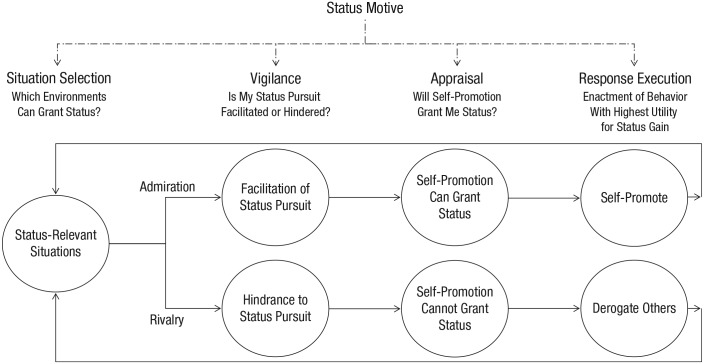
We propose a self-regulation model of grandiose narcissism. This model illustrates an interconnected set of processes through which narcissists (i.e., individuals with relatively high levels of grandiose narcissism) pursue social status in their moment-by-moment transactions with their environments. The model shows that narcissists select situations that afford status. Narcissists vigilantly attend to cues related to the status they and others have in these situations and, on the basis of these perceived cues, appraise whether they can elevate their status or reduce the status of others. Narcissists engage in self-promotion (admiration pathway) or other-derogation (rivalry pathway) in accordance with these appraisals. Each pathway has unique consequences for how narcissists are perceived by others, thus shaping their social status over time. The model demonstrates how narcissism manifests itself as a stable and consistent cluster of behaviors in pursuit of social status and how it develops and maintains itself over time. More broadly, the model might offer useful insights for future process models of other personality traits.
Verified 2026-11-22 · 4 references not checked yet
Overview
CoChat Summary
TL;DR
The paper proposes the SPIN model, a self-regulation framework in which grandiose narcissism is driven by a dominant motive for social status and unfolds through situation selection, vigilance, appraisal, and response execution. It explains when narcissists self-promote (admiration pathway) versus derogate others (rivalry pathway), and how these pathways shape status and likability across status-oriented versus affiliation-oriented settings.
Key findings
- Narcissists are argued to pursue status more strongly, more narrowly (at the cost of affiliation), and more rigidly than nonnarcissists; the status motive is positioned as the core of grandiose narcissism.
- The SPIN sequence is: select public and hierarchical situations; vigilantly attend to status-relevant cues; appraise whether self-promotion or other-derogation can secure status; then execute admiration or rivalry responses.
- Admiration is described as the default pathway when status pursuit seems facilitated; rivalry emerges when self-promotion is blocked or hindered, especially after criticism, humiliation, or being outperformed.
- Consequences depend on setting: in status-oriented settings, admiration and rivalry can aid status; in affiliation-oriented settings, initial status and likability gains tend to erode over time, especially through rivalry. No original numerical results are reported.
Methods
- Theoretical/conceptual article: proposes a process model by integrating evolutionary and motivational accounts of behavior with self-regulatory processing models of narcissism.
- No new empirical sample or primary data analysis; the argument draws on prior theory and findings from existing studies.
- The paper outlines future tests using intensive longitudinal experience-sampling/smartphone methods and experimental or field interventions targeting each proposed process.
Limitations
- The paper states that vigilance and appraisals have not been studied in relation to narcissism, and that the model needs more empirical scrutiny before it can be translated into intervention programs.
- The paper states that not all proposed processes have equal empirical support: status motivation, situation selection, and response execution have more evidence than vigilance and appraisal.
- Evident from the text: the model is conceptual and largely synthesizes indirect or correlational evidence; it focuses on grandiose narcissism and explicitly excludes vulnerable narcissism and narcissistic personality disorder, limiting its scope.
Model-written summary. Check it against the paper before relying on it.
Integrity signals
Registry
Cites
Statistics
Figures
Verification
Claims the paper makes
19 Valid · 5 Not valid · 92 Not checked · 82 Own results and interpretations
The sources with a verdict support this claim; the rest weren’t checked yet, have no full text we could read, or their verdicts aren’t rated yet.
In the paper
“They often demonstrate an increased preference for high-status friends (Jonason & Schmitt, 2012) and trophy partners (Campbell, 1999), perhaps because they can bask in the reflected glory of these people.”
§ The “Why” and “How” of Narcissism: A Process Model of Narcissistic Status Pursuit > The SPIN Model > Situation selection
What the sources say
- Supportedcites Jonason & Schmitt, 2012 matched to “What Have You Done for Me Lately? Friendship-Selection in the Shadow of the Dark Triad Traits” (2012) source
Only the high-status-friends clause is attributed to Jonason and Schmitt; the trophy-partners clause cites a different source. In Results and Discussion, Table 2 reports positive associations between narcissism and social status as a reason for choosing same-sex friends and as a desired friend characteristic (page not available in our copy). (LLM, conf=0.93)
- Not checked — no full text of the sourcecites Campbell, 1999 matched to “Narcissism and romantic attraction.” (1999) source
boostedstates an association- Asserted: passes — The authors put it forward as true.
- Checkable: passes — It can be checked against evidence.
- Load-bearing: passes — The paper’s conclusions depend on it.
- Based: passes — The paper gives a reason why it holds.
- Supported
The cited sources support only part of this claim — read each source’s verdict below.
In the paper
“The gradual emergence of rivalry in affiliative settings can eventually damage narcissists’ relationships with others (Campbell & Campbell, 2009; Sedikides & Campbell, 2017).”
§ The “Why” and “How” of Narcissism: A Process Model of Narcissistic Status Pursuit > The SPIN Model > Social consequences of admiration and rivalry
What the sources say
- Not checked — no full text of the sourcecites Campbell & Campbell, 2009 matched to “On the Self-regulatory Dynamics Created by the Peculiar Benefits and Costs of Narcissism: A Contextual Reinforcement Model and Examination of Leadership” (2009) source
- Partly supportedcites Sedikides & Campbell, 2017 matched to “Narcissistic Force Meets Systemic Resistance: The Energy Clash Model” (2017) sourceExperimental — accuracy not yet measured
In “Antipathy toward Narcissistic Leaders” (page unavailable), the paper says people form increasingly unfavorable impressions of narcissists as they get to know them, supporting the claim that relationships can worsen over time. Its discussion concerns organizational and leadership relationships; it does not identify gradually emerging rivalry in affiliative settings as the cause. (LLM, conf=0.84)
plainstates a possible cause- Asserted: passes — The authors put it forward as true.
- Checkable: passes — It can be checked against evidence.
- Load-bearing: passes — The paper’s conclusions depend on it.
- Based: passes — The paper gives a reason why it holds.
The sources with a verdict support this claim; the rest weren’t checked yet, have no full text we could read, or their verdicts aren’t rated yet.
In the paper
“Narcissists (i.e., individuals with relatively high levels of grandiose narcissism) tend to go out of their way to impress others: They often groom their appearance to grasp others’ attention (Back, Schmukle, & Egloff, 2010), brag about themselves (Buss & Chiodo, 1991), and showcase their talents and abilities in front of others (Wallace & Baumeister, 2002).”
§ The “Why” and “How” of Narcissism: A Process Model of Narcissistic Status Pursuit > Abstract
What the sources say
- Supportedcites Back, Schmukle, & Egloff, 2010 matched to “Why are narcissists so charming at first sight? Decoding the narcissism–popularity link at zero acquaintance.” (2010) source
Back et al. report in “The Popularity of Narcissists at First Sight” (p. 10) that narcissism was related to fancier clothing, supporting the appearance-related point attached to this citation. Their lens-model discussion (p. 3) also describes flashy, neatly kept clothing and dressed-up hairstyles. The separate claims about bragging and showcasing talents cite other sources and are not judged here. (LLM, conf=0.89)
- Not checked — no full text of the sourcecites Buss & Chiodo, 1991 matched to “Narcissistic Acts in Everyday Life” (1991) source
- Not checked — no full text of the sourcecites Wallace & Baumeister, 2002 matched to “The performance of narcissists rises and falls with perceived opportunity for glory.” (2002) source
plainstates an association- Asserted: passes — The authors put it forward as true.
- Checkable: passes — It can be checked against evidence.
- Load-bearing: passes — The paper’s conclusions depend on it.
- Based: passes — The paper gives a reason why it holds.
- Supported
The cited sources support only part of this claim — read each source’s verdict below.
In the paper
“At the same time, narcissists are often combative toward others. In such instances, they are often perceived as confrontational, insulting, belittling, and intimidating (Holtzman, Vazire, & Mehl, 2010; Morf & Rhodewalt, 1993; Reijntjes et al., 2016).”
§ The “Why” and “How” of Narcissism: A Process Model of Narcissistic Status Pursuit > Abstract
What the sources say
- Partly supportedcites Holtzman, Vazire, & Mehl, 2010 matched to “Sounds like a narcissist: Behavioral manifestations of narcissism in everyday life” (2010) sourceExperimental — accuracy not yet measured
The Results (Behavioral Correlates of Narcissism; page not provided) associate narcissism with disagreeable acts, including arguing, swear words, and anger words, supporting the description of combative behavior. The paper does not report that others perceived participants as confrontational, insulting, belittling, or intimidating. (LLM, conf=0.86)
- Not checked — no full text of the sourcecites Morf & Rhodewalt, 1993 matched to “Narcissism and Self-Evaluation Maintenance: Explorations in Object Relations” (1993) source
- Partly supportedcites Reijntjes et al., 2016 matched to “Narcissism, Bullying, and Social Dominance in Youth: A Longitudinal Analysis” (2016) sourceExperimental — accuracy not yet measured
The introductory passage under “Electronic supplementary material” (page unavailable) says youth with narcissistic traits often show aggression and other aversive interpersonal behavior, supporting the general description of combative behavior. The paper does not establish that narcissists are perceived specifically as confrontational, insulting, belittling, and intimidating; its study concerns bullying among youth, with findings that differ by gender (Discussion, page unavailable). (LLM, conf=0.85)
plainstates an association- Asserted: passes — The authors put it forward as true.
- Checkable: passes — It can be checked against evidence.
- Load-bearing: unclear — It is unclear whether the paper’s conclusions depend on it.
- Based: passes — The paper gives a reason why it holds.
- Partly supported
The cited sources support only part of this claim — read each source’s verdict below.
In the paper
“Narcissists might also try to stand out through their communication style, which often involves charming facial expressions, humor, as well as expressive and confident gestures that reflect their extraversion and self-confidence (Back et al., 2010; Paulhus, 1998; Tracy, Cheng, Martens, & Robins, 2011; Zeigler-Hill, Vrabel, et al., 2018).”
§ The “Why” and “How” of Narcissism: A Process Model of Narcissistic Status Pursuit > The SPIN Model > Response execution
What the sources say
- Partly supportedcites Back et al., 2010 matched to “Why are narcissists so charming at first sight? Decoding the narcissism–popularity link at zero acquaintance.” (2010) sourceExperimental — accuracy not yet measured
The Results (p. 7) link narcissists’ initial popularity to charming facial expressions, verbal humor, and self-assured body movements; the lens-model discussion (p. 3) also describes a desire to present themselves. The paper does not establish that their gestures are expressive or that those gestures reflect extraversion, and its findings concern first impressions rather than communication style generally. (LLM, conf=0.82)
- Not checked — no full text of the sourcecites Paulhus, 1998 matched to “Interpersonal and intrapsychic adaptiveness of trait self enhancement: a mixed blessing?” (1998) source
- Not checked — no full text of the sourcecites Tracy, Cheng, Martens, & Robins, 2011 matched to “The Emotional Dynamics of Narcissism: Inflated by Pride, Deflated by Shame” (2011) source
hedgedstates a cause- Asserted: passes — The authors put it forward as true.
- Checkable: passes — It can be checked against evidence.
- Load-bearing: unclear — It is unclear whether the paper’s conclusions depend on it.
- Based: passes — The paper gives a reason why it holds.
- Partly supported
129 more claims · 11 with their cited sources checked
Create a free account to see all 198 claims and to verify the 26 references still open.
- It may state two separate claims as one. 47
- Probably not a substantial claim. 20
Self-check
Percentages, sums and reported differences re-computed from the paper’s own numbers.
Each contradiction between two passages listed here was confirmed by an independent check.
Rated minor: it would not touch a result — a value no result rests on, a p-value that stays on the same side of the significance level, or a conflict that is clerical, resolved elsewhere in the paper, or outside its own findings.
In the paper
§ The “Why” and “How” of Narcissism: A Process Model of Narcissistic Status Pursuit > References
“Krizan Z. Bushman B. J. (2011). Better than my loved ones: Social comparison tendencies among narcissists. Personality and Individual Differences, 50, 212– 216. doi: 10.1016/j.paid.2010.09.031”
§ The “Why” and “How” of Narcissism: A Process Model of Narcissistic Status Pursuit > References
“Krizan Z. Herlache A. D. (2018). The narcissism spectrum model: A synthetic view of narcissistic personality. Personality and Social Psychology Review, 22, 3– 31. doi: 10.1016/j.paid.2010.09.031”
Rated minor: it would not touch a result — a value no result rests on, a p-value that stays on the same side of the significance level, or a conflict that is clerical, resolved elsewhere in the paper, or outside its own findings.
In the paper
§ The “Why” and “How” of Narcissism: A Process Model of Narcissistic Status Pursuit > References
“Back M. D. Küfner A. C. P. Leckelt M. (2018). Early impressions of grandiose narcissists: A dual-pathway perspective. In Hermann A. D. Brunell A. B. Foster J. D. (Eds.), The handbook of trait narcissism: Key advances, research methods, and controversies (pp. 309– 316).”
§ The “Why” and “How” of Narcissism: A Process Model of Narcissistic Status Pursuit > References
“Konrath S. Tian Y. (2018). Narcissism and prosocial behavior. In Hermann A. D. Brunell A. B. Foster J. D. (Eds.), The handbook of trait narcissism: Key advances, research methods, and controversies (pp. 309– 316).”
Citations
Cites
Diagnostic and Statistical Manual of Mental Disorders
American Psychiatric Association (2013) · doi:10.1176/appi.books.9780890425596 · Cited by 116,369
Society and the Adolescent Self-Image
Rosenberg, M. (1965) · doi:10.1515/9781400876136 · Cited by 30,126
The need to belong: Desire for interpersonal attachments as a fundamental human motivation.
Baumeister, R. F., & Leary, M. R. (1995) · Psychological Bulletin · doi:10.1037//0033-2909.117.3.497 · Cited by 23,245 · cited 1×
“Some individuals want status as long as it does not go against their motive to get along well with others (i.e., affiliation motive; Baumeister & Leary, 1995; McClelland, 1987), whereas other individuals want status even at the cost of getting along well with others.”
BackgroundThe emerging field of emotion regulation: an integrative review
Gross, J. J. (1998) · Review of General Psychology · doi:10.1037/1089-2680.2.3.271 · Cited by 9,916 · cited 4×
“In so doing, we build on core self-regulation processes (e.g., Baumeister, Schmeichel, & Vohs, 2007; Denissen et al., 2013; Geukes, van Zalk, & Back, 2018; Gross, 1998): situation selection,1 attention (which we term vigilance for reasons outlined below), appraisal, and response execution.”
InfluentialA social-cognitive approach to motivation and personality.
Dweck, C. S., & Leggett, E. L. (1988) · Psychological Review · doi:10.1037/0033-295x.95.2.256 · Cited by 9,745 · cited 1×
“For example, interventions could teach individuals to reappraise critical feed-back not as a sign of their incompetence but as a set of suggestions that indicate how to improve their competence (for a similar rationale, see Dweck & Leggett, 1988; Yeager, Trzesniewski, & Dweck, 2013).”
Crick, N. R., & Dodge, K. A. (1994) · Psychological Bulletin · doi:10.1037/0033-2909.115.1.74 · Cited by 5,510 · cited 2×
“Individuals are assumed to be especially vigilant toward environmental cues that convey information about how much environments facilitate or hinder their goal pursuit (Crick & Dodge, 1994).”
BackgroundSocial psychology: handbook of basic principles
(2008) · Choice Reviews Online · doi:10.5860/choice.45-3496 · Cited by 5,473
Taking time seriously: A theory of socioemotional selectivity.
Carstensen, L. L., Isaacowitz, D. M., & Charles, S. T. (1999) · American Psychologist · doi:10.1037//0003-066x.54.3.165 · Cited by 5,377
The dark triad of personality: Narcissism, Machiavellianism, and psychopathy
Paulhus, D. L., & Williams, K. M. (2002) · Journal of Research in Personality · doi:10.1016/s0092-6566(02)00505-6 · Cited by 5,265 · cited 1×
“Some scholars have proposed that narcissism belongs to a broader group of so-called dark traits (including Machiavellianism and psychopathy; Paulhus & Williams, 2002) that represent a tendency to “maximize one’s own utility” while “disregarding, accepting, or malevolently provoking disutility for…”
BackgroundCoping theory and research: past, present, and future
Lazarus, R. S. (1993) · Psychosomatic Medicine · doi:10.1097/00006842-199305000-00002 · Cited by 3,253 · cited 1×
“Appraisals therefore direct the selection of goal-fulfilling behaviors (Crick & Dodge, 1994; Lazarus, 1993) in response to cues indicating that a situation is relevant to goal fulfillment.”
Research works printed but not linked: 6
- Back M. D. Küfner A. C. P. Leckelt M. (2018). Early impressions of grandiose narcissists: A dual-pathway perspective. In Hermann A. D. Brunell A. B. Foster J. D. (Eds.), The handbook of trait narcissism: Key advances, research methods, and controversies (pp. 309– 316). New York, NY: Springer. doi: 10.1007/978-3-319-92171-6_6 · DOI · Paper page
- Campbell W. K. Brunell A. B. Finkel E. J. (2006). Narcissism, interpersonal self-regulation, and romantic relationships: An agency model approach. In Vohs K. D. Finkel E. J. (Eds.), Self and relationships (pp. 57– 83). New York, NY: Guilford Press.
- Campbell W. K. Foster J. D. (2007). The narcissistic self: Background, an extended agency model, and ongoing controversies. In Sedikides C. Spencer S. J. (Eds.), The self (pp. 115– 138). New York, NY: Psychology Press.
- Erikson E. H. (1959). Identity and the life cycle: Selected papers. Psychological Issues, 1, 1– 171.
- Freud S. (1955). Libidinal types. London, England: Hogarth Press. (Original work published 1931)
- Reich W. (1949). Character analysis (3rd ed.), (T. P. Wolfe, Trans.). New York, NY: Orgone Institute Press. (Original work published 1933)
Cited by
Items 201–300 of 320
Gauglitz, I. K. (2021) · doi:10.20378/irb-54906 · Cited by 3
Kroencke, L., Kuper, N., Mota, S., Utesch, K., Zeigler‐Hill, V., & Back, M. D. (2023) · doi:10.31234/osf.io/sz2jh · Cited by 2
Self-citationOpenness to being gossiped about: understanding gossip from the target’s perspective
Hales, A. H., Yucel, M., & Rudert, S. C. (2025) · Self and Identity · doi:10.1080/15298868.2025.2467737 · Cited by 3
“This is consistent with conceptualizations of narcissism as a trait that motivates a desire for notoriety and special treatment (Grapsas et al., 2020) and fi ndings that indicate a higher sensitivity of narcissists to clues indicating ostracism, i.e., not being talked about (Büttner et al., 2025).”
Liu, X., Lai, I. K. W., Zhang, Y., Lu, Y. L., & Wang, X. (2025) · Asia Pacific Journal of Marketing and Logistics · doi:10.1108/apjml-11-2024-1723 · Cited by 2
Zhao, J., & Feng, J. (2025) · Personality and Individual Differences · doi:10.1016/j.paid.2025.113352 · Cited by 1
Ortaöğrenim Öğrencilerinde Akran Zorbalığı İçin Dini Başa Çıkma Destekli Bir Program Önerisi
Çinici, M., Tuysuz, S., Akyüz, Ş., Kayserili, İ., & Bire, M. (2025) · Türk Din Psikolojisi Dergisi · doi:10.59379/tdpd.1581335 · Cited by 1
Park, G., Yong, J. C., & Lim, B. (2025) · Personality and Social Psychology Bulletin · doi:10.1177/01461672251345514 · Cited by 1
“…that narcissistic individuals’ desire to demonstrate superiority makes them highly attentive to and eager for opportunities to elevate their status (Grapsas et al., 2019), causing them to read into situations as being competitive and experience motivation from competitive arousal (Elliot &…”
Narcissism From Every Angle: An Interpersonal Analysis of Narcissism in Young Adults
Edershile, E. A., Girard, J. M., Woods, W. C., Williams, T. F., Simms, L. J., & Wright, A. G. C. (2025) · Assessment · doi:10.1177/10731911251356150 · Cited by 1
“The majority of work on narcissism overwhelmingly suggests that a dominant-oriented interpersonal style is a key to the construct (Grapsas et al., 2020, 2022; Zeigler-Hill et al., 2018).”
Schneider, S., Kornberger, S., Aßmuth, A., & Mokros, A. (2025) · Behavioral Sciences · doi:10.3390/bs15091214 · Cited by 4
“Setting high standards for others might also represent a strategy to consolidate a superior social status, which has been suggested as an important motive in GN (Grapsas et al., 2020).”
Fanti, E., Sarno, M. D., & Pierro, R. D. (2025) · Current Psychology · doi:10.1007/s12144-025-08349-y · Cited by 1
The longitudinal interplay between life events and socially aversive traits
Bromme, L., & Wetzel, E. (2025) · European Journal of Personality · doi:10.1177/08902070251360036 · Cited by 1
“Grandiosenarcissism as a personality trait is de fi ned by the belief in one ’ s grandiosity and superiority and the need to maintain this grandiose self-image (e.g., Grapsas et al., 2020).”
Malik, I., & Jain, H. C. (2025) · Review of Marketing Science · doi:10.1515/roms-2025-0040 · Cited by 2
“Narcissistic individuals typically exhibit an in fl ated self-view, a heightened need for admiration, and a pronounced sense of entitlement (Grapsas et al. 2019).”
How do narcissistic CEOs decide their firms’ debt maturity? An analysis based on the SPIN model
Liu, X., & Du, C. (2025) · Journal of Contemporary Accounting & Economics · doi:10.1016/j.jcae.2025.100516 · Cited by 1
Serenko, A. (2025) · Journal of Knowledge Management · doi:10.1108/jkm-05-2025-0745 · Cited by 3
Hou, R., Li, S., Miller, J. D., Lynam, D. R., & Xiang, Y. (2025) · Journal of Personality · doi:10.1111/jopy.70044 · Cited by 2
The Mediating Role of Narcissistic Attitudes in Exercise Addiction and Self-Esteem Among Referees
Dereceli, Ç., & Ermiş, S. A. (2025) · Research in Sport Education and Sciences · doi:10.62425/rses.1669200 · Cited by 1
Defense mechanisms and social mentalities in grandiose narcissism: an empirical investigation
Tanzilli, A., Liotti, M., Guarino, D., Buglio, G. L., Dentale, F., Vecchione, M., & Lingiardi, V. (2025) · Research in Psychotherapy Psychopathology Process and Outcome · doi:10.4081/ripppo.2025.882 · Cited by 3
“Narcissistic rivalry was associated with poorer defensive functioning (cf., Grapsas et al. , 2020; Grove et al. , 2019).”
Bright systems, dark traits: High-performance work systems amplify narcissistic managers' derailment
Agarwal, P., & Farndale, E. (2026) · Personality and Individual Differences · doi:10.1016/j.paid.2026.113700 · Cited by 2
Akaighe, G. O., Oyetunde, K., Adebiyi, S. O., & George, O. J. (2026) · Employee Responsibilities and Rights Journal · doi:10.1007/s10672-026-09573-9 · Cited by 2
Ahmed, N., Ahmed, M., Gillipsie, B., Sharaf, F., Salah, K., Eissa, L., Abdrabou, R., Essayed, R., Yasser, R., Zaky, Y., et al. (2026) · BMC Psychology · doi:10.1186/s40359-026-04219-9 · Cited by 2
“In contrast, women may be more likely to internalize per-fectionistic standards, resulting in greater self-critical tendencies [48–51].”
Zdolska, M., Trzcińska, M. J., Berg, A., Kirszling, M. H., & Sawicki, A. J. (2026) · Personality and Individual Differences · doi:10.1016/j.paid.2026.113810 · Cited by 1
Avi Besser, A., & Zeigler‐Hill, V. (2026) · International Journal of Environmental Research and Public Health · doi:10.3390/ijerph23050577 · Cited by 1
“…restrictions of freedom to motivations to restore autonomy through oppositional or controlling responses, e.g., [22], and in process models of narcissistic self-regulation and status pursuit that differentiate between recognition-oriented versus defensive status-protective responding [1,2].”
InfluentialGauglitz, I. K., Held, M. J., Schütz, M., & Schütz, A. (2026) · British Journal of Management · doi:10.1111/1467-8551.70071 · Cited by 1
Unveiling the Dynamics of Narcissistic Fluctuations and the Affective Cycles in Narcissism
Rogoza, R., Krammer, G., Baran, L. N., Jauk, E., Flakus, M., Pierro, R. D., Sarno, M. D., Stapp, E. K., Zajenkowski, M., Dufner, M., et al. (2026) · European Journal of Personality · doi:10.1177/08902070261448061 · Cited by 2
“Regarding antagonistic narcissism, we assumed that initiation of the antagonistic narcissism mode is a reaction to speci fi c situational factors (e.g., a hindrance to status pursuit; Grapsas et al., 2020) aimed at restoring narcissistic self-esteem.”
Ratzsch, J., Rafflenbeul, E., Meinert, S., Flinkenflügel, K., Goltermann, J., Kraus, A., Kircher, T. T. J., Nenadić, I., Straube, B., Alexander, N., et al. (2026) · Child Abuse & Neglect · doi:10.1016/j.chiabu.2026.108227 · Cited by 1
Self-citationCommunal narcissism, self-motives, and work effort
Prundeanu, O., & Popușoi, S. A. (2022) · Psihologia Resurselor Umane · doi:10.24837/pru.v20i2.508 · Cited by 3
Climb to the top! An examination of how and when leader narcissism promotes workplace status
Chen, C., Zhang, M., Hu, X., Xiong, T., & Zhang, Y. (2023) · Current Psychology · doi:10.1007/s12144-023-05141-8 · Cited by 3
“…personal goals, including recognition from others (Zhang et al., 2020), realization of achievement (Rovelli & Curnis, 2021), improvement of status (Grapsas et al., 2020; Zeigler-Hill et al., 2019), etc. Notably, narcissists pay too much attention to their own interests (especially grand…”
InfluentialWhen do gossip receivers assess negative gossip as justifiable? A goal framing approach
Martinescu, E. (2024) · Acta Psychologica · doi:10.1016/j.actpsy.2024.104327 · Cited by 1
Komáromy, D., Rooduijn, M., & Schumacher, G. (2024) · Frontiers in Political Science · doi:10.3389/fpos.2024.1401758 · Cited by 3
Do Narcissist Phubs or Get Phubbed? Analyzing the Role of Motivational Systems
Sudha, K. S., Shahnawaz, M. G., & Hasan, Z. (2024) · The Journal of Psychology · doi:10.1080/00223980.2024.2363538 · Cited by 1
“Simultaneously, due to their long, unrealistic, self-fulfilling talks (Grapsas et al., 2020; Braun, 2017), they might get phubbed as well.”
Narcissism and Risk-Taking: The Roles of Dangerous and Competitive Social Worldviews
Dehaghi, A. M. B., & Zeigler‐Hill, V. (2021) · Psihologijske teme · doi:10.31820/pt.30.3.11 · Cited by 3
A Homeostatic Perspective on Narcissistic Personality Dynamics
Zeigler‐Hill, V. (2021) · Psychological Inquiry · doi:10.1080/1047840x.2021.2007700 · Cited by 1
Innovation in Churches: A Theoretical FrameworkPreprint
Dunaetz, D. R. (2021) · SSRN Electronic Journal · doi:10.31219/osf.io/wuc2k · Cited by 1
Grosz, M. P., Hartmann, I., Dufner, M., et al. (2021) · doi:10.31234/osf.io/phj2c · Cited by 1
Self-citationEavesdropping on Interpersonal Behavior in Everyday LifePreprint
Sun, J. (2020) · Thesis Commons (OSF Preprints) · doi:10.31237/osf.io/aj94u · Cited by 1
Sękowski, M., Piotrowski, J. P., Nowak, B., & Żemojtel-Piotrowska, M. A. (2024) · SSRN Electronic Journal · doi:10.2139/ssrn.4865757 · Cited by 1
Rebels without a cause: Collective narcissism and political contrarianism
Federico, C. M., de Zavala, A. G., & Baran, T. (2026) · Political Psychology · doi:10.1111/pops.70114 · Cited by 1
“…by high self-esteem, self-entitlement, vanity, and exploitativeness) and vulnerable narcissism (characterized by shame, frustration, detachment from others, defensiveness, and passive re-sentment, Grapsas et al., 2020; Krizan & Herlache, 2018; Sedikides, 2021; see also Golec de Zavala, 2023).”
REMOVED DUE TO POLICY VIOLATIONSPreprint
Vos, L. M. W., Frowijn, I., & van Scheppingen, M. A. (2021) · PsyArXiv (OSF Preprints) · doi:10.31234/osf.io/ag65h
Vize, C. E., & Lynam, D. R. (2020) · PsyArXiv (OSF Preprints) · doi:10.31234/osf.io/w5tvh
Zeigler‐Hill, V., & Jordan, C. (2013) · Oxford University Press eBooks · doi:10.1093/obo/9780199828340-0113 · Cited by 2
Bragger, J. D., Alonso, N. A., Templeman, A., Tosto, P., Coulter, A., Steinhour, B., Williams, N., Sobel, D., & Lakusta, L. (2022) · Springer eBooks · doi:10.1007/978-3-030-69802-7_10-1 · Cited by 1
Li, Z. (2023) · Advances in Psychology · doi:10.12677/ap.2023.132050
Too Beautiful to be Fake: Attractive Faces are Less Likely to be Judged as Artificially GeneratedPreprint
Makowski, D., Te, A., Neves, A. B., et al. (2023) · doi:10.31234/osf.io/qbvy7
Why, when, and how leaders' narcissistic rivalry relates to destructive leadership
Fehn, T. (2023) · doi:10.20378/irb-53256 · Cited by 1
Showing True Colours: EMA Case Descriptions of Narcissistic States
Freund, V. L., Peeters, F. P. M. L., & Lobbestael, J. (2023) · Journal of Personality Assessment · doi:10.1080/00223891.2023.2244074
“Alike personality (disorders), narcissism is largely thought to be inflexible over time (e.g., Cobb-Clark & Schurer, 2012; Grapsas et al., 2020), with diagnostic criteria stating that the “pattern is stable” across time and situations (American Psychiatric Association, 2022, p. 735).”
BackgroundInfluence of Narcissism on Gen Z’s Life Satisfaction
Nguyen Ngoc Dan Thanh, T. Y. H., & Thanh, D. (2023) · Hong Kong Journal of Social Sciences · doi:10.55463/hkjss.issn.1021-3619.61.65
La Relación entre la Mentalidad Conspirativa y los Rasgos Narcisistas
Castillo, M. A. A., Ramírez-Oliver, J. A., Peña-Medina, Y. O., & Sánchez-Vincitore, L. V. (2024) · Revista Caribeña de Psicología · doi:10.37226/rcp.v8i1.8101
Etiologija patološkog narcizma
Sveučilište u Zagrebu, F. F., & Pavlić, M. (2024) · Socijalna psihijatrija · doi:10.24869/spsih.2023.291
Nudging customer-centricity: A case for entrepreneur’s perspective-taking
Sapru, A. (2023) · doi:10.31274/td-20240329-551 · Cited by 1
Do Narcissists Play Solo? Differences in Self-Efficacy and Narcissism Among Band and Solo Musicians
Molińska, W., Rajchert, J. M., & Bodecka-Zych, M. (2024) · Roczniki Psychologiczne · doi:10.18290/rpsych2024.0005
“Previous research has shown that narcissistic people select situations that afford them status (Grapsas et al., 2020).”
BackgroundWhen and Why Do Individuals High in Narcissistic Rivalry Attain Social Status?Preprint
Grosz, M. P., Thielmann, I., Krabbe, H., et al. (2024) · doi:10.31234/osf.io/x2rsn
Self-citationUnderstanding the Relationship Between Narcissism and Political Orientations in College-Aged Adults
Richards, S. (2024) · Digital USD (University of San Diego) · doi:10.22371/02.2024.001
Kudapa, D., Klaver, S. J., Peterson, R. S., Burr, E. K., Leon, A. N. D., Leary, A. V., Maynard, M. H., Hayden, E. R., Kramer, M. P., & Dvorak, R. D. (2024) · Substance Use & Misuse · doi:10.1080/10826084.2024.2360108
“Previous research has indicated that higher levels of trait narcissism are associated with a stronger desire to gain/maintain high social status (Grapsas et al., 2019).”
BackgroundPringle, V., Tissera, H., Elsaadawy, N., et al. (2024) · doi:10.31234/osf.io/vxejq
Falcons or Pigeons? Grandiose Narcissism, Personal Values, and Attitudes Towards War and PeacePreprint
Kowalski, E., Brud, P. P., & Żemojtel-Piotrowska, M. A. (2024) · SSRN Electronic Journal · doi:10.2139/ssrn.4897672
Nevicka, B., van den Hee, S. M., van Loenen, M., et al. (2024) · doi:10.31234/osf.io/67fqx
Self-citationBentley, J. R., Treadway, D. C., Seitz, S. R., & Williams, L. V. (2024) · Journal of Business and Psychology · doi:10.1007/s10869-024-09979-y · Cited by 3
“As observed by Grapsas et al. (2020), grandiose narcissists are hypervigilant to signals of their status in a social environment and their likelihood of improving it.”
A computational framework to study the etiology of narcissisimPreprint
Löschner, D. M., Schoemann, M., Jauk, E., Herchenhahn, L., Schwöbel, S., Kanske, P., & Scherbaum, S. (2024) · doi:10.31234/osf.io/4mhva
Grandiose or vulnerable? Narcissism subtype differentiates materialistic pursuit
Jha, A., Sekhar, S., & Uppal, N. (2024) · Personality and Individual Differences · doi:10.1016/j.paid.2024.112896 · Cited by 4
Nigerian Exceptionalism: Identity and Diasporan Success in the US
Apata, G. O. (2024) · Diaspora Studies · doi:10.1163/09763457-bja10132 · Cited by 2
Zuiker, A. A. M., Born, M. P., & Strien, J. W. V. (2025) · Social Psychology of Education · doi:10.1007/s11218-024-09958-4
A computational framework to study the etiology of grandiose narcissism
Löschner, D. M., Schoemann, M., Jauk, E., Herchenhahn, L., Schwöbel, S., Kanske, P., & Scherbaum, S. (2025) · Scientific Reports · doi:10.1038/s41598-025-90109-w · Cited by 1
“There is strong evidence for the assumption that narcissistic agency is associated with admiration as a self-regulation strategy, while antagonism is related to rivalry 53,54 .”
Narcissism and Anti-Immigrant Attitudes: A Tale of Pride and Prejudice?
Zeigler‐Hill, V., Toma, A., Thomas, E., & Besser, A. (2025) · Behavioral Sciences · doi:10.3390/bs15040451 · Cited by 1
“Building on the principle that personality traits are linked with individual differences in motivation (Denissen & Penke, 2008), theoretical frameworks suggest that narcissism may be fundamentally driven by the pursuit of status (Grapsas et al., 2020; Zeigler-Hill et al., 2018, 2019).”
Wang, Y., Hawk, S. T., & Wong, N. (2025) · Aggressive Behavior · doi:10.1002/ab.70032
“Individuals with narcissistic traits may be more inclined to adopt aggressive approaches to protect their perceived social standing, a tendency that carries over to novel social exchanges (Grapsas et al. 2020).”
InfluentialNarcissism on Venus and Mars: The Impact of Sex on Types of Narcissistic Behaviors
Nogalski, S., & Rogoza, R. (2025) · Edukacja · doi:10.24131/3724.250103
Lynch, J., Giacomin, M., Jordan, C. H., et al. (2025) · SSRN Electronic Journal · doi:10.2139/ssrn.5269443
Lee, H. Y., Gürel, Ç., Overbeek, G. J., & Brummelman, E. (2025) · Development and Psychopathology · doi:10.1017/s0954579425000331 · Cited by 2
Self-citationNarcissism and the Appraisal of Status-Related Social CuesPreprint
Atkinson, B. E., & Heerey, E. A. (2025) · SSRN Electronic Journal · doi:10.2139/ssrn.5274327
Enhancing ethical hiring practices: a remedy for academic narcissism
Kasaeiyan, R. (2025) · Mental Wellness · doi:10.4081/mw.2025.27
“1,27,28”
A Contemporary Integrative Interpersonal Theory Formulation of Self and Social Pathology
Wright, A. G. C., & Nielsen, S. R. (2025) · Cambridge University Press eBooks · doi:10.1017/9781009445955.007 · Cited by 2
Jak mnie widzą, tak mnie piszą. Ocena społecznej percepcji narcyzmu wśród adolescentów
Krakowska, J., & Rogoza, R. (2025) · Edukacja · doi:10.24131/3724.250202
Silver tongues, plastic pens: modality-dependent persuasiveness in narcissists
Foster, J. D., Leunissen, J. M., Nevicka, B., & Sedikides, C. (2025) · Journal of Research in Personality · doi:10.1016/j.jrp.2025.104649
Chen, J., Nevicka, B., Homan, A. C., & Kleef, G. A. V. (2025) · Journal of Research in Personality · doi:10.1016/j.jrp.2025.104653
Can narcissistic managers fake that they care?
Hamstra, M. R. W. (2021) · The Conversation · doi:10.64628/aak.fwywxfhh9
Lynch, J., Giacomin, M., Jordan, C. H., & Benson, A. J. (2025) · Journal of Research in Personality · doi:10.1016/j.jrp.2025.104664
Narcissistic Leadership: A Global Threat to a Sustainable World
Mankelwicz, J. M., & Milligan, M. (2025) · Emerald Group Publishing Limited eBooks · doi:10.1108/978-1-83662-646-620251023 · Cited by 1
Narcissism and the appraisal of status-related social cues
Atkinson, B. E., & Heerey, E. A. (2025) · Journal of Research in Personality · doi:10.1016/j.jrp.2025.104671
de Zavala, A. G. (2025) · Advances in experimental social psychology · doi:10.1016/bs.aesp.2025.10.001 · Cited by 1
Differentiating narcissism modes in everyday life: The role of situation perception
Rogoza, R., Leniarska, M., Baran, L. N., Gorgol, J., Bocianowska, Z., & Wiśniowska, K. (2025) · European Journal of Personality · doi:10.1177/08902070251412097 · Cited by 1
“As such, the antagonistic facet is considered a reactive mode that is triggered under speci fi c situations (Back, 2018; Grapsas et al., 2020; Rogoza, Cieciuch et al., 2022).”
InfluentialHall, B. T., Hart, W., Lambert, J. T., & Roberts, B. C. (2025) · The Journal of Social Psychology · doi:10.1080/00224545.2025.2608306
“…narcissism is uniquely related to bold attempts to get attention or signal grandness (Back, 2018; Back et al., 2013; Bishop & Lane, 2002; Grapsas et al., 2020; Miller et al., 2017; Samuel et al., 2012); the latter effect seems consistent with the view that only grandiose narcissistic…”
Barrios, L., González-Bravo, C., Alvarez-Mon, M., Buján, J., Ortega, M. A., & de la Torre, B. (2025) · Discover Psychology · doi:10.1007/s44202-025-00517-2 · Cited by 1
Živković-Rančić, Ž. (2025) · Sinteze · doi:10.5937/sinteze14-58434
Meng, Y., & Zhang, J. (2026) · Journal of Aggression Maltreatment & Trauma · doi:10.1080/10926771.2026.2615873
“The status pursuit model of narcissism suggested that individuals high in narcissism sought elevated social status, often engaging in self-enhancement strategies such as frequent online self-promotion (Grapsas et al., 2019).”
Ribotta, B., Hilpert, P., & Lemaître, B. (2026) · Humanities and Social Sciences Communications · doi:10.1057/s41599-026-06519-2
“Narcissism has been linked to heightened motivation for status, particularly in contexts involving public exposure, where traits like differentiation and persuasion play a role in gaining recognition (Grapsas et al., 2020; Lebuda et al., 2021; Lemaitre, 2019).”
Bruchmann, K., Kothuri, S., Qualitza, A., et al. (2026) · SSRN Electronic Journal · doi:10.2139/ssrn.6207150
Where does awe lead self? Explanation of the source behind the positive significance of awe
Li, Z. (2026) · Cognition & Emotion · doi:10.1080/02699931.2026.2630413
Worldviews Justification of Intergroup Conflict
Gąsienica-Szostak, M., & Nowakowska, I. (2026) · Springer eBooks · doi:10.1007/978-3-031-38971-9_971-1
Liu, Y., Liu, H., Wang, X., & Park, H. (2026) · Frontiers in Psychology · doi:10.3389/fpsyg.2026.1730577 · Cited by 1
“Such interpretations should be particularly pronounced when the team is composed of members who are highly attuned to status and external validation (e.g., recognition and admiration), as emphasized in the grandiose narcissism literature (Grapsas et al., 2020; Morf and Rhodewalt, 2001).”
Narcissism Runs in Families Due to Genetics: An Extended Twin Family Analysis
Back, M. D., Instinske, J., Rohm, T., Deppe, M., & Kandler, C. (2026) · Social Psychological and Personality Science · doi:10.1177/19485506261429556
Self-citationConceptualizing and measuring power addiction: scale development and validation
ŞİMŞEK, S. E., Kökalan, Ö., & Çetin, M. (2026) · Strategy and Leadership · doi:10.1108/sl-10-2025-0358
Narcissism is not one thing: Designing HR practices to channel admiration, not rivalry
Harms, P. D., & Fezzey, T. N. A. (2026) · Industrial and Organizational Psychology · doi:10.1017/iop.2025.10064
“Specifically, admiration maps onto SCT ’ s “ identity-safe ” conditions that encourage leaders to seek esteem through prosocial, group-serving behaviors (Grapsas et al., 2020).”
InfluentialBocianowska, Z., Woźniak, W., & Rogoza, R. (2026) · Personality and Individual Differences · doi:10.1016/j.paid.2026.113812
Star personalities on the winners' podium: Exploring dysfunctional personalities in elite athletes
Hauw, D., von Roten, F. C., Rolland, J., & Fruyt, F. D. (2026) · Acta Psychologica · doi:10.1016/j.actpsy.2026.106890 · Cited by 1
How Does Narcissism Relate to Popularity and Likeability in an Adolescent Residential Setting?
Barry, C. T., Yoshizumi, A. C., Kim, H. W., & Yedinak, P. (2026) · Journal of Social and Personal Relationships · doi:10.1177/02654075261444785
“…issue has not been specifically addressed for vulnerable narcissism, grandiose narcissism is linked to choosing situations that will afford opportunities for social status relative to others, either through elevation of their own status or diminishing the status of others (Grapsas et al., 2020).”
Narcissism as an Adaptive Trait for Successful Migration
O’Rourke, L., McDermott, R., & Hatemi, P. (2026) · Evolutionary Psychology · doi:10.1177/14747049261445049
Gauglitz, I. K., Schyns, B., & Klasmeier, K. N. (2026) · European Journal of Work and Organizational Psychology · doi:10.1080/1359432x.2026.2664209 · Cited by 1
Jordan, C. H., & Mahadevan, N. (2026) · Journal of Personality · doi:10.1111/jopy.70081
Aydin, G., Başoğlu, Ö. E., Karababa, B., Ünver, O., Yavuz, G., & Aydin, G. (2026) · Frontiers in Psychology · doi:10.3389/fpsyg.2026.1773459
Metadata
- Authors
- Grapsas, S., Brummelman, E., Back, M. D., & Denissen, J. J. A.
- Affiliations
- Tilburg University (NL)
- University of Amsterdam (NL)
- University of Münster (DE)
- Corresponding author
- Grapsas, Stathis
- Venue
- Perspectives on Psychological Science
- Publisher
- SAGE Publications
- Published
- 2019-12-05
- Volume
- 15
- Issue
- 1
- Pages
- 150-172
- ISSN
- 1745-6916 (ISSN-L)
- 1745-6924
- PMC
- PMC6970445
- OpenAlex
- W2992965847
- Cited by
- 312
- References
- 213
- Citations by year
- 2026: 49 · 2025: 56 · 2024: 51 · 2023: 44 · 2022: 43 · 2021: 42 · 2020: 22 · 2019: 2
- FWCI
- 31.80
- Type
- journal article
- Language
- en
- Open access
- hybrid
- doi.org
- Licence
- cc-by-nc
- creativecommons.org/licenses/by-nc/4.0/ (unspecified)
- journals.sagepub.com/page/policies/text-and-data-mining-license (tdm)
- Locations
- Perspectives on Psychological Science (publishedVersion, cc-by-nc)
- Europe PMC (PubMed Central) (publishedVersion, cc-by-nc)
- PubMed Central (publishedVersion, cc-by-nc)
- Research portal (Tilburg University) (publishedVersion, cc-by-nc)
- PubMed (publishedVersion)
- Data Archiving and Networked Services (DANS) (submittedVersion, cc-by-nc)
- UvA-DARE (University of Amsterdam) (submittedVersion, cc-by-nc)
- Utrecht University Repository (Utrecht University) (submittedVersion, other-oa)
- Data Archiving and Networked Services (DANS) (submittedVersion, other-oa)
- Topics
- Social Sciences › Psychology › Clinical Psychology › Personality Traits and Psychology
- Social Sciences › Psychology › Social Psychology › Emotions and Moral Behavior
- Social Sciences › Sociology and Political Science › Social Power and Status Dynamics
- Keywords
- grandiose narcissism, self-regulation, self-promotion, admiration, rivalry, status signals, status perception, process model, personality development
- MeSH terms
- Adult, Humans, Models, Psychological, Motivation, Narcissism, Personality, Social Behavior, Psychological Distance
About these checks
Registry, retraction, Cites and statistics results are computed, not judged, with one exception: a printed reference that no index lists is read once by a model before it counts as a citation error. Claims are extracted by a model and kept only when their quote appears verbatim in the text; each cited source is then checked, with a model’s help, for whether it says what the claim relies on. Those verdicts can be wrong — read the claim’s quote and the cited source before relying on one.
The claim verdicts this report counts are experimental: their accuracy is not yet measured.
A language model drew the claims from the paper on 2026-10-10, under version 3 of the claim definition (model deepseek-v4.1-flash, prompt extract-v3).
A second model labelled each claim on 2026-10-10 (model jev-1.13-20260917, definition revision gold-guideline-v0.2).
Cited sources are checked with a language model’s help (gpt-6-sol).
Statistics and arithmetic are recomputed, not judged.
Confidence bands are shown only for fields calibrated on our annotated test set. None is calibrated yet, so no band is shown.
What counts as a claim ›How we measure confidence ›How we check this ›
Are you an author, or do you see a problem with this page? Request a review
Data sources
Bibliographic data: Semantic Scholar, OpenAlex, Crossref.
Contains information from the Semantic Scholar Academic Graph Datasets, made available under the ODC Attribution License (ODC-BY 1.0).
Semantic Scholar’s data is described in: Kinney, R., et al. (2023). The Semantic Scholar Open Data Platform. arXiv:2301.10140.
