

The "Why" and "How" of Narcissism: A Process Model of Narcissistic Status Pursuit
Open accessThe DOI matches its Crossref record; 206 of the 213 references it cites were found in a registry or an index, and 4 are not checked yet; 27 of the 201 sources its claims cite were checked for support.
Abstract
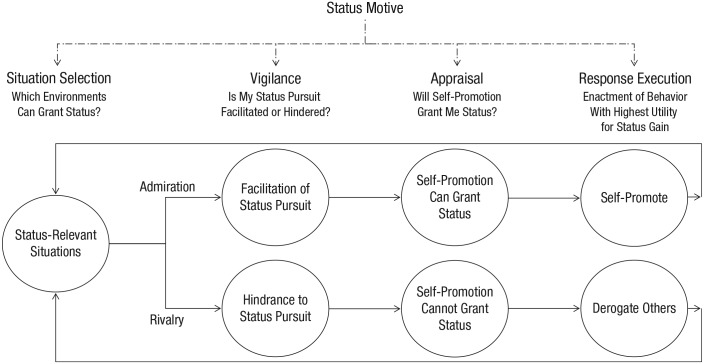
We propose a self-regulation model of grandiose narcissism. This model illustrates an interconnected set of processes through which narcissists (i.e., individuals with relatively high levels of grandiose narcissism) pursue social status in their moment-by-moment transactions with their environments. The model shows that narcissists select situations that afford status. Narcissists vigilantly attend to cues related to the status they and others have in these situations and, on the basis of these perceived cues, appraise whether they can elevate their status or reduce the status of others. Narcissists engage in self-promotion (admiration pathway) or other-derogation (rivalry pathway) in accordance with these appraisals. Each pathway has unique consequences for how narcissists are perceived by others, thus shaping their social status over time. The model demonstrates how narcissism manifests itself as a stable and consistent cluster of behaviors in pursuit of social status and how it develops and maintains itself over time. More broadly, the model might offer useful insights for future process models of other personality traits.
Verified 2026-11-22 · 4 references not checked yet
Overview
CoChat Summary
TL;DR
The paper proposes the SPIN model, a self-regulation framework in which grandiose narcissism is driven by a dominant motive for social status and unfolds through situation selection, vigilance, appraisal, and response execution. It explains when narcissists self-promote (admiration pathway) versus derogate others (rivalry pathway), and how these pathways shape status and likability across status-oriented versus affiliation-oriented settings.
Key findings
- Narcissists are argued to pursue status more strongly, more narrowly (at the cost of affiliation), and more rigidly than nonnarcissists; the status motive is positioned as the core of grandiose narcissism.
- The SPIN sequence is: select public and hierarchical situations; vigilantly attend to status-relevant cues; appraise whether self-promotion or other-derogation can secure status; then execute admiration or rivalry responses.
- Admiration is described as the default pathway when status pursuit seems facilitated; rivalry emerges when self-promotion is blocked or hindered, especially after criticism, humiliation, or being outperformed.
- Consequences depend on setting: in status-oriented settings, admiration and rivalry can aid status; in affiliation-oriented settings, initial status and likability gains tend to erode over time, especially through rivalry. No original numerical results are reported.
Methods
- Theoretical/conceptual article: proposes a process model by integrating evolutionary and motivational accounts of behavior with self-regulatory processing models of narcissism.
- No new empirical sample or primary data analysis; the argument draws on prior theory and findings from existing studies.
- The paper outlines future tests using intensive longitudinal experience-sampling/smartphone methods and experimental or field interventions targeting each proposed process.
Limitations
- The paper states that vigilance and appraisals have not been studied in relation to narcissism, and that the model needs more empirical scrutiny before it can be translated into intervention programs.
- The paper states that not all proposed processes have equal empirical support: status motivation, situation selection, and response execution have more evidence than vigilance and appraisal.
- Evident from the text: the model is conceptual and largely synthesizes indirect or correlational evidence; it focuses on grandiose narcissism and explicitly excludes vulnerable narcissism and narcissistic personality disorder, limiting its scope.
Model-written summary. Check it against the paper before relying on it.
Integrity signals
Registry
Cites
Statistics
Figures
Verification
Claims the paper makes
19 Valid · 5 Not valid · 92 Not checked · 82 Own results and interpretations
The sources with a verdict support this claim; the rest weren’t checked yet, have no full text we could read, or their verdicts aren’t rated yet.
In the paper
“They often demonstrate an increased preference for high-status friends (Jonason & Schmitt, 2012) and trophy partners (Campbell, 1999), perhaps because they can bask in the reflected glory of these people.”
§ The “Why” and “How” of Narcissism: A Process Model of Narcissistic Status Pursuit > The SPIN Model > Situation selection
What the sources say
- Supportedcites Jonason & Schmitt, 2012 matched to “What Have You Done for Me Lately? Friendship-Selection in the Shadow of the Dark Triad Traits” (2012) source
Only the high-status-friends clause is attributed to Jonason and Schmitt; the trophy-partners clause cites a different source. In Results and Discussion, Table 2 reports positive associations between narcissism and social status as a reason for choosing same-sex friends and as a desired friend characteristic (page not available in our copy). (LLM, conf=0.93)
- Not checked — no full text of the sourcecites Campbell, 1999 matched to “Narcissism and romantic attraction.” (1999) source
boostedstates an association- Asserted: passes — The authors put it forward as true.
- Checkable: passes — It can be checked against evidence.
- Load-bearing: passes — The paper’s conclusions depend on it.
- Based: passes — The paper gives a reason why it holds.
- Supported
The cited sources support only part of this claim — read each source’s verdict below.
In the paper
“The gradual emergence of rivalry in affiliative settings can eventually damage narcissists’ relationships with others (Campbell & Campbell, 2009; Sedikides & Campbell, 2017).”
§ The “Why” and “How” of Narcissism: A Process Model of Narcissistic Status Pursuit > The SPIN Model > Social consequences of admiration and rivalry
What the sources say
- Not checked — no full text of the sourcecites Campbell & Campbell, 2009 matched to “On the Self-regulatory Dynamics Created by the Peculiar Benefits and Costs of Narcissism: A Contextual Reinforcement Model and Examination of Leadership” (2009) source
- Partly supportedcites Sedikides & Campbell, 2017 matched to “Narcissistic Force Meets Systemic Resistance: The Energy Clash Model” (2017) sourceExperimental — accuracy not yet measured
In “Antipathy toward Narcissistic Leaders” (page unavailable), the paper says people form increasingly unfavorable impressions of narcissists as they get to know them, supporting the claim that relationships can worsen over time. Its discussion concerns organizational and leadership relationships; it does not identify gradually emerging rivalry in affiliative settings as the cause. (LLM, conf=0.84)
plainstates a possible cause- Asserted: passes — The authors put it forward as true.
- Checkable: passes — It can be checked against evidence.
- Load-bearing: passes — The paper’s conclusions depend on it.
- Based: passes — The paper gives a reason why it holds.
The sources with a verdict support this claim; the rest weren’t checked yet, have no full text we could read, or their verdicts aren’t rated yet.
In the paper
“Narcissists (i.e., individuals with relatively high levels of grandiose narcissism) tend to go out of their way to impress others: They often groom their appearance to grasp others’ attention (Back, Schmukle, & Egloff, 2010), brag about themselves (Buss & Chiodo, 1991), and showcase their talents and abilities in front of others (Wallace & Baumeister, 2002).”
§ The “Why” and “How” of Narcissism: A Process Model of Narcissistic Status Pursuit > Abstract
What the sources say
- Supportedcites Back, Schmukle, & Egloff, 2010 matched to “Why are narcissists so charming at first sight? Decoding the narcissism–popularity link at zero acquaintance.” (2010) source
Back et al. report in “The Popularity of Narcissists at First Sight” (p. 10) that narcissism was related to fancier clothing, supporting the appearance-related point attached to this citation. Their lens-model discussion (p. 3) also describes flashy, neatly kept clothing and dressed-up hairstyles. The separate claims about bragging and showcasing talents cite other sources and are not judged here. (LLM, conf=0.89)
- Not checked — no full text of the sourcecites Buss & Chiodo, 1991 matched to “Narcissistic Acts in Everyday Life” (1991) source
- Not checked — no full text of the sourcecites Wallace & Baumeister, 2002 matched to “The performance of narcissists rises and falls with perceived opportunity for glory.” (2002) source
plainstates an association- Asserted: passes — The authors put it forward as true.
- Checkable: passes — It can be checked against evidence.
- Load-bearing: passes — The paper’s conclusions depend on it.
- Based: passes — The paper gives a reason why it holds.
- Supported
The cited sources support only part of this claim — read each source’s verdict below.
In the paper
“At the same time, narcissists are often combative toward others. In such instances, they are often perceived as confrontational, insulting, belittling, and intimidating (Holtzman, Vazire, & Mehl, 2010; Morf & Rhodewalt, 1993; Reijntjes et al., 2016).”
§ The “Why” and “How” of Narcissism: A Process Model of Narcissistic Status Pursuit > Abstract
What the sources say
- Partly supportedcites Holtzman, Vazire, & Mehl, 2010 matched to “Sounds like a narcissist: Behavioral manifestations of narcissism in everyday life” (2010) sourceExperimental — accuracy not yet measured
The Results (Behavioral Correlates of Narcissism; page not provided) associate narcissism with disagreeable acts, including arguing, swear words, and anger words, supporting the description of combative behavior. The paper does not report that others perceived participants as confrontational, insulting, belittling, or intimidating. (LLM, conf=0.86)
- Not checked — no full text of the sourcecites Morf & Rhodewalt, 1993 matched to “Narcissism and Self-Evaluation Maintenance: Explorations in Object Relations” (1993) source
- Partly supportedcites Reijntjes et al., 2016 matched to “Narcissism, Bullying, and Social Dominance in Youth: A Longitudinal Analysis” (2016) sourceExperimental — accuracy not yet measured
The introductory passage under “Electronic supplementary material” (page unavailable) says youth with narcissistic traits often show aggression and other aversive interpersonal behavior, supporting the general description of combative behavior. The paper does not establish that narcissists are perceived specifically as confrontational, insulting, belittling, and intimidating; its study concerns bullying among youth, with findings that differ by gender (Discussion, page unavailable). (LLM, conf=0.85)
plainstates an association- Asserted: passes — The authors put it forward as true.
- Checkable: passes — It can be checked against evidence.
- Load-bearing: unclear — It is unclear whether the paper’s conclusions depend on it.
- Based: passes — The paper gives a reason why it holds.
- Partly supported
The cited sources support only part of this claim — read each source’s verdict below.
In the paper
“Narcissists might also try to stand out through their communication style, which often involves charming facial expressions, humor, as well as expressive and confident gestures that reflect their extraversion and self-confidence (Back et al., 2010; Paulhus, 1998; Tracy, Cheng, Martens, & Robins, 2011; Zeigler-Hill, Vrabel, et al., 2018).”
§ The “Why” and “How” of Narcissism: A Process Model of Narcissistic Status Pursuit > The SPIN Model > Response execution
What the sources say
- Partly supportedcites Back et al., 2010 matched to “Why are narcissists so charming at first sight? Decoding the narcissism–popularity link at zero acquaintance.” (2010) sourceExperimental — accuracy not yet measured
The Results (p. 7) link narcissists’ initial popularity to charming facial expressions, verbal humor, and self-assured body movements; the lens-model discussion (p. 3) also describes a desire to present themselves. The paper does not establish that their gestures are expressive or that those gestures reflect extraversion, and its findings concern first impressions rather than communication style generally. (LLM, conf=0.82)
- Not checked — no full text of the sourcecites Paulhus, 1998 matched to “Interpersonal and intrapsychic adaptiveness of trait self enhancement: a mixed blessing?” (1998) source
- Not checked — no full text of the sourcecites Tracy, Cheng, Martens, & Robins, 2011 matched to “The Emotional Dynamics of Narcissism: Inflated by Pride, Deflated by Shame” (2011) source
hedgedstates a cause- Asserted: passes — The authors put it forward as true.
- Checkable: passes — It can be checked against evidence.
- Load-bearing: unclear — It is unclear whether the paper’s conclusions depend on it.
- Based: passes — The paper gives a reason why it holds.
- Partly supported
129 more claims · 11 with their cited sources checked
Create a free account to see all 198 claims and to verify the 26 references still open.
- It may state two separate claims as one. 47
- Probably not a substantial claim. 20
Self-check
Percentages, sums and reported differences re-computed from the paper’s own numbers.
Each contradiction between two passages listed here was confirmed by an independent check.
Rated minor: it would not touch a result — a value no result rests on, a p-value that stays on the same side of the significance level, or a conflict that is clerical, resolved elsewhere in the paper, or outside its own findings.
In the paper
§ The “Why” and “How” of Narcissism: A Process Model of Narcissistic Status Pursuit > References
“Krizan Z. Bushman B. J. (2011). Better than my loved ones: Social comparison tendencies among narcissists. Personality and Individual Differences, 50, 212– 216. doi: 10.1016/j.paid.2010.09.031”
§ The “Why” and “How” of Narcissism: A Process Model of Narcissistic Status Pursuit > References
“Krizan Z. Herlache A. D. (2018). The narcissism spectrum model: A synthetic view of narcissistic personality. Personality and Social Psychology Review, 22, 3– 31. doi: 10.1016/j.paid.2010.09.031”
Rated minor: it would not touch a result — a value no result rests on, a p-value that stays on the same side of the significance level, or a conflict that is clerical, resolved elsewhere in the paper, or outside its own findings.
In the paper
§ The “Why” and “How” of Narcissism: A Process Model of Narcissistic Status Pursuit > References
“Back M. D. Küfner A. C. P. Leckelt M. (2018). Early impressions of grandiose narcissists: A dual-pathway perspective. In Hermann A. D. Brunell A. B. Foster J. D. (Eds.), The handbook of trait narcissism: Key advances, research methods, and controversies (pp. 309– 316).”
§ The “Why” and “How” of Narcissism: A Process Model of Narcissistic Status Pursuit > References
“Konrath S. Tian Y. (2018). Narcissism and prosocial behavior. In Hermann A. D. Brunell A. B. Foster J. D. (Eds.), The handbook of trait narcissism: Key advances, research methods, and controversies (pp. 309– 316).”
Citations
Cites
Diagnostic and Statistical Manual of Mental Disorders
American Psychiatric Association (2013) · doi:10.1176/appi.books.9780890425596 · Cited by 116,369
Society and the Adolescent Self-Image
Rosenberg, M. (1965) · doi:10.1515/9781400876136 · Cited by 30,126
The need to belong: Desire for interpersonal attachments as a fundamental human motivation.
Baumeister, R. F., & Leary, M. R. (1995) · Psychological Bulletin · doi:10.1037//0033-2909.117.3.497 · Cited by 23,245 · cited 1×
“Some individuals want status as long as it does not go against their motive to get along well with others (i.e., affiliation motive; Baumeister & Leary, 1995; McClelland, 1987), whereas other individuals want status even at the cost of getting along well with others.”
BackgroundThe emerging field of emotion regulation: an integrative review
Gross, J. J. (1998) · Review of General Psychology · doi:10.1037/1089-2680.2.3.271 · Cited by 9,916 · cited 4×
“In so doing, we build on core self-regulation processes (e.g., Baumeister, Schmeichel, & Vohs, 2007; Denissen et al., 2013; Geukes, van Zalk, & Back, 2018; Gross, 1998): situation selection,1 attention (which we term vigilance for reasons outlined below), appraisal, and response execution.”
InfluentialA social-cognitive approach to motivation and personality.
Dweck, C. S., & Leggett, E. L. (1988) · Psychological Review · doi:10.1037/0033-295x.95.2.256 · Cited by 9,745 · cited 1×
“For example, interventions could teach individuals to reappraise critical feed-back not as a sign of their incompetence but as a set of suggestions that indicate how to improve their competence (for a similar rationale, see Dweck & Leggett, 1988; Yeager, Trzesniewski, & Dweck, 2013).”
Crick, N. R., & Dodge, K. A. (1994) · Psychological Bulletin · doi:10.1037/0033-2909.115.1.74 · Cited by 5,510 · cited 2×
“Individuals are assumed to be especially vigilant toward environmental cues that convey information about how much environments facilitate or hinder their goal pursuit (Crick & Dodge, 1994).”
BackgroundSocial psychology: handbook of basic principles
(2008) · Choice Reviews Online · doi:10.5860/choice.45-3496 · Cited by 5,473
Taking time seriously: A theory of socioemotional selectivity.
Carstensen, L. L., Isaacowitz, D. M., & Charles, S. T. (1999) · American Psychologist · doi:10.1037//0003-066x.54.3.165 · Cited by 5,377
The dark triad of personality: Narcissism, Machiavellianism, and psychopathy
Paulhus, D. L., & Williams, K. M. (2002) · Journal of Research in Personality · doi:10.1016/s0092-6566(02)00505-6 · Cited by 5,265 · cited 1×
“Some scholars have proposed that narcissism belongs to a broader group of so-called dark traits (including Machiavellianism and psychopathy; Paulhus & Williams, 2002) that represent a tendency to “maximize one’s own utility” while “disregarding, accepting, or malevolently provoking disutility for…”
BackgroundCoping theory and research: past, present, and future
Lazarus, R. S. (1993) · Psychosomatic Medicine · doi:10.1097/00006842-199305000-00002 · Cited by 3,253 · cited 1×
“Appraisals therefore direct the selection of goal-fulfilling behaviors (Crick & Dodge, 1994; Lazarus, 1993) in response to cues indicating that a situation is relevant to goal fulfillment.”
Research works printed but not linked: 6
- Back M. D. Küfner A. C. P. Leckelt M. (2018). Early impressions of grandiose narcissists: A dual-pathway perspective. In Hermann A. D. Brunell A. B. Foster J. D. (Eds.), The handbook of trait narcissism: Key advances, research methods, and controversies (pp. 309– 316). New York, NY: Springer. doi: 10.1007/978-3-319-92171-6_6 · DOI · Paper page
- Campbell W. K. Brunell A. B. Finkel E. J. (2006). Narcissism, interpersonal self-regulation, and romantic relationships: An agency model approach. In Vohs K. D. Finkel E. J. (Eds.), Self and relationships (pp. 57– 83). New York, NY: Guilford Press.
- Campbell W. K. Foster J. D. (2007). The narcissistic self: Background, an extended agency model, and ongoing controversies. In Sedikides C. Spencer S. J. (Eds.), The self (pp. 115– 138). New York, NY: Psychology Press.
- Erikson E. H. (1959). Identity and the life cycle: Selected papers. Psychological Issues, 1, 1– 171.
- Freud S. (1955). Libidinal types. London, England: Hogarth Press. (Original work published 1931)
- Reich W. (1949). Character analysis (3rd ed.), (T. P. Wolfe, Trans.). New York, NY: Orgone Institute Press. (Original work published 1933)
Cited by
Items 101–200 of 320
Liu, Z., Zhou, R., Wei, L., Ouyang, X., & Zhou, K. (2021) · Chinese Management Studies · doi:10.1108/cms-08-2021-0347 · Cited by 14
Nagel, M. G., Marcus, D. K., & Zeigler‐Hill, V. (2022) · Clinical Psychology & Psychotherapy · doi:10.1002/cpp.2796 · Cited by 14
Grosz, M. P., van Aert, R. C. M., & Back, M. D. (2024) · Psychological Bulletin · doi:10.1037/bul0000416 · Cited by 16
Self-citationNarcissism and Self-Esteem Revisited : The Mediating Roles of Perceived Status and Inclusion
Zeigler‐Hill, V., & Vonk, J. M. (2022) · Identity · doi:10.1080/15283488.2022.2081572 · Cited by 12
“These results provide support for the recent argument that the desire for status may serve as the motivational core of narcissism (Grapsas et al., 2020; Zeigler-Hill et al., 2018).”
BackgroundResultFatfouta, R. (2021) · Current Psychology · doi:10.1007/s12144-020-01332-9 · Cited by 19
Rahal, D., Fales, M. R., Haselton, M. G., Slavich, G. M., & Robles, T. F. (2021) · Social Development · doi:10.1111/sode.12569 · Cited by 11
“Moreover, narcissistic individuals actively attempt to gain status among peers (Grapsas et al., 2020; Sheldon & Bryant, 2016).”
BackgroundSzücs, A., Edershile, E. A., Wright, A. G. C., & Dombrovski, A. Y. (2023) · Personality Disorders Theory Research and Treatment · doi:10.1037/per0000610 · Cited by 18
To share or not to share? A double-edge effect of narcissism on knowledge sharing in hospitality
Wang, Z., Yang, S., Li, X., Liu, P., & Liu, N. (2023) · International Journal of Hospitality Management · doi:10.1016/j.ijhm.2023.103637 · Cited by 12
Bhattacharjee, A., & Sarkar, A. (2025) · Asia-Pacific Journal of Business Administration · doi:10.1108/apjba-07-2024-0376 · Cited by 14
Who will embrace upward line extension? The role of power distance belief
He, Y., Mo, Z., Wan, X., Li, M., & Fu, H. (2023) · Journal of Retailing and Consumer Services · doi:10.1016/j.jretconser.2023.103475 · Cited by 13
Narcissism, Social Experiences, and Mood in Late Life
Zhang, S., Kim, Y. K., Fingerman, K. L., Birditt, K. S., & Charles, S. T. (2022) · The Journals of Gerontology Series B · doi:10.1093/geronb/gbac019 · Cited by 11
Narcissistic coaches and athletes’ individual rowing performance
Nevicka, B., van Gerven, E. J. G., & Sedikides, C. (2023) · Scientific Reports · doi:10.1038/s41598-023-48239-6 · Cited by 10
The many faces of narcissism: A question of situation perception?
Bauditz, S. C., Wright, A. G. C., Heß, U., & Ziegler, M. D. (2024) · Journal of Research in Personality · doi:10.1016/j.jrp.2024.104554 · Cited by 12
When humble AI meets narcissistic customers: A terror management perspective
Liu, J., Hsu, F., Yu, J., Cao, J., & Mai, H. (2025) · International Journal of Information Management · doi:10.1016/j.ijinfomgt.2025.102904 · Cited by 9
Chou, S. Y., & Ramser, C. (2022) · Personnel Review · doi:10.1108/pr-11-2021-0799 · Cited by 11
Leder, J., Schneider, S., & Schütz, A. (2021) · Personality Science · doi:10.5964/ps.7293 · Cited by 7
“Our findings support the hierarchical model of grandiose narcissism with admiration as the “default” mode (Back, 2018; Grapsas et al., 2020) because admiration and rivalry share variance with each other, and thus, one dimension can be a "less noisy" representation of the other.”
BackgroundResultInfluentialGrandiose narcissism and performance in organizations: mediating role of subjective wellbeing
Sakkar Sudha, K., & Shahnawaz, M. G. (2020) · Leadership, Education, Personality: An Interdisciplinary Journal · doi:10.1365/s42681-020-00015-0 · Cited by 7
“Recent literature on narcissism has suggested that there is a need to assess self-regulatory processes such as wellbeing which might affect behaviors of narcissistic leaders in a social and organizational setting (Grapsas et al. 2020).”
BackgroundToo beautiful to be fake: Attractive faces are less likely to be judged as artificially generated
Makowski, D., Te, A., Neves, A. B., Kirk, S., Liang, N. Z., Mavros, P., & Chen, S. A. (2024) · Acta Psychologica · doi:10.1016/j.actpsy.2024.104670 · Cited by 12
Courting the Sharks: The Influence of CEO Narcissistic Admiration and Rivalry on New Venture Funding
Sanchez-Ruiz, P., Blake, A. B., Petrenko, O. V., Maldonado-Bautista, I., Collewaert, V., & Artz, K. (2025) · Organization Science · doi:10.1287/orsc.2022.17024 · Cited by 9
Early physiological indicators of narcissism and self‐esteem in children
Brummelman, E., Nikolić, M., Nevicka, B., & Bögels, S. M. (2022) · Psychophysiology · doi:10.1111/psyp.14082 · Cited by 7
“Unsurprisingly, these children often employ strategies to elicit positive social evaluations (Grapsas et al., 2020; Morf & Rhodewalt, 2001).”
Self-citationWien, A. H., Peluso, A. M., Pichierri, M., Piper, L., & Guido, G. (2023) · Italian Journal of Marketing · doi:10.1007/s43039-023-00088-x · Cited by 9
“At the same time, narcissists are highly sensitive toward environmental cues that convey hindrances to their status pursuit (Grapsas et al., 2020).”
The joke is on us? National narcissism and dispositions towards laughter
Szczepańska, D., Marchlewska, M., Rogoza, R., Podsiadłowski, W., Molenda, Z., Maciantowicz, O., Rogoza, M., & Klusek, D. (2024) · Personality and Individual Differences · doi:10.1016/j.paid.2024.112543 · Cited by 8
Liu, Z., Zhou, K., & Wang, J. (2024) · Human Relations · doi:10.1177/00187267241239855 · Cited by 10
“Narcissists attach greater importance to status and are more likely to set status-relevant goals (e.g. achieving high performance and acquiring leadership) than people with low narcissism (Grapsas et al., 2020).”
An, Z., Zou, Y., Wu, S., Tong, S., & Peng, K. (2024) · Social and Personality Psychology Compass · doi:10.1111/spc3.70010 · Cited by 13
Vize, C. E., & Lynam, D. R. (2020) · European Journal of Personality · doi:10.1002/per.2241 · Cited by 8
Narcissism and partner-enhancement at different relationship stages
Czarna, A. Z., Śmieja, M., Wider, M., Dufner, M., & Sedikides, C. (2022) · Journal of Research in Personality · doi:10.1016/j.jrp.2022.104212 · Cited by 10
“…and measures converge in indicating — contrary to the above-stated perspective — that high nar-cissists do not partner-enhance in the first place (Campbell, 1999; Campbell et al., 2002; Grapsas et al., 2020; Krizan & Bushman, 2011; Rohmann et al., 2011; Tortoriello et al., 2017; Seidman, 2016).”
Leniarska, M., Zajenkowski, M., Rogoza, R., & Fatfouta, R. (2023) · Personality and Individual Differences · doi:10.1016/j.paid.2023.112153 · Cited by 6
A multidimensional model of collective narcissism
Montoya, R. M., Pittinsky, T. L., & Rosenthal, S. A. (2020) · Journal of Theoretical Social Psychology · doi:10.1002/jts5.71 · Cited by 7
Chen, J., Nevicka, B., Homan, A. C., & Kleef, G. A. V. (2021) · Personality and Social Psychology Bulletin · doi:10.1177/01461672211007293 · Cited by 9
“Previous work has shown that, to maintain a positive self-concept in the agentic (vs. communal) domain (e.g., power, status; Grijalva & Zhang, 2016), narcissists are hyper-sensitive and vigilant to external cues related to status or power (Grapsas et al., 2020).”
BackgroundJauk, E., Olaru, G., Schürch, E., Back, M. D., & Morf, C. C. (2022) · PsyArXiv (OSF Preprints) · doi:10.31234/osf.io/mcj8g · Cited by 5
Self-citationReconceptualizing ethically and socially aversive (“dark”) personality traits
Moshagen, M., Hilbig, B. E., & Zettler, I. (2025) · Current Opinion in Psychology · doi:10.1016/j.copsyc.2025.102111 · Cited by 9
Yang, Y., Zhao, M., Li, Y., Li, B., Dong, Y. H., & Fang, Y. (2022) · Current Psychology · doi:10.1007/s12144-022-03770-z · Cited by 7
“However, when this method fails to achieve the desired outcome, narcissistic rivalry maintains self-image by demeaning others, which is a self-protection strategy (Back et al., 2013; Grapsas, 2020).”
InfluentialDetecting Narcissism From Older Adults’ Daily Language Use: A Machine Learning Approach
Zhang, S., Fingerman, K. L., & Birditt, K. S. (2023) · The Journals of Gerontology Series B · doi:10.1093/geronb/gbad061 · Cited by 10
Grandiose narcissism, unfounded beliefs, and behavioral reactions during the COVID-19 pandemic
Żemojtel-Piotrowska, M. A., Sawicki, A. J., Piotrowski, J. P., Lifshin, U., Kretchner, M., Skowronski, J. J., Sedikides, C., Jonason, P. K., Adamovic, M., Ahmed, O., et al. (2024) · Scientific Reports · doi:10.1038/s41598-024-67954-2 · Cited by 6
“One stream of this research focused on grandiose narcissism 4–6 , characterized by self-absorbing self-aggrandizement 5,6 , distinctly from vulnerable narcissism that is characterized by feelings of inadequacy and incompetence 5–7 .”
BackgroundKirk, C. P., Sedikides, C., & Givi, J. (2024) · Journal of Personality · doi:10.1111/jopy.12983 · Cited by 7
Liu, M., & Zheng, W. (2025) · Social and Personality Psychology Compass · doi:10.1111/spc3.70088 · Cited by 8
Zeigler‐Hill, V., & Andrews, D. (2021) · Sexes · doi:10.3390/sexes2020017 · Cited by 7
“The connections between narcissistic personality features and power are also consistent with recent arguments that the navigation of status hierarchies, which are often closely linked with issues concerning power and dominance, may be essential for understanding narcissism [47,50,51].”
ResultPerceptions of narcissism in college professors
Wallace, H. M., Carrillo, A., & Kelley, J. (2022) · The Journal of Social Psychology · doi:10.1080/00224545.2022.2050167 · Cited by 8
Me, Me, Me: Narcissism and Motivation to Lead
Schyns, B., Lagowska, U. G., & Braun, S. H. (2022) · Zeitschrift für Psychologie · doi:10.1027/2151-2604/a000504 · Cited by 7
Zajenkowski, M., Sedikides, C., Gignac, G. E., Górniak, J., & Maciantowicz, O. (2022) · Journal of Research in Personality · doi:10.1016/j.jrp.2022.104311 · Cited by 8
“For example, intelligence is linked to status and success on several life domains (i.e., educational, professional, income; Canter, 1956; Gott-fredson, 1997; Grapsas et al., 2020).”
Zhao, Y., Zhou, K., & Liu, W. (2023) · Management and Organization Review · doi:10.1017/mor.2022.42 · Cited by 8
The Tango of pride and envy: does others’ envy lead to the feeling of pride?
Sung, B., Septianto, F., Stankovic, M., & Duong, C. (2023) · European Journal of Marketing · doi:10.1108/ejm-03-2022-0190 · Cited by 8
Dehaghi, A. M. B., & Zeigler‐Hill, V. (2021) · Psihologijske teme · doi:10.31820/pt.30.1.3 · Cited by 11
All the Working World's a Stage: Narcissism, Work Values, and Vocational Choices
Fezzey, T. N. A., Harms, P. D., & Cho, Y. (2023) · Personality Science · doi:10.1177/27000710241257770 · Cited by 5
“While theory suggests that narcissistic admiration and rivalry share the same underlying motive for social status (Grapsas et al., 2020), the NARC also asserts that the two unique behavioral dynamics employ different social tactics (i.e., self-promotion and self-defense, respectively) and…”
Mitchell, T. D., Haslam, S. A., Burke, V., & Steffens, N. K. (2025) · Industrial and Organizational Psychology · doi:10.1017/iop.2025.10044 · Cited by 17
“Atthesame time, though, this perspective is somewhat surprising considering evidence that narcissism can change during adulthood and can be influenced both by entry into the workforce and by early experiences within the workplace (e.g., Grapsas et al., 2020; Heyde et al., 2024).”
Chen, S., van Tilburg, W. A. P., Mahadevan, N., & Leman, P. J. (2024) · Current Psychology · doi:10.1007/s12144-024-06141-y · Cited by 8
Eyes on the prize: Narcissism and visual attention to status and affiliation
Grapsas, S., Kyriazi, F. S., & Dufner, M. (2024) · Personality Science · doi:10.1177/27000710241257758 · Cited by 6
“Recent theory and research (Grapsas et al., 2020; Jonason & Zeigler-Hill, 2018; Mahadevan et al., 2016; Zeigler-Hill, McCabe, et al., 2018) suggest that grandiose (i.e., agentic and antagonistic) narcissism is underlain by a strong motive for social status.”
InfluentialSelf-citationUnderstanding and Coping in Social Relationships with Narcissists
Brunell, A. B., & Hermann, A. D. (2024) · Cambridge University Press eBooks · doi:10.1017/9781108908306 · Cited by 5
Mohamed, H. S., Elbakry, M. A. A. E., Othman, A. A., Atta, M. H. R., Barakat, A. M., & Hamed, A. E. M. (2025) · BMC Nursing · doi:10.1186/s12912-025-03166-x · Cited by 6
“The mismatch between their perceived capabilities and job responsibilities can foster feelings of inadequacy or superiority, further associating with narcissistic traits [38].”
How narcissism relates to upward-status disagreement in virtual project design teams
Xu, T., & Benson, A. J. (2024) · Self and Identity · doi:10.1080/15298868.2024.2314922 · Cited by 4
“…with the status pursuit in narcissism model’s (SPIN) appraisal phase (i.e., assessing situational affordances toward goal fulfilling behavior, Grapsas et al., 2020), whereby the likelihood of engaging in self-promotive strategies depends on whether such behaviors are appraised as an…”
BackgroundNarcissism moderates the association between basal testosterone and generosity in men
Czarna, A. Z., Ziemiańska, M., Pawlicki, P., Carré, J. M., & Sedikides, C. (2022) · Hormones and Behavior · doi:10.1016/j.yhbeh.2022.105265 · Cited by 8
Mück, M., Mattes, A., Porth, E., & Stähl, J. (2023) · Personality Neuroscience · doi:10.1017/pen.2022.7 · Cited by 6
Mota, S., Mielke, I., Kroencke, L., et al. (2022) · doi:10.31219/osf.io/925vy · Cited by 5
Self-citationMazzeo, O., Selva, G. L., Longo, M., & Monacis, L. (2025) · Frontiers in Psychology · doi:10.3389/fpsyg.2025.1562635 · Cited by 6
Liu, X., Dong, J., Chen, L., Yu, Y., & Harms, P. D. (2026) · Journal of Organizational Behavior · doi:10.1002/job.70077 · Cited by 5
Mahadevan, N., & Jordan, C. H. (2025) · Behavioral Sciences · doi:10.3390/bs15091221 · Cited by 5
“Extending research suggesting that narcissistic attributes function as a coordinated system to facilitate gaining status (Grapsas et al., 2020; Morf & Rhodewalt, 2001; Mahadevan, 2024; Zeigler-Hill et al., 2019), we found that individuals high in all Dark Triad traits are highly motivated to…”
How Need for Power Explains Why Narcissists Are Antisocial
Alexander, M. B., Gore, J. S., & Estep, C. (2020) · Psychological Reports · doi:10.1177/0033294120926668 · Cited by 6
“The characteristics of a person diagnosed with narcissism are the following: a sense of self entitlement, a need to be liked, and no empathy or remorse (Grapsas et al., 2020).”
BackgroundThe brain dynamics of trust decisions and outcome evaluation in narcissists
Guo, F., Ziyang, Y., Liu, T., & Gu, L. (2022) · Frontiers in Psychology · doi:10.3389/fpsyg.2022.929674 · Cited by 5
“Narcissists are driven by a dominant status motive (Grapsas et al., 2020), while distrust violates the social norm of cooperation and may be harmful to establishing and maintaining long-term friendships, which may be opposite to the dominant status and require greater cognitive control for narcissists.”
BackgroundFehn, T., & Schütz, A. (2022) · Zeitschrift für Psychologie · doi:10.1027/2151-2604/a000503 · Cited by 11
Does narcissus prefer to be alone? Narcissistic personality features and the preference for solitude
Zeigler‐Hill, V., Vonk, J. M., & Fatfouta, R. (2023) · Journal of Personality · doi:10.1111/jopy.12901 · Cited by 4
Explorations of the Shadow Realm: Examining the Role of Dark Personality in the Workplace
Harms, P. D., Landay, K., & Fezzey, T. N. A. (2024) · Oxford University Press eBooks · doi:10.1093/oxfordhb/9780192897114.013.12 · Cited by 8
Decoding the Narcissistic Brain
Zhou, Z., Huang, C., Robins, E. M., Angus, D. J., Sedikides, C., & Kelley, N. J. (2025) · NeuroImage · doi:10.1016/j.neuroimage.2025.121284 · Cited by 5
“Follow-up research should continue to examine the patterns of neural oscillations that distinguish admiration from rivalry and their implications for narcissistic status pursuit (Grapsas et al., 2020; Zeigler-Hill et al., 2019).”
Grandiose narcissism shapes counterfactual thinking (and regret): Direct and indirect evidence
Grundmann, F., Smallman, R., & Epstude, K. (2022) · Journal of Research in Personality · doi:10.1016/j.jrp.2022.104235 · Cited by 8
On the beauty of sadness: it’s okay to say, I am sad, thank you
Tobore, T. O. (2023) · Communicative & Integrative Biology · doi:10.1080/19420889.2023.2211424 · Cited by 6
“to success and happiness also promotes narcissism [50,51], which is believed to be on the rise, especially in young people [52,53].”
BackgroundOverconfidence and the Pursuit of High-Status Positions: A Test of Two Behavioral Strategies
Mayoral, S., Ronay, R., & Oostrom, J. K. (2024) · Journal of Business and Psychology · doi:10.1007/s10869-024-09936-9 · Cited by 10
Narcissism Dynamics and Auditor Skepticism
Kaszak, S. E., Johnson, E. N., Reckers, P. M. J., & Reinstein, A. (2024) · Journal of Business Ethics · doi:10.1007/s10551-024-05668-1 · Cited by 9
“…has been suggested to differentiate between the directionally opposing interpersonal effects (behavioral patterns) of these two forms of narcissism (Edershile & Wright, 2022; Gignac & Zajenkowski, 2021; Grapsas et al., 2020; Kaufman et al., 2020; Miller et al., 2020; Rogoza & Fatfouta 2020).”
Relations among the trifurcated narcissism domains at trait and state level: Two of a kind?
Bauditz, S. C., Wright, A. G. C., Heß, U., & Ziegler, M. D. (2024) · European Journal of Personality · doi:10.1177/08902070241297727 · Cited by 10
“…in its grandiose manifestations, is primarily characterized by two key motivational goals: the pursuit of a grandiose self-image, associated with agentic extraversion, and its protection, linked to self-centered antagonism (Back et al., 2013; Grapsas et al., 2020; Morf & Rhodewalt, 2001).”
Radiation enterocolitis. A case report.
Heffernon, E. W., & Memik, F. (1969) · PubMed · Cited by 4
Adolf Hitler: Hatred driven destructive leadership
Banai, M., & Mayer, C. (2025) · International Journal of Cross Cultural Management · doi:10.1177/14705958251319653 · Cited by 6
“Psychology-oriented biographies by Langer (1972), Rosenbaum (1999), and Volker (2016), as well as a stream of studies by Coolidge et al. (2007) indicate that Hitler ’ s main psychological issues were narcissism and paranoia (Grapsas et al., 2020), not psychopathic cruelty per se.”
Sarno, M. D., Frisina, S., Madeddu, F., & Pierro, R. D. (2022) · Journal of Clinical Psychology · doi:10.1002/jclp.23454 · Cited by 4
Bajcsi, N., Fino, E., Popușoi, S. A., & Holman, A. C. (2025) · Current Psychology · doi:10.1007/s12144-025-07692-4 · Cited by 3
Are all narcissistic people more motivated to self-enhance?: A novel test of a NARC model postulate
Hart, W., Lambert, J. T., & Hall, B. T. (2025) · Personality and Individual Differences · doi:10.1016/j.paid.2025.113217 · Cited by 3
Wang, Y., Hawk, S. T., & Wong, N. (2025) · Journal of Youth and Adolescence · doi:10.1007/s10964-025-02199-4 · Cited by 3
“…Resource Control Theory, the SPIN model suggests that narcissistic individuals react to social status fl uctuations by displaying rivalry-oriented aggression when they experience status frustration, and admiration-oriented prosociality when they experience status satisfaction (Grapsas et al., 2020).”
Emotional Intelligence and Narcissism among Senior Corporate Executives
Fida, M. K., Naz, B., Khan, M. Z., & Safdar, A. (2020) · Foundation University Journal of Psychology · Cited by 6
Narcissism, Communion, and Perceptions of Accounting Information Source Reliability
Johnson, E. N., Reckers, P. M. J., & Festa, M. M. (2023) · Behavioral Research in Accounting · doi:10.2308/bria-2022-047 · Cited by 4
Zeigler‐Hill, V., Besser, A., Barlow, C., & Quay, J. (2023) · International Journal of Personality Psychology · doi:10.21827/ijpp.9.41320 · Cited by 3
“Narcissism is strongly intertwined with concerns regarding one’s social status (e.g., Grapsas et al., 2020; Zeigler-Hill et al., 2018, 2019).”
BackgroundWhen and why do individuals high in narcissistic rivalry attain social status?
Grosz, M. P., Thielmann, I., Krabbe, H., & Back, M. D. (2024) · European Journal of Personality · doi:10.1177/08902070241256142 · Cited by 8
“…2019), lead to admiring respect and freely conferred def-erence, whereas dominance-based processes, which are related to narcissistic rivalry (e.g., Grapsas et al., 2020; Grove et al., 2019; Zeigler-Hill et al., 2019), do not lead to admiring respect and freely conferred deference from others…”
Self-citationPringle, V., Tissera, H., Elsaadawy, N., Carlson, E. N., & Human, L. J. (2024) · Social Psychological and Personality Science · doi:10.1177/19485506241263636 · Cited by 3
“Furthermore, narcissists use the social arena to maintain their self-esteem (Campbell & Campbell, 2009) by seeking social status, popularity, and leadership, and by engaging in a host of behaviors (e.g., self-promotion) to secure this form of social success (Grapsas et al., 2020).”
Yu, Q., Ren, Y., Zuo, C., Qiu, S., Zhang, F., Guo, S., & Huang, S. (2025) · Personality and Individual Differences · doi:10.1016/j.paid.2025.113340 · Cited by 2
The envy-contempt spiral: affective self-regulation in grandiose narcissism
Raftopoulos, A., & Unterrainer, H. (2025) · Frontiers in Psychiatry · doi:10.3389/fpsyt.2025.1620201 · Cited by 2
“Even though we integrate aspects of classic emotion-regulation approaches, such as the situation selection and the vigilance component that is also used in the SPIN, we decouple our model from a cognitive tradition in the strict sense by understanding (a) these cognitive functions to be inherent to emotions and (b) em…”
InfluentialSękowski, M., Piotrowski, J. P., Nowak, B., Żemojtel-Piotrowska, M. A., & Maltby, J. (2025) · International Journal of Psychology · doi:10.1002/ijop.70080 · Cited by 2
From Sports Fields to Storefronts: The Dark Triad's Impact on Luxury Consumption
Akoğlu, H. E., & Cesur, B. (2025) · Spor Bilimleri Araştırmaları Dergisi · doi:10.25307/jssr.1723051 · Cited by 2
Mahimkar, A. (2025) · Journal of Retailing and Consumer Services · doi:10.1016/j.jretconser.2025.104674 · Cited by 2
Worship me at the office altar: Why narcissistic leaders resist remote work
Shandell, M. S., Elliott, C. E., & Grant, A. M. (2026) · Organizational Behavior and Human Decision Processes · doi:10.1016/j.obhdp.2026.104496 · Cited by 3
GÖK, O., Hazar, K., & Koç, A. F. (2021) · Journal of Education and Learning · doi:10.5539/jel.v10n4p192 · Cited by 4
“It can be defined as a personality trait characterized by a sense of self-importance and a desire to receive special treatment (Grapsas et al., 2020). According to Reijntjes (2016), it is a personality trait that includes beliefs of”
BackgroundInfluentialThe Superior Me! An Empirical Examination of the Dominance-Self of Narcissism
Hu, J., Gardner, W. L., Rong, Y., Jones, D. N., & Karam, E. P. (2022) · Journal of Organizational Psychology · doi:10.33423/jop.v22i3.5554 · Cited by 4
Moral Grandstanding as a Narcissistic Intrinsic Satisfaction
Şen, G., & Manuoğlu, E. (2022) · Psikiyatride Guncel Yaklasimlar - Current Approaches in Psychiatry · doi:10.18863/pgy.1070103 · Cited by 2
Coworkers Behaving Badly: How the Dark Triad Influences Responses to Witnessing Workplace Misconduct
Hall, B. T., Lambert, J. T., Wahlers, D. E., & Hart, W. (2024) · Psychological Reports · doi:10.1177/00332941241234594 · Cited by 3
“Such fi ndings accord with Chatterjee and Hambrick ’ s (2007) suggestion that individuals higher in narcissism, per se, can occasionally bene fi t the organization because they may enhance the organization to enhance the self by association (Grapsas et al., 2020).”
Tinghu, K. A. N. G., & Jing, Z. H. A. O. (2024) · Advances in Psychological Science · doi:10.3724/sp.j.1042.2024.01354 · Cited by 2
Narcissistic vigilance to status cues
Atkinson, B. E., & Heerey, E. A. (2024) · Journal of Experimental Social Psychology · doi:10.1016/j.jesp.2024.104688 · Cited by 1
Three-Dimensional Narcissism Scale for Children: Structure, Reliability, and Construct Validity
Turek, A., Zajenkowski, M., Rogoza, R., Rogoza, M., & Gignac, G. E. (2025) · Assessment · doi:10.1177/10731911251320050 · Cited by 2
“It is typically triggered by cues of social disapproval and threat to one’s self-image (Back, 2018; Grapsas et al., 2020).”
Falcons or pigeons? Grandiose narcissism, personal values, and attitudes toward war and peace
Kowalski, E., Brud, P. P., & Żemojtel-Piotrowska, M. A. (2025) · Personality and Individual Differences · doi:10.1016/j.paid.2025.113183 · Cited by 3
Wibowo, S. K., & Suharnomo, S. (2022) · JURNAL MEDIA INFORMATIKA BUDIDARMA · doi:10.30865/mib.v6i1.3548 · Cited by 1
“Walaupun narsisisme itu kelihatannya benar-benar bertentangan dengan konsep rohani, kepemimpinan yang menghamba, sudah terlalu lazim dan ada di dalam organisasi dan di antara kepemimpinan lainnya[7],[3],[8],[9],[10].”
BackgroundKhan, K., Nazir, T., & Shafi, K. (2022) · International Journal of Management Research and Emerging Sciences · doi:10.56536/ijmres.v12i1.188 · Cited by 7
Mercadante, E., Heine, S. J., & Aquino, K. F. (2022) · Journal of Personality · doi:10.1111/jopy.12799 · Cited by 2
“Narcissistic individuals deeply value their agentic qualities like intelligence and competence and are highly motivated to pursue social status (Campbell & Foster, 2007; Grapsas et al., 2020).”
Bragger, J. D., Alonso, N. A., Templeman, A., Tosto, P., Coulter, A., Steinhour, B., Williams, N., Sobel, D., & Lakusta, L. (2023) · Springer eBooks · doi:10.1007/978-3-031-01323-2_10 · Cited by 2
Narcissism and Narcissistic Personality Disorder: Evolutionary Roots and Emotional Profiles
Czarna, A. Z., Wróbel, M., Folger, L. F., Holtzman, N. S., Daley, J. R., & Foster, J. D. (2024) · Oxford University Press eBooks · doi:10.1093/oxfordhb/9780197544754.013.62 · Cited by 4
Stöcker, A.-K., Gauglitz, I. K., & Schütz, A. (2024) · Journal of Personnel Psychology · doi:10.1027/1866-5888/a000348 · Cited by 3
Szücs, A., Edershile, E. A., Wright, A. G. C., & Dombrovski, A. Y. (2022) · doi:10.31234/osf.io/cwtvp · Cited by 2
Status, rivalry and admiration-seeking in narcissism and depression: a behavioral studyPreprint
Szücs, A., Szántó, K., Adalbert, J., et al. (2020) · doi:10.31234/osf.io/mxve9 · Cited by 2
Metadata
- Authors
- Grapsas, S., Brummelman, E., Back, M. D., & Denissen, J. J. A.
- Affiliations
- Tilburg University (NL)
- University of Amsterdam (NL)
- University of Münster (DE)
- Corresponding author
- Grapsas, Stathis
- Venue
- Perspectives on Psychological Science
- Publisher
- SAGE Publications
- Published
- 2019-12-05
- Volume
- 15
- Issue
- 1
- Pages
- 150-172
- ISSN
- 1745-6916 (ISSN-L)
- 1745-6924
- PMC
- PMC6970445
- OpenAlex
- W2992965847
- Cited by
- 312
- References
- 213
- Citations by year
- 2026: 49 · 2025: 56 · 2024: 51 · 2023: 44 · 2022: 43 · 2021: 42 · 2020: 22 · 2019: 2
- FWCI
- 31.80
- Type
- journal article
- Language
- en
- Open access
- hybrid
- doi.org
- Licence
- cc-by-nc
- creativecommons.org/licenses/by-nc/4.0/ (unspecified)
- journals.sagepub.com/page/policies/text-and-data-mining-license (tdm)
- Locations
- Perspectives on Psychological Science (publishedVersion, cc-by-nc)
- Europe PMC (PubMed Central) (publishedVersion, cc-by-nc)
- PubMed Central (publishedVersion, cc-by-nc)
- Research portal (Tilburg University) (publishedVersion, cc-by-nc)
- PubMed (publishedVersion)
- Data Archiving and Networked Services (DANS) (submittedVersion, cc-by-nc)
- UvA-DARE (University of Amsterdam) (submittedVersion, cc-by-nc)
- Utrecht University Repository (Utrecht University) (submittedVersion, other-oa)
- Data Archiving and Networked Services (DANS) (submittedVersion, other-oa)
- Topics
- Social Sciences › Psychology › Clinical Psychology › Personality Traits and Psychology
- Social Sciences › Psychology › Social Psychology › Emotions and Moral Behavior
- Social Sciences › Sociology and Political Science › Social Power and Status Dynamics
- Keywords
- grandiose narcissism, self-regulation, self-promotion, admiration, rivalry, status signals, status perception, process model, personality development
- MeSH terms
- Adult, Humans, Models, Psychological, Motivation, Narcissism, Personality, Social Behavior, Psychological Distance
About these checks
Registry, retraction, Cites and statistics results are computed, not judged, with one exception: a printed reference that no index lists is read once by a model before it counts as a citation error. Claims are extracted by a model and kept only when their quote appears verbatim in the text; each cited source is then checked, with a model’s help, for whether it says what the claim relies on. Those verdicts can be wrong — read the claim’s quote and the cited source before relying on one.
The claim verdicts this report counts are experimental: their accuracy is not yet measured.
A language model drew the claims from the paper on 2026-10-10, under version 3 of the claim definition (model deepseek-v4.1-flash, prompt extract-v3).
A second model labelled each claim on 2026-10-10 (model jev-1.13-20260917, definition revision gold-guideline-v0.2).
Cited sources are checked with a language model’s help (gpt-6-sol).
Statistics and arithmetic are recomputed, not judged.
Confidence bands are shown only for fields calibrated on our annotated test set. None is calibrated yet, so no band is shown.
What counts as a claim ›How we measure confidence ›How we check this ›
Are you an author, or do you see a problem with this page? Request a review
Data sources
Bibliographic data: Semantic Scholar, OpenAlex, Crossref.
Contains information from the Semantic Scholar Academic Graph Datasets, made available under the ODC Attribution License (ODC-BY 1.0).
Semantic Scholar’s data is described in: Kinney, R., et al. (2023). The Semantic Scholar Open Data Platform. arXiv:2301.10140.
