

The "Why" and "How" of Narcissism: A Process Model of Narcissistic Status Pursuit
Open accessThe DOI matches its Crossref record; 206 of the 213 references it cites were found in a registry or an index, and 4 are not checked yet; 27 of the 201 sources its claims cite were checked for support.
Abstract
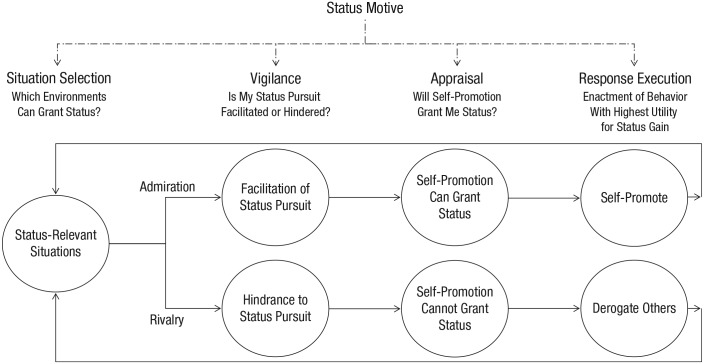
We propose a self-regulation model of grandiose narcissism. This model illustrates an interconnected set of processes through which narcissists (i.e., individuals with relatively high levels of grandiose narcissism) pursue social status in their moment-by-moment transactions with their environments. The model shows that narcissists select situations that afford status. Narcissists vigilantly attend to cues related to the status they and others have in these situations and, on the basis of these perceived cues, appraise whether they can elevate their status or reduce the status of others. Narcissists engage in self-promotion (admiration pathway) or other-derogation (rivalry pathway) in accordance with these appraisals. Each pathway has unique consequences for how narcissists are perceived by others, thus shaping their social status over time. The model demonstrates how narcissism manifests itself as a stable and consistent cluster of behaviors in pursuit of social status and how it develops and maintains itself over time. More broadly, the model might offer useful insights for future process models of other personality traits.
Verified 2026-11-22 · 4 references not checked yet
Overview
CoChat Summary
TL;DR
The paper proposes the SPIN model, a self-regulation framework in which grandiose narcissism is driven by a dominant motive for social status and unfolds through situation selection, vigilance, appraisal, and response execution. It explains when narcissists self-promote (admiration pathway) versus derogate others (rivalry pathway), and how these pathways shape status and likability across status-oriented versus affiliation-oriented settings.
Key findings
- Narcissists are argued to pursue status more strongly, more narrowly (at the cost of affiliation), and more rigidly than nonnarcissists; the status motive is positioned as the core of grandiose narcissism.
- The SPIN sequence is: select public and hierarchical situations; vigilantly attend to status-relevant cues; appraise whether self-promotion or other-derogation can secure status; then execute admiration or rivalry responses.
- Admiration is described as the default pathway when status pursuit seems facilitated; rivalry emerges when self-promotion is blocked or hindered, especially after criticism, humiliation, or being outperformed.
- Consequences depend on setting: in status-oriented settings, admiration and rivalry can aid status; in affiliation-oriented settings, initial status and likability gains tend to erode over time, especially through rivalry. No original numerical results are reported.
Methods
- Theoretical/conceptual article: proposes a process model by integrating evolutionary and motivational accounts of behavior with self-regulatory processing models of narcissism.
- No new empirical sample or primary data analysis; the argument draws on prior theory and findings from existing studies.
- The paper outlines future tests using intensive longitudinal experience-sampling/smartphone methods and experimental or field interventions targeting each proposed process.
Limitations
- The paper states that vigilance and appraisals have not been studied in relation to narcissism, and that the model needs more empirical scrutiny before it can be translated into intervention programs.
- The paper states that not all proposed processes have equal empirical support: status motivation, situation selection, and response execution have more evidence than vigilance and appraisal.
- Evident from the text: the model is conceptual and largely synthesizes indirect or correlational evidence; it focuses on grandiose narcissism and explicitly excludes vulnerable narcissism and narcissistic personality disorder, limiting its scope.
Model-written summary. Check it against the paper before relying on it.
Integrity signals
Registry
Cites
Statistics
Figures
Verification
Claims the paper makes
19 Valid · 5 Not valid · 92 Not checked · 82 Own results and interpretations
The sources with a verdict support this claim; the rest weren’t checked yet, have no full text we could read, or their verdicts aren’t rated yet.
In the paper
“They often demonstrate an increased preference for high-status friends (Jonason & Schmitt, 2012) and trophy partners (Campbell, 1999), perhaps because they can bask in the reflected glory of these people.”
§ The “Why” and “How” of Narcissism: A Process Model of Narcissistic Status Pursuit > The SPIN Model > Situation selection
What the sources say
- Supportedcites Jonason & Schmitt, 2012 matched to “What Have You Done for Me Lately? Friendship-Selection in the Shadow of the Dark Triad Traits” (2012) source
Only the high-status-friends clause is attributed to Jonason and Schmitt; the trophy-partners clause cites a different source. In Results and Discussion, Table 2 reports positive associations between narcissism and social status as a reason for choosing same-sex friends and as a desired friend characteristic (page not available in our copy). (LLM, conf=0.93)
- Not checked — no full text of the sourcecites Campbell, 1999 matched to “Narcissism and romantic attraction.” (1999) source
boostedstates an association- Asserted: passes — The authors put it forward as true.
- Checkable: passes — It can be checked against evidence.
- Load-bearing: passes — The paper’s conclusions depend on it.
- Based: passes — The paper gives a reason why it holds.
- Supported
The cited sources support only part of this claim — read each source’s verdict below.
In the paper
“The gradual emergence of rivalry in affiliative settings can eventually damage narcissists’ relationships with others (Campbell & Campbell, 2009; Sedikides & Campbell, 2017).”
§ The “Why” and “How” of Narcissism: A Process Model of Narcissistic Status Pursuit > The SPIN Model > Social consequences of admiration and rivalry
What the sources say
- Not checked — no full text of the sourcecites Campbell & Campbell, 2009 matched to “On the Self-regulatory Dynamics Created by the Peculiar Benefits and Costs of Narcissism: A Contextual Reinforcement Model and Examination of Leadership” (2009) source
- Partly supportedcites Sedikides & Campbell, 2017 matched to “Narcissistic Force Meets Systemic Resistance: The Energy Clash Model” (2017) sourceExperimental — accuracy not yet measured
In “Antipathy toward Narcissistic Leaders” (page unavailable), the paper says people form increasingly unfavorable impressions of narcissists as they get to know them, supporting the claim that relationships can worsen over time. Its discussion concerns organizational and leadership relationships; it does not identify gradually emerging rivalry in affiliative settings as the cause. (LLM, conf=0.84)
plainstates a possible cause- Asserted: passes — The authors put it forward as true.
- Checkable: passes — It can be checked against evidence.
- Load-bearing: passes — The paper’s conclusions depend on it.
- Based: passes — The paper gives a reason why it holds.
The sources with a verdict support this claim; the rest weren’t checked yet, have no full text we could read, or their verdicts aren’t rated yet.
In the paper
“Narcissists (i.e., individuals with relatively high levels of grandiose narcissism) tend to go out of their way to impress others: They often groom their appearance to grasp others’ attention (Back, Schmukle, & Egloff, 2010), brag about themselves (Buss & Chiodo, 1991), and showcase their talents and abilities in front of others (Wallace & Baumeister, 2002).”
§ The “Why” and “How” of Narcissism: A Process Model of Narcissistic Status Pursuit > Abstract
What the sources say
- Supportedcites Back, Schmukle, & Egloff, 2010 matched to “Why are narcissists so charming at first sight? Decoding the narcissism–popularity link at zero acquaintance.” (2010) source
Back et al. report in “The Popularity of Narcissists at First Sight” (p. 10) that narcissism was related to fancier clothing, supporting the appearance-related point attached to this citation. Their lens-model discussion (p. 3) also describes flashy, neatly kept clothing and dressed-up hairstyles. The separate claims about bragging and showcasing talents cite other sources and are not judged here. (LLM, conf=0.89)
- Not checked — no full text of the sourcecites Buss & Chiodo, 1991 matched to “Narcissistic Acts in Everyday Life” (1991) source
- Not checked — no full text of the sourcecites Wallace & Baumeister, 2002 matched to “The performance of narcissists rises and falls with perceived opportunity for glory.” (2002) source
plainstates an association- Asserted: passes — The authors put it forward as true.
- Checkable: passes — It can be checked against evidence.
- Load-bearing: passes — The paper’s conclusions depend on it.
- Based: passes — The paper gives a reason why it holds.
- Supported
The cited sources support only part of this claim — read each source’s verdict below.
In the paper
“At the same time, narcissists are often combative toward others. In such instances, they are often perceived as confrontational, insulting, belittling, and intimidating (Holtzman, Vazire, & Mehl, 2010; Morf & Rhodewalt, 1993; Reijntjes et al., 2016).”
§ The “Why” and “How” of Narcissism: A Process Model of Narcissistic Status Pursuit > Abstract
What the sources say
- Partly supportedcites Holtzman, Vazire, & Mehl, 2010 matched to “Sounds like a narcissist: Behavioral manifestations of narcissism in everyday life” (2010) sourceExperimental — accuracy not yet measured
The Results (Behavioral Correlates of Narcissism; page not provided) associate narcissism with disagreeable acts, including arguing, swear words, and anger words, supporting the description of combative behavior. The paper does not report that others perceived participants as confrontational, insulting, belittling, or intimidating. (LLM, conf=0.86)
- Not checked — no full text of the sourcecites Morf & Rhodewalt, 1993 matched to “Narcissism and Self-Evaluation Maintenance: Explorations in Object Relations” (1993) source
- Partly supportedcites Reijntjes et al., 2016 matched to “Narcissism, Bullying, and Social Dominance in Youth: A Longitudinal Analysis” (2016) sourceExperimental — accuracy not yet measured
The introductory passage under “Electronic supplementary material” (page unavailable) says youth with narcissistic traits often show aggression and other aversive interpersonal behavior, supporting the general description of combative behavior. The paper does not establish that narcissists are perceived specifically as confrontational, insulting, belittling, and intimidating; its study concerns bullying among youth, with findings that differ by gender (Discussion, page unavailable). (LLM, conf=0.85)
plainstates an association- Asserted: passes — The authors put it forward as true.
- Checkable: passes — It can be checked against evidence.
- Load-bearing: unclear — It is unclear whether the paper’s conclusions depend on it.
- Based: passes — The paper gives a reason why it holds.
- Partly supported
The cited sources support only part of this claim — read each source’s verdict below.
In the paper
“Narcissists might also try to stand out through their communication style, which often involves charming facial expressions, humor, as well as expressive and confident gestures that reflect their extraversion and self-confidence (Back et al., 2010; Paulhus, 1998; Tracy, Cheng, Martens, & Robins, 2011; Zeigler-Hill, Vrabel, et al., 2018).”
§ The “Why” and “How” of Narcissism: A Process Model of Narcissistic Status Pursuit > The SPIN Model > Response execution
What the sources say
- Partly supportedcites Back et al., 2010 matched to “Why are narcissists so charming at first sight? Decoding the narcissism–popularity link at zero acquaintance.” (2010) sourceExperimental — accuracy not yet measured
The Results (p. 7) link narcissists’ initial popularity to charming facial expressions, verbal humor, and self-assured body movements; the lens-model discussion (p. 3) also describes a desire to present themselves. The paper does not establish that their gestures are expressive or that those gestures reflect extraversion, and its findings concern first impressions rather than communication style generally. (LLM, conf=0.82)
- Not checked — no full text of the sourcecites Paulhus, 1998 matched to “Interpersonal and intrapsychic adaptiveness of trait self enhancement: a mixed blessing?” (1998) source
- Not checked — no full text of the sourcecites Tracy, Cheng, Martens, & Robins, 2011 matched to “The Emotional Dynamics of Narcissism: Inflated by Pride, Deflated by Shame” (2011) source
hedgedstates a cause- Asserted: passes — The authors put it forward as true.
- Checkable: passes — It can be checked against evidence.
- Load-bearing: unclear — It is unclear whether the paper’s conclusions depend on it.
- Based: passes — The paper gives a reason why it holds.
- Partly supported
129 more claims · 11 with their cited sources checked
Create a free account to see all 198 claims and to verify the 24 references still open.
- It may state two separate claims as one. 47
- Probably not a substantial claim. 20
Self-check
Percentages, sums and reported differences re-computed from the paper’s own numbers.
Each contradiction between two passages listed here was confirmed by an independent check.
Rated minor: it would not touch a result — a value no result rests on, a p-value that stays on the same side of the significance level, or a conflict that is clerical, resolved elsewhere in the paper, or outside its own findings.
In the paper
§ The “Why” and “How” of Narcissism: A Process Model of Narcissistic Status Pursuit > References
“Krizan Z. Bushman B. J. (2011). Better than my loved ones: Social comparison tendencies among narcissists. Personality and Individual Differences, 50, 212– 216. doi: 10.1016/j.paid.2010.09.031”
§ The “Why” and “How” of Narcissism: A Process Model of Narcissistic Status Pursuit > References
“Krizan Z. Herlache A. D. (2018). The narcissism spectrum model: A synthetic view of narcissistic personality. Personality and Social Psychology Review, 22, 3– 31. doi: 10.1016/j.paid.2010.09.031”
Rated minor: it would not touch a result — a value no result rests on, a p-value that stays on the same side of the significance level, or a conflict that is clerical, resolved elsewhere in the paper, or outside its own findings.
In the paper
§ The “Why” and “How” of Narcissism: A Process Model of Narcissistic Status Pursuit > References
“Back M. D. Küfner A. C. P. Leckelt M. (2018). Early impressions of grandiose narcissists: A dual-pathway perspective. In Hermann A. D. Brunell A. B. Foster J. D. (Eds.), The handbook of trait narcissism: Key advances, research methods, and controversies (pp. 309– 316).”
§ The “Why” and “How” of Narcissism: A Process Model of Narcissistic Status Pursuit > References
“Konrath S. Tian Y. (2018). Narcissism and prosocial behavior. In Hermann A. D. Brunell A. B. Foster J. D. (Eds.), The handbook of trait narcissism: Key advances, research methods, and controversies (pp. 309– 316).”
Citations
Cites
Diagnostic and Statistical Manual of Mental Disorders
American Psychiatric Association (2013) · doi:10.1176/appi.books.9780890425596 · Cited by 116,369
Society and the Adolescent Self-Image
Rosenberg, M. (1965) · doi:10.1515/9781400876136 · Cited by 30,126
The need to belong: Desire for interpersonal attachments as a fundamental human motivation.
Baumeister, R. F., & Leary, M. R. (1995) · Psychological Bulletin · doi:10.1037//0033-2909.117.3.497 · Cited by 23,245 · cited 1×
“Some individuals want status as long as it does not go against their motive to get along well with others (i.e., affiliation motive; Baumeister & Leary, 1995; McClelland, 1987), whereas other individuals want status even at the cost of getting along well with others.”
BackgroundThe emerging field of emotion regulation: an integrative review
Gross, J. J. (1998) · Review of General Psychology · doi:10.1037/1089-2680.2.3.271 · Cited by 9,916 · cited 4×
“In so doing, we build on core self-regulation processes (e.g., Baumeister, Schmeichel, & Vohs, 2007; Denissen et al., 2013; Geukes, van Zalk, & Back, 2018; Gross, 1998): situation selection,1 attention (which we term vigilance for reasons outlined below), appraisal, and response execution.”
InfluentialA social-cognitive approach to motivation and personality.
Dweck, C. S., & Leggett, E. L. (1988) · Psychological Review · doi:10.1037/0033-295x.95.2.256 · Cited by 9,745 · cited 1×
“For example, interventions could teach individuals to reappraise critical feed-back not as a sign of their incompetence but as a set of suggestions that indicate how to improve their competence (for a similar rationale, see Dweck & Leggett, 1988; Yeager, Trzesniewski, & Dweck, 2013).”
Crick, N. R., & Dodge, K. A. (1994) · Psychological Bulletin · doi:10.1037/0033-2909.115.1.74 · Cited by 5,510 · cited 2×
“Individuals are assumed to be especially vigilant toward environmental cues that convey information about how much environments facilitate or hinder their goal pursuit (Crick & Dodge, 1994).”
BackgroundSocial psychology: handbook of basic principles
(2008) · Choice Reviews Online · doi:10.5860/choice.45-3496 · Cited by 5,473
Taking time seriously: A theory of socioemotional selectivity.
Carstensen, L. L., Isaacowitz, D. M., & Charles, S. T. (1999) · American Psychologist · doi:10.1037//0003-066x.54.3.165 · Cited by 5,377
The dark triad of personality: Narcissism, Machiavellianism, and psychopathy
Paulhus, D. L., & Williams, K. M. (2002) · Journal of Research in Personality · doi:10.1016/s0092-6566(02)00505-6 · Cited by 5,265 · cited 1×
“Some scholars have proposed that narcissism belongs to a broader group of so-called dark traits (including Machiavellianism and psychopathy; Paulhus & Williams, 2002) that represent a tendency to “maximize one’s own utility” while “disregarding, accepting, or malevolently provoking disutility for…”
BackgroundCoping theory and research: past, present, and future
Lazarus, R. S. (1993) · Psychosomatic Medicine · doi:10.1097/00006842-199305000-00002 · Cited by 3,253 · cited 1×
“Appraisals therefore direct the selection of goal-fulfilling behaviors (Crick & Dodge, 1994; Lazarus, 1993) in response to cues indicating that a situation is relevant to goal fulfillment.”
Research works printed but not linked: 6
- Back M. D. Küfner A. C. P. Leckelt M. (2018). Early impressions of grandiose narcissists: A dual-pathway perspective. In Hermann A. D. Brunell A. B. Foster J. D. (Eds.), The handbook of trait narcissism: Key advances, research methods, and controversies (pp. 309– 316). New York, NY: Springer. doi: 10.1007/978-3-319-92171-6_6 · DOI · Paper page
- Campbell W. K. Brunell A. B. Finkel E. J. (2006). Narcissism, interpersonal self-regulation, and romantic relationships: An agency model approach. In Vohs K. D. Finkel E. J. (Eds.), Self and relationships (pp. 57– 83). New York, NY: Guilford Press.
- Campbell W. K. Foster J. D. (2007). The narcissistic self: Background, an extended agency model, and ongoing controversies. In Sedikides C. Spencer S. J. (Eds.), The self (pp. 115– 138). New York, NY: Psychology Press.
- Erikson E. H. (1959). Identity and the life cycle: Selected papers. Psychological Issues, 1, 1– 171.
- Freud S. (1955). Libidinal types. London, England: Hogarth Press. (Original work published 1931)
- Reich W. (1949). Character analysis (3rd ed.), (T. P. Wolfe, Trans.). New York, NY: Orgone Institute Press. (Original work published 1933)
Cited by
Narcissism Today: What We Know and What We Need to Learn
Miller, J. D., Back, M. D., Lynam, D. R., & Wright, A. G. C. (2021) · Current Directions in Psychological Science · doi:10.1177/09637214211044109 · Cited by 319
“According to the status-pursuit-in-narcissism model (Grapsas et al., 2020), narcissism is related to selection of situations that afford status, increased attention to status-related cues, and increased behavioral activation following evaluations of these cues and appraisals of whether they signal…”
MethodSelf-citationNationalism as collective narcissism
Cichocka, A., & Cislak, A. (2020) · Current Opinion in Behavioral Sciences · doi:10.1016/j.cobeha.2019.12.013 · Cited by 191
Sedikides, C. (2020) · Trends in Cognitive Sciences · doi:10.1016/j.tics.2020.10.010 · Cited by 157
The dynamics, processes, mechanisms, and functioning of personality: An overview of the field
Kuper, N., Modersitzki, N., Phan, L. V., & Rauthmann, J. F. (2021) · British Journal of Psychology · doi:10.1111/bjop.12486 · Cited by 134
Weidmann, R., Chopik, W. J., Ackerman, R. A., Allroggen, M., Bianchi, E. C., Brecheen, C., Campbell, W. K., Gerlach, T. M., Geukes, K., Grijalva, E. J., et al. (2023) · Journal of Personality and Social Psychology · doi:10.1037/pspp0000463 · Cited by 145
“Further, narcissism is linked to short-term mating strategies, social status, and dominant behaviors (e.g., Cheng et al., 2010; Grapsas et al., 2020; Holtzman & Donnellan, 2015).”
Self-citationGauglitz, I. K., Schyns, B., Fehn, T., & Schütz, A. (2023) · Journal of Business Ethics · doi:10.1007/s10551-022-05146-6 · Cited by 84
Narcissism and conspicuous consumption
Sedikides, C., & Hart, C. M. (2022) · Current Opinion in Psychology · doi:10.1016/j.copsyc.2022.101322 · Cited by 75
Rogoza, R., Cieciuch, J., & Strus, W. (2021) · Journal of Research in Personality · doi:10.1016/j.jrp.2021.104167 · Cited by 70
Mahadevan, N., & Jordan, C. H. (2021) · Personality and Social Psychology Bulletin · doi:10.1177/01461672211021189 · Cited by 64
“Grapsas et al. (2020) and Zeigler-Hill et al. (2019) both suggest that narcissistic admiration is associated with the perception of high status attainment, through self-enhancement, but that rivalry reflects a vigilance for threats to status that may be associated with lower perceived attainment of…”
BackgroundResultInfluentialFehn, T., & Schütz, A. (2020) · Journal of Business Ethics · doi:10.1007/s10551-020-04604-3 · Cited by 73
Development of narcissism across the life span: A meta-analytic review of longitudinal studies.
Orth, U., Krauss, S., & Back, M. D. (2024) · Psychological Bulletin · doi:10.1037/bul0000436 · Cited by 79
Self-citationSocial goals and gains of adolescent bullying and aggression: A meta-analysis
Hensums, M., Brummelman, E., Larsen, H., van den Bos, W., & Overbeek, G. J. (2023) · Developmental Review · doi:10.1016/j.dr.2023.101073 · Cited by 74
“…in coercive strategies to gain desired resources (e.g., agency), such as fewer prosocial personality traits (Book et al., 2012), low hostility-humility traits (de Vries et al., 2020), and higher levels of narcissism which is characterized by a strong desire for social status (Grapsas et al., 2020).”
BackgroundSelf-citationRaising Children With High Self-Esteem (But Not Narcissism)
Brummelman, E., & Sedikides, C. (2020) · Child Development Perspectives · doi:10.1111/cdep.12362 · Cited by 49
“Also, these parents are emotionally invested in their children’s social status (Grapsas, Brummelman, et al., 2020).”
Self-citationNarcissism and stress-reactivity: a biobehavioural health perspective
Coleman, S. R. M., Pincus, A. L., & Smyth, J. M. (2019) · Health Psychology Review · doi:10.1080/17437199.2018.1547118 · Cited by 44
Cheshure, A., Zeigler‐Hill, V., Sauls, D., Vrabel, J. K., & Lehtman, M. J. (2019) · Personality and Individual Differences · doi:10.1016/j.paid.2019.109679 · Cited by 56
Employee narcissism and promotability prospects
Nevicka, B., & Sedikides, C. (2021) · Journal of Personality · doi:10.1111/jopy.12619 · Cited by 50
“Narcissistic individuals are strongly characterized by motives for status and power, and so are attracted to hierarchies that offer them such opportunities and that they feel confident they can scale (Grapsas et al., 2020; Zitek & Jordan, 2016).”
BackgroundInfluentialPerceived susceptibility to COVID-19 infection and narcissistic traits
Venema, T. A. G., & Pfattheicher, S. (2021) · Personality and Individual Differences · doi:10.1016/j.paid.2021.110696 · Cited by 48
Fang, Y., Niu, Y., & Dong, Y. H. (2020) · Personality and Individual Differences · doi:10.1016/j.paid.2020.110604 · Cited by 54
Narcissism and psychological needs for social status, power, and belonging
Zeigler‐Hill, V., & Dehaghi, A. M. B. (2023) · Personality and Individual Differences · doi:10.1016/j.paid.2023.112231 · Cited by 51
Social interaction processes and personality
Back, M. D. (2021) · Elsevier eBooks · doi:10.1016/b978-0-12-813995-0.00008-x · Cited by 74
Self-citationEdershile, E. A., & Wright, A. G. C. (2021) · Social and Personality Psychology Compass · doi:10.1111/spc3.12649 · Cited by 54
Zeigler‐Hill, V., Sauls, D., & Malay, P. (2020) · Self and Identity · doi:10.1080/15298868.2020.1779118 · Cited by 38
Mahadevan, N., Gregg, A. P., & Sedikides, C. (2020) · Journal of Personality · doi:10.1111/jopy.12559 · Cited by 33
“Finally, narcissism has been linked to the pursuit of status both theoretically and empirically (Grapsas, Brummelman, Back, & Denissen, 2019; Zeigler-Hill et al., 2019).”
Personality and Social Relationships: What Do We Know and Where Do We Go
Back, M. D., Branje, S., Eastwick, P. W., Human, L. J., Penke, L., Sadikaj, G., Slatcher, R. B., Thielmann, I., van Zalk, M. H. W., & Wrzus, C. (2023) · Personality Science · doi:10.5964/ps.7505 · Cited by 55
“Similarly, following social status accounts to narcissism, narcissistic individuals can be expected to react particularly aggressively to those who act dominant and, thus, are perceived as threats to social status (Grapsas et al., 2020; Mota et al., 2022).”
BackgroundSelf-citationZeigler‐Hill, V., Sauls, D., Ochoa, V., Kopitz, J. L., & Besser, A. (2021) · Evolutionary Psychological Science · doi:10.1007/s40806-021-00278-w · Cited by 36
Szabó, Z. P., Kun, Á., Balogh, B., Simon, E., & Csike, T. (2021) · Personality and Individual Differences · doi:10.1016/j.paid.2021.111339 · Cited by 43
Schalkwijk, F., Luyten, P., Ingenhoven, T., & Dekker, J. (2021) · Frontiers in Psychology · doi:10.3389/fpsyg.2021.676733 · Cited by 30
O’Reilly, C. A., & Pfeffer, J. (2020) · Personality and Individual Differences · doi:10.1016/j.paid.2020.110557 · Cited by 37
Pathways From Narcissism to Leadership Emergence in Social Groups
Härtel, T. M., Leckelt, M., Grosz, M. P., Küfner, A. C. P., Geukes, K., & Back, M. D. (2021) · European Journal of Personality · doi:10.1177/08902070211046266 · Cited by 35
Self-citationJauk, E., Olaru, G., Schürch, E., Back, M. D., & Morf, C. C. (2022) · Assessment · doi:10.1177/10731911221075761 · Cited by 32
Self-citationNarcissus locked in the past: vulnerable narcissism and the negative views of the past.
Zajenkowski, M., Rogoza, R., Maciantowicz, O., Witowska, J., & Jonason, P. K. (2021) · Journal of Research in Personality · doi:10.1016/j.jrp.2021.104123 · Cited by 30
“…through self-promotion and praise-seeking and when they fail to get it, they derogate others to protect their ego (Back et al., 2013; Back, 2018; Grapsas, Brummelman, Back, & Denissen, 2020; Wetzel, Leckelt, Gerlach, & Back, 2016) whereas vulnerable narcissists do so by withdrawing to avoid…”
BackgroundBad Is Stronger Than Good: A Review of the Models and Measures of Dark Personality
Harms, P. D. (2022) · Zeitschrift für Psychologie · doi:10.1027/2151-2604/a000496 · Cited by 36
Seidman, G., Shrout, P. E., & Zeigler‐Hill, V. (2020) · Journal of Research in Personality · doi:10.1016/j.jrp.2020.104022 · Cited by 33
Balcerowska, J. M., & Sawicki, A. J. (2022) · Personality and Individual Differences · doi:10.1016/j.paid.2022.111530 · Cited by 32
Kirk, C. P., Peck, J., Hart, C. M., & Sedikides, C. (2022) · Journal of Business Research · doi:10.1016/j.jbusres.2022.06.004 · Cited by 28
My way or the highway: Narcissism and dysfunctional team conflict processes
Lynch, J., McGregor, A., & Benson, A. J. (2021) · Group Processes & Intergroup Relations · doi:10.1177/13684302211001944 · Cited by 32
“As individuals higher in narcissistic admiration tend to be successful in achieving their social goals (Grapsas et al., 2020), they might be equally savvy in how they approach and navigate moments of conflict within teams and organizations.”
BackgroundInfluentialCulture and narcissism: The roles of fundamental social motives
Li, Z., & Benson, A. J. (2022) · Current Research in Behavioral Sciences · doi:10.1016/j.crbeha.2022.100072 · Cited by 41
Mahadevan, N., Gregg, A. P., & Sedikides, C. (2023) · Journal of Experimental Psychology General · doi:10.1037/xge0001286 · Cited by 41
Self‐Worth and Politics: The Distinctive Roles of Self‐Esteem and Narcissism
Cichocka, A. K., Marchlewska, M., & Cisłak, A. (2023) · Political Psychology · doi:10.1111/pops.12897 · Cited by 38
Luxury consumption and the dark triad of personality
Razmus, W., Czarna, A. Z., & Fortuna, P. (2023) · Journal of Business Research · doi:10.1016/j.jbusres.2023.114246 · Cited by 34
Narcissism and Leadership in Children
Brummelman, E., Nevicka, B., & O’Brien, J. (2021) · Psychological Science · doi:10.1177/0956797620965536 · Cited by 31
Self-citationLay theories of grandiose and vulnerable narcissism
Koepernik, T., Jauk, E., & Kanske, P. (2021) · Current Psychology · doi:10.1007/s12144-020-01296-w · Cited by 29
Affective contingencies of narcissism.
Grapsas, S., Brummelman, E., Dufner, M., & Denissen, J. J. A. (2022) · Journal of Personality and Social Psychology · doi:10.1037/pspp0000406 · Cited by 27
Self-citationThe Psychology of Collective Narcissism: Insights from Social Identity Theory
de Zavala, A. G. (2023) · Routledge eBooks · doi:10.4324/9781003296577 · Cited by 53
The dynamics, processes, mechanisms, and functioning of personality: An overview of the field.Preprint
Kuper, N., Modersitzki, N., Phan, L., & Rauthmann, J. (2020) · British Journal of Psychology · doi:10.31234/osf.io/pcgfa · Cited by 71
Putting Oneself Ahead of the Group: The Liability of Narcissistic Leadership
Lynch, J., & Benson, A. J. (2023) · Personality and Social Psychology Bulletin · doi:10.1177/01461672231163645 · Cited by 31
“…may not deeply care about leading others in ways that optimize benefits for the collective, they desire the status afforded by such positions (Grapsas et al., 2020; Zeigler-Hill et al., 2019), tend to occupy leadership positions, and play a crucial role in organizations (Maccoby, 2000;…”
BackgroundMethodResultInfluentialDark clouds on the horizon: Dark personality traits and the frontiers of the entrepreneurial economy
Harms, P. D., White, J. V., & Fezzey, T. N. A. (2023) · Journal of Business Research · doi:10.1016/j.jbusres.2023.114364 · Cited by 30
Fatfouta, R., Rogoza, R., Brud, P. P., & Rentzsch, K. (2021) · Journal of Research in Personality · doi:10.1016/j.jrp.2021.104156 · Cited by 26
“In other words, the agentic facet explains how narcissists attain social status, while the antagonistic facet explains why they are unable to maintain it (Grapsas et al., 2020).”
Dynamics of narcissistic grandiosity and vulnerability in naturalistic and experimental settings.
Edershile, E. A., Szücs, A., Dombrovski, A. Y., & Wright, A. G. C. (2024) · Journal of Personality and Social Psychology · doi:10.1037/pspp0000510 · Cited by 28
Braun, S. H., Sleebos, E., Zou, L. L., & Wisse, B. M. (2024) · Journal of Occupational and Organizational Psychology · doi:10.1111/joop.12555 · Cited by 25
Mahadevan, N. (2024) · Social and Personality Psychology Compass · doi:10.1111/spc3.12977 · Cited by 28
Narcissism and Exercise Addiction: The Mediating Roles of Exercise-Related Motives
Zeigler‐Hill, V., Besser, A., Gabay, M., & Young, G. (2021) · International Journal of Environmental Research and Public Health · doi:10.3390/ijerph18084243 · Cited by 27
“These results align with recent arguments that attitudes and behaviors connected with the pursuit of status may be a central feature of narcissism [26,55,80] because exercise may serve as another means for narcissistic individuals to navigate local status hierarchies by demonstrating their dominance and superiority ov…”
ResultZeigler‐Hill, V., & Vrabel, J. K. (2022) · Self and Identity · doi:10.1080/15298868.2022.2091656 · Cited by 22
“The idea that individuals with narcissistic personality features may be motivated by the desire to feel superior to others is consistent with recent arguments that narcissism may actually reflect an evolved psychological system that is primarily concerned with the navigation of status hierarchies (Grapsas et al., 2020…”
ResultGrapsas, S., Denissen, J. J. A., Lee, H. Y., Bos, P. A., & Brummelman, E. (2020) · Developmental Science · doi:10.1111/desc.13062 · Cited by 23
Self-citationStatus, rivalry and admiration-seeking in narcissism and depression: A behavioral study
Szücs, A., Szántó, K., Adalbert, J., Wright, A. G. C., Clark, L., & Dombrovski, A. Y. (2020) · PLoS ONE · doi:10.1371/journal.pone.0243588 · Cited by 22
“Our participants were not specifically sampled for high/pathological levels of narcissism, since most of the conceptual frameworks relevant to our paradigm have focused on normally distributed subclinical narcissistic traits [3,26,60].”
BackgroundRole of engagement in online gaming: a study of generation Z customers
Jasrotia, S. S., Kamila, M. K., Chib, S., & Mishra, H. G. (2022) · Digital Creativity · doi:10.1080/14626268.2022.2033272 · Cited by 29
“response to a situation which they think could be more acceptable to the society in general rather than being the true self (Grapsas et al. 2020).”
BackgroundScharbert, J., Dein, L. M., Kroencke, L., Nestler, S., Back, M. D., & Utesch, K. (2024) · Journal of Personality and Social Psychology · doi:10.1037/pspp0000495 · Cited by 26
Self-citationBenson, A. J., & Giacomin, M. (2020) · Journal of Personality · doi:10.1111/jopy.12565 · Cited by 23
Narcissism and Wellbeing: A Cross-Cultural Meta-Analysis
Sedikides, C., Tang, Y., Liu, Y., de Boer, E., Assink, M., Thomaes, S. C. E., & Brummelman, E. (2024) · Personality and Social Psychology Bulletin · doi:10.1177/01461672241307531 · Cited by 31
“They also pursue and maintain their inflated self-views by seeking admiration via assertive self-promotion (Back et al., 2013; Grapsas et al., 2020).”
Self-citationNational narcissism in politics and public understanding of science
Cisłak, A., & Cichocka, A. K. (2023) · Nature Reviews Psychology · doi:10.1038/s44159-023-00240-6 · Cited by 29
“tend to reinforce each other 36 , but those high in narcissism are especially likely to display rivalry when their self-promoting efforts fail to succeed 37 .”
BackgroundI feel smart today! A daily diary study on narcissism and self-assessed intelligence
Rogoza, R., Zajenkowski, M., Sarno, M. D., Flakus, M., Baran, L. N., Pierro, R. D., Krammer, G., Jauk, E., & Fatfouta, R. (2023) · European Journal of Personality · doi:10.1177/08902070231212313 · Cited by 17
“They may, on the other hand, temporarily assess themselves as less intelligent under certain circumstances, such as failures, criticism, and rebuke, including perceived lack of admiration from others (Grapsas et al., 2020).”
BackgroundMota, S., Mielke, I., Kroencke, L., Geukes, K., Nestler, S., & Back, M. D. (2022) · European Journal of Personality · doi:10.1177/08902070221081322 · Cited by 26
Self-citationSocial interaction processes and personalityPreprint
Back, M. (2020) · The Handbook of Personality Dynamics and Processes · doi:10.31234/osf.io/evm4n · Cited by 27
Self-citationTriggered Abuse: How and Why Leaders with Narcissistic Rivalry React to Follower Deviance
Gauglitz, I. K., & Schyns, B. (2024) · Journal of Business Ethics · doi:10.1007/s10551-023-05579-7 · Cited by 18
“Furthermore, it has been assumed that status-protection is an important motive that guides the behavior of individuals high in narcissistic rivalry such that they behave aggressively when their status is undermined (Grapsas et al., 2019).”
I tweet, therefore I am: a systematic review on social media use and disorders of the social brain
Yang, N. Y., & Crespi, B. J. (2025) · BMC Psychiatry · doi:10.1186/s12888-025-06528-6 · Cited by 43
Bullying, victimization, and psychopathy in early adolescents: The moderating role of social support
Despoti, G., Kokkinos, C. M., & Fanti, K. A. (2020) · European Journal of Developmental Psychology · doi:10.1080/17405629.2020.1858787 · Cited by 26
“A possible explanation for this finding could be that narcissistic youth, especially boys, are perhaps longing to attain higher positions in the social hierarchy, which outweighs other motives, such as that of authentic personal connections with peers (Grapsas et al., 2020).”
BackgroundNowak, B., Brzóska, P., Piotrowski, J. P., & Żemojtel-Piotrowska, M. A. (2021) · Personality and Individual Differences · doi:10.1016/j.paid.2021.111167 · Cited by 22
Rentzsch, K., Wieczorek, L. L., & Gerlach, T. M. (2021) · Social Psychological and Personality Science · doi:10.1177/1948550620987419 · Cited by 19
“…social situations, it might be of pronounced value for the investigation of interpersonal dynamics; for example, the perception of power discrepancies is not considered within the DIAMONDS taxonomy but might be crucial to understand narcissistic situational construal (e.g., Grapsas et al., 2020).”
BackgroundClimb up your ego! Narcissistic status pursuit and motivation to lead
Prundeanu, O., Constantin, T., & Popușoi, S. A. (2021) · Personality and Individual Differences · doi:10.1016/j.paid.2021.110830 · Cited by 17
Organizational power and politics: The narcissist's advantage?
O’Reilly, C. A., & Pfeffer, J. (2021) · Personality and Individual Differences · doi:10.1016/j.paid.2021.111061 · Cited by 21
Grosz, M. P., Hartmann, I., Dufner, M., Leckelt, M., Gerlach, T. M., Rauthmann, J. F., Denissen, J. J. A., Küfner, A. C. P., & Back, M. D. (2021) · Assessment · doi:10.1177/10731911211020075 · Cited by 18
“The social dominance domain is relevant because social status and leadership are central goals for many people high in narcissism (e.g., Grapsas et al., 2020; Zeigler-Hill et al., 2019).”
BackgroundSelf-citationRogoza, R., & Danieluk, B. (2021) · Journal of Research in Personality · doi:10.1016/j.jrp.2021.104129 · Cited by 16
Cichocka, A. K., Cisłak, A., Stronge, S., Osborne, D., & Sibley, C. G. (2019) · Journal of Research in Personality · doi:10.1016/j.jrp.2019.103882 · Cited by 23
Schyns, B., Gauglitz, I. K., Wisse, B. M., & Schütz, A. (2022) · Oxford University Press eBooks · doi:10.1093/oso/9780197552759.003.0013 · Cited by 26
Richter, M., Mota, S., Hater, L., Bratek, R., Goltermann, J., Barkhau, C., Gruber, M., Repple, J., Storck, M., Blitz, R., et al. (2023) · The Lancet Psychiatry · doi:10.1016/s2215-0366(23)00293-6 · Cited by 20
Self-citationDong, Y. H., Wen, W., Zhang, D., & Fang, Y. (2020) · Children and Youth Services Review · doi:10.1016/j.childyouth.2020.105521 · Cited by 18
Davis, A. C., & Vaillancourt, T. (2022) · Current Psychology · doi:10.1007/s12144-021-02492-y · Cited by 20
Orthorexia nervosa and its association with narcissism in fitness center users
Martinović, D., Tokić, D., Martinovic, L., Rakušić, M., Kumrić, M., Rušić, D., Vilović, M., Vrdoljak, J., Kurir, T. T., & Božić, J. (2022) · Eating and Weight Disorders - Studies on Anorexia Bulimia and Obesity · doi:10.1007/s40519-022-01368-9 · Cited by 20
“Furthermore, narcissism was found to be linked with appearance concerns [52, 53] and pursuit of status [54, 55].”
BackgroundMotive-Specific Affective Contingencies and Their Relevance for Personality and Motivated Behavior
Dufner, M., Wieg, F., Kraft, L., Grapsas, S., & Hagemeyer, B. (2023) · European Journal of Personality · doi:10.1177/08902070231156842 · Cited by 20
“The fi ndings thus indicate that grandiose narcissists ’ pronounced tendency to seek power and their attenuated need for af fi liation, which are well documented in the literature, might indeed go back to characteristic underlying motive-speci fi c PACs (Grapsas et al., 2020, 2022).”
BackgroundSelf-citationZeigler‐Hill, V., Cosby, C. A., Vrabel, J. K., & Southard, A. C. (2020) · Journal of Social and Personal Relationships · doi:10.1177/0265407520939190 · Cited by 21
“It has recently been argued that the pursuit of social status may play an even more fundamental role in the understanding of narcissism than had been previously recognized (Grapsas et al., 2020; Zeigler-Hill et al., 2018, 2019).”
BackgroundLazarević, L. B., Knežević, G., & Bošnjak, M. (2021) · Current Psychology · doi:10.1007/s12144-021-02112-9 · Cited by 14
Li, Z. (2023) · Personality and Individual Differences · doi:10.1016/j.paid.2023.112154 · Cited by 17
Narcissism and seeing red: How perceptions of social rank conflict fuels dominance
McGregor, A., Baird, N., Jensen, L., & Benson, A. J. (2023) · Personality and Individual Differences · doi:10.1016/j.paid.2023.112328 · Cited by 15
Murphy, B. A., Casto, K. V., Watts, A. L., Costello, T. H., Jolink, T. A., Verona, E., & Algoe, S. B. (2022) · Journal of Research in Personality · doi:10.1016/j.jrp.2022.104305 · Cited by 17
Evolutionary benefits of personality traits when facing workplace bullying
Dåderman, A. M., & Basińska, B. (2021) · Personality and Individual Differences · doi:10.1016/j.paid.2021.110849 · Cited by 20
Moral Disengagement, Dark Triad and Face Mask Wearing during the COVID-19 Pandemic
Chávez-Ventura, G., Santa-Cruz-Espinoza, H., Domínguez-Vergara, J., & Negreiros-Mora, N. (2022) · European Journal of Investigation in Health Psychology and Education · doi:10.3390/ejihpe12090090 · Cited by 22
“In addition, it could be due to their tendency towards self-promotion [48] and status seeking [46], so they may refuse to wear masks as they perceive them as unaesthetic.”
BackgroundPlanetary Health: We Need to Talk about Narcissism
Logan, A. C., & Prescott, S. L. (2022) · Challenges · doi:10.3390/challe13010019 · Cited by 13
Lișman, C. G., & Holman, A. C. (2023) · Psihologija · doi:10.2298/psi220410003l · Cited by 23
Zajenkowski, M., Gignac, G. E., Rogoza, R., Górniak, J., Maciantowicz, O., Leniarska, M., Jonason, P. K., & Jankowski, K. S. (2023) · Psychological Science · doi:10.1177/09567976231184886 · Cited by 10
“, 2018), which is defined through increased motivation for status pursuit and viewing oneself as superior to others (Grapsas et al., 2020).”
BackgroundGignac, G. E., Jones, C. S., Mason, N., Yuen, I., & Zajenkowski, M. (2023) · Personality and Individual Differences · doi:10.1016/j.paid.2023.112382 · Cited by 18
Wang, Y., Hawk, S. T., Wong, N., & Zhang, Y. (2023) · International Journal of Behavioral Development · doi:10.1177/01650254231198034 · Cited by 17
“Generally, our findings supported strategic accounts (Grapsas et al., 2020; Morf & Rhodewalt, 2001) over impulsivity accounts (Vazire & Funder, 2006), in that only attention-seeking mediated the associations that narcissism held with cyberbullying and prosocial behaviors.”
BackgroundMethodResultInfluentialJordan, D. G., Winer, E. S., Zeigler‐Hill, V., & Marcus, D. K. (2021) · Self and Identity · doi:10.1080/15298868.2021.1944298 · Cited by 18
“Relatedly, the recent status pursuit in narcissism (SPIN) model (Grapsas et al., 2020) emphasizes momentby-moment self-regulatory processes (e.g., reflection, decision-making, and planning) related to the pursuit of status.”
BackgroundMethodWeidmann, R., Chopik, W. J., Ackerman, R. A., Allroggen, M., Bianchi, E. C., Brecheen, C., Campbell, W. K., Gerlach, T. M., Utesch, K., Grijalva, E. J., et al. (2023) · doi:10.31234/osf.io/5ygtc · Cited by 11
Self-citationTranslating trait to state assessment: The case of grandiose narcissism
Heyde, F., Wille, B., Kuijpers, E., Vergauwe, J., & Hofmans, J. (2023) · PLoS ONE · doi:10.1371/journal.pone.0284649 · Cited by 11
The nature of status: Navigating the varied approaches to conceptualizing and measuring status
Xu, T., Evans, M. B., & Benson, A. J. (2023) · Organizational Psychology Review · doi:10.1177/20413866231220505 · Cited by 14
“…those who are preferentially attuned to social comparisons and view interactions through a zero-sum lens may place greater weight on their relative status ranking in the group than the absolute level of status they are afforded (i.e., individuals high in grandiose narcissism, Grapsas et al., 2020).”
BackgroundTan, K., Jaafar, N. R. N., Bahar, N., Ibrahim, N., Baharudin, A., Ismail, W. S. W., Aziz, M. A., & Sim, S. T. (2024) · Cyberpsychology Behavior and Social Networking · doi:10.1089/cyber.2023.0337 · Cited by 13
“…the grandiose form characterized by self-confidence and assertiveness, 74,75 might be connected to higher self-regulation levels, potentially supporting self-control and goal-directed behaviors, 76,77 but additional research is needed to fully understand these dynamics and underlying mechanisms.”
Ego vs. reality: Narcissism and the discrepancy between academic expectations and achievement
Zajenkowski, M., & Gignac, G. E. (2024) · Learning and Individual Differences · doi:10.1016/j.lindif.2024.102466 · Cited by 14
Liang, T., Wang, X., Ng, S., Xu, X., & Ning, Z. (2024) · Frontiers in Psychology · doi:10.3389/fpsyg.2024.1403530 · Cited by 20
“This may drive them to perceive themselves as invincible and capable of maintaining confidence in challenging situations (Rogoza et al., 2018; Grapsas et al., 2020).”
BackgroundWang, P., Yue, Y., Ouyang, M., Yin, L., Yin, Y., & Li, B. (2024) · Social Science Computer Review · doi:10.1177/08944393241308511 · Cited by 12
“Besides, research has shown that narcissists usually have emotional needs for admiration and praise but show little empathy for others (American Psychiatric Association, 2013; Grapsas et al., 2020).”
Antisemitism as a dark-ego vehicle
Bertrams, A., & Krispenz, A. (2024) · Current Psychology · doi:10.1007/s12144-024-07120-z · Cited by 10
Metadata
- Authors
- Grapsas, S., Brummelman, E., Back, M. D., & Denissen, J. J. A.
- Affiliations
- Tilburg University (NL)
- University of Amsterdam (NL)
- University of Münster (DE)
- Corresponding author
- Grapsas, Stathis
- Venue
- Perspectives on Psychological Science
- Publisher
- SAGE Publications
- Published
- 2019-12-05
- Volume
- 15
- Issue
- 1
- Pages
- 150-172
- ISSN
- 1745-6916 (ISSN-L)
- 1745-6924
- PMC
- PMC6970445
- OpenAlex
- W2992965847
- Cited by
- 312
- References
- 213
- Citations by year
- 2026: 49 · 2025: 56 · 2024: 51 · 2023: 44 · 2022: 43 · 2021: 42 · 2020: 22 · 2019: 2
- FWCI
- 31.80
- Type
- journal article
- Language
- en
- Open access
- hybrid
- doi.org
- Licence
- cc-by-nc
- creativecommons.org/licenses/by-nc/4.0/ (unspecified)
- journals.sagepub.com/page/policies/text-and-data-mining-license (tdm)
- Locations
- Perspectives on Psychological Science (publishedVersion, cc-by-nc)
- Europe PMC (PubMed Central) (publishedVersion, cc-by-nc)
- PubMed Central (publishedVersion, cc-by-nc)
- Research portal (Tilburg University) (publishedVersion, cc-by-nc)
- PubMed (publishedVersion)
- Data Archiving and Networked Services (DANS) (submittedVersion, cc-by-nc)
- UvA-DARE (University of Amsterdam) (submittedVersion, cc-by-nc)
- Utrecht University Repository (Utrecht University) (submittedVersion, other-oa)
- Data Archiving and Networked Services (DANS) (submittedVersion, other-oa)
- Topics
- Social Sciences › Psychology › Clinical Psychology › Personality Traits and Psychology
- Social Sciences › Psychology › Social Psychology › Emotions and Moral Behavior
- Social Sciences › Sociology and Political Science › Social Power and Status Dynamics
- Keywords
- grandiose narcissism, self-regulation, self-promotion, admiration, rivalry, status signals, status perception, process model, personality development
- MeSH terms
- Adult, Humans, Models, Psychological, Motivation, Narcissism, Personality, Social Behavior, Psychological Distance
About these checks
Registry, retraction, Cites and statistics results are computed, not judged, with one exception: a printed reference that no index lists is read once by a model before it counts as a citation error. Claims are extracted by a model and kept only when their quote appears verbatim in the text; each cited source is then checked, with a model’s help, for whether it says what the claim relies on. Those verdicts can be wrong — read the claim’s quote and the cited source before relying on one.
The claim verdicts this report counts are experimental: their accuracy is not yet measured.
A language model drew the claims from the paper on 2026-10-10, under version 3 of the claim definition (model deepseek-v4.1-flash, prompt extract-v3).
A second model labelled each claim on 2026-10-10 (model jev-1.13-20260917, definition revision gold-guideline-v0.2).
Cited sources are checked with a language model’s help (gpt-6-sol).
Statistics and arithmetic are recomputed, not judged.
Confidence bands are shown only for fields calibrated on our annotated test set. None is calibrated yet, so no band is shown.
What counts as a claim ›How we measure confidence ›How we check this ›
Are you an author, or do you see a problem with this page? Request a review
Data sources
Bibliographic data: Semantic Scholar, OpenAlex, Crossref.
Contains information from the Semantic Scholar Academic Graph Datasets, made available under the ODC Attribution License (ODC-BY 1.0).
Semantic Scholar’s data is described in: Kinney, R., et al. (2023). The Semantic Scholar Open Data Platform. arXiv:2301.10140.
