

Consequences of cognitive offloading: Boosting performance but diminishing memory
Open accessThe DOI matches its Crossref record; 65 of the 65 references it cites were found in a registry or an index; 11 of the 61 sources its claims cite were checked for support.
Abstract
Modern technical tools such as tablets allow for the temporal externalisation of working memory processes (i.e., cognitive offloading). Although such externalisations support immediate performance on different tasks, little is known about potential long-term consequences of offloading behaviour. In the current set of experiments, we studied the relationship between cognitive offloading and subsequent memory for the offloaded information as well as the interplay of this relationship with the goal to acquire new memory representations. Our participants solved the Pattern Copy Task, in which we manipulated the costs of cognitive offloading and the awareness of a subsequent memory test. In Experiment 1 ( N = 172), we showed that increasing the costs for offloading induces reduced offloading behaviour. This reduction in offloading came along with lower immediate task performance but more accurate memory in an unexpected test. In Experiment 2 ( N = 172), we confirmed these findings and observed that offloading behaviour remained detrimental for subsequent memory performance when participants were aware of the upcoming memory test. Interestingly, Experiment 3 ( N = 172) showed that cognitive offloading is not detrimental for long-term memory formation under all circumstances. Those participants who were forced to offload maximally but were aware of the memory test could almost completely counteract the negative impact of offloading on memory. Our experiments highlight the importance of the explicit goal to acquire new memory representations when relying on technical tools as offloading did have detrimental effects on memory without such a goal.
Overview
CoChat Summary
TL;DR
Across three preregistered experiments (N = 172 each), cognitive offloading in a Pattern Copy Task improved immediate task speed but impaired later memory for the offloaded information. The trade-off was reduced when participants had an explicit goal to remember and, under forced maximal offloading, could nearly counteract the memory deficit.
Key findings
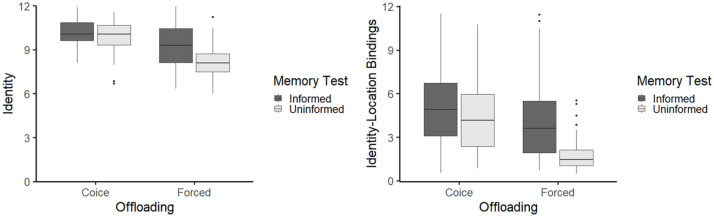
- In Experiment 1, the no-lockout group offloaded more (openings: M = 3.61 vs. 2.31; initial encoding: 13.99 s vs. 20.14 s; initially correctly copied items: 5.45 vs. 7.22), solved trials faster (49.33 s vs. 55.06 s), but remembered fewer identity-location bindings (5.91 vs. 7.07) and identities (10.55 vs. 10.93); individual offloading-memory correlations were all |r|s(84) ≥ .51.
- In Experiment 2, no-lockout and uninformed participants offloaded more and remembered less, while informed participants offloaded less and showed better memory; e.g., identity-location bindings were 4.20 in no-lockout/uninformed, 5.17 in no-lockout/informed, 5.24 in lockout/uninformed, and 6.28 in lockout/informed.
- In Experiment 3, forced/uninformed participants had the worst memory, but forced/informed participants nearly matched free-choice conditions for identity-location bindings (4.18 vs. 4.69 choice/uninformed and 5.18 choice/informed; differences not significant), though their identity memory remained lower than both choice groups (9.34 vs. 9.97 and 10.20).
- Mediation analyses in Experiments 1 and 2 indicated that the effects of lockout and memory-test announcement on later memory were mediated by offloading behaviour.
Methods
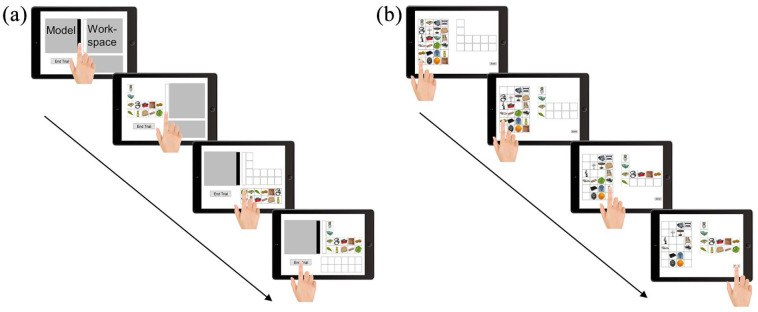
- Three preregistered experiments each with a final sample of 172 university students; participants solved a tablet-based Pattern Copy Task with 12 images (Experiments 1 and 3) or 8 images (Experiment 2), where the model and workspace windows were never visible simultaneously.
- Experiment 1 manipulated temporal access costs (2-s lockout vs. no lockout); Experiment 2 added awareness of an upcoming memory test; Experiment 3 crossed test awareness with free-choice vs. forced maximal offloading (only one object copied per cycle).
- After a retention interval containing working memory capacity tests, participants completed a delayed memory test for the copied objects; analyses used t-tests, ANOVAs, Pearson correlations, and exploratory bootstrapped mediation.
Limitations
- The authors state that Experiment 3 did not replicate Experiment 2’s finding that test awareness reduces offloading under free choice, raising questions about the generality, reliability, or magnitude of that effect, and they avoid strong conclusions about it.
- The authors note that participants in the forced/informed condition took longer, so additional time rather than released cognitive resources might partly explain improved memory, though they consider this unlikely.
- The authors also note that the Corsi Blocks Task was administered after the Pattern Copy Task as part of the retention interval, so it was not independent of the manipulation; evident from the text, all samples were university students tested in a lab with a specific tablet task, limiting generalizability to other populations and settings.
Model-written summary. Check it against the paper before relying on it.
Integrity signals
Registry
Cites
Statistics
Figures
Verification
Claims the paper makes
11 Valid · 0 Not valid · 22 Not checked · 139 Own results and interpretations
Every source the paper cites for this claim was checked and supports it.
In the paper
“With regard to working memory, the act of cognitive offloading releases resources which otherwise would be necessary to actively hold information in short-term representations.”
§ Consequences of cognitive offloading: Boosting performance but diminishing memory > Cognitive offloading
What the sources say
- Supportedcites Wilson, 2002 matched to “Six views of embodied cognition” (2002) source
In “Claim 3: We Off-Load Cognitive Work Onto the Environment,” Wilson distinguishes off-loading from actively holding information in short-term memory. The paper also says that limits on working memory lead people to use the environment to reduce cognitive workload. The supplied passages do not give page numbers. (LLM, conf=0.92)
plainstates a cause- Asserted: passes — The authors put it forward as true.
- Checkable: passes — It can be checked against evidence.
- Load-bearing: passes — The paper’s conclusions depend on it.
- Based: passes — The paper gives a reason why it holds.
- Supported
The cited sources support only part of this claim — read each source’s verdict below.
In the paper
“a common concern states that frequent externalisation of internal cognitive processes leads to an impoverishment of the corresponding internal abilities. This concern has received empirical support from findings on spatial memory (e.g., Fenech et al., 2010; Gardony et al., 2015), problem solving (Moritz et al., 2018, 2020; O’Hara & Payne, 1998; Van Nimwegen & Van Oostendorp, 2009), as well as the”
§ Consequences of cognitive offloading: Boosting performance but diminishing memory > Consequences of cognitive offloading
What the sources say
- Not checked — no full text of the sourcecites Fenech et al., 2010 matched to “The Effects of Acoustic Turn-by-turn Navigation on Wayfinding” (2010) source
- Not checked — no full text of the sourcecites Gardony et al., 2015 matched to “Navigational Aids and Spatial Memory Impairment: The Role of Divided Attention” (2015) source
- Partly supportedcites Moritz et al., 2018 matched to “Representation control increases task efficiency in complex graphical representations” (2018) sourceExperimental — accuracy not yet measured
The Introduction describes externalising cognitive processes in problem-solving tasks, and the Discussion reports that this offloading increased task efficiency. But the Discussion also says the study did not measure participants’ abilities, so it provides no empirical support for the claimed impoverishment of internal abilities through frequent externalisation (pages unavailable in our copy). (LLM, conf=0.84)
boostedstates a cause- Asserted: passes — The authors put it forward as true.
- Checkable: passes — It can be checked against evidence.
- Load-bearing: passes — The paper’s conclusions depend on it.
- Based: passes — The paper gives a reason why it holds.
The sources with a verdict support this claim; the rest weren’t checked yet, have no full text we could read, or their verdicts aren’t rated yet.
In the paper
“Critically, in these lines of research, the participants typically could not choose how to perform the task while encoding task-relevant information (e.g., Eskritt & Ma, 2014; Kelly & Risko, 2019; Sparrow et al., 2011).”
§ Consequences of cognitive offloading: Boosting performance but diminishing memory > Consequences of cognitive offloading
What the sources say
- Not checked — no full text of the sourcecites Eskritt & Ma, 2014 matched to “Intentional forgetting: Note-taking as a naturalistic example” (2014) source
- Supportedcites Kelly & Risko, 2019 matched to “Offloading memory: Serial position effects” (2019) source
The Discussion (p. n/a) states explicitly that 'Requiring individuals to write down all words (rather than allowing a choice of what to record) seemingly removed the need to "choose" which items to offload,' and flags the resulting 'unnaturalness' relative to everyday offloading. The Method (Encoding) confirms the imposed procedure: participants 'were instructed to write down each word as they heard it onto provided paper,' with recall instructions fixed by trial, so participants had no discretion over how to encode. The paper therefore is a valid instance of the claim's characterization of these paradigms. (LLM, conf=0.85)
- Not checked — no full text of the sourcecites Sparrow et al., 2011 matched to “Google Effects on Memory: Cognitive Consequences of Having Information at Our Fingertips” (2011) source
plain- Asserted: passes — The authors put it forward as true.
- Checkable: passes — It can be checked against evidence.
- Load-bearing: passes — The paper’s conclusions depend on it.
- Based: passes — The paper gives a reason why it holds.
Every source the paper cites for this claim was checked and supports it.
In the paper
“Moreover, Kelly and Risko (2019) recently studied how relying on external representations affects memory accuracy for the offloaded information. Despite identical stimulus encoding, the participants of this study remembered word lists less accurately when they thought they would have access to external representations than when they thought they would have to rely on their internal memory.”
§ Consequences of cognitive offloading: Boosting performance but diminishing memory > Consequences of cognitive offloading
What the sources say
- Supportedcites Kelly and Risko (2019) matched to “Offloading memory: Serial position effects” (2019) source
The Exploratory analyses section states that, across all positions, 'memory for offloaded items was significantly worse' in both Experiment 1a (no-offloading 0.49 vs. offloading 0.36) and Experiment 1b (0.51 vs. 0.35), i.e. lower accuracy when participants believed the external store would be available. The Current investigation section confirms the manipulation was purely one of expectation at recall ('no participants were able to access their external store on the final trial'; 'our critical manipulation focuses on the expectations that participants had'), and the Method/Results (encoding phase; 'participants encoded >99% of all words on each of Trials 1, 2, 3 and 4') show encoding was held constant across conditions. The paper's headline result is more specific (selective impairment of primacy with intact/enhanced recency), but the claim as paraphrased is stated by the source. (LLM, conf=0.85)
plainstates a cause- Asserted: passes — The authors put it forward as true.
- Checkable: passes — It can be checked against evidence.
- Load-bearing: passes — The paper’s conclusions depend on it.
- Based: passes — The paper gives a reason why it holds.
- Supported
The sources with a verdict support this claim; the rest weren’t checked yet, have no full text we could read, or their verdicts aren’t rated yet.
In the paper
“Recent findings revealed that already children selectively use tools to overcome cognitive limitations (Armitage et al., 2020; Bulley et al., 2020).”
§ Consequences of cognitive offloading: Boosting performance but diminishing memory > General discussion > The trade-off of cognitive offloading
What the sources say
- Supportedcites Armitage et al., 2020 matched to “Developmental origins of cognitive offloading” (2020) source
The Abstract (p. 1) and General discussion (p. 7) state that children aged 4–11 given the opportunity to manually rotate a turntable did so selectively to eliminate the internal demands of mental rotation, and that 'even some 4- and 5-year-old children have the capacity to manually rotate external stimuli in order to alleviate the demands of internal mental rotation'. Study 2 (p. 6) confirms selective rotation in young children (11.76% of 4- and 5-year olds rising to 62.5% of 10- and 11-year olds), and Study 1 (p. 5) says 'even from 4 and 5 years old, some children possess metacognitive awareness about mental rotation difficulty and are able to transform this awareness into selective manual rotation'. The one qualifier the citing sentence flattens is that selectivity is graded and, in the youngest children, present in only a minority — the paper frames it as gradual calibration throughout childhood rather than a uniform child-wide capacity. (LLM, conf=0.82)
- Not checked — no full text of the sourcecites Bulley et al., 2020 matched to “Children Devise and Selectively Use Tools to Offload Cognition” (2020) source
plainstates a cause- Asserted: passes — The authors put it forward as true.
- Checkable: passes — It can be checked against evidence.
- Load-bearing: unclear — It is unclear whether the paper’s conclusions depend on it.
- Based: passes — The paper gives a reason why it holds.
- Supported
102 more claims
Create a free account to see all 172 claims and to verify the 5 references still open.
- Probably not a substantial claim. 43
- It may state two separate claims as one. 30
Claims other papers make about this one
Each is checked against this paper’s own text: does it say what the citing paper says it does?
The source backs part of the claim, not all of it — or backs it for a different population, condition or comparison.
In the citing paper
“It can also reduce later retention or internal processing when learners cease to encode or practice the offloaded operation”
From Layer-sensitive cognitive offloading in generative AI-assisted writing: supported performance and independent no-AI outcomes (2026) · cites this paper as Grinschgl et al., 2021
Experimental — accuracy not yet measuredThe source backs part of the claim, not all of it — or backs it for a different population, condition or comparison.
In the citing paper
“At the same time, studies on cognitive offloading indicate that externalizing memory and information-processing demands can free internal cognitive resources, allowing individuals to focus on higher-level reasoning and problem solving (Grinschgl et al., 2021).”
From Cognitive offloading through digital tools and its relationship with critical thinking, task persistence, and learning depth (2026) · cites this paper as Grinschgl et al., 2021
Experimental — accuracy not yet measuredThe source backs part of the claim, not all of it — or backs it for a different population, condition or comparison.
In the citing paper
“Not being informed regarding a subsequent test increased offloading behavior and decreased memory performance.”
From The Cognitive Architecture of Digital Externalization (2023) · cites this paper as Grinschgl, Papenmeier, and Meyerhoff (2021a)
Experimental — accuracy not yet measuredThe source backs part of the claim, not all of it — or backs it for a different population, condition or comparison.
In the citing paper
“being aware of a later test reduced offloading behavior.”
From The Cognitive Architecture of Digital Externalization (2023) · cites this paper as Grinschgl, Papenmeier, and Meyerhoff (2021a)
Experimental — accuracy not yet measuredThe cited source says what the claim attributes to it.
In the citing paper
“not receiving temporal costs for offloading also reduced memory performance.”
From The Cognitive Architecture of Digital Externalization (2023) · cites this paper as Grinschgl, Papenmeier, and Meyerhoff (2021a)
4 more claims about this paper
Create a free account to see every claim other papers make about this one.
Statistics that don’t add up
Each reported p-value recomputed from its test statistic and degrees of freedom, each partial η² from its F, and each ratio, mean difference or B printed with a p checked against its own confidence interval.
Rated minor: it would not touch a result — a value no result rests on, a p-value that stays on the same side of the significance level, or a conflict that is clerical, resolved elsewhere in the paper, or outside its own findings.
In the paper
“F(1, 168) = 9.62, p = .005”
§ Consequences of cognitive offloading: Boosting performance but diminishing memory > Experiment 2 > Results
Reported p = .005 · recomputed p = .002
Rated minor: it would not touch a result — a value no result rests on, a p-value that stays on the same side of the significance level, or a conflict that is clerical, resolved elsewhere in the paper, or outside its own findings.
In the paper
“t(84) = −0.39, p = .693”
§ Consequences of cognitive offloading: Boosting performance but diminishing memory > Experiment 3 > Results
Reported p = .693 · recomputed p = .698
Rated minor: it would not touch a result — a value no result rests on, a p-value that stays on the same side of the significance level, or a conflict that is clerical, resolved elsewhere in the paper, or outside its own findings.
In the paper
“F(1, 168) = 4.43, p = .039”
§ Consequences of cognitive offloading: Boosting performance but diminishing memory > Experiment 3 > Results
Reported p = .039 · recomputed p = .037
Rated minor: it would not touch a result — a value no result rests on, a p-value that stays on the same side of the significance level, or a conflict that is clerical, resolved elsewhere in the paper, or outside its own findings.
In the paper
“F(1, 168) = 16.24, p < .001, ηp2=.08”
§ Consequences of cognitive offloading: Boosting performance but diminishing memory > Experiment 2 > Results
Reported ηp² = .08 · recomputed ηp² .08813–.08817
Rated minor: it would not touch a result — a value no result rests on, a p-value that stays on the same side of the significance level, or a conflict that is clerical, resolved elsewhere in the paper, or outside its own findings.
In the paper
“F(1, 168) = 2.68, p = .103, ηp2=.01”
§ Consequences of cognitive offloading: Boosting performance but diminishing memory > Experiment 3 > Results
Reported ηp² = .01 · recomputed ηp² = .0157
2 more findings
Create a free account to see every finding of this check.
Statistics recomputed
Every reported test result, recomputed from its test statistic and degrees of freedom. A result shows as not adding up only once an independent check has confirmed it.
- Doesn’t add upF(1, 168) = 9.62reported p = .005 · recomputed p = .002
“F(1, 168) = 9.62, p = .005”
- Doesn’t add upt(84) = -0.39reported p = .693 · recomputed p = .698
“t(84) = −0.39, p = .693”
- Doesn’t add upF(1, 168) = 4.43reported p = .039 · recomputed p = .037
“F(1, 168) = 4.43, p = .039”
- Consistentt(170) = 7.55reported p < .001 · recomputed p < .001
“t(170) = 7.55, p < .001”
- Consistentt(170) = -3.87reported p < .001 · recomputed p < .001
“t(170) = −3.87, p < .001”
31 more recomputed tests
Create a free account to see every test the Stats check recomputed.
Self-check
Percentages, sums and reported differences re-computed from the paper’s own numbers.
Self-check results appear here once an independent check has confirmed them.
Citations
Cites
Faul, F., Erdfelder, E., Lang, A.-G., & Buchner, A. (2007) · Behavior Research Methods · doi:10.3758/bf03193146 · Cited by 65,971 · cited 2×
“We used G*Power (Faul et al., 2007) to calculate the required sample size for a 2 × 2 between-subjects analysis of variance (ANOVA; i.e., the main statistical test for Experiments 2 and 3).”
MethodLevels of processing: A framework for memory research
Craik, F. I. M., & Lockhart, R. S. (1972) · Journal of Verbal Learning and Verbal Behavior · doi:10.1016/s0022-5371(72)80001-x · Cited by 9,566 · cited 2×
“Such released cognitive resources might in turn serve to gain a deeper processing of the remaining task-relevant information and, therefore, improve memory (Craik & Lockhart, 1972) as well as learning (Salomon, 1990; Sweller et al., 1998).”
BackgroundClark, A., & Chalmers, D. (1998) · Analysis · doi:10.1093/analys/58.1.7 · Cited by 6,333
Cognitive Architecture and Instructional Design
Sweller, J., van Merrienboer, J. J. G., & Paas, F. G. W. C. (1998) · Educational Psychology Review · doi:10.1023/a:1022193728205 · Cited by 6,023 · cited 2×
“Such released cognitive resources might in turn serve to gain a deeper processing of the remaining task-relevant information and, therefore, improve memory (Craik & Lockhart, 1972) as well as learning (Salomon, 1990; Sweller et al., 1998).”
BackgroundSix views of embodied cognition
Wilson, M. (2002) · Psychonomic Bulletin & Review · doi:10.3758/bf03196322 · Cited by 4,782
PsychoPy—Psychophysics software in Python
Peirce, J. W. (2007) · Journal of Neuroscience Methods · doi:10.1016/j.jneumeth.2006.11.017 · Cited by 4,603 · cited 1×
“All tasks were controlled by PsychoPy scripts (Peirce, 2007) running on 12.3″ Microsoft Surface Pro tablets (2,736 × 1,824 pixels; touch served as input device) lying flat on the table at a viewing distance of approximately 36 cm.”
MethodInfluentialmediation:R Package for Causal Mediation Analysis
Tingley, D., Yamamoto, T., Hirose, K., Keele, L., & Imai, K. (2014) · Journal of Statistical Software · doi:10.18637/jss.v059.i05 · Cited by 4,155
INTERHEMISPHERIC DIFFERENCES IN THE LOCALIZATION OF PSYCHOLOGICAL PROCESSES IN MAN
MILNER, B. (1971) · British Medical Bulletin · doi:10.1093/oxfordjournals.bmb.a070866 · Cited by 2,329 · cited 1×
“In the second task, the participants had to reconstruct a temporal sequence of spatial locations (Corsi Blocks Task; adapted from Milner, 1971).”
BackgroundGoogle Effects on Memory: Cognitive Consequences of Having Information at Our Fingertips
Sparrow, B., Liu, J., & Wegner, D. M. (2011) · Science · doi:10.1126/science.1207745 · Cited by 1,762 · cited 5×
“In an experiment reported by Sparrow et al. (2011), the participants transferred trivia statements into a computer document.”
BackgroundResultInfluentialOn Distinguishing Epistemic from Pragmatic Action
Kirsh, D., & Maglio, P. (1994) · Cognitive Science · doi:10.1207/s15516709cog1804_1 · Cited by 1,641 · cited 2×
“Empirically, such externalisations have been shown to improve problem-solving accuracy as well as speed (Kirsh & Maglio, 1994).”
Background
Cited by
Items 101–141 of 141
On the Value of the Nitty–Gritty Details: A Problem for Powerful AI Tools
Herzog, C., & Sarikaya, D. (2026) · Springer eBooks · doi:10.1007/978-3-032-15112-4_24
YORULMAZ, D. S., & Kanbay, Y. (2026) · Psychology and Psychotherapy Theory Research and Practice · doi:10.1111/papt.70077 · Cited by 1
“This result also aligns with theoretical perspectives that propose digital technologies reorganize cognitive processes, and especially with the literature on cognitive offloading (Ali et al., 2024; Grinschgl et al., 2021).”
Šņitņikovs, A., Koroļeva, I., & Steinberga, R. (2026) · Culture and Education · doi:10.1177/11356405261437797
“Investigaciones previas (Grinschgl et al., 2021) revelan que el exceso de dependencia en la descarga cognitiva tiene un impacto negativo en la memoria a largo plazo.”
Eureka in the Age of Agentic AI: Educational Foundations for Creative Futures
Andreadakis, Z. (2026) · Advances in computational intelligence and robotics book series · doi:10.4018/979-8-3373-6471-1.ch009
Reina, M. R., Aisa-Dris, N., & Martínez-Rodríguez, S. (2026) · SSRN Electronic Journal · doi:10.2139/ssrn.6883075
Grinschgl, S., Ninaus, M., Wood, G. M. D. O., & Neubauer, A. C. (2026) · Physics of Life Reviews · doi:10.1016/j.plrev.2026.06.006
Self-citationGao, Q., Zhou, H., & Lu, H. (2026) · Frontiers in Psychology · doi:10.3389/fpsyg.2026.1881713
“This decoupling reflects a process of cognitive offloading (Grinschgl et al., 2021; Risko and Gilbert, 2016), where students delegate critical mental steps to multiple LLMs to minimize internal cognitive effort.”
AI as a thinking partner: rethinking human cognitive processes in the age of generative AI
Zhong, T., & Zhu, G. (2026) · Interactive Learning Environments · doi:10.1080/10494820.2026.2680598 · Cited by 2
Is AI Bad for Thought, or Does the Human Preference for Validation Make It That Way?Preprint
Hall, B. T., & Hart, W. (2026) · SSRN Electronic Journal · doi:10.2139/ssrn.6984562
Artificial intelligence in healthcare – the other side of the coin!
Azad, S., & Kaur, M. (2026) · Indian Journal of Ophthalmology · doi:10.4103/ijo.ijo_3183_25
“[2,3] An overreliance on technology without adequate emphasis on the simultaneous development of clinical skills and critical thinking can be more detrimental than useful in the long run.”
黎政諺, & Chen, C. (2026) · Lecture notes in computer science · doi:10.1007/978-3-032-30860-3_29
Crompton, H., & Burke, D. (2026) · Oxford University Press eBooks · doi:10.1093/9780198945215.003.0220
Extreme Cognitive Assistance and Open Futures
Sharadin, N. (2026) · Journal of Ethics and Social Philosophy · doi:10.26556/jesp.v31i4.6237 · Cited by 2
Li, X., Xian, X., & Du, P. (2026) · Frontiers in Psychology · doi:10.3389/fpsyg.2026.1903784 · Cited by 3
“When students cannot recall what they submitted, cannot explain why a claim was made, or cannot defend a coding decision, the issue is not simply poor memory (Grinschgl et al., 2021; Risko and Gilbert, 2016; Sparrow et al., 2011).”
Keeping Humans in the Driver’s Seat: A Conceptual Framework for GenAI and Competence Debt
Lüders, C. M., Krużycki, O., & Brandt, C. (2026) · ACM Joint European Software Engineering Conference and Symposium on the Foundations of Software Engineering (ESEC/FSE) · doi:10.1145/3803437.3806707 · Cited by 2
Noel, Z. R., Morbitzer, K. A., & McLaughlin, J. E. (2026) · Medical Education · doi:10.1111/medu.70274
de Souza, B. C., Neto, A. S. D. A., & Roazzi, A. (2026) · SSRN Electronic Journal · doi:10.2139/ssrn.7158756
Ching-Tsung, J., Lu, W., & Sang, T. Q. (2026) · Research Square · doi:10.21203/rs.3.rs-10421674/v1
Digital amnesia: The aftermath of a screenshot
Fabrizio, S. P., Lurie, R., & Westerman, D. L. (2026) · Memory & Cognition · doi:10.3758/s13421-026-01921-2 · Cited by 2
Gill, A. A., Janjua, F., Zahoor, M., & Afzal, A. (2026) · Advances in computational intelligence and robotics book series · doi:10.4018/979-8-3373-9484-8.ch008
Britel, I., Moummou, H., Aghdou, Z., Bouzidi, H. E., & El‐Mansoury, B. (2026) · Advances in computational intelligence and robotics book series · doi:10.4018/979-8-3373-9484-8.ch011
Shukla, A., & Sinha, V. (2026) · Development in Learning Organizations An International Journal · doi:10.1108/dlo-06-2026-0334
Ho, C. S. M., & Chen, J. (2026) · Computers and Education Artificial Intelligence · doi:10.1016/j.caeai.2026.100670 · Cited by 3
Kim, J. H., & Moldavan, A. M. (2026) · Advances in computational intelligence and robotics book series · doi:10.4018/979-8-2600-3840-6.ch002
Artificial Intelligence and the Loss of the ‘Writing Struggle’: Is Struggle Essential to Learning?
Desai, H. (2026) · Emerald Group Publishing Limited eBooks · doi:10.1108/978-1-80686-243-620261003
Malik, M. F., Khan, K., & Burhan, Q.-U.-A. (2026) · Leadership & Organization Development Journal · doi:10.1108/lodj-02-2026-0127 · Cited by 1
Grubbs, T. M., Perez, O. D. R., Ehardt, Z. N., & Soares, J. S. (2026) · Memory · doi:10.1080/09658211.2026.2727403
Schulte, N., Nussbaum, J. A., Steinhoff, M. M., Stubner, S., & Kanbach, D. K. (2026) · Telematics and Informatics Reports · doi:10.1016/j.teler.2026.100371 · Cited by 1
Klapproth, F. (2026) · Education Sciences · doi:10.3390/educsci16091507 · Cited by 4
Underused but not lost: adaptive working memory usage in agingPreprint
Shalev, N., Atias, L., Kumle, L., Nobre, A. C., & Draschkow, D. (2026) · Research Square · doi:10.21203/rs.3.rs-10487563/v1
Halupa, C. M. (2026) · Advances in computational intelligence and robotics book series · doi:10.4018/979-8-3373-9089-5.ch003
Who Is Training Whom: Human Cognitive Drift and Machine Degradation in Coupled AI Knowledge SystemsPreprint
Turner, T. N. (2026) · SSRN Electronic Journal · doi:10.2139/ssrn.7486218
Formal Reasoning and Guidance Platform for Transparent Scaffolding for Multi-agent Debate
Harbar, Y., & Chudziak, J. A. (2026) · Lecture notes in computer science · doi:10.1007/978-3-032-36868-3_7
Ríos-Flórez, J. A., Muñoz-Giraldo, A. D. J., Bustamante, A. R., & Castañeda-Quirama, T. (2026) · Frontiers in Cognition · doi:10.3389/fcogn.2026.1932224
Ho, C. S. M., & Chen, J. (2026) · Computers in Human Behavior Reports · doi:10.1016/j.chbr.2026.101329 · Cited by 2
El‐Nasr, M. S. (2026) · Computer · doi:10.1109/mc.2026.3654310
Adithiya, L. M. D. D., Samarawickrema, N. S., Peiris, J. A. H. L., & Weerasinghe, B. R. D. S. (2026) · International Journal of Modern Science and Research Technology · doi:10.67317/ijmsrt26sep116
The Perils of “Effortless Excellence”: Generative AI and the Erosion of Effort in Medical Education
Hadidchi, R., Patel, V., Chung, C., Scott, N., Bhagat, P., & Rajput, V. (2026) · Medical Science Educator · doi:10.1007/s40670-026-02899-x
Xiaotian, R., Li, X., Gao, L., Wei, Q., Liu, H., & Yu, X. (2026) · Educational Psychology Review · doi:10.1007/s10648-026-10217-5
“Cognitively, limited AI exposure may support learning by offloading routine processing, but prolonged reliance may weaken effortful reasoning and deep processing (Grinschgl et al., 2021; Risko & Gilbert, 2016 ).”
Xiang, G., & Hu, C. (2026) · Tourism Management Perspectives · doi:10.1016/j.tmp.2026.101539
Too Much Mind Extension? Towards a Virtue Ethics of the Extended Mind
Chlebowski, S., Ratajczyk, D., & Wyrwa, M. (2026) · Roczniki Filozoficzne · doi:10.18290/rf26743.6
Metadata
- Authors
- Grinschgl, S., Papenmeier, F., & Meyerhoff, H. S.
- Affiliations
- University of Graz (AT)
- University of Tübingen (DE)
- Leibniz-Institut für Wissensmedien (DE)
- Corresponding author
- Grinschgl, Sandra
- Venue
- Quarterly Journal of Experimental Psychology
- Publisher
- SAGE Publications
- Published
- 2021-04-04
- Volume
- 74
- Issue
- 9
- Pages
- 1477-1496
- ISSN
- 0033-555X (ISSN-L)
- 1747-0218
- 1747-0226
- PMC
- PMC8358584
- OpenAlex
- W3138692432
- Cited by
- 147
- References
- 65
- Citations by year
- 2026: 71 · 2025: 33 · 2024: 20 · 2023: 12 · 2022: 7 · 2021: 2
- FWCI
- 5.38
- Type
- journal article
- Language
- en
- Open access
- hybrid
- doi.org
- Locations
- Quarterly Journal of Experimental Psychology (publishedVersion, cc-by)
- PubMed Central (publishedVersion, cc-by)
- PubMed (publishedVersion)
- Unipub UB Graz (Universität Graz) (submittedVersion, cc-by)
- Funders
- State Baden-Württemberg
- Leibniz Foundation
- Topics
- Life Sciences › Neuroscience › Cognitive Neuroscience › Memory Processes and Influences
- Social Sciences › Psychology › Experimental and Cognitive Psychology › Cognitive Functions and Memory
- Social Sciences › Psychology › Experimental and Cognitive Psychology › Cognitive Abilities and Testing
- Keywords
- cognitive offloading, working memory, long-term memory, memory encoding, memory awareness, offloading cost, pattern copying, tablets
- MeSH terms
- Cognition, Humans, Memory, Memory, Short-Term, Motivation, Mental Recall, Task Performance and Analysis
About these checks
Registry, retraction, Cites and statistics results are computed, not judged, with one exception: a printed reference that no index lists is read once by a model before it counts as a citation error. Claims are extracted by a model and kept only when their quote appears verbatim in the text; each cited source is then checked, with a model’s help, for whether it says what the claim relies on. Those verdicts can be wrong — read the claim’s quote and the cited source before relying on one.
The claim verdicts this report counts are experimental: their accuracy is not yet measured.
A language model drew the claims from the paper on 2026-10-10, under version 3 of the claim definition (model deepseek-v4.1-flash, prompt extract-v3).
A second model labelled each claim on 2026-10-10 (model jev-1.13-20260917, definition revision gold-guideline-v0.2).
Cited sources are checked with a language model’s help (gpt-6-sol and qwen3.8-omni-flash).
Statistics and arithmetic are recomputed, not judged.
Confidence bands are shown only for fields calibrated on our annotated test set. None is calibrated yet, so no band is shown.
What counts as a claim ›How we measure confidence ›How we check this ›
Are you an author, or do you see a problem with this page? Request a review
Data sources
Bibliographic data: Semantic Scholar, OpenAlex, Crossref.
Contains information from the Semantic Scholar Academic Graph Datasets, made available under the ODC Attribution License (ODC-BY 1.0).
Semantic Scholar’s data is described in: Kinney, R., et al. (2023). The Semantic Scholar Open Data Platform. arXiv:2301.10140.
