

The varved succession of Crawford Lake, Milton, Ontario, Canada as a candidate Global boundary Stratotype Section and Point for the Anthropocene series
Open accessThe DOI matches its Crossref record; 49 of the 51 references it cites were found in a registry or an index, and 2 are not checked yet; 19 of the 79 sources its claims cite were checked for support.
Abstract
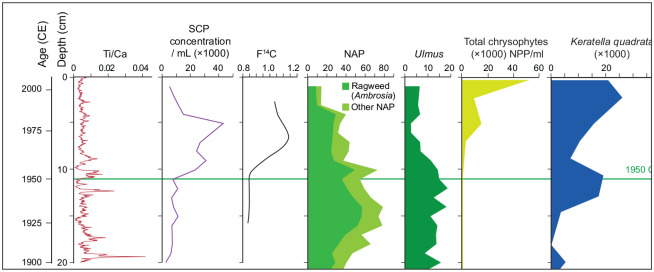
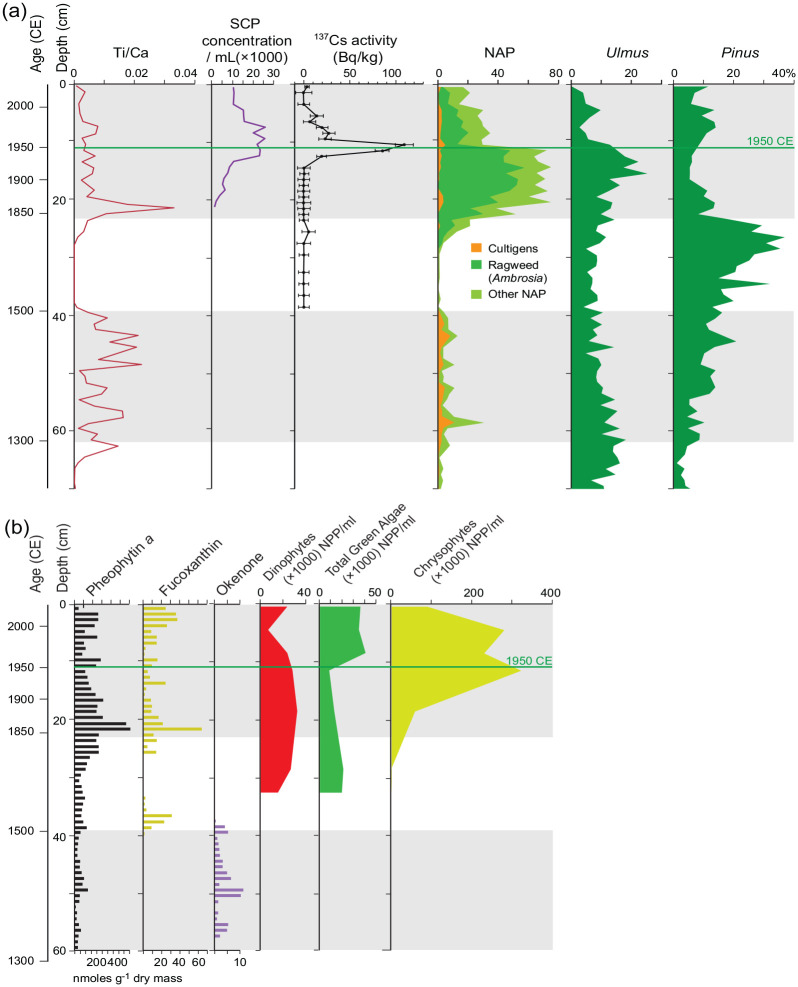
An annually laminated succession in Crawford Lake, Ontario, Canada is proposed for the Global boundary Stratotype Section and Point (GSSP) to define the Anthropocene as a series/epoch with a base dated at 1950 CE. Varve couplets of organic matter capped by calcite precipitated each summer in alkaline surface waters reflect environmental change at global to local scales. Spheroidal carbonaceous particles and nitrogen isotopes record an increase in fossil fuel combustion in the early 1950s, coinciding with early fallout from nuclear and thermonuclear testing – 239+240 Pu and 14 C: 12 C, the latter more than compensating for the effects of old carbon in this dolomitic basin. Rapid industrial expansion in the North American Great Lakes region led to enhanced leaching of terrigenous elements by acid precipitation during the Great Acceleration, and calcite precipitation was reduced, producing thin calcite laminae around the GSSP that is marked by a sharp decline in elm pollen (Dutch Elm disease). The lack of bioturbation in well-oxygenated bottom waters, supported by the absence of fossil pigments from obligately anaerobic purple sulfur bacteria, is attributed to elevated salinities and high alkalinity below the chemocline. This aerobic depositional environment, highly unusual in a meromictic lake, inhibits the mobilization of Pu, the proposed primary stratigraphic guide for the Anthropocene.
Verified 2026-11-22 · 2 references not checked yet
Overview
CoChat Summary
TL;DR
The paper proposes the annually laminated (varved) succession of Crawford Lake, Ontario, Canada as a candidate Global boundary Stratotype Section and Point (GSSP) for the Anthropocene series/epoch, with a base dated to 1950 CE. It argues that the varves preserve a high-fidelity, annually resolved record of mid-20th-century global markers, especially plutonium fallout, fossil-fuel combustion particles, and radiocarbon from nuclear testing.
Key findings
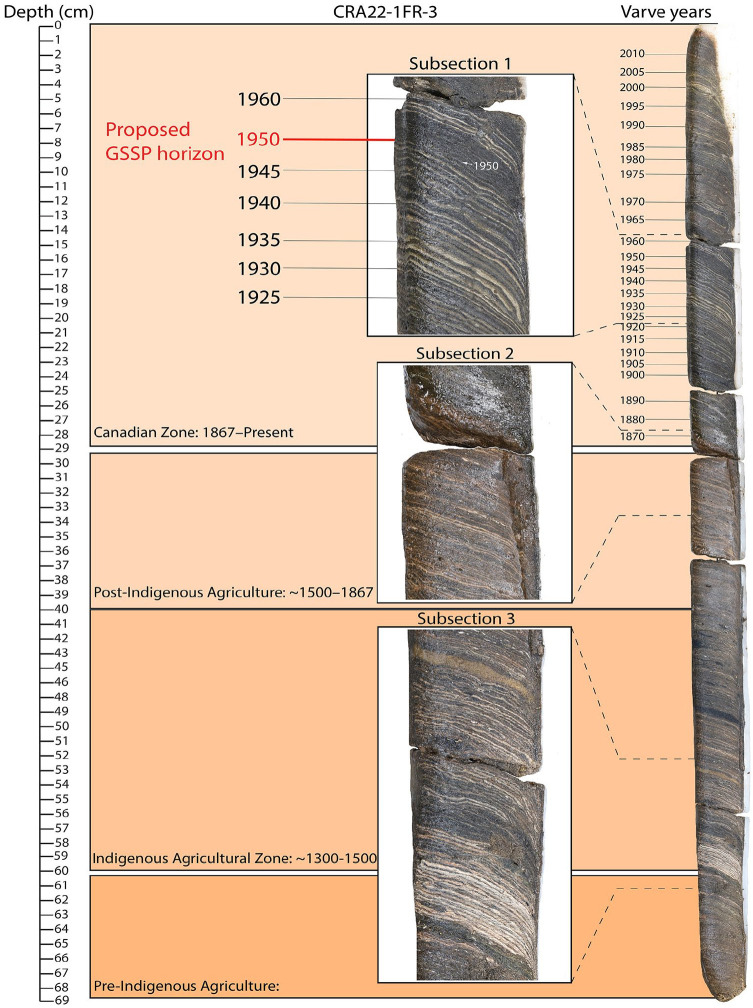
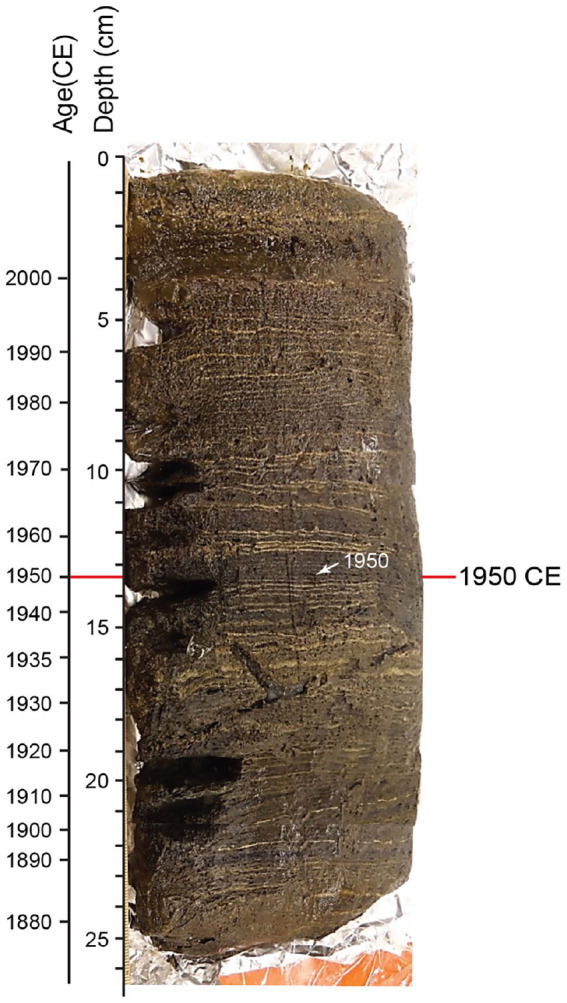
- The proposed GSSP is placed at the base of the calcite lamina deposited in summer 1950 CE in freeze core CRA22-1FR-3, at a depth of 15.6 cm; the associated stage and age name “Crawfordian” is proposed.
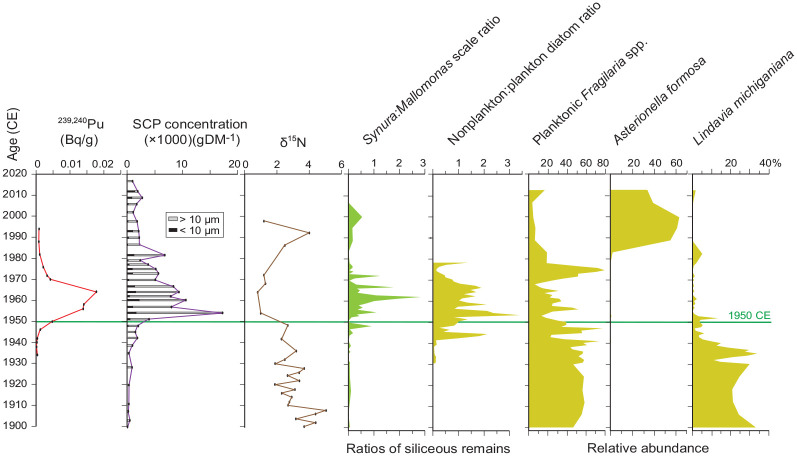
- A sharp rise in 239+240Pu begins between 1948–1951 and 1950–1953 CE, continues to a peak in 1964–1967 CE, and reaches a Nuclear Age plateau by 1982–1985 CE; 240Pu/239Pu ratios from the mid-1950s–1980s range between 0.15 and 0.19, consistent with global weapons fallout.
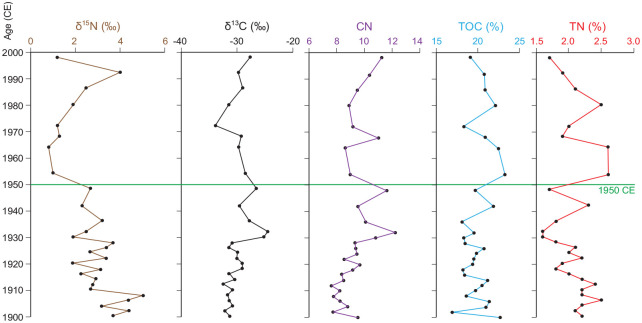
- Spheroidal carbonaceous particles (SCPs) rise from ~3800 g/DM in 1950–1952 to a peak of ~17,000 g/DM in 1954 CE, then decline to ~8000 g/DM by 1967 and stabilize between ~1000 and 2000 g/DM after 1980 CE; δ15N declines to a minimum in 1964–1965 CE.
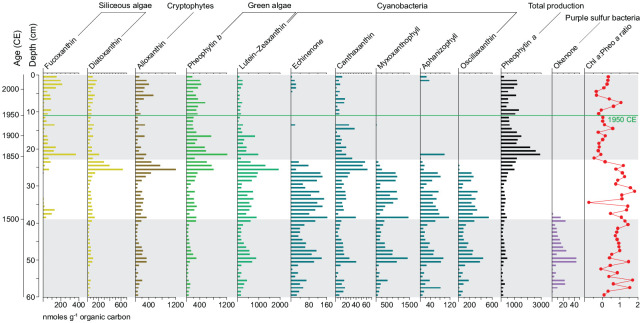
- The varves are undisturbed by bioturbation despite a well-oxygenated monimolimnion: dissolved oxygen remained above the hypoxic limit (2 mg/L) throughout the water column, with mean DO = 8.2 mg/L (range 4.6–11.4 mg/L, n = 78), and okenone from obligately anaerobic purple sulfur bacteria is absent after ~1500 CE. This oxygenated, slightly saline/alkaline bottom water is argued to inhibit Pu mobilization.
Methods
- Freeze cores and gravity cores were collected from the deep basin of Crawford Lake in 2011, 2019, and 2022; the proposed GSSP core CRA22-1FR-3 is archived at the National Biodiversity Cryobank of Canada, and parastratotype CRA22-1FR-1 at the Royal Ontario Museum.
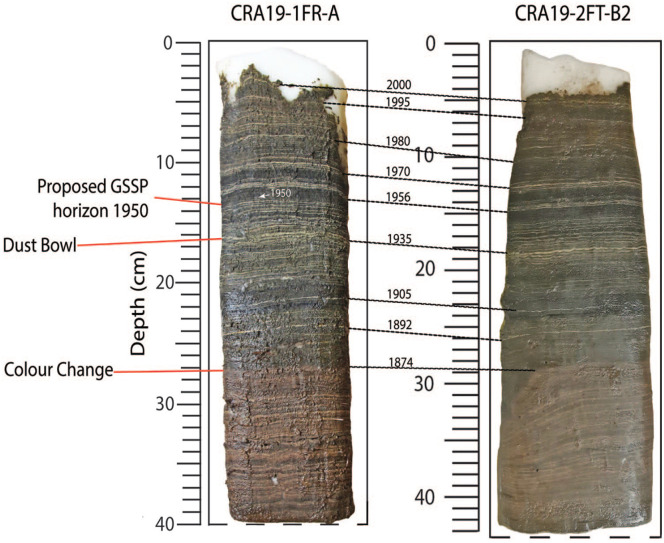
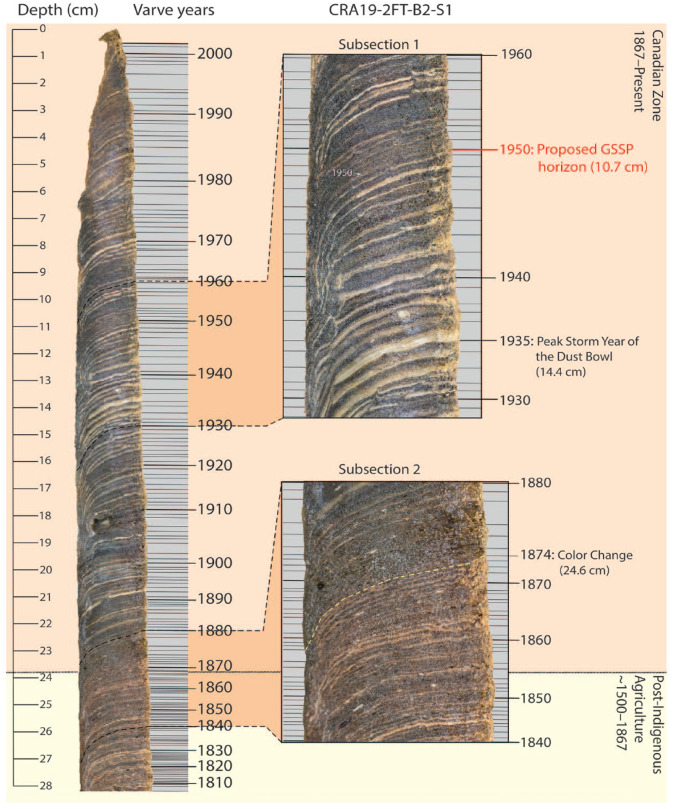
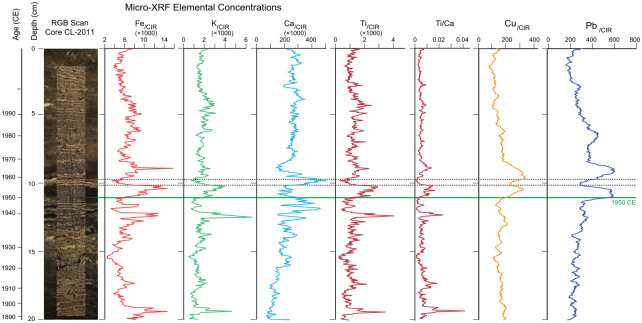
- Varve chronology was anchored to the thickest white calcite lamina, assigned to 1935 CE, because core tops were not always fully recovered; analyses included AMS radiocarbon, 210Pb/137Cs gamma spectrometry, plutonium alpha spectrometry and MC-ICP-MS, SCP counting, µXRF elemental analysis, stable isotopes, fossil pigments, pollen/non-pollen palynomorphs, and siliceous microfossils.
- Sampling followed varve boundaries in freeze cores where possible, but multiple varve years were amalgamated for some analyses depending on sample-size requirements; gravity core CL-19 was subsampled at 1 cm intervals.
Limitations
- The paper states that core tops were not always fully recovered, so varve years were counted relative to marker laminae rather than from the top; it also notes that bulk sediment radiocarbon from core CL-2011 may retain old dolomitic carbon, attenuating the bomb pulse, and that a macrofossil measurement is probably more accurate.
- The paper states that gravity core CL-19 cannot be discriminated at annual precision and that 1-cm subsampling mutes the mid-20th-century signature; PCBs did not exceed background, suggesting the small rural lake is not a useful repository for local persistent organic pollutants.
- Evident from the text: the paper presents a candidate GSSP rather than a ratified boundary, and the chronology depends on the assumption that the thickest white lamina corresponds to 1935 CE.
Model-written summary. Check it against the paper before relying on it.
Integrity signals
Registry
Cites
Statistics
Figures
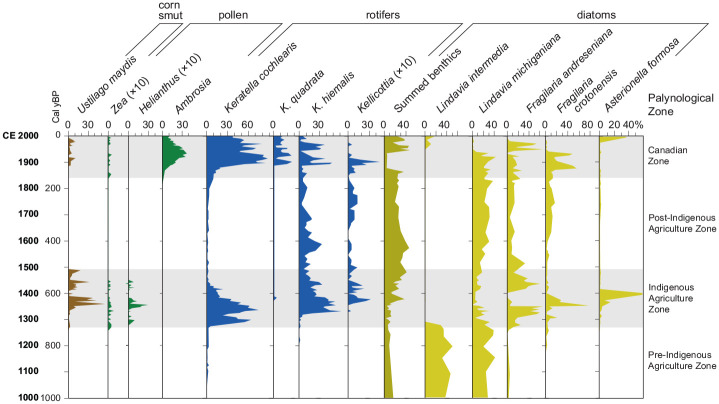
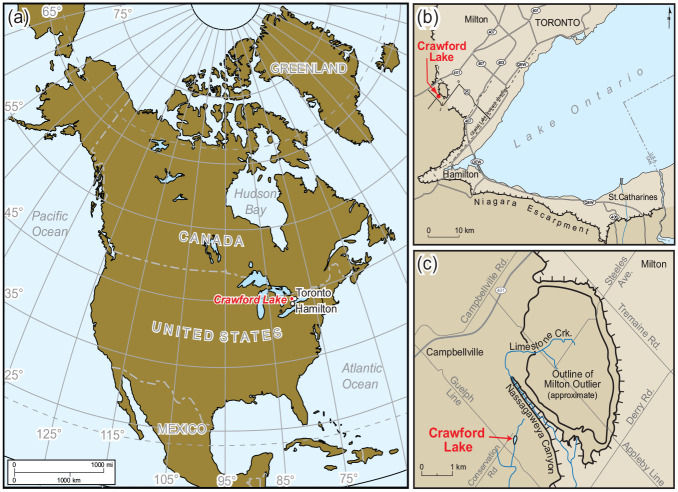
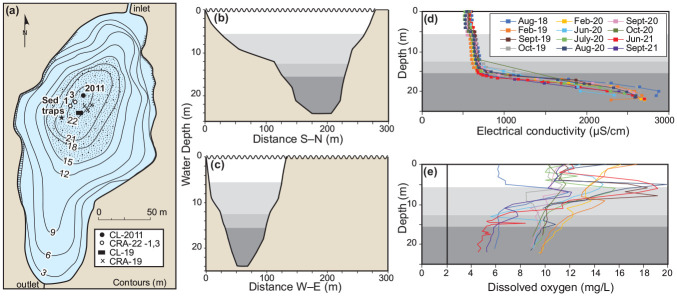
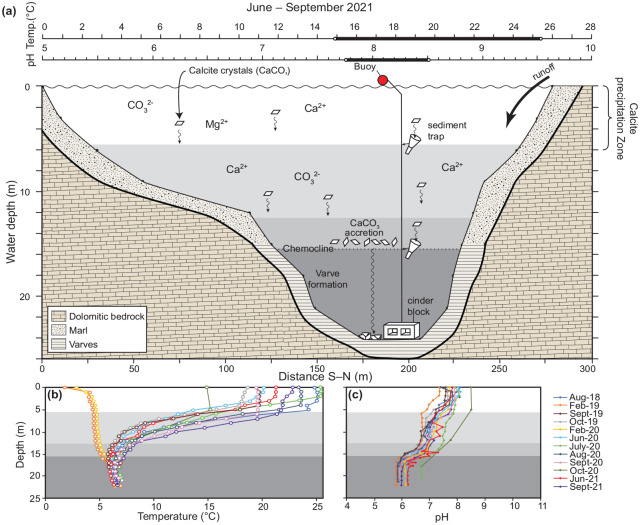
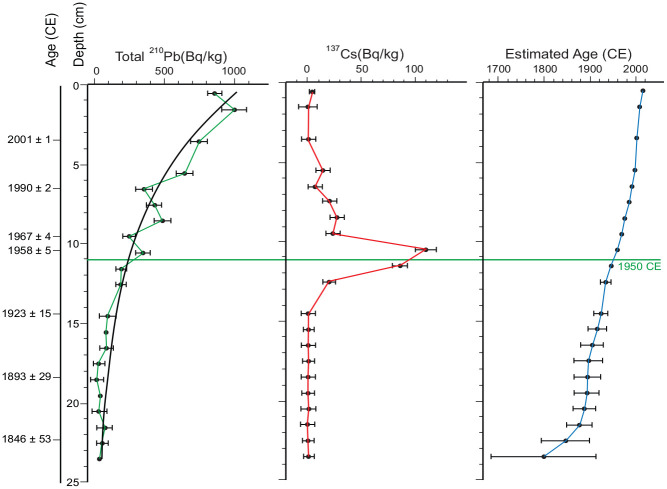
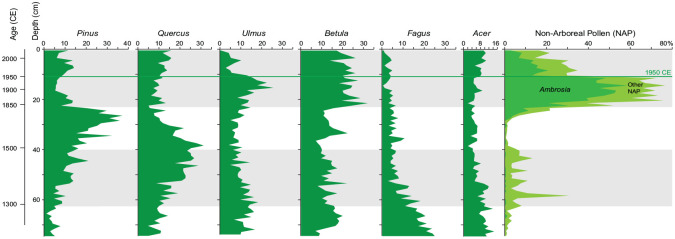
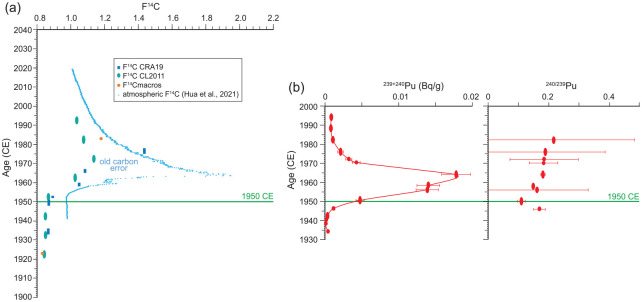
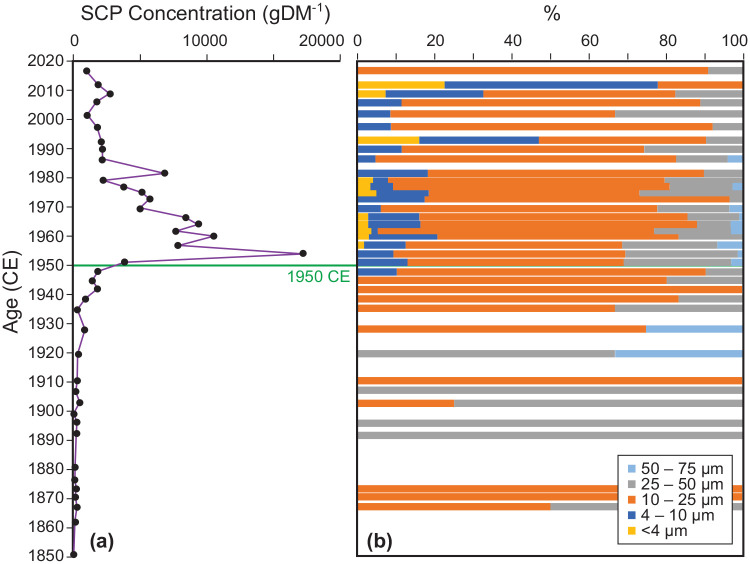
Verification
Claims the paper makes
16 Valid · 2 Not valid · 49 Not checked · 121 Own results and interpretations
Every source the paper cites for this claim was checked and supports it.
In the paper
“The values, with a peak in 1970 CE, compare reasonably well with the post-bomb atmospheric curve of Hua et al. (2022), taking the attenuation of F14C in bulk sediments measured at ETH into account (Figure 11a).”
§ The varved succession of Crawford Lake, Milton, Ontario, Canada as a candidate Global boundary Stratotype Section and Point for the Anthropocene series > Results > Radioisotopes
What the sources say
- Supportedcites Hua et al., 2022 matched to “ATMOSPHERIC RADIOCARBON FOR THE PERIOD 1950–2019” (2022) source
Hua et al. provide compiled monthly atmospheric F14C curves for 1941–2019 (Results and Discussion; Figure 5 caption). The citation identifies the atmospheric curve used for comparison; the 1970 peak and attenuation in ETH-measured bulk sediments describe the citing authors’ data, not findings attributed to Hua et al. (LLM, conf=0.90)
plainstates an association- Asserted: passes — The authors put it forward as true.
- Checkable: passes — It can be checked against evidence.
- Load-bearing: passes — The paper’s conclusions depend on it.
- Based: passes — The paper gives a reason why it holds.
- Supported
Every source the paper cites for this claim was checked and supports it.
In the paper
“Values of F14C in bulk sediment from core CRA19-2FT-1FR-A and macrofossils from core CL-2011 (Table 2) compare well with atmospheric 14C concentration (Hua et al., 2022).”
§ The varved succession of Crawford Lake, Milton, Ontario, Canada as a candidate Global boundary Stratotype Section and Point for the Anthropocene series > Results > Chronology
What the sources say
- Supportedcites Hua et al., 2022 matched to “ATMOSPHERIC RADIOCARBON FOR THE PERIOD 1950–2019” (2022) source
The Results and Discussion report compiled monthly atmospheric F14C data for 1941–2019 (Supplementary Tables S2a–e and Figure 5). Hua et al. thus provide the atmospheric values used as the comparison reference; the core measurements and the comparison itself are presented by the citing authors in their Table 2. (LLM, conf=0.88)
plainstates an association- Asserted: passes — The authors put it forward as true.
- Checkable: passes — It can be checked against evidence.
- Load-bearing: passes — The paper’s conclusions depend on it.
- Based: passes — The paper gives a reason why it holds.
- Supported
Every source the paper cites for this claim was checked and supports it.
In the paper
“Direct observation of freeze cores collected since the early 1970s and high-resolution AMS 14C chronology confirms that these represent annual couplets through the Canadian zone (Ekdahl et al., 2004), allowing varves from the past 150 years to ensure accurate and precise correlation between freeze cores.”
§ The varved succession of Crawford Lake, Milton, Ontario, Canada as a candidate Global boundary Stratotype Section and Point for the Anthropocene series > Results > Chronology
What the sources say
- Supportedcites Ekdahl et al., 2004 matched to “Prehistorical record of cultural eutrophication from Crawford Lake, Canada” (2004) source
The citation is attached to the claim that the Canadian-zone couplets are annual; the statement about correlating freeze cores follows as the citing authors’ inference. In Results and Discussion (page not provided), Ekdahl et al. report varve counts from 2001 back to 1867 and say four calibrated AMS radiocarbon dates confirm that chronology. (LLM, conf=0.88)
boostedstates a cause- Asserted: passes — The authors put it forward as true.
- Checkable: passes — It can be checked against evidence.
- Load-bearing: passes — The paper’s conclusions depend on it.
- Based: passes — The paper gives a reason why it holds.
- Supported
The cited sources support only part of this claim — read each source’s verdict below.
In the paper
“Direct observation of freeze cores collected since the early 1970s and high-resolution AMS 14C chronology confirms that these represent annual couplets through the Canadian zone (Ekdahl et al., 2004), allowing varves from the past 150 years to ensure accurate and precise correlation between freeze cores.”
§ The varved succession of Crawford Lake, Milton, Ontario, Canada as a candidate Global boundary Stratotype Section and Point for the Anthropocene series > Results > Chronology
What the sources say
- Partly supportedcites Ekdahl et al., 2004 matched to “Prehistorical record of cultural eutrophication from Crawford Lake, Canada” (2004) sourceExperimental — accuracy not yet measured
Results and Discussion (page not provided) says varves were counted from 2001 back to 1867 and that four calibrated AMS radiocarbon dates confirm that chronology, supporting annual layering through the Canadian zone. Materials and Methods (page not provided) describes freeze cores recovered in 2001, but does not document direct observations of cores collected since the early 1970s. (LLM, conf=0.86)
boostedstates a cause- Asserted: passes — The authors put it forward as true.
- Checkable: passes — It can be checked against evidence.
- Load-bearing: passes — The paper’s conclusions depend on it.
- Based: passes — The paper gives a reason why it holds.
- Partly supported
The cited sources support only part of this claim — read each source’s verdict below.
In the paper
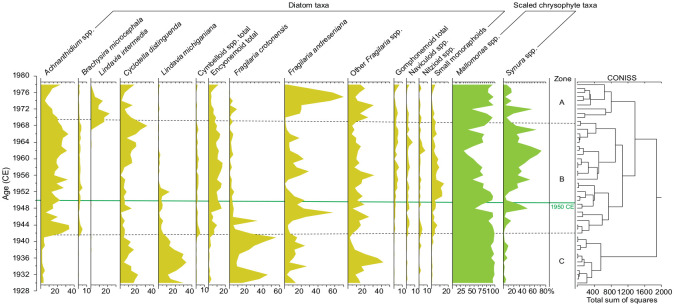
“with abundant Mallomonas acaroides var. acaroides from ~1950 CE to the top of the core section (Gushulak et al., 2022; Marshall et al., 2023).”
§ The varved succession of Crawford Lake, Milton, Ontario, Canada as a candidate Global boundary Stratotype Section and Point for the Anthropocene series > Results > Biotic markers
What the sources say
- Not checked yetcites Gushulak et al., 2022 matched to “Siliceous algae response to the “Great Acceleration” of the mid-20th century in Crawford Lake (Ontario, Canada): A potential candidate for the Anthropocene GSSP” (2022) source
Checked before — its earlier verdict is held back until a new check runs.
- Partly supportedcites Marshall et al., 2023 matched to “Annual-scale assessment of mid-20th century anthropogenic impacts on the algal ecology of Crawford Lake, Ontario, Canada” (2023) sourceExperimental — accuracy not yet measured
The Results (Chrysophyte-delineated zones; page not provided) report M. acaroides at over 70% relative abundance in 1979–1990, supporting abundance near the top of the studied core. They instead describe 1930–1952 as dominated by other Mallomonas species and 1952–1978 chiefly by Synura, with only a later spike of M. acaroides. The paper does not establish abundance continuously from about 1950 or use the varietal designation “var. acaroides” in these passages. (LLM, conf=0.88)
plain- Asserted: passes — The authors put it forward as true.
- Checkable: passes — It can be checked against evidence.
- Load-bearing: passes — The paper’s conclusions depend on it.
- Based: passes — The paper gives a reason why it holds.
- Not checked yet
90 more claims · 1 with their cited sources checked
Create a free account to see all 188 claims and to verify the 11 references still open.
- It may state two separate claims as one. 68
- Probably not a substantial claim. 34
Self-check
Percentages, sums and reported differences re-computed from the paper’s own numbers.
Each contradiction between two passages listed here was confirmed by an independent check.
Rated minor: it would not touch a result — a value no result rests on, a p-value that stays on the same side of the significance level, or a conflict that is clerical, resolved elsewhere in the paper, or outside its own findings.
In the paper
§ The varved succession of Crawford Lake, Milton, Ontario, Canada as a candidate Global boundary Stratotype Section and Point for the Anthropocene series > Discussion
“including particles smaller than 10 µm in freeze core CRA22-2FT-B2”
§ The varved succession of Crawford Lake, Milton, Ontario, Canada as a candidate Global boundary Stratotype Section and Point for the Anthropocene series > Materials and methods > Anthropocene proxies
“Spheroidal carbonaceous particles (SCPs) were extracted from samples following Rose (1994) from core CRA19-2FT-B2 at University College London.”
Rated minor: it would not touch a result — a value no result rests on, a p-value that stays on the same side of the significance level, or a conflict that is clerical, resolved elsewhere in the paper, or outside its own findings.
In the paper
§ The varved succession of Crawford Lake, Milton, Ontario, Canada as a candidate Global boundary Stratotype Section and Point for the Anthropocene series > Results > Radioisotopes
“1975–1977 CE in sediment samples from core CRA19-2FT-1FR-A”
§ The varved succession of Crawford Lake, Milton, Ontario, Canada as a candidate Global boundary Stratotype Section and Point for the Anthropocene series > Materials and methods > Chronological controls
“UOC-12317 | CRA19_IFRA_12 | 1975–78 | 1.4331 ± 0.0042”
Rated minor: it would not touch a result — a value no result rests on, a p-value that stays on the same side of the significance level, or a conflict that is clerical, resolved elsewhere in the paper, or outside its own findings.
In the paper
§ The varved succession of Crawford Lake, Milton, Ontario, Canada as a candidate Global boundary Stratotype Section and Point for the Anthropocene series > Results > Lithology
“mean DBD = 0.96, n = 28”
§ The varved succession of Crawford Lake, Milton, Ontario, Canada as a candidate Global boundary Stratotype Section and Point for the Anthropocene series > Results > Lithology
“range 0.06–0.17 g/cm3”
Citations
Cites
The IntCal20 Northern Hemisphere Radiocarbon Age Calibration Curve (0–55 cal kBP)
Reimer, P. J., Austin, W. E. N., Bard, E., Bayliss, A., Blackwell, P. G., Bronk Ramsey, C., Butzin, M., Cheng, H., Edwards, R. L., Friedrich, M., et al. (2020) · Radiocarbon · doi:10.1017/rdc.2020.41 · Cited by 7,900 · cited 1×
“…to 1984 sample is probably a more accurate record of atmospheric radiocarbon than the sediment. were calculated as −8033ln(F 14 C) following Stuiver and Polach (1977), with the fraction modern carbon (F 14 C) calculated following Reimer et al. (2020) and reported in 14 C year BP (BP = 1950 CE).”
Self-citationDiscussion Reporting of 14 C Data
Stuiver, M., & Polach, H. A. (1977) · Radiocarbon · doi:10.1017/s0033822200003672 · Cited by 5,640
The trajectory of the Anthropocene: The Great Acceleration
Steffen, W., Broadgate, W., Deutsch, L., Gaffney, O., & Ludwig, C. (2015) · The Anthropocene Review · doi:10.1177/2053019614564785 · Cited by 3,935 · cited 1×
“Values of δ 13 C through the Great Acceleration (Head et al., 2022; Steffen et al., 2015) ranged from −34.0 in 1972 –1973 to −24.6‰ in 1932–1933 (mean −29.9‰, n = 28), with the most enriched values measured through the 1930s and 40s, following depleted values between 1900 and 1930 CE.”
InfluentialAppleby, P. G., & Oldfield, F. (1978) · CATENA · doi:10.1016/s0341-8162(78)80002-2 · Cited by 2,906 · cited 1×
“The time-depth chronology was determined from unsup-ported 210 Pb activities using the constant rate of supply (CRS) model (Appleby and Oldfield, 1978) and the well-defined Ambrosia rise at 23 cm as an anchor point (1830 ± 20 CE).”
Smol, J. P., & Birks, H. J. B. (2001) · Cited by 1,305
Atmospheric radiocarbon for the period 1950–2010
Hua, Q., Barbetti, M., & Rakowski, A. Z. (2013) · Radiocarbon · doi:10.2458/azu_js_rc.v55i2.16177 · Cited by 1,019
MICADAS: A new compact radiocarbon AMS system
Synal, H.-A., Stocker, M., & Suter, M. (2007) · Nuclear Instruments and Methods in Physics Research Section B: Beam Interactions with Materials and Atoms · doi:10.1016/j.nimb.2007.01.138 · Cited by 704 · cited 3×
“Accelerator mass spectrometer (AMS) radiocarbon analysis of bulk varved sediment from cores CL-2011 and CRA19-1FR-A was performed at ETH, Zurich (Synal et al., 2007) and André E. Lalonde (AEL) AMS Laboratory, University of Ottawa (Crann et al., 2017), respectively.”
The Working Group on the Anthropocene: Summary of evidence and interim recommendations
Zalasiewicz, J., Waters, C. N., Summerhayes, C. P., Wolfe, A. P., Barnosky, A. D., Cearreta, A., Crutzen, P., Ellis, E., Fairchild, I. J., Gałuszka, A., et al. (2017) · Anthropocene · doi:10.1016/j.ancene.2017.09.001 · Cited by 487 · cited 1×
“…comparison between profiles of 239 + 240 Pu and 240/239 Pu and the global record of nuclear and thermonuclear testing (Figure 11b) illustrates the stability of this element, proposed as the best primary marker for the Anthropocene with a base in the mid-20 th century (Zalasiewicz et al., 2017).”
Self-citationATMOSPHERIC RADIOCARBON FOR THE PERIOD 1950–2019
Hua, Q., Turnbull, J. C., Santos, G. M., Rakowski, A. Z., Ancapichún, S., De Pol-Holz, R., Hammer, S., Lehman, S. J., Levin, I., Miller, J. B., et al. (2022) · Radiocarbon · doi:10.1017/rdc.2021.95 · Cited by 458 · cited 3×
“F 14 C values were compared to the atmospheric record of the Northern Hemisphere (Hua et al., 2022).”
InfluentialKey to the Quaternary pollen and spores of the Great Lakes region /
McAndrews, J. H., Berti, A. A., Norris, G., & Museum., R. O. (1973) · Royal Ontario Museum eBooks · doi:10.5962/bhl.title.60762 · Cited by 455 · cited 1×
“Slides were analyzed at 400 × magnification for pollen and non-pollen palynomorphs (NPP) primarily using the guides of McAndrews et al. (1973) and McCarthy et al. (2021).”
Self-citation
Research works printed but not linked: 11
- Battarbee RW Jones VJ Flower RJ, et al. (2001) Diatoms. In: Smol JP Birks HJB Last WM (eds) Tracking Environmental Change Using Lake Sediments, Vol. 3: Terrestrial, Algal, and Siliceous Indicators. Dordrecht: Kluwer Academic Publishers, pp. 55– 202.
- Boyko-Diakonow M (1979) The laminated sediments of Crawford Lake, southern Ontario, Canada. In: Schluchter C (ed.) Moraines and Varves. Rotterdam: A. A. Balkema, pp. 303– 307.
- Boyko M (1973) European impact on the vegetation around Crawford Lake in Southern Ontario. MSc Thesis, University of Toronto.
- Byrne R Finlayson WD (1998) Iroquoian agriculture and forest clearance at Crawford Lake, Ontario. In: Finlayson WD (ed.) Iroquoian Peoples of the Land of Rocks and Water A.D. 1000–1650: A Study in Settlement Archaeology. London: Museum of Archaeology, London, Ontario, Canada: The University of Western Ontario, Special Publication 1, pp. 94– 107.
- Finlayson WD Byrne AR McAndrews JA (1973) Iroquoian settlement and subsistence patterns near Crawford Lake, Ontario. Bulletin (Canadian Archaeological Association) 5: 134– 136.
- Karrow PF (1987) Quaternary geology of the Hamilton Cambridge area, Southern Ontario. Ontario Geological Survey Report 255: 94.
- Llew-Williams B (2022) The hydrological and limnological characterization of two Canadian water catchments sensitive to anthropogenic influences: Crawford Lake, Ontario and Old Crow Flats, Yukon. MSc Thesis, Brock University.
- Llew-Williams BM McCarthy FMG Krueger AM, et al. (in revision) Varve formation in meromictic Crawford Lake, Ontario, Canada: Important process for characterizing the Anthropocene epoch. In revision to Journal of Paleolimnology
- McAndrews JH (1994) Pollen diagrams for southern Ontario applied to archaeology. In: MacDonald R (ed.) Great Lakes Archaeology and Paleoecology: Exploring Interdisciplinary Initiatives for the Nineties. Waterloo, Ontario, Canada: Quaternary Sciences Institute, University of Waterloo, pp. 179– 196.
- McAndrews JH Boyko-Diakonow M (1989) Pollen analysis of varved sediment at Crawford Lake, Ontario: Evidence of Indian and European farming. In: Fulton RJ (ed.) Quaternary Geology of Canada and Greenland, Geology of Canada, vol. 1. Ottawa, Ontario, Canada: Geological Survey of Canada, pp. 528– 530
- McCarthy FMG Pilkington PM Volik O, et al. (2021) Non-pollen palynomorphs in freshwater sediments and their paleolimnological potential. In: Marret F O’Keefe J Sterloff O, et al (eds) TMS Special Publication SP511, Applications of Non-pollen Palynomorphs from Palaeoenvironmental Reconstructions to Biostratigraphy. London: Geological Society of London, pp.121–150.
Cited by
Waters, C. N., Turner, S. D., Zalasiewicz, J., & Head, M. J. (2023) · The Anthropocene Review · doi:10.1177/20530196221136422 · Cited by 122
“6 cm depth, at the base of the calcite lamina deposited in the summer of 1950 CE, selected because of the rapid rise in key markers between 1950 and 1954 and in particular the primary guide of 239+240Pu having a significant initial upturn at ~1950 CE (McCarthy et al., 2023).”
BackgroundInfluentialSelf-citationGeologists reject the Anthropocene as Earth’s new epoch — after 15 years of debate
Witze, A. (2024) · Nature · doi:10.1038/d41586-024-00675-8 · Cited by 112
The Anthropocene within the Geological Time Scale: a response to fundamental questions
Zalasiewicz, J., Head, M. J., Waters, C. N., Turner, S. D., Haff, P. K., Summerhayes, C. P., Williams, M., Cearreta, A., Wagreich, M., Fairchild, I. J., et al. (2023) · Episodes · doi:10.18814/epiiugs/2023/023025 · Cited by 41
Self-citationThe Anthropocene Is More Than a Time Interval
Edgeworth, M., Bauer, A. M., Ellis, E. C., Finney, S. C., Gill, J. L., Gibbard, P. L., Maslin, M. A., Merritts, D. J., & WALKER, M. J. C. (2024) · Earth s Future · doi:10.1029/2024ef004831 · Cited by 43
“…the epoch proposal put forward by the former Anthropocene Working Group or AWG (Head et al., 2023; Zalasiewicz et al., 2019) and its associates (McCarthy et al., 2023) is equivalent to denial of global anthropogenic climate change (Waters, quoted in Ly, 2023; see Ellis & Gib-bard, 2024 for a…”
BackgroundKuwae, M., Yokoyama, Y., Tims, S. G., Froehlich, M. B., Fifield, L. K., Aze, T., Tsugeki, N. K., Doi, H., & Saito, Y. (2024) · Proceedings of the National Academy of Sciences · doi:10.1073/pnas.2313098121 · Cited by 32
“These include changes in pigment compositions at Beppu Bay (1950) (20), the first appearance of dichloro - diphenyl - trichloroethane (DDT) in Gotland Basin, Baltic Sea (1950) (44), the upturn of 239+240 Pu (1951) and lithological changes (1950) at Crawford Lake (28).”
InfluentialThis quiet lake could mark the start of a new Anthropocene epoch
Witze, A. (2023) · Nature · doi:10.1038/d41586-023-02234-z · Cited by 30
Palaeontological signatures of the Anthropocene are distinct from those of previous epochs
Williams, M., Zalasiewicz, J., Barnosky, A. D., Leinfelder, R., Head, M. J., Waters, C. N., McCarthy, F. M. G., Cearreta, A., Aldridge, D. C., McGann, M. L., et al. (2024) · Earth-Science Reviews · doi:10.1016/j.earscirev.2024.104844 · Cited by 30
Self-citationHead, M. J., Waters, C. N., Zalasiewicz, J., Barnosky, A. D., Turner, S. D., Cearreta, A., Leinfelder, R., McCarthy, F. M. G., Richter, D. D. B., Rose, N. L., et al. (2023) · Journal of Quaternary Science · doi:10.1002/jqs.3513 · Cited by 25
“This signal has a detectable global upturn in the stratigraphic record beginning around and soon after the year 1950 (Han et al., 2023; McCarthy et al., 2023; Waters and Turner, 2022; Waters et al., 2023; Fig.”
BackgroundSelf-citationMcCarthy, F. M. G., Patterson, R. T., Walsh, C. R., Lafond, K. M., Cumming, B. F., Cundy, A. B., Hain, K., Gaca, P., Steier, P., Boom, A., et al. (2025) · The Anthropocene Review · doi:10.1177/20530196251315454 · Cited by 29
“Differences to the original protocol published in (McCarthy et al., 2023) are described in the following section ‘Laboratory methods’.”
InfluentialSelf-citationWaters, C. N., Turner, S. D., An, Z., Barnosky, A. D., Cearreta, A., Cundy, A. B., Fairchild, I. J., Fiałkiewicz-Kozieł, B., Gałuszka, A., Grinevald, J., et al. (2024) · EarthArXiv (California Digital Library) · doi:10.31223/x5vh70 · Cited by 41
Self-citationWaters, C. N., Turner, S. D., An, Z., Barnosky, A. D., Cearreta, A., Cundy, A. B., Fairchild, I. J., Fiałkiewicz-Kozieł, B., Gałuszka, A., Grinevald, J., et al. (2024) · EarthArXiv (California Digital Library) · doi:10.31223/x5mq3c · Cited by 29
Self-citationWould Adding the Anthropocene to the Geologic Time Scale Matter?
McCarthy, F. M. G., Head, M. J., Waters, C. N., & Zalasiewicz, J. (2025) · AGU Advances · doi:10.1029/2024av001430 · Cited by 20
“A varved succession from Crawford Lake, Canada was announced as the “golden spike” stratotype candidate (McCarthy et al., 2023) on 11 July 2023.”
Self-citationSustainability as a core principle of space and planetary exploration
Atri, D., Umansky, P., & Sreenivasan, K. R. (2024) · Space Policy · doi:10.1016/j.spacepol.2024.101636 · Cited by 16
Potential role of microplastic in sediment as an indicator of Anthropocene
Yin, Q., Gong, P., & Wang, X. (2024) · Earth Critical Zone · doi:10.1016/j.ecz.2024.100016 · Cited by 16
Waters, C. N., Turner, S. D., An, Z., Barnosky, A. D., Cearreta, A., Cundy, A. B., Fairchild, I. J., Fiałkiewicz-Kozieł, B., Gałuszka, A., Grinevald, J., et al. (2024) · doi:10.31223/x5rd71 · Cited by 19
Self-citationCowan, E. A., Wang, Z., Brachfeld, S., Hageman, S. J., Seramur, K. C., Pearson, W. F., Wilson, J., Karcher, R. K., Hill, R., & Vengosh, A. (2024) · Environmental Pollution · doi:10.1016/j.envpol.2024.124982 · Cited by 12
Marshall, M. G., Hamilton, P. B., Lafond, K. M., Nasser, N. A., McCarthy, F. M. G., & Patterson, R. T. (2023) · PeerJ · doi:10.7717/peerj.14847 · Cited by 10
Self-citationUrbanization-driven Cladocera community shifts in the lake - a case study from Baltic region, Europe
Lanka, A., Dimante‐Deimantovica, I., Saarni, S., Stivriņš, N., Tylmann, W., Zawiska, I., & Veski, S. (2024) · Anthropocene · doi:10.1016/j.ancene.2024.100439 · Cited by 9
Ön, Z. B., Ateş, M., & Kaiser, J. (2025) · Progress in Physical Geography Earth and Environment · doi:10.1177/03091333241310742 · Cited by 9
“…markers (Waters et al., 2018) resulted in a special issue (Waters et al., 2023b), culminating in the selection of a sediment core sample from Crawford Lake, Canada (McCarthy et al., 2023, 2024), as the most suited GSSP candidate for the Holocene-Anthropocene transition (Waters et al., 2023a).”
InfluentialA critical review of sampling, extraction and analysis methods for tyre and road wear particles
Tariq, Z., Williams, I. D., Cundy, A. B., & Restrepo, L. (2025) · Environmental Pollution · doi:10.1016/j.envpol.2025.126440 · Cited by 12
“Freeze corers are also useful for collecting undisturbed sediment cores (McCarthy et al., 2023).”
Self-citationLlew-Williams, B. M., McCarthy, F. M. G., Krueger, A. M., Riddick, N. L., MacKinnon, M. D., Lafond, K. M., Patterson, R. T., Nasser, N. A., Head, M. J., Pisaric, M. F. J., et al. (2023) · Journal of Paleolimnology · doi:10.1007/s10933-023-00304-w · Cited by 11
“This allows (sub)annual chronological precision over the last two centuries (Ekdahl et al. 2004) including across the proposed base of the Anthropocene epoch in the mid-twentieth century (McCarthy et al. 2023).”
InfluentialSelf-citationPlutonium Marker for the Great Acceleration by Intensified Human Activities
Zhao, X. Y., Hou, X., Zhou, W., et al. (2025) · Environmental Science & Technology · doi:10.1021/acs.est.4c11841 · Cited by 7
The Case for the Anthropocene Epoch Is Stronger Than the Case for the Holocene Epoch
Skelton, A., & Noone, K. J. (2025) · Earth s Future · doi:10.1029/2024ef005719 · Cited by 17
“Finally, we remark on a striking similarity between the iridium anomaly marking the base of the Paleocene and the “artificial radionuclides” at the proposed base of the Anthropocene (McCarthy et al., 2023).”
InfluentialAnthropocene ordinary: Emergent worlds with/in imaginaries of anthropogenic planetary crisis
Fredriksen, A. (2025) · Progress in Human Geography · doi:10.1177/03091325251348612 · Cited by 11
“The recent rejection of the formal proposal to date the start of the Anthropocene at the start of ‘ the great acceleration ’ using a sedimentary core from Canada ’ s Lake Crawford (McCarthy et al., 2023), meanwhile, acts as some-thing of an external shock to the work of the An-thropocene Working Group, but has not sto…”
InfluentialSynchronizing Pu fallout and inorganic fly ash particles record in Northern Hemisphere peatlands
Fiałkiewicz-Kozieł, B., Smieja-Król, B., Łokas, E., Cwanek, A., Plado, J., Mróz, T., Wąsowicz, P., & Gałka, M. (2025) · The Science of The Total Environment · doi:10.1016/j.scitotenv.2025.180011 · Cited by 9
Chakraborty, A. (2024) · The Anthropocene Review · doi:10.1177/20530196241270665 · Cited by 10
“…2023 and Kuwae et al., 2023, respectively); coral reef (North Flinders Reef in Australia, for details see Zinke et al., 2023) and varved sedimentary deposits in lakes (Crawford Lake in Canada and Sihailongwan Maar in China, for details see McCarthy et al., 2023 and Han et al., 2023, respectively).”
Anthropocene angst: Authentic geology and stratigraphic sincerity
Damianos, A. (2024) · Social Studies of Science · doi:10.1177/03063127241282309 · Cited by 11
“…boundary at 1952, because various rock samples extracted from across the world indicate that rock from 1952 marks the onset of significant change in its chemical composition, primarily in terms of its content of a particular kind of plutonium from nuclear weapons detonation (McCarthy et al., 2023).”
Thermal stratification and meromixis in four dilute temperate zone lakes
Swanner, E. D., Harding, C., Akam, S. A., et al. (2024) · Biogeosciences · doi:10.5194/bg-21-1549-2024 · Cited by 6
“For instance, meromictic Crawford Lake in Ontario, Canada was recently promoted as a “golden spike” for the proposed Anthropocene Epoch based on radionuclide patterns recorded in its laminated sediments (McCarthy et al., 2023).”
Earth system science: quo vadis?—Odyssey of the Earth I
Wang, P. (2025) · Chinese Science Bulletin (Chinese Version) · doi:10.1360/csb-2025-0562 · Cited by 9
Influence of Climatic Trends and Cycles on Varve Deposition in Crawford Lake, Ontario, Canada
Lafond, K. M., Walsh, C. R., Patterson, R. T., McCarthy, F. M. G., Llew-Williams, B. M., Hamilton, P. B., Nasser, N. A., & Cumming, B. F. (2023) · Geosciences · doi:10.3390/geosciences13030087 · Cited by 8
Self-citationThomas, J. A. (2023) · Journal of Quaternary Science · doi:10.1002/jqs.3562 · Cited by 6
“Their core samples reveal not only the gentle changes of the Holocene when indigenous people lived in the area from the 13th to the 15th centuries, but also the abrupt develop - ments of the Anthropocene (McCarthy, Patterson, et al., 2023).”
BackgroundThe importance of lake ecosystem evolution for anthropocene research
Rong, W., Zhang, K., Liu, J., Dong, X., & Xiangdong, Y. (2024) · Journal of Lake Sciences · doi:10.18307/2024.0200 · Cited by 7
The Anthropocene Is Dead—Long Live the Anthropocene
Bourzac, K. (2025) · Engineering · doi:10.1016/j.eng.2025.03.003 · Cited by 6
Evans, R. S., McGregor, H. E., & Reed, B. (2024) · Education Citizenship and Social Justice · doi:10.1177/17461979241289280 · Cited by 10
“It is a pressing responsibility to be an environmental and citizenship educator at a time when the unprecedented consequences of human actions are evident in Earth’s geological record (McCarthy et al., 2023), and climate change is ubiquitous (McGregor et al., 2024).”
Researchers move closer to defining the Anthropocene
Perkins, S. (2023) · Proceedings of the National Academy of Sciences · doi:10.1073/pnas.2310613120 · Cited by 33
Defining the Anthropocene using precise geological evidence
Waters, C. N., Zalasiewicz, J., Turner, S. D., Head, M. J., McCarthy, F. M. G., Kuwae, M., Han, Y., Fiałkiewicz-Kozieł, B., Wagreich, M., DeLong, K. L., et al. (2026) · Nature Reviews Earth & Environment · doi:10.1038/s43017-026-00817-8 · Cited by 9
Self-citationStatistical approaches for improved definition of carbon isotope excursions
Eldrett, J. S., Bergman, S. C., & Minisini, D. (2024) · Earth-Science Reviews · doi:10.1016/j.earscirev.2024.104851 · Cited by 6
The Oxford Handbook of Archaeology and Language
Robbeets, M., & Hudson, M. (2025) · Oxford University Press eBooks · doi:10.1093/oxfordhb/9780192868350.001.0001 · Cited by 6
Acceleration of Deep Subsurface Fluid Fluxes in the Anthropocene
Ferguson, G., Bailey, L. R., Kim, J., Osburn, M. R., Reiners, P. W., Drake, H., Stevenson, B. S., & McIntosh, J. C. (2024) · Earth s Future · doi:10.1029/2024ef004496 · Cited by 6
“The Anthropocene is often thought of in terms of land use change, greenhouse gas emissions and climate change, biodiversity and the appearance of distinctive physical and chemical features in the stratigraphic record (Crut-zen, 2002; Lewis & Maslin, 2015; McCarthy et al., 2023; Seddon et al., 2016).”
BackgroundInfluentialRocha, M. X., Rosa, M. L. C. D. C., de Freitas, M. W. D., & Rodrigues, É. L. D. S. (2025) · Journal of South American Earth Sciences · doi:10.1016/j.jsames.2025.105628 · Cited by 4
Guillevic, F., Sabatier, P., Dicen, G. P., Aggarwal, P., Foucher, A., Evrard, O., & Alewell, C. (2026) · Journal of Environmental Radioactivity · doi:10.1016/j.jenvrad.2026.107906 · Cited by 5
The Anthropocene: Proposal, rejection, consequences, alternatives, and a lesson
Rull, V. (2026) · Journal of Quaternary Science · doi:10.1002/jqs.70077 · Cited by 3
Fan, J., Wang, Y., & Cui, K. (2023) · The Science of The Total Environment · doi:10.1016/j.scitotenv.2023.169094 · Cited by 3
The potential of Municipal Solid Waste (MSW) layers as Anthropocene strata
Nahm, W., Kim, W., Kim, M., Park, B. S., Han, M., Kim, S., Lim, H. S., Choi, J., & Jun, C. (2024) · Episodes · doi:10.18814/epiiugs/2023/02333 · Cited by 4
A microbial evolutionary approach for a sustainable future
Wackett, L. P. (2023) · Microbial Biotechnology · doi:10.1111/1751-7915.14331 · Cited by 3
The Anthropocene as a civil time unit
Stange, U. (2023) · The Anthropocene Review · doi:10.1177/20530196231204326 · Cited by 2
“The work of the AWG continued with the analysis of reference sections from which one has now been proposed (McCarthy et al., 2023; Witze, 2023) as the Global Stratotype Section and Point (GSSP), an internationally agreed upon reference point on a stratigraphic section which defines the lower…”
Breitbart, S. T., Johnson, M. T. J., & Wagner, H. H. (2025) · Ecology and Evolution · doi:10.1002/ece3.71250 · Cited by 3
“N e decreased more quickly after ~792 ya, shortly before paleobotan-ical evidence from Halton, Ontario, suggests the Iroquois cultivated diverse crops in the area (i.e., for multiple periods during ~500–700 ya) (McCarthy et al. 2023).”
Spheroidal carbonaceous particles and other black carbon from Crawford Lake, Ontario, Canada
Moraal, J. M., McCarthy, F. M. G., Turner, S. D., Pisaric, M. F. J., Cumming, B. F., Riddick, N. L., & Boyce, J. I. (2025) · Palynology · doi:10.1080/01916122.2025.2500055 · Cited by 4
“SCP concentrations are very low (around 2,500 particles/mL) during the late nineteenth century and increase gradually throughout the early twentieth century, reaching 10,000 particles/mL by about 1940 in core CL-19 and 1952 in core CL-2011.”
InfluentialSelf-citationPhotoanthropocene: The decentered lens of colonial photography
Reisz, E. (2024) · Curator The Museum Journal · doi:10.1111/cura.12588 · Cited by 3
Meybeck, M., Chapron, E., Molo, B., & Lavina, P. (2024) · IntechOpen eBooks · doi:10.5772/intechopen.1007684 · Cited by 2
Bautista, A. T., Limlingan, S. J. M., Valdez, J. D. G., et al. (2025) · Chemosphere · doi:10.1016/j.chemosphere.2025.144342 · Cited by 2
Crisis Talk: Archaeology and the Narrativization of the Environmental Present
Hunter, R. A. (2025) · American Anthropologist · doi:10.1111/aman.28105 · Cited by 2
The ‘Anthropocene’: alea iacta est
Rull, V. (2024) · EMBO Reports · doi:10.1038/s44319-024-00065-1 · Cited by 5
“In addition, they recall that the suffix ‘-cene’ characterizes Cenozoic epochs and is therefore inappropriate for naming an event (Head et al., 2023).”
BackgroundThe geography of the Anthropocene
Moss, P. (2024) · Geographical Research · doi:10.1111/1745-5871.12651 · Cited by 3
Reply to Edgeworth et al. (2024): The Anthropocene Is a Time Interval, and More Besides
Zalasiewicz, J., Head, M. J., Waters, C. N., Summerhayes, C. P., Turner, S. D., Wagreich, M., Aquilina, L., Cearreta, A., Chakraborty, A., Gałuszka, A., et al. (2025) · Earth s Future · doi:10.1029/2024ef005612 · Cited by 6
“…of Crawford Lake, are too thin: missing the point that the 17‐cm‐thick suite of stratigraphic signals they contain are (sub)annually resolved, as are ∼ 43 cm of subjacent Holocene deposits that place the overlying Anthropocene record in exceptionally detailed context (McCarthy et al., 2023, 2025).”
Self-citationConte, M., & Bates, J. (2024) · The Anthropocene Review · doi:10.1177/20530196241245650 · Cited by 1
“Most notably they have argued for a Golden Spike to be defined, placing this in the latest round of announcements in Canada’s Lake Crawford at 1952 CE (McCarthy et al., 2023; Waters et al., 2023).”
Increased soil erosion in the Anthropocene
McCarthy, F. M. G. (2024) · Elsevier eBooks · doi:10.1016/b978-0-443-14082-2.00049-1 · Cited by 1
Self-citationSpace architecture and the four futures of human space flight
Sherwood, B. (2025) · Elsevier eBooks · doi:10.1016/b978-0-443-13850-8.00008-7 · Cited by 1
Historical comparative linguistics and language classification
Barlow, R., & Campbell, L. R. (2025) · Oxford University Press eBooks · doi:10.1093/oxfordhb/9780192868350.013.3 · Cited by 3
Archaeolinguistics of the languages of the Andes
Urban, M., Barbieri, C., & Rademaker, K. (2025) · Oxford University Press eBooks · doi:10.1093/oxfordhb/9780192868350.013.33 · Cited by 1
Niger-Congo archaeolinguistics, including Bantu
Bostoen, K. A. G., Coutros, P. R., & Schlebusch, C. M. (2025) · Oxford University Press eBooks · doi:10.1093/oxfordhb/9780192868350.013.30 · Cited by 11
Archaeolinguistics of Papuan languages
Schapper, A., Gaffney, D., & Brucato, N. (2025) · Oxford University Press eBooks · doi:10.1093/oxfordhb/9780192868350.013.26 · Cited by 3
Indo-European archaeolinguistics
Lubotsky, A., & Pronk, T. (2025) · Oxford University Press eBooks · doi:10.1093/oxfordhb/9780192868350.013.18 · Cited by 2
Austronesian archaeolinguistics
Spriggs, M., Geraghty, P., & Liu, Y.-C. (2025) · Oxford University Press eBooks · doi:10.1093/oxfordhb/9780192868350.013.25 · Cited by 3
Vesakoski, O., Salmela, E., & Piezonka, H. (2025) · Oxford University Press eBooks · doi:10.1093/oxfordhb/9780192868350.013.19 · Cited by 5
Ljung, K., Allison, E., Rohozin, Y., Silvester, E. L., & Hammarlund, D. (2025) · Anthropocene · doi:10.1016/j.ancene.2025.100495 · Cited by 1
Biostratigraphy of the Anthropocene
Zalasiewicz, J., Williams, M., Barnosky, A. D., & Himson, S. J. (2025) · Elsevier eBooks · doi:10.1016/b978-0-443-29092-3.00008-x · Cited by 1
Asynchronous abrupt changes of lake ecosystems in the Anthropocene
Wu, D., Xia, T., Zhao, Q., Sun, Y., Song, N., Li, M., & He, T. (2026) · Global and Planetary Change · doi:10.1016/j.gloplacha.2026.105376 · Cited by 2
Microplastics and the Anthropocene: Towards a new class of planetary markers
do Sul, J. A. I., Reineccius, J., Waters, C. N., Zalasiewicz, J., & Waniek, J. J. (2026) · Earth-Science Reviews · doi:10.1016/j.earscirev.2026.105619 · Cited by 2
Xiang, L., Wang, W., Farqan, M., Yan, C., Li, Y., Liu, J., Gou, X., & Huang, X. (2026) · Progress in Physical Geography Earth and Environment · doi:10.1177/03091333261472388 · Cited by 2
Introduction to the Holocene climate
Fletcher, W. J., Goñi, M. F. S., Naughton, F., & Seppä, H. (2023) · Elsevier eBooks · doi:10.1016/b978-0-323-99712-6.00001-5 · Cited by 14
Kaeding, L. R. (2023) · Conservation Science and Practice · doi:10.1111/csp2.13067 · Cited by 1
“Earth arguably entered the present Anthropocene series/epoch in the middle Twentieth Century (McCarthy et al., 2023).”
BackgroundGolden spikes, scientific types, and the ma(r)king of deep time
Witteveen, J. (2024) · Studies in History and Philosophy of Science Part A · doi:10.1016/j.shpsa.2024.02.004 · Cited by 4
“The controversial proposal for an Anthropocene epoch has its candidate GSSP in a sediment core taken from Lake Crawford in Ontario, Canada (McCarthy et al., 2023). strato types , this category includes holo types 2 from biological taxonomy and measurement proto types from the international…”
BackgroundRemondo, J., Forte, L. M., Zhang, T., & Cendrero, A. (2024) · Elsevier eBooks · doi:10.1016/b978-0-443-13215-5.00015-2 · Cited by 1
Sellers, H., Williams, M., Berrío, J. C., Sabbata, S. D., Rose, N. L., Turner, S. D., Yang, H., Bennion, H., Sayer, C. D., Roberts, N., et al. (2024) · The Anthropocene Review · doi:10.1177/20530196241306407 · Cited by 6
“Similar to GROB1, the profile of the 137 Cs record can be compared to that of the Sihailongwan Maar Lake succession, and thus to the proposed Crawford Lake GSSP through the chain of correlation we note above.”
InfluentialSelf-citationBayesian phylogenetics for language prehistory— and archaeology
Heggarty, P., & Powell, A. (2025) · Oxford University Press eBooks · doi:10.1093/oxfordhb/9780192868350.013.11 · Cited by 3
A crisis of lake hypoxia in the Anthropocene: The long-term effects of climate and nutrientsPreprint
Soares, L. M. V., Jenny, J., Desgué‐Itier, O., et al. (2023) · Research Square · doi:10.21203/rs.3.rs-3234938/v1 · Cited by 1
A Canadian lake holds the key to the beginning of the Anthropocene, a new geological epoch
Cearreta, A. (2023) · The Conversation · doi:10.64628/aao.ck5twruts · Cited by 2
The Anthropocene as a civil time unitPreprint
Stange, U. (2023) · doi:10.31219/osf.io/fe8nk
Reddick, Y. J. (2023) · Literatures, Cultures, and the Environment · doi:10.1007/978-3-031-39389-1_2 · Cited by 1
Will the ‘Anthropocene’ finally be formalized?Preprint
Rull, V. (2024) · EarthArXiv (California Digital Library) · doi:10.31223/x5dh4t
Pillans, B. J., & Head, M. J. (2024) · Elsevier eBooks · doi:10.1016/b978-0-323-99931-1.00151-3
Self-citationGiacometti, A., & Giardullo, P. (2024) · Science as Culture · doi:10.1080/09505431.2024.2321366 · Cited by 3
Guerrero, P. P. (2024) · Revista Española de Investigación Criminológica · doi:10.46381/reic.v21i2.827 · Cited by 2
The Earth-System Humanization Event (ESHE)Preprint
Rull, V. (2024) · doi:10.22541/essoar.171052513.36034057/v1
The Earth-System Humanization Event (ESHE)Preprint
Rull, V. (2024) · doi:10.22541/essoar.171138053.35767251/v1
Contributions of paleolimnological research to biogeography
Moser, K. A., & Doyle, R. M. (2024) · Elsevier eBooks · doi:10.1016/b978-0-323-99931-1.00276-2
A meal to ameliorate the Anthropocene
Brothers, S. M., & McCarthy, F. M. G. (2024) · Frontiers in Ecology and Evolution · doi:10.3389/fevo.2024.1440028
Self-citationRyan, J. C. (2024) · The Year s Work in Critical and Cultural Theory · doi:10.1093/ywcct/mbae002 · Cited by 2
Spheroidal carbonaceous fly ash particles in the Anthropocene
Rose, N. L. (2024) · Elsevier eBooks · doi:10.1016/b978-0-443-14082-2.00001-6
Self-citationLet the Transformative Anthropocene Be Positive!Preprint
Rodrigues, P. J. F. P., & Lira, C. D. F. (2024) · Qeios · doi:10.32388/dj3tp4
Sedimentary terrestrial records of global environmental change
Moreno, A., Valero-Garces, B. L., Frugone‐Álvarez, M., Bartolomé, M., de Vera, A. V., Bernal-Wormull, J. L., & PaleoIPE Group (2024) · Elsevier eBooks · doi:10.1016/b978-0-443-13215-5.00017-6
Let the Transformative Anthropocene Be Positive!Preprint
Rodrigues, P. J. F. P., & Lira, C. D. F. (2025) · Qeios · doi:10.32388/dj3tp4.2
The AWG and the Scientific Debate About the Anthropocene
Bohle, M., Holzer, B., Sklair, L., & Will, F. (2025) · Emerging globalities and civilizational perspectives · doi:10.1007/978-3-031-85175-9_3
Symptoms of Infrastructural Slow Violence in Adolfo Tommasi’s Allegory of Work
Finch-Race, D. A. (2025) · The Professional Geographer · doi:10.1080/00330124.2025.2468657
“There was a geological rationale for placing the Global boundary Stratotype Section and Point for the Anthropocene — its Golden Spike — in 1950 because of the rapid increase of key markers during the half-decade either side of that moment (McCarthy et al. 2023).”
The Anthropocene: The New Geological Epoch—Summary of the Debate on Its Dating
Hétier, R., & Wallenhorst, N. (2025) · Springer eBooks · doi:10.1007/978-3-031-80264-5_2 · Cited by 1
Enjeux d’une conceptualisation éducative de l’Anthropocène à partir des ruptures biogéophysiques
Wallenhorst, N. (2025) · Recherches en éducation · doi:10.4000/13l6h · Cited by 1
Let the Transformative Anthropocene Be Positive!Preprint
Rodrigues, P. J. F. P., & Lira, C. D. F. (2025) · Qeios · doi:10.32388/dj3tp4.3
Historical (1850–1995) nitrogen changes in UK catchments recorded by lake sediment δ15N
Turner, S. D., Rose, N. L., Boyle, J., Simpson, G. L., & Gardner, E. (2025) · Environmental Chemistry · doi:10.1071/en23031
Self-citationDiscussion and prospects on the multidimensional Anthropocene concept under disciplinary integration
Chen, J., Chen, Q., Wu, D., & Chen, F. (2025) · Chinese Science Bulletin (Chinese Version) · doi:10.1360/tb-2025-0077
Metadata
- Authors
- McCarthy, F. M., Patterson, R. T., Head, M. J., Riddick, N. L., Cumming, B. F., Hamilton, P. B., Pisaric, M. F., Gushulak, A. C., Leavitt, P. R., Lafond, K. M., Llew-Williams, B., Marshall, M., Heyde, A., Pilkington, P. M., Moraal, J., Boyce, J. I., Nasser, N. A., Walsh, C., Garvie, M., Roberts, S., Rose, N. L., Cundy, A. B., Gaca, P., Milton, A., Hajdas, I., Crann, C. A., Boom, A., Finkelstein, S. A., & McAndrews, J. H.
- Affiliations
- Brock University (CA)
- Carleton University (CA)
- Queen's University (CA)
- Canadian Museum of Nature (CA)
- University of Regina, Canada
- University of Regina (CA)
- McMaster University (CA)
- University College London (GB)
- University of Southampton, UK
- University of Southampton (GB)
- ETH Zurich (CH)
- University of Ottawa (CA)
- University of Leicester (GB)
- University of Toronto (CA)
- Corresponding author
- McCarthy, Francine MG
- ORCID
- McCarthy, Francine MG
- Patterson, R. Timothy
- Head, Martin J
- Riddick, Nicholas L
- Cumming, Brian F
- Hamilton, Paul B
- Pisaric, Michael FJ
- Gushulak, A. Cale
- Leavitt, Peter R
- Lafond, Krysten M
- Marshall, Matthew
- Pilkington, Paul M
- Moraal, Joshua
- Boyce, Joseph I
- Nasser, Nawaf A
- Walsh, Carling
- Roberts, Sarah
- Rose, Neil L
- Hajdas, Irka
- Crann, Carley A
- Boom, Arnoud
- Finkelstein, Sarah A
- Venue
- The Anthropocene Review
- Publisher
- SAGE Publications
- Published
- 2023-02-16
- Volume
- 10
- Issue
- 1
- Pages
- 146-176
- ISSN
- 2053-0196 (ISSN-L)
- 2053-020X
- PMC
- PMC10226010
- OpenAlex
- W4321095461
- Semantic Scholar
- a7308536d6100512954f0695b98c2cb5d5bb4809
- Cited by
- 160
- References
- 48
- Citations by year
- 2026: 24 · 2025: 75 · 2024: 40 · 2023: 21
- FWCI
- 17.63
- Type
- journal article
- Language
- en
- Open access
- hybrid
- doi.org
- Licence
- Locations
- The Anthropocene Review (publishedVersion, cc-by-nc)
- PubMed Central (publishedVersion, cc-by-nc)
- PubMed (publishedVersion)
- ePrints Soton (University of Southampton) (submittedVersion)
- UCL Discovery (University College London) (submittedVersion)
- Figshare (submittedVersion, cc-by-nc)
- Funders
- Kulturveranstaltungen des Bundes in Berlin
- Natural Sciences and Engineering Research Council of Canada
- Topics
- Physical Sciences › Earth and Planetary Sciences › Atmospheric Science › Geology and Paleoclimatology Research
- Physical Sciences › Earth and Planetary Sciences › Paleontology › Paleontology and Stratigraphy of Fossils
- Life Sciences › Agricultural and Biological Sciences › Soil Science › Soil and Environmental Studies
- Keywords
- Anthropocene, GSSP, Crawford Lake, varved lake sediments, annually laminated sediments, Great Acceleration, fossil fuel combustion, plutonium-239,240, radioactive fallout, carbon-14, nitrogen isotopes, spheroidal carbonaceous particles, acid rain, Dutch elm disease, purple sulfur bacteria, bioturbation, meromictic lakes, Great Lakes, calcite precipitation
About these checks
Registry, retraction, Cites and statistics results are computed, not judged, with one exception: a printed reference that no index lists is read once by a model before it counts as a citation error. Claims are extracted by a model and kept only when their quote appears verbatim in the text; each cited source is then checked, with a model’s help, for whether it says what the claim relies on. Those verdicts can be wrong — read the claim’s quote and the cited source before relying on one.
The claim verdicts this report counts are experimental: their accuracy is not yet measured.
A language model drew the claims from the paper on 2026-10-10, under version 3 of the claim definition (model deepseek-v4.1-flash, prompt extract-v3).
A second model labelled each claim on 2026-10-10 (model jev-1.13-20260917, definition revision gold-guideline-v0.2).
Cited sources are checked with a language model’s help (gpt-6-sol).
Statistics and arithmetic are recomputed, not judged.
Confidence bands are shown only for fields calibrated on our annotated test set. None is calibrated yet, so no band is shown.
What counts as a claim ›How we measure confidence ›How we check this ›
Are you an author, or do you see a problem with this page? Request a review
Data sources
Bibliographic data: Semantic Scholar, OpenAlex, Crossref.
Contains information from the Semantic Scholar Academic Graph Datasets, made available under the ODC Attribution License (ODC-BY 1.0).
Semantic Scholar’s data is described in: Kinney, R., et al. (2023). The Semantic Scholar Open Data Platform. arXiv:2301.10140.
