

Organic online politics: Farmers, Facebook, and Myanmar's military coup
Open accessThe DOI matches its Crossref record; 72 of the 75 references it cites were found in a registry or an index, and 3 are not checked yet; 1 of the 17 sources its claims cite were checked for support.
Abstract
Despite perennial hope in the democratic possibilities of the internet, the rise of digital authoritarianism threatens online and offline freedom across much of the world. Yet while critical data studies has expanded its geographic focus, limited work to date has examined digital mobilization in the agrarian communities that comprise much of the Global South. This article advances the concept of “organic online politics,” to demonstrate how digital mobilization grows from specific rural conditions, material concerns, and repertoires of resistance, within the constraints of authoritarian violence and internet control. To do so, we examine social media interaction in the wake of the 2021 military coup in Myanmar, an agrarian nation with recent, rapid digital connection that corresponded with a decade-long democratic turn. Analyzing an original archive of over 2000 Facebook posts collected from popular farming pages and groups, we find a massive drop-off in online activity after the military coup and analyze the shifting temporalities of digital mobilization.
Verified 2026-11-22 · 3 references not checked yet
Overview
CoChat Summary
## TL;DR
The paper argues that Facebook-based political mobilization in Myanmar’s farming communities emerged from rural livelihoods, local grievances, and agrarian repertoires of resistance, not just from generic “social media activism.” Using an original archive of 2005 Facebook posts from 210 agriculture-related pages and groups, the authors find a sharp post-coup collapse in activity alongside a brief surge of political content and distinctly rural forms of dissent.
## Key findings
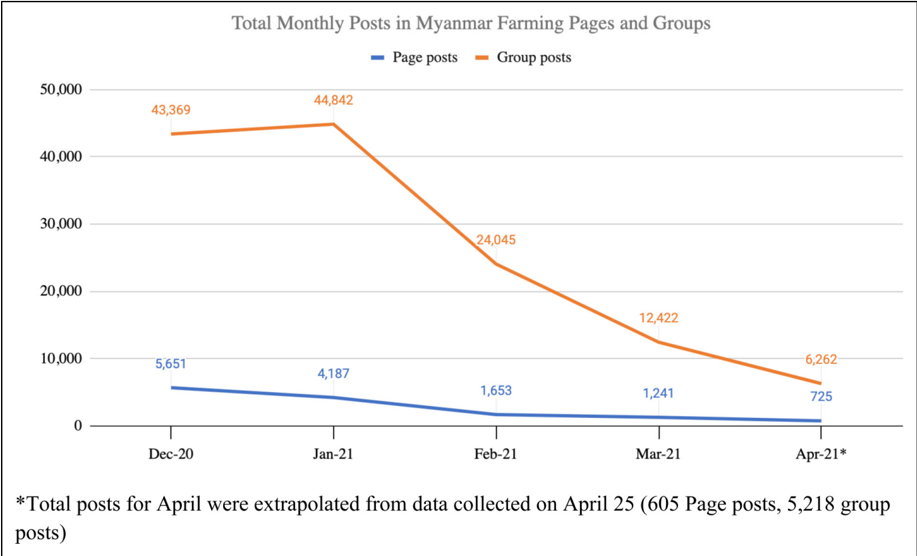
- In the weeks after the 2021 coup, online activity fell dramatically: by April 25, 2021, pages and groups had produced just 11% of the total January 2021 posts; inactive groups rose from 5% to 28% and inactive pages from 13% to 66% between January and April.
- Engagement also dropped steeply: by April 2021, a popular post had less than half the interactions it had in January, and the dataset overall had just 6% of the interactions compared to three months earlier.
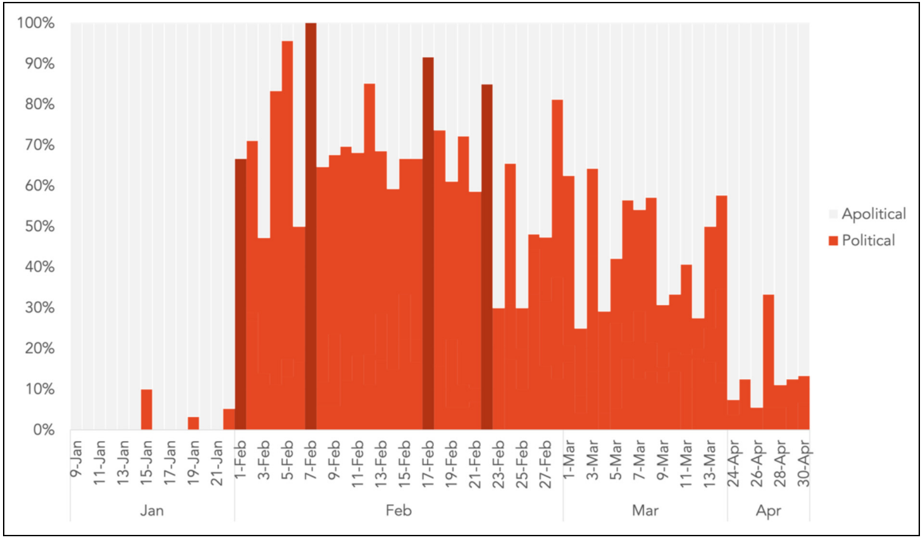
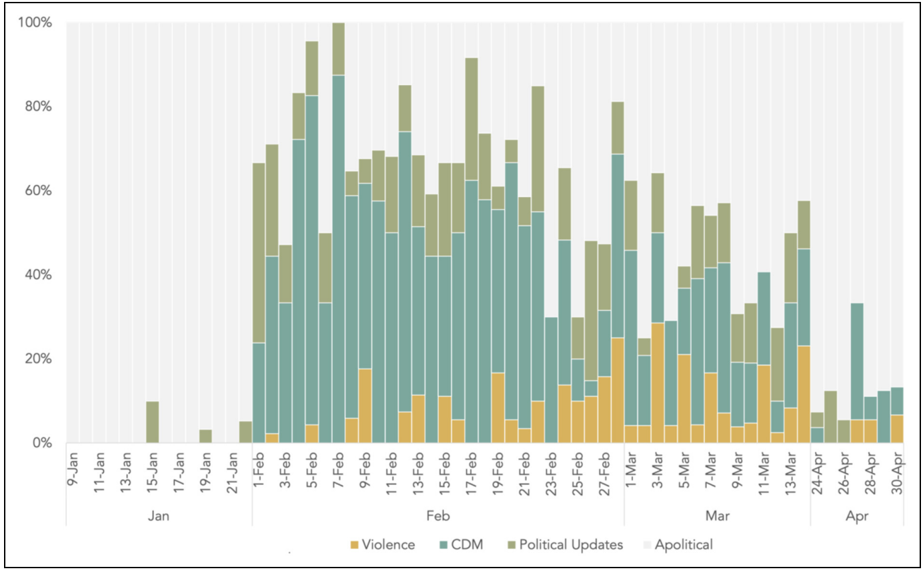
- Political content surged immediately after the coup: in January 2021 there was “almost no political content,” but on February 1 it surged; on February 7 (the first day of mass protests), 100% of viral content was political, and on February 22 (General Strike Day) more than two-thirds of viral posts were still political.
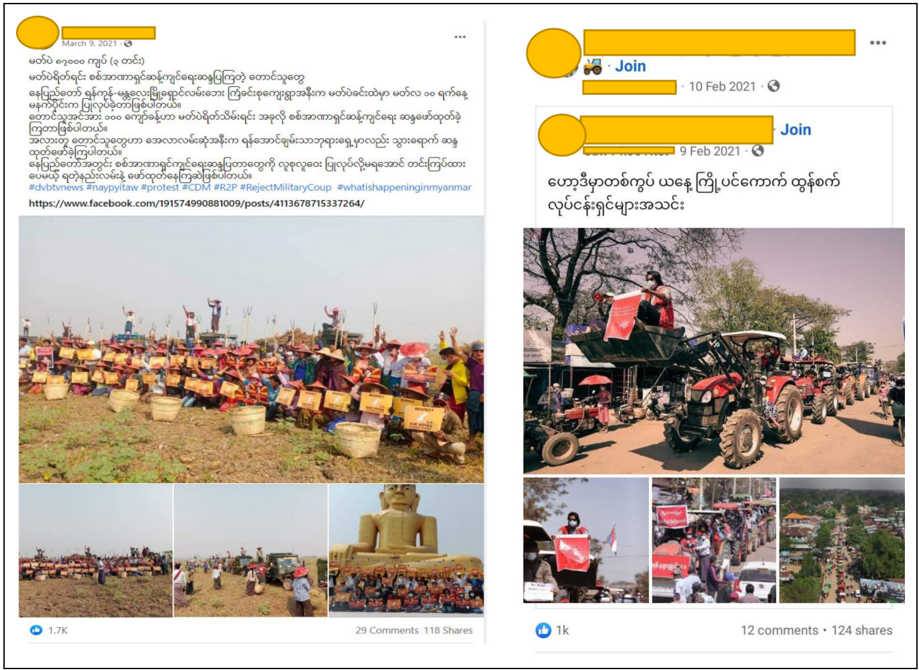
- The paper identifies specific agrarian forms of dissent, including calls to refuse repayment of seasonal crop loans; among the 26 groups that became more active after the coup, 81% posted about politics, compared with one-third of the 71 groups that became less active.
- The authors argue that farmers’ posts centered on material concerns such as commodity prices, food supply, agricultural markets, input costs, land grabs, border trade, and rural economy disruptions, showing that online politics in these spaces was grounded in “an agrarian vernacular.”
## Methods
- Mixed-methods design combining digital ethnography and computational analysis; the authors describe the study as integrating computational tools with the contextual depth of long-term ethnography.
- Data came from an original dataset of 2005 Facebook posts from 210 Myanmar Facebook pages and groups related to agriculture, gathered before and after the 2021 military coup.
- Data collection used CrowdTangle to identify and track public pages/groups and to collect monthly posts/interactions plus weekly top viral posts; analysis used an iterative, inductive qualitative coding process with a codebook of 40 nested codes.
## Limitations
- The paper states that CrowdTangle tracks only a subset of public data, has a bias toward large, U.S.-based accounts, and does not provide reach, so the study is not exhaustive.
- The authors state that Myanmar farmers’ Facebook is not representative of all Myanmar farmers or of national/regional online communities; they also note that they have no demographic data on post authors and that many active members were likely from dominant groups — this is the paper’s inference.
- The paper says many posts were removed after the coup, limiting the dataset; it also notes that the study would be impossible now because of rising data costs and the chilling of online dissent.
Model-written summary. Check it against the paper before relying on it.
Integrity signals
Registry
Cites
Statistics
Figures


Verification
Claims the paper makes
1 Valid · 4 Not valid · 11 Not checked · 103 Own results and interpretations
The cited sources support only part of this claim — read each source’s verdict below.
In the paper
“Yet while critical data studies has expanded its geographic focus, limited work to date has examined digital mobilization in the agrarian communities that comprise much of the Global South.”
- Also stated in: § Keywords · plain
“With a few exceptions (Roberts et al., 2017; Su et al., 2021), rural contexts have received limited treatment in critical data studies.”
What the sources say
- Partly supportedcites Roberts et al., 2017 matched to “Rural resilience in a digital society: Editorial” (2017) sourceExperimental — accuracy not yet measured
The Introduction notes an implicit urban bias in digital-technology discourse, which supports the broader point that rural settings receive less attention. It does not establish that little work has examined digital mobilization specifically in agrarian communities of the Global South; the discussion of future research in section 5 addresses rural digital inclusion more generally. (LLM, conf=0.78)
- Not matchedcites Su et al., 2021
This doesn’t read as a citation we can look up.
plain- Asserted: passes — The authors put it forward as true.
- Checkable: passes — It can be checked against evidence.
- Load-bearing: passes — The paper’s conclusions depend on it.
- Based: passes — The paper gives a reason why it holds.
- Also stated in: § Keywords · plain
A result the paper reports from its own data — it cites no other source for it, so there is none to check. The quote shows it is in the paper.
In the paper
“Analyzing an original archive of over 2000 Facebook posts collected from popular farming pages and groups, we fi nd a massive drop-off in online activity after the military coup and analyze the shifting temporalities of digital mobilization.”
plainstates a cause- Asserted: passes — The authors put it forward as true.
- Checkable: passes — It can be checked against evidence.
- Load-bearing: passes — The paper’s conclusions depend on it.
- Based: passes — The paper gives a reason why it holds.
- Rests on an assumption not shown here.
A result the paper reports from its own data — it cites no other source for it, so there is none to check. The quote shows it is in the paper.
In the paper
“The page went silent after the coup, with almost no posts, interactions, or new followers between February and April 2021.”
plainSingle case- Asserted: passes — The authors put it forward as true.
- Checkable: passes — It can be checked against evidence.
- Load-bearing: passes — The paper’s conclusions depend on it.
- Based: passes — The paper gives a reason why it holds.
A result the paper reports from its own data — it cites no other source for it, so there is none to check. The quote shows it is in the paper.
In the paper
“After the coup, content decreased dramatically: by April 25, 2021, pages and groups had produced just 11% of the total January 2021 posts (Figure 2).”
plain- Asserted: passes — The authors put it forward as true.
- Checkable: passes — It can be checked against evidence.
- Load-bearing: passes — The paper’s conclusions depend on it.
- Based: passes — The paper gives a reason why it holds.
A result the paper reports from its own data — it cites no other source for it, so there is none to check. The quote shows it is in the paper.
In the paper
“Overall, pages and groups in April 2021 had just 6% of interactions compared to three months earlier.”
plain- Asserted: passes — The authors put it forward as true.
- Checkable: passes — It can be checked against evidence.
- Load-bearing: passes — The paper’s conclusions depend on it.
- Based: passes — The paper gives a reason why it holds.
47 more claims
Create a free account to see all 119 claims and to verify the 2 references still open.
- It may state two separate claims as one. 45
- Probably not a substantial claim. 32
Citations
Cites
Weapons of the weak: Everyday forms of peasant resistance
(1986) · World Development · doi:10.1016/0305-750x(86)90141-5 · Cited by 9,842
Algorithms of Oppression: How Search Engines Reinforce Racism
Noble, S. U. (2020) · doi:10.2307/j.ctt1pwt9w5 · Cited by 2,709
Merz, S. (2020) · Ethnic and Racial Studies · doi:10.1080/01419870.2020.1715454 · Cited by 1,870
Social Media and the Decision to Participate in Political Protest: Observations From Tahrir Square
Tufekci, Z., & Wilson, C. (2012) · Journal of Communication · doi:10.1111/j.1460-2466.2012.01629.x · Cited by 1,532
Review of “Race After Technology: Abolitionist Tools for the New Jim Code”
Jipguep-Akhtar, M. (2020) · Social Forces · doi:10.1093/sf/soz162 · Cited by 1,473
Twitter and Tear Gas: The Power and Fragility of Networked Protest: Book Reviews
Sauter, M. (2017) · Journal of Communication · doi:10.1111/jcom.12331 · Cited by 1,341
States and Social Revolutions: A Comparative Analysis of France, Russia, and China
Skocpol, T. (2015) · Cambridge University Press eBooks · doi:10.1017/cbo9781316423998 · Cited by 1,177
BONILLA, Y., & ROSA, J. (2015) · American Ethnologist · doi:10.1111/amet.12112 · Cited by 1,116 · cited 2×
“Offline cultures matter for online movements (Bonilla and Rosa, 2015; Tufekci, 2017), as analog communication infrastructures (Elyachar, 2014), imperial and colonial power relations (Aouragh and Chakravartty, 2016), and intersectional inequalities (Benjamin, 2019; Elwood, 2020; Noble, 2018) shape…”
BackgroundA Networked self: identity, community, and culture on social network sites
(2011) · Choice Reviews Online · doi:10.5860/choice.48-3694 · Cited by 1,097
Disinformation as Political Communication
Freelon, D., & Wells, C. (2020) · Political Communication · doi:10.1080/10584609.2020.1723755 · Cited by 559
Twitter and Tear Gas. The Power and Fragility of Networked Protest
Tufekci, Z. (2017) · Yale University Press · doi:10.25969/mediarep/14848 · Cited by 527
The Social Media Basis of Youth Protest Behavior: The Case of Chile
Valenzuela, S., Arriagada, A., & Scherman, A. (2012) · Journal of Communication · doi:10.1111/j.1460-2466.2012.01635.x · Cited by 478
Emancipatory rural politics: confronting authoritarian populism
Scoones, I., Dzingirai, V., Anderson, N. E., MacLeod, E. T., Mangwanya, L., Matawa, F., Murwira, A., Nyakupinda, L., Shereni, W., & Welburn, S. C. (2017) · Human Ecology · doi:10.1007/s10745-017-9929-y · Cited by 453
Algorithms of Oppression: How Search Engines Reinforce Racism
Noble, S. U. (2020) · New York University Press eBooks · doi:10.18574/nyu/9781479833641.001.0001 · Cited by 416
Emancipatory rural politics: confronting authoritarian populism
Scoones, I., Edelman, M., Borras, S. M., Hall, R., Wolford, W., & White, B. (2021) · Authoritarian Populism and the Rural World · doi:10.4324/9781003162353-1 · Cited by 406
Why Does China Allow Freer Social Media? Protests versus Surveillance and Propaganda
Qin, B., Strömberg, D., & Wu, Y. (2017) · Journal of Economic Perspectives · doi:10.1257/jep.31.1.117 · Cited by 353
(2013) · Agriculture and Human Values · doi:10.1007/10460.1572-8366 · Cited by 304
Dimensions of Everyday Resistance: An Analytical Framework
Johansson, A., & Vinthagen, S. (2016) · Critical Sociology · doi:10.1177/0896920514524604 · Cited by 301
Harvard Kennedy School Misinformation Review
(2019) · doi:10.37016/mr-2020-000 · Cited by 282
Datta, A. (2018) · Transactions of the Institute of British Geographers · doi:10.1111/tran.12225 · Cited by 258 · cited 2×
“ship that challenges data universalism (Datta, 2018),”
BackgroundDigital geographies, feminist relationality, Black and queer code studies: Thriving otherwise
Elwood, S. (2021) · Progress in Human Geography · doi:10.1177/0309132519899733 · Cited by 225
More than a rural revolt: Landscapes of despair and the 2016 Presidential election
Monnat, S. M., & Brown, D. L. (2017) · Journal of Rural Studies · doi:10.1016/j.jrurstud.2017.08.010 · Cited by 219
World Social Report 2021: Reconsidering Rural Development
United Nations Department of Economic and Social Affairs (2021) · World social report · doi:10.18356/9789216040628 · Cited by 201
Black Trolls Matter: Racial and Ideological Asymmetries in Social Media Disinformation
Freelon, D., Bossetta, M., Wells, C., Lukito, J., Xia, Y., & Adams, K. (2022) · Social Science Computer Review · doi:10.1177/0894439320914853 · Cited by 190
Infrastructures of empire: towards a critical geopolitics of media and information studies
Aouragh, M., & Chakravartty, P. (2016) · Media, Culture & Society · doi:10.1177/0163443716643007 · Cited by 187
The rapid rise of agricultural mechanization in Myanmar
Belton, B., Win, M. T., Zhang, X., & Filipski, M. (2021) · Food Policy · doi:10.1016/j.foodpol.2021.102095 · Cited by 180
Glitch epistemologies for computational cities
Leszczynski, A., & Elwood, S. A. (2022) · Dialogues in Human Geography · doi:10.1177/20438206221075714 · Cited by 151
Digitally enabled affordances for community‐driven environmental movement in rural Malaysia
Tim, Y., Pan, S. L., Bahri, S., & Fauzi, A. (2018) · Information Systems Journal · doi:10.1111/isj.12140 · Cited by 133
How Dictators Control the Internet: A Review Essay
Keremoğlu, E., & Weidmann, N. B. (2020) · Comparative Political Studies · doi:10.1177/0010414020912278 · Cited by 131
Introduction: Towards an anthropology of data
Douglas‐Jones, R., Walford, A., & Seaver, N. (2021) · Journal of the Royal Anthropological Institute · doi:10.1111/1467-9655.13477 · Cited by 130
Rural resilience in a digital society: Editorial
Roberts, E., Beel, D., Philip, L., & Townsend, L. (2017) · Journal of Rural Studies · doi:10.1016/j.jrurstud.2017.06.010 · Cited by 127
Hashtag activism: social media and the #FreeYouth protests in Thailand
Sinpeng, A. (2021) · Critical Asian Studies · doi:10.1080/14672715.2021.1882866 · Cited by 121
Lee, F. L. F., Liang, H., Cheng, E. W., Tang, G. K. Y., & Yuen, S. (2021) · Information Communication & Society · doi:10.1080/1369118x.2021.1877772 · Cited by 117
Rural digital geographies and new landscapes of social resilience
Young, J. C. (2019) · Journal of Rural Studies · doi:10.1016/j.jrurstud.2019.07.001 · Cited by 110
Digital media, political authoritarianism, and Internet controls in Southeast Asia
Sinpeng, A. (2020) · Media, Culture & Society · doi:10.1177/0163443719884052 · Cited by 96
Upending Infrastructure: Tamarod , Resistance, and Agency after the January 25th Revolution in Egypt
Elyachar, J. (2014) · History and Anthropology · doi:10.1080/02757206.2014.930460 · Cited by 91
Tackling misinformation: What researchers could do with social media data
Pasquetto, I., Swire-Thompson, B., & Amazeen, M. A. (2020) · Harvard Kennedy School Misinformation Review · doi:10.37016/mr-2020-49 · Cited by 86
The Immaculate Conception of Data: Agribusiness, Activists, and Their Shared Politics of the Future
Bronson, K. (2022) · McGill-Queen's University Press eBooks · doi:10.1515/9780228012535 · Cited by 82
Poison If You Don’t Know How to Use It: Facebook, Democracy, and Human Rights in Myanmar
Whitten-Woodring, J., Kleinberg, M. S., Thawnghmung, A., & Thitsar, M. T. (2020) · The International Journal of Press/Politics · doi:10.1177/1940161220919666 · Cited by 77 · cited 1×
“Facebook became the central platform through which new users experienced digital life (McCarthy, 2017; The-Thitsar, 2021; Whitten-Woodring et al., 2020).”
Background(2022) · doi:10.7551/mitpress/14122.001.0001 · Cited by 73
Why Does China Allow Freer Social Media? Protests versus Surveillance and PropagandaPreprint
Qin, B., & Wu, Y. (2017) · SSRN Electronic Journal · doi:10.2139/ssrn.2910223 · Cited by 70
The problem of researching a recursive society: Algorithms, data coils and the looping of the social
Beer, D. (2022) · Big Data & Society · doi:10.1177/20539517221104997 · Cited by 67
Terror Capitalism: Uyghur Dispossession and Masculinity in a Chinese City
Byler, D. (2021) · Duke University Press eBooks · doi:10.1515/9781478022268 · Cited by 62
Racial formation, inequality and the political economy of web traffic
McIlwain, C. D. (2016) · Information Communication & Society · doi:10.1080/1369118x.2016.1206137 · Cited by 54
Routledge Handbook of Contemporary Myanmar
(2018) · doi:10.4324/9781315743677 · Cited by 49
Welcome to the Digital Village: Networking Geographies of Agrarian Change
Faxon, H. O. (2022) · Annals of the American Association of Geographers · doi:10.1080/24694452.2022.2044752 · Cited by 44 · cited 1×
“For Myanmar’s largely rural population, where over half the labor force works in agriculture (Central Statistical Organization, 2020), social media extended existing economic, social, and political activities into the digital domain (Faxon, 2022).”
BackgroundSelf-citationRestricting digital sites of dissent: commercial social media and free expression
Hintz, A. (2016) · Critical Discourse Studies · doi:10.1080/17405904.2016.1141695 · Cited by 43
Pretending to be States: The Use of Facebook by Armed Groups in Myanmar
Tønnesson, S., Oo, M. Z., & Aung, N. L. (2021) · Journal of Contemporary Asia · doi:10.1080/00472336.2021.1905865 · Cited by 41
Kermani, H., & Adham, M. (2021) · Big Data & Society · doi:10.1177/20539517211025568 · Cited by 35
Ethnographic data in the age of big data: How to compare and combine
Bjerre-Nielsen, A., & Glavind, K. L. (2022) · Big Data & Society · doi:10.1177/20539517211069893 · Cited by 32 · cited 1×
“Our study combined the scale of computational tools with the contextual depth of long-term ethnography (Bjerre-Nielsen and Glavind, 2022) to produce and analyze an original dataset of 2005 posts from Myanmar-language Facebook pages and groups related to farming.”
MethodMcCarthy, G. (2018) · Routledge eBooks · doi:10.4324/9781315743677-10 · Cited by 30
The cloud, the crowd, and the city: How new data practices reconfigure urban governance?
Ashton, P., Weber, R. N., & Zook, M. (2017) · Big Data & Society · doi:10.1177/2053951717706718 · Cited by 29
(2022) · doi:10.2307/j.ctv2t46r84.16 · Cited by 27
The Immaculate Conception of Data
(2022) · doi:10.2307/j.ctv307fhbd · Cited by 26
Jack, M., Chann, S., Jackson, S. J., & Dell, N. L. (2021) · Proceedings of the ACM on Human-Computer Interaction · doi:10.1145/3449124 · Cited by 26
Authoritarianism, populism, nationalism and resistance in the agrarian South
McKay, B. M., Oliveira, G. D. L. T., & Liu, J. (2020) · Canadian Journal of Development Studies/Revue canadienne d études du développement · doi:10.1080/02255189.2020.1814707 · Cited by 25
A view from anthropology: Should anthropologists fear the data machines?
Albris, K., Otto, E. I., Astrupgaard, S. L., Gregersen, E. M., Jørgensen, L. S., Jørgensen, O. N., Sandbye, C. R., & Schønning, S. H. (2021) · Big Data & Society · doi:10.1177/20539517211043655 · Cited by 23
Tacheva, Z. (2022) · Big Data & Society · doi:10.1177/20539517221112901 · Cited by 21
Democratic backsliding disrupted: The role of digitalized resistance in Myanmar
Ryan, M., & Tran, M. V. (2024) · Asian Journal of Comparative Politics · doi:10.1177/20578911221125511 · Cited by 21 · cited 1×
“Anti-coup forces used social media to discredit and denounce the SAC and mobilize resistance campaigns on the ground by encouraging and coordinating protests, CDM, and armed attacks (Ryan and Tran, 2022).”
BackgroundSelf-citationCritical geographies of smart development
Faxon, H. O., & Kintzi, K. (2022) · Transactions of the Institute of British Geographers · doi:10.1111/tran.12560 · Cited by 20
Self-citationIntroduction: Performing Rurality with Computing
Su, N. M., Hardÿ, J., Vigil-Hayes, M., Veinot, T. C., & Comber, R. (2021) · ACM Transactions on Computer-Human Interaction · doi:10.1145/3461832 · Cited by 17
Organizing an “organizationless” protest campaign in the WeChatsphere
Cao, H. (2022) · Big Data & Society · doi:10.1177/20539517221078823 · Cited by 11
Connected Countryside: The Inhibiting Effect of Social Media on Rural Social Movements
Schuler, P., & Truong, M. (2019) · Comparative politics · doi:10.5129/001041520x15743805571380 · Cited by 7
Rio, V. (2021) · Routledge eBooks · doi:10.4324/9781003087649-10 · Cited by 7
From glitch epistemologies to glitch politics
(2022) · doi:10.1177/20438206221102951 · Cited by 6
Empowering or endangering minorities? Facebook, language, and identity in Myanmar
The-Thitsar, M. (2022) · Asian Ethnicity · doi:10.1080/14631369.2021.1951596 · Cited by 6
How Generation Z Galvanized a Revolutionary Movement against Myanmar’s 2021 Military Coup
Jordt, I., Than, T., & Ye Lin, S. (2021) · How Generation Z Galvanized a Revolutionary Movement against Myanmar’s 2021 Military Coup · doi:10.1355/9789814951746-003 · Cited by 6
1. Introduction: Myanmar Media Historically and the Challenges of Transition
(2019) · Myanmar Media in Transition · doi:10.1355/9789814843409-003 · Cited by 4
From glitch epistemologies to glitch politics
Leon, L. F. A. (2022) · doi:10.31235/osf.io/ek4wq
Research works printed but not linked: 3
- Datta A (2018) The digital turn in postcolonial urbanism: smart citizenship in the making of India ' s 100 smart cities. Transactions of the Institute of British Geographers 43(3): 405 -419. della Porta D and Mattoni A (2014) Social networking sites in prodemocracy and anti-austerity protests: some thoughts from a social movement perspective. In: Social Media, Politics and the State: Protests, Revolutions, Riots, Crime and Policing in the Age of Facebook, Twitter and Youtube . New York: Routledge, 51 -76.
- Fanon F (1963) The Wretched of the Earth . New York: Grove Press. Faxon HO (2022) Welcome to the digital village: networking geographies of agrarian change. Annals of the American Association of Geographers 112(7): 2096 -2110.
- Tilly C (2015) Contentious Politics , 2nd ed. Fully revised and updated. New York, NY: Oxford University Press.
Cited by
Why Does China Allow Freer Social Media? Protests versus Surveillance and Propaganda
Qin, B., Strömberg, D., & Wu, Y. (2017) · Journal of Economic Perspectives · doi:10.1257/jep.31.1.117 · Cited by 353
Small farmers, big tech: agrarian commerce and knowledge on Myanmar Facebook
Faxon, H. O. (2023) · Agriculture and Human Values · doi:10.1007/s10460-023-10446-2 · Cited by 51
Self-citationFeminist political ecologies of agrarian technologies: knowing the digital differently
Nelson, I. L., Faxon, H. O., & Ehlers, M. (2024) · The Journal of Peasant Studies · doi:10.1080/03066150.2024.2308637 · Cited by 29
Self-citationStokke, K., & Kyaw, N. N. (2023) · Political Geography · doi:10.1016/j.polgeo.2023.103011 · Cited by 24
Fung, Z. (2024) · Australian Geographer · doi:10.1080/00049182.2024.2406059 · Cited by 10
Metadata
- Authors
- Faxon, H. O., Kintzi, K., Tran, V., Wine, K. Z., & Htut, S. Y.
- Affiliations
- University of Copenhagen (DK)
- Cornell University (US)
- Nordic Institute of Asian Studies and Department of Political Science, University of Copenhagen, Kobenhavn, Denmark
- Independent Scholar, Myanmar
- Stanford University (US)
- Corresponding author
- Faxon, Hilary Oliva
- Venue
- Big Data & Society
- Publisher
- SAGE Publications
- Published
- 2023-01
- Volume
- 10
- Issue
- 1
- ISSN
- 2053-9517 (ISSN-L)
- OpenAlex
- W4366121998
- Cited by
- 17
- References
- 60
- Citations by year
- 2026: 5 · 2025: 2 · 2024: 7 · 2023: 2
- FWCI
- 5.42
- Type
- journal article
- Language
- en
- Open access
- gold
- doi.org
- Locations
- Big Data & Society (publishedVersion, cc-by)
- Research at the University of Copenhagen (University of Copenhagen) (publishedVersion, cc-by)
- DOAJ (DOAJ: Directory of Open Access Journals) (submittedVersion, cc-by-sa)
- Funders
- H2020 Marie Skłodowska-Curie Actions (895909)
- Horizon 2020 Framework Programme (101079069)
- Facebook Research
- Topics
- Social Sciences › Communication › Social Media and Politics
- Social Sciences › Political Science and International Relations › Asian Geopolitics and Ethnography
- Physical Sciences › Computer Science › Information Systems › ICT in Developing Communities
- Keywords
- online mobilization, farmers, Facebook, 2021 Myanmar military coup, digital authoritarianism, agrarian communities, internet control, political crisis, Facebook posts, Global South, data practices
About these checks
Registry, retraction, Cites and statistics results are computed, not judged, with one exception: a printed reference that no index lists is read once by a model before it counts as a citation error. Claims are extracted by a model and kept only when their quote appears verbatim in the text; each cited source is then checked, with a model’s help, for whether it says what the claim relies on. Those verdicts can be wrong — read the claim’s quote and the cited source before relying on one.
The claim verdicts this report counts are experimental: their accuracy is not yet measured.
A language model drew the claims from the paper on 2026-10-11, under version 3 of the claim definition (model deepseek-v4.1-flash, prompt extract-v3).
A second model labelled each claim on 2026-10-11 (model jev-1.13-20260917, definition revision gold-guideline-v0.2).
Cited sources are checked with a language model’s help (gpt-6-sol).
Statistics and arithmetic are recomputed, not judged.
Confidence bands are shown only for fields calibrated on our annotated test set. None is calibrated yet, so no band is shown.
What counts as a claim ›How we measure confidence ›How we check this ›
Are you an author, or do you see a problem with this page? Request a review
Data sources
Bibliographic data: Semantic Scholar, OpenAlex, Crossref.
Contains information from the Semantic Scholar Academic Graph Datasets, made available under the ODC Attribution License (ODC-BY 1.0).
Semantic Scholar’s data is described in: Kinney, R., et al. (2023). The Semantic Scholar Open Data Platform. arXiv:2301.10140.
